AI Summary Powered by PixelBrainy
Healthcare organizations are under constant pressure to improve efficiency without compromising patient safety, and this is where AI begins to transform clinical operations. An AI clinical workflow PoC is often the first critical step that determines whether innovation will succeed or fail in real clinical environments. Hospitals, digital health startups, and healthcare technology leaders are increasingly exploring clinical workflow automation software PoC development to validate ideas before committing to large investments.
For decision makers such as CIOs, CMIOs, healthcare product managers, and clinical innovation teams, understanding PoC development for AI Clinical Workflow System is essential. Unlike traditional software, AI driven clinical systems interact with sensitive patient data, clinician decision making, and regulated workflows. Knowing how to make PoC for AI Clinical Workflow Software allows organizations to reduce risk, validate feasibility, and gain clinician trust early.
Developing an AI Clinical Workflow Software PoC helps businesses test assumptions, assess integration with EHR systems, and evaluate whether AI can genuinely improve care delivery. This guide is designed for healthcare enterprises, digital health startups, and innovation leaders who want a structured, compliant, and outcome driven approach to PoC development. It explains what a PoC is, why it matters, how to build it step by step, and how to move confidently from concept to production.
An AI Clinical Workflow Software Proof of Concept is a limited scope implementation designed to validate whether an AI solution can solve a specific clinical workflow problem. It is not a full product and not a market ready system. Instead, it focuses on demonstrating feasibility, safety, usability, and technical viability within a controlled environment.
In healthcare, a PoC may involve automating patient triage, improving clinical documentation, optimizing care coordination, or supporting clinical decision making. The goal is to prove that AI can integrate into existing workflows without disrupting care delivery or increasing risk.
A PoC typically includes a small dataset, a basic AI model or rules engine, minimal user interfaces, and controlled integrations. It allows stakeholders to evaluate whether the solution is worth scaling into a pilot or production system.
Building a Proof of Concept is a critical step for businesses looking to introduce AI into clinical workflows. Healthcare environments are complex, highly regulated, and deeply connected to patient safety. Deploying AI solutions without early validation can lead to high financial losses, low clinician adoption, and unintended risks. A PoC allows organizations to test feasibility in a controlled setting before committing to full scale development.
One of the primary reasons to build a PoC is to validate clinical relevance. Not every operational challenge in healthcare requires AI, and not every AI model improves outcomes in practice. A PoC helps determine whether the proposed solution genuinely improves efficiency, reduces administrative burden, or supports better clinical decision making. Research published by the National Institutes of Health on AI adoption across U.S. health systems highlights that while many organizations are experimenting with AI, successful adoption varies widely and depends heavily on structured evaluation and early testing within real clinical workflows.
A PoC also enables organizations to assess data quality and availability, which is a frequent barrier in healthcare AI projects. Clinical data is often fragmented across electronic health records, laboratory systems, imaging platforms, and clinician notes. By working with real or representative datasets during the PoC phase, businesses can identify data gaps, inconsistencies, and bias issues that could compromise AI performance in production.
Another major benefit of building a PoC is the ability to identify integration challenges with EHR systems early. Clinical workflow software must integrate seamlessly with existing hospital infrastructure. Industry research published on ScienceDirect that examines barriers to AI integration in healthcare workflows shows that interoperability and workflow alignment are among the most common reasons AI initiatives struggle in real clinical environments.
Testing clinician adoption and usability is equally important. Even technically accurate AI systems fail if clinicians do not trust them or find them disruptive. A PoC allows healthcare professionals to interact with the system, provide feedback, and influence design decisions. This early involvement increases trust, improves usability, and significantly raises the likelihood of adoption during later stages.
Finally, a PoC plays a key role in reducing compliance and safety risks. Healthcare AI systems must meet strict privacy, security, and ethical standards from the outset. Early PoC development allows organizations to validate data handling practices, access controls, and clinical safety boundaries before the system interacts with live patient care.
For startups, a well-executed PoC strengthens investor confidence and accelerates partnerships with hospitals and health systems. For established healthcare enterprises, it supports responsible innovation, protects organizational reputation, and ensures that AI driven clinical workflow automation delivers measurable and safe value.
Also Read: Top AI Healthcare Software Development Companies in USA
Deciding when to invest in a Proof of Concept is just as important as knowing how to build one. In healthcare, timing a PoC correctly can prevent operational disruptions, reduce compliance risks, and ensure AI solutions align with real clinical needs. Organizations exploring PoC development for AI Clinical Workflow Systems should view a PoC as a strategic checkpoint rather than an optional experiment.
Below are the key scenarios where building an AI clinical workflow PoC becomes essential.
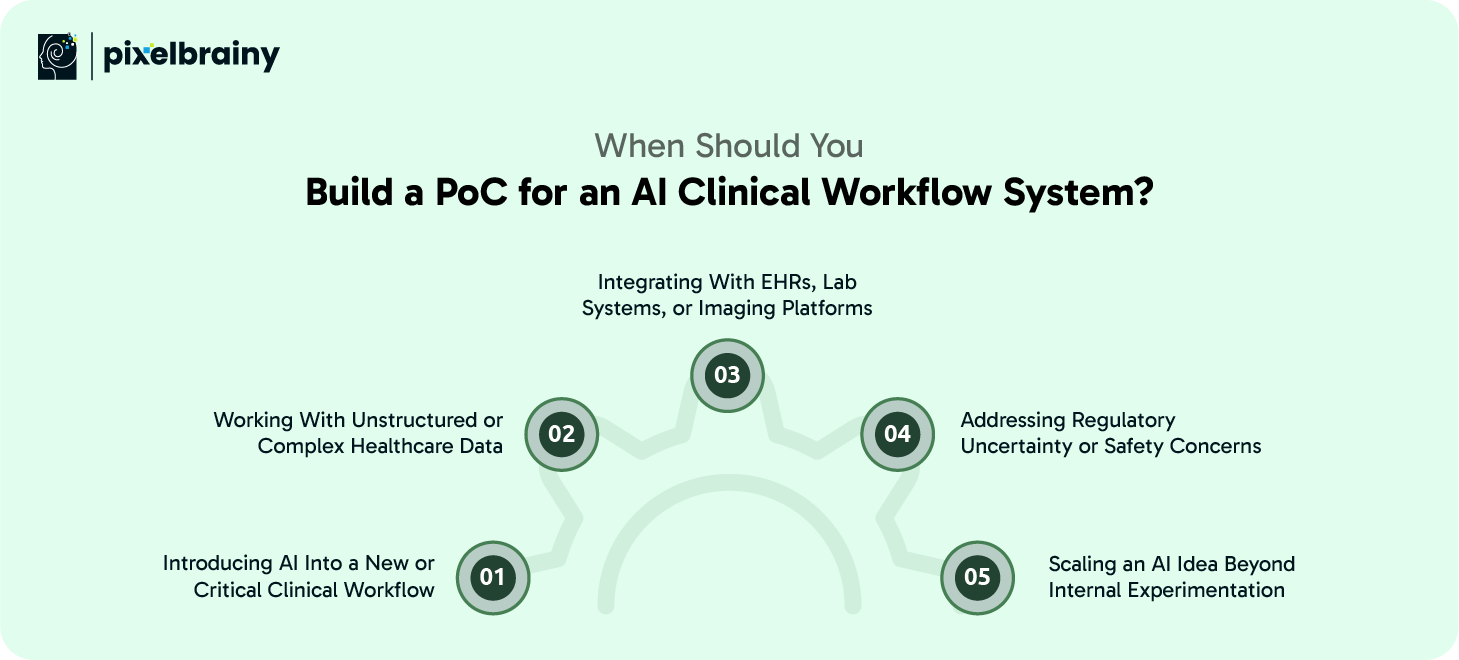
A PoC should be built whenever AI is introduced into a workflow that is new, high impact, or closely tied to patient care. Clinical workflows such as triage, diagnostics, care coordination, or discharge planning involve complex decision making and tight timelines. Implementing AI without validation can disrupt clinician routines and introduce safety risks.
A PoC allows organizations to observe how the AI system fits into existing workflows, identify bottlenecks, and validate whether it truly improves efficiency or care quality. For AI clinical workflow PoC development, early testing ensures that automation supports clinicians rather than adding friction.
Healthcare data is rarely clean or standardized. Clinical notes, imaging reports, lab results, and patient histories are often unstructured and vary widely across systems. When developing an AI Clinical Workflow Software PoC, organizations must evaluate whether available data is suitable for AI processing.
A PoC helps determine if natural language processing, machine learning, or generative AI models can reliably extract insights from real world data. It also exposes issues such as missing data, bias, and inconsistency that could impact accuracy in production environments.
Integration complexity is one of the most common reasons AI clinical workflow initiatives fail. Electronic Health Records, laboratory information systems, and imaging platforms often use different standards and interfaces. A PoC allows teams to test interoperability, data exchange, and workflow synchronization before scaling.
For clinical workflow automation software PoC development, this step is critical to ensure that AI outputs are delivered at the right time and place within clinician workflows without disrupting existing systems.
AI systems that influence clinical decisions must comply with strict regulatory and ethical standards. When there is uncertainty around data privacy, model explainability, or clinical accountability, a PoC provides a controlled environment to validate compliance requirements.
During PoC development for AI Clinical Workflow Systems, organizations can test security controls, audit trails, and decision boundaries to ensure patient safety and regulatory alignment before broader deployment.
Many healthcare organizations start with internal prototypes or small scale experiments. However, scaling these ideas into real clinical settings requires more than technical success. A PoC bridges the gap between experimentation and operational deployment.
It helps validate performance under realistic conditions, measure clinician adoption, and assess infrastructure readiness. When learning how to make PoC for AI Clinical Workflow Software, this stage ensures that the solution is scalable, sustainable, and ready for pilot or production use.
If an AI system directly affects clinical decisions, clinician efficiency, or patient outcomes, a PoC is not optional. It is a necessary step to ensure safe, effective, and responsible adoption of AI in clinical workflows.
Also Read: AI Workflow Automation System Development: Architecture, Tools & Best Practices
Developing a Proof of Concept for an AI clinical workflow system is not just a technical exercise. It requires navigating data, people, processes, and regulatory realities unique to healthcare. Identifying challenges early and addressing them proactively is essential for successful AI clinical workflow PoC development and for ensuring the solution can progress beyond experimentation.
Below are the most common challenges faced during PoC development for AI Clinical Workflow Systems, along with practical solutions to overcome them.
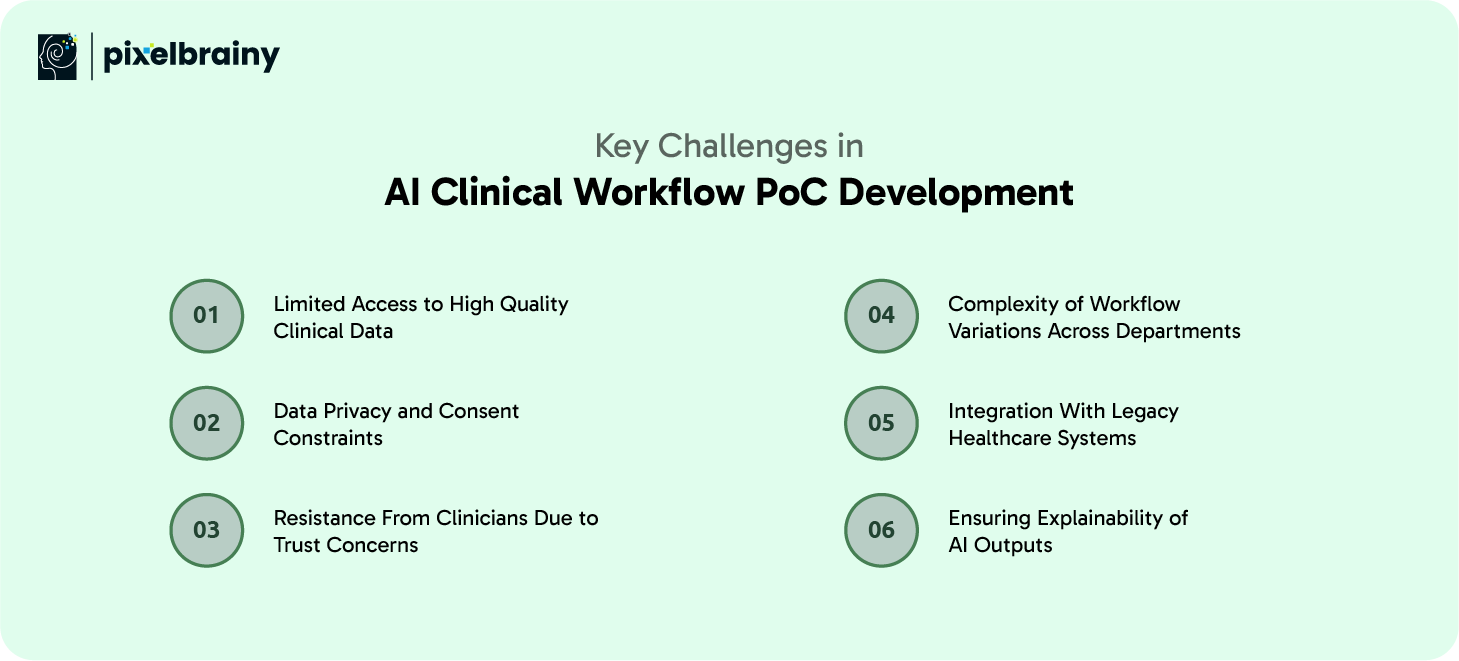
Challenge: AI models rely on accurate, representative, and sufficient data. In many healthcare organizations, clinical data is fragmented across multiple systems, inconsistently documented, or incomplete. This limits the ability to train or validate AI models during the PoC phase and can result in unreliable outputs.
Solution: Start with a focused use case that requires a manageable dataset. Use historical or de- identified data where possible. During developing an AI Clinical Workflow Software PoC, conduct a data readiness assessment to evaluate completeness, consistency, and relevance. Collaborating with data governance teams early helps ensure realistic expectations and avoids rework later.
Challenge: Healthcare data is highly sensitive and subject to strict privacy regulations. Accessing patient data for AI experimentation often requires approvals, consent management, and security controls. These constraints can slow down PoC timelines or limit data availability.
Solution: Design the PoC with privacy by design principles. Use anonymized or synthetic datasets whenever feasible. Implement role-based access controls and audit logging from the beginning. For clinical workflow automation software PoC development, involving compliance and legal teams early helps ensure that data usage aligns with regulatory requirements and organizational policies.
Challenge: Clinicians may be skeptical of AI tools, especially if they are perceived as black boxes or as replacements for clinical judgment. Lack of trust can lead to poor engagement and ineffective PoC outcomes.
Solution: Engage clinicians as partners, not end users. Involve them in defining the problem, reviewing outputs, and testing workflows. Clearly communicate that the AI system supports decision making rather than replacing it. During AI clinical workflow PoC development, early clinician involvement builds trust, improves usability, and increases adoption likelihood.
Challenge: Clinical workflows differ significantly between departments, specialties, and even individual clinicians. A solution that works well in one setting may fail in another, making it difficult to design a one size fits all PoC.
Solution: Limit the PoC scope to a single department or well-defined workflow. Document existing processes thoroughly and identify variations. This approach allows teams to validate core functionality before expanding. When learning how to make PoC for AI Clinical Workflow Software, starting small ensures clearer insights and more actionable results.
Challenge: Many healthcare organizations rely on legacy systems that were not designed for modern AI integrations. Limited APIs, outdated data formats, and rigid workflows can create significant technical barriers during PoC development.
Solution: Adopt a modular and integration friendly architecture. Use industry standards such as FHIR and HL7 where possible. For PoC development for AI Clinical Workflow Systems, testing integrations in a sandbox environment helps uncover constraints early and informs realistic scaling plans.
Challenge: AI systems that influence clinical workflows must be transparent and interpretable. Black box models can raise concerns around safety, accountability, and regulatory compliance, especially during clinical decision support.
Solution: Choose AI models that prioritize explainability over complexity. Provide clear reasoning, confidence scores, and audit trails for AI outputs. During developing an AI Clinical Workflow Software PoC, explainability should be treated as a core requirement rather than an afterthought.
Addressing these challenges early in the PoC phase increases the likelihood that an AI clinical workflow solution will be safe, trusted, and ready for real world deployment.
A structured and methodical approach is essential when undertaking PoC development for AI Clinical Workflow Software. Unlike general software proofs of concept, healthcare PoCs must balance technical feasibility with clinical safety, regulatory alignment, and real-world usability.
The following step-by-step process outlines how organizations can successfully execute an AI clinical workflow PoC that delivers meaningful insights and sets the foundation for scalable deployment.
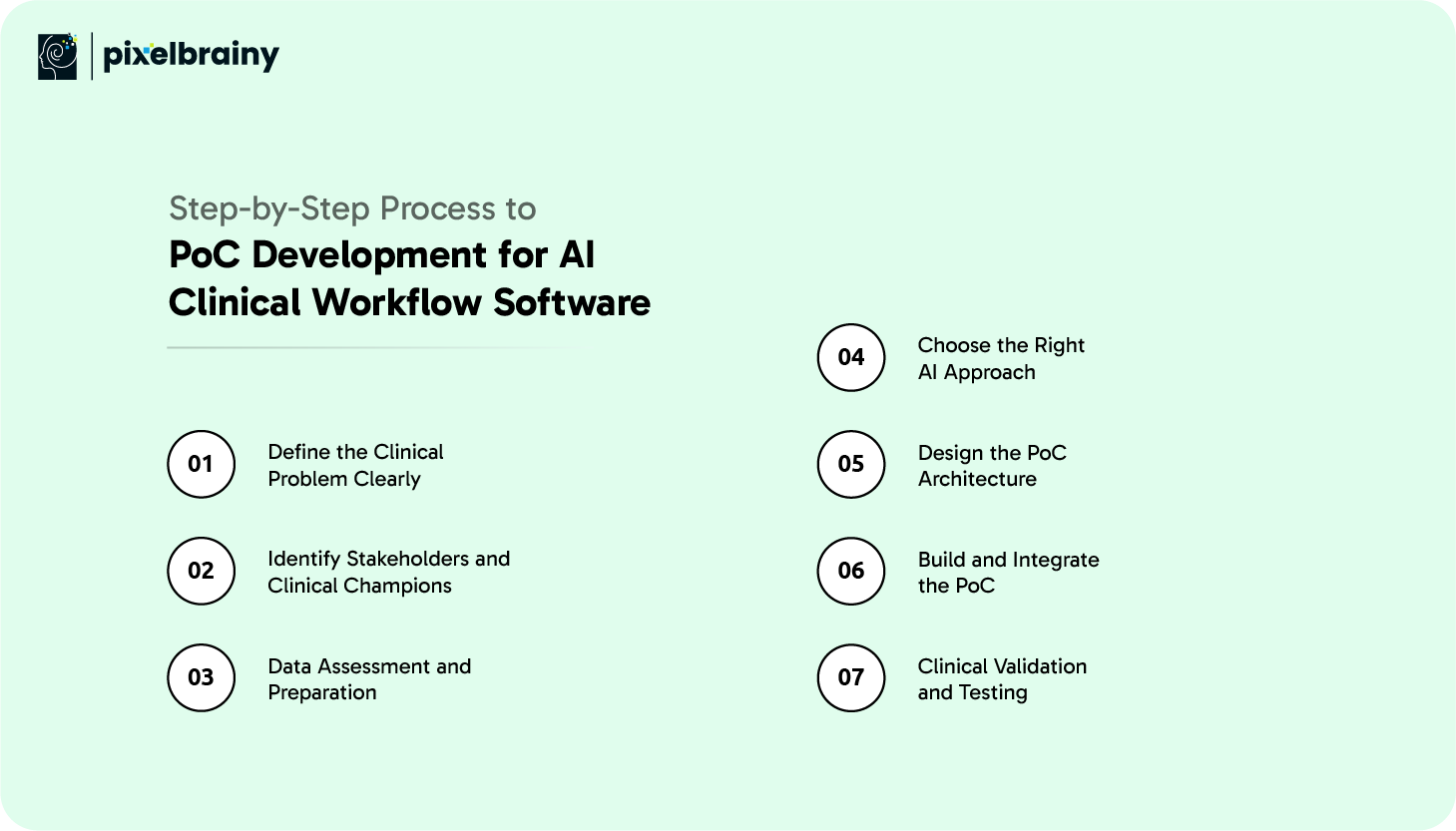
The success of AI clinical workflow PoC development begins with a clear understanding of the clinical problem. Organizations should focus on specific workflow inefficiencies such as excessive documentation time, delayed patient triage, or fragmented care coordination. The goal is to define the problem in clinical terms rather than technical ones.
Establish measurable objectives such as time saved per clinician, reduction in manual tasks, or improvement in turnaround times. When developing an AI Clinical Workflow Software PoC, clarity at this stage prevents scope creep and ensures the AI solution addresses real operational needs.
Additional considerations:
Clinical workflows involve multiple stakeholders including clinicians, nurses, administrators, IT teams, and compliance officers. Identifying and engaging these stakeholders early is critical to PoC success.
Clinical champions play a particularly important role by advocating for the PoC, validating clinical relevance, and encouraging adoption among peers. For PoC development for AI Clinical Workflow Systems, stakeholder alignment ensures the solution fits within existing processes and receives meaningful feedback throughout development.
Additional considerations:
Data is the foundation of any AI system. During this phase, teams assess the availability, quality, and relevance of clinical data sources such as EHRs, lab results, clinical notes, and imaging data.
Data preparation includes cleaning, normalization, labeling, and de identification. In clinical workflow automation software PoC development, understanding data limitations early helps determine whether AI can deliver reliable results and informs model selection and architecture design.
Additional considerations:
Selecting the appropriate AI approach is a critical decision in PoC development for AI Clinical Workflow Software. Depending on the use case, this may involve rule based systems, machine learning models, natural language processing, or generative AI.
Factors such as explainability, data availability, and regulatory requirements should guide this choice. In healthcare, simpler and more interpretable models often provide greater value during a PoC than complex black box solutions.
Additional considerations:
The PoC architecture should be lightweight, secure, and modular. It must support data ingestion, AI processing, integration with existing systems, and user interaction.
Security controls and access management should be included from the start. For AI clinical workflow PoC development, designing an architecture that mirrors future production needs while remaining flexible allows organizations to scale smoothly if the PoC is successful.
Additional considerations:
Once the architecture is defined, development begins. This phase focuses on implementing core functionality rather than building a complete product.
Integration should be limited to essential systems such as EHRs or workflow management tools. In developing an AI Clinical Workflow Software PoC, using sandbox environments and iterative development cycles enables rapid testing and refinement without disrupting live clinical operations.
Additional considerations:
Clinical validation is the most critical phase of the PoC process. The system is tested with real users to evaluate accuracy, usability, workflow alignment, and safety.
Feedback from clinicians is used to refine outputs and interfaces. Performance metrics are measured against predefined success criteria. For AI clinical workflow PoC development, this step determines whether the solution is ready to advance to pilot or production stages.
Additional considerations include:
By following this structured approach, organizations can ensure that PoC development for AI Clinical Workflow Software remains focused, compliant, and aligned with real clinical and operational outcomes.
Also Read: AI Medical Claims Processing Automation Software Development: Architecture, Tech Stack & Use Cases
Understanding what is the cost to make AI Clinical Workflow Software PoC is a key concern for healthcare organizations, digital health startups, and enterprise decision makers. A Proof of Concept is designed to validate feasibility rather than deliver a full scale product, which helps keep costs controlled. However, the AI Clinical Workflow Software PoC development cost can still vary significantly based on scope, data readiness, and technical complexity.
On average, the cost of building an AI Clinical Workflow System PoC falls in the range of $10,000 to $50,000+. Simple PoCs that focus on a single workflow with limited data sources tend to be more affordable, while PoCs involving complex integrations, advanced AI models, or compliance requirements may require a higher development budget of AI Clinical Workflow Software PoC.
To improve clarity, the table below outlines the major cost components and how they influence overall PoC pricing.
| Cost Factor | Description | Impact on PoC Cost | Estimated Cost Range |
| Clinical workflow complexity | Number of workflow steps, clinical decision points, and departments involved | More complexity requires more design and validation effort | $2,000 to $8,000 |
| Data availability and quality | Data cleaning, normalization, labeling, and preparation effort | Poor quality data increases preparation time | $2,000 to $10,000 |
| AI approach selection | Rule based logic, ML models, NLP, or generative AI | Advanced AI increases development and compute cost | $3,000 to $12,000 |
| Integration requirements | Connectivity with EHRs, lab systems, or imaging platforms | Integration testing adds engineering effort | $2,000 to $10,000 |
| Security and compliance setup | Access control, data protection, and audit logging | Required for healthcare safety and compliance | $1,000 to $5,000 |
| User interface and usability testing | Clinician dashboards and workflow interfaces | Improves adoption and usability insights | $1,000 to $4,000 |
| Validation and testing effort | Clinical testing, feedback cycles, and performance review | Ensures reliable PoC outcomes | $2,000 to $6,000 |
The AI Clinical Workflow Software PoC development cost increases when multiple integrations, complex workflows, or advanced AI techniques are required. Conversely, organizations with well-structured data and a narrowly defined use case can keep PoC costs closer to the lower end of the range.
By clearly defining objectives, limiting scope, and focusing on a single clinical workflow, businesses can control the cost of building an AI Clinical Workflow System PoC while still gaining valuable technical and clinical insights.
Measuring success is a critical part of AI clinical workflow PoC development. Unlike traditional software projects, success in a clinical PoC is not defined solely by technical performance. Healthcare organizations must evaluate whether the PoC delivers real workflow improvements, supports clinicians effectively, and meets safety and compliance expectations.
Below are the key metrics that should be used to assess the success of an AI Clinical Workflow Software PoC.
One of the most important success indicators is whether the PoC improves clinical efficiency. This includes measurable reductions in time spent on specific tasks, faster patient throughput, or improved turnaround times for clinical processes.
For PoC development for AI Clinical Workflow Systems, efficiency gains demonstrate that AI is adding operational value rather than increasing complexity.
A successful PoC should reduce repetitive and manual work such as data entry, documentation, or information retrieval. Measuring how many steps are automated or simplified provides clear evidence of workflow optimization.
In clinical workflow automation software PoC development, this metric directly reflects the ability of AI to relieve clinician workload and reduce burnout.
Accuracy remains an important metric, but it must be evaluated in real clinical contexts. Reliability includes consistency of outputs, handling of edge cases, and stability over time.
During AI Clinical Workflow Software PoC testing, accuracy should be measured alongside error rates and confidence levels to ensure safe clinical use.
Clinician feedback is essential for determining PoC success. High satisfaction scores, positive usability feedback, and willingness to use the system regularly indicate strong adoption potential.
For developing an AI Clinical Workflow Software PoC, clinician acceptance often determines whether the solution progresses to pilot or production stages.
Clinical workflows are time sensitive, so system responsiveness matters. Performance metrics such as processing time, response latency, and system availability should be closely monitored.
In PoC development for AI Clinical Workflow Software, slow or inconsistent performance can undermine trust even if the AI is accurate.
A successful PoC must demonstrate that data handling, access controls, and decision support boundaries align with regulatory requirements. Audit readiness includes proper logging, traceability, and security controls.
For AI clinical workflow PoC development, compliance validation is critical for scaling beyond the PoC phase.
Accuracy alone is not enough to define success. The true measure of an AI Clinical Workflow Software PoC lies in its ability to improve workflows, support clinicians, and operate safely within real healthcare environments.
Regulatory and ethical compliance must be embedded into the PoC from the very beginning. Even though a Proof of Concept is limited in scope, it still operates within regulated healthcare environments and may involve sensitive clinical data or influence care delivery. Ignoring compliance during AI Clinical Workflow Software PoC development can delay scaling, increase legal risk, and erode clinician trust.
Below is a structured overview of the key compliance areas that must be addressed during PoC development.
| Compliance Area | What It Requires During PoC | Why It Matters |
| HIPAA and patient data privacy | Secure data storage, controlled access, encrypted transmission, audit logs | Protects patient information and prevents legal exposure |
| GDPR compliance where applicable | Lawful data processing, purpose limitation, defined retention policies | Ensures compliance for EU based patients and organizations |
| FDA considerations for software as a medical device | Clear definition of intended use, documentation of AI behavior, performance validation | Prepares the PoC for future regulatory review and scaling |
| Ethical AI and bias mitigation | Evaluation of training data, monitoring for bias, fairness checks | Prevents unequal treatment and unsafe clinical recommendations |
| Accountability for clinical decisions | Clear definition of clinician oversight and AI decision boundaries | Ensures AI supports care rather than replaces clinical judgment |
Even in early experimentation, AI systems can influence workflows, decision making, and clinician behavior. For PoC development for AI Clinical Workflow Systems, incorporating compliance early helps organizations identify risks before patient impact occurs. It also reduces the need for costly redesigns during pilot or production phases.
Healthcare leaders and compliance teams should be involved during PoC planning to ensure regulatory alignment. Ethical safeguards, transparency, and accountability should be treated as core requirements rather than future enhancements.
Compliance is not a milestone that comes after validation. In healthcare AI, it is a continuous responsibility that begins with the PoC and extends throughout the system lifecycle. Addressing regulatory, ethical, and compliance considerations early ensures that the AI clinical workflow solution is safe, trustworthy, and ready for real world deployment.
Completing a Proof of Concept is an important milestone, but it is only the beginning of the AI clinical workflow journey. To realize real value, organizations must carefully plan the transition from PoC to pilot and eventually to production. Each stage requires clear decision making, operational readiness, and a focus on long term sustainability for AI clinical workflow systems.
After the PoC is complete, organizations should conduct a structured evaluation to determine whether the solution is ready to advance. This includes reviewing clinical impact, workflow improvements, technical stability, and compliance readiness.
For PoC development for AI Clinical Workflow Software, success should be measured against predefined goals rather than theoretical potential. If the PoC demonstrates measurable efficiency gains, clinician acceptance, and safe operation, it can move forward to a pilot phase.
Scaling an AI clinical workflow solution involves more than increasing user numbers. Data volume, system performance, and workflow complexity grow significantly in pilot and production environments.
During this stage, organizations must assess whether the AI model, data pipelines, and integrations can handle increased demand. In AI Clinical Workflow Software development, planning for scalability ensures consistent performance across departments and facilities.
Introducing AI into clinical workflows requires careful change management. Clinicians and staff must be trained, workflows adjusted, and expectations clearly communicated. Resistance often arises when changes feel imposed or poorly explained.
For AI clinical workflow system adoption, engaging users early, providing training, and addressing concerns openly are critical for sustained success.
A PoC typically runs in a lightweight environment, but production systems require robust infrastructure. This includes enhanced security, redundancy, monitoring, and disaster recovery capabilities.
For AI Clinical Workflow Software production deployment, infrastructure hardening ensures reliability, protects patient data, and supports continuous operation in clinical settings.
Once in production, AI systems must be continuously monitored to ensure ongoing accuracy, fairness, and performance. Clinical workflows evolve, data distributions change, and new risks may emerge.
Continuous monitoring allows organizations to detect model drift, performance degradation, and compliance issues early. In AI clinical workflow system lifecycle management, ongoing oversight is essential for maintaining trust and safety.
Moving from PoC to pilot to production requires disciplined execution and strategic planning. By addressing these key areas, healthcare organizations can successfully transform validated AI concepts into scalable, reliable, and clinically impactful solutions.
Choosing the right technology partner is a critical factor in the success of AI Clinical Workflow Software PoC development. PixelBrainy brings a healthcare focused, outcome driven approach to building PoCs that are not only technically sound but also clinically relevant, compliant, and scalable. With deep experience in PoC development for AI Clinical Workflow Systems, PixelBrainy helps organizations move confidently from idea validation to real world deployment.
PixelBrainy operates as a specialized AI development company with strong expertise in healthcare workflows, clinical data handling, and regulated software environments. The team understands that developing an AI clinical workflow PoC is not about building a demo. It is about validating safety, usability, and operational impact within real clinical constraints.
One of PixelBrainy’s key strengths lies in AI integration with existing healthcare systems. The team has hands-on experience working with EHR platforms, clinical data pipelines, and workflow tools, ensuring that PoCs align with how clinicians actually work. This reduces friction during validation and accelerates the transition from PoC to pilot.
PixelBrainy recently delivered an AI clinical workflow PoC for a US based healthcare provider focused on automating clinical documentation and care coordination workflows. The objective was to reduce clinician time spent on manual documentation while maintaining compliance with HIPAA requirements.
The PoC involved:
The outcome of the project included measurable reductions in documentation time, positive clinician feedback on usability, and a clear roadmap for scaling into a pilot phase across additional departments. This project demonstrated PixelBrainy’s ability to deliver AI clinical workflow PoCs that balance efficiency, compliance, and clinician trust in the US healthcare landscape.
Organizations choose PixelBrainy for developing an AI Clinical Workflow Software PoC because of:
By combining technical expertise with healthcare domain knowledge, PixelBrainy enables businesses to validate AI driven clinical workflow automation with confidence. The result is a PoC that delivers actionable insights, reduces risk, and lays a strong foundation for scalable AI adoption.

Building an AI clinical workflow system without proper validation can introduce unnecessary risk in healthcare environments where safety, compliance, and clinician trust are critical. A well-structured Proof of Concept enables organizations to test feasibility, validate clinical value, and identify technical or regulatory challenges early. By focusing on real workflow problems, engaging clinicians, and measuring meaningful outcomes, businesses can ensure their AI initiatives deliver practical and sustainable value.
From defining the right use case to navigating data readiness, compliance, and system scalability, PoC development provides a clear and responsible path forward. It allows healthcare organizations and digital health innovators to move beyond assumptions and make evidence-based decisions with confidence.
With the right strategy and execution, an AI clinical workflow PoC becomes the foundation for successful pilot and production deployment.
Ready to validate your AI clinical workflow idea? Book an appointment with our experts to get started.
The timeline for developing an AI clinical workflow PoC usually ranges from four to eight weeks. The duration depends on the complexity of the workflow, availability of clinical data, and the level of system integration required. Clearly defined objectives and limited scope help keep timelines predictable.
Yes, many PoCs are developed using deidentified, historical, or synthetic datasets. This approach allows teams to validate technical feasibility and workflow fit while minimizing privacy and compliance risks during early experimentation.
Workflows that are repetitive, time consuming, or data heavy are ideal candidates. Examples include clinical documentation, patient intake, care coordination, and administrative task automation. These workflows often show measurable efficiency gains during PoC evaluation.
A successful PoC review typically involves clinicians, IT leaders, compliance officers, and operational stakeholders. Including cross functional perspectives ensures the solution is clinically relevant, technically feasible, and compliant with healthcare regulations.
A PoC does not guarantee regulatory approval, but it helps identify regulatory requirements early. Designing the PoC with compliance and documentation in mind significantly reduces barriers when moving toward pilot or production stages.
The decision is based on predefined success metrics such as workflow efficiency improvements, clinician adoption, system reliability, and compliance readiness. If these criteria are met, the organization can confidently progress to a pilot phase.

About The Author
Sagar Bhatnagar
Sagar Sahay Bhatnagar brings over a decade of IT industry experience to his role as Marketing Head at PixelBrainy. He's known for his knack in devising creative marketing strategies that boost brand visibility and market influence. Sagar's strategic thinking, coupled with his innovative vision and focus on results, sets him apart. His track record of successful campaigns proves his ability to utilize digital platforms effectively for impactful marketing efforts. With a genuine passion for both technology and marketing, Sagar continuously pushes PixelBrainy's marketing initiatives to greater success.

Working with the PixelBrainy team has been a highly positive experience. They understand the design requirements and create beautiful UX elements to meet the application needs. The dev team did an excellent job bringing my vision to life. We discussed usability and flow. Sagar worked with his team to design the database and begin coding. Working with Sagar was easy. He has the knowledge to create robust apps, including multi-language support, Google and Apple ID login options, Ad-enabled integrations, Stripe payment processing, and a Web Admin site for maintaining support data. I'm extremely satisfied with the services provided, the quality of the final product, and the professionalism of the entire process. I highly recommend them for Android and iOS Mobile Application Design and Development.

Great experience working with them. Had a lot of feedback and I found that unlike most contractors they were bugging me for updates instead of the other way around. They were extremely time conscience and great at communicating! All work was done extremely high quality and if not on time, early! They were always proactive when it comes to communication and the work is great/above par always. Very flexible and a great team to work with! Goes above and beyond to present us with multiple options and always provides quality. Amazing work per usual with Chitra. If you have UI/UX or branding design needs I recommend you go to them! Will likely work with them in the future as well, definitely recommended!

PixelBrainy is a joy to work with and is a great partner when thinking through branding, logo, and website layout. I appreciate that they spend time going into the "why" behind their decisions to help inform me and others about industry best practices and their expertise.

I hired them to design our software apps. Things I really like about them are excellent communication skills, they answer all project suggestions and collaborate right away, and their input on design and colors is amazing. This project was complex and needed patience and creativity. The team is amazing to do business with. I will be using them long-term. Glad to see there are some good people out there. I was afraid to try and outsource my project to someone but I am glad I met them! I really can't say enough. They went above and beyond on this project. I am very happy with everything they have done to make my business stand out from the competition.

It was great working with PixelBrainy and the team. They were very responsive and really owned the project. We'll definitely work with them again!

I recently worked with the PixelBrainy team on a project and I was blown away by their communication skills. They were prompt, clear, and articulate in all of our interactions. They listened and provided valuable feedback and suggestions to help make the project a success. They also kept me updated throughout the entire process, which made the experience stress-free and enjoyable.

PixelBrainy is very good at what it does. The team also presents themselves very professionally and takes care of their side of things very well. I could fully trust them taking up the design work in a timely and organised manner and their attention to detail saved us lots of effort and time. This particular project was quite intense and the team showed that they function very well under pressure. Very much looking forward to working with her again!

It's always an absolute pleasure working with them. They completed all of my requests quickly and followed every note I had for them to a T, which made our process go smoothly from start to finish. Everything was completed fast and following all of the guidelines. And I would recommend their services to anyone. If you need any design work done in the future, PixelBrainy should be your first call!

They took ownership of our requirements and designed and proposed multiple beautiful variants. The team is self-motivated, requires minimum supervision, committed to see-through designs with quality and delivering them on time. We would definitely love to work with PixelBrainy again when we have any requirements.

PixelBrainy was a big help with our SaaS application. We've been hard at work with a new UI/UX and they provided a lot of help with the designs. If you're looking for assistance with your website, software, or mobile application designs, PixelBrainy and the team is a great recommendation.

PixelBrainy designers are amazing. They are responsive, talented, and always willing to help craft the design until it matches your vision. I would recommend them and plan to continue them for my future projects and more!!!

They were awesome! Did a good job fast, and good communication. Will work with them again. Thank you

Creative, detail-oriented, and talented designers who take direction well and implement changes quickly and accurately. They consistently over-delivered for us.

PixelBrainy team is very talented and creative. Great designers and a pleasure to work with. PixelBrainy is an excellent communicator and I look forward to working with them again.

PixelBrainy has a very talented design team. Their work is excellent and they are very responsive. I enjoy working with them and hope to continue on all of our future projects.


Transform your ideas into reality with us.
Across these industries, each engagement brings unique challenges, from early-stage product development to scaling complex systems, helping us build a practical understanding of real-world product environments.