AI Summary Powered by PixelBrainy
If your law firm records 100 hours of attorney work but realizes revenue on only 78 of those hours, where are the other 22 hours going?
For a CFO at a 120-attorney law firm, a 78% billing realization rate is not simply a billing metric. It is a signal that revenue may be leaking somewhere between attorney activity and client payment. Some of the gap may come from attorneys failing to capture billable work, while other losses can occur when time entries are vague, violate client billing guidelines, contain incorrect task codes, remain unbilled for too long, or are written down during pre-bill review. Collections can create another layer of revenue loss after invoices are issued.
This is where AI legal billing automation software development becomes financially relevant. The objective is not merely to replace manual invoice preparation with an AI-powered interface. The real opportunity is to build a system that identifies potential revenue leakage earlier, captures billable activity more consistently, validates entries against client requirements, and gives billing teams actionable visibility before revenue is lost.
For firms considering whether to build AI legal billing automation software, the business case should therefore start with measurable billing problems. How much billable time is being missed? Which matters have the highest write-down rates? How frequently are invoices rejected because of billing guidelines? How long does recorded time remain unbilled? And can AI reduce those losses without compromising attorney control or client confidentiality?
The broader legal AI market also provides context for this investment. Grand View Research projects the global legal AI market to reach $2.1 billion in 2026 and $3.9 billion by 2030, with a projected CAGR of 17.3% from 2025 to 2030.
This guide to building an AI legal billing automation software examines the technology from that business perspective. It covers how AI can support time tracking and billable hour capture, the essential and advanced features, development process, technology stack, development cost, security challenges, and the considerations involved when selecting AI legal billing automation software development services. It also examines how to create an AI legal billing automation software with time tracking and billable hour capture features while keeping human review at the center of billing decisions.
AI legal billing automation software is a technology platform that uses artificial intelligence, automated workflows, and legal billing rules to capture billable work, create time entries, validate billing data, generate invoices, and support payment collection with less manual intervention. Unlike conventional legal billing software, which primarily records information entered by attorneys or billing teams, an AI-powered system can analyze activity, identify potential billable work, generate draft entries, and recommend actions before billing errors or missed time affect revenue.
Traditional legal billing software typically manages core functions such as time tracking, expense recording, billing rates, invoice creation, payment processing, and financial reporting. These capabilities remain essential, but the workflow often depends heavily on users remembering to record their work and billing teams reviewing the resulting entries.
AI legal billing automation adds an intelligence layer to these processes.
For example, modern legal timekeeping platforms can capture activities from calendars, communications, documents, and other connected systems, then create time entries that users can review and adjust. AI billing capabilities can also generate draft bills from recorded time and expenses based on predefined firm preferences, with the resulting bills remaining subject to review and approval.
The fundamental difference can be summarized as follows:
| Traditional legal billing software | AI legal billing automation software |
|---|---|
| Relies primarily on manual time entry | Uses AI-assisted activity and time capture |
| Records billing information | Interprets and organizes billing information |
| Manual invoice preparation | Automated or AI-assisted invoice generation |
| Reactive error checking | Proactive billing anomaly detection |
| Fixed billing workflows | Intelligent, configurable workflows |
| Historical reporting | Advanced billing insights and recommendations |
| Manual review of large volumes of entries | AI-assisted exception identification |
The distinction does not mean AI should independently decide what a lawyer bills a client. A properly designed AI legal billing automation software development solution should keep attorneys and authorized billing professionals in control. AI can suggest a matter, duration, billing description, or invoice adjustment, while a human reviews and approves the final information.
Therefore, the purpose of AI legal billing automation software is not simply to automate invoices. Its greater value is connecting time tracking, billable hour capture, billing compliance, invoice generation, and financial intelligence into one workflow. This can help law firms identify potential revenue leakage earlier, reduce repetitive billing administration, and create a more consistent path from work performed to revenue collected.
AI legal billing automation software works by connecting attorney activities, time tracking, billing rules, AI analysis, invoice generation, and payment workflows into a single automated process.
Instead of depending entirely on attorneys to remember every billable activity and manually prepare time entries, the software can identify potentially billable work, associate it with the appropriate matter, generate draft entries, check billing requirements, and send approved information into the invoicing workflow.
The process typically works through the following stages:
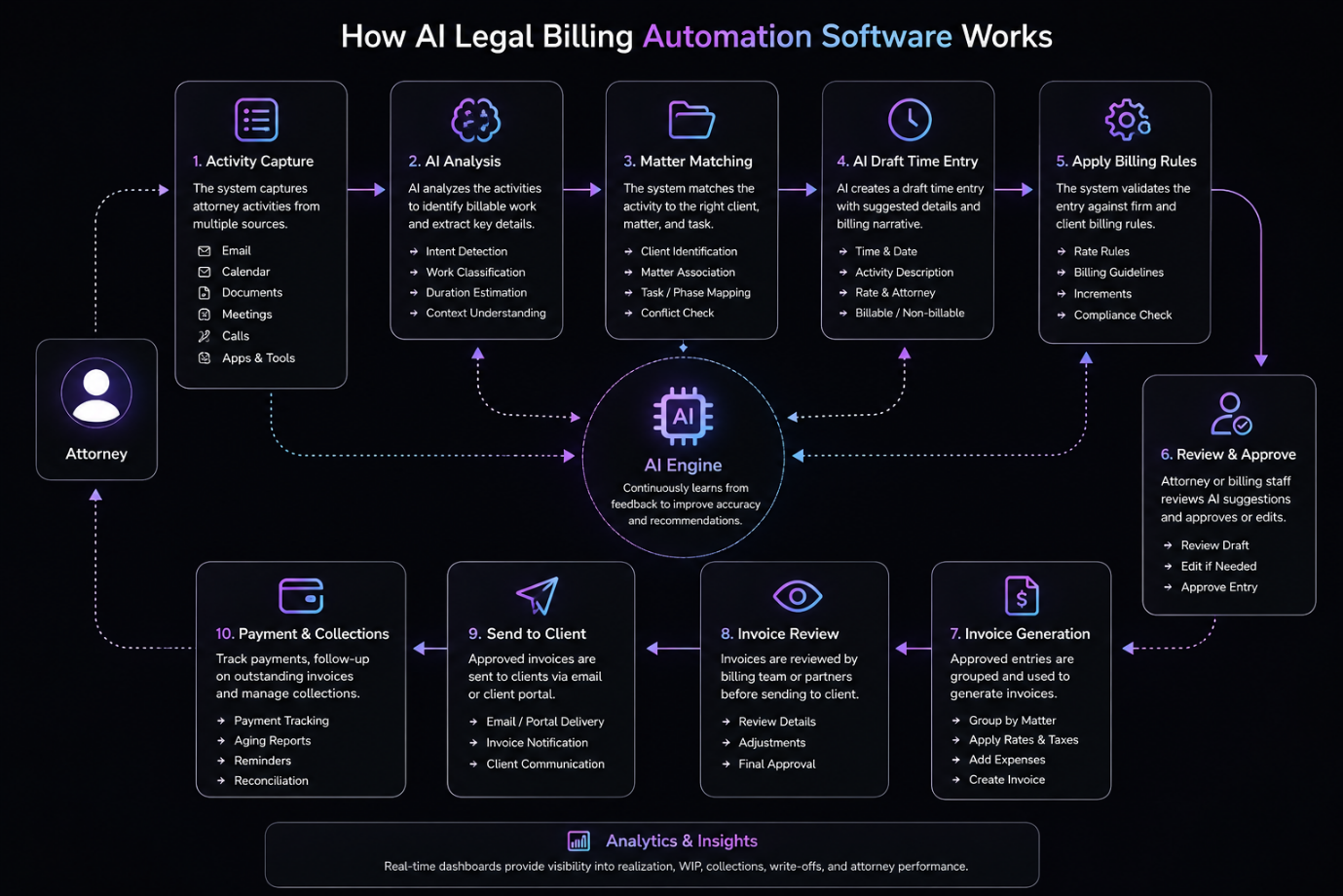
The system collects permitted activity signals from connected tools such as email, calendars, documents, tasks, communication records, and timekeeping applications. Modern legal billing platforms already support activity-based time capture from sources such as calendar events, communications, documents, and email.
AI analyzes the captured activity to determine whether it may represent billable work. For example, reviewing a client email, analyzing a contract, conducting matter-related research, or participating in a client meeting may generate a suggested time entry.
The system uses available context to associate an activity with the relevant client and matter. This is important because attorneys may work on multiple matters during the same day.
The software can create a draft containing the duration, matter, billing status, and suggested narrative. AI timekeeping solutions can already generate draft entries with captured duration, matched matters, and descriptions for user review.
The billing engine checks factors such as attorney rates, billing increments, client-specific requirements, activity codes, and billable or non-billable classifications.
Attorneys or authorized billing professionals review AI-generated entries, make corrections, and approve them. Human approval should remain an essential control rather than allowing AI to independently finalize client charges.
Approved time and expenses flow into the invoice engine. AI can assist with draft invoice preparation, while billing teams and designated approvers retain control over final approval. Current legal billing platforms demonstrate workflows that combine AI-generated billing with approval routing.
After invoices are issued, the system can monitor outstanding balances, aging, collections, and billing performance.
In simple terms, the workflow is:
Activity capture → AI analysis → Matter matching → Time entry → Billing validation → Human approval → Invoice generation → Payment tracking
This approach makes AI legal billing automation software development valuable not only for automating invoicing, but also for improving the connection between work performed, billable hours captured, revenue billed, and revenue collected.
Why are law firms moving from simply adopting legal AI tools to considering their own AI legal billing automation software? The answer is increasingly tied to financial pressure, changing client expectations, rising technology investment, and the need for greater control over how legal work is measured and billed.
Law firms are not evaluating AI only as an experimental technology. Thomson Reuters' Future of Professionals Report 2026 found that 38% of law firm professionals report significant or some financial pressure to act faster on AI, while 25% of senior law firm leaders expect financial consequences either already or within the next 12 months.
The report also found that 32% of in-house legal professionals are already reconsidering relationships with firms that do not demonstrate clear AI-enabled value within 12 months.
For managing partners and CFOs, this changes the question from "Should we experiment with AI?" to "Which business processes should we build AI around first?" Billing is a logical area to evaluate because it connects attorney activity with revenue, client expectations, and financial performance.
The 2026 Report on the State of the US Legal Market from Thomson Reuters and Georgetown Law found that average law firm spending on technology increased 9.7%, while spending on knowledge management tools increased 10.5% in 2025. The report describes this as part of a broader technology investment race driven by advanced AI adoption.
This creates a stronger case for firms to evaluate whether an off-the-shelf billing platform is sufficient or whether custom AI legal billing automation software development is needed to support their specific billing rules, integrations, and financial workflows.
The pressure is not coming only from inside law firms. Current market developments show corporate clients increasingly questioning how legal services are priced as AI changes the economics of legal work. The Financial Times reported in September 2026 that major Wall Street banks were pressing large law firms to reduce fees and demonstrate how AI-driven efficiency gains are affecting legal costs.
This makes billing intelligence strategically important. Firms need systems capable of understanding where time is recorded, how work is billed, which entries face potential challenges, and how changing client expectations affect pricing and realization.
Thomson Reuters reports that 34% of law firm professionals are already using AI tools that their firms have not authorized.
For firms handling confidential client and financial information, developing or deploying a controlled billing AI environment can provide a structured alternative to unmanaged AI usage.
The investment case is increasingly about operationalizing AI rather than simply purchasing an AI assistant. Law firms are evaluating AI across workflows, including financial operations, because they need measurable systems that connect technology investment with business objectives.
That is why firms considering how to build AI legal billing automation software should begin with specific financial problems, existing billing workflows, data availability, integrations, security requirements, and measurable KPIs rather than starting with the AI model itself.
What business value can a law firm expect when it invests in AI legal billing automation software development? The answer should be measured through outcomes that directly affect the firm's revenue, operational efficiency, billing performance, and client relationships. Rather than simply replacing manual invoice creation, an AI-powered billing system can help firms identify missed billable work, reduce preventable billing errors, accelerate the billing cycle, and give financial leaders greater visibility into revenue performance.
For business owners, managing partners, and CFOs, these outcomes make AI legal billing automation more than a technology upgrade. It can become part of the firm's broader financial operations strategy.
The 7 key benefits of AI legal billing automation software development include:

Billing administration can consume substantial time across attorneys, billing specialists, finance teams, and partners. Manually reviewing time entries, correcting narratives, checking client billing rules, preparing invoices, and following up on exceptions creates repetitive work throughout the billing cycle.
AI legal billing automation software can automate many of these activities. It can identify potentially billable work, prepare draft time entries, generate billing narratives, validate entries against configured rules, and route exceptions to the appropriate person for review.
This allows billing professionals to focus on exceptions and higher-value financial activities instead of manually checking every routine transaction. For growing firms, reducing repetitive billing work can also make the billing operation easier to scale without adding administrative resources at the same rate as attorney headcount.
How can AI help law firms capture more billable hours? One answer is by identifying potentially billable activities that attorneys may forget to record.
An AI-assisted time tracking system can analyze permitted activity signals such as meetings, emails, document work, calls, research, and calendar events. It can then suggest time entries associated with the appropriate matter for attorney review.
This creates a stronger connection between work performed and billable hours recorded. Attorneys can edit or reject suggestions before they become billable entries, maintaining control over what is ultimately charged to the client.
For firms experiencing inconsistent timekeeping or missed entries, improving billable hour capture can create additional revenue opportunities without increasing attorney workload.
Billing inaccuracies can result in invoice rejections, client disputes, write-downs, and additional administrative work. Problems may include incorrect billing rates, duplicate entries, inappropriate descriptions, incorrect matter codes, or violations of client-specific billing guidelines.
An AI legal billing automation software development project can incorporate automated validation into the billing workflow. AI can identify potentially problematic entries and flag them before invoices reach the client.
For example, the system could identify a narrative that is too vague, detect an unusual billing pattern, or flag an entry that appears inconsistent with a client's billing requirements.
Early detection gives attorneys and billing teams an opportunity to correct issues before invoice submission, supporting more consistent billing and reducing preventable errors.
The time between completing legal work and sending an invoice directly affects the speed of the firm's revenue cycle. Manual consolidation of attorney time, expenses, rates, adjustments, and client-specific requirements can slow invoice preparation.
Legal billing automation software can bring these components together in one workflow. Approved time and expense entries can flow automatically into invoice generation, while configured billing rules determine how information should be presented.
AI can assist with invoice drafting and identify exceptions that require human attention, allowing billing teams to spend less time assembling routine invoices.
A faster billing workflow can help firms move recorded work into accounts receivable more efficiently and reduce unnecessary delays between time capture, invoice approval, and client billing.
Revenue leakage occurs when a firm fails to convert performed legal work into realized revenue. Missed time, write-downs, billing guideline violations, rejected invoices, and delayed billing can all contribute to the problem.
AI legal billing automation can help firms identify these leakage points by analyzing billing patterns across attorneys, matters, clients, and practice groups.
For example, the platform could highlight matters with unusually high write-down rates, identify attorneys with inconsistent time capture, or flag invoices containing potential guideline violations.
The financial objective should not be based on an unsupported promise of a specific realization-rate increase. Instead, firms can establish a baseline and measure whether automation reduces missed time, write-downs, invoice rejections, or other identifiable sources of revenue leakage.
Corporate clients increasingly expect legal invoices to be accurate, detailed, consistent, and compliant with agreed billing requirements. Unclear descriptions or unexpected charges can create unnecessary billing questions and disputes.
AI-powered billing software can improve transparency by creating standardized billing narratives, checking entries against client requirements, and maintaining structured records behind each invoice.
A well-designed system can also provide authorized users with a clear audit trail showing how an invoice was created, which time entries contributed to it, and who reviewed or approved the information.
This makes billing conversations easier to manage and gives clients greater confidence in the accuracy and consistency of the firm's invoices.
Billing data can provide much more value than simply showing how much a client owes. When structured correctly, it can reveal where the firm's revenue is being generated, delayed, reduced, or lost.
An AI legal billing automation software platform can analyze metrics such as realization rates, write-downs, WIP, accounts receivable, billing velocity, attorney time capture, matter profitability, and collection performance.
A CFO could use these insights to identify which practice groups have declining realization, which matters accumulate unbilled time, or which clients generate recurring billing issues.
This gives business leaders a stronger basis for decisions involving pricing, staffing, client management, matter profitability, and financial forecasting.
These advantages make AI legal billing automation relevant to both operational teams and firm leadership. The strongest implementations connect everyday billing activity with measurable financial KPIs, giving firms a clearer path from attorney work to captured time, billed revenue, and collected cash.

What features should an AI legal billing software include to help a law firm capture billable work, reduce billing errors, and move from attorney time entries to accurate client invoices? This is one of the first questions firms should answer before starting AI legal billing automation software development. The right feature set should focus on the core billing workflow rather than adding AI capabilities simply for the sake of automation.
For firms asking how to build AI legal billing software, the foundation should be a system that accurately captures time, connects activities to the right matters, applies billing rules, manages expenses, generates invoices, and provides appropriate review controls. These capabilities create the underlying data and workflow required for reliable AI-assisted billing.
Below are the 15 must-have features for AI legal billing automation software, with each feature explained in terms of its practical business and operational role.
| Must-Have Feature | Feature Requirement and Explanation |
|---|---|
| AI-Powered Time Tracking | AI-powered time tracking should identify potentially billable activities from permitted sources such as calendars, emails, meetings, documents, and connected applications. It should generate suggestions without automatically billing clients. |
| Billable Hour Capture | Billable hour capture should allow attorneys to record, review, edit, and approve time associated with specific matters. The system should support timers, manual entries, billing increments, and billable status. |
| AI-Generated Time Entries | AI-generated time entries should convert captured activity into structured billing records containing suggested duration, matter, billing status, and narrative. Attorneys should be able to edit, approve, or reject every suggestion. |
| Automated Billing Narratives | Automated billing narratives should create clear and consistent descriptions from approved legal activities. The feature should support firm preferences and client requirements while keeping final control with attorneys or authorized billing professionals. |
| Matter and Client Management | Matter and client management should connect clients, matters, attorneys, time entries, expenses, invoices, and payments. Accurate matter association is essential for preventing incorrect billing allocations and maintaining organized financial records. |
| Billing Rate Management | Billing rate management should support attorney-specific, client-specific, matter-specific, and practice-group rates. The billing engine should automatically apply approved rates and maintain records of rate changes for financial auditing. |
| Expense Tracking | Expense tracking should capture and categorize billable costs such as filing fees, travel, research, court expenses, and other matter-related charges. Expenses should be reviewed and associated with the correct client matter. |
| Billing Rules Management | Billing rules management should allow firms to configure client-specific requirements, including billing increments, task codes, prohibited charges, rate restrictions, narrative requirements, and other billing guidelines before invoices are finalized. |
| Billing Validation | Billing validation should automatically check time and expense entries for potential errors such as duplicate records, missing information, incorrect rates, incomplete descriptions, incorrect matter assignments, and possible billing-rule violations. |
| Automated Invoice Generation | Automated invoice generation should combine approved time, expenses, rates, discounts, adjustments, and applicable charges into client invoices. Deterministic calculations should be handled by the billing engine rather than relying on AI. |
| Invoice Customization | Invoice customization should allow firms to create different invoice formats for different clients, matters, or billing arrangements. The system should support customized fields, billing codes, layouts, descriptions, and supporting information. |
| Invoice Approval Workflow | Invoice approval workflows should route invoices to the appropriate attorneys, partners, billing professionals, or finance teams before submission. Approval status, revisions, and user actions should be recorded for accountability. |
| Payment Tracking | Payment tracking should monitor issued invoices, due dates, outstanding balances, payment status, and payment history. Finance teams should be able to identify overdue accounts and monitor the firm's accounts receivable position. |
| Billing Reports and Dashboards | Billing dashboards should provide authorized users with visibility into recorded time, billed revenue, unbilled WIP, write-downs, realization, invoice status, collections, and other core billing metrics needed for financial management. |
| Role-Based Access Control | Role-based access control should restrict sensitive billing and client information according to user responsibilities. Attorneys, partners, billing teams, administrators, finance leaders, and clients should receive appropriate permissions. |
These foundational capabilities give AI legal billing automation software development a reliable base for accurate time capture, controlled billing workflows, and automated invoice processing while keeping human review at critical financial decision points.
Once the core billing workflow is established, firms can introduce advanced AI capabilities that help turn billing data into predictive insights, proactive recommendations, and intelligent financial controls. These features are particularly relevant for firms looking to build AI legal billing automation software that can support CFOs, managing partners, billing teams, and finance departments beyond basic time tracking and invoice generation.
A common real-world query is: What advanced features should an AI legal billing software have to improve realization and reduce revenue leakage? The answer depends on the firm's data maturity and billing objectives, but predictive analytics, intelligent recommendations, and automated exception management can add significant value when implemented with appropriate human oversight.
The following 10 advanced features for AI legal billing automation software development can be considered after the foundational billing capabilities are in place.
| Advanced Feature | Feature Requirement and Explanation |
|---|---|
| Predictive Write-Down Detection | AI can analyze historical billing patterns to identify time entries or matters that may have a higher likelihood of write-downs. The system can flag unusual hours, descriptions, rates, or billing patterns before pre-bill review. |
| Revenue Leakage Detection | An AI-powered revenue leakage engine can compare recorded work, billed time, write-downs, and historical matter performance to identify potential revenue loss. It can highlight recurring leakage patterns by attorney, client, matter, or practice group. |
| AI Billing Recommendations | The system can analyze billing records and recommend actions such as reviewing unusually high write-downs, correcting incomplete narratives, investigating missing time, or prioritizing specific invoices for review. Recommendations should remain subject to authorized user approval. |
| Predictive Collections Analytics | AI can analyze historical payment behavior, invoice characteristics, client patterns, and accounts receivable data to identify invoices that may require earlier collection attention. Finance teams can use these predictions to prioritize collection workflows. |
| Matter Profitability Forecasting | Advanced analytics can combine billing rates, attorney hours, expenses, WIP, realization trends, and historical matter data to estimate future matter profitability. This can help financial leaders identify matters that may require closer financial monitoring. |
| AI Billing Copilot | An AI billing copilot can allow authorized users to ask questions about billing data using natural language. For example, a CFO could ask, "Which matters had the largest realization decline this quarter?" and receive an explanation based on permitted firm data. |
| Intelligent Billing Guideline Interpretation | AI can analyze complex client billing guidelines and convert relevant requirements into structured checks. This can help identify potentially prohibited charges, narrative issues, rate restrictions, or submission requirements before invoices are sent. |
| Automated Billing Anomaly Detection | Machine learning can establish normal billing patterns and identify unusual changes, such as unexpected increases in hours, unusual time-entry behavior, duplicate activity, abnormal discounts, or significant changes in realization. |
| Realization Forecasting | AI can analyze historical realization, current WIP, billing activity, write-down trends, and matter characteristics to estimate potential realization performance. Finance teams can use these forecasts when planning revenue and identifying areas requiring intervention. |
| AI-Powered Financial Insights | An advanced analytics layer can combine billing, WIP, realization, collections, and matter-level information to surface financial trends automatically. Leadership can receive prioritized insights instead of manually analyzing multiple billing reports and spreadsheets. |
These advanced capabilities can move an AI legal billing automation software platform from reactive billing management toward proactive financial intelligence, helping firms identify potential billing and realization issues earlier in the revenue cycle.
After you finalized the features, now it is time to turn the product concept into a functional, secure, and scalable platform. But how do you take an AI legal billing software idea from a concept to a production-ready product? The answer requires more than selecting an AI model and building an invoice interface. A successful AI legal billing automation software development process starts with clearly defined business problems, maps the firm's billing workflow, establishes measurable KPIs, and then introduces AI where it can create meaningful value.
For legal businesses, the development approach should also account for confidential client information, billing regulations, existing legal software, accounting integrations, attorney workflows, and human approval requirements.
The following 8 steps to build AI legal billing automation software from idea to launch provide a practical roadmap for building an AI legal billing automation software.

The first step is to establish exactly what the software needs to solve. Instead of beginning with AI technology, identify the firm's existing billing problems and establish measurable baseline metrics.
Evaluate areas such as missed billable hours, manual time entry, write-downs, invoice preparation time, billing guideline violations, invoice rejection rates, WIP, realization, and collection performance. Interview attorneys, billing professionals, finance teams, and firm leadership to understand where the current workflow breaks down.
If the goal is to develop AI legal billing automation software for multiple law firms, also define the target market, practice areas, firm size, billing models, user roles, and integration requirements. These requirements become the foundation for product scope, technical architecture, and ROI measurement.
Before committing to full-scale development, validate whether the proposed AI workflow can work with real-world billing data. PoC development can test a narrow use case such as identifying potentially billable activities, generating draft time entries, classifying matters, or detecting billing anomalies.
Use representative and appropriately protected data to evaluate accuracy, processing time, integration feasibility, and user acceptance. Define success criteria before testing, such as matter-matching accuracy or acceptable AI-generated narrative quality.
A successful proof of concept should answer one critical question: Can the proposed AI capability solve a specific billing problem accurately enough to justify production development? This prevents firms from spending heavily on features that do not produce measurable operational or financial value.
Once the concept is validated, design how users will interact with the platform. A UI/UX design company can help create separate experiences for attorneys, partners, billing teams, CFOs, administrators, and clients.
The attorney workflow should require minimal effort to review suggested time entries. Billing teams should have dashboards for exceptions, invoice preparation, and approvals. Finance leaders need visibility into realization, WIP, write-downs, collections, and revenue leakage.
Map the complete workflow from activity capture to payment collection before development begins. Clearly identify where AI makes recommendations and where humans make decisions. This is particularly important for legal billing because the system should not automatically turn uncertain AI output into a client charge without authorized review.
The next stage is MVP development, where the team creates a usable version containing the highest-priority capabilities.
A practical MVP may include:
Keep the initial scope focused. The objective is to validate the core billing workflow with real users before investing in complex predictive analytics or extensive automation.
For firms developing an internal platform, the MVP can be tested with a limited practice group. For a commercial product, it can be introduced to a carefully selected group of pilot customers.
Also Read: Top 10 AI MVP Development Companies in USA
After the core billing engine is stable, introduce AI integration into the workflows identified during earlier stages. AI may support activity classification, time-entry suggestions, billing narrative generation, anomaly detection, billing guideline analysis, or financial insights.
The AI layer should work alongside deterministic billing logic. For example, an AI model can suggest a time-entry description, but the billing engine should calculate the actual charge using predefined rates and billing rules.
Integrate the platform with existing systems such as legal practice management software, accounting platforms, email, calendars, document management systems, and payment providers. Strong integration reduces duplicate data entry and allows the new platform to fit into the firm's existing technology environment.
The quality of the AI directly affects user trust, so model development should include structured testing rather than simply connecting an LLM and launching it.
AI consultation can help determine which use cases require generative AI, machine learning, classification, OCR, predictive analytics, or rule-based automation.
During AI model development, establish evaluation datasets and measure accuracy for tasks such as matter classification, billing narrative generation, anomaly detection, and billing guideline interpretation.
The system should also record confidence levels where appropriate and provide explanations for important recommendations. Low-confidence results can be routed for manual review instead of being presented as definitive conclusions.
This approach makes legal billing automation software development using AI more reliable and easier to govern.
Before launch, test the entire system across both conventional software requirements and AI-specific risks.
Testing should cover:
AI outputs should be evaluated against predefined acceptance criteria. The team should also test scenarios involving incomplete information, ambiguous activities, incorrect matter suggestions, unusual billing patterns, and potentially sensitive information.
For organizations comparing top AI development companies, security methodology, AI evaluation practices, legal technology experience, and post-launch support should be considered alongside development capabilities.
The final step is moving the validated platform into production through a controlled rollout. Start with a pilot group, monitor system performance, gather attorney and billing-team feedback, and compare results with the baseline established during requirements analysis.
Track KPIs such as billable time captured, write-down rates, invoice cycle time, rejected invoices, WIP aging, realization, administrative hours, and collection performance.
For commercial products, AI product development companies can support ongoing improvements across infrastructure, AI models, integrations, and product features. If the internal team lacks specialized expertise, firms can also hire AI developers to maintain and expand the platform.
The development process does not end at launch. Continuous evaluation is necessary as billing rules, client requirements, AI models, integrations, and user expectations evolve.
A disciplined development process turns AI legal billing automation from a technology concept into a measurable billing operation that can be tested, governed, scaled, and continuously improved.
The cost to develop an AI legal billing automation software typically ranges from $50,000 to $350,000+, depending on the product's complexity, AI capabilities, integrations, security requirements, user roles, and customization. A basic platform with time tracking, billing, invoicing, and limited AI functionality can fall toward the lower end, while an enterprise-grade solution with advanced AI, predictive analytics, extensive integrations, and sophisticated security can exceed $350,000.
For businesses planning the development budget of AI legal billing automation software, there is no single fixed price. The cost estimation of AI legal billing automation software should be based on the features being developed, the number of platforms involved, the complexity of AI workflows, and the development team's location and expertise.
A common real-world query is: "How much does it cost to develop AI legal billing software for a law firm?" The answer depends primarily on whether the firm needs a customized internal system, an MVP for market validation, or a scalable enterprise platform.
It is also important to distinguish between AI legal billing automation software development cost and ongoing operating expenses. After launch, businesses may need to budget separately for cloud infrastructure, AI API usage, maintenance, security monitoring, third-party services, and continuous feature development.
Note: The cost ranges below are planning estimates for software development. They are not fixed industry prices. Actual pricing should be determined after defining the product scope, integrations, AI requirements, security architecture, and deployment model.
| Type of AI Legal Billing Software | Estimated Development Cost | Typical Development Scope |
|---|---|---|
| Basic AI legal billing automation software | $50,000 to $100,000 | Core time tracking, billable hour capture, client and matter management, expense tracking, billing rates, basic AI-assisted time entries, invoice generation, user authentication, basic reporting, and payment tracking. |
| Advanced AI legal billing automation software | $100,000 to $200,000 | Everything in the basic version plus AI-generated billing narratives, billing guideline validation, automated anomaly detection, advanced dashboards, approval workflows, accounting integrations, payment integrations, mobile support, and enhanced security. |
| Enterprise AI legal billing automation software | $200,000 to $350,000+ | Multi-firm or enterprise architecture, advanced AI models, predictive analytics, revenue leakage detection, realization forecasting, AI billing copilot, extensive legal and accounting integrations, advanced permissions, enterprise security, audit trails, scalability, and custom workflows. |
The final AI legal billing automation software development cost can change considerably depending on the following factors.
The number of workflows, user roles, billing scenarios, dashboards, approval processes, and customization requirements directly affects development effort. A simple billing application requires considerably less engineering than an enterprise platform supporting multiple firms, complex billing arrangements, and extensive automation.
Basic AI-assisted time-entry generation may require less investment than advanced capabilities such as revenue leakage detection, predictive write-down analysis, billing anomaly detection, natural language financial queries, and an AI billing copilot.
Developing automated activity capture, timers, manual time entry, matter association, billing increments, activity classification, and approval workflows increases the development scope. Integrating multiple activity sources can increase the cost further.
Integrations with legal practice management systems, accounting platforms, payment gateways, email, calendars, document management systems, and e-billing services can significantly affect the budget. Each integration has its own API requirements, authentication process, data structure, and testing needs.
Attorney dashboards, billing-team interfaces, CFO reporting dashboards, administrative panels, and client portals require different user experiences. Highly customized enterprise interfaces can increase design and development costs.
Legal billing platforms handle confidential client and financial information. Investment may be required for encryption, secure authentication, role-based access control, audit logs, data isolation, security testing, monitoring, and other organizational security requirements.
The billing engine must accurately handle time entries, rates, expenses, discounts, adjustments, invoice calculations, billing rules, approvals, and payment records. Since these are financial workflows, deterministic calculations should be implemented through reliable application logic rather than depending on generative AI.
Basic billing reports are relatively straightforward, while advanced dashboards covering realization, WIP, write-downs, revenue leakage, collections, matter profitability, and attorney performance require more extensive data processing and visualization.
If attorneys need mobile time tracking, activity review, notifications, expense submission, or invoice access, developing native or cross-platform mobile applications can increase the overall budget.
Testing costs depend on product complexity. Legal billing platforms require functional testing, billing calculation testing, integration testing, security testing, performance testing, user acceptance testing, and AI output evaluation.
Initial infrastructure costs may include cloud configuration, databases, storage, monitoring, deployment pipelines, backups, and security controls. Ongoing cloud expenses should be calculated separately based on users, data volume, API consumption, and traffic.
After launch, firms should budget for bug fixes, security updates, API changes, infrastructure management, AI model evaluation, third-party service costs, and new feature development. AI usage costs can also vary significantly depending on model selection and usage volume.
For most businesses, a phased investment can reduce financial risk. A $50,000 to $100,000 MVP can validate core billing workflows and AI-assisted time capture before the business commits to a larger enterprise build. An advanced platform may require $100,000 to $200,000, while complex enterprise deployments can reach $350,000 or more.
The most accurate cost estimation of AI legal billing automation software comes after defining the MVP, AI scope, integrations, security requirements, target users, and expected scale.
A well-planned development budget should prioritize the billing workflows that can produce measurable financial value first, then expand into advanced AI capabilities as adoption and ROI are validated.

Also Read: AI Software Development Cost(10K-300K)
A reliable AI legal billing automation software is built on more than an AI model. Behind every automated time entry, billing recommendation, invoice, and financial dashboard is a technology stack that connects application logic, legal data, AI services, integrations, databases, and security controls.
For businesses planning AI legal billing automation software development, understanding this technology stack is important because each component affects the platform's performance, scalability, security, development cost, and ability to integrate with existing legal systems.
A practical question for firms and software businesses is: What technology stack is required to develop AI legal billing automation software that can securely process attorney time, client matters, billing rules, invoices, and financial data?
The answer depends on the product's scope, but a production-ready platform generally requires technologies for frontend development, backend engineering, AI and machine learning, databases, APIs, cloud infrastructure, authentication, payment processing, analytics, and security.
The table below outlines the core tools and technologies for AI legal billing automation software development and explains how each contributes to the overall system.
| Technology Layer | Recommended Tools and Technologies | Role in AI Legal Billing Automation Software |
|---|---|---|
| Frontend Development | React, Next.js, Angular | Used to build attorney dashboards, billing interfaces, matter screens, invoice management, approval workflows, and financial reporting dashboards. |
| Mobile Development | Flutter, React Native, Swift, Kotlin | Supports mobile applications for attorneys and billing teams to record time, review AI-generated entries, manage expenses, and receive billing notifications. |
| Backend Development | Node.js, Python, Java, .NET | Handles business logic, authentication, billing workflows, matter management, invoice processing, integrations, and communication between application components. |
| AI and Machine Learning | Python, PyTorch, TensorFlow, scikit-learn | Supports AI capabilities such as activity classification, billable-time suggestions, anomaly detection, predictive analytics, and billing pattern analysis. |
| Generative AI and LLMs | OpenAI API, Anthropic API, Google Gemini API, open-source LLMs | Can support billing narrative generation, natural language queries, document understanding, and AI-assisted billing workflows. Model selection should depend on security, accuracy, cost, and data-handling requirements. |
| Natural Language Processing | spaCy, Hugging Face Transformers, cloud NLP services | Helps the system understand billing narratives, emails, documents, client billing guidelines, and other text-based information relevant to billing workflows. |
| Database | PostgreSQL, MySQL, MongoDB | Stores clients, matters, time entries, expenses, billing rates, invoices, payments, user permissions, and other structured application data. |
| Data Warehouse and Analytics | Snowflake, BigQuery, Amazon Redshift | Supports large-scale financial analytics, historical billing analysis, realization reporting, WIP analysis, and AI model data processing. |
| API and Integration Layer | REST APIs, GraphQL, webhooks | Connects the billing platform with legal practice management systems, accounting software, calendars, email platforms, payment providers, and other business applications. |
| Cloud Infrastructure | AWS, Microsoft Azure, Google Cloud | Provides computing, storage, databases, networking, monitoring, backups, and scalable infrastructure for deploying the application and AI services. |
| Authentication and Access Control | OAuth 2.0, OpenID Connect, SSO, MFA | Protects user accounts and ensures attorneys, billing teams, administrators, partners, and clients can access only authorized information and functions. |
| Payment Processing | Stripe, Adyen, PayPal, bank payment APIs | Enables online invoice payments, payment status tracking, transaction processing, and integration with accounts receivable workflows where supported. |
| Document and File Storage | Amazon S3, Azure Blob Storage, Google Cloud Storage | Stores invoices, billing documents, supporting files, and other authorized data with configurable access permissions, encryption, retention, and backup policies. |
| DevOps and CI/CD | Docker, Kubernetes, GitHub Actions, GitLab CI/CD | Automates application deployment, testing, infrastructure management, version control, and scalable production operations. |
| Security and Monitoring | AWS CloudTrail, Azure Monitor, Datadog, Sentry | Helps monitor application activity, infrastructure performance, errors, access events, and security-related signals across the platform. |
Therefore, the right technology architecture connects AI intelligence with reliable billing logic, secure data management, integrations, and human approval to create a scalable legal billing automation platform.
Should your law firm build custom AI legal billing automation software or invest in an off-the-shelf billing solution? This decision depends on how closely your current billing processes match standard software workflows, how much control you need over AI capabilities, and whether billing is a strategic source of operational and financial differentiation for your business.
Off-the-shelf platforms can provide ready-to-use time tracking, invoicing, expense management, reporting, and integrations without requiring a lengthy development cycle. Custom AI legal billing automation software development, however, allows firms to design workflows around their own billing policies, client requirements, technology environment, data architecture, and financial KPIs.
For a CFO or managing partner, the right comparison is therefore not simply custom software vs ready-made software. The more useful question is: Which approach can solve our specific billing problems at an acceptable cost, implementation time, and level of risk?
| Factor | Custom AI Legal Billing Software | Off-the-Shelf Solution |
|---|---|---|
| Initial Cost | Higher upfront investment because the platform is designed and developed specifically for the business. | Lower initial cost because the core platform has already been developed. |
| Development Time | Usually requires several months depending on scope, integrations, AI complexity, and testing requirements. | Can generally be deployed much faster after configuration and onboarding. |
| Customization | Provides extensive control over billing workflows, dashboards, AI behavior, permissions, and business rules. | Customization is limited to the features and configuration options supported by the vendor. |
| AI Capabilities | AI features can be designed around specific use cases such as time capture, billing analysis, or revenue leakage detection. | AI capabilities depend on what the vendor currently offers and its product roadmap. |
| Billing Workflows | Can replicate complex internal billing processes and client-specific requirements. | Works best when the firm's existing workflows fit the platform's supported processes. |
| Integrations | APIs and integrations can be developed specifically for the firm's existing legal, accounting, document, and payment systems. | Uses prebuilt integrations supported by the vendor. Custom integrations may require additional fees or technical work. |
| Data Control | Greater control over architecture, data storage, access policies, and system configuration. | Data is generally managed according to the vendor's infrastructure, policies, and contractual terms. |
| Scalability | Architecture can be designed around expected user volume, firms, matters, transaction volume, and future product requirements. | Scalability depends largely on the vendor's infrastructure and subscription model. |
| Security Controls | Security architecture can be designed around the organization's specific requirements and risk model. | Security depends on the vendor's controls, certifications, infrastructure, and contractual commitments. |
| Maintenance | The business is responsible for ongoing development, maintenance, infrastructure, security, and AI model management, either internally or through a development partner. | Vendor generally handles product maintenance, updates, infrastructure, and core security operations. |
| Feature Roadmap | The business controls which features are developed and when they are prioritized. | Product updates and new capabilities depend on the vendor's roadmap. |
| Long-Term Cost | Can become cost-effective at significant scale, but requires ongoing technical investment. | Predictable subscription expenses can be attractive initially, but costs may increase with users, matters, transactions, or premium features. |
| Competitive Differentiation | Can create proprietary workflows, analytics, and AI capabilities that are difficult to replicate with standard software. | Provides standardized capabilities that may also be available to competing firms. |
| Best For | Firms with complex billing requirements, proprietary workflows, large-scale operations, or a strategic need for specialized AI capabilities. | Firms seeking faster deployment, predictable functionality, lower upfront investment, and standard billing workflows. |
Custom development becomes more attractive when standard billing platforms cannot adequately support the firm's requirements. This can happen when a firm has complex client billing guidelines, multiple billing arrangements, unique approval workflows, proprietary financial reporting requirements, or specialized integrations.
It can also make sense when the firm's objective extends beyond basic invoicing. For example, a business may want AI to analyze missed billable time, identify potential revenue leakage, predict write-down risk, or provide firm-specific financial intelligence.
Another important consideration is control. With a custom platform, the business determines how AI is integrated into its billing workflow, which data it can access, where human approval is required, and how the system evolves.
An off-the-shelf platform can be the better option when the firm's billing requirements are relatively standard and the priority is rapid implementation.
If the business primarily needs time tracking, expense management, invoicing, payment processing, basic reporting, and established integrations, developing an entirely new platform may not provide enough additional value to justify the investment.
It can also be appropriate for firms that do not want to maintain an internal software engineering or AI team. The vendor assumes responsibility for much of the platform maintenance, infrastructure, and product updates.
Some firms do not need to make an all-or-nothing decision. A hybrid approach can combine an existing legal billing or practice management platform with custom AI capabilities.
For example, the existing system can remain the system of record while a custom AI layer analyzes authorized billing data, suggests time entries, identifies anomalies, or produces financial insights. APIs can connect the two environments without requiring the firm to replace its entire billing infrastructure.
Before investing in custom AI legal billing automation software development, evaluate five areas:
For a firm with straightforward requirements, off-the-shelf software may provide the fastest path to implementation. For organizations with complex workflows, significant revenue leakage, specialized AI requirements, or a need for deeper control, custom AI legal billing automation software development can provide a stronger long-term fit.
The right choice is the one that delivers measurable billing improvements without introducing unnecessary technology cost or complexity
Building an AI legal billing automation software can streamline time capture, billing validation, invoicing, and financial analysis, but legal billing is not a workflow where automation can be added without careful controls. Firms must deal with confidential client data, complex billing arrangements, AI accuracy, existing software integrations, and strict financial requirements.
A practical question for firms planning AI legal billing automation software development is: What could go wrong when AI is used to automate legal billing, and how can those risks be controlled? The answer depends on the firm's workflows and technology environment, but eight challenges require particular attention during the development process of AI legal billing automation software.
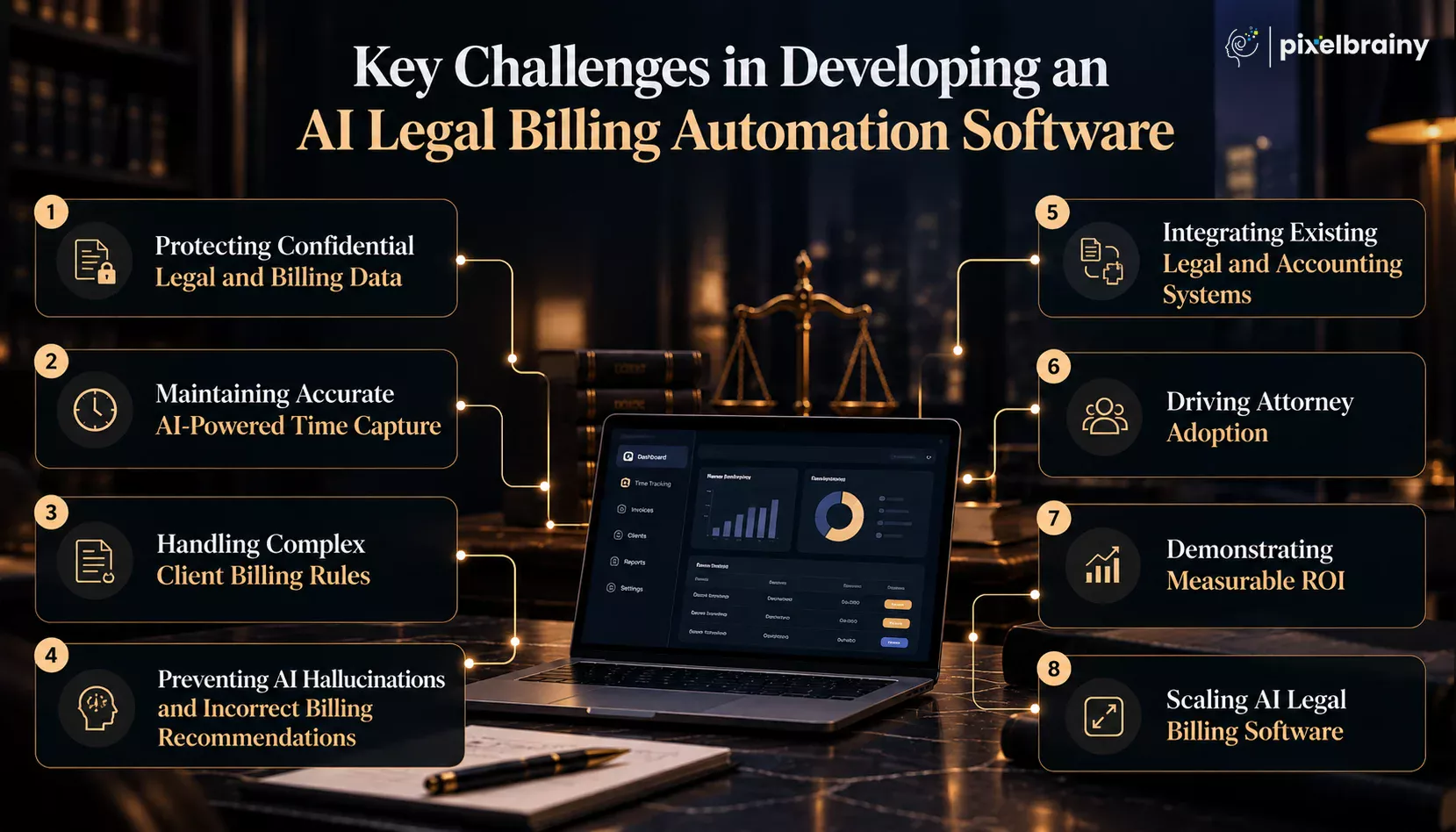
Challenge: An AI legal billing platform may process client information, matter details, attorney activities, billing rates, invoices, payment records, and other confidential data. Sending sensitive information to external AI services without appropriate controls can introduce privacy and security risks.
Solution: Security should be incorporated into the architecture from the beginning. Use encryption, multi-factor authentication, role-based access control, tenant isolation, secure APIs, audit logging, and defined data-retention policies. AI providers should also be evaluated carefully for their security and data-handling practices.
Challenge: One of the core objectives of AI legal billing automation software development is improving billable hour capture. However, AI may incorrectly identify an activity as billable, associate it with the wrong matter, estimate an inaccurate duration, or generate an unsuitable billing description.
Solution: The software should treat AI-generated time entries as recommendations rather than automatically billable records. Attorneys should be able to review, edit, reject, or approve every suggestion. Confidence scores and validation rules can help identify entries requiring additional attention.
Challenge: Client billing guidelines can differ significantly. Requirements may cover billing increments, rates, task codes, prohibited charges, invoice formats, expense policies, and narrative descriptions. Failure to follow these rules can result in rejected invoices and unnecessary write-downs.
Solution: Legal billing automation software development using AI should include a configurable billing rules engine. AI can help interpret unstructured client guidelines, while deterministic validation rules should check time entries and invoices against the applicable requirements.
Challenge: Generative AI can produce convincing but unsupported information. In a billing environment, this could result in an incorrect time description, matter association, billing recommendation, or financial explanation.
Solution: Restrict AI to clearly defined billing use cases and ground outputs in authorized data. Apply validation rules, confidence thresholds, and human review. Critical calculations such as rates, invoice totals, and approved charges should be handled by deterministic software logic rather than generative AI.
Challenge: How do you build AI legal billing automation software that works with a firm's existing technology stack? This can be difficult because firms may already rely on practice management platforms, accounting systems, calendars, email, document management tools, payment gateways, and e-billing platforms.
Solution: Use an API-first architecture with standardized data models, webhooks, and integration monitoring. Clearly define the system of record for clients, matters, time entries, invoices, and payments. Thorough synchronization and integration testing should be performed before production deployment.
Challenge: Even technically advanced AI legal billing automation software can fail to deliver results if attorneys do not use it consistently. Lawyers may be concerned about inaccurate activity capture, additional review work, or losing control over client billing.
Solution: Make the attorney workflow simple and transparent. Present concise AI suggestions with straightforward edit, approve, and reject controls. Start with a pilot group, collect user feedback, and demonstrate how the system fits into existing timekeeping practices before expanding across the firm.
Challenge: Investing in AI legal billing automation software development does not automatically guarantee higher realization or reduced revenue leakage. Firm leadership needs evidence that automation is improving financial performance.
Solution: Establish measurable benchmarks before development or deployment. Track billable time captured, realization rate, write-downs, invoice cycle time, unbilled WIP, rejected invoices, billing errors, and administrative hours. Comparing baseline and post-launch performance provides a clearer view of the software's actual financial impact.
Challenge: A platform may work effectively during an initial pilot but encounter performance or infrastructure issues as attorney numbers, matters, time entries, invoices, and AI requests increase.
Solution: Building an AI legal billing automation software for long-term use requires scalable cloud infrastructure, optimized databases, modular services, asynchronous AI processing, monitoring, caching, and load testing. AI workloads should remain separate from critical billing calculations so heavy AI processing does not disrupt core financial operations.
Addressing these challenges during AI legal billing automation software development creates a stronger foundation for secure automation, accurate billing workflows, reliable AI assistance, and sustainable financial operations.
From the above discussion, now it is time to identify the right development partner that can turn a legal billing concept into a secure, scalable, and business-focused software solution. For law firms, technology expertise alone is not enough. The development partner should understand billing workflows, attorney time capture, financial controls, integrations, AI implementation, and the importance of human oversight.
PixelBrainy as AI legal software development company can be considered by firms looking for customized solutions aligned with their existing operations. Its approach focuses on creating software around specific business requirements instead of forcing firms into rigid workflows.
A practical question for decision-makers is: How do I find a development partner that can create AI-powered legal billing software around my firm's workflow, integrations, and security requirements? The evaluation should consider AI expertise, legal technology experience, development methodology, data security, integration capabilities, scalability, and ongoing support.
PixelBrainy can support organizations that want to build AI legal billing automation software with capabilities such as AI-assisted time capture, billing narrative generation, matter management, billing validation, automated invoicing, analytics, dashboards, and customized approval workflows.
The focus is on connecting AI capabilities with dependable application logic and business rules. This is important when firms need legal billing automation software development integrating AI, because AI recommendations should work alongside established financial controls rather than operate independently.
Project Type: AI-powered billing and workflow automation platform
Industry: Legal and professional services
Client: Confidential
Objective: Automate repetitive billing activities while improving visibility across time entries, billing workflows, and financial operations.
Development Approach: The platform was designed around the client's existing operational processes rather than requiring users to completely change their established workflows. AI capabilities were connected with conventional application logic, allowing automated recommendations to be reviewed and approved by authorized users before becoming final business records.
Confidentiality Note: The client's identity, proprietary workflow details, and specific financial performance figures are not disclosed due to confidentiality obligations.
For firms evaluating AI legal billing automation software development services, this type of customized approach can provide a practical path for combining AI capabilities with established billing processes, financial controls, and organizational requirements.
Ready to discuss your legal billing automation idea? Connect with PixelBrainy to explore your requirements and development roadmap.

For a law firm, billing automation is ultimately about protecting revenue while making the billing process easier for attorneys, billing teams, and finance leaders. AI legal billing automation software development brings these capabilities together by combining intelligent time capture, billable hour tracking, billing validation, invoice automation, financial analytics, and workflow automation within one platform.
The key is to build the software around actual billing challenges rather than adding AI simply because it is available. A well-planned solution can help firms identify missed billable work, reduce avoidable billing errors, enforce client billing guidelines, accelerate invoicing, and give leadership clearer visibility into realization and revenue leakage.
Whether you plan to build AI legal billing automation software for internal use or create a commercial legal technology product, the right combination of features, AI capabilities, integrations, security, and development strategy will determine its long-term value.
Book an appointment with PixelBrainy today to turn your AI legal billing automation idea into a practical, scalable software solution.
AI legal billing automation software can automate or assist with activities such as time capture, billable hour recording, billing narrative generation, matter classification, billing guideline checks, invoice preparation, payment tracking, and billing analytics. AI can identify patterns and make recommendations, while final billing decisions can remain under authorized human review.
Yes, depending on the system design. The software can analyze permitted activity sources such as calendars, emails, meetings, documents, or application activity and suggest potentially billable time. Attorneys can then review and approve the suggested entries before they are included in client invoices.
The cost to develop AI legal billing automation software can typically range from $50,000 to $350,000+. A basic platform may cost around $50,000 to $100,000, an advanced solution around $100,000 to $200,000, and an enterprise platform can reach $200,000 to $350,000 or more depending on AI complexity, integrations, security, and scalability requirements.
AI can support billing accuracy through intelligent time-entry suggestions, billing narrative generation, anomaly detection, billing guideline analysis, duplicate-entry detection, matter classification, and predictive write-down identification. These capabilities should work alongside deterministic billing rules and human approval rather than replacing financial controls.
The development timeline depends on the scope. A focused MVP may take several months, while an advanced or enterprise-grade platform can require substantially more time because of AI model development, integrations, security testing, data migration, user acceptance testing, and deployment requirements.
A custom solution for AI billing software can be appropriate when a firm has complex billing workflows, specialized client requirements, proprietary processes, or AI use cases that existing platforms cannot support. Off-the-shelf software may be more suitable when the firm's requirements are standard and rapid deployment with predictable subscription costs is the priority.
Yes. AI legal billing automation software development can include integrations with practice management platforms, accounting systems, calendars, email, document management software, payment gateways, and e-billing platforms. APIs, webhooks, and integration services can synchronize relevant data between systems.
Firms can establish baseline metrics before implementation and compare them after deployment. Useful KPIs include billable hours captured, realization rate, write-downs, unbilled WIP, invoice processing time, billing errors, rejected invoices, administrative effort, and collection performance. This provides a clearer way to evaluate whether the AI legal billing automation software development investment is delivering measurable business value.

About The Author
Sagar Bhatnagar
Sagar Sahay Bhatnagar brings over a decade of IT industry experience to his role as Marketing Head at PixelBrainy. He's known for his knack in devising creative marketing strategies that boost brand visibility and market influence. Sagar's strategic thinking, coupled with his innovative vision and focus on results, sets him apart. His track record of successful campaigns proves his ability to utilize digital platforms effectively for impactful marketing efforts. With a genuine passion for both technology and marketing, Sagar continuously pushes PixelBrainy's marketing initiatives to greater success.

Working with the PixelBrainy team has been a highly positive experience. They understand the design requirements and create beautiful UX elements to meet the application needs. The dev team did an excellent job bringing my vision to life. We discussed usability and flow. Sagar worked with his team to design the database and begin coding. Working with Sagar was easy. He has the knowledge to create robust apps, including multi-language support, Google and Apple ID login options, Ad-enabled integrations, Stripe payment processing, and a Web Admin site for maintaining support data. I'm extremely satisfied with the services provided, the quality of the final product, and the professionalism of the entire process. I highly recommend them for Android and iOS Mobile Application Design and Development.

Great experience working with them. Had a lot of feedback and I found that unlike most contractors they were bugging me for updates instead of the other way around. They were extremely time conscience and great at communicating! All work was done extremely high quality and if not on time, early! They were always proactive when it comes to communication and the work is great/above par always. Very flexible and a great team to work with! Goes above and beyond to present us with multiple options and always provides quality. Amazing work per usual with Chitra. If you have UI/UX or branding design needs I recommend you go to them! Will likely work with them in the future as well, definitely recommended!

PixelBrainy is a joy to work with and is a great partner when thinking through branding, logo, and website layout. I appreciate that they spend time going into the "why" behind their decisions to help inform me and others about industry best practices and their expertise.

I hired them to design our software apps. Things I really like about them are excellent communication skills, they answer all project suggestions and collaborate right away, and their input on design and colors is amazing. This project was complex and needed patience and creativity. The team is amazing to do business with. I will be using them long-term. Glad to see there are some good people out there. I was afraid to try and outsource my project to someone but I am glad I met them! I really can't say enough. They went above and beyond on this project. I am very happy with everything they have done to make my business stand out from the competition.

It was great working with PixelBrainy and the team. They were very responsive and really owned the project. We'll definitely work with them again!

I recently worked with the PixelBrainy team on a project and I was blown away by their communication skills. They were prompt, clear, and articulate in all of our interactions. They listened and provided valuable feedback and suggestions to help make the project a success. They also kept me updated throughout the entire process, which made the experience stress-free and enjoyable.

PixelBrainy is very good at what it does. The team also presents themselves very professionally and takes care of their side of things very well. I could fully trust them taking up the design work in a timely and organised manner and their attention to detail saved us lots of effort and time. This particular project was quite intense and the team showed that they function very well under pressure. Very much looking forward to working with her again!

It's always an absolute pleasure working with them. They completed all of my requests quickly and followed every note I had for them to a T, which made our process go smoothly from start to finish. Everything was completed fast and following all of the guidelines. And I would recommend their services to anyone. If you need any design work done in the future, PixelBrainy should be your first call!

They took ownership of our requirements and designed and proposed multiple beautiful variants. The team is self-motivated, requires minimum supervision, committed to see-through designs with quality and delivering them on time. We would definitely love to work with PixelBrainy again when we have any requirements.

PixelBrainy was a big help with our SaaS application. We've been hard at work with a new UI/UX and they provided a lot of help with the designs. If you're looking for assistance with your website, software, or mobile application designs, PixelBrainy and the team is a great recommendation.

PixelBrainy designers are amazing. They are responsive, talented, and always willing to help craft the design until it matches your vision. I would recommend them and plan to continue them for my future projects and more!!!

They were awesome! Did a good job fast, and good communication. Will work with them again. Thank you

Creative, detail-oriented, and talented designers who take direction well and implement changes quickly and accurately. They consistently over-delivered for us.

PixelBrainy team is very talented and creative. Great designers and a pleasure to work with. PixelBrainy is an excellent communicator and I look forward to working with them again.

PixelBrainy has a very talented design team. Their work is excellent and they are very responsive. I enjoy working with them and hope to continue on all of our future projects.


Transform your ideas into reality with us.
Across these industries, each engagement brings unique challenges, from early-stage product development to scaling complex systems, helping us build a practical understanding of real-world product environments.