
 AI Summary Powered by PixelBrainy
Are manual scheduling errors, denied insurance claims, and overloaded administrative teams quietly costing healthcare practices thousands of dollars every month?
Healthcare organizations are facing an operational efficiency crisis. Rising patient volumes, growing regulatory requirements, increasing documentation workloads, billing inaccuracies, and fragmented workflows are putting immense pressure on clinics, hospitals, specialty practices, and physician groups. While patient expectations continue to rise, many healthcare providers still rely on disconnected systems, spreadsheets, legacy software, and manual administrative processes that create bottlenecks across the entire care delivery cycle.
The problem is no longer just inefficiency. It is lost revenue, poor patient experiences, compliance risks, staff burnout, and limited scalability.
This is where AI medical practice management software development is transforming the healthcare industry. Modern AI powered medical practice management software combines automation, predictive analytics, machine learning, natural language processing, and intelligent workflow management into a single platform. These systems automate appointment scheduling, optimize billing operations, improve patient communication, reduce claim denials, streamline compliance management, and help healthcare providers make faster operational decisions.
The market signals are impossible to ignore. The global medical practice management software market is projected to reach $18.08 billion by 2032, growing at a CAGR of 9.30%, reflecting the increasing demand for intelligent healthcare administration solutions. Additionally, 85% of healthcare leaders are exploring or implementing AI solutions, while the American Medical Association reported that two out of three physicians were already using AI in their practice was in 2024. Cloud-based healthcare management platforms now account for approximately 96% adoption among modern healthcare providers, highlighting the shift toward AI-driven, scalable infrastructure.
Organizations looking to build AI medical practice management software are no longer investing in future innovation. They are investing in immediate operational survival, profitability, and competitive advantage.
What This Blog Covers?
As a trusted healthcare technology partner, PixelBrainy helps healthcare providers develop intelligent, scalable, and compliant AI solutions that modernize operations while improving patient outcomes.
AI-powered medical practice management software is a healthcare administration platform that helps clinics, hospitals, and physician practices manage daily operations such as appointment scheduling, patient registration, billing, insurance claims, reporting, and workflow management from a single system.
Traditional practice management software mainly digitizes administrative tasks. It stores patient information, tracks appointments, generates invoices, and manages records. While this reduces paperwork, most processes still require significant manual effort and staff oversight.
An AI powered practice management software solution takes automation a step further. By integrating machine learning, natural language processing (NLP), predictive analytics, and intelligent automation, the platform can analyze data, identify patterns, make recommendations, and automate routine tasks.
For example, an AI medical practice management system can predict appointment demand, reduce no-shows through smart scheduling, detect billing errors before claim submission, automate documentation, and personalize patient communications. Instead of simply managing workflows, AI actively improves them.
| Traditional PMS | AI-Powered PMS |
|---|---|
| Digitizes administrative tasks | Predicts, automates, and optimizes workflows |
| Manual appointment management | AI-driven scheduling and no-show prediction |
| Basic billing processes | Automated billing validation and claim optimization |
| Static reports | Real-time predictive analytics |
| Manual patient follow-ups | Personalized AI-powered communication |
| Fixed functionality | Continuously learns and improves over time |
The key difference is intelligence. Traditional systems help healthcare staff perform tasks digitally, while AI driven medical practice software helps organizations make smarter decisions, reduce administrative workload, improve operational efficiency, and increase revenue. As the system processes more data, its accuracy and performance improve, making it a valuable long-term investment for growing healthcare practices.
Healthcare providers are under growing pressure to manage higher patient volumes, rising operational costs, increasing compliance requirements, and workforce shortages. Traditional practice management systems often depend on manual workflows that slow operations and create inefficiencies.
This is why many clinics, hospitals, and physician groups are investing in AI medical practice management software development in 2026. AI helps healthcare organizations automate routine tasks, improve accuracy, increase revenue, and deliver better patient experiences.
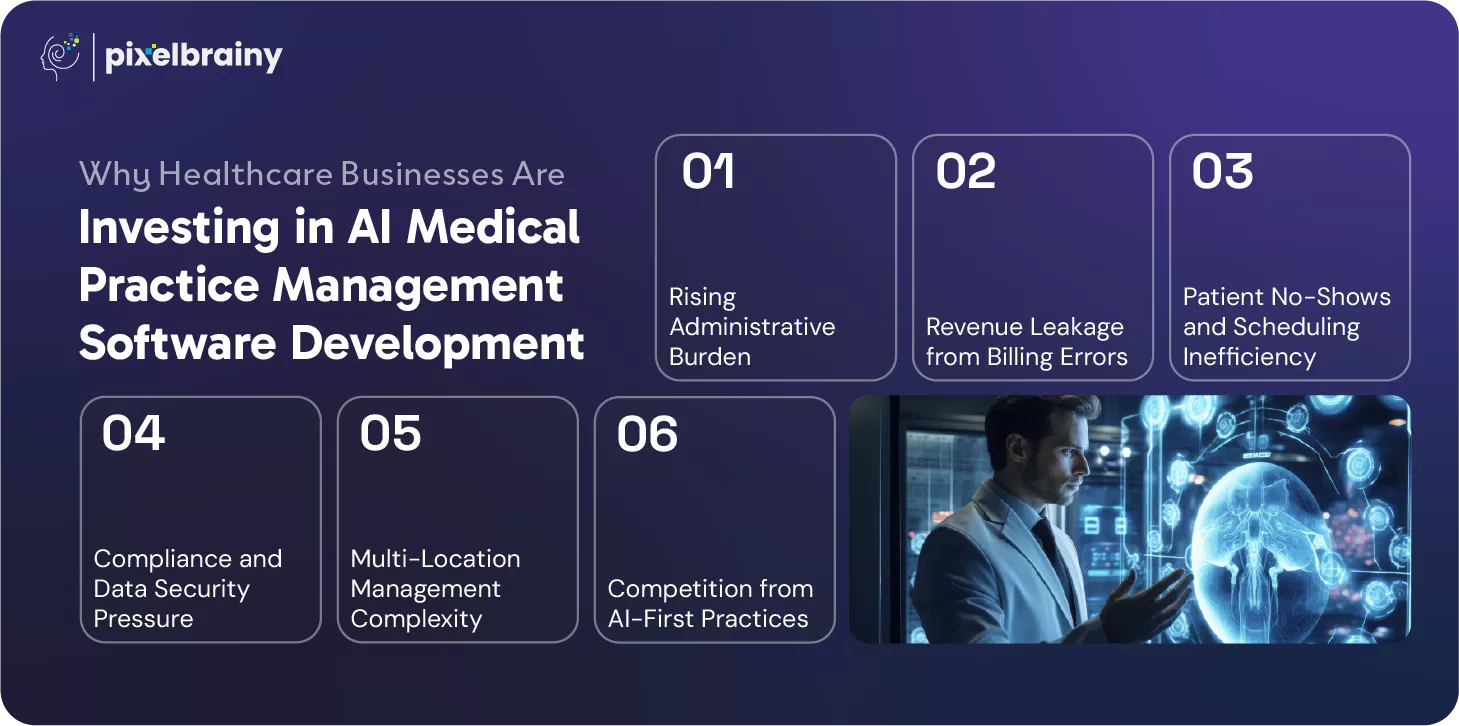
Healthcare staff spend countless hours on appointment scheduling, patient registration, insurance verification, documentation, and follow-up communication. These repetitive tasks reduce productivity and contribute to staff burnout.
How AI helps: AI automates scheduling, patient intake, reminders, data entry, and administrative workflows. This reduces manual workload, improves operational efficiency, and allows healthcare teams to focus more on patient care.
Billing mistakes, coding errors, and incomplete claim submissions often lead to claim denials, delayed reimbursements, and lost revenue. For many healthcare practices, revenue cycle inefficiencies remain a major financial challenge.
How AI helps: AI-powered billing systems validate claims before submission, identify coding issues, detect missing information, and recommend corrections automatically. This improves claim acceptance rates and accelerates reimbursement cycles.
Missed appointments create revenue loss, scheduling gaps, and underutilized provider time. Manual scheduling systems often struggle to optimize appointment management.
How AI helps: AI analyzes patient behavior, predicts no-show risks, and sends automated reminders. Intelligent scheduling tools also optimize provider calendars, helping practices improve attendance rates and maximize appointment utilization.
Healthcare organizations must protect patient data while meeting strict regulatory requirements such as HIPAA and audit compliance standards. Managing these obligations manually increases operational risk.
How AI helps: AI supports compliance through automated audit trails, role-based access controls, security monitoring, and anomaly detection. This strengthens data protection while simplifying compliance management.
Managing patient records, staff schedules, billing operations, and reporting across multiple locations can become difficult as healthcare organizations grow.
How AI helps: AI centralizes data and workflows across clinics, providing a unified view of operations, patient activity, staffing, and financial performance. This improves visibility and simplifies management at scale.
Patients increasingly expect faster service, seamless communication, and personalized healthcare experiences. Practices using outdated systems often struggle to meet these expectations.
How AI helps: The benefits of developing AI powered medical practice management software include faster workflows, improved patient engagement, better decision-making, and greater operational efficiency. AI-driven healthcare organizations are better positioned to improve patient satisfaction and maintain a competitive advantage.
As healthcare operations become more complex, organizations that develop AI medical practice management software gain the ability to automate processes, reduce administrative overhead, improve revenue performance, and build scalable healthcare operations for long-term growth.
The value of AI medical practice management software becomes much clearer when we look at how healthcare organizations are using it to solve real operational challenges. Across clinics, hospitals, telehealth providers, and multi-specialty practices, AI is helping teams reduce administrative workload, improve efficiency, and deliver better patient experiences.
Below are some of the most impactful AI use cases in medical practice management software development that we are seeing in healthcare organizations today.
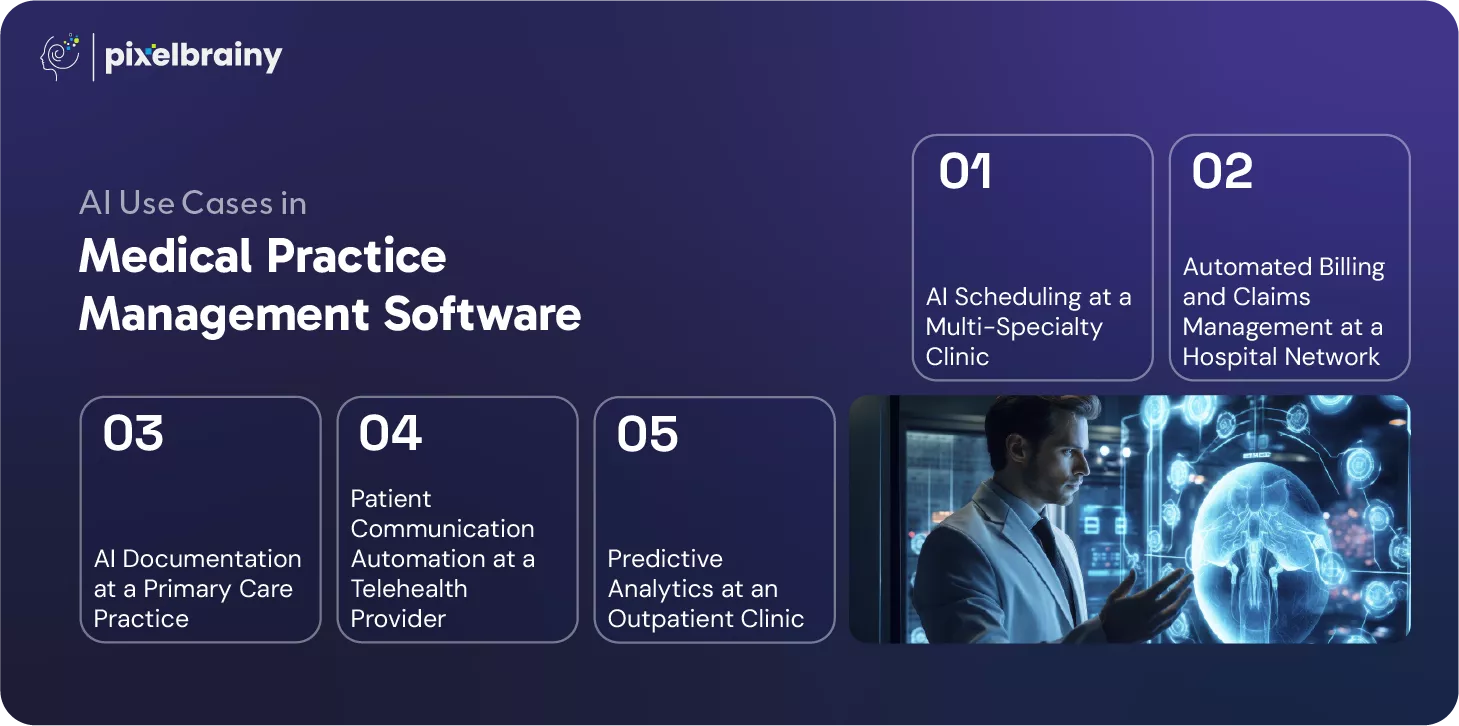
One of the biggest challenges we often see in multi-specialty clinics is appointment scheduling inefficiency. Different specialists have different availability patterns, appointment durations, and patient demand levels. When scheduling is managed manually, clinics frequently experience long wait times, underutilized providers, and appointment bottlenecks.
By implementing AI-powered scheduling, we can analyze historical appointment data, patient attendance patterns, provider availability, seasonal demand, and cancellation trends. The system automatically recommends optimal appointment slots and adjusts schedules based on real-time conditions.
For example, if the AI identifies that certain patients have a higher likelihood of cancelling appointments, it can strategically manage waitlists and overbooking thresholds to minimize lost appointment time.
Business Outcomes:
This is one of the most common AI medical practice management software use cases for growing healthcare organizations that want to increase operational efficiency without expanding administrative teams.
Large hospital networks process thousands of insurance claims every month. Even minor coding errors, incomplete documentation, or missing patient information can result in claim denials, delayed reimbursements, and revenue loss.
We often work with healthcare organizations that struggle with fragmented billing departments and inconsistent claim review processes. Manual claim verification creates significant inefficiencies and increases the likelihood of errors.
With AI-powered claim scrubbing and billing automation, the system reviews claims before submission, identifies coding inconsistencies, validates documentation requirements, and flags potential reimbursement risks.
Rather than discovering issues after claim rejection, billing teams can resolve problems proactively.
Business Outcomes:
For hospitals looking to improve financial performance, automated billing remains one of the highest-value use cases of AI in medical practice management software for hospitals and clinics.
Physician burnout continues to be a major challenge across healthcare. Many providers spend hours every day documenting patient encounters after consultations have ended. In some cases, physicians spend almost as much time on documentation as they do with patients.
We frequently see primary care practices searching for ways to reduce administrative burdens without compromising clinical accuracy.
This is where ambient AI documentation tools deliver significant value.
AI-powered medical practice management systems can listen to patient-provider conversations, extract key clinical details, and automatically generate structured notes for electronic health records. Physicians simply review and approve the generated documentation.
Instead of spending several minutes documenting every consultation manually, providers can complete records much faster.
Business Outcomes:
As AI technology continues to advance, intelligent documentation is becoming a core component of modern medical practice management platforms.
Telehealth providers often face a different challenge: managing large volumes of patient interactions across multiple communication channels. Appointment requests, reminders, follow-up messages, insurance questions, and common inquiries can overwhelm support teams.
When communication is handled manually, response times increase and patient satisfaction declines.
We help telehealth organizations address this challenge by integrating AI-powered chatbots and virtual assistants directly into practice management workflows.
These AI assistants can schedule appointments, send reminders, answer frequently asked questions, verify patient information, provide follow-up instructions, and escalate complex cases to human staff when necessary.
The system operates continuously, providing support even outside regular business hours.
Business Outcomes:
For virtual healthcare providers, patient communication automation represents one of the fastest-return investments in AI.
Outpatient clinics often experience fluctuating patient demand throughout the year. Seasonal illnesses, local events, staffing shortages, and changing patient behavior can make resource planning extremely difficult.
Without accurate forecasting, clinics may become understaffed during busy periods or overstaffed during slower periods, increasing operational costs and reducing efficiency.
By implementing machine learning-driven predictive analytics, we can analyze historical patient volume, appointment trends, provider utilization, and operational data to forecast future demand.
The AI system identifies patterns that may not be visible through traditional reporting tools and provides recommendations for staffing, scheduling, and resource allocation.
Business Outcomes:
These real-world AI medical practice management software use cases demonstrate why healthcare providers are increasingly investing in intelligent platforms that can learn, adapt, and continuously improve operational performance.
The success of any AI medical practice management software development project depends on selecting the right features from the beginning. Modern healthcare providers are not looking for software that simply digitizes administrative tasks. They need intelligent systems that automate workflows, improve decision-making, reduce operational costs, and enhance patient experiences.
When healthcare organizations build medical practice management software, the focus should be on combining core practice management capabilities with AI-driven automation, predictive analytics, and intelligent communication tools.
The following are the most important AI powered features for medical practice management systems that deliver measurable business and operational value.
| Feature | Description |
|---|---|
| AI Appointment Scheduling | Uses predictive algorithms to optimize appointment slots, reduce scheduling conflicts, identify no-show risks, and improve provider utilization while minimizing patient wait times. |
| Automated Patient Registration | Captures and validates patient information automatically, reducing manual data entry, improving record accuracy, and accelerating onboarding processes for new and returning patients. |
| AI Billing and Coding Validation | Reviews billing codes, identifies errors, detects missing information, and validates claims before submission to improve reimbursement rates and reduce claim denials. |
| Intelligent Claims Management | Automates claim processing workflows, predicts denial risks, prioritizes claim reviews, and accelerates reimbursement cycles through real-time claim validation and monitoring. |
| AI Medical Documentation Assistant | Converts physician-patient conversations into structured clinical notes, reducing documentation time, improving record accuracy, and allowing providers to focus more on patient care. |
| Patient Communication Automation | Sends personalized reminders, follow-up messages, appointment confirmations, and care notifications automatically through email, SMS, chat, or mobile applications. |
| AI-Powered Healthcare Chatbot | Provides 24/7 patient support by answering common questions, scheduling appointments, collecting information, and directing patients to appropriate services when needed. |
| Predictive Patient Demand Forecasting | Analyzes historical patient trends and seasonal patterns to predict future demand, helping healthcare organizations optimize staffing and resource planning. |
| Revenue Cycle Analytics | Tracks financial performance, identifies revenue leakage, forecasts collections, and provides actionable insights to improve overall practice profitability and cash flow. |
| Smart Provider Resource Allocation | Evaluates patient demand, provider schedules, and operational requirements to allocate resources efficiently and improve healthcare service delivery. |
| AI Compliance Monitoring | Continuously monitors workflows for compliance risks, maintains audit trails, tracks user activity, and helps healthcare organizations meet regulatory requirements. |
| Insurance Eligibility Verification | Automatically verifies patient insurance coverage before appointments, reducing administrative workload, minimizing claim issues, and improving billing efficiency. |
| Multi-Location Operations Dashboard | Centralizes data from multiple clinics or facilities, providing real-time visibility into scheduling, patient activity, staffing, and financial performance. |
| AI Reporting and Business Intelligence | Generates real-time operational reports, predictive insights, and performance dashboards that support faster and more informed management decisions. |
| Patient Retention and Engagement Analytics | Identifies patients at risk of missing appointments or discontinuing treatment and recommends engagement strategies to improve retention and continuity of care. |
The most successful AI features in medical practice management software are those that reduce administrative workload, improve operational efficiency, and create measurable value for both healthcare providers and patients.
Developing an AI-powered medical practice management platform requires a strategic combination of healthcare expertise, artificial intelligence, regulatory compliance, and scalable software architecture. Healthcare organizations cannot simply add AI features to a traditional practice management system and expect transformational results. The goal is to build an intelligent platform that automates administrative operations, improves decision-making, optimizes revenue cycles, enhances patient experiences, and adapts as the organization grows.
Whether you are a healthcare startup, private clinic, multi-specialty practice, or hospital network, following a structured development roadmap is essential for success. If you are exploring how to build AI powered medical practice management software or planning to invest in a custom healthcare platform, the following process provides a proven framework for achieving long-term business and operational value.
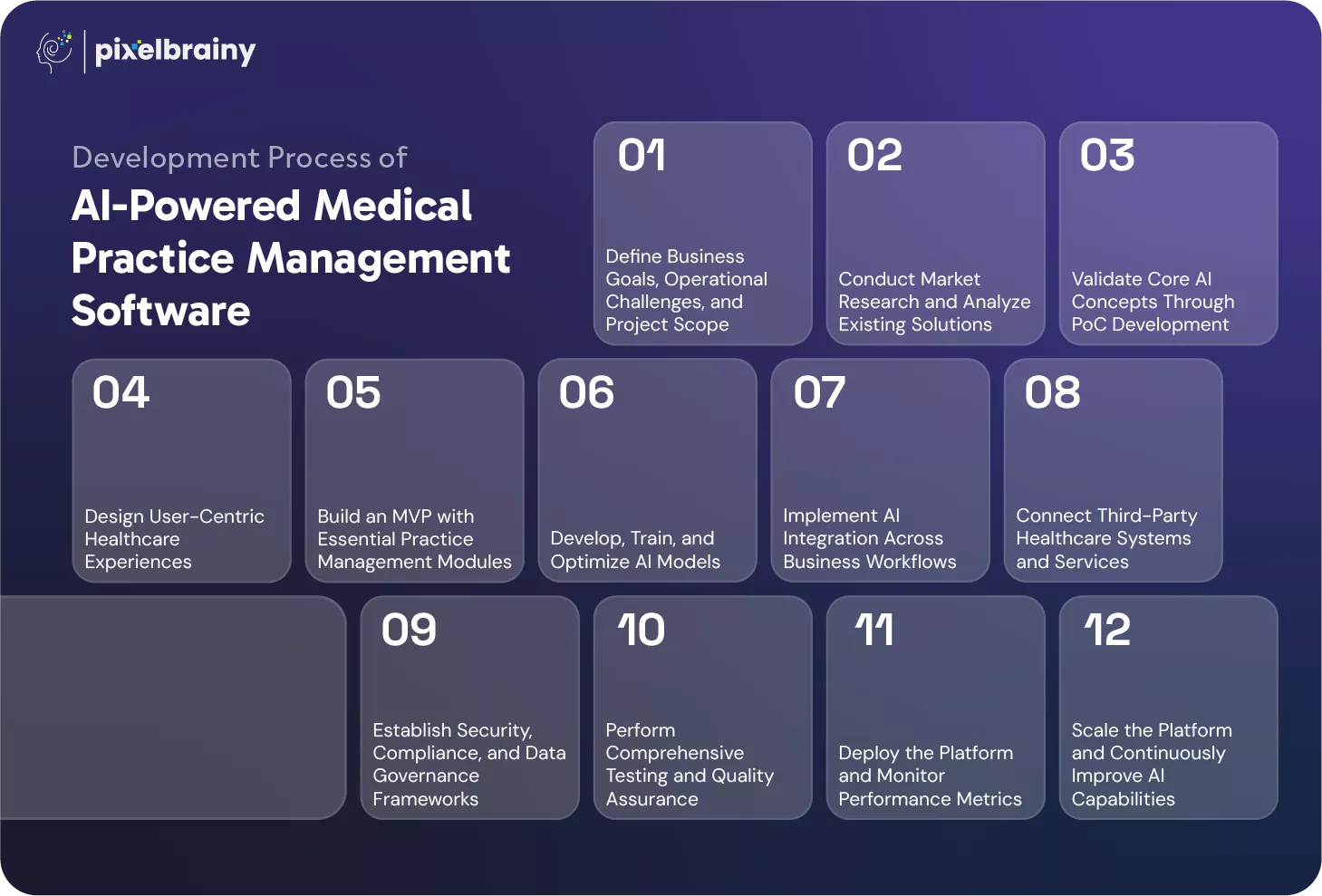
The foundation of every successful healthcare software project begins with understanding the specific problems the platform is expected to solve. Many healthcare organizations face challenges such as appointment scheduling inefficiencies, increasing administrative workload, claim denials, physician burnout, fragmented patient data, and rising operational costs.
Before development begins, clearly define:
This stage helps establish project priorities and ensures development efforts align with measurable business outcomes. The more clearly the scope is defined, the easier it becomes to develop a platform that delivers meaningful value.
Once business goals are established, the next step is understanding the competitive landscape and identifying opportunities for innovation.
Research should focus on:
Many organizations also evaluate products developed by top AI healthcare software development companies to understand industry benchmarks and identify capabilities that can create competitive differentiation.
This research phase helps validate demand, uncover feature priorities, and reduce the risk of developing functionality that users may not need.
Artificial intelligence is often the most complex and resource-intensive component of the platform. Before investing in full-scale development, healthcare organizations should validate their most critical AI assumptions through PoC development.
A proof of concept helps determine whether proposed AI capabilities can achieve the desired outcomes.
For example:
Validating these assumptions early minimizes development risks and provides confidence that the selected AI models can perform effectively within real healthcare environments.
Healthcare software must be designed for speed, clarity, and efficiency. Physicians, administrators, billing teams, nurses, and patients all interact with the platform differently, making user experience a critical success factor.
During this phase, teams create workflows, wireframes, user journeys, and interface designs that support everyday healthcare operations.
Key focus areas include:
Working with an experienced UI/UX design company helps ensure the platform remains easy to use while handling complex healthcare workflows. A well-designed interface can significantly improve user adoption and reduce training requirements after deployment.
Rather than developing a feature-rich enterprise platform immediately, healthcare organizations typically begin with MVP development to validate functionality in a real-world environment.
The MVP should include the most critical operational components such as:
Launching a minimum viable product allows organizations to gather user feedback, identify workflow improvements, and validate business assumptions before committing additional resources to advanced development phases.
This approach accelerates time-to-market while reducing financial and technical risk.
Also Read: Top AI MVP Development Companies in USA
Once the foundational platform is in place, attention shifts toward developing the artificial intelligence capabilities that will drive automation and predictive decision-making.
Depending on project goals, AI functionality may include:
Machine learning models are trained using historical healthcare and operational datasets to identify patterns and generate accurate predictions. Continuous testing and optimization are essential to ensure the models perform reliably in real-world scenarios.
The effectiveness of AI features depends heavily on data quality, training methodology, and ongoing refinement.
Developing AI models is only part of the process. To generate measurable business value, organizations must ensure seamless AI integration across operational workflows.
AI capabilities should be embedded directly into daily healthcare processes rather than functioning as isolated tools.
This includes integration with:
When AI is integrated effectively, staff members receive intelligent recommendations and automation support within their existing workflows, creating a smoother and more productive user experience.
Healthcare organizations rarely operate using a single software platform. Most practices depend on multiple systems that must exchange information securely and accurately.
Key integrations often include:
Supporting healthcare interoperability standards such as HL7 and FHIR ensures seamless data exchange and enables a more connected healthcare ecosystem.
Without strong integration capabilities, even the most advanced AI platform may struggle to deliver operational value.
Healthcare data is among the most sensitive information organizations manage. Security and compliance must be embedded into the platform architecture from the earliest stages of development.
Critical implementation areas include:
Strong governance policies help healthcare organizations maintain trust, avoid regulatory penalties, and protect patient information from evolving cybersecurity threats.
Before deployment, every component of the platform must undergo extensive testing to ensure reliability, accuracy, and security.
Testing activities should include:
This phase helps identify issues before launch and ensures the system can handle real-world healthcare workloads without compromising performance or patient data security.
After successful testing, the platform can be deployed in a controlled production environment. However, deployment should be viewed as the beginning of the optimization journey rather than the final step.
Organizations should continuously monitor:
Monitoring these indicators helps healthcare providers measure ROI and identify opportunities for future enhancements.
As healthcare organizations grow, their software must evolve with changing operational requirements and patient expectations.
Over time, additional capabilities can be introduced, including:
Continuous model retraining, feature enhancements, and workflow optimization ensure the platform remains accurate, scalable, and aligned with emerging healthcare trends.
Following a structured AI medical practice management software development process helps healthcare organizations build a secure, intelligent, and future-ready platform that improves operational efficiency, increases revenue, strengthens compliance, and delivers better patient experiences at every stage of growth.
One of the most common questions healthcare organizations ask before starting a project is: "How much does it cost to develop AI-powered medical practice management software?"
The answer depends on several factors, including platform complexity, AI capabilities, compliance requirements, third-party integrations, and deployment scale. Unlike traditional practice management systems, AI-powered platforms require additional investments in machine learning models, NLP engines, AI infrastructure, healthcare data security, and ongoing model optimization.
As a result, the AI medical practice management software development cost can vary significantly based on the scope of functionality and the level of intelligence built into the platform.
| Development Tier | Estimated Cost | Ideal For | Key Features |
|---|---|---|---|
| Basic AI-Powered PMS (MVP) | $50,000 – $90,000 | Small clinics, healthcare startups, single-location practices | Appointment scheduling, patient management, billing, basic AI automation, reporting dashboard, HIPAA-compliant architecture |
| Intermediate AI-Powered PMS | $100,000 – $250,000 | Growing clinics, multi-specialty practices, outpatient centers | AI scheduling, automated billing, NLP documentation, predictive analytics, EHR integration, patient communication automation |
| Enterprise AI-Powered PMS | $250,000 – $350,000+ | Hospital networks, healthcare enterprises, multi-location providers | Custom AI models, agentic AI workflows, enterprise security, advanced analytics, multi-location management, full EHR and insurance integration |
The total cost to build AI powered medical practice management software is influenced by several technical, operational, and compliance-related components.
| Cost Factor | Estimated Cost |
|---|---|
| AI Model Development and Training | $20,000 – $80,000 |
| EHR Integration (Per Platform) | $15,000 – $80,000 |
| NLP and Ambient AI Scribing Module | $25,000 – $60,000 |
| UI/UX Design for Clinical Workflows | $10,000 – $30,000 |
| QA, Security Audit, and Compliance Testing | $15,000 – $40,000 |
| HIPAA Compliance Architecture | Adds 15% – 25% to total project cost |
| Cloud Infrastructure (HIPAA-Compliant AWS/Azure Environment) | $300 – $600 per month per provider |
| Post-Launch AI Monitoring and Maintenance | $2,000 – $8,000 per month |
Many healthcare organizations underestimate the cost difference between a traditional practice management system and an AI-powered platform.
Traditional PMS solutions mainly focus on administrative workflows such as scheduling, billing, and patient record management. However, AI-powered systems require additional investments in intelligence layers that significantly increase development complexity.
Custom AI models require healthcare-specific datasets, model training, testing, optimization, and ongoing retraining to maintain accuracy. The more advanced the predictive capabilities, the higher the development investment.
Estimated Cost: $20,000 to $80,000
If the platform includes AI-generated clinical notes, physician dictation processing, or conversation-to-documentation capabilities, Natural Language Processing models must be implemented and fine-tuned.
Estimated Cost: $25,000 to $60,000
Many healthcare organizations integrate large language models such as GPT, Claude, or Gemini to power chatbots, documentation assistants, and workflow automation.
Costs vary based on:
Estimated Cost: Variable based on usage and provider pricing.
Healthcare software requires significantly stronger security controls than standard business applications. Features such as encryption, audit logging, access controls, backup systems, and compliance monitoring increase both development and infrastructure costs.
Impact on Project Cost: Typically adds 15% to 25% to the total development budget.
If a mid-sized clinic wants to create a custom AI-driven practice management platform with:
The realistic investment typically falls between $120,000 and $180,000, depending on the number of integrations, AI complexity, and scalability requirements.
Healthcare organizations can optimize budgets by:
This phased approach reduces risk while accelerating time-to-market.
For most healthcare organizations, the cost to create a custom AI medical practice management system should be viewed as a long-term operational investment rather than a software expense. A well-designed platform can reduce administrative costs, improve claim approval rates, increase provider productivity, strengthen compliance, and deliver measurable ROI for years after deployment.
In 2026, healthcare providers typically need to budget between $50,000 and $350,000+ for AI medical practice management software development, depending on the platform's complexity, AI capabilities, integration requirements, and long-term scalability goals.
The success of an AI-powered medical practice management platform depends heavily on the technologies used behind the scenes. Features such as predictive scheduling, automated billing, AI documentation, patient communication automation, revenue forecasting, and compliance monitoring require a sophisticated combination of software frameworks, AI models, cloud infrastructure, healthcare standards, and security technologies.
Healthcare organizations planning AI medical practice management software development often ask questions such as: What technologies are used to build AI-powered medical practice management software?, Which AI tools are required for healthcare practice management systems?, and What technology stack is best for developing AI-based medical practice management software in 2026?
The answer lies in building a technology ecosystem that supports scalability, interoperability, security, regulatory compliance, and advanced artificial intelligence capabilities. Modern healthcare platforms must seamlessly connect with EHR systems, insurance providers, payment gateways, telehealth solutions, and clinical workflows while processing large volumes of healthcare data in real time.
The following technologies are commonly used to build AI powered medical practice management software that can support both current operational needs and future AI-driven innovations.
| Technology Category | Tools & Technologies | Purpose |
|---|---|---|
| Frontend Development | React.js, Angular, Vue.js, Next.js | Creates intuitive dashboards, patient portals, scheduling interfaces, billing screens, and administrative panels with responsive user experiences. |
| Backend Development | Node.js, Python, Java, .NET Core | Manages business logic, workflow automation, APIs, data processing, authentication, and platform scalability. |
| AI & Machine Learning Frameworks | TensorFlow, PyTorch, Scikit-learn, XGBoost | Powers predictive scheduling, billing intelligence, patient analytics, demand forecasting, and operational optimization. |
| Large Language Models (LLMs) | OpenAI GPT, Anthropic Claude, Google Gemini | Enables AI assistants, automated documentation, intelligent search, patient communication, and workflow automation. |
| Natural Language Processing (NLP) | spaCy, BioBERT, Med-PaLM, Hugging Face Transformers | Processes clinical text, generates medical notes, extracts healthcare insights, and supports ambient AI documentation. |
| Databases | PostgreSQL, MongoDB, MySQL, Redis | Securely stores patient information, billing records, appointments, AI outputs, and healthcare operational data. |
| Cloud Infrastructure | AWS, Microsoft Azure, Google Cloud Platform | Provides scalable hosting, healthcare-compliant environments, AI deployment, disaster recovery, and secure storage. |
| Healthcare Interoperability Standards | HL7, FHIR, ICD-10, CPT, SNOMED CT | Ensures seamless communication between EHRs, hospitals, insurance systems, laboratories, and practice management platforms. |
| API & Integration Technologies | REST APIs, GraphQL, MuleSoft, Boomi | Connects third-party healthcare systems, telehealth tools, payment platforms, insurance databases, and EHR solutions. |
| Security & Compliance Technologies | OAuth 2.0, JWT, AES-256 Encryption, Multi-Factor Authentication | Protects sensitive patient data and supports HIPAA, GDPR, and healthcare security requirements. |
| Analytics & Business Intelligence | Power BI, Tableau, Apache Superset | Delivers operational reports, financial dashboards, patient trends, and predictive business insights. |
| DevOps & Deployment Tools | Docker, Kubernetes, Jenkins, GitHub Actions | Supports continuous deployment, scalability, system reliability, and faster software updates. |
| Telehealth Technologies | Twilio, Agora, Vonage, Zoom SDK | Enables virtual consultations, secure video conferencing, messaging, and remote patient interactions. |
| Speech Recognition & Ambient AI Tools | Whisper, Deepgram, Amazon Transcribe | Converts provider-patient conversations into structured documentation and clinical notes automatically. |
| Monitoring & Performance Management | Datadog, New Relic, Grafana, Prometheus | Tracks system performance, application health, infrastructure usage, and AI model effectiveness. |
Every technology layer contributes to the overall success of an AI-powered medical practice management system. While AI frameworks provide intelligence, healthcare interoperability standards enable data exchange, cloud platforms ensure scalability, and security technologies protect sensitive patient information.
Organizations planning AI medical practice management software development should focus on creating a future-ready technology stack capable of supporting automation, analytics, compliance, and continuous innovation as healthcare operations evolve.
The right combination of AI, cloud, security, and healthcare technologies creates the foundation for a scalable medical practice management platform that can deliver long-term operational and clinical value.
One of the most important decisions healthcare organizations face is whether to invest in custom AI medical practice management software development or purchase an existing off-the-shelf platform. The right choice depends on your organization's size, growth plans, workflow complexity, compliance requirements, and long-term technology strategy.
For some clinics, a ready-made solution may provide enough functionality to support daily operations. For others, especially multi-specialty practices, hospital networks, and rapidly growing healthcare providers, standard software often creates limitations that affect efficiency, scalability, and innovation.
If you are wondering, "Should I build custom AI medical practice management software or buy an existing solution?", understanding the strengths and limitations of each approach is essential.
Custom development involves building a platform specifically around your organization's workflows, business goals, compliance requirements, and AI strategy.
Advantages of Custom AI Medical Practice Management Software
Potential Considerations:
Off-the-shelf solutions are pre-built platforms designed to serve a broad range of healthcare providers with standardized features and workflows.
Advantages of Off-the-Shelf Solutions:
Potential Limitations:
Many healthcare organizations initially choose off-the-shelf platforms because of the lower implementation cost. However, over time, recurring licensing fees, integration charges, customization requests, user expansion costs, and vendor dependency can increase the total cost of ownership substantially.
Custom development typically requires a larger initial investment but often provides greater long-term value for organizations with complex workflows, multiple locations, or ambitious growth plans.
An off-the-shelf platform may be the better choice if:
A custom solution is often the better option if:
For small practices with standard operational needs, an off-the-shelf platform can provide a fast and cost-effective starting point. However, healthcare organizations focused on growth, advanced automation, operational efficiency, and AI-driven innovation often gain greater long-term value from custom AI medical practice management software development, especially when scalability, flexibility, and competitive advantage are critical business priorities.
The decision is simple: buy when standardization meets your needs, but build when your workflows, AI requirements, and growth strategy demand a platform designed specifically for your healthcare organization.
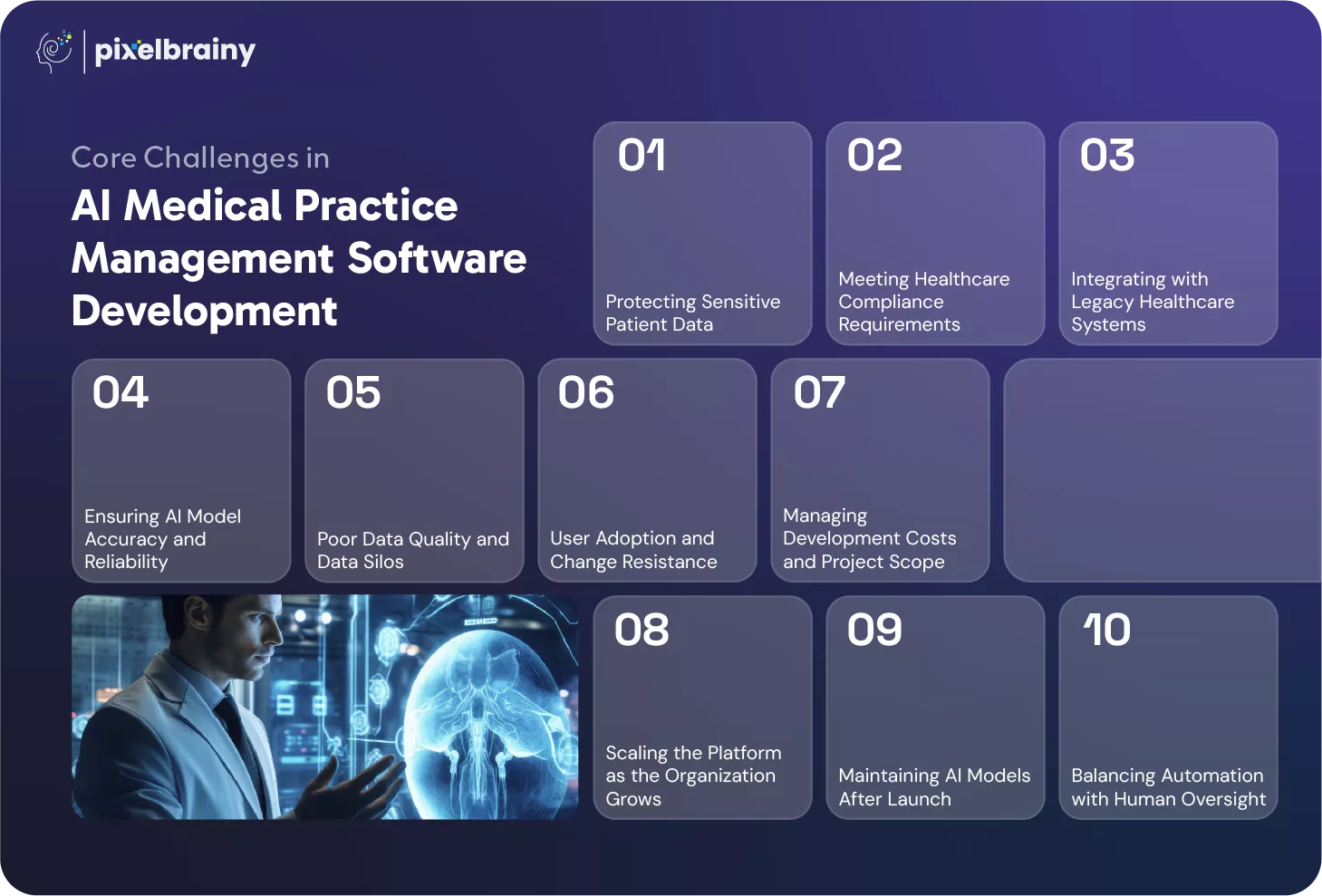
While the benefits of AI-powered practice management systems are significant, developing a healthcare-grade platform is far more complex than building traditional business software. Healthcare organizations must navigate strict regulatory requirements, sensitive patient data, complex integrations, and AI reliability concerns while ensuring the platform remains scalable and user-friendly.
Understanding these challenges early helps organizations reduce development risks, control costs, and improve implementation success. Below are the most common obstacles encountered during AI medical practice management software development and the strategies used to overcome them.
Medical practice management systems handle highly sensitive patient information, including medical records, insurance details, billing data, and personal identifiers. Any security vulnerability can result in compliance violations, financial penalties, and loss of patient trust.
How to Resolve It:
A security-first development approach should be incorporated from the beginning rather than added after deployment.
Healthcare software must comply with regulations such as HIPAA, GDPR, HITECH, and regional healthcare data protection laws. Compliance failures can delay product launches and expose organizations to legal risks.
How to Resolve It:
Building compliance into the platform architecture reduces long-term risk and simplifies future audits.
Many healthcare providers still rely on older EHRs, billing platforms, laboratory systems, and insurance databases. These systems often use different standards and communication protocols, making integration difficult.
How to Resolve It:
Strong interoperability ensures seamless data exchange across healthcare ecosystems.
AI models are only as effective as the data used to train them. Inaccurate predictions, billing recommendations, or scheduling decisions can negatively impact patient care and business operations.
How to Resolve It:
Reliable AI requires ongoing optimization rather than a one-time implementation.
Many healthcare organizations store information across multiple disconnected systems. Incomplete, duplicated, or inconsistent data can reduce the effectiveness of AI-powered features and analytics.
How to Resolve It:
Clean, structured data significantly improves AI performance and reporting accuracy.
Healthcare professionals often work under significant time pressure. If a new system feels complicated or disrupts existing workflows, adoption rates can suffer regardless of how advanced the technology is.
How to Resolve It:
Successful AI implementation depends as much on usability as it does on technology.
Healthcare organizations frequently underestimate the complexity of AI initiatives. Expanding requirements, additional integrations, and compliance demands can increase budgets and timelines.
How to Resolve It:
A phased development approach reduces risk while ensuring steady progress.
A solution that works for a single clinic may struggle to support multiple locations, thousands of patients, and growing data volumes. Scalability challenges often emerge after deployment.
How to Resolve It:
Scalability should be considered during the initial architecture phase rather than after growth occurs.
Many organizations focus heavily on development but underestimate the ongoing effort required to maintain AI performance. Healthcare workflows, patient behavior, and regulatory requirements evolve over time.
How to Resolve It:
Continuous improvement ensures AI systems remain relevant and effective.
AI can automate many administrative tasks, but healthcare decisions often require human judgment. Overreliance on automation can create operational and compliance risks.
How to Resolve It:
The most effective healthcare platforms combine AI efficiency with human expertise.
The biggest challenges in AI medical practice management software development are not related to technology alone. They involve balancing security, compliance, interoperability, AI accuracy, user adoption, and scalability within a highly regulated healthcare environment. Organizations that proactively address these challenges can build intelligent, compliant, and future-ready platforms that deliver lasting operational and financial value.
When you plan to develop an AI-powered medical practice management platform, choosing the right technology partner becomes just as important as selecting the right features. Healthcare software requires expertise in AI, compliance, workflow automation, EHR integrations, billing systems, data security, and healthcare operations. A development team that understands these complexities can significantly reduce project risks and accelerate time-to-market.
Many healthcare organizations ask questions like: "We are a growing healthcare provider looking for a reliable partner to build a custom AI-powered medical practice management system with scheduling, billing, EHR integration, and compliance features. How do we choose the right development company?"
The answer lies in finding a partner with both healthcare domain expertise and proven AI development capabilities.
PixelBrainy helps healthcare startups, clinics, multi-specialty practices, telehealth providers, and hospital networks build intelligent, HIPAA-compliant practice management solutions tailored to their operational goals. From AI-powered scheduling and billing automation to NLP-based documentation and predictive analytics, our team manages the complete development lifecycle from strategy to deployment.
Client Type: Multi-Location Healthcare Provider
Business Challenge:
Solution Delivered by PixelBrainy:
Business Impact:
As an experienced AI healthcare software development company, PixelBrainy combines healthcare workflow expertise, secure architecture, seamless third-party integrations, and long-term support to deliver scalable AI development solutions for medical practice management software that generate measurable business outcomes.
Planning to build AI-powered medical practice management software? PixelBrainy can help define the right roadmap, feature set, and AI strategy for your healthcare organization.
AI is rapidly transforming how healthcare organizations manage operations, patient interactions, billing workflows, compliance requirements, and administrative efficiency. As patient volumes continue to rise and healthcare systems become more complex, traditional practice management software is no longer sufficient for organizations seeking scalability and long-term growth.
Investing in AI-powered medical practice management software development enables healthcare providers to automate repetitive tasks, reduce billing errors, optimize scheduling, improve patient engagement, strengthen compliance, and gain actionable insights through predictive analytics. From multi-specialty clinics and telehealth providers to hospital networks and healthcare startups, AI-driven platforms are helping organizations improve operational performance while delivering better patient experiences.
The key to success lies in choosing the right development approach, prioritizing high-impact AI features, building a secure and compliant architecture, and partnering with an experienced healthcare technology team that understands both AI and healthcare workflows.
Organizations that embrace AI today will be better positioned to improve efficiency, increase profitability, and deliver smarter healthcare experiences in the years ahead.
Ready to build your AI-powered medical practice management software? Book a consultation with PixelBrainy today and discuss your project requirements with our healthcare technology experts.
Migration is manageable when done in phases where both systems run in parallel during transition and AI automation layers are introduced progressively after core modules go live. A well-planned migration with proper data transfer and staff training typically takes 8 to 16 weeks depending on your data volume and existing integrations.
AI validates claims before submission by detecting coding errors, missing documentation, and eligibility mismatches in real time so issues are fixed before they become denials. Practices using AI billing automation have reported denial rate reductions of 30% to 50%, directly improving cash flow and reimbursement speed.
A basic AI-powered MVP takes 4 to 6 weeks, an intermediate system with full AI features and EHR integration takes 8 to 12 weeks, and an enterprise-grade platform takes 12 to 18 weeks. Starting with an MVP and building iteratively is the most cost-effective and low-risk approach.
HIPAA compliance must be architected from day one and includes end-to-end encryption, role-based access control, full audit trails, and Business Associate Agreements with all AI and cloud service providers. Any AI model processing patient data must operate within a fully HIPAA-compliant environment as retrofitting this after development is expensive and legally risky.
If you are building a SaaS product to sell to other practices, custom development is the only viable path since you need full control over the AI layer and feature roadmap. For internal clinic use, off-the-shelf tools may work short term but most growing practices hit their ceiling quickly due to limited customization and scaling costs.

About The Author
Sagar Bhatnagar
Sagar Sahay Bhatnagar brings over a decade of IT industry experience to his role as Marketing Head at PixelBrainy. He's known for his knack in devising creative marketing strategies that boost brand visibility and market influence. Sagar's strategic thinking, coupled with his innovative vision and focus on results, sets him apart. His track record of successful campaigns proves his ability to utilize digital platforms effectively for impactful marketing efforts. With a genuine passion for both technology and marketing, Sagar continuously pushes PixelBrainy's marketing initiatives to greater success.


Transform your ideas into reality with us.
Working with the PixelBrainy team has been a highly positive experience. They understand the design requirements and create beautiful UX elements to meet the application needs. The dev team did an excellent job bringing my vision to life. We discussed usability and flow. Sagar worked with his team to design the database and begin coding. Working with Sagar was easy. He has the knowledge to create robust apps, including multi-language support, Google and Apple ID login options, Ad-enabled integrations, Stripe payment processing, and a Web Admin site for maintaining support data. I'm extremely satisfied with the services provided, the quality of the final product, and the professionalism of the entire process. I highly recommend them for Android and iOS Mobile Application Design and Development.

Great experience working with them. Had a lot of feedback and I found that unlike most contractors they were bugging me for updates instead of the other way around. They were extremely time conscience and great at communicating! All work was done extremely high quality and if not on time, early! They were always proactive when it comes to communication and the work is great/above par always. Very flexible and a great team to work with! Goes above and beyond to present us with multiple options and always provides quality. Amazing work per usual with Chitra. If you have UI/UX or branding design needs I recommend you go to them! Will likely work with them in the future as well, definitely recommended!

PixelBrainy is a joy to work with and is a great partner when thinking through branding, logo, and website layout. I appreciate that they spend time going into the "why" behind their decisions to help inform me and others about industry best practices and their expertise.

I hired them to design our software apps. Things I really like about them are excellent communication skills, they answer all project suggestions and collaborate right away, and their input on design and colors is amazing. This project was complex and needed patience and creativity. The team is amazing to do business with. I will be using them long-term. Glad to see there are some good people out there. I was afraid to try and outsource my project to someone but I am glad I met them! I really can't say enough. They went above and beyond on this project. I am very happy with everything they have done to make my business stand out from the competition.

It was great working with PixelBrainy and the team. They were very responsive and really owned the project. We'll definitely work with them again!

I recently worked with the PixelBrainy team on a project and I was blown away by their communication skills. They were prompt, clear, and articulate in all of our interactions. They listened and provided valuable feedback and suggestions to help make the project a success. They also kept me updated throughout the entire process, which made the experience stress-free and enjoyable.

PixelBrainy is very good at what it does. The team also presents themselves very professionally and takes care of their side of things very well. I could fully trust them taking up the design work in a timely and organised manner and their attention to detail saved us lots of effort and time. This particular project was quite intense and the team showed that they function very well under pressure. Very much looking forward to working with her again!

It's always an absolute pleasure working with them. They completed all of my requests quickly and followed every note I had for them to a T, which made our process go smoothly from start to finish. Everything was completed fast and following all of the guidelines. And I would recommend their services to anyone. If you need any design work done in the future, PixelBrainy should be your first call!

They took ownership of our requirements and designed and proposed multiple beautiful variants. The team is self-motivated, requires minimum supervision, committed to see-through designs with quality and delivering them on time. We would definitely love to work with PixelBrainy again when we have any requirements.

PixelBrainy was a big help with our SaaS application. We've been hard at work with a new UI/UX and they provided a lot of help with the designs. If you're looking for assistance with your website, software, or mobile application designs, PixelBrainy and the team is a great recommendation.

PixelBrainy designers are amazing. They are responsive, talented, and always willing to help craft the design until it matches your vision. I would recommend them and plan to continue them for my future projects and more!!!

They were awesome! Did a good job fast, and good communication. Will work with them again. Thank you

Creative, detail-oriented, and talented designers who take direction well and implement changes quickly and accurately. They consistently over-delivered for us.

PixelBrainy team is very talented and creative. Great designers and a pleasure to work with. PixelBrainy is an excellent communicator and I look forward to working with them again.

PixelBrainy has a very talented design team. Their work is excellent and they are very responsive. I enjoy working with them and hope to continue on all of our future projects.


