
 AI Summary Powered by PixelBrainy
“Drivers spend an average of 17 hours a year searching for parking, wasting valuable time, burning fuel, and increasing urban congestion.” In 2026, with city populations growing and vehicle ownership on the rise, parking remains one of the most frustrating daily challenges for drivers worldwide. Fortunately, technology has evolved to tackle this issue head-on, and artificial intelligence is leading the charge.
The emergence of smart cities, connected infrastructure, real-time data processing, and machine learning has paved the way for the development of the AI Parking Finder App. This intelligent mobile solution does far more than just show parking locations. It leverages predictive analytics, computer vision, and sensor data to forecast parking availability, optimize routing, and enhance the overall driving experience.
But how do you build an AI Parking Finder App in 2026? What are the key components, technologies, and steps involved in the process? From selecting the right tech stack to integrating AI models and creating a user-friendly interface, AI Parking Finder App development requires thoughtful planning and execution.
In this comprehensive blog, we will walk you through every essential aspect of the development journey. You will learn what an AI Parking Finder App is, how it works, the benefits it offers, what features to include, and how to navigate the development process successfully.
Whether you are a startup founder, mobility innovator, or enterprise leader, this guide will equip you to build smarter, more efficient parking solutions powered by AI.
An AI Parking Finder App is a smart application that helps users locate and reserve available parking spaces in real-time using artificial intelligence and machine learning. By analyzing data from sensors, cameras, and historical patterns, the app can predict parking availability, guide users to nearby spots, and streamline the entire parking experience.
It typically includes features like live parking maps, in-app navigation, digital payments, and advanced filters such as EV charging or covered parking options.
Who uses it?
This app is a key tool in modern urban mobility, helping cities and drivers manage parking smarter and more efficiently.
The core idea behind an AI Parking Spot Finder App is to eliminate the guesswork and frustration of looking for parking. It combines artificial intelligence, real-time data, and smart navigation to help users find, reserve, and reach parking spots with ease.
Here’s how it works from a user’s perspective:
As soon as you open the app, it identifies your current GPS location or allows you to enter your destination manually. Whether you're searching near your home, office, a shopping mall, or a concert venue, the app starts by understanding where you need to park.
By tapping a simple button like “Find Parking Near Me,” the app begins scanning nearby areas for available parking spaces. This includes both street-level parking and nearby garages, depending on data availability.
The app gathers data from multiple sources:
AI algorithms process this information in seconds to determine the most accurate view of current availability.
One of the biggest advantages of an AI Parking Finder App is its ability to predict future availability. Using machine learning, it analyzes:
Even if no sensors are available, the AI can estimate where a spot is likely to be free when you arrive.
The app then shows you a list or map of nearby spots with useful filters:
You can sort options based on what matters most to you.
Once you choose a spot:
Some apps also integrate with license plate recognition or QR code scanning for seamless entry and exit.
After parking, users can rate the spot and provide feedback for others. The app also stores your parking history for easy rebooking and receipts.
If you're wondering how to find parking near me without stress, an AI Parking Spot Finder App makes it possible by combining predictive analytics, real-time data, and intelligent guidance. The result is less time spent searching and more time spent where you want to be.
This is exactly how an AI parking app works. It turns complex data into a seamless, user-friendly experience.
As urban areas grow more congested, the demand for smart, efficient parking solutions continues to rise. Businesses that create AI Parking Finder App platforms not only solve a real-world problem but also unlock new revenue streams and competitive advantages.
Here's how Parking Finder App Development using AI can benefit your business:
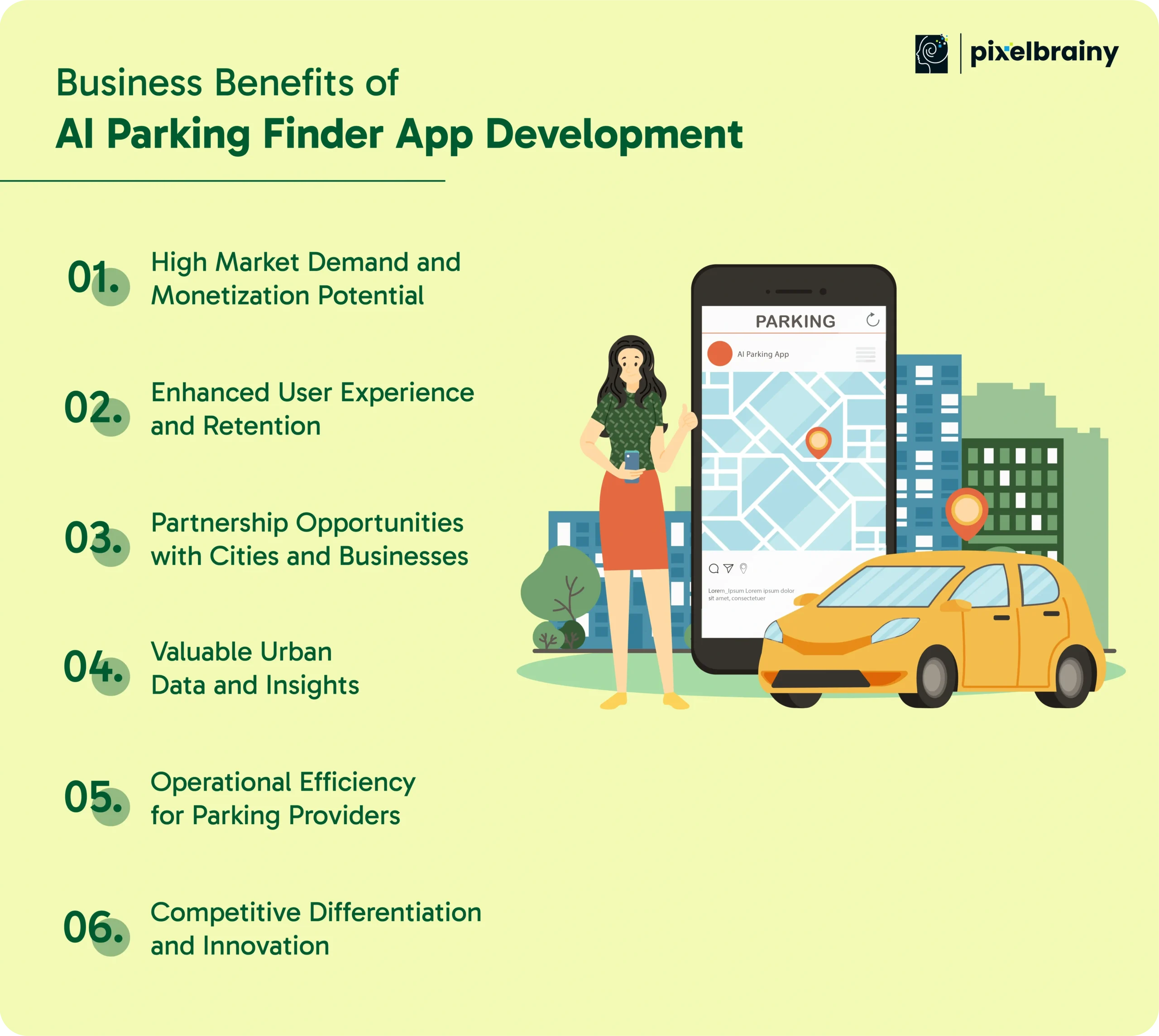
The growing need for intelligent parking solutions means there is strong user demand. You can monetize the app through subscriptions, in-app advertisements, reservation fees, or partnerships with parking lot owners. The building of AI Parking Finder App opens up a profitable space in the mobility tech market.
AI-driven personalization, real-time updates, and predictive availability reduce frustration and waiting time. A smoother user experience leads to higher retention and more frequent app usage, increasing long-term customer value.
Smart cities and municipalities are actively seeking digital solutions to reduce congestion. By offering your AI-powered parking app, you can partner with local governments, shopping centers, and event venues for exclusive integration and revenue-sharing models.
When you create AI Parking Finder App solutions, you also generate large volumes of urban mobility data. This data can be anonymized and analyzed to help city planners, traffic departments, and property developers make better infrastructure decisions.
AI can optimize parking space usage, dynamic pricing, and traffic flow. Parking lot owners and operators benefit from better occupancy rates, reduced manual operations, and insights into user patterns.
Parking Finder App Development using AI sets your brand apart by offering smarter, more efficient services compared to traditional apps. Being an early adopter of AI in urban mobility strengthens your market positioning and technological credibility.
By choosing to create an AI Parking Finder App, you are not just building a product. You are investing in a scalable solution with real business impact, future-ready technology, and strong market demand. The opportunities for growth, revenue, and innovation are endless.
Choosing the right business model is crucial to ensure long-term sustainability and profitability for your AI Parking Finder App. It defines how your app will generate revenue, engage users, and deliver value to drivers, parking providers, and city authorities alike.
Below are the most effective and scalable business models to consider when planning your AI parking app:
The freemium model allows users to access essential features at no cost, while premium functionalities are available through in-app purchases or subscriptions. This strategy helps attract a wide user base and gradually converts free users into paying customers.
How it works: Users can search for nearby parking and check real-time availability for free. However, advanced features such as guaranteed reservations, predictive suggestions, or exclusive filters are available only to premium users.
Benefits:
A subscription model charges users a recurring monthly or annual fee in exchange for full access to all features. It is especially appealing to frequent drivers, commuters, and corporate fleet users.
How it works: Subscribers receive unlimited access to all app features, including smart navigation, priority reservations, ad-free usage, and exclusive parking insights. Different tiers can be offered to suit individuals or businesses.
Benefits:
This model positions your app as a platform that connects users with parking providers, and you earn a commission on each transaction completed through the app.
How it works: Every time a user books and pays for a parking space, your platform receives a percentage of the total transaction. This model is effective in marketplaces where multiple parking owners list their spots on your app.
Benefits:
With high app traffic, you can monetize through strategic advertising and featured listings. Local businesses and parking operators can promote their services directly to users within the app.
How it works: Ad space is sold to advertisers who want visibility among your users. This includes banner ads, promoted parking listings, and targeted offers from nearby retailers or venues.
Benefits:
As your app collects data on parking behavior and urban traffic, this information becomes a valuable asset for third-party organizations interested in transportation and infrastructure planning.
How it works: You license anonymized and aggregated data to municipalities, real estate developers, transportation planners, or logistics companies to help them make informed decisions.
Benefits:
If your platform is technically robust and adaptable, you can offer it as a white-label solution to other businesses or government agencies that need their own branded version of a parking app.
How it works: You license your app to clients like airports, universities, municipalities, or real estate groups. They rebrand the platform with their own identity while using your underlying technology.
Benefits:
The success of your AI Parking Finder App depends not only on its technology but also on how effectively it monetizes user engagement and partner collaboration.
Many successful apps use a combination of models, such as offering a freemium experience alongside commissions and advertisements. Align your business model with your target audience, product goals, and regional market dynamics to build a profitable and sustainable platform.

To ensure successful development of AI Parking Finder App, it's essential to include core features that solve real parking challenges while delivering a smooth and intuitive user experience. Whether you’re looking to launch an MVP or scale a complete solution, these key features form the foundation of effective Parking Finder App Development with AI.
Here’s a breakdown of the top 10 core features you should consider when you make AI Parking Finder App:
| Feature | Description |
| Real-Time Parking Availability | Shows users up-to-date parking space status using sensor data and AI-powered detection for faster decisions |
| Location-Based Search | Allows users to find parking near their current location or chosen destination with GPS integration |
| Predictive Spot Availability | Uses AI to forecast future parking availability based on traffic patterns and historical data |
| Smart Filters & Preferences | Lets users filter by pricing, type (street, garage), EV charging, or accessibility to match specific needs |
| In-App Navigation | Offers turn-by-turn guidance from the user’s location to the selected parking spot for convenience |
| Reservation & Booking System | Enables users to reserve parking spots in advance, reducing last-minute stress and improving planning |
| Integrated Payment Gateway | Supports secure digital payments directly through the app with cards, wallets, or UPI |
| User Account & History | Stores past bookings, receipts, and user preferences for a more personalized experience |
| Reviews & Ratings | Allows users to rate and review parking spots to help others make informed decisions |
| Admin Panel for Lot Owners | Gives parking providers a dashboard to manage availability, pricing, and reservations efficiently |
These features are not just essential for usability. They are key to ensuring competitive advantage and long-term success in the development of AI Parking Finder App. Including them will help you make AI Parking Finder App solutions that are reliable, scalable, and user-friendly.
To stand out in today’s competitive mobility market, offering core features is not enough. Advanced functionalities powered by artificial intelligence and real-time technologies can significantly enhance the user experience and increase app value. Integrating these features during AI Parking Finder App Development ensures that your solution remains future-ready and scalable.
If you want to successfully build AI Parking Finder App systems that compete at an enterprise level, consider adding the following innovations during your Parking Finder App Development using AI:
| Advanced Feature | Description |
| AI-Powered Dynamic Pricing | Automatically adjusts parking rates based on demand, location, and time using machine learning models to maximize lot revenue and manage flow |
| License Plate Recognition (LPR) | Uses computer vision to identify vehicles for automatic gate entry, ticketless exits, and enhanced security across parking zones |
| Voice Search and Commands | Allows users to interact with the app using voice commands for hands-free operation while driving, improving safety and convenience |
| Augmented Reality (AR) Parking View | Overlays real-time AR directions onto the phone camera view to guide users directly to the parking spot, especially in complex structures |
| EV Charging Station Integration | Displays available EV charging stations along with parking availability, helping electric vehicle users plan charging and parking together |
| Waitlist and Notification System | Lets users join a waitlist for occupied spots and receive instant alerts when a spot becomes available in their preferred area |
| AI-Based Heat Maps and Forecasts | Visualizes parking demand trends through heat maps and forecasts high-traffic areas based on time, day, and event data |
| Automated Parking Time Extension | Sends real-time alerts before expiration and allows users to extend their parking time remotely through the app |
| Multi-Vehicle and Fleet Support | Enables account holders to manage multiple vehicles or entire fleets, ideal for businesses or shared family usage |
| Offline Access with Cached Data | Allows users to view previously loaded maps, saved locations, and preferences even in low or no internet zones like underground parking |
Incorporating these advanced features into your AI Parking Finder App Development process will give your platform the intelligence, flexibility, and innovation it needs to thrive in smart city ecosystems. If your goal is to build AI Parking Finder App solutions that lead the industry, these technologies are no longer optional. They are expected.
After you analyzed the features of a smart parking solution and defined your goals, the next phase is execution. The process of AI Parking Finder App development involves more than coding — it demands thorough planning, intelligent design, scalable infrastructure, and the seamless use of artificial intelligence. Whether you’re targeting a niche city or planning for large-scale deployment, following a structured roadmap is key to delivering a successful product.
Below is a complete and detailed guide on how to build an AI Parking Finder App from the ground up.
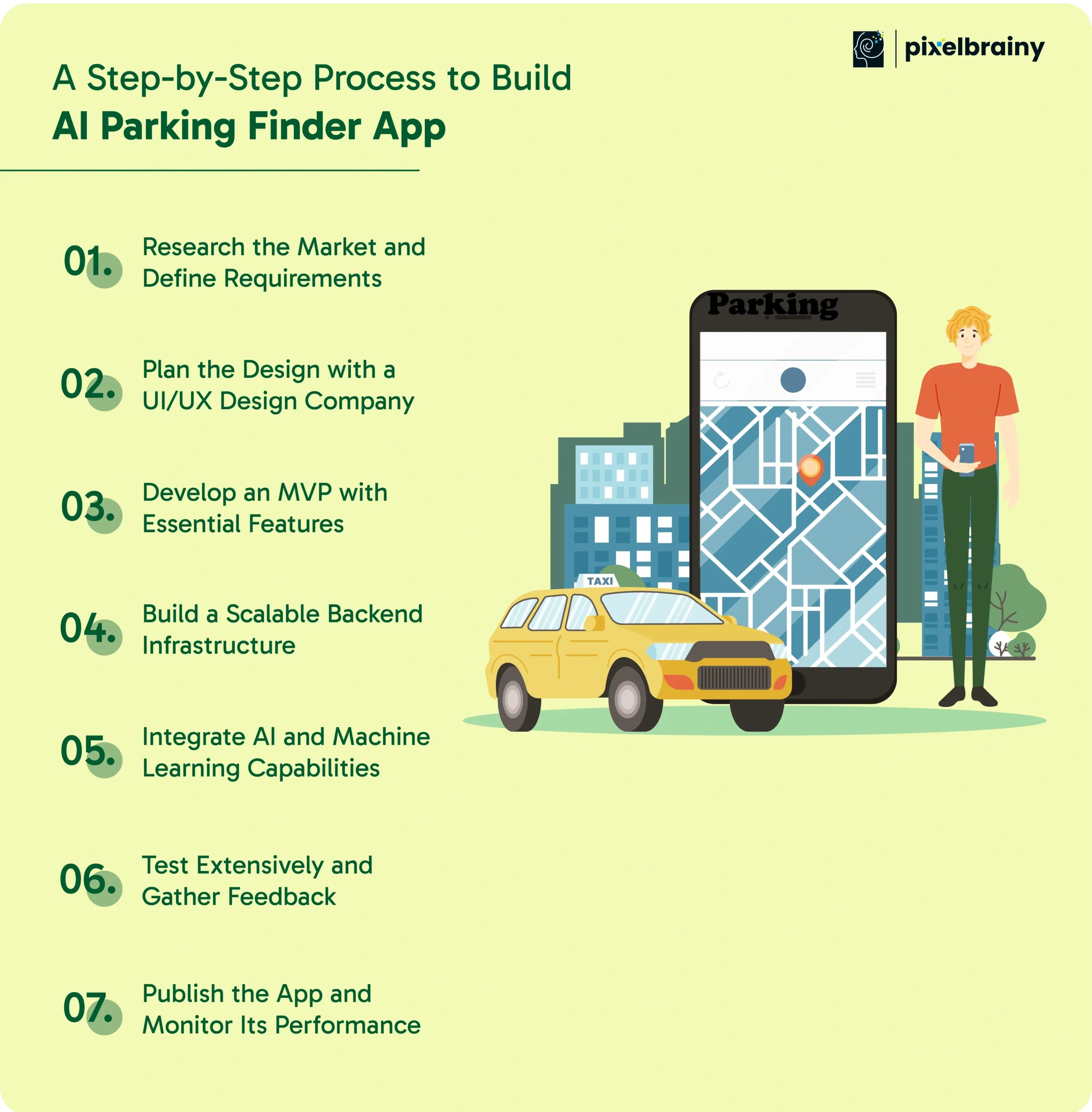
Before development begins, conduct deep research to understand the existing market landscape. Identify common pain points faced by drivers, fleet owners, and municipalities. Look into competitor apps to discover what features they offer and what users complain about.
Define a clear problem statement: What exactly will your app solve? Are you targeting residential areas, airports, or commercial zones? Will your app focus on EV users, or offer premium reserved parking?
Document all insights in a detailed product requirement brief. This will guide design, development, and future feature planning.
User interface and user experience design play a crucial role in how your app will be perceived. A cluttered, confusing UI can turn users away — especially when they're driving and need quick, real-time decisions.
Partner with a specialized UI/UX design company to create a mobile-first layout. Prioritize smooth transitions, high readability, and one-tap actions. Make sure the app flow is intuitive — from locating a spot to booking and navigating there.
Also design dashboards for parking lot owners and administrators, ensuring they can manage space availability, pricing, and reservations with ease.
Jumping into full-scale development can be risky and expensive. Start with an MVP (Minimum Viable Product) to launch a lean version of your app that includes only the essential features needed to test your concept.
In the MVP phase of your AI Parking Finder App development, include core functions like location-based parking search, real-time availability, basic filters, and navigation. Launch it to a small market or test group to gather feedback.
This strategy helps you avoid wasted investment and makes it easier to pivot based on real user needs. MVP development also speeds up your time-to-market while reducing risk.
Also Read: MVP vs Prototype vs Proof of Concept: A Strategic Approach to Product Development
The backend of your app powers everything the user doesn’t see — parking data processing, user management, bookings, analytics, and more. Choose a tech stack that is cloud-based, secure, and scalable.
Use platforms like AWS, Google Cloud, or Azure to support high traffic and real-time data flow. Your backend should support real-time updates for space availability, cancellations, and dynamic pricing. Integrate APIs for maps, payment gateways, and third-party city data.
Also implement role-based access for drivers, admins, and parking providers to ensure secure multi-user access.
AI is the defining element that separates your app from traditional parking apps. This stage is all about AI integration — bringing intelligence and automation to your parking system.
Use machine learning models to predict future parking availability based on historical trends, peak hours, and location patterns. For computer vision-based apps, integrate object detection models to analyze video feeds from cameras and determine whether a parking spot is occupied or free.
You can also use AI for dynamic pricing, optimizing rates based on demand. Partnering with top AI development companies in USA will help you integrate the right models and tools efficiently.
Before launch, your app needs to go through rigorous testing to ensure it's functional, secure, and ready for real-world use. AI features should also be validated for accuracy and reliability.
Start with functional testing — ensure that all user journeys like booking, searching, navigating, and paying work without bugs. Run AI model testing under different lighting, weather, and traffic conditions. Perform load testing to see how your app behaves under high usage.
Finally, conduct closed beta testing with real users to collect early feedback. Their insights can help you fine-tune both UX and AI performance before public release.
Once testing is complete and the app is stable, it’s time to go live. Prepare your app for launch on the Google Play Store and Apple App Store, making sure it complies with all guidelines for design, privacy, and functionality.
Craft compelling store listings with clear descriptions, screenshots, icons, and app previews. Use ASO (App Store Optimization) techniques to increase discoverability. After launch, closely monitor app downloads, crash reports, user reviews, and retention metrics.
Plan your updates based on user feedback and evolving market needs. Offer customer support channels, and continue refining your AI models post-launch.
By following this structured roadmap, your journey to build an AI Parking Finder App becomes more strategic and result-oriented. From MVP development to AI integration, every step is critical to creating a reliable, intelligent, and user-friendly solution that aligns with modern urban mobility.
If you aim to scale faster and ensure high technical quality, consider collaborating with experienced teams or top AI development companies in USA that specialize in mobility and AI-powered platforms.
If you're asking how much does it cost to develop an AI Parking Finder App, the answer depends on various factors like features, technology stack, team expertise, and integration level. The total AI Parking Finder App development cost can range anywhere from $30,000 to $300,000 or more, based on complexity and scale.
Understanding the factors that impact the cost to build an AI-based parking app is essential for budgeting, prioritizing features, and choosing the right development partner.
Here’s a detailed breakdown of what affects the pricing:
The more advanced and feature-rich your app is, the higher the cost. A basic MVP with real-time availability and navigation may start at $30,000. However, integrating AI prediction, license plate recognition, AR views, and dynamic pricing significantly increases development time and cost.
Adding AI to your parking app comes with its own cost. AI-driven features like predictive availability, computer vision, and dynamic pricing require custom model development, training, and testing.
Investing in a professional mobile app design and intuitive user experience can influence how users perceive and use your app. Engaging a top-tier UI/UX design company will increase upfront costs but dramatically improve long-term user retention.
The geographic location and experience of your development team play a major role in determining cost. Hiring top AI development companies in the USA may be more expensive than outsourcing to offshore teams, but it typically ensures better quality, support, and IP protection.
The cost increases with the number of third-party services and platforms your app needs to integrate with. These include IoT systems, parking sensors, real-time maps, payment gateways, and government parking APIs.
Publishing your app on the Google Play Store and Apple App Store involves more than just uploading the files. You need optimized listings, ASO, updates, bug fixing, and regular feature releases.
Comprehensive testing, including manual and automated tests for functionality, performance, and AI reliability, is crucial. The more complex your app is, the more time and cost testing requires.
The total cost to develop an AI Parking Finder App depends on your business goals, app scope, and desired technology depth. While a basic version can be built within a limited budget, advanced AI-driven apps demand greater investment in design, data, development, and infrastructure.
To get the best return on investment, work with experienced professionals who understand smart mobility. If you're looking to reduce risk and accelerate delivery, partnering with top AI development companies in the USA is a smart and scalable choice.
Also Read: AI Parking App Development: Features, Steps and Cost
Choosing the right technologies is critical for the successful development of AI Parking Finder App. Your tech stack should support real-time data processing, AI model integration, scalability, and a smooth user experience. This section outlines the most reliable tools and platforms to use when planning the tech stack for Parking Finder App Development using AI.
The table below categorizes the essential components to help you build a robust, intelligent parking solution:
| Tech Layer | Recommended Tools | Description |
| Frontend (User App) | React Native, Flutter | Enables cross-platform mobile development with responsive UI and real-time map interactions |
| Frontend (Web Admin) | React.js, Angular | Used for building admin dashboards for lot owners and system management with dynamic interfaces |
| Backend Framework | Node.js, Django, FastAPI | Handles APIs, data routing, and integration with external services quickly and securely |
| Database | PostgreSQL, MongoDB | Stores user profiles, booking history, and location data with support for structured and unstructured formats |
| AI/ML Frameworks | TensorFlow, PyTorch, Scikit-learn | Powers machine learning models for predicting parking availability and implementing smart features |
| Computer Vision | OpenCV, YOLOv8, Detectron2 | Used for detecting empty spots via camera feeds and enabling features like license plate recognition |
| Cloud Services | AWS, Google Cloud, Microsoft Azure | Provides scalable storage, AI training environments, and real-time deployment infrastructure |
| Real-Time Communication | Firebase, WebSockets, MQTT | Enables instant updates for parking spot availability, reservations, and notifications |
| Maps and Navigation | Google Maps API, Mapbox | Offers geolocation, route guidance, and map rendering with support for custom overlays |
| Payment Integration | Stripe, Razorpay, PayPal | Handles secure in-app transactions for bookings, subscriptions, and dynamic pricing |
Using this carefully selected tech stack allows you to build high-performance applications that are scalable, intelligent, and user-friendly. A well-structured stack also reduces development time and ensures smooth operation throughout the development of AI Parking Finder App.

As urban mobility evolves, several AI-powered parking apps have gained popularity in 2026 by integrating advanced technologies like real-time data processing, predictive analytics, computer vision, and smart payments. These platforms offer users a seamless experience in finding, reserving, and paying for parking with minimal hassle.
Here are some of the most recognized and widely used AI Parking Finder Apps in 2026:
SpotHero, originally a US-based parking reservation platform, has taken a major leap in 2026 with the integration of AI capabilities. The app now offers predictive parking availability, real-time congestion mapping, and dynamic pricing based on historical usage patterns.
Key Highlights:
ParkMobile has transformed into a data-driven parking assistant. Its latest version, ParkMobile Next, combines real-time parking data, sensor integrations, and AI algorithms to provide hyper-accurate spot availability.
Key Highlights:
JustPark, popular in the UK and Europe, has become a leading example of Parking-as-a-Service with AI integration. It now helps drivers not only find parking but also recommends the safest and most cost-effective locations.
Key Highlights:
Google Maps has expanded its smart city capabilities by introducing an AI-powered Parking Assistant feature. Available in select metro areas, this tool helps users plan trips by identifying parking availability near their destination ahead of time.
Key Highlights:
Parkopedia, known as the "Wikipedia for parking," has evolved into an AI-first platform in 2026. It now offers real-time parking intelligence to drivers and partners with car manufacturers to embed parking services directly into in-vehicle systems.
Key Highlights:
FlashParking has rebranded its app with a stronger focus on AI and data-driven operations. Designed more for enterprise use, FlashParking IQ offers parking management solutions for operators, airports, and venues.
Key Highlights:
PayByPhone, widely used in North America and Europe, has added intelligent features to its app in 2026. Users can now receive personalized recommendations based on past parking behavior, weather, and real-time events.
Key Highlights:
These popular apps reflect how AI Parking Finder App Development is rapidly transforming the way drivers interact with urban infrastructure. With predictive insights, smart automation, and seamless payment integration, the parking experience in 2026 is smarter, faster, and far more efficient than ever before.
For those looking to build AI Parking Finder App solutions, analyzing the features and strategies used by these leading platforms can provide valuable inspiration and direction.
Also Read: AI App Development Cost in 2026: From MVPs to Full-Scale AI App
While the demand for intelligent parking solutions is rising, the journey to successfully build AI Parking Finder App platforms comes with several technical, logistical, and operational challenges. From handling real-time data to ensuring AI model accuracy, developers and stakeholders face multiple hurdles during the process of AI Parking Finder App Development.
Understanding these obstacles and preparing strategic solutions is essential for a successful and scalable Parking Finder App Development using AI.
Here are the key challenges along with effective solutions:
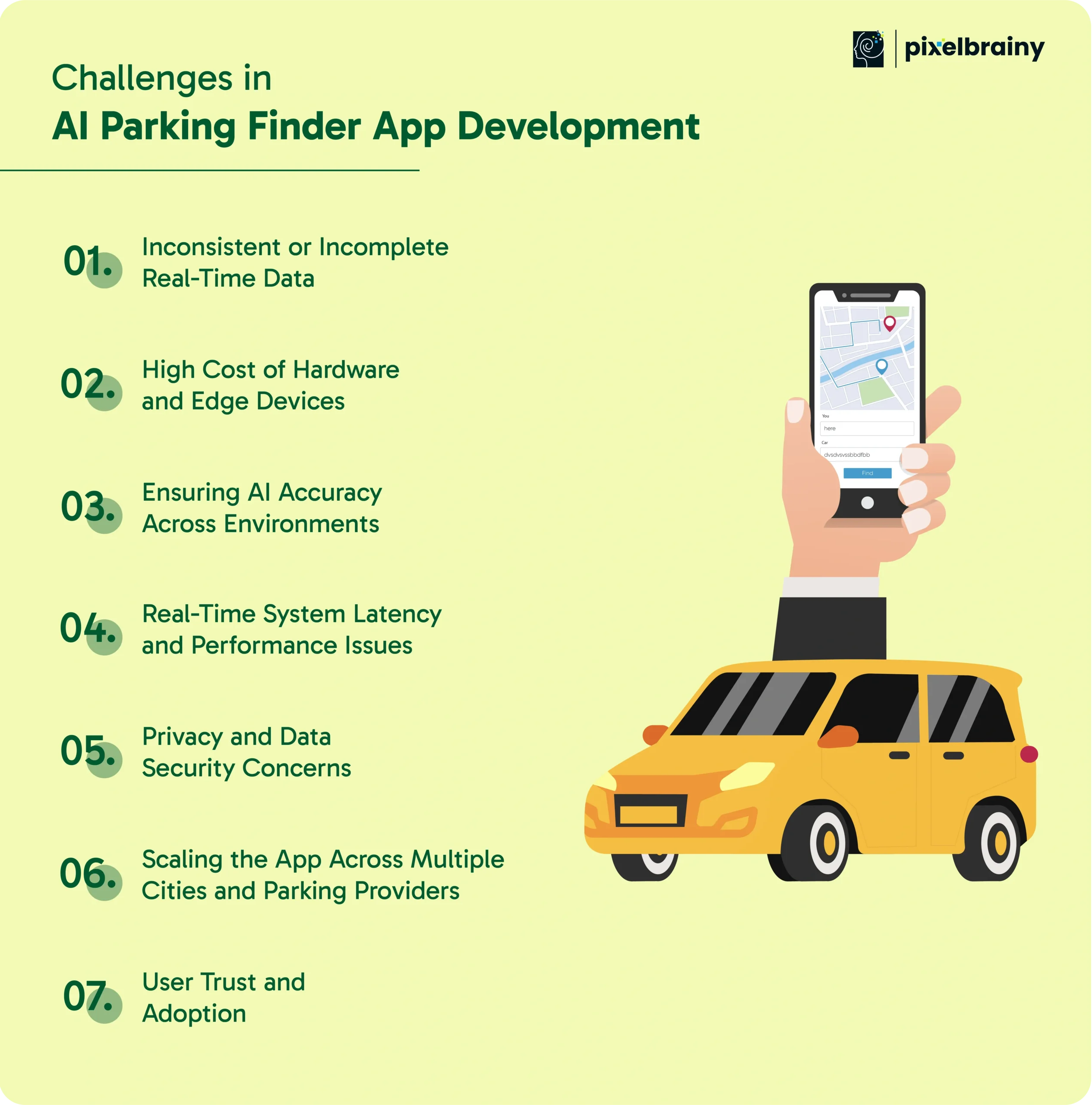
Challenge: Many cities and parking lots lack standardized IoT infrastructure or real-time data sources. This results in inconsistent availability data and makes it difficult for the AI system to deliver accurate predictions.
Solution:
Challenge: Installing cameras, LPR systems, or smart sensors for accurate parking monitoring can be expensive, especially at scale.
Solution:
Challenge: AI models can struggle with different lighting conditions, weather, or unusual parking layouts. This can affect image recognition and prediction accuracy.
Solution:
Challenge: Delays in data syncing or AI processing can result in outdated parking availability being shown to users, causing a poor experience.
Solution:
Challenge: Using video surveillance, geolocation, and license plate data raises concerns about user privacy and regulatory compliance.
Solution:
Challenge: Expanding the app beyond one region involves integrating with different infrastructure types, data formats, and local regulations.
Solution:
Challenge: Users may hesitate to trust app-based parking suggestions or may not be willing to pay for features without proven value.
Solution:
Every innovative solution comes with its own set of challenges, and AI Parking Finder App Development is no exception. From data quality to system performance and regulatory compliance, these hurdles require smart, scalable solutions. By planning ahead and adopting the right technologies, it's entirely possible to build AI Parking Finder App platforms that are both technically strong and commercially viable.
The key to success in Parking Finder App Development using AI lies in balancing innovation with real-world usability, while maintaining a user-centric and scalable architecture.
If you're planning the building of an AI Parking Finder Application, choosing the right technology partner is critical. At PixelBrainy, we bring deep expertise in AI, machine learning, computer vision, and mobility solutions. As a trusted AI development company in USA, we specialize in the creation of Parking Finder App with AI that is intelligent, user-centric, and future-ready.
We offer full-cycle AI app development services for Parking Finder Apps, covering everything from strategy and design to development, deployment, and support. Whether you're launching a new product or modernizing an existing system, our team delivers scalable and innovative solutions tailored to your goals.
What We Offer:
We recently completed a city-level AI Parking Finder App Development project for a smart mobility initiative in the United States. The solution was designed to improve parking efficiency and reduce traffic congestion.
What We Did:
Challenges We Faced:
What We Delivered:
This project demonstrates our capability to deliver scalable, high-performance solutions under real-world constraints.
Ready to turn your idea into a powerful AI-driven parking solution?
Let’s build the future of smart parking together. Contact PixelBrainy today.

From here, the opportunity to build a smarter, AI-driven parking solution is entirely in your hands. With rising urban challenges and driver expectations, the demand for intelligent and efficient parking systems is only growing. This blog has walked you through every critical aspect of AI Parking Finder App development, from planning and features to business models, tech stack, and real-world implementation.
By leveraging artificial intelligence and predictive data, you can build a smart parking app with AI that transforms the way people find and use parking in real time. Whether you're a startup or an enterprise, an AI-based parking app solution is your path to leading the future of urban mobility.
Now is the perfect time to turn your vision into a powerful, scalable product.
Book a free appointment with PixelBrainy today to get started.
Unlike traditional apps that show static parking listings, an AI Parking Finder App uses real-time data, predictive analytics, and machine learning to forecast spot availability, optimize user routes, and automate parking decisions.
Not necessarily. While sensors and cameras enhance data accuracy, you can start with AI models trained on historical and crowdsourced data. Hardware integration can be added later as the system scales.
The timeline depends on features and complexity. A basic MVP can take 8–12 weeks, while a full-scale AI-powered solution with real-time updates and LPR might take 4–6 months.
Yes. With scalable backend architecture and modular APIs, you can easily expand your AI Parking Finder App to support multiple cities, each with its own data sources and parking rules.
Absolutely. In addition to subscriptions, you can generate revenue through parking commissions, sponsored listings, API licensing, data insights, and B2B integrations with parking operators.
Trust builds over time. By showing real-time accuracy, offering user reviews, and providing transparent predictions, your app can gain user confidence quickly and deliver a dependable experience.

About The Author
Sagar Bhatnagar
Sagar Sahay Bhatnagar brings over a decade of IT industry experience to his role as Marketing Head at PixelBrainy. He's known for his knack in devising creative marketing strategies that boost brand visibility and market influence. Sagar's strategic thinking, coupled with his innovative vision and focus on results, sets him apart. His track record of successful campaigns proves his ability to utilize digital platforms effectively for impactful marketing efforts. With a genuine passion for both technology and marketing, Sagar continuously pushes PixelBrainy's marketing initiatives to greater success.


Transform your ideas into reality with us.
Working with the PixelBrainy team has been a highly positive experience. They understand the design requirements and create beautiful UX elements to meet the application needs. The dev team did an excellent job bringing my vision to life. We discussed usability and flow. Sagar worked with his team to design the database and begin coding. Working with Sagar was easy. He has the knowledge to create robust apps, including multi-language support, Google and Apple ID login options, Ad-enabled integrations, Stripe payment processing, and a Web Admin site for maintaining support data. I'm extremely satisfied with the services provided, the quality of the final product, and the professionalism of the entire process. I highly recommend them for Android and iOS Mobile Application Design and Development.

Great experience working with them. Had a lot of feedback and I found that unlike most contractors they were bugging me for updates instead of the other way around. They were extremely time conscience and great at communicating! All work was done extremely high quality and if not on time, early! They were always proactive when it comes to communication and the work is great/above par always. Very flexible and a great team to work with! Goes above and beyond to present us with multiple options and always provides quality. Amazing work per usual with Chitra. If you have UI/UX or branding design needs I recommend you go to them! Will likely work with them in the future as well, definitely recommended!

PixelBrainy is a joy to work with and is a great partner when thinking through branding, logo, and website layout. I appreciate that they spend time going into the "why" behind their decisions to help inform me and others about industry best practices and their expertise.

I hired them to design our software apps. Things I really like about them are excellent communication skills, they answer all project suggestions and collaborate right away, and their input on design and colors is amazing. This project was complex and needed patience and creativity. The team is amazing to do business with. I will be using them long-term. Glad to see there are some good people out there. I was afraid to try and outsource my project to someone but I am glad I met them! I really can't say enough. They went above and beyond on this project. I am very happy with everything they have done to make my business stand out from the competition.

It was great working with PixelBrainy and the team. They were very responsive and really owned the project. We'll definitely work with them again!

I recently worked with the PixelBrainy team on a project and I was blown away by their communication skills. They were prompt, clear, and articulate in all of our interactions. They listened and provided valuable feedback and suggestions to help make the project a success. They also kept me updated throughout the entire process, which made the experience stress-free and enjoyable.

PixelBrainy is very good at what it does. The team also presents themselves very professionally and takes care of their side of things very well. I could fully trust them taking up the design work in a timely and organised manner and their attention to detail saved us lots of effort and time. This particular project was quite intense and the team showed that they function very well under pressure. Very much looking forward to working with her again!

It's always an absolute pleasure working with them. They completed all of my requests quickly and followed every note I had for them to a T, which made our process go smoothly from start to finish. Everything was completed fast and following all of the guidelines. And I would recommend their services to anyone. If you need any design work done in the future, PixelBrainy should be your first call!

They took ownership of our requirements and designed and proposed multiple beautiful variants. The team is self-motivated, requires minimum supervision, committed to see-through designs with quality and delivering them on time. We would definitely love to work with PixelBrainy again when we have any requirements.

PixelBrainy was a big help with our SaaS application. We've been hard at work with a new UI/UX and they provided a lot of help with the designs. If you're looking for assistance with your website, software, or mobile application designs, PixelBrainy and the team is a great recommendation.

PixelBrainy designers are amazing. They are responsive, talented, and always willing to help craft the design until it matches your vision. I would recommend them and plan to continue them for my future projects and more!!!

They were awesome! Did a good job fast, and good communication. Will work with them again. Thank you

Creative, detail-oriented, and talented designers who take direction well and implement changes quickly and accurately. They consistently over-delivered for us.

PixelBrainy team is very talented and creative. Great designers and a pleasure to work with. PixelBrainy is an excellent communicator and I look forward to working with them again.

PixelBrainy has a very talented design team. Their work is excellent and they are very responsive. I enjoy working with them and hope to continue on all of our future projects.


