AI Summary Powered by PixelBrainy
Managing parking operations is no longer just about filling spaces. Today, it's about maximizing every square foot, reducing manual oversight, and boosting revenue using data-driven tools. Traditional systems fall short, often leaving operators with underutilized lots, inefficient staff scheduling, and little to no real-time insights.
In the U.S. alone, outdated parking inefficiencies cost drivers over $73 billion per year, with 17 hours spent annually just searching for parking. For parking operators, this translates to missed revenue, inconsistent occupancy rates, and poor customer experiences.
This is where an AI parking app can completely transform your operation.
With AI-powered parking management, you can monitor real-time occupancy, predict demand patterns, automate space allocation, and even implement dynamic pricing to maximize profits. It’s not just about adopting new technology, it’s about working smarter, faster, and with more control over your assets.
In this blog, you’ll learn exactly how to build an AI parking app tailored for operators like you. We’ll walk through:
If you're serious about creating an AI smart parking app that gives you control, clarity, and a true competitive edge, keep reading. Everything you need is right below.
An AI parking app is a smart, data-driven system designed to help parking operators manage their facilities more efficiently. It goes far beyond simple monitoring. Instead of just showing occupancy or entry logs, it uses artificial intelligence to analyze behavior, predict trends, and automate key operational tasks. Whether you manage a single garage or a network of lots, this type of system transforms traditional parking into an intelligent, responsive service.
So, how does it actually work behind the scenes?
Everything begins with data collection. Sensors embedded in each parking space, overhead cameras with computer vision, license plate recognition (LPR) systems at entry and exit points, and ticketing machines all feed into the system. These tools work together to provide live updates on space availability, vehicle flow, and usage patterns.
Once the system receives data, artificial intelligence begins identifying trends. It learns when your lot is busiest, how long vehicles typically stay, and which areas are underused. Over time, it becomes more accurate at predicting future demand and suggesting ways to optimize space and flow.
Based on what it learns, the app can automatically respond to changing conditions. It might increase pricing during peak hours to maximize revenue, activate overflow zones when occupancy is high, or notify staff about maintenance issues or unusual activity.
All insights are delivered through a user-friendly dashboard. Here, you can view real-time occupancy, track revenue, spot trends, and receive helpful alerts. This puts everything you need in one place, helping you stay proactive without being overwhelmed.
In short, an AI parking app is more than a digital upgrade. It acts like a virtual operations manager, giving you the tools and insights to run your facility smarter, faster, and more profitably.
For years, parking operations have depended on traditional management systems such as manual ticketing, fixed pricing, and reactive oversight. While these methods were once sufficient, they are increasingly out of step with today’s demands for efficiency, scalability, and data-driven insights.
AI-powered parking apps offer a significant upgrade. Instead of simply digitizing existing processes, they introduce a new paradigm that enables intelligent, automated, and adaptive parking management. These systems go beyond tracking vehicle entry and exit—they analyze usage trends, predict demand patterns, and optimize space utilization in real time.
This shift transforms the operator’s role from manual supervisor to strategic decision-maker. By leveraging artificial intelligence, parking operators gain the ability to improve occupancy rates, increase revenue, and enhance the overall operational flow of their facilities.
| Aspect | Traditional Parking Systems | AI-Powered Parking Apps |
| Occupancy Monitoring | Manual checks or basic sensors | Real-time tracking using AI, IoT sensors, and computer vision |
| Space Utilization | Static allocation, often first-come-first-served | Intelligent allocation based on vehicle size, patterns, and availability |
| Pricing Model | Fixed pricing, set manually | Dynamic pricing based on demand, time, and local conditions |
| Decision Making | Relies on staff experience | Driven by real-time data and predictive analytics |
| Revenue Optimization | Limited to basic occupancy | Maximized through dynamic pricing and demand forecasting |
| Operational Oversight | Reactive and labor-intensive | Automated dashboards, alerts, and performance KPIs |
| Integration Capabilities | Often isolated systems | Unified with access control, LPR, payments, and sensors |
| Maintenance Planning | Scheduled manually | Data-driven recommendations based on usage patterns |
| Scalability | Challenging to scale across locations | Easily scalable with centralized cloud infrastructure |
| Customer Insights | Minimal data collection | Deep analytics on user behavior, peak periods, and trends |
AI-enabled parking management offers more than just advanced technology. It delivers strategic control, real-time operational visibility, and a scalable foundation designed for the future. By moving from traditional systems to intelligent solutions, parking operators can unlock new levels of efficiency, performance, and profitability.
Managing a parking facility today involves more than just handling vehicles coming in and out. Operators are expected to optimize space, reduce congestion, maintain service quality, and respond to fluctuating demand quickly and efficiently. Relying on manual processes or outdated systems often leads to missed opportunities and unnecessary complications.
This is where AI parking app development becomes valuable. When you develop an AI parking app, you gain access to tools that bring automation, real-time data, and intelligent forecasting into your daily operations.
Below are the key reasons why AI-powered parking apps are becoming essential for modern parking management:
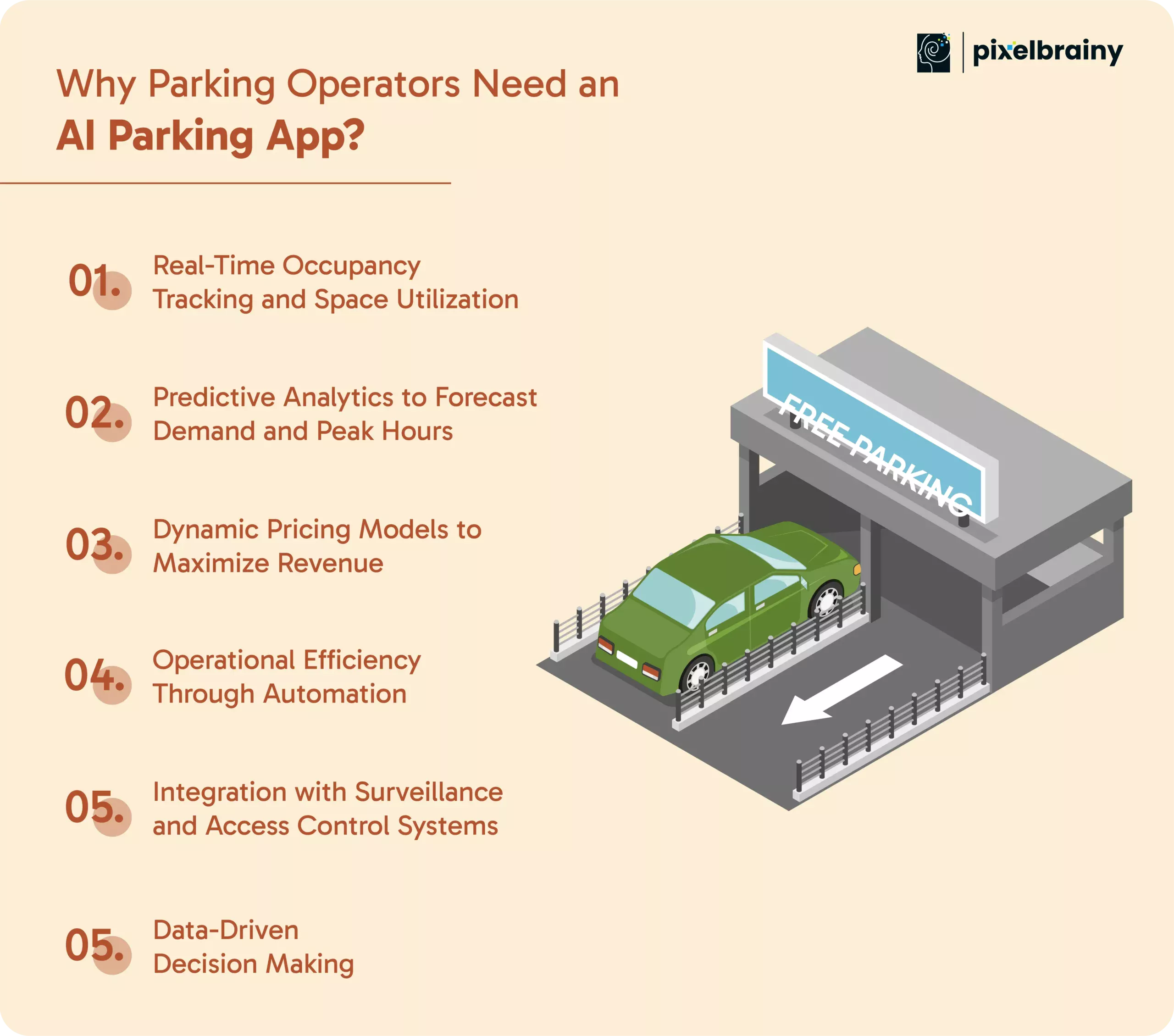
AI-enabled apps track vehicle movement and space occupancy in real time using sensors or camera systems. This live data helps operators instantly understand how full the lot is, which zones are underused, and where bottlenecks may form. It allows for smarter space allocation, reduces congestion, and improves flow throughout the facility.
The app doesn’t just show current data—it learns from historical usage to predict future trends. Operators can anticipate peak hours, high-traffic days, or seasonal surges, helping them prepare staffing, maintenance, and pricing strategies in advance.
With AI, pricing can automatically adjust based on demand, availability, time of day, or event schedules. Instead of fixed rates, operators can apply flexible pricing to increase revenue during busy times while staying competitive during off-peak hours.
Routine manual tasks—such as tracking available spots, opening overflow zones, or dispatching staff—can be automated. This reduces the need for constant supervision, lowers labor costs, and ensures smoother daily operations.
An AI parking app can integrate with existing systems like license plate recognition (LPR), ticketing gates, and CCTV. This creates a unified ecosystem where entry, exit, security, and payment systems work together for seamless facility management.
Operators get access to detailed analytics and reports that highlight revenue trends, occupancy patterns, and operational bottlenecks. These insights help drive smarter decisions around expansion, staffing, pricing, and long-term strategy.
By integrating AI into your parking operations, you gain more control, better visibility, and smarter ways to manage every aspect of your facility. It’s a practical step toward making your parking system more efficient and future-ready.
The parking industry is evolving rapidly, and investors are taking serious interest. More capital is being directed toward investing in AI parking app development, driven by the high potential for returns and the increasing demand for smarter, scalable infrastructure. The market numbers tell a compelling story:
Here are the key reasons investors are backing AI parking solutions:
With rising urbanization and increasing traffic congestion, demand for AI-driven parking solutions continues to grow. North America alone holds over 35% of the market share, signaling strong adoption potential.
When investors support AI parking app development, they’re enabling platforms with built-in scalability. These systems include dynamic pricing, real-time monitoring, automated access control, and demand forecasting - all features that attract long-term clients.
As cities modernize, smart parking is becoming a key component of broader smart city initiatives. These systems integrate with IoT, traffic control, and sustainability programs, often qualifying for government grants and public-private partnerships.
Many AI parking platforms follow a software-as-a-service (SaaS) model. This creates consistent income streams through subscriptions, transaction-based fees, or pay-per-use pricing—exactly the type of business model that investors find attractive.
In short, investing in AI parking app development offers investors a unique opportunity to participate in a fast-growing, future-proof sector. With rising adoption, strong tech integration, and predictable returns, AI parking solutions are quickly becoming one of the most attractive investment areas in the smart mobility space.
When you develop an AI parking app, it’s not just about tracking vehicles—it's about building a smart, connected system that runs efficiently with minimal manual effort. These apps combine automation, analytics, and integration to help operators monitor, manage, and monetize their parking assets in real time.
Below is a breakdown of 15 key features that define a high-performing AI-powered parking solution:
| Feature | Explanation |
| Real-Time Occupancy Monitoring | Uses sensors or cameras to track which spaces are occupied or vacant in real time. Helps operators react quickly to demand and reduce inefficiencies |
| Smart Space Allocation | AI automatically assigns vehicles to zones based on demand, size, or reservation type. Maximizes space usage and prevents overcrowding |
| Predictive Analytics | Learns from historical data to forecast peak hours, high-demand days, and seasonal trends. Allows for proactive planning and staffing |
| Dynamic Pricing Engine | Adjusts rates automatically based on current demand, time, or availability. Boosts revenue while improving space turnover |
| License Plate Recognition (LPR) | Enables automated access control and logging through number plate scanning. Reduces manual checks and speeds up entry/exit |
| Integrated Payment Gateway | Offers seamless digital payment options like cards, wallets, or mobile apps. Supports contactless, fast, and secure transactions |
| Staff Mobile App | Gives ground staff tools to check availability, troubleshoot issues, and respond to alerts. Improves on-site coordination and service |
| Maintenance and Issue Alerts | Notifies operators about broken sensors, lighting issues, or abnormal activity. Minimizes downtime and enhances safety |
| Occupancy Heatmaps | Visual representation of usage patterns across different areas or time slots. Helps in identifying underused zones and optimizing layout |
| Multi-Lot Management | Manage multiple parking facilities from a single dashboard. Ensures consistent control, reporting, and user experience across locations |
| Reservation System | Allows operators to offer advance bookings for specific slots or zones. Helps reduce last-minute congestion and improve user satisfaction |
| Customizable Admin Dashboard | Provides KPIs, trends, reports, and live insights in a clean, visual format. Tailored views for managers, staff, or franchise operators |
| AI-Powered Reporting | Automatically generates reports on revenue, occupancy, turnover, and user behavior. Reduces time spent on manual analysis |
| Access Control Integration | Syncs with boom barriers, RFID readers, or gate controllers for hands-free entry. Enhances automation and security |
| User and Vehicle Profiling | Tracks user behavior and vehicle history to personalize experiences or flag irregularities. Useful for loyalty features or security audits |
These core features work together to create a smart, efficient, and scalable parking system tailored to the needs of modern operators.
The successful development of an AI parking app requires more than just coding—it’s about strategic planning, seamless integration, and designing tools that truly work for your operations. Here’s a step-by-step breakdown of how parking operators can go from concept to deployment with a smart, efficient AI-powered system.
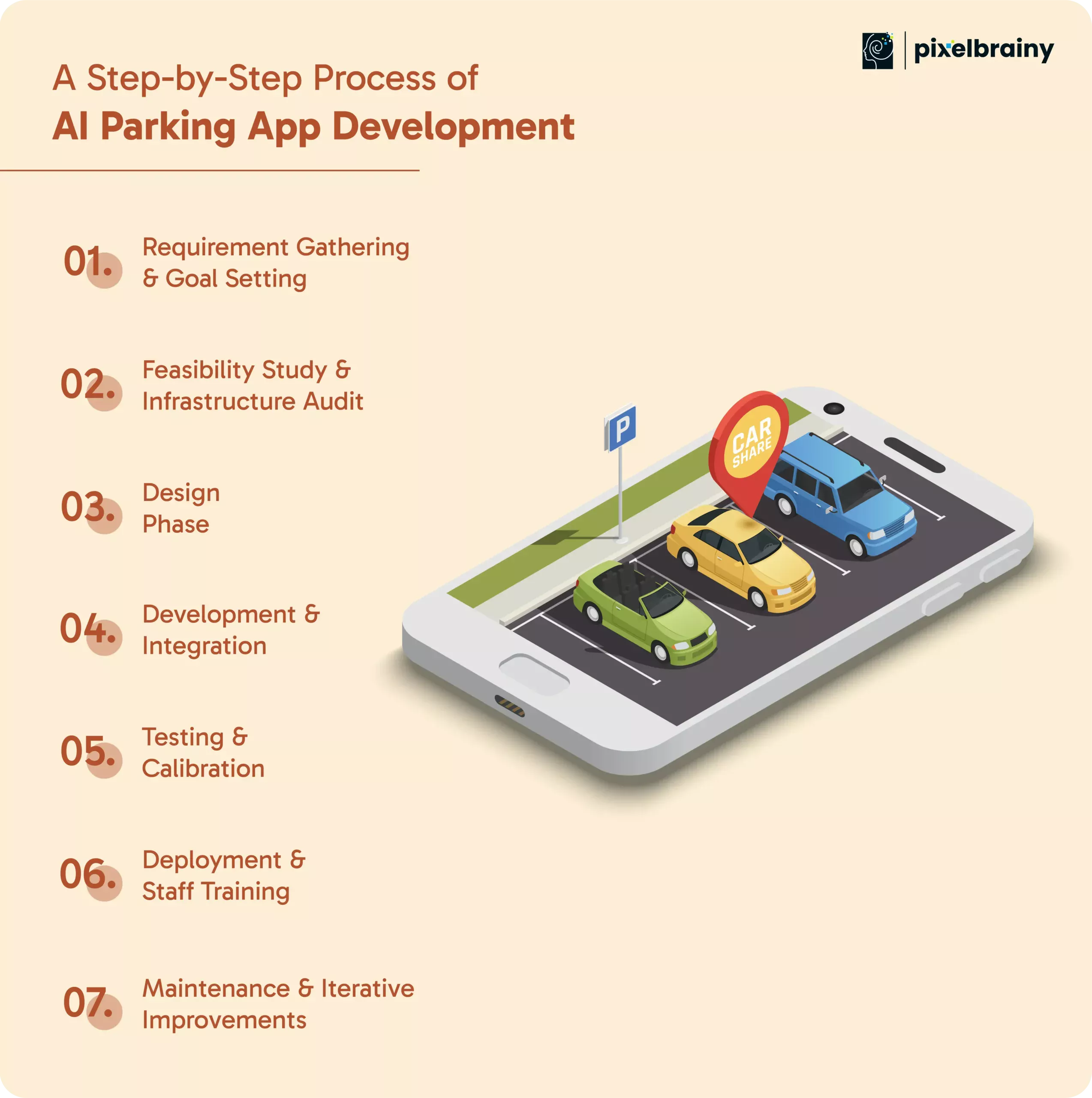
The first step in building an AI parking app is understanding your business objectives. Are you aiming to boost space utilization, automate access, or increase revenue through dynamic pricing? This phase defines your vision, outlines core features for MVP development, and sets measurable goals to guide the entire project.
Why this matters:
Before development begins, an on-site assessment is essential. This includes reviewing existing hardware like sensors and cameras, evaluating network connectivity, and checking system compatibility. The goal is to identify any limitations or upgrades needed to support AI integration effectively.
Why this matters:
A clean, intuitive interface is critical to operational efficiency. Partner with a UI/UX design company to create operator dashboards, real-time maps, and mobile interfaces for staff. Good design ensures users can act on insights quickly without being overwhelmed by complex menus or cluttered screens.
Why this matters:
In this step, AI developers begin connecting all necessary systems. From linking occupancy sensors and LPR cameras to syncing with access gates and POS systems, AI parking app development involves blending multiple technologies into one seamless platform. Historical parking data is also fed into the system to train AI models and enhance early prediction accuracy.
Why this matters:
Before full launch, thorough testing is essential. This includes real-world trials to ensure sensor accuracy, AI predictions, and system responsiveness. Calibration may involve adjusting sensor positions or refining data models to better reflect actual usage.
Why this matters:
Once testing is complete, the app is rolled out in phases. Staff onboarding is a key part of this process. Provide hands-on training, clear documentation, and real-time support to ensure your team understands the platform and feels confident using it from day one.
Why this matters:
The work doesn’t stop at launch. Regular updates are needed to keep AI models accurate and responsive. Feedback from staff and analytics from real-world usage should inform continuous improvements, helping you evolve your platform with your business needs.
Why this matters:
This structured approach to AI parking app development ensures that every phase—planning, integration, design, and rollout—is aligned with your operational goals. It’s not just about building software, it’s about transforming how your parking facility works.
Also Read: A Comprehensive Guide To AI Mobile App Development
If you’re a parking operator planning to adopt smart technology, one of your first questions is likely: what is the cost to create an AI parking app? The answer depends on your facility’s needs, scale, and technical complexity.
Generally, the AI parking app development cost ranges from $30,000 to over $300,000. This wide range accounts for variations in features, system integrations, hardware compatibility, and custom development work.
Here’s a breakdown to help you understand the cost at different levels:
Ideal for small or single-location facilities. Includes real-time occupancy tracking, a simple operator dashboard, and basic reporting. Limited AI functionality and minimal third-party system integration.
Typical features:
Designed for medium-sized lots with multi-zone or multi-floor setups. Includes AI integration for demand forecasting and dynamic pricing, plus support for LPR and mobile app development.
Typical features:
Built for large-scale operators, municipalities, or airports managing several facilities. Includes full automation, smart integrations, custom dashboards, and scalability options.
Typical features:
Ultimately, the AI parking app development cost is an investment in long-term operational efficiency, automation, and revenue growth. Whether you’re starting small or aiming for full-scale transformation, understanding these cost components helps you plan your budget wisely.
Also Read: AI App Development Cost in 2026
Choosing the right tools and frameworks is essential for the successful development of an AI parking app. The ideal stack must support real-time data processing, hardware integration, predictive analytics, and seamless UI/UX. Below is a breakdown of the recommended tech stack tailored for performance, scalability, and future-proof AI capabilities.
| Layer | Recommended Tools | Explanation |
| Frontend | React, React Native, Flutter | These frameworks are ideal for building responsive dashboards and mobile apps for operators and staff. They offer flexibility and fast UI rendering |
| Backend | Node.js, Python (FastAPI, Django), Firebase | Supports the logic layer, API handling, and business rules. Python is particularly useful for AI features, while Node.js offers real-time communication capabilities |
| AI/ML Frameworks | TensorFlow, PyTorch, OpenCV | Used to develop core AI features like image recognition, predictive analytics, and computer vision. OpenCV helps process camera and LPR feeds |
| Database | PostgreSQL, MongoDB, Firebase Realtime DB | PostgreSQL is reliable for relational data, while MongoDB and Firebase offer flexible, scalable options for real-time and unstructured data |
| Cloud Services | AWS, Google Cloud, Microsoft Azure | These cloud platforms provide hosting, AI model training, storage, and serverless functions needed to scale the app |
| DevOps & CI/CD | Docker, Jenkins, GitHub Actions, Kubernetes | Enables smoot+C8h deployment, version control, and updates. Docker and Kubernetes help manage containers for different services |
| Authentication | Firebase Auth, OAuth 2.0, Auth0 | Ensures secure login for staff and admin users. Supports multi-role access control and encryption |
| Maps & Geolocation | Google Maps API, Mapbox | Powers visual features like heatmaps, spot guidance, and lot boundaries. Crucial for real-time spatial data |
| Payment Integration | Stripe, Razorpay, PayPal | Provides secure digital payment options for booking, prepaying, or in-app transactions. Easily integrates with web or mobile apps |
| Notifications | Firebase Cloud Messaging, Twilio, OneSignal | Enables real-time alerts for occupancy, system errors, or pricing changes via SMS, email, or in-app push notifications |
| Analytics & Reporting | Google Analytics, Mixpanel, custom dashboards | Tracks system performance, user behavior, and revenue trends through detailed reports and KPIs tailored for operators |
This stack ensures that every component of your AI parking app, from AI logic and sensor integration to mobile usability and cloud performance, is optimized for real-world operational success.
Once your AI parking app development is complete, the next step is making it profitable. Whether you're managing a single facility or offering your app as a solution to other operators, there are multiple ways to generate recurring revenue and scale your return on investment. Below are the most effective monetization strategies:
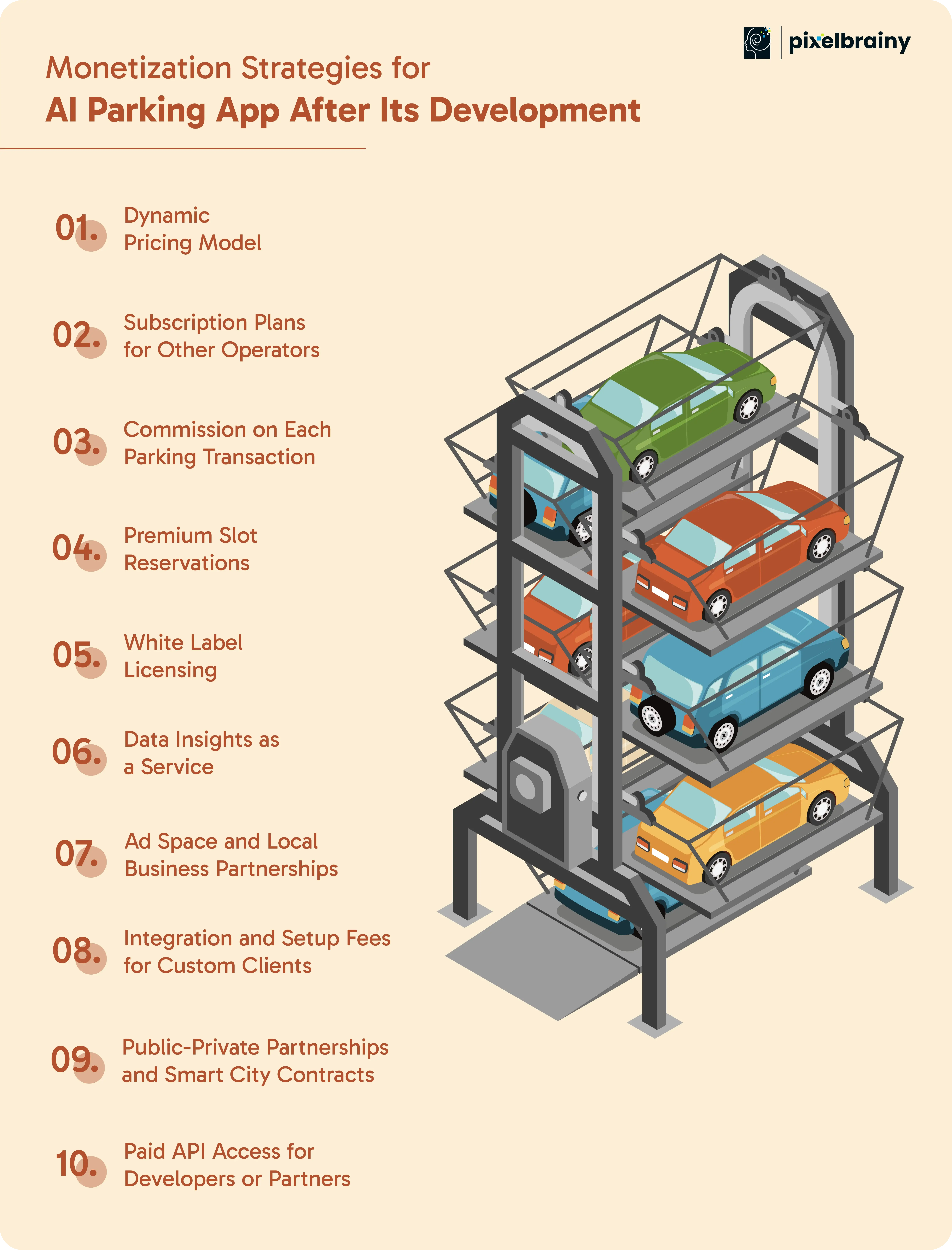
Enable flexible pricing based on real-time demand, location, and time of day. For example, during peak hours or special events, rates can automatically increase, while off-peak times can feature discounted rates to improve space utilization. This model maximizes revenue without compromising occupancy.
Offer your AI parking app as a SaaS platform to other parking facility owners. You can charge a monthly or annual fee based on the number of spaces, lots, or features they use. This creates a steady income stream while making your solution accessible to a broader market.
Apply a small percentage-based commission on every parking session processed through the app. This model works especially well if users are booking, reserving, or paying through the platform, turning each transaction into a revenue opportunity.
Allow users to reserve high-demand or prime parking spots in advance for an additional fee. These could be near entrances, under covered areas, or in EV charging zones. Offering priority access adds value for drivers and increases per-slot revenue for operators.
Package and license your app to other parking companies, real estate developers, or municipal operators under their own branding. You retain ownership and earn from licensing fees, while they benefit from a plug-and-play smart parking solution.
Your app collects valuable data on occupancy trends, peak usage times, and customer behavior. By anonymizing and analyzing this data, you can offer detailed reports or live dashboards to city planners, real estate developers, and business analysts for a recurring fee.
Leverage app screens or in-lot digital displays to promote local businesses, services, or offers. You can charge advertisers for display time, clicks, or impressions. This is especially effective in high-footfall areas like malls, stadiums, or airports.
Charge one-time setup or integration fees when your app connects with third-party systems such as access gates, payment terminals, or enterprise CRMs. This covers configuration time and ensures you monetize beyond core features.
Pitch your AI parking solution to municipalities or government agencies aiming to reduce congestion and digitize public infrastructure. These partnerships can result in large-scale deployments backed by grants or public funding.
Offer secure API access to developers, tech integrators, or mobility service providers. This lets them build complementary tools or integrate parking data into their platforms, and you can monetize access through tiered pricing or usage-based plans.
By choosing the right monetization strategies, your AI parking app can evolve from a smart operational tool into a sustainable and scalable revenue-generating asset.
Developing an AI parking app can be a highly rewarding initiative for parking operators, but it is not without its share of obstacles. These challenges often remain hidden until the project is underway and can lead to delays, increased costs, or technical roadblocks if not addressed early.
Understanding these potential issues before they arise allows you to plan smarter, avoid costly mistakes, and ensure that your app performs reliably once deployed. Below are some of the most common challenges in AI parking app development, along with practical solutions to overcome them.
AI applications rely heavily on accurate data from sensors and cameras. If these devices malfunction or provide inconsistent readings, it can disrupt real-time decision-making and occupancy tracking.
Solution: Choose high-quality hardware with proven reliability and set up scheduled maintenance routines. Implement automated checks to identify and flag any data anomalies.
Deploying AI requires investment in supporting technology such as IoT sensors, cameras, network equipment, and cloud services. These costs can escalate quickly for larger or multi-location facilities.
Solution: Begin with a pilot deployment in one high-traffic area to prove value and functionality. Expand gradually based on measurable success and available budget.
Building accurate AI models takes time and clean data. Without enough historical data or proper input, the AI may struggle to deliver useful insights.
Solution: Start by training the system with available data and gradually refine the models as more data is collected. Collaborate with AI specialists who can fine-tune algorithms to your unique parking environment.
Many parking facilities still operate with older access control, payment, or ticketing systems that are not compatible with modern software.
Solution: Use flexible software architecture that supports API connections. Middleware can serve as a bridge between old and new systems, making it easier to integrate without a complete overhaul.
Introducing a new system can cause hesitation among staff who are used to manual processes. They may see automation as a threat or worry about added complexity.
Solution: Offer comprehensive training and make sure staff understand how the app simplifies their daily tasks. Focus on how it supports their work, not replaces it.
Collecting license plate numbers, payment details, and user behavior introduces the need for strong data protection measures.
Solution: Ensure your app is compliant with data regulations such as GDPR or CCPA. Use encryption, anonymization, and transparent user policies to build trust and security into the system.
As your app expands to more locations, maintaining consistent performance and manageability becomes more challenging.
Solution: Build your application using a scalable cloud-based infrastructure. Use centralized dashboards for unified control, and allow flexible configurations for each facility as needed.By identifying and planning for these common challenges in advance, you can create an AI parking app that is reliable, scalable, and ready to meet the evolving needs of your operation.
Building a smart parking system powered by AI takes more than just good code. It requires a deep understanding of real-world parking operations, intelligent system design, and a partner who knows how to turn complex data into practical solutions. At PixelBrainy, we specialize in exactly that.
As an experienced AI app development company, we help parking operators and tech-focused businesses develop tailored platforms that do more than just manage parking. Our focus is on Parking App Development using AI to improve space utilization, automate workflows, and boost long-term revenue.
Whether you're planning to modernize a single location or roll out a multi-lot network, our team works closely with you to build an AI-powered app that fits your infrastructure, scales with your growth, and delivers measurable impact from day one.
In a recent project, we worked with a U.S.-based commercial parking operator managing over 4,000 spots across multiple zones. The AI app we developed delivered real-time tracking, dynamic pricing, predictive insights, and automated space allocation. Within three months of launch, they reported a 27% improvement in space utilization and a 19% increase in monthly parking revenue.
If you're looking to build a reliable and intelligent AI-powered parking platform, PixelBrainy is the AI app development company that brings together experience, innovation, and proven results.

As cities grow and demand for efficient parking increases, embracing intelligent solutions is no longer optional. Whether you're managing a single lot or a multi-facility operation, AI parking app development allows you to optimize space, automate workflows, and improve revenue through data-driven decision-making. From real-time monitoring to predictive analytics and dynamic pricing, a smart parking app can transform how your facility operates.
Choosing the right AI development company is crucial when planning to build a smart parking app that fits your business needs. With the right features and a strategic approach, Parking App Development using AI can future-proof your operations and set you apart in a competitive industry.
Ready to get started? Book a free appointment with our AI experts today and let's build your future-ready parking system.
Yes, most AI parking apps can be integrated with existing hardware like cameras, sensors, or LPR systems. During development, compatibility is assessed to ensure seamless data flow and system performance.
Development time varies based on complexity, but a typical AI parking app can take anywhere from 3 to 8 months. This includes design, development, AI training, testing, and deployment phases.
No, AI training is handled by the development team using your historical parking data. The system continues learning over time to improve accuracy in predicting demand, usage patterns, and pricing.
Absolutely. Even single-lot operators can benefit from AI features like space optimization, live occupancy monitoring, and automation—saving time and boosting daily efficiency.
Yes, AI parking apps typically include role-based access controls. Admins, managers, and staff can each have tailored dashboards and permissions depending on their responsibilities.
It’s normal for AI models to improve over time. The app is calibrated using real-world data, and initial inaccuracies are corrected through ongoing adjustments and re-training cycles.

About The Author
Sagar Bhatnagar
Sagar Sahay Bhatnagar brings over a decade of IT industry experience to his role as Marketing Head at PixelBrainy. He's known for his knack in devising creative marketing strategies that boost brand visibility and market influence. Sagar's strategic thinking, coupled with his innovative vision and focus on results, sets him apart. His track record of successful campaigns proves his ability to utilize digital platforms effectively for impactful marketing efforts. With a genuine passion for both technology and marketing, Sagar continuously pushes PixelBrainy's marketing initiatives to greater success.

Working with the PixelBrainy team has been a highly positive experience. They understand the design requirements and create beautiful UX elements to meet the application needs. The dev team did an excellent job bringing my vision to life. We discussed usability and flow. Sagar worked with his team to design the database and begin coding. Working with Sagar was easy. He has the knowledge to create robust apps, including multi-language support, Google and Apple ID login options, Ad-enabled integrations, Stripe payment processing, and a Web Admin site for maintaining support data. I'm extremely satisfied with the services provided, the quality of the final product, and the professionalism of the entire process. I highly recommend them for Android and iOS Mobile Application Design and Development.

Great experience working with them. Had a lot of feedback and I found that unlike most contractors they were bugging me for updates instead of the other way around. They were extremely time conscience and great at communicating! All work was done extremely high quality and if not on time, early! They were always proactive when it comes to communication and the work is great/above par always. Very flexible and a great team to work with! Goes above and beyond to present us with multiple options and always provides quality. Amazing work per usual with Chitra. If you have UI/UX or branding design needs I recommend you go to them! Will likely work with them in the future as well, definitely recommended!

PixelBrainy is a joy to work with and is a great partner when thinking through branding, logo, and website layout. I appreciate that they spend time going into the "why" behind their decisions to help inform me and others about industry best practices and their expertise.

I hired them to design our software apps. Things I really like about them are excellent communication skills, they answer all project suggestions and collaborate right away, and their input on design and colors is amazing. This project was complex and needed patience and creativity. The team is amazing to do business with. I will be using them long-term. Glad to see there are some good people out there. I was afraid to try and outsource my project to someone but I am glad I met them! I really can't say enough. They went above and beyond on this project. I am very happy with everything they have done to make my business stand out from the competition.

It was great working with PixelBrainy and the team. They were very responsive and really owned the project. We'll definitely work with them again!

I recently worked with the PixelBrainy team on a project and I was blown away by their communication skills. They were prompt, clear, and articulate in all of our interactions. They listened and provided valuable feedback and suggestions to help make the project a success. They also kept me updated throughout the entire process, which made the experience stress-free and enjoyable.

PixelBrainy is very good at what it does. The team also presents themselves very professionally and takes care of their side of things very well. I could fully trust them taking up the design work in a timely and organised manner and their attention to detail saved us lots of effort and time. This particular project was quite intense and the team showed that they function very well under pressure. Very much looking forward to working with her again!

It's always an absolute pleasure working with them. They completed all of my requests quickly and followed every note I had for them to a T, which made our process go smoothly from start to finish. Everything was completed fast and following all of the guidelines. And I would recommend their services to anyone. If you need any design work done in the future, PixelBrainy should be your first call!

They took ownership of our requirements and designed and proposed multiple beautiful variants. The team is self-motivated, requires minimum supervision, committed to see-through designs with quality and delivering them on time. We would definitely love to work with PixelBrainy again when we have any requirements.

PixelBrainy was a big help with our SaaS application. We've been hard at work with a new UI/UX and they provided a lot of help with the designs. If you're looking for assistance with your website, software, or mobile application designs, PixelBrainy and the team is a great recommendation.

PixelBrainy designers are amazing. They are responsive, talented, and always willing to help craft the design until it matches your vision. I would recommend them and plan to continue them for my future projects and more!!!

They were awesome! Did a good job fast, and good communication. Will work with them again. Thank you

Creative, detail-oriented, and talented designers who take direction well and implement changes quickly and accurately. They consistently over-delivered for us.

PixelBrainy team is very talented and creative. Great designers and a pleasure to work with. PixelBrainy is an excellent communicator and I look forward to working with them again.

PixelBrainy has a very talented design team. Their work is excellent and they are very responsive. I enjoy working with them and hope to continue on all of our future projects.


Transform your ideas into reality with us.
Across these industries, each engagement brings unique challenges, from early-stage product development to scaling complex systems, helping us build a practical understanding of real-world product environments.