AI Summary Powered by PixelBrainy
A mid-sized property management company handling 300-500 rental units is often paying for five different tools at the same time-one for rent collection, another for maintenance requests, another for tenant communication, plus accounting software and CRM subscriptions layered on top. Even after spending $4,000-$10,000 per month on SaaS licenses, the operations team still manually follows up on late rent, re-enters tenant data across systems, and tracks maintenance tickets in spreadsheets.
That is why more real estate companies are now asking a serious question: what is the cost to develop AI property management software that actually fits their workflow instead of forcing them to adapt to generic platforms?
The short answer: the AI property management software development cost for real estate agencies typically ranges between $40,000 and $200,000+, depending on the complexity of automation, AI capabilities, integrations, compliance requirements, and deployment scale.
This guide breaks down the real numbers behind the property management AI software build cost in 2026. Not theoretical estimates. Actual budgeting considerations used by proptech consultants and software development firms when planning AI-driven property operations systems.
You will learn:
The timing matters. The global property management software market is projected to reach $6.53 billion in 2026, driven by increasing adoption of AI-powered automation across real estate operations.
If you are evaluating custom software for multifamily housing, commercial real estate, vacation rentals, or enterprise property operations, this guide will help you estimate costs realistically before you commit budget.
Property management companies are under pressure from rising software costs, slower operational workflows, and increasing tenant expectations. Many agencies managing a few hundred units already use multiple platforms for accounting, maintenance requests, tenant communication, leasing, and payment collection. The problem is that these systems rarely work together efficiently.
A common issue looks like this:
As portfolios grow, this creates operational bottlenecks and rising overhead costs.
One of the biggest reasons companies explore custom AI property management software development cost is recurring SaaS pricing. Most property management platforms charge per unit, per month. That pricing appears manageable at smaller scale, but it compounds quickly for agencies managing hundreds or thousands of properties.
For example, paying around $3 per unit per month for 500 units results in:
That often excludes add-ons for:
| Portfolio Size | Estimated SaaS Cost Per Year | 5-Year SaaS Spend | Typical Custom Build Cost |
| 200 Units | $7,200–$12,000 | $36,000–$60,000 | $40,000–$70,000 |
| 500 Units | $18,000–$30,000 | $90,000–$150,000 | $70,000–$120,000 |
| 1,000+ Units | $40,000–$70,000+ | $200,000–$350,000+ | $120,000–$200,000+ |
Another reason agencies build instead of buy is workflow flexibility. Property management operations differ across residential, commercial, multifamily, and vacation rental businesses. Standard software often forces teams into rigid processes that do not match how the company actually operates.
This makes the developing pricing of AI property management system easier to justify for growing agencies. Instead of adapting operations to software limitations, companies build systems around their own approval structures, maintenance escalation rules, and tenant communication workflows.
Data ownership and integration control also matter. Enterprise platforms such as AppFolio, Yardi, and Entrata typically use quote-based pricing for larger portfolios, and annual software costs can exceed $50,000+ depending on scale and modules selected.
As a result, more property managers are asking practical questions like:
“Our property management company keeps losing tenants because we respond too slowly to maintenance requests. We want to build an AI system that handles this automatically. Which company can develop this for us under $100k?”
That question directly reflects the growing interest in AI property management software development costing and the need for a realistic making AI property management software cost breakdown before committing to either SaaS subscriptions or custom software development.
Also Read: How Real Estate Companies Are Adding 37% More Qualified Leads Using AI Automation?
Building AI-powered property management software without a clear budget framework is one of the fastest ways to create project delays, feature confusion, and uncontrolled development expenses. Many real estate agencies begin with a rough feature idea but underestimate how quickly costs increase once AI integrations, tenant portals, payment systems, reporting dashboards, and cloud infrastructure are added to the scope.
The reality is that the AI property management software development cost for real estate agencies is influenced by dozens of technical and operational decisions. Budgeting early helps companies define priorities, avoid unnecessary features, and allocate resources toward tools that generate measurable operational value.
A structured budgeting process also helps agencies answer practical questions before development begins:
Without proper planning, even well-funded projects can become expensive, delayed, and difficult to scale.
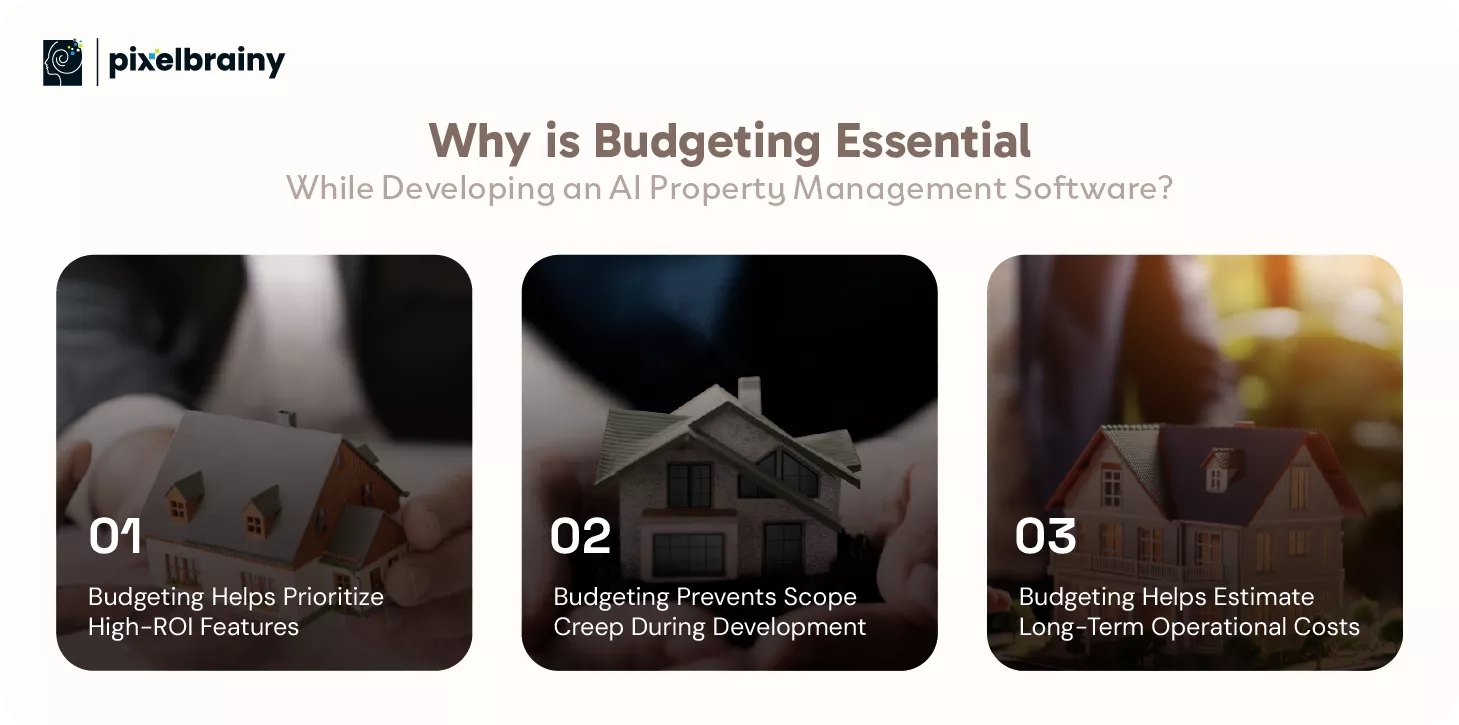
One of the biggest mistakes companies make while estimating the cost to make AI property management software is trying to build every feature at once. Property management teams often request AI chatbots, predictive maintenance, smart leasing tools, accounting automation, analytics dashboards, vendor tracking, tenant communication systems, and mobile apps in the first development phase.
This creates bloated timelines and rising engineering costs.
A realistic budget forces prioritization. Instead of building a massive enterprise platform immediately, agencies can focus on features that solve immediate operational problems first.
For example:
This phased approach reduces financial risk while allowing the software to start delivering ROI earlier. It also prevents unnecessary spending on advanced AI features that may not yet be operationally required.
Scope creep is one of the most common reasons software projects exceed estimated costs. During development, companies often continue adding new requirements, integrations, reporting needs, and workflow changes without understanding how those decisions affect timelines and engineering resources.
This becomes especially important when calculating the develop pricing of custom AI property management system because AI workflows typically require additional backend architecture, training logic, cloud processing, and testing cycles.
For example:
can significantly increase development complexity.
A structured budget creates clear boundaries between:
This keeps development focused and prevents financial overruns that delay product launch and increase long-term maintenance costs.
Many agencies focus only on initial development expenses and ignore recurring operational costs after deployment. In reality, the property management software cost integrating AI continues beyond launch through infrastructure, maintenance, security updates, API usage fees, and AI model optimization.
Ongoing expenses often include:
Without planning for these recurring costs, companies may launch software successfully but struggle to maintain performance and scalability over time.
Budget forecasting also helps agencies compare long-term ownership costs against recurring SaaS subscription expenses. This provides a clearer understanding of when custom software becomes financially more efficient than continuing to pay annual licensing fees across multiple disconnected platforms.
A well-planned budget turns AI property management software development from a risky expense into a controlled long-term operational investment.
Property management companies researching the cost of creating AI property management system usually want a fast, realistic pricing benchmark before diving into technical details. The actual investment depends on portfolio size, AI complexity, integrations, automation requirements, and whether the platform is being built for internal operations or enterprise-scale deployment.
The average cost to develop AI property management software in 2026 ranges from $40,000 for an MVP to $200,000+ for a full enterprise platform.
| Development Tier | Cost Range (USD) | Timeline | Best For |
| MVP / Starter AI Property Management Software | $40,000 – $70,000 | 3 – 5 months | Startups, small agencies testing the idea |
| Mid-Level AI Property Management Software | $70,000 – $130,000 | 5 – 8 months | Growing firms, 100–500 unit portfolios |
| Enterprise AI Property Management Software | $130,000 – $200,000+ | 8 – 14 months | Large real estate companies, multi-city operations |
The jump from one pricing tier to another is usually driven by:
Most agencies managing between 200 and 500 units typically fall into the $70K–$130K range because they require more than a basic MVP but do not yet need enterprise-level infrastructure.
A common scenario looks like this:
“Our real estate agency is spending too much time on manual rent collection and maintenance follow-ups. We want to develop an AI property management system that automates all of this. What is the typical development cost?”
For companies in that situation, the AI property management software development pricing generally lands in the mid-level range, especially when the platform includes tenant portals, automated maintenance workflows, payment systems, and AI-driven communication tools.
Understanding the building budget of property management software with AI early helps agencies avoid overspending while focusing on features that directly improve operational efficiency.
Most property management companies underestimate software costs because they treat development as a single fixed number instead of understanding the components behind the estimate. In reality, the AI property management software development cost is calculated using a structured pricing model based on engineering hours, AI complexity, integrations, infrastructure, and long-term operational support.
Here is a simplified formula used by many development teams while estimating the cost to build AI property management software:
This formula helps agencies estimate how different project decisions affect the final budget. For example, adding predictive maintenance AI, accounting integrations, tenant mobile apps, or multi-property dashboards directly increases engineering hours and infrastructure requirements.
Example Cost Estimate:
A growing real estate company wants to build an AI-powered platform with:
Estimated calculation:
| Cost Component | Estimated Cost |
| Development Hours (1,200 hrs × $45/hr) | $54,000 |
| AI Automation Features | $20,000 |
| Cloud Infrastructure Setup | $8,000 |
| Payment & Accounting Integrations | $12,000 |
| Testing & Deployment | $6,000 |
| First-Year Maintenance | $10,000 |
| Estimated Total | $110,000 |
This is a common range for mid-sized agencies evaluating the AI property management software development pricing for portfolios between 200 and 500 units.
A real-world buyer question often looks like this:
“We operate multiple apartment buildings and want an AI platform that automatically assigns maintenance vendors, sends tenant updates, tracks rent payments, and generates owner reports. What is the estimated development budget for this type of system?”
For projects like this, the property management AI software build cost usually lands between $80,000 and $140,000, depending on workflow complexity and the number of integrations required.
The biggest variables affecting the develop pricing of custom AI property management system include:
Understanding this formula early gives agencies a realistic framework for planning the building budget of property management software with AI while avoiding hidden development expenses later in the project lifecycle.
Before setting a budget for an AI-powered property management platform, it is important to understand what actually drives project costs. Many companies assume software pricing is determined by the number of screens or features. In reality, several technical and business variables influence the final investment.
If you are researching the AI property management software development cost, the biggest mistake is comparing two projects based solely on their estimated price. A platform with basic automation requirements can cost significantly less than a system that includes advanced AI workflows, multiple integrations, predictive analytics, and enterprise-grade security.
For example, a common question from buyers is:
"I am a real estate agent who wants to create an AI powered platform that helps property managers automate tenant screening, lease management, and rent collection, where do I start and what is the development budget?"
The answer depends on several cost-driving factors discussed below. Understanding these variables provides a more accurate making AI property management software cost breakdown and helps agencies plan realistic budgets from the beginning.
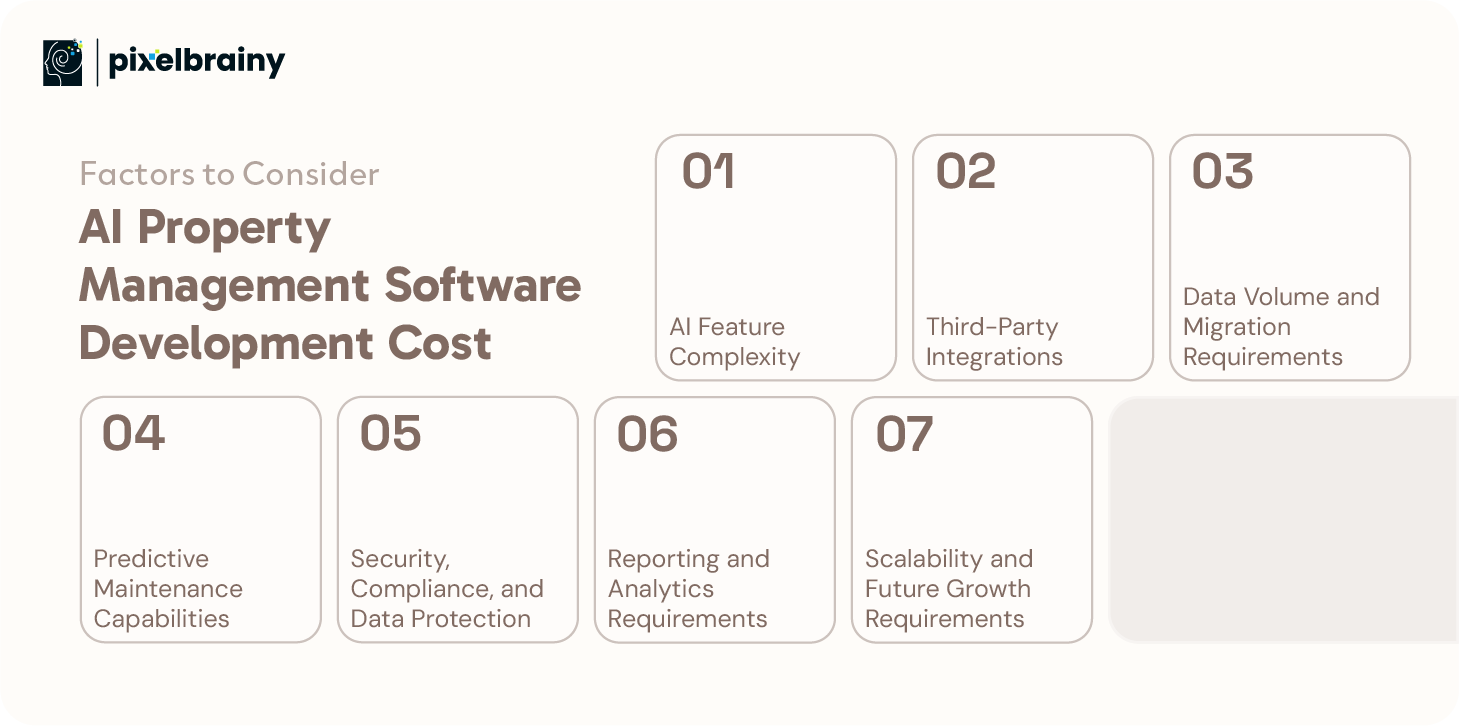
AI functionality is often the largest cost variable in a property management platform.
Basic AI features typically include:
Advanced AI capabilities require significantly more development effort, such as:
The more decision-making responsibilities assigned to AI, the greater the need for model training, testing, optimization, and infrastructure. This is one of the most important factors affecting AI property management software development cost because AI sophistication directly impacts engineering effort and operational complexity.
Property management software rarely operates in isolation.
Most companies require integrations with:
Each integration requires custom development, testing, authentication management, and ongoing maintenance.
A platform connected to two external services will cost substantially less than one connected to ten different systems. Integration-heavy projects also require additional security validation and data synchronization logic, increasing both development time and maintenance requirements.
Data migration is frequently underestimated during project planning.
Property management companies often possess:
Migrating and organizing years of operational data requires cleaning, validation, mapping, and testing.
If AI features depend on historical data for analytics or automation, migration becomes even more critical. Poor-quality data can reduce AI accuracy and increase implementation costs. The amount and condition of existing data often have a major impact on project budgets.
Predictive maintenance is becoming one of the most requested AI applications in property management.
Instead of waiting for equipment failures, AI systems can analyze historical service records and identify maintenance risks before problems occur.
However, building predictive maintenance systems requires:
As a result, the cost of creating AI predictive maintenance software for property managers is usually higher than standard workflow automation features. Agencies pursuing predictive maintenance should expect additional investment in both development and data preparation.
Property management platforms handle sensitive information every day.
This often includes:
Security requirements influence development costs through:
Organizations managing larger portfolios or operating across multiple regions typically require stronger compliance frameworks, which increases both development and ongoing maintenance costs.
Many agencies want more than operational software. They also want business intelligence.
Advanced reporting systems may include:
Basic reports are relatively inexpensive to develop. Interactive dashboards, AI-generated insights, and custom reporting engines require significantly more backend architecture and data processing capabilities.
The depth of reporting requirements often becomes a hidden cost factor during project planning because analytics functionality is usually requested after development begins.
Software built for 100 units differs significantly from software designed for 10,000 units.
Scalable systems require:
Companies that anticipate rapid growth should account for scalability during initial development rather than rebuilding infrastructure later.
When evaluating what is the development budget of AI property management software, future expansion plans should be included in the calculation because scalability decisions made early can significantly reduce long-term costs and technical debt.
The final cost of an AI property management platform depends less on the number of features and more on the complexity, integrations, intelligence, security, and scalability required to support long-term business goals.
Also Read: AI Software Development Cost: A Complete Software Cost Guide
One of the biggest misconceptions about software development is that companies pay a single fixed amount and receive a finished platform a few months later. In reality, the cost to develop AI property management software is distributed across multiple phases, each with its own deliverables, timeline, and budget allocation.
Understanding how costs are spread throughout the project helps property management companies plan cash flow, prioritize features, and reduce the risk of overspending early in development.
A common inquiry from decision-makers sounds like this:
"Our real estate firm does not have a centralized system for tracking leases, rent payments, and maintenance requests and it is costing us clients. We want to develop an AI property management software. What is the realistic budget?"
The answer depends on how much investment is allocated to each stage of development.
| Development Phase | What Happens | Duration | Estimated Cost |
| Discovery and Planning | Requirements gathering, architecture design, tech stack selection | 2 – 4 weeks | $3,000 – $8,000 |
| UI/UX Design | Wireframes, prototypes, user journey mapping | 3 – 5 weeks | $5,000 – $15,000 |
| Backend Development | Database setup, API development, AI model integration | 8 – 16 weeks | $20,000 – $60,000 |
| Frontend Development | Web and mobile app interfaces | 6 – 12 weeks | $15,000 – $40,000 |
| AI Model Development and Training | Building and training ML/NLP models on property data | 4 – 10 weeks | $10,000 – $40,000 |
| Third-Party Integrations | Payment gateways, CRMs, accounting tools | 3 – 6 weeks | $5,000 – $20,000 |
| QA Testing and Bug Fixing | Manual and automated testing across all modules | 3 – 5 weeks | $5,000 – $15,000 |
| Deployment and Launch | Cloud setup, server configuration, go-live | 1 – 2 weeks | $2,000 – $6,000 |
Many companies assume AI features are simply "added" to the platform after development. In practice, AI systems require significant effort beyond coding.
The AI team must:
This is one reason the AI property management system development cost can vary significantly between projects with similar feature lists. A simple chatbot may require a modest budget, while predictive maintenance, lease intelligence, or tenant risk scoring systems can add substantial development effort.
An MVP-first strategy focuses on launching essential business functionality before investing in advanced capabilities.
Typically, MVP development includes:
Advanced predictive models, complex analytics, and multiple third-party integrations are usually postponed until after launch.
This approach helps control the custom AI property management software development budget while allowing agencies to validate the platform with real users before making larger investments.
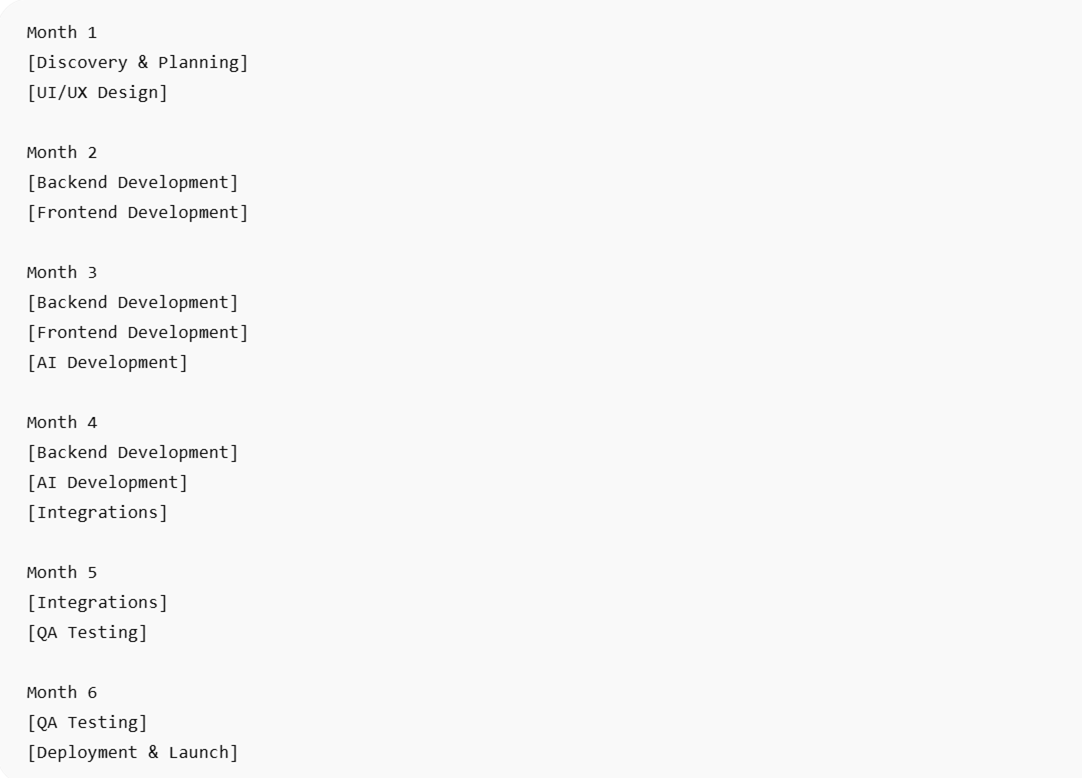
For most mid-sized property management companies, the AI property management software development cost for real estate agencies in USA is spread across these phases rather than paid upfront, making phased budgeting far more practical than treating the project as a single expense.
When evaluating the development cost of AI property management software phases by phases, companies gain a clearer picture of where resources are invested, which stages create the most value, and how the overall AI property management software cost aligns with business goals and expected ROI.
Most development quotes cover the build. They do not cover what comes after. For AI software, the post-launch cost can add 20% to 40% to your total first-year spend.
This is where many property management companies get surprised. A development proposal might show a project cost of $80,000, $120,000, or $150,000, but that number often excludes several operational expenses required to keep the platform running, secure, and continuously improving.
When evaluating the AI property management software development cost, it is important to look beyond the initial invoice and calculate the total cost of ownership.
A common question from buyers is:
"We manage several hundred rental units across multiple locations and want an AI platform for tenant communication, maintenance automation, lease tracking, and payment processing. The development proposal looks reasonable, but what additional costs should we expect after launch that most vendors do not mention upfront?"
The answer lies in the hidden expenses below.
| Hidden Cost Category | What It Is | Estimated Annual Cost |
| Cloud Infrastructure (AWS, GCP, Azure) | Servers, storage, AI processing, CDN | $6,000 – $24,000/year |
| AI Model Retraining and Updates | Models drift over time and need periodic retraining | $3,000 – $15,000/year |
| Third-Party API Fees | Payment gateways, SMS services, background check APIs | $2,000 – $10,000/year |
| Security Audits and Compliance | CCPA, Fair Housing Act, data encryption audits | $2,000 – $8,000/year |
| Bug Fixes and Ongoing Maintenance | Post-launch updates, patches, performance fixes | $8,000 – $20,000/year |
| New Feature Additions | Adding modules as the business grows | $10,000 – $50,000/year |
| Staff Training and Onboarding | Getting your team to actually use the system | $1,000 – $5,000 one-time |
| Downtime and Recovery Costs | Cost of system failure if no redundancy plan | Variable |
Many companies assume cloud hosting is a minor expense. In reality, AI systems consume significantly more infrastructure resources than traditional software.
Costs typically grow as:
Cloud spending is one of the most overlooked factors in the overall property management software total ownership cost.
Unlike traditional software, AI systems are not completely "set and forget."
Over time, model performance can decline. Regular retraining and optimization help maintain accuracy and automation effectiveness. These ongoing expenses are often excluded from initial development proposals.
Most AI property management platforms rely on external services for:
These vendors charge recurring usage-based fees.
At the same time, compliance requirements continue evolving. Security reviews, data protection assessments, and regulatory updates contribute to the ongoing hidden costs of AI property management software development that many buyers fail to budget for.
Consider a platform with an initial development investment of $100,000.
| Cost Category | Amount |
| Initial Development | $100,000 |
| Cloud Infrastructure | $12,000 |
| Maintenance & Support | $15,000 |
| API Usage Fees | $5,000 |
| Security & Compliance | $3,000 |
| AI Model Updates | $5,000 |
| Total First-Year Investment | $140,000 |
This example highlights why the real cost of AI property management software extends far beyond development.
The smartest buyers build a 24-month budget, not just a build budget, because long-term operational expenses often determine whether an AI property management platform delivers the expected return on investment.
Also Read: How to Build Real Estate AI Software: Cost, Features & Tech Stack Explained
One of the most common questions property managers ask before investing in technology is:
"Is it cheaper to build a custom AI property management software or keep paying for AppFolio and Yardi subscriptions in the long run?"
The honest answer is: it depends on portfolio size, growth plans, and operational complexity.
For smaller property management companies, buying an existing platform is usually the more economical choice. For larger organizations with hundreds or thousands of units, a custom platform often becomes financially attractive because recurring subscription costs continue to increase every year while a custom system becomes a long-term owned asset.
The comparison below provides a realistic view of the build vs buy AI property management software cost over a multi-year period.
| Portfolio Size | SaaS Annual Cost (AppFolio/Yardi) | Custom Build Total Cost | Break-Even Point | Recommended Path |
| Under 100 Units | $3,600 – $7,200/year | $40,000 – $70,000 | 7 – 12 years | Buy (SaaS wins) |
| 100 – 500 Units | $18,000 – $36,000/year | $70,000 – $130,000 | 3 – 5 years | Evaluate both options |
| 500+ Units | $60,000 – $120,000/year | $130,000 – $200,000 | 1 – 2 years | Build (custom wins) |
If you manage a relatively small portfolio, buying software is usually the smarter financial decision.
The upfront investment required for custom development is difficult to justify when modern SaaS platforms already provide:
For smaller agencies, subscription costs remain manageable and implementation is significantly faster.
This is where the decision becomes less obvious.
Many growing agencies start questioning recurring subscription fees, workflow limitations, and integration restrictions. The total cost of ownership over five years often begins approaching the investment required for a custom platform.
This is the range where a detailed custom AI property management software cost comparison becomes important because the right choice depends on:
Some agencies benefit from SaaS. Others achieve better long-term value through custom development.
For large property management organizations, the economics often shift toward building.
Annual software licensing costs can become substantial, especially when multiple modules, users, locations, and integrations are involved.
A custom platform provides:
For large portfolios, break-even often occurs within one to two years.
Financial calculations are important, but they are not the only consideration.
With custom software, all operational and tenant data remains under your control. SaaS platforms may limit access, exports, or customization options.
Every property management company operates differently. Custom software allows processes to be designed around your business instead of adapting your business to predefined workflows.
A proprietary AI platform can create unique operational advantages that competitors using the same off-the-shelf tools cannot easily replicate.
With SaaS solutions, pricing, features, and policies can change over time. Custom platforms provide greater independence and strategic control.
Choose custom development if you:
Choose SaaS if you:
The most practical answer to the build vs buy AI property management software debate is not that one option is always better. The right choice depends on portfolio scale, operational requirements, and long-term business strategy. For smaller firms, SaaS typically delivers the best value. For larger organizations, custom development often becomes the stronger long-term investment.

One of the biggest mistakes buyers make is comparing their project against generic software pricing benchmarks. The budget required for an independent landlord managing 75 units is very different from the investment needed by a multi-city property management enterprise overseeing thousands of units.
The best way to estimate costs is to look at businesses similar to your own. Below are three common real-world scenarios that reflect how most property management software projects are scoped and budgeted in 2026.
Imagine a local property management company managing around 100 residential units. The team is small, tenant requests are handled manually through email and phone calls, and rent collection still requires significant administrative effort each month.
Their primary goal is operational efficiency, not enterprise-level automation.
Typical buyer question: "Can we automate rent collection and maintenance requests without spending six figures?"
Recommended Budget: $40,000–$70,000
Timeline: 3–5 months
Recommended Features:
What to Skip Initially?
For agencies at this stage, a focused MVP often delivers the highest return because it solves everyday operational problems without introducing unnecessary complexity.
Consider a regional property management company managing 300 to 400 units across multiple locations. The business already uses several software tools, but teams still spend significant time moving data between systems, coordinating maintenance vendors, and reviewing tenant applications manually.
Their objective is not just automation but workflow optimization.
Typical buyer question: "At what point does custom software become more valuable than paying for multiple SaaS subscriptions?"
Recommended Budget: $70,000–$130,000
Timeline: 5–8 months
Recommended Features:
What This Budget Delivers Beyond SaaS?
This is the range where many agencies begin seeing meaningful advantages from custom development because operational processes become a competitive differentiator.
Now consider a property management enterprise operating across multiple cities with hundreds or thousands of units. Teams manage large maintenance networks, multiple property types, and significant volumes of tenant interactions daily.
At this scale, operational efficiency directly impacts profitability.
Typical buyer question: "How can we centralize operations, reduce software dependency, and automate large-scale property management workflows?"
Recommended Budget: $130,000–$200,000+
Timeline: 8–14 months
Recommended Features:
If the organization is currently spending approximately $80,000 annually on software subscriptions and operational inefficiencies, a custom platform can often recover its investment within two years through cost savings and process improvements.
| Business Type | Portfolio Size | Budget Range | Timeline | Recommended Approach |
| Small Real Estate Agency | 50–150 Units | $40,000–$70,000 | 3–5 Months | Build a focused MVP with core automation |
| Mid-Size Property Management Firm | 150–500 Units | $70,000–$130,000 | 5–8 Months | Add AI workflows, integrations, and analytics |
| Large Real Estate Enterprise | 500+ Units | $130,000–$200,000+ | 8–14 Months | Build a full-scale AI platform with enterprise automation |
The most accurate software budget for AI property management software is not determined by company size alone. It depends on the number of units managed, operational complexity, automation goals, and how much control the business wants over its technology stack.
Many property management companies assume that reducing software development costs automatically means compromising on quality, security, or performance. In reality, the opposite is often true. The most successful AI software projects are not the ones with the biggest budgets. They are the ones with the clearest priorities and smartest implementation strategy.
The goal should not be to build the cheapest platform possible. The goal should be to eliminate unnecessary spending while investing in features that deliver measurable operational value. By making a few strategic decisions early, property managers can significantly reduce development expenses without sacrificing user experience, scalability, or future growth potential.
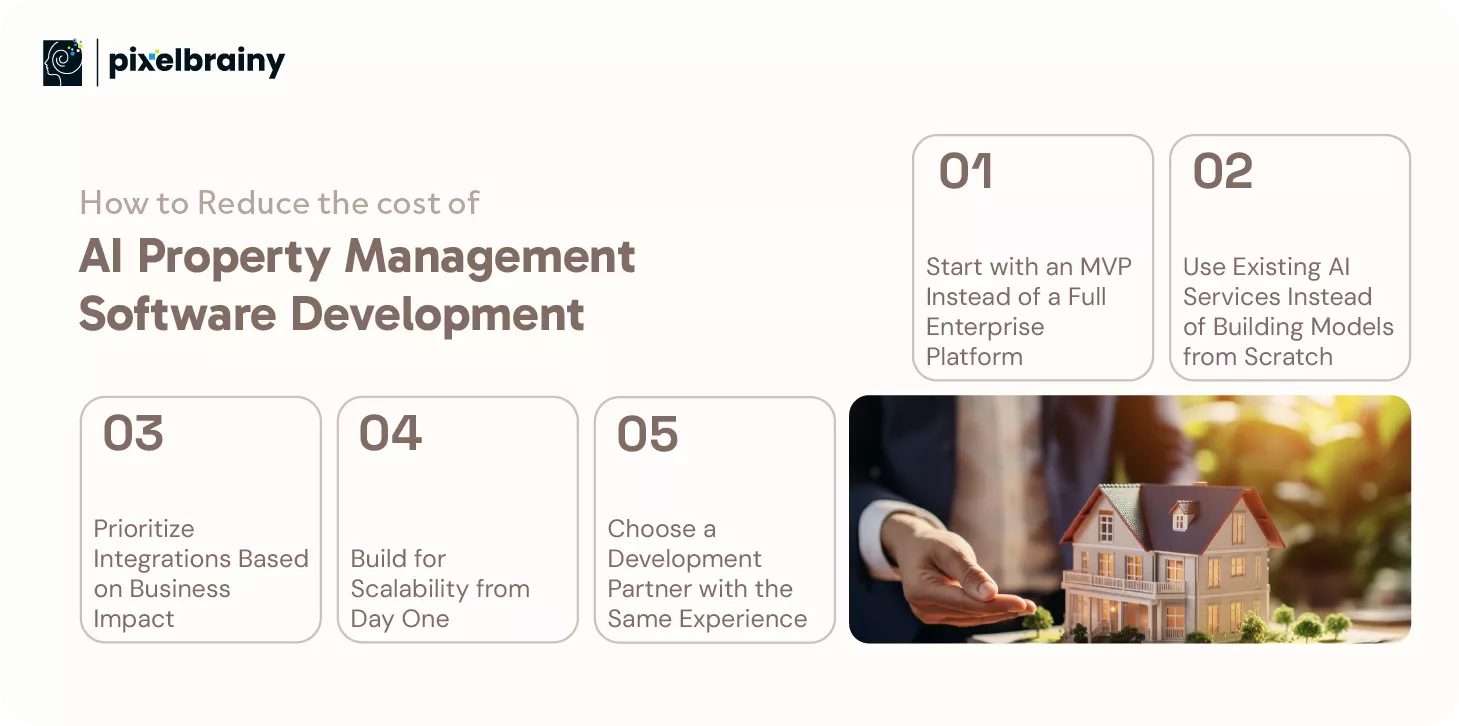
One of the fastest ways to increase project costs is trying to build every possible feature before launch. Many agencies initially request tenant portals, maintenance automation, predictive analytics, AI chatbots, owner dashboards, CRM integrations, mobile apps, and reporting systems all at once.
A better approach is launching with the features that solve the most expensive operational problems first. For most property management companies, that means focusing on rent collection, maintenance requests, tenant communication, and lease management. Once the platform begins generating value, advanced capabilities can be added in future phases without stretching the initial budget.
Also Read: Top 10 AI MVP Development Companies in USA
Custom AI model development can consume a significant portion of the project budget. Training proprietary machine learning models requires large datasets, data scientists, testing environments, and continuous optimization.
In many cases, property management businesses can achieve excellent results using existing AI services and APIs. Features such as chatbots, document processing, tenant communication automation, and lease analysis can often be implemented using proven AI platforms. This reduces development time, lowers infrastructure requirements, and allows businesses to focus investment on property-specific workflows rather than rebuilding technology that already exists.
Not every integration needs to be included during the first release.
Property managers often create long wish lists that include accounting systems, CRM tools, payment gateways, marketing platforms, tenant screening providers, document management systems, and reporting tools. While these integrations can be valuable, implementing all of them simultaneously increases both cost and complexity.
Instead, identify which integrations directly affect daily operations and revenue generation. Start with essential systems such as payment processing and accounting software. Additional integrations can be introduced later based on user feedback and operational needs, helping control development costs without limiting future expansion.
Trying to save money by choosing a short-term architecture often creates larger expenses later. A system designed only for current requirements may require major redevelopment once the business grows.
Investing in scalable architecture early helps avoid expensive migrations, database redesigns, and performance issues. This does not mean overbuilding the platform. It means selecting technology frameworks and infrastructure that can support future growth without requiring complete reconstruction.
A scalable foundation allows agencies to add new properties, users, locations, and AI features without repeatedly paying for major structural changes.
A highly skilled development team can reduce costs even if their hourly rates appear higher initially. Teams that understand property management workflows spend less time learning industry requirements and are more likely to identify unnecessary features before development begins.
Experienced partners can recommend practical solutions, streamline workflows, avoid technical mistakes, and create more accurate project estimates. They also understand common integrations, compliance requirements, tenant management processes, and operational challenges specific to the property management industry.
This expertise often saves far more money than choosing a lower-cost team with limited domain knowledge.
The most effective way to reduce AI property management software development costs is not spending less on development, but spending smarter on the features and decisions that create the highest long-term value.
For most property management companies, the biggest question is not whether AI software can improve operations. The real question is whether the investment will generate enough savings to justify the development cost.
The answer depends on portfolio size, operational inefficiencies, and how extensively AI is used across leasing, maintenance, tenant communication, and administrative workflows. While every business is different, the strongest ROI typically comes from reducing manual work, improving occupancy rates, and eliminating recurring software expenses.
The good news is that these savings are measurable.
The most successful AI property management platforms create value across multiple areas of the business simultaneously.
| ROI Source | How AI Saves Money | Estimated Annual Saving (200-Unit Portfolio) |
| Reduced Manual Staff Hours | AI handles 60–80% of routine tenant queries | $15,000 – $30,000/year |
| Faster Lease Turnaround | AI reduces vacancy days from 21 to 10 on average | $20,000 – $40,000/year |
| Predictive Maintenance Savings | Catching issues early reduces emergency repair costs | $8,000 – $20,000/year |
| Reduced SaaS Subscription Costs | Replace 3–4 tools with one custom platform | $12,000 – $36,000/year |
| Improved Tenant Retention | AI communication improves satisfaction, reducing churn | $10,000 – $25,000/year |
Property managers spend a significant amount of time answering repetitive tenant questions, processing requests, tracking payments, and coordinating maintenance.
AI automates many of these routine interactions, allowing staff to focus on higher-value activities. For agencies managing hundreds of units, labor savings alone can justify a substantial portion of the software investment.
Every vacant unit represents lost revenue.
AI-powered tenant screening, automated follow-ups, document processing, and leasing workflows help reduce delays throughout the rental process. Even a small reduction in vacancy days can create meaningful annual revenue gains across a large portfolio.
Emergency repairs are almost always more expensive than planned maintenance.
AI systems that identify patterns in maintenance requests and equipment performance can help property managers address issues before they become major problems. This reduces repair costs, tenant complaints, and operational disruptions.
A practical ROI calculation might look like this:
| Item | Value |
| Software Development Cost | $100,000 |
| Annual Operational Savings | $65,000 |
| Estimated Break-Even Period | 18 Months |
If you build a $100,000 platform and it saves you $65,000 per year in operating costs and SaaS fees, your break-even point is 18 months.
After reaching break-even, the software continues generating savings year after year while remaining a business-owned asset.
Unlike many traditional software investments, AI systems become more effective as they process more data. Tenant interactions, maintenance records, leasing trends, and operational workflows continuously improve the quality of automation and decision-making.
This means ROI often compounds over time rather than remaining static.
For this reason, the highest returns are typically achieved by property management companies overseeing 200+ units, where operational efficiencies, subscription savings, and automation benefits have the greatest financial impact.
Choosing the right development partner can have a bigger impact on project costs than the technology itself. A company with proptech experience can help avoid unnecessary features, reduce development time, and prioritize the automations that deliver the highest ROI.
A common question from buyers is:
"We are a real estate agency based in Texas and we want to develop a custom AI property management system in budget. Can you recommend affordable development companies that have experience in proptech?"
PixelBrainy helps real estate businesses reduce development costs by focusing on business outcomes first, not feature lists.
| How PixelBrainy Helps | Cost Impact |
| MVP-first development strategy | Reduces upfront investment |
| Proptech-focused expertise | Avoids costly workflow mistakes |
| Modern AI development solutions | Faster implementation |
| Scalable architecture planning | Prevents expensive rebuilds later |
| Integration-first approach | Reduces manual operations |
Whether you need a lean MVP or a full-scale enterprise platform, PixelBrainy combines proptech expertise with practical AI development solutions to help property management companies build smarter software while keeping development costs under control.
The AI property management software development cost in 2026 typically ranges from $40,000 to $200,000+, depending on the complexity of AI features, integrations, portfolio size, security requirements, and long-term scalability goals. While the upfront investment may seem significant, the real evaluation should focus on operational savings, reduced SaaS dependency, faster leasing processes, improved tenant experiences, and long-term ownership of your technology.
For many property management companies, the question is no longer whether AI can improve operations. The question is:
"Our property management team spends too much time on tenant communication, rent collection, maintenance coordination, and reporting. Is building a custom AI platform worth the investment?"
For growing portfolios, especially those managing 200+ units, the answer is often yes when the software is built around your unique workflows and business objectives.
If you are evaluating a custom AI property management platform and want a realistic budget estimate, feature roadmap, or ROI analysis, schedule a consultation call with PixelBrainy. Our team can help you identify the right scope, optimize development costs, and create a tailored strategy for your property management business.
The cost to build AI property management software in 2026 typically ranges from $40,000 to $200,000+. The final budget depends on factors such as feature requirements, AI complexity, third-party integrations, security needs, development team location, and platform scalability. A basic MVP costs significantly less than an enterprise-grade solution with advanced automation and analytics.
The most cost-effective approach is to start with an MVP (Minimum Viable Product). Focus only on essential features such as tenant management, rent collection, maintenance ticketing, and a basic AI chatbot. This strategy can keep development costs within the $40,000–$60,000 range while allowing you to validate the product before investing in advanced functionality.
Development timelines vary based on project scope. A basic MVP can often be developed within 4–6 weeks, while a fully featured enterprise platform with AI automation, integrations, and analytics may take 8–14 weeks or more depending on complexity and team size.
For property portfolios under 100 units, SaaS platforms are usually more affordable because of lower upfront costs. For larger portfolios managing 500+ units, a custom AI platform often becomes more cost-effective over time and can achieve a return on investment within 1–2 years through subscription savings and operational efficiencies.
The most expensive AI features are typically: 1. Voice AI and AI-powered IVR systems 2. Conversational AI chatbots with advanced workflows 3. Predictive maintenance systems These features require specialized AI models, additional infrastructure, extensive testing, and ongoing optimization.
Post-launch expenses typically include: 1. Cloud hosting and infrastructure 2. AI model retraining and updates 3. Third-party API fees 4. Security audits and compliance 5. Software maintenance and support These recurring costs usually range between $20,000 and $50,000 per year, depending on usage and system complexity.
Yes. Small agencies can often build a practical AI-powered platform using an MVP-first strategy. By focusing on essential workflows and working with an offshore or hybrid development team, a functional solution can typically be developed for $40,000–$60,000.
The best starting features are those that reduce manual work immediately. Most agencies begin with: 1. AI tenant support chatbots 2. Automated rent reminders 3. Maintenance request automation 4. Lease document management 5. Tenant communication tools These features usually provide the fastest ROI.
Feature complexity has the largest impact on project cost. AI automation, predictive analytics, custom integrations, mobile applications, and enterprise-grade security requirements can significantly increase development budgets compared to a basic property management platform.
For agencies managing between 150 and 500 units, the ideal budget generally falls between $70,000 and $130,000. This range typically supports AI-powered automation, tenant management, maintenance workflows, reporting dashboards, integrations, and scalable infrastructure for future growth.

About The Author
Sagar Bhatnagar
Sagar Sahay Bhatnagar brings over a decade of IT industry experience to his role as Marketing Head at PixelBrainy. He's known for his knack in devising creative marketing strategies that boost brand visibility and market influence. Sagar's strategic thinking, coupled with his innovative vision and focus on results, sets him apart. His track record of successful campaigns proves his ability to utilize digital platforms effectively for impactful marketing efforts. With a genuine passion for both technology and marketing, Sagar continuously pushes PixelBrainy's marketing initiatives to greater success.

Working with the PixelBrainy team has been a highly positive experience. They understand the design requirements and create beautiful UX elements to meet the application needs. The dev team did an excellent job bringing my vision to life. We discussed usability and flow. Sagar worked with his team to design the database and begin coding. Working with Sagar was easy. He has the knowledge to create robust apps, including multi-language support, Google and Apple ID login options, Ad-enabled integrations, Stripe payment processing, and a Web Admin site for maintaining support data. I'm extremely satisfied with the services provided, the quality of the final product, and the professionalism of the entire process. I highly recommend them for Android and iOS Mobile Application Design and Development.

Great experience working with them. Had a lot of feedback and I found that unlike most contractors they were bugging me for updates instead of the other way around. They were extremely time conscience and great at communicating! All work was done extremely high quality and if not on time, early! They were always proactive when it comes to communication and the work is great/above par always. Very flexible and a great team to work with! Goes above and beyond to present us with multiple options and always provides quality. Amazing work per usual with Chitra. If you have UI/UX or branding design needs I recommend you go to them! Will likely work with them in the future as well, definitely recommended!

PixelBrainy is a joy to work with and is a great partner when thinking through branding, logo, and website layout. I appreciate that they spend time going into the "why" behind their decisions to help inform me and others about industry best practices and their expertise.

I hired them to design our software apps. Things I really like about them are excellent communication skills, they answer all project suggestions and collaborate right away, and their input on design and colors is amazing. This project was complex and needed patience and creativity. The team is amazing to do business with. I will be using them long-term. Glad to see there are some good people out there. I was afraid to try and outsource my project to someone but I am glad I met them! I really can't say enough. They went above and beyond on this project. I am very happy with everything they have done to make my business stand out from the competition.

It was great working with PixelBrainy and the team. They were very responsive and really owned the project. We'll definitely work with them again!

I recently worked with the PixelBrainy team on a project and I was blown away by their communication skills. They were prompt, clear, and articulate in all of our interactions. They listened and provided valuable feedback and suggestions to help make the project a success. They also kept me updated throughout the entire process, which made the experience stress-free and enjoyable.

PixelBrainy is very good at what it does. The team also presents themselves very professionally and takes care of their side of things very well. I could fully trust them taking up the design work in a timely and organised manner and their attention to detail saved us lots of effort and time. This particular project was quite intense and the team showed that they function very well under pressure. Very much looking forward to working with her again!

It's always an absolute pleasure working with them. They completed all of my requests quickly and followed every note I had for them to a T, which made our process go smoothly from start to finish. Everything was completed fast and following all of the guidelines. And I would recommend their services to anyone. If you need any design work done in the future, PixelBrainy should be your first call!

They took ownership of our requirements and designed and proposed multiple beautiful variants. The team is self-motivated, requires minimum supervision, committed to see-through designs with quality and delivering them on time. We would definitely love to work with PixelBrainy again when we have any requirements.

PixelBrainy was a big help with our SaaS application. We've been hard at work with a new UI/UX and they provided a lot of help with the designs. If you're looking for assistance with your website, software, or mobile application designs, PixelBrainy and the team is a great recommendation.

PixelBrainy designers are amazing. They are responsive, talented, and always willing to help craft the design until it matches your vision. I would recommend them and plan to continue them for my future projects and more!!!

They were awesome! Did a good job fast, and good communication. Will work with them again. Thank you

Creative, detail-oriented, and talented designers who take direction well and implement changes quickly and accurately. They consistently over-delivered for us.

PixelBrainy team is very talented and creative. Great designers and a pleasure to work with. PixelBrainy is an excellent communicator and I look forward to working with them again.

PixelBrainy has a very talented design team. Their work is excellent and they are very responsive. I enjoy working with them and hope to continue on all of our future projects.


Transform your ideas into reality with us.
Across these industries, each engagement brings unique challenges, from early-stage product development to scaling complex systems, helping us build a practical understanding of real-world product environments.