AI Summary Powered by PixelBrainy
Why are real estate companies generating more leads yet struggling to find buyers who are actually ready to act? The challenge is no longer lead volume but lead quality and speed of response. Real estate agencies, property developers, real estate marketers, and broker owners often receive large numbers of inquiries that lack clear intent, forcing teams to spend time manually qualifying prospects instead of focusing on serious opportunities. Without intelligent systems, identifying high-intent buyers becomes inefficient and inconsistent.
AI automation real estate solutions are reshaping how businesses approach this problem by turning data into actionable insights. AI real estate lead generation analyzes behavioral patterns, search activity, and engagement signals to prioritize prospects with higher conversion potential. Real estate lead qualification AI helps teams automatically rank leads based on intent, while AI lead nurturing real estate workflows maintain personalized communication through automated follow-ups and tailored property recommendations. This shift supports real estate sales automation by reducing repetitive tasks and enabling agents to focus on meaningful conversations with qualified prospects.
The rapid adoption of AI reflects its growing impact across the industry. Research shows that the global AI in real estate market, valued at about USD 303 billion in 2025, is projected to reach nearly USD 988 billion by 2029 as companies invest in automation and predictive analytics.
As more businesses learn how to automate real estate lead qualification using AI and how to filter high-intent buyers using AI, understanding how real estate companies use AI to qualify leads becomes essential. From this blog you can explore practical strategies, tools, and workflows that help generate more qualified real estate leads through AI automation.
AI automation in real estate refers to the use of artificial intelligence tools to streamline lead generation, qualification, nurturing, and conversion processes. Instead of relying on manual workflows, AI systems analyze customer data, behavior, and engagement patterns to identify high-quality prospects.
Key capabilities include:
For real estate businesses, this means smarter decision-making and faster response times that improve overall efficiency.
Traditional real estate lead generation strategies were built around manual outreach, broad advertising, and reactive follow-up processes. While these methods once worked, modern buyer behavior and digital expectations have changed significantly. Without intelligent systems, agencies struggle to manage increasing lead volume while maintaining quality engagement. AI automation real estate solutions are emerging because traditional approaches can no longer keep pace with how buyers research and interact today.
Below are the key reasons traditional methods are losing effectiveness.
Real estate leads are highly time-sensitive. When prospects submit inquiries, delays in responding often result in lost opportunities. Manual workflows depend on agent availability, which creates gaps in communication.
AI real estate lead generation solves this challenge by enabling instant responses through automation, ensuring prospects receive immediate engagement regardless of time or workload.
Traditional marketing campaigns focus on generating more leads rather than better leads. This creates a large pool of inquiries where only a small percentage are serious buyers.
Real estate lead qualification AI helps reduce unqualified real estate leads using AI by analyzing behavioral signals such as search patterns, engagement history, and intent indicators. This allows teams to focus on prospects with higher conversion potential.
Generic marketing emails and standard follow-ups fail to address individual preferences. Buyers now expect relevant property suggestions and tailored communication.
AI automation real estate platforms personalize messaging automatically, increasing engagement and helping businesses increase real estate leads using artificial intelligence through smarter targeting.
Traditional systems often lack real-time analytics. Without data-driven insights, teams struggle to understand which strategies produce results.
AI-powered tools track user behavior, campaign performance, and lead quality, allowing continuous optimization of AI real estate lead generation strategies.
Manual follow-ups rely heavily on individual effort, which can lead to missed opportunities and inconsistent communication.
Automation ensures structured nurturing workflows, timely reminders, and ongoing engagement, helping maintain strong relationships with potential buyers.
As buyer expectations continue to evolve, traditional methods cannot match the speed, personalization, and intelligence provided by AI-driven solutions.
Real estate AI automation is transforming how agencies identify, engage, and convert prospects by combining intelligent data analysis with automated workflows. Instead of relying on manual processes, AI automation for real estate business helps teams focus on high-intent buyers while reducing wasted effort.
Below are the most effective ways AI is improving lead quality and supporting smarter decision-making.
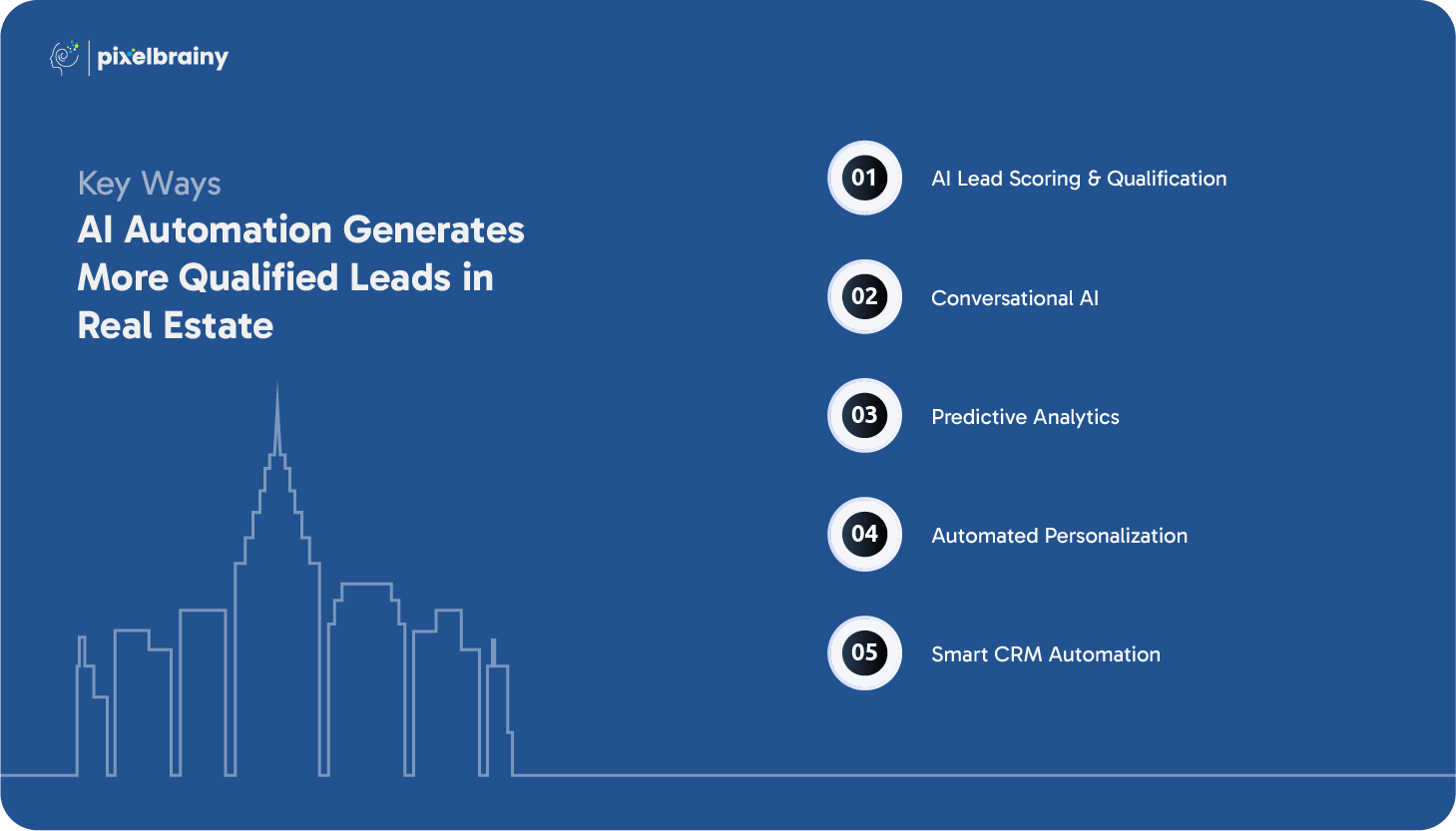
One of the biggest advantages of AI automation for real estate business is the ability to automatically analyze and prioritize leads based on intent. Traditional systems often treat every inquiry equally, which leads to inefficient use of time and resources. Real estate lead qualification AI evaluates behavioral signals such as property searches, website activity, communication patterns, and demographic data to determine how likely a prospect is to convert.
Instead of manually filtering contacts, AI assigns lead scores that help agents identify serious buyers quickly. This process reduces guesswork and ensures that sales teams focus on opportunities with higher potential value. Over time, machine learning models refine their predictions, improving accuracy and helping businesses consistently generate more qualified leads through smarter targeting and decision-making.
Conversational AI enables real-time engagement through automated chat systems that interact with prospects across websites, messaging platforms, and social channels. Unlike static forms, AI-driven chatbots for real estate can ask qualifying questions, provide property details, and guide users toward relevant listings based on their responses. As AI chatbot adoption continues to grow across the real estate industry, agencies are discovering new ways to capture and qualify leads without increasing manual workload.
This approach significantly improves response speed, which is crucial in real estate where buyer interest can change quickly. A well-designed Real estate AI app can capture inquiries instantly, schedule appointments, and collect detailed buyer preferences without requiring constant manual involvement. By maintaining ongoing communication, conversational AI helps nurture relationships while ensuring that agents receive qualified leads who have already shared important information about their needs, preferences, and timelines.
Also Read: Real Estate AI Chatbot Development Cost: Factors and Smart Budgeting Tips
Predictive analytics allows real estate companies to move beyond reactive marketing and anticipate buyer behavior before it happens. AI systems analyze historical data, engagement patterns, and market trends to identify which prospects are most likely to take action.
This insight helps businesses allocate resources more effectively by targeting high-value audiences instead of broad demographics. For example, AI real estate lead generation tools can identify when a prospect repeatedly views similar property types or revisits listings, signaling increased buying intent. These insights enable proactive outreach strategies that improve engagement rates and help answer the question many businesses ask: is AI worth it for real estate leads generation? For many organizations, predictive analytics provides measurable improvements in lead quality and conversion outcomes.
Modern buyers expect personalized experiences, and AI makes this possible at scale. Automated personalization uses data analysis to deliver tailored property recommendations, customized email campaigns, and relevant content based on individual preferences.
Instead of sending generic property updates, AI automation real estate platforms create dynamic messaging that reflects a buyer’s search history, budget range, and preferred locations. This increases engagement because prospects receive information that feels relevant and timely. Personalized communication also strengthens trust, helping nurture leads throughout longer decision cycles. By automating personalization, agencies can maintain consistent engagement with hundreds of prospects simultaneously while still delivering experiences that feel human and customized.
CRM systems enhanced with AI provide centralized lead management combined with automation capabilities that streamline workflows. Smart CRM automation tracks interactions, schedules follow-ups, and analyzes communication history to ensure no opportunity is overlooked.
Real estate AI automation integrates directly with marketing channels, allowing data to flow seamlessly between lead generation and sales processes. Automated reminders and nurturing sequences keep prospects engaged without requiring manual tracking. This not only improves efficiency but also helps teams maintain consistent communication, which is essential for building trust. Over time, AI insights reveal which strategies produce the best results, allowing agencies to refine campaigns and improve overall performance.
That’s why, by exploring these key approaches, real estate companies are realizing how AI automation is redefining the way they attract, qualify, and convert buyers through intelligent insights and scalable engagement strategies.

Real estate companies adopting Real estate AI automation are seeing measurable improvements across their lead generation and sales processes. Instead of relying on assumptions, AI automation for real estate business introduces data-driven workflows that improve efficiency and targeting accuracy.
Many agencies report up to a 37% increase in qualified leads because AI identifies intent earlier, automates engagement, and ensures consistent nurturing throughout the buyer journey. Below are the top benefits of AI automation for real estate lead generation that contribute to these results.
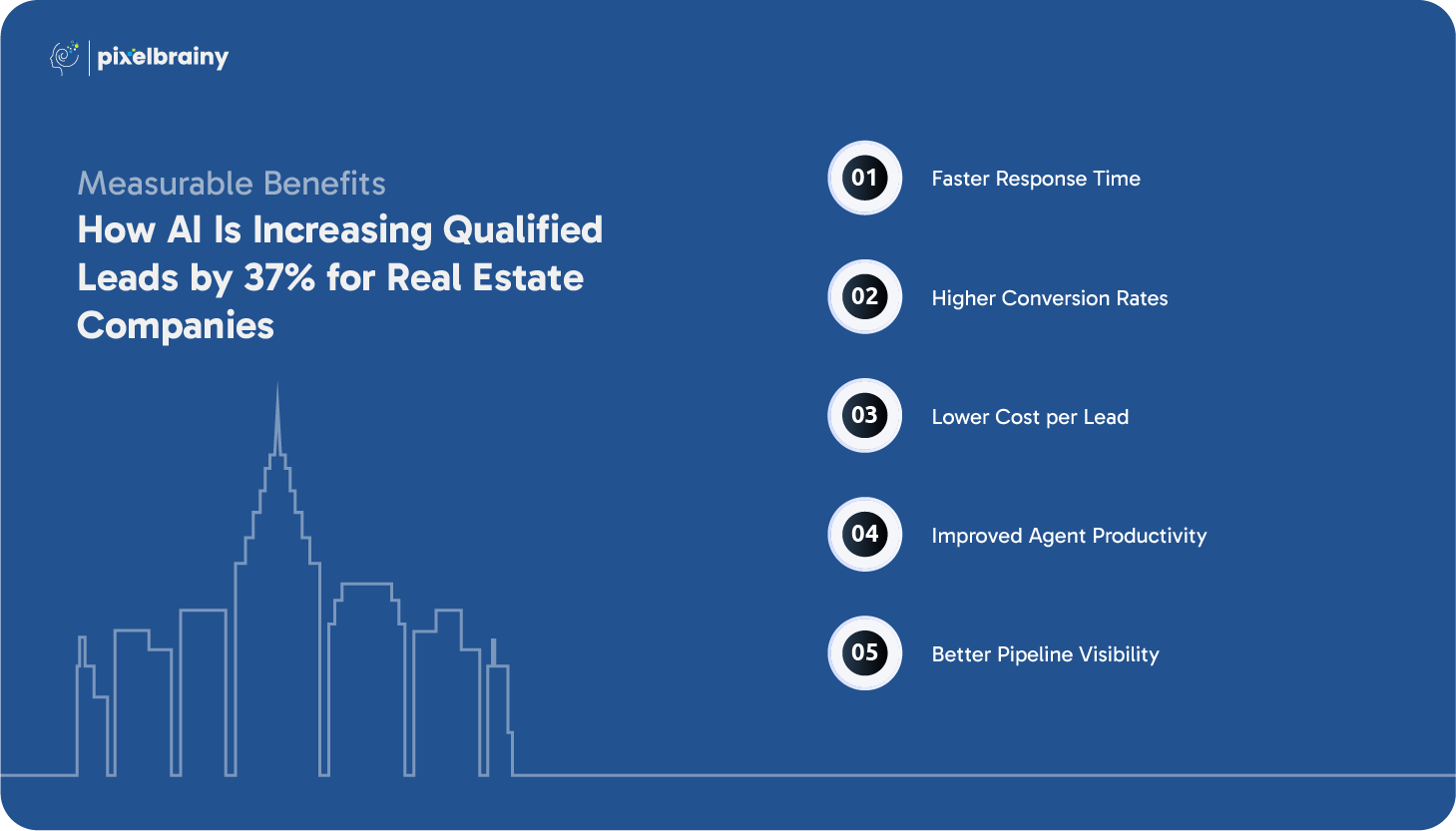
Speed plays a critical role in converting real estate inquiries into serious opportunities. Traditional workflows often involve manual responses, which can create delays that cause prospects to lose interest or move toward competitors. Real estate AI automation eliminates this gap by enabling instant engagement through automated messaging, intelligent routing, and real-time responses.
When prospects receive immediate replies, they are more likely to stay engaged and continue the conversation. AI systems can acknowledge inquiries, answer common questions, and collect initial qualification data before agents even step in. This not only improves user experience but also ensures that no lead goes unnoticed. Faster response time significantly contributes to the reported 37% increase in qualified leads, as early engagement helps identify serious buyers before they disengage.
One of the most impactful outcomes of AI automation for real estate business is improved conversion performance. Instead of focusing on lead quantity alone, AI tools analyze user behavior and engagement patterns to identify prospects with genuine buying intent. Real estate lead qualification AI ensures that agents prioritize leads who are more likely to move forward.
AI-driven personalization also plays a key role by delivering relevant property recommendations and timely follow-ups. When communication aligns with individual preferences, prospects feel understood and remain engaged longer. This targeted approach reduces drop-offs throughout the sales funnel. As a result, companies experience higher conversion rates because they are focusing on high-value opportunities rather than spreading resources across low-intent inquiries.
Marketing budgets are often stretched thin when campaigns generate large volumes of low-quality leads. AI automation real estate strategies improve cost efficiency by refining targeting and reducing wasted ad spend. Predictive analytics identifies audiences most likely to convert, allowing businesses to invest in high-performing channels.
Automation also reduces operational costs by minimizing manual effort required for lead qualification and follow-ups. Instead of hiring additional staff to manage inquiries, AI systems handle repetitive tasks at scale. Over time, this leads to a lower cost per lead while maintaining or improving quality. The ability to focus marketing resources on qualified prospects is another factor contributing to the 37% increase in meaningful leads reported by many real estate organizations.
Agents often spend significant time on administrative tasks such as responding to basic inquiries, scheduling appointments, or tracking follow-ups. Real estate AI automation streamlines these workflows by automating repetitive processes, allowing agents to focus on relationship-building and closing deals.
With AI automation for real estate business, lead data is organized automatically, conversations are summarized, and next-step recommendations are generated based on engagement history. This reduces cognitive overload and helps agents manage larger pipelines without sacrificing quality. Increased productivity directly impacts performance because agents can dedicate more attention to high-intent buyers rather than manual tasks that do not generate revenue.
Understanding where each lead stands in the sales funnel is essential for strategic decision-making. Traditional systems often lack real-time insights, making it difficult to track progress or identify bottlenecks. AI-powered platforms provide detailed analytics and predictive insights that improve visibility across the entire pipeline.
Real estate lead qualification AI continuously analyzes interactions, engagement levels, and conversion signals, allowing managers to forecast outcomes more accurately. Teams can identify which marketing channels perform best and adjust strategies accordingly. Enhanced visibility ensures that no opportunity is overlooked and helps maintain consistent momentum throughout the sales cycle. This data-driven clarity supports the measurable growth in qualified leads that many companies attribute to AI adoption.
By combining speed, precision, and intelligent automation, real estate AI automation is enabling companies to achieve measurable improvements, including up to a 37% increase in qualified leads and more efficient sales processes.
A structured AI automation funnel helps real estate businesses transform raw inquiries into qualified opportunities through intelligent workflows. Instead of relying on manual steps, AI automation for real estate business creates a connected system that captures, analyzes, nurtures, and prioritizes leads automatically. Below is a practical breakdown of how AI real estate lead generation works step by step to improve lead quality and conversion outcomes.
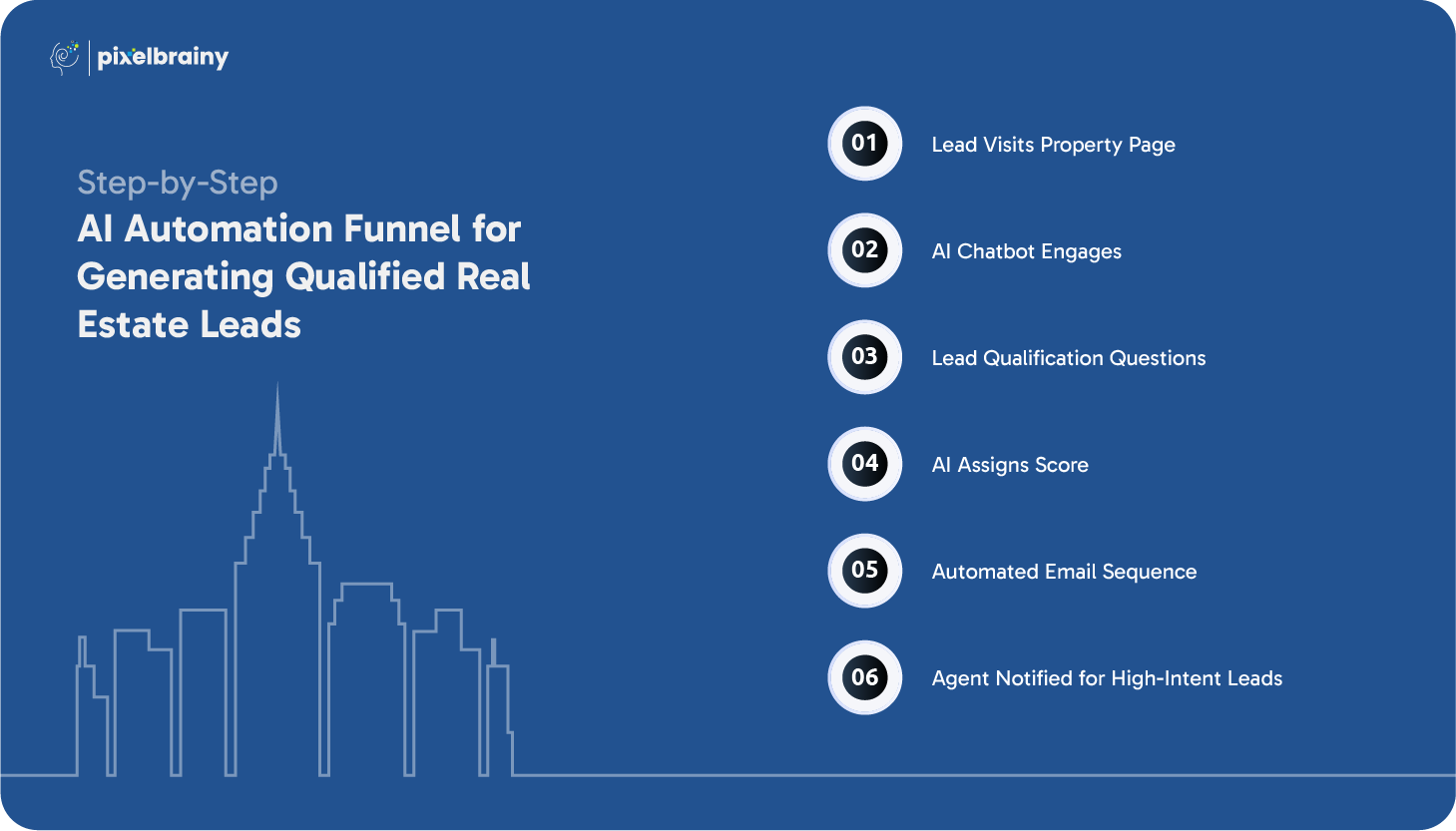
The journey begins when a potential buyer lands on a Real estate website and starts browsing listings. AI systems immediately begin collecting behavioral signals such as viewed properties, time spent on pages, location preferences, and interaction patterns. This data provides valuable insights into the visitor’s intent even before direct communication begins.
The Aim of this step is to capture meaningful engagement data without interrupting the user experience. Instead of relying solely on form submissions, AI automation real estate tools track passive signals that help identify early buying interest. This allows businesses to understand user behavior at scale and prepare personalized engagement strategies. Early data collection forms the foundation for real estate lead qualification AI by building a detailed profile of each prospect from their first interaction.
Once engagement signals are detected, an AI chatbot initiates interaction through contextual prompts or assistance offers. Unlike traditional pop-ups, conversational AI responds dynamically based on user behavior and property interests. The chatbot can answer questions, recommend similar listings, and guide visitors toward deeper engagement.
The Aim of this step is to create instant communication while reducing response delays. AI automation for real estate business ensures that every visitor receives immediate attention, even outside working hours. This improves user experience and increases the likelihood of capturing contact information. As conversational engagement continues, AI gathers essential details such as budget range, preferred location, and timeline, which helps improve lead qualification accuracy.
After initial engagement, AI systems ask structured qualification questions designed to understand the buyer’s intent and readiness level. These questions may include financing status, purchase timeline, property type preference, or specific requirements. Unlike manual processes, AI adapts questions based on previous responses to create a more personalized experience.
The Aim of this step is to reduce unqualified inquiries and collect meaningful data that supports real estate lead qualification AI. By automating this process, agencies avoid spending time on prospects who are not ready to move forward. Intelligent questioning also improves user engagement because conversations feel relevant rather than generic. This stage transforms casual interest into structured data that helps determine which leads require immediate human attention.
Once sufficient information is gathered, AI algorithms analyze behavioral signals, responses, and engagement history to assign a lead score. This score reflects the likelihood that a prospect will convert into a serious buyer or client. Factors such as repeat visits, interaction depth, property preferences, and response patterns influence the scoring process. Through seamless AI integration, data from multiple touchpoints such as website activity, chatbot interactions, and marketing campaigns is combined to create a more accurate evaluation of buyer intent.
The Aim of this step is to prioritize opportunities effectively. Instead of manually reviewing each inquiry, agents receive ranked leads based on real-time insights, allowing them to focus on the most promising prospects first. AI real estate lead generation platforms continuously refine scoring models using machine learning, improving accuracy over time. This ensures that teams concentrate on high-value prospects, increasing efficiency and helping businesses maximize their conversion potential without increasing workload.
After scoring, AI triggers personalized nurturing workflows tailored to each lead’s profile. Automated email sequences deliver property updates, educational content, and timely reminders that align with buyer preferences and engagement history. Messaging is dynamically adjusted based on user behavior, ensuring communication stays relevant, personalized, and aligned with the prospect’s stage in the buying journey. Many solutions developed by Top AI real estate software development companies include advanced automation features that enable businesses to design intelligent nurturing journeys without complex manual setup.
The Aim of this step is to maintain consistent engagement throughout the decision-making process. Many buyers require multiple touchpoints before taking action, and AI automation real estate solutions ensure no lead is overlooked. Automated nurturing builds trust while keeping the brand top-of-mind through valuable and timely communication. This stage also allows businesses to scale outreach efficiently, nurturing hundreds of prospects simultaneously while reducing manual workload and maintaining personalized engagement.
When a lead reaches a certain score threshold or shows strong buying signals, the system alerts agents automatically. Notifications include summarized insights such as property preferences, interaction history, and conversation highlights. This prepares agents to approach the lead with context and personalized recommendations.
The Aim of this step is to connect human expertise with AI insights at the right moment. Instead of cold outreach, agents engage prospects who have already demonstrated intent, leading to more productive conversations. Many organizations working with Top AI development companies in USA implement this approach to improve response quality and increase closing efficiency. By combining automation with human interaction, businesses achieve stronger results.
A well-designed AI automation funnel ensures that every interaction moves prospects closer to conversion by combining intelligent qualification with timely human engagement.
The rapid adoption of AI automation real estate solutions has introduced a wide range of tools designed to improve how agencies capture, qualify, and convert leads. These platforms go beyond simple automation by using data analysis, behavioral tracking, and predictive intelligence to support smarter decision-making. From conversational engagement to advanced analytics, AI tools are helping real estate businesses build more efficient workflows that reduce manual effort while increasing lead quality.
AI-powered chatbots help real estate companies engage visitors instantly through websites, social media platforms, and messaging applications. These tools collect buyer preferences, answer property-related questions, and guide prospects through early stages of the funnel.
Key benefits include:
Conversational AI plays a significant role in AI automation for real estate business by ensuring that no potential lead is missed, even outside business hours.
AI-enabled CRM systems combine traditional contact management with intelligent automation. These platforms analyze interaction history, assign lead scores, and provide insights that help agents prioritize prospects.
Important features include:
By centralizing data and automating routine tasks, AI-driven CRMs improve productivity and help teams maintain consistent engagement with prospects.
Predictive analytics platforms use machine learning to identify patterns that indicate buyer intent. These tools analyze historical data, user behavior, and engagement signals to determine which prospects are most likely to convert.
Benefits include:
Predictive tools strengthen AI real estate lead generation by focusing resources on opportunities with the highest potential value.
Marketing automation tools help real estate businesses manage email campaigns, retargeting ads, SMS outreach, and personalized content delivery. AI enhances these platforms by automatically adjusting messaging based on user behavior.
Common capabilities:
These tools ensure that communication remains consistent and relevant throughout the buyer journey.
Analytics platforms powered by AI provide deep insights into lead performance, conversion rates, and marketing effectiveness. Instead of relying on guesswork, teams gain data-driven visibility into which strategies work best.
Key advantages:
Better analytics helps businesses refine their AI automation real estate strategy and achieve measurable improvements over time.
These platforms are helping real estate teams move from manual lead handling to smarter, more efficient workflows powered by AI.

AI automation real estate solutions are helping companies transform how they attract, qualify, and convert prospects, but success depends on how strategically these tools are implemented. Many real estate organizations adopt AI with the expectation that technology alone will increase performance, only to realize that without proper planning, integration, and training, the results fall short. While AI real estate lead generation offers powerful advantages, avoiding common mistakes is essential to ensure automation delivers meaningful outcomes instead of adding complexity.
Below are some of the most common challenges that limit the effectiveness of AI automation for real estate business workflows.
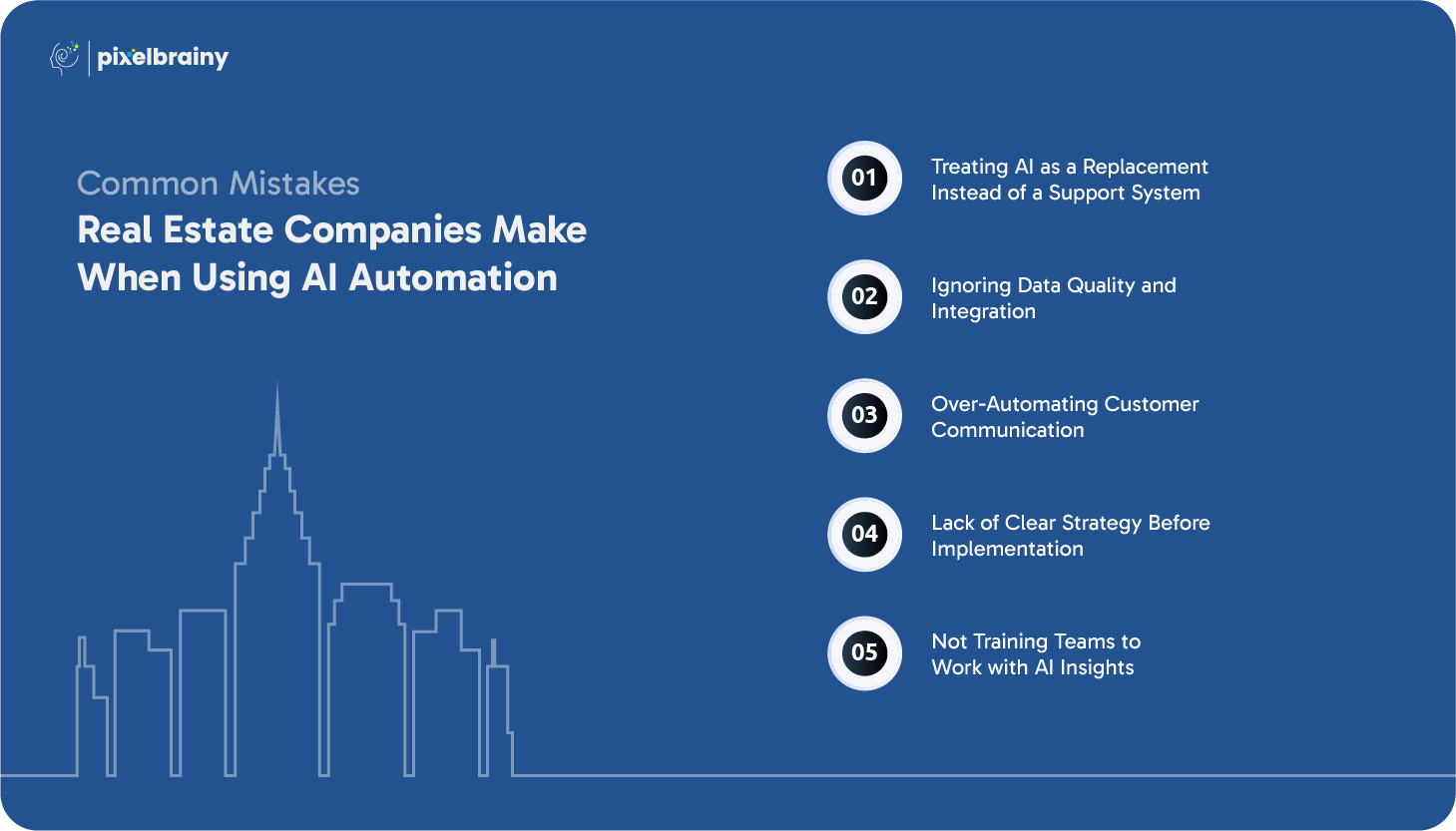
A frequent misconception is believing that AI can replace agents entirely. Real estate remains deeply relationship-driven, and human expertise is still essential for building trust and closing deals. AI automation real estate platforms work best when they enhance human capabilities rather than remove them.
Automation should handle repetitive tasks such as lead sorting, initial engagement, and data analysis, allowing agents to focus on strategic conversations and personalized service. When businesses use AI as a collaborative tool instead of a replacement, they are better positioned to increase real estate leads using artificial intelligence while maintaining strong customer relationships.
AI systems depend heavily on accurate and connected data sources. Without proper integration between CRM systems, marketing platforms, and analytics tools, real estate lead qualification AI may generate inaccurate scoring or misleading insights.
Many companies struggle because their data is fragmented or outdated, making it difficult for AI models to identify genuine buying signals. Clean, centralized data enables AI automation for real estate business processes to function effectively and helps reduce unqualified real estate leads using AI by improving targeting accuracy. Successful implementation requires ongoing data management and alignment across all digital tools.
Automation improves efficiency, but excessive automation can create communication that feels robotic or disconnected. Sending too many automated messages or relying solely on scripted interactions may reduce engagement and weaken trust.
AI real estate lead generation strategies should balance automation with personalization. AI tools can analyze user preferences and behavior to deliver relevant messaging, but human involvement remains important at key decision stages. Maintaining a balance between automation and authenticity ensures that communication feels meaningful rather than transactional.
Some real estate companies invest in AI tools without defining clear goals or measurable outcomes. Without a structured plan, automation can lead to confusion instead of improved performance. Businesses should first identify challenges such as slow response times, inefficient follow-ups, or inconsistent lead qualification processes.
AI automation real estate solutions work best when aligned with specific business objectives. A well-defined strategy helps teams understand how AI supports AI real estate lead generation efforts, improves workflow efficiency, and creates measurable improvements across the sales funnel.
Even the most advanced AI tools require human understanding to be effective. Without proper training, agents may overlook valuable insights provided by real estate lead qualification AI, such as lead scoring recommendations or predictive analytics.
Teams need guidance on how to interpret AI-generated data and integrate insights into daily workflows. Training ensures that AI automation for real estate business becomes part of the operational culture rather than an unused feature. When teams understand how to use AI effectively, they can make faster decisions, prioritize high-intent leads, and improve overall productivity.
Avoiding these common mistakes allows real estate businesses to maximize the benefits of AI automation real estate strategies, strengthening AI real estate lead generation performance and enabling more accurate real estate lead qualification AI for sustainable growth.
AI automation real estate technology continues to evolve rapidly, reshaping how businesses approach lead generation, customer engagement, and decision-making. As artificial intelligence becomes more advanced, real estate companies are moving beyond basic automation toward intelligent systems that predict buyer behavior, personalize experiences, and optimize entire sales pipelines. Understanding emerging trends helps agencies stay ahead while adapting their AI automation for real estate business strategies to future market demands.
Below are some key developments shaping the future of AI real estate lead generation.
Future AI systems will go beyond analyzing past behavior by predicting when prospects are most likely to enter the market. Advanced algorithms will identify subtle signals such as browsing frequency, lifestyle changes, or financial patterns to anticipate buying readiness.
This evolution will improve real estate lead qualification AI by helping agents focus on buyers who are approaching decision stages, enabling more proactive engagement rather than reactive follow-ups.
Personalization will become increasingly sophisticated as AI analyzes deeper behavioral data. Instead of suggesting properties based only on filters like price or location, future systems will consider lifestyle preferences, historical engagement, and contextual signals.
AI real estate lead generation platforms will deliver highly tailored experiences across email, chat, and digital advertising channels, increasing engagement and helping businesses increase real estate leads using artificial intelligence through relevance-driven marketing.
Voice-enabled AI assistants and advanced conversational platforms are expected to play a larger role in real estate interactions. Buyers may search for properties, schedule tours, or request recommendations using natural voice commands.
For real estate companies, this means expanding beyond traditional forms and chat interfaces into more natural communication channels that enhance accessibility and improve user experience.
Visual recognition technology will allow buyers to upload images or describe styles to find matching properties. Combined with virtual tours and immersive experiences, AI will help prospects explore listings more intuitively.
These tools will improve engagement while providing valuable behavioral insights that strengthen real estate lead qualification AI processes.
Future AI automation real estate platforms will unify marketing automation, CRM systems, analytics, and communication tools into seamless ecosystems. Instead of managing separate tools, businesses will operate within connected platforms that automate workflows from first interaction to closing.
This level of integration will allow AI automation for real estate business operations to deliver consistent experiences, improved data visibility, and more accurate performance forecasting.
As these innovations continue to evolve, AI automation real estate solutions will play a central role in helping businesses generate smarter insights, improve real estate lead qualification AI, and scale AI real estate lead generation more efficiently.
AI automation real estate initiatives succeed when technology aligns with real operational challenges rather than functioning as an isolated tool. Many real estate agencies, property developers, broker owners, and real estate marketers struggle to connect lead generation platforms, CRM systems, and marketing workflows into a unified strategy. PixelBrainy LLC focuses on building structured automation ecosystems that simplify this complexity while improving AI real estate lead generation performance and strengthening real estate lead qualification AI.
PixelBrainy LLC works closely with businesses to understand their current sales funnel, marketing processes, and customer journey gaps before implementing automation. Instead of applying one-size-fits-all software, the approach combines strategic planning with scalable technology architecture designed to support long-term growth. Acting as a Real estate AI software development company, the team delivers tailored AI development solutions that integrate predictive analytics, conversational AI, automated nurturing workflows, and performance tracking into a cohesive framework.
For organizations exploring AI automation for real estate business operations, the emphasis remains on measurable outcomes. Automation is implemented to reduce manual workload, improve response speed, and enable teams to increase real estate leads using artificial intelligence without losing the human touch that drives real estate relationships. By connecting data insights with automation, businesses gain clarity on buyer behavior and stronger control over their marketing and sales performance.
Objective: A growing residential real estate agency in California sought to improve lead quality, shorten response times, and scale digital marketing without increasing operational overhead.
Challenges:
Solutions Implemented: PixelBrainy LLC introduced an AI automation real estate framework that combined conversational AI engagement, predictive lead scoring, automated email nurturing, and integrated analytics dashboards. The system connected website activity, marketing campaigns, and CRM workflows to create a unified lead management process.
Results Achieved:
By combining strategic expertise with intelligent automation, PixelBrainy LLC enables real estate businesses to turn AI automation into a practical growth engine that drives measurable results.

AI automation real estate strategies are changing how businesses approach lead generation, qualification, and customer engagement. By combining intelligent data analysis with automated workflows, real estate companies can identify high-intent buyers faster, reduce manual tasks, and create more personalized experiences throughout the sales journey. From predictive analytics to conversational AI and automated nurturing, these technologies help transform traditional processes into scalable systems designed for measurable growth.
As competition continues to evolve, adopting AI real estate lead generation is becoming less about experimentation and more about staying efficient and responsive to modern buyer expectations. Real estate lead qualification AI allows teams to focus on meaningful opportunities while improving overall productivity and marketing performance. Businesses that integrate AI automation for real estate business operations position themselves to generate better results while maintaining strong human connections.
Book an appointment today to explore how AI automation can help your real estate business generate more qualified leads and achieve sustainable growth.
AI automation real estate systems analyze user behavior, engagement patterns, and buyer intent to identify high-quality prospects. Instead of focusing only on lead volume, AI real estate lead generation prioritizes qualified leads through predictive analytics, automated nurturing, and real-time engagement, helping agents focus on serious buyers.
Yes, many real estate companies see measurable improvements after adopting AI automation for real estate business processes. AI reduces manual tasks, improves response speed, and enhances targeting accuracy, which often leads to higher conversion rates and better marketing ROI.
Real estate lead qualification AI evaluates signals such as website activity, communication behavior, property preferences, and engagement history. Based on these factors, AI assigns lead scores that help agents prioritize high-intent prospects and reduce time spent on unqualified inquiries.
Yes. AI systems use data analysis and predictive models to filter low-intent prospects early in the funnel. This allows businesses to reduce unqualified real estate leads using AI while improving the efficiency of marketing campaigns and sales teams.
Common tools include AI chatbots for instant engagement, predictive analytics platforms for buyer intent analysis, AI-powered CRM systems for lead scoring, and marketing automation tools for personalized communication and nurturing workflows.
Results vary depending on implementation, but many businesses start seeing improvements in response time, engagement, and lead quality within a few months. With consistent optimization, AI automation real estate strategies can significantly increase qualified leads and overall sales performance.

About The Author
Sagar Bhatnagar
Sagar Sahay Bhatnagar brings over a decade of IT industry experience to his role as Marketing Head at PixelBrainy. He's known for his knack in devising creative marketing strategies that boost brand visibility and market influence. Sagar's strategic thinking, coupled with his innovative vision and focus on results, sets him apart. His track record of successful campaigns proves his ability to utilize digital platforms effectively for impactful marketing efforts. With a genuine passion for both technology and marketing, Sagar continuously pushes PixelBrainy's marketing initiatives to greater success.

Working with the PixelBrainy team has been a highly positive experience. They understand the design requirements and create beautiful UX elements to meet the application needs. The dev team did an excellent job bringing my vision to life. We discussed usability and flow. Sagar worked with his team to design the database and begin coding. Working with Sagar was easy. He has the knowledge to create robust apps, including multi-language support, Google and Apple ID login options, Ad-enabled integrations, Stripe payment processing, and a Web Admin site for maintaining support data. I'm extremely satisfied with the services provided, the quality of the final product, and the professionalism of the entire process. I highly recommend them for Android and iOS Mobile Application Design and Development.

Great experience working with them. Had a lot of feedback and I found that unlike most contractors they were bugging me for updates instead of the other way around. They were extremely time conscience and great at communicating! All work was done extremely high quality and if not on time, early! They were always proactive when it comes to communication and the work is great/above par always. Very flexible and a great team to work with! Goes above and beyond to present us with multiple options and always provides quality. Amazing work per usual with Chitra. If you have UI/UX or branding design needs I recommend you go to them! Will likely work with them in the future as well, definitely recommended!

PixelBrainy is a joy to work with and is a great partner when thinking through branding, logo, and website layout. I appreciate that they spend time going into the "why" behind their decisions to help inform me and others about industry best practices and their expertise.

I hired them to design our software apps. Things I really like about them are excellent communication skills, they answer all project suggestions and collaborate right away, and their input on design and colors is amazing. This project was complex and needed patience and creativity. The team is amazing to do business with. I will be using them long-term. Glad to see there are some good people out there. I was afraid to try and outsource my project to someone but I am glad I met them! I really can't say enough. They went above and beyond on this project. I am very happy with everything they have done to make my business stand out from the competition.

It was great working with PixelBrainy and the team. They were very responsive and really owned the project. We'll definitely work with them again!

I recently worked with the PixelBrainy team on a project and I was blown away by their communication skills. They were prompt, clear, and articulate in all of our interactions. They listened and provided valuable feedback and suggestions to help make the project a success. They also kept me updated throughout the entire process, which made the experience stress-free and enjoyable.

PixelBrainy is very good at what it does. The team also presents themselves very professionally and takes care of their side of things very well. I could fully trust them taking up the design work in a timely and organised manner and their attention to detail saved us lots of effort and time. This particular project was quite intense and the team showed that they function very well under pressure. Very much looking forward to working with her again!

It's always an absolute pleasure working with them. They completed all of my requests quickly and followed every note I had for them to a T, which made our process go smoothly from start to finish. Everything was completed fast and following all of the guidelines. And I would recommend their services to anyone. If you need any design work done in the future, PixelBrainy should be your first call!

They took ownership of our requirements and designed and proposed multiple beautiful variants. The team is self-motivated, requires minimum supervision, committed to see-through designs with quality and delivering them on time. We would definitely love to work with PixelBrainy again when we have any requirements.

PixelBrainy was a big help with our SaaS application. We've been hard at work with a new UI/UX and they provided a lot of help with the designs. If you're looking for assistance with your website, software, or mobile application designs, PixelBrainy and the team is a great recommendation.

PixelBrainy designers are amazing. They are responsive, talented, and always willing to help craft the design until it matches your vision. I would recommend them and plan to continue them for my future projects and more!!!

They were awesome! Did a good job fast, and good communication. Will work with them again. Thank you

Creative, detail-oriented, and talented designers who take direction well and implement changes quickly and accurately. They consistently over-delivered for us.

PixelBrainy team is very talented and creative. Great designers and a pleasure to work with. PixelBrainy is an excellent communicator and I look forward to working with them again.

PixelBrainy has a very talented design team. Their work is excellent and they are very responsive. I enjoy working with them and hope to continue on all of our future projects.


Transform your ideas into reality with us.
Across these industries, each engagement brings unique challenges, from early-stage product development to scaling complex systems, helping us build a practical understanding of real-world product environments.