AI Summary Powered by PixelBrainy
What if your property portal could understand what a buyer actually wants instead of simply showing hundreds of listings that technically match a search query?
For real estate businesses, listing volume is no longer the only competitive advantage. The bigger challenge is helping users discover the right property quickly. A buyer may enter a budget, preferred location, property type, bedroom count, and amenities, yet their actual preferences are often more complex. They may repeatedly view properties in a particular neighborhood, spend more time comparing certain layouts, save specific listings, reject properties with long commutes, or change their budget after exploring the market. A conventional search engine often fails to connect these behavioral signals.
This is where an AI property recommendations app can create a significant advantage. Instead of treating every user as a keyword-based searcher, AI can analyze explicit preferences, browsing behavior, saved listings, location patterns, property attributes, and historical interactions to generate personalized recommendations.
For companies planning to develop an AI property recommendations app, the objective is not simply to add an AI chatbot to a property portal. The goal is to build an intelligent recommendation engine that continuously learns from user behavior and improves the relevance of property suggestions.
The opportunity is expanding rapidly. The Business Research Company’s September 2026 report estimates the global AI in real estate market at $404.9 billion in 2026, with a forecast of approximately $1.303 trillion by 2030, representing a 33.9% CAGR from 2026 to 2030.
For a property portal receiving thousands or millions of listings, this creates a practical question: how can technology turn an overwhelming property catalog into a personalized discovery experience?
This guide explains AI property recommendations app development for real estate business, including how the recommendation engine works, essential and advanced features, development process, technology stack, business models, challenges, and estimated development costs.
Whether you are researching how to build an AI property recommendations app, evaluating creating an AI property recommendations app for an existing portal, or looking for a guide to custom AI property recommendations app development, the following sections provide a practical roadmap.
An AI property recommendations app is an AI-powered real estate application that recommends relevant properties based on a user's preferences, requirements, search intent, and previous interactions. It goes beyond basic property search by using artificial intelligence and recommendation algorithms to personalize the property discovery experience.
A traditional property search app primarily depends on predefined filters such as budget, location, property type, bedrooms, bathrooms, property size, and amenities. Users enter their requirements, and the platform displays listings that match those selected criteria.
An AI property recommendation app adds a personalization layer to this experience. Instead of treating every search as an isolated query, it can create a more individualized property discovery experience. This makes it particularly useful for real estate portals with thousands or millions of listings.
| Comparison Factor | Standard Property Search App | AI Property Recommendations App |
|---|---|---|
| Primary Purpose | Helps users find properties that match manually selected search criteria. | Helps users discover properties that are most relevant to their individual preferences and requirements. |
| Search Experience | Primarily relies on keywords, filters, and predefined search parameters. | Can combine traditional search with AI-powered personalization and intelligent property discovery. |
| Personalization | Offers limited personalization beyond saved searches or basic preferences. | Provides highly personalized property suggestions based on individual user profiles and preferences. |
| User Preferences | Mainly considers explicitly entered requirements such as budget, location, and property type. | Can account for explicit preferences as well as broader preference patterns and historical interactions. |
| Property Ranking | Listings are generally ranked by filters, price, date, popularity, or predefined rules. | Listings can be ranked according to predicted relevance and individual user preferences. |
| Recommendation Quality | Shows properties that technically satisfy the selected criteria. | Prioritizes properties that are more likely to align with the user's overall requirements and interests. |
| Discovery | Users generally browse and compare listings manually. | AI can proactively highlight relevant, similar, and personalized property options. |
| Natural-Language Search | Often requires specific keywords or structured filters. | Can support conversational property requirements through natural language and AI-based search. |
| Adaptability | Personalization is usually limited and relatively static. | Recommendations can become increasingly personalized as more user preference data becomes available. |
| Business Value | Provides essential property search and listing discovery capabilities. | Can support stronger personalization, engagement, lead generation, customer retention, and conversion opportunities. |
For a property portal with a large inventory, simply providing more listings does not necessarily create a better user experience. Users can become overwhelmed when hundreds or thousands of properties appear in search results.
An AI property recommendations app can help turn a large property inventory into a more personalized discovery experience. Instead of making users manually evaluate every potentially suitable listing, the platform can prioritize properties based on their individual needs.
In simple terms, a standard property search app answers, "Which properties match my search criteria?" An AI property recommendation app aims to answer, "Which properties are most relevant to me?"
This distinction makes AI-powered property recommendations a valuable capability for modern real estate marketplaces, property portals, rental platforms, brokerages, and property investment platforms.
An AI property recommendations app works by collecting property and user data, understanding user preferences, generating relevant property matches, ranking those matches, and continuously improving recommendations based on feedback. The system combines artificial intelligence, machine learning, recommendation algorithms, semantic search, and real estate data to deliver personalized property suggestions.
Here is how the AI property recommendation process typically works:
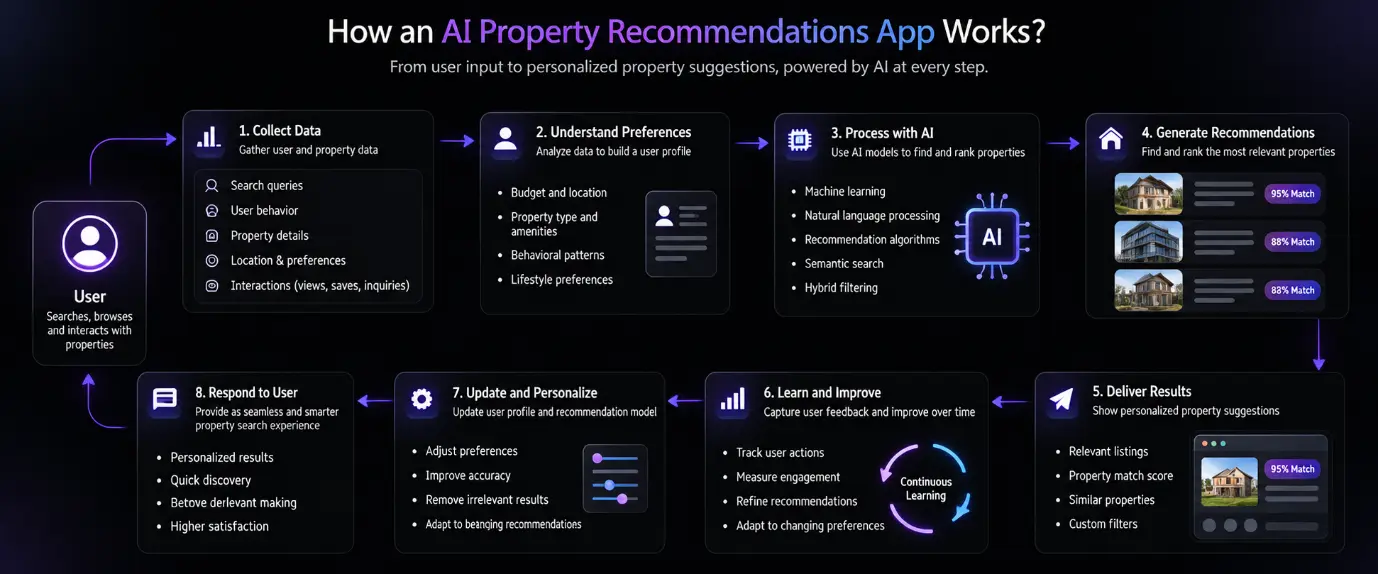
The recommendation engine needs reliable data to generate relevant results. Property data can include:
User data can include search preferences, saved properties, viewed listings, comparisons, inquiries, and other relevant interactions.
AI analyzes both explicit and behavioral preferences to create a user profile.
For example, a user may specify a budget of $500,000 and prefer three-bedroom homes. Their interactions may also indicate a preference for properties with parking, outdoor space, or proximity to specific locations.
The system can combine these signals to understand the user's broader property preferences.
Natural language processing can help the application understand conversational property searches.
For example:
"Show me a family-friendly three-bedroom home near good schools under $600,000."
AI can identify important requirements such as property type, bedroom count, budget, location-related preferences, and lifestyle needs.
The recommendation engine retrieves potentially relevant properties from the available inventory.
Depending on the system architecture, it can use content-based filtering, collaborative filtering, semantic search, property embeddings, machine learning models, or a hybrid recommendation approach.
The system scores potential properties according to factors such as:
The highest-relevance properties can then be presented first.
User actions provide continuous feedback to the recommendation engine.
If a user repeatedly saves properties with specific characteristics, those signals can influence future recommendations. Similarly, repeatedly ignoring certain property types can help reduce irrelevant suggestions.
The AI system can continuously evaluate recommendation performance using metrics such as click-through rate, saves, inquiries, viewing bookings, and conversions.
This creates a continuous cycle:
User Activity → Data Analysis → AI Prediction → Property Recommendations → User Feedback → Improved Recommendations
As the platform collects more relevant data, its recommendation engine can become increasingly personalized and useful.
For real estate businesses, this architecture enables an AI property recommendations app to move beyond basic listing search and deliver a dynamic, data-driven property discovery experience tailored to individual users.
Why should real estate businesses invest in an AI property recommendation app when traditional property search already exists? The answer is that the real estate market is moving toward AI-driven, personalized, and data-led digital experiences. For property portals with large inventories, the opportunity is not simply to add another search feature. It is to build an intelligent property discovery infrastructure that can support changing customer expectations and future AI capabilities.
Traditional search works well when users know exactly what they want. Real estate searches are often more complicated. A buyer may care about budget, location, commute, lifestyle, property type, neighborhood, amenities, and other factors at the same time.
For a business planning to develop an AI property recommendations app, this creates an opportunity to move beyond basic keyword and filter-based search toward intelligent property matching.
AI adoption across real estate is accelerating globally. JLL's 2026 research found that 90% of real estate companies are piloting AI projects, while only 5% have achieved most of their AI program goals. This shows that AI is already becoming part of the industry's technology strategy, but many organizations are still working out how to move from experimentation to scalable applications.
For property portals, an AI recommendation engine represents a practical use case that can be integrated directly into the core customer journey.
Real estate platforms increasingly need to understand individual customer preferences instead of providing identical experiences to every user.
An AI property recommendation system can become the foundation for personalized experiences for:
This makes personalization a product strategy rather than simply another application feature.
The United States continues to be a significant target for global real estate investment. Deloitte's 2026 Commercial Real Estate Outlook reports that the US was identified as a preferred investment market by 16% of surveyed respondents, up from 11% the previous year. The report also notes that AI adoption is expanding while organizations continue to face challenges related to implementation, technical capabilities, and expertise.
This creates room for US-focused property platforms to differentiate through intelligent digital experiences.
Developing an AI property recommendations app also gives businesses a strategic reason to organize their property and customer data.
A recommendation platform can connect:
Deloitte's 2026 outlook emphasizes that reliable data and application readiness are critical to converting AI investment into practical business outcomes.
Investing in creating an AI property recommendations app does not have to stop at recommendations. Once the AI and data architecture is established, businesses can expand into:
This makes recommendation technology a potential foundation for a broader AI real estate platform.
The current market presents a clear gap between AI interest and successful implementation. JLL reports that only 5% of organizations in its 2026 outlook achieved most of their AI program goals.
For businesses exploring how to build an AI property recommendations app, this means the focus should be on a clearly defined business problem, reliable data, measurable objectives, and scalable implementation rather than adding AI simply because it is trending.
The investment case is straightforward: AI recommendations can become the intelligent layer connecting a real estate business's property inventory with the evolving expectations of its customers.
For a property portal, starting with personalized property discovery can also create the technology foundation for a much broader AI-powered real estate ecosystem.
How can an AI property recommendation app help a real estate business generate better leads, increase user engagement, and create more revenue opportunities? For property portals managing thousands of listings, AI-powered recommendations can make property discovery more relevant while helping businesses optimize important parts of their digital sales funnel.
An AI property recommendation app can analyze user preferences and interactions to create a more personalized property discovery experience. This can help businesses move beyond basic listing search and build a platform that is more aligned with user intent and commercial goals.
For businesses planning to develop an AI property recommendations app, the following are the top benefits of building an AI property recommendation app:
The following benefits focus specifically on the business outcomes that real estate owners, property portals, brokers, developers, and rental platforms look for when investing in AI property recommendation app development.
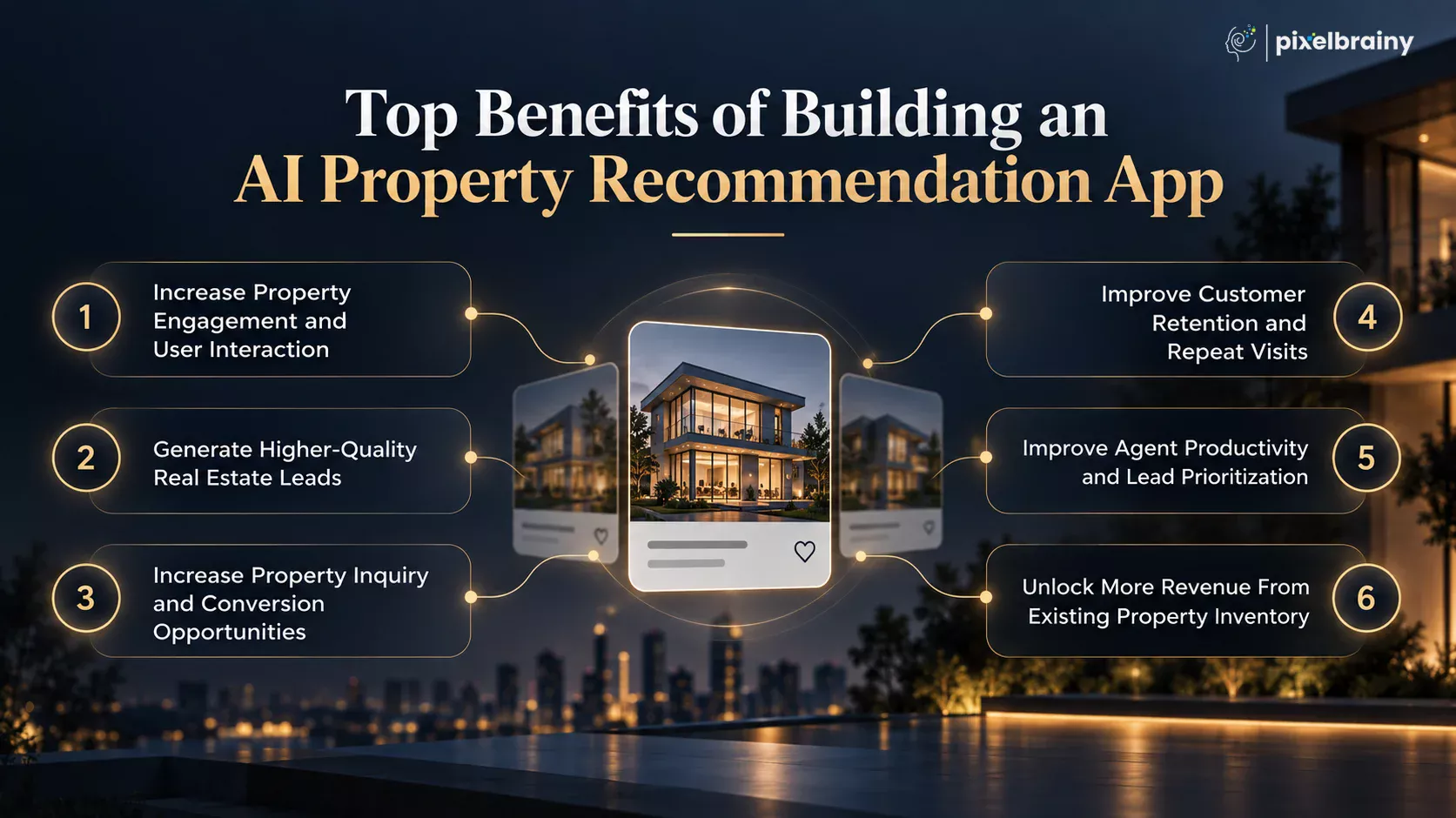
One of the major benefits of developing an AI property recommendation app is its ability to create a more relevant property discovery experience. Instead of showing broadly matching listings, AI can help personalize the properties presented to each user according to their requirements and interests.
When users encounter properties that better align with their needs, they have more reasons to explore listing details, view property images, save favorites, compare properties, and continue browsing.
For a property portal, higher-quality interactions can create more engagement throughout the customer journey. These interactions can also provide valuable behavioral signals that help improve future recommendations.
A major business objective of AI property recommendations app development is improving the quality of leads entering the sales pipeline. Not every visitor demonstrates the same level of buying or renting intent.
An AI recommendation system can identify meaningful behavioral signals, such as repeated property views, saved listings, comparisons, inquiries, and consistent searches within a specific budget or location.
These signals can help businesses better understand potential customers and provide agents with more relevant prospects. Instead of focusing only on generating a higher number of leads, real estate businesses can work toward generating more relevant and actionable leads.
Personalized recommendations can help reduce the gap between discovering a property and taking action. When users receive listings that closely match their requirements, they may have more opportunities to find a property worth contacting an agent about.
An AI property recommendation app can support conversion actions such as property inquiries, viewing requests, agent contacts, callbacks, applications, and other relevant interactions.
For real estate businesses, this creates an opportunity to optimize the property discovery journey around measurable actions rather than simply increasing website traffic.
Property searches can continue for weeks or months, particularly when buyers and renters are comparing multiple options. An AI-powered recommendation platform can make each return visit more relevant by presenting new properties based on the user's evolving preferences.
Instead of beginning every session with a blank search, returning users can see personalized listings, newly added properties, price changes, and similar recommendations.
This creates a more continuous property discovery experience and gives users a reason to return to the platform throughout their search journey.
An AI property recommendation system can also benefit the agents operating behind a real estate platform. Agents can receive better insights into what prospects are looking for, including preferred locations, budgets, property types, and previously viewed listings.
This information can reduce the time agents spend manually searching through large property databases. AI can help them identify suitable properties and prioritize prospects based on available intent signals.
For businesses managing large agent networks, this can support a more organized sales workflow and help teams focus their time on prospects with stronger requirements and engagement.
One of the most commercially valuable benefits of AI property recommendation app development is the ability to improve discovery across existing inventory.
Relevant properties can be surfaced to users even when they are not the first results produced by conventional searches. This can create additional exposure opportunities for agents, developers, landlords, and property owners.
For the platform owner, stronger inventory utilization can support revenue models such as qualified lead generation, premium listings, agent subscriptions, featured placements, and transaction-related revenue.
Ultimately, the value of an AI property recommendation app comes from connecting users with more relevant listings while creating stronger commercial opportunities for the real estate business.
For property portals and real estate companies, these benefits make AI-powered recommendations a practical investment in engagement, lead generation, conversion, retention, productivity, and revenue growth.
Where can an AI property recommendation app deliver practical value in the real estate industry? The answer extends far beyond simply recommending homes on a property portal. AI-powered property recommendations can support buyers, renters, investors, agents, developers, commercial tenants, relocation companies, and property managers by matching complex requirements with relevant property inventory.
For businesses considering AI property recommendation app development, the strongest use case depends on the audience, property type, available data, and business objective. A residential marketplace may need personalized home discovery, while an investment platform may require AI-driven property matching based on investment criteria.
For example, instead of making a user manually select multiple filters, an AI-powered platform can understand a query such as "Find a 3-bedroom house under $650,000, close to good schools, with a backyard and less than 30 minutes from downtown." The system can use these requirements to identify and prioritize relevant properties.
Below are the major real-world use cases for AI property recommendation app development, along with practical examples and real user queries.
Residential property marketplaces can use AI to make home discovery more personalized for buyers. Purchasing a home usually involves multiple criteria, including budget, location, bedrooms, property size, neighborhood, schools, commute, parking, outdoor space, and lifestyle preferences.
An AI property recommendation system can combine these requirements to help buyers discover properties that fit their overall needs rather than simply matching individual filters. It can also support similar-property recommendations when users find a listing they like.
Real user query:
"Show me 3-bedroom homes under $700,000 near good schools with a backyard and garage."
Example: A buyer frequently views suburban homes with garages, large kitchens, and outdoor spaces. Instead of repeatedly searching for these features, the platform can prioritize similar properties and neighborhoods in the user's personalized recommendations.
Business use: This can help residential property portals create a more intelligent home discovery experience across large listing inventories.
Rental platforms can use AI recommendations to help tenants find properties according to their financial, lifestyle, and location requirements. Rental searches often involve additional criteria such as furnished units, pet policies, lease duration, parking, public transportation, utilities, and commute time.
An AI property recommendation app for rentals can combine these requirements and present properties that better match the tenant's overall situation.
Real user query:
"Find a furnished 2-bedroom apartment under $3,000 within 30 minutes of my office and allow pets."
Example: A tenant repeatedly searches for furnished apartments near public transportation and saves properties with parking. The recommendation engine can recognize these preferences and prioritize comparable rentals in future searches.
Business use: Rental businesses can use AI to create personalized property feeds and improve the way tenants navigate large rental inventories.
Real estate investors evaluate properties differently from traditional homebuyers. They may focus on purchase price, rental yield, expected cash flow, appreciation potential, occupancy, location trends, and investment strategy.
An AI property recommendation system can be designed specifically around investor requirements and help identify properties that meet selected financial and market criteria.
Real user query:
"Find properties under $500,000 with strong rental yield in neighborhoods with growing demand."
Example: An investor looking for rental properties can receive a shortlist based on selected investment parameters, available property information, rental data, and market indicators.
Business use: Investment platforms can position AI recommendations as an intelligent property discovery layer for investors rather than treating every user like a conventional homebuyer.
Commercial property searches can involve complex requirements that are difficult to manage through basic search filters. Businesses may need to evaluate location, floor area, accessibility, parking, loading facilities, zoning, rent, transportation, and proximity to customers or suppliers.
AI can help commercial real estate platforms interpret these requirements and identify suitable properties from large inventories.
Real user query:
"Find a 10,000-square-foot warehouse near major highways with loading access and parking."
Example: A logistics company can receive warehouse recommendations based on required floor area, transportation access, loading facilities, location, and budget.
Business use: Commercial real estate marketplaces can use AI recommendations to support more complex B2B property searches and reduce manual property discovery.
Real estate agents often spend significant time searching through listings that match individual client requirements. An AI property recommendation app for real estate agents can automate the initial property matching process and help agents create client-specific shortlists.
The system can consider client requirements, previously viewed properties, saved listings, budget changes, preferred neighborhoods, and other available interaction data.
Real user query:
"Find properties for my client looking for a 4-bedroom home under $900,000 in a family-friendly neighborhood."
Example: An agent enters the client's requirements and receives a ranked list of relevant properties. The agent can review the recommendations, select the best options, and share them with the client.
Business use: Brokerage platforms can use AI to support agents with faster client-property matching and more structured property discovery workflows.
Developers managing multiple communities and projects can use AI to recommend suitable properties, units, floor plans, and developments to prospective buyers.
This becomes particularly useful when developers have a large portfolio with different property types, locations, prices, configurations, and amenities.
Real user query:
"Show me 2-bedroom apartments in new developments under $450,000 with a gym, pool, and parking."
Example: Instead of browsing every project manually, the buyer can receive recommendations across the developer's portfolio based on budget, apartment size, amenities, preferred location, and other requirements.
Business use: Developers can use AI recommendations to connect buyers with suitable inventory across multiple projects and make large property portfolios easier to explore.
Luxury property discovery often depends on lifestyle preferences and highly specific property characteristics. Buyers may search for waterfront locations, architectural styles, privacy, large plots, smart-home systems, private pools, views, premium interiors, or exclusive neighborhoods.
An AI property recommendation app can provide a more curated discovery experience by considering these detailed requirements.
Real user query:
"Show me waterfront homes with a private pool, home office, modern architecture, and high privacy."
Example: A luxury property platform can recommend homes based on waterfront access, architectural characteristics, privacy, premium amenities, and preferred location rather than relying only on price and bedroom filters.
Business use: Luxury real estate businesses can use AI to create highly curated property discovery experiences for high-intent customers.
People relocating for employment often need to balance several requirements at once. They may need a property close to their workplace while also considering family size, schools, rental budget, neighborhood preferences, transportation, and amenities.
AI can combine these requirements to generate more relevant relocation housing recommendations.
Real user query:
"Find a family-friendly 3-bedroom rental within 20 minutes of my new office and close to good schools."
Example: A relocation company can enter an employee's housing requirements and receive properties ranked according to commute, household needs, budget, neighborhood, and available amenities.
Business use: Corporate housing and relocation companies can use AI to streamline property shortlisting for employees and their families.
Property management companies can use AI recommendations to help prospective tenants find suitable units across their available inventory.
The system can consider unit type, monthly rent, availability, floor plan, amenities, parking, pet policies, and tenant preferences. This is particularly useful for companies managing multiple buildings or large multifamily portfolios.
Real user query:
"Show me pet-friendly 2-bedroom apartments with parking under $2,500."
Example: If a tenant prefers two-bedroom units with parking and repeatedly searches for pet-friendly properties, the system can prioritize matching available units across the managed portfolio.
Business use: Property managers can use AI to make available inventory easier to discover and create a more personalized leasing experience.
Large property marketplaces with thousands or millions of listings represent one of the strongest use cases for AI property recommendation app development. Users can easily become overwhelmed when a search produces hundreds of potentially relevant properties.
AI can create personalized property feeds, similar-property suggestions, intelligent search results, and property alerts based on each user's requirements and interaction patterns.
Real user query:
"Show me homes similar to the properties I saved, but closer to downtown and within my current budget."
Example: A returning user does not need to start a completely new search. The platform can use their previous property interactions and current requirements to generate a new, more relevant selection.
Business use: Large marketplaces can use AI to turn extensive property inventories into personalized discovery experiences while creating an intelligent foundation for future real estate AI capabilities.
From residential property search and rentals to investment, commercial real estate, and property management, AI recommendations can be tailored to different real estate business models and customer needs.
Therefore, choosing the right use case allows businesses to turn AI property recommendation technology into a practical, scalable part of their real estate platform.
Which type of AI property recommendation app is right for your real estate business? The answer depends on who your users are, what properties you offer, and what your platform needs to achieve.
For example, imagine a real estate company operating a large residential marketplace. A buyer enters a query such as “Find a 3-bedroom home under $700,000, close to good schools, with a backyard and within 30 minutes of downtown.” A consumer-focused AI recommendation app would be designed to understand this requirement and create a personalized property discovery experience.
Now consider a rental company, an investment platform, a brokerage, or a commercial property marketplace. Each business has different users, data requirements, recommendation logic, and workflows. This is why AI property recommendations app development needs to be aligned with the specific real estate business model.
Below are the major types of AI property recommendation apps businesses can develop.
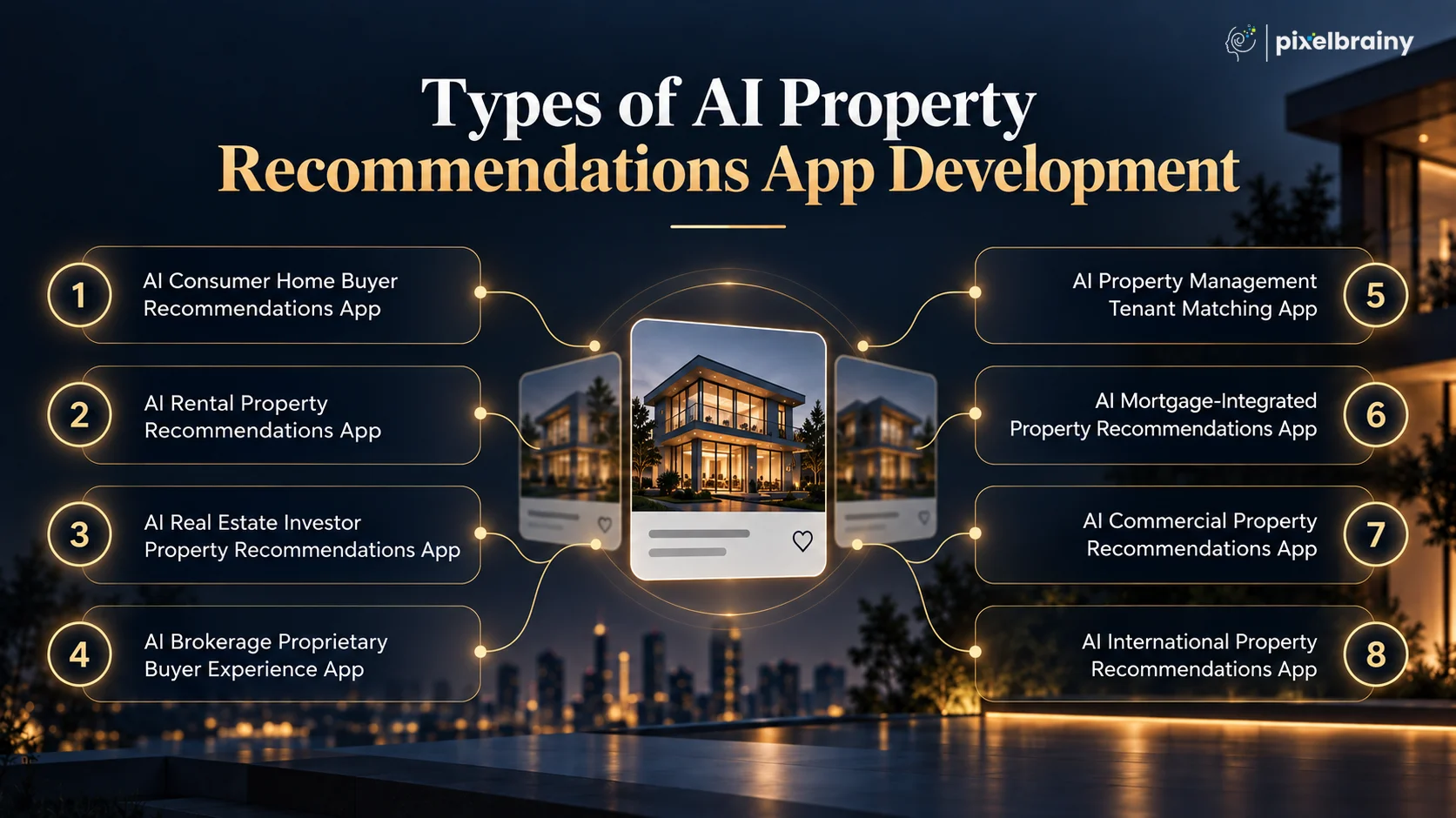
An AI consumer home buyer recommendations app is designed for individuals searching for properties to purchase. Its primary purpose is to make residential property discovery more personalized and relevant.
The application can be designed around factors such as budget, preferred location, property type, bedrooms, bathrooms, property size, amenities, neighborhood preferences, commute requirements, and lifestyle needs.
The recommendation engine can also provide personalized property feeds, similar listings, saved-search recommendations, and relevant new-property alerts.
Scenario: A first-time buyer has a $650,000 budget and wants a three-bedroom home near schools. Instead of manually reviewing hundreds of listings, the app can present a curated selection based on those requirements.
Best suited for: Residential property portals, home-buying marketplaces, property listing platforms, and real estate startups.
An AI rental property recommendations app is built specifically for tenants searching for apartments, houses, condos, and other rental properties.
Rental decisions often involve more than monthly rent. Users may care about furnishing, lease duration, pet policies, parking, public transportation, amenities, neighborhood, commute time, and proximity to workplaces or educational institutions.
AI can help combine these requirements into a personalized rental discovery experience.
Scenario: A renter searches for “a furnished two-bedroom apartment under $3,000, pet-friendly, near public transportation.” The platform can prioritize available rentals that align with these requirements instead of simply returning properties within a price range.
Best suited for: Rental marketplaces, apartment platforms, multifamily operators, property management companies, and residential leasing businesses.
An AI real estate investor property recommendation app focuses on investment-oriented property discovery. Investors generally evaluate properties using financial and market-related criteria rather than lifestyle preferences alone.
The application can incorporate factors such as purchase price, rental income, estimated yield, occupancy, property type, location characteristics, investment strategy, and other available market indicators.
AI can then organize and rank properties according to the investor's selected criteria.
Scenario: An investor enters “Find properties under $500,000 with strong rental potential in growing neighborhoods.” The application can create a shortlist based on the investor's requirements and available property and market data.
Best suited for: Real estate investment platforms, property investment firms, investor marketplaces, and investment-focused brokerages.
A brokerage can develop an AI-powered proprietary buyer experience app to provide clients with a branded property discovery platform instead of relying entirely on third-party marketplaces.
The app can combine AI property recommendations with client profiles, agent communication, property comparisons, saved listings, viewing requests, and personalized search experiences.
This approach also allows brokerages to build their own digital customer experience around their property inventory and client relationships.
Scenario: An agent creates a profile for a buyer looking for homes under $900,000 in three preferred neighborhoods. The AI can continuously recommend relevant listings while the agent reviews and refines the recommendations.
Best suited for: Real estate brokerages, agency networks, luxury brokerages, and large independent real estate firms.
An AI property management tenant matching app focuses on matching prospective tenants with suitable available units across a property manager's portfolio.
The recommendation system can consider rent, unit size, floor plan, availability, location, amenities, parking, pet policies, furnishing, and tenant preferences.
This is particularly useful for companies managing multiple apartment communities or large multifamily portfolios.
Scenario: A prospective tenant searches “I need a pet-friendly two-bedroom apartment with parking under $2,500.” AI can identify matching available units across different properties and present the most relevant options.
Best suited for: Property management companies, multifamily operators, apartment communities, residential leasing companies, and housing providers.
An AI mortgage-integrated property recommendation app combines property discovery with affordability and financing considerations. Instead of focusing only on the property's listed price, the application can incorporate user-defined financing parameters.
Depending on the available integrations and applicable financial regulations, the platform may consider factors such as estimated monthly payments, down payment preferences, loan scenarios, and affordability ranges.
Scenario: A buyer searches “Show me homes that fit a $100,000 down payment and an estimated monthly payment below $3,500.” The application can prioritize properties that fit the user's selected affordability parameters.
Best suited for: Real estate marketplaces, mortgage companies, banks, fintech platforms, lenders, and property-financing ecosystems.
An AI commercial property recommendation app is designed for businesses searching for offices, retail spaces, warehouses, industrial properties, and other commercial real estate.
Commercial property requirements can be highly detailed. Businesses may consider floor area, location, accessibility, parking, loading facilities, zoning, lease terms, transportation access, and proximity to customers or suppliers.
AI can combine these requirements to make commercial property discovery more efficient.
Scenario: A logistics company searches “Find a 20,000-square-foot warehouse near major highways with loading docks and sufficient parking.” The recommendation engine can prioritize commercial properties that satisfy these specific requirements.
Best suited for: Commercial real estate marketplaces, CRE brokerages, developers, logistics companies, and corporate real estate platforms.
An AI international property recommendation app is designed for users searching for properties across different cities, regions, or countries. This type of application requires additional consideration because international buyers may have different currencies, property categories, market conditions, regulations, languages, and investment objectives.
AI can help organize large international inventories according to a user's preferred destination, budget, property type, lifestyle requirements, or investment criteria.
Scenario: An overseas investor searches “Show me investment properties in major European cities under €500,000 with strong rental potential.” The platform can organize suitable properties across supported markets according to the investor's selected criteria.
Best suited for: Global property marketplaces, international brokerages, overseas property investment platforms, relocation companies, and luxury real estate businesses.
From homebuyer recommendations and rental matching to investment, brokerage, mortgage, commercial, and international property discovery, AI recommendation technology can be customized around virtually every major real estate business model.
The right development approach is to align the recommendation engine, data architecture, and user experience with the specific needs of your target customers and property market.
A successful AI property recommendation app needs a strong set of core features that can understand customer requirements, process property data, and deliver relevant listings automatically. These features form the foundation of an AI property matching app and help real estate businesses move beyond traditional keyword and filter-based property search.
For example, consider a business requirement like this:
“We manage a large property inventory and it’s becoming difficult to show the right listings to the right customers. We want to build an AI property matching app that can analyze customer requirements and recommend properties automatically. Looking for a company with experience in AI and real estate app development.”
For this type of platform, the development process should focus on core recommendation capabilities first. The following features can help create a personalized property discovery experience while giving real estate businesses better control over their inventory and customer interactions.
| Feature | Explanation |
|---|---|
| AI-Powered Property Search | AI-powered property search allows users to describe requirements naturally, such as budget, location, property type, bedrooms, or amenities, while the system interprets intent and returns relevant listings. |
| Personalized Property Recommendations | Personalized property recommendations use customer preferences, requirements, previous searches, saved listings, and interactions to present properties that are more relevant to each individual user. |
| Customer Preference Profiling | Customer preference profiling creates a structured understanding of what each user wants, including budget, location, property type, size, amenities, and other stated property preferences. |
| Intelligent Property Matching | Intelligent property matching compares customer requirements with available listings and identifies properties that satisfy important criteria, helping businesses automatically connect suitable customers with relevant inventory. |
| AI-Based Property Ranking | AI-based property ranking evaluates multiple matching signals and organizes listings according to relevance, helping users see the properties most closely aligned with their requirements at the beginning. |
| Natural Language Query Processing | Natural language query processing enables customers to search using conversational phrases instead of complicated filters, allowing the application to understand requirements expressed in everyday language. |
| User Behavior Tracking | User behavior tracking captures searches, property views, clicks, saves, comparisons, and inquiries, providing valuable signals that can help personalize future property recommendations for individual customers. |
| Property Recommendation Feed | A personalized property recommendation feed continuously displays relevant listings based on customer requirements and recent interactions, giving users an easier way to discover suitable properties without repeatedly searching. |
| Similar Property Suggestions | Similar property suggestions identify listings with comparable characteristics to properties a customer has viewed, saved, or selected, helping expand discovery while maintaining relevance to their original preferences. |
| Budget-Based Property Matching | Budget-based property matching prioritizes listings according to the customer's specified purchase price or rental range, helping prevent irrelevant properties from dominating personalized property recommendation results. |
| Location-Based Recommendations | Location-based recommendations consider preferred cities, neighborhoods, postal areas, proximity requirements, and other geographic preferences to identify properties that better match where customers want to live or invest. |
| Property Filters and Preferences | Property filters allow users to refine AI recommendations using practical criteria such as price, bedrooms, bathrooms, property type, size, amenities, availability, and other business-specific requirements. |
| Property Details Integration | Property details integration brings essential listing information into the recommendation experience, including descriptions, images, pricing, specifications, amenities, availability, and location information from connected property data sources. |
| Smart Property Alerts | Smart property alerts notify customers when newly available listings match their requirements, helping them discover relevant inventory sooner without requiring continuous manual searches across the property platform. |
| Admin Recommendation Analytics | Admin recommendation analytics gives real estate businesses visibility into recommendation activity, popular preferences, listing interactions, customer searches, and other performance indicators needed to manage and improve the recommendation system. |
The right combination of these core features provides the foundation for an AI property recommendations app that can match customers with relevant inventory while creating a more personalized property discovery experience.
Core recommendation features can help users find properties based on their basic requirements. However, businesses looking to develop a more differentiated AI property recommendation app can go further by introducing capabilities that understand context, intent, trade-offs, and changing preferences.
For example, consider this real user query from a property marketplace:
“I’m relocating to Austin for work and need a two-bedroom home under $600,000. I want a safe neighborhood, good restaurants nearby, a reasonable commute to downtown, and access to parks. Can you recommend the best areas and properties for me?”
A traditional property search may handle the price, bedrooms, and location filters, but an intelligent AI property matching app can interpret the broader requirements and connect multiple preference signals. The following non-ordinary features can make the property discovery experience more intelligent and personalized.
| Feature | Explanation |
|---|---|
| Lifestyle-Based Property Matching | Lifestyle-based matching considers factors beyond standard property specifications, including walkability, nearby restaurants, parks, entertainment, schools, commuting preferences, and neighborhood characteristics to create more relevant property suggestions. |
| Intent-Aware Property Recommendations | Intent-aware recommendations identify whether users are buying, renting, investing, relocating, upgrading, or simply exploring the market, allowing the AI property recommendation engine to adjust results accordingly. |
| Explainable AI Recommendations | Explainable AI recommendations tell users why particular properties appear in their results, highlighting relevant factors such as budget, location, amenities, property characteristics, and previously expressed preferences. |
| Dynamic Preference Learning | Dynamic preference learning continuously updates a user's profile as their requirements change, allowing the recommendation engine to recognize new interests instead of depending only on information provided during registration. |
| Property Trade-Off Suggestions | Property trade-off suggestions provide alternatives when users cannot find a listing matching every requirement, such as recommending a nearby neighborhood, slightly different property size, or adjusted price range. |
| Conversational Recommendation Refinement | Conversational refinement lets users modify property recommendations through natural dialogue, allowing requests such as “show me newer homes,” “remove apartments,” or “find something closer to work” without starting another search. |
| Context-Aware Property Discovery | Context-aware discovery considers the broader situation behind a property search, such as relocation, family requirements, investment objectives, lifestyle changes, or changing housing needs when generating recommendations. |
| Cross-Session Recommendation Memory | Cross-session recommendation memory allows the AI system to retain relevant preferences across multiple visits, helping returning users receive recommendations based on their previous searches, saved properties, and meaningful interactions. |
| AI Recommendation Feedback Loop | An AI feedback loop learns from actions such as property likes, dislikes, saves, skips, comparisons, and inquiries, using these signals to continuously improve the relevance of future recommendations. |
| Personalized Property Discovery Paths | Personalized discovery paths guide different users through customized property journeys, presenting relevant listings, comparisons, neighborhood information, and recommendations according to their individual search objectives and decision-making patterns. |
These non-ordinary capabilities can help businesses create a more context-aware AI property recommendation app that goes beyond basic property matching and delivers a more personalized real estate discovery experience.
Building an AI property recommendation app requires more than connecting an AI model to an existing property portal. The development process needs to cover business goals, customer requirements, property data, recommendation logic, AI models, application design, testing, and deployment.
For example, a real estate business may have this requirement:
“Our customers often view hundreds of listings before finding something relevant, and we’re seeing high drop-off rates. We want to create an intelligent property recommendation engine that learns from user behavior and suggests better properties. Need a development company to build the complete solution.”
In this situation, following structured steps to build an AI property recommendation app from idea to launch can help reduce development risks and create a solution that is aligned with both user expectations and business objectives. Here is the development process of an AI property recommendation app, from the initial concept to production launch.
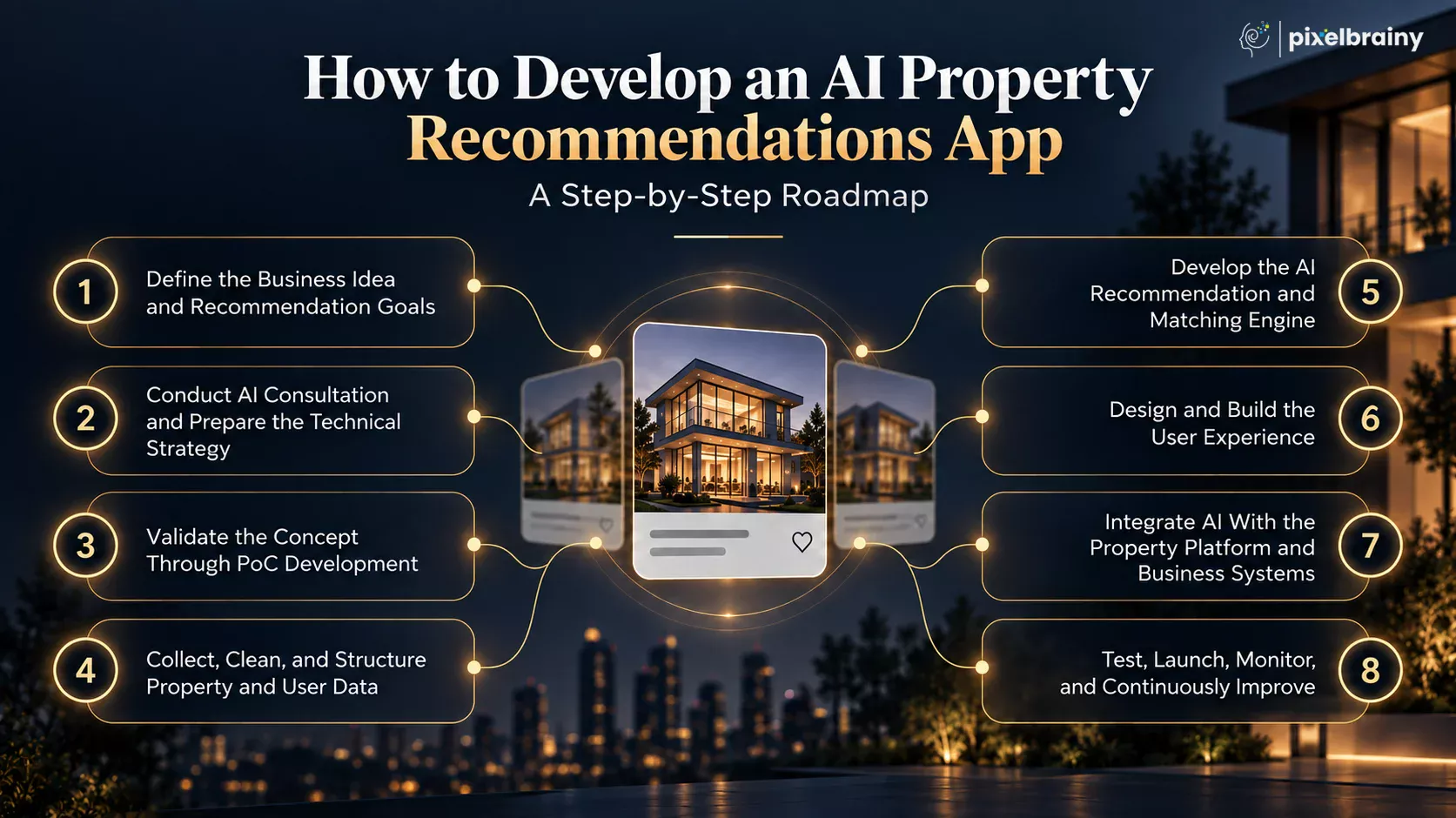
The first step is to clearly define what the AI property recommendation app needs to achieve. Start by identifying the target users, property categories, geographic market, business model, and the specific problem the application should solve.
For example, a residential marketplace may want to reduce search time and improve listing discovery, while an investment platform may focus on matching properties with investor strategies.
At this stage, businesses should define measurable objectives such as improving property discovery, increasing qualified inquiries, reducing search abandonment, or improving listing visibility.
This foundation helps determine how to build an AI property recommendation app from scratch without adding unnecessary functionality.
Once the business objectives are defined, the next step is to determine how AI can practically support the recommendation experience. AI consultation can help evaluate the required technologies, data sources, recommendation approaches, integrations, infrastructure, and development priorities.
The team should identify whether the platform needs content-based recommendations, collaborative filtering, hybrid recommendation models, semantic search, natural language processing, or a combination of approaches.
The technical strategy should also address data privacy, scalability, security, model performance, API architecture, and future expansion.
This stage creates a practical roadmap for AI property recommendation app development and prevents businesses from selecting AI technologies simply because they are popular.
Also Read: Top 10 AI Consulting Companies in USA
Before investing in complete product development, businesses can validate the recommendation concept through PoC development. A proof of concept can test whether available property and user data can generate meaningful recommendations.
For example, a PoC could take historical searches, viewed properties, saved listings, and property attributes and determine whether the system can identify relevant matches.
The objective is not to build a complete application at this stage. Instead, it is to validate the technical feasibility of the recommendation approach, data quality, AI model performance, and expected user experience.
A successful PoC provides greater confidence before moving into full-scale AI model development and application development.
Also Read: Top 12+ AI Model Development Companies in the USA
Data is one of the most important components when you create an AI property recommendation app. The development team needs to identify the data required for accurate recommendations and prepare it for AI processing.
Property data may include price, location, property type, bedrooms, bathrooms, size, amenities, descriptions, availability, images, and neighborhood information. User data can include searches, clicks, views, saves, inquiries, preferences, and other interaction signals.
The data should be cleaned, standardized, deduplicated, and structured before being used by recommendation models.
A strong data foundation improves recommendation quality and provides the foundation for scalable AI real estate software development.
The next step is to build the intelligence that connects customer requirements with suitable properties. AI model development can involve multiple approaches depending on the platform's data and objectives.
Content-based models can recommend properties with characteristics similar to listings a user prefers. Collaborative approaches can identify patterns among users with similar behavior. Hybrid models can combine property attributes, user preferences, behavioral signals, and contextual information.
Semantic search can also help the application understand natural-language requirements instead of relying entirely on exact keywords.
The recommendation engine should then score and rank properties according to their relevance, creating the intelligence needed to develop an AI property recommendation app for a real estate business.
After establishing the recommendation architecture, the next stage is to create the application interface through which customers and real estate teams will interact with the system.
A specialized UI/UX design company can help create intuitive search experiences, personalized property feeds, recommendation cards, property comparisons, saved listings, alerts, and conversational search interfaces.
The design should make AI recommendations easy to understand rather than making the technology itself the center of the experience.
Once the interface is finalized, MVP development can begin with the most important customer and business functions. This approach allows the company to launch a focused version, collect real-world feedback, and prioritize future improvements.
Also Read: Top 10 AI MVP Development Companies in USA
The recommendation engine needs to work with the rest of the real estate technology ecosystem. This stage involves AI integration with property databases, listing systems, CRM platforms, search infrastructure, analytics tools, maps, communication systems, and other required services.
For example, when a new property enters the inventory, the system should be able to process its attributes and make it available to the recommendation engine. When a customer saves or rejects a listing, that interaction can become a new signal for personalization.
Businesses may hire AI developers to connect these components, implement APIs, establish data pipelines, and ensure that AI capabilities operate reliably within the existing real estate platform.
The final stage is to test the complete application before making it available to customers. Testing should cover recommendation accuracy, application performance, API reliability, security, data handling, scalability, usability, and different user scenarios.
After launch, the work does not stop. Recommendation performance should be monitored using metrics such as search engagement, property views, saves, inquiries, conversion activity, and recommendation relevance.
The system can then be improved using new behavioral data, model updates, customer feedback, and business insights. Experienced AI product development companies or AI real estate software development companies can support ongoing optimization as the platform grows.
Following these structured steps can turn the idea of an AI property recommendation app into a scalable, data-driven real estate product ready for real-world users.
The cost to develop an AI property recommendation app typically ranges from $30,000 to $200,000+, depending on the application's features, AI complexity, property data volume, integrations, platform requirements, and development scope. A basic recommendation solution with limited personalization can require a much smaller budget than an enterprise platform processing millions of listings and complex customer behavior.
For example, a real estate business may ask:
“We have a large property portal with thousands of listings, and we want AI to recommend properties based on each customer's budget, preferred locations, search history, and behavior. What would the development cost be for a complete AI property recommendation solution?”
There is no single fixed AI property recommendation app development cost because every platform has different requirements. The development budget of an AI property recommendation app should be estimated according to the desired recommendation capabilities, data infrastructure, application platforms, integrations, and ongoing AI requirements.
For businesses wondering what is the development pricing of an AI property recommendation app, the following estimate provides a practical starting point.
| Type of AI Property Recommendation App | Estimated Cost | Typical Scope |
|---|---|---|
| Basic AI Property Recommendation App | $30,000 to $60,000 | AI-assisted property search, basic recommendation engine, user profiles, property filters, personalized suggestions, listing management, basic analytics, and essential third-party integrations. |
| Advanced AI Property Recommendation App | $60,000 to $120,000 | Advanced personalization, behavioral recommendations, intelligent property matching, semantic search, AI ranking, conversational search, recommendation analytics, multiple integrations, and scalable backend infrastructure. |
| Enterprise AI Property Recommendation App | $120,000 to $200,000+ | Large-scale property inventory, sophisticated AI models, complex recommendation algorithms, multiple platforms, extensive data pipelines, enterprise integrations, advanced analytics, high scalability, security, and continuous AI optimization. |
These are estimated development ranges, not fixed quotations. The final cost estimation of AI property recommendation app development depends on the exact product scope, technology choices, data requirements, development team, and complexity of the AI recommendation system.
Several factors can significantly change the total development budget. Understanding them before development begins can help real estate businesses plan their investment more accurately.
The complexity of the recommendation engine is one of the biggest cost drivers. Basic rule-based recommendations require less development effort, while hybrid recommendation systems, behavioral learning, semantic matching, predictive models, and advanced personalization require more sophisticated AI model development and testing.
Connecting the application with property databases, MLS or IDX systems, internal listing databases, valuation sources, mapping services, or other external APIs can increase development costs. The number and complexity of data sources determine the required integration and data engineering work.
Developing custom AI models can cost more than using pre-existing AI services. Costs depend on the model architecture, training data, recommendation logic, personalization requirements, model evaluation, and optimization needed to achieve the desired recommendation accuracy.
Building a responsive web platform generally requires a different budget from developing native iOS and Android applications. Supporting web, mobile, and admin applications simultaneously increases development hours, testing requirements, and maintenance costs.
If customers should be able to search properties using conversational queries, additional development may be required for natural language processing, semantic search, embeddings, vector databases, conversational interfaces, and AI response handling.
The cost of designing the property discovery experience depends on the number of screens, user journeys, personalization interfaces, recommendation layouts, search experiences, dashboards, and supported platforms. Complex customer and agent workflows require more design and prototyping effort.
The backend must process property information, customer activity, recommendation requests, API calls, and AI workloads. Costs increase when the application requires high availability, real-time processing, scalable cloud infrastructure, large databases, and sophisticated data pipelines.
CRM systems, payment services, maps, communication tools, analytics platforms, property data providers, mortgage services, authentication systems, and other APIs can increase the overall development budget. Each integration may require separate API configuration, testing, and maintenance.
A property business may need dashboards for managing listings, monitoring recommendation performance, analyzing customer behavior, reviewing searches, and tracking inquiries. The more detailed the reporting and business intelligence requirements, the higher the development cost.
Applications handling customer information and property data need appropriate authentication, authorization, encryption, secure APIs, access controls, monitoring, and compliance measures. Enterprise platforms generally require more extensive security architecture and testing.
Testing costs depend on application size, number of platforms, AI complexity, integrations, and expected user volume. AI recommendation systems also require accuracy testing, relevance evaluation, performance testing, edge-case testing, and continuous validation.
An AI property recommendation application requires ongoing maintenance after launch. Businesses may need model optimization, infrastructure management, security updates, bug fixes, API maintenance, new features, data pipeline improvements, and recommendation performance monitoring.
The final AI property recommendation app development cost is usually determined by the combination of app complexity, AI sophistication, data requirements, number of platforms, integrations, development team structure, and post-launch support.
A startup validating an idea may begin with a $30,000 to $60,000 solution, while an established property marketplace requiring sophisticated AI personalization and enterprise infrastructure may need $120,000 to $200,000 or more.
The best approach is to define the required features and AI capabilities first, then prepare a detailed AI property recommendation app cost estimation based on the actual scope rather than relying on a generic development price.
In short, a well-planned AI property recommendation app can start around $30,000, while complex enterprise solutions can exceed $200,000 depending on AI, data, integration, and scalability requirements.

The technology stack determines how effectively an AI property recommendation app can process property data, understand customer requirements, generate personalized matches, and scale as the property inventory grows. A suitable stack should support AI capabilities, real estate data integrations, secure APIs, fast search, cloud infrastructure, and continuous recommendation improvements.
For example, consider a real estate business with this requirement:
“Our customers often view hundreds of listings before finding something relevant, and we’re seeing high drop-off rates. We want to create an intelligent property recommendation engine that learns from user behavior and suggests better properties. Need a development company to build the complete solution.”
For this type of platform, the technology stack for AI property recommendation app development needs to support both the customer-facing application and the intelligence running behind it. The right combination of frontend, backend, databases, AI frameworks, search technologies, APIs, and cloud services creates the technical foundation required to build a scalable and reliable recommendation platform.
Recommended Technology Stack for an AI Property Recommendation App:
| Technology Layer | Recommended Technologies | Purpose in AI Property Recommendation App |
|---|---|---|
| Frontend Development | React.js, Next.js | Build fast, responsive web interfaces for property search, personalized recommendations, listing pages, user profiles, and property discovery. |
| Mobile App Development | Flutter, React Native, Swift, Kotlin | Develop cross-platform or native mobile applications for property buyers, renters, investors, agents, and other real estate users. |
| Backend Development | Node.js, Python, FastAPI, Django | Handle business logic, user requests, property data, recommendation APIs, authentication, integrations, and communication between application components. |
| AI and Machine Learning | Python, TensorFlow, PyTorch, Scikit-learn | Develop recommendation models, behavioral prediction systems, property matching algorithms, ranking models, and other machine learning capabilities. |
| Natural Language Processing | Python NLP libraries, transformer models, LLM APIs | Understand conversational property searches and convert natural language requirements into structured search and recommendation signals. |
| Vector Database | Pinecone, Weaviate, Milvus, pgvector | Store and search property and user embeddings to support semantic property matching and similarity-based recommendations. |
| Primary Database | PostgreSQL, MySQL, MongoDB | Store property information, customer profiles, preferences, searches, saved listings, inquiries, and application data. |
| Search Engine | Elasticsearch, OpenSearch | Provide fast property search, filtering, indexing, geographic search, and large-scale listing discovery across extensive inventories. |
| Cloud Infrastructure | AWS, Microsoft Azure, Google Cloud | Provide scalable computing, storage, databases, AI infrastructure, monitoring, networking, and deployment environments for the application. |
| Data Processing | Apache Spark, Apache Kafka, Python | Process large property datasets and customer behavior streams while supporting data pipelines required for recommendation model training and updates. |
| API Development | REST APIs, GraphQL | Connect the frontend, mobile applications, recommendation engine, property databases, CRM systems, MLS or IDX sources, and third-party services. |
| Maps and Location Services | Google Maps Platform, Mapbox | Support property mapping, distance calculations, location-based searches, neighborhood discovery, and geographic recommendation requirements. |
| Authentication and Security | OAuth 2.0, JWT, AWS Cognito, Auth0 | Protect customer accounts, property data, APIs, administrative systems, and other application resources through secure authentication and authorization. |
| Analytics and Monitoring | Google Analytics, Mixpanel, CloudWatch, Grafana | Monitor customer interactions, recommendation performance, application usage, system health, and important business metrics. |
| DevOps and Deployment | Docker, Kubernetes, GitHub Actions, Terraform | Automate application deployment, infrastructure management, testing, scaling, version control, and reliable delivery across development and production environments. |
For businesses looking to develop an AI property recommendation app, the technology stack should be flexible enough to support future AI capabilities without requiring the entire application to be rebuilt.
The final stack may vary according to factors such as property inventory size, number of users, recommendation complexity, required platforms, geographic coverage, existing systems, data sources, and budget.
A scalable combination of AI, cloud, search, database, API, and application technologies provides the technical foundation needed to build a high-performing AI property recommendation platform.
An AI property recommendation app can generate revenue in several ways, depending on the target audience, property inventory, partnerships, and overall real estate business model. A platform serving homebuyers may monetize qualified leads, while a property management company may use AI recommendations to improve leasing operations and generate revenue from its own portfolio.
For example, a property management business may have this requirement:
“We want to build an AI property recommendations app for prospective tenants that learns each applicant's apartment preferences from their search interactions, matches them with available units in our portfolio that fit their lifestyle and budget, and automatically schedules viewings with our leasing agents when a strong match is identified. The app should also predict which current tenants are likely to renew their lease versus move out.”
This type of requirement shows how AI property recommendations app development can support both customer-facing property discovery and internal real estate operations. The same platform can recommend suitable apartments, generate qualified leasing opportunities, automate viewing workflows, and provide predictive insights for property managers.
Businesses can build an AI property recommendations app around one primary monetization model or combine several revenue streams. Below are six practical business models to consider.
An AI property recommendation platform can generate revenue by connecting high-intent users with real estate agents, brokers, leasing professionals, or property specialists. The recommendation engine can identify users who show strong interest in specific properties and route qualified leads to the appropriate professional.
For example, when a user repeatedly views apartments in a particular area and requests a viewing, the platform can offer an agent connection or automatically forward the qualified lead.
The business can charge agents or brokerage partners for qualified leads, successful introductions, or completed transactions.
This model can work particularly well for businesses that want to develop an AI property recommendations app without charging consumers directly.
A subscription model allows businesses to provide basic property recommendations for free while charging users for advanced capabilities.
Premium features could include personalized property reports, deeper property comparisons, enhanced search capabilities, investment insights, priority alerts, saved recommendation profiles, or expanded market information.
Different subscription tiers can be created for homebuyers, renters, investors, or real estate professionals.
For an AI home recommendations app development project, subscription access can provide recurring revenue while allowing the business to continuously improve its recommendation engine and introduce new premium capabilities.
Real estate recommendation platforms can create partnerships with mortgage lenders, brokers, or financial service providers. When users identify properties they are interested in purchasing, the application can connect them with relevant financing services.
For example, a homebuyer receiving property recommendations may also be presented with an option to explore mortgage products or request financing assistance from a participating partner.
Depending on the applicable market, business structure, licensing requirements, and partnership agreements, revenue may come through referral arrangements or other permitted commercial structures.
This model can extend the value of AI property recommendations app development services beyond property discovery and into connected homebuying workflows.
Brokerages can develop their own branded AI property recommendation platform rather than relying entirely on third-party marketplaces.
The application can provide personalized property discovery, buyer or tenant profiles, listing recommendations, saved searches, property comparisons, lead management, and agent communication within one branded ecosystem.
A brokerage can use the platform to strengthen its digital customer experience while maintaining greater control over its customer relationships and property inventory.
This approach can be especially valuable when businesses build AI property recommendations app solutions around their existing CRM, listing database, agents, and customer workflows.
A company can develop the AI recommendation technology as a software-as-a-service platform and license it to multiple real estate businesses.
For example, property portals, brokerages, multifamily operators, rental platforms, and property managers could pay monthly or annual fees to access the recommendation engine.
Pricing can be structured around factors such as the number of properties, users, recommendation requests, locations, integrations, or selected features.
This model allows companies providing AI property recommendations app development services to turn their technology into a scalable B2B product rather than creating a separate application for every customer.
Advertising and sponsored property placements can provide another revenue stream for property recommendation platforms with significant user traffic.
Developers can create clearly identified sponsored placements where property owners, developers, brokers, or other authorized businesses pay to promote eligible listings to relevant audiences.
For example, a new residential development could sponsor visibility among users searching for properties within a specific price range and location.
However, sponsored recommendations should remain clearly distinguishable from organic AI recommendations. Maintaining transparency is important because users need to understand whether a property was recommended because it matches their requirements or because it is paid promotion.
A well-planned AI property recommendation business model can turn personalized property discovery into a scalable revenue opportunity while creating value for users, agents, property owners, and real estate businesses.
Real estate businesses can implement AI-powered property recommendations in two main ways: develop a custom solution specifically around their business requirements or adopt a ready-made recommendation platform. The right approach depends on property inventory, target users, data ownership, personalization requirements, existing technology, budget, and long-term growth plans.
A ready-made solution can provide a faster starting point with prebuilt functionality, while custom AI property recommendation app development gives businesses greater control over recommendation logic, user experiences, data, integrations, and future AI capabilities.
For example, a large property marketplace with its own listing database, CRM, customer behavior data, and unique recommendation requirements may need a different approach from a small real estate company that simply wants basic personalized listing suggestions.
| Comparison Factor | Custom AI Property Recommendation App | Ready-Made Solution |
|---|---|---|
| Business Requirements | Built around specific business processes, users, property types, and recommendation objectives. | Designed around predefined use cases and standard workflows. |
| Personalization | Recommendation logic can be customized according to customer preferences, behavior, property data, and business rules. | Personalization is generally limited to the capabilities offered by the provider. |
| Property Data | Can be designed around proprietary listing databases and unique real estate datasets. | Usually works with supported data formats and integrations provided by the solution. |
| AI Recommendation Logic | Businesses can develop and modify recommendation models according to their requirements. | Uses the recommendation technology and configuration provided by the vendor. |
| User Experience | Search, recommendation feeds, property profiles, alerts, and workflows can be designed specifically for the target audience. | User experience is generally based on the provider's existing interface and customization options. |
| Third-Party Integrations | Can integrate with existing CRM, MLS, IDX, property databases, analytics platforms, and other business systems. | Integration options depend on the APIs and connectors supported by the vendor. |
| Scalability | Architecture can be planned for the expected property inventory, users, geographic expansion, and future requirements. | Scalability depends largely on the provider's infrastructure and service limitations. |
| Development Time | Requires more planning, development, testing, and deployment time. | Can generally be implemented faster because the core software already exists. |
| Initial Cost | Usually requires a higher upfront investment because the application is developed specifically for the business. | Generally has a lower initial cost through subscription, licensing, or usage-based pricing. |
| Ownership and Control | Provides greater control over application architecture, features, data workflows, and future development. | Control is shared with the software provider and depends on the licensing agreement. |
| Future AI Capabilities | New recommendation models, AI search, behavioral learning, and other capabilities can be added according to business priorities. | Future capabilities depend on the vendor's product roadmap and available upgrades. |
| Maintenance | The business can work with its development team to maintain and continuously improve the platform. | Maintenance and platform updates are generally managed by the solution provider. |
A custom solution is generally more suitable for businesses with complex requirements or a large property inventory. The application can be designed around the company's specific recommendation strategy instead of forcing existing workflows into a prebuilt system.
For example, a property marketplace may want its AI to consider customer behavior, preferred neighborhoods, property attributes, search intent, previous inquiries, and proprietary business rules when ranking listings. A custom platform can be developed around these requirements.
It can also provide greater flexibility when integrating existing CRM systems, property databases, MLS or IDX data, analytics platforms, and internal business applications.
Custom development typically requires a larger initial investment and longer development cycle, but it can provide stronger control and flexibility for businesses planning to make AI a central part of their long-term real estate technology strategy.
A ready-made solution can be appropriate for businesses that want to introduce AI recommendations quickly without building the entire technology infrastructure internally.
These platforms may provide prebuilt recommendation engines, APIs, dashboards, personalization tools, or property search capabilities that can be configured for a particular use case.
This approach can reduce initial development effort and allow a business to test AI-powered recommendations before committing to a larger technology investment. However, customization may be limited, particularly when a company needs proprietary recommendation logic, specialized integrations, unique user journeys, or complete control over its AI infrastructure.
The decision should be based on the complexity and strategic importance of AI within the business.
For many established real estate businesses, a hybrid approach can also make sense. The company can begin with a ready-made AI capability to validate user demand and later move toward a custom platform when more sophisticated personalization, data ownership, and integration requirements emerge.
The right choice ultimately depends on whether your business needs a quick AI capability or a flexible, scalable recommendation platform built around its long-term real estate strategy.
Developing an AI property recommendation app can help real estate businesses deliver more relevant property suggestions, but building a reliable recommendation system also comes with technical, data, operational, and user experience challenges. The quality of AI recommendations depends heavily on the quality of property data, customer behavior signals, recommendation logic, integrations, and continuous model improvement.
For example, a property marketplace may have thousands of listings but still struggle to recommend the right properties because listing information is incomplete, customer preferences change frequently, and user behavior can be difficult to interpret. These challenges need to be addressed during AI property recommendations app development rather than after the platform goes live.
Understanding the common challenges and their solutions can help businesses build an AI property recommendation platform that is more accurate, scalable, secure, and useful.
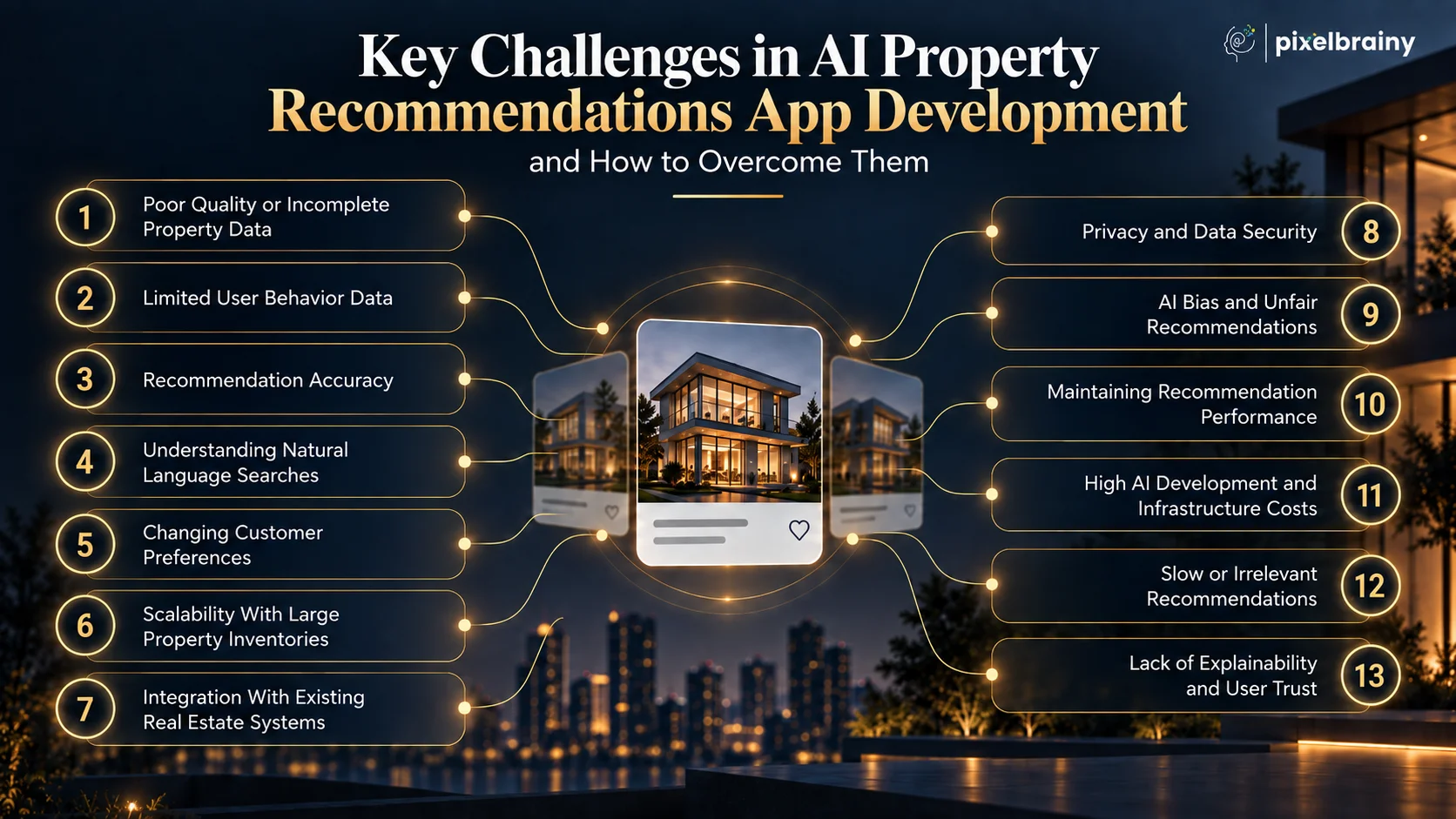
AI recommendations are only as reliable as the data used to generate them. Real estate platforms may have duplicate listings, outdated prices, missing amenities, inconsistent property descriptions, incorrect locations, or incomplete availability information.
Poor data can cause the recommendation engine to suggest properties that no longer meet customer requirements.
How to overcome it: Establish automated data validation, cleaning, deduplication, normalization, and synchronization processes. Regularly update property information and create clear data standards across all connected sources.
New platforms may not have enough historical searches, clicks, saved properties, inquiries, or transactions to understand individual preferences. This creates a cold-start problem where the AI has limited information for generating personalized recommendations.
How to overcome it: Combine user-provided preferences with property attributes and contextual information. Use onboarding questions, explicit preference selection, popular-property signals, and content-based recommendations until sufficient behavioral data becomes available.
A property may match a user's basic filters but still fail to meet their actual expectations. For example, two properties can have the same price and number of bedrooms but differ significantly in location, amenities, condition, or lifestyle suitability.
How to overcome it: Use multiple recommendation signals instead of relying only on basic filters. Combine property attributes, user preferences, search intent, behavioral signals, and relevance scoring to improve property matching.
Users often describe their requirements conversationally rather than using structured filters. Queries such as “I need a quiet family home near good schools with a short commute” contain several requirements that traditional search systems may struggle to interpret.
How to overcome it: Implement natural language processing and semantic search capabilities that can identify entities, preferences, locations, budget constraints, and contextual intent from conversational queries.
Property requirements are rarely fixed throughout the entire search journey. A customer may increase their budget, change neighborhoods, reconsider property types, or prioritize different amenities after viewing several listings.
How to overcome it: Build dynamic user profiles that continuously update based on explicit feedback and behavioral signals. The recommendation engine should adapt as new information becomes available.
A property marketplace can contain thousands or millions of listings. Searching, ranking, and generating personalized recommendations across a large inventory can place significant demands on databases, search infrastructure, APIs, and AI systems.
How to overcome it: Use scalable cloud infrastructure, optimized search engines, efficient indexing, caching, vector databases where appropriate, and recommendation pipelines designed for high-volume processing.
Real estate businesses often rely on CRM platforms, MLS or IDX systems, property databases, mapping services, analytics tools, and other applications. Connecting an AI recommendation engine with these systems can become technically complex.
How to overcome it: Design an API-first architecture and establish standardized data pipelines. Use secure APIs, integration middleware, event-driven workflows, and clear data synchronization rules to maintain consistency between systems.
AI property recommendation platforms can process customer information, search history, behavioral data, contact details, and other sensitive business information. Improper data handling can create security and compliance risks.
How to overcome it: Implement strong authentication, authorization, encryption, secure API practices, access controls, data retention policies, monitoring, and appropriate privacy controls. Businesses should also evaluate applicable privacy and real estate regulations for their operating markets.
Recommendation systems can unintentionally produce biased results when training data or recommendation rules contain problematic patterns. This is particularly important in housing because property recommendations can have significant real-world consequences.
How to overcome it: Establish responsible AI practices, monitor recommendation outputs, test models for potentially discriminatory patterns, maintain human oversight where appropriate, and ensure recommendations are based on legitimate property and user preferences rather than protected characteristics.
An AI model that performs well at launch may become less effective as property inventory, market conditions, user behavior, and customer preferences change.
How to overcome it: Continuously monitor recommendation metrics, collect feedback, retrain or update models when appropriate, test new recommendation strategies, and maintain a feedback loop between customer interactions and model improvement.
Sophisticated recommendation models, large-scale data processing, cloud infrastructure, third-party APIs, and ongoing model optimization can increase the overall cost of developing and operating an AI property recommendation application.
How to overcome it: Begin with clearly defined business objectives and prioritize high-value capabilities. A phased development approach can help businesses validate the recommendation engine before investing in more complex functionality. Cloud resources and AI services can also be scaled according to actual usage.
Users expect property searches and recommendations to respond quickly. Delays can negatively affect the discovery experience, while irrelevant recommendations can reduce trust in the platform.
How to overcome it: Optimize databases and search indexes, use caching where appropriate, precompute selected recommendation results, optimize AI inference, and establish performance targets for search and recommendation APIs.
Customers may question why a particular property was recommended, especially when the listing does not appear to match their obvious search criteria.
How to overcome it: Add explainable recommendation elements that identify relevant matching factors. For example, the application could indicate that a property was recommended because it fits the user's budget, preferred location, property type, and previously demonstrated interests.
Addressing data quality, recommendation accuracy, scalability, privacy, integration, and continuous AI improvement from the beginning can create a more reliable and effective AI property recommendation platform for real estate businesses.
From this point above, it is time to identify the right development partner that can turn your property recommendation concept into a production-ready solution. PixelBrainy as an AI real estate software development company brings AI engineering, real estate technology expertise, product development, integrations, and ongoing support together under one development approach. Its real estate AI services cover consultation, app development, MVP and PoC work, integrations, modernization, maintenance, and support.
For a business asking, “How can we create a property recommendation platform that understands customers and automatically surfaces the right listings?”, PixelBrainy approaches the project around the actual business problem rather than simply adding an AI feature.
The process begins with understanding your users, property inventory, existing technology, customer journey, and business objectives. This helps define what the recommendation engine needs to understand and which data signals should influence property matching.
For example, if your real query is:
“Our customers often view hundreds of listings before finding something relevant, and we’re seeing high drop-off rates. We want to create an intelligent property recommendation engine that learns from user behavior and suggests better properties. Need a development company to build the complete solution.”
The solution can be planned around customer preferences, property attributes, search behavior, saved listings, inquiries, and other relevant interaction signals.
PixelBrainy can structure the platform around recommendation models, property data pipelines, search capabilities, APIs, databases, and scalable cloud infrastructure. Its stated methodology includes requirements analysis, AI feature and architecture definition, data integration, AI algorithm development, testing, full product development, deployment, and post-launch support.
The recommendation engine can be designed to support property matching based on user preferences and behavioral signals, helping the platform progressively deliver more relevant listings.
The development process can include customer-facing web or mobile applications, property management interfaces, recommendation APIs, dashboards, and integrations with existing real estate systems.
PixelBrainy specifically lists AI real estate app development, property recommendation engines, CRM and listing integrations, and AI-powered search among its real estate capabilities.
This approach allows businesses to build AI property recommendation app solutions that fit their existing technology environment instead of creating disconnected AI functionality.
PixelBrainy has worked on confidential real estate AI projects involving intelligent property experiences and automation. One such project involved an AI-powered real estate application where users could search listings through natural language, receive property suggestions, schedule viewing slots through an AI chatbot, and have lead information integrated with CRM workflows.
The project demonstrates how AI property recommendation app development services can extend beyond listing suggestions to connect property discovery with customer engagement and agent workflows. PixelBrainy's published portfolio also describes an AI-powered real estate chatbot integration with natural language search, instant property suggestions, viewing bookings, and CRM-integrated lead collection.
Businesses can start with a focused product to validate recommendation quality and customer response before expanding the platform. PixelBrainy offers MVP and PoC development as part of its real estate AI methodology, followed by full-scale development, testing, deployment, and ongoing optimization.
Whether you want to develop AI property recommendation app capabilities for a property marketplace, brokerage, rental platform, property management company, or another real estate business, the architecture can be aligned with your specific inventory, users, data, and growth roadmap.
The objective of property recommendation app development integrating AI is not simply to make property search smarter. It is to create an intelligent real estate product that can understand users, connect them with relevant inventory, and continuously improve the discovery experience.
Ready to turn your property recommendation idea into an AI-powered real estate product? Connect with PixelBrainy to discuss your project and development roadmap.

An AI property recommendation app can transform how real estate businesses connect customers with relevant properties. Instead of making buyers, renters, or investors browse hundreds of listings, AI can understand their budget, location preferences, property requirements, search intent, and behavior to deliver more personalized recommendations.
However, successful AI property recommendation app development requires more than adding an AI model to an existing property portal. Businesses need accurate property data, intelligent matching algorithms, scalable technology, intuitive user experiences, secure integrations, and continuous optimization to create a recommendation platform that delivers real business value.
Whether you want to build an AI property recommendation app for a property marketplace, rental platform, brokerage, investment business, or property management company, the right development strategy can help turn your idea into a scalable real estate product.
Book an appointment with PixelBrainy today to discuss your AI property recommendation app and take your real estate business toward smarter, more personalized property discovery.
To build an AI property recommendation app, you need to define your target users, property data sources, recommendation requirements, AI capabilities, integrations, and application platforms. The development process typically includes planning, data preparation, AI model development, app development, testing, deployment, and ongoing optimization.
The cost to develop an AI property recommendation app generally starts from around $30,000 and can exceed $200,000 for complex enterprise solutions. The final development budget depends on features, AI complexity, property inventory, data infrastructure, integrations, platforms, security, and scalability requirements.
AI property recommendation app development enables a platform to analyze customer preferences, search activity, property attributes, and behavioral signals to identify relevant listings. Instead of relying only on traditional filters, AI can rank and recommend properties according to individual customer requirements.
Yes. You can develop an AI property recommendation app that learns from searches, listing views, clicks, saved properties, comparisons, inquiries, and other interactions. These signals can help the recommendation engine identify evolving preferences and improve the relevance of future property suggestions.
AI property recommendation app development services can include business analysis, AI consultation, data engineering, recommendation engine development, natural language search, application development, third-party integrations, testing, deployment, and post-launch maintenance. The exact services depend on the real estate business model and product scope.
Yes. An AI property recommendations app can support different customer segments through separate recommendation criteria. Buyers may receive recommendations based on purchase budget, location, property specifications, and lifestyle preferences, while tenants can be matched according to rent, lease requirements, amenities, commute, and apartment preferences.
The time required to build an AI property recommendation app depends on the product scope and technical complexity. A focused MVP can take several weeks to a few months, while an advanced platform with custom AI models, large property datasets, multiple integrations, and enterprise infrastructure can require several months.

About The Author
Sagar Bhatnagar
Sagar Sahay Bhatnagar brings over a decade of IT industry experience to his role as Marketing Head at PixelBrainy. He's known for his knack in devising creative marketing strategies that boost brand visibility and market influence. Sagar's strategic thinking, coupled with his innovative vision and focus on results, sets him apart. His track record of successful campaigns proves his ability to utilize digital platforms effectively for impactful marketing efforts. With a genuine passion for both technology and marketing, Sagar continuously pushes PixelBrainy's marketing initiatives to greater success.

Working with the PixelBrainy team has been a highly positive experience. They understand the design requirements and create beautiful UX elements to meet the application needs. The dev team did an excellent job bringing my vision to life. We discussed usability and flow. Sagar worked with his team to design the database and begin coding. Working with Sagar was easy. He has the knowledge to create robust apps, including multi-language support, Google and Apple ID login options, Ad-enabled integrations, Stripe payment processing, and a Web Admin site for maintaining support data. I'm extremely satisfied with the services provided, the quality of the final product, and the professionalism of the entire process. I highly recommend them for Android and iOS Mobile Application Design and Development.

Great experience working with them. Had a lot of feedback and I found that unlike most contractors they were bugging me for updates instead of the other way around. They were extremely time conscience and great at communicating! All work was done extremely high quality and if not on time, early! They were always proactive when it comes to communication and the work is great/above par always. Very flexible and a great team to work with! Goes above and beyond to present us with multiple options and always provides quality. Amazing work per usual with Chitra. If you have UI/UX or branding design needs I recommend you go to them! Will likely work with them in the future as well, definitely recommended!

PixelBrainy is a joy to work with and is a great partner when thinking through branding, logo, and website layout. I appreciate that they spend time going into the "why" behind their decisions to help inform me and others about industry best practices and their expertise.

I hired them to design our software apps. Things I really like about them are excellent communication skills, they answer all project suggestions and collaborate right away, and their input on design and colors is amazing. This project was complex and needed patience and creativity. The team is amazing to do business with. I will be using them long-term. Glad to see there are some good people out there. I was afraid to try and outsource my project to someone but I am glad I met them! I really can't say enough. They went above and beyond on this project. I am very happy with everything they have done to make my business stand out from the competition.

It was great working with PixelBrainy and the team. They were very responsive and really owned the project. We'll definitely work with them again!

I recently worked with the PixelBrainy team on a project and I was blown away by their communication skills. They were prompt, clear, and articulate in all of our interactions. They listened and provided valuable feedback and suggestions to help make the project a success. They also kept me updated throughout the entire process, which made the experience stress-free and enjoyable.

PixelBrainy is very good at what it does. The team also presents themselves very professionally and takes care of their side of things very well. I could fully trust them taking up the design work in a timely and organised manner and their attention to detail saved us lots of effort and time. This particular project was quite intense and the team showed that they function very well under pressure. Very much looking forward to working with her again!

It's always an absolute pleasure working with them. They completed all of my requests quickly and followed every note I had for them to a T, which made our process go smoothly from start to finish. Everything was completed fast and following all of the guidelines. And I would recommend their services to anyone. If you need any design work done in the future, PixelBrainy should be your first call!

They took ownership of our requirements and designed and proposed multiple beautiful variants. The team is self-motivated, requires minimum supervision, committed to see-through designs with quality and delivering them on time. We would definitely love to work with PixelBrainy again when we have any requirements.

PixelBrainy was a big help with our SaaS application. We've been hard at work with a new UI/UX and they provided a lot of help with the designs. If you're looking for assistance with your website, software, or mobile application designs, PixelBrainy and the team is a great recommendation.

PixelBrainy designers are amazing. They are responsive, talented, and always willing to help craft the design until it matches your vision. I would recommend them and plan to continue them for my future projects and more!!!

They were awesome! Did a good job fast, and good communication. Will work with them again. Thank you

Creative, detail-oriented, and talented designers who take direction well and implement changes quickly and accurately. They consistently over-delivered for us.

PixelBrainy team is very talented and creative. Great designers and a pleasure to work with. PixelBrainy is an excellent communicator and I look forward to working with them again.

PixelBrainy has a very talented design team. Their work is excellent and they are very responsive. I enjoy working with them and hope to continue on all of our future projects.


Transform your ideas into reality with us.
Across these industries, each engagement brings unique challenges, from early-stage product development to scaling complex systems, helping us build a practical understanding of real-world product environments.