AI Summary Powered by PixelBrainy
What if you could build a real-estate app that predicts property values, recommends ideal listings, and automates client interactions all powered by AI? This is exactly why many startups are focusing on AI Real Estate MVP App Development. If you’re wondering how to develop an AI Real Estate MVP App, this guide is for you.
The real estate industry is undergoing a strong transformation and artificial intelligence has become central to the change. From predictive analytics and intelligent search filters to chatbots that handle client questions, AI technology enables startups to deliver smarter, data-driven solutions to buyers, sellers and agents. Instead of going straight to large-scale app development, promoting an AI Real Estate MVP App gives startups a lean and cost-effective way to test their value proposition—validating key assumptions and gathering feedback with less spending and less risk.
According to a recent report, the global AI in real-estate market is projected to grow from approximately US $222.65 billion in 2024 to about US $303.06 billion in 2025. Looking further ahead, it is forecast to surge past US $988.59 billion by 2029.
This guide will walk you through how to build an AI Real Estate MVP App: from selecting your core features and technology stack to managing development timelines, cost and early-stage challenges. Whether you are a tech founder exploring PropTech, a real-estate professional aiming to innovate, or an investor looking at the building of an AI Real Estate MVP App, you’ll learn how to create an AI Real Estate MVP that positions your business for long-term success.
An AI Real Estate App MVP is a simplified version of a full-scale real estate application that uses artificial intelligence to validate business ideas quickly and cost-effectively. MVP stands for Minimum Viable Product, meaning the app includes only the most essential features needed to test market demand and gather user feedback. In the context of real estate, this could include AI-driven property recommendations, automated valuations, and predictive analytics.
The goal is to help startups showcase the potential of AI without investing in complete development upfront. By focusing on key functionalities, founders can evaluate user behavior, refine their app’s concept, and attract investors based on proven data. Essentially, AI Real Estate MVP App Development allows startups to experiment, learn, and evolve faster in a competitive property tech landscape, paving the way to build a scalable, intelligent platform for the future.
The real estate sector is entering a new era driven by artificial intelligence. Through AI Real Estate App Development, startups and enterprises can leverage the power of data to understand market behavior, automate operations, and provide personalized customer experiences.
The advantages of building an AI Real Estate App extend far beyond convenience; it redefines how real estate businesses operate, communicate, and grow in a competitive market. Here are six major benefits of choosing to develop an AI Real Estate App for your business.
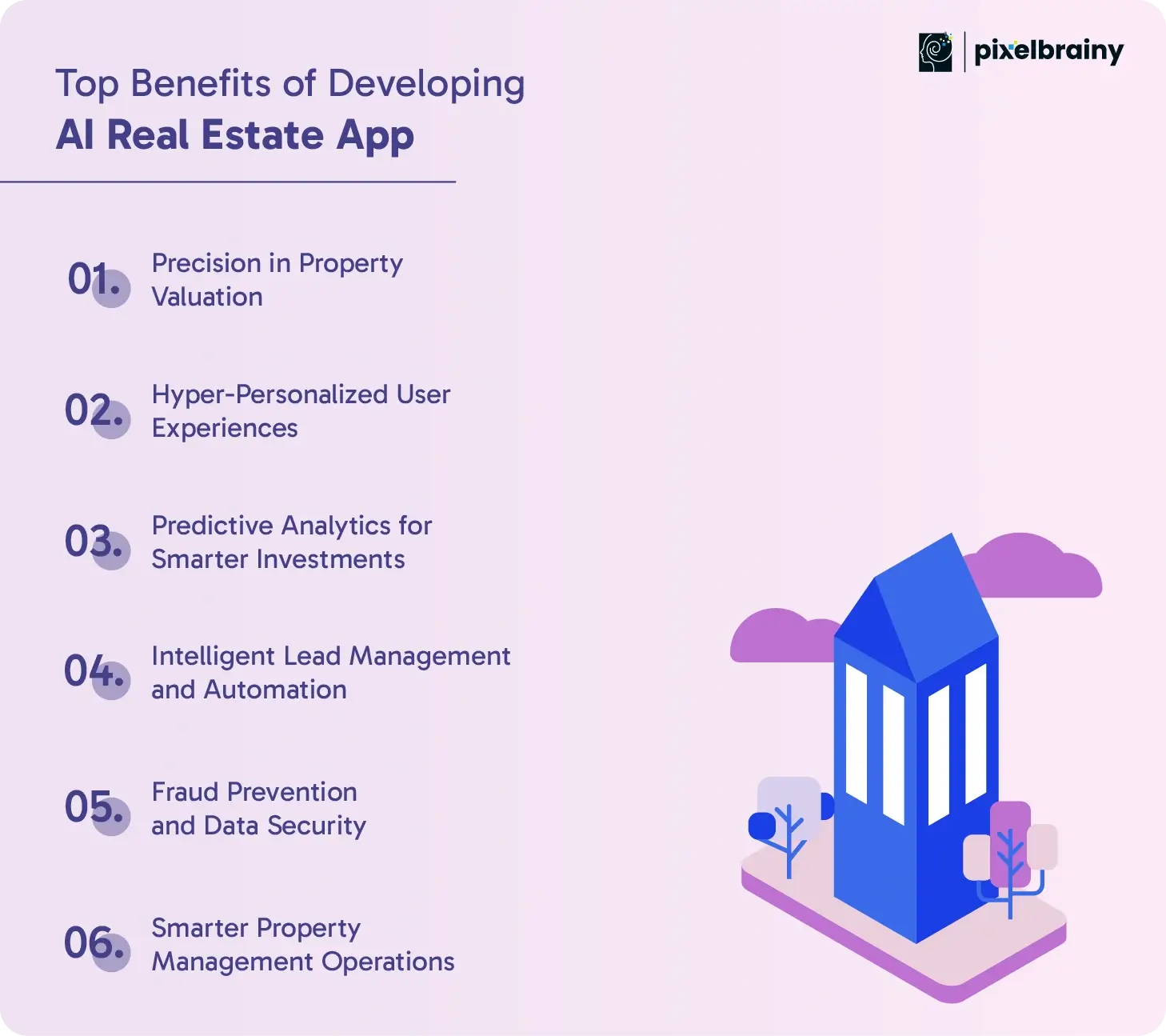
Accurate property valuation has always been one of the biggest challenges in the real estate sector. AI helps overcome this by analyzing multiple data points such as neighborhood trends, property conditions, nearby amenities, and recent sales.
Instead of relying on traditional estimates or manual comparisons, AI-powered valuation tools generate real-time, data-backed price assessments. This not only builds trust between buyers and sellers but also improves negotiation outcomes.
The ability to provide transparent and precise valuations positions your platform as a reliable source, which strengthens both brand reputation and customer loyalty.
Modern users expect more than just listings — they want tailored recommendations that align with their preferences. AI allows apps to track user behavior, analyze search patterns, and understand lifestyle choices to present relevant property matches.
By learning from user interactions, the system continuously refines its recommendations. This keeps users engaged and increases the likelihood of conversions.
For startups, personalization powered by AI not only improves customer satisfaction but also enhances retention and brand differentiation in a crowded market.
AI’s predictive analytics capabilities are revolutionizing real estate investment strategies. The technology can forecast property values, market demand, and rental yield using vast datasets and pattern recognition.
This empowers investors and agents to make data-driven decisions rather than relying on intuition. They can identify emerging neighborhoods, assess long-term growth potential, and plan profitable investments.
For startups, predictive analytics means reduced financial risk and the ability to stay ahead of shifting market trends, ensuring sustained growth and competitiveness.
Lead management is one of the most time-consuming tasks in real estate. AI simplifies it by automatically sorting leads, identifying high-potential clients, and assigning follow-ups.
Chatbots and AI assistants can respond to inquiries instantly, schedule property tours, and handle repetitive questions. This gives sales teams more time to focus on meaningful conversations that close deals.
When implemented correctly, automation can increase efficiency, shorten sales cycles, and deliver a more seamless customer experience from the first interaction to the final purchase.
Trust is essential in real estate transactions. AI strengthens platform security by monitoring user behavior, flagging unusual activity, and identifying potential fraud patterns.
This technology can verify property listings, detect fake profiles, and ensure that every transaction meets compliance standards. By reducing risks, it enhances the integrity of your marketplace.
Building AI-driven security measures also reassures users that their data is protected, making them more likely to continue using your platform and recommend it to others.
AI transforms property management by automating repetitive tasks and providing actionable insights. It can predict maintenance needs, alert managers to potential issues, and optimize rental pricing based on market dynamics.
This proactive approach minimizes costly downtime and keeps tenants satisfied. It also helps property owners make more strategic decisions about upgrades, leases, and occupancy rates.
For startups managing multiple properties, AI ensures consistent performance, cost control, and the scalability required to grow efficiently.
By choosing to make an AI Real Estate App, startups are not just adopting a trend — they are building intelligent systems that deliver value, innovation, and a competitive edge in the modern real estate landscape.
Building an AI Real Estate App MVP requires identifying features that create immediate user value while demonstrating AI’s real potential. The goal in AI Real Estate App Development is not to build everything at once but to focus on intelligent automation, user experience, and predictive technology that solve real estate challenges efficiently.
Below is a table of essential features every startup should consider to develop an AI Real Estate App MVP successfully.
| Feature | Description |
| AI-Powered Property Search | Integrates machine learning algorithms to deliver accurate, personalized, and context-aware property results. The app refines search outcomes over time by analyzing user behavior and intent. |
| Dynamic Pricing and Valuation | Utilizes predictive analytics to estimate property values based on market trends, location data, and historical pricing. It provides reliable insights for buyers, sellers, and investors. |
| Intelligent Recommendation Engine | Suggests properties tailored to user preferences, lifestyle, and financial capacity. The AI model learns continuously, improving personalization with each user interaction. |
| Virtual Property Tours with AI | Uses AI-enhanced 3D visualization and augmented reality to create immersive virtual property experiences. This increases engagement and reduces the need for physical visits. |
| AI Chatbots for Customer Support | Automates conversations through intelligent chat systems that answer inquiries, schedule viewings, and offer property insights instantly, enhancing customer satisfaction. |
| Predictive Market Insights | Employs AI to detect market shifts and forecast investment opportunities. This enables users to make informed and strategic buying or selling decisions. |
| Lead Scoring and Automation | Applies AI algorithms to rank leads based on engagement and intent. This helps agents focus their efforts on the most promising prospects, improving conversion rates. |
| Smart Image Recognition | Analyzes property images automatically to tag attributes, identify quality issues, and enhance visual appeal. It streamlines listing creation and improves user trust. |
| AI-Driven Fraud Detection | Monitors listings and transactions for unusual patterns to identify fake or risky activities. It strengthens user confidence through proactive fraud prevention. |
| Personalized User Dashboard | Delivers a customized interface showing saved properties, market insights, and recommendations relevant to the user’s profile and goals. |
| Voice Search Integration | Enables users to find properties through natural speech commands, enhancing accessibility and convenience, especially for mobile users. |
| Real-Time Market Analytics Dashboard | Displays live market data and buyer behavior analytics, helping users and agents make timely, data-informed decisions. |
| AI-Based Mortgage and Loan Calculator | Helps users assess financing options and repayment scenarios using predictive models that offer accurate affordability estimates. |
| Automated Document Verification | Validates property ownership and related documents through AI-based verification systems, ensuring legal accuracy and reducing fraud risks. |
| Smart Notification System | Sends timely, personalized updates about new listings, market changes, or saved property alerts, increasing engagement and retention. |
Each feature brings measurable value and forms the foundation to make an AI Real Estate App that adapts, learns, and delivers results from the very first release.
By focusing on these AI-driven features, startups can launch an MVP that is intelligent, user-centric, and ready to evolve into a full-scale real estate innovation platform.
Once the core MVP is validated, integrating advanced features can elevate your AI Real Estate App Development to the next level. These features leverage deeper machine learning, predictive analytics, and automation to make your app smarter and more competitive.
Startups aiming to develop an AI Real Estate App MVP that stands out should consider these advanced functionalities for long-term scalability and innovation.
| Advanced Feature | Description |
| AI-Powered Predictive Investment Insights | Uses deep learning models to forecast property appreciation, rental yield, and emerging neighborhood value. This helps investors make strategic and data-driven investment decisions. |
| Automated Property Valuation Models (AVMs) | Builds self-learning valuation systems that continuously adjust pricing predictions as new market data becomes available. This provides real-time accuracy and consistency in property pricing. |
| Blockchain Integration for Smart Contracts | Combines AI and blockchain to secure property transactions with transparent, automated smart contracts. This eliminates fraud and enhances trust between buyers and sellers. |
| Augmented Reality (AR) and Virtual Reality (VR) Tours | Allows users to explore 3D-rendered properties through immersive virtual experiences. This makes online property exploration more engaging and interactive, boosting user satisfaction. |
| AI-Driven CRM and Customer Journey Mapping | Tracks user behavior across all interactions to predict needs and optimize engagement. AI suggests the right properties and communication strategies at the perfect time. |
| Geospatial Data Analysis | Integrates satellite and map-based data to evaluate environmental, infrastructural, and geographic factors that influence property value and livability. |
| AI-Powered Content Generation | Automatically creates property descriptions, market updates, and marketing materials based on listing data. This saves time and ensures professional, SEO-friendly content for every listing. |
| Voice-Activated Property Assistance | Enables users to navigate, compare, and inquire about properties using natural voice commands. This enhances accessibility and creates a hands-free, modern app experience. |
| Emotion Recognition for Buyer Behavior Analysis | Uses AI to analyze user reactions and preferences through visual or voice data. It helps predict emotional engagement with certain listings and tailor future recommendations accordingly. |
| Smart IoT Integration | Connects with smart home devices to provide real-time insights into energy efficiency, security, and property maintenance. It adds futuristic functionality that appeals to tech-savvy buyers. |
These innovations showcase how AI Real Estate App MVP Development can evolve into an intelligent, data-driven ecosystem that enhances decision-making and user engagement.
Incorporating advanced AI capabilities transforms your MVP into a next-generation real estate platform ready to dominate the PropTech market.

Building a successful AI Real Estate App MVP Development journey requires a clear roadmap that connects technical innovation with real market needs. Below is a practical 8-step process that explains what is the process to build AI Real Estate App MVP from concept to launch.
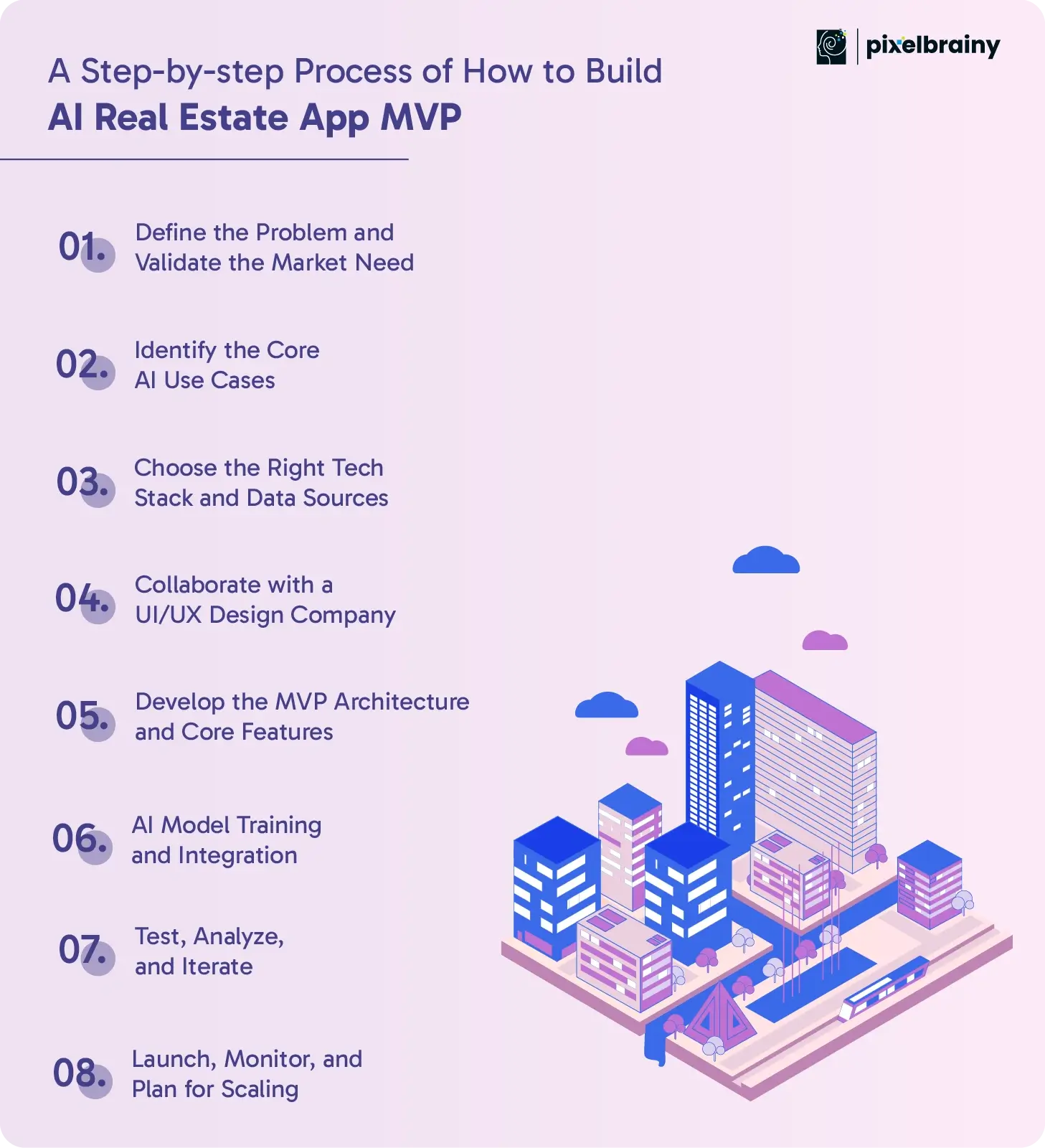
Aim of this: To ensure that your AI real estate idea solves an actual market challenge.
Start by conducting comprehensive market research and user interviews to validate your concept. Study what current apps are lacking—whether it’s predictive property pricing, intelligent search filters, or automated recommendations. This early stage helps you build a PoC (Proof of Concept) that supports your assumptions. Validating the problem early prevents expensive development reworks and keeps your project aligned with business goals.
Goal of this: To determine how artificial intelligence will add tangible value.
In this stage, decide the AI-driven functions your app will deliver, such as price prediction, image-based property matching, or AI chatbots for virtual assistants. This step marks the development of AI Real Estate App MVP as you define how automation and data intelligence will enhance user experience. Ensure your AI models are focused on delivering measurable benefits like speed, personalization, and accurate insights for real estate buyers and sellers.
Aim of this: To establish a strong foundation for scalability and performance.
Select frameworks like TensorFlow or PyTorch for machine learning, and combine them with a robust backend using Python or Node.js. For front-end, choose responsive options like React Native or Flutter. Use reliable property data sources such as MLS databases, Zillow API, or open datasets to train AI models. Integrating real-time data pipelines is crucial to make AI Real Estate App MVP efficient and reliable. This ensures smooth performance and accurate predictions once users start interacting with the platform.
Goal of this: To create an intuitive and user-centered interface.
The design phase translates your concept into wireframes and prototypes. Partnering with a professional UI/UX Design company ensures your application layout is clean, visually appealing, and highly functional. Focus on easy navigation for buyers, agents, and property managers. Effective design at this stage improves engagement and retention rates while allowing quick feedback during user testing before full development begins.
Aim of this: To transform ideas into a functional prototype.
Now begins the developing AI Real Estate App MVP phase, where your technical team builds the initial product version. Include essential features such as property listings, AI-powered search, smart chatbots, and analytics dashboards. Keep the scope lean but impactful. The focus should be on delivering immediate value with minimal complexity. Collaborate closely with developers to ensure security, scalability, and seamless performance throughout.
Goal of this: To make your app intelligent and adaptive through AI.
This stage involves AI Real Estate App MVP development Integrating AI into your system. Train models using property images, market data, and user behavior to deliver personalized insights. Use predictive algorithms to estimate property prices or recommend investment opportunities. Proper integration ensures your AI system learns from user interactions and keeps improving accuracy over time. Monitoring model performance helps you fine-tune results for better decision-making.
Aim of this: To validate app functionality and refine user experience.
Quality assurance testing ensures every module works as intended. Conduct usability testing, A/B testing, and AI performance evaluation. Gather user feedback to identify potential enhancements before expanding the platform. This iterative improvement process bridges the gap between AI Real Estate App MVP Development and the Full fledge product launch. Each cycle of refinement adds more precision, stability, and customer trust.
Goal of this: To transition from MVP to a sustainable business solution.
After thorough validation, release your MVP to early adopters or a limited market segment. Use analytics tools to track engagement, property searches, and conversion rates. Gather insights for feature upgrades and AI model tuning. Collaborate with one of the top AI development companies in USA for ongoing scaling and cloud optimization. This step turns your minimal viable product into a growth-ready, AI-powered real estate platform.
By following these structured steps, startups can confidently navigate the journey from idea validation to successful AI Real Estate App MVP launch. This process not only minimizes risks but also builds a strong technological foundation for scaling into a full-featured, AI-driven real estate platform that stands out in the competitive PropTech market.
Also Read: AI Real Estate Website Development: Features and Steps
Understanding what is cost to develop AI Real Estate App MVP is essential for startups that want to plan their budget wisely and allocate resources efficiently. The AI Real Estate App MVP Development Cost can vary depending on the project’s complexity, technology stack, and integration of AI-driven functionalities. On average, the cost of building AI Real Estate App MVP ranges from $20,000 to $50,000+, depending on the scope and desired features.
When estimating the Cost of creating AI Real Estate App MVP, several factors influence the total budget:
If your team plans on Real Estate App MVP Development Integrating AI, it’s important to prioritize key features first and then scale intelligently once your MVP proves market viability.
| Type of MVP | Description | Estimated Cost Range | Ideal For |
| Basic AI Real Estate App MVP | Includes fundamental features like property listings, search filters, basic AI recommendations, and user login. Limited automation and simple analytics. | $20,000 – $25,000 | Early-stage startups validating ideas or testing market response |
| Intermediate AI Real Estate App MVP | Adds enhanced AI models for property matching, chatbots, pricing estimation, and interactive dashboards. Better UI/UX with data insights. | $30,000 – $40,000 | Startups aiming for stronger functionality and early investor traction |
| Advanced AI Real Estate App MVP | Fully data-driven platform integrating AI-powered valuations, predictive insights, image recognition, and automated workflows. Scalable architecture. | $45,000 – $50,000+ | Growing startups preparing for large-scale deployment and funding rounds |
While initial development may start at $20,000, investing strategically in the right AI features ensures higher returns and long-term scalability. A well-planned cost of creating AI Real Estate App MVP helps startups balance innovation with financial efficiency, setting the foundation for a sustainable, intelligent real estate platform.
Also Read: AI Real Estate App Development Cost: Factors and Examples
Creating an AI-driven real estate platform demands the right combination of technologies, frameworks, and tools to ensure scalability, accuracy, and performance. The development of AI Real Estate App MVP depends heavily on the tools you select for AI modeling, data management, backend, frontend, and cloud deployment. The following stack will help streamline every phase from prototype to deployment efficiently.
Below is a table outlining the recommended AI tools and technology stack categorized by their core functions:
| Category | Recommended Tools & Technologies | Purpose / Functionality |
| Programming Languages | Python, JavaScript, TypeScript | Core coding for AI algorithms, backend APIs, and front-end logic |
| AI & Machine Learning Frameworks | TensorFlow, PyTorch, Scikit-learn | Building, training, and deploying predictive models for price estimation, recommendations, and analytics |
| Natural Language Processing (NLP) | OpenAI API, spaCy, Hugging Face Transformers | Powering AI chatbots, property search automation, and conversational interfaces |
| Computer Vision Tools | OpenCV, AWS Rekognition | Enabling image recognition for property tagging and photo-based property matching |
| Frontend Frameworks | React Native, Flutter | Building responsive and cross-platform mobile applications |
| Backend Frameworks | Node.js, Django, FastAPI | Managing APIs, business logic, and data flow between AI models and the UI |
| Databases | PostgreSQL, MongoDB, Firebase | Storing user profiles, property data, and analytics records securely |
| Cloud Platforms | AWS, Google Cloud AI, Microsoft Azure | Hosting AI models, managing data pipelines, and providing scalable compute resources |
| Data Visualization Tools | Power BI, Tableau, Plotly | Creating dashboards for user insights, trends, and market analytics |
| DevOps & CI/CD Tools | Docker, Kubernetes, GitHub Actions | Automating deployment, scaling, and continuous updates efficiently |
| APIs & Integrations | Zillow API, Google Maps API, Twilio | Providing real-time data, property listings, geolocation, and communication functionalities |
Selecting the right AI tools and technology stack ensures the smooth, efficient, and scalable execution of your AI Real Estate App MVP, helping startups turn innovative ideas into intelligent, high-performing property solutions.

Scaling a custom AI Real Estate App MVP is one of the most critical transitions for any PropTech startup. After your MVP has validated the core business idea, generated user traction, and proven its technical viability, the next step is to strategically scale it into a full-fledged, high-performing AI-driven platform.
This stage demands careful timing, a solid technological foundation, and a clear roadmap to avoid scaling prematurely or inefficiently.
Before expanding your MVP, it’s important to identify measurable indicators that confirm readiness for scaling. Scaling too early can drain resources, while scaling too late can slow growth momentum.
Once you determine that your MVP is ready, the focus shifts from validation to growth. The goal is to transform a functional prototype into a complete, market-ready product that leverages AI at every stage of the real estate process.
Enhance your existing machine learning and AI algorithms to process larger datasets and deliver more personalized, accurate insights. Introduce advanced features like predictive analytics for property valuation, buyer behavior modeling, and image-based property identification. This transforms your MVP into a truly intelligent platform capable of adapting to user intent in real time.
Goal: To elevate AI performance and deliver scalable intelligence that adds tangible business value.
As user demand grows, scalability becomes essential. Move from a monolithic system to a microservices-based architecture. Adopt cloud solutions such as AWS or Google Cloud to ensure load balancing and automated scaling. Utilize CI/CD pipelines to enable faster deployment cycles and updates.
Goal: To build a system architecture that supports long-term growth without compromising performance.
Partner with a professional design and product team to refine the platform’s interface for multi-device accessibility. Introduce personalization elements such as smart dashboards, virtual tours, and recommendation panels. A user-friendly experience boosts retention and brand trust.
Goal: To provide a seamless, intuitive, and scalable experience for end-users across platforms.
Connect your platform to multiple property listing databases, financial services, and CRM tools. Strategic partnerships with real estate agencies and brokers expand your data ecosystem and improve platform credibility.
Goal: To enrich your ecosystem through integrations that enhance functionality and trust.
Automate key workflows such as lead qualification, property verification, and user communication using AI-powered chatbots and automation tools. Implement advanced analytics to track user patterns and performance KPIs continuously.
Goal: To create a self-learning, data-driven ecosystem that supports operational efficiency.
As your product evolves, build specialized teams for AI, DevOps, and customer success. Scaling is not just technical—it requires the right talent and infrastructure to maintain reliability, innovation, and customer satisfaction.
Goal: To establish organizational readiness that aligns with product expansion.
Once your platform stabilizes, explore new geographies and business models such as B2B property analytics, subscription plans, or white-label solutions for agents and brokers.
Goal: To transform the MVP into a diversified, revenue-generating AI platform.
Scaling your custom AI Real Estate App MVP solutions is not about adding more features—it’s about enhancing intelligence, usability, and market reach. By strengthening AI capabilities, refining design, and expanding integrations, your MVP can evolve into a future-ready real estate platform that drives innovation and profitability in the PropTech landscape.
Developing an AI Real Estate App MVP can be a game-changing step for startups, but it also comes with a unique set of challenges. From data handling and AI accuracy to design complexity and integration issues, each stage of development requires strategic planning and technical precision.
Understanding these challenges early and preparing effective mitigation strategies helps ensure a smooth, scalable, and successful development journey.
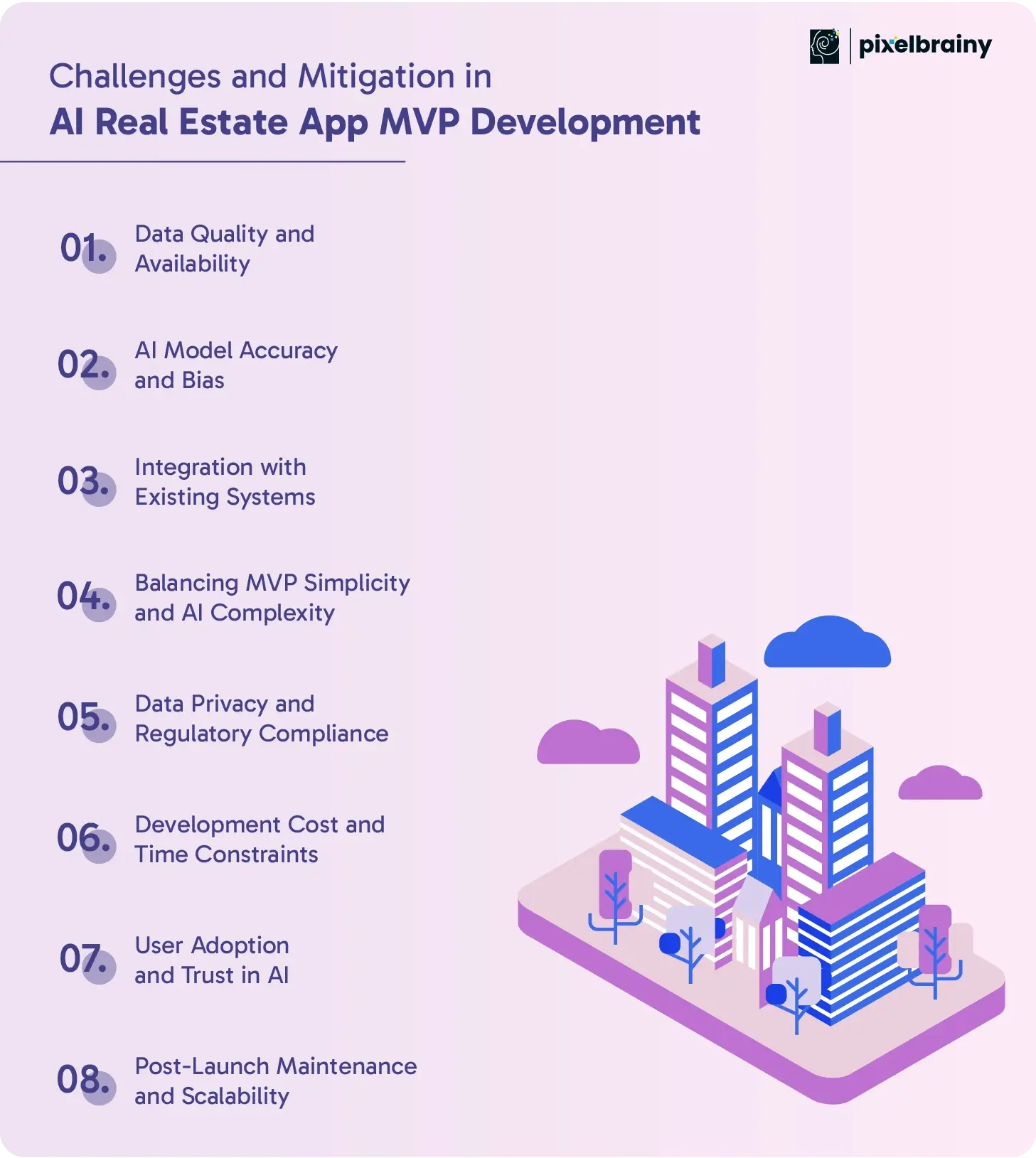
AI models in real estate rely heavily on high-quality datasets to generate reliable insights such as property valuations, demand predictions, and customer preferences. However, acquiring structured, unbiased, and region-specific data can be difficult for startups.
Mitigation:
Goal: Ensure your AI system delivers accurate, real-time results that reflect real market conditions.
AI algorithms can sometimes produce inaccurate predictions or biased outcomes due to limited or skewed datasets. This can affect trust among users and harm your brand credibility.
Mitigation:
Goal: Build trustworthy AI systems that maintain fairness, accuracy, and reliability.
Many real estate businesses already use legacy systems, CRMs, or databases. Integrating a new AI-powered MVP with these systems can create compatibility and synchronization challenges.
Mitigation:
Goal: Achieve smooth interoperability without disrupting existing business workflows.
AI solutions often demand advanced algorithms and complex data processing. However, overloading the MVP with too many features can slow development and increase costs.
Mitigation:
Goal: Build a focused, cost-effective MVP that validates your idea efficiently.
Real estate data often includes sensitive information such as buyer profiles, payment details, and location data. Failing to comply with data protection laws can lead to legal and reputational risks.
Mitigation:
Goal: Protect user trust by maintaining the highest standards of data privacy and security.
For startups, budget limitations and strict timelines are common barriers. AI development, training, and testing can quickly consume resources if not managed efficiently.
Mitigation:
Goal: Optimize time and cost while ensuring the MVP meets core business objectives.
Convincing users to rely on AI recommendations in real estate can be difficult, especially if they are unfamiliar with AI-driven decision-making.
Mitigation:
Goal: Encourage user confidence and long-term adoption of AI-enabled features.
After launching the MVP, continuous monitoring, updates, and scalability become critical to maintain performance and relevance as user demand grows.
Mitigation:
Goal: Ensure your AI Real Estate App MVP remains adaptive, efficient, and future-ready.
Addressing these challenges strategically ensures your AI Real Estate App MVP development process remains stable, secure, and effective. With proper planning, robust data management, and continuous iteration, startups can overcome common barriers and transform their MVP into a scalable, intelligent real estate solution.
Selecting the right technology partner for AI Real Estate App MVP Development can determine the success or failure of your product vision. PixelBrainy has emerged as a trusted innovator and strategic ally for startups and enterprises seeking cutting-edge AI real estate solutions in the United States.
As an experienced AI Development Company in USA, PixelBrainy combines domain knowledge, advanced technologies, and business insight to build intelligent MVPs that accelerate growth and market validation.
PixelBrainy specializes in MVP Development that enables startups to test, validate, and scale their product ideas faster. Every MVP is designed with precision — from concept architecture to prototype deployment — ensuring functionality, performance, and user satisfaction. The company’s focus lies not only in developing technology but in helping clients achieve measurable business outcomes.
Our dedicated AI and product teams follow an agile and data-driven approach to develop AI Real Estate App MVP that is reliable, scalable, and investor-ready. Each solution is engineered for flexibility, allowing startups to expand features as their market presence grows.
PixelBrainy is more than just a development partner; it is a full-cycle innovation lab specializing in building of AI Real Estate App MVP platforms that blend artificial intelligence, analytics, and intuitive design. What differentiates us is our ability to translate complex AI capabilities into real estate-specific solutions that drive tangible value.
Through these capabilities, PixelBrainy consistently ranks among the leading AI Real estate development companies in USA, known for technical precision and innovative problem-solving.
One of PixelBrainy’s recent success stories involved a confidential real estate startup in Florida that wanted to develop AI Real Estate App MVP capable of automating property evaluations and improving buyer experience through AI insights.
PixelBrainy led the creating AI Real Estate App MVP process from concept to launch, which included:
Within four months, the client’s MVP successfully launched, achieved investor approval for scaling, and recorded a 40% increase in user engagement. This project demonstrated PixelBrainy’s unmatched expertise in crafting real-world AI real estate applications that deliver measurable business impact.
PixelBrainy continues to set benchmarks in PropTech innovation as one of the most trusted AI Real estate development companies in USA. By combining strategic thinking, design excellence, and AI expertise, we help startups confidently move from vision to reality — guiding every step of creating AI Real Estate App MVP that delivers measurable success and sustainable growth.

From this comprehensive guide, it’s clear that developing an AI Real Estate App MVP is a strategic step for startups aiming to innovate in the property technology market. By combining AI intelligence, seamless design, and data-driven insights, businesses can create smarter real estate solutions that attract users and investors alike.
The journey from idea to launch requires the right mix of planning, technical expertise, and scalability. Partnering with a reliable AI Development Company in USA like PixelBrainy ensures your MVP is built with precision, efficiency, and long-term vision.
As real estate continues to evolve with AI, the opportunity to lead is greater than ever.
Book an appointment with PixelBrainy today to begin building your intelligent, market-ready AI Real Estate App MVP.
AI integration allows real estate apps to analyze large volumes of property and user data instantly. It helps automate property recommendations, predict market trends, personalize user experiences, and improve decision-making. This turns traditional property search tools into intelligent, insight-driven platforms that deliver real value to buyers, sellers, and agents.
The development timeline depends on the app’s complexity, AI features, and integration requirements. On average, creating an AI Real Estate App MVP takes about 3 to 6 months, including research, UI/UX design, AI model training, and testing. A clear roadmap and agile development process help deliver faster results without compromising quality.
Yes. Startups can begin with a lean MVP model focused on one or two key AI features such as price prediction or recommendation systems. This approach minimizes cost while validating the business idea. Once the MVP gains user traction and investor interest, it can be scaled into a full-featured AI-powered platform.
AI models in real estate typically use data such as property listings, location metrics, price history, user preferences, and market trends. For image recognition or property scoring features, photo datasets are also used. The quality, diversity, and accuracy of these datasets directly affect how precise and reliable the AI predictions become.
For property agents, AI automates repetitive tasks such as lead management, property matching, and communication. For investors, it provides predictive analytics on pricing, demand, and ROI potential. Together, these capabilities enhance efficiency, save time, and improve business decisions across the real estate value chain.
PixelBrainy combines deep expertise in AI, real estate technologies, and agile product design. As a leading AI Development Company in USA, it specializes in building intelligent, data-driven MVPs that deliver measurable growth. The company’s proven process helps startups validate ideas faster, reduce risk, and launch smarter AI-powered real estate platforms.

About The Author
Sagar Bhatnagar
Sagar Sahay Bhatnagar brings over a decade of IT industry experience to his role as Marketing Head at PixelBrainy. He's known for his knack in devising creative marketing strategies that boost brand visibility and market influence. Sagar's strategic thinking, coupled with his innovative vision and focus on results, sets him apart. His track record of successful campaigns proves his ability to utilize digital platforms effectively for impactful marketing efforts. With a genuine passion for both technology and marketing, Sagar continuously pushes PixelBrainy's marketing initiatives to greater success.

Working with the PixelBrainy team has been a highly positive experience. They understand the design requirements and create beautiful UX elements to meet the application needs. The dev team did an excellent job bringing my vision to life. We discussed usability and flow. Sagar worked with his team to design the database and begin coding. Working with Sagar was easy. He has the knowledge to create robust apps, including multi-language support, Google and Apple ID login options, Ad-enabled integrations, Stripe payment processing, and a Web Admin site for maintaining support data. I'm extremely satisfied with the services provided, the quality of the final product, and the professionalism of the entire process. I highly recommend them for Android and iOS Mobile Application Design and Development.

Great experience working with them. Had a lot of feedback and I found that unlike most contractors they were bugging me for updates instead of the other way around. They were extremely time conscience and great at communicating! All work was done extremely high quality and if not on time, early! They were always proactive when it comes to communication and the work is great/above par always. Very flexible and a great team to work with! Goes above and beyond to present us with multiple options and always provides quality. Amazing work per usual with Chitra. If you have UI/UX or branding design needs I recommend you go to them! Will likely work with them in the future as well, definitely recommended!

PixelBrainy is a joy to work with and is a great partner when thinking through branding, logo, and website layout. I appreciate that they spend time going into the "why" behind their decisions to help inform me and others about industry best practices and their expertise.

I hired them to design our software apps. Things I really like about them are excellent communication skills, they answer all project suggestions and collaborate right away, and their input on design and colors is amazing. This project was complex and needed patience and creativity. The team is amazing to do business with. I will be using them long-term. Glad to see there are some good people out there. I was afraid to try and outsource my project to someone but I am glad I met them! I really can't say enough. They went above and beyond on this project. I am very happy with everything they have done to make my business stand out from the competition.

It was great working with PixelBrainy and the team. They were very responsive and really owned the project. We'll definitely work with them again!

I recently worked with the PixelBrainy team on a project and I was blown away by their communication skills. They were prompt, clear, and articulate in all of our interactions. They listened and provided valuable feedback and suggestions to help make the project a success. They also kept me updated throughout the entire process, which made the experience stress-free and enjoyable.

PixelBrainy is very good at what it does. The team also presents themselves very professionally and takes care of their side of things very well. I could fully trust them taking up the design work in a timely and organised manner and their attention to detail saved us lots of effort and time. This particular project was quite intense and the team showed that they function very well under pressure. Very much looking forward to working with her again!

It's always an absolute pleasure working with them. They completed all of my requests quickly and followed every note I had for them to a T, which made our process go smoothly from start to finish. Everything was completed fast and following all of the guidelines. And I would recommend their services to anyone. If you need any design work done in the future, PixelBrainy should be your first call!

They took ownership of our requirements and designed and proposed multiple beautiful variants. The team is self-motivated, requires minimum supervision, committed to see-through designs with quality and delivering them on time. We would definitely love to work with PixelBrainy again when we have any requirements.

PixelBrainy was a big help with our SaaS application. We've been hard at work with a new UI/UX and they provided a lot of help with the designs. If you're looking for assistance with your website, software, or mobile application designs, PixelBrainy and the team is a great recommendation.

PixelBrainy designers are amazing. They are responsive, talented, and always willing to help craft the design until it matches your vision. I would recommend them and plan to continue them for my future projects and more!!!

They were awesome! Did a good job fast, and good communication. Will work with them again. Thank you

Creative, detail-oriented, and talented designers who take direction well and implement changes quickly and accurately. They consistently over-delivered for us.

PixelBrainy team is very talented and creative. Great designers and a pleasure to work with. PixelBrainy is an excellent communicator and I look forward to working with them again.

PixelBrainy has a very talented design team. Their work is excellent and they are very responsive. I enjoy working with them and hope to continue on all of our future projects.


Transform your ideas into reality with us.
Across these industries, each engagement brings unique challenges, from early-stage product development to scaling complex systems, helping us build a practical understanding of real-world product environments.