AI Summary Powered by PixelBrainy
Are growing compliance demands slowing down your real estate operations and increasing legal risk?
Real estate businesses today deal with an increasingly complex mix of zoning laws, regional regulations, KYC and AML requirements, and evolving documentation standards. Managing these processes manually often leads to delays, human errors, missed compliance checks, and costly legal consequences. For property developers, real estate agencies, and enterprise firms managing multi-region portfolios, maintaining compliance accuracy at scale has become a major operational challenge.
As operations expand, many real estate agencies begin to reassess their existing systems. They actively explore better ways to manage compliance and often reach a common realization: we are looking for a company that can build custom AI real estate compliance software tailored to our regional regulations. This reflects a growing demand for smarter systems that not only automate workflows but also interpret regulations, monitor changes, and reduce compliance risks in real time.
Market trends reinforce this shift. The global compliance management software market will grow from $60.02 billion in 2025 to $68.4 billion in 2026, at a compound annual growth rate of 14.0%. This rapid growth shows how businesses are moving toward AI-driven compliance solutions.
To keep pace, companies are choosing to develop intelligent real estate regulatory software that aligns with their workflows and jurisdiction-specific requirements. Many are also investing in ways to make automated real estate compliance solutions that reduce manual effort while improving accuracy and speed.
In this blog, you can explore how AI is transforming compliance, the key features and technologies involved, and the AI real estate compliance software development process to build a solution that fits your real estate business needs.

AI real estate compliance software is a digital platform designed to help property businesses manage and enforce regulatory requirements using machine learning, natural language processing, and rule-based automation. It brings together compliance data, legal rules, and transaction workflows into a single system that continuously monitors and validates compliance activities in real time.
Instead of relying on manual reviews and periodic audits, these systems automate compliance workflows from end to end. They scan property documents, verify data against regulatory sources, detect risks, and generate reports without requiring constant human intervention. This allows real estate companies to maintain accuracy and consistency even as regulations change across regions.
AI transforms compliance from a reactive process into a continuous and proactive system. It works by analyzing large volumes of structured and unstructured data, identifying patterns, and applying regulatory logic automatically.
For example:
At a high level, AI real estate compliance software operates through a structured architecture:
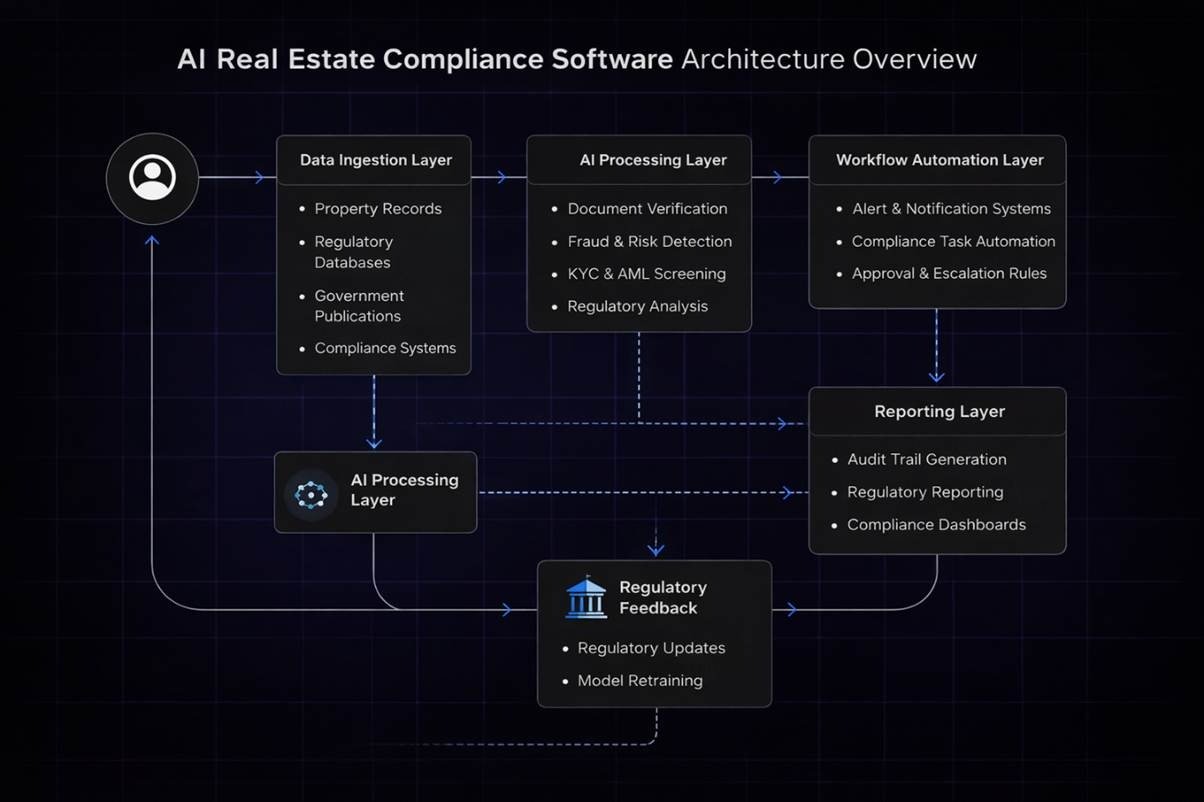
This architecture enables real estate businesses to shift from manual, error-prone compliance processes to scalable, automated systems that operate continuously and adapt as regulations evolve.
In simple terms, AI real estate compliance software turns complex regulatory processes into automated, accurate, and scalable workflows for modern property businesses.
Real estate businesses operating across multiple regions are increasingly asking a practical question: how can AI real estate compliance software help reduce legal risks and automate regulatory processes across multiple regions? The answer lies in the growing gap between regulatory complexity and the limitations of manual compliance systems.
That's why investing in AI real estate compliance softwares is becoming a strategic move for companies dealing with high transaction volumes, multi-jurisdiction regulations, and strict compliance requirements. This shift is not driven by convenience but by necessity, as traditional systems struggle to keep up with real-world demands.
Here are the key reasons why businesses are actively investing in AI-powered compliance solutions.
Zoning laws, AML policies, data privacy regulations, and local compliance rules change frequently across regions. Businesses that invest in intelligent real estate regulatory software gain the ability to track and interpret these changes continuously, instead of relying on delayed manual updates.
Compliance failures can result in fines, blocked transactions, and long-term reputational damage. Companies are investing in AI-driven systems to identify compliance gaps early and maintain consistent regulatory adherence across all operations.
Manual processes depend heavily on human review, which becomes inefficient as transaction volumes grow. This limitation is pushing organizations to make automated real estate compliance solutions that can handle large-scale operations without slowing down business workflows.
Managing compliance across different states or countries requires consistent application of rules. Businesses are investing in centralized AI systems that standardize compliance processes while adapting to regional variations.
Real estate firms working with institutional investors, lenders, and enterprise clients are expected to demonstrate strong compliance infrastructure. Investing in custom AI compliance software helps meet these expectations and supports smoother transaction processes.
These factors explain why companies across real estate, PropTech, and property management are prioritizing investment in AI real estate compliance software development to handle regulatory complexity, reduce legal exposure, and automate compliance operations at scale.
What do real estate businesses actually gain by adopting AI-driven compliance systems? The impact goes far beyond basic automation. AI real estate compliance softwares bring consistency, speed, and intelligence to compliance operations that are otherwise fragmented and difficult to manage at scale.
For property management firms, developers, and enterprise real estate companies, AI real estate compliance software development enables a shift from reactive compliance handling to structured, system-driven processes that improve accuracy, reduce risk, and support multi-region operations.
Here are the six key benefits explained in detail.
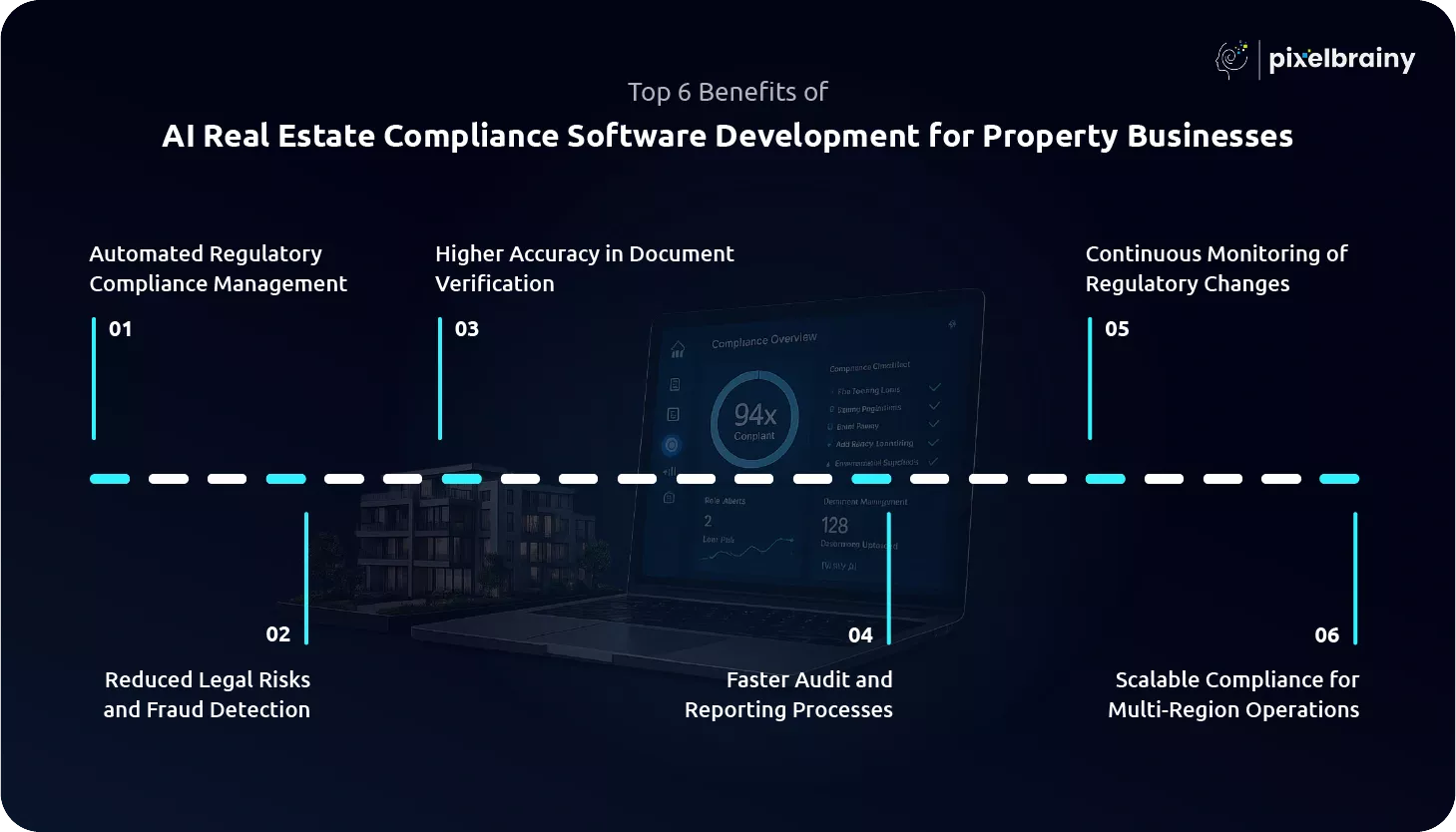
Managing regulatory requirements manually often leads to missed updates and inconsistent execution. AI-driven systems continuously monitor regulatory changes and automatically align workflows with the latest requirements across jurisdictions.
Key advantages:
Compliance risks often arise from unnoticed irregularities in transactions or documents. AI models analyze large volumes of data to identify patterns and flag risks before they lead to legal issues or financial loss.
Key advantages:
Manual document review is time-consuming and prone to errors, especially when dealing with large transaction volumes. AI improves accuracy by extracting and validating data with precision across multiple document types.
Key advantages:
Preparing compliance reports manually can take days or even weeks. AI streamlines this process by generating structured, audit-ready reports directly from system data.
Key advantages:
Regulations evolve frequently, and missing even a minor update can create compliance gaps. AI systems track regulatory sources continuously and apply relevant changes to workflows without delay.
Key advantages:
As real estate businesses expand into new markets, managing compliance across regions becomes more complex. AI systems provide a scalable framework that adapts to different regulatory environments without increasing operational burden.
Key advantages:
From these above benefits, it becomes clear that AI real estate compliance software enables businesses to maintain consistent compliance, improve operational efficiency, and manage regulatory complexity across growing property portfolios with greater control and confidence.
Real estate businesses often struggle with fragmented compliance processes spread across documents, regulations, and multiple jurisdictions. As portfolios grow and transactions increase, teams begin to look for practical ways to streamline compliance without increasing manual workload. This is where companies start exploring how to build AI solutions for real estate legal compliance that solve specific operational challenges.
In many cases, decision-makers ask a broader question during this transition: how can we develop smart compliance solutions for property businesses that handle document verification, zoning regulations, audits, and multi-region compliance within one system? The answer becomes clearer when we look at real-world applications where AI is already delivering measurable results.
Below are the top use cases of AI real estate compliance software that show how businesses are solving real compliance problems.
One of the most common use cases is automating the verification of property-related documents such as title deeds, ownership records, and compliance certificates. AI models use NLP and computer vision to extract data, validate it against regulatory databases, and flag inconsistencies instantly.
This reduces dependency on manual verification, which is often slow and error-prone, especially when handling high transaction volumes.
Example: A commercial property firm processing hundreds of transactions annually reduced document verification time by 78% and removed recurring compliance errors within six months of adopting AI.
Fraud detection is another critical area where companies develop smart compliance solutions for property businesses. AI systems analyze transaction behavior, financial records, and document metadata to identify unusual patterns that may indicate fraud.
Unlike manual checks, AI can process large datasets in real time and detect subtle anomalies that are often missed.
Example: A PropTech platform implementing AI-based fraud detection reduced fraudulent transactions reaching final stages by 65%, improving both compliance and transaction security.
Keeping track of zoning laws and land-use regulations across different regions is a major challenge. AI platforms continuously monitor regulatory databases and automatically compare property data with current requirements.
This ensures that any compliance issue is identified before it impacts development or transactions.
Example: A real estate developer managing multiple projects reduced zoning-related violations by 82% within a year by using AI-driven monitoring tools.
Audit preparation is traditionally time-intensive and requires compiling data from multiple sources. AI simplifies this by generating structured, audit-ready reports directly from compliance data and transaction logs.
This not only saves time but also improves consistency and accuracy in reporting.
Example: An enterprise real estate company reduced audit preparation time from three weeks to just four days by automating reporting with AI.
Identity verification and financial screening are essential for compliance in property transactions. AI-powered systems automate KYC and AML checks by verifying identities, screening against global watchlists, and analyzing transaction flows.
This significantly reduces manual effort while improving detection accuracy.
Example: A property investment platform reduced screening time from several hours to minutes per transaction while increasing accuracy by 40%.
Reviewing lease agreements and contracts manually can lead to missed clauses or compliance gaps. AI systems extract key terms such as obligations, renewal dates, and compliance conditions, ensuring that all agreements meet regulatory standards.
This is particularly valuable for companies managing large lease portfolios.
Example: A property management firm analyzing over a thousand leases identified multiple non-compliant clauses that had previously gone unnoticed in manual reviews.
Companies operating across multiple locations often make automated real estate compliance solutions that centralize compliance management. AI-driven platforms apply jurisdiction-specific rules automatically while maintaining a unified system.
This eliminates inconsistencies and reduces operational complexity.
Example: A real estate enterprise managing assets across several states significantly reduced region-specific compliance errors within the first few months of adopting a centralized AI platform.
AI models can evaluate properties and transactions by assigning compliance risk scores based on historical data, document completeness, and regulatory factors. This helps businesses prioritize high-risk areas and make informed decisions.
Such systems are particularly useful during acquisitions and portfolio evaluations.
Example: A real estate investment firm reduced post-acquisition compliance costs by 35% by focusing due diligence efforts on high-risk properties identified through AI scoring.
These use cases clearly show how businesses are using AI to build structured, scalable compliance systems that address real-world challenges across transactions, documents, and multi-region regulatory environments.

When real estate businesses plan to build AI solutions for real estate legal compliance, one of the most critical decisions is defining the right feature set. The effectiveness of any compliance platform depends on how well its features align with real-world regulatory workflows, transaction processes, and multi-region requirements.
A well-designed system is not just a collection of tools. It is a connected framework where each feature contributes to accurate monitoring, faster decision-making, and consistent compliance execution. For companies aiming to develop intelligent real estate regulatory software, these core features form the foundation of a scalable and reliable compliance platform.
Below are the essential features every AI real estate compliance system should include.
| Feature | Description |
|---|---|
| AI Document Verification Engine | Uses NLP and computer vision to extract key data from property documents such as title deeds and contracts. It validates this data against regulatory databases to identify errors, missing information, or inconsistencies. This significantly reduces manual review time and improves document accuracy. |
| Regulatory Rule Engine | Encodes compliance rules based on jurisdiction, property type, and transaction category. It automatically updates when regulations change, ensuring workflows remain aligned with current legal requirements. This helps businesses maintain consistent compliance across regions. |
| KYC and AML Screening Module | Verifies identities of buyers, sellers, and investors while screening them against global sanctions and watchlists. It also detects suspicious financial patterns and supports automated regulatory reporting. This strengthens transaction security and compliance. |
| Fraud Detection System | Applies machine learning models to analyze transaction behavior, document metadata, and financial signals. It identifies unusual patterns that may indicate fraud or compliance violations. Early detection helps prevent financial loss and legal issues. |
| Zoning and Land-Use Compliance Monitor | Continuously monitors zoning regulations and land-use laws across regions. It compares property data with current requirements and flags violations before development or transactions proceed. This reduces the risk of regulatory conflicts. |
| Audit Trail and Reporting Engine | Records every compliance action with timestamps to create a complete audit trail. It generates structured reports for regulatory filings, internal audits, and stakeholder reviews. This improves transparency and simplifies audit preparation. |
| Multi-Region Compliance Dashboard | Provides a centralized view of compliance status across all jurisdictions and properties. Users can monitor performance, identify risks, and access detailed insights through a single interface. This improves decision-making and operational control. |
| Contract and Lease Compliance Analyzer | Uses NLP to analyze lease agreements and contracts by extracting obligations, clauses, and key dates. It identifies non-standard or non-compliant terms and alerts relevant teams. This ensures agreements meet regulatory standards. |
| Risk Scoring Engine | Generates dynamic risk scores for properties and transactions based on compliance history and regulatory factors. It helps prioritize high-risk cases and supports better decision-making during transactions and audits. |
| Regulatory Change Monitoring | Tracks updates from legal databases, government sources, and regulatory publications. It classifies changes based on impact and automatically updates compliance workflows. This ensures businesses stay aligned with evolving regulations. |
| Workflow Automation Engine | Automates task assignment, approvals, and escalations based on predefined compliance rules and risk levels. It reduces manual intervention and ensures timely execution of compliance activities. |
| Role-Based Access Controls | Defines user roles and permissions to control access to sensitive compliance data. It also maintains detailed logs of user actions for accountability and security. This helps meet data protection and audit requirements. |
| Integration API Layer | Connects the compliance platform with external systems such as MLS platforms, CRM tools, and regulatory databases. It enables seamless data exchange and ensures all systems work together efficiently. |
| Push Notifications and Alerts | Sends real-time alerts for compliance events, regulatory updates, and approaching deadlines. It ensures that stakeholders can take immediate action when required, reducing the risk of missed compliance tasks. |
Together, these features create a well-structured compliance ecosystem that enables real estate businesses to manage regulatory requirements efficiently, improve accuracy, and support scalable operations across multiple regions.
As real estate businesses move beyond basic automation, the focus shifts toward building smarter, more adaptive systems. These advanced capabilities represent the next stage of innovation for companies looking to build AI solutions for real estate legal compliance that can scale, evolve with regulations, and handle complex compliance scenarios with minimal manual intervention.
For organizations aiming to develop intelligent real estate regulatory software, these capabilities enhance decision-making, improve transparency, and future-proof compliance platforms in dynamic regulatory environments.
| Advanced Capability | What It Does | Value Impact |
|---|---|---|
| Generative AI for Compliance Documentation | Uses large language models to automatically generate compliance reports, regulatory filings, and due diligence summaries based on system data. It reduces manual drafting efforts and ensures consistency across documents. | Reduces documentation time significantly and allows compliance teams to focus on critical review tasks instead of repetitive writing. |
| Explainable AI for Regulatory Decisions | Provides clear, traceable explanations for every AI-driven decision, including risk scores and fraud alerts. It shows which rules and data points influenced the outcome. | Improves trust in AI systems and ensures compliance decisions meet regulatory transparency requirements. |
| Predictive Compliance Risk Modeling | Analyzes historical data, transaction patterns, and regulatory trends to predict potential compliance risks before they occur. It helps identify vulnerabilities early. | Enables proactive compliance management and reduces the likelihood of future violations or penalties. |
| Computer Vision for Physical Property Compliance | Processes property images and inspection data to detect issues such as zoning violations, structural risks, or safety concerns. It automates visual compliance checks. | Reduces the need for manual inspections and supports remote compliance monitoring at scale. |
| Blockchain for Immutable Compliance Records | Stores compliance events and audit trails on a distributed ledger to ensure data cannot be altered or tampered with. It provides a secure and verifiable record of all activities. | Enhances audit reliability and simplifies regulatory reviews by providing tamper-proof evidence. |
| Agentic AI for Multi-Step Compliance Workflows | Uses autonomous AI agents to execute complex workflows such as onboarding, compliance checks, and reporting without constant human intervention. It coordinates multiple steps seamlessly. | Eliminates workflow delays and improves efficiency in high-volume compliance operations. |
| Natural Language Regulatory Search | Allows users to search and understand regulatory requirements using simple, conversational queries instead of complex database filters. It simplifies access to compliance information. | Reduces time spent searching for regulations and improves productivity for compliance teams. |
| Multi-Language Compliance Processing | Uses multilingual NLP models to process and analyze compliance documents in different languages. It ensures accurate interpretation across global markets. | Supports international operations and ensures consistent compliance across diverse regulatory environments. |
Together, these advanced capabilities enhance the intelligence, adaptability, and reliability of AI real estate compliance software, enabling businesses to handle complex regulatory environments with greater efficiency and confidence.
Real estate businesses planning to build compliance platforms often begin with a fundamental question: how to create automated compliance solutions for property management that are accurate, scalable, and aligned with changing regulations?
The answer lies in following a structured development approach that combines compliance expertise, AI model design, and scalable system architecture. Without a clear process, platforms may deliver inconsistent results, fail regulatory checks, or require constant rework as laws evolve. A step-by-step approach ensures that the platform is not only technically sound but also aligned with real-world compliance workflows.
Below is a practical framework followed by leading teams and several of the top AI real estate software development companies to build reliable AI-driven compliance systems.
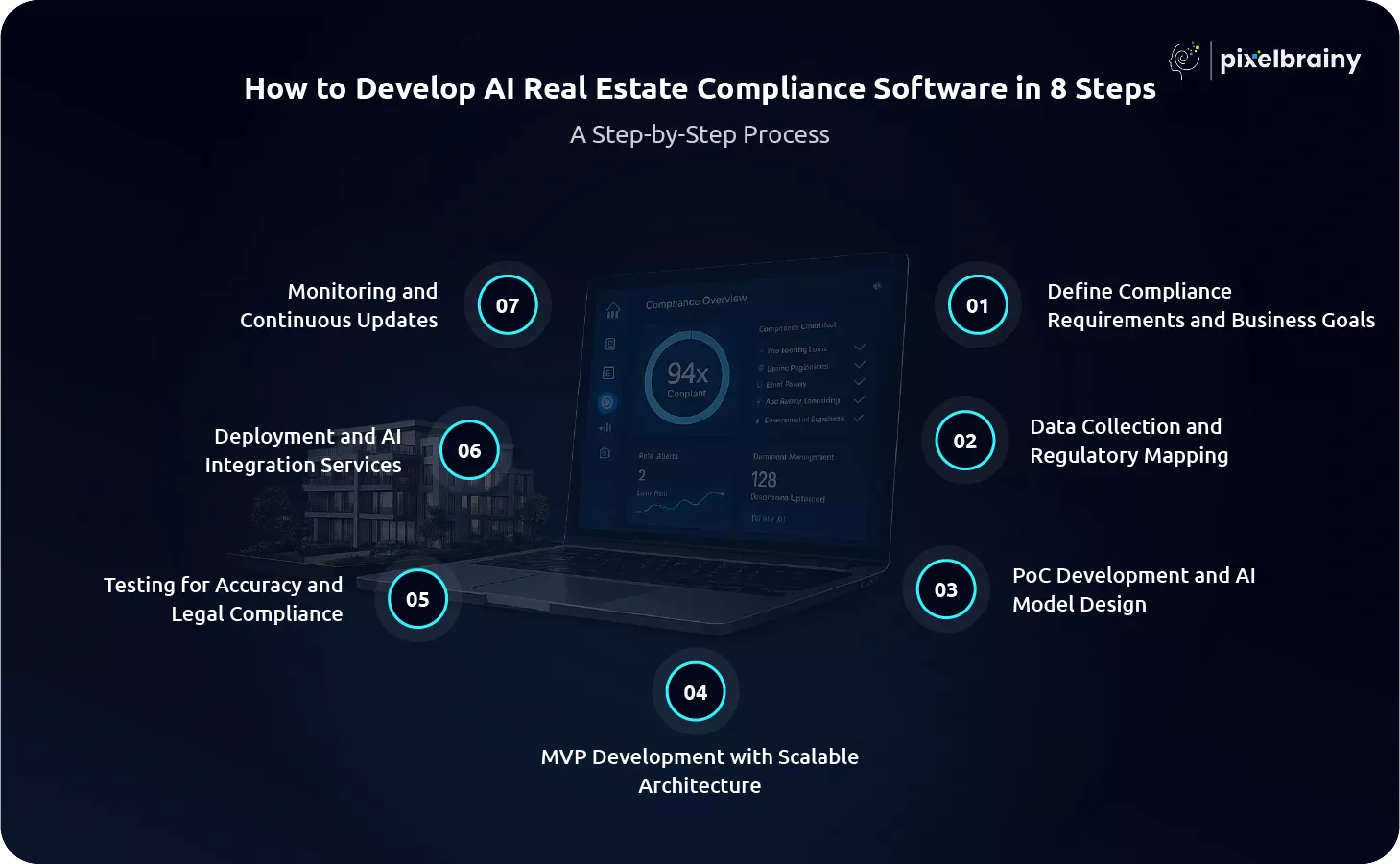
This is the most critical stage, where the entire direction of the platform is defined. Businesses must clearly outline what compliance challenges they are solving, which regulations apply, and how success will be measured.
Skipping this step often leads to systems that work technically but fail to meet actual compliance needs.
Focus on:
AI models depend heavily on data quality. This step ensures that all compliance-related data is collected, structured, and mapped correctly to support accurate model training and decision-making.
Incomplete or outdated data at this stage can compromise the entire system.
Focus on:
Before building a full system, teams typically create a PoC development version to test feasibility and validate core AI capabilities. This helps reduce risk and ensures the approach works in real scenarios.
It is also the stage where AI models are designed and refined for specific compliance tasks.
Focus on:
After validating the concept, businesses move to MVP development, where a working version of the platform is built with essential features and scalable architecture.
This stage focuses on usability, integration, and performance.
Focus on:
Also Read: Top 10 AI MVP Development Companies in USA
Thorough testing is required to ensure the platform produces accurate and legally acceptable outputs. This step validates both the technical performance and regulatory reliability of the system.
It helps identify gaps before the platform is exposed to real transactions.
Focus on:
Once validated, the platform is deployed and integrated with existing business systems. This includes connecting with property management tools, CRM platforms, and regulatory data sources.
Proper integration ensures that compliance workflows operate seamlessly within daily operations.
Focus on:
Compliance systems require continuous monitoring to remain effective. Regulations change frequently, and AI models must be updated to reflect new requirements and maintain accuracy.
This step ensures long-term system performance and reliability.
Focus on:
By following this structured process, businesses can build AI-powered compliance systems that are accurate, adaptable, and capable of handling complex regulatory environments while supporting long-term operational growth.
One of the most common questions real estate businesses ask before starting development is: how much does it actually cost to build a reliable AI-driven compliance system?
The cost of developing AI real estate compliance softwares can vary widely based on the scope, complexity, and scale of the platform. On average, development costs range from $30,000 to $200,000 or more, depending on the number of compliance workflows, jurisdictions covered, and the level of AI capabilities required.
A clear way to understand this is by breaking it down into development tiers.
| Development Tier | Cost Range | What It Includes |
|---|---|---|
| Basic AI Real Estate Compliance MVP | $30,000 to $70,000 | A focused MVP designed for a single jurisdiction and limited compliance workflows. Typically includes document verification, a basic regulatory rule engine, compliance dashboard, alert system, and audit reporting. Suitable for startups and small property businesses testing compliance automation. |
| Mid-Level AI Compliance Platform | $70,000 to $130,000 | A more advanced platform supporting multiple workflows and regions. Includes KYC and AML screening, fraud detection, zoning compliance monitoring, contract analysis, and multi-region tracking. Ideal for growing real estate firms and mid-sized enterprises. |
| Advanced Enterprise AI Compliance Platform | $130,000 to $200,000+ | A full-scale system with advanced AI capabilities such as generative documentation, predictive risk modeling, explainable AI, blockchain-based audit trails, and multi-language support. Designed for enterprise-level real estate companies operating across multiple jurisdictions. |
The final cost depends on several critical variables that directly impact development effort and system complexity.
Beyond initial development, maintaining and scaling the platform also involves ongoing investment.
Overall, the cost of building AI real estate compliance software depends on how advanced, scalable, and region-specific the solution needs to be, making it essential to align development scope with business goals and compliance requirements from the start.

Also Read: AI Real Estate Software Development Cost: Factors, Tiers, and Estimates
Building a robust compliance platform requires more than just AI models. It involves selecting the right combination of technologies that work together to support data processing, automation, integrations, and user experience.
For businesses planning to develop intelligent real estate regulatory software, choosing the right tech stack is critical to ensure scalability, accuracy, and long-term performance. Each layer of the system, from AI processing to frontend dashboards, must be supported by reliable and well-integrated technologies.
Below is a structured overview of the core technologies used to build modern AI real estate compliance softwares.
| Category | Tools and Technologies | Explanation |
|---|---|---|
| Programming Languages | Python, TypeScript, Node.js, Swift, Kotlin | Python is widely used for AI model development and data processing. TypeScript and Node.js support backend services and workflow automation. Swift and Kotlin are used for building mobile applications for compliance management. |
| AI and Machine Learning | TensorFlow, PyTorch, scikit-learn, XGBoost | These frameworks are used to develop models for document verification, fraud detection, risk scoring, and compliance monitoring. They enable systems to learn from data and improve over time. |
| Natural Language Processing | OpenAI GPT Models, Anthropic Claude, spaCy, Hugging Face | NLP tools help process legal documents, extract key information from contracts, generate compliance reports, and support natural language search for regulations. |
| Computer Vision | Google Vision AI, AWS Rekognition, Tesseract OCR | These technologies enable document scanning, image-based compliance checks, and extraction of text from physical documents. They are essential for verifying property-related documents and visual data. |
| Databases and Storage | PostgreSQL, MongoDB, Redis, Amazon S3, Snowflake | PostgreSQL manages structured data, while MongoDB handles flexible regulatory schemas. Redis supports fast data access, and Snowflake enables large-scale analytics. Cloud storage like S3 is used for document storage. |
| Regulatory Data Integrations | Zoning APIs, government databases, LexisNexis, Wolters Kluwer | These integrations provide access to real-time regulatory data, including zoning laws, legal frameworks, and compliance requirements across regions. |
| KYC and AML APIs | Jumio, Onfido, Refinitiv World-Check, ComplyAdvantage | These APIs enable identity verification, sanctions screening, and AML risk assessment directly within compliance workflows. |
| Verification APIs | Plaid, Stripe Identity, Persona | Used for financial verification, identity validation, and onboarding processes. These tools help ensure accurate and secure user verification. |
| Blockchain | Ethereum, Hyperledger Fabric, Polygon | Blockchain technologies are used to create immutable audit trails and secure compliance records that cannot be altered, ensuring transparency and trust. |
| Cloud Infrastructure | AWS, Google Cloud Platform, Microsoft Azure | These platforms provide scalable infrastructure for hosting applications, running AI models, and managing large volumes of compliance data securely. |
| DevOps and CI/CD | GitHub Actions, Docker, Kubernetes, Terraform | These tools support automated deployment, containerization, and infrastructure management, ensuring consistent and efficient system operations. |
| Frontend Frameworks | React, Next.js, Tailwind CSS | Used to build responsive dashboards and user interfaces that allow compliance teams to monitor, manage, and act on compliance data easily and efficiently. |
| Push Notifications and Alerts | Firebase Cloud Messaging, Twilio, OneSignal | Enable real-time communication by sending alerts for compliance issues, regulatory updates, and important deadlines to relevant users. |
Selecting the right combination of these technologies ensures that AI real estate compliance software is scalable, secure, and capable of handling complex regulatory requirements while delivering a seamless user experience for real estate businesses.
Building a compliance platform for real estate is not just about adding AI capabilities. It requires a disciplined approach to data, architecture, security, and usability. Businesses that successfully build AI solutions for real estate legal compliance follow proven best practices that ensure their systems remain accurate, scalable, and aligned with regulatory expectations.
Ignoring these practices often leads to unreliable outputs, compliance gaps, and systems that fail under real-world regulatory scrutiny. The following best practices help ensure long-term success when developing AI real estate compliance softwares.
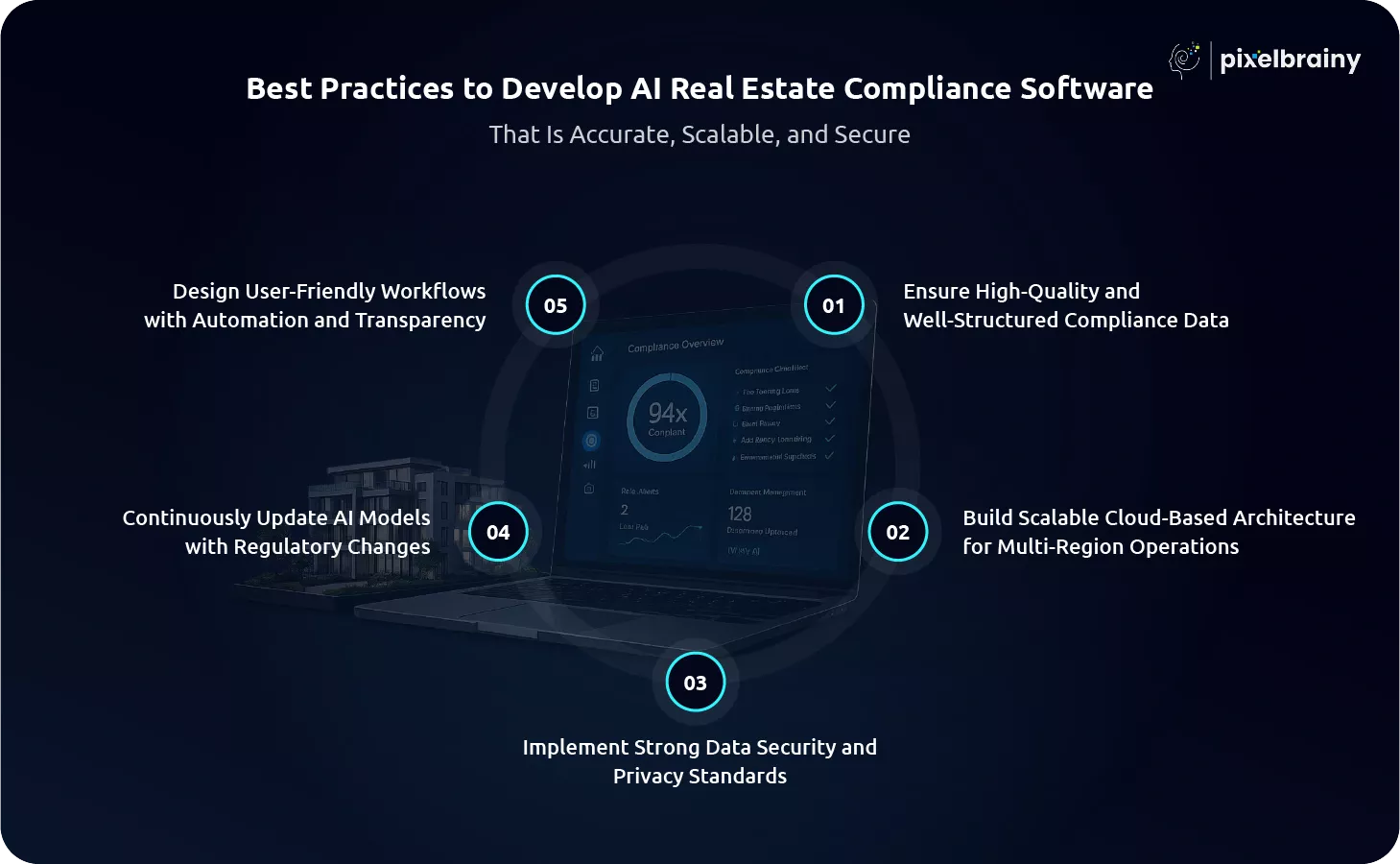
The accuracy of any AI system depends directly on the quality of the data it is trained on. Poor or outdated data leads to incorrect compliance decisions and increased risk.
To avoid this, businesses should work with trusted regulatory data sources, validate datasets against current legal standards, and maintain continuous data update pipelines. Structured and well-mapped data ensures that AI models can interpret regulations correctly and deliver reliable outputs.
Real estate compliance systems must handle growing data volumes and multiple jurisdictions. A scalable architecture allows the platform to expand without performance issues or major redesign.
This involves designing multi-tenant systems, enabling horizontal scaling, and creating flexible rule engines that support region-specific compliance requirements. The goal is to onboard new markets through configuration rather than rebuilding the system.
Compliance platforms deal with sensitive legal and financial data, making security a critical requirement from the start.
Businesses should implement end-to-end encryption, role-based access controls, detailed audit logs, and data residency policies aligned with regulations such as GDPR and CCPA. Strong security measures not only protect data but also build trust with stakeholders and regulators.
Regulations are constantly evolving, and AI models must adapt to stay accurate. Without regular updates, compliance systems can quickly become outdated and unreliable.
To address this, businesses should implement automated regulatory monitoring and retraining pipelines. This ensures that the system continuously learns from new data and maintains alignment with current laws.
Even the most advanced compliance system will fail if users cannot interact with it effectively. Interfaces should be intuitive, with clear workflows that allow compliance teams to act quickly.
This includes providing real-time insights, simplifying exception handling, and offering full audit trail visibility. When users can easily understand and trust AI outputs, adoption and efficiency improve significantly.
By following these best practices, real estate businesses can develop compliance systems that deliver consistent accuracy, support multi-region operations, and maintain security and reliability as regulatory environments continue to evolve.
Real estate businesses exploring compliance solutions often face a critical decision: should you build, buy, or outsource AI real estate compliance software development?
The right choice depends on several factors such as regulatory complexity, internal technical expertise, time constraints, and the need for customization. Each approach has its own advantages and limitations, and selecting the wrong one can lead to delays, higher costs, or systems that do not meet compliance requirements.
Below is a clear comparison to help businesses make an informed decision.
| Approach | What It Means | Best For | Advantages | Limitations |
|---|---|---|---|---|
| Build In-House | Developing the entire AI compliance platform using your internal engineering and compliance teams. | Large enterprises with strong AI capabilities and long-term product strategy. | Full control over data, compliance logic, and system evolution. Ability to customize every aspect of the platform. | Requires significant time and investment. Development can take 12 to 18 months or more. High dependency on internal expertise. |
| Buy Off-the-Shelf | Purchasing a ready-made compliance software solution with predefined features and workflows. | Businesses with simple, single-region compliance requirements. | Quick deployment and lower upfront effort. Suitable for standard compliance needs. | Limited customization. May not support complex workflows or multi-region regulations. Difficult to adapt to specific business requirements. |
| Outsource to a Specialist Partner | Partnering with an experienced development company to design and build a custom AI compliance solution. | Real estate firms, PropTech startups, and enterprises needing tailored compliance systems. | Faster time to market. Access to domain expertise and advanced AI capabilities. Custom-built solution aligned with regulatory requirements. | Requires selecting the right partner. Ongoing collaboration is needed for updates and maintenance. |
Many businesses evaluating these options often ask: which approach is best for building AI real estate compliance software that can handle multi-region regulations and complex workflows without long development delays?
For most real estate companies, outsourcing to a specialized partner offers the best balance. It combines speed, customization, and compliance expertise while allowing businesses to gradually build internal capabilities for long-term ownership.
That's why choosing the right approach depends on your business goals, regulatory complexity, and available resources, but aligning your decision with long-term scalability and compliance accuracy is essential for success.
The success of any AI compliance platform depends heavily on the capabilities of the development partner behind it. A well-qualified partner ensures the system aligns with real estate regulations, integrates smoothly with existing tools, and continues to perform accurately as compliance requirements evolve over time.
For real estate businesses planning to build AI solutions for real estate legal compliance, evaluating the right partner requires a careful review of technical expertise, industry knowledge, and long-term support capabilities.
Here are the key factors to consider.
A development partner must have a clear understanding of real estate regulations, including zoning laws, KYC and AML requirements, and document verification processes. General AI expertise is not enough in this space.
Review past projects and case studies related to real estate or RegTech. This helps confirm that the partner can translate regulatory requirements into functional compliance systems.
In compliance-driven environments, AI decisions must be transparent and auditable. It is important to ensure that the partner builds models that not only deliver accurate results but also provide clear reasoning behind each decision.
This includes the ability to explain risk scores, fraud alerts, and compliance outcomes in a way that satisfies regulatory reviews and builds user trust.
Handling sensitive legal and financial data requires strong security practices. The development partner should have experience building systems that meet industry standards such as SOC 2, GDPR, and CCPA.
Look for expertise in data encryption, access controls, audit logging, and secure data storage to ensure the platform meets all necessary compliance requirements.
A compliance platform must work seamlessly with existing tools such as MLS systems, property management software, and CRM platforms. Integration challenges can significantly impact system performance and usability.
Assess the partner's experience with API development and third-party integrations to ensure smooth connectivity across all systems.
AI compliance software requires ongoing updates to remain effective as regulations change. A reliable partner should offer continuous support, including model retraining, system updates, and performance monitoring.
This ensures the platform remains accurate and aligned with evolving compliance requirements rather than becoming outdated over time.
A development partner with the right combination of domain expertise, technical capability, and long-term support can make the difference between a system that simply functions and one that delivers reliable, scalable compliance performance in real-world environments.
AI-driven compliance systems in real estate operate within complex regulatory environments, large data ecosystems, and high-stakes decision workflows. These conditions introduce specific challenges that must be addressed early to ensure accuracy, reliability, and long-term performance.
For businesses aiming to develop smart compliance solutions for property businesses, understanding these challenges helps avoid costly issues after deployment and ensures smoother system adoption.
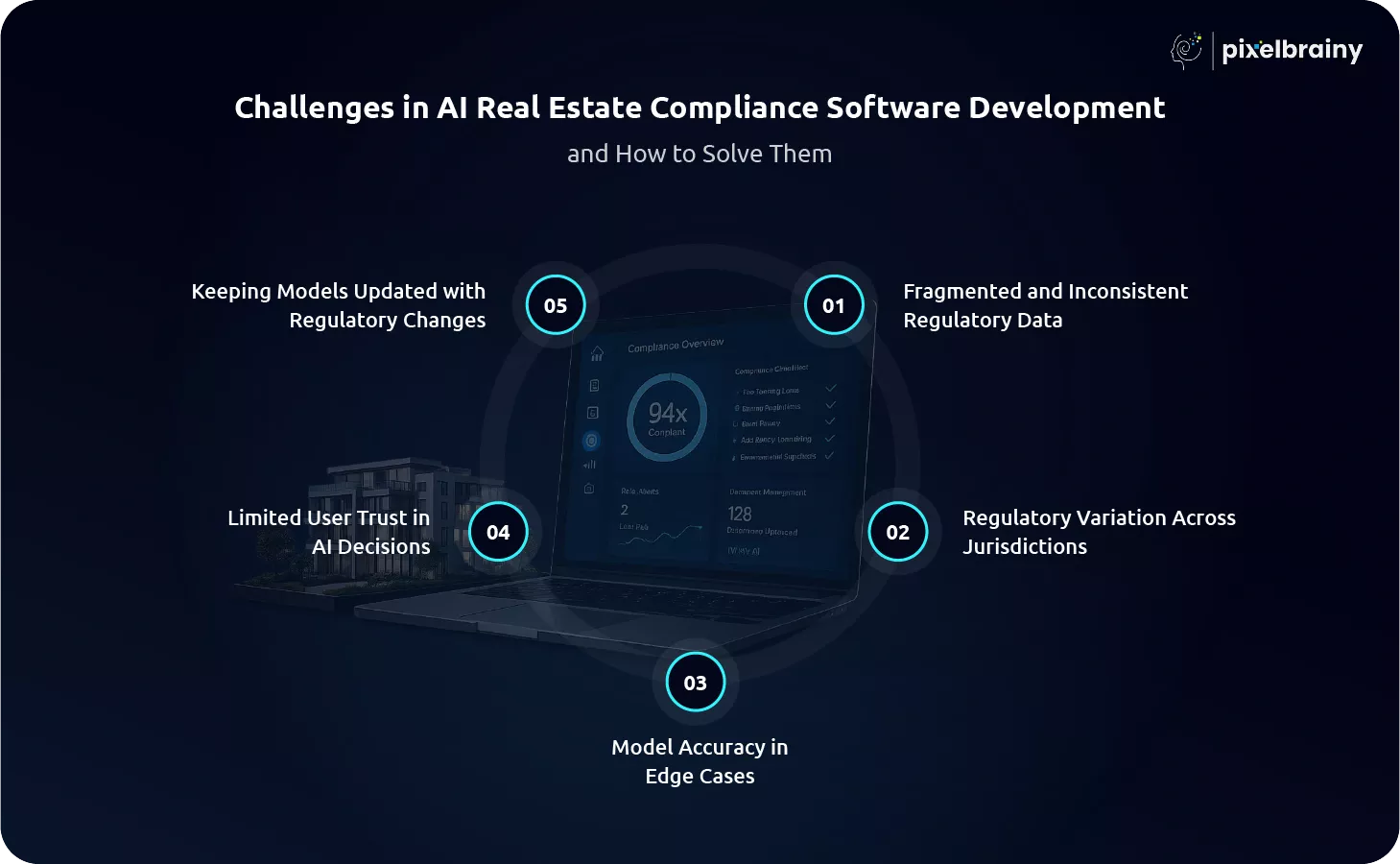
Compliance data comes from multiple sources such as government databases, MLS systems, and legal repositories, each with different formats and update cycles. This inconsistency can reduce model accuracy and create gaps in compliance validation.
Solution: Implement a centralized data aggregation layer that standardizes inputs before they reach AI models. Use reliable third-party providers for KYC, AML, and zoning data to improve consistency and accuracy.
Regulations vary across states, countries, and property types, making it difficult for a single system to handle all requirements effectively.
Solution: Use jurisdiction-specific rule engines and modular compliance frameworks. This allows the platform to adapt to regional requirements without major system changes.
AI models may struggle with uncommon scenarios, unusual document formats, or newly introduced regulations that were not part of the training data.
Solution: Introduce human review workflows for low-confidence outputs and continuously refine models using real-world edge cases to improve accuracy over time.
Compliance teams often require clear reasoning before relying on AI-generated outputs, especially for critical decisions.
Solution: Provide explainable AI outputs with visible logic, supporting data, and confidence scores to improve transparency and user confidence.
Frequent regulatory updates can make AI models outdated if not maintained properly, leading to incorrect compliance results.
Solution: Set up automated regulatory monitoring and retraining pipelines to ensure models stay aligned with current laws and requirements.
Addressing these challenges early helps ensure that AI compliance systems remain accurate, adaptable, and reliable across evolving regulatory environments.
In AI development and real estate for the past 7 years, PixelBrainy LLC has been helping businesses design and deploy intelligent compliance platforms that are accurate, scalable, and aligned with real-world regulatory environments. As an experienced AI real estate software development company, the focus is on delivering solutions that go beyond basic automation and address complex compliance challenges across jurisdictions.
Real estate businesses often approach with a clear requirement: I need a dedicated team to create and maintain AI-based real estate compliance software. This reflects the growing demand for long-term, scalable, and reliable compliance systems rather than one-time development projects.
PixelBrainy builds platforms around actual regulatory requirements instead of generic frameworks. Every solution is designed with explainability, audit readiness, and compliance accuracy at its core.
The team works closely with domain experts and UI/UX specialists to ensure:
PixelBrainy provides complete AI development solutions for real estate compliance software, covering the entire lifecycle from planning to post-launch support.
Core capabilities include:
PixelBrainy developed a fully integrated AI compliance platform for a multi-state real estate organization managing both commercial and residential property portfolios. The solution combined document verification, fraud detection, KYC and AML screening, zoning compliance monitoring, and real-time risk scoring within a unified system.
Results achieved:
This implementation demonstrates how AI-driven compliance systems can streamline operations, improve accuracy, and ensure consistent regulatory adherence across multi-region real estate portfolios.
Get a quote for AI real estate compliance software development from PixelBrainy LLC and take the first step toward a compliance platform that protects your property business and scales with your portfolio.

From these above insights, it is clear that AI is transforming how real estate businesses manage compliance across transactions, documents, and multi-region regulations. Manual processes can no longer keep up with increasing regulatory complexity, while AI-driven systems provide accuracy, speed, and scalability.
From understanding core features and technologies to exploring real-world use cases and development steps, businesses now have a clear path to build reliable compliance infrastructure. Many organizations today express a common need: i am searching for a trusted partner to build and scale AI real estate compliance software. This reflects the shift toward long-term, intelligent compliance systems rather than short-term fixes.
Choosing the right approach and development partner plays a key role in achieving this transformation.
Schedule a call today to discuss your requirements and build a scalable AI real estate compliance solution tailored to your business.
For most businesses, outsourcing AI real estate compliance software development to a specialized partner is faster and more efficient. Building in-house requires strong AI expertise, regulatory knowledge, and data infrastructure. A hybrid model works well for enterprises that want long-term control after the initial build.
The timeline for AI real estate compliance software development depends on complexity. A basic MVP takes 10 to 14 weeks, mid-level platforms take 16 to 22 weeks, and enterprise systems with multi-region compliance can take 24 to 36 weeks.
Modern AI real estate compliance softwares use automated regulatory monitoring that tracks legal updates and triggers workflow changes and model retraining. This ensures continuous compliance without relying on manual updates.
The cost to develop intelligent real estate regulatory software ranges from $30,000 to $70,000 for MVPs, $70,000 to $130,000 for mid-level platforms, and $130,000 to $200,000+ for enterprise solutions with advanced AI capabilities.
Yes, startups can build AI solutions for real estate legal compliance by starting with a focused MVP such as document verification or KYC screening, then expanding into broader compliance workflows.
Yes, companies can make automated real estate compliance solutions that are fully customized to their regulatory environment, transaction workflows, and regional requirements, ensuring better alignment than off-the-shelf tools.

About The Author
Sagar Bhatnagar
Sagar Sahay Bhatnagar brings over a decade of IT industry experience to his role as Marketing Head at PixelBrainy. He's known for his knack in devising creative marketing strategies that boost brand visibility and market influence. Sagar's strategic thinking, coupled with his innovative vision and focus on results, sets him apart. His track record of successful campaigns proves his ability to utilize digital platforms effectively for impactful marketing efforts. With a genuine passion for both technology and marketing, Sagar continuously pushes PixelBrainy's marketing initiatives to greater success.

Working with the PixelBrainy team has been a highly positive experience. They understand the design requirements and create beautiful UX elements to meet the application needs. The dev team did an excellent job bringing my vision to life. We discussed usability and flow. Sagar worked with his team to design the database and begin coding. Working with Sagar was easy. He has the knowledge to create robust apps, including multi-language support, Google and Apple ID login options, Ad-enabled integrations, Stripe payment processing, and a Web Admin site for maintaining support data. I'm extremely satisfied with the services provided, the quality of the final product, and the professionalism of the entire process. I highly recommend them for Android and iOS Mobile Application Design and Development.

Great experience working with them. Had a lot of feedback and I found that unlike most contractors they were bugging me for updates instead of the other way around. They were extremely time conscience and great at communicating! All work was done extremely high quality and if not on time, early! They were always proactive when it comes to communication and the work is great/above par always. Very flexible and a great team to work with! Goes above and beyond to present us with multiple options and always provides quality. Amazing work per usual with Chitra. If you have UI/UX or branding design needs I recommend you go to them! Will likely work with them in the future as well, definitely recommended!

PixelBrainy is a joy to work with and is a great partner when thinking through branding, logo, and website layout. I appreciate that they spend time going into the "why" behind their decisions to help inform me and others about industry best practices and their expertise.

I hired them to design our software apps. Things I really like about them are excellent communication skills, they answer all project suggestions and collaborate right away, and their input on design and colors is amazing. This project was complex and needed patience and creativity. The team is amazing to do business with. I will be using them long-term. Glad to see there are some good people out there. I was afraid to try and outsource my project to someone but I am glad I met them! I really can't say enough. They went above and beyond on this project. I am very happy with everything they have done to make my business stand out from the competition.

It was great working with PixelBrainy and the team. They were very responsive and really owned the project. We'll definitely work with them again!

I recently worked with the PixelBrainy team on a project and I was blown away by their communication skills. They were prompt, clear, and articulate in all of our interactions. They listened and provided valuable feedback and suggestions to help make the project a success. They also kept me updated throughout the entire process, which made the experience stress-free and enjoyable.

PixelBrainy is very good at what it does. The team also presents themselves very professionally and takes care of their side of things very well. I could fully trust them taking up the design work in a timely and organised manner and their attention to detail saved us lots of effort and time. This particular project was quite intense and the team showed that they function very well under pressure. Very much looking forward to working with her again!

It's always an absolute pleasure working with them. They completed all of my requests quickly and followed every note I had for them to a T, which made our process go smoothly from start to finish. Everything was completed fast and following all of the guidelines. And I would recommend their services to anyone. If you need any design work done in the future, PixelBrainy should be your first call!

They took ownership of our requirements and designed and proposed multiple beautiful variants. The team is self-motivated, requires minimum supervision, committed to see-through designs with quality and delivering them on time. We would definitely love to work with PixelBrainy again when we have any requirements.

PixelBrainy was a big help with our SaaS application. We've been hard at work with a new UI/UX and they provided a lot of help with the designs. If you're looking for assistance with your website, software, or mobile application designs, PixelBrainy and the team is a great recommendation.

PixelBrainy designers are amazing. They are responsive, talented, and always willing to help craft the design until it matches your vision. I would recommend them and plan to continue them for my future projects and more!!!

They were awesome! Did a good job fast, and good communication. Will work with them again. Thank you

Creative, detail-oriented, and talented designers who take direction well and implement changes quickly and accurately. They consistently over-delivered for us.

PixelBrainy team is very talented and creative. Great designers and a pleasure to work with. PixelBrainy is an excellent communicator and I look forward to working with them again.

PixelBrainy has a very talented design team. Their work is excellent and they are very responsive. I enjoy working with them and hope to continue on all of our future projects.


Transform your ideas into reality with us.
Across these industries, each engagement brings unique challenges, from early-stage product development to scaling complex systems, helping us build a practical understanding of real-world product environments.