AI Summary Powered by PixelBrainy
What if your MLS could understand what a realtor means instead of making every professional search for properties like a database administrator?
For a regional MLS serving 8,000 realtor members, replacing a 14-year-old legacy platform is much more than an IT modernization project. It is a strategic business decision that can directly affect member satisfaction, listing accuracy, productivity, data governance, operational costs, and the long-term value of the MLS.
Consider this scenario: you are the executive director of a regional MLS, and your members consistently rate the existing system as the most frustrating tool in their daily workflow. Before presenting a platform replacement proposal to your board of directors, you need answers to three critical questions: What would a custom AI-powered MLS cost? Should the organization build its own platform or migrate to an established provider such as Bright MLS or CoreLogic Matrix? And which US-based real estate software development companies have the capabilities required to build a custom AI MLS for a mid-sized regional realtor association?
This is where AI real estate MLS software development becomes strategically important.
A modern MLS can combine structured property data with artificial intelligence, machine learning, natural language processing (NLP), semantic search, recommendation engines, predictive analytics, computer vision, and conversational AI. Instead of forcing realtor to enter dozens of filters, an AI-powered platform can interpret a request such as, "Find three-bedroom homes under $700,000 with a large backyard, two-car garage, good schools, and a short commute to downtown."
The broader real estate technology market also indicates substantial room for continued investment. Mordor Intelligence projects the global IT market in real estate to reach $12.56 billion in 2026 and $18.45 billion by 2031, representing a projected CAGR of 7.99%. North America is identified as the largest regional market.
For an organization considering whether to create AI real estate MLS software, the key question is therefore not simply "How much does development cost?" It is "Which technology strategy delivers the strongest combination of member experience, data control, compliance, scalability, integration flexibility, and five-year total cost of ownership?"
This guide explains how to build a smart AI real estate MLS software with NLP and natural language property search features, covering architecture, features, development stages, costs, technology stack, business models, compliance, challenges, and vendor selection.
AI real estate Multiple Listing Service (MLS) software is an intelligent property listing and data management platform that combines traditional MLS capabilities with artificial intelligence, machine learning, natural language processing, semantic search, recommendation engines, and predictive analytics.
Traditional MLS software operates primarily as a structured property database where realtors, brokers, MLS administrators, and real estate professionals can add, update, search, and share listing information. Property searches typically depend on predefined fields such as location, price, bedrooms, bathrooms, property type, square footage, and listing status.
AI-powered MLS software adds an intelligence layer to these core functions. Instead of relying entirely on multiple filters, users can interact with property data through natural language and conversational search.
For example, a realtor could enter:
“Find three-bedroom homes under $700,000 with a large backyard, two-car garage, home office, and convenient access to downtown.”
An AI-powered MLS platform can interpret the user's intent, identify relevant property attributes, evaluate available listings, and rank results according to the search requirements. Semantic search can also identify relevant properties based on context and meaning rather than depending only on exact keyword matches.
| Feature | Traditional MLS Software | AI-Powered MLS Software |
|---|---|---|
| Property Search | Users search listings through predefined filters such as price, location, bedrooms, property type, and listing status. | Users can combine filters with natural language and conversational searches based on specific property requirements. |
| Search Matching | Results generally depend on exact fields, keywords, and selected search criteria. | AI interprets search intent, context, and related property attributes to identify more relevant listings. |
| Property Recommendations | Recommendations are usually based on fixed criteria, saved searches, or basic matching rules. | AI analyzes preferences, property attributes, and user behavior to generate personalized property recommendations. |
| Listing Management | Realtors and MLS staff manually enter, update, review, and organize listing information. | AI can assist with listing descriptions, categorization, data enrichment, duplicate detection, and repetitive listing tasks. |
| Data Quality | Validation primarily depends on predefined rules and manual review. | AI can detect unusual values, missing information, duplicate records, inconsistent data, and potential listing errors for review. |
| Market Analysis | Users rely mainly on standard reports, statistics, and predefined market metrics. | AI can analyze large datasets, identify market patterns, generate summaries, and support predictive market analysis. |
| User Experience | Users interact mainly through forms, menus, dashboards, and filter-based interfaces. | Users can interact with MLS data through conversational search, AI assistants, personalized dashboards, and intelligent recommendations. |
| Property Ranking | Listings are sorted using predefined criteria such as price, date, or basic relevance. | AI can evaluate multiple signals and rank listings according to search intent and user preferences. |
| Content Summarization | Users manually review listing descriptions, property details, and market information. | AI can generate concise summaries of listings, property features, market data, and search results. |
| Workflow Automation | Administrative and data-related tasks often require manual handling or rule-based automation. | AI can automate or assist with repetitive workflows while maintaining business rules and human review. |
The underlying MLS database remains essential for maintaining structured property information. AI does not replace the MLS data foundation. Instead, it works as an intelligent layer that helps users search, understand, compare, summarize, rank, and analyze property information more efficiently.
For MLS organizations, realtor associations, brokerages, real estate software companies, and large property networks, AI MLS development can support smarter property discovery, personalized recommendations, automated listing workflows, improved data quality, conversational search, and data-driven decision-making.
AI real estate MLS software works by connecting authorized MLS data with artificial intelligence, machine learning, natural language processing, semantic search, recommendation engines, and automation technologies. The platform processes property information, understands user intent, matches relevant listings, generates insights, and supports real estate workflows through an integrated technology architecture.
The core architecture of an AI-powered MLS platform follows this flow:
MLS/API Integration → Data Processing → AI/ML Layer → Search & Matching → Recommendations → Analytics → User Interface
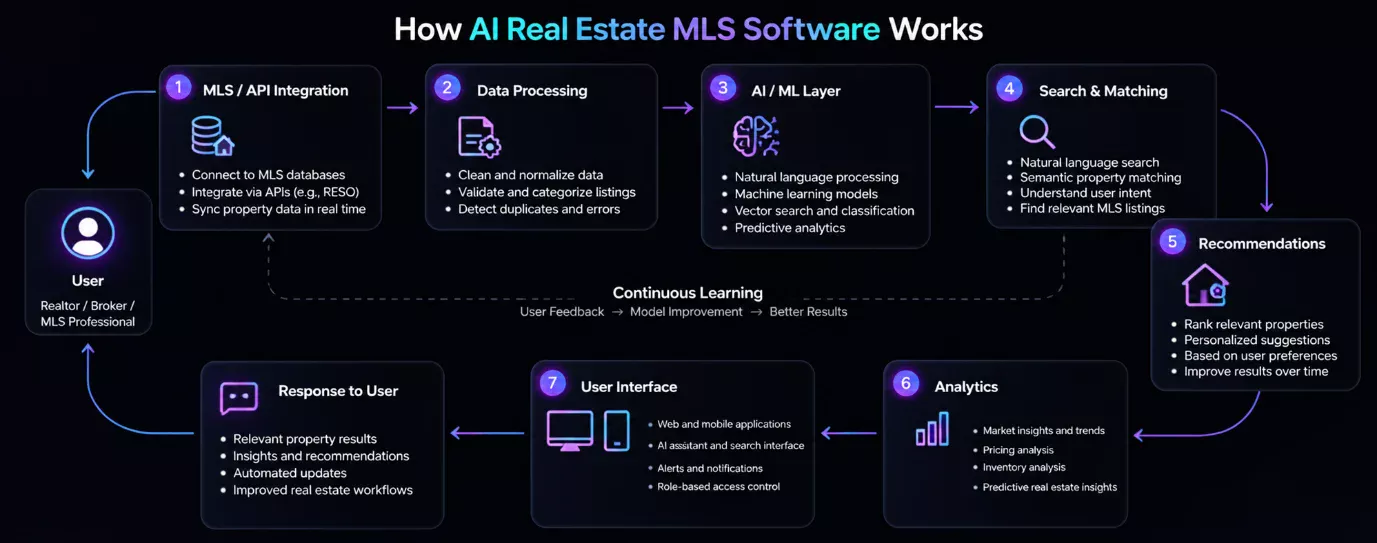
The first layer connects the AI real estate MLS software with authorized MLS databases and real estate data sources through APIs. Property information such as price, location, property type, listing status, features, images, and agent details can be synchronized with the platform.
The MLS data pipeline cleans, normalizes, categorizes, and validates incoming property records. Data processing can identify duplicate listings, missing fields, inconsistent property information, and unusual values before the data is used by AI models.
The AI and machine learning layer adds intelligence to the MLS data. Natural language processing, machine learning models, vector search, classification, and predictive analytics can be used for property search, listing analysis, recommendations, summarization, and data-quality assistance.
AI-powered search allows realtors and brokers to enter property requirements using natural language. For example, a user can search for:
“Find three-bedroom homes under $650,000 with a garage, backyard, and easy access to downtown.”
The system analyzes the query, identifies the user's search intent, and matches the requirements against available MLS property attributes.
The recommendation engine evaluates relevant property characteristics and approved matching signals to rank suitable listings. This helps realtors and brokers discover properties that align more closely with specific buyer requirements.
AI MLS analytics can process large volumes of property data to generate market insights, listing summaries, pricing patterns, inventory analysis, and predictive real estate insights. MLS administrators and brokerage teams can use these capabilities to support faster data analysis and decision-making.
The processed results are delivered through MLS dashboards, web applications, mobile apps, intelligent search interfaces, AI assistants, alerts, and personalized property experiences. Role-based access controls and business rules help ensure users receive information and functionality appropriate to their permissions.
This connected architecture allows MLS organizations, realtor associations, brokerages, and real estate software companies to develop smarter MLS platforms with intelligent property search, AI property matching, personalized recommendations, automated workflows, stronger data management, and actionable real estate analytics.
The investment in AI real estate MLS software development is being driven by measurable changes in real estate technology adoption, property search behavior, software market growth, and the increasing need for AI-ready MLS infrastructure. MLS organizations, realtor associations, brokerages, and PropTech companies are evaluating AI MLS platforms as part of their longer-term technology strategy.
A common question for real estate technology decision-makers is: “Why should a real estate business invest in AI MLS software development?”
The following market trends explain why AI-powered MLS development is becoming a strategic priority.
AI adoption among real estate professionals has reached a level that is influencing technology investment decisions. A February 2026 NAR report found that 92% of surveyed real estate professionals were using AI or planning to use it. The same research found that 71% identified time savings as AI's top value, while 63% identified output accuracy as their top concern.
For MLS businesses, this creates a stronger case for developing AI capabilities directly into the platform instead of relying entirely on disconnected third-party AI tools.
The way consumers research properties is also changing. In June 2026, NAR reported that 20% of prospective buyers and current homeowners surveyed had used AI tools or chatbots for homebuying research. Their use cases included affordability research, homebuying education, neighborhood research, market trends, and property values.
This trend gives MLS organizations a reason to prepare their listing data for AI-powered property search, conversational queries, semantic search, natural-language discovery, and AI-assisted information retrieval.
Investment in real estate technology is also supported by broader market growth. Grand View Research estimates that the global real estate software market will reach $14.3 billion in 2026 and grow to approximately $32.0 billion by 2033, representing a 12.2%
This expanding market creates an investment environment for MLS modernization, custom MLS software development, AI real estate platforms, intelligent property databases, and advanced real estate search systems.
AI adoption is also expanding across broader real estate operations. PwC's Emerging Trends in Real Estate: Europe 2026 reports that 75% of respondents were using AI or machine learning in real estate activities, compared with 51% the previous year. The research identifies applications ranging from data analysis to forecasting portfolio and market performance.
For MLS technology leaders, this signals a shift toward AI-ready infrastructure rather than isolated AI experiments. Development priorities increasingly include machine learning capabilities, semantic data processing, intelligent search, predictive models, and AI governance.
MLS platforms contain large volumes of structured and unstructured property information, including listing attributes, locations, pricing, descriptions, historical records, images, and other market data. As businesses introduce AI search and analytical systems, the underlying MLS architecture needs to support reliable data processing, normalization, access controls, APIs, and machine-readable information.
This is why AI MLS software development is increasingly being considered alongside MLS data modernization. The investment is not limited to adding an AI chatbot. It involves creating an architecture capable of supporting future AI use cases while maintaining appropriate data controls and integration standards.
AI adoption also introduces questions around data privacy, fair housing, copyrighted listing content, AI training data, and evolving state-level AI requirements. NAR's AI guidance highlights these areas as important considerations for real estate organizations implementing AI.
For this reason, organizations investing in custom AI MLS platforms can design AI workflows around their data policies, user permissions, governance requirements, and operational model.
The market signals are clear: AI adoption among real estate professionals is rising, consumers are beginning to use AI during property research, real estate software spending is expanding, and AI is moving into broader real estate operations. Together, these trends are pushing MLS organizations and real estate businesses to evaluate AI as part of their core technology roadmap.
For businesses planning AI real estate MLS software development in 2026 and beyond, the investment decision is therefore increasingly connected to data modernization, AI-ready architecture, intelligent property search, platform governance, and the future direction of real estate technology.
AI real estate MLS software can be classified into seven major types: regional MLS platforms for realtor associations, proprietary brokerage MLS platforms, commercial real estate MLS platforms, multi-source MLS data aggregation platforms, AI MLS compliance and quality control platforms, AI MLS analytics and market intelligence platforms, and luxury or niche property MLS platforms.
Each type serves a different real estate business model and therefore requires different data structures, AI capabilities, integrations, access controls, and scalability requirements.
What types of AI real estate MLS software can organizations build for property listing, search, data management, and market intelligence?
The answer depends on the organization's users, geographic coverage, property types, data sources, compliance requirements, and AI objectives. These factors should guide the platform architecture from the beginning of the AI real estate MLS software development process.
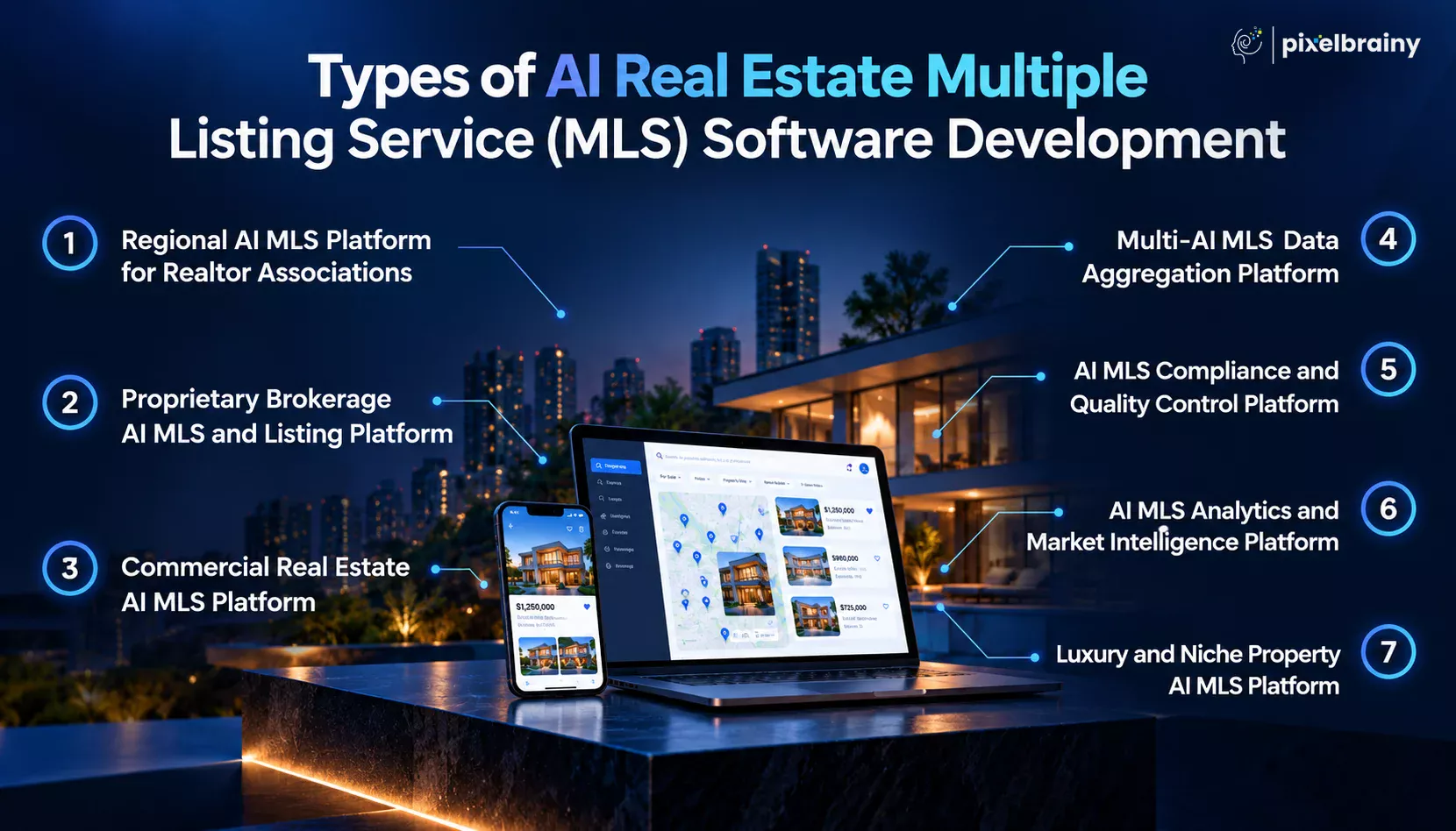
Regional realtor associations can build real estate AI MLS software designed to serve a defined geographic market and provide authorized real estate professionals with centralized property listings, intelligent search, data management, and collaboration tools. AI can support natural language property search, listing recommendations, automated data classification, duplicate detection, and market intelligence.
Key product design implication:
Because regional platforms can serve multiple brokerages and large numbers of realtors, the architecture should prioritize scalability, multi-organization support, role-based access, standardized listing fields, MLS data governance, API integrations, and configurable AI controls.
Large brokerages can develop proprietary AI MLS platforms around their internal listings, agents, leads, transactions, and business workflows. These systems can combine property search with CRM integrations, internal listing intelligence, agent dashboards, lead matching, and AI-assisted property recommendations.
Key product design implication:
The platform should support proprietary brokerage data, granular permissions, CRM integrations, private listing workflows, and customizable AI features. Data access should be structured so internal brokerage information remains appropriately separated from externally sourced MLS information.
Commercial real estate companies can develop specialized MLS platforms for office, retail, industrial, multifamily, land, and other commercial properties. These platforms can combine property listings with lease information, occupancy metrics, financial attributes, investment characteristics, location intelligence, and market indicators.
Key product design implication:
Commercial platforms need a specialized property data model that supports financial metrics, lease details, geographic information, documents, and investment analytics. AI search and matching should understand commercial property requirements rather than relying mainly on residential attributes.
Organizations working with multiple MLS databases, brokerages, listing feeds, and approved external sources can build AI real estate multi listing services platform around centralized data aggregation. AI can normalize different data structures, classify property information, resolve duplicate records, identify anomalies, and improve search across multiple property data sources.
Key product design implication:
These platforms require strong API orchestration, data normalization, entity resolution, synchronization, duplicate detection, source attribution, and scalable data pipelines. Data provenance should be maintained so organizations can understand where property information originated and how it was processed.
MLS organizations and real estate technology providers can develop AI-powered platforms focused on listing accuracy, data quality, policy enforcement, and content validation. AI can identify missing fields, inconsistent values, duplicate listings, unusual data patterns, and potentially problematic listing content for authorized personnel to review.
Key product design implication:
The platform should combine AI detection with configurable rules, human review workflows, audit trails, alerts, and explainable outputs. This allows AI to assist with quality control while authorized professionals maintain oversight of compliance-related decisions.
Brokerages, MLS organizations, investors, and PropTech companies can develop AI MLS analytics platforms that convert large property datasets into market intelligence. These systems can analyze inventory, pricing patterns, property segments, market trends, and other approved datasets while allowing users to interact with information through natural language queries.
Key product design implication:
The system should use scalable data warehouses or lakehouses, analytics pipelines, predictive models, visualization dashboards, natural language interfaces, and role-based access. This architecture is particularly suitable for organizations that need market intelligence alongside conventional MLS search capabilities.
Luxury brokerages and specialized real estate businesses can develop AI MLS platforms for high-value or niche properties, including waterfront homes, vacation properties, historic estates, equestrian properties, and other specialized inventory. AI can analyze detailed property descriptions, lifestyle preferences, unique amenities, location characteristics, and buyer intent to support more relevant property discovery.
Key product design implication:
These platforms should prioritize rich property taxonomies, semantic search, personalized matching, visual discovery, detailed listing attributes, and high-quality content management. Such capabilities are valuable when standard MLS filters cannot fully capture the characteristics that make a luxury or niche property relevant.
Therefore, from these AI MLS software types, organizations should select the platform model that best aligns with their users, property data, market scope, compliance requirements, and business objectives. Choosing the right model early creates a stronger foundation for scalable AI real estate MLS software development, future AI capabilities, and platform expansion.
Traditional MLS platforms provide the infrastructure for listing distribution, property search, and real estate data management. However, organizations looking to improve pricing intelligence, buyer matching, compliance monitoring, listing productivity, search experiences, and market analytics are increasingly evaluating AI capabilities as part of their MLS technology strategy.
Our MLS platform already handles property listings and searches, but agents still spend time pricing properties, finding suitable buyers, reviewing listing content, and analyzing market data.
How can developing AI real estate MLS software improve these workflows and create more value for MLS members?
The answer lies in applying AI across the core MLS workflows where large volumes of property data, repetitive tasks, and complex search requirements create opportunities for intelligent automation and decision support. The key benefits include:
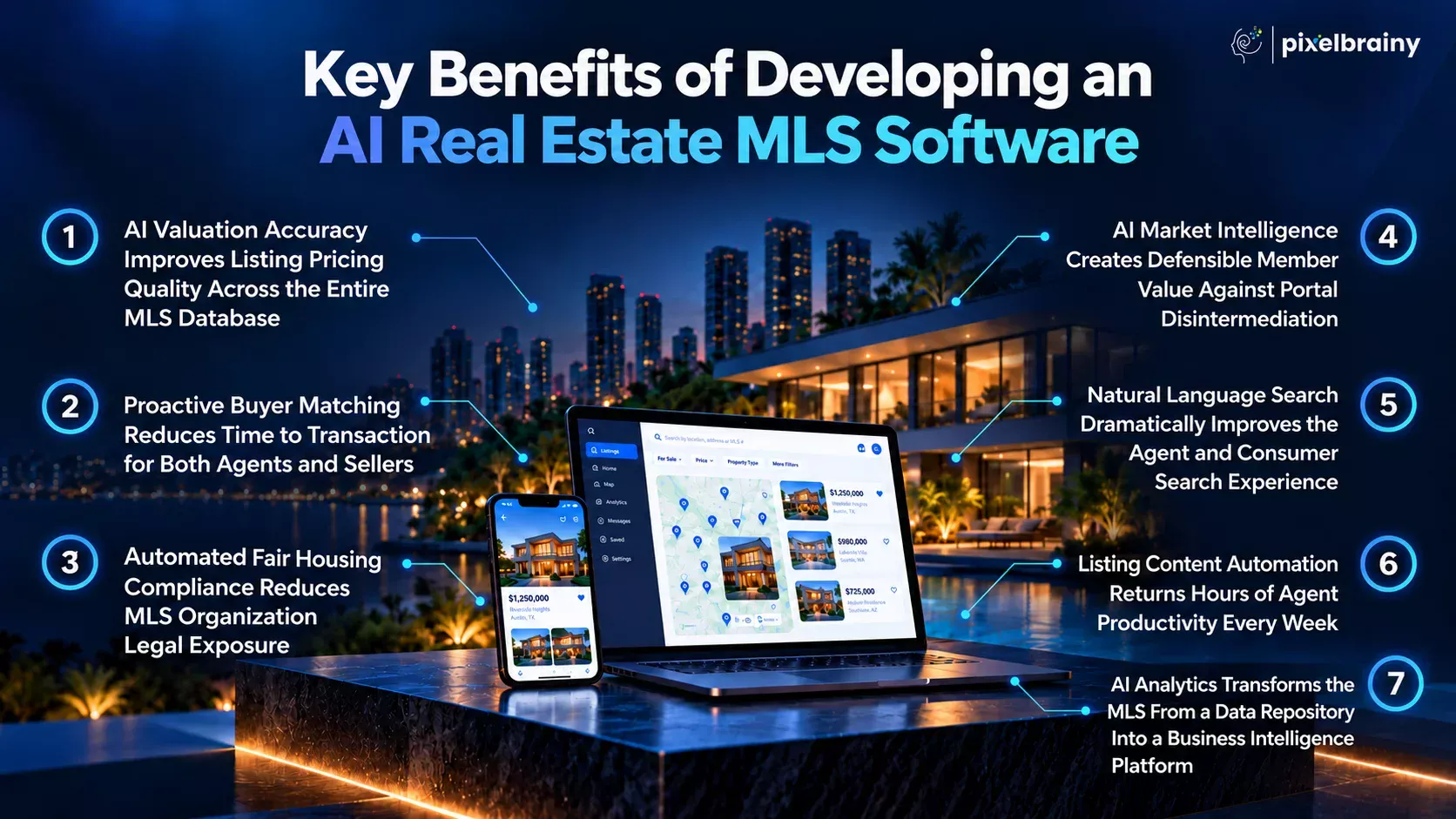
AI valuation models can analyze large volumes of MLS data, including historical sales, property characteristics, location, price trends, inventory levels, and comparable properties. Instead of relying only on manually selected comparables, AI can identify relevant patterns across a much broader dataset and generate data-driven valuation estimates.
For MLS organizations, this can improve the consistency of pricing insights available across the platform. Realtors can use AI-assisted valuation as an additional reference when preparing listing prices, reviewing comparable properties, or evaluating market changes. However, AI valuations should support professional judgment rather than replace licensed valuation or appraisal processes.
AI-powered buyer matching can analyze buyer preferences, search behavior, budget, location requirements, property characteristics, and other authorized signals to identify listings that may match specific buyer needs. This moves the MLS experience beyond reactive searches toward more proactive property discovery.
For realtors, AI can surface relevant properties that buyers may not discover through conventional filters. Sellers can potentially gain exposure to a more targeted pool of qualified prospects, while buyers receive recommendations aligned with their stated requirements and preferences. When designed correctly, AI real estate listing software development can make property matching more relevant throughout the buying journey.
AI can assist MLS organizations with monitoring listing content, detecting potentially problematic language, flagging unusual patterns, and routing issues for human review. Automated compliance checks can apply predefined rules consistently across large volumes of listing content, helping organizations identify issues that may otherwise require extensive manual review.
However, AI should not independently determine whether a listing violates fair housing laws or make protected-class-based recommendations. A safer approach combines automated detection, clear compliance rules, audit trails, explainable alerts, and qualified human oversight. This approach can help reduce operational and legal risk while supporting responsible AI real estate MLS software development.
MLS organizations hold valuable property and market data, but simply providing database access may not be enough to differentiate the MLS experience. AI market intelligence can transform that data into searchable market trends, pricing insights, inventory analysis, property-level intelligence, and natural language answers for authorized members.
This creates additional value that large consumer property portals may not provide through a traditional listing database alone. Realtors can use MLS intelligence to understand market movements, identify opportunities, compare inventory, and support client conversations. As a result, AI can help MLS organizations strengthen the strategic value of their member-facing platforms.
Traditional MLS search typically depends on predefined filters such as price, location, property type, bedrooms, bathrooms, and square footage. AI-powered natural language search allows users to describe what they want in conversational terms, such as “Find a three-bedroom home near downtown with a large backyard and a home office.”
Natural language processing and semantic search can interpret the intent behind the query and identify relevant listings even when the exact words do not appear in the listing fields. This can make property discovery more intuitive for both realtors and consumers while creating a more modern experience across web and mobile MLS platforms.
AI can assist realtors with repetitive listing content tasks such as generating property descriptions, summarizing features, creating short-form listing copy, organizing property attributes, and adapting approved information for different platform formats. This can reduce the amount of manual writing and formatting required for routine listing workflows.
For brokerage and MLS platforms, content automation can be integrated directly into listing management rather than requiring agents to switch between multiple AI tools. Human review remains important to verify accuracy and ensure that generated content does not introduce unsupported claims, discriminatory language, or misleading descriptions. This makes automation a practical component of AI real estate listing software development.
Traditional MLS systems primarily organize and distribute property information. AI analytics can add another layer by converting that information into actionable market intelligence, including inventory trends, pricing movements, property demand patterns, market segmentation, and predictive insights.
MLS organizations can provide authorized users with dashboards, natural language analytics, automated reports, and AI-generated summaries based on approved datasets. This changes the role of the MLS from a property data repository into a broader business intelligence platform. For organizations that build real estate AI MLS software, advanced analytics can become a central component of the platform's long-term product strategy.
Therefore, the benefits of AI real estate MLS software extend beyond faster property search by improving valuation, matching, compliance support, content workflows, and market intelligence. These capabilities can help MLS organizations and brokerages create a more intelligent, data-driven real estate technology platform.
Our MLS organization is planning to replace its current platform, and the board wants to know whether we should build a custom AI-powered MLS system or license an existing platform. How should we compare the cost, implementation time, AI capabilities, customization, data control, and long-term ROI before choosing between the two?
This is a critical decision in AI real estate MLS software development because the choice affects the organization's technology roadmap, operating costs, data strategy, and ability to introduce future AI capabilities.
Organizations that build real estate AI MLS software can design the platform around their specific MLS data model, member workflows, integrations, permissions, and AI requirements. Custom development can support natural language property search, semantic matching, AI valuation, listing quality automation, personalized recommendations, predictive analytics, and market intelligence.
The main consideration is the higher initial investment. Development costs can include product discovery, UI/UX design, AI engineering, MLS integrations, cloud infrastructure, cybersecurity, testing, deployment, and ongoing maintenance. In return, the organization gains greater control over customization, data architecture, AI capabilities, and its long-term product roadmap.
Licensing an established MLS platform can provide proven functionality for listing management, property search, data distribution, user administration, and integrations without requiring the organization to develop the entire MLS infrastructure internally. This can make migration faster and reduce the internal engineering burden.
The tradeoff is reduced control over customization and product direction. AI capabilities, integrations, pricing, and future functionality depend on the provider's available features and roadmap. Organizations should therefore consider licensing, implementation, migration, customization, support, and recurring costs when calculating total ownership expenses.
| Decision Factor | Custom AI MLS Software | Existing MLS Platform |
|---|---|---|
| Initial Investment | Higher investment for custom development, AI engineering, integrations, infrastructure, security, and testing. | Lower development burden, with spending focused on licensing, implementation, migration, and configuration. |
| AI Capabilities | AI search, valuation, recommendations, analytics, and automation can be designed around specific MLS requirements. | AI capabilities depend on the provider's current features, integrations, APIs, and product roadmap. |
| Customization | Full control over workflows, interface, data model, permissions, and member experience. | Customization depends on supported configurations, APIs, extensions, and provider capabilities. |
| Implementation Time | Longer because the organization must design, develop, test, integrate, and deploy the platform. | Generally faster when required MLS functionality is already available. |
| Data Control | Greater control over data architecture, processing, access policies, and AI implementation. | Data architecture and processing depend more heavily on provider infrastructure and contractual terms. |
| Long-Term Cost | Higher upfront investment, with greater control over future development and platform direction. | Recurring licensing and provider costs, with less responsibility for underlying platform maintenance. |
| Best Fit | Organizations seeking proprietary AI capabilities, deep customization, and long-term technology control. | Organizations prioritizing established MLS functionality, faster deployment, and lower internal development responsibility. |
If an organization has unique workflows, proprietary data strategies, advanced AI requirements, and sufficient technology resources, developing AI real estate MLS software can provide greater flexibility and control. If faster deployment, established functionality, and reduced internal development responsibility are more important, licensing an existing MLS platform may be the better option.
For organizations planning to build AI real estate multi listing services platform, the decision should also account for five to ten-year total cost of ownership, data governance, scalability, AI model management, security, integrations, maintenance, and the ability to adapt the platform as MLS technology evolves.
Therefore, build vs buy should be evaluated as a long-term technology strategy rather than an upfront cost comparison. The right choice is the approach that delivers the required AI capabilities, data control, customization, scalability, and ROI for the organization's future MLS roadmap.

The core features of AI real estate MLS software should support the complete day-to-day workflow of an MLS organization, brokerage, or real estate technology business. These capabilities manage property listings, MLS data, property searches, user permissions, listing updates, notifications, and secure access.
When businesses build AI real estate MLS software, the first version should establish a dependable operational foundation before adding advanced AI capabilities. The platform needs structured property data, reliable integrations, flexible search, secure user management, and efficient listing workflows so future AI functionality can operate on consistent and accessible data.
Real-world query:
“We’re planning to replace our existing MLS platform with a new AI-powered system, but our development team needs to finalize the core feature list first. What features are essential for managing property listings, MLS data, searches, user permissions, listing updates, and notifications?”
The following 15 features represent the essential functionality to consider during AI real estate MLS software development:
| Core Feature | Description |
|---|---|
| Property Listing Management | Property listing management enables authorized users to create, edit, publish, update, and remove listings while maintaining structured details such as price, address, property type, bedrooms, bathrooms, amenities, descriptions, and availability. |
| MLS Data Integration | MLS data integration connects the platform with authorized MLS databases, APIs, and approved data feeds to synchronize property information, listing statuses, pricing, agent details, and other permitted real estate data. |
| Property Search | A comprehensive property search system helps users find suitable listings through criteria such as location, price, property type, bedrooms, bathrooms, square footage, amenities, listing status, and other relevant property attributes. |
| Natural Language Property Search | Natural language property search allows users to describe their requirements using everyday language, enabling the platform to process requests such as finding three-bedroom homes near a preferred neighborhood within a specific budget. |
| Property Details Pages | Property detail pages present listing information in one organized interface, including photographs, descriptions, pricing, location, property features, amenities, availability, agent information, and other approved MLS data. |
| Interactive Property Maps | Interactive property maps help users explore listings by location, view nearby properties, identify properties within selected areas, and combine geographical browsing with price, property type, and other search requirements. |
| Listing Media Management | Listing media management provides authorized users with tools to upload, organize, replace, and manage property photographs, videos, floor plans, virtual tours, and other approved visual content associated with property listings. |
| User Account Management | User account management handles registration, authentication, profile information, password management, account preferences, verification, and other essential functions required to administer users throughout the MLS software platform. |
| Role-Based Access Control | Role-based access control allows administrators to define permissions for different platform participants, controlling which MLS data, listings, tools, and administrative functions can be viewed, edited, published, or managed. |
| Listing Status Management | Listing status management keeps property availability information accurate by supporting approved states such as active, pending, sold, withdrawn, expired, and other statuses required by the organization's MLS workflow. |
| Saved Searches and Favorites | Saved searches and favorites allow users to store frequently used property criteria, bookmark listings, maintain shortlists, and quickly return to relevant properties without repeatedly entering the same search requirements. |
| Property Alerts and Notifications | Property alerts notify users about relevant events such as new matching listings, price changes, status updates, and other permitted MLS changes based on saved searches and user preferences. |
| Agent and Brokerage Profiles | Agent and brokerage profiles organize approved professional information, contact details, associated listings, brokerage relationships, and other relevant information that helps users identify authorized real estate professionals. |
| MLS Dashboards and Reporting | MLS dashboards and reporting tools provide administrators with visibility into listings, users, searches, platform activity, data synchronization, and operational metrics needed to manage the software and evaluate platform performance. |
| Security, Privacy, and Audit Controls | Security and audit controls protect MLS information and user accounts through authentication, authorization, encryption, access management, activity logging, audit trails, and privacy safeguards across the platform. |
These features form the core architecture of AI real estate listing software development, covering the operational requirements that users and administrators depend on every day. They also create the structured data and workflow foundation required for organizations that want to develop real estate AI MLS software at scale.
Advanced capabilities such as AI valuation, predictive analytics, intelligent property recommendations, computer vision, and sophisticated AI assistants should be treated separately and added on top of this core MLS foundation.
A well-planned core feature set gives an AI real estate MLS platform the functionality, data structure, security, and scalability needed for long-term growth.
After the core MLS functionality is established, the next development stage can introduce advanced AI capabilities that improve property valuation, matching, market analysis, listing content, and workflow efficiency. These capabilities can help an MLS organization or brokerage use its property data more intelligently while creating a more personalized experience for realtors and property seekers.
A business planning to build AI real estate MLS software may already have essential functionality such as property listing management, MLS data integration, property search, user accounts, and notifications. At this stage, a common real-world development requirement is: “Our new MLS platform already handles property listings, MLS data integration, search, user accounts, and alerts. We now want to add AI to improve property valuation, recommendations, market insights, listing automation, and buyer matching. Which advanced AI capabilities should we prioritize?”
The answer depends on the platform's users, available MLS data, business objectives, compliance requirements, and expected ROI. The following advanced features can be evaluated during AI real estate MLS software development.
| Advanced AI Feature | Description |
|---|---|
| AI Property Valuation | AI valuation models analyze comparable sales, property characteristics, location, historical prices, market conditions, and other approved data to generate data-driven property value estimates that can support pricing decisions and market analysis. |
| AI Property Recommendations | AI recommendation engines analyze user searches, saved listings, preferences, budget, location, and other permitted signals to rank properties according to individual requirements, creating a more personalized property discovery experience. |
| Predictive Market Analytics | Predictive analytics processes historical and current MLS data to identify patterns involving property prices, inventory, demand, sales activity, and market conditions, helping real estate professionals evaluate potential market movements. |
| AI Listing Content Generation | Generative AI can create property descriptions from approved structured listing information, reducing repetitive writing work while helping realtors produce consistent, informative, and property-specific content for MLS listings. |
| AI Listing Quality Analysis | AI can review listing information to identify missing fields, inconsistent details, unusual values, duplicate information, and other potential data-quality issues, helping realtors and MLS administrators improve listing accuracy before publication. |
| Computer Vision for Property Images | Computer vision can analyze property photographs to identify rooms, visible property attributes, image quality, and other relevant characteristics, creating additional metadata that can support property categorization and more effective listing discovery. |
| Conversational AI MLS Assistant | A conversational AI assistant enables authorized users to interact with MLS information through natural language, ask property questions, refine searches, summarize listings, compare relevant properties, and access supported platform workflows. |
| AI Buyer and Property Matching | AI matching models compare buyer requirements with available property attributes, location, budget, preferences, and other approved criteria to identify listings that closely align with the buyer's stated needs and search intent. |
| AI Market Intelligence | AI market intelligence analyzes large volumes of MLS and related market data to produce useful insights about pricing patterns, inventory changes, comparable properties, neighborhood activity, and other relevant real estate indicators. |
| AI Workflow Automation | AI workflow automation can assist with repetitive activities such as information extraction, data classification, listing review, report preparation, notifications, and other approved processes, reducing manual effort across MLS and brokerage operations. |
These advanced capabilities allow organizations to develop real estate AI MLS software that does more than store and display property information. The AI layer can turn structured MLS data into valuation support, personalized recommendations, predictive insights, automated content, and decision-support tools.
For companies looking to build AI real estate multi listing services platform, prioritizing advanced capabilities according to actual user problems can create a stronger product roadmap and prevent unnecessary AI development.
The right advanced AI capabilities can turn an MLS platform's existing property data into actionable intelligence for realtors, brokers, buyers, sellers, and MLS organizations.
After you finalized the features, now it’s time to turn the MLS software concept into a structured development plan. AI real estate MLS software development requires more than connecting an AI model to an existing property database. The development process must cover business requirements, MLS data sources, system architecture, AI capabilities, security, user experience, testing, deployment, and ongoing optimization.
If you are researching the steps to build real estate AI MLS software from idea to launch, the process generally moves through eight major stages. These steps help organizations understand how to build real estate AI MLS software from scratch, control development priorities, validate the product early, and prepare the platform for future expansion.
A real estate investor researching this space may ask: “I am a real estate investor who is frustrated that existing MLS systems are designed for agents and not for investors and I want to build an AI MLS software specifically for real estate investors that includes investment-specific data fields like cap rate, gross rent multiplier, and estimated renovation cost alongside standard listing data, AI deal scoring against investor-defined criteria, and automated cash flow modeling for each listed property based on current rental market data in that submarket. Which development companies have experience building MLS platforms?”
That requirement illustrates why real estate MLS software development using AI should begin with a clearly defined product strategy rather than jumping directly into coding.
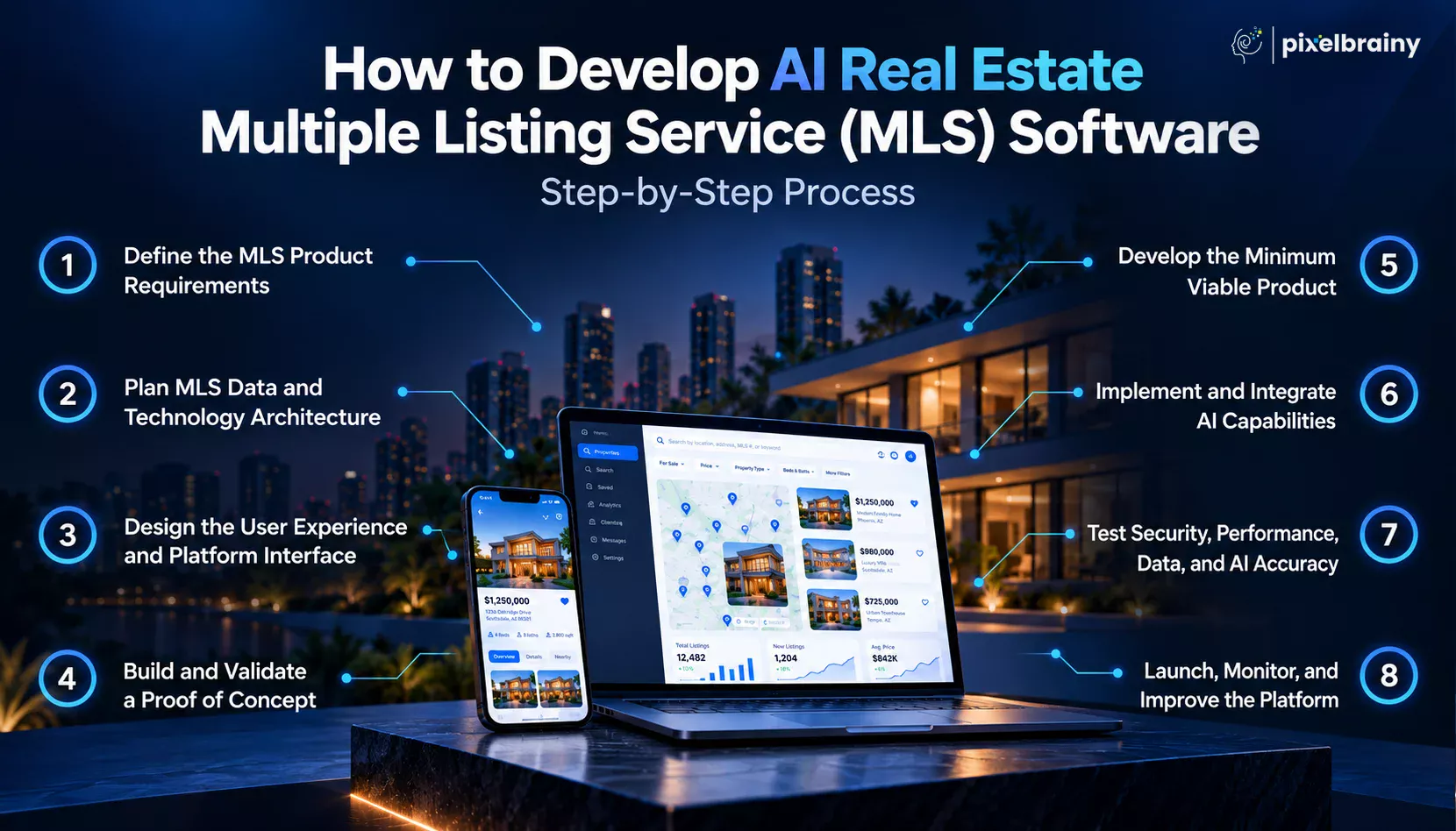
Start by identifying the purpose of the MLS platform, target users, property types, geographic market, and primary business requirements. Decide whether the software will serve realtors, investors, brokers, MLS organizations, or a specific real estate niche.
Document essential listing fields, search requirements, user roles, integrations, dashboards, notifications, and AI use cases. For an investor-focused platform, requirements could include cap rate, gross rent multiplier, renovation costs, rental income, cash flow, and deal scoring.
Clear requirements make AI consultation more productive and give developers a precise scope before architecture and development begin.
Also Read: Top 10 AI Consulting Companies in USA
Determine how the platform will collect, process, store, and distribute property information. Depending on the business model, this may involve authorized MLS APIs, brokerage systems, public records, rental market data, mapping services, and other approved sources.
The development team should define the database structure, APIs, cloud infrastructure, data synchronization process, security controls, and user permissions.
This stage is particularly important when building an real estate AI multi listing services software, because AI features depend on reliable, structured, and consistently updated property data.
The interface should be designed around the actual workflows of the platform's target users. Property search, listing management, property analysis, dashboards, saved searches, alerts, and AI-assisted actions should remain easy to navigate.
For example, an investor-focused MLS could display purchase price, estimated rent, renovation cost, cap rate, projected cash flow, and deal score within the property profile.
A specialized UI/UX design company can help organize complex MLS and investment information into practical screens without making the platform difficult to use.
Before developing the complete platform, validate the most technically challenging AI capabilities through PoC development. This allows the development team to test whether available data can support the intended functionality.
For an investment-focused MLS, the PoC could test automated cash flow modeling, investor-specific deal scoring, natural language search, or property classification.
Testing these capabilities early can reveal data limitations, integration problems, model accuracy issues, and infrastructure requirements before significant development resources are committed to the complete platform.
After validating the concept, build the first usable version through MVP development. The MVP should contain the core functionality needed for users to access listings, search properties, manage accounts, receive alerts, and interact with the platform.
Depending on the product strategy, selected AI capabilities can also be included in the MVP. An investor-focused platform might introduce basic deal analysis alongside standard MLS listing and search functionality.
Launching a focused MVP allows the business to collect actual user feedback and determine which features deserve priority in future development phases.
Also Read: Top 10 AI MVP Development Companies in USA
Once the MLS foundation is functional, implement AI capabilities according to the validated product requirements. This may include AI property recommendations, valuation, natural language search, listing analysis, market insights, deal scoring, or automated financial calculations.
AI integration should connect intelligence directly with MLS workflows rather than keeping AI as a separate tool. AI model development should also consider training data, accuracy, evaluation, security, inference costs, explainability, and ongoing model monitoring.
This approach makes AI functionality more useful within everyday real estate workflows.
Before deployment, conduct functional, integration, performance, security, usability, and AI-specific testing. Verify that property information is synchronized correctly and that searches, calculations, permissions, alerts, and dashboards perform as expected.
AI features should be evaluated against defined accuracy and quality criteria. For investment-focused functionality, financial calculations and market data dependencies require particular attention.
Working with top AI real estate software development companies can provide access to specialized expertise for complex MLS integrations, AI validation, cybersecurity, scalability, and production readiness.
After testing is complete, deploy the MLS platform and continuously monitor its performance. Track system availability, API synchronization, user engagement, search behavior, AI accuracy, infrastructure costs, and support issues.
User feedback should guide future releases and help identify which features need improvement or expansion. Businesses can work with AI product development companies for ongoing product enhancement or hire AI developers to build and maintain an internal development capability.
Continuous updates are essential because MLS data sources, user expectations, AI models, security requirements, and real estate workflows can change over time.
A structured development process helps businesses create real estate AI MLS software that is scalable, reliable, user-focused, and ready for continuous AI innovation.
The AI real estate MLS software development cost generally falls between $50,000 and $350,000+. The actual investment depends on the platform's scope, number of MLS integrations, AI functionality, user roles, technology stack, security requirements, and level of customization.
For example, a focused MLS MVP with property listings, search, user management, MLS API integration, and selected AI capabilities can require a significantly smaller budget than an enterprise MLS platform with multiple data sources, AI valuation, intelligent property matching, predictive analytics, advanced dashboards, and complex administrative workflows.
A company planning real estate MLS software development using AI may realistically ask:
“We are budgeting for a new AI-powered MLS platform and need to know whether our development budget is realistic. What would it cost to build an MLS system with property listings, MLS data integration, AI-powered search, property recommendations, and a custom admin dashboard?”
The answer depends on the exact functionality and technical complexity. Key cost factors include AI integration, MLS API development, UI/UX design, backend development, cloud infrastructure, security, testing, and ongoing maintenance.
| Development Scope | Approximate Cost |
|---|---|
| Basic AI MLS MVP | $50,000 to $100,000 |
| Mid-Level AI MLS Platform | $100,000 to $200,000 |
| Advanced AI MLS Platform | $200,000 to $350,000+ |
These figures are starting estimates rather than fixed quotations. The cost to develop AI real estate MLS software can increase when the platform requires extensive data integrations, custom AI models, large-scale infrastructure, complex permissions, or specialized workflows.
If you want to calculate your expected budget in detail, explore our dedicated guide, “How Much Does It Cost to Develop an AI Real Estate Multiple Listing Service (MLS) Software?”

The AI real estate MLS software development technology stack needs to support high-volume property data, MLS API integrations, secure user access, fast property search, AI-powered recommendations, analytics, and scalable cloud infrastructure. A practical stack should allow real estate businesses to build an AI MLS platform that can process structured listing data while supporting machine learning and natural language capabilities.
For example, a brokerage planning a new MLS platform may ask: “We need to develop an AI-powered MLS system that can handle thousands of property listings, integrate MLS data, provide fast searches, generate property recommendations, and support future AI features. Which technologies should our development team use?” The answer depends on the platform's scale and AI requirements, but the following technologies provide a strong foundation for real estate AI MLS software development.
| Technology Area | Recommended Tools and Technologies | Role in AI Real Estate MLS Software Development |
|---|---|---|
| Frontend Development | React.js, Next.js, TypeScript | Builds responsive MLS dashboards, property search interfaces, listing pages, admin panels, and user-facing web applications. |
| Mobile Development | React Native, Flutter | Supports iOS and Android MLS applications for agents, brokers, buyers, sellers, and property investors. |
| Backend Development | Node.js, Python, FastAPI, Django | Handles business logic, user requests, listing workflows, MLS integrations, APIs, notifications, and AI services. |
| Database | PostgreSQL, MySQL | Stores structured property listings, users, agents, brokerages, transactions, permissions, and other MLS records. |
| Search Engine | Elasticsearch, OpenSearch | Provides fast property searches across locations, prices, property types, amenities, listing status, and other MLS attributes. |
| AI and Machine Learning | Python, PyTorch, TensorFlow, scikit-learn | Supports AI model development for valuation, recommendations, property matching, market predictions, classification, and analytics. |
| Natural Language Processing | OpenAI APIs, Hugging Face, spaCy | Enables conversational property searches, listing summarization, query understanding, and AI-powered MLS assistants. |
| Vector Database | Pinecone, Weaviate, pgvector | Supports semantic property search and similarity matching by converting listing information and user queries into vector representations. |
| MLS and Data Integration | REST APIs, GraphQL, RESO Web API | Connects the platform with authorized MLS data sources and enables standardized property data exchange. |
| Cloud Infrastructure | AWS, Microsoft Azure, Google Cloud | Provides scalable computing, storage, databases, networking, monitoring, and infrastructure for growing MLS platforms. |
| File and Media Storage | Amazon S3, Cloudinary | Stores property photographs, videos, floor plans, documents, and other listing media securely and efficiently. |
| Caching and Performance | Redis | Reduces database load and improves response times for frequently accessed property searches, sessions, recommendations, and API responses. |
| Authentication and Security | OAuth 2.0, OpenID Connect, JWT | Protects MLS accounts and provides secure authentication, authorization, session management, and role-based platform access. |
| Analytics and Reporting | Power BI, Tableau, Apache Superset | Converts MLS data into dashboards covering inventory, pricing trends, user activity, market performance, and business intelligence. |
| DevOps and Monitoring | Docker, Kubernetes, GitHub Actions, AWS CloudWatch | Supports automated deployments, containerized services, infrastructure scaling, application monitoring, logging, and continuous delivery. |
For organizations building an AI real estate multi listing services platform, the stack should not be treated as a fixed technology checklist. The architecture should match the expected listing volume, number of MLS integrations, AI workload, security requirements, mobile requirements, and future expansion plans.
For example, PostgreSQL can manage structured MLS records while Elasticsearch or OpenSearch handles high-speed property discovery. Python can power AI model development, while vector search technologies can support semantic matching. Cloud infrastructure then provides the scalability required as listings, users, searches, images, and AI workloads increase.
A well-planned technology stack gives real estate businesses the performance, scalability, security, data connectivity, and AI foundation required to develop a reliable MLS platform.
An AI real estate MLS software business model defines how the platform generates revenue while delivering property search, listing management, AI recommendations, market intelligence, and other real estate services. The most suitable model depends on the target customers, platform capabilities, MLS data access, AI infrastructure costs, and expected user volume.
For example, a PropTech company plans to develop real estate AI MLS software for brokerages and real estate professionals. The team needs a revenue model that supports ongoing MLS data costs, cloud infrastructure, AI usage, maintenance, and future product development while remaining affordable for customers. Several models can support this type of platform.
A subscription model allows users or organizations to pay monthly or annually for access to the AI MLS platform. Plans can be structured around features, number of users, property data access, AI capabilities, or usage limits.
Basic plans can provide property search and listing management, while higher plans can include AI recommendations, market analytics, automated listing content, and advanced reporting.
Under this model, the platform charges a recurring fee for each active realtor, broker, investor, or other authorized user. This approach works particularly well for brokerages because pricing can scale with the number of professionals using the system.
For example, a brokerage with 50 agents could pay according to its active user count, while larger organizations can negotiate volume-based pricing.
Enterprise licensing is suitable when an MLS organization, brokerage network, or large real estate company requires a highly customized platform. The contract can include dedicated infrastructure, custom integrations, advanced security, administrative controls, support, and organization-specific AI capabilities.
This model can generate larger contracts while giving enterprise customers greater control over their MLS technology environment.
A platform can offer core MLS functionality under a standard subscription while charging additional fees for advanced AI capabilities. Features such as AI property valuation, intelligent property matching, predictive market analytics, conversational search, AI listing generation, and AI market intelligence can be included in premium plans.
This approach allows businesses to monetize AI functionality according to the additional value and infrastructure it provides.
Real estate technology companies can monetize authorized access to selected MLS data and platform services through APIs. Customers may pay according to API usage, data volume, number of applications, or commercial licensing terms.
This model can be useful when building an AI real estate multi listing services platform that also serves other PropTech applications, analytics platforms, or real estate software products.
A white-label AI MLS platform allows technology providers to offer their infrastructure to MLS organizations, brokerages, associations, or real estate brands under their own branding.
The provider manages the underlying technology while the customer operates a branded MLS experience. Revenue can come from implementation fees, recurring licensing, customization, maintenance, and AI services.
A freemium strategy provides limited MLS or property-search functionality at no cost and reserves advanced capabilities for paid users. Free users might access basic searches, while paid users receive AI recommendations, advanced analytics, saved workflows, market intelligence, and professional tools.
This model can help consumer-facing platforms build an initial user base before converting active users into paying customers.
A hybrid model combines multiple revenue streams, such as subscriptions, enterprise licensing, premium AI features, API access, and white-label services. For many AI real estate MLS software development businesses, this provides greater flexibility because different customer groups can be monetized differently.
For example, individual professionals can use subscription plans, brokerages can purchase enterprise packages, and technology companies can pay for approved API access.
The business model should also account for recurring costs such as MLS data licensing, cloud infrastructure, AI model usage, cybersecurity, technical maintenance, and customer support. A pricing structure that considers these costs from the beginning can support sustainable growth.
A strong AI MLS business model connects customer value with recurring revenue, AI operating costs, MLS data requirements, and long-term platform scalability.
NAR compliance and regulatory requirements are critical when developing AI real estate MLS software for the US market. An AI-powered MLS platform must handle property data, listing content, user permissions, search results, and automated recommendations in ways that align with applicable MLS rules, fair housing requirements, data licensing terms, and technical data standards.
For businesses planning real estate MLS software development using AI, compliance should be considered during architecture and product design rather than added after development. The platform should provide appropriate controls for data validation, access management, auditability, listing updates, and AI-generated content.
Technical compliance begins with understanding the Real Estate Standards Organization (RESO) standards used for standardized real estate data exchange. When developing an MLS platform for the US real estate market, the architecture may need to support applicable RESO standards, including standardized data structures and API-based data access.
A business preparing its development scope may ask:
“Before we scope development, we need to understand what RESO data standard compliance requires technically and which development companies specialize in building PropTech MLS products for the US real estate market. What should our architecture, API integration, data model, and development team support?”
The development team should therefore plan MLS data integration around the requirements of the specific MLS data source, its licensing agreement, and applicable RESO specifications. This includes handling standardized property fields, listing statuses, identifiers, timestamps, media, agent information, and data updates consistently across the platform.
AI can also become part of the MLS compliance workflow. An organization may need an AI MLS compliance and listing accuracy system that automatically checks information when agents submit new listings, identifies potential issues, and supports administrators before content reaches users.
For example, the platform can validate required listing fields, detect inconsistent property information, identify duplicate listings, flag unusual data changes, and monitor active listings for updates that may require review. These capabilities can improve data quality while reducing repetitive manual checks.
Fair housing compliance in AI real estate software requires particular attention because AI systems can influence property recommendations, search ranking, content generation, and user targeting. Automated systems should not introduce discriminatory criteria or generate listing language that could indicate unlawful preferences or limitations.
AI-generated listing descriptions should therefore pass through appropriate validation and review workflows before publication. The system can flag potentially problematic language for human review rather than automatically making a legal determination.
Every MLS operates under its own rules, policies, and data access arrangements. AI MLS software should therefore implement role-based access control, listing permissions, data visibility rules, audit logs, and administrative controls according to the applicable MLS environment.
Data governance is equally important. The platform should track where listing data originates, how it is processed, which users can access it, and how AI systems use that information. Data retention, API restrictions, redistribution rights, and permitted uses should be defined according to the applicable agreements and regulations.
AI should support compliance teams rather than operate as an uncontrolled decision-maker. A reliable AI real estate MLS software development strategy should include confidence scores, review queues, explainable alerts, audit trails, exception handling, and human approval for sensitive compliance decisions.
This approach allows MLS organizations and brokerages to use AI for high-volume validation while maintaining appropriate human oversight for decisions involving fair housing, listing eligibility, data rights, and policy violations.
Building compliance into the architecture from the beginning helps create AI real estate MLS software that is data-consistent, auditable, secure, and better prepared for evolving MLS and regulatory requirements.
Developing AI real estate MLS software involves more than connecting property listings with an AI model. The platform must process large volumes of MLS data, maintain data accuracy, protect sensitive information, support fast property searches, integrate AI responsibly, and operate within applicable MLS, fair housing, and data licensing requirements.
For example, an MLS organization may have a reliable listing platform but face problems when adding AI capabilities: inconsistent property data can reduce recommendation quality, multiple MLS feeds can create duplicate records, and AI-generated content may require additional compliance checks. These challenges need to be addressed during the real estate AI MLS software development process rather than after launch.
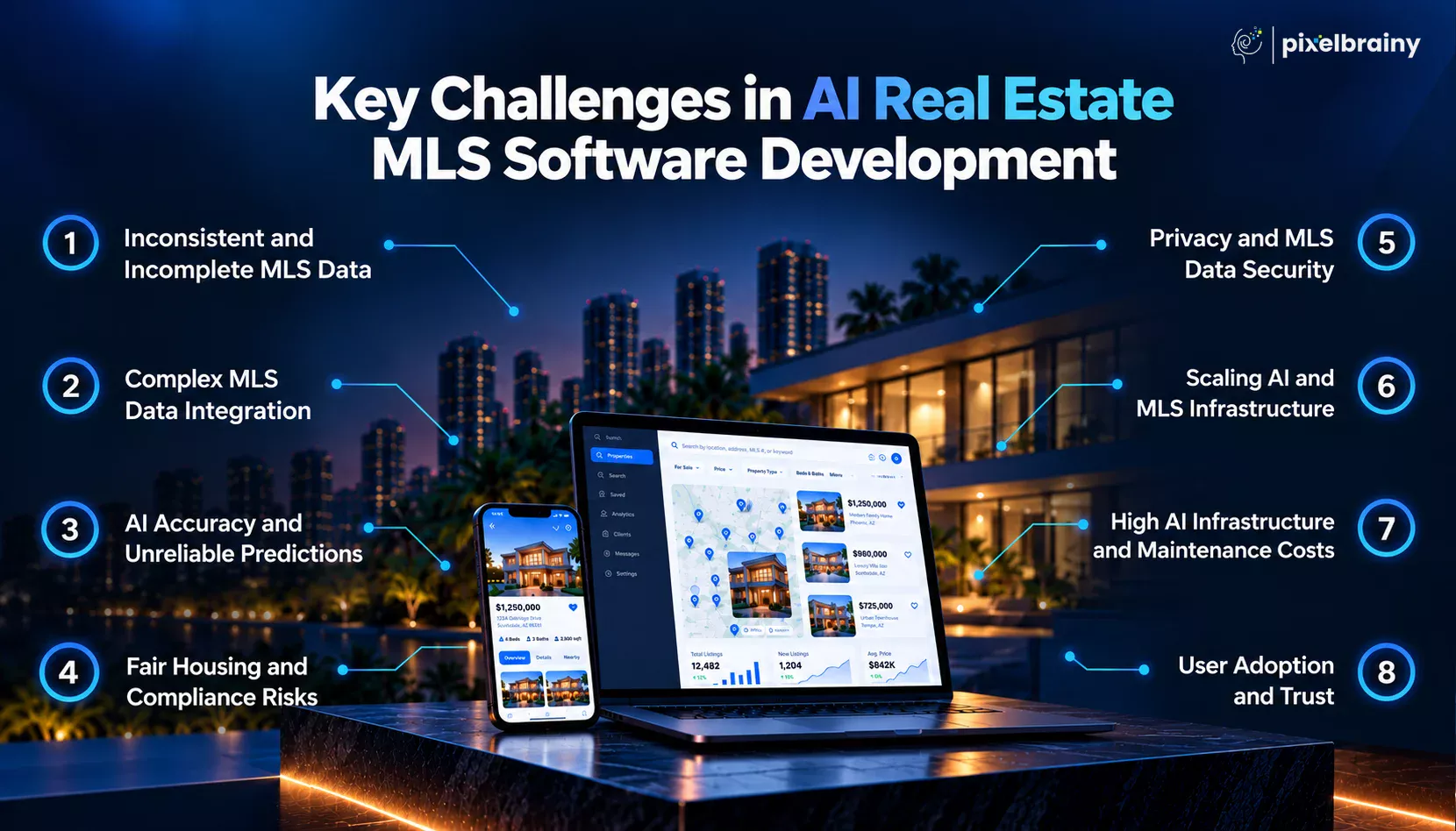
Property data can contain missing fields, outdated information, inconsistent formats, duplicate listings, or conflicting values across data sources. AI systems depend heavily on data quality, so inaccurate MLS records can directly affect search results, recommendations, valuation models, and analytics.
How to overcome it: Build a dedicated data processing layer that validates incoming records, standardizes fields, detects duplicates, tracks updates, and flags unusual values for review. Automated data quality rules combined with AI-based anomaly detection can keep the MLS database more reliable.
Building an AI MLS platform often requires integration with authorized MLS data sources, APIs, property databases, mapping services, media systems, and other real estate technologies. Each integration can have different technical requirements, data structures, update frequencies, and access restrictions.
How to overcome it: Use a modular integration architecture with standardized APIs, data mapping, validation rules, error handling, monitoring, and synchronization processes. This makes it easier to add or modify data sources without rebuilding the entire platform.
AI-powered property valuation, recommendations, market predictions, and listing analysis can produce incorrect results when models receive incomplete data, outdated information, or unusual property records. An inaccurate AI output can negatively affect user trust and business decisions.
How to overcome it: Use high-quality training data, continuous model evaluation, confidence scoring, validation workflows, and human review for high-impact outputs. AI results should be presented as decision support rather than automatically treated as definitive professional or financial conclusions.
AI can create compliance concerns when it influences property recommendations, search ranking, listing descriptions, or user targeting. Poorly designed models or generated content may introduce inappropriate preferences or discriminatory patterns.
How to overcome it: Add compliance checks throughout the AI workflow. Listing content can be screened before publication, recommendation logic can be tested for problematic patterns, and sensitive AI decisions can be routed through human review with appropriate audit logs.
An MLS platform can handle substantial amounts of property, professional, account, and operational data. Unauthorized access, weak permissions, insecure APIs, or poor data handling can expose the platform to significant security risks.
How to overcome it: Implement encryption, secure authentication, role-based access control, API security, audit logging, vulnerability testing, monitoring, and controlled data access. Security requirements should be incorporated into the architecture from the beginning.
As listing volume and user activity increase, the platform must process more searches, API requests, images, AI queries, recommendations, and analytics workloads. An architecture that works for an MVP may struggle under enterprise-level traffic.
How to overcome it: Use scalable cloud infrastructure, caching, database optimization, asynchronous processing, containerized services, load balancing, and independent AI services. This allows individual components to scale according to demand.
AI functionality creates continuing costs beyond initial development. Model inference, vector databases, cloud computing, data processing, monitoring, security, and model updates can increase operational expenses as usage grows.
How to overcome it: Track AI usage and infrastructure costs from the MVP stage. Use appropriate models for each task, optimize API calls, cache repetitive requests, process non-urgent workloads asynchronously, and establish clear usage limits where appropriate.
Realtors, brokers, MLS administrators, investors, and other users may hesitate to rely on AI recommendations or automated workflows if they cannot understand how results are generated. A technically advanced platform can still struggle if users do not trust or understand its AI capabilities.
How to overcome it: Provide transparent AI outputs, useful explanations, confidence indicators, editable recommendations, feedback mechanisms, and human approval workflows. The interface should make AI assistance feel like a practical part of the existing MLS workflow.
Addressing data quality, integration, compliance, security, scalability, AI accuracy, cost, and user trust early creates a stronger foundation for reliable AI real estate MLS software development.
From this point, it is time to identify a development partner that understands both real estate technology and AI implementation. PixelBrainy works with businesses that want to modernize property platforms, introduce intelligent MLS capabilities, and create technology that can support evolving real estate workflows.
As an AI real estate software development company, PixelBrainy approaches MLS projects around the actual business requirements, including property data management, MLS integrations, intelligent search, property matching, AI analytics, user roles, security, and scalable infrastructure.
A real estate business considering this investment may ask:
“We have an existing MLS workflow, but our users need faster property discovery, investment analysis, better listing intelligence, and AI-powered recommendations. Can a development partner build these capabilities into a customized MLS platform without compromising data accuracy and scalability?”
That is where PixelBrainy's product-focused approach becomes relevant.
PixelBrainy offers real estate AI MLS software development services covering product discovery, architecture, UI/UX, backend engineering, MLS data integration, AI implementation, testing, deployment, and post-launch improvements.
Businesses can build real estate AI MLS software around their specific users and workflows instead of adapting their requirements to a rigid off-the-shelf product. The platform can be structured to support capabilities such as semantic property search, AI recommendations, automated listing analysis, valuation intelligence, market analytics, and investor-focused property insights.
For a confidential US real estate project, PixelBrainy worked on an AI-powered property deal analysis solution connected with live MLS data. The platform automated calculations for metrics such as ROI, cap rate, rental yield, and property appreciation while providing predictive insights to help users evaluate investment opportunities more efficiently.
This experience is relevant to organizations planning to develop real estate AI MLS capabilities where property data must connect with intelligent analysis and decision-support workflows.
For businesses planning real estate multi listing software development integrating AI, PixelBrainy can help translate the product vision into a practical development roadmap, scalable architecture, and AI-enabled user experience.
Ready to discuss your AI MLS product idea? Connect with PixelBrainy and plan your development roadmap with our team.

AI real estate MLS software development is becoming an important technology investment for MLS organizations, brokerages, realtors, PropTech companies, and real estate businesses looking to improve how property data is searched, analyzed, managed, and delivered. Unlike traditional MLS platforms, AI-powered solutions can support intelligent property matching, natural language search, automated listing analysis, AI valuation, market intelligence, predictive analytics, and workflow automation.
However, successful real estate AI MLS software development requires more than adding AI features to an existing platform. Businesses need reliable MLS data integration, scalable architecture, secure access controls, appropriate compliance measures, accurate AI models, and a user experience designed around real estate workflows.
Whether you want to build real estate AI MLS software from scratch, modernize an existing MLS platform, or create a specialized real estate multi listing software integrating AI, a structured development strategy can help turn the concept into a scalable product.
Book an appointment with PixelBrainy to discuss your AI MLS software development requirements and roadmap.
Yes. AI real estate MLS software can be designed for MLS organizations, brokerages, realtors, property investors, buyers, and real estate technology companies. User-specific dashboards, permissions, search preferences, analytics, and AI workflows can be configured according to each group's requirements.
AI can understand natural language queries and match them with relevant property attributes, locations, pricing, amenities, and user preferences. This allows businesses to develop real estate AI MLS platforms with semantic search, intelligent ranking, personalized recommendations, and conversational property discovery.
Yes. A specialized platform can combine MLS listing information with investment criteria such as purchase price, rental income, cap rate, gross rent multiplier, estimated expenses, and renovation assumptions. This allows businesses to build real estate AI MLS software with investment analysis and property scoring capabilities.
Existing MLS systems can be enhanced with AI-powered search, property recommendations, automated listing descriptions, image analysis, valuation assistance, market forecasting, buyer-property matching, conversational assistants, and listing quality checks. The exact approach depends on the existing architecture and available data.
MLS data integration directly affects the quality and reliability of AI features. Property records need to be consistently structured, updated, validated, and accessed according to applicable data agreements. Real estate AI MLS software development should therefore include a dedicated data integration and processing layer.
Businesses should define their target users, MLS data sources, required integrations, core workflows, AI use cases, compliance requirements, security architecture, scalability expectations, and monetization strategy. Establishing these requirements early helps create a realistic development roadmap and budget.
Yes. A platform can be designed around specific regions, property categories, market conditions, MLS data sources, user roles, and local business workflows. Real estate multi listing software development integrating AI can therefore support specialized regional or niche property platforms instead of relying on a single generic configuration.
The cost can range from approximately $50,000 to $350,000+, depending on platform complexity, MLS integrations, AI functionality, user volume, security requirements, customization, and infrastructure. A basic MVP will typically require a smaller investment than an enterprise-grade AI MLS platform with advanced analytics and multiple integrations.

About The Author
Sagar Bhatnagar
Sagar Sahay Bhatnagar brings over a decade of IT industry experience to his role as Marketing Head at PixelBrainy. He's known for his knack in devising creative marketing strategies that boost brand visibility and market influence. Sagar's strategic thinking, coupled with his innovative vision and focus on results, sets him apart. His track record of successful campaigns proves his ability to utilize digital platforms effectively for impactful marketing efforts. With a genuine passion for both technology and marketing, Sagar continuously pushes PixelBrainy's marketing initiatives to greater success.

Working with the PixelBrainy team has been a highly positive experience. They understand the design requirements and create beautiful UX elements to meet the application needs. The dev team did an excellent job bringing my vision to life. We discussed usability and flow. Sagar worked with his team to design the database and begin coding. Working with Sagar was easy. He has the knowledge to create robust apps, including multi-language support, Google and Apple ID login options, Ad-enabled integrations, Stripe payment processing, and a Web Admin site for maintaining support data. I'm extremely satisfied with the services provided, the quality of the final product, and the professionalism of the entire process. I highly recommend them for Android and iOS Mobile Application Design and Development.

Great experience working with them. Had a lot of feedback and I found that unlike most contractors they were bugging me for updates instead of the other way around. They were extremely time conscience and great at communicating! All work was done extremely high quality and if not on time, early! They were always proactive when it comes to communication and the work is great/above par always. Very flexible and a great team to work with! Goes above and beyond to present us with multiple options and always provides quality. Amazing work per usual with Chitra. If you have UI/UX or branding design needs I recommend you go to them! Will likely work with them in the future as well, definitely recommended!

PixelBrainy is a joy to work with and is a great partner when thinking through branding, logo, and website layout. I appreciate that they spend time going into the "why" behind their decisions to help inform me and others about industry best practices and their expertise.

I hired them to design our software apps. Things I really like about them are excellent communication skills, they answer all project suggestions and collaborate right away, and their input on design and colors is amazing. This project was complex and needed patience and creativity. The team is amazing to do business with. I will be using them long-term. Glad to see there are some good people out there. I was afraid to try and outsource my project to someone but I am glad I met them! I really can't say enough. They went above and beyond on this project. I am very happy with everything they have done to make my business stand out from the competition.

It was great working with PixelBrainy and the team. They were very responsive and really owned the project. We'll definitely work with them again!

I recently worked with the PixelBrainy team on a project and I was blown away by their communication skills. They were prompt, clear, and articulate in all of our interactions. They listened and provided valuable feedback and suggestions to help make the project a success. They also kept me updated throughout the entire process, which made the experience stress-free and enjoyable.

PixelBrainy is very good at what it does. The team also presents themselves very professionally and takes care of their side of things very well. I could fully trust them taking up the design work in a timely and organised manner and their attention to detail saved us lots of effort and time. This particular project was quite intense and the team showed that they function very well under pressure. Very much looking forward to working with her again!

It's always an absolute pleasure working with them. They completed all of my requests quickly and followed every note I had for them to a T, which made our process go smoothly from start to finish. Everything was completed fast and following all of the guidelines. And I would recommend their services to anyone. If you need any design work done in the future, PixelBrainy should be your first call!

They took ownership of our requirements and designed and proposed multiple beautiful variants. The team is self-motivated, requires minimum supervision, committed to see-through designs with quality and delivering them on time. We would definitely love to work with PixelBrainy again when we have any requirements.

PixelBrainy was a big help with our SaaS application. We've been hard at work with a new UI/UX and they provided a lot of help with the designs. If you're looking for assistance with your website, software, or mobile application designs, PixelBrainy and the team is a great recommendation.

PixelBrainy designers are amazing. They are responsive, talented, and always willing to help craft the design until it matches your vision. I would recommend them and plan to continue them for my future projects and more!!!

They were awesome! Did a good job fast, and good communication. Will work with them again. Thank you

Creative, detail-oriented, and talented designers who take direction well and implement changes quickly and accurately. They consistently over-delivered for us.

PixelBrainy team is very talented and creative. Great designers and a pleasure to work with. PixelBrainy is an excellent communicator and I look forward to working with them again.

PixelBrainy has a very talented design team. Their work is excellent and they are very responsive. I enjoy working with them and hope to continue on all of our future projects.


Transform your ideas into reality with us.
Across these industries, each engagement brings unique challenges, from early-stage product development to scaling complex systems, helping us build a practical understanding of real-world product environments.