AI Summary Powered by PixelBrainy
What would happen to your pipeline if an eight-person SDR team could spend the majority of its working hours on qualified sales conversations instead of researching accounts, building prospect lists, and manually writing follow-ups?
For a B2B SaaS company, this is the central business case behind AI sales development representative agent development. Modern AI SDR agents are moving beyond basic email automation and becoming intelligent sales development systems that can research prospects, identify ideal customer profiles, detect buying signals, personalize outreach, qualify responses, schedule meetings, update CRM records, and recommend the next-best sales action.
For a VP of Sales with an eight-person SDR team spending around 70% of its time on manual research, list building, and personalized outreach, the opportunity is particularly significant. The question is not whether artificial intelligence can write an email. It can. The real question is whether an AI SDR agent can reliably perform the research, reasoning, personalization, qualification, and workflow execution required to generate measurable pipeline.
The market opportunity is expanding rapidly. According to Grand View Research, the global AI agents market is estimated at $10.9 billion in 2026 and is projected to reach $182.9 billion by 2033, representing a 49.6% CAGR from 2026 to 2033. North America accounted for 39.6% of the global market in 2025.
However, market growth alone does not prove that an AI SDR investment will produce revenue. Sales leaders should examine documented customer outcomes.
For example, Greenhouse reports that its AI SDR agent, Piper, handled 15,000 conversations, booked 2,000 meetings, influenced $27 million in pipeline, and contributed to $4 million in closed-won revenue during its first year live. Questex reports more than $1 million in pipeline in its first three months, approximately 2,000 hours of manual outbound work automated per month, and a 5x ROI. Brainsuite reports a 30% increase in pipeline and more than $315,000 in influenced pipeline within its first 90 days.
There is also newer evidence from ElevenLabs. In September 2026, the company reported that its AI SDR, Dom, qualified leads in minutes compared with a two-day human median, created more than $1 million in qualified pipeline during the previous month, and saved its SDR team 180 hours.
These results are company-reported case studies, not universal benchmarks, so buyers should validate the underlying methodology, attribution model, customer references, and revenue data before making an investment.
This guide explains custom AI SDR agent development, including how to build an AI SDR agent from scratch, how to create an AI SDR agent with personalized outreach, the features and technology required, development stages, estimated costs, challenges, and the criteria for evaluating companies that develop AI SDR agents for startups and enterprise sales organizations.

An AI Sales Development Representative (SDR) agent is an AI-powered software system designed to perform, assist with, or autonomously execute sales development activities that are traditionally handled by human SDRs. Unlike conventional sales automation tools that primarily follow predefined workflows, an AI SDR agent can analyze data, reason about prospects, make context-based decisions, personalize communication, respond to prospects, and determine the next appropriate sales action.
In simple terms, a traditional automation system follows instructions, while an AI SDR agent can interpret information and make decisions within predefined business boundaries.
For example, a traditional sales automation workflow may look like this:
This workflow can save time, but the system generally operates according to fixed rules. It does not necessarily understand why a prospect is valuable, whether a recent company event changes the outreach strategy, or whether a prospect's reply requires a different response.
An AI SDR agent operates at a more intelligent level. It can research an account, analyze the prospect's role, identify relevant business signals, determine whether the company matches the ideal customer profile (ICP), generate contextual messaging, analyze replies, adjust follow-up strategies, and escalate high-value conversations to human sales representatives.
| Capability | Traditional Sales Automation | AI SDR Agent |
|---|---|---|
| Lead collection | Rule-based | AI-assisted and context-aware |
| Prospect research | Manual or predefined enrichment | Autonomous and contextual research |
| Lead qualification | Static rules | AI reasoning combined with business rules |
| Personalization | Templates and variables | Context-aware content generation |
| Outreach | Fixed sequences | Adaptive and dynamic sequences |
| Follow-up | Time-based | Context- and response-based |
| Reply analysis | Basic classification | Intent, context, and conversation analysis |
| Buying signal detection | Limited | AI-driven signal identification |
| CRM updates | Workflow-based | Context-aware updates |
| Next-best action | Predefined | Dynamically recommended |
| Campaign optimization | Primarily manual | AI-assisted optimization |
| Knowledge utilization | Limited | RAG and knowledge-base powered |
| Human escalation | Task-based | Context-aware handoff |
The biggest difference between traditional automation and an AI SDR agent is decision-making.
A traditional automation platform essentially asks:
"What action should be performed according to this predefined workflow?"
An AI SDR agent can evaluate a broader set of information and ask:
"What should happen next based on this prospect's company, role, previous interactions, buying signals, intent, engagement, and sales context?"
For example, imagine that an SDR campaign is targeting Chief Revenue Officers at B2B SaaS companies.
A traditional automation platform might send the same three-email sequence to every CRO.
An AI SDR agent could identify that one prospect's company has recently expanded its sales organization, another has adopted a competing technology, and a third has just announced an enterprise expansion. The agent can use those signals to determine whether each prospect deserves outreach and how the messaging should differ.
This creates a fundamental shift from sequence automation to intelligent sales execution.
One common misconception is that an AI SDR agent is simply an LLM connected to an email platform.
That approach is too limited.
An effective AI SDR agent can combine multiple capabilities, including:
The AI model is only one component of the overall system.
The real value comes from connecting the AI model with sales data, business rules, external tools, CRM systems, knowledge bases, communication channels, and workflow automation.
For a growing B2B SaaS company, this distinction directly affects the business case for AI SDR agent development.
If the system only sends automated emails, its value is limited to communication efficiency.
If the system can research accounts, identify high-fit prospects, understand buying intent, personalize outreach, interpret responses, qualify opportunities, and route high-intent prospects to human sellers, it can potentially automate a much larger portion of the SDR workflow.
Therefore, the objective of developing an AI SDR agent should not be:
"Send more emails with AI."
Instead, the objective should be:
"Automate repetitive sales development work while increasing the number and quality of qualified sales conversations generated by the team."
This is what makes custom AI SDR agent development substantially more sophisticated than traditional sales automation.
An AI SDR agent works by combining artificial intelligence, sales data, prospect research, business rules, and automated workflows to perform repetitive sales development activities with minimal human intervention. Instead of following a fixed sequence, the agent analyzes prospect information, determines the most relevant action, executes that action, evaluates the response, and updates the sales workflow accordingly.
A typical AI SDR workflow can be summarized as:
Lead Discovery → Data Enrichment → ICP Qualification → Account Research → Buying Signal Detection → Personalized Outreach → Reply Analysis → Lead Qualification → CRM Update → Human Handoff
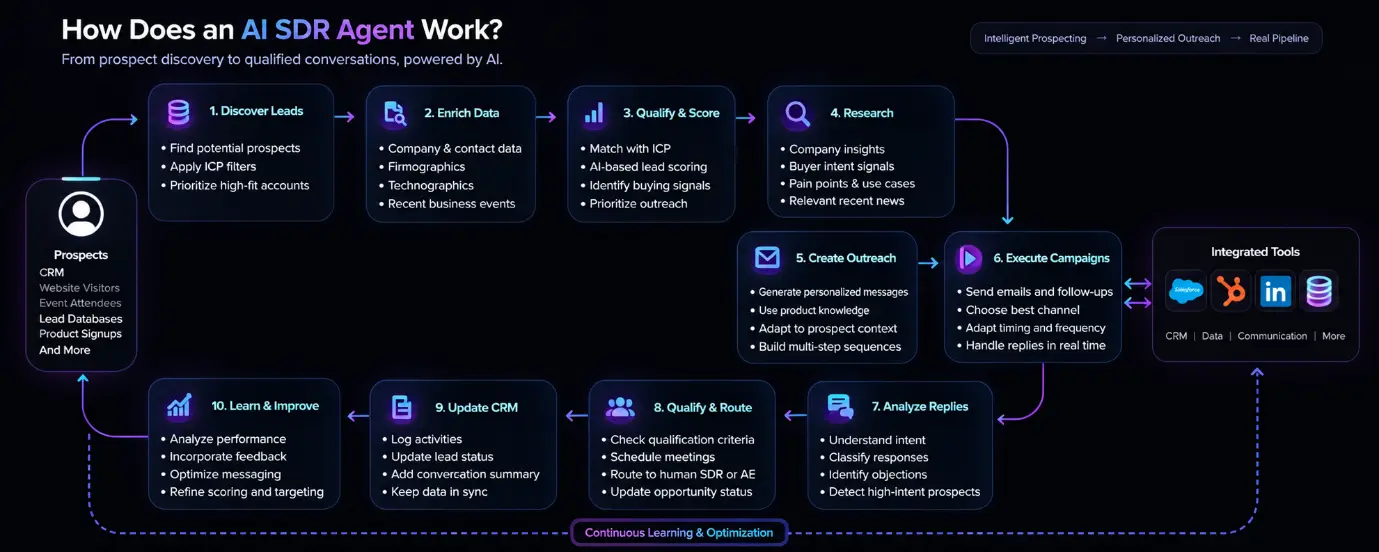
The AI SDR agent first identifies potential prospects from sources such as CRM databases, lead lists, website forms, product signups, intent platforms, event registrations, and other sales data sources. It can apply predefined ICP criteria to prioritize prospects that are more likely to become customers.
After finding a prospect, the agent collects additional information about the company and contact. This may include company size, industry, revenue, technology stack, job role, seniority, recent hiring, funding, product launches, and other relevant business signals.
This enriched information gives the AI SDR agent enough context to make better sales decisions.
The agent evaluates whether the prospect matches the company's ideal customer profile (ICP). It can assign a lead score based on factors such as company characteristics, buyer persona, business requirements, technology usage, engagement, and buying intent.
High-fit prospects can receive higher priority, while poor-fit leads can be excluded or placed into a lower-priority workflow.
The AI SDR agent researches relevant information about the target account and decision-maker. It can identify business events, potential pain points, technology changes, growth initiatives, and other signals that may create a reason for outreach.
The agent uses the research data, product knowledge, sales playbook, and prospect context to create personalized outreach. Instead of sending identical messages to every prospect, it can adapt the messaging according to the prospect's role, company situation, industry, and potential business challenges.
When a prospect responds, the AI SDR agent analyzes the message to determine intent. It can recognize positive interest, objections, questions, meeting requests, referrals, or opt-out requests and determine the appropriate next action.
The agent can automatically update CRM records with conversation summaries, lead status, qualification information, and recommended next steps. High-intent prospects or complex conversations can then be handed over to human SDRs or account executives.
In this way, AI SDR agent development creates an intelligent sales workflow that continuously moves prospects from discovery to qualified conversation while keeping human salespeople involved where their judgment has the greatest value.
Why are sales technology companies investing in AI SDR agents now, and what makes a custom AI SDR product commercially viable when established platforms such as Artisan, 11x AI, and AiSDR already compete for the same market?
The answer is not simply automation. The real investment opportunity is the ability to build a proprietary sales intelligence and execution layer that understands why a prospect may buy, rather than simply identifying that something happened at the prospect's company.
For a sales technology startup, this distinction can become the foundation of product differentiation. A conventional AI SDR may trigger outreach when a company raises funding, publishes a job, or announces company news. A more sophisticated AI SDR agent development strategy can combine job postings, product reviews, professional activity, funding announcements, technology adoption, company changes, and other signals to construct a richer picture of the prospect's likely business challenges.
The commercial case for investing in AI sales technology is becoming stronger as organizations move beyond experimentation.
Gartner forecasts that worldwide AI spending will reach $2.59 trillion in 2026, representing a 47% increase from 2025. Within that forecast, AI software spending is projected to reach $453.2 billion in 2026, up from $282.9 billion in 2025. Gartner also forecasts AI application development platform spending to increase from $6.6 billion in 2025 to $8.4 billion in 2026.
For a startup developing an AI SDR product, this signals that AI application infrastructure is becoming a substantial software market rather than remaining a narrow experimental category.
More importantly, Gartner forecasts that the market for stand-alone AI agents and assistants across consumers and enterprises will grow 13 times between 2025 and 2030, reaching a projected $222 billion opportunity.
This creates an opportunity for companies that can develop specialized agents for revenue workflows rather than building generic AI assistants.
A major reason to invest in custom AI SDR agent development is that sales research itself is becoming increasingly AI-driven.
Gartner predicts that 95% of sellers' research workflows will begin with AI by 2027, compared with less than 20% in 2024. Gartner also found that sales organizations providing sellers with AI-enabled next-best actions were 2.6 times more likely to achieve commercial growth.
This creates an important product opportunity.
A future AI SDR does not need to stop at:
"This company recently raised funding."
It can potentially reason across multiple sources:
Job posting + product review + executive activity + funding + technology stack + company growth + previous engagement
and convert those signals into a hypothesis about the prospect's business challenge.
For example, a company hiring 20 enterprise account executives while receiving negative reviews about onboarding may indicate a very different sales challenge from a company hiring the same number of engineers.
That deeper context can become the foundation of personalization intelligence.
Funding announcements, company news, job postings, and basic firmographic information are increasingly accessible through commercial data providers.
That means simply adding more triggers may not create a durable competitive advantage.
A sales technology startup competing with Artisan, 11x AI, or AiSDR should therefore consider building intelligence around the relationship between signals, rather than simply collecting more signals.
For example:
Job Posting: Company is hiring revenue operations specialists.
Product Review: Customers complain about fragmented sales reporting.
Technology Signal: Company uses several disconnected sales tools.
Funding Signal: Company recently raised a growth round.
AI Interpretation: The organization may be entering a scaling phase where sales operations infrastructure is becoming a bottleneck.
The AI SDR can then generate outreach around the potential operational challenge rather than mentioning the funding announcement as superficial personalization.
This is a fundamentally different product proposition.
For a sales technology startup, building an AI SDR agent is not simply about reducing internal sales costs.
The development can create proprietary technology around:
Over time, the company can develop its own sales intelligence layer that becomes difficult for competitors to replicate.
The key is to avoid building a generic wrapper around an LLM.
The defensible product should sit in the workflow between:
Raw prospect data → Business challenge inference → Sales hypothesis → Personalized engagement → Conversation → Qualification → Revenue outcome
That workflow can become the core intellectual property of the product.
For a startup developing an AI SDR agent, profitability should be considered before development begins. The business needs to determine whether recurring customer revenue can cover AI inference, prospect data, enrichment APIs, cloud infrastructure, communication, maintenance, support, and customer acquisition costs.
Agentic sales products can generate significant variable costs because each prospect may require multiple AI operations for research, qualification, personalization, outreach, and reply analysis. Therefore, the architecture should include cost controls such as model selection, caching, usage limits, and efficient workflows. A clear pricing strategy should also be established early, whether based on seats, usage, accounts, meetings, or subscriptions. This helps create sustainable margins as customer usage scales.
The AI SDR market is becoming crowded.
Artisan, for example, raised $25 million in Series A funding in April 2025 and reported 250 customers and $5 million in ARR at that time. 11x had previously raised significant venture funding and positioned its products as AI digital workers for sales and other go-to-market functions.
This means a new entrant needs a clearly differentiated reason for customers to switch or adopt another product.
For the startup described in the target query, one possible positioning is:
"An AI SDR that understands the prospect's business problem, not just the prospect's company news."
That positioning can be supported by an intelligence architecture that analyzes:
The product can then translate those signals into a potential business challenge and use that context to determine outreach strategy.
A common mistake during AI SDR agent development is allocating most of the budget toward the visible product interface.
The more strategically important components are often behind the interface:
Data ingestion → Signal extraction → Entity resolution → Context layer → Reasoning → Personalization → Agent orchestration → CRM integration → Outcome measurement
This is where a development partner needs expertise in:
The goal is to create an AI system that can reliably transform fragmented information into useful sales decisions.
For a startup building a competing AI sales product, selecting a development partner requires a different evaluation process from hiring a conventional software development agency.
Look for teams that can demonstrate experience with production AI agents, sales automation, CRM integrations, data pipelines, and measurable sales workflows.
A few companies with publicly documented relevant work include:
Azumo: Azumo is headquartered in San Francisco and provides custom AI development. Its publicly documented AI SDR case study describes an autonomous outbound system that sources, qualifies, personalizes, and sends outbound email, with human approval controls. The company reports 409 logged autonomous runs with clean completion or intentional safe stops and no duplicate-send incidents in more than 100 days.
A.Team: A.Team provides access to senior AI-ready product development teams and publicly documents work on Valley, an AI-powered sales automation platform designed to automate prospect research, personalized conversations, and meeting scheduling.
When evaluating these or other companies that develop AI SDR agents for startups, ask for evidence in five areas:
Do not select a vendor solely because it can demonstrate an impressive AI SDR interface.
For a competitive sales technology product, the development partner should be capable of building the underlying data, intelligence, orchestration, evaluation, and revenue attribution infrastructure.
For a startup competing in the AI SDR market, the investment decision should ultimately be evaluated across four dimensions:
| Investment Area | Key Question |
|---|---|
| Product | Does the agent solve a problem existing AI SDRs do not solve well? |
| Technology | Can the architecture process multiple prospect signals reliably and economically? |
| Profitability | Can customer revenue exceed AI, data, infrastructure, and acquisition costs at scale? |
| Differentiation | Is the intelligence difficult for competitors to replicate? |
This framework is more useful than simply estimating the cost of building an AI agent.
A company can spend $100,000 building an impressive AI SDR and still have an unprofitable product if inference, data, acquisition, and support costs are too high. Conversely, a focused MVP that solves one high-value sales intelligence problem can establish product-market fit before the company commits to a much larger platform.
The strongest reason to invest in AI SDR agent development is not automation alone. It is the opportunity to build a proprietary sales intelligence engine that understands prospect-specific business challenges and converts that intelligence into commercially relevant engagement.
For a sales technology startup, deeper personalization intelligence, measurable revenue outcomes, and sustainable unit economics should be the foundation of the investment decision, not simply the ability to send more automated outreach.
Also Read: How to Develop a Multi-Agent AI System: Steps and Cost
For B2B SaaS companies, AI SDR agent development can address one of the biggest sales challenges: too much SDR time is spent on repetitive prospecting work instead of meaningful sales conversations. This is especially relevant to the real-world use case of an eight-person SDR team spending around 70% of its time on research, list building, qualification, and personalized outreach.
A well-designed AI SDR agent can take over repetitive execution while helping sales teams work with better prospect context and more consistent workflows. Below are the top benefits of developing an AI SDR agent for modern B2B sales teams.
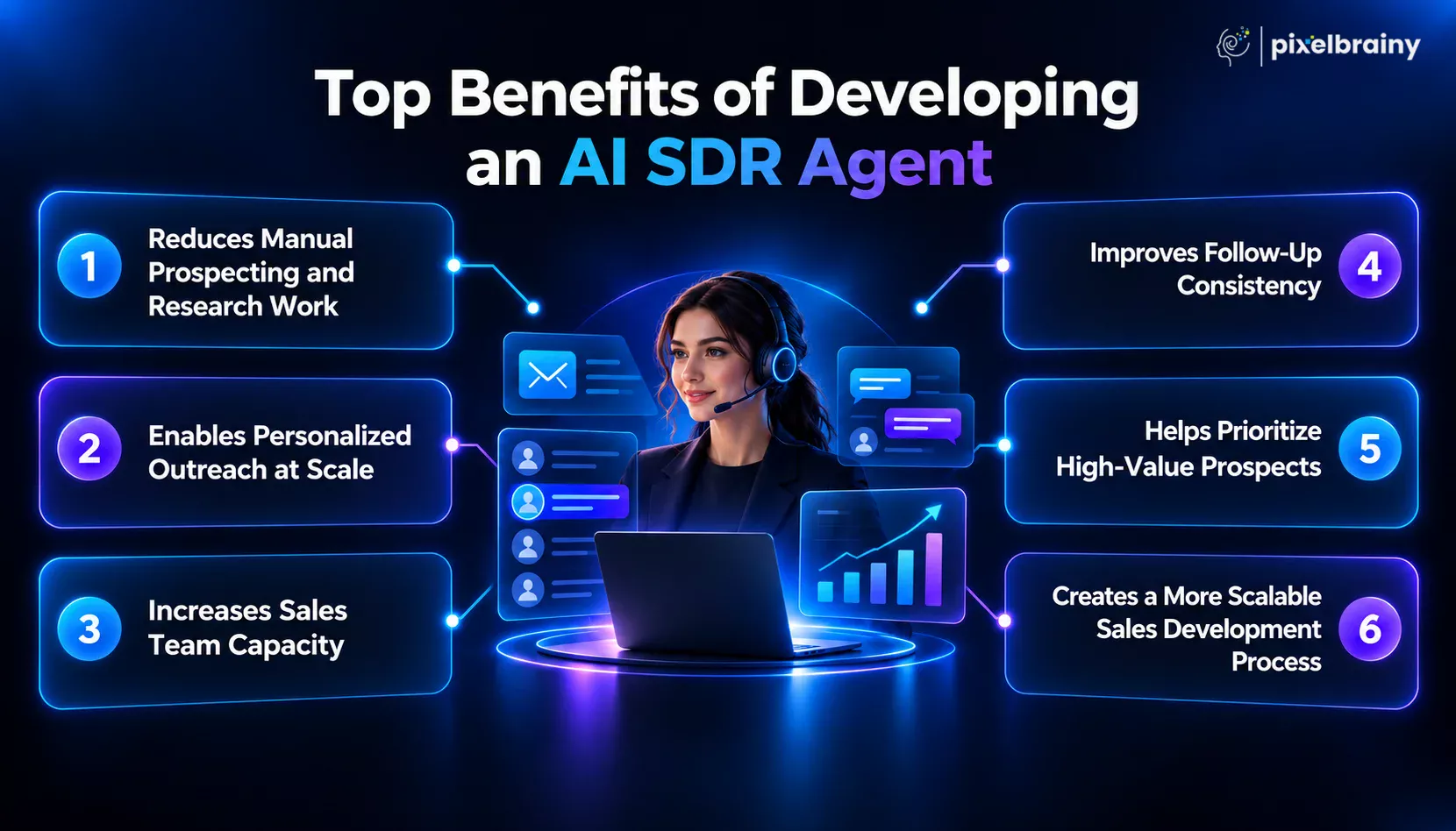
An AI SDR agent can automate time-consuming activities such as finding prospects, enriching contact information, researching companies, checking job postings, and identifying relevant business signals.
Instead of spending hours collecting information manually, SDRs can review AI-generated prospect intelligence and focus on accounts that require human attention.
This is particularly valuable for companies where SDRs spend a large portion of their working hours on research and list building.
Manual personalization becomes difficult when an SDR needs to contact hundreds of prospects. AI can analyze information about each account and contact before creating an outreach message.
A more advanced AI SDR agent with personalized outreach can consider job responsibilities, company developments, product reviews, funding activity, hiring patterns, and other signals.
This allows personalization to move beyond inserting a prospect's name or mentioning recent company news.
An AI SDR agent can handle repetitive prospecting activities across a much larger account list than a small human team can manage manually.
This gives businesses the ability to expand prospect coverage without increasing SDR workload at the same rate.
Human SDRs can then concentrate on qualified prospects, discovery conversations, strategic accounts, and opportunities where human judgment is more valuable.
Prospects can be missed when SDRs manage large numbers of conversations manually. An AI SDR agent can track interactions and determine when a follow-up is appropriate.
It can also analyze previous communication before generating the next message, helping maintain continuity throughout the conversation.
This creates a more consistent prospecting process and reduces the possibility of qualified leads being forgotten after the first interaction.
Not every prospect deserves the same level of sales attention. An AI SDR agent can evaluate prospects using ICP fit, engagement, buying signals, company characteristics, and available business intelligence.
The system can then prioritize accounts that appear more relevant to the company's offering.
This helps SDR teams spend more time on prospects with stronger potential instead of treating every lead equally.
A well-developed AI SDR agent can connect prospect research, qualification, personalization, outreach, follow-up, and CRM updates into one intelligent workflow.
This creates a scalable process that can adapt as the sales organization grows.
For startups and B2B SaaS companies, this means developing an AI SDR agent can become more than a productivity project. It can become part of the company's long-term sales infrastructure.
The biggest advantage is simple: AI handles repetitive sales development work at scale, while human sellers focus their time on prospects and conversations that require real sales judgment.

For a professional services firm where senior partners currently identify prospects, research accounts, write outreach, and follow up manually, the right AI SDR agent development strategy should focus first on automating the core sales development workflow. The agent should be capable of researching prospects, understanding their business context, creating relevant outreach, managing follow-ups, and involving senior professionals only when genuine buying interest is detected.
For this use case, developing an AI SDR agent is not about building an advanced autonomous system from day one. The priority should be creating a reliable foundation that reduces research and outreach workload while maintaining control over client-facing communication.
Below are the 15 must-have features to implement when building an AI SDR agent for professional services and B2B outbound sales. Modern AI SDR systems commonly combine account research, contact intelligence, personalized outreach, qualification, reply handling, CRM synchronization, and meeting workflows
| Feature | Explanation |
|---|---|
| AI Prospect Identification | The AI SDR should identify potential clients based on defined criteria such as industry, company size, geography, service requirements, and target decision-maker roles. This reduces manual prospect discovery and creates a consistent starting point for outbound campaigns. |
| ICP-Based Lead Qualification | The system should evaluate prospects against the firm's ideal customer profile before initiating outreach. It can assess industry, company characteristics, decision-maker relevance, potential service requirements, and other qualification rules to prioritize accounts with stronger commercial potential. |
| Automated Lead Enrichment | Lead enrichment should automatically collect relevant information about prospects and companies, including company size, industry, leadership, technology, location, and business activities. This gives the AI SDR sufficient context to research and qualify prospects without extensive manual data collection. |
| Account Research | The AI SDR should research each target account before creating outreach. It can identify company initiatives, expansion plans, hiring activity, leadership changes, service requirements, and other relevant business information that may reveal a potential reason for starting a conversation. |
| Contact Research | The system should analyze the target decision-maker's role, responsibilities, seniority, department, and professional context. This helps determine whether the individual is relevant to the firm's services and allows the AI to create outreach appropriate to their position. |
| AI Lead Scoring | AI-powered lead scoring should rank prospects according to ICP fit, business relevance, engagement, and available buying signals. This allows senior partners to concentrate on accounts with stronger potential instead of manually reviewing every prospect in the database. |
| Personalized Message Generation | The AI should generate outreach using verified information about the prospect rather than relying only on templates. It can combine account research, contact information, service positioning, and relevant business challenges to create more credible and context-specific messages. |
| Multi-Step Outreach Sequences | The AI SDR should manage initial outreach and subsequent follow-ups according to predefined rules. Each follow-up should consider previous communication and prospect activity rather than repeatedly sending the same generic message. |
| Email and Outreach Automation | The agent should connect with approved communication systems to send or prepare outreach according to campaign rules. Sending limits, approval controls, suppression lists, and communication preferences should be built into the workflow to maintain responsible outreach. |
| Reply Detection and Classification | The AI should analyze incoming responses and classify them as interested, not interested, requesting information, asking for a meeting, referring another contact, or requesting no further communication. This allows the system to determine the appropriate next step. |
| AI Response Drafting | When a prospect responds, the AI should use the conversation history, prospect research, and approved service information to prepare an appropriate response. This helps senior professionals avoid spending time drafting routine replies while maintaining relevant and consistent communication. |
| Meeting Scheduling | When a prospect demonstrates genuine interest, the AI SDR should support meeting scheduling through connected calendars. It should consider availability, time zones, meeting preferences, and the appropriate senior professional before proposing or confirming a meeting. |
| CRM Integration and Synchronization | The AI SDR should synchronize prospect records, research information, outreach history, responses, qualification status, and meetings with the firm's CRM. This prevents information from becoming isolated inside the AI system and gives senior teams a complete prospect history. |
| Human Approval and Handoff | The system should define clear boundaries between autonomous work and human involvement. Routine research can be automated, while high-value prospects, complex questions, pricing discussions, and genuine buying interest can be transferred to senior partners for personal engagement. |
| Sales Activity Analytics | The AI SDR should track prospects researched, outreach activity, responses, qualified conversations, meetings, and conversion rates. These insights help the business determine which prospect segments and outreach approaches are generating meaningful opportunities and where the sales process needs improvement. |
For a professional services business, these core features create the foundation for an AI SDR agent with personalized outreach that can handle research and initial engagement while bringing senior professionals into the process when a prospect shows genuine commercial interest.
The right core features allow an AI SDR to handle repetitive prospecting work while keeping senior expertise focused on qualified, high-value conversations.
Once the core capabilities of an AI SDR agent are working reliably, businesses can introduce advanced features that make the system more intelligent, adaptive, and capable of handling complex sales development workflows.
For companies looking to build an AI SDR agent from scratch, these capabilities can help create stronger differentiation from basic sales automation platforms. They are particularly useful for businesses that want an AI SDR to understand deeper prospect context, make better decisions, and continuously improve its outreach strategy.
For example, a professional services firm could use advanced AI capabilities to move beyond basic prospect research and identify relationships between a prospect's hiring activity, business expansion, customer feedback, funding, and other signals to determine why the prospect may need a particular service.
Below are 10 advanced features to consider while developing an AI SDR agent.
| Advanced Feature | Explanation |
|---|---|
| Multi-Agent Architecture | A multi-agent architecture divides the SDR workflow between specialized AI agents such as research, qualification, personalization, outreach, and reply agents. Each agent performs a specific responsibility, making complex sales workflows easier to manage, evaluate, and optimize. |
| Deep Buying Signal Detection | Advanced buying signal detection can analyze multiple prospect signals simultaneously, including hiring patterns, funding, product launches, technology changes, leadership movements, reviews, and professional activity. Combining signals can provide stronger context than relying on individual company events. |
| AI-Powered Business Challenge Detection | Instead of simply identifying what happened at a company, the AI can interpret multiple signals to estimate potential business challenges. This allows the SDR agent to create outreach around a prospect's possible needs rather than sending generic messages based on company news. |
| Dynamic Sequence Optimization | Dynamic sequencing allows the AI SDR to adjust outreach based on prospect behavior. The system can change messaging, timing, follow-up frequency, or communication paths depending on responses, engagement, intent, and previous interactions instead of following one fixed sequence. |
| AI-Powered Next-Best Action | The agent can evaluate the available prospect context and recommend the most appropriate next action. Depending on the situation, it may recommend additional research, another email, a follow-up, a phone call, a meeting request, or immediate human intervention. |
| Real-Time Prospect Intelligence | Real-time intelligence allows the AI SDR to continuously incorporate newly available information about target accounts. When important events occur, the system can update prospect context and determine whether the new information creates a relevant reason for sales engagement. |
| Conversation Intelligence and Intent Analysis | Advanced conversation intelligence can analyze prospect responses to understand intent, objections, urgency, sentiment, questions, and potential purchase signals. The agent can then use this information to determine whether the conversation should continue automatically or be transferred to a salesperson. |
| AI Sales Memory and Context Management | An AI SDR should maintain relevant context across prospect interactions, including previous messages, research findings, objections, preferences, and qualification information. This prevents repetitive conversations and helps the agent provide more consistent responses throughout longer sales cycles. |
| Autonomous Campaign Optimization | The system can analyze campaign performance and identify which personas, industries, messages, signals, and sequence structures are producing stronger results. Based on predefined controls, it can recommend or automatically apply approved optimizations to future outreach. |
| AI Revenue Attribution and Learning Loop | An advanced AI SDR can connect outreach activity with meetings, opportunities, pipeline, and revenue outcomes. This creates a feedback loop where actual sales results can help evaluate prospecting strategies and improve future targeting, qualification, and personalization. |
These advanced capabilities can turn an AI SDR from a basic automated outreach tool into an adaptive sales intelligence and execution system that continuously improves with prospect and revenue data.
How can a B2B SaaS startup build an AI SDR agent that researches every prospect individually and creates genuinely personalized outreach instead of sending obviously templated AI emails?
This is a key question for businesses building an AI SDR agent as a commercial product. Consider a startup building an AI SDR agent specifically for B2B SaaS companies where the core differentiation is genuinely personalized outreach. The objective is to develop a personalization engine that researches each prospect individually using LinkedIn, company news, job postings, and technology stack signals, then uses those insights to create outreach that references something specific and commercially relevant to that prospect.
This requires more than connecting an LLM to an email platform. The architecture needs a research layer that gathers prospect information, a data processing layer that validates and organizes those signals, an intelligence layer that identifies meaningful business challenges, and a personalization engine that converts those insights into relevant messaging.
The AI sales development representative (SDR) agent development process should therefore connect prospect research, signal analysis, business challenge detection, message generation, outreach execution, response analysis, and CRM workflows.
The following 8 steps to develop an AI SDR agent from idea to launch explain how businesses can move from defining the product and research architecture to developing, testing, and launching an AI SDR system capable of delivering genuine personalization at scale.
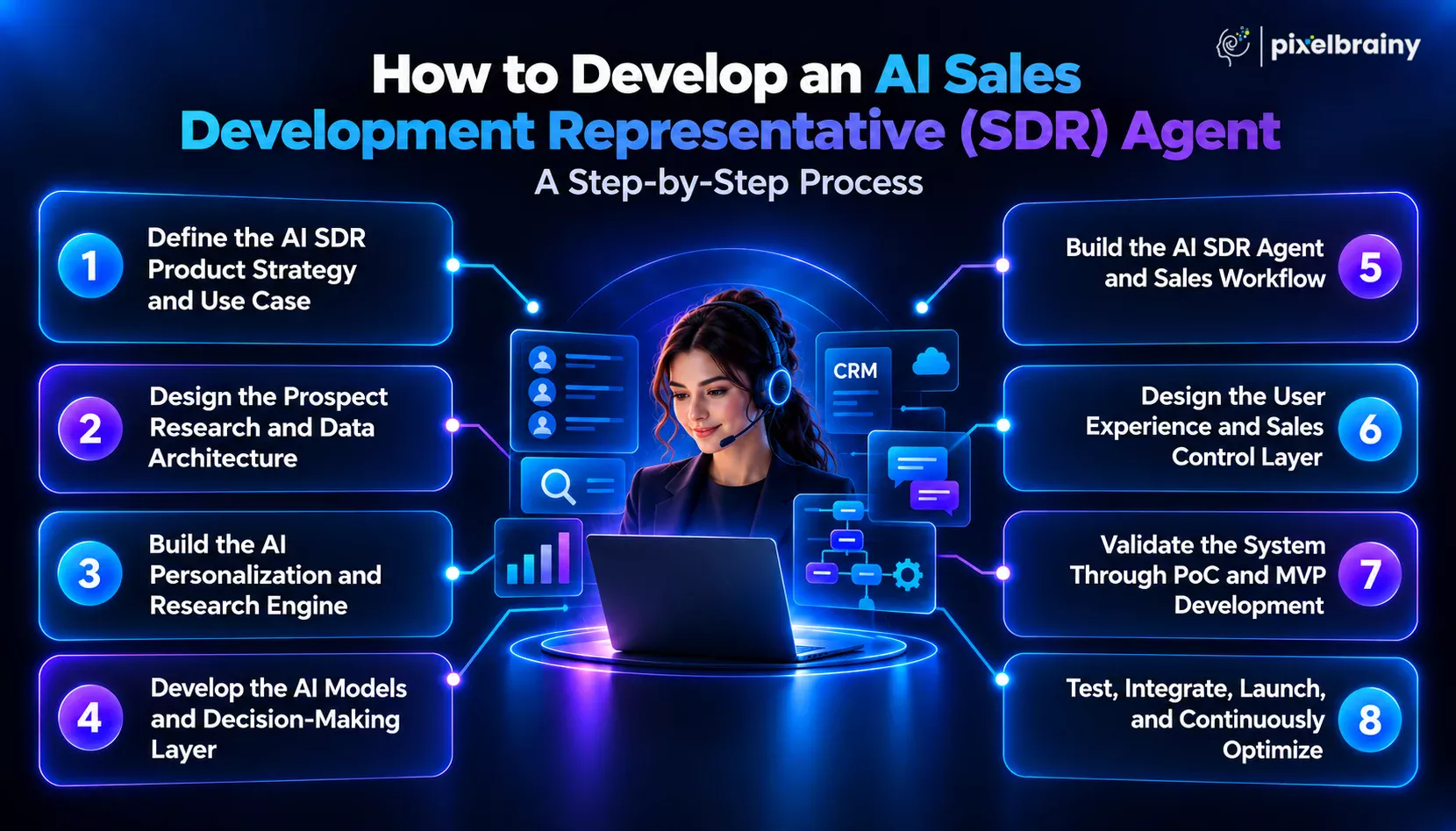
The first step in AI sales development representative (SDR) agent development is defining exactly what the product needs to accomplish. Start by identifying the target customers, ideal customer profile, sales workflow, primary users, and specific problems the AI SDR will solve.
For a B2B SaaS product, the differentiation may be genuine personalization rather than generic AI-generated emails. Define what "personalized" means in measurable terms. For example, the agent should research each prospect, identify a specific business challenge, connect that challenge to the product's value proposition, and generate outreach using verified context.
At this stage, businesses can use AI consultation to validate the product concept, workflow, target market, and technical feasibility before investing heavily in development.
The quality of personalization depends heavily on the quality of prospect research. Therefore, the next stage is designing an architecture that collects relevant information from approved data sources and organizes it into a unified prospect profile.
The system can connect company information, professional data, job postings, technology stack signals, company announcements, product reviews, funding information, CRM records, and previous interactions.
The architecture should include data ingestion, enrichment, normalization, entity resolution, source tracking, freshness checks, and storage. Every signal should be connected to the correct company and individual.
This research layer becomes the foundation for AI integration, because the AI needs reliable context before it can make personalization decisions.
This is the core stage for a product that wants to deliver genuinely personalized outreach. Instead of passing all available information directly to an LLM, the personalization engine should first identify which signals are commercially relevant to the prospect.
A useful workflow can be:
Research → Signal Extraction → Signal Ranking → Business Challenge Detection → Product Relevance → Message Angle → Outreach Generation
For example, a job posting may indicate that a company is expanding its sales operations, while technology data shows multiple sales tools and reviews reveal operational difficulties. The engine can combine these signals to form a potential business hypothesis.
The LLM should then use that verified context to create outreach instead of inventing personalization.
Once the research architecture is established, the next step is implementing the intelligence layer that determines what the collected information means.
AI model development may involve several specialized capabilities, including classification, summarization, lead scoring, signal ranking, intent detection, business challenge identification, and message generation.
Not every task requires the largest or most expensive model. Smaller models can handle classification and extraction, while stronger reasoning models can handle complex research interpretation and personalization.
A structured output layer should also validate AI responses before they reach the outreach system. This helps prevent unsupported claims, irrelevant information, and generic messaging from being sent to prospects.
Also Read: Top 12+ AI Model Development Companies in the USA
After the intelligence layer is ready, the next stage is AI agent development for SDR. The agent should connect research, qualification, personalization, outreach, reply handling, and CRM workflows into an organized process.
A possible architecture is:
Research Agent → Qualification Agent → Personalization Agent → Outreach Agent → Reply Agent → CRM Agent
The system should include clear instructions, tool permissions, decision rules, confidence thresholds, escalation conditions, and human approval points.
For companies planning to hire AI developers for this stage, experience with agent orchestration, LLM applications, data pipelines, CRM integrations, and production AI systems is more important than experience with simple chatbot development.
An AI SDR should not operate as an invisible system. Sales teams need visibility into what the agent researched, why it selected a particular signal, how the message was generated, and what action it plans to take.
The interface can provide:
A specialized UI/UX design company can help create an interface that makes complex AI decisions understandable to sales users without overwhelming them with technical information.
The objective is to make human oversight simple while keeping the autonomous workflow efficient.
Before launching the complete product, validate the most important technical assumption: Can the system consistently produce genuinely relevant personalization at scale?
During PoC development, test a controlled number of prospects across different industries and personas. Compare AI-generated outreach against manually researched outreach and evaluate research accuracy, personalization quality, response relevance, and unsupported claims.
After validating the core concept, move into MVP development with essential functionality such as prospect research, data enrichment, personalization, outreach, reply classification, CRM integration, and analytics.
This approach reduces development risk and allows the startup to validate product-market fit before building more sophisticated capabilities.
Also Read: Top 10 AI MVP Development Companies in USA
The final stage of developing an AI SDR agent is preparing the system for production. Conduct technical testing, AI output evaluation, security testing, integration testing, deliverability testing, and workflow testing before exposing the system to large-scale outreach.
Track metrics such as:
After launch, use real sales outcomes to improve the system. This is where AI product development companies and experienced AI agent development companies can provide value when building evaluation frameworks, monitoring systems, and continuous optimization workflows.
The goal is not simply to create an AI SDR agent that works technically. It is to build a sales system that becomes more accurate, relevant, efficient, and commercially valuable as real prospect and revenue data accumulates.
A successful AI SDR development process combines reliable prospect intelligence, strong personalization logic, controlled AI decision-making, and continuous feedback from real sales outcomes.
Also Read: How To Build An AI Agent: A Step-by-Step Guide
The cost to develop an AI SDR agent generally ranges from $25,000 to $200,000+, depending on the level of intelligence, number of integrations, personalization depth, automation requirements, security, and scalability. For businesses asking, "What is the development pricing of an AI Sales Development Representative (SDR) agent?", there is no single fixed price because a basic lead qualification agent and an enterprise AI SDR platform are very different products.
For a B2B SaaS startup, the development budget of an AI SDR agent should account for more than the AI model. Prospect data, enrichment APIs, CRM integrations, research infrastructure, personalization engines, workflow orchestration, testing, monitoring, and ongoing maintenance can significantly influence the final AI SDR agent development cost.
Current 2026 AI agent development benchmarks place focused production agents around the tens of thousands of dollars, while multi-agent and enterprise systems can reach $200,000 or considerably higher depending on scope.
For a practical AI SDR agent cost estimation, the following three development levels provide a useful starting point.
| AI SDR Agent Type | Estimated Development Cost | Typical Scope |
|---|---|---|
| Basic AI SDR Agent | $25,000 to $50,000 | Prospect research, lead qualification, basic personalization, email generation, simple outreach workflows, basic CRM integration, and analytics |
| Advanced AI SDR Agent | $50,000 to $120,000 | Deep prospect research, multi-source enrichment, personalized outreach, reply analysis, lead scoring, CRM and calendar integrations, workflow automation, human approval, and monitoring |
| Enterprise AI SDR Agent | $120,000 to $200,000+ | Advanced personalization intelligence, multiple AI agents, extensive data integrations, enterprise CRM systems, security controls, advanced analytics, custom workflows, scalability, governance, and production monitoring |
These ranges are development estimates rather than fixed vendor prices. Current 2026 market estimates for production AI agents show similar variation, with production systems commonly reaching $80,000 to $200,000 and more complex multi-agent systems moving beyond that range.
Estimated impact: $10,000 to $60,000+
A basic agent that qualifies leads and drafts emails requires significantly less development than an autonomous AI SDR that researches prospects, analyzes buying signals, manages conversations, and takes actions across multiple platforms.
The more decisions the agent can make independently, the higher the development effort.
Estimated impact: $5,000 to $30,000+
If the AI SDR needs to research LinkedIn activity, company news, job postings, funding announcements, technology stacks, reviews, and other prospect signals, additional data pipelines and enrichment integrations are required.
This becomes a major cost component for products focused on deep personalization.
Estimated impact: $8,000 to $35,000+
Basic personalization can use templates and CRM variables. Advanced personalization requires signal extraction, relevance scoring, business challenge detection, context selection, and AI-generated messaging.
For an AI SDR product competing on genuine personalization, this can become one of the most important development investments.
Estimated impact: $3,000 to $20,000+ for initial implementation
The cost depends on model selection, orchestration, prompt architecture, RAG, evaluation, model routing, and expected usage.
Using smaller task-specific models for simpler operations can help reduce ongoing inference expenses. Recent reporting also highlights the growing use of specialized models to reduce AI costs in high-volume workflows.
Estimated impact: $5,000 to $25,000+
Integrating Salesforce, HubSpot, Microsoft Dynamics, or other CRM platforms requires API development, authentication, data mapping, synchronization, error handling, and testing.
A single basic CRM integration costs considerably less than supporting multiple enterprise CRM environments.
Estimated impact: $3,000 to $15,000+
Email infrastructure, communication APIs, calendar systems, sending controls, bounce handling, opt-out management, and campaign workflows all contribute to development costs.
More communication channels generally increase both development and maintenance requirements.
Estimated impact: $10,000 to $40,000+
A single AI workflow is less expensive than a multi-agent architecture involving dedicated research, qualification, personalization, outreach, and reply agents.
Agent orchestration also requires workflow management, permissions, tool access, failure handling, and evaluation.
Estimated impact: $5,000 to $25,000+
A basic admin dashboard may provide prospect and campaign information. An enterprise product may require detailed views for prospect research, AI reasoning, approvals, conversations, campaigns, pipeline, and performance analytics.
The complexity of the user interface directly affects development time.
Estimated impact: $5,000 to $30,000+
Enterprise AI SDR products may require encryption, role-based access, audit logs, data retention policies, secure API access, permission controls, and compliance workflows.
Security requirements become particularly important when the AI SDR accesses CRM records and customer information.
Estimated impact: $5,000 to $25,000+
Production AI SDR systems require more than conventional software testing.
Teams need to evaluate personalization quality, hallucinations, incorrect prospect information, inappropriate responses, workflow failures, API errors, and AI decision accuracy.
Monitoring also helps identify rising inference costs and unexpected agent behavior after launch.
Estimated recurring cost: $2,000 to $15,000+ per month
The initial development budget does not cover all post-launch expenses.
Businesses should plan for ongoing costs involving:
Current 2026 AI agent cost benchmarks similarly emphasize that recurring inference, hosting, monitoring, and maintenance costs need to be included in the overall budget rather than treated as an afterthought.
Businesses can control the AI SDR agent development cost by starting with a focused scope rather than building the entire autonomous sales platform immediately.
A practical approach is:
Core workflow → Controlled MVP → Production pilot → Performance validation → Advanced capabilities → Enterprise scaling
For example, the initial version can focus on prospect research, ICP qualification, personalized email generation, CRM integration, and human approval. Advanced multi-agent orchestration, autonomous optimization, extensive data sources, and sophisticated revenue intelligence can be added after the core workflow demonstrates value.
This approach helps businesses control the initial AI SDR agent development budget while validating whether the product can generate measurable sales outcomes before committing to a larger investment.
In short, a realistic AI SDR development budget starts around $25,000 for a focused system and can exceed $200,000 for a sophisticated enterprise platform, with complexity, integrations, personalization, and ongoing AI operations being the biggest cost drivers.
Also Read: AI Agent Development Cost ($10K-$100K+): Factors and Cost Optimization Tips
Building an AI SDR agent is not just about connecting an LLM to an email platform. The agent needs the right technology stack to find prospects, understand their business context, identify relevant signals, personalize outreach, manage conversations, qualify leads, and update sales systems automatically.
So, if you are planning AI SDR agent development, the technology decisions made at the architecture stage can directly affect the agent's personalization quality, reliability, scalability, integration capability, and overall development cost.
A typical business may ask: What tools and technologies are required to develop an AI SDR agent that can research prospects across multiple sources, generate context-aware outreach, follow up automatically, and hand qualified opportunities to sales representatives?
The answer depends on the scope of the product. A basic AI SDR can operate with an LLM, CRM, enrichment API, email infrastructure, and database. A more sophisticated platform requires agent orchestration, RAG, vector databases, real-time data pipelines, evaluation systems, security controls, observability, and multiple business integrations.
For how to build an AI SDR agent from scratch, the technology stack should therefore be planned around the complete sales workflow rather than individual features. The following table breaks down the core tools and technologies required for developing a production-ready AI SDR agent.
| Tech Stack / Tool Category | Recommended Technologies | Purpose in AI SDR Agent Development |
|---|---|---|
| Large Language Models | OpenAI, Anthropic, Google Gemini, open-source LLMs | LLMs provide the reasoning and language generation layer for prospect research, qualification, email generation, reply analysis, objection handling, and sales conversation support. Multiple models can be used depending on task complexity, latency, accuracy, and operating cost. |
| AI Agent Framework | LangGraph, LangChain, OpenAI Agents SDK, Semantic Kernel | An agent framework manages the AI SDR's reasoning, tool usage, memory, workflow states, and decision-making. It allows the system to move from simple text generation toward an agent that can independently research a prospect, decide what to do next, and execute approved actions. |
| Agent Orchestration | LangGraph, Temporal, workflow engines, custom orchestration services | Orchestration coordinates multiple AI tasks and business workflows. A research agent can gather information, a qualification layer can score the prospect, and an outreach agent can create and execute the next action. This architecture is useful when building complex AI SDR workflows. |
| CRM Integration | Salesforce, HubSpot, Microsoft Dynamics, Pipedrive, Zoho CRM | CRM integration gives the AI SDR access to lead, account, contact, opportunity, ownership, activity, and lifecycle information. The agent should also write research findings, qualification results, outreach activity, and conversation outcomes back into the CRM. |
| Lead Enrichment APIs | Apollo, ZoomInfo, Clearbit alternatives, People Data Labs, Clay | Enrichment services provide company and contact information that may not exist in the CRM. This can include job title, company size, industry, location, technology usage, contact information, and other attributes required for ICP qualification and personalization. |
| Web Research and Data Collection | Search APIs, browser automation, web extraction services, compliant data providers | The research layer helps the AI SDR collect current information about prospects, including company announcements, hiring activity, product changes, funding, technology signals, and other relevant business context. Fresh data is important because outreach quality depends heavily on the context available to the agent. |
| Vector Database | Pinecone, Weaviate, Qdrant, Milvus, pgvector | A vector database stores embeddings and enables semantic retrieval. It can help the AI SDR retrieve relevant product information, previous conversations, sales materials, company knowledge, and prospect context before generating an answer or outreach message. |
| RAG System | LlamaIndex, LangChain retrieval, custom RAG pipelines | Retrieval-Augmented Generation allows the AI SDR to ground its responses and decisions in current business information instead of relying only on the model's training knowledge. This is especially useful for product questions, company information, sales policies, and historical prospect context. |
| Database | PostgreSQL, MySQL, MongoDB | The application database stores users, prospects, accounts, campaign configuration, agent states, research results, workflow records, approvals, and other application data. PostgreSQL is often suitable when the system requires structured relational data alongside AI application workflows. |
| Email Infrastructure | Gmail API, Microsoft Graph API, SendGrid, Amazon SES, Postmark | Email infrastructure enables the AI SDR to send approved outreach, process incoming replies, maintain conversation threads, and execute follow-up sequences. Production systems should also include deliverability controls, sending limits, authentication, and opt-out handling. |
| Calendar Integration | Google Calendar API, Microsoft Graph Calendar API, Calendly | Calendar integrations allow the AI SDR to move qualified prospects from conversation to meeting. The agent can identify meeting intent, provide available times or scheduling links, create meetings, and update the CRM after booking. Salesforce's current SDR agent architecture similarly connects outreach, qualification, and meeting scheduling. |
| Communication and Notification Layer | Slack, Microsoft Teams, email notifications, webhooks | This layer keeps human sales representatives informed when the AI SDR requires approval, detects high buying intent, receives an important reply, or reaches a predefined escalation condition. |
| Authentication and API Management | OAuth 2.0, API gateways, JWT, role-based access control | AI SDR agents interact with sensitive CRM, email, calendar, and customer information. Authentication and authorization controls ensure that the agent can access only the systems and actions permitted for its role. |
| Guardrails and Approval Layer | Rule engines, approval workflows, policy checks, human-in-the-loop controls | Guardrails prevent the AI SDR from sending inappropriate messages, contacting restricted prospects, making unsupported claims, or taking actions outside its authority. Human approval can be required for sensitive emails, high-value accounts, unusual requests, or uncertain decisions. |
| Observability and AI Monitoring | LangSmith, Langfuse, OpenTelemetry, custom dashboards | Monitoring tracks agent decisions, tool calls, latency, errors, token consumption, failed workflows, and message quality. Observability is especially important because autonomous agents can execute multiple steps before producing a final outcome. |
| AI Evaluation Framework | Custom evaluation datasets, LLM-as-judge, rule-based evaluation, human review | Evaluation measures whether research is accurate, personalization is relevant, lead scoring is consistent, and generated messages follow company policies. Testing should evaluate complete workflows rather than only individual prompts. |
| Cloud Infrastructure | AWS, Microsoft Azure, Google Cloud | Cloud infrastructure provides compute, storage, networking, databases, secrets management, monitoring, and deployment environments required to operate the AI SDR reliably at scale. |
| Backend Development | Python, FastAPI, Node.js, TypeScript | The backend connects AI models, databases, APIs, agent workflows, CRM systems, email services, enrichment providers, and business rules. Python is particularly useful for AI-heavy systems, while Node.js and TypeScript are strong options for API and application development. |
| Frontend Application | React, Next.js, Vue.js | The frontend gives sales teams visibility and control over prospects, research results, generated messages, campaign status, approvals, conversations, analytics, and agent activity. |
| Analytics and Reporting | Power BI, Tableau, Looker, custom dashboards | Analytics helps measure meetings booked, qualified leads, reply rates, conversion rates, pipeline contribution, campaign performance, agent activity, and human handoffs. These metrics help determine whether the AI SDR is producing actual sales value rather than simply generating activity. |
| Security and Compliance | Encryption, secrets management, audit logs, SOC 2 controls, GDPR and CCPA processes | Security infrastructure protects prospect and customer information while supporting enterprise requirements. Audit trails should record important agent actions, approvals, data access, and outbound communication. |
| Deployment and DevOps | Docker, Kubernetes, GitHub Actions, Terraform, CI/CD | DevOps tools support repeatable deployments, automated testing, version control, infrastructure management, rollback procedures, and scalable production operations. |
| Caching and Queue Infrastructure | Redis, Kafka, RabbitMQ, AWS SQS | Queues and caching help manage asynchronous research, enrichment, outreach, reply processing, and other background jobs. They become increasingly important when the AI SDR processes large numbers of prospects simultaneously. |
Therefore, the right AI SDR tech stack brings data, AI models, automation, integrations, and human oversight together to create a scalable sales development system that can research, engage, qualify, and convert prospects more effectively.
Should a business build a custom AI SDR agent or buy an AI SDR platform? The answer depends on what you expect the agent to accomplish, how unique your sales process is, how deeply it needs to connect with existing systems, and whether AI SDR capabilities are simply an internal productivity tool or a strategic part of your business.
Consider a B2B SaaS company asking: “We already have a CRM and sales engagement tools, but we want an AI SDR that researches every prospect using our CRM data, job postings, company updates, technology signals, and previous interactions before creating personalized outreach. Should we invest in custom AI SDR agent development or buy an existing AI SDR solution?”
This is where the difference between custom AI SDR agent development vs. buying an AI SDR agent becomes important.
A buy AI SDR agent approach is generally suitable when the business wants to launch quickly with established prospecting, enrichment, outreach, qualification, and meeting-booking capabilities. The company does not need to build the underlying AI infrastructure and can usually start with a subscription-based platform.
On the other hand, custom AI SDR agent development gives businesses greater control over how the agent researches prospects, evaluates leads, generates messages, follows sales rules, uses internal data, and interacts with existing systems. This approach can be particularly valuable when the sales process contains specialized workflows that standard AI SDR platforms cannot support effectively.
| Factor | Custom AI SDR Agent Development | Buy AI SDR Agent |
|---|---|---|
| Development Cost | Higher upfront investment because the agent, integrations, workflows, and intelligence layers are developed specifically for the business. | Lower initial investment because the core platform is already developed and usually offered through a subscription or usage-based model. |
| Time to Market | Requires planning, development, testing, integration, and deployment, so launching can take longer. | Faster implementation because the business can configure an existing platform and connect supported sales systems. |
| Personalization | Personalization logic can be designed around proprietary customer data, ICP rules, buying signals, and business-specific research requirements. | Personalization depends on the research sources, prompts, workflows, and capabilities provided by the vendor. |
| Integrations | CRM, ERP, data warehouse, communication systems, internal databases, and proprietary applications can be integrated according to business requirements. | Integration options are limited to the systems and APIs supported by the platform. |
| Data Control | Provides greater control over where sales data is stored, how it is processed, and which systems the AI agent can access. | Data handling depends on the vendor's infrastructure, policies, security controls, and available configuration options. |
| Scalability | Architecture can be designed specifically for the company's expected prospect volume, markets, workflows, and future product requirements. | Scalability depends on the vendor's infrastructure, pricing model, usage limits, and product roadmap. |
| Best Fit | Businesses with complex sales processes, proprietary data, specialized workflows, or plans to make AI SDR technology a long-term competitive advantage. | Businesses that prioritize faster deployment and need standardized AI-powered prospecting and outreach capabilities. |
Custom development makes sense when the AI SDR needs to do more than standard prospecting and email automation. For example, a company may want the agent to combine proprietary customer information with external research, identify business-specific pain points, apply unique qualification rules, and automatically adapt outreach based on prospect behavior.
It is also a strong option for companies planning to develop an AI SDR agent as a commercial product. In that case, the AI agent itself becomes part of the company's intellectual property and product strategy rather than simply being another sales tool.
Buying is usually more practical when the primary goal is to automate existing SDR activities without creating a new technology platform. Businesses with standardized outbound processes can benefit from faster deployment, predictable subscription costs, vendor-managed infrastructure, and continuous product updates.
Therefore, you can choose custom AI SDR agent development when your business needs proprietary sales intelligence, deeper personalization, and complete workflow control, while buying an AI SDR agent is better suited to businesses that prioritize faster deployment and ready-to-use sales automation.
Building an AI SDR agent involves much more than connecting an AI model with a CRM and email platform. A production-ready agent needs to understand prospect context, make reliable sales decisions, generate relevant communication, use business data correctly, and operate within clearly defined boundaries.
A common question from businesses planning AI SDR agent development is: “We want to develop an AI SDR agent that can research prospects, identify buying signals, personalize outreach, qualify responses, and update our CRM automatically, but how can we prevent inaccurate research, generic messaging, incorrect decisions, and uncontrolled automation as the system scales?”
These concerns are important because an AI SDR represents the business directly in conversations with potential customers. Poor research can result in irrelevant outreach, weak qualification can waste sales capacity, and uncontrolled automation can create compliance or brand risks.
The challenges of AI SDR agent development therefore need to be addressed during architecture, development, testing, and deployment rather than after the product goes live.
An AI SDR depends on prospect and company information to make good decisions. Outdated contact details, incorrect job titles, incomplete company information, or stale business signals can cause the agent to create irrelevant research and inaccurate outreach.
Solution: Build a reliable data pipeline that combines CRM information with reputable enrichment and research sources. Add data validation, freshness checks, duplicate detection, source tracking, and confidence scores so the agent can distinguish verified information from uncertain data.
Generating thousands of emails with an LLM does not automatically create personalized outreach. If every message follows the same structure or relies on generic company news, prospects may recognize the communication as automated and ignore it.
Solution: Develop a dedicated personalization engine that researches each prospect and identifies meaningful connections between their role, company situation, business challenges, and your offering. Use structured research inputs, retrieval systems, personalization rules, and quality evaluation before allowing messages to be sent.
An AI SDR may sometimes generate information that is unsupported by available data or incorrectly interpret a prospect's situation. This becomes especially risky when the agent independently qualifies leads, responds to questions, or makes decisions that affect the sales pipeline.
Solution: Ground agent decisions in verified business data through RAG, structured context, source attribution, and confidence thresholds. Introduce approval requirements for uncertain or high-impact actions and create evaluation datasets to continuously test research accuracy, qualification, and response quality.
An AI SDR usually needs to interact with several systems, including CRM platforms, enrichment services, email providers, calendars, sales engagement tools, and internal databases. Poor integration design can result in duplicate records, incorrect CRM updates, failed workflows, and inconsistent customer information.
Solution: Use well-defined APIs, webhooks, authentication controls, integration services, and standardized data models. Design every agent action with clear permissions and error handling. Maintain activity logs so sales teams can see what information the agent accessed and which actions it performed.
Giving an AI SDR too much autonomy can create operational and reputational risks. The agent could send an unsuitable message, contact the wrong person, continue communicating after a negative response, or take an action that should require human judgment.
Solution: Introduce human-in-the-loop controls and clearly defined guardrails. Set rules for sending messages, handling sensitive conversations, escalating objections, modifying CRM records, and contacting high-value accounts. The agent should automatically hand off situations that exceed its defined authority.
Activity metrics such as emails sent, prospects researched, or replies generated do not necessarily indicate business value. A poorly designed AI SDR can produce high activity while generating few qualified meetings or meaningful pipeline opportunities.
Solution: Connect AI SDR analytics with actual sales outcomes. Track qualified leads, positive replies, meetings booked, opportunity creation, pipeline contribution, conversion rates, response quality, cost per qualified meeting, and human handoff rates. Use these metrics to identify weak workflows and continuously improve the agent.
Addressing these six challenges during AI SDR agent development helps businesses create an agent that is accurate, personalized, controlled, integrated, and capable of producing measurable sales outcomes.
From the above discussion, it is now time to identify the right development partner that can turn an AI SDR concept into a reliable, scalable sales product. A successful sales agent requires more than an AI model. It needs the right combination of prospect intelligence, personalization, workflow automation, CRM integration, decision-making logic, security, and human oversight.
A common question business ask at this stage is: “We want an AI SDR that researches every prospect individually using CRM information, company updates, job postings, technology signals, and previous interactions, then creates genuinely personalized outreach instead of generic AI-written emails. How can we turn this idea into a production-ready product that can scale with our sales operation?”
This is where PixelBrainy as a leading AI agent development company helps businesses transform their sales automation ideas into practical AI solutions. Our approach starts with understanding the sales workflow, identifying where autonomous intelligence can create measurable value, and then designing the technology around those requirements.
Our AI SDR agent development services cover the complete product journey, from initial discovery and technical planning to AI architecture, integrations, development, testing, deployment, and ongoing optimization.
Businesses can build AI SDR agent solutions around their own ICP criteria, qualification rules, prospect research process, personalization requirements, CRM workflows, approval controls, and sales methodology. This creates a solution that works according to the organization's sales process instead of forcing the business to adapt to a generic platform.
To demonstrate this approach, here is a high-level example from a confidential client engagement. Specific client information and commercially sensitive details are intentionally excluded.
Aim:
Create an AI-powered workflow that could handle information-intensive processes while reducing the amount of repetitive manual work handled by the client's team.
Business Goal:
Improve operational efficiency by introducing AI-driven decision support and automation across multiple stages of an existing workflow, while maintaining appropriate human control over important actions.
Our Approach:
PixelBrainy first analyzed the existing business workflow and identified repetitive activities, decision points, data requirements, and integration dependencies. We then designed an agent architecture capable of handling multiple connected tasks instead of operating as a standalone conversational interface.
Technology Focus:
The solution incorporated AI-driven decision logic, workflow orchestration, relevant system integrations, structured data handling, and controlled automation. The architecture was designed with scalability and future workflow expansion in mind.
Development Process:
The engagement progressed through discovery, workflow analysis, AI architecture, integration planning, implementation, testing, and deployment. Each stage was validated against the client's operational requirements before moving toward production.
Outcome:
The resulting solution established a structured foundation for AI-assisted workflow automation, reduced dependency on repetitive manual activities, and created an architecture that could support additional automation use cases as the business evolved.
Companies looking to develop AI SDR agent solutions need a technology partner that understands both AI capabilities and real business workflows. PixelBrainy combines AI engineering, product development, integrations, UX, and scalable architecture to create AI solutions designed for practical business use.
Our approach to SDR agent development integrating AI focuses on creating systems that can research, reason, personalize, automate, and escalate tasks appropriately while remaining aligned with business objectives.
Whether you are starting with an AI SDR concept, validating a new product, replacing manual sales development processes, or creating a differentiated AI sales platform, PixelBrainy can help define the architecture and development roadmap around your specific requirements.
Have an AI SDR idea you want to turn into a real product? Connect with PixelBrainy today.
AI SDR agent development is becoming a practical way for businesses to transform how they identify, research, engage, and qualify prospects. A well-designed AI SDR agent can go beyond basic email automation by combining prospect intelligence, personalized outreach, lead qualification, follow-up automation, CRM integration, and intelligent decision-making within one connected workflow.
For businesses considering custom AI SDR agent development, the right approach starts with a clear sales use case and continues through data architecture, AI models, agent orchestration, integrations, security, testing, and continuous optimization. The development cost and technology stack will depend on the level of personalization, autonomy, integrations, scalability, and intelligence required.
Whether your goal is to build an AI SDR agent for internal sales operations or create a commercial AI sales product, the most important factor is developing an agent that produces meaningful sales outcomes rather than simply increasing automated activity.
With the right development strategy and technology partner, developing an AI SDR agent can create a scalable sales development engine that supports your team and strengthens your pipeline.
Ready to turn your AI SDR idea into a scalable solution? Schedule a call with PixelBrainy today.
An AI SDR agent is an autonomous sales system that can research prospects, enrich leads, qualify accounts, generate personalized outreach, manage follow-ups, classify replies, schedule meetings, and update CRM records. It can replace repetitive SDR activities, while human representatives remain responsible for strategic conversations, complex objections, relationships, and high-value opportunities.
The AI SDR agent development cost in 2026 typically ranges from $25,000 to $200,000+, depending on complexity. A basic agent may cost $25,000 to $50,000, an advanced solution $50,000 to $120,000, and an enterprise-grade AI SDR agent $120,000 to $200,000+.
The timeline for AI SDR agent development depends on the number of workflows, integrations, AI capabilities, and personalization requirements. A focused proof of concept can take several weeks, while a production-ready AI SDR platform with CRM integrations, autonomous workflows, security, testing, and analytics can require several months.
Create a dedicated personalization engine rather than relying on generic prompts. The AI SDR should research each prospect's role, company situation, business challenges, technology environment, and relevant activity before generating outreach. Strong custom AI SDR agent development also requires message evaluation, tone controls, contextual validation, and human approval for sensitive campaigns.
Compliance depends on the countries and audiences being targeted. An AI SDR agent should support applicable email marketing, privacy, data protection, consent, opt-out, and communication regulations. The architecture should include suppression lists, unsubscribe handling, data governance, audit logs, access controls, sending policies, and approval workflows before automated outreach is deployed at scale.
Yes, an advanced AI SDR agent can support multi-stakeholder enterprise sales by maintaining account-level context across multiple contacts and interactions. It can research different stakeholders, identify their roles and potential interests, track conversations, coordinate follow-ups, and surface account-level buying signals while escalating strategic relationship-building and complex negotiations to human sales teams.
An AI SDR agent can integrate with Salesforce and other CRM systems through APIs, webhooks, authentication frameworks, and integration middleware. The agent can retrieve prospect and account information, enrich records, update lead scores, log activities, store conversation outcomes, create tasks, and trigger workflows while maintaining appropriate permissions and audit controls.
There is no universal reply or meeting booking rate for an AI SDR agent because performance depends on ICP quality, data accuracy, offer relevance, deliverability, personalization, targeting, and campaign execution. Businesses should establish baseline metrics and measure positive replies, qualified meetings, opportunities, pipeline contribution, and conversion rates rather than relying on generic benchmarks.
Buying an existing platform is generally suitable when you need established sales automation quickly. Custom AI SDR agent development becomes more valuable when you require proprietary sales intelligence, deeper personalization, specialized qualification logic, unique workflows, extensive integrations, or complete control over agent behavior, data, and future product capabilities.
Use different approval levels based on account value, action sensitivity, and AI confidence. Routine research and low-risk follow-ups can remain autonomous, while strategic-account outreach, unusual replies, pricing discussions, objections, and sensitive communications can require human approval. This creates a controlled AI SDR agent development model without removing automation from routine sales activities.
PixelBrainy approaches AI SDR projects as complete business products rather than simple AI automation workflows. The team combines AI agent architecture, product engineering, integrations, UX, data workflows, and scalable infrastructure to create solutions around specific sales requirements. This enables businesses to develop differentiated AI SDR capabilities instead of depending entirely on generic platform functionality.
Yes. PixelBrainy can design an AI SDR workflow that supports both outbound and inbound sales development. The agent can identify and research outbound prospects while simultaneously capturing, enriching, qualifying, routing, and following up with inbound leads. CRM integration and shared sales intelligence can keep both workflows connected within one AI-powered system.

About The Author
Sagar Bhatnagar
Sagar Sahay Bhatnagar brings over a decade of IT industry experience to his role as Marketing Head at PixelBrainy. He's known for his knack in devising creative marketing strategies that boost brand visibility and market influence. Sagar's strategic thinking, coupled with his innovative vision and focus on results, sets him apart. His track record of successful campaigns proves his ability to utilize digital platforms effectively for impactful marketing efforts. With a genuine passion for both technology and marketing, Sagar continuously pushes PixelBrainy's marketing initiatives to greater success.

Working with the PixelBrainy team has been a highly positive experience. They understand the design requirements and create beautiful UX elements to meet the application needs. The dev team did an excellent job bringing my vision to life. We discussed usability and flow. Sagar worked with his team to design the database and begin coding. Working with Sagar was easy. He has the knowledge to create robust apps, including multi-language support, Google and Apple ID login options, Ad-enabled integrations, Stripe payment processing, and a Web Admin site for maintaining support data. I'm extremely satisfied with the services provided, the quality of the final product, and the professionalism of the entire process. I highly recommend them for Android and iOS Mobile Application Design and Development.

Great experience working with them. Had a lot of feedback and I found that unlike most contractors they were bugging me for updates instead of the other way around. They were extremely time conscience and great at communicating! All work was done extremely high quality and if not on time, early! They were always proactive when it comes to communication and the work is great/above par always. Very flexible and a great team to work with! Goes above and beyond to present us with multiple options and always provides quality. Amazing work per usual with Chitra. If you have UI/UX or branding design needs I recommend you go to them! Will likely work with them in the future as well, definitely recommended!

PixelBrainy is a joy to work with and is a great partner when thinking through branding, logo, and website layout. I appreciate that they spend time going into the "why" behind their decisions to help inform me and others about industry best practices and their expertise.

I hired them to design our software apps. Things I really like about them are excellent communication skills, they answer all project suggestions and collaborate right away, and their input on design and colors is amazing. This project was complex and needed patience and creativity. The team is amazing to do business with. I will be using them long-term. Glad to see there are some good people out there. I was afraid to try and outsource my project to someone but I am glad I met them! I really can't say enough. They went above and beyond on this project. I am very happy with everything they have done to make my business stand out from the competition.

It was great working with PixelBrainy and the team. They were very responsive and really owned the project. We'll definitely work with them again!

I recently worked with the PixelBrainy team on a project and I was blown away by their communication skills. They were prompt, clear, and articulate in all of our interactions. They listened and provided valuable feedback and suggestions to help make the project a success. They also kept me updated throughout the entire process, which made the experience stress-free and enjoyable.

PixelBrainy is very good at what it does. The team also presents themselves very professionally and takes care of their side of things very well. I could fully trust them taking up the design work in a timely and organised manner and their attention to detail saved us lots of effort and time. This particular project was quite intense and the team showed that they function very well under pressure. Very much looking forward to working with her again!

It's always an absolute pleasure working with them. They completed all of my requests quickly and followed every note I had for them to a T, which made our process go smoothly from start to finish. Everything was completed fast and following all of the guidelines. And I would recommend their services to anyone. If you need any design work done in the future, PixelBrainy should be your first call!

They took ownership of our requirements and designed and proposed multiple beautiful variants. The team is self-motivated, requires minimum supervision, committed to see-through designs with quality and delivering them on time. We would definitely love to work with PixelBrainy again when we have any requirements.

PixelBrainy was a big help with our SaaS application. We've been hard at work with a new UI/UX and they provided a lot of help with the designs. If you're looking for assistance with your website, software, or mobile application designs, PixelBrainy and the team is a great recommendation.

PixelBrainy designers are amazing. They are responsive, talented, and always willing to help craft the design until it matches your vision. I would recommend them and plan to continue them for my future projects and more!!!

They were awesome! Did a good job fast, and good communication. Will work with them again. Thank you

Creative, detail-oriented, and talented designers who take direction well and implement changes quickly and accurately. They consistently over-delivered for us.

PixelBrainy team is very talented and creative. Great designers and a pleasure to work with. PixelBrainy is an excellent communicator and I look forward to working with them again.

PixelBrainy has a very talented design team. Their work is excellent and they are very responsive. I enjoy working with them and hope to continue on all of our future projects.


Transform your ideas into reality with us.
Across these industries, each engagement brings unique challenges, from early-stage product development to scaling complex systems, helping us build a practical understanding of real-world product environments.