AI Summary Powered by PixelBrainy
Imagine you're the founder of a sports tech startup. After months of market research, you've identified an opportunity to launch an AI sports betting predictions app that helps users make data-driven betting decisions instead of relying on instinct or social media tips.
Your initial assumption seems straightforward:
"We'll collect historical match data, train an AI model, build a mobile app, and start generating predictions."
However, once you begin speaking with development companies, you quickly realize that building an AI sports betting prediction platform is far more complex than creating a standard betting application.
You need a development partner that understands far more than mobile app development. The platform must continuously collect and process millions of historical records, live match statistics, player performance metrics, betting odds, injury reports, weather conditions, and in-game events. It also needs machine learning models that can transform this constantly changing data into reliable probability-based predictions-all while processing thousands of live sporting events in real time.
As one founder explained during a project consultation:
"We are looking to develop an AI sports betting predictions app, but finding the right development company has been incredibly challenging. We don't need a generic AI development agency that understands machine learning in theory. We need a team that has experience building real-time prediction engines, sports data pipelines, probability models, and scalable AI systems specifically for the sports betting industry."
This is exactly where many businesses struggle.
Creating an AI sports betting predictions app isn't simply about integrating ChatGPT or training a machine learning model on historical sports data. Success depends on building an intelligent prediction ecosystem that combines robust data engineering, feature engineering, predictive machine learning models, real-time data processing, cloud infrastructure, API integrations, probability calibration, and continuous model retraining to deliver accurate predictions at scale.
The business opportunity is equally compelling. According to Grand View Research, the global sports betting market is projected to grow from USD 123.4 billion in 2026 to USD 236.0 billion by 2033, creating enormous demand for AI-powered analytics, predictive intelligence, and personalized betting experiences. As sportsbooks and sports analytics companies compete to improve prediction accuracy and user engagement, AI is rapidly becoming a competitive differentiator rather than an optional feature.
If you're wondering how to build an AI sports betting predictions app, this guide covers everything you need to know. You'll learn the complete AI sports betting predictions app development process, the underlying technology stack, AI and machine learning models, essential features, development costs, monetization strategies, implementation challenges, and best practices for building a scalable, high-performance prediction app platform in 2026.
An AI sports betting predictions app is an intelligent platform that analyzes historical and real-time sports data using machine learning models to predict the probability of different match outcomes. Unlike a traditional tipster service or an odds comparison tool, it continuously processes new information, generates confidence-scored predictions, personalizes recommendations for each user, and improves its forecasting accuracy over time through continuous model learning.
Whether you're planning AI sports betting predictions app development or looking to develop an AI sports betting predictions app from scratch, understanding how the product actually works is the first step toward building a platform that delivers genuine predictive intelligence rather than simply displaying betting information.
Many founders assume all sports betting platforms offer similar functionality. In reality, these products solve very different problems and require completely different technology stacks.
| Product Type | What It Actually Is |
| Traditional Tipster Service | Human-generated betting picks based on personal experience, opinions, or manual research. No AI or automated prediction engine is involved. |
| Basic Odds Comparison Tool | Aggregates odds from multiple bookmakers, helping users find the best available prices without predicting which outcome is most likely. |
| AI Sports Betting Predictions App | Uses machine learning and deep learning models to analyze historical and live sports data, generate probability-based predictions, assign confidence scores, personalize recommendations, and continuously improve through real-time learning. |
The distinction is important because each product requires a fundamentally different architecture. While a tipster platform primarily manages content and an odds comparison site focuses on data aggregation, a genuine AI sports prediction app development project revolves around building robust data pipelines, prediction models, and scalable AI infrastructure capable of processing live sporting events in real time.
For a non-technical founder, the workflow of an AI sports betting predictions app can be understood as a continuous five-step process:
This continuous feedback and learning cycle is what separates a genuine AI prediction platform from a static picks service that simply publishes betting tips without becoming smarter over time.
From the user's perspective, the experience feels highly personalized rather than overwhelming. Upon opening the app, they see a curated prediction feed featuring upcoming matches with AI-generated win probabilities, confidence scores, and suggested betting markets tailored to their interests. Each prediction is accompanied by an odds comparison layer, allowing users to quickly identify the most favorable bookmaker odds for the same event. If the system detects a high-value betting opportunity that matches the user's preferences and risk profile, it instantly delivers a push notification, enabling the user to act before market conditions change.
Whether your goal is to build an AI powered sports betting predictions app or you're developing an AI sports betting predictions app with deep learning models trained on historical match data, player performance, weather conditions, and team form, this intelligent, continuously learning user experience is what creates long-term engagement and competitive differentiation.
Now that you understand what an AI sports betting predictions app is and how it works, let's explore why 2026 presents the ideal opportunity to build one.
The market opportunity for AI sports betting predictions app development for startups is stronger than ever. The convergence of three major trends is reshaping the industry: the rapid expansion of regulated sports betting markets, widespread adoption of artificial intelligence in sports analytics, and a growing preference among bettors for data driven predictions over traditional betting tips.
For startups planning to build AI sports betting predictions app in 2026, the timing is ideal to establish an early competitive advantage before AI native prediction platforms become mainstream.
The global sports betting industry has evolved far beyond conventional sportsbooks. Today, technology is becoming the primary differentiator, with artificial intelligence, predictive analytics, and real time data processing driving the next generation of betting experiences. As the market matures, users are increasingly seeking platforms that help them make informed betting decisions rather than simply placing wagers.
Another key trend is the rapid growth of online betting. According to the European Gaming & Betting Association (EGBA), online gambling revenue across Europe is expected to reach €47.9 billion in 2026, accounting for approximately 40% of the total European gambling market. This steady migration from retail betting to digital platforms is creating significant opportunities for AI powered prediction applications that deliver personalized insights, real time analytics, and intelligent betting recommendations.
For startups looking to develop AI sports betting prediction platform solutions, this digital transformation represents a rapidly expanding customer base that increasingly values data driven decision making over traditional betting advice.
Founder Takeaway: The biggest opportunity is no longer building another sportsbook. It is building an intelligent prediction layer that helps users make smarter betting decisions using AI, predictive analytics, and real time sports data.
How Is Sports Betting Legalization Creating New Business Opportunities?
The continued legalization of sports betting has significantly expanded the addressable market for technology startups. Since the repeal of the Professional and Amateur Sports Protection Act (PASPA) in 2018, the United States has become one of the fastest growing regulated betting markets, creating new opportunities for businesses developing AI powered betting solutions.
As of 2026:
For startups targeting North America, this expanding legal ecosystem reduces market barriers while increasing demand for intelligent prediction platforms that enhance betting decisions instead of merely facilitating wagers.
Founder Takeaway: Regulatory expansion is creating one of the largest addressable markets for companies planning to develop AI sports betting prediction platform solutions for licensed betting operators and end users.
Although North America is experiencing rapid growth, Europe remains the world's most mature and technologically advanced sports betting market. Countries such as the United Kingdom, Germany, Italy, Spain, Denmark, and Sweden have well established regulatory frameworks that support innovation while promoting responsible gambling.
European bettors are also among the earliest adopters of online sportsbooks, live betting, and sports analytics tools. This creates an ideal environment for businesses creating AI sports betting predictions app solutions that combine machine learning with personalized user experiences.
For founders entering the European market, the opportunity extends beyond betting itself. Users increasingly expect intelligent products that explain predictions, provide confidence scores, and adapt recommendations based on changing match conditions.
Founder Takeaway: Europe offers an established customer base that already understands digital betting, making it one of the most attractive launch markets for AI powered prediction platforms.
Artificial intelligence is rapidly transforming every part of the sports ecosystem. Professional teams, broadcasters, sportsbooks, fantasy sports platforms, and analytics companies are increasingly using machine learning to evaluate player performance, simulate match outcomes, optimize strategies, and improve fan engagement.
As AI adoption accelerates across professional sports, bettors are beginning to expect the same level of intelligence from prediction platforms. Instead of relying on generic betting tips, users increasingly prefer AI generated predictions supported by historical data, live match statistics, and probability-based forecasting.
Founder Takeaway: AI is no longer a premium feature. It is becoming the foundation of next generation sports betting experiences.
Modern sports bettors are becoming more analytical in the way they place wagers. Instead of following opinion-based betting tips from blogs, forums, or social media channels, they increasingly look for platforms that provide transparent, data backed recommendations.
Today's users expect platforms that can:
This behavioral shift is transforming AI prediction platforms from a niche product into an intelligent decision support system for serious sports bettors.
Founder Takeaway: Users no longer want betting opinions. They want AI powered insights that are personalized, transparent, and supported by data.
Despite the growing number of betting applications, very few products are genuinely AI native. Many platforms promote AI as a feature, but still depend primarily on manual tipsters, basic statistical analysis, or bookmaker odds aggregation.
The difference between conventional prediction platforms and AI powered prediction engines is substantial.
| Traditional Prediction Platforms | AI Native Prediction Platforms |
| Manual betting tips | Machine learning prediction engine |
| Static daily picks | Real time probability predictions |
| Generic recommendations | Personalized prediction feed |
| Historical statistics only | Historical and live sports data |
| Fixed prediction models | Continuously learning deep learning models |
| Limited automation | Automated prediction generation and model retraining |
For startups pursuing AI sports betting predictions app development for startups, this technology gap presents one of the strongest opportunities to build a differentiated product with long term competitive value.
Founder Takeaway: Winning the next generation of sports betting will depend less on marketing and more on the quality of proprietary AI models, data pipelines, and prediction accuracy.
The timing has never been more favorable for founders entering this space. Regulatory support continues to expand, cloud-based AI infrastructure is more accessible than ever, high quality sports data APIs have become widely available, and users are actively seeking smarter betting tools powered by artificial intelligence.
Perhaps the biggest advantage is that the market is still in its early stages when it comes to genuinely AI native prediction platforms. Companies that build AI sports betting predictions app in 2026 can begin collecting proprietary user behavior data, continuously train their machine learning models, and improve prediction accuracy with every completed match. Over time, this creates a powerful competitive moat that becomes increasingly difficult for new entrants to replicate.
Unlike traditional sportsbooks that compete through bonuses and promotional offers, AI powered prediction platforms compete through data quality, model performance, personalization, and user trust. Businesses that invest early are well positioned to establish themselves as leaders in one of the fastest evolving segments of the global sports technology industry.
The growing adoption of artificial intelligence is redefining how sports betting platforms deliver value to users. Unlike traditional betting tipster services that rely on manual analysis, an AI powered betting predictions app can process vast amounts of data, generate real time insights, and continuously improve its prediction accuracy through machine learning. For businesses planning to develop AI sports prediction software, the benefits extend beyond better predictions. They include stronger user engagement, improved scalability, recurring revenue opportunities, and a sustainable competitive advantage.
Let's explore the key benefits of building an AI sports betting predictions app for startups from both the founder's and the user's perspective.
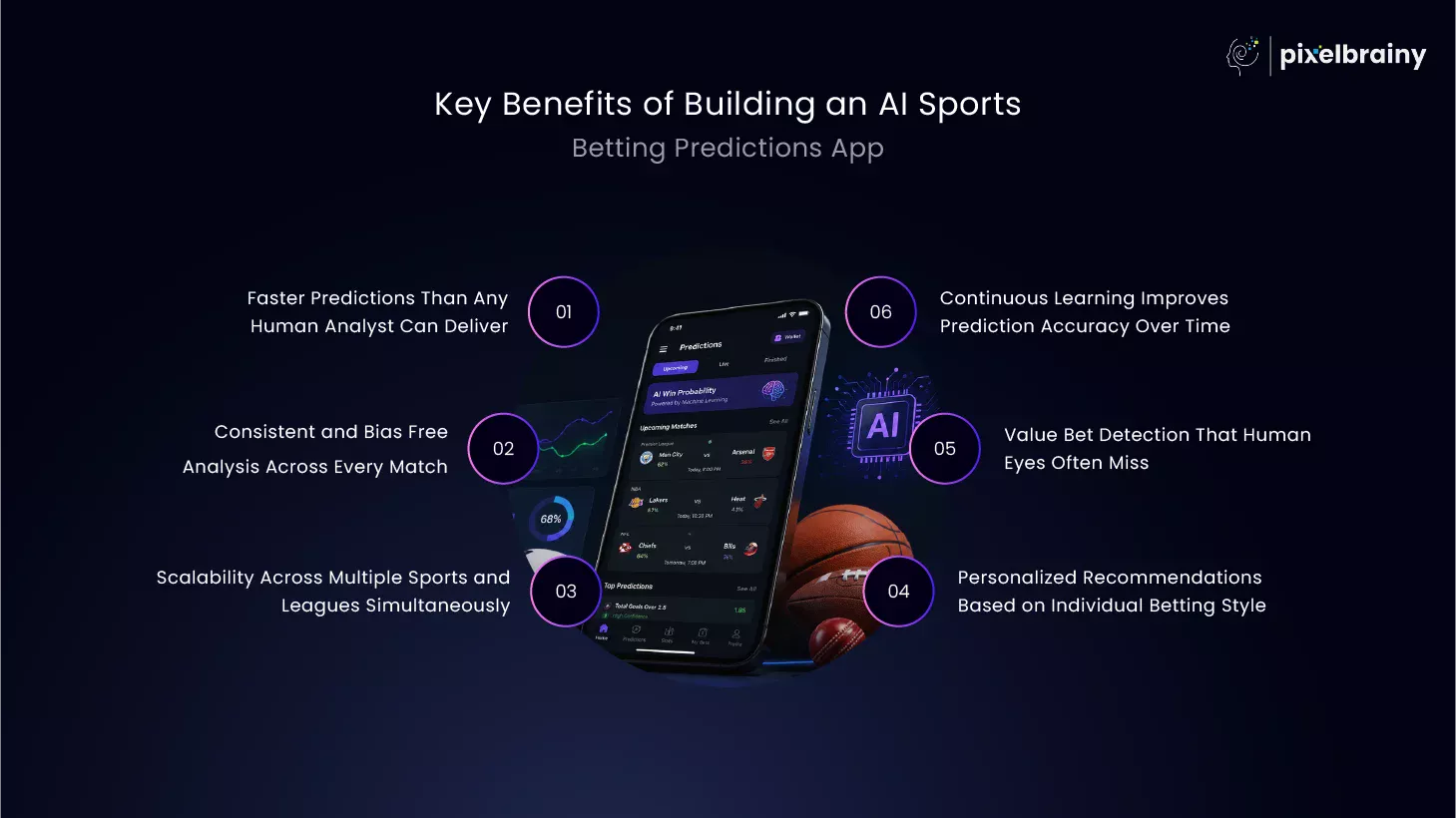
Speed is one of the greatest advantages of artificial intelligence. An AI prediction engine can simultaneously analyze team news, injury reports, player statistics, historical head-to-head records, weather conditions, live betting odds, and recent team form within seconds. This allows predictions to be generated almost instantly, even as new information becomes available.
By contrast, human analysts often require considerable time to review the same data, during which betting odds may have already changed.
For users, this means receiving predictions while betting opportunities are still available. For founders, faster predictions create a clear competitive advantage over traditional tipster platforms that struggle to react in real time.
Human judgment is naturally influenced by personal preferences, emotional biases, fatigue, and inconsistent decision making. Even experienced sports analysts can unintentionally favor certain teams or interpret similar situations differently.
Artificial intelligence eliminates these inconsistencies by applying the same analytical framework to every match. Every prediction is generated using predefined machine learning models and objective data, ensuring a consistent evaluation regardless of the league, team, or tournament.
This consistency helps users trust the platform's recommendations while giving founders a product backed by measurable, repeatable decision making instead of subjective opinions.
One of the biggest operational advantages of AI is scalability.
A human analyst may realistically cover a limited number of matches each day. In contrast, an AI prediction engine can analyze and generate predictions for hundreds of events simultaneously across multiple sports, including:
This enables businesses to expand into new sports and international leagues without hiring additional analysts or increasing operational costs.
For startups, this scalability significantly increases the total addressable market while maintaining operational efficiency.
Modern users expect personalized digital experiences, and sports betting is no exception.
An AI prediction platform can learn each user's:
Using these insights, the application delivers customized prediction feeds, personalized betting recommendations, and intelligent alerts that match each user's interests.
Instead of overwhelming users with hundreds of daily predictions, the app surfaces the opportunities that are most relevant to them. This level of personalization improves user satisfaction, increases engagement, and encourages long term retention.
One of the most commercially valuable capabilities of an AI powered prediction engine is identifying value betting opportunities.
The AI continuously compares its own calculated probability for a match outcome against live bookmaker odds across multiple betting platforms. When the AI identifies a discrepancy where the implied bookmaker probability is lower than its own prediction, it flags the event as a potential value bet.
Because this analysis is performed continuously across thousands of betting markets, the system can uncover profitable opportunities that are nearly impossible for human analysts to detect manually.
For users, this provides a statistical edge when making betting decisions. For businesses, value bet detection becomes a premium feature that can justify higher subscription plans and increase customer lifetime value.
Unlike traditional software, an AI prediction engine becomes more intelligent as it processes additional data.
Every completed sporting event generates new information that feeds back into the machine learning pipeline. The system retrains its models using fresh match outcomes, player performance data, betting market movements, and other variables to improve future predictions.
This continuous learning cycle delivers two significant advantages.
First, users benefit from increasingly accurate predictions as the platform evolves.
Second, founders build a proprietary competitive advantage. As more historical data and user interactions accumulate, the prediction engine becomes progressively more difficult for competitors to replicate.
Over time, this creates a data driven moat that strengthens the platform's long term market position.
| Benefit | Value for End User | Value for Founder |
| Prediction Speed | Receive predictions before betting odds change | Competitive advantage over manual tipster platforms |
| Consistency and Zero Bias | Reliable, objective analysis for every match | Stronger product credibility backed by data driven decisions |
| Multi-Sport Scalability | Access predictions across multiple sports and leagues | Expand into new markets without increasing analyst costs |
| Personalized Recommendations | Relevant predictions tailored to individual preferences | Higher user retention, engagement, and lower customer churn |
| Value Bet Detection | Identify statistically favorable betting opportunities | Premium feature that supports subscription-based monetization |
| Continuous Learning | More accurate predictions over time | Proprietary machine learning models that create a long-term competitive moat |
Building an AI powered betting predictions app is no longer just about automating sports analysis. It is about creating a scalable, intelligent platform that delivers measurable value to users while giving founders a sustainable competitive advantage through data, personalization, and continuously improving machine learning models.
Up next, let's explore the different types of AI sports betting prediction applications that can be built for various sports leagues and betting markets.
The sport and league you choose to target will directly influence the architecture of your AI prediction platform. It determines the type of data you need to collect, the machine learning models you should train, the betting markets you must support, and the overall user experience.
Understanding the right product category before starting AI sports betting predictions app development helps founders avoid unnecessary development costs, reduce architectural rework, and build a platform that aligns with their target audience from day one.
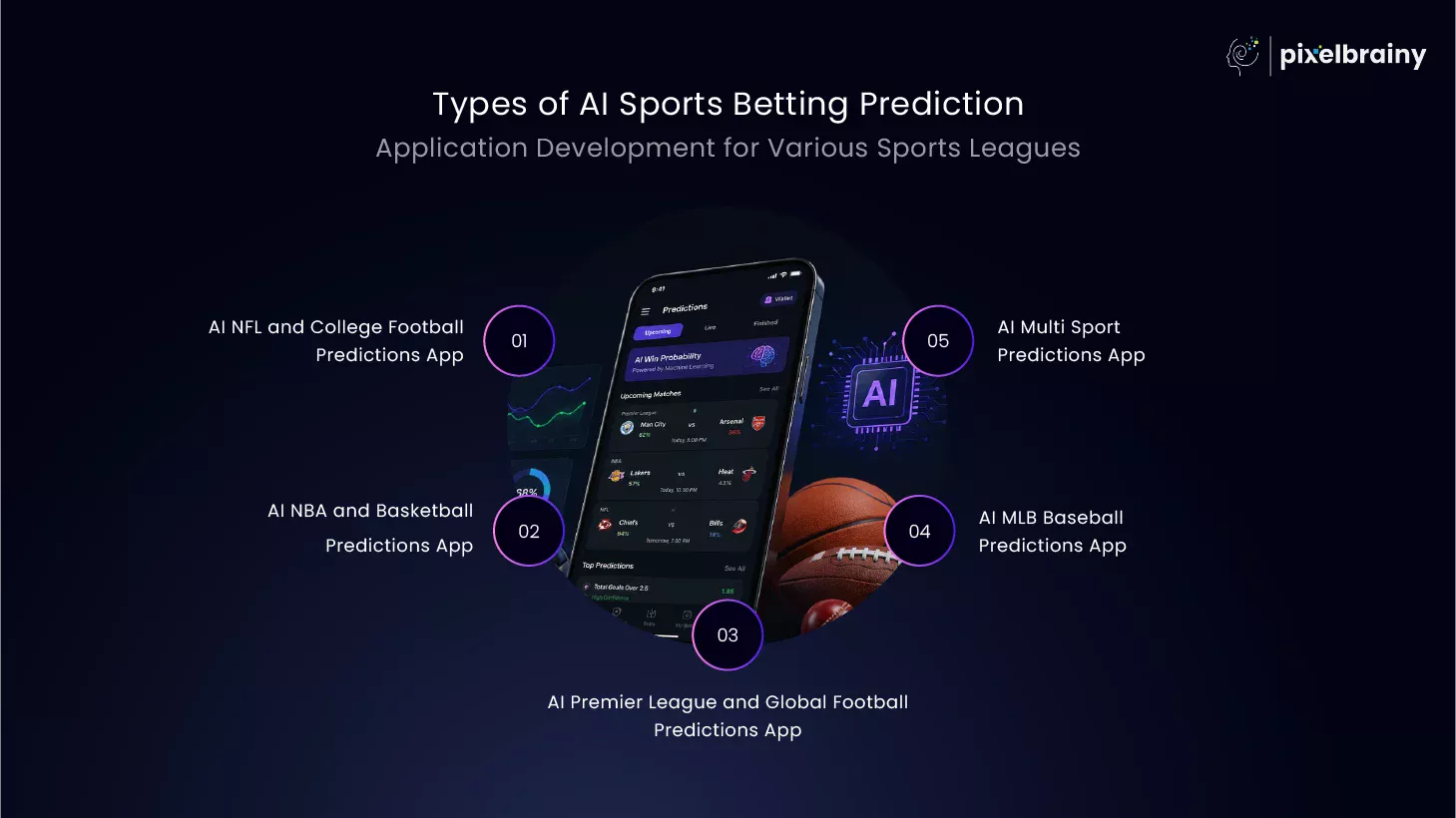
For startups targeting the United States, NFL and college football represent one of the most lucrative opportunities. American football generates some of the highest betting volumes each season, making it an attractive market for businesses looking to develop AI sports betting predictions app solutions focused on US bettors.
Unlike sports with daily fixtures, football follows a weekly schedule. This gives AI models more time to analyze team performance, player fitness, coaching strategies, and historical matchups before generating predictions. Because each game carries greater significance, prediction accuracy depends heavily on processing multiple contextual variables rather than recent form alone.
A well-designed AI prediction engine should support betting markets such as:
To improve prediction accuracy, the model should also evaluate:
Recommended Data Sources
Best For: Startups targeting regulated US sportsbooks and American football fans.
Basketball is one of the fastest moving betting markets, requiring AI systems that can process new information almost instantly. Businesses planning AI sports prediction app development for basketball must prioritize low latency data pipelines and rapid model inference because games take place almost every day throughout the season.
Unlike football, NBA prediction models must continuously adapt to changing player availability and scheduling factors.
The AI should account for:
Popular betting markets include:
Because basketball is highly player driven, tracking individual player performance is often more valuable than relying solely on team level statistics.
Recommended Data Sources
Best For: Companies targeting high engagement users who expect daily AI generated predictions and live betting opportunities.
Global football represents the largest sports betting ecosystem worldwide, with the English Premier League being the single most wagered competition across international betting markets.
Businesses looking to build AI sports betting predictions app for football should design their platform to support multiple leagues simultaneously, including:
Unlike most US sports, football betting includes a much wider variety of betting markets.
Common prediction markets include:
One of the most valuable predictive metrics in football is Expected Goals (xG), which measures the quality of scoring opportunities rather than simply counting goals scored. Combining xG with player availability, tactical formations, historical performance, and live match statistics enables AI models to generate significantly more reliable predictions.
Recommended Data Sources
Best For: Founders targeting international audiences across Europe, Asia, Africa, and South America.
Baseball is widely recognized as one of the most data rich sports, making it particularly well suited for AI sports betting prediction platform development. With a 162 game regular season and decades of structured statistical records, machine learning models have access to an enormous volume of historical data for training and validation.
The most popular betting markets include:
Unlike many other sports, the starting pitcher has a significant influence on match outcomes. As a result, prediction models should prioritize pitching metrics alongside bullpen usage, batting performance, lineup changes, and ballpark characteristics.
Recommended Data Sources
Best For: Data driven startups that want to leverage one of the richest statistical sports datasets available.
A multi-sport prediction platform offers the largest market opportunity but is also the most technically demanding product to build. Instead of supporting a single league, the platform delivers AI predictions across multiple sports from one unified application.
Founders must decide whether to:
A successful multi-sport platform also requires:
This approach enables users to move seamlessly between NFL, NBA, Premier League, MLB, cricket, tennis, and other sports without leaving the application.
While developing a multi-sport platform requires greater investment, it also creates a stronger long term competitive advantage because expanding into additional sports becomes significantly easier once the core infrastructure has been established.
Recommended Data Sources
Best For: Businesses targeting global audiences and long-term platform scalability.
Although mainstream sports attract the highest betting volumes, several emerging categories present excellent opportunities for founders seeking lower competition and faster market differentiation.
For many startups, these sports can serve as strategic entry points before expanding into larger and more competitive betting markets.
| App Type | Primary Market | Key Strength | Ideal For |
| NFL & College Football | United States | Weekly strategic analysis and player props | US focused startups |
| NBA & Basketball | Global | High frequency predictions and live betting | Daily engagement platforms |
| Premier League & Global Football | Europe and Global | Largest betting audience and diverse betting markets | International products |
| MLB Baseball | United States | Rich historical datasets and statistical modeling | Data driven prediction platforms |
| Multi-Sport Platform | Global | Maximum scalability and wider user reach | Enterprise and high growth startups |
Now that you understand which type of AI sports betting predictions app aligns with your target market and audience, the next section explores the core features every AI prediction platform needs, regardless of the sport it supports.

Building a successful AI prediction platform requires much more than integrating machine learning models. The foundation of every high performing application lies in delivering a seamless user experience, reliable prediction workflows, and intuitive betting insights. Before investing in advanced AI capabilities, founders should focus on the core features that users expect from a modern sports prediction platform.
If you plan to build AI sports betting predictions app, these features will form the backbone of your product regardless of whether you target NFL, NBA, Premier League, MLB, cricket, or multiple sports. They not only improve usability but also support higher user engagement, retention, and long-term scalability.
One of the most common founder questions is:
"We want to develop an AI sports betting predictions app with a machine learning prediction engine, real time odds integration, personalized recommendations, and responsible gambling features from scratch in 2026. Which features are absolutely essential for the first product launch?"
The answer is to prioritize the core features that directly support prediction delivery, user engagement, and platform reliability before investing in more sophisticated AI capabilities. The following features represent the minimum viable foundation for successful AI sports betting predictions app development and should be included in almost every product roadmap.
| Feature | Why It Matters |
| User Registration and Profile Management | Secure user onboarding allows users to create accounts, manage preferences, save favorite sports and leagues, synchronize predictions across devices, and receive a personalized experience from the very first session. |
| AI Prediction Dashboard | The prediction dashboard serves as the application's homepage, displaying upcoming matches, AI generated predictions, confidence scores, match insights, and recommended betting opportunities in an organized and easy to understand format. |
| Match and League Explorer | Users should easily browse matches across different sports, tournaments, and leagues using filters that simplify navigation and help them quickly find predictions for their preferred competitions. |
| Prediction Details Screen | Every prediction should include supporting information such as predicted outcome, confidence percentage, historical team performance, recent form, head-to-head records, and key factors influencing the AI's decision. |
| Real Time Match Scores | Live score updates keep users informed about ongoing matches without leaving the application, improving engagement while allowing users to compare predictions with actual match progress in real time. |
| Live Odds Integration | Integrating bookmaker odds enables users to compare available betting prices alongside AI predictions, helping them evaluate potential betting opportunities more efficiently before placing a wager. |
| Search and Smart Filters | Advanced search functionality allows users to quickly locate matches, teams, leagues, players, or tournaments while filtering predictions by sport, confidence level, or betting market. |
| Favorite Teams and Competitions | Users should be able to follow their preferred teams, leagues, and competitions so the application can prioritize relevant predictions and simplify content discovery during every visit. |
| Push Notifications | Timely notifications inform users about newly published predictions, match reminders, significant odds movements, and favorite team updates, encouraging regular engagement with the platform. |
| Betting History Tracker | Users can maintain a personal record of viewed predictions, selected bets, win rates, and historical performance, helping them evaluate betting habits and improve future decision making. |
| Confidence Score Display | Every prediction should display an AI generated confidence score that communicates the model's estimated probability, allowing users to better understand prediction strength before making decisions. |
| Responsible Gambling Tools | Responsible gaming features such as session reminders, betting limits, educational content, and self exclusion options promote healthier betting behavior while supporting compliance with gambling regulations. |
| Multi Language and Multi Currency Support | Supporting multiple languages and currencies enables businesses to reach international markets while providing a localized user experience that improves accessibility and customer satisfaction. |
| Admin Dashboard | A centralized administration panel allows operators to manage users, sports, leagues, predictions, content, API integrations, subscriptions, and platform performance from a single interface. |
| Analytics and Reporting | Comprehensive analytics help founders monitor user engagement, prediction performance, popular sports, subscription trends, retention metrics, and operational insights for continuous product improvement. |
Together, these features create the foundation of a reliable and user-friendly AI sports betting prediction platform development project. They ensure that users can discover predictions, understand AI generated insights, track matches, and interact with the platform efficiently, while giving businesses the operational tools needed to scale successfully.
Rather than overwhelming users with unnecessary functionality, focusing on these essentials allows startups to launch faster, validate their product with real users, and establish a strong base before introducing more sophisticated AI capabilities.
Next, let's explore the advanced features that can differentiate your AI sports betting predictions app and create a lasting competitive advantage in the market.
Once the core functionality is in place, the next step is to enhance your platform with advanced AI capabilities that improve prediction accuracy, user engagement, and long-term business value. These features transform a standard prediction application into an intelligent decision support platform that continuously adapts to changing sports data and user behavior.
For businesses planning AI sports betting predictions app development, advanced features play a critical role in differentiating the product from conventional betting tipster services and basic prediction platforms. They leverage artificial intelligence, machine learning, automation, and real time analytics to deliver smarter recommendations and a more personalized betting experience.
One of the most common questions founders ask is:
"We want to build an AI sports betting predictions app similar to DraftKings or Bet365 but with a dedicated AI prediction layer that provides confidence scored match predictions, personalized recommendations, and continuously improving machine learning models. Which advanced features should we prioritize after the MVP launch?"
The answer is to focus on features that enhance prediction intelligence, increase user retention, and create a sustainable competitive advantage. These capabilities help businesses move beyond basic prediction delivery and establish themselves as truly AI driven sports betting platforms.
| Advanced Feature | Why It Matters |
| Real Time AI Prediction Engine | Instead of generating predictions only before a match begins, the AI continuously updates probabilities throughout the game using live events, player substitutions, momentum changes, injuries, and bookmaker odds movements to provide dynamic prediction updates. |
| Personalized AI Recommendation Engine | Machine learning analyzes each user's favorite sports, betting behavior, prediction history, and engagement patterns to deliver highly personalized prediction feeds, improving user satisfaction, session duration, and long term retention. |
| Value Bet Detection Engine | The system automatically compares AI calculated probabilities with bookmaker odds across multiple sportsbooks and identifies statistically favorable betting opportunities where users may gain long term expected value. |
| Deep Learning Prediction Models | Advanced neural networks process millions of historical match records, player statistics, weather conditions, tactical data, and betting market movements to identify complex patterns that traditional statistical models often overlook. |
| Explainable AI Prediction Insights | Instead of displaying only a prediction, the platform explains the primary factors influencing the AI's decision, increasing transparency and helping users understand why a particular outcome has been recommended. |
| Real Time Odds Movement Analysis | The platform continuously monitors bookmaker odds across multiple providers and detects significant market changes, allowing users to react quickly when odds shift due to injuries, team news, or betting volume. |
| Automated Machine Learning Model Retraining | As new sporting events conclude, the system automatically retrains machine learning models using fresh match results and user interaction data, ensuring prediction accuracy improves continuously without requiring manual intervention. |
| AI Powered Risk Assessment | The application evaluates the relative risk associated with each prediction by considering historical model accuracy, confidence levels, betting market volatility, and match specific variables, helping users make more informed decisions. |
| Cross Sport Unified Prediction Engine | A unified AI architecture enables the platform to generate predictions across multiple sports including NFL, NBA, football, MLB, cricket, and tennis while maintaining consistent prediction quality and a seamless user experience. |
| Predictive Analytics Dashboard | Advanced dashboards provide founders and administrators with actionable insights into prediction accuracy, user engagement, subscription growth, betting trends, model performance, and operational metrics that support continuous business optimization. |
While core features make an application functional, advanced AI capabilities make it truly competitive. They improve prediction accuracy, strengthen user trust, increase engagement, and create premium functionality that can support subscription plans, enterprise licensing, and long-term customer retention.
For startups building AI sports betting predictions app with real time data pipeline, investing in these intelligent capabilities after the MVP stage helps create a product that is difficult to replicate and capable of evolving as more sports data and user interactions become available.
In the next section, we'll walk through the complete step by step process of developing an AI sports betting predictions app, from market research and data collection to deployment and ongoing model optimization.
Building an AI sports betting predictions app is not a single sprint. It is a structured, multi-phase development process where every stage builds on the success of the previous one. A clear roadmap helps founders minimize technical risks, control development costs, and launch on schedule. Whether you want to build AI sports betting predictions app for the US, UK, or global markets, following the right sequence is essential for creating a scalable and reliable product.
A common founder requirement is:
"Our startup is building an AI sports betting predictions app targeting serious sports bettors in the US and UK markets who want data driven AI predictions rather than relying on gut feel or tipster services. We need the app to include an AI prediction engine trained on historical match data, real time odds feeds, user personalization, and push notifications for high confidence prediction alerts. Can you recommend the best AI app development companies in the USA who can build this for us in 2026?"
The answer starts with choosing an experienced development partner that understands artificial intelligence, sports data engineering, machine learning, and regulatory compliance. More importantly, it requires following a proven development process from discovery to post launch optimization. Below is the complete roadmap for AI sports betting prediction platform development.
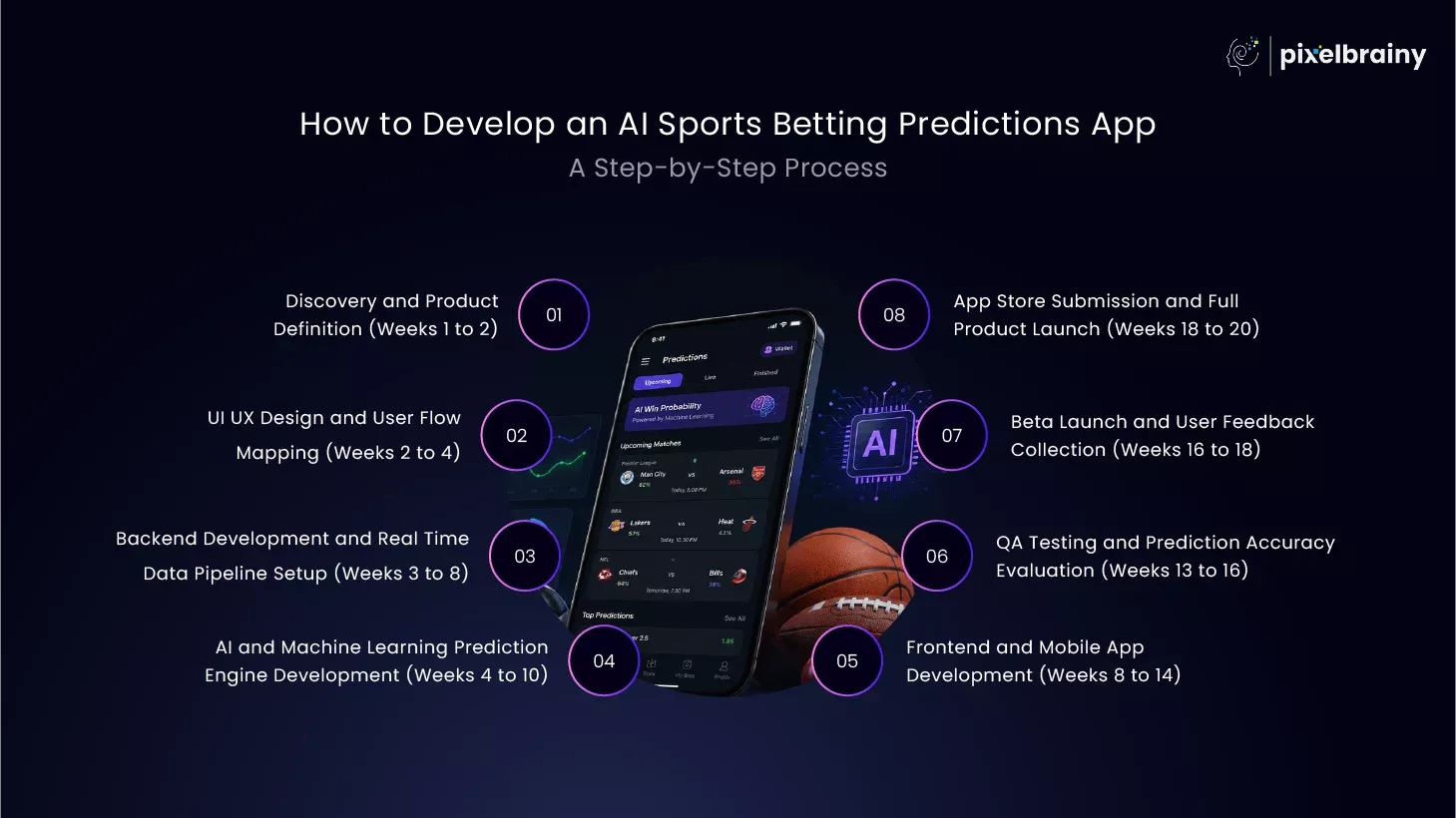
Every successful project begins with a comprehensive discovery phase before a single line of code is written. This stage transforms a business idea into a well-defined product strategy.
At PixelBrainy, every engagement starts with a paid discovery and architecture workshop that focuses on identifying the target sports, leagues, betting markets, user personas, monetization strategy, compliance requirements, and long-term product vision. This phase also helps founders decide whether to launch with a single sport MVP or a scalable multi-sport platform.
The discovery phase includes:
Deliverables
This phase also provides a solid foundation for future PoC development and investor discussions.
After defining the product, the next step is designing a user experience that makes complex prediction data simple to understand.
Unlike standard sports applications, prediction platforms must clearly display confidence scores, recommended betting markets, AI explanations, and live odds without overwhelming users. Responsible gambling features should also remain accessible while maintaining a clean interface.
Working with an experienced UI/UX design company ensures that the platform balances usability with information density.
During this phase, designers create:
Deliverables
The backend forms the operational backbone of the application. This stage focuses on building scalable infrastructure capable of processing large volumes of sports data in real time.
Key development activities include:
Businesses also frequently implement AI integration solutions during this phase to simplify communication between data providers, prediction services, and frontend applications.
Deliverables
This is the heart of AI sports betting predictions app development.
Machine learning engineers begin by collecting historical sports datasets, cleaning inconsistent records, performing feature engineering, and selecting the most appropriate prediction models based on the targeted sport.
Depending on the use case, models may include:
The development team then:
Deliverables
Once backend services and AI models are ready, frontend developers build the complete user experience.
For startups looking to develop AI sports betting predictions app for iOS and Android in 2026, React Native is often the preferred framework because it supports both platforms using a shared codebase, reducing development time and maintenance costs.
Core screens developed during this phase include:
For many startups, this stage results in the first fully functional MVP development milestone that can be demonstrated to investors and early adopters.
Deliverables
Quality assurance consists of two parallel testing tracks.
Development teams validate:
Data scientists simultaneously evaluate prediction quality through:
Deliverables
Before public release, the platform is introduced to a carefully selected beta audience.
Typical beta participants include:
The team collects structured feedback on:
This phase also provides valuable real world prediction data that helps validate machine learning performance before commercial launch.
Deliverables
Launching a sports prediction platform requires careful preparation because Apple and Google enforce strict policies for gambling related and betting adjacent applications.
Before submission, founders should ensure:
After approval, the development team should continuously monitor:
Partnering with one of the top AI product development companies in USA and experienced AI consulting specialists can further streamline post launch optimization and long-term product evolution.
Deliverables
| Step | Duration | Primary Deliverable |
| Discovery & Product Definition | Weeks 1 to 2 | PRD, roadmap, tech stack |
| UI UX Design | Weeks 2 to 4 | Wireframes, prototypes, design system |
| Backend & Data Pipeline | Weeks 3 to 8 | APIs, databases, infrastructure |
| AI Prediction Engine | Weeks 4 to 10 | Trained models, confidence scoring, prediction APIs |
| Frontend & Mobile Development | Weeks 8 to 14 | Android and iOS applications |
| QA & Accuracy Testing | Weeks 13 to 16 | QA reports and model validation |
| Beta Launch | Weeks 16 to 18 | User feedback and optimization plan |
| Production Launch | Weeks 18 to 20 | Live application and monitoring dashboard |
With the development roadmap clearly defined, the next section explores the actual cost of AI sports betting predictions app development and the key factors that influence your overall project budget.
For founders planning AI sports betting predictions app development, one of the first questions is the expected investment. The answer depends on the product scope, AI complexity, supported sports, and infrastructure requirements. As a high-level estimate, the cost to build AI sports betting predictions app typically ranges from $30,000 to $300,000+. A basic MVP with limited features and a single sport sits at the lower end of the range, while a multi-sport platform with advanced machine learning, real time data pipelines, and enterprise grade infrastructure can exceed $300,000.
A common founder question is:
"How much does it cost to develop AI sports betting predictions app that supports NFL, NBA, Premier League, real time odds integration, personalized AI recommendations, and confidence scored predictions?"
The answer depends on several technical and business factors. Below is a practical cost overview to help you estimate your AI sports betting predictions app development budget before starting the project.
Note: This section provides a summary cost estimate. We have also published a dedicated in-depth guide that explains every cost component, budgeting strategy, and optimization approach in detail.
No two AI prediction platforms are built the same. The final budget depends on the complexity of the product, the quality of AI models, and the scale of the infrastructure required to support real time predictions.
Some of the biggest cost drivers include:
The prediction engine is the most technically demanding component of the application. Supporting multiple sports, prediction markets, deep learning models, confidence scoring, and automated model retraining significantly increases development effort and overall project cost.
Most prediction platforms rely on premium sports data providers such as Sportradar, Stats Perform, and Odds API. Licensing fees vary based on the sports covered, request volume, historical datasets, and commercial usage rights.
A simple MVP with prediction feeds and user authentication costs considerably less than a platform offering live odds comparison, personalized recommendations, AI explanations, subscriptions, analytics dashboards, and responsible gambling tools.
Developing only for Android or iOS reduces initial costs. Building a cross-platform application that supports both operating systems requires additional testing and deployment, although frameworks like React Native can reduce overall development expenses.
Hourly development rates differ significantly between regions. US agencies generally charge the highest rates, while experienced teams in Eastern Europe and South Asia often provide more cost-effective development without compromising technical quality.
Markets with stricter regulatory requirements may require additional development for age verification, responsible gambling features, legal disclosures, privacy controls, and compliance documentation, all of which affect the final project budget.
| Development Component | Estimated Cost Range | Notes |
| AI and ML Prediction Engine Development | $10,000 to $100,000+ | Includes data preparation, model development, confidence scoring, testing, and automated retraining pipelines. |
| Real Time Sports Data API Integration | $3,000 to $25,000+ | Depends on the number of providers, sports covered, and API complexity. Licensing costs are generally billed separately. |
| Core Feature Development | $8,000 to $60,000 | Covers authentication, prediction feeds, profiles, subscriptions, dashboards, and essential application functionality. |
| UI UX Design | $3,000 to $20,000 | Includes user research, wireframes, prototypes, visual design, and responsive mobile interfaces. |
| Push Notification and Alert System | $2,000 to $8,000 | Supports prediction alerts, odds movement notifications, personalized recommendations, and engagement campaigns. |
| Responsible Gambling Module | $2,000 to $12,000 | Includes betting limits, self exclusion tools, educational content, and compliance related workflows. |
| QA and Testing | $4,000 to $20,000 | Functional testing, security testing, performance validation, cross platform testing, and AI prediction accuracy evaluation. |
| Cloud Infrastructure and ML Model Hosting Setup | $3,000 to $30,000+ | Covers cloud deployment, databases, model hosting, monitoring, scalability, and DevOps configuration. |
| Estimated Total Project Cost | $30,000 to $300,000+ | Varies based on AI sophistication, number of supported sports, features, integrations, and development team location. |
| Team Type | Estimated Total Cost Range |
| US Based AI Development Agency | $150,000 to $300,000+ |
| Eastern Europe Based Development Team | $80,000 to $180,000 |
| South Asia Based Development Team | $30,000 to $120,000 |
| Freelancer Team | $20,000 to $80,000* |
*Freelancer teams may appear more affordable initially, but coordinating multiple independent specialists for AI engineering, mobile development, backend infrastructure, UI UX design, quality assurance, and long-term maintenance often introduces additional project management challenges and delivery risks.
For most startups, the smartest approach is to begin with a focused MVP rather than building every feature at once. Launching with one sport, a limited number of prediction markets, and essential AI capabilities allows businesses to validate product demand, collect real user feedback, and improve the prediction engine before expanding into additional leagues or advanced functionality.
This phased strategy reduces upfront investment while creating a roadmap for future enhancements based on actual user behavior instead of assumptions. It is also one of the most effective ways to achieve affordable AI sports betting predictions app development without compromising the long-term vision of the product.
Want a detailed cost estimate? Read our dedicated guide on AI Sports Betting Predictions App Development Cost, where we break down every expense, feature wise pricing, hidden costs, ongoing maintenance, and budgeting strategies for startups and enterprises.
The machine learning prediction engine is the single largest cost driver in an AI sports betting predictions app, and it is also the one area where cutting corners has the greatest impact on prediction quality, user trust, and long-term product success.
Also Read: Top 12 AI Sports Betting Software Development Companies in USA
The performance of an AI sports betting predictions app depends heavily on the technologies powering its prediction engine, real time data pipeline, mobile application, and cloud infrastructure. A well-planned tech stack enables faster predictions, seamless scalability, secure data processing, and continuous AI model improvement. Whether you plan to build AI sports betting predictions app with real time data pipeline or develop AI sports betting predictions app for iOS and Android in 2026, using proven technologies from the beginning helps reduce technical risks and supports long term product growth.
One of the most common questions founders ask is:
"Our team has completed the product design and wireframes for an AI sports betting predictions app, and we are now looking for a development partner to build it. Which technologies should we use to create a scalable AI prediction platform?"
The answer is to build every layer of the platform using technologies that are purpose built for artificial intelligence, real time sports data processing, cloud scalability, and cross platform mobile development. The recommended technology stack below is widely adopted for modern AI sports betting predictions app development services and provides a strong foundation for startups creating AI sports betting predictions app solutions that are secure, scalable, and future ready.
| Technology Category | Recommended Technologies | Why It Is the Right Choice |
| AI and ML Prediction Layer | XGBoost, LightGBM, TensorFlow, PyTorch, Scikit learn | These frameworks support high accuracy prediction models, deep learning, ensemble learning, and continuous model improvement using historical match data and live sports information. |
| Real Time Sports Data Providers | Sportradar API, Stats Perform, Odds API, Betfair Exchange API | These providers deliver reliable real time sports statistics, betting odds, player information, match events, and historical datasets required for accurate AI predictions. |
| LLM Layer for Natural Language Outputs | GPT 4, Claude | Large Language Models convert complex prediction outputs into easy-to-understand match summaries, betting insights, and human readable explanations that improve user experience. |
| Backend Development | Python, FastAPI, Node.js | Python powers machine learning workloads, FastAPI efficiently serves AI prediction models, while Node.js manages authentication, business logic, subscriptions, and application services. |
| Real Time Data Processing | Apache Kafka | Kafka enables high throughput streaming of live odds, player statistics, match events, and sports feeds while ensuring reliable processing with minimal latency. |
| Database | PostgreSQL, Redis | PostgreSQL securely stores structured user, prediction, and subscription data, while Redis delivers ultra-fast caching for frequently accessed odds, predictions, and live match information. |
| Mobile App Development | React Native | React Native allows businesses to develop AI sports betting predictions app for iOS and Android in 2026 using a single codebase, significantly reducing development time and maintenance costs. |
| Push Notification System | Firebase Cloud Messaging, OneSignal | These services deliver real time prediction alerts, confidence score updates, odds movement notifications, and personalized user engagement across both mobile platforms. |
| Cloud Infrastructure | AWS SageMaker, AWS Lambda | SageMaker simplifies machine learning model training, deployment, and monitoring, while Lambda efficiently executes serverless backend tasks without managing infrastructure manually. |
| Payment and Subscription Management | RevenueCat | RevenueCat simplifies subscription management across Apple App Store and Google Play while reducing implementation complexity for premium AI prediction services. |
| Analytics and Behavioral Tracking | Mixpanel, Amplitude | These platforms help founders understand user behavior, prediction engagement, subscription conversion, feature adoption, and retention for continuous product optimization. |
| Responsible Gambling APIs and Compliance Tools | Jumio, GeoComply, Gamban Integration, Custom Responsible Gaming Modules | These solutions support identity verification, location compliance, self-exclusion workflows, betting limit enforcement, and responsible gambling requirements across regulated markets. |
That’s why whether you are evaluating AI sports betting predictions app development services, preparing for an architecture workshop, or selecting a long-term technology partner, adopting a proven tech stack minimizes development risks and accelerates time to market.
A monetization strategy should be defined before development begins because it influences product architecture, feature prioritization, user onboarding, and long-term growth. For example, a subscription-based platform requires payment infrastructure and account management from the beginning, while an affiliate driven platform depends on bookmaker integrations and referral tracking. If you plan to build AI sports betting predictions app, selecting the right revenue model early helps prevent costly product changes after launch.
One of the most common founder questions is:
"We are planning to develop an AI sports betting predictions app with AI generated match predictions, confidence scores, and personalized recommendations. Which monetization model offers the best balance between user growth and recurring revenue?"
The answer depends on your target audience, business goals, and expansion strategy. Most successful AI prediction platforms combine multiple revenue streams instead of relying on a single monetization model.
The freemium model allows users to access basic match predictions at no cost while reserving advanced features such as AI confidence scores, detailed match analysis, personalized alerts, and premium prediction reports for paid subscribers.
Pros: Low barrier to user acquisition, predictable recurring revenue, and faster product adoption.
Cons: Requires a strong free user base to achieve healthy subscription conversion rates.
Best For: Startups launching a consumer-focused prediction platform that wants to grow rapidly while building recurring monthly revenue.
Instead of offering a single premium plan, businesses can introduce multiple pricing tiers such as Basic, Pro, and Sharp, with each plan providing progressively deeper AI insights, additional betting markets, advanced analytics, and enhanced personalization.
Pros: Increases average revenue per user while giving customers flexibility to upgrade as their needs evolve.
Cons: Poor feature segmentation or pricing can confuse users and reduce conversion rates.
Best For: Platforms serving both casual bettors and experienced sports betting enthusiasts.
Affiliate partnerships generate revenue when users register or place qualifying bets with partnered sportsbooks through referral links within the application. Revenue may be earned through Cost Per Acquisition (CPA), revenue sharing, or hybrid partnership agreements.
Pros: Generates revenue without charging users directly and complements subscription-based income.
Cons: Earnings depend on user conversion rates, sportsbook agreements, and regulatory restrictions within each market.
Best For: Consumer applications targeting regulated sports betting markets with established sportsbook operators.
Instead of serving only end users, businesses can license their AI prediction engine through APIs to sportsbooks, fantasy sports platforms, sports media companies, and betting technology providers.
Pros: Creates high value enterprise contracts, recurring licensing revenue, and scalable business to business growth.
Cons: Requires enterprise ready APIs, technical documentation, service level agreements, and ongoing customer support.
Best For: Companies with mature AI prediction models seeking long term enterprise revenue.
As prediction models mature, businesses accumulate valuable historical prediction data, betting trends, and model performance insights. These datasets can be licensed to betting operators, sports analytics companies, research organizations, and academic institutions.
Pros: Creates an additional revenue stream while maximizing the commercial value of proprietary data assets.
Cons: Requires large, accurate datasets along with clear legal rights for commercial data usage.
Best For: Established platforms with significant historical prediction data and enterprise partnerships.
This hybrid model combines AI generated predictions with premium picks from verified sports analysts and experienced tipsters. Users can subscribe to individual experts while comparing human insights with AI generated predictions.
Pros: Increases user engagement, encourages community participation, and creates multiple subscription opportunities.
Cons: Requires expert verification, quality assurance, and active moderation to maintain credibility.
Best For: Businesses looking to blend artificial intelligence with trusted human expertise.
Sports publishers and digital media companies can integrate AI predictions into their websites, mobile applications, newsletters, podcasts, and live match coverage to increase audience engagement and create new monetization opportunities.
Pros: Leverages existing traffic, strengthens user retention, and supports advertising, sponsorship, subscription, and licensing revenue.
Cons: Works best for organizations with an established audience or strong distribution partnerships.
Best For: Sports media brands, publishers, broadcasters, and digital content platforms expanding into AI powered sports analytics.
For most first-time founders, the most practical approach is to launch with a combination of Freemium, Premium Subscription, and Bookmaker Affiliate Partnerships. This approach accelerates user acquisition, generates recurring subscription revenue, and creates an additional affiliate income stream from day one.
As the platform grows, revenue can be diversified through White Label API Licensing, Data Licensing, and Sports Media Integrations, creating a scalable business model that serves both consumer and enterprise markets.
Building an AI sports betting predictions platform is far more complex than developing a traditional mobile application. Success depends on combining machine learning, real time sports data, scalable infrastructure, regulatory compliance, and an intuitive user experience into a single product. For startups investing in AI sports betting predictions app development, understanding these challenges early helps reduce technical risks, control development costs, and accelerate time to market.
One of the most common founder questions is:
"We want to build an AI sports betting predictions app similar to DraftKings or Bet365 but with a dedicated AI prediction layer. We also need an AI development company with proven experience in machine learning, real time sports data pipelines, and prediction platforms. What are the biggest technical and product challenges we should prepare for?"
Below are the most common challenges founders face when they build AI sports betting predictions app, along with practical strategies to overcome them.
Challenge
Every sport follows different rules, statistical patterns, and influencing factors. A prediction model that performs well for the NBA is unlikely to deliver the same accuracy for football, cricket, or MLB. Expanding into multiple betting markets further increases model complexity.
Solution
Develop independent prediction models for each sport and continuously retrain them using updated historical datasets, player statistics, injuries, weather conditions, and live match information. Performance should be monitored separately for every league and betting market instead of relying on one universal model.
Challenge
Prediction quality depends heavily on receiving live data without delays. Even a few seconds of latency in bookmaker odds or match events can reduce prediction reliability and negatively affect user experience.
Solution
Implement building AI sports betting predictions app with real time data pipeline and anomaly detection using streaming technologies such as Apache Kafka, intelligent caching with Redis, and automated monitoring that immediately detects missing or delayed data feeds.
Challenge
New platforms often lack proprietary historical prediction data during the early stages. This limits the ability to train highly accurate machine learning models using only internal datasets.
Solution
Begin with trusted third-party historical sports datasets from providers such as Sportradar, Stats Perform, and official league databases. As the platform grows, gradually combine external datasets with proprietary prediction history and user interaction data to improve model performance over time.
Challenge
A machine learning model may achieve impressive testing accuracy but perform poorly during live sporting events because it has learned historical patterns too specifically instead of recognizing broader trends.
Solution
Use cross validation, independent validation datasets, backtesting across multiple seasons, and continuous production monitoring. Automated retraining pipelines help models adapt to new seasons, rule changes, player transfers, and evolving team strategies.
Challenge
Apple App Store and Google Play enforce strict policies for applications associated with sports betting and gambling. Even prediction platforms may face additional review requirements depending on how the product is presented.
Solution
Clearly position the application as an AI powered sports prediction and analytics platform rather than a betting operator. Include age restrictions, responsible gambling tools, transparent legal disclaimers, and ensure compliance with regional regulations before submission.
Challenge
Users can quickly lose confidence if early predictions perform poorly or if the application presents recommendations without explaining how they were generated.
Solution
Instead of displaying only predicted outcomes, provide confidence scores, supporting statistics, historical model performance, and concise AI generated explanations. Transparent prediction logic helps users understand the reasoning behind every recommendation and gradually builds long term trust.
Challenge
Highly sophisticated deep learning models often deliver better prediction accuracy but require significantly more processing time. In live betting environments, slow predictions may lose their practical value.
Solution
Optimize models for both speed and accuracy by combining lightweight machine learning algorithms with more advanced deep learning models where appropriate. Fast inference pipelines and efficient infrastructure ensure predictions remain useful during live sporting events.
Challenge
Responsible gambling functionality is essential for regulatory compliance, but excessive interruptions or restrictive workflows may negatively affect user experience and platform engagement.
Solution
Integrate responsible gambling features naturally into the user journey through optional betting limits, self-exclusion tools, educational resources, session reminders, and personalized alerts that encourage healthier betting behavior without disrupting normal application usage.
Challenge
Most prediction platforms depend on third party sports data providers. Service outages, API changes, inaccurate feeds, or pricing updates can directly impact prediction quality and application availability.
Solution
Design a resilient architecture with multiple data providers, automated failover mechanisms, local caching, and continuous API health monitoring. Reducing dependence on a single provider improves platform reliability and business continuity.
10. Differentiating from Tipster Services and Odds Comparison Platforms
Challenge
The market already contains thousands of betting tipster websites and odds comparison applications. Simply displaying predictions is rarely enough to attract and retain users.
Solution
Focus on creating measurable competitive advantages through developing AI sports betting predictions app with NLP and deep learning models, personalized prediction feeds, confidence scoring, explainable AI, continuous model improvement, and intelligent recommendations tailored to individual betting behavior. The long-term value should come from proprietary AI capabilities rather than manual betting tips.
| Challenge | Recommended Solution |
| Prediction accuracy across multiple sports | Train separate AI models for each sport and continuously retrain them with updated datasets. |
| Real time data latency | Build low latency streaming pipelines with Kafka, Redis, and automated anomaly detection. |
| Limited historical training data | Combine trusted third-party datasets with proprietary platform data as it grows. |
| Overfitting machine learning models | Apply cross validation, backtesting, and continuous production monitoring. |
| App Store compliance | Position the app as an AI prediction platform and implement responsible gambling features. |
| Building user trust | Display confidence scores, AI explanations, and historical model accuracy. |
| Prediction speed | Balance lightweight inference models with advanced deep learning architectures. |
| Responsible gambling implementation | Integrate user protection features naturally without disrupting engagement. |
| Data provider dependency | Use multiple API providers with failover and monitoring mechanisms. |
| Market differentiation | Deliver explainable AI, personalization, and continuously improving prediction intelligence. |
Overcoming these challenges with the right technology, experienced AI engineers, and a structured development approach lays the foundation for a scalable and competitive AI sports betting predictions platform.
Also Read: How to Create a Sports Betting Website and App Like DraftKings?
Compliance should be considered from the first day of product planning, not after development is complete. Even if your platform only provides AI generated predictions and does not accept wagers, it still operates within a regulated ecosystem where privacy, consumer protection, app store policies, and responsible gambling standards matter. For startups planning AI sports betting predictions app development, addressing compliance early reduces legal risks, simplifies app approvals, and builds long term user trust.
A common founder question is:
"We are looking for an AI development agency that can build a sports betting predictions app with a machine learning prediction engine, real time odds integration, personalized recommendations, and responsible gambling features while ensuring compliance for the US and UK markets. What regulations should we prepare for?"
The answer depends on where your users are located and how your application operates. Below are the key compliance areas every founder should understand before launching.
The first and most important distinction is understanding the difference between an AI prediction platform and a licensed sportsbook.
A sports betting predictions app provides AI generated insights, confidence scores, betting recommendations, and statistical analysis. It does not accept deposits, process wagers, hold player funds, or settle bets.
A licensed betting operator, on the other hand, directly facilitates gambling activities and must obtain gambling licenses in every jurisdiction where it operates.
Although predictions platform generally has fewer regulatory obligations than a sportsbook, it must still comply with advertising rules, responsible gambling practices, data privacy laws, consumer protection requirements, and platform specific policies.
If your application targets users in the United Kingdom, it should align with guidance published by the UK Gambling Commission (UKGC), even if a gambling license is not required for a prediction only service.
Key considerations include:
Following UKGC guidance helps establish credibility while reducing regulatory risk.
Sports betting regulations in the United States vary by state. Although prediction platforms generally do not require sportsbook licenses, businesses should still review state specific advertising, affiliate marketing, and gambling related regulations before launch.
Founders should evaluate:
This is especially important for businesses planning to develop AI sports betting predictions app solutions targeting multiple regulated states.
Responsible gambling should be integrated into the product rather than treated as an optional add on. Organizations such as the American Gaming Association (AGA) through its Have A Game Plan. Bet Responsibly. initiative and GamCare provide widely recognized responsible gambling principles that prediction platforms can follow.
Recommended responsible gambling features include:
Building these capabilities helps founders build AI sports betting predictions app with responsible gambling features while improving user trust and supporting future regulatory compliance.
Sports prediction platforms collect personal information such as user profiles, betting preferences, subscription details, and behavioral analytics. This data must be handled according to applicable privacy regulations.
Important frameworks include:
Compliance typically includes:
Privacy compliance should be incorporated into the application architecture from the beginning rather than added after launch.
Apple App Store and Google Play apply additional review standards to gambling related and betting adjacent applications.
To improve approval success, founders should:
Proper positioning significantly reduces review delays and rejection risks.
Many prediction platforms monetize through affiliate partnerships with licensed sportsbooks. These relationships must be managed transparently.
Founders should:
Transparent affiliate practices strengthen both regulatory compliance and user confidence.
Sports betting related products should implement appropriate age controls to help prevent underage access.
Recommended practices include:
These safeguards support responsible product design and align with expectations across many regulated markets.
Addressing compliance and responsible gambling requirements early helps create a trusted, scalable, and market ready AI sports betting predictions app.
Studying successful products is one of the fastest ways to make better product decisions. If you're planning to develop AI sports betting predictions app, you don't need to copy existing platforms. Instead, analyze what they do well, identify gaps in the market, and apply those insights to build a more differentiated product.
The following platforms validate that AI driven sports predictions are no longer an emerging concept but an established market with growing demand.
Bet365 is one of the world's largest online sportsbooks and has invested heavily in artificial intelligence to improve live betting experiences. While its proprietary AI models are not publicly disclosed, the platform uses advanced data analytics for dynamic in play odds adjustments, personalized betting recommendations, fraud detection, and risk management.
What makes it stand out?
Founder Lesson
If you want to develop AI sports betting app like Bet365 or DraftKings, focus on delivering intelligent user experiences through personalization and real time decision making instead of simply publishing match predictions.
Betegy is a dedicated AI sports prediction platform that combines machine learning with advanced data visualization. Rather than overwhelming users with raw statistics, it transforms complex sports data into intuitive prediction dashboards and interactive match insights.
What makes it stand out?
Founder Lesson
Users value explanations as much as predictions. Presenting AI outputs with visual context, confidence scores, and supporting statistics significantly improves user trust and engagement.
Statscore provides AI powered sports data solutions, live match statistics, predictive analytics, and widgets for sportsbooks, sports media companies, and betting operators. Instead of targeting consumers directly, it focuses on powering other businesses with reliable sports intelligence.
What makes it stand out?
Founder Lesson
A successful AI sports betting predictions app development strategy does not have to rely solely on subscriptions. Licensing prediction technology and APIs to other businesses can create scalable B2B revenue opportunities.
SportyBet combines machine learning with sports analytics to improve odds calculation, betting recommendations, and personalized user experiences across multiple sports. The platform continuously analyzes betting patterns and live sports data to optimize prediction quality and user engagement.
What makes it stand out?
Founder Lesson
Artificial intelligence should improve every stage of the customer journey, from personalized recommendations to smarter notifications and user retention, rather than functioning as a standalone prediction feature.
Ada Edge AI is one of the emerging AI native sports prediction platforms introduced in 2026. Built on Stats Perform's Opta data, the platform allows users to create personalized AI prediction agents, generate match predictions, test different strategies, and track performance over time instead of relying on generic betting tips.
What makes it stand out?
Founder Lesson
The future of sports prediction platforms is moving beyond static AI picks toward customizable AI assistants that allow users to create, refine, and evaluate their own prediction strategies. Building explainable and interactive AI experiences can become a significant competitive advantage.
| Platform | Core Strength | Key Learning for Founders |
| Bet365 | AI assisted live betting and personalization | Build intelligent user experiences powered by real time data. |
| Betegy | AI predictions with visual analytics | Explain predictions through confidence scores and visual insights. |
| Statscore | Enterprise sports analytics platform | Explore B2B licensing alongside consumer applications. |
| SportyBet AI | Personalized machine learning recommendations | Use AI across the complete user journey, not only for predictions. |
| Ada Edge AI | AI native prediction agents | Differentiate through explainable AI and personalized prediction strategies. |
These platforms demonstrate that success in AI sports betting predictions app development comes from combining accurate prediction models with personalization, transparency, real time data processing, and a user experience that helps bettors make more informed decisions rather than simply displaying betting tips.
By now, you have a clear understanding of what it takes to build AI sports betting predictions app, from validating the market opportunity and selecting the right AI technologies to implementing compliance, responsible gambling features, and scalable infrastructure. The next step is partnering with an experienced team that can transform that strategy into a production ready platform.
As an AI app development company USA, PixelBrainy provides end to end AI sports betting predictions app development services for startups, sports media companies, and funded businesses. Our team combines AI engineering, machine learning, full stack development, and product strategy to build intelligent sports prediction platforms that are secure, scalable, and ready for long term growth.
Instead of managing multiple vendors for AI, backend, mobile, cloud, and compliance, founders work with one experienced team that handles the complete product lifecycle.
Every successful AI sports betting prediction application development project begins with a well-defined technical strategy instead of jumping straight into development.
During our paid discovery session, you'll receive:
By the end of the workshop, you'll have a clear execution plan that reduces technical uncertainty and helps you move into development with confidence.
A startup approached us with the vision of launching an AI powered sports prediction platform for regulated betting markets but needed guidance on architecture, machine learning, and real time data infrastructure before investing in product development.
Working under a confidentiality agreement, our team helped the client develop AI sports betting predictions app solutions by designing a scalable machine learning prediction engine, integrating multiple live sports data providers, building cross platform mobile applications with React Native, implementing responsible gambling features, and deploying a secure AWS based cloud infrastructure.
Outcome: The client successfully launched a production ready MVP with a scalable foundation capable of supporting future AI enhancements, additional sports, and growing user demand.
We work with businesses at every stage of growth, including:
Ready to turn your idea into reality? Connect with the PixelBrainy team today and let's discuss your sports prediction platform during a paid discovery and architecture session.

The sports betting industry is evolving rapidly, and artificial intelligence is becoming a key differentiator for platforms that want to deliver faster, smarter, and more personalized prediction experiences. As this market continues to grow, founders have a unique opportunity to launch products that go beyond traditional betting tips by combining machine learning, real time sports data, and responsible gambling features into a single intelligent platform.
Throughout this guide, we've explored every major aspect of AI sports betting predictions app development, from market opportunities and essential features to technology stacks, compliance requirements, monetization models, development costs, and implementation strategies. While building an AI powered prediction platform comes with technical and regulatory challenges, they are entirely achievable with the right architecture, experienced engineering team, and long term product vision.
Perhaps most importantly, the market is still waiting for the next AI native sports prediction platform that sets a new standard for accuracy, transparency, and user experience. That creates a significant opportunity for founders who are ready to innovate today rather than follow tomorrow.
Ready to Build Your AI Sports Betting Predictions Platform?
If you're planning to build AI betting predictions app with PixelBrainy, our AI experts can help you validate your idea, define the right technical architecture, and create a scalable roadmap before development begins. Schedule a discovery call today and let's discuss how we can turn your vision into a market ready AI sports prediction platform.
The accuracy of an AI sports betting predictions app depends on the quality of its training data, machine learning models, and real time data sources. While AI can identify patterns across thousands of historical matches and live statistics, no prediction system can guarantee winning outcomes. The goal is to improve decision making with data driven insights rather than promise certain results.
The development timeline depends on the project's complexity. An MVP with core prediction features can typically be built in 3 to 5 months, while a fully featured platform with advanced AI models, live odds integration, subscriptions, and responsible gambling capabilities may take 6 to 12 months.
Popular providers include Sportradar, Stats Perform (Opta), The Odds API, SportsDataIO, and other league specific APIs. The right choice depends on your target sports, geographic markets, data coverage, update frequency, and licensing budget.
Yes. If your platform only provides AI generated predictions, analytics, and betting insights without accepting wagers or processing payments for bets, the compliance requirements are generally different from those of a licensed betting operator. However, you should still address privacy, responsible gambling, advertising, and regional regulations before launch.
Many successful platforms combine multiple revenue streams, including premium subscriptions, freemium upgrades, affiliate partnerships with licensed sportsbooks, API licensing, and white label solutions. A diversified monetization strategy often provides better long-term scalability than relying on a single revenue source.
Before starting development, founders should define their target sports, user personas, monetization strategy, preferred markets, AI prediction approach, sports data providers, compliance requirements, and MVP feature list. A structured discovery and architecture session can help validate these decisions before significant development investment.
Choosing the right development partner is just as important as choosing the right technology. PixelBrainy combines expertise in AI, machine learning, real time sports data engineering, React Native development, cloud architecture, and compliance to deliver end to end sports prediction platforms. From the initial discovery and architecture workshop to MVP development and post launch scaling, our team helps founders reduce technical risks and build a secure, scalable, and future ready AI sports betting predictions app.

About The Author
Sagar Bhatnagar
Sagar Sahay Bhatnagar brings over a decade of IT industry experience to his role as Marketing Head at PixelBrainy. He's known for his knack in devising creative marketing strategies that boost brand visibility and market influence. Sagar's strategic thinking, coupled with his innovative vision and focus on results, sets him apart. His track record of successful campaigns proves his ability to utilize digital platforms effectively for impactful marketing efforts. With a genuine passion for both technology and marketing, Sagar continuously pushes PixelBrainy's marketing initiatives to greater success.

Working with the PixelBrainy team has been a highly positive experience. They understand the design requirements and create beautiful UX elements to meet the application needs. The dev team did an excellent job bringing my vision to life. We discussed usability and flow. Sagar worked with his team to design the database and begin coding. Working with Sagar was easy. He has the knowledge to create robust apps, including multi-language support, Google and Apple ID login options, Ad-enabled integrations, Stripe payment processing, and a Web Admin site for maintaining support data. I'm extremely satisfied with the services provided, the quality of the final product, and the professionalism of the entire process. I highly recommend them for Android and iOS Mobile Application Design and Development.

Great experience working with them. Had a lot of feedback and I found that unlike most contractors they were bugging me for updates instead of the other way around. They were extremely time conscience and great at communicating! All work was done extremely high quality and if not on time, early! They were always proactive when it comes to communication and the work is great/above par always. Very flexible and a great team to work with! Goes above and beyond to present us with multiple options and always provides quality. Amazing work per usual with Chitra. If you have UI/UX or branding design needs I recommend you go to them! Will likely work with them in the future as well, definitely recommended!

PixelBrainy is a joy to work with and is a great partner when thinking through branding, logo, and website layout. I appreciate that they spend time going into the "why" behind their decisions to help inform me and others about industry best practices and their expertise.

I hired them to design our software apps. Things I really like about them are excellent communication skills, they answer all project suggestions and collaborate right away, and their input on design and colors is amazing. This project was complex and needed patience and creativity. The team is amazing to do business with. I will be using them long-term. Glad to see there are some good people out there. I was afraid to try and outsource my project to someone but I am glad I met them! I really can't say enough. They went above and beyond on this project. I am very happy with everything they have done to make my business stand out from the competition.

It was great working with PixelBrainy and the team. They were very responsive and really owned the project. We'll definitely work with them again!

I recently worked with the PixelBrainy team on a project and I was blown away by their communication skills. They were prompt, clear, and articulate in all of our interactions. They listened and provided valuable feedback and suggestions to help make the project a success. They also kept me updated throughout the entire process, which made the experience stress-free and enjoyable.

PixelBrainy is very good at what it does. The team also presents themselves very professionally and takes care of their side of things very well. I could fully trust them taking up the design work in a timely and organised manner and their attention to detail saved us lots of effort and time. This particular project was quite intense and the team showed that they function very well under pressure. Very much looking forward to working with her again!

It's always an absolute pleasure working with them. They completed all of my requests quickly and followed every note I had for them to a T, which made our process go smoothly from start to finish. Everything was completed fast and following all of the guidelines. And I would recommend their services to anyone. If you need any design work done in the future, PixelBrainy should be your first call!

They took ownership of our requirements and designed and proposed multiple beautiful variants. The team is self-motivated, requires minimum supervision, committed to see-through designs with quality and delivering them on time. We would definitely love to work with PixelBrainy again when we have any requirements.

PixelBrainy was a big help with our SaaS application. We've been hard at work with a new UI/UX and they provided a lot of help with the designs. If you're looking for assistance with your website, software, or mobile application designs, PixelBrainy and the team is a great recommendation.

PixelBrainy designers are amazing. They are responsive, talented, and always willing to help craft the design until it matches your vision. I would recommend them and plan to continue them for my future projects and more!!!

They were awesome! Did a good job fast, and good communication. Will work with them again. Thank you

Creative, detail-oriented, and talented designers who take direction well and implement changes quickly and accurately. They consistently over-delivered for us.

PixelBrainy team is very talented and creative. Great designers and a pleasure to work with. PixelBrainy is an excellent communicator and I look forward to working with them again.

PixelBrainy has a very talented design team. Their work is excellent and they are very responsive. I enjoy working with them and hope to continue on all of our future projects.


Transform your ideas into reality with us.
Across these industries, each engagement brings unique challenges, from early-stage product development to scaling complex systems, helping us build a practical understanding of real-world product environments.