AI Summary Powered by PixelBrainy
Are you a retail investor planning to automate a systematic US equity trading strategy and wondering how much it costs to build an AI trading agent? Before approaching a development company, understanding the actual cost drivers can help you separate genuine technical requirements from pricing premiums that may appear in development proposals.
Consider this real-world scenario: you already have a defined trading strategy and want an AI trading agent to automate strategy execution. At the basic level, your system may need market data integration, signal generation, order execution, and portfolio monitoring. At the advanced end, you may want multiple strategies, AI-driven predictions, backtesting, real-time analytics, and sophisticated risk management controls.
So, what is the cost to develop an AI trading agent in 2026, and which components genuinely increase the budget?
For most projects, the AI trading agent development cost can range from approximately $20,000 to $300,000+, depending on the agent's complexity, AI capabilities, integrations, security requirements, and infrastructure. A basic automated execution system requires significantly less development effort than a multi-strategy AI platform designed to process real-time market data and manage complex risk rules.
This guide breaks down:
If you are preparing a development proposal or negotiating with an AI development company, this guide will help you understand where your budget is actually going and what questions to ask before signing a contract.
Before you commit to an AI trading agent development project, estimating the budget is important for understanding what you are actually paying for. For a retail investor automating a US equity strategy, the cost is not determined by the word “AI” alone. Data feeds, execution infrastructure, strategy complexity, integrations, security, testing, and ongoing model optimization can all influence the final quote.
A clear cost assessment also helps you evaluate development proposals more effectively. Instead of accepting a single project price, you can compare each technical component, identify genuine complexity, and question unnecessary pricing premiums.
Here’s why cost should remain a strategic consideration when building a custom AI trading solution:
The cost to develop an AI trading agent depends on what you expect the system to accomplish. A basic automated execution platform may require a relatively limited budget, while a sophisticated agent supporting multiple strategies, AI models, real-time analytics, and risk controls can require a substantially larger investment.
Defining your trading objectives first helps establish a realistic AI trading bot development cost and prevents you from paying for capabilities that your strategy does not require.
Every feature adds development effort, but not every feature adds the same level of technical complexity. Real-time market data, automated order execution, backtesting, portfolio monitoring, AI-based signals, and risk management each involve different engineering requirements.
Breaking down the custom AI trading bot development cost feature by feature allows you to identify which capabilities are essential and challenge inflated estimates during proposal negotiations.
Technology choices affect development effort, infrastructure requirements, scalability, and maintenance. Python-based trading logic, machine learning frameworks, cloud infrastructure, brokerage APIs, databases, and real-time processing tools may all form part of the technology stack.
For your trading strategy, the goal should be to select technologies that meet performance and reliability requirements without adding unnecessary complexity or licensing expenses.
Your initial trading system may support one strategy and a single brokerage account, but future requirements could include multiple strategies, assets, accounts, or execution venues.
Planning the architecture for future expansion can increase the initial AI trading agent development cost, but it may prevent expensive redevelopment when trading volume or functionality grows.
A trading agent handling financial accounts, market data, and brokerage credentials requires strong security controls. Depending on the intended use and jurisdiction, regulatory and legal requirements can also influence the project scope.
Authentication, encrypted data handling, access controls, audit logs, secure API integrations, and appropriate compliance reviews should therefore be considered during initial AI trading agent development, rather than added after deployment.
Prebuilt trading platforms and automation tools can reduce upfront expenses, but they may restrict strategy customization, integrations, data ownership, or execution controls.
A custom solution generally costs more because developers build the system around your specific trading logic. The important question is whether the additional development cost delivers capabilities that a prebuilt solution cannot provide.
A detailed cost assessment gives you greater control over your AI trading investment, helping you distinguish necessary engineering work from avoidable development premiums.
How much does it cost to build an AI trading agent, and how can you estimate the investment before development starts? This is an important question for retail investors, fintech startups, and businesses planning to automate systematic trading strategies across US equities, crypto, forex, or multiple markets.
There is no fixed price for AI trading agent development. The final investment depends on the trading strategy, level of AI sophistication, real-time market data requirements, broker or exchange integrations, backtesting capabilities, risk management controls, execution speed, security, and infrastructure. A structured cost calculation helps separate genuine technical requirements from optional features and pricing premiums.
The AI trading agent development cost typically ranges from $20,000 to $300,000+. A basic automated execution system may sit toward the lower end, while a sophisticated multi-strategy AI trading agent with predictive models, advanced risk controls, multiple integrations, and scalable infrastructure can move well beyond $150,000.
A practical way to estimate the cost of developing an AI trading agent is:
Total AI Trading Agent Cost = (Development Hours × Hourly Rate) + AI/ML Development + Market Data Cost + Trading API Integration + Backtesting & Simulation + Risk Management + Infrastructure + Security & Compliance + Maintenance
This formula includes the following major cost components:
Using these variables gives a more realistic picture of the cost to develop an AI trading agent and makes it easier to compare development proposals based on actual project requirements.
Example Project: AI Trading Agent for US Equities
Consider a retail investor who has a systematic US equity trading strategy and wants an AI trading agent to automate signal processing, order execution, backtesting, and risk controls.
Assume the following estimates for a mid-level custom AI trading agent:
Development Cost = 1,200 × $65
Development Cost = $78,000
Now calculate the complete investment:
Total AI Trading Agent Cost = $78,000 + $20,000 + $8,000 + $7,000 + $10,000 + $8,000 + $7,000 + $6,000 + $15,000
Total Estimated AI Trading Agent Development Cost = $159,000
This calculation provides a transparent starting point rather than treating a development company's quote as the entire project cost. You can adjust the development hours, AI complexity, data requirements, integrations, risk controls, and infrastructure to estimate where your project should realistically fall within the $20,000 to $300,000+ AI trading agent development cost range.
What determines the cost of developing an AI trading agent, and which factors have the biggest impact on the final budget and delivery timeline? For a retail investor or fintech business, the answer depends less on the label “AI” and more on what the trading system actually needs to do.
A basic agent that follows predefined rules and connects to one broker has very different development requirements from a multi-strategy AI system that processes real-time market data, runs backtests, manages portfolio risk, and executes trades across multiple exchanges. In most cases, the overall AI trading agent development cost ranges from $20,000 to $300,000+, with a typical development timeline of 4 to 6 months.
The tables below break down the major cost drivers so you can evaluate a development proposal based on technical requirements, rather than accepting a single bundled estimate without understanding what you are paying for.
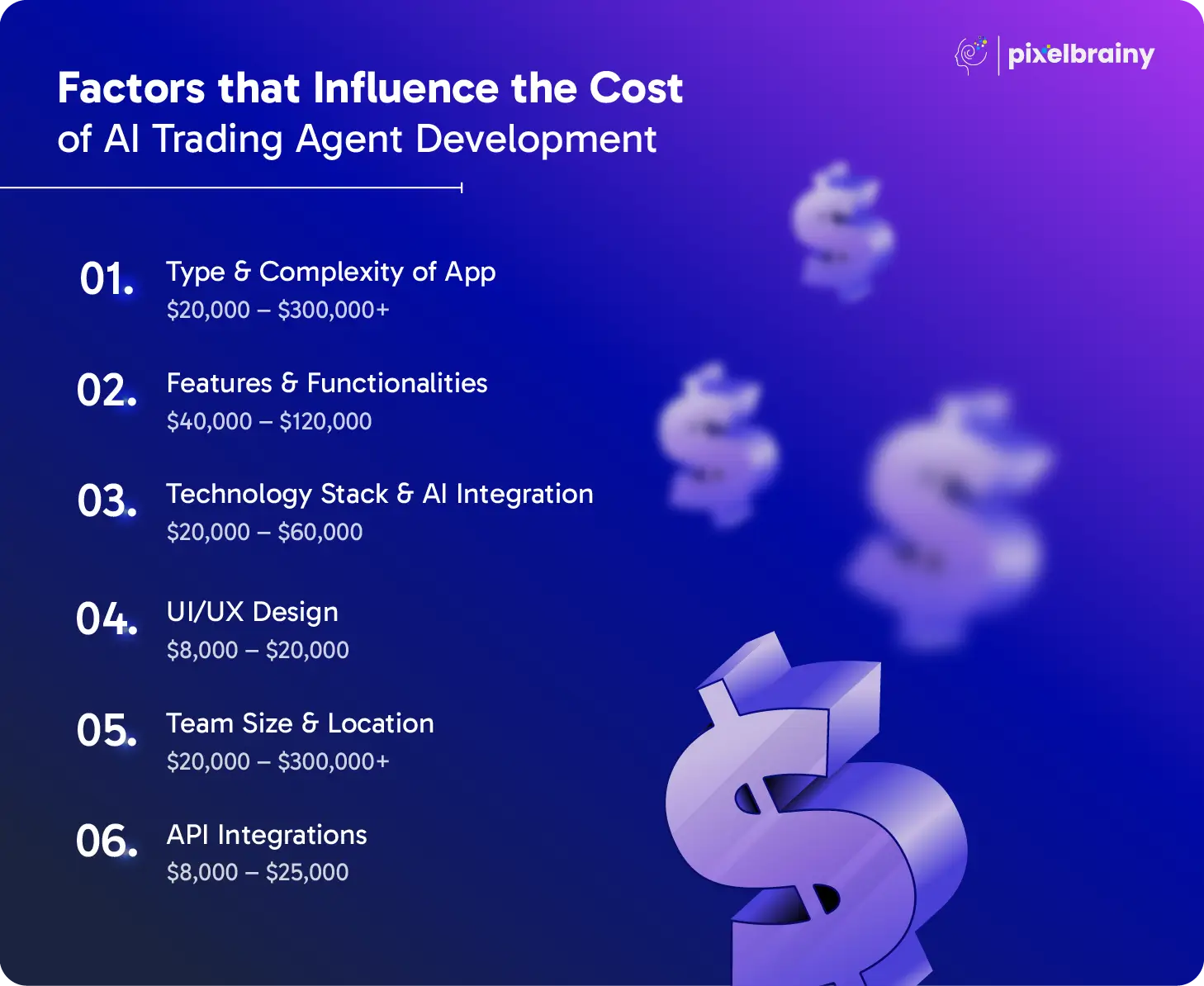
The type of trading agent is one of the strongest determinants of both development cost and timeline. If your objective is to automate an existing systematic strategy for US equities, you may need a focused architecture with broker connectivity, market data, backtesting, and risk controls. A larger platform supporting multiple strategies, markets, users, and AI models requires considerably more engineering.
| App Type | Description | Estimated Cost |
| MVP / Basic AI Trading Agent | Core trading logic, simple strategy execution | $20,000 to $40,000 |
| Advanced Custom AI Trading Agent | AI-driven predictions, backtesting, UI, risk management | $50,000 to $120,000 |
| Enterprise-Level AI Agent | Multi-market support, custom AI models, scalability | $150,000 to $300,000+ |
The features included in your trading agent directly affect development hours, integrations, testing requirements, and infrastructure. For example, automated execution is comparatively straightforward when limited to one broker and strategy, while AI-based optimization, multi-exchange execution, and advanced risk controls require additional engineering.
Prioritizing features around your actual trading workflow can help you understand the cost to build an AI trading agent without paying for capabilities you do not need.
| Feature | Description | Estimated Cost |
| Real-Time Market Data Feed | Live market data integration | $5,000 to $10,000 |
| Backtesting Engine | Strategy simulation on historical data | $6,000 to $12,000 |
| Automated Trade Execution | Execute trades based on strategy output | $4,000 to $8,000 |
| Risk Management Module | Stop-loss, max drawdown, alerts | $5,000 to $10,000 |
| Dashboard & Reporting | Visual insights, logs, performance analytics | $5,000 to $15,000 |
| Strategy Builder (No-Code/Low-Code) | Drag-and-drop strategy configuration | $8,000 to $20,000 |
| AI/ML Model Integration | Predictive modeling and optimization | $10,000 to $30,000 |
| Multi-Exchange Support | Trade across Binance, Coinbase, etc. | $5,000 to $15,000 |
Technology decisions influence how efficiently your agent processes market data, generates signals, performs backtesting, and communicates with trading APIs. Python-based data processing may be sufficient for many systematic strategies, while advanced AI workloads can require dedicated ML frameworks and additional computing resources.
The AI trading bot development cost also increases when the project requires custom model training, continuous inference, large datasets, or low-latency execution. The technology stack should therefore match the strategy's actual performance and scalability requirements.
| Technology Stack | Purpose | Estimated Cost |
| Python + Pandas + NumPy | Core logic, data analysis | $4,000 to $10,000 |
| TensorFlow / PyTorch | AI/ML model development | $8,000 to $20,000 |
| FastAPI / Django | Backend API framework | $3,000 to $7,000 |
| React / Next.js | Frontend UI framework | $4,000 to $8,000 |
| AWS / GCP / Azure | Cloud deployment, hosting, scaling | $5,000 to $15,000+ |
A trading interface needs to present market data, signals, orders, portfolio information, risk metrics, and performance reports clearly. The design workload depends on whether you need a simple monitoring dashboard or a complete trading workspace with interactive charts and multiple user workflows.
For businesses planning to develop an AI trading agent, the number of screens, user roles, responsive requirements, and interactive components can significantly influence design effort and project timelines.
| Design Component | Description | Estimated Cost |
| Wireframing & User Flow Planning | Navigation, user journey maps | $1,000 to $3,000 |
| Custom UI Design (Screens/Layout) | Visual design of trading screens | $3,000 to $7,000 |
| Interactive Prototypes | Clickable mockups for feedback | $2,000 to $4,000 |
| Responsive Design | Mobile/tablet optimization | $2,000 to $4,000 |
| Design System & Style Guide | Icons, typography, color systems | $1,500 to $3,000 |
The development team's composition can substantially change the total project budget. A trading agent typically requires a combination of backend developers, AI/ML engineers, data specialists, QA professionals, DevOps expertise, and fintech knowledge.
Location also affects hourly rates. However, comparing proposals solely on developer rates can be misleading. A lower hourly rate may not reduce the total investment if the team requires more hours to deliver the same functionality.
| Team Type | Location | Estimated Cost |
| Small Team (3 to 5) | India, Ukraine, Philippines | $20,000 to $50,000 |
| Mid-Size Team (6 to 10) | Eastern Europe, LATAM | $50,000 to $120,000 |
| In-House/USA Team | US, UK, Canada | $100,000 to $300,000+ |
Trading agents depend heavily on external APIs for market information, order execution, payments, notifications, and identity or compliance workflows. Each integration introduces development, authentication, testing, error handling, and ongoing maintenance requirements.
For example, an agent designed for one US equities broker will generally require less integration work than a platform supporting several exchanges and multiple asset classes. This makes API scope an important part of the custom AI trading agent development cost.
| API Type | Examples | Estimated Cost |
| Market Data API | Alpha Vantage, CoinMarketCap | $2,000 to $5,000 |
| Exchange API Integration | Binance, Coinbase, Kraken | $3,000 to $8,000 |
| Payment/Subscription Gateway | Stripe, PayPal | $2,000 to $4,000 |
| Notification/Alerting Services | Twilio, SendGrid | $1,000 to $3,000 |
| KYC/AML Compliance APIs | Trulioo, SumSub | $3,000 to $7,000 |
Combined Table: Total AI Trading Agent Development Cost Breakdown:
| Factor | Cost Range |
| Type & Complexity of App | $20,000 to $300,000+ |
| Features & Functionalities | $40,000 to $120,000 |
| Technology Stack & AI Integration | $20,000 to $60,000 |
| UI/UX Design | $8,000 to $20,000 |
| Team Size & Location | $20,000 to $300,000+ |
| API Integrations | $8,000 to $25,000 |
| Total Estimated Range | $20,000 to $300,000+ |
For a realistic budget, evaluate each cost driver against your trading strategy, market coverage, AI requirements, execution workflow, and risk controls before comparing development proposals.
Also Read: AI Agent Development Cost Guide: Factors and Cost Optimization Tips
How much does an AI trading agent cost for different trading strategies? The answer depends heavily on the market, execution model, number of integrations, AI capabilities, and risk controls required for the specific use case. A crypto trading bot, for example, may need multiple exchange APIs and continuous market monitoring, while an HFT agent requires substantially more engineering around latency and execution infrastructure.
For investors and fintech businesses, understanding the use-case-wise AI trading agent development cost makes it easier to create a realistic budget before development begins. It also helps determine whether a basic automated system is sufficient or whether the trading workflow requires a more sophisticated AI architecture.
Below are seven common AI trading agent use cases and their estimated development costs.
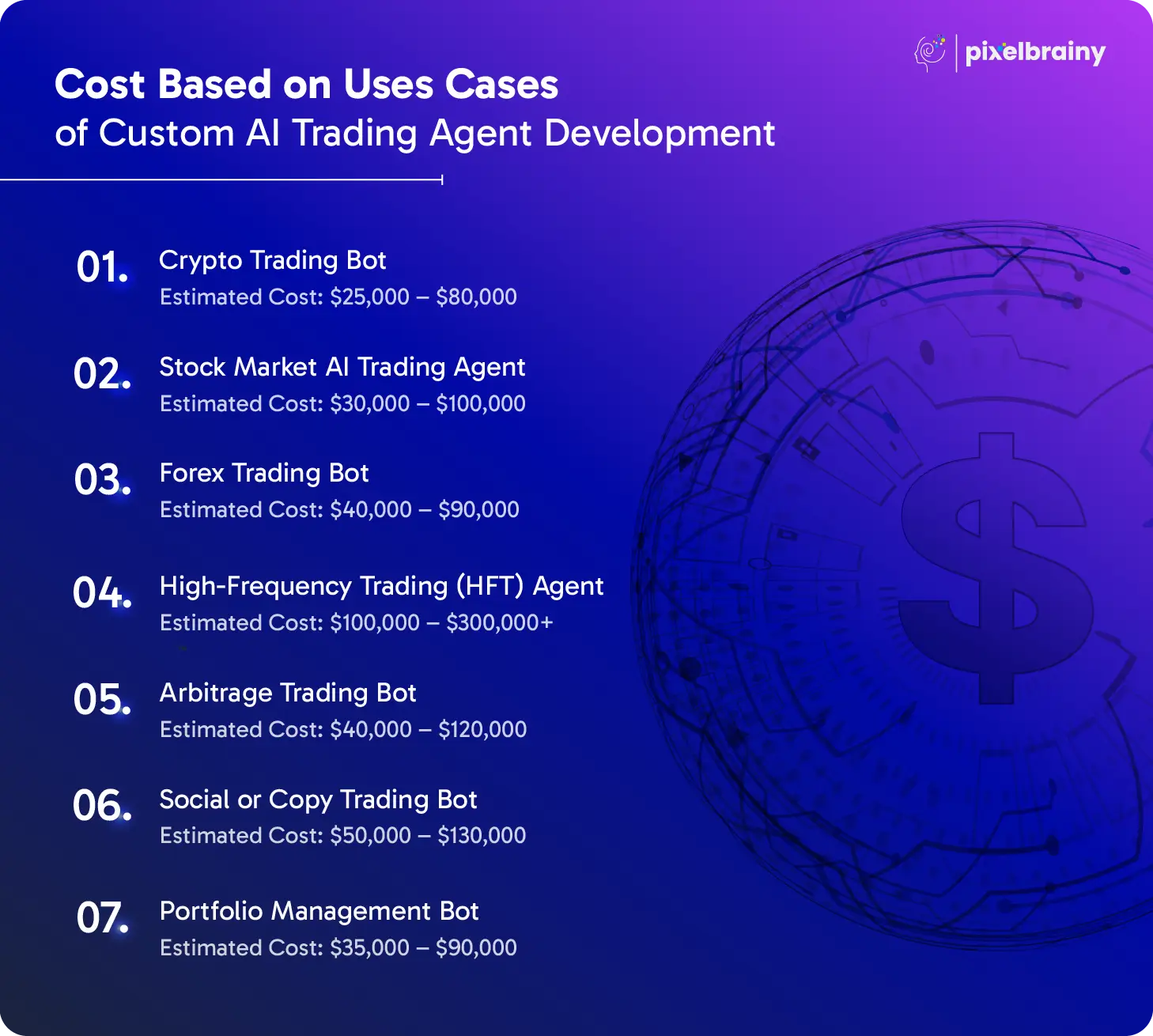
A crypto trading bot automates cryptocurrency strategies using real-time market data, predefined or AI-generated signals, and automated order execution. Depending on the product scope, it may connect with multiple exchanges and incorporate predictive analytics, technical indicators, sentiment analysis, portfolio tracking, and risk controls.
The cost to create a custom crypto trading bot depends primarily on the number of exchanges, trading strategies, AI capabilities, execution requirements, and backtesting depth.
Estimated Cost: $25,000 to $80,000
A stock market AI trading agent is designed to automate equity strategies using historical prices, technical indicators, market signals, and potentially news or sentiment data. For a retail investor trading US equities, the system may connect to a brokerage API and include automated execution, portfolio monitoring, backtesting, and risk management.
The cost to develop an AI trading agent for the stock market depends on the broker integrations, number of strategies, AI model complexity, data requirements, and level of automation.
Estimated Cost: $30,000 to $100,000
A forex trading bot automates currency-pair strategies using market trends, volatility indicators, technical signals, and real-time data. Since forex markets operate across global sessions, the system may require continuous monitoring and responsive execution.
The cost to build a forex AI trading bot varies according to the number of currency pairs, indicators, AI models, broker connections, execution requirements, and backtesting infrastructure.
Estimated Cost: $40,000 to $90,000
An HFT agent is designed for extremely fast trade analysis and execution, making infrastructure and latency optimization central to its architecture. These systems can require specialized computing environments, optimized data pipelines, exchange connectivity, and carefully engineered execution logic.
Because of these requirements, HFT AI trading agent development cost is considerably higher than that of standard retail trading bots. The final budget depends on execution speed targets, market connectivity, infrastructure, strategy complexity, and scalability requirements.
Estimated Cost: $100,000 to $300,000+
An arbitrage trading bot identifies price differences for the same or related assets across markets and attempts to execute trades based on those discrepancies. It typically requires multiple exchange connections, real-time price monitoring, automated order execution, and safeguards against execution delays.
The cost to create an arbitrage trading bot depends on the number of exchanges, data feeds, execution speed, trading logic, AI capabilities, and infrastructure required to coordinate transactions.
Estimated Cost: $40,000 to $120,000
A social or copy trading bot allows users to follow and replicate selected trading strategies or transactions. A commercial platform may require trader profiles, performance tracking, leaderboards, subscription management, portfolio synchronization, automated trade replication, and risk controls.
The custom AI trading bot development cost for this use case depends on user management requirements, real-time trade synchronization, analytics, payment functionality, and the intelligence used to rank or recommend strategies.
Estimated Cost: $50,000 to $130,000
A portfolio management bot focuses on longer-term investment workflows such as portfolio analysis, asset allocation, automated rebalancing, diversification, and risk monitoring. AI can be incorporated to analyze portfolio conditions, identify allocation changes, and generate data-driven recommendations.
The cost to build an AI-powered portfolio management bot varies according to supported asset classes, portfolio complexity, AI model requirements, brokerage integrations, reporting capabilities, and automation level.
Estimated Cost: $35,000 to $90,000
The right budget depends on the trading problem you are solving, not simply the type of bot you choose. Mapping your strategy, data, execution, AI, and risk requirements to the appropriate use case provides a clearer basis for estimating AI trading agent development cost.

Have you calculated the development budget but still wonder why the final quote for an AI trading bot could be higher than expected? The visible features, technology stack, and use case are only part of the investment. Data licensing, model training, compliance, security, infrastructure, and post-launch operations can add substantial costs that are easy to miss during initial planning.
For a retail investor automating a US equities strategy, these expenses may look different from those of a fintech company operating a multi-market trading platform. Some are one-time development expenses, while others continue after launch. Understanding these cost drivers helps you evaluate proposals more accurately and identify which expenses are technically necessary for your trading requirements.
Let’s examine the hidden factors that can influence the AI trading bot development cost beyond the initial development estimate.
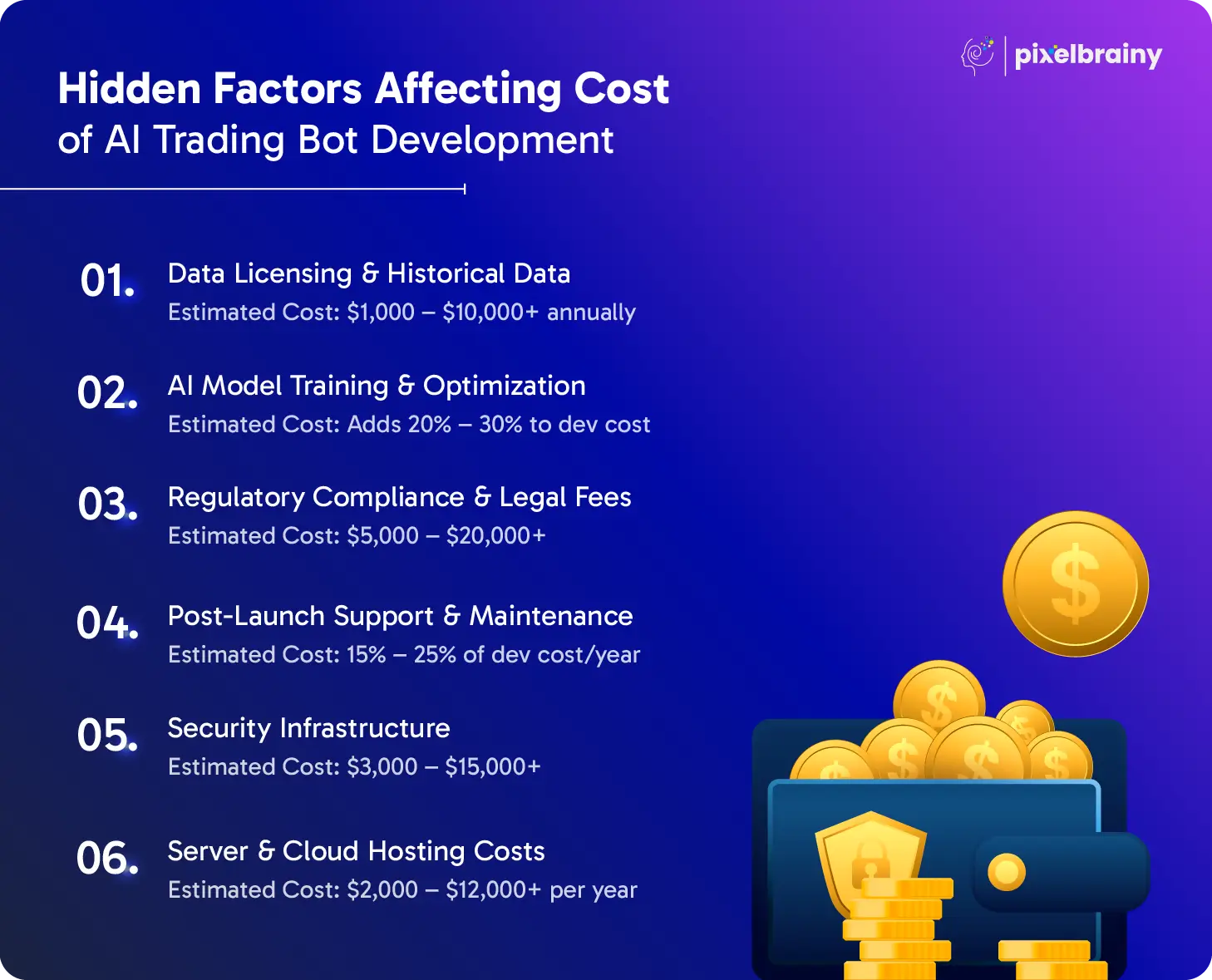
AI trading systems depend on historical and real-time market data for strategy development, backtesting, model training, and live signal generation. Depending on the market and data requirements, you may need premium datasets or commercially licensed feeds with recurring charges.
Data costs can increase when you require higher-frequency data, broader market coverage, longer historical periods, or additional sources such as news and sentiment feeds. These expenses should be separated from development fees when calculating the overall cost to develop an AI trading agent.
Impact: $1,000 to $10,000+ annually
AI model development does not end when the first model produces usable predictions. Models generally require repeated training, validation, testing, and optimization using different datasets and market conditions.
These iterations can require additional engineering hours and computing resources, particularly when working with large datasets or computationally intensive models. As a result, model refinement can increase the cost to build a custom AI trading agent beyond the initial AI development estimate.
Potential Impact: Adds 20% to 30% to development cost
The compliance requirements for a trading system depend on its market, jurisdiction, business model, and whether it executes trades only for its owner or provides services to other users. Requirements may involve financial regulations, data privacy, KYC/AML workflows, record keeping, and audit processes.
Legal consultation, compliance reviews, documentation, and specialized integrations can therefore become additional budget items. These requirements should be assessed before development rather than treated as an afterthought.
Impact: $5,000 to $20,000+
An AI trading agent requires ongoing technical maintenance after deployment. Broker or exchange APIs can change, market data feeds can be updated, infrastructure needs can grow, and AI models may require retraining or optimization as market conditions change.
Your maintenance budget may also include bug fixes, performance monitoring, security updates, model evaluation, and new integrations. For long-term planning, AI trading bot maintenance costs may range from 15% to 25% of the initial development budget annually.
Trading systems handle sensitive information such as API credentials, account information, transaction data, and proprietary trading strategies. Security therefore needs to be incorporated into the architecture from the beginning.
Expenses can include encrypted data storage and transmission, secure authentication, secrets management, access controls, audit logs, vulnerability assessments, and penetration testing. Strong security measures can increase the initial investment, but they also reduce exposure to unauthorized access and costly remediation.
Impact: $3,000 to $15,000+
A real-time trading agent requires infrastructure capable of processing market data, generating signals, communicating with broker or exchange APIs, and maintaining reliable availability. Infrastructure requirements become more demanding as trading frequency, data volume, user count, or market coverage increases.
Cloud services such as AWS, GCP, or Azure can provide scalable infrastructure, but hosting, storage, compute, monitoring, and data transfer can create recurring expenses. These costs should be included when calculating the long-term custom AI trading bot development cost.
Impact: $2,000 to $12,000+ per year
| Hidden Factor | Description | Estimated Cost |
| Data Licensing & Historical Data | Access to premium market data or historical datasets for model training and testing. | $1,000 to $10,000+ annually |
| AI Model Training & Optimization | Iterative model development, testing, tuning, validation, and computing resources. | Adds 20% to 30% to development cost |
| Regulatory Compliance & Legal Fees | Legal consulting, KYC/AML integration, compliance reviews, and documentation. | $5,000 to $20,000+ |
| Post-Launch Support & Maintenance | Bug fixes, API updates, model retraining, monitoring, and technical improvements. | 15% to 25% of development cost/year |
| Security Infrastructure | Encryption, authentication, credential protection, security testing, and audit controls. | $3,000 to $15,000+ |
| Server & Cloud Hosting Costs | Real-time data processing, compute resources, storage, monitoring, and uptime requirements. | $2,000 to $12,000+ per year |
These hidden expenses can materially change the total cost of developing an AI trading agent. Separating one-time development costs from recurring data, infrastructure, compliance, and maintenance expenses gives you a more realistic budget for launching and operating the trading system.
How much would it cost to build an AI trading agent similar to platforms already used by traders? Reviewing established trading bots can help startups and businesses understand how functionality, automation, integrations, and platform complexity influence the overall budget.
The examples below cover crypto trading bots, forex-focused solutions, copy trading platforms, and institutional-grade algorithmic trading systems. The estimated costs are indicative development ranges for creating a comparable solution from scratch, not the actual development costs of the companies behind these products. Your final budget will depend on the features, AI capabilities, supported markets, integrations, security requirements, and scalability you need.
Here are six popular AI trading solutions and their estimated development costs:
3Commas is a feature-rich crypto trading platform that combines automated trading, portfolio tracking, copy trading, signals, and multi-strategy functionality. A comparable solution would require integrations with multiple exchanges, automated trade execution, strategy configuration, portfolio management, and real-time trading data.
Estimated Cost to Build a Similar Bot: $80,000 to $150,000
TradeSanta focuses on automated crypto trading with strategy templates, cloud-based execution, analytics, and multi-exchange connectivity. A similar platform would need automated strategy execution, exchange APIs, user dashboards, trading configuration, and real-time performance monitoring.
Custom AI Trading Bot Development Cost for a Similar Platform: $50,000 to $90,000
Cryptohopper is a cloud-based crypto trading platform with features such as automated strategies, backtesting, trading signals, marketplace functionality, and advanced trading tools. A comparable product requires a broader technical architecture because it combines automation, strategy management, analytics, exchange integrations, and mobile accessibility.
Estimated Development Cost for a Cryptohopper-Style Bot: $100,000 to $180,000
AI trading bots built for MetaTrader 5 can support forex, commodities, and indices through automated strategies and algorithmic execution. Development costs vary considerably based on whether the solution uses basic rule-based strategies, predictive models, neural networks, custom indicators, or advanced risk controls.
Cost to Create MT5-Compatible AI Trading Bots: $25,000 to $80,000 depending on features.
AlgoTrader represents a much more sophisticated category of algorithmic trading technology designed for institutional use. A comparable platform may support multiple asset classes, advanced trading strategies, extensive market integrations, analytics, automation, and scalable infrastructure.
Because of this enterprise-level scope, the investment is substantially higher than a retail trading bot.
Development Cost for a Platform Like AlgoTrader: $200,000 to $350,000+
Zignaly focuses on copy trading, profit-sharing, automation, and portfolio management for crypto traders. A similar product would require real-time trade synchronization, user and portfolio management, automated execution, performance tracking, and exchange connectivity.
Estimated Cost to Build a Platform Like Zignaly: $60,000 to $110,000
These examples demonstrate why AI trading agent development cost can range from tens of thousands to several hundred thousand dollars. A focused trading bot with limited integrations can remain within the lower range, while multi-market platforms with advanced AI, real-time execution, copy trading, risk management, and enterprise scalability require considerably more investment.
The most useful comparison is not the brand name, but the features, technical complexity, integrations, and infrastructure your proposed trading agent actually needs.
Also Read: AI App Development Cost: From MVPs to Full-Scale AI App
How can you lower the AI trading bot development cost without compromising security, performance, or scalability? The most effective approach is to optimize the development scope rather than simply cutting features or choosing the lowest-cost development team.
For startups, fintech businesses, and retail trading platforms, the cost to develop an AI trading agent can be controlled by prioritizing essential capabilities, reusing proven technologies, and planning integrations and infrastructure carefully. These strategies help reduce unnecessary development effort while preserving the components that directly affect trading execution, AI performance, risk management, and reliability.
Here are practical ways to reduce AI trading agent development cost while maintaining product quality:
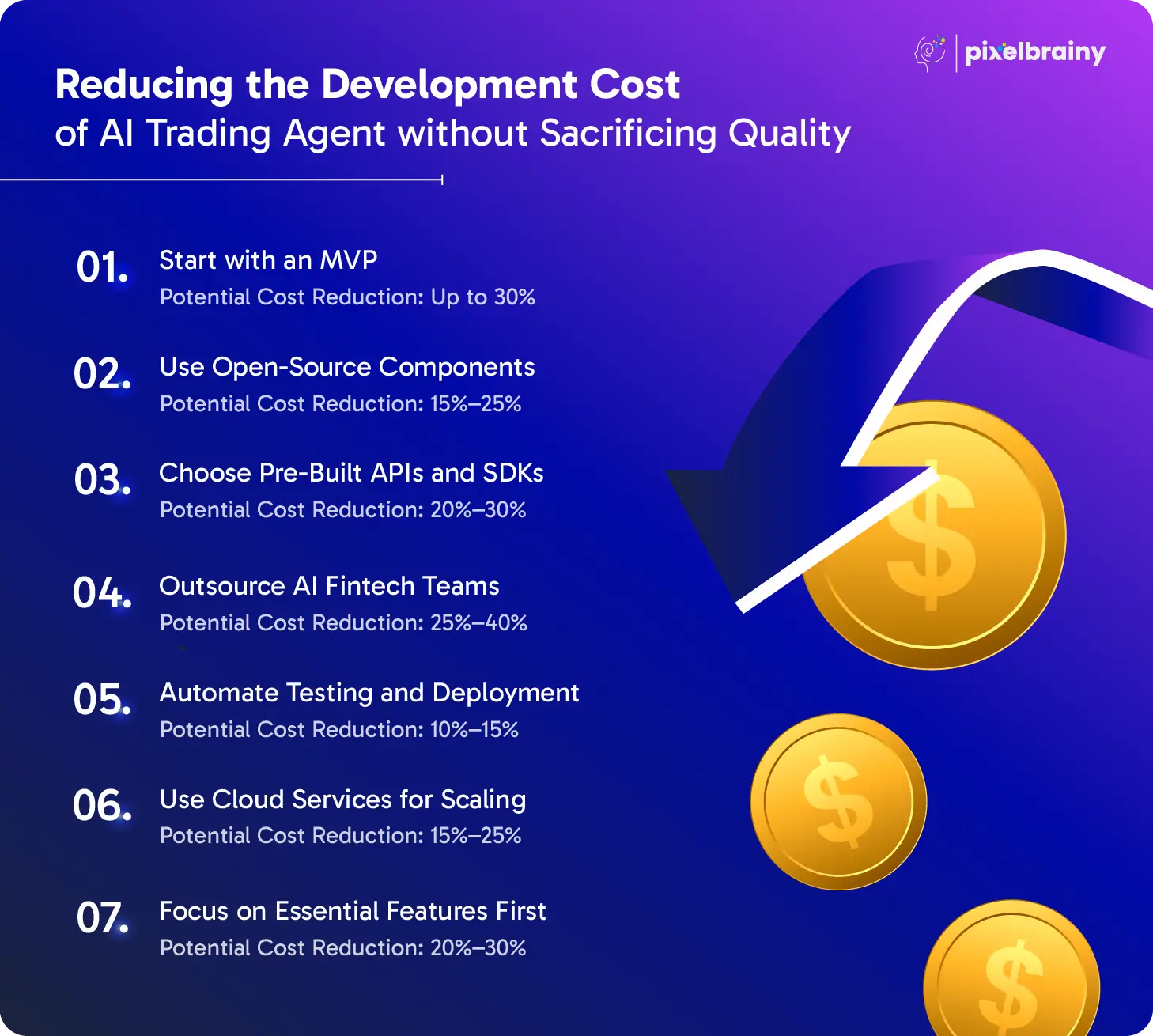
Launching with an MVP is one of the most practical ways to control custom AI trading bot development cost. Instead of launching with multiple trading strategies, exchanges, advanced analytics, and complex automation, start with the capabilities required to validate your core trading concept.
For example, an initial AI trading agent MVP could include market data integration, strategy execution, backtesting, basic risk controls, alerts, and performance tracking. Once the system is validated, you can introduce advanced AI models, additional markets, and sophisticated automation based on actual requirements.
Potential Cost Reduction: Up to 30% by avoiding unnecessary features during the initial development phase.
Also Read: Top 10 AI MVP Development Companies in USA
Using suitable open-source AI frameworks and trading technologies can lower development expenses by reducing the amount of functionality that needs to be created from scratch. Libraries for machine learning, data analysis, statistical processing, API development, and model experimentation can provide a strong technical foundation.
This allows your development team to focus its budget on proprietary trading strategies, AI model development, risk management, and other features that differentiate your trading solution. Before implementation, each open-source component should still be reviewed for licensing, security, compatibility, and long-term maintenance requirements.
Potential Cost Reduction: 15% to 25% by reducing custom development effort.
Pre-built APIs and SDKs can significantly reduce AI trading software development cost when your solution needs connections to market data providers, exchanges, payment services, notification platforms, or identity verification systems.
Instead of developing every integration internally, your team can use established APIs for real-time market data and automated trade execution. This reduces integration time and allows more resources to be directed toward AI-powered trading strategies, backtesting, risk controls, and system reliability.
Potential Cost Reduction: 20% to 30% by minimizing custom integration work.
Partnering with an experienced AI trading bot development company can help startups access specialized developers, AI engineers, data professionals, and QA specialists without maintaining a large in-house team.
A specialized team can bring experience in algorithmic trading, financial APIs, AI model integration, cloud infrastructure, and security. This approach can be particularly useful when you need to build an AI trading agent within a defined budget and timeline while avoiding unnecessary hiring and training costs.
Potential Cost Reduction: 25% to 40% compared with maintaining an equivalent in-house team.
Automated testing is important for controlling the cost of AI trading bot development because trading systems require consistent validation across strategies, market data, APIs, and order execution workflows.
Automated regression testing, API testing, model validation, continuous integration, and deployment pipelines can identify problems earlier and reduce repetitive manual QA work. For AI trading systems, automated testing can also help validate strategy behavior and system performance before new versions reach production.
Potential Cost Reduction: 10% to 15% in long-term maintenance and support.
Cloud infrastructure can make AI trading agent development more cost-efficient by allowing businesses to scale computing, storage, databases, and AI workloads according to actual usage.
Instead of investing heavily in fixed infrastructure from the beginning, a trading platform can start with resources appropriate for its MVP and scale as users, trading activity, market data, and model workloads increase. Cloud infrastructure can also support monitoring, automated deployment, data processing, and high-availability requirements.
Potential Cost Reduction: 15% to 25% compared with fixed infrastructure costs.
Feature prioritization has a direct impact on custom AI trading agent development cost. Before investing in advanced dashboards, multiple asset classes, complex strategy builders, or sophisticated predictive models, identify the capabilities that directly support your trading objectives.
For a systematic US equities trading agent, for instance, the initial scope could focus on reliable market data, automated strategy execution, backtesting, risk management, alerts, and performance reporting. Once these core functions perform reliably, additional AI trading agent features can be introduced without unnecessarily increasing the initial development budget.
Potential Cost Reduction: 20% to 30% by maintaining a focused development scope.
| Start with an MVP | Focus on core AI trading capabilities first | Up to 30% |
| Use Open-Source Components | Leverage suitable AI and development frameworks | 15% to 25% |
| Choose Pre-Built APIs and SDKs | Reuse established market and service integrations | 20% to 30% |
| Outsource to Specialized Teams | Access specialized AI and fintech expertise | 25% to 40% |
| Automate Testing & Deployment | Reduce repetitive QA and deployment work | 10% to 15% |
| Use Cloud Services for Scaling | Scale infrastructure according to actual usage | 15% to 25% |
| Focus on Essential Features First | Prioritize high-value features and control scope | 20% to 30% |
The best way to reduce AI trading bot development cost is to eliminate unnecessary complexity while protecting investment in trading logic, data quality, security, AI performance, and risk management.
PixelBrainy is a top AI trading software development company in USA, helping startups, fintech businesses, and enterprises create intelligent trading solutions while keeping development investments aligned with their business goals. Our approach to AI trading agent development focuses on reducing unnecessary complexity without compromising security, trading performance, scalability, or reliability.
Whether you want to build a basic automated trading bot, an AI-powered strategy execution platform, or a sophisticated multi-strategy trading agent, our team can help you define the right scope, technology stack, integrations, and development roadmap. The goal is to ensure every development dollar contributes to a meaningful capability.
Got questions about controlling the cost to develop an AI trading agent? Let’s break it down.
Client Overview:
A fintech startup approached PixelBrainy to develop a custom AI trading agent designed to enter the crypto trading market. The client wanted an automated solution that could:
The Challenge:
The client needed to launch quickly while keeping the custom AI trading bot development cost below $75,000. The solution also needed to support reliable API integrations, real-time execution, and ongoing model improvements without creating unnecessary technical complexity.
If your goal is to develop an AI trading agent without overspending, PixelBrainy can help you turn your trading strategy into a secure, scalable, and cost-efficient solution.
Understanding the AI trading agent development cost is essential for entrepreneurs and businesses aiming to enter the trading space with innovative solutions. From initial planning to deployment, several factors impact the custom AI trading bot development cost, including app complexity, features, technology stack, and integrations.
By carefully managing these factors and choosing the right AI development company, you can significantly reduce expenses without sacrificing quality. As we saw, companies like PixelBrainy specialize in delivering tailored, scalable, and secure AI agent development services that help you build AI agent for trading platform within your budget.
Whether you’re developing a basic trading bot or a complex enterprise-level AI agent, understanding cost drivers and strategic planning are key to a successful project. With the right partner, you can bring your AI-powered trading vision to life efficiently and competitively.
Ready to explore how you can build a custom AI trading agent that fits your budget and business goals? Book an Appointment with PixelBrainy today and take the first step toward smarter trading automation.
The cost to develop an AI trading bot typically ranges from $20,000 to $300,000+. A basic automated execution system can fit toward the lower end, while an advanced AI trading agent with predictive models, multiple strategies, real-time data, risk controls, and multi-market support can require a significantly higher investment.
There is no single fixed price for custom AI trading agent development. The budget depends on the trading strategy, AI capabilities, data requirements, integrations, user interface, security, infrastructure, and scalability. A practical estimate is $20,000 to $300,000+, with the final cost determined by the actual technical scope.
Developing an AI trading bot for US stocks can cost approximately $30,000 to $100,000, depending on the required functionality. Broker API integration, real-time market data, automated order execution, backtesting, portfolio controls, AI-based signals, reporting, and security requirements can all influence the final development budget.
The biggest cost increases usually come from genuine technical complexity, such as custom AI models, real-time data processing, low-latency execution, multiple trading strategies, advanced backtesting, risk management, multi-market support, third-party integrations, and enterprise-grade security. Development company pricing can also vary, so proposals should clearly separate engineering effort from service or management premiums.
The initial AI trading agent development cost is only part of the total investment. Ongoing expenses may include market data licensing, cloud hosting, API usage, AI model retraining, monitoring, security updates, bug fixes, infrastructure scaling, and technical support. These recurring costs should be included when calculating the long-term operating budget.
Yes, a $20,000 AI trading agent can be achievable when the initial scope is limited. A focused MVP could include core strategy execution, a market data integration, basic backtesting, essential risk controls, and a simple monitoring interface. Advanced AI models, multiple strategies, additional markets, and complex integrations can be added in later development phases.
You can reduce AI trading bot development cost by starting with an MVP, prioritizing essential trading features, using suitable open-source technologies, integrating proven APIs, automating testing, and adopting scalable cloud infrastructure. Working with a specialized AI fintech development team can also help reduce unnecessary development effort while maintaining technical quality.
A typical AI trading agent development timeline is around 4 to 6 months, although the duration depends on project complexity. A basic automated trading bot may require less time, while a sophisticated system with multiple strategies, custom AI models, real-time execution, advanced risk management, extensive integrations, and enterprise scalability will generally take longer.

About The Author
Sagar Bhatnagar
Sagar Sahay Bhatnagar brings over a decade of IT industry experience to his role as Marketing Head at PixelBrainy. He's known for his knack in devising creative marketing strategies that boost brand visibility and market influence. Sagar's strategic thinking, coupled with his innovative vision and focus on results, sets him apart. His track record of successful campaigns proves his ability to utilize digital platforms effectively for impactful marketing efforts. With a genuine passion for both technology and marketing, Sagar continuously pushes PixelBrainy's marketing initiatives to greater success.

Working with the PixelBrainy team has been a highly positive experience. They understand the design requirements and create beautiful UX elements to meet the application needs. The dev team did an excellent job bringing my vision to life. We discussed usability and flow. Sagar worked with his team to design the database and begin coding. Working with Sagar was easy. He has the knowledge to create robust apps, including multi-language support, Google and Apple ID login options, Ad-enabled integrations, Stripe payment processing, and a Web Admin site for maintaining support data. I'm extremely satisfied with the services provided, the quality of the final product, and the professionalism of the entire process. I highly recommend them for Android and iOS Mobile Application Design and Development.

Great experience working with them. Had a lot of feedback and I found that unlike most contractors they were bugging me for updates instead of the other way around. They were extremely time conscience and great at communicating! All work was done extremely high quality and if not on time, early! They were always proactive when it comes to communication and the work is great/above par always. Very flexible and a great team to work with! Goes above and beyond to present us with multiple options and always provides quality. Amazing work per usual with Chitra. If you have UI/UX or branding design needs I recommend you go to them! Will likely work with them in the future as well, definitely recommended!

PixelBrainy is a joy to work with and is a great partner when thinking through branding, logo, and website layout. I appreciate that they spend time going into the "why" behind their decisions to help inform me and others about industry best practices and their expertise.

I hired them to design our software apps. Things I really like about them are excellent communication skills, they answer all project suggestions and collaborate right away, and their input on design and colors is amazing. This project was complex and needed patience and creativity. The team is amazing to do business with. I will be using them long-term. Glad to see there are some good people out there. I was afraid to try and outsource my project to someone but I am glad I met them! I really can't say enough. They went above and beyond on this project. I am very happy with everything they have done to make my business stand out from the competition.

It was great working with PixelBrainy and the team. They were very responsive and really owned the project. We'll definitely work with them again!

I recently worked with the PixelBrainy team on a project and I was blown away by their communication skills. They were prompt, clear, and articulate in all of our interactions. They listened and provided valuable feedback and suggestions to help make the project a success. They also kept me updated throughout the entire process, which made the experience stress-free and enjoyable.

PixelBrainy is very good at what it does. The team also presents themselves very professionally and takes care of their side of things very well. I could fully trust them taking up the design work in a timely and organised manner and their attention to detail saved us lots of effort and time. This particular project was quite intense and the team showed that they function very well under pressure. Very much looking forward to working with her again!

It's always an absolute pleasure working with them. They completed all of my requests quickly and followed every note I had for them to a T, which made our process go smoothly from start to finish. Everything was completed fast and following all of the guidelines. And I would recommend their services to anyone. If you need any design work done in the future, PixelBrainy should be your first call!

They took ownership of our requirements and designed and proposed multiple beautiful variants. The team is self-motivated, requires minimum supervision, committed to see-through designs with quality and delivering them on time. We would definitely love to work with PixelBrainy again when we have any requirements.

PixelBrainy was a big help with our SaaS application. We've been hard at work with a new UI/UX and they provided a lot of help with the designs. If you're looking for assistance with your website, software, or mobile application designs, PixelBrainy and the team is a great recommendation.

PixelBrainy designers are amazing. They are responsive, talented, and always willing to help craft the design until it matches your vision. I would recommend them and plan to continue them for my future projects and more!!!

They were awesome! Did a good job fast, and good communication. Will work with them again. Thank you

Creative, detail-oriented, and talented designers who take direction well and implement changes quickly and accurately. They consistently over-delivered for us.

PixelBrainy team is very talented and creative. Great designers and a pleasure to work with. PixelBrainy is an excellent communicator and I look forward to working with them again.

PixelBrainy has a very talented design team. Their work is excellent and they are very responsive. I enjoy working with them and hope to continue on all of our future projects.


Transform your ideas into reality with us.
Across these industries, each engagement brings unique challenges, from early-stage product development to scaling complex systems, helping us build a practical understanding of real-world product environments.