AI Summary Powered by PixelBrainy
Can your organization still rely on traditional visitor sign-in methods when AI can automate security, identity verification, and visitor management in seconds?
The way businesses manage visitors has changed dramatically over the past few years. Manual visitor logs, paper sign-in sheets, and basic reception processes are no longer sufficient for organizations that prioritize security, operational efficiency, and compliance. This growing demand has made AI visitor sign-in app development one of the fastest-growing areas of enterprise software innovation. Companies across healthcare, corporate offices, manufacturing, education, logistics, hospitality, and government sectors are investing in intelligent visitor management solutions that automate check-ins, verify identities, notify hosts instantly, and maintain accurate visitor records.
The market growth reflects this accelerating demand. According to Grand View Research, the global Visitor Management System (VMS) market is estimated to reach USD 2.4 billion in 2026 and is projected to grow to USD 3.9 billion by 2030 at a CAGR of 13.5%, driven by rising investments in workplace security, cloud-based visitor management platforms, AI-powered identity verification, and smart building technologies.
Whether you want to build AI visitor management app solutions for corporate offices, healthcare facilities, manufacturing plants, or enterprise campuses, understanding how to build an AI visitor sign-in app is the first step toward creating a secure, scalable, and future-ready solution. A well-planned development process of AI visitor sign-in app helps organizations automate visitor registration, strengthen physical security, improve compliance, and deliver seamless digital check-in experiences. Businesses that develop AI visitor sign-in application platforms can significantly reduce reception workloads, eliminate manual errors, automate visitor approvals, and maintain comprehensive digital audit trails.
One of the most searched enterprise questions today is:
Which are the best AI visitor management app development companies in USA in 2026 that have actually built and deployed custom visitor sign-in systems for enterprise clients with verified reviews and real project case studies?
The answer depends on several factors, including proven AI development expertise, enterprise deployment experience, industry-specific knowledge, security certifications, verified client reviews, and successful project case studies. Choosing the right technology partner ensures your visitor management solution is scalable, secure, compliant, and tailored to your organization's operational requirements.
In this comprehensive guide, you'll learn everything about smart visitor management app development, including AI-powered features, industry-specific use cases, the complete development process, technology stack, development costs, implementation challenges, and best practices to successfully launch a modern AI visitor sign-in application in 2026.
An AI visitor sign-in app is an intelligent digital solution that automates the entire visitor check-in process using artificial intelligence. Unlike traditional visitor registers or basic digital forms, an AI powered visitor management app can verify identities, screen visitors against security watchlists, notify hosts instantly, issue visitor badges, and generate real-time analytics without requiring manual intervention.
Many businesses begin with a simple digital sign-in form to replace paper logbooks. While this improves record-keeping, it still depends on visitors manually entering their information and reception staff verifying identities. In contrast, AI visitor sign-in app development focuses on creating intelligent systems that automate identity verification, improve workplace security, reduce waiting times, and deliver a seamless visitor experience from arrival to departure.
If your goal is to build smart visitor management system solutions for enterprise offices, hospitals, schools, manufacturing facilities, or government buildings, AI introduces capabilities that go far beyond digital registration. These applications use machine learning, computer vision, and predictive analytics to make visitor management faster, smarter, and more secure.
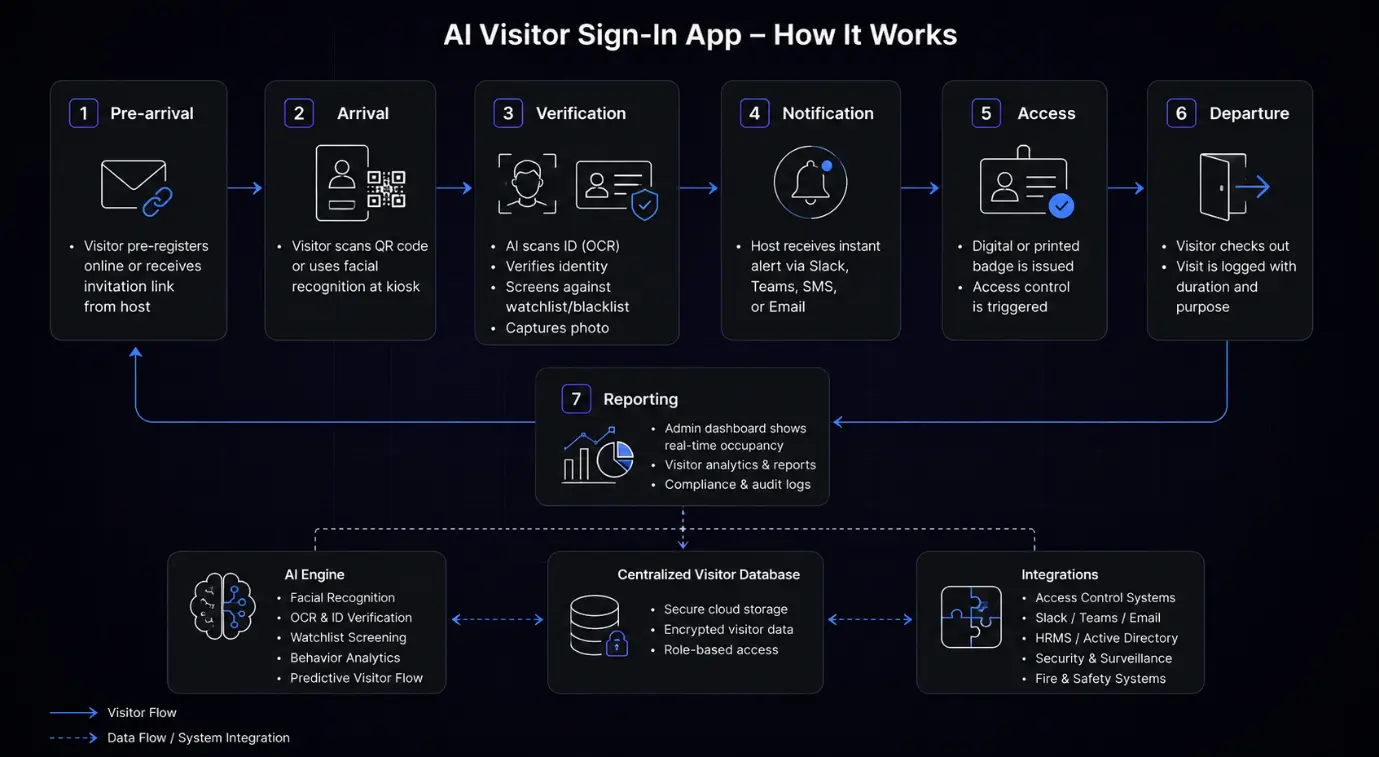
| Stage | What Happens |
| Pre-arrival | Visitor pre-registers online or receives an invitation link and QR code from the host. |
| Arrival | Visitor scans a QR code or completes contactless check-in using facial recognition at a self-service kiosk. |
| Verification | AI scans government-issued IDs using OCR, verifies visitor identity, screens against watchlists or blacklists, and captures a visitor photo. |
| Notification | The host receives an instant notification through Slack, Microsoft Teams, SMS, email, or a mobile app. |
| Access | The system generates a digital or printed visitor badge and automatically triggers access control permissions for approved areas. |
| Departure | Visitors check out digitally, while the application records visit duration, exit time, and purpose of the visit. |
| Reporting | Administrators access real-time occupancy dashboards, visitor history, compliance reports, and visitor analytics. |
Artificial intelligence transforms visitor management from a simple check-in process into an intelligent security and operational platform.
AI-powered facial recognition verifies visitor identities in seconds, enabling secure and contactless check-ins while minimizing queues at reception. It also helps prevent unauthorized access by matching visitors with pre-approved records.
Instead of manually entering information, Optical Character Recognition (OCR) automatically extracts visitor details from passports, driver's licenses, or national identity cards. This improves accuracy, reduces human errors, and speeds up registration.
The application instantly compares visitor information against internal watchlists, banned visitor databases, or security blacklists. If a match is detected, security teams receive immediate alerts for further action.
AI continuously analyzes visitor behavior and movement patterns to identify unusual activities, repeated visits, or potential security risks. This proactive monitoring helps organizations strengthen workplace safety.
Using historical visitor data, AI forecasts peak visitor hours and expected foot traffic. Reception teams can allocate staff more effectively, reduce waiting times, and improve the overall visitor experience.
Many organizations require visitors to sign non-disclosure agreements, safety policies, or compliance forms before entering restricted areas. AI-powered visitor management systems automatically present the required documents, collect digital signatures, and securely store them for future audits.
Unlike traditional digital visitor sign-in app development, AI-driven solutions continuously learn from visitor patterns, automate repetitive administrative tasks, and provide actionable insights that improve security, operational efficiency, and compliance. As organizations embrace smarter workplaces in 2026, AI visitor sign-in applications have become an essential component of modern enterprise visitor management.
Businesses are replacing paper sign-in sheets with AI visitor management apps because traditional visitor logs create security vulnerabilities, slow down reception operations, and make compliance difficult. AI visitor sign-in app development enables organizations to automate visitor registration, verify identities, screen visitors against watchlists, track real-time occupancy, and generate secure digital audit trails from a single platform.
Whether you want to build AI visitor management app solutions for a corporate office, hospital, school, manufacturing facility, or government building, AI-powered automation delivers greater security, operational efficiency, and a better visitor experience than paper logs or basic digital forms. Organizations that develop smart visitor sign-in system solutions also benefit from improved compliance, reduced administrative work, and a scalable digital visitor management system that supports business growth.
The most common reasons organizations are investing in AI visitor sign-in app development include:
Paper visitor registers are easy to alter, lose, or access without authorization. Anyone can write false information, view previous visitor records, or remove pages, making paper logs unreliable for modern workplace security.
They also provide no real-time visibility into who is currently inside the building and fail to create a secure audit trail. For organizations operating in regulated industries, paper visitor records are frequently identified during audits as a compliance weakness.
An AI-powered digital visitor management system automatically stores visitor records securely, maintains complete activity logs, and provides tamper-resistant digital documentation that simplifies compliance and improves data security.
Our reception team spends three to four hours every day manually processing visitor sign-ins. How can an AI visitor management app fix this?
AI visitor management applications automate nearly every reception task, including visitor registration, QR code check-in, ID verification, badge printing, digital document signing, and host notifications. Instead of manually entering visitor details, reception staff supervise an automated process that completes check-ins in less than 30 seconds.
This significantly reduces administrative work while creating a faster, more professional arrival experience for customers, business partners, vendors, and job candidates.
Paper visitor logs only record who signed in. They cannot accurately show who is still inside the building because visitors often forget to sign out.
This becomes a major safety concern during emergencies such as fire evacuations or lockdowns. AI visitor management systems provide real-time occupancy dashboards, active visitor lists, and instant evacuation reports, allowing facility managers and security teams to respond quickly with accurate information.
We had a serious security incident because a visitor with a criminal record signed in without verification. How does an AI visitor management system prevent this?
Unlike paper sign-in sheets, AI-powered visitor management applications verify visitor identities before access is granted. The system scans government-issued identification using OCR, validates visitor information, compares records against internal watchlists or blacklists, and can perform facial recognition for additional verification where permitted.
If a potential security risk is detected, the application immediately alerts reception or security personnel, preventing unauthorized visitors from entering restricted areas.
Our auditors flagged our paper visitor log as a compliance risk. What does an AI visitor sign-in app do to solve this?
Modern regulations such as GDPR, HIPAA, SOC 2, ISO 27001, and industry-specific privacy standards require organizations to manage visitor data securely throughout its lifecycle.
Paper records cannot automate consent collection, enforce data retention policies, support secure deletion requests, or produce detailed audit reports. AI visitor management applications address these requirements by automatically recording visitor consent, encrypting visitor information, applying retention rules, and generating compliance-ready reports whenever auditors request them.
Managing 30 or 40 visitors each day with a paper register may be practical, but the process quickly becomes inefficient as visitor volumes increase or organizations expand across multiple locations.
Businesses that build AI visitor management app solutions gain a centralized platform capable of processing hundreds or even thousands of visitor check-ins simultaneously. Automated workflows, cloud infrastructure, and intelligent resource allocation reduce operational costs while delivering consistent visitor experiences across every office.
Paper visitor sign-in sheets are no longer suitable for organizations that prioritize workplace security, regulatory compliance, and operational efficiency. AI visitor sign-in app development enables businesses to automate visitor verification, reduce reception workloads, improve emergency preparedness, strengthen compliance, and deliver seamless digital check-in experiences.
As organizations continue their digital transformation in 2026, investing in a modern AI-powered digital visitor management system is becoming a strategic business decision that improves security, enhances visitor experiences, and supports long-term scalability.
There is no one-size-fits-all approach to AI visitor sign-in app development. The type of visitor management application you build depends on factors such as your industry, security requirements, visitor volume, compliance obligations, and the number of facilities you manage. For example, a hospital requires strict identity verification and regulatory compliance, while a coworking space may prioritize fast, contactless check-ins through mobile devices.
If you're wondering what are the different types of AI visitor sign-in apps I can build and which one is right for my business, the answer lies in understanding how each solution addresses specific operational challenges. Whether you want to build smart visitor management system software for a single office, a high-security facility, or a multi-location enterprise, selecting the appropriate app type ensures better security, smoother visitor experiences, and long-term scalability.
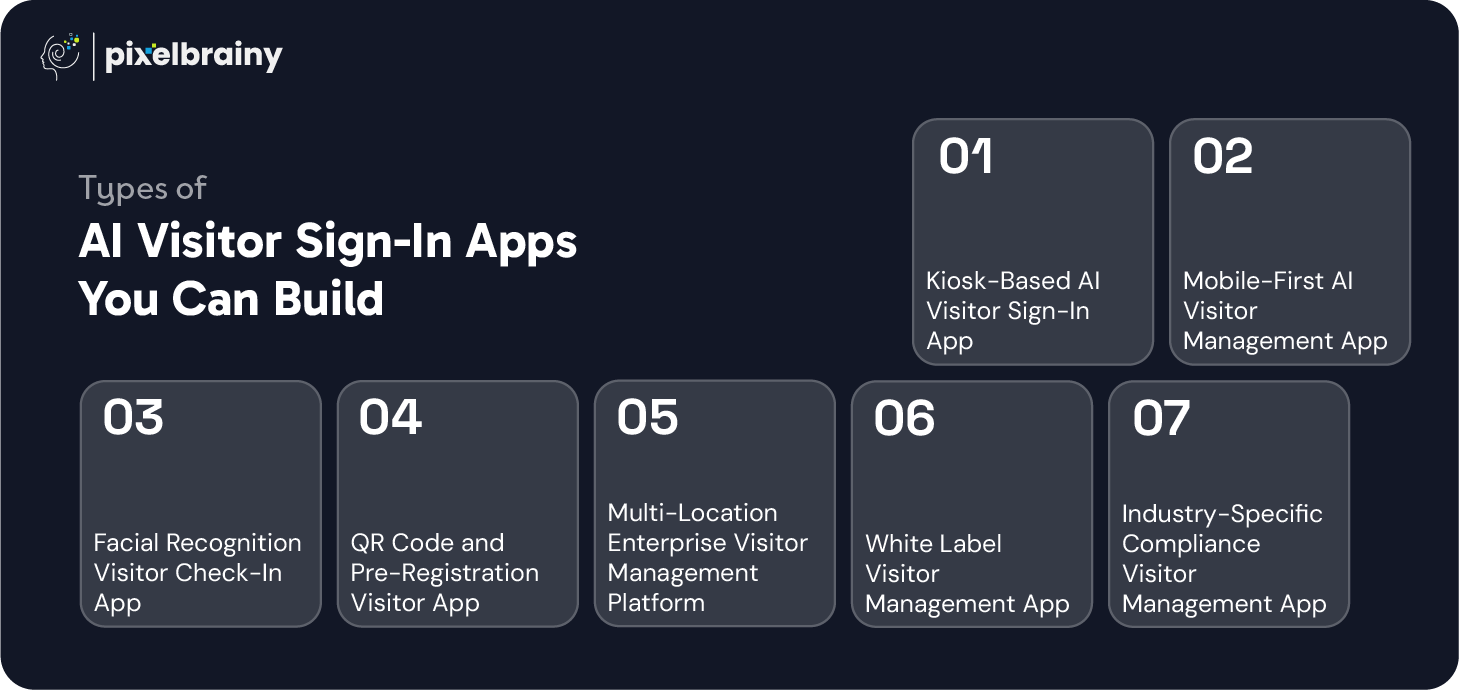
A kiosk-based visitor management application is installed on a touchscreen tablet or self-service kiosk placed at the entrance of a building. Visitors complete the entire registration process independently without requiring assistance from reception staff.
Modern kiosks support AI-powered ID scanning, photo capture, digital document signing, badge printing, and host notifications, making them one of the most popular solutions for enterprise reception areas.
Best For: Corporate offices, hospitals, government buildings, manufacturing facilities
Estimated Development Cost: $15,000 to $50,000
A mobile-first application allows visitors to check in using their own smartphones through a secure web link or dedicated mobile application. Since visitors use their personal devices, the experience is completely contactless and eliminates the need for shared kiosks.
This approach is particularly valuable for businesses focused on convenience, hybrid workplaces, and modern visitor experiences. It is also an excellent choice for contactless visitor sign-in app development.
Best For: Technology companies, coworking spaces, event venues, hybrid workplaces
Estimated Development Cost: $20,000 to $60,000
A facial recognition visitor management application uses AI to identify pre-registered visitors automatically as they arrive. Instead of scanning QR codes or entering personal information, visitors are recognized within seconds using computer vision technology.
This is one of the fastest and most secure approaches to facial recognition visitor management app development, making it ideal for organizations with strict access control requirements.
Best For: Financial institutions, data centers, research facilities, private clubs, high-security offices
Estimated Development Cost: $40,000 to $150,000
Also Read: Top 12 AI Computer Vision Software Development Companies in USA
This type of visitor management system enables employees to pre-register guests before they arrive. Visitors receive an email or SMS containing a unique QR code, which they scan upon arrival for instant verification.
Since visitor information is already validated before arrival, check-in typically takes less than 10 seconds while significantly reducing queues at reception.
Best For: Corporate campuses, hospitals, educational institutions, appointment-based businesses, conference venues
Estimated Development Cost: $15,000 to $50,000
We have multiple locations and want one centralized visitor management platform. What type of system should we develop?
A multi-location enterprise platform is the ideal solution. It provides a centralized dashboard that manages visitor registration, approvals, compliance, reporting, and security across multiple offices, campuses, warehouses, or retail locations from a single interface.
Each location can have its own branding, visitor workflows, security rules, and compliance policies while headquarters maintains complete visibility across the organization.
Best For: Enterprise organizations, hotel chains, retail chains, logistics companies, government agencies
Estimated Development Cost: $80,000 to $250,000
A white label visitor management platform is designed for companies that want to resell visitor management software under their own brand. The platform supports multiple tenants, allowing each client to have independent branding, visitor records, user management, and administrative controls while sharing the same backend infrastructure.
This model is popular among SaaS startups, facility management companies, and commercial real estate providers looking to launch their own visitor management products quickly.
Best For: SaaS founders, property management companies, facility management providers, commercial real estate businesses
Estimated Development Cost: $80,000 to $200,000
Some industries require visitor management systems tailored to strict regulatory requirements. Industry-specific applications include custom compliance workflows, specialized integrations, and security controls that cannot be achieved with generic visitor management software.
For example, healthcare organizations may require HIPAA-compliant visitor records and Electronic Health Record integrations, while educational institutions often need safeguarding workflows and visitor screening against sex offender registries. Financial institutions and government agencies may require advanced identity verification, audit logging, and document retention policies.
Best For: Hospitals, schools, financial institutions, pharmaceutical companies, government facilities
Estimated Development Cost: $50,000 to $200,000
| Visitor App Type | Tech Complexity | Estimated Cost | Best For |
| Kiosk-Based AI Visitor Sign-In App | Medium | $15K to $50K | Corporate offices, hospitals, government facilities |
| Mobile-First AI Visitor Management App | Medium | $20K to $60K | Tech companies, coworking spaces, events |
| Facial Recognition Visitor Check-In App | High | $40K to $150K | Financial institutions, high-security facilities, private clubs |
| QR Code and Pre-Registration Visitor App | Low to Medium | $15K to $50K | Appointment-based businesses, corporate campuses, healthcare |
| Multi-Location Enterprise Platform | High | $80K to $250K | Large enterprises, retail chains, hotel groups |
| White Label Visitor Management App | High | $80K to $200K | SaaS companies, property managers, facility management providers |
| Industry-Specific Compliance Visitor App | High | $50K to $200K | Healthcare, education, finance, government |
Understanding the different types of visitor management apps helps businesses invest in a solution that aligns with their operational goals, security standards, and future growth. The right architecture not only improves today's visitor experience but also creates a scalable foundation for smarter, AI-powered workplace management in the years ahead.
Every industry manages visitors differently. A corporate office focuses on employee productivity and meeting coordination, while a hospital prioritizes patient privacy, restricted access, and HIPAA compliance. Schools emphasize student safety through visitor screening, whereas government facilities require multi-level identity verification and strict access controls. Because of these differences, a generic visitor management solution rarely meets the operational and regulatory requirements of every organization.
Modern AI visitor sign-in app development is centered on building industry-specific solutions that combine intelligent automation with compliance, security, and customized workflows. From AI-powered identity verification and facial recognition to automated document signing and real-time visitor tracking, each application is designed to address the unique challenges of a particular sector.
The sections below explore how organizations across different industries are implementing AI visitor management systems, the features they require, the regulations they must comply with, and the typical development costs and timelines involved in building a production-ready solution.
Corporate offices require visitor management systems that simplify front desk operations while maintaining a professional visitor experience. These platforms help employees manage guest arrivals, contractors, interview candidates, and deliveries without manual coordination.
Common Use Cases
Compliance Requirements
Key Features
Estimated Development Cost: $20,000 to $80,000
Estimated Timeline: 2 to 4 months
How much does it cost to build a HIPAA compliant AI visitor management app for a healthcare facility?
Healthcare organizations require highly secure visitor management systems that protect patient privacy while controlling visitor access across departments. An AI visitor management app for healthcare helps hospitals manage patient visitors, contractors, vendors, and clinical staff with strict access controls.
Common Use Cases
Compliance Requirements
Key Features
Estimated Development Cost: $60,000 to $200,000
Estimated Timeline: 4 to 8 months
We are a school and want to build a visitor sign-in app with real-time sex offender registry checks. What will this cost?
Schools require visitor management systems that prioritize student safety while providing fast visitor registration for parents, volunteers, contractors, and authorized guests. A modern visitor sign-in app for schools helps educational institutions strengthen campus security through automated identity verification and background screening.
Common Use Cases
Compliance Requirements
Key Features
Estimated Development Cost: $30,000 to $100,000
Estimated Timeline: 3 to 5 months
Organizations operating government buildings, defense facilities, and other high-security environments require advanced identity verification and access control. These systems often operate within secure on-premise environments and integrate with national identity systems.
Common Use Cases
Compliance Requirements
Key Features
Estimated Development Cost: $100,000 to $350,000
Estimated Timeline: 6 to 12 months
Manufacturing plants receive a constant flow of contractors, suppliers, maintenance teams, and logistics partners. An AI visitor management app for manufacturing helps automate safety procedures while ensuring every visitor completes mandatory compliance requirements before entering production areas.
Common Use Cases
Compliance Requirements
Key Features
Estimated Development Cost: $40,000 to $120,000
Estimated Timeline: 3 to 6 months
Modern coworking spaces and commercial buildings often manage multiple tenants with different visitor policies. These environments require flexible visitor management systems that support independent tenant operations while giving property managers centralized oversight.
Common Use Cases
Compliance Requirements
Key Features
Estimated Development Cost: $50,000 to $150,000
Estimated Timeline: 3 to 6 months
Every industry has different operational priorities, regulatory obligations, and security risks, which means there is no universal visitor management solution. Whether you need an AI visitor management app for healthcare, a visitor sign-in app for schools, a platform to build visitor management app for corporate offices, a solution to develop visitor sign-in system for government facilities, or an AI visitor management app for manufacturing, the platform should be designed around your industry's specific workflows and compliance requirements.
Building an industry-specific AI visitor management solution ensures higher security, simplified compliance, better operational efficiency, and a visitor experience tailored to your organization's unique needs.
First make intro content then make a table & explain 15 features each in 30-30 words…at last make 1 liner closing statement for this section.
Focus keywords: AI visitor sign-in app development, features of AI visitor management app, build visitor management app with facial recognition, create AI visitor sign-in app with QR code, smart visitor management app features.
Focus Query by adding a scenario: I want to build a custom AI visitor sign-in app for our corporate office that replaces our current paper logbook and manual reception process, what are all the features I should include and what will it cost to develop from scratch in 2026.
At last make 1 liner closing statement for this section…
Building an intelligent visitor management solution involves much more than digitizing a paper sign-in sheet. Modern organizations expect visitor management software to automate identity verification, improve workplace security, simplify compliance, and provide a seamless visitor experience from pre-registration to check-out. As a result, AI visitor sign-in app development has evolved into creating smart platforms that integrate artificial intelligence with enterprise security, access control, and communication systems.
The features of AI visitor management app solutions vary depending on business requirements, industry regulations, and operational workflows. For example, a corporate office may prioritize QR code check-ins and employee notifications, while a healthcare facility may require visitor screening, digital consent forms, and restricted access management. Selecting the right feature set ensures the application not only improves visitor experiences but also strengthens security, enhances operational efficiency, and supports future business growth.
One of the most common questions businesses ask is:
"I want to build a custom AI visitor sign-in app for our corporate office that replaces our current paper logbook and manual reception process. What are all the features I should include?"
The answer depends on your organization's security policies, visitor volume, compliance requirements, and long-term objectives. However, every modern AI-powered visitor management solution should include a strong foundation of intelligent automation, digital identity verification, real-time monitoring, and enterprise integrations. The following features form the core of a scalable and secure visitor management platform in 2026.
| Feature | Description |
| Visitor Pre-Registration | Enables employees to register visitors before arrival by sending invitation emails or SMS messages with appointment details, digital instructions, and check-in information, helping reduce reception workload and improve visitor flow. |
| QR Code Check-In | Allows visitors to check in instantly by scanning a unique QR code, creating a fast, contactless experience while eliminating manual registration and reducing waiting times at reception. |
| AI-Powered ID Scanning (OCR) | Uses Optical Character Recognition to automatically extract visitor information from government-issued identification documents, improving data accuracy and significantly reducing manual entry errors. |
| Facial Recognition Verification | Verifies visitor identities using AI-powered facial recognition for secure and contactless authentication, making it an essential capability for organizations that want to build visitor management app with facial recognition. |
| Digital Visitor Badge Generation | Automatically creates personalized visitor badges containing names, photographs, QR codes, visit purposes, and access permissions for quick identification throughout the facility. |
| Host Notifications | Instantly alerts employees through email, SMS, Microsoft Teams, Slack, or mobile notifications when their visitors arrive, improving coordination and reducing visitor waiting time. |
| Digital Document and NDA Signing | Allows visitors to review and electronically sign confidentiality agreements, safety policies, compliance forms, and other required documents before entering restricted areas. |
| Watchlist and Blacklist Screening | Automatically compares visitor information against internal watchlists, banned visitor databases, or security records before granting access, helping prevent unauthorized entry. |
| Access Control Integration | Integrates with existing access control systems to automatically assign temporary permissions based on visitor type, approved locations, and visit duration. |
| Real-Time Visitor Dashboard | Provides administrators with a live overview of active visitors, occupancy levels, visitor history, host information, and building activity from a centralized dashboard. |
| Automated Visitor Check-Out | Records visitor departures, updates occupancy information, revokes temporary access permissions, and maintains accurate visit history without requiring manual intervention. |
| Visitor Analytics and Reporting | Generates reports on visitor traffic, peak hours, recurring visitors, contractor activity, and operational trends to help organizations make data-driven decisions. |
| Emergency Evacuation Management | Displays a real-time list of everyone currently inside the building, enabling security teams to perform faster and more accurate evacuations during emergencies. |
| Multi-Location Management | Supports centralized visitor management across multiple offices, campuses, or facilities while allowing each location to maintain its own workflows, branding, and security policies. |
| Role-Based Access Management | Restricts system access based on employee roles, ensuring receptionists, security personnel, facility managers, and administrators only access information relevant to their responsibilities. |
Incorporating these smart visitor management app features lays the foundation for a secure, intelligent, and scalable AI visitor sign-in solution that delivers exceptional visitor experiences while supporting long-term business growth.
As organizations adopt intelligent workplace technologies, visitor management systems are evolving beyond digital check-ins and basic security controls. Modern enterprises expect AI-powered platforms to automate decision-making, predict visitor patterns, strengthen security, and integrate seamlessly with existing business systems. These advanced capabilities not only improve operational efficiency but also create safer, smarter, and more personalized visitor experiences.
While core functionality is essential, businesses investing in AI visitor sign-in app development often gain the greatest long-term value by incorporating advanced AI capabilities that support automation, predictive analytics, and enterprise-scale operations. These features are especially valuable for organizations managing high visitor volumes, multiple locations, or strict regulatory requirements.
One of the most common enterprise questions is:
"We already have a digital visitor sign-in system, but we want to upgrade it with AI-powered automation, facial recognition, predictive analytics, and enterprise integrations. Which advanced features should we include to future-proof our visitor management platform?"
The answer depends on your organization's security objectives, compliance requirements, and digital transformation strategy. The following advanced capabilities represent the next generation of AI-powered visitor management and help organizations build a smarter, more secure, and scalable platform.
| Advanced Feature | Description |
| AI-Powered Facial Recognition | Instantly recognizes pre-approved visitors using facial recognition technology for fast, contactless authentication while reducing manual identity verification and strengthening workplace security. |
| Predictive Visitor Flow Analytics | Uses machine learning to analyze historical visitor trends, forecast peak arrival periods, optimize reception staffing, and reduce waiting times through intelligent resource planning. |
| AI Risk Scoring and Threat Detection | Evaluates visitor profiles, visit history, watchlist matches, and behavioral patterns to assign automated risk scores and notify security teams of potential threats before entry approval. |
| Behavior Analytics and Anomaly Detection | Continuously monitors visitor activities and identifies unusual behavior, unauthorized movement, repeated visits, or suspicious access attempts that may require immediate investigation. |
| Voice-Enabled AI Reception Assistant | Enables visitors to interact with a conversational AI assistant for self-service check-in, appointment guidance, visitor support, and navigation without receptionist involvement. |
| Smart Document Verification | Uses AI and Optical Character Recognition to validate government-issued IDs, passports, business credentials, and supporting documents while detecting forged or expired identification. |
| Automated Visitor Workflow Engine | Dynamically routes visitor approvals, document requests, access permissions, and security reviews based on predefined business rules, visitor type, or risk level. |
| Digital Twin and Indoor Navigation | Integrates with smart building systems to provide visitors with interactive indoor navigation, meeting room directions, and location guidance after successful check-in. |
| Enterprise AI Integrations | Connects with enterprise platforms such as Microsoft 365, Microsoft Teams, Slack, Active Directory, HR systems, access control platforms, CRM software, and SIEM solutions to automate communication and security workflows. |
| AI-Powered Compliance Monitoring | Continuously monitors visitor records, consent forms, document retention policies, and regulatory requirements while automatically identifying compliance gaps and generating audit-ready reports. |
Integrating these advanced AI capabilities transforms a standard visitor registration system into an intelligent enterprise platform that enhances security, automates operations, and delivers a future-ready visitor management experience.
Successful AI visitor sign-in app development requires much more than building a digital check-in screen. It involves understanding visitor workflows, designing intuitive user experiences, integrating AI technologies, ensuring regulatory compliance, and connecting the application with enterprise systems such as access control, HR platforms, and communication tools. Following a structured development roadmap helps organizations reduce implementation risks while delivering a scalable, secure, and future-ready solution.
A common question businesses ask during project planning is:
"We are planning to develop a smart visitor management app for our multi-location business that can handle visitor check-in, host notifications, badge printing, and watchlist screening from a single dashboard. What does the development process look like, and how long will it take?"
The answer depends on the project's scope, AI capabilities, integrations, and deployment model. However, most successful projects follow the nine development stages outlined below. This process is equally suitable for businesses planning to develop custom visitor management app from scratch, launch an MVP, or build an enterprise-grade AI platform.
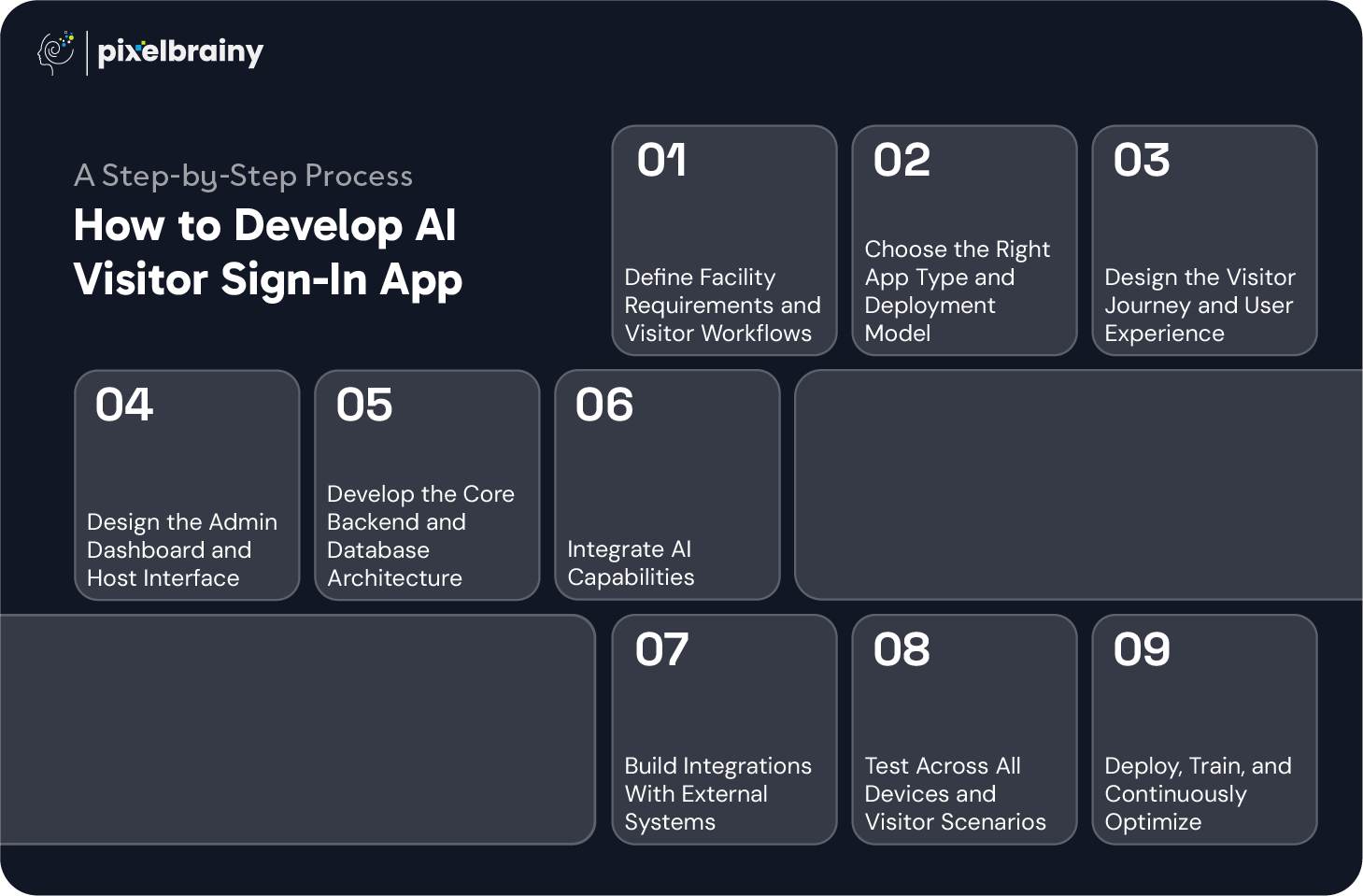
The first stage focuses on understanding how visitors interact with your facilities. Different visitor categories such as clients, contractors, interview candidates, vendors, delivery personnel, and VIP guests often require different registration processes, approval workflows, and access permissions.
At this stage, development teams also identify compliance requirements such as GDPR, HIPAA, FERPA, or industry-specific regulations that influence system architecture from the beginning. Many organizations begin this phase with AI consulting solutions to define project scope and prepare a detailed product roadmap before moving into PoC development.
Estimated Timeline: 1 to 2 weeks
Once requirements are finalized, the next step is selecting the most suitable visitor management architecture. Organizations determine whether a kiosk-based application, mobile-first platform, facial recognition solution, or hybrid model best supports their operational needs.
Deployment decisions are equally important. Cloud-based applications provide flexibility and faster implementation, while on-premise deployments are often required for highly regulated industries. Businesses managing multiple facilities should also decide whether to build a centralized enterprise platform from the beginning.
Estimated Timeline: 3 to 5 days
A seamless visitor experience begins with thoughtful interface design. Every interaction should be mapped, from invitation emails and pre-registration forms to QR code scanning, identity verification, badge printing, and digital check-out.
Working with an experienced UI/UX design company or a dedicated UI/UX designer for AI Visitor Sign-In App ensures the application remains intuitive for visitors of all ages and technical abilities. Accessibility features, multilingual support, and responsive interfaces should also be incorporated during this stage.
Estimated Timeline: 1 to 2 weeks
While visitors interact with the front-end experience, administrators and employees require a powerful backend interface to manage visitor operations efficiently.
The admin dashboard should provide real-time occupancy monitoring, visitor logs, compliance reports, pending approvals, and emergency management tools. Hosts should receive instant visitor notifications and approve or reject requests directly from email, Slack, Microsoft Teams, or mobile devices. Security personnel should also have dedicated interfaces for reviewing watchlist matches and responding to alerts.
Estimated Timeline: 1 to 2 weeks
This phase establishes the technical foundation of the platform. Developers build secure APIs, visitor databases, authentication systems, encrypted storage, audit logging, and role-based access controls that support enterprise-scale operations.
The architecture should also include automated data retention, archival, and deletion policies to comply with privacy regulations. Many organizations first validate technical feasibility through MVP development before expanding into a full-scale enterprise solution.
Estimated Timeline: 3 to 5 weeks
Also Read: Top 10 AI MVP Development Companies in USA
Artificial intelligence transforms a standard visitor registration system into an intelligent security platform. During this stage, developers integrate facial recognition, OCR-based ID scanning, automated watchlist screening, and behavioral analysis.
Businesses often leverage specialized AI integration services or partner with top AI product development companies to accelerate implementation. Projects requiring proprietary computer vision models may also include custom AI model development solutions for greater accuracy and industry-specific performance.
Estimated Timeline: 3 to 6 weeks
Enterprise visitor management applications rarely operate independently. They typically integrate with access control hardware, HR platforms, calendar applications, communication tools, CRM software, and identity management systems.
These integrations automate door access, employee notifications, visitor scheduling, badge activation, and directory synchronization, creating a connected digital workplace with minimal manual intervention.
Estimated Timeline: 2 to 4 weeks
Comprehensive testing ensures the application performs reliably under real-world conditions. The complete visitor journey should be tested across kiosks, tablets, smartphones, desktop browsers, and different operating systems.
Testing also includes AI accuracy, QR code recognition, ID scanning performance, watchlist detection, badge printing, network interruptions, camera failures, and peak visitor traffic simulations to ensure a consistent user experience.
Estimated Timeline: 2 to 3 weeks
After successful testing, the application is deployed to the production environment with monitoring, security controls, and backup mechanisms in place.
Reception teams, security personnel, and administrators should receive hands-on training before launch. Following deployment, continuous monitoring of visitor behavior, AI accuracy, system performance, and user feedback enables regular improvements and long-term platform optimization.
Estimated Timeline: 1 to 2 weeks, followed by continuous monitoring and feature enhancements
| Phase 1 | Facility requirements, visitor workflows, and compliance planning | 2 weeks |
| Phase 2 | App type selection and deployment model planning | 1 week |
| Phase 3 | Visitor journey and UI/UX design | 2 weeks |
| Phase 4 | Admin dashboard and host interface design | 2 weeks |
| Phase 5 | Backend architecture and database development | 4 weeks |
| Phase 6 | AI capabilities integration | 5 weeks |
| Phase 7 | External system integrations | 3 weeks |
| Phase 8 | Cross-device testing and quality assurance | 3 weeks |
| Phase 9 | Deployment, user training, and production monitoring | 2 weeks |
| Overall Project Duration | End-to-end AI visitor sign-in app development | Approximately 3 to 6 months |
Following a structured development process ensures your AI visitor management platform is secure, scalable, user-friendly, and ready to support long-term business growth across single or multiple locations.
The AI visitor sign-in app development cost varies significantly because no two visitor management solutions are built with the same requirements. A simple QR code check-in application for a single office requires considerably less effort than an enterprise platform with facial recognition, watchlist screening, access control integration, and multi-location management.
Many businesses receive development estimates ranging from $20,000 to over $150,000, leading to confusion about pricing. The variation is primarily driven by AI capabilities, compliance requirements, third-party integrations, deployment architecture, and the overall scope of the platform.
A question we frequently hear from decision-makers is:
"How much does it cost to develop a custom AI visitor sign-in app, and why have we received quotes ranging from $20,000 to $150,000 for seemingly similar solutions?"
The answer lies in the complexity of the features, infrastructure, and long-term scalability being built into the application. Understanding how development costs are distributed helps organizations budget more accurately and avoid unexpected expenses later in the project.
| App Type | Features Included | Estimated Cost | Timeline |
| Basic MVP Sign-In App | QR code check-in, host notifications, visitor log | $10,000 to $30,000 | 6 to 10 weeks |
| Mid-Level AI Visitor App | Facial recognition, ID scanning, badge printing, visitor analytics | $30,000 to $80,000 | 3 to 5 months |
| Enterprise Visitor Management Platform | Multi-location management, access control integration, compliance workflows | $80,000 to $200,000 | 4 to 7 months |
| White Label Multi-Tenant Platform | Multi-brand support, tenant separation, reseller dashboard | $100,000 to $250,000 | 5 to 8 months |
| High-Security Government Platform | Biometrics, PIV integration, FedRAMP architecture, on-premise deployment | $150,000 to $350,000+ | 6 to 12 months |
Breaking development into individual components provides a clearer understanding of where the project budget is allocated.
| Development Component | Estimated Cost Range |
| UX design and visitor journey mapping | $3,000 to $10,000 |
| Backend development and database architecture | $8,000 to $30,000 |
| AI and computer vision integration | $10,000 to $50,000 |
| Facial recognition implementation | $8,000 to $30,000 |
| External system integrations | $5,000 to $30,000 |
| Kiosk UI and frontend development | $5,000 to $20,000 |
| Mobile application development (iOS and Android) | $10,000 to $40,000 |
| Compliance and security implementation | $5,000 to $25,000 |
| Testing and quality assurance | $3,000 to $10,000 |
| Hardware setup and kiosk configuration | $1,000 to $5,000 per kiosk location |
| Post-launch maintenance and support | $1,000 to $5,000 per month |
Many organizations currently subscribe to visitor management SaaS platforms and eventually question whether custom development offers a better long-term return.
A common example is:
"We pay approximately $48,000 per year for an off-the-shelf visitor management SaaS. Would building a custom AI visitor management platform cost less over the next three years?"
For organizations with multiple locations, complex workflows, or growing visitor volumes, custom development often becomes more cost-effective over time because recurring subscription fees, user licensing, and customization limitations are reduced.
Several technical and business factors directly influence the cost to develop custom visitor management system solutions.
Applications that include facial recognition, behavioral analytics, watchlist screening, AI-powered OCR, and predictive analytics require more development effort than basic visitor registration platforms.
Managing multiple offices, campuses, or facilities increases infrastructure, synchronization, reporting, and administrative complexity compared to a single-location deployment.
Integrating with access control systems, Microsoft Teams, Slack, Active Directory, HR software, calendar platforms, CRM systems, and security tools requires additional development and testing.
Organizations operating under HIPAA, GDPR, FedRAMP, FERPA, ISO 27001, or similar regulations typically require additional security controls, encryption, audit logging, consent management, and retention policies, which can increase overall development costs by 30 to 50 percent.
A web-only application generally costs less than a solution that includes responsive web, iOS, Android, kiosk interfaces, and administrative dashboards.
Cloud-hosted applications are generally faster and more cost-effective to deploy. Organizations with strict data sovereignty or government requirements may require on-premise infrastructure, increasing implementation complexity and cost.
Development costs vary depending on the team's geographic location. US-based engineering teams often charge between $100 and $200 per hour, while experienced offshore development teams typically range from $25 to $60 per hour, depending on expertise and project complexity.
The lowest development estimate is not always the most cost-effective choice. A well-architected platform with scalable infrastructure, robust security, and flexible integrations often delivers significantly greater value over its lifecycle than a lower-cost solution that requires frequent upgrades or platform limitations.
For organizations with evolving business requirements, flexible engagement models such as PoC development, MVP development, dedicated development teams, or full-cycle product engineering allow the project to be delivered in phases while maintaining better control over timelines, budgets, and future enhancements.
Understanding the complete visitor management app development cost breakdown enables businesses to make informed investment decisions and build an AI-powered solution that balances functionality, scalability, and long-term return on investment.
Also Read: AI App Development Cost: From MVPs to Full-Scale AI App
Building a scalable AI-powered visitor management platform requires selecting technologies that support intelligent automation, enterprise security, real-time processing, and seamless integrations. The right visitor management app tech stack depends on the application's complexity, AI capabilities, deployment model, and industry-specific compliance requirements.
Businesses often ask:
"What technology stack should I use to build a custom AI visitor sign-in app in 2026? What AI models, frameworks, and databases do top visitor management app development companies use? How do I build a visitor management app that supports facial recognition, ID scanning, and access control integration?"
The table below outlines the recommended technologies to develop smart visitor management system solutions, including AI frameworks, OCR tools, cloud infrastructure, databases, security technologies, and hardware commonly used for AI visitor sign-in app development.
| Technology Category | Recommended Technologies | Purpose in AI Visitor Management App Development |
| Programming Languages | Python, JavaScript, TypeScript, Swift (iOS), Kotlin (Android) | Build scalable backend services, AI modules, web dashboards, and native mobile applications. Python is widely preferred to build AI visitor management app using Python because of its strong AI ecosystem. |
| AI and Computer Vision | TensorFlow, PyTorch, OpenCV, AWS Rekognition, Google Vision AI, Azure Face API | Power facial recognition, object detection, visitor verification, image analysis, and intelligent automation for secure visitor authentication. |
| OCR and ID Scanning | AWS Textract, Google Cloud Vision, Tesseract OCR, ABBYY FlexiCapture | Extract visitor information automatically from passports, driver's licenses, employee IDs, and other government-issued identification documents. |
| Facial Recognition | DeepFace, FaceNet, AWS Rekognition, Microsoft Azure Face API, Kairos | Enable contactless visitor authentication, identity verification, duplicate visitor detection, and high-security access management. |
| Backend Frameworks | Django, FastAPI, Node.js, Spring Boot | Develop secure APIs, business logic, authentication services, visitor workflows, and enterprise-grade backend infrastructure. |
| Frontend and Kiosk UI | React.js, Vue.js, Angular, React Native, Electron | Build responsive admin dashboards, self-service kiosk interfaces, mobile applications, and cross-platform visitor experiences. |
| Database | PostgreSQL, MongoDB, Redis, Elasticsearch | Store visitor records, user profiles, audit logs, session data, and enable fast search across historical visitor information. |
| Cloud Infrastructure | Amazon Web Services (AWS), Google Cloud Platform (GCP), Microsoft Azure | Host applications securely while supporting scalability, AI processing, storage, disaster recovery, and global deployment. |
| Real-Time Notifications | Firebase Cloud Messaging, Twilio, Slack API, Microsoft Teams Webhooks | Deliver instant host notifications, security alerts, visitor approvals, appointment reminders, and emergency communication. |
| Access Control Integration | REST APIs for Brivo, Kisi, Honeywell, HID Global, LenelS2 | Automate door access, elevator permissions, visitor badge activation, and integration with enterprise physical security systems. |
| Document Signing | DocuSign API, Dropbox Sign (HelloSign), Adobe Acrobat Sign API | Collect legally binding digital signatures for NDAs, visitor agreements, safety policies, and compliance documentation before facility access. |
| Security and Compliance | AES-256 Encryption, OAuth 2.0, OpenID Connect, GDPR Consent Management, HIPAA Security Controls | Protect visitor information through encryption, secure authentication, role-based access control, audit logging, and regulatory compliance. |
| Analytics and Reporting | Microsoft Power BI, Tableau, Apache Superset, Custom Analytics Dashboards | Generate visitor trends, occupancy reports, compliance reports, operational KPIs, and executive-level business intelligence. |
| Hardware for Kiosk Deployment | Apple iPad Pro, Samsung Galaxy Tab Active, Android Touchscreen Kiosks, Zebra Badge Printers, DYMO Label Printers, QR Code Scanners | Support self-service visitor check-in, badge printing, ID scanning, QR code verification, and reliable reception operations in enterprise environments. |
Selecting a future-ready technology stack ensures your AI visitor management platform delivers high performance, enterprise-grade security, seamless integrations, and the flexibility to scale as your business grows.
Building an AI-powered visitor management solution involves more than designing a digital check-in experience. Organizations must balance security, compliance, user experience, enterprise integrations, and AI performance while ensuring the platform remains scalable and easy to manage. Overlooking these challenges during AI visitor sign-in app development can result in project delays, budget overruns, security vulnerabilities, and poor user adoption.
One of the most common concerns businesses have is:
"We're planning to build a custom AI visitor management app with facial recognition, watchlist screening, and access control integration, but we're worried about security, compliance, and integration challenges. What are the biggest risks, and how can we avoid them?"
Understanding these challenges early helps organizations build AI visitor management app solutions that are secure, compliant, and prepared for long-term growth.
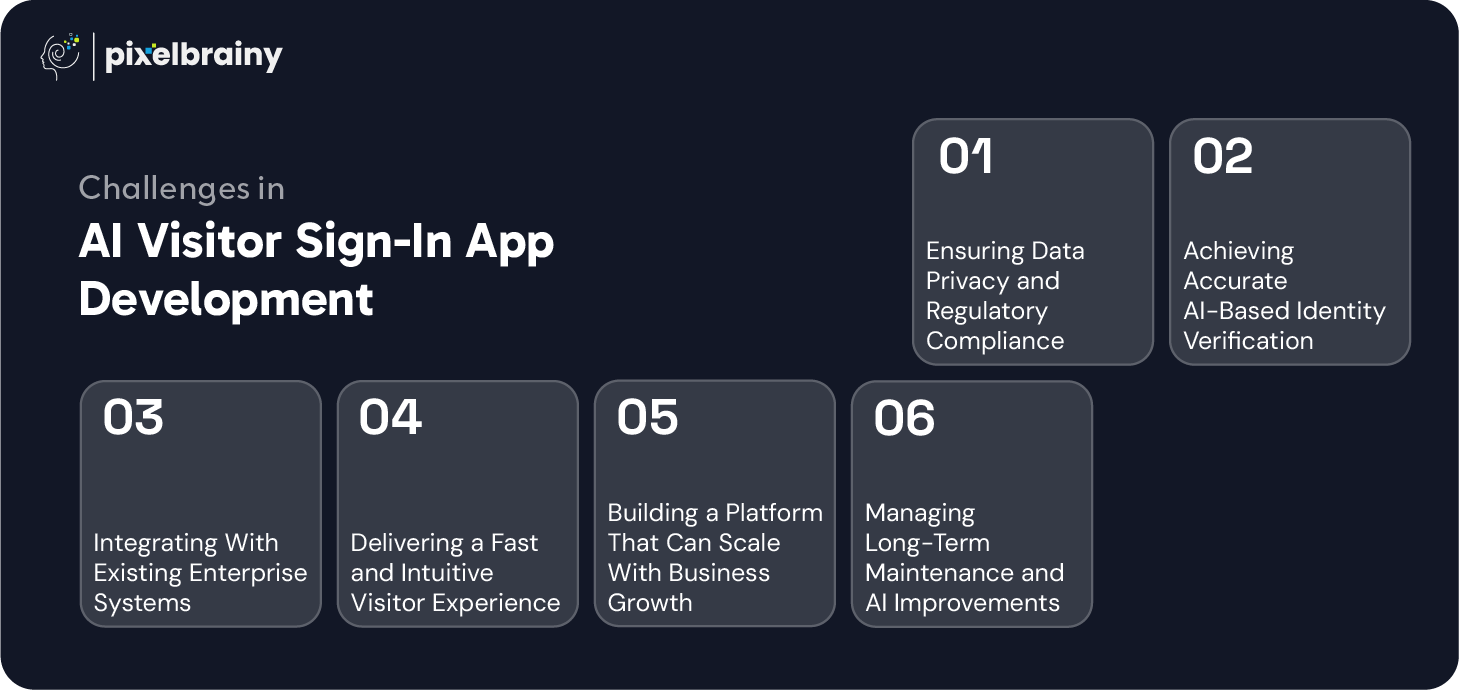
Visitor management applications collect sensitive personal information, including visitor identities, photographs, government-issued IDs, and access records. Without proper security controls, businesses risk regulatory violations and reputational damage.
How to Overcome It
Build compliance into the platform from the beginning by implementing encrypted data storage, role-based access control, consent management, audit logs, automated retention policies, and secure deletion workflows. This approach supports GDPR, HIPAA, FERPA, and other industry-specific regulations while protecting visitor data.
Facial recognition and OCR technologies may produce inaccurate results when images are blurry, lighting conditions are poor, or identification documents are damaged. Low AI accuracy can slow visitor check-ins and create unnecessary manual verification.
How to Overcome It
Use high-quality AI models, continuously retrain recognition systems with new data, support multiple identity verification methods, and establish manual verification workflows for exceptional cases. Regular AI performance testing also improves long-term accuracy.
Many organizations already use access control systems, HR software, Microsoft Teams, Active Directory, CRM platforms, and security tools. Poor integrations often create isolated systems that increase administrative work instead of reducing it.
How to Overcome It
Design the platform with API-first architecture and standardized integration frameworks. During AI visitor sign-in app development, identify all required third-party systems early and validate compatibility before development begins to avoid costly integration challenges later.
Visitors expect a simple, contactless, and efficient check-in process. Complicated forms, confusing interfaces, or lengthy verification steps can increase waiting times and negatively affect the overall visitor experience.
How to Overcome It
Prioritize user-centered design by creating intuitive workflows, minimizing manual data entry, supporting QR code check-ins, offering multilingual interfaces, and ensuring accessibility for all visitors. A streamlined user experience also improves adoption across reception teams.
Many organizations initially deploy visitor management software at a single office but later expand to multiple locations. Applications that are not designed for scalability often require expensive redevelopment as business needs evolve.
How to Overcome It
Develop a cloud-native architecture with modular components, centralized administration, configurable workflows, and multi-location support. A scalable design allows businesses to add new offices, users, kiosks, and AI capabilities without rebuilding the platform.
Launching the application is only the beginning. AI models, operating systems, security standards, compliance regulations, and third-party APIs continue to evolve, requiring regular updates to maintain system performance and security.
How to Overcome It
Plan for ongoing maintenance from the start by scheduling security updates, AI model optimization, feature enhancements, compliance reviews, and continuous monitoring. Partnering with an top AI development companies ensures the platform remains reliable, secure, and aligned with changing business requirements.
Addressing these challenges early in the development process helps organizations create a secure, scalable, and future-ready AI visitor management platform that delivers long-term operational value while minimizing implementation risks.
At Pixelbrainy, we believe visitor management should do more than record names at the reception desk. It should strengthen workplace security, simplify compliance, automate repetitive tasks, and create an exceptional first impression for every visitor. As an experienced AI development company, we specialize in AI visitor sign-in app development that is built around your organization's unique security policies, operational workflows, and long-term business goals instead of forcing your teams to adapt to a generic software platform.
Many organizations approach us after struggling with disconnected systems, expensive SaaS subscriptions, limited customization, and visitor management platforms that cannot integrate with their existing access control infrastructure. Others need advanced capabilities such as facial recognition, watchlist screening, multi-location management, or white-label deployments that off-the-shelf products simply cannot provide. Our approach focuses on delivering custom visitor management app development solutions that scale with your business while giving you complete ownership of your data, workflows, and technology roadmap.
Whether you are managing a single corporate office, a healthcare network, a manufacturing plant, or a portfolio of commercial properties, we help businesses build AI visitor management app solutions that improve security, streamline visitor operations, and reduce long-term operational costs through intelligent automation.
Building an enterprise visitor management platform requires much more than software development. It requires understanding security operations, compliance frameworks, enterprise integrations, and user experience. That is where Pixelbrainy brings measurable value.
One of our enterprise clients, operating multiple commercial office buildings across several cities, wanted to replace different visitor management systems used by individual properties with a single centralized platform. Their primary goals were multi-tenant management, custom branding for each property, AI-powered visitor verification, and complete visibility across every location.
Pixelbrainy designed and developed a white-label AI visitor management platform that allowed each property to maintain its own branding, visitor workflows, access rules, and administrative controls while being managed through one centralized backend. The platform also integrated with access control systems, QR code check-ins, facial recognition, digital badge printing, and Microsoft Teams notifications.
As a result, the client standardized visitor operations across all locations, significantly reduced manual reception work, improved compliance reporting, and eliminated the need for multiple third-party visitor management subscriptions.
Our AI visitor management app development solutions are designed for organizations that require enterprise-grade customization, including:
If your organization is evaluating development partners for a custom AI visitor management solution, look for a team with proven AI engineering expertise, enterprise integration experience, and the ability to build software around your operations instead of asking your operations to fit the software.
Partner with Pixelbrainy to build a secure, scalable, and intelligent visitor management platform that delivers measurable business value today while remaining flexible for tomorrow's workplace demands.

Modern businesses require visitor management systems that deliver stronger security, faster check-ins, accurate compliance records, and seamless workplace experiences. AI visitor sign-in app development enables organizations to replace manual reception processes with intelligent automation, helping reduce administrative effort while improving visitor verification, access control, and operational visibility.
Building the right solution requires more than adding AI features. The app type, technology stack, integrations, compliance planning, and development partner all play a critical role in determining long-term success. Whether you want to build AI visitor management app solutions for a corporate office, healthcare facility, school, or enterprise campus, careful planning ensures better scalability and return on investment.
Development costs typically range from $10,000 for an MVP to $350,000+ for enterprise-grade platforms, depending on AI capabilities, integrations, and security requirements.
At Pixelbrainy, we help organizations develop smart visitor management system solutions and custom visitor sign-in app platforms tailored to their business goals.
Ready to Get Started?
Schedule a free consultation, discuss your project requirements, and receive a customized roadmap, timeline, and cost estimate for your AI visitor management solution.
The AI visitor sign-in app development cost typically ranges from $10,000 for a basic MVP to $350,000 or more for enterprise-grade platforms. The final cost depends on AI capabilities, facial recognition, ID scanning, compliance requirements, third-party integrations, deployment model, and the number of locations your solution supports.
The timeline to develop an AI visitor management app from scratch generally ranges from 3 to 6 months. A basic MVP can be delivered within 6 to 10 weeks, while enterprise solutions with AI, multi-location support, access control integrations, and compliance workflows require additional planning, development, testing, and deployment.
A custom AI visitor management app is designed specifically around your business workflows, branding, security policies, and integrations. Off-the-shelf software offers faster deployment but often limits customization, scalability, and data ownership. Custom development provides greater flexibility, long-term value, and complete control over your platform.
Yes. During AI visitor sign-in app development, the platform can integrate with access control systems such as HID Global, Brivo, Honeywell, Kisi, LenelS2, and other enterprise security solutions. These integrations automate door access, badge activation, visitor permissions, and real-time security workflows.
Compliance should be incorporated during the planning and architecture phase rather than added later. A properly designed custom visitor management app includes encrypted data storage, role-based access, consent management, audit trails, retention policies, and secure deletion workflows to support GDPR, HIPAA, and other regulatory requirements.
Yes. A custom AI visitor management app can integrate with approved watchlists, internal security databases, and, where legally permitted, sex offender registries. The system automatically screens visitor information during check-in and immediately alerts security teams if a potential match is detected.
A cloud-based AI visitor management app can process hundreds or even thousands of concurrent visitor check-ins, depending on the underlying infrastructure. Enterprise architectures are designed to scale across multiple kiosks, offices, and locations while maintaining fast response times and reliable performance during peak hours.
Most organizations deploy AI visitor kiosks using iPads, Android tablets, or commercial touchscreen kiosks paired with badge printers, QR code scanners, document scanners, webcams, and optional facial recognition cameras. The hardware configuration depends on visitor volume, security requirements, and facility type.
For businesses with multiple locations or complex workflows, custom visitor management app development often provides a lower total cost of ownership over several years. While SaaS solutions have lower upfront costs, recurring subscription fees, licensing charges, and customization limitations can make them more expensive over time.
Yes. Enterprise-grade AI visitor sign-in app development supports centralized management of multiple offices, campuses, or facilities through a single administrative dashboard. Administrators can monitor visitor activity, occupancy, security alerts, reports, and compliance while maintaining separate workflows and branding for each location.
Look for an AI visitor management app development company with proven experience in enterprise software, artificial intelligence, security integrations, and regulatory compliance. Review their portfolio, industry expertise, client testimonials, development methodology, post-launch support, and ability to deliver fully customized solutions rather than relying on pre-built templates.

About The Author
Sagar Bhatnagar
Sagar Sahay Bhatnagar brings over a decade of IT industry experience to his role as Marketing Head at PixelBrainy. He's known for his knack in devising creative marketing strategies that boost brand visibility and market influence. Sagar's strategic thinking, coupled with his innovative vision and focus on results, sets him apart. His track record of successful campaigns proves his ability to utilize digital platforms effectively for impactful marketing efforts. With a genuine passion for both technology and marketing, Sagar continuously pushes PixelBrainy's marketing initiatives to greater success.

Working with the PixelBrainy team has been a highly positive experience. They understand the design requirements and create beautiful UX elements to meet the application needs. The dev team did an excellent job bringing my vision to life. We discussed usability and flow. Sagar worked with his team to design the database and begin coding. Working with Sagar was easy. He has the knowledge to create robust apps, including multi-language support, Google and Apple ID login options, Ad-enabled integrations, Stripe payment processing, and a Web Admin site for maintaining support data. I'm extremely satisfied with the services provided, the quality of the final product, and the professionalism of the entire process. I highly recommend them for Android and iOS Mobile Application Design and Development.

Great experience working with them. Had a lot of feedback and I found that unlike most contractors they were bugging me for updates instead of the other way around. They were extremely time conscience and great at communicating! All work was done extremely high quality and if not on time, early! They were always proactive when it comes to communication and the work is great/above par always. Very flexible and a great team to work with! Goes above and beyond to present us with multiple options and always provides quality. Amazing work per usual with Chitra. If you have UI/UX or branding design needs I recommend you go to them! Will likely work with them in the future as well, definitely recommended!

PixelBrainy is a joy to work with and is a great partner when thinking through branding, logo, and website layout. I appreciate that they spend time going into the "why" behind their decisions to help inform me and others about industry best practices and their expertise.

I hired them to design our software apps. Things I really like about them are excellent communication skills, they answer all project suggestions and collaborate right away, and their input on design and colors is amazing. This project was complex and needed patience and creativity. The team is amazing to do business with. I will be using them long-term. Glad to see there are some good people out there. I was afraid to try and outsource my project to someone but I am glad I met them! I really can't say enough. They went above and beyond on this project. I am very happy with everything they have done to make my business stand out from the competition.

It was great working with PixelBrainy and the team. They were very responsive and really owned the project. We'll definitely work with them again!

I recently worked with the PixelBrainy team on a project and I was blown away by their communication skills. They were prompt, clear, and articulate in all of our interactions. They listened and provided valuable feedback and suggestions to help make the project a success. They also kept me updated throughout the entire process, which made the experience stress-free and enjoyable.

PixelBrainy is very good at what it does. The team also presents themselves very professionally and takes care of their side of things very well. I could fully trust them taking up the design work in a timely and organised manner and their attention to detail saved us lots of effort and time. This particular project was quite intense and the team showed that they function very well under pressure. Very much looking forward to working with her again!

It's always an absolute pleasure working with them. They completed all of my requests quickly and followed every note I had for them to a T, which made our process go smoothly from start to finish. Everything was completed fast and following all of the guidelines. And I would recommend their services to anyone. If you need any design work done in the future, PixelBrainy should be your first call!

They took ownership of our requirements and designed and proposed multiple beautiful variants. The team is self-motivated, requires minimum supervision, committed to see-through designs with quality and delivering them on time. We would definitely love to work with PixelBrainy again when we have any requirements.

PixelBrainy was a big help with our SaaS application. We've been hard at work with a new UI/UX and they provided a lot of help with the designs. If you're looking for assistance with your website, software, or mobile application designs, PixelBrainy and the team is a great recommendation.

PixelBrainy designers are amazing. They are responsive, talented, and always willing to help craft the design until it matches your vision. I would recommend them and plan to continue them for my future projects and more!!!

They were awesome! Did a good job fast, and good communication. Will work with them again. Thank you

Creative, detail-oriented, and talented designers who take direction well and implement changes quickly and accurately. They consistently over-delivered for us.

PixelBrainy team is very talented and creative. Great designers and a pleasure to work with. PixelBrainy is an excellent communicator and I look forward to working with them again.

PixelBrainy has a very talented design team. Their work is excellent and they are very responsive. I enjoy working with them and hope to continue on all of our future projects.


Transform your ideas into reality with us.
Across these industries, each engagement brings unique challenges, from early-stage product development to scaling complex systems, helping us build a practical understanding of real-world product environments.