
 AI Summary Powered by PixelBrainy
What if identity verification could be instant, secure, and completely frictionless? This is exactly why AI-powered facial recognition is becoming a core part of modern digital experiences. From unlocking smartphones to verifying users in high-risk transactions, the AI Face Recognition App is transforming how businesses authenticate identities and protect sensitive data.
The demand for AI Face Recognition App Development is rapidly increasing across industries. Banks and fintech companies use facial recognition to strengthen KYC, prevent identity fraud, and enable secure digital onboarding. Healthcare providers rely on it for accurate patient identification and controlled access to medical records. Retail and eCommerce businesses adopt facial recognition to personalize customer experiences and improve in-store security. Government agencies, travel authorities, and smart city projects use it for surveillance, border control, and public safety. Even HR teams and enterprises are investing in facial recognition solutions for attendance tracking, access management, and workplace automation.
As interest grows, businesses frequently search for answers to practical questions such as how to develop an AI face recognition app, what is the cost of AI face recognition app development, how secure facial recognition apps really are, and which technology stack is best for building a recognition app. Many decision-makers also look for guidance on the development of AI face recognition app solutions that comply with data protection regulations while delivering high accuracy in real-world conditions.
However, building a recognition app is not just about implementing an algorithm. It requires high-quality datasets, robust AI models, strong security measures, and ethical handling of biometric data. This guide is designed for businesses and innovators looking to create an AI face recognition app, covering its benefits, development steps, real-world challenges, and best practices to build reliable and future-ready solutions.
An AI Face Recognition App is a technology-driven application that identifies or verifies individuals by analyzing their facial features using artificial intelligence. It replaces traditional authentication methods with a faster and more secure biometric approach. Because of its reliability and convenience, many organizations are investing in AI Face Recognition App Development to strengthen security, streamline verification, and improve user experience.
The process begins when the app captures a facial image or live video using a camera. This could happen during login, onboarding, access control, or identity verification.
The system scans the image to detect a human face and separates it from the background. This ensures the app focuses only on relevant facial data and ignores unnecessary visual elements.
The app analyzes distinct facial features such as eye placement, nose structure, facial contours, and distances between key landmarks. During the development of an AI face recognition app, these features are translated into a unique digital facial pattern.
Instead of saving raw images, the app securely stores encrypted facial patterns in a database or cloud environment. This improves privacy and reduces security risks.
When authentication is required, the app compares the newly captured facial data with stored records. If the similarity level meets the defined criteria, access is approved.
AI models learn from new data over time, improving accuracy and adaptability to lighting changes, facial expressions, or appearance updates.
For businesses evaluating how to develop an AI face recognition app, this structured workflow is essential. Whether you are building a recognition app for banking, healthcare, retail, or workplace security, the goal is to create an AI face recognition app that delivers accurate results, protects sensitive data, and scales with business needs.
Investing in AI Face Recognition App Development is not just about adopting new technology. It is a strategic move that helps organizations align with digital transformation goals, strengthen security, and unlock new operational opportunities. Below are key reasons why businesses should consider investing in this technology now.
The global facial recognition market is rapidly expanding. It is estimated to be worth around USD 8.1 billion in 2025 and is forecast to grow significantly in the coming decade, reaching approximately USD 36.2 billion by 2035. This growth reflects increasing adoption across sectors, improving AI capabilities, and rising demand for secure, contactless solutions.
Cybersecurity threats and identity fraud are major concerns for businesses of all sizes. Face recognition provides an advanced biometric authentication method that is more difficult to fake or steal than traditional passwords or PINs. This makes it highly relevant for digital banking, mobile apps, secure access systems, and other platforms where identity assurance is critical.
Many industries are facing stricter requirements for identity verification, especially in financial services, healthcare, and government. AI face recognition can help businesses meet compliance standards related to Know Your Customer (KYC), anti-money laundering (AML), and secure access control, reducing the risk of regulatory penalties.
Customer expectations have shifted toward digital-first experiences. Contactless authentication methods such as facial recognition support faster onboarding, smoother user journeys, and seamless access in mobile and web applications. This helps companies compete more effectively and deliver enhanced customer satisfaction.
From retail and hospitality to travel and enterprise security, building a recognition app enables diverse use cases such as identity verification, workforce management, attendance tracking, and fraud reduction. These practical applications make developing an AI face recognition app a valuable investment for long-term business innovation.
These factors together explain why organizations exploring how to create an AI face recognition app are prioritizing this technology as part of their growth and security strategies.
Businesses across industries are increasingly adopting facial recognition to strengthen security and modernize digital interactions. The development of AI Face Recognition App solutions allows organizations to replace outdated authentication methods with intelligent, biometric-driven systems. Below are the key benefits that explain why many companies choose to invest in this technology.
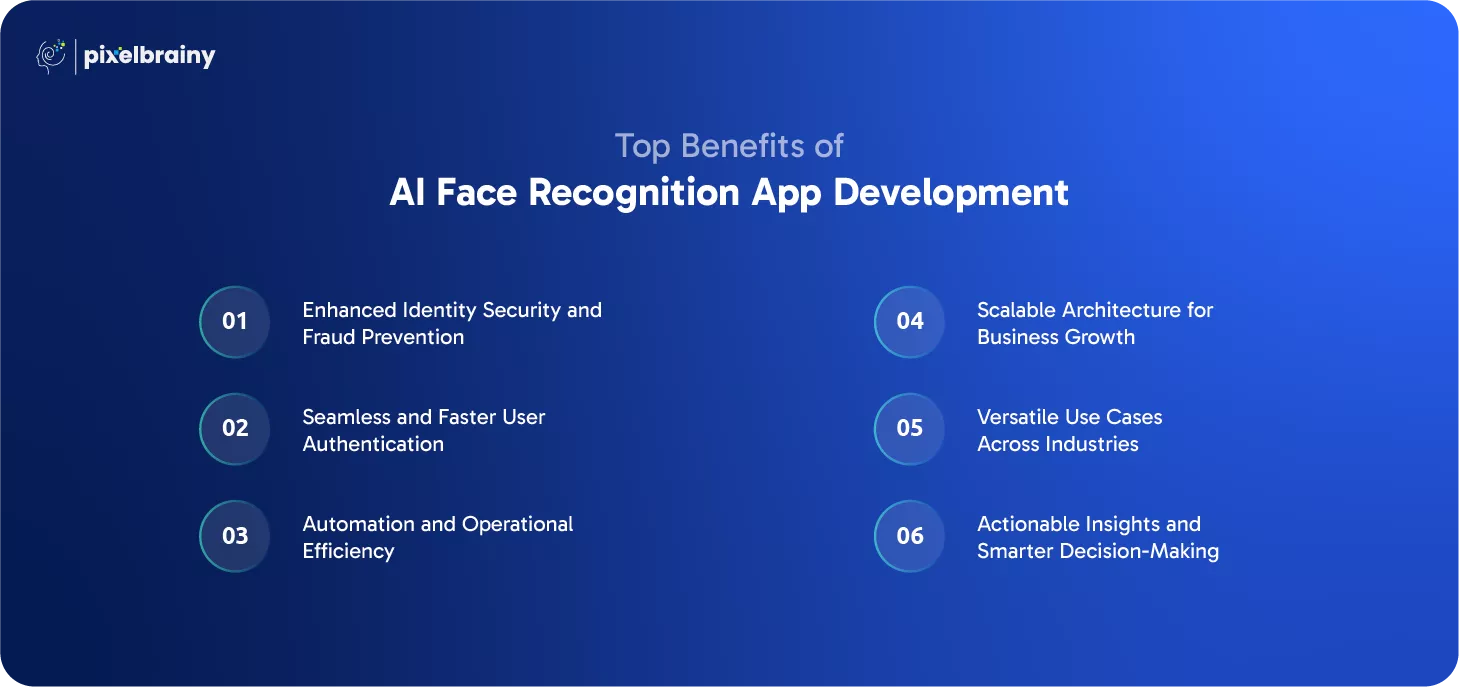
One of the most important benefits of AI Face Recognition App Development is the ability to provide a higher level of identity security. Facial features are unique to every individual, which makes biometric authentication far more reliable than passwords or access cards.
When businesses create AI Face Recognition App solutions, they significantly reduce the risk of identity theft, impersonation, and unauthorized system access. This level of security is especially critical for industries such as banking, fintech, and healthcare where sensitive user data is involved.
Another major advantage of building of AI Face Recognition App systems is the improved user experience. Facial recognition enables instant authentication without requiring users to remember passwords or complete lengthy verification steps. This leads to faster logins, smoother onboarding, and reduced friction across digital platforms. When organizations create AI Face Recognition App solutions, they can offer a more convenient and intuitive experience that aligns with modern user expectations.
The development of AI Face Recognition App technology helps businesses automate processes that traditionally require manual effort. Tasks such as employee attendance tracking, identity verification, and access management can be handled automatically using facial recognition. By building of AI Face Recognition App solutions, organizations reduce administrative workload, minimize human error, and improve overall operational efficiency.
Scalability is a strong benefit when companies invest in AI Face Recognition App Development. Facial recognition systems can be designed to support growing user bases without compromising performance. Whether a business is onboarding new customers, expanding to new locations, or managing large volumes of data, the building of AI Face Recognition App ensures the system can scale alongside business growth.
When businesses create AI Face Recognition App solutions, they gain access to a wide range of applications across multiple industries. From identity verification in financial services to patient identification in healthcare and access control in enterprises, the development of AI Face Recognition App supports diverse operational needs. This flexibility makes facial recognition a long-term investment rather than a single-use technology.
AI-driven facial recognition systems can generate valuable data insights when implemented responsibly. The building of AI Face Recognition App solutions allows businesses to analyze usage patterns, optimize workflows, and enhance personalization strategies. These insights support better decision-making and help organizations refine their digital services over time.
Overall, the advantages of AI Face Recognition App Development make it a strategic choice for organizations aiming to improve security, efficiency, and user experience while preparing for future digital demands.
AI-driven facial recognition is now deeply integrated into real business environments. Organizations across industries create AI Face Recognition App solutions to solve identity verification, security, and automation challenges at scale.
The development of AI Face Recognition App technology supports practical use cases that deliver measurable impact in everyday operations.
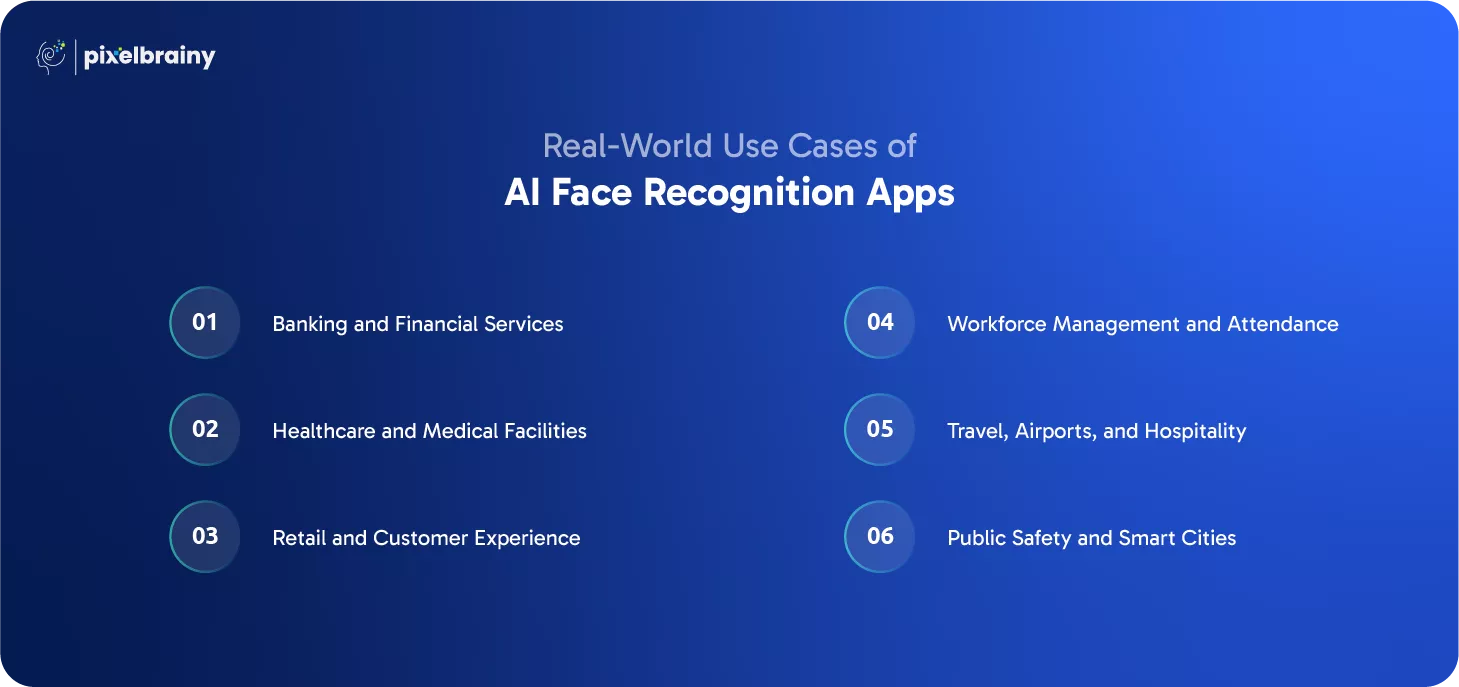
Banks and fintech companies are among the earliest adopters of facial recognition technology. Global institutions like HSBC and JPMorgan Chase use facial recognition as part of digital KYC and remote onboarding processes. When customers open an account through a mobile app, their face scan is matched against identity documents and existing databases. This reduces manual verification costs and significantly lowers fraud risks.
For fintech platforms such as Revolut or PayPal, building of AI Face Recognition App systems also enables secure login and transaction approval, replacing passwords with biometric authentication that customers trust.
Also Read: AI Fintech App Development Cost: Factors and Examples
Healthcare providers use facial recognition to solve long-standing patient identification challenges. Large hospital networks and digital health platforms apply AI face recognition to ensure that patients are correctly matched to their medical records during registration. For example, a patient arriving at a hospital can be recognized at a kiosk using facial data, instantly retrieving their history and reducing administrative delays.
In addition, the development of AI Face Recognition App solutions helps healthcare organizations restrict access to sensitive areas and electronic health records, ensuring compliance with privacy regulations and improving overall data security.
Also Read: AI Medical Diagnosis Chatbot Development: Features and Cost
Retail brands use facial recognition to combine personalization with loss prevention. Companies like Alibaba and Walmart have explored facial recognition to identify repeat customers and deliver tailored shopping experiences. A returning customer can be recognized in-store and offered personalized discounts or loyalty rewards at checkout.
At the same time, retailers create AI Face Recognition App solutions to identify repeat theft patterns and enhance store security. This dual use supports revenue growth while protecting physical assets, making facial recognition a strategic retail investment.
Also Read: Retail AI Software Development: Use Cases, Benefits & Cost
Enterprises across manufacturing, IT, and corporate sectors use facial recognition to automate workforce management. Companies like Amazon and Infosys have tested facial recognition systems for attendance tracking and secure workplace access. Employees can clock in simply by scanning their face, eliminating card misuse and time fraud.
The building of AI Face Recognition App solutions also supports access control for restricted zones, ensuring only authorized personnel can enter sensitive work areas. This improves both operational efficiency and workplace safety.
Also Read: A Comprehensive Guide To Develop Employee Management Software
Airports and hospitality brands rely heavily on facial recognition to reduce congestion and improve customer experience. Airlines such as Delta and Emirates use facial recognition at check-in, security, and boarding gates to verify passenger identity faster. This shortens queues and improves operational flow.
Hotels like Marriott have piloted facial recognition for contactless check-in, allowing guests to access rooms without key cards. Through the development of AI Face Recognition App, travel businesses deliver smoother, faster, and more secure journeys.
Also Read: AI Travel Planner App Development: Features and Cost
Governments and city authorities use facial recognition to manage large populations and enhance public safety. Cities like Singapore and London deploy facial recognition systems in transportation hubs and public spaces to identify missing persons or persons of interest.
The building of AI Face Recognition App solutions also supports secure access to government buildings and large-scale event monitoring. These applications help authorities respond faster while managing urban security more efficiently.
These real-world examples clearly show how organizations across sectors create AI Face Recognition App solutions to solve real business challenges, improve operational control, and deliver secure, scalable digital experiences.

To build a reliable and market-ready solution, businesses must focus on strong foundational capabilities. The success of AI Face Recognition App Development depends on features that ensure accuracy, security, scalability, and smooth user interaction.
Below are the core features that form the backbone of the development of AI Face Recognition App solutions across industries.
| Core Feature | Description |
| Face Detection | This feature identifies human faces within images or live video streams. It ensures the system focuses only on facial regions and ignores background noise. Accurate face detection is critical when businesses create AI Face Recognition App solutions for real-world environments. |
| Facial Feature Extraction | The app analyzes unique facial landmarks such as eyes, nose, lips, and contours. These features are converted into mathematical representations instead of storing raw images. This process is central to the building of AI Face Recognition App systems that prioritize accuracy and privacy. |
| Face Matching and Verification | This feature compares captured facial data with stored records to confirm identity. It supports both one-to-one verification and one-to-many identification use cases. Reliable matching is essential for secure authentication workflows. |
| Real-Time Recognition | Real-time processing allows the app to recognize faces instantly through live camera feeds. This is widely used in access control, attendance systems, and surveillance. The development of AI Face Recognition App solutions often prioritizes speed and responsiveness here. |
| User Enrollment and Registration | This feature allows users to register their facial data securely within the system. It ensures high-quality image capture and proper data validation. A smooth enrollment process improves accuracy and user adoption. |
| Data Encryption and Security | Facial data is highly sensitive and must be protected at all levels. Encryption ensures that stored and transmitted biometric data remains secure. Businesses building AI Face Recognition App platforms must treat security as a core requirement. |
| Cloud and Database Integration | The app connects with cloud platforms or local databases to store and retrieve facial data. This supports scalability and centralized data management. It is a key feature in enterprise-grade AI Face Recognition App Development. |
| Accuracy Optimization | The system continuously improves recognition accuracy by refining models and reducing false positives. This feature helps maintain reliability across different lighting conditions and face angles. Accuracy optimization directly impacts trust in the app. |
| User Authentication and Access Control | Facial recognition is used to grant or deny access to apps, systems, or physical locations. This feature replaces passwords and access cards. It is widely adopted when businesses create AI Face Recognition App solutions for security-focused use cases. |
| Cross-Platform Compatibility | The app works seamlessly across mobile, web, and desktop platforms. This ensures wider adoption and flexibility for different business needs. Cross-platform support is essential for scalable AI Face Recognition App Development. |
| Performance Monitoring | This feature tracks system performance, recognition speed, and error rates. Businesses can identify issues early and improve system efficiency. Performance monitoring supports long-term reliability. |
| Compliance and Privacy Controls | The app includes consent management and data handling controls to meet regulatory requirements. This is critical in regions with strict data protection laws. Responsible development of AI Face Recognition App solutions depends on this feature. |
| Admin Dashboard | An admin panel allows organizations to manage users, permissions, and system settings. It provides visibility into app usage and performance. This feature simplifies system management for enterprises. |
| API Integration | APIs allow the face recognition system to integrate with third-party platforms. This supports use cases like HR systems, banking apps, and security tools. API readiness is a must when building AI Face Recognition App solutions. |
| Logging and Audit Trails | The system records authentication attempts and access logs. This helps with compliance, security audits, and issue investigation. Audit trails add transparency and accountability. |
These core features ensure that AI Face Recognition App Development delivers secure, accurate, and scalable solutions that meet real business needs.
Once the foundation is strong, advanced capabilities help businesses differentiate their solutions and handle complex scenarios.
While building AI Face Recognition App platforms, these advanced features enhance intelligence, resilience, and long-term value.
| Advanced Feature | Description |
| Liveness Detection | This feature prevents spoofing attempts using photos or videos. It detects real human presence through blinking, head movement, or depth analysis. Liveness detection is crucial for high-security AI Face Recognition App Development. |
| Anti-Spoofing Protection | Advanced algorithms identify fake faces, masks, or screen replays. This strengthens defense against biometric fraud. It is especially important in financial and government applications. |
| Multi-Face Recognition | The system can detect and recognize multiple faces simultaneously. This feature is widely used in surveillance and crowd monitoring. It enhances scalability in large environments. |
| Edge AI Processing | Facial recognition runs directly on devices instead of relying entirely on the cloud. This reduces latency and improves privacy. Edge AI is a growing trend in the development of AI Face Recognition App solutions. |
| Adaptive Learning Models | The system improves recognition accuracy over time by learning from new data. It adapts to changes in appearance such as aging or hairstyle changes. Adaptive learning increases long-term reliability. |
| Low-Light Recognition | Advanced models recognize faces in poor lighting conditions. This feature is useful for night surveillance and low-visibility environments. It expands real-world usability. |
| Emotion and Expression Analysis | The app can analyze facial expressions to understand emotions. This is used in customer experience, healthcare, and retail analytics. It adds intelligence beyond basic identification. |
| Mask and Occlusion Handling | The system recognizes faces even when partially covered. This became especially important in post-pandemic environments. It ensures continuity of recognition accuracy. |
| Behavioral Analytics Integration | Facial recognition data is combined with behavior patterns for deeper insights. This supports advanced security and fraud detection. It enhances decision-making for enterprises. |
| AI Bias Detection and Fairness Controls | The system monitors and reduces bias across age, gender, and ethnicity. This ensures fair and ethical recognition outcomes. Responsible building of AI Face Recognition App solutions depends on this capability. |
These advanced features help businesses future-proof their AI Face Recognition App Development strategy and deliver intelligent solutions that perform reliably in complex, real-world conditions.
Building a facial recognition solution is not just a technical exercise. It is a structured journey that combines business strategy, data science, security planning, and user experience design. For organizations exploring what is the process of creating an AI Face Recognition App, understanding each development phase helps avoid costly mistakes and ensures long-term success. The following steps outline how companies approach AI Face Recognition App Development in a practical, scalable, and business-ready way.
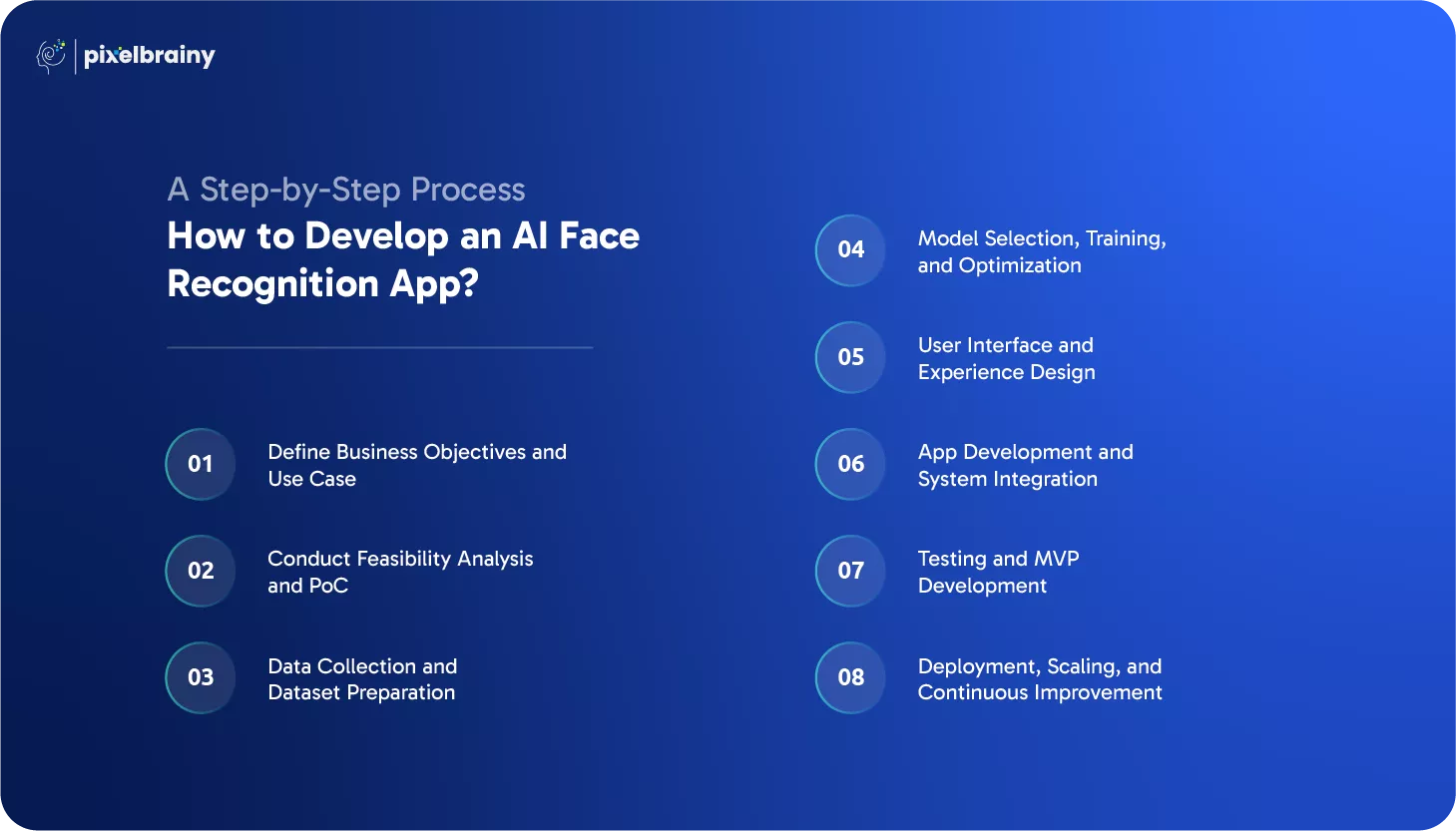
Every successful AI Face Recognition App Creation starts with a clear understanding of why the app is being built. Businesses must define the problem they want to solve, whether it is identity verification, fraud prevention, employee attendance, or secure access control. This step also involves identifying the target users and operational environment where the app will be used.
Goal: Establish a focused direction so the development team builds features that directly support business outcomes and compliance needs.
Before committing to full development, teams evaluate technical feasibility by building a PoC. This early prototype helps test face recognition accuracy, processing speed, and system compatibility under real-world conditions. It also highlights potential challenges related to data quality and infrastructure.
Goal: Validate core technology assumptions early and reduce risks before scaling the solution.
Data quality plays a major role in the development of AI Face Recognition App solutions. This step focuses on collecting diverse facial datasets that represent different age groups, lighting conditions, and facial variations. Data cleaning, labeling, and compliance with privacy regulations are handled carefully at this stage.
Goal: Create a reliable and unbiased data foundation that supports accurate facial recognition.
In this phase, developers or an AI model development company select appropriate AI and machine learning models for face detection and recognition. The models are trained using prepared datasets and optimized for accuracy and performance. Continuous fine-tuning helps the system adapt to real-world variations.
Goal: Ensure the recognition engine performs consistently and meets accuracy benchmarks across use cases.
A facial recognition system must be easy for users to interact with. Businesses often collaborate with a professional UI/UX Design Company to design intuitive enrollment, verification, and error-handling flows. Clear visual guidance improves user confidence and reduces friction.
Goal: Deliver a smooth and user-friendly experience that encourages adoption and trust.
This stage focuses on building an AI Face Recognition App by integrating trained AI models with backend systems, APIs, databases, and front-end applications. Developers also implement encryption, access controls, and performance optimization.
Goal: Develop a secure, scalable, and stable application architecture ready for real-world deployment.
Extensive testing ensures the app works reliably across devices and environments. Functional testing, security testing, and accuracy evaluation are performed before release. Many organizations launch the first version through MVP Development to collect user feedback and improve features iteratively.
Goal: Identify issues early, validate user acceptance, and refine the solution based on real-world usage.
Also Read: Top 10 AI MVP Development Companies in USA
The final phase of developing AI Face Recognition App solutions includes deployment, system monitoring, and ongoing enhancements. Businesses often work with Top AI Product Development Companies in USA to support large-scale deployments, performance optimization, and future upgrades.
Goal: Maintain long-term reliability, support business growth, and continuously improve recognition accuracy and security.
Following this step-by-step approach helps organizations to make AI Face Recognition App solutions that are secure, scalable, and aligned with real business needs.
One of the first questions businesses ask before starting development is cost. The truth is that there is no fixed price, because the cost depends on features, complexity, accuracy requirements, and deployment scale.
However, to give you a realistic picture, the cost to build an AI Face Recognition App typically ranges from $30,000 to $250,000+, depending on what you want to achieve and how advanced the solution needs to be.
| App Type | Development Timeline | Estimated Cost | What You Get |
| Basic AI Face Recognition App (MVP) | 2 to 3 months | $30,000 to $60,000 | Core face detection and recognition, basic user enrollment, simple authentication, limited dataset training, basic security, and initial testing suitable for pilot use or startups |
| Medium AI Face Recognition App | 4 to 6 months | $70,000 to $140,000 | Improved recognition accuracy, scalable architecture, cloud integration, real-time recognition, admin dashboard, data encryption, compliance-ready workflows, and multi-platform support |
| Advanced AI Face Recognition App | 6 to 9+ months | $150,000 to $250,000+ | High-accuracy AI models, liveness detection, anti-spoofing, edge AI support, multi-face recognition, enterprise-grade security, advanced analytics, and large-scale deployment readiness |
The more features you include, the higher the cost. A basic app with simple face matching costs significantly less than an advanced solution with liveness detection and real-time processing. Adding advanced capabilities can increase the budget by $20,000 to $80,000 depending on complexity.
High-accuracy facial recognition requires extensive training and fine-tuning. If your app needs to work in low light, handle facial masks, or support large user databases, model development costs can increase by $15,000 to $50,000 due to additional training and testing efforts.
Collecting and preparing quality datasets is a major cost factor. Businesses that need diverse and compliant datasets may spend $10,000 to $40,000 on data preparation, labeling, and privacy compliance measures, especially in regulated industries.
The cost also depends on whether the app is cloud-based, on-device, or hybrid. Cloud infrastructure, storage, and processing can add $5,000 to $30,000 in initial setup costs, while edge AI solutions may require additional optimization investment.
Stronger encryption, access controls, audit logs, and regulatory compliance features increase development effort. For enterprise or financial-grade security, this can add $10,000 to $35,000 to the overall budget.
The cost of development varies depending on the experience and location of the development team. Working with highly specialized AI engineers and security experts often results in higher upfront costs, but it also leads to better long-term reliability and scalability.
In the end, the cost of building AI Face Recognition App solutions reflects the balance between functionality, security, and long-term business goals, making careful planning essential before development begins.

Also Read: AI App Development Cost: From MVPs to Full-Scale AI App
Behind every reliable facial recognition solution is a well-thought-out technology stack. When businesses plan the development of AI Face Recognition App, the choice of tools directly impacts performance, accuracy, security, and future scalability.
Using the right technologies from the start helps avoid rework, reduces technical debt, and ensures the app performs well in real-world conditions.
| Technology Area | Tools and Technologies | Explanation |
| Programming Languages | Python, Java, C++, JavaScript | Python is widely used for AI model development due to its rich libraries. Java and C++ support backend performance and system-level processing. JavaScript helps build responsive web interfaces. |
| AI and Machine Learning Frameworks | TensorFlow, PyTorch, Keras | These frameworks are used to train and deploy facial recognition models. They support deep learning and help improve accuracy and performance during real-world usage. |
| Computer Vision Libraries | OpenCV, Dlib, MediaPipe | These libraries handle face detection, image processing, and feature extraction. They are essential components in the development of AI Face Recognition App solutions. |
| Face Recognition Models | CNN-based models, FaceNet, DeepFace | Pretrained and custom models help detect and recognize facial features. They reduce development time while maintaining reliable accuracy. |
| Backend Development | Node.js, Django, Flask, Spring Boot | Backend frameworks manage authentication logic, APIs, and communication between the AI engine and the app interface. |
| Frontend Development | React, Angular, Flutter, Swift, Kotlin | These tools are used to build mobile and web interfaces. They ensure smooth user interaction and cross-platform compatibility. |
| Database Management | PostgreSQL, MongoDB, MySQL | Databases store encrypted facial data, user profiles, and logs. The choice depends on scalability and data structure needs. |
| Cloud Platforms | AWS, Google Cloud, Microsoft Azure | Cloud platforms provide scalable computing power, storage, and AI services. They support large-scale deployment and high availability. |
| Security Tools | SSL, AES encryption, OAuth | Security technologies protect biometric data during storage and transmission. They help meet compliance and privacy requirements. |
| APIs and Integration Tools | REST APIs, GraphQL | APIs enable seamless integration with third-party systems such as HR platforms, banking systems, and access control solutions. |
| DevOps and Deployment | Docker, Kubernetes, CI/CD tools | These tools automate deployment, scaling, and updates. They ensure consistent performance and faster release cycles. |
| Testing and Monitoring | Selenium, JMeter, Prometheus | Testing and monitoring tools help validate functionality, performance, and system health after deployment. |
A carefully selected technology stack lays the foundation for a face recognition solution that is not only accurate and secure today, but also flexible enough to evolve with future business and technology demands.
Building a facial recognition solution requires more than just implementing AI models. Businesses must carefully balance accuracy, security, ethics, and user experience to ensure long-term success. Following these best practices helps organizations build reliable, compliant, and user-trusted AI face recognition applications.
Facial data is highly sensitive, so protecting user privacy should be the foundation of development. Users must clearly understand how their biometric data is collected, stored, and used. Transparent data practices build trust and reduce legal risks.
The accuracy and fairness of facial recognition systems depend on the quality of training data. Using diverse datasets helps prevent bias and improves recognition performance across different demographics.
Scaling a system before validating accuracy can lead to failures and user dissatisfaction. Businesses should test thoroughly in real-world conditions before expanding usage.
Security must be integrated into every layer of the AI face recognition app. Strong security practices protect both user data and system integrity.
A well-designed interface helps users feel comfortable using facial recognition technology. Clear guidance reduces errors and increases adoption.
Facial recognition technology and regulations evolve constantly. Ongoing monitoring and updates ensure the app remains effective and compliant.
By following these best practices, businesses can build AI face recognition apps that are secure, accurate, compliant, and trusted by users while remaining adaptable to future requirements.
While facial recognition offers powerful capabilities, building a reliable solution is not without obstacles. Businesses investing in AI Face Recognition App Development often face technical, ethical, and operational challenges that must be addressed early to ensure success. Understanding these challenges and knowing how to overcome them helps organizations build secure, accurate, and future-ready applications.
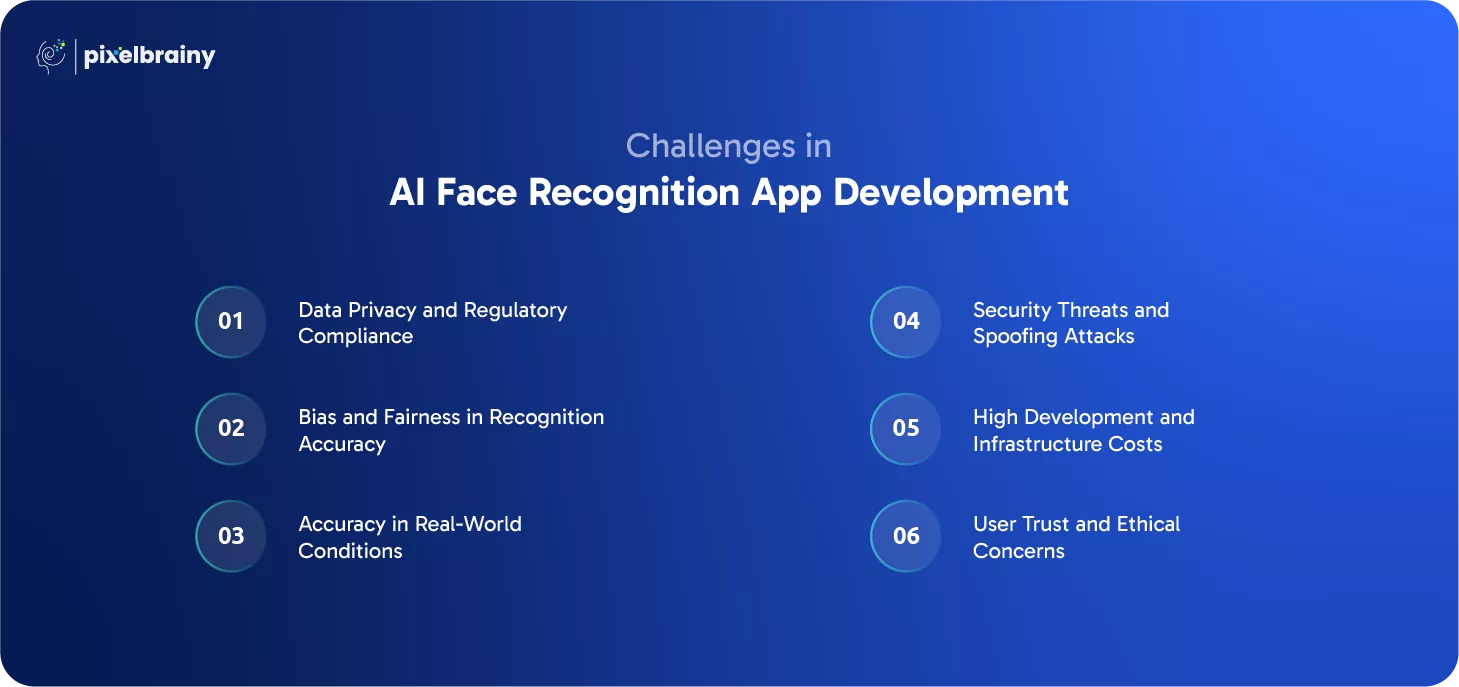
One of the biggest challenges in the development of AI face recognition app solutions is handling sensitive biometric data responsibly. Regulations such as GDPR, CCPA, and other regional data protection laws impose strict requirements on how facial data is collected, stored, and processed. Non-compliance can lead to legal penalties and loss of user trust.
How to overcome it: Implement clear consent mechanisms, encrypt facial data, anonymize where possible, and define strict data retention policies. Working with legal and compliance experts during development ensures the app aligns with regulatory standards.
Facial recognition systems can show bias if training datasets lack diversity. This may result in lower accuracy for certain age groups, ethnicities, or lighting conditions, which can harm user experience and brand credibility.
How to overcome it: Use diverse and representative datasets during training. Continuously test models across different demographics and update them regularly to improve fairness and overall accuracy.
Factors such as poor lighting, camera quality, facial expressions, masks, or partial face visibility can affect recognition performance. These conditions often differ significantly from controlled testing environments.
How to overcome it: Train models using real-world data, optimize algorithms for low-light and occlusion scenarios, and perform extensive testing across devices and environments before deployment.
AI face recognition apps are vulnerable to spoofing attempts using photos, videos, or masks. If not addressed, these threats can compromise system integrity and user safety.
How to overcome it: Integrate liveness detection and anti-spoofing techniques such as motion analysis, depth sensing, and behavioral checks. Regular security audits further strengthen system defenses.
Building and maintaining facial recognition systems can be expensive due to AI model training, cloud infrastructure, and skilled resource requirements. This can be a concern for startups and mid-sized businesses.
How to overcome it: Start with an MVP approach, optimize infrastructure usage, and scale gradually based on demand. Cloud services and modular architectures can help control costs while maintaining performance.
Users may feel uncomfortable with facial recognition if they do not understand how their data is used. Lack of transparency can reduce adoption and lead to reputational risks.
How to overcome it: Be transparent about data usage, explain benefits clearly, and give users control over their data. Ethical design and clear communication help build long-term trust.
Addressing these challenges proactively allows businesses to build AI face recognition apps that are not only technologically strong but also secure, compliant, and trusted in real-world use.
AI face recognition technology is evolving rapidly, driven by advances in artificial intelligence, changing user expectations, and stricter data regulations. Businesses planning long-term investments in AI Face Recognition App Development need to understand where the technology is heading and how future trends will shape real-world applications.
Below are the key trends expected to define the next phase of facial recognition solutions.
One major trend is the shift toward edge computing. Instead of processing facial data entirely in the cloud, recognition is performed directly on devices such as smartphones, cameras, or access terminals. This reduces latency, improves response time, and enhances privacy by minimizing data transmission. Edge-based processing will play a crucial role in environments where real-time recognition is essential.
Future facial recognition apps will be built with privacy at the core. Developers are moving toward techniques that store encrypted facial templates rather than raw images and limit data retention. User-controlled consent and transparent data usage will become standard practices as regulations continue to evolve.
Advancements in deep learning and neural networks will significantly improve recognition accuracy. Future systems will better handle variations in lighting, aging, facial expressions, and partial occlusion. These improvements will make facial recognition more reliable in uncontrolled, real-world environments.
Facial recognition will increasingly be combined with other biometric methods such as voice recognition, fingerprint scanning, or behavioral biometrics. This layered approach strengthens security and reduces the risk of identity fraud, especially in high-risk industries like banking and government services.
Addressing bias and fairness will remain a top priority. Future AI face recognition systems will include built-in monitoring to detect and reduce bias across demographics. Ethical AI frameworks and explainable decision-making will help organizations build trust and meet compliance standards.
Beyond security and authentication, facial recognition will expand into areas such as personalized healthcare, smart retail analytics, automotive systems, and immersive digital experiences. As adoption grows, businesses will find new ways to integrate facial recognition into everyday workflows.
Facial recognition will increasingly connect with IoT devices, smart buildings, and smart city infrastructure. This integration will support automated access control, personalized services, and improved public safety through connected systems.
These emerging trends show that AI Face Recognition App Development is moving toward smarter, more secure, and more responsible solutions that will continue to shape how businesses and users interact in the digital world.
For business owners and decision-makers, choosing the right AI development company is not just a technical decision, it is a strategic one. When investing in advanced biometric technology, clients look for a partner that understands business risks, regulatory expectations, and real-world deployment challenges. PixelBrainy works with this mindset, helping organizations confidently move from concept to production-ready AI solutions for Face Recognition App.
PixelBrainy partners with startups, enterprises, and product-led businesses that want to make an AI Face Recognition Application tailored to their specific use cases. Instead of offering one-size-fits-all solutions, the team focuses on building systems that align with operational goals such as secure onboarding, access control, workforce management, or fraud detection. This business-first approach ensures the development of AI Face Recognition App solutions delivers measurable value, not just technical output.
PixelBrainy successfully delivered a face recognition solution for a business client in the United States operating in the financial services space. The client needed a secure and scalable identity verification system to support digital customer onboarding while meeting strict compliance requirements. PixelBrainy designed and implemented an AI-powered facial recognition workflow that enabled real-time identity checks, reduced manual verification efforts, and improved onboarding speed. The solution was integrated into the client’s existing digital platform, allowing a smooth rollout without disrupting operations.
What business leaders appreciate most is PixelBrainy’s ability to build Face Recognition App integrating AI with existing systems while keeping security and data privacy at the core. From model selection and optimization to deployment and post-launch support, the team ensures long-term reliability and scalability.
For clients and business owners looking for a trusted partner to deliver robust facial recognition technology, PixelBrainy offers the experience, clarity, and execution needed to turn AI investments into real business outcomes.

AI-powered facial recognition is no longer an emerging concept but a practical solution for businesses seeking secure, scalable, and future-ready authentication systems. From identity verification and access control to fraud prevention and automation, the development of AI Face Recognition App solutions is transforming how organizations operate across industries. By investing in AI Face Recognition App Development, businesses can improve security, streamline user experiences, and adapt to growing digital demands.
However, success depends on choosing the right strategy, technology stack, and development partner. Whether you are planning to create an AI Face Recognition App from scratch or enhance an existing system, focusing on accuracy, privacy, and compliance is essential. With the right expertise, building of AI Face Recognition App solutions can deliver long-term value and competitive advantage.
Looking to turn your idea into a reliable AI-driven product? Book an appointment today and explore how a tailored facial recognition solution can support your business goals.
Modern AI face recognition apps can achieve high accuracy when trained on diverse datasets and optimized for real-world conditions. Factors such as lighting, camera quality, and model selection play a major role in maintaining consistent performance.
Yes, many solutions support on-device or edge processing. This approach improves response time and enhances privacy, making it suitable for mobile apps and offline environments, though it may require optimized models.
Absolutely. With scalable architecture and flexible deployment options, small and mid-sized businesses can adopt facial recognition for use cases like employee authentication, customer verification, and secure access control.
High-quality facial images or video data are essential for training and testing. During development, data diversity and ethical sourcing are critical to ensure accuracy and reduce bias.
The development timeline depends on app complexity, features, and integration requirements. A basic solution may take a few months, while enterprise-grade systems can require additional time for testing, compliance, and scaling.
Yes, facial recognition solutions can be tailored for industries such as finance, healthcare, retail, and enterprise security. Customization ensures the app aligns with industry workflows, compliance needs, and user expectations.

About The Author
Sagar Bhatnagar
Sagar Sahay Bhatnagar brings over a decade of IT industry experience to his role as Marketing Head at PixelBrainy. He's known for his knack in devising creative marketing strategies that boost brand visibility and market influence. Sagar's strategic thinking, coupled with his innovative vision and focus on results, sets him apart. His track record of successful campaigns proves his ability to utilize digital platforms effectively for impactful marketing efforts. With a genuine passion for both technology and marketing, Sagar continuously pushes PixelBrainy's marketing initiatives to greater success.


Transform your ideas into reality with us.
Working with the PixelBrainy team has been a highly positive experience. They understand the design requirements and create beautiful UX elements to meet the application needs. The dev team did an excellent job bringing my vision to life. We discussed usability and flow. Sagar worked with his team to design the database and begin coding. Working with Sagar was easy. He has the knowledge to create robust apps, including multi-language support, Google and Apple ID login options, Ad-enabled integrations, Stripe payment processing, and a Web Admin site for maintaining support data. I'm extremely satisfied with the services provided, the quality of the final product, and the professionalism of the entire process. I highly recommend them for Android and iOS Mobile Application Design and Development.

Great experience working with them. Had a lot of feedback and I found that unlike most contractors they were bugging me for updates instead of the other way around. They were extremely time conscience and great at communicating! All work was done extremely high quality and if not on time, early! They were always proactive when it comes to communication and the work is great/above par always. Very flexible and a great team to work with! Goes above and beyond to present us with multiple options and always provides quality. Amazing work per usual with Chitra. If you have UI/UX or branding design needs I recommend you go to them! Will likely work with them in the future as well, definitely recommended!

PixelBrainy is a joy to work with and is a great partner when thinking through branding, logo, and website layout. I appreciate that they spend time going into the "why" behind their decisions to help inform me and others about industry best practices and their expertise.

I hired them to design our software apps. Things I really like about them are excellent communication skills, they answer all project suggestions and collaborate right away, and their input on design and colors is amazing. This project was complex and needed patience and creativity. The team is amazing to do business with. I will be using them long-term. Glad to see there are some good people out there. I was afraid to try and outsource my project to someone but I am glad I met them! I really can't say enough. They went above and beyond on this project. I am very happy with everything they have done to make my business stand out from the competition.

It was great working with PixelBrainy and the team. They were very responsive and really owned the project. We'll definitely work with them again!

I recently worked with the PixelBrainy team on a project and I was blown away by their communication skills. They were prompt, clear, and articulate in all of our interactions. They listened and provided valuable feedback and suggestions to help make the project a success. They also kept me updated throughout the entire process, which made the experience stress-free and enjoyable.

PixelBrainy is very good at what it does. The team also presents themselves very professionally and takes care of their side of things very well. I could fully trust them taking up the design work in a timely and organised manner and their attention to detail saved us lots of effort and time. This particular project was quite intense and the team showed that they function very well under pressure. Very much looking forward to working with her again!

It's always an absolute pleasure working with them. They completed all of my requests quickly and followed every note I had for them to a T, which made our process go smoothly from start to finish. Everything was completed fast and following all of the guidelines. And I would recommend their services to anyone. If you need any design work done in the future, PixelBrainy should be your first call!

They took ownership of our requirements and designed and proposed multiple beautiful variants. The team is self-motivated, requires minimum supervision, committed to see-through designs with quality and delivering them on time. We would definitely love to work with PixelBrainy again when we have any requirements.

PixelBrainy was a big help with our SaaS application. We've been hard at work with a new UI/UX and they provided a lot of help with the designs. If you're looking for assistance with your website, software, or mobile application designs, PixelBrainy and the team is a great recommendation.

PixelBrainy designers are amazing. They are responsive, talented, and always willing to help craft the design until it matches your vision. I would recommend them and plan to continue them for my future projects and more!!!

They were awesome! Did a good job fast, and good communication. Will work with them again. Thank you

Creative, detail-oriented, and talented designers who take direction well and implement changes quickly and accurately. They consistently over-delivered for us.

PixelBrainy team is very talented and creative. Great designers and a pleasure to work with. PixelBrainy is an excellent communicator and I look forward to working with them again.

PixelBrainy has a very talented design team. Their work is excellent and they are very responsive. I enjoy working with them and hope to continue on all of our future projects.


