
 AI Summary Powered by PixelBrainy
What if your users could talk to an app that truly understands them, remembers their preferences, and evolves with every interaction?
This question is driving a new wave of digital products where AI is no longer just a feature but a companion. From mental wellness and productivity to education, fitness, and customer engagement, AI companions are rapidly becoming a core product category for modern businesses. As user expectations shift toward personalization, empathy, and real time interaction, companies are exploring how to create an AI Companion App MVP that delivers value early without excessive risk.
Building a full-scale AI product from day one can be costly, complex, and uncertain. That is why many startups, enterprises, and digital-first businesses are prioritizing MVP development for AI Companion App solutions. An AI Companion App MVP allows founders to validate use cases, test user engagement, and refine the companion’s personality before committing to large scale development. Whether you aim to make AI Companion App MVP for wellness coaching, virtual friends, employee support, or customer interaction, starting small is the smartest path forward.
AI Companion App MVP Development is especially relevant for sectors such as healthcare, education, SaaS, eCommerce, HR tech, and consumer apps where user trust and engagement matter most. Entrepreneurs, startup founders, product managers, and innovation teams are actively searching for how to create an AI Companion App MVP that aligns with real user needs.
This guide is designed to help you understand not just the technology, but the strategy behind building an AI Companion App MVP that works. From idea validation to launch, it explains how to reduce risk, optimize cost, and build a companion users actually want to return to.
An AI Companion App MVP is the most simplified version of an AI-powered companion application built to validate the core idea with real users. Instead of launching a fully developed product, businesses focus on delivering only the essential features needed to test engagement, usability, and value. The primary goal of an AI Companion App MVP is to understand whether users find the companion helpful, relatable, and worth returning to.
MVP development for AI Companion App solutions typically includes a basic conversational interface, limited personalization, and simple memory capabilities. This approach allows founders to quickly gather user feedback and improve the experience without heavy investment. Learning how to create an AI Companion App MVP helps businesses reduce technical risk, control costs, and speed up time to market. By choosing to make AI Companion App MVP first, companies can refine functionality, improve user trust, and build a stronger foundation before scaling into a full-fledged AI companion platform.
Investing in MVP development for AI Companion App solutions is not optional in today’s competitive digital landscape. It is a necessary step for companies that want to move fast, validate core product assumptions, and make data-driven decisions before committing time and money to a full product build.
One key reason is that the AI companion app market is rapidly expanding with strong growth projections. The global AI companion app market is estimated to be worth billions in 2025 and is expected to grow substantially through the next decade. For example, research shows the global AI companion app market was valued at around USD 14.1 billion in 2024 and is projected to grow with a compound annual growth rate of about 26.8% between 2025 and 2034. Other forecasts indicate that the market could be worth around USD 290.8 billion by 2034 at a 39% CAGR from 2025 onward.
This explosive growth reflects increased adoption across sectors such as healthcare, education, customer service, lifestyle apps, and productivity tools. However, building a full-fledged AI companion without early validation carries significant risk because user behavior and preferences for AI companions can vary widely across demographics and use cases.
An MVP enables founders and innovation teams to validate their value proposition, test user interaction patterns, refine conversational design, and learn what features truly matter. This early market insight reduces technical and financial risk, improves the product strategy, and positions the business to make informed investments in subsequent scaling phases. By focusing on MVP development for AI Companion App first, companies gain clarity and confidence before expanding into a full product.
AI Companion App MVP Development helps businesses move from idea to execution with clarity and control. Instead of investing heavily in untested assumptions, companies can experiment, learn, and refine their approach using real user interactions. The creation of MVP for AI Companion App ensures that product decisions are guided by insight rather than speculation.
Below are the key advantages of developing an AI Companion App MVP explained in depth.
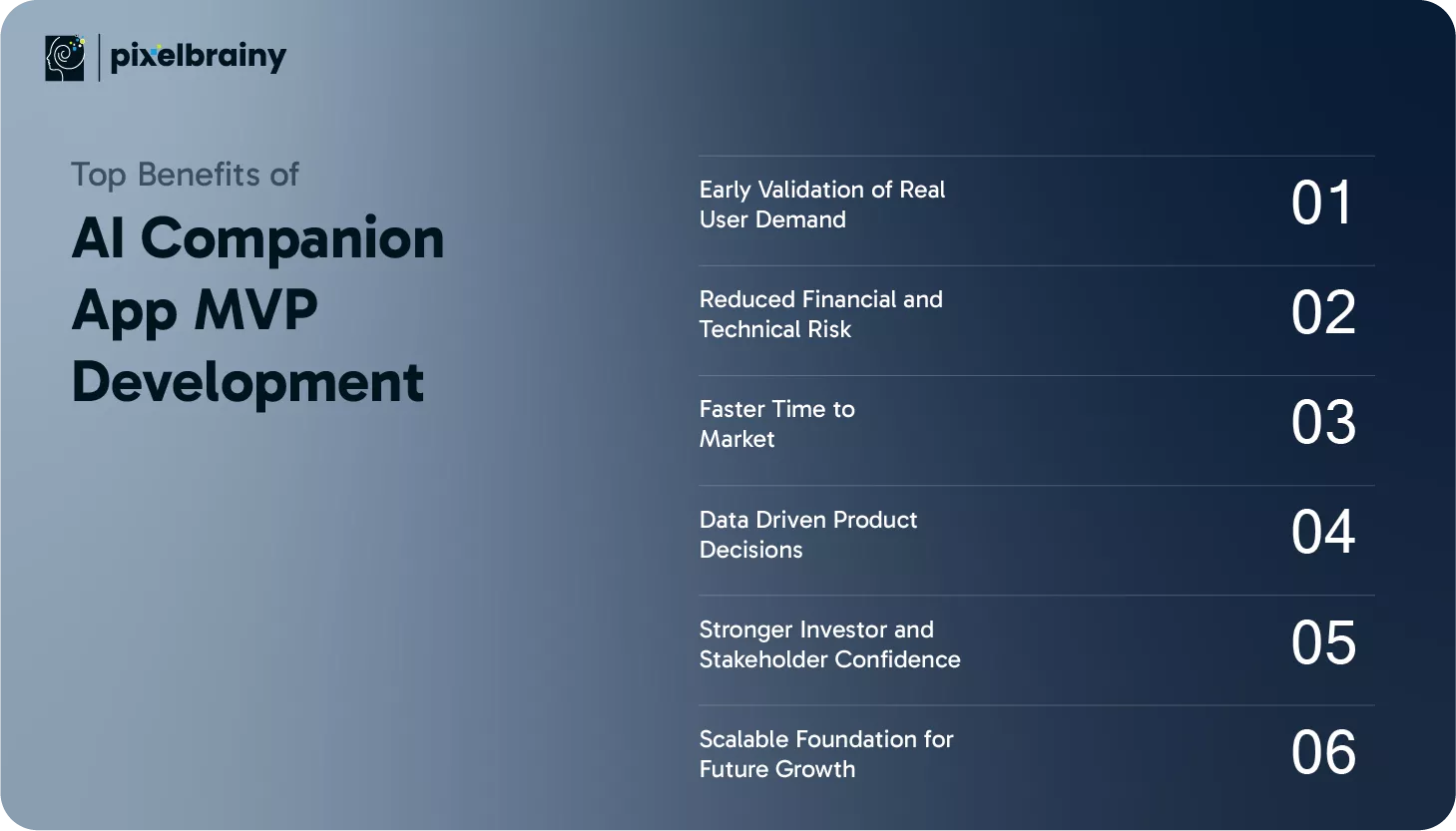
One of the most important advantages of developing an AI Companion App MVP is the ability to validate whether users actually want the product. AI companions are deeply personal and their success depends on how naturally users engage with them. An MVP allows businesses to observe real conversations, usage frequency, and emotional responses from early adopters.
Through this validation phase, companies can identify whether users find the AI companion helpful, engaging, and relevant to their daily needs. This feedback reveals if the problem being solved is meaningful or if the product needs adjustment. By validating demand early, businesses avoid building a full solution that fails to resonate with its intended audience.
Building a full-scale AI companion application requires significant investment in development, infrastructure, and ongoing maintenance. By choosing to build an AI Companion App MVP, businesses can significantly reduce financial risk by limiting initial scope and focusing only on essential functionality.
From a technical perspective, an MVP helps teams test AI model performance, response quality, and system reliability before scaling. It exposes potential challenges such as latency, data handling, or conversation breakdowns early in the process. Addressing these issues at the MVP stage prevents expensive fixes later and creates a safer path toward long-term development.
Speed is a critical factor in the AI space, where trends and user expectations evolve rapidly. AI Companion App MVP Development enables businesses to launch faster by prioritizing core features and eliminating unnecessary complexity. This allows companies to introduce their idea to the market while it is still relevant.
A faster launch also means earlier access to user feedback and market signals. Businesses can iterate quickly, refine the experience, and adapt to changing demands. Entering the market sooner helps establish brand presence, build early loyalty, and stay ahead of competitors who delay release in pursuit of perfection.
The creation of MVP for AI Companion App provides access to real usage data that guides smarter decision making. Metrics such as session duration, repeat usage, engagement depth, and conversation outcomes offer clear insight into how users interact with the AI companion.
This data helps teams understand what features matter most and where users lose interest. Instead of relying on opinions or assumptions, businesses can make informed choices about feature improvements, persona adjustments, and AI behavior. Data driven development results in a product that aligns more closely with user expectations and market demand.
Investors and stakeholders look for evidence that an idea has real potential. An AI Companion App MVP offers tangible proof of progress, showing that the concept works beyond theory. Early user engagement, feedback, and traction demonstrate that the business understands both the technology and the market.
AI Companion App MVP Development also signals a disciplined approach to innovation. It shows that resources are being used responsibly and that decisions are based on validation rather than assumptions. This builds confidence among investors, partners, and internal teams, making it easier to secure funding and long-term support.
When businesses build an AI Companion App MVP with scalability in mind, they create a strong foundation for future expansion. Early testing helps define architecture, conversation flows, and data management practices that can grow with the product.
As the AI companion evolves, businesses can confidently add advanced features such as deeper personalization, long-term memory, voice interactions, and integrations. This structured approach ensures that scaling efforts are efficient and aligned with proven user needs rather than guesswork.
From these benefits, it becomes clear that AI Companion App MVP Development is not just a preliminary step but a strategic investment. It empowers businesses to reduce risk, learn faster, and build an AI companion that is both valuable and scalable from the start.

When developing an AI Companion App MVP, feature selection should focus on delivering meaningful interaction while keeping the product lean and testable. The goal of a Companion App MVP integrating AI is to validate engagement, personalization, and usability without overengineering.
Below are the essential features to include when you make AI Companion App MVP, explained clearly within the table.
| Core Feature | Explanation |
| Conversational Chat Interface | This feature enables real-time text-based communication between the user and the AI companion. It should feel intuitive and responsive, allowing users to interact naturally without friction. A strong conversational interface forms the backbone of developing an AI Companion App MVP and directly impacts user engagement. |
| AI Persona Definition | AI persona defines the companion’s tone, behavior, and communication style. It helps users emotionally connect with the app and sets clear expectations for interaction. In an MVP, a well-defined persona ensures consistency and builds early trust with users. |
| Context Awareness | Context awareness allows the AI to understand references from earlier messages within a conversation. This prevents fragmented responses and improves conversation flow. Even basic contextual handling significantly enhances the perceived intelligence of an AI Companion App MVP. |
| Short-Term Memory | Short-term memory enables the AI to remember recent interactions during an active session. This helps maintain continuity and avoids repetitive questions. It is a lightweight but critical feature when you make AI Companion App MVP. |
| Basic Long-Term Memory | This feature stores essential user information such as preferences or goals for future conversations. It allows the AI to personalize interactions over time. Implementing basic long-term memory improves retention without adding excessive complexity. |
| Personalization Engine | A personalization engine adapts responses based on user behavior and interaction history. It helps test how customization influences engagement during MVP stages. This feature is central to Companion App MVP integrating AI experiences that feel relevant and user-focused. |
| Emotion Detection | Emotion detection identifies basic emotional cues from user input such as stress or excitement. This allows the AI to respond more empathetically. Including this feature enhances emotional connection during AI Companion App MVP development. |
| Safety and Content Filters | Safety filters ensure the AI avoids harmful, inappropriate, or misleading responses. This is essential for maintaining user trust and ethical standards. Implementing safety early protects both users and the business. |
| Feedback Collection System | This feature allows users to share feedback directly within the app. Feedback helps teams refine features, conversations, and usability. It plays a key role in improving the product during MVP validation cycles. |
| User Profile Management | User profile management securely stores user data and preferences. It supports personalization and future scalability. Even at MVP level, proper data handling builds credibility and prepares the app for growth. |
| Multi-Platform Accessibility | This feature ensures the AI companion can be accessed via web or mobile platforms. It improves reach and convenience for users. For MVPs, supporting limited platforms is often sufficient to validate demand. |
| Onboarding Experience | Onboarding introduces users to the AI companion and explains how to interact with it. A clear onboarding flow reduces confusion and increases early engagement. It sets the tone for long-term usage. |
| Analytics and Usage Tracking | Analytics track user behavior such as session length and engagement frequency. These insights guide data-driven improvements. Analytics are essential for evaluating the success of developing an AI Companion App MVP. |
| Prompt Management System | Prompt management controls how the AI responds to different user inputs. It allows teams to adjust behavior without major code changes. This flexibility is valuable for rapid testing and iteration. |
| Scalable Backend Architecture | A scalable backend supports growth as user demand increases. Even when you make AI Companion App MVP, planning for scalability avoids future redevelopment. It ensures a smooth transition to a full-scale product. |
Focusing on these carefully selected features ensures that Companion App MVP integrating AI delivers real value, supports fast learning, and lays a strong foundation for future expansion.
Understanding what is the process of creating an AI Companion App MVP is critical for founders who want clarity, speed, and validation.
Below is a detailed, step-by-step explanation of AI Companion App MVP Development, followed by the aim or goal of each step, as typically practiced by a UI/UX design company and top AI development companies in USA.
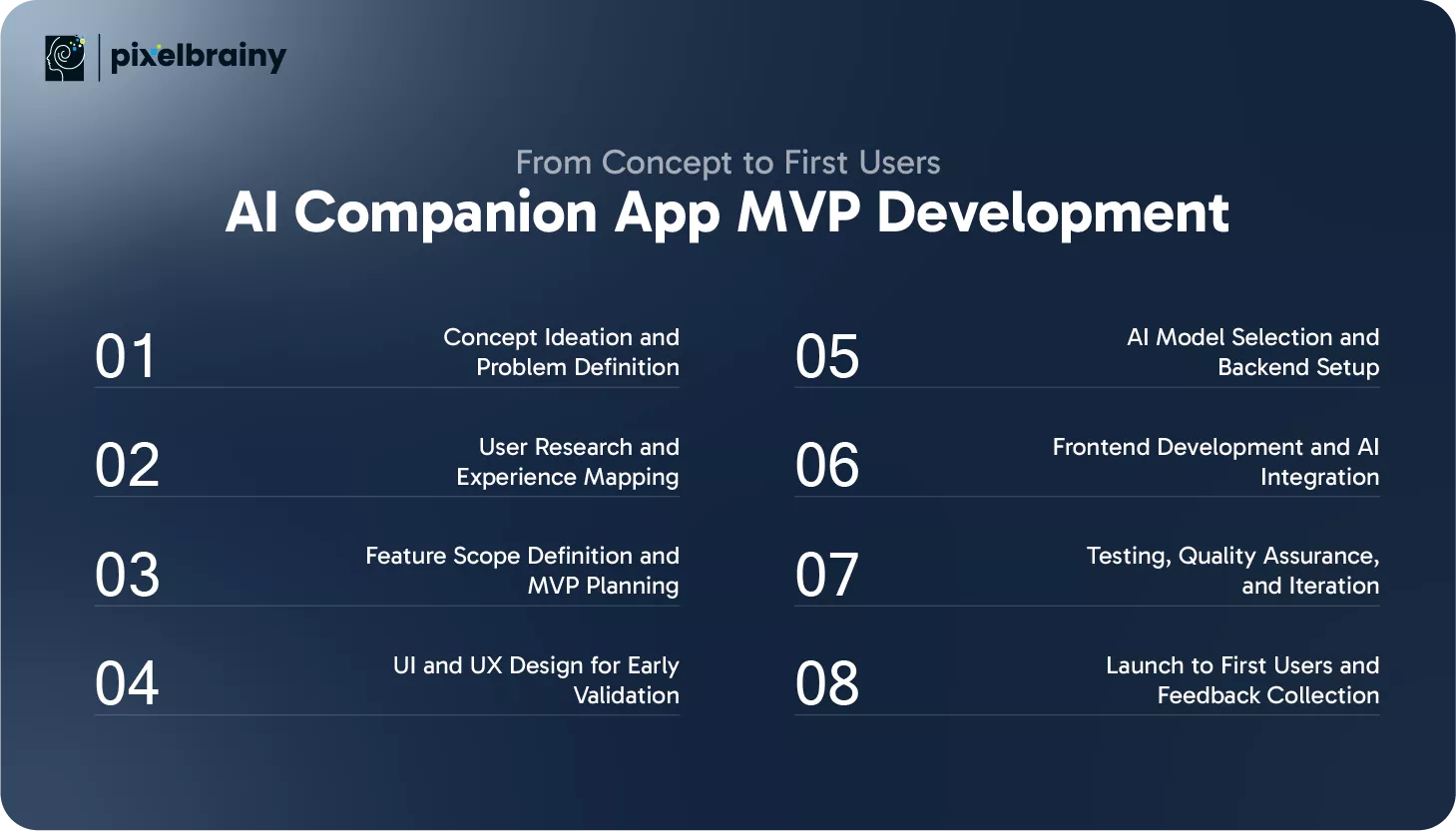
The development of AI Companion App MVP begins with defining the core idea and the specific problem the app aims to solve. Businesses must clearly identify their target audience, user pain points, and the role the AI companion will play in daily interactions. Whether the focus is emotional support, productivity, learning assistance, or customer engagement, clarity at this stage determines the direction of the entire project. Market research and competitive analysis are conducted to ensure the concept is viable and relevant.
Aim of this step: The goal is to eliminate ambiguity and ensure the AI companion addresses a real, validated user problem rather than a theoretical idea.
User research is essential to understand how users think, behave, and interact with AI-driven products. A UI/UX design company typically conducts interviews, surveys, and behavioral analysis to map user journeys and emotional touchpoints. This process defines how users discover the app, onboard, and engage in conversations. Experience mapping ensures that the AI companion feels intuitive and human-centered from the start.
Aim of this step: The goal is to design interactions that align with real user expectations and reduce friction throughout the user journey.
At this stage, teams define which features are essential for MVP creation for AI Companion App and which can be postponed. The focus remains on core functionality such as basic conversations, personalization, memory, and safety mechanisms. Clear scope definition prevents overbuilding and keeps the development process efficient. Planning also includes defining timelines, milestones, and success criteria.
Aim of this step: The goal is to keep the MVP lean, focused, and aligned with validation objectives rather than feature quantity.
Also Read: Top 10 AI MVP Development Companies in USA
Design plays a vital role in user perception and engagement. A UI/UX design company creates wireframes, prototypes, and interaction flows that prioritize simplicity and conversational ease. The design supports natural communication with the AI companion and minimizes cognitive load. Early prototypes are often tested with users to validate usability before full development begins.
Aim of this step: The goal is to validate usability and emotional appeal early, reducing costly design changes later.
This step focuses on selecting appropriate AI models and building the backend infrastructure. Top AI development companies in USA evaluate AI frameworks, APIs, and data pipelines to balance performance, cost, and scalability. Backend systems are designed to manage conversations, store memory, and support personalization. Security and scalability considerations are also addressed at this stage.
Aim of this step: The goal is to create a stable and scalable technical foundation that supports reliable AI interactions.
Frontend development brings the AI companion to life by connecting the user interface with backend intelligence. Developers integrate chat interfaces, user profiles, and AI responses to enable real-time interaction. Continuous testing ensures smooth communication, fast response times, and consistent behavior across devices.
Aim of this step: The goal is to ensure seamless interaction between users and the AI companion with minimal latency or friction.
Testing ensures the MVP functions as intended and delivers a reliable experience. Teams perform functional testing, usability testing, and AI behavior testing to identify bugs and inconsistencies. Feedback from internal testers helps refine conversation quality and system stability. Iteration is continuous during this phase.
Aim of this step: The goal is to deliver a stable, usable MVP that reflects quality and reliability before user launch.
The final stage involves releasing the MVP to a controlled group of early users through beta testing or pilot programs. These users provide direct feedback on engagement, usefulness, and overall experience. Their insights help guide future development priorities and scaling decisions, marking a critical milestone in AI Companion App MVP Development.
Aim of this step: The goal is to validate the product with real users and gather actionable insights for future growth.
By following this structured approach, businesses can confidently build an AI Companion App MVP that is user-focused, validated, and ready to evolve into a scalable product.
Estimating the cost to make an AI Companion App MVP is a crucial step before starting development. Most businesses can expect the pricing of AI Companion App MVP Development to fall between $10,000 and $50,000, depending on scope, technology, and execution strategy. This range is ideal for validating the product idea while keeping financial risk under control.
This range represents a practical development budget of AI Companion App MVP for startups, SMBs, and innovation-focused enterprises.
The number and depth of features directly impact the cost estimation for AI Companion App MVP Development. A simple chat interface with basic memory and persona settings requires less development effort. Adding advanced capabilities such as emotion detection, behavior tracking, or analytics increases development time and cost.
The choice between third-party AI APIs and custom AI models plays a major role in determining the cost of developing an AI Companion App MVP. API-based solutions reduce initial build time but may increase recurring expenses. Custom AI development demands higher upfront investment but provides greater flexibility and control.
User experience is critical for AI companion apps. Investing in intuitive UI, smooth onboarding, and engaging conversation design can raise the cost to make an AI Companion App MVP, but it significantly improves user adoption and retention.
Backend architecture, data storage, and security measures also influence the pricing of AI Companion App MVP Development. Even at MVP stage, planning for scalability ensures the app can grow without major redevelopment later.
For most businesses, allocating $10,000 to $50,000 offers a balanced approach to testing ideas, gathering feedback, and refining the product. This investment ensures the AI companion MVP is functional, user-ready, and scalable while avoiding unnecessary overspending during early development.

Building an AI Companion App MVP is not just about having a strong idea, it also depends heavily on the tools and technologies used to bring that idea to life. The right technology stack determines how efficiently the AI companion performs, how easily the product can be scaled, and how quickly improvements can be made based on user feedback.
During the development of MVP for AI Companion App, businesses must prioritize tools that support flexibility, reliability, and rapid iteration without adding unnecessary complexity.
The table below outlines the advanced tools and technologies commonly used in AI Companion App MVP Development, along with their purpose and impact on MVP success.
| Technology Layer | Tools / Technologies | Explanation |
| AI Language Models | OpenAI API, Anthropic Claude, Google Gemini, Open Source LLMs | These models power the conversational intelligence of the AI companion. They generate human-like responses and adapt to different conversation styles. Selecting the right model affects response quality, latency, and operational cost during MVP creation for AI Companion App. |
| Prompt Engineering & Orchestration | LangChain, LlamaIndex | These tools manage how prompts are structured and routed to AI models. They help maintain conversation flow, context handling, and persona consistency. Prompt orchestration is essential to control AI behavior during early MVP stages. |
| Backend Development | Node.js, Python (FastAPI, Django) | Backend frameworks handle business logic, API calls, user sessions, and data processing. A stable backend ensures smooth communication between the AI model and the user interface. It forms the backbone of the AI Companion App MVP. |
| Memory Management | Redis, Pinecone, FAISS, Weaviate | Memory tools store short-term and long-term user context. They allow the AI companion to remember preferences and previous interactions. Effective memory management improves personalization and engagement without excessive complexity. |
| Frontend Development | React.js, Next.js, Flutter | Frontend frameworks create the user-facing interface of the AI companion app. They support responsive design and real-time chat interactions. A clean frontend improves usability and user adoption during MVP launch. |
| UI/UX Design Tools | Figma, Adobe XD | These tools are used to design wireframes, prototypes, and user flows. They help visualize the experience before development begins. Strong UI/UX design is critical for user trust and engagement in AI companion apps. |
| Database Management | PostgreSQL, MongoDB, Firebase | Databases store user profiles, conversation logs, and application data. The choice of database affects scalability and data security. Lightweight databases are often preferred during MVP development for faster iteration. |
| Cloud Infrastructure | AWS, Google Cloud, Microsoft Azure | Cloud platforms host the application, manage servers, and support scalability. They allow businesses to deploy MVPs quickly and scale as user demand grows. Cloud services also provide security and monitoring features. |
| Analytics and Monitoring | Google Analytics, Mixpanel, Amplitude | Analytics tools track user behavior, engagement metrics, and retention. These insights are crucial for evaluating MVP performance. Data collected helps guide future feature development and optimization. |
| Security and Compliance | OAuth, JWT, SSL Encryption | Security tools protect user data and ensure secure authentication. Implementing security early builds trust and ensures compliance. Even at MVP stage, basic security measures are essential. |
| Testing and QA Tools | Jest, Cypress, Postman | Testing tools ensure the app functions correctly and reliably. They help identify bugs, performance issues, and integration problems. Continuous testing supports quality during AI Companion App MVP Development. |
| Deployment and CI/CD | Docker, GitHub Actions, GitLab CI | These tools automate deployment and updates. They allow teams to release improvements quickly and consistently. CI/CD pipelines support rapid iteration during MVP creation for AI Companion App. |
Choosing the right combination of tools and technologies ensures the AI Companion App MVP is scalable, reliable, and ready for continuous improvement as user needs evolve.
Measuring success is a critical part of AI Companion App MVP Development, as it helps businesses understand whether the product is delivering real value to users. Without clearly defined metrics, it becomes difficult to evaluate performance or decide what to improve next. Tracking the right data ensures that decisions during MVP iteration are driven by insight rather than assumptions.
Below are the key metrics used to evaluate the success of an AI Companion App MVP, explained in detail.
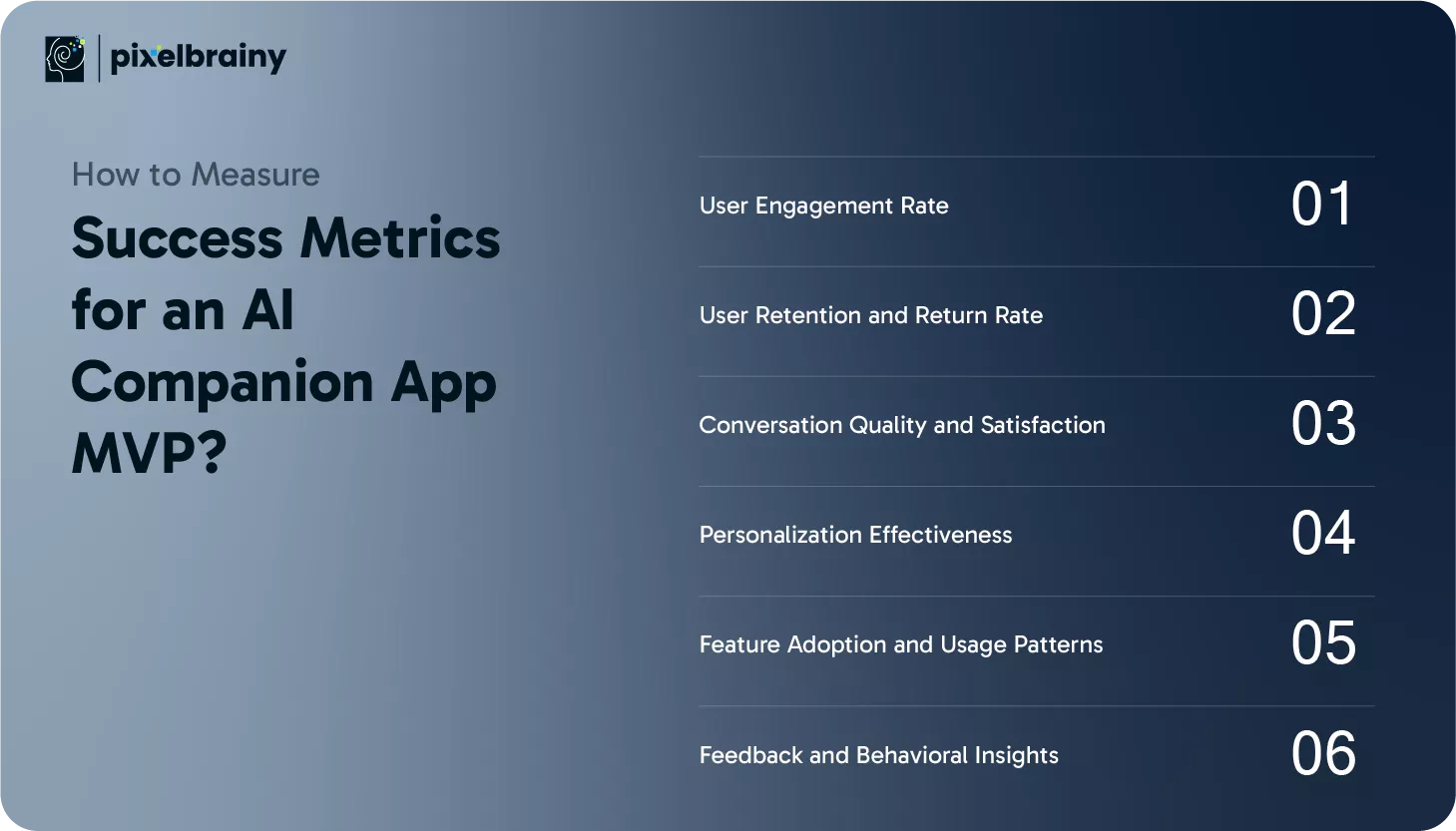
User engagement measures how actively users interact with the AI companion over time. It reflects whether users find the conversations meaningful and relevant. High engagement indicates that the AI companion is becoming part of the user’s routine.
Retention shows whether users continue using the AI companion after their first interaction. Since AI companions rely on ongoing relationships, retention is a strong indicator of long-term potential.
This metric evaluates how users perceive the quality of conversations. It helps assess whether responses are helpful, natural, and emotionally appropriate.
Personalization effectiveness measures how well the AI adapts to individual users. It indicates whether memory and preference handling improve user experience.
Feature adoption metrics show which parts of the MVP users actually use. This helps teams prioritize development efforts and remove unnecessary features.
Qualitative feedback complements quantitative data by revealing user motivations and pain points. This insight is essential during AI Companion App MVP Development.
By consistently tracking these success metrics, businesses can validate assumptions, refine the experience, and make informed decisions about scaling the AI Companion App MVP.
Choosing the right monetization strategy for an AI Companion App MVP depends on user behavior, usage frequency, and the problem the companion is solving. Different target audiences respond to different pricing models, which is why MVP-stage experimentation is essential.
Below is a revised presentation of monetization approaches, framed around who the strategy is for, how it works, and why it fits at MVP stage.
Who it targets: General consumers, wellness users, casual app users
How it works: Users access essential AI companion features for free, while advanced capabilities require payment.
Why it fits MVP stage: This model accelerates user adoption and allows businesses to observe real engagement patterns. It helps validate whether users find enough value in the AI companion to consider upgrading later.
Who it targets: Daily users, professionals, learners, mental wellness audiences
How it works: Users pay a recurring fee for uninterrupted access to enhanced AI interactions and personalization.
Why it fits MVP stage: Subscriptions test long-term value perception and retention, offering insights into whether the AI companion becomes part of users’ routines.
Who it targets: Light users, flexible spenders, exploratory users
How it works: Users are charged based on interaction volume, such as messages or session time.
Why it fits MVP stage: This model aligns cost with usage, making it easier to analyze demand patterns and optimize pricing without limiting access.
Who it targets: Users seeking customized experiences or niche functionality
How it works: Specific features such as premium personas or extended memory are available as one-time purchases.
Why it fits MVP stage: Feature-based monetization helps identify which capabilities users value most, guiding future development priorities.
Who it targets: Businesses, educational institutions, HR teams, customer service platforms
How it works: Organizations pay to deploy AI companions for internal or customer-facing use.
Why it fits MVP stage: Enterprise pilots validate scalability and revenue potential while opening higher-value growth channels early.
Who it targets: Brands, service providers, lifestyle-focused platforms
How it works: Revenue is generated through relevant brand collaborations integrated into AI conversations.
Why it fits MVP stage: Partnerships allow revenue testing without charging users directly, preserving engagement while exploring alternative income streams.
This audience-centric approach to monetization enables businesses to align revenue models with real usage patterns while maintaining trust during AI Companion App MVP Development.
Building an AI Companion App MVP is a complex process that blends technology, psychology, and user experience. Many founders make avoidable mistakes during early stages that increase cost, delay launch, or reduce user trust.
Understanding these pitfalls early helps ensure smoother AI Companion App MVP Development and stronger product validation.
The mistake: Founders often attempt to include advanced capabilities such as voice, deep memory, analytics, and multiple personas in the MVP. This leads to overcomplexity and delays.
How to avoid it: Focus on the core experience that proves value. Prioritize essential features that support meaningful conversations and user engagement, and leave enhancements for later stages.
The mistake: Some teams concentrate heavily on AI functionality while neglecting UI and UX design. This results in an app that works technically but feels confusing or impersonal.
How to avoid it: Collaborate with a UI/UX design company early in the process. Design conversation flows, onboarding, and interface elements that feel natural and human-centered.
The mistake: Founders sometimes view AI as an add-on rather than the core product experience. This leads to inconsistent behavior and unclear value.
How to avoid it: Design the AI companion as the central product. Every interaction, feature, and decision should support the companion’s role and purpose.
The mistake: Launching without testing with real users results in blind spots and poor assumptions about engagement.
How to avoid it: Release the MVP to a small group of early users. Collect feedback, observe interactions, and iterate continuously based on real usage data.
The mistake: Failing to implement safety filters and clear boundaries can lead to harmful interactions and loss of trust.
How to avoid it: Establish safety rules, content moderation, and transparency from the beginning. Clear boundaries protect both users and the business.
The mistake: Some MVPs are built without considering future growth, leading to performance issues as usage increases.
How to avoid it: Even during MVP creation, choose scalable architecture and cloud infrastructure that can grow with user demand.
By avoiding these common mistakes, founders can build an AI Companion App MVP that is focused, user-driven, and prepared for sustainable growth.
As an experienced PixelBrainy LLC, we understand that building an AI companion is not just a technical challenge but a product, design, and strategy challenge combined. Our approach to AI Companion App MVP Development Services is centered on helping founders and businesses move from idea to validation with speed, clarity, and confidence.
PixelBrainy works closely with startups, enterprises, and innovation teams to simplify the development of AI Companion App MVP without compromising quality. From defining the right use case to selecting the appropriate AI models and designing intuitive user experiences, our team ensures that every step aligns with real user needs. We focus on lean development practices that help businesses make AI Companion App MVP solutions that are scalable, secure, and market-ready.
Our services cover the entire MVP lifecycle, including product discovery, UI and UX design, AI model integration, backend development, testing, and launch support. By combining product thinking with deep AI expertise, we help clients reduce risk, control costs, and accelerate time to market.
One of our recent projects involved building an AI companion MVP for a wellness-focused startup targeting working professionals. The goal was to validate daily engagement and emotional support use cases within a limited budget and timeline. PixelBrainy LLC designed the AI persona, implemented core conversational features, added basic personalization, and launched a beta version within weeks. The MVP successfully attracted early users, generated actionable feedback, and helped the client secure further investment for scaling the product.
By partnering with PixelBrainy LLC, businesses gain a reliable AI development company that delivers strategic guidance, technical excellence, and end-to-end support throughout the AI companion MVP journey.
From this above guide, it is clear that building an AI companion is not about launching a complex product at once but about making informed, strategic decisions through validation. AI Companion App MVP Development allows businesses to test ideas, understand user behavior, and refine experiences before scaling.
By following the right process, choosing the correct technology stack, and focusing on real engagement, companies can reduce risk while accelerating innovation. The development of AI Companion App MVP also enables startups and enterprises to control costs, attract stakeholders, and build products users genuinely connect with. Whether your goal is to create a wellness companion, productivity assistant, or customer engagement tool, starting small helps you build smart.
If you are planning to make AI Companion App MVP and need expert guidance, our team is ready to help. Book an appointment today and take the first step toward building a successful AI companion product.
Startups, enterprises, wellness platforms, edtech companies, HR tech firms, and SaaS businesses exploring personalized user engagement should consider building an AI Companion App MVP. It is especially valuable for founders testing emotionally driven or conversational experiences.
The timeline usually ranges from 6 to 12 weeks, depending on feature scope, AI complexity, and design requirements. A focused MVP with core conversational functionality can be developed faster with the right team and tools.
No, large datasets are not mandatory during MVP development. Most MVPs rely on pre-trained AI models combined with prompt engineering and limited memory systems. Data collection and refinement happen gradually after user validation.
Yes, many successful MVPs start with text-based interactions only. Text-first companions are easier to test, less expensive to build, and still effective for validating user engagement before adding voice capabilities later.
User trust is built through transparency, consistent AI behavior, clear boundaries, and data privacy measures. Even at the MVP stage, setting expectations and ensuring safe interactions is essential for long-term success.
Once validated, businesses can scale the product by adding advanced personalization, integrations, voice interactions, and expanded use cases. MVP insights guide roadmap planning and reduce risk during full-scale development.

About The Author
Sagar Bhatnagar
Sagar Sahay Bhatnagar brings over a decade of IT industry experience to his role as Marketing Head at PixelBrainy. He's known for his knack in devising creative marketing strategies that boost brand visibility and market influence. Sagar's strategic thinking, coupled with his innovative vision and focus on results, sets him apart. His track record of successful campaigns proves his ability to utilize digital platforms effectively for impactful marketing efforts. With a genuine passion for both technology and marketing, Sagar continuously pushes PixelBrainy's marketing initiatives to greater success.


Transform your ideas into reality with us.
Working with the PixelBrainy team has been a highly positive experience. They understand the design requirements and create beautiful UX elements to meet the application needs. The dev team did an excellent job bringing my vision to life. We discussed usability and flow. Sagar worked with his team to design the database and begin coding. Working with Sagar was easy. He has the knowledge to create robust apps, including multi-language support, Google and Apple ID login options, Ad-enabled integrations, Stripe payment processing, and a Web Admin site for maintaining support data. I'm extremely satisfied with the services provided, the quality of the final product, and the professionalism of the entire process. I highly recommend them for Android and iOS Mobile Application Design and Development.

Great experience working with them. Had a lot of feedback and I found that unlike most contractors they were bugging me for updates instead of the other way around. They were extremely time conscience and great at communicating! All work was done extremely high quality and if not on time, early! They were always proactive when it comes to communication and the work is great/above par always. Very flexible and a great team to work with! Goes above and beyond to present us with multiple options and always provides quality. Amazing work per usual with Chitra. If you have UI/UX or branding design needs I recommend you go to them! Will likely work with them in the future as well, definitely recommended!

PixelBrainy is a joy to work with and is a great partner when thinking through branding, logo, and website layout. I appreciate that they spend time going into the "why" behind their decisions to help inform me and others about industry best practices and their expertise.

I hired them to design our software apps. Things I really like about them are excellent communication skills, they answer all project suggestions and collaborate right away, and their input on design and colors is amazing. This project was complex and needed patience and creativity. The team is amazing to do business with. I will be using them long-term. Glad to see there are some good people out there. I was afraid to try and outsource my project to someone but I am glad I met them! I really can't say enough. They went above and beyond on this project. I am very happy with everything they have done to make my business stand out from the competition.

It was great working with PixelBrainy and the team. They were very responsive and really owned the project. We'll definitely work with them again!

I recently worked with the PixelBrainy team on a project and I was blown away by their communication skills. They were prompt, clear, and articulate in all of our interactions. They listened and provided valuable feedback and suggestions to help make the project a success. They also kept me updated throughout the entire process, which made the experience stress-free and enjoyable.

PixelBrainy is very good at what it does. The team also presents themselves very professionally and takes care of their side of things very well. I could fully trust them taking up the design work in a timely and organised manner and their attention to detail saved us lots of effort and time. This particular project was quite intense and the team showed that they function very well under pressure. Very much looking forward to working with her again!

It's always an absolute pleasure working with them. They completed all of my requests quickly and followed every note I had for them to a T, which made our process go smoothly from start to finish. Everything was completed fast and following all of the guidelines. And I would recommend their services to anyone. If you need any design work done in the future, PixelBrainy should be your first call!

They took ownership of our requirements and designed and proposed multiple beautiful variants. The team is self-motivated, requires minimum supervision, committed to see-through designs with quality and delivering them on time. We would definitely love to work with PixelBrainy again when we have any requirements.

PixelBrainy was a big help with our SaaS application. We've been hard at work with a new UI/UX and they provided a lot of help with the designs. If you're looking for assistance with your website, software, or mobile application designs, PixelBrainy and the team is a great recommendation.

PixelBrainy designers are amazing. They are responsive, talented, and always willing to help craft the design until it matches your vision. I would recommend them and plan to continue them for my future projects and more!!!

They were awesome! Did a good job fast, and good communication. Will work with them again. Thank you

Creative, detail-oriented, and talented designers who take direction well and implement changes quickly and accurately. They consistently over-delivered for us.

PixelBrainy team is very talented and creative. Great designers and a pleasure to work with. PixelBrainy is an excellent communicator and I look forward to working with them again.

PixelBrainy has a very talented design team. Their work is excellent and they are very responsive. I enjoy working with them and hope to continue on all of our future projects.


