AI Summary Powered by PixelBrainy
Imagine having a digital partner that understands your goals, anticipates your needs, and assists you in completing complex tasks with remarkable efficiency. That’s exactly what an AI companion app like GitHub Copilot achieves. These intelligent assistants are reshaping how people work by offering real-time suggestions, streamlining workflows, and boosting productivity across development, writing, and business operations.
An AI companion app like Copilot goes beyond basic automation. It learns from user behavior, adapts to preferences, and becomes smarter over time. This level of personalization and contextual intelligence makes such applications indispensable tools for professionals, teams, and enterprises seeking smarter digital collaboration.
For companies and innovators, investing in AI companion app development like Copilot opens the door to immense opportunities. From empowering developers with predictive code suggestions to helping writers generate creative content or assisting customer service teams with faster responses, the possibilities are endless.
In this comprehensive guide, you’ll learn everything you need to know to build an AI companion app like Copilot — including its core features, how it works, the step-by-step development process, and the overall cost involved. You’ll also discover the tools and technologies that make these applications possible and gain insights into how to bring your own intelligent assistant to life.
If you’ve been curious about how to make an AI companion app like Copilot, this article will serve as your roadmap to designing, developing, and launching an AI-driven product that truly transforms user experience.

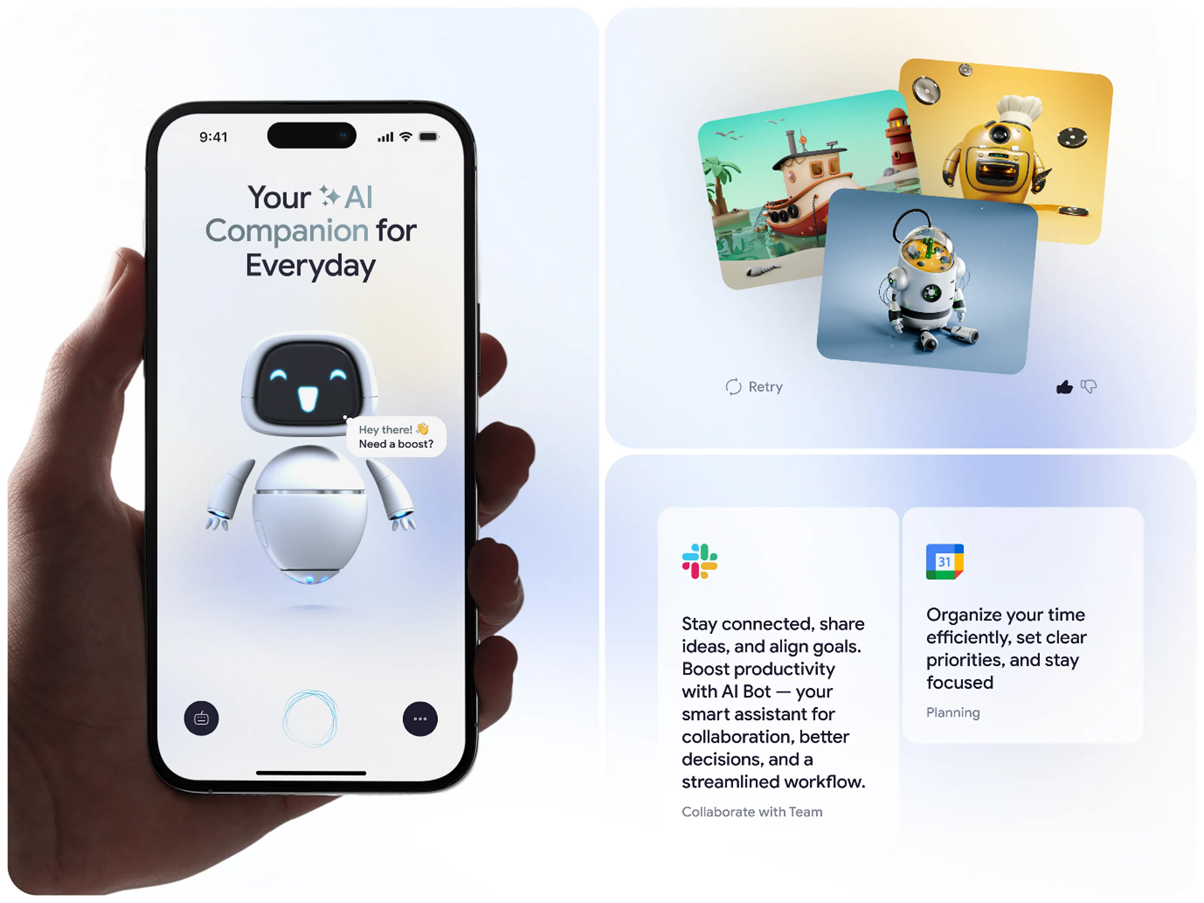
An AI companion app like Copilot is a smart digital assistant that helps users complete tasks more efficiently by understanding their goals and providing intelligent suggestions. Instead of following fixed commands or simple scripts, these apps use artificial intelligence and large language models to understand natural language, interpret intent, and deliver useful, real-time responses.
GitHub Copilot is one of the most popular examples. It assists developers by suggesting lines of code, identifying patterns, and even generating full functions based on what the user is typing. It learns from massive amounts of code data and user behavior to offer relevant and context-aware suggestions.
However, AI companion apps are not limited to coding. Businesses are creating similar tools for writing, marketing, design, education, healthcare, and customer service. These assistants can draft content, answer questions, automate tasks, or support creative work, all while adapting to each user’s unique style and preferences.
What makes an AI companion app like Copilot stand out is its ability to learn and improve continuously. The more a person interacts with it, the better it understands how to assist effectively. Over time, it becomes more intuitive, personalized, and capable of handling complex requests.
Whether it’s helping developers build cleaner code, writers craft better content, or teams collaborate more efficiently, an AI companion app bridges the gap between human creativity and machine intelligence, creating a smoother and more productive workflow.
An AI companion app like Copilot functions as a smart assistant that learns from data, understands natural language, and provides useful suggestions in real time. It blends multiple technologies—artificial intelligence, machine learning, and natural language processing—to create seamless human-like interactions.
When a user types or speaks to the app, it first processes that input to understand intent and context. The AI model, trained on large datasets, analyzes the structure of the language or code to determine what the user is trying to accomplish.
Once the input is processed, the AI generates a relevant response or action. For example, in a coding environment, it can suggest the next line of code, detect possible bugs, or explain a function. In a writing or customer support tool, it might recommend phrasing, summarize content, or answer questions accurately.
Every interaction improves the app’s performance. Through continuous learning, the AI refines its understanding of each user’s preferences, tone, and workflow. This ongoing feedback loop makes future recommendations more precise and personalized.
Finally, the app delivers responses instantly through an easy-to-use interface—whether it’s a chat window, IDE plugin, or mobile app. This real-time assistance saves time, reduces effort, and enhances overall productivity.
An AI companion app like Copilot ultimately acts as a supportive partner that evolves with its user, offering smarter help with every interaction.
Building an AI companion app like Copilot can completely transform the way businesses operate, innovate, and deliver value to customers. These intelligent applications are no longer just productivity boosters—they are becoming strategic assets that help organizations automate complex tasks, personalize user experiences, and make smarter decisions at scale.
Below are six detailed benefits that show why developing an AI companion app like Copilot can be a game-changer for any business, whether it’s in technology, finance, healthcare, education, or enterprise software.
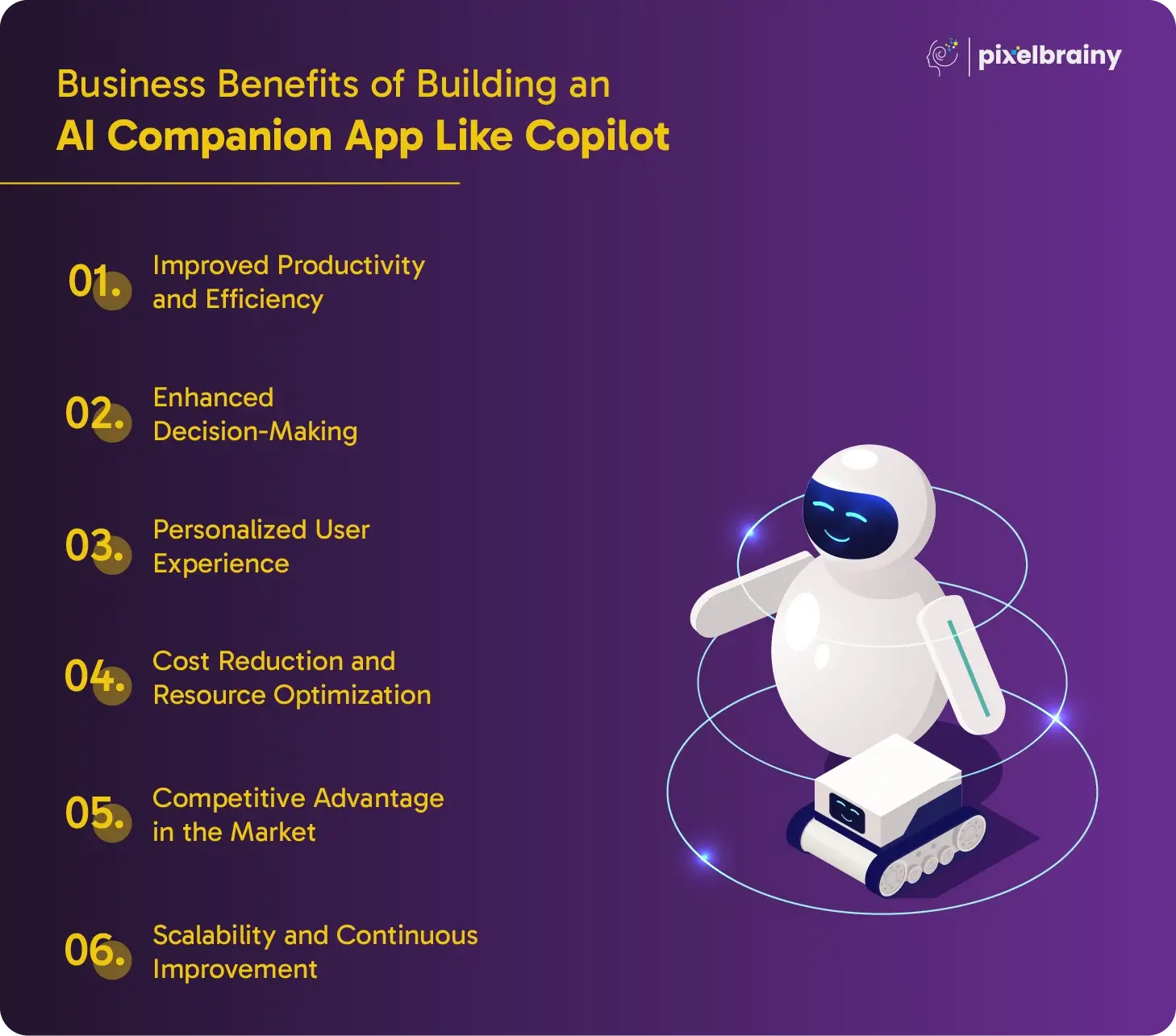
A major advantage of building an AI companion app like Copilot is the dramatic boost in productivity it brings to teams and individuals. These applications automate repetitive and time-consuming tasks that would otherwise take hours, allowing professionals to focus on high-priority objectives.
For example, GitHub Copilot helps developers generate clean, efficient code suggestions instantly, reducing time spent debugging and searching for syntax errors. Similarly, in other industries, AI assistants can draft reports, create marketing content, or manage scheduling with minimal human intervention. This level of automation enables employees to accomplish more in less time, reducing burnout and improving overall workflow efficiency.
Moreover, AI companion apps can operate around the clock, ensuring tasks are completed even outside of standard working hours. This 24/7 availability enhances responsiveness and ensures consistent progress, making the app a dependable digital partner for any business environment.
Every successful organization relies on accurate and timely decisions. An AI companion app like Copilot can analyze massive amounts of data in seconds and present actionable insights that guide better business and operational decisions.
Whether it’s evaluating project performance, optimizing code quality, or predicting customer preferences, AI-powered apps can provide instant recommendations based on data patterns that humans might miss. For instance, in a product development environment, such an app can identify potential design flaws early or suggest improvements drawn from historical performance metrics.
This ability to process information at scale and present relevant insights gives businesses a competitive advantage. Instead of relying on intuition alone, decision-makers can base strategies on real data, improving precision, reducing risk, and ensuring more confident and informed actions.
Modern users expect tailored interactions, and personalization has become one of the key success factors in digital experiences. When you develop an AI companion app like Copilot, personalization becomes an inherent feature. The app learns from every user interaction, gradually understanding individual goals, preferences, and behaviors.
Over time, it can predict user needs and provide proactive suggestions. For example, if a writer uses the app for creative content, it will adapt to their tone and vocabulary style. If a developer uses it for coding, it will learn the frameworks and syntax patterns they prefer. This adaptive learning ensures that every interaction feels customized and intuitive.
A highly personalized experience increases user satisfaction, retention, and loyalty. Businesses benefit as users develop trust in the app’s ability to understand and support them, creating a strong emotional connection between technology and its users.
One of the most practical benefits of AI companion app development like Copilot is its ability to lower operational costs. By automating repetitive processes and minimizing manual work, businesses can save both time and money.
For example, tasks such as technical documentation, customer query handling, and content generation can be handled by the AI companion without requiring full-time staff for every function. This leads to significant reductions in labor costs and administrative overhead.
Additionally, AI systems optimize how human resources are utilized. Instead of focusing on mundane work, employees can dedicate their time to innovation, strategy, and creative problem-solving. Over the long term, this not only reduces expenses but also boosts employee satisfaction and productivity. The financial savings gained from automation can be reinvested in research, product improvement, or marketing, fueling continuous business growth.
The demand for smart, interactive applications is rapidly growing, and businesses that build an AI companion app like Copilot are positioning themselves as technology leaders. Offering intelligent digital assistants sets companies apart from competitors who rely solely on traditional software solutions.
AI companion apps can become a brand differentiator, showcasing innovation and forward-thinking capability. Customers increasingly prefer platforms that anticipate their needs and offer contextual support rather than simple interfaces. This expectation creates a strong incentive for businesses to adopt AI-driven features early.
Moreover, such apps enhance brand reputation. When users experience seamless automation, intelligent recommendations, and real-time assistance, they associate the brand with innovation and reliability. This long-term perception helps organizations attract more users, investors, and partners, further strengthening their market position.
Unlike static software tools, AI companion apps are built to evolve. Once launched, they continue learning from user interactions and improve their accuracy, speed, and contextual understanding over time. This self-learning capability makes the system scalable and adaptable to new demands.
As a company’s user base grows, the AI model can be retrained with larger datasets, enabling it to handle more complex interactions or new domains. For example, a coding assistant can expand its support from one programming language to several others, or a content assistant can learn new writing styles and formats.
This scalability ensures that the application remains relevant and competitive. Businesses can introduce new features, improve response quality, and expand to new markets without needing a complete redesign. With continuous improvement built into its architecture, an AI companion app like Copilot becomes a sustainable long-term investment rather than a one-time innovation.
By investing in AI companion app development like Copilot, businesses unlock smarter operations, stronger customer engagement, and a sustainable path toward innovation-driven growth.
AI companion apps like Copilot are transforming how people work, learn, and create. Their versatility allows them to be applied across different industries, helping professionals automate tasks, generate ideas, and improve performance. Whether it’s software development, education, healthcare, or customer engagement, these intelligent assistants are reshaping digital experiences and driving innovation in every field.
Below are some of the most impactful and practical use cases of AI companion app development like Copilot that highlight how businesses can leverage this technology to boost efficiency and deliver smarter solutions.
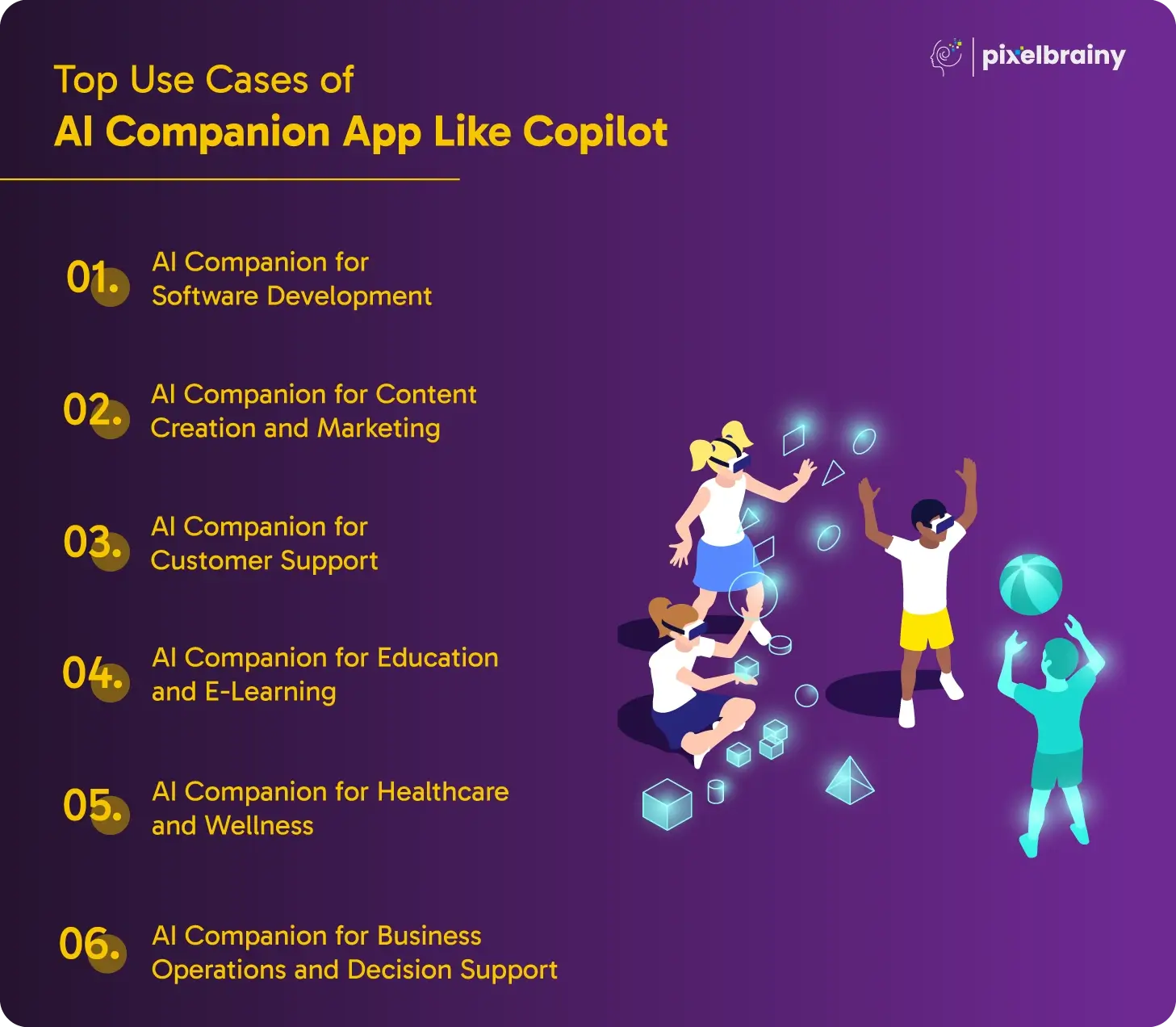
One of the most recognized applications of AI companions is in software development. GitHub Copilot is the best-known example, offering developers intelligent code suggestions, syntax corrections, and real-time assistance as they write. An AI-powered development assistant can analyze the code context, predict the next line, and even explain logic in simpler terms.
For businesses, integrating such an app means faster project delivery, fewer coding errors, and more productive teams. Junior developers benefit from guided learning, while experienced programmers save hours of manual effort. It can also be integrated with IDEs like Visual Studio Code or JetBrains, providing seamless workflow support.
In the long term, AI development companions can help companies maintain consistent code quality, enhance collaboration, and reduce technical debt by detecting potential bugs or inefficiencies early in the process.
In the world of content creation and marketing, AI companions act as creative partners. These apps help writers, marketers, and social media managers generate ideas, craft engaging copy, optimize SEO, and maintain brand consistency.
An AI companion app like Copilot can analyze tone, writing patterns, and brand guidelines to create personalized and coherent content across multiple channels. It can produce blog drafts, ad copies, social media posts, or even email campaigns in minutes, reducing the time needed for brainstorming and editing.
For marketing teams, this means faster content delivery and the ability to experiment with more strategies simultaneously. It also ensures consistency in messaging and enhances creativity by offering alternative phrasing, visuals, or taglines.
Customer support is one of the most time-consuming yet essential areas for businesses. An AI companion app can transform this function by acting as a 24/7 virtual assistant that resolves queries, provides instant information, and escalates complex issues to human agents when necessary.
Unlike traditional chatbots, which rely on predefined responses, AI companions understand natural language, learn from previous conversations, and adapt over time. This means customers receive personalized, context-aware assistance instead of generic replies.
Such systems can handle thousands of queries simultaneously, reducing the workload on customer service teams and improving response times. They also collect valuable insights about customer needs and pain points, helping businesses refine their services and improve satisfaction levels.
Also Read: AI Chatbot Adoption Statistics: The Stats Every Business Needs to Know
In education, AI companion apps like Copilot serve as personalized learning assistants that guide students through lessons, explain difficult concepts, and provide instant feedback. These apps can adapt to each learner’s pace, offering customized study plans and practice exercises.
Teachers and educational institutions can use them to automate grading, track progress, and deliver interactive learning experiences. For example, an AI tutor can generate quiz questions based on a student’s weaknesses or provide explanations using examples that match their learning style.
This level of personalization makes education more engaging and effective. It ensures that learners receive constant support and motivation, while educators can focus more on creative teaching and mentorship.
Healthcare professionals and patients both benefit from AI companions designed for health management. These apps can monitor vital signs, remind users about medication schedules, and even analyze symptoms to provide early health insights.
For doctors, an AI companion app can summarize patient records, suggest diagnoses based on symptoms, or assist in creating treatment plans. For patients, it acts as a 24/7 health assistant that encourages healthy habits, tracks progress, and provides emotional support through conversational interaction.
Incorporating AI into healthcare not only enhances efficiency but also improves patient engagement and accessibility to medical advice. It bridges gaps between patients and professionals while ensuring better monitoring and preventive care.
Also Read: How to Develop an AI Health Companion App: Benefits, Features and Cost
Businesses can use AI companion app development like Copilot to streamline operations, manage data, and support decision-making. These applications can analyze business metrics, predict trends, and generate actionable insights for managers and teams.
For example, an AI companion could help a sales manager forecast demand, recommend pricing adjustments, or identify potential leads based on data trends. In HR, it can assist with recruitment by screening resumes and matching candidates more efficiently.
This kind of intelligent automation saves time, improves accuracy, and empowers leaders with real-time insights. By integrating AI companions into their workflows, organizations can make faster, data-backed decisions and respond to market changes with greater agility.
AI companion apps are proving valuable across every industry. From writing code to supporting customers and managing operations, they deliver intelligent automation and real-time collaboration that redefine digital productivity. Businesses that build AI companion apps like Copilot can unlock new efficiencies, innovate faster, and create meaningful user experiences that drive long-term success.
An AI companion app like Copilot needs to be powerful, intuitive, and adaptable. To achieve that, it must include a combination of technical, functional, and user-centered features that ensure smooth interaction, real-time intelligence, and personalized support. These features work together to create a seamless experience that feels natural, responsive, and helpful across different use cases.
Below is a detailed list of 15 must-have features for AI companion app development like Copilot, along with explanations for how each contributes to performance, usability, and user satisfaction.
| Feature | Description |
| Natural Language Processing (NLP) | Enables the AI to understand human language, interpret meaning, and respond naturally. It helps users communicate in conversational terms rather than relying on structured commands. |
| Contextual Understanding | Allows the app to recognize user intent based on context, previous interactions, and surrounding data. This ensures responses are relevant and coherent across sessions. |
| Machine Learning and Adaptability | The system learns from every user interaction, improving accuracy and personalization over time. This adaptability makes the AI companion smarter with continued use. |
| Real-Time Response Generation | Delivers instant suggestions, answers, or actions without delays. A fast and fluid response system enhances the natural conversational experience. |
| Code and Text Auto-Completion | Ideal for developers and content creators, this feature predicts and completes sentences or code snippets, saving time and reducing repetitive effort. |
| Personalization and Memory | Retains user preferences, tone, and previous actions to create a customized experience that feels familiar and intuitive. |
| Voice Interaction Capability | Supports hands-free communication through speech recognition, making interactions faster and more accessible for all types of users. |
| Integration with Third-Party Tools | Connects seamlessly with IDEs, CRMs, project management software, or communication platforms to expand functionality and simplify workflows. |
| Data Security and Privacy Management | Protects sensitive user data through encryption, secure storage, and compliance with global data protection regulations. |
| Multi-Platform Support | Ensures consistent performance and accessibility across web, desktop, and mobile platforms, allowing users to interact from any device. |
| Feedback and Reinforcement Learning | Encourages users to rate or correct AI suggestions, allowing the system to learn and refine future responses automatically. |
| Analytics Dashboard | Provides insights into app usage, performance metrics, and behavior trends, helping both developers and users make data-driven improvements. |
| Customizable Interface and Themes | Lets users personalize their interface design, color themes, and layout, enhancing comfort and engagement during long sessions. |
| Offline and Cloud Synchronization | Allows users to work offline with automatic data syncing once connected, maintaining productivity in all situations. |
| Multi-Language Support | Expands the app’s accessibility by offering interactions in different languages, making it inclusive for global audiences. |
A feature-rich AI companion app like Copilot blends intelligence, flexibility, and personalization to deliver a truly engaging and human-like digital experience that adapts to every user’s needs.
Creating an AI companion app like Copilot requires a strategic approach that balances innovation, user experience, and technology. Whether you are building a Minimum Viable Product (MVP) or planning a full-fledged application, every step in the process must align with your business goals and user expectations.
This section explains what is the process to build AI Companion App Like Copilot, covering each stage in detail while focusing on its purpose and why it matters for successful execution.
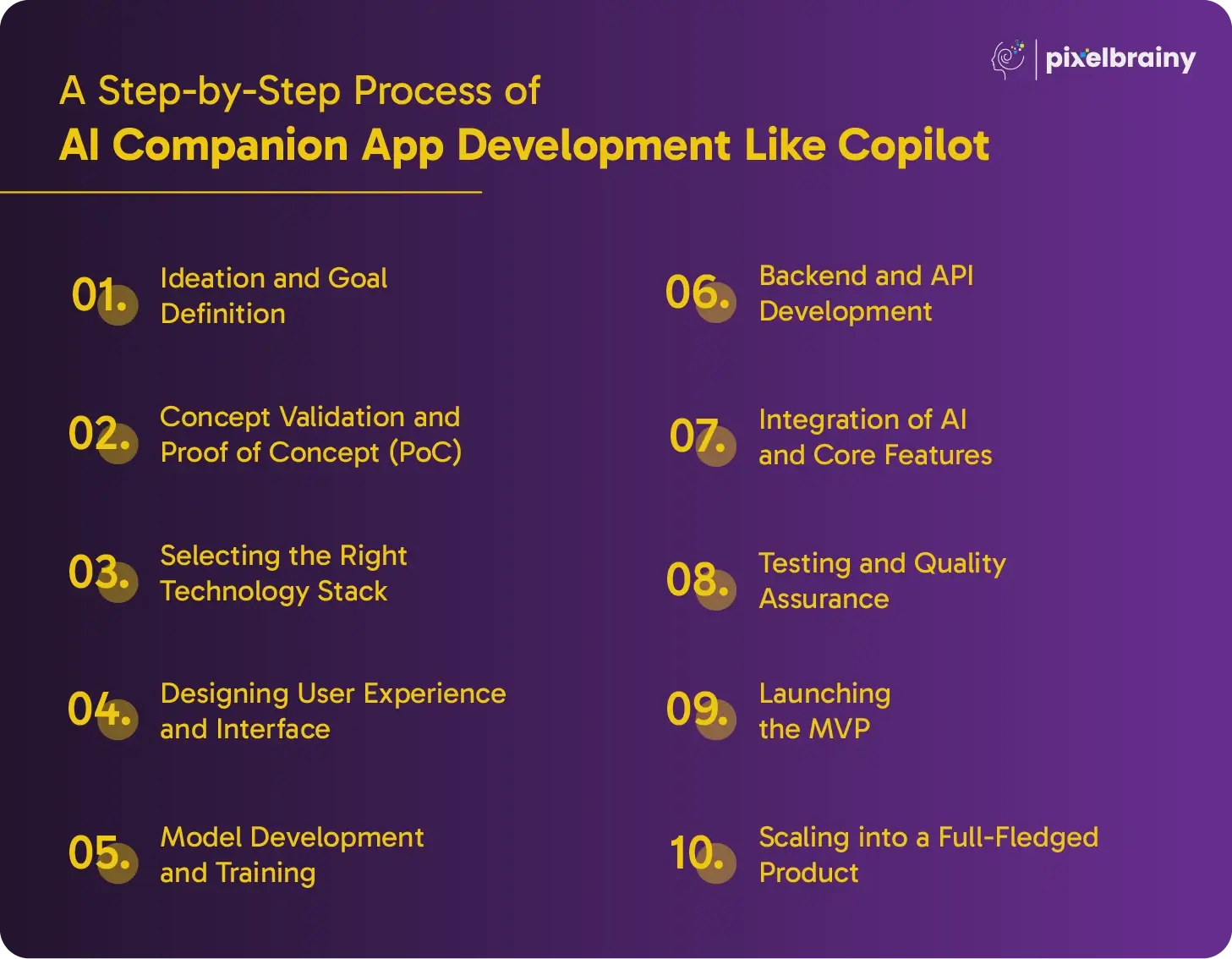
Aim: To establish a clear understanding of the app’s purpose, audience, and objectives.
The process begins by defining what your AI companion app will solve and who it will serve. Businesses should conduct market research to identify pain points and potential users. For example, you might decide whether the AI will focus on coding assistance, content generation, healthcare, or customer support. During this phase, it’s also essential to outline measurable goals such as reducing manual workload or improving user engagement.
Why this matters: A clear vision prevents scope confusion and ensures that every design and development decision supports real user needs and market demand.
Aim: To test the feasibility of your idea before full-scale development.
Before committing major resources, teams should build a small Proof of Concept (PoC) that tests the AI model’s capability to handle specific tasks. This stage may include limited data sets, model testing, or prototype interactions. A successful PoC confirms that your chosen AI approach can deliver practical and accurate results in real-world conditions.
Why this matters: Early validation minimizes risk, prevents financial losses, and gives confidence to investors or stakeholders about the app’s potential.
Aim: To choose reliable tools and frameworks for AI model integration and app functionality.
At this stage, the focus is on selecting the right combination of technologies for AI Companion App Development Like Copilot. This may include choosing language models like GPT-4, Llama, or Claude, vector databases like Pinecone, and frameworks such as LangChain for contextual understanding. The backend may use Python or Node.js, while the frontend could rely on React, Flutter, or Swift for cross-platform usability.
Why this matters: The correct technology stack ensures scalability, high performance, and easier maintenance while supporting seamless integration with external systems.
Aim: To create a user-friendly interface that enhances engagement and clarity.
A professional UI/UX design company plays a vital role in designing intuitive layouts, smooth navigation, and clean visuals that align with user goals. The design should focus on simplicity, clarity, and real-time interaction flow. Wireframes and prototypes are built to visualize how the AI will interact with users, ensuring the app feels natural and human-like.
Why this matters: Good design bridges the gap between advanced AI functionality and human usability, ensuring that users can easily understand and trust the system.
Aim: To build, train, and fine-tune the AI model that powers the app.
This step involves developing AI Companion App Like Copilot by training it on domain-specific data. The AI model learns from examples, feedback, and interaction patterns to generate relevant responses. Teams must fine-tune the model to handle different inputs accurately while avoiding bias or errors.
Why this matters: The intelligence of the AI companion depends on this stage. Well-trained models ensure precision, personalization, and reliability—core elements that define user satisfaction.
Aim: To build the infrastructure that connects the user interface to the AI model.
Developers create APIs and backend systems that handle data flow between users, the AI model, and third-party tools. This includes secure authentication, data storage, and request processing. The app must also allow integration with external services such as CRMs, IDEs, or productivity tools for Companion App Development Like Copilot Integrating AI across platforms.
Why this matters: A robust backend ensures smooth performance, scalability, and the ability to integrate new features easily as the app evolves.
Aim: To combine the AI model with real-time app functionality.
Once the backend and front-end are ready, the AI model is integrated into the system. This is where the app starts behaving like an intelligent assistant—understanding context, suggesting actions, and delivering meaningful results. Features like natural language processing, auto-completion, and voice interaction are activated and tested for responsiveness.
Why this matters: This stage transforms the app from a static platform into a living assistant capable of human-like interaction, making it the centerpiece of user engagement.
Aim: To ensure performance, accuracy, and reliability before public release.
Comprehensive testing covers functionality, user experience, security, and data handling. AI-specific testing includes evaluating model accuracy, response time, and adaptability to new inputs. The development team must simulate real-world scenarios to identify bugs or inconsistencies.
Why this matters: Rigorous testing ensures that the final product is stable, error-free, and ready for public use, building trust among users and stakeholders.
Aim: To release a minimal version of the app for initial feedback and market validation.
The MVP includes only essential features that demonstrate the app’s value. Launching early allows the team to gather user insights, understand performance in real-world environments, and prioritize improvements. The goal is to validate usability and AI efficiency before scaling.
Why this matters: Launching an MVP helps reduce time-to-market and guides the team in refining the product based on actual user experiences instead of assumptions.
Aim: To expand the app into a complete, feature-rich product with advanced capabilities.
After analyzing MVP feedback, the team works on additional functionalities, improved personalization, and stronger AI performance. Integration with more tools, languages, and industries makes the app more versatile. The product transitions from a minimal solution into a fully operational companion that can serve multiple use cases efficiently.
Why this matters: Scaling transforms the app into a long-term asset that delivers value to a broader audience and positions it competitively among the top AI development companies in USA and globally.
Each stage in the development of AI Companion App Like Copilot plays a critical role in shaping an intelligent, scalable, and reliable digital assistant. Following this structured roadmap ensures that your project evolves smoothly from concept to completion, delivering measurable business impact and exceptional user experiences.
The cost to create an AI companion app like Copilot can range between $10,000 to $100,000 or more, depending on the app’s complexity, features, AI model integration, and level of customization. Developing such an advanced product involves several cost factors, including UI/UX design, model training, backend development, cloud infrastructure, and ongoing maintenance.
To understand this investment better, let’s explore each cost element in detail and what influences the overall budget of AI companion app development like Copilot.
The scope of the project has the biggest influence on cost. A basic prototype or MVP version may cost between $10,000 and $25,000, covering core functionalities like text-based interaction, NLP integration, and a simple dashboard. However, if you plan to build a full-fledged AI companion app with contextual understanding, voice recognition, memory retention, and integration with multiple third-party tools, the cost can easily rise above $80,000 to $100,000.
More complex apps require deeper model fine-tuning, larger data sets, and advanced personalization—all of which add to development time and expenses.
The choice of AI model directly affects the AI companion app development cost. Using APIs like OpenAI GPT-4 or Anthropic Claude typically incurs pay-per-use fees that vary based on usage volume. Fine-tuning custom models or training your own large language model (LLM) can cost anywhere between $5,000 and $30,000, depending on the computational power, dataset size, and engineering expertise required.
If the app uses open-source models such as Llama or Mistral, development teams save on licensing fees but spend more on infrastructure and optimization. The balance between accuracy, scalability, and cost-efficiency depends on the chosen AI approach.
Design plays a crucial role in user engagement and retention. Hiring a professional UI/UX design company can cost between $3,000 and $15,000, depending on the complexity of the app interface, number of screens, and required animations or interactive elements.
For example, a simple interface with chatbot-style interaction will cost less compared to a fully customized platform with dashboards, visual editors, and adaptive layouts. Investing in quality design is vital because it ensures that users find the app intuitive and easy to use, which leads to higher satisfaction and retention rates.
The backend development cost for AI companion apps ranges between $5,000 and $25,000, depending on the architecture, database systems, and integration complexity. The backend serves as the foundation that connects the AI model with user interfaces, manages requests, stores data, and ensures secure communication.
Additionally, integrating APIs such as IDE plugins, third-party CRMs, or analytics tools increases functionality but also adds to the total budget. Scalable cloud infrastructure and strong encryption measures can further influence backend costs.
AI companion apps require robust servers for real-time processing and data storage. Hosting and infrastructure costs vary based on usage volume, performance requirements, and cloud providers. On average, small-scale deployment may cost $500 to $2,000 per month, while enterprise-level hosting with high traffic and redundancy can reach $10,000 per month or more.
Cloud providers such as AWS, Google Cloud, or Microsoft Azure charge for computing power, storage, and bandwidth. Using GPU-powered instances for model training also adds to overall infrastructure expenses.
Quality assurance ensures that the app performs flawlessly before launch. Testing costs for developing an AI companion app like Copilot typically range between $2,000 and $10,000, depending on the number of platforms and features being tested.
AI-specific testing focuses on evaluating response accuracy, data security, and adaptability. Continuous testing also involves verifying that the app responds well to different user inputs, accents, or data types. Although it adds to the upfront cost, it helps prevent expensive post-launch issues.
After launching the app, businesses must allocate a maintenance budget of 10% to 20% of the total development cost annually. This covers system updates, performance optimization, bug fixes, and model retraining.
If your AI companion app handles sensitive user data, additional costs may arise from compliance management and data privacy audits. Continuous updates ensure that the app stays relevant with new technologies and evolving AI frameworks.
The cost of developing an AI companion app like Copilot also depends on the team’s experience and location. Hiring a small local team or freelancers may cost less initially, but working with top AI development companies in USA ensures higher-quality results, better security practices, and scalable architecture.
Typical AI development teams include project managers, AI engineers, backend developers, UI/UX designers, and QA testers. Hourly rates for such professionals vary from $50 to $150 per hour, depending on expertise and region. Choosing the right team directly impacts both quality and development speed.
For apps that handle user information or operate across regulated industries, compliance costs are critical. Licensing and security measures may add $2,000 to $10,000 to the overall AI companion app development cost. This includes implementing GDPR compliance, SOC 2 standards, and robust encryption systems to ensure user privacy.
These expenses are essential for building trust and credibility, especially when dealing with sensitive data or enterprise clients.
Even after development is complete, promoting the app and maintaining visibility requires investment. Marketing campaigns, app store optimization, and performance tracking tools may cost an additional $3,000 to $15,000. Ongoing user support, documentation, and customer engagement also contribute to recurring costs.
Promoting the app effectively ensures wider reach, better adoption rates, and faster ROI. Businesses should include these costs in their overall development strategy.
The total cost to develop an AI companion app like Copilot depends on how advanced you want the solution to be. By partnering with an experienced AI development company, you can balance cost, quality, and innovation to create a powerful, intelligent companion that drives real business value.
Also Read: AI App Development Cost: From MVPs to Full-Scale AI App
Choosing the right set of tools and technologies is essential for building a scalable and high-performing AI companion app like Copilot. The right stack ensures smooth AI integration, fast response times, and a seamless user experience. It also helps reduce development effort and maintenance costs while improving flexibility and performance across multiple platforms.
Below is a detailed table listing the recommended AI tools and tech stack for the development of an AI companion app like Copilot, including each component’s purpose and how it supports the overall development process.
| Category | Recommended Tools & Technologies | Explanation |
| Programming Languages | Python, JavaScript (Node.js), TypeScript | Python is widely used for AI model training and data processing, while JavaScript or TypeScript helps in building scalable and responsive web applications |
| Frontend Frameworks | React.js, Next.js, Flutter, Swift | React and Next.js support modern, dynamic interfaces for web apps, while Flutter and Swift are ideal for mobile platforms to ensure consistent performance and design |
| Backend Frameworks | FastAPI, Django, Express.js | These frameworks provide a solid foundation for API development and backend logic, ensuring fast communication between the AI engine and user interface |
| AI/ML Frameworks | TensorFlow, PyTorch, Keras | These frameworks are essential for model training, testing, and deployment, enabling developers to customize and fine-tune AI models effectively |
| Pre-trained Language Models | OpenAI GPT-4, Anthropic Claude, Mistral, LLaMA | These large language models power intelligent text understanding and generation, allowing natural and context-aware interactions similar to Copilot |
| Data Management & Vector Databases | Pinecone, Weaviate, Milvus, PostgreSQL | Vector databases store and retrieve context embeddings efficiently, while PostgreSQL helps manage structured user and interaction data |
| Natural Language Processing APIs | OpenAI API, Cohere API, Hugging Face Transformers | These APIs enable natural language understanding, context retention, and accurate generation of human-like responses |
| Cloud Infrastructure | AWS, Google Cloud, Microsoft Azure | These cloud platforms offer scalable infrastructure, GPU processing, and storage capabilities for AI workloads, ensuring reliability and performance |
| Authentication & Security Tools | OAuth 2.0, JWT, Firebase Authentication | Secure login systems and encryption protocols protect user data and ensure safe communication between devices and servers |
| Version Control & Collaboration | GitHub, GitLab, Bitbucket | These tools help teams collaborate efficiently, track changes, and maintain code consistency during development |
| Continuous Integration & Deployment (CI/CD) | Jenkins, GitHub Actions, Docker, Kubernetes | These platforms streamline deployment, testing, and scaling processes, reducing downtime and ensuring continuous improvement |
| Monitoring & Analytics Tools | Google Analytics, Mixpanel, Prometheus, Grafana | These tools track app performance, monitor errors, and provide valuable insights into user behavior for data-driven improvements |
| UI/UX Design Tools | Figma, Adobe XD, Sketch | Used by designers to create interactive prototypes and design systems that enhance usability and maintain brand consistency |
| Communication APIs | Twilio, Socket.io, WebRTC | Enable real-time chat, voice, or video communication within the app, improving interactivity and collaboration capabilities |
| Testing & QA Tools | Postman, Selenium, PyTest, JMeter | These ensure quality and reliability through automated testing, performance analysis, and API validation during the development process |
The right combination of tools and frameworks not only accelerates development but also guarantees scalability, performance, and long-term maintainability. By choosing a modern and efficient AI tech stack, developers can ensure the app delivers smooth, intelligent, and reliable experiences across all devices.
Developing an AI companion app like Copilot involves far more than coding and design—it requires solving complex technical, ethical, and operational challenges. From managing large data sets to maintaining user trust, each stage of development brings unique considerations that must be handled strategically. Businesses and developers should be aware of these obstacles to ensure the app performs efficiently, scales smoothly, and provides an ethical, user-friendly experience.
Below are the major challenges and key considerations involved in AI companion app development like Copilot, along with insights into how to address them effectively.
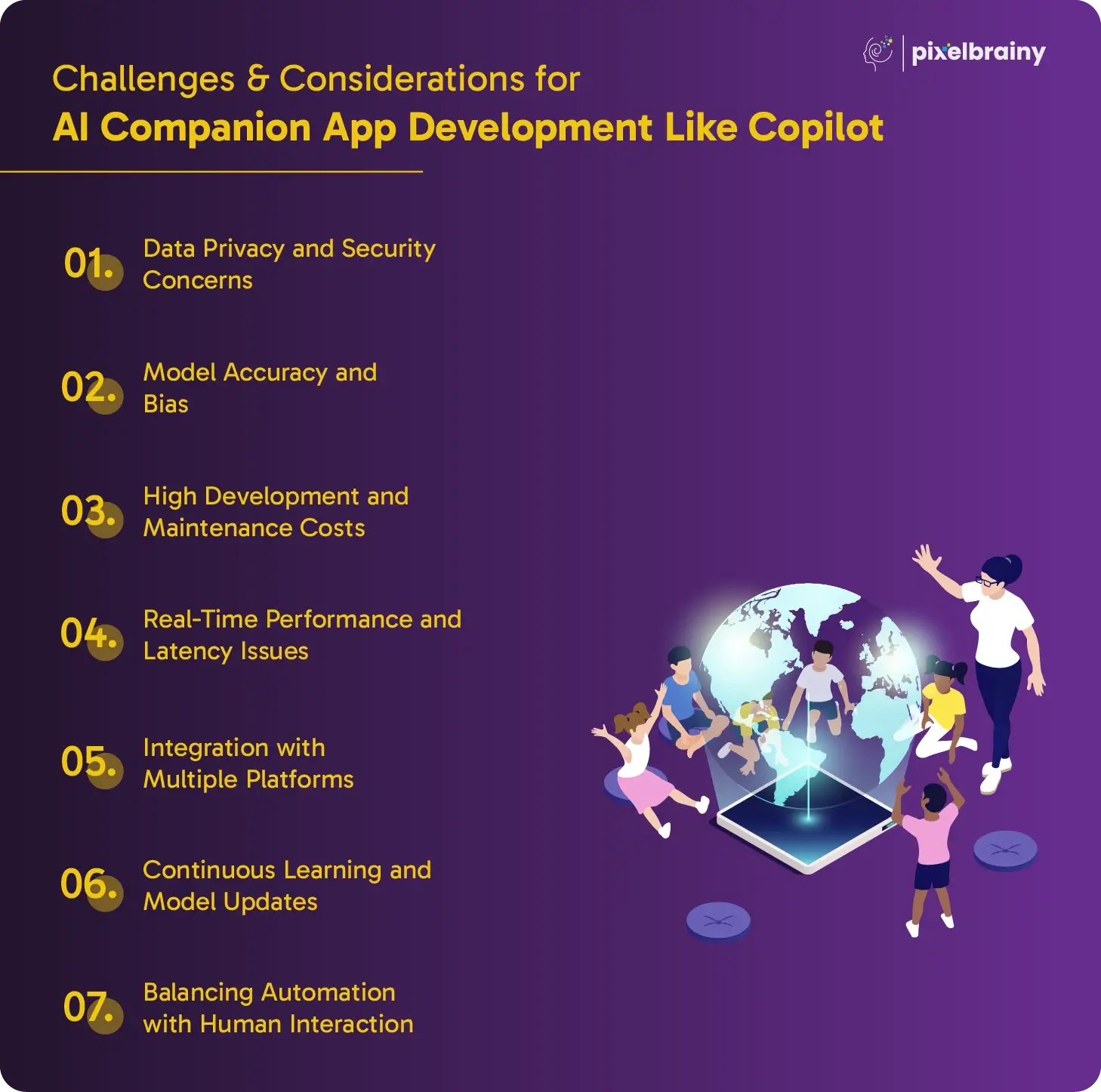
One of the biggest challenges in developing AI companion apps like Copilot is ensuring user data privacy. Since these apps process sensitive information such as messages, code snippets, or personal data, they must comply with regulations like GDPR, HIPAA, or CCPA.
Developers should use end-to-end encryption, anonymize user data, and store information securely on the cloud. Regular security audits and authentication protocols (like OAuth or JWT) are essential to prevent unauthorized access. Safeguarding privacy builds long-term trust between users and the application.
AI models depend on training data, and if that data contains bias, the app might generate inaccurate or biased responses. In Companion App Development Like Copilot Integrating AI, developers must train models using diverse, high-quality datasets to ensure fairness and precision.
Regular model evaluation, human-in-the-loop systems, and feedback-based learning can help reduce these issues. A balanced approach ensures the AI provides consistent, unbiased assistance across different user groups and industries.
The cost to make an AI companion app like Copilot can be significant, especially when factoring in advanced model training, infrastructure, and ongoing improvements. AI models require frequent retraining, data updates, and cloud scalability, which add to recurring expenses.
To control costs, businesses can start with an MVP to validate core features and gradually expand. Partnering with a skilled AI development company also helps optimize resource use and reduce long-term operational costs without sacrificing quality.
AI companion apps rely heavily on quick response generation. High latency in AI processing or poor infrastructure setup can lead to delays, affecting user experience. This is especially critical in coding assistants, customer service bots, or creative writing tools where users expect instant feedback.
Using scalable cloud environments like AWS or Google Cloud, combined with optimized APIs and caching mechanisms, can help maintain real-time performance. Efficient data pipelines and GPU-based processing also ensure the app operates seamlessly under high demand.
Modern users expect their AI companion apps to work consistently across mobile, web, and desktop environments. Achieving this requires careful planning of the technology stack and responsive design.
Integrating the app with IDEs, communication tools, or CRMs can also present compatibility challenges. Developers must use cross-platform frameworks such as Flutter or React Native to ensure smooth functionality and a uniform user experience.
The success of AI companion app development like Copilot depends on how well the system adapts over time. Continuous learning requires periodic retraining with new data and ongoing evaluation of AI performance.
This process demands strong data pipelines, skilled data scientists, and cloud resources. Without updates, the AI may become outdated or lose contextual accuracy. Businesses must establish a regular feedback loop where real user interactions refine the model’s intelligence and precision.
While automation is the strength of AI companions, complete reliance on machine-generated responses can feel impersonal. Successful development of AI companion apps like Copilot involves maintaining a balance between AI-driven automation and human supervision.
Including an option for manual input, human review, or override ensures reliability in sensitive or critical scenarios. This hybrid approach creates a better user experience and enhances trust in the system.
Building an AI companion app like Copilot requires more than technical skills—it demands foresight, adaptability, and responsible innovation. By addressing these challenges early, businesses can develop powerful, ethical, and scalable AI applications that provide real value to users and maintain long-term success.
The future of AI companion apps like Copilot is rapidly evolving as artificial intelligence continues to advance across industries. These digital assistants are no longer limited to offering simple suggestions or code completions—they are becoming proactive, adaptive, and contextually aware collaborators that can understand emotions, intentions, and even real-world environments. The next generation of AI companion app development like Copilot will redefine how people interact with technology, merging human intelligence with machine learning for seamless digital assistance.
Below are the key trends and innovations shaping the future of developing AI companion apps like Copilot, along with their potential impact on users and businesses.
Future AI companions will move beyond text and speech to understand images, videos, gestures, and real-time environmental data. This multimodal capability will allow apps to assist users through multiple input forms—for example, helping a designer by analyzing a sketch or supporting a doctor by reviewing diagnostic images.
These multimodal systems will make AI companions more interactive, intuitive, and capable of solving complex, cross-domain problems. They’ll evolve from reactive assistants to proactive, context-driven partners.
As emotional AI matures, companion apps will be able to interpret user tone, sentiment, and mood. This advancement will help the AI tailor responses based on emotional context, making conversations feel more human and empathetic.
For example, in customer service or education, emotionally aware AI can adapt its communication style to motivate, comfort, or guide users effectively. The ability to form genuine emotional connections will significantly enhance user trust and engagement.
The future of Companion App Development Like Copilot Integrating AI lies in building unified ecosystems where users can access their AI companion anywhere—on smartphones, laptops, wearables, or even within IoT environments. The AI will sync data and preferences automatically across platforms to offer a consistent experience.
This kind of integration will help businesses deliver omnichannel engagement, while users benefit from continuous support whether they’re coding at a desk, driving, or using voice assistants at home.
AI companions will become more specialized, focusing on niche industries or workflows. For instance, healthcare AI assistants will help doctors with patient data analysis, while finance AI companions might support investment advisors in risk evaluation.
By training models with domain-specific data, developers can create AI that understands industry jargon, regulations, and workflows deeply. This targeted approach will lead to more precise, reliable, and valuable AI applications.
The next phase in the development of AI companion apps like Copilot will involve self-learning mechanisms that enable models to improve autonomously without constant retraining. Using real-time feedback loops and edge AI technologies, future companions will adapt instantly to new data and user habits.
This evolution will reduce human intervention in model updates and make AI systems more efficient, cost-effective, and continuously relevant. Businesses will save resources while ensuring the AI stays up to date with minimal manual tuning.
As AR and VR technologies mature, AI companions will become immersive digital partners that assist users in virtual environments. For example, an AI companion could guide a developer through a 3D workspace or assist architects with design visualizations.
This combination of AI and spatial computing will transform industries like design, gaming, and education by creating more engaging, interactive learning and working experiences.
With growing awareness around AI ethics, future AI companion apps will place greater emphasis on transparency, fairness, and accountability. Developers and businesses will be expected to adopt responsible AI practices that clearly explain how data is used, ensure unbiased results, and prioritize user privacy.
Users will have more control over their personal information, and open AI governance frameworks will become a standard part of the development process. This ethical foundation will help companies maintain long-term trust and credibility.
In the near future, AI companions will evolve from being passive assistants to active collaborators. They’ll participate in meetings, suggest creative strategies, and help manage tasks dynamically based on real-time conversations.
This will redefine team productivity, enabling employees to offload repetitive tasks to AI while focusing on strategic and creative decision-making. Human-AI collaboration will become an essential component of every modern digital workflow.
As AI infrastructure advances, future AI companions will leverage edge computing to process data locally, ensuring faster responses and better privacy. Cloud-agnostic development will also allow apps to operate on multiple cloud platforms without dependency on a single vendor.
This will make AI solutions more resilient, scalable, and cost-effective—especially for businesses managing large-scale deployments across different regions.
The growing availability of low-code platforms will simplify how companies build and customize AI companion apps. These platforms will allow non-technical professionals to create and deploy intelligent assistants using drag-and-drop interfaces and pre-trained models.
This democratization of AI will speed up innovation, reduce development costs, and allow startups and enterprises alike to experiment with new ideas rapidly.
The future of AI companion app development like Copilot is centered around personalization, empathy, and adaptability. As AI continues to evolve, these companions will become integral to both personal and professional life, enhancing human creativity, efficiency, and decision-making in ways we’re only beginning to imagine.
Building an intelligent and scalable AI companion app requires not just technical skill but also strategic insight and creative precision. PixelBrainy brings all three together, offering end-to-end expertise in AI Companion App Development Like Copilot. The company has a proven track record of delivering high-performing, human-centric AI solutions that empower businesses to innovate faster and operate smarter.
At PixelBrainy, every project begins with a deep understanding of the client’s objectives and market needs. The team works collaboratively to shape the product vision, define user journeys, and select the right technology stack. With a strong foundation in AI, machine learning, and natural language processing, PixelBrainy develops intelligent systems capable of understanding context, generating relevant responses, and adapting to user behavior over time.
Design excellence is another defining strength. As a UI/UX design company, PixelBrainy ensures that every AI application is built for both functionality and delight. The interfaces are intuitive, accessible, and tailored to enhance user engagement. Whether it’s a coding assistant, a creative writing partner, or a business automation companion, the design remains consistent—clear, interactive, and simple to use.
Client Industry: Enterprise Productivity & Automation
Project Overview: PixelBrainy developed an AI-powered productivity assistant for a U.S.-based organization. The solution was designed to streamline internal communication, automate documentation workflows, and provide intelligent, context-aware task recommendations.
Outcome: Within the first quarter of deployment, the client achieved a 40% increase in team efficiency, significantly reduced repetitive tasks, and improved decision-making across departments.
Confidentiality: The project details are shared with permission, but the client’s name remains undisclosed to maintain confidentiality and data privacy.
PixelBrainy’s approach to developing AI companion apps like Copilot is holistic. The company handles everything—from initial concept and MVP design to model training, integration, and post-launch optimization. Agile development practices ensure transparency, flexibility, and measurable results at every stage. Once deployed, PixelBrainy continues to support clients with maintenance, performance tuning, and AI model enhancements to keep the product evolving with time.
Recognized among the top AI development companies in the USA, PixelBrainy is driven by innovation, integrity, and excellence. Businesses partnering with PixelBrainy gain more than a software vendor—they gain a strategic AI technology ally dedicated to delivering sustainable, intelligent, and future-ready solutions.
If you are planning to make an AI Companion App Like Copilot, PixelBrainy has the experience, talent, and vision to turn your idea into a market-leading product that truly stands out.
The journey to develop an AI companion app like Copilot is both innovative and transformative. It is not just about building software but about creating an intelligent assistant that understands, learns, and collaborates with users in meaningful ways. When designed with precision, the right technology, and a user-focused approach, these applications can reshape industries by improving efficiency, creativity, and engagement.
Partnering with an experienced team like PixelBrainy ensures that your vision grows into a powerful, scalable, and future-ready product. With strong expertise in AI, design, and cloud engineering, PixelBrainy helps businesses turn ideas into intelligent digital companions that deliver real-world results.
Looking to bring your AI concept to life? Book an appointment with PixelBrainy and start building your own AI companion app today.
An AI companion app like Copilot is designed to assist users by understanding their input, analyzing context, and providing intelligent suggestions or solutions in real time. It enhances productivity, supports creativity, and automates complex tasks across different industries.
The development timeline depends on the app’s complexity and features. A basic MVP can take around 8 to 12 weeks, while a full-scale version with advanced AI integration, customization, and multi-platform support may take 6 to 9 months to complete.
Yes. AI companion apps can be customized for industries such as healthcare, education, finance, or software development. By training the model on domain-specific data, businesses can create specialized assistants that deliver relevant insights and perform targeted functions.
A complete team typically includes AI engineers, data scientists, backend and frontend developers, UI/UX designers, project managers, and QA testers. Collaboration between design, development, and AI specialists ensures the app is both intelligent and user-friendly.
Data security is ensured through encryption, anonymization, and compliance with global regulations like GDPR and SOC 2. Regular audits, access controls, and secure APIs are also implemented to protect sensitive information and maintain user trust.
PixelBrainy combines deep AI expertise, modern design principles, and reliable engineering practices to deliver intelligent, scalable, and secure AI companion apps. The team’s end-to-end development approach ensures that every project is strategically planned, expertly built, and optimized for long-term success.

About The Author
Sagar Bhatnagar
Sagar Sahay Bhatnagar brings over a decade of IT industry experience to his role as Marketing Head at PixelBrainy. He's known for his knack in devising creative marketing strategies that boost brand visibility and market influence. Sagar's strategic thinking, coupled with his innovative vision and focus on results, sets him apart. His track record of successful campaigns proves his ability to utilize digital platforms effectively for impactful marketing efforts. With a genuine passion for both technology and marketing, Sagar continuously pushes PixelBrainy's marketing initiatives to greater success.

Working with the PixelBrainy team has been a highly positive experience. They understand the design requirements and create beautiful UX elements to meet the application needs. The dev team did an excellent job bringing my vision to life. We discussed usability and flow. Sagar worked with his team to design the database and begin coding. Working with Sagar was easy. He has the knowledge to create robust apps, including multi-language support, Google and Apple ID login options, Ad-enabled integrations, Stripe payment processing, and a Web Admin site for maintaining support data. I'm extremely satisfied with the services provided, the quality of the final product, and the professionalism of the entire process. I highly recommend them for Android and iOS Mobile Application Design and Development.

Great experience working with them. Had a lot of feedback and I found that unlike most contractors they were bugging me for updates instead of the other way around. They were extremely time conscience and great at communicating! All work was done extremely high quality and if not on time, early! They were always proactive when it comes to communication and the work is great/above par always. Very flexible and a great team to work with! Goes above and beyond to present us with multiple options and always provides quality. Amazing work per usual with Chitra. If you have UI/UX or branding design needs I recommend you go to them! Will likely work with them in the future as well, definitely recommended!

PixelBrainy is a joy to work with and is a great partner when thinking through branding, logo, and website layout. I appreciate that they spend time going into the "why" behind their decisions to help inform me and others about industry best practices and their expertise.

I hired them to design our software apps. Things I really like about them are excellent communication skills, they answer all project suggestions and collaborate right away, and their input on design and colors is amazing. This project was complex and needed patience and creativity. The team is amazing to do business with. I will be using them long-term. Glad to see there are some good people out there. I was afraid to try and outsource my project to someone but I am glad I met them! I really can't say enough. They went above and beyond on this project. I am very happy with everything they have done to make my business stand out from the competition.

It was great working with PixelBrainy and the team. They were very responsive and really owned the project. We'll definitely work with them again!

I recently worked with the PixelBrainy team on a project and I was blown away by their communication skills. They were prompt, clear, and articulate in all of our interactions. They listened and provided valuable feedback and suggestions to help make the project a success. They also kept me updated throughout the entire process, which made the experience stress-free and enjoyable.

PixelBrainy is very good at what it does. The team also presents themselves very professionally and takes care of their side of things very well. I could fully trust them taking up the design work in a timely and organised manner and their attention to detail saved us lots of effort and time. This particular project was quite intense and the team showed that they function very well under pressure. Very much looking forward to working with her again!

It's always an absolute pleasure working with them. They completed all of my requests quickly and followed every note I had for them to a T, which made our process go smoothly from start to finish. Everything was completed fast and following all of the guidelines. And I would recommend their services to anyone. If you need any design work done in the future, PixelBrainy should be your first call!

They took ownership of our requirements and designed and proposed multiple beautiful variants. The team is self-motivated, requires minimum supervision, committed to see-through designs with quality and delivering them on time. We would definitely love to work with PixelBrainy again when we have any requirements.

PixelBrainy was a big help with our SaaS application. We've been hard at work with a new UI/UX and they provided a lot of help with the designs. If you're looking for assistance with your website, software, or mobile application designs, PixelBrainy and the team is a great recommendation.

PixelBrainy designers are amazing. They are responsive, talented, and always willing to help craft the design until it matches your vision. I would recommend them and plan to continue them for my future projects and more!!!

They were awesome! Did a good job fast, and good communication. Will work with them again. Thank you

Creative, detail-oriented, and talented designers who take direction well and implement changes quickly and accurately. They consistently over-delivered for us.

PixelBrainy team is very talented and creative. Great designers and a pleasure to work with. PixelBrainy is an excellent communicator and I look forward to working with them again.

PixelBrainy has a very talented design team. Their work is excellent and they are very responsive. I enjoy working with them and hope to continue on all of our future projects.


Transform your ideas into reality with us.
Across these industries, each engagement brings unique challenges, from early-stage product development to scaling complex systems, helping us build a practical understanding of real-world product environments.