AI Summary Powered by PixelBrainy
The crypto market operates 24/7, making continuous market monitoring and timely trade execution a major challenge for traders and crypto investment firms. A manually tested strategy may perform well under historical conditions, but applying the same strategy consistently across Bitcoin and Ethereum markets requires constant monitoring, disciplined execution, and the ability to process large amounts of market data.
Consider a crypto investment firm that has already developed and manually tested a Bitcoin and Ethereum swing trading strategy. The strategy is based on historical trades and specific market conditions that indicate when to enter, exit, or manage a position. The business now wants to build an AI crypto trading bot that can execute this strategy autonomously while learning from historical trade data and real-time on-chain market signals.
This is where AI crypto trading bot development becomes valuable. Instead of relying only on fixed trading rules, an AI-powered bot can use machine learning models trained on historical trading data to identify patterns and evaluate current market conditions. It can combine price movements, technical indicators, trading history, blockchain activity, and other on-chain signals to generate trading decisions based on the defined strategy.
A production-ready AI crypto trading bot can support:
For businesses exploring crypto trading bot development, a critical question is: What does a production-grade AI crypto trading bot cost to build, and which development companies have delivered AI crypto bots with live trading performance that matches or improves on the original manual strategy?
This guide explains how to develop an AI crypto trading bot, covering its types, benefits, essential features, development process, technology stack, cost, challenges, and the expertise required to transform a manually tested trading strategy into an autonomous AI-powered trading solution.
An AI crypto trading bot is an intelligent software system designed to analyze cryptocurrency markets and automate trading activities with minimal manual involvement. It combines machine learning, market intelligence, trading algorithms, and exchange connectivity to evaluate market conditions and carry out actions according to a predefined trading framework.
The key difference between conventional trading automation and AI-based systems is the way they handle information. A traditional bot generally follows fixed instructions, such as buying when a moving average crosses another indicator. An AI-driven solution can examine larger datasets, recognize relationships between multiple variables, and adjust its analysis as new information becomes available.
The operation of an AI-powered crypto trading system can be divided into several connected stages:
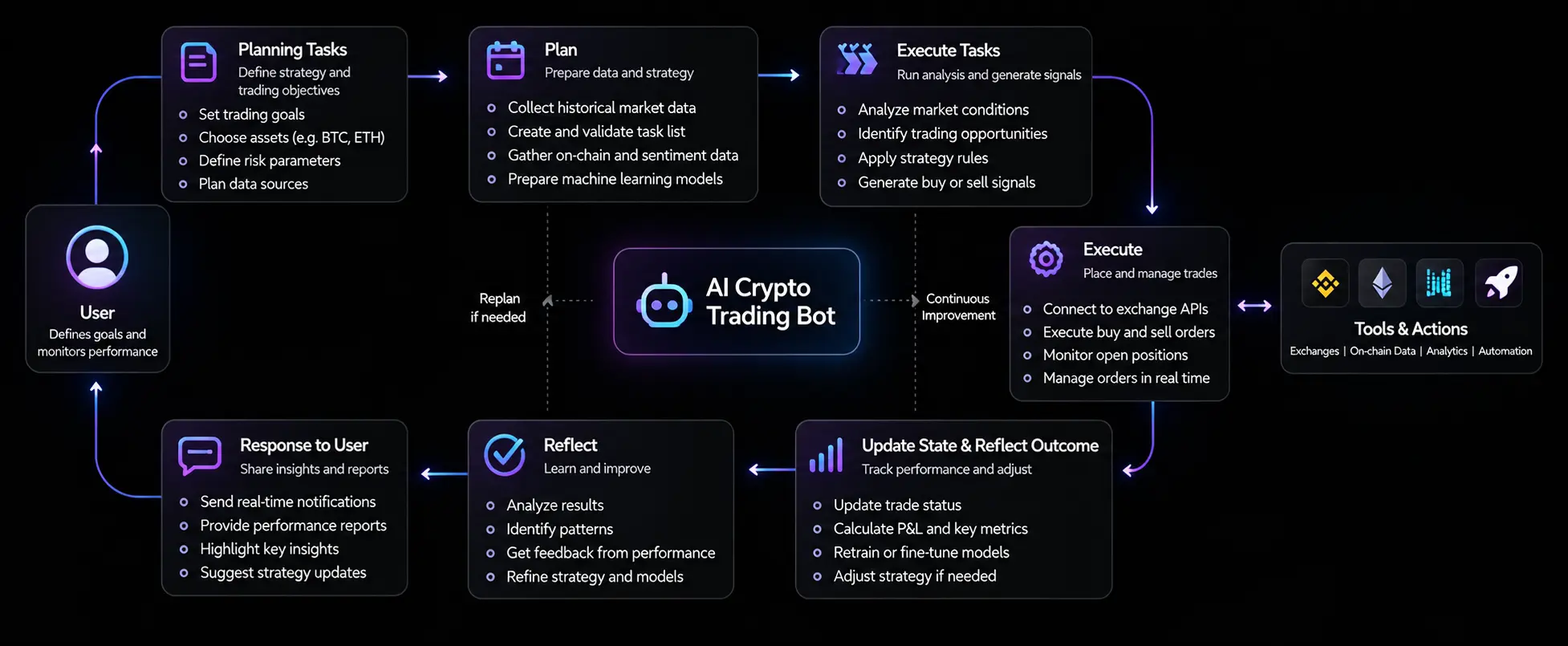
Data Sources → Data Processing → ML Models → Strategy Engine → Risk Controls → Exchange API → Order Execution → Performance Monitoring
This architecture allows businesses to combine intelligent analysis with automated execution while maintaining defined trading and risk controls. The exact design depends on the assets, trading methodology, data sources, exchange integrations, and degree of automation required.
The shift toward intelligent automation is creating new opportunities for businesses building crypto trading products. Cryptocurrency markets run continuously, generate large volumes of data, and operate across multiple exchanges and blockchain networks. For businesses, AI Crypto Trading Bot development can turn these market characteristics into an automated trading infrastructure capable of analyzing information, evaluating strategies, and managing execution without requiring constant manual intervention.
The market outlook also supports this broader move toward AI-powered trading technology. According to The Business Research Company, the global AI in trading market is projected to increase from $27.85 billion in 2026 to $45.74 billion by 2030, representing a 13.2% CAGR. The report identifies real-time AI analytics, adaptive trading algorithms, cloud-based infrastructure, and AI integration with portfolio management among the factors supporting future growth.
The crypto-specific opportunity is also expanding. The Business Research Company estimates the crypto trading platform market at $38.5 billion in 2026, with projections reaching $66.92 billion by 2030. Its analysis highlights AI-powered innovation as an important market trend.
Another forward-looking indicator is generative AI in cryptocurrency. The market is projected to grow from $1.01 billion in 2025 to $4.32 billion by 2030, at a 33.6% CAGR, with applications including trading strategy optimization, price analysis, sentiment analysis, and portfolio risk management.
When businesses build AI Crypto Trading Bots, they can develop capabilities such as:
For businesses considering crypto trading bot development, the opportunity is therefore not limited to faster trade execution. The larger value lies in creating an intelligent system that connects data, strategy, automation, execution, and risk management within one scalable platform.
Therefore, AI crypto trading bot development can help businesses transform systematic trading strategies into scalable, data-driven, and continuously operating digital trading solutions.
Cryptocurrency trading strategies vary widely, from exploiting short-lived price differences to following market trends, managing portfolios, analyzing sentiment, or combining multiple approaches. This makes the type of AI crypto trading bot an important consideration when developing an automated trading solution. Different bot architectures can be designed around specific assets, trading timeframes, risk parameters, data sources, and execution requirements.
For businesses exploring AI crypto trading bot development, a common question is: What type of AI crypto trading bot should be developed for arbitrage, swing trading, market making, sentiment analysis, or automated portfolio management? The answer depends on the trading methodology, target market, level of automation, and operational objectives.
As an AI crypto trading bot solutions provider, we develop specialized solutions that can support different trading models and workflows. These may range from high-speed arbitrage systems and AI-powered trend-following bots to sentiment-driven platforms, portfolio management solutions, and custom hybrid architectures.
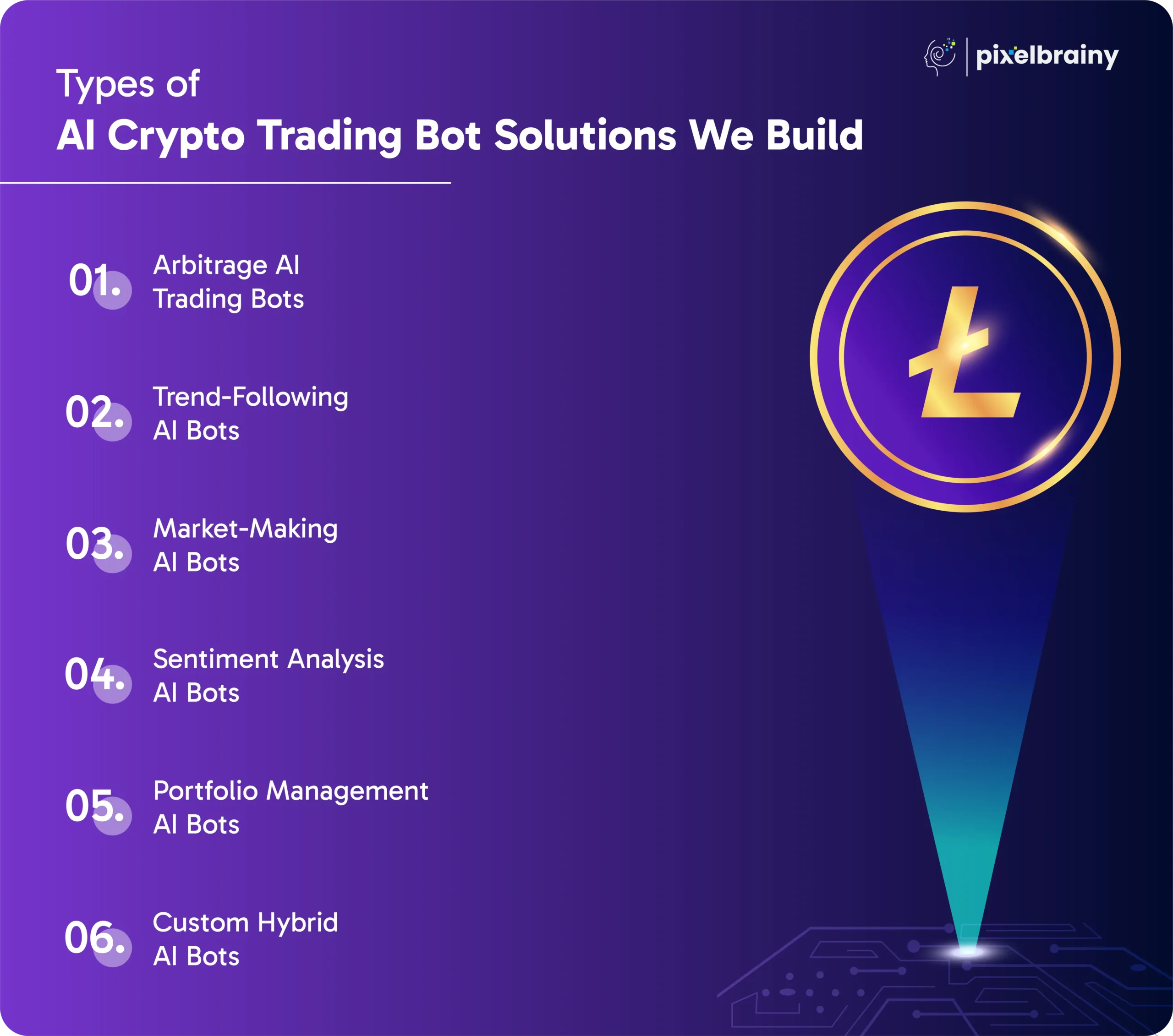
These bots detect and exploit price differences for the same cryptocurrency across multiple exchanges. They continuously scan market order books, identify arbitrage opportunities, and execute trades instantly to capture the spread.
Use Cases:
Major Features:
Trend-following bots identify the direction of the market and trade in that direction until the trend reverses. They are powered by historical data analysis, technical indicators, and AI-driven pattern recognition.
Use Cases:
Major Features:
Market-making bots provide liquidity by placing simultaneous buy and sell orders at different price levels. They profit from the bid-ask spread while maintaining balanced exposure.
Use Cases:
Major Features:
These bots read between the lines of market chatter. They use Natural Language Processing (NLP) to analyze social media posts, news headlines, and community forums to predict market sentiment and act before price changes occur.
Use Cases:
Major Features:
Designed for investors seeking balanced growth, these bots automatically rebalance crypto portfolios to maintain desired asset allocations.
Use Cases:
Major Features:
Hybrid bots combine multiple trading strategies into one system. For example, a bot may run arbitrage, sentiment analysis, and trend-following simultaneously to diversify income streams.
Use Cases:
Major Features:
From arbitrage and trend following to sentiment analysis, portfolio management, and hybrid strategies, different AI crypto trading bot solutions can be tailored to specific trading objectives, market conditions, and risk frameworks.
AI trading bots are being applied across different areas of the cryptocurrency ecosystem, from retail investing and institutional trading to automated risk controls, market analysis, and high-frequency strategies. Their role is no longer limited to placing buy or sell orders. With machine learning, natural language processing, real-time data analysis, and automated execution, AI crypto trading bots can support multiple trading and portfolio workflows.
For businesses exploring AI trading bot development, an important question is: How can AI trading bots be used across retail crypto trading, institutional trading, risk management, high-frequency trading, and market sentiment analysis? The answer depends on the trading environment, available data, execution requirements, asset class, and degree of automation required.
The following use cases demonstrate how AI trading bots can be incorporated into different cryptocurrency trading scenarios. From helping retail investors automate recurring strategies to supporting institutional desks with large-volume execution, these systems can process market information continuously and respond according to configured strategies and risk parameters.
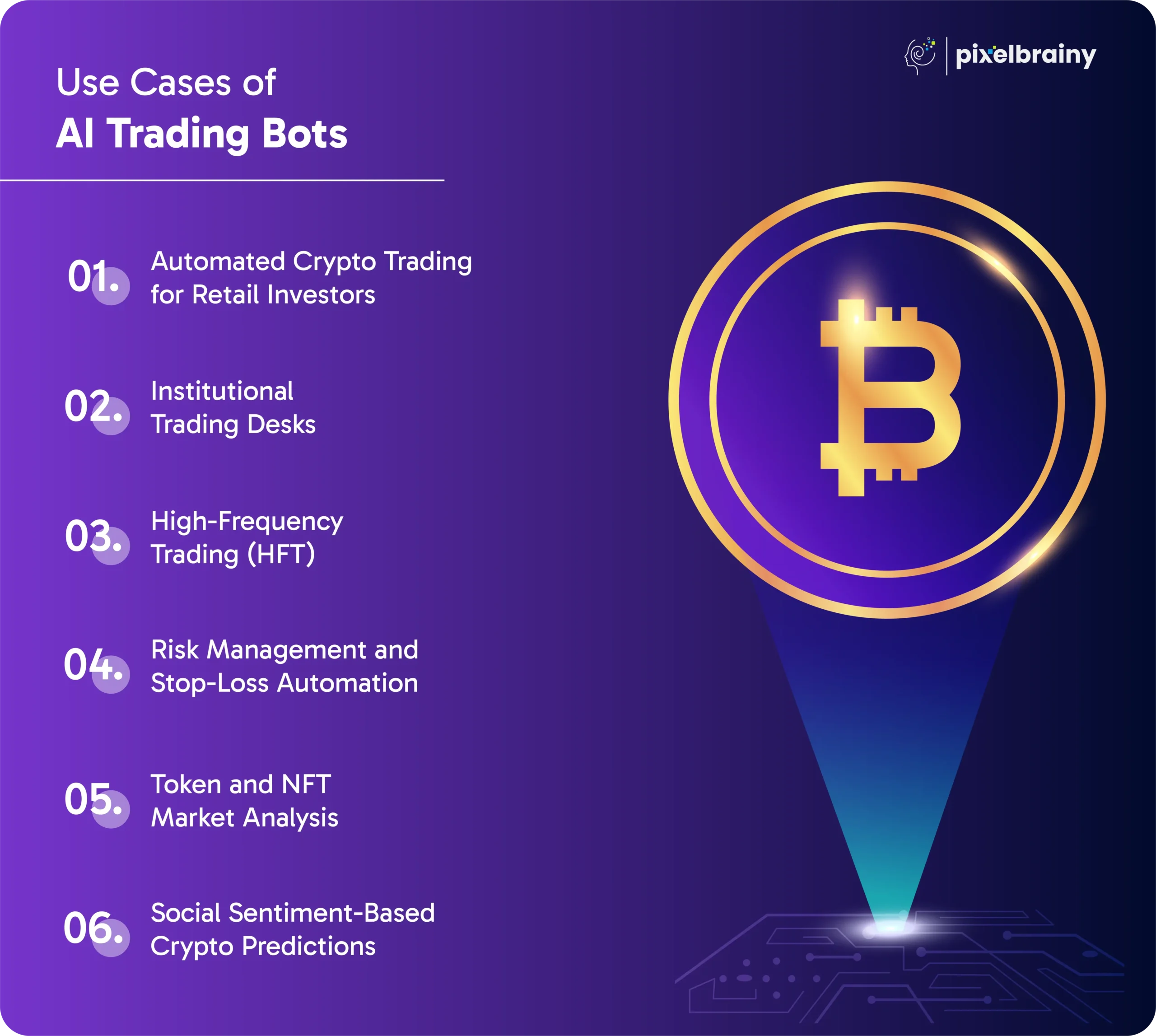
For everyday traders, time and market knowledge can be limiting factors. AI trading bots solve this by automatically buying and selling cryptocurrencies based on predefined strategies or AI-driven predictions. These bots run 24/7, ensuring retail investors never miss an opportunity while reducing the need for constant market monitoring. For example, a retail trader can use a bot to execute dollar-cost averaging, track small price fluctuations, or follow trend signals without needing to manually place orders.
Institutional investors require trading systems that can handle large volumes while maintaining precision and speed. AI bots are integrated into institutional trading desks to manage diversified portfolios, execute bulk orders without moving the market, and ensure compliance with internal trading guidelines. These bots also run multiple strategies in parallel, allowing for better risk-adjusted returns and consistent portfolio performance at scale.
High-frequency trading relies on making thousands of small trades in milliseconds. AI-powered HFT bots analyze market depth, order flow, and micro-price movements to exploit even the smallest market inefficiencies. In crypto markets, where volatility is constant, these bots can rapidly enter and exit trades, capturing incremental profits that accumulate significantly over time.
One of the biggest advantages of AI trading bots is their ability to execute trades without emotional interference. They can set and adjust stop-loss levels in real time based on volatility and market signals, protecting portfolios from sharp downturns. AI-enhanced risk management also includes dynamic position sizing, capital allocation rules, and automated hedging strategies to preserve capital in unpredictable markets.
The rise of decentralized finance (DeFi) and NFTs has expanded the scope of trading beyond traditional cryptocurrencies. AI bots can analyze token liquidity, monitor NFT floor prices, and track blockchain activity for early signals of rising interest. For example, an AI bot might scan Ethereum-based NFT marketplaces to detect patterns in buying activity that could indicate upcoming demand surges.
Market sentiment plays a huge role in crypto price movements. AI bots equipped with natural language processing (NLP) can analyze millions of social media posts, news headlines, and forum discussions in real time. By identifying shifts in public sentiment, these bots can enter or exit positions before the market fully reacts. For instance, detecting a sudden increase in positive mentions of a specific altcoin could trigger a timely buy signal.
These AI trading bot use cases show how AI can support automated execution, market intelligence, portfolio management, risk controls, and strategy analysis across retail, institutional, and emerging crypto markets.

A reliable AI crypto trading bot needs more than automated buy and sell functionality. It requires a combination of real-time market intelligence, machine learning capabilities, strategy management, risk controls, exchange connectivity, and strong security. These components allow the system to process changing market conditions, evaluate trading opportunities, and execute actions according to the configured strategy.
For businesses planning AI crypto trading bot development, an important question is: What features should an AI crypto trading bot include to support automated strategy execution, real-time market analysis, multi-exchange trading, and risk management? The answer depends on the trading model, supported assets, data requirements, execution speed, and level of automation.
A production-ready crypto trading bot development project may incorporate machine learning for pattern analysis, predictive analytics for market signals, NLP-based sentiment analysis, historical backtesting, automated order execution, portfolio monitoring, and configurable risk parameters. Multi-exchange connectivity can further allow the platform to access different liquidity sources and manage multiple digital assets from a centralized system.
The following core features provide the foundation for developing an intelligent, secure, and scalable AI-powered crypto trading platform.
| Feature | Description |
| Real-Time Market Data Integration | Connects to multiple exchanges and streams live price, volume, and order book data to ensure accurate, up-to-the-second trading decisions |
| Predictive Analytics & Machine Learning | Uses AI models to forecast short- and long-term price movements based on historical trends, market patterns, and sentiment analysis |
| Automated Trade Execution | Places buy, sell, and stop-loss orders instantly through API connections, eliminating delays caused by human intervention |
| Backtesting Environment | Tests strategies using historical market data, allowing fine-tuning before deploying the bot in live conditions |
| Risk Management Tools | Includes automated stop-loss, take-profit, position sizing, and hedging mechanisms to minimize trading losses |
| Multi-Exchange & Multi-Currency Support | Trades across various cryptocurrency exchanges and supports multiple digital assets simultaneously for broader market reach |
| Strategy Customization | Allows traders to set custom parameters, rules, and AI-driven strategies to match their risk appetite and trading goals |
| Sentiment Analysis Integration | Uses NLP to process news, tweets, and market sentiment indicators to anticipate market reactions before they occur |
| Security & Data Encryption | Protects sensitive account details and API keys with advanced encryption and two-factor authentication |
| Continuous Learning & Optimization | The bot refines its strategies based on live results, market behavior, and updated AI models for better long-term performance |
Together, these AI crypto trading bot features create the foundation for automated market analysis, strategy execution, portfolio monitoring, risk management, and scalable multi-exchange trading.
As crypto markets become more sophisticated, basic automation may not be enough for businesses targeting advanced trading workflows. Developing a crypto trading bot with intelligent optimization, on-chain analytics, decentralized exchange connectivity, adaptive risk controls, and multi-strategy execution can create a more capable trading infrastructure.
For businesses planning AI crypto trading bot development, a key question is: What advanced features can make a crypto trading bot more adaptive across volatile markets, decentralized exchanges, multiple strategies, and changing liquidity conditions? The answer depends on the trading model, supported assets, execution environment, data sources, and operational requirements.
Advanced capabilities can help a crypto trading bot development project move beyond fixed trading rules. For example, machine learning can support strategy optimization, blockchain data can provide additional market context, and volatility-aware logic can modify trading parameters as market conditions change. Smart order routing can also help manage execution across available liquidity sources, while DeFi and DEX integrations can expand the environments in which the bot operates.
The following advanced features can be incorporated to create a more flexible, data-driven, and scalable AI crypto trading bot.
| Advanced Feature | Description |
| AI-Powered Strategy Optimization | Continuously evaluates live performance and adjusts trading algorithms for better accuracy and returns |
| Custom Indicator Integration | Supports proprietary or specialized technical indicators beyond standard RSI, MACD, or EMA settings |
| Multi-Strategy Execution Engine | Runs several trading strategies simultaneously and allocates capital dynamically between them |
| DeFi and DEX Integration | Enables trading on decentralized exchanges and liquidity pools, expanding market opportunities |
| On-Chain Data Analysis | Uses blockchain data such as wallet activity and transaction flows to anticipate price movements |
| Volatility-Adaptive Trading | Automatically modifies position sizes and risk settings based on real-time volatility levels |
| Smart Order Routing | Selects the most efficient exchange and order type to minimize slippage and maximize profit |
| Cross-Asset Trading | Trades not only cryptocurrencies but also tokenized stocks, commodities, and other blockchain-based assets |
| Voice Command and Alerts | Integrates voice control for trade actions and delivers real-time alerts via mobile or smart devices |
| Regulatory Compliance Module | Ensures all trades meet relevant KYC/AML and jurisdictional regulatory requirements |
These advanced crypto trading bot features can extend automation with adaptive strategies, on-chain intelligence, multi-market connectivity, dynamic risk controls, and more sophisticated execution capabilities.
Also Read: Top 16+ Trading Software Development Companies in USA
The development process of an AI crypto trading bot requires more than connecting a trading strategy to an exchange API. A production-ready platform needs a clear business model, well-defined trading logic, reliable market data, suitable machine learning models, secure integrations, rigorous testing, and continuous monitoring.
For a crypto fintech startup planning to offer institutional-quality algorithmic strategies to retail users through a simple subscription platform, the development approach should also prioritize usability. The platform should allow non-technical traders to configure strategies, connect supported exchanges, monitor performance, and manage risk without writing code.
A practical approach to develop an AI crypto trading bot should therefore cover the complete journey from strategy definition and data preparation to AI implementation, multi-exchange execution, testing, deployment, and ongoing optimization.
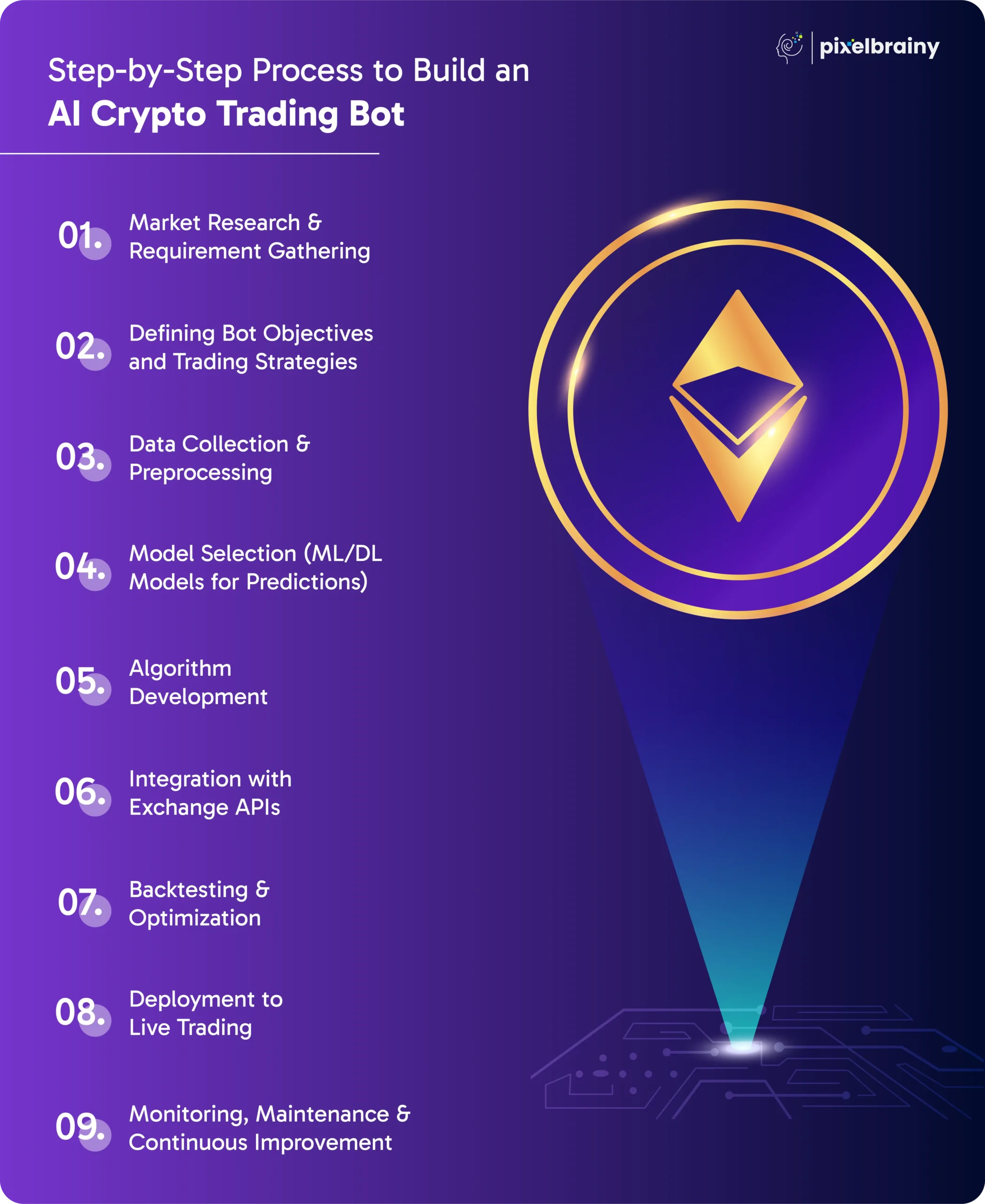
The first stage in the steps to develop AI crypto trading bot from idea to launch is understanding the market, users, and business requirements. Research competing retail trading platforms, subscription models, supported assets, automation levels, and available trading strategies. Define whether the product will provide signals, automated execution, portfolio tools, or complete strategy automation.
For a retail-focused platform, usability should be treated as a core requirement because users may not have programming knowledge. Map essential workflows such as registration, subscription, exchange connection, strategy activation, portfolio monitoring, and performance reporting. A UI/UX design company can help translate these requirements into an intuitive interface.
Also Review this Project: Focused Trading: Trading Platform App Design
The next step is to establish exactly what the bot should accomplish and how its strategies will operate. Define supported cryptocurrencies, trading timeframes, entry and exit conditions, risk limits, capital allocation, and automation levels. For the proposed retail platform, strategies should be packaged into understandable subscription offerings rather than requiring users to configure complex algorithms themselves.
At this stage, determine whether the system will support trend following, arbitrage, swing trading, market making, sentiment-based strategies, or combinations of these approaches. Define measurable performance criteria before development begins. AI consultation can help translate business objectives into technical specifications while keeping strategy rules, risk parameters, and user workflows clearly documented.
Data forms the foundation of building an AI crypto trading bot. Collect the historical and real-time information required by each strategy, including OHLCV data, order books, trading volume, market depth, transaction activity, and relevant on-chain metrics. If sentiment-based strategies are planned, appropriate news and social data can also be incorporated.
The collected information should then be cleaned, synchronized, normalized, and transformed into features suitable for model training and testing. Data quality checks are particularly important when combining feeds from multiple exchanges because timestamps, symbols, liquidity, and market conditions may differ. A well-designed data pipeline should also support continuous ingestion so the system can work with newly available information after deployment.
Once the data pipeline is established, the appropriate machine learning architecture can be determined. Different strategies may require different approaches. LSTM or other time-series models can be explored for sequential market data, reinforcement learning can support strategy experimentation, while NLP models can process textual sentiment.
The objective is not simply to add AI, but to identify models that provide measurable value within the trading workflow. Models should be evaluated using appropriate historical datasets and validation methods while accounting for overfitting and changing market conditions. AI model development should also include model versioning, evaluation metrics, retraining procedures, and monitoring requirements so the system remains manageable after launch.
The fifth stage focuses on converting the trading methodology and model outputs into an operational decision engine. The algorithm determines how market information and AI signals translate into potential actions while enforcing predefined trading rules.
For a subscription-based retail platform, the architecture can separate strategy logic from the customer interface. Users can select an available strategy, configure permitted parameters, and activate automation without accessing the underlying code. The system can then evaluate market conditions, generate signals, calculate position requirements, and pass approved actions to the execution layer.
AI agent development companies can contribute to autonomous workflows where multiple AI components coordinate market analysis, strategy evaluation, monitoring, and predefined operational tasks.
A trading platform cannot execute automated strategies without dependable exchange connectivity. Integrate supported platforms such as Binance, Coinbase, and Kraken through their available APIs for market data, account information, order management, and execution tracking.
The integration layer should handle authentication, API permissions, rate limits, order states, errors, retries, and synchronization between exchange accounts and the platform. Security is especially important because API credentials provide access to financial accounts. Where possible, permissions should be restricted to the capabilities actually required by the application.
For a multi-exchange retail product, standardized connectors can provide a common interface while allowing exchange-specific differences to be handled within individual integration modules.
Before developing an AI crypto trading bot for live execution, strategies and models should be evaluated against historical market conditions. Backtesting can help determine how a strategy would have behaved across different volatility levels, trends, drawdowns, liquidity conditions, and market cycles.
The testing environment should account for factors such as transaction fees, slippage, latency, position sizing, and available liquidity rather than relying only on theoretical entry and exit prices. Walk-forward testing and out-of-sample validation can provide additional insight into model behavior.
PoC development can be useful at this stage for validating the core strategy, AI workflow, exchange connectivity, and technical feasibility before investing in the complete production platform.
After successful testing, the system can move toward controlled live deployment. MVP development allows the business to launch a limited version containing essential strategies, supported exchanges, account connectivity, subscription functionality, dashboards, and risk controls.
A staged rollout can reduce operational exposure by initially limiting supported assets, users, capital, or automation levels. The platform should include monitoring for order failures, API disruptions, abnormal activity, latency, model behavior, and unexpected strategy outcomes. User-facing dashboards should clearly display active strategies, positions, transactions, and relevant performance information.
For businesses looking to create AI crypto trading bot platforms for retail customers, production deployment should balance automation with transparent controls and clear user visibility.
Also Read: Top 10 AI MVP Development Companies in USA
Launching the product is not the end of AI crypto trading bot development. Market behavior, exchange APIs, liquidity conditions, data quality, and model performance can change over time. Continuous monitoring is therefore required to identify technical problems and strategy degradation.
Regular maintenance may include model retraining, data pipeline updates, exchange API changes, security patches, infrastructure optimization, and feature improvements. Performance dashboards can track trading activity, execution quality, drawdowns, and other predefined metrics.
Businesses may also hire AI developers to maintain models and trading infrastructure or work with specialized AI chatbot development companies when conversational interfaces are added for strategy discovery, account assistance, or platform support.
A structured approach to make AI crypto trading bot solutions helps transform trading strategies into secure, scalable, and user-friendly platforms from concept through live deployment.
The AI crypto trading bot development cost can vary significantly based on the trading strategy, AI complexity, exchange integrations, security requirements, and level of automation. A basic bot designed to validate a trading concept requires considerably less investment than a production platform supporting multiple exchanges, machine learning models, advanced risk controls, and real-time analytics.
For businesses researching how much does it cost to build an AI crypto trading bot, a practical development range is approximately $10,000 to $100,000+. However, the final budget depends on the functionality and technical architecture required for the solution.
Key factors that influence the overall crypto trading bot development cost include:
A basic solution is suitable for validating an initial trading concept or launching a limited-scope product. It may include:
This level is generally appropriate for early-stage validation before expanding into a more sophisticated platform.
A standard solution provides broader automation and analytical capabilities for startups and growing trading businesses. It can include:
This tier provides a stronger foundation for a scalable commercial trading platform.
Enterprise-grade AI crypto trading bot development involves significantly more complex infrastructure and customization. Depending on requirements, it may include:
The quoted ranges are starting estimates rather than fixed prices. For example, a retail subscription platform offering automated strategies across Binance, Coinbase, and Kraken will require a different architecture and budget than a single-exchange bot created for strategy validation.
The best approach is to define the required strategies, AI capabilities, integrations, user workflows, security controls, and expected trading volume before preparing a detailed estimate.
Pro Tip: When evaluating AI crypto trading bot development pricing, consider the total cost of data, infrastructure, exchange integrations, security, maintenance, and model monitoring, not just the initial development effort.
A well-defined scope helps businesses allocate the right budget for an AI crypto trading bot that can scale from strategy validation to production-grade automated trading.

Also Read: AI Trading Platform Development Cost: Factors and Budgeting Tips
A reliable AI crypto trading bot requires a technology stack that can handle real-time market data, machine learning workloads, exchange connectivity, automated execution, and secure data processing.
For businesses planning AI crypto trading bot development, a key question is: What technology stack is required to build an AI crypto trading bot with machine learning, real-time market data, multi-exchange connectivity, and automated trading? The answer depends on the bot's strategies, AI complexity, data requirements, supported exchanges, and scalability needs.
The architecture may combine Python, AI frameworks, real-time streaming technologies, databases, cloud infrastructure, exchange APIs, and security tools to support the complete trading workflow.
| Category | Tools / Technologies | Purpose in Development |
| Programming Languages | Python, JavaScript (Node.js), C++ | Core bot logic, data processing, and API interactions |
| AI & Machine Learning Frameworks | TensorFlow, PyTorch, Scikit-learn | Model training for predictions, sentiment analysis, and pattern recognition |
| Data Processing Libraries | Pandas, NumPy, Dask | Handling, cleaning, and processing large datasets efficiently |
| Backtesting Frameworks | Backtrader, Zipline | Simulating strategies on historical data to refine performance |
| Exchange Integration APIs | Binance API, Coinbase API, Bybit API, KuCoin API | Connecting the bot to trading platforms for live market access |
| Cloud Infrastructure | AWS, Google Cloud, Microsoft Azure | Hosting, scaling, and deploying trading bots globally |
| Databases | PostgreSQL, MongoDB, Redis | Storing market data, trade history, and bot configurations |
| Security Tools | SSL/TLS encryption, OAuth 2.0, JWT | Securing API keys, data, and transactions |
| Real-Time Data Streaming | WebSocket, Kafka | Ensuring low-latency market data feeds and instant trade execution |
| DevOps & Deployment Tools | Docker, Kubernetes, Jenkins | Continuous integration, scaling, and easy deployment of bots |
The right AI crypto trading bot technology stack creates a strong foundation for intelligent analysis, secure integrations, automated execution, and scalable trading operations.
Developing an AI crypto trading bot involves more than implementing automated trading logic. Real-world systems must handle unreliable data, exchange connectivity issues, sudden market movements, model limitations, security threats, regulatory requirements, and infrastructure demands. These factors can directly affect the reliability and operational performance of an automated trading platform.
For businesses investing in AI crypto trading bot development, an important question is: What are the main challenges of building an AI crypto trading bot that can operate reliably across volatile markets, multiple exchanges, real-time data feeds, and automated trading workflows? Addressing these challenges during the development stage can reduce operational risks and create a stronger foundation for production deployment.
A robust crypto trading bot development strategy should therefore include data validation, resilient API architecture, volatility-aware controls, model testing, secure credential management, compliance planning, and scalable infrastructure. Each area requires dedicated safeguards because even a technically functional bot can encounter problems when exposed to unpredictable market conditions or live exchange environments.
The following challenges highlight the key areas businesses should address while developing an AI-powered crypto trading solution.
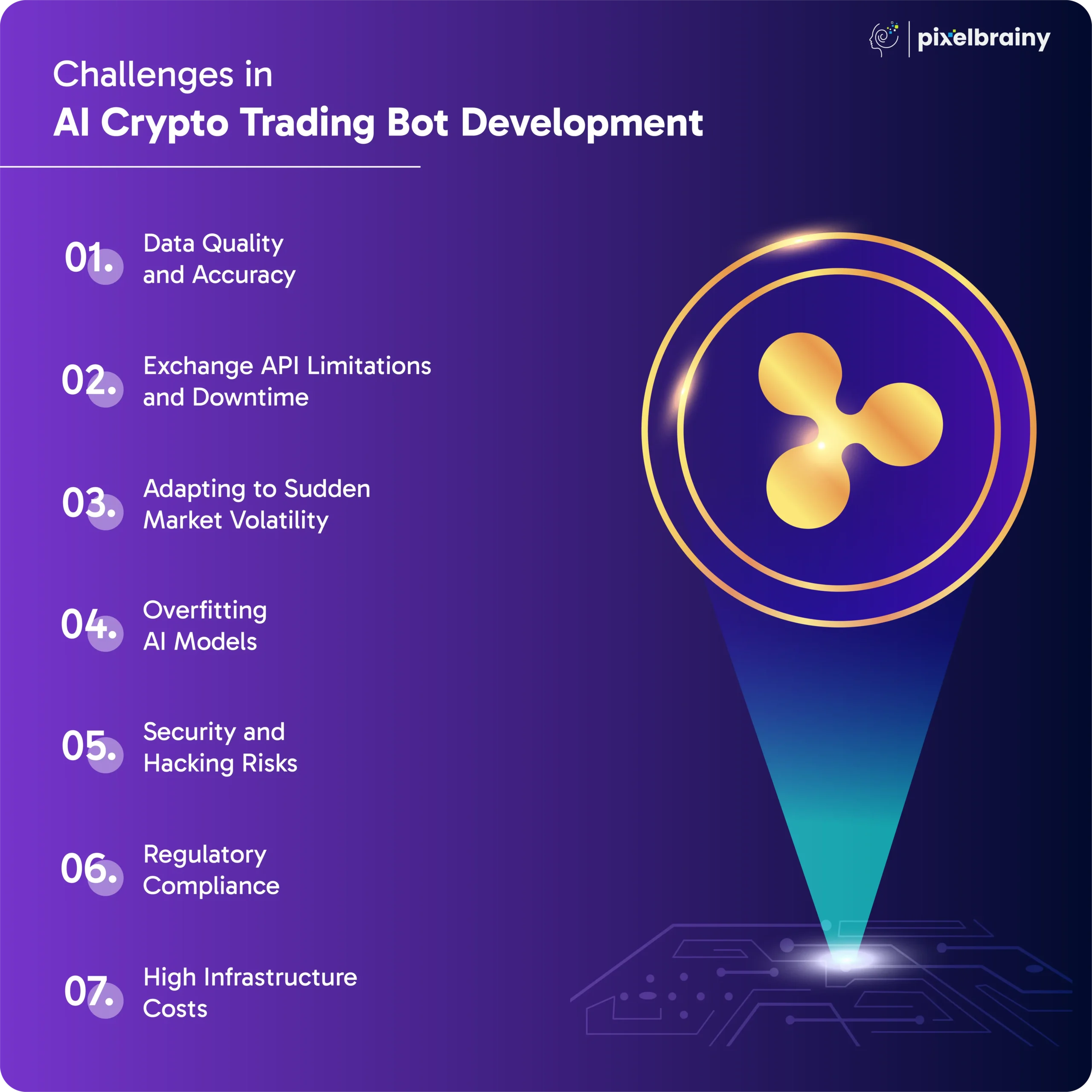
The Challenge: AI models rely on large volumes of accurate market data. Poor-quality or incomplete data can lead to inaccurate predictions and failed trades.
The Solution:
The Challenge: Exchanges often have API rate limits, downtime, or connection issues that can disrupt trading.
The Solution:
The Challenge: Crypto markets can change direction in seconds, making fixed strategies risky.
The Solution:
The Challenge: An AI bot that performs well on historical data may fail in live markets if it’s too tailored to past conditions.
The Solution:
The Challenge: Trading bots are prime targets for hackers seeking to steal API keys or manipulate trades.
The Solution:
The Challenge: Different jurisdictions have varying crypto regulations, and non-compliance can result in penalties.
The Solution:
The Challenge: Running advanced AI trading bots requires significant computing resources.
The Solution:
Addressing these AI crypto trading bot development challenges with reliable data, resilient infrastructure, secure architecture, effective model validation, and appropriate compliance controls can create a more robust and production-ready trading platform.
The next phase of AI crypto trading bot development is moving toward more adaptive intelligence, broader blockchain connectivity, simpler user experiences, and increasingly sophisticated market analysis. As crypto markets, DeFi ecosystems, and AI technologies continue to evolve, businesses developing automated trading platforms need to consider capabilities that can support future trading models and changing user expectations.
For businesses planning long-term AI crypto trading bot development, an important question is: What future technologies will shape AI crypto trading bots for automated strategy optimization, DeFi trading, cross-market analysis, behavioral insights, and no-code access? Emerging developments in machine learning, Web3, automation, and computing could influence how these platforms analyze information and interact with digital asset markets.
Future-ready crypto trading bot development is likely to focus on combining multiple data sources, improving strategy adaptability, expanding access to decentralized markets, and making advanced automation easier for non-technical users. At the same time, claims around future capabilities should be evaluated carefully, particularly where technologies such as quantum computing remain at an emerging stage.
The following trends highlight important areas businesses can consider when planning the next generation of AI-powered crypto trading platforms.
The future development of AI crypto trading bots will involve more sophisticated use of deep learning, reinforcement learning, and hybrid AI models to predict market movements with higher precision.
These bots will analyze vast datasets, including price charts, order book depth, social sentiment, and macroeconomic indicators, to forecast price changes before they happen.
This level of intelligence will allow traders to act on opportunities that the broader market has yet to identify, giving them a significant competitive advantage.
As decentralized finance continues to grow, more bots will integrate with decentralized exchanges, liquidity pools, staking platforms, and yield farming protocols.
By building AI crypto trading bots with Web3 capabilities, traders can automate participation in DeFi ecosystems, capture arbitrage opportunities across blockchain networks, and execute smart contract-based trades without the need for centralized intermediaries.
The development of AI crypto trading bots is moving toward multi-asset functionality.
This means bots will be able to trade cryptocurrencies alongside tokenized equities, commodities, forex pairs, and other blockchain-based assets.
With cross-market trading capabilities, traders can diversify portfolios, hedge against volatility in one sector, and seize opportunities across global markets from a single AI-powered platform.
Quantum computing, while still emerging, presents both challenges and opportunities for AI trading.
Future bots will incorporate quantum-resistant encryption to protect sensitive trading data.
They may also use quantum computing’s immense processing power to analyze and act on market data in nanoseconds. Building AI crypto trading bots with quantum readiness ensures they remain secure and competitive in the post-quantum era.
Next-generation bots will combine sentiment analysis with behavioral AI to better interpret human market psychology.
They will process emotional cues from social media posts, news headlines, and market reactions to adjust trading strategies in real time.
This advancement in the development of AI crypto trading bots will make decision-making more adaptive, allowing bots to act with a human-like understanding but without emotional bias.
The barrier to entry for creating trading bots is lowering. Soon, individuals will be able to build AI crypto trading bots without writing code by using no-code platforms.
These systems will offer drag-and-drop interfaces, pre-built AI modules, automated backtesting environments, and integration templates for popular exchanges.
This will make sophisticated bot development accessible to a much wider audience.
These emerging trends can shape the future of AI crypto trading bots, bringing greater automation, broader market connectivity, advanced analytics, and more accessible trading experiences as the technology matures.
Building a successful AI crypto trading bot requires expertise across artificial intelligence, trading strategies, exchange integrations, security, and scalable fintech architecture. PixelBrainy is an AI trading software development company that helps businesses transform crypto trading concepts into customized, secure, and scalable solutions designed around their specific trading requirements.
Our approach to cryptocurrency trading bot development with AI combines intelligent automation, reliable infrastructure, and crypto market expertise. Whether the requirement is automated strategy execution, multi-exchange trading, AI-powered market analysis, or a retail-focused trading platform, the development process can be aligned with the product's business objectives and technical requirements.
PixelBrainy worked with a U.S.-based financial technology startup on an AI-enabled cryptocurrency trading bot project. The solution required:
Reported Project Outcome:
According to the project information provided, the bot achieved more than 93% trade execution accuracy, sub-second latency, 24/7 operation, and the ability to process thousands of trades daily after deployment. These figures are client project claims and should not be interpreted as a guarantee of future trading performance.
Turn your crypto trading strategy into a secure, scalable AI trading platform with PixelBrainy’s expert development team.

AI is reshaping cryptocurrency trading by enabling continuous market analysis, automated strategy execution, intelligent risk controls, and data-driven decision-making. For businesses, AI crypto trading bot development offers a way to transform trading strategies into scalable digital systems that can operate across markets and exchanges without requiring constant manual intervention.
From retail-focused trading platforms and institutional solutions to arbitrage systems, portfolio management bots, and AI-powered strategy automation, the opportunities extend across different areas of the crypto ecosystem. However, building a production-ready solution requires more than adding an AI model. Reliable data pipelines, exchange APIs, security, backtesting, risk management, scalable infrastructure, and ongoing model monitoring are all essential to the development process.
At PixelBrainy, we help businesses turn their crypto trading concepts into customized AI-powered solutions, supporting strategy development, AI implementation, exchange integration, testing, deployment, and ongoing optimization.
Ready to build your AI crypto trading bot? Connect with PixelBrainy to discuss your trading platform requirements with our development team.
The main steps to develop an AI crypto trading bot from idea to launch include defining the trading objective, researching the market, preparing datasets, developing the trading algorithm, training and validating AI models, integrating exchange APIs, backtesting, deploying the product, and continuously monitoring its performance.
To build an AI crypto trading bot from scratch, start by defining the trading strategy and supported assets, then establish the data pipeline, select suitable ML technologies, develop the decision engine, connect cryptocurrency exchanges, implement risk controls, and test the system before controlled live deployment.
The cost to develop an AI crypto trading bot typically starts around $10,000 and can exceed $100,000, depending on the number of exchanges, AI complexity, trading strategies, real-time data requirements, security, backtesting, user interface, and infrastructure requirements.
AI crypto trading bot development can use technologies such as Python, TensorFlow, PyTorch, Scikit-learn, Node.js, PostgreSQL, Redis, WebSockets, Kafka, Docker, Kubernetes, and cloud platforms. The final stack depends on the bot's trading logic, AI workload, execution requirements, and expected scale.
Building an AI crypto trading bot can involve machine learning models that analyze historical and real-time information, while conventional bots generally execute predefined rules. AI systems may incorporate market patterns, sentiment, volatility, and on-chain information alongside programmed trading conditions.
To create an AI crypto trading bot that operates across exchanges such as Binance, Coinbase, and Kraken, the platform needs exchange API integrations, standardized order management, secure authentication, real-time market feeds, rate-limit handling, error recovery, portfolio synchronization, and exchange-specific execution logic.
Yes, developing an AI crypto trading bot can automate a manually tested strategy by translating its trading conditions into software and using machine learning to analyze relevant historical and live data. Backtesting, paper trading, and controlled deployment should be used to evaluate whether the automated implementation behaves consistently with the original strategy.
When developing an AI crypto trading bot for retail users, businesses should consider simple strategy interfaces, subscription management, exchange connectivity, automated execution, portfolio dashboards, risk controls, security, performance reporting, and an architecture that allows non-technical users to access automated strategies without coding.

About The Author
Sagar Bhatnagar
Sagar Sahay Bhatnagar brings over a decade of IT industry experience to his role as Marketing Head at PixelBrainy. He's known for his knack in devising creative marketing strategies that boost brand visibility and market influence. Sagar's strategic thinking, coupled with his innovative vision and focus on results, sets him apart. His track record of successful campaigns proves his ability to utilize digital platforms effectively for impactful marketing efforts. With a genuine passion for both technology and marketing, Sagar continuously pushes PixelBrainy's marketing initiatives to greater success.

Working with the PixelBrainy team has been a highly positive experience. They understand the design requirements and create beautiful UX elements to meet the application needs. The dev team did an excellent job bringing my vision to life. We discussed usability and flow. Sagar worked with his team to design the database and begin coding. Working with Sagar was easy. He has the knowledge to create robust apps, including multi-language support, Google and Apple ID login options, Ad-enabled integrations, Stripe payment processing, and a Web Admin site for maintaining support data. I'm extremely satisfied with the services provided, the quality of the final product, and the professionalism of the entire process. I highly recommend them for Android and iOS Mobile Application Design and Development.

Great experience working with them. Had a lot of feedback and I found that unlike most contractors they were bugging me for updates instead of the other way around. They were extremely time conscience and great at communicating! All work was done extremely high quality and if not on time, early! They were always proactive when it comes to communication and the work is great/above par always. Very flexible and a great team to work with! Goes above and beyond to present us with multiple options and always provides quality. Amazing work per usual with Chitra. If you have UI/UX or branding design needs I recommend you go to them! Will likely work with them in the future as well, definitely recommended!

PixelBrainy is a joy to work with and is a great partner when thinking through branding, logo, and website layout. I appreciate that they spend time going into the "why" behind their decisions to help inform me and others about industry best practices and their expertise.

I hired them to design our software apps. Things I really like about them are excellent communication skills, they answer all project suggestions and collaborate right away, and their input on design and colors is amazing. This project was complex and needed patience and creativity. The team is amazing to do business with. I will be using them long-term. Glad to see there are some good people out there. I was afraid to try and outsource my project to someone but I am glad I met them! I really can't say enough. They went above and beyond on this project. I am very happy with everything they have done to make my business stand out from the competition.

It was great working with PixelBrainy and the team. They were very responsive and really owned the project. We'll definitely work with them again!

I recently worked with the PixelBrainy team on a project and I was blown away by their communication skills. They were prompt, clear, and articulate in all of our interactions. They listened and provided valuable feedback and suggestions to help make the project a success. They also kept me updated throughout the entire process, which made the experience stress-free and enjoyable.

PixelBrainy is very good at what it does. The team also presents themselves very professionally and takes care of their side of things very well. I could fully trust them taking up the design work in a timely and organised manner and their attention to detail saved us lots of effort and time. This particular project was quite intense and the team showed that they function very well under pressure. Very much looking forward to working with her again!

It's always an absolute pleasure working with them. They completed all of my requests quickly and followed every note I had for them to a T, which made our process go smoothly from start to finish. Everything was completed fast and following all of the guidelines. And I would recommend their services to anyone. If you need any design work done in the future, PixelBrainy should be your first call!

They took ownership of our requirements and designed and proposed multiple beautiful variants. The team is self-motivated, requires minimum supervision, committed to see-through designs with quality and delivering them on time. We would definitely love to work with PixelBrainy again when we have any requirements.

PixelBrainy was a big help with our SaaS application. We've been hard at work with a new UI/UX and they provided a lot of help with the designs. If you're looking for assistance with your website, software, or mobile application designs, PixelBrainy and the team is a great recommendation.

PixelBrainy designers are amazing. They are responsive, talented, and always willing to help craft the design until it matches your vision. I would recommend them and plan to continue them for my future projects and more!!!

They were awesome! Did a good job fast, and good communication. Will work with them again. Thank you

Creative, detail-oriented, and talented designers who take direction well and implement changes quickly and accurately. They consistently over-delivered for us.

PixelBrainy team is very talented and creative. Great designers and a pleasure to work with. PixelBrainy is an excellent communicator and I look forward to working with them again.

PixelBrainy has a very talented design team. Their work is excellent and they are very responsive. I enjoy working with them and hope to continue on all of our future projects.


Transform your ideas into reality with us.
Across these industries, each engagement brings unique challenges, from early-stage product development to scaling complex systems, helping us build a practical understanding of real-world product environments.