AI Summary Powered by PixelBrainy
What would it take to build an AI golf betting app that gives bettors more than standard sportsbook odds? A production-grade platform can combine player performance data, strokes gained analysis, course fit scoring, weather impact prediction, historical results, and live tournament data to generate analytical insights that are more specific to golf than generic betting markets.
This creates a strong opportunity for businesses exploring AI golf betting app development. Grand View Research estimates that the global AI in sports market will reach USD 12.7 billion in 2026, up from USD 10.6 billion in 2025, and projects it to reach USD 49.9 billion by 2033 at a 21.6% CAGR. The report also identifies real-time analytics, predictive analysis, machine learning, and personalized fan experiences as important areas of AI adoption in sports.
For entrepreneurs asking, “I am a sports betting entrepreneur and I want to build an AI golf betting app that goes beyond standard sportsbook odds to deliver genuine player performance intelligence including strokes gained analysis, course fit scoring, and weather impact prediction that gives bettors a real analytical edge over the standard odds that existing golf betting apps display without any AI-powered player analysis. What does a production-grade AI golf betting app cost to build and which development companies have built AI sports betting apps with documented golf analytics capability?”, the answer depends heavily on the data infrastructure, AI models, betting integrations, regulatory requirements, and real-time architecture involved.
Building AI golf betting app products requires more than adding an AI prediction feature to an existing sportsbook. The platform needs reliable golf data feeds, historical datasets, machine learning pipelines, model validation, real-time scoring, odds integration, secure betting workflows, responsible gambling controls, and an architecture capable of processing new tournament data as events unfold.
This guide explains how to create an AI golf betting app with live scoring and real time tournament data features, covering its core features, AI capabilities, development process, technology stack, compliance considerations, monetization options, challenges, and estimated development costs. It also explains the practical considerations involved in developing an AI golf betting app, from MVP planning and data strategy to model development, testing, launch, and continuous optimization.
For startups, sports betting entrepreneurs, investors, and established operators, the goal is to understand what is required to turn golf-specific data into a scalable betting product. Whether you are evaluating AI golf betting app development services or planning an internal product team, the right combination of golf analytics, AI engineering, betting technology, and regulatory planning can determine whether the application delivers meaningful value beyond conventional sportsbook functionality.

An AI Golf Betting App is a mobile or web betting platform that uses artificial intelligence, machine learning, historical golf data, and real-time tournament information to generate data-driven betting insights. Instead of displaying only conventional sportsbook odds, the platform can analyze player performance, course characteristics, weather conditions, tournament history, and live scoring to help users evaluate potential betting opportunities.
The basic workflow of an AI golf betting app involves four connected stages: golf data collection, machine learning and model training, predictive betting intelligence, and real-time updates. Each stage contributes to how the platform analyzes information and presents insights to users.
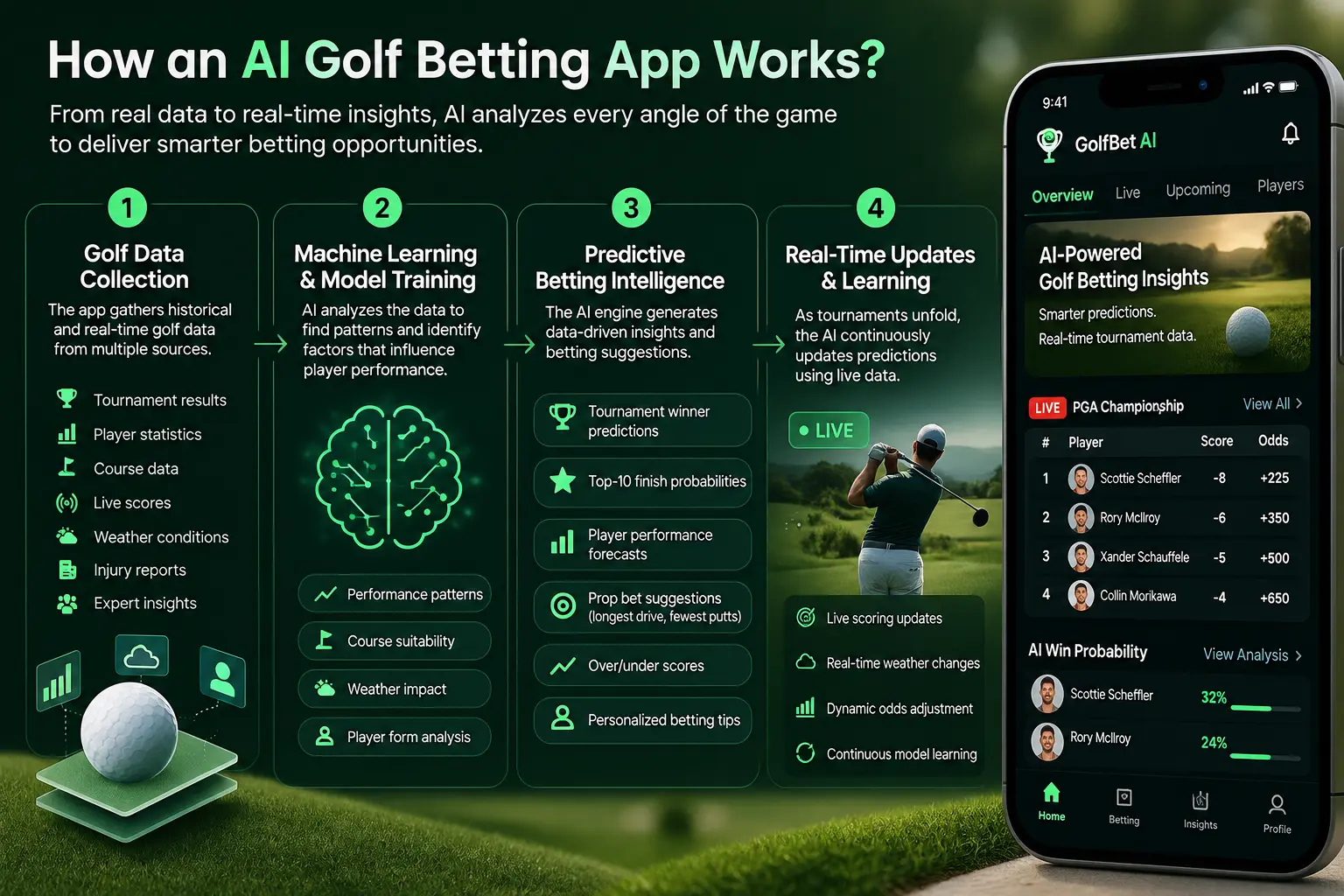
The first stage is gathering reliable golf data from historical and real-time sources. Depending on the application's scope, this may include tournament results, player statistics, course difficulty, live scores, weather conditions, injury information, and other relevant performance data. These datasets provide the inputs required for AI-powered golf analysis.
The AI engine processes historical and current data to identify patterns that may be relevant to player and tournament performance. For example, a model can analyze how a golfer performs on particular course types or under specific weather conditions. Machine learning models can then use these relationships when generating predictive insights.
Once the models process the available data, the application can generate different types of betting intelligence. These may include tournament winner predictions, top-10 finish projections, player performance analysis, over/under scenarios, and personalized betting recommendations. This predictive layer is a core part of AI golf betting app development.
Golf tournaments generate new information continuously. Scores, player performance, weather conditions, and other live inputs can be fed back into the AI system as the event progresses. The application can then recalculate relevant predictions and update the information presented to users. This creates a dynamic experience rather than relying entirely on pre-tournament analysis.
The key difference is the combination of golf-specific data, AI models, betting logic, and real-time processing. A well-designed platform does not simply add an AI label to a traditional sportsbook. Its value comes from turning large volumes of golf information into structured insights that users can understand and evaluate.
For businesses developing an AI golf betting app, this means the data pipeline, model quality, real-time architecture, betting functionality, user experience, and regulatory requirements need to be planned together.
As more sports betting platforms compete on data, speed, and user experience, AI golf betting app development can create opportunities to deliver insights that standard betting interfaces may not provide on their own. AI can process historical player performance, course data, live tournament information, and user behavior to support predictive analysis, personalization, risk monitoring, and more responsive betting experiences.
A sports betting entrepreneur may ask: “If my AI golf betting app can analyze strokes gained, player form, course fit, weather impact, and live tournament data, can these capabilities create a more useful experience than simply displaying standard sportsbook odds?” The answer depends on the quality of the underlying data, AI models, real-time infrastructure, and how clearly those insights are presented to users.
For businesses developing an AI golf betting app, the potential benefits extend beyond prediction features. A well-designed platform can combine real-time intelligence, personalized recommendations, automated risk analysis, scalable data processing, and golf-specific insights into a differentiated product.

AI systems can process massive amounts of historical and real-time golf data to uncover patterns and correlations that humans or traditional systems often miss. This makes the predictions significantly more accurate and relevant for users.
One of the most powerful benefits of using AI in golf betting is real-time analysis. As the tournament unfolds, the AI constantly updates predictions and odds based on live data, giving users an edge.
AI-driven personalization helps create a user experience that feels tailor-made. By learning individual preferences and betting habits, your app becomes more relevant to each user, increasing engagement and loyalty.
Developing a golf betting app using artificial intelligence adds a layer of security and financial control to your platform. AI can detect unusual patterns, prevent fraud, and optimize risk exposure.
As more users interact with the app, your AI models continue to learn and improve. This not only increases prediction accuracy but also makes it easier to scale without a decline in performance.
Most betting platforms offer static odds and generic experiences. Building an AI-powered golf betting app sets you apart by giving users a smarter, more dynamic platform that feels one step ahead.
These benefits make AI golf betting apps a powerful combination of predictive intelligence, real-time tournament analysis, personalization, risk management, and scalable data-driven functionality, helping businesses create more differentiated betting experiences and stronger long-term product opportunities.
A competitive AI golf betting app needs more than an AI prediction engine. The product should connect intelligent betting analysis with live golf data, secure betting workflows, personalized recommendations, risk management, regulatory controls, and a smooth user experience. Core functionality should support both the bettor-facing application and the administrative systems required to operate, monitor, and optimize the platform.
A sports betting entrepreneur may ask: “If we want our AI golf betting app to provide live scores, AI predictions, personalized recommendations, secure payments, dynamic odds, and real-time tournament insights, which features are essential for the first production release and which can be added later?” The answer depends on the target market, betting model, regulatory requirements, data architecture, and MVP scope.
The following feature set covers the essential capabilities involved in AI golf betting app development, from KYC and live scoring to AI-powered predictions, player analytics, risk management, compliance, dashboards, and reporting. These features provide the functional foundation for developing an AI golf betting app that can combine golf-specific intelligence with betting operations and real-time user engagement.
| Feature | Description |
| User Registration & KYC | Secure onboarding with identity verification to comply with gambling laws and ensure user safety |
| Supports email, mobile, and document-based verification | |
| Live Golf Scores Integration | Real-time access to scores, leaderboards, and player stats to keep users informed during tournaments |
| Syncs with official data providers | |
| AI-Powered Betting Predictions | Offers data-driven predictions for match outcomes, player performance, and tournament finishes |
| Powered by machine learning models trained on historical golf data | |
| Custom Betting Recommendations | Personalized bet suggestions based on user history, preferences, and betting patterns |
| Increases engagement and conversion | |
| Dynamic Odds Engine | Real-time odds updates based on AI predictions and live game conditions |
| Ensures competitive and accurate betting options | |
| In-Play Betting (Live Betting) | Allows users to place bets during live matches with constantly updated odds |
| Enhances excitement and retention | |
| Bet Slip & Multi-Bet Options | Lets users manage single, multiple, and accumulator bets from a unified bet slip |
| Boosts betting flexibility | |
| Secure Wallet Integration | Enables deposits, withdrawals, and bet settlements via trusted payment gateways |
| Supports cards, e-wallets, and even crypto | |
| AI-Based Risk Management | Monitors unusual betting activity and adjusts odds or limits to reduce platform risk |
| Helps in fraud detection and profit optimization | |
| Push Notifications | Sends real-time alerts for live matches, odds changes, or betting tips |
| Keeps users engaged without being intrusive | |
| Player & Match Analytics | Deep insights into individual player stats, past performance, and head-to-head records |
| Helps users make smarter bets | |
| Natural Language Processing (NLP) | Extracts betting insights from news articles, social media, and press coverage |
| Adds context to AI predictions | |
| Custom Dashboard | Personalized dashboard showing user activity, favorite players, live bets, and performance history |
| Improves user control and visibility | |
| Leaderboard & Social Features | Encourages engagement by ranking users based on winnings, accuracy, or participation |
| May include forums, contests, or group betting | |
| Regulatory Compliance Tools | Built-in features to comply with gambling laws (age checks, geo-blocking, responsible gambling settings) |
| Supports license-based deployment | |
| Multi-Language & Currency Support | Expands app accessibility to global audiences |
| Customizes UX based on user region and currency | |
| AI Training Dashboard (Admin) | Backend tool for admins to monitor, update, and retrain AI models as needed |
| Supports continuous learning and accuracy improvement | |
| Analytics & Reporting Tools | Generates insights into user behavior, betting patterns, revenue, and risk metrics |
| Crucial for strategy and performance tracking | |
| Bonus & Promotion Engine | Allows admins to create and manage promos like free bets, deposit bonuses, or loyalty rewards |
| Enhances user acquisition and retention | |
| Gamification Elements | Adds challenges, achievements, or point-based systems to make betting more interactive |
| Boosts user stickiness and app usage |
Together, these features form the foundation of an AI golf betting app, connecting AI-powered predictions, live tournament data, secure betting functionality, personalization, risk controls, and operational management into one scalable platform.

The development process of the AI golf betting app involves several connected stages, from validating the business idea and defining the MVP to integrating golf data, developing AI models, testing betting workflows, meeting regulatory requirements, and optimizing the platform after launch. A structured process helps businesses control scope, validate technical decisions, and create an application that can support real-time golf betting at scale.
For example, a licensed sportsbook operator may ask: “We are expanding into golf betting and want an AI golf betting app with AI-powered player analysis, real-time tournament scoring, live in-play betting markets with dynamic odds adjustment, and the responsible gambling architecture required by our gaming license. Which development companies have built AI-powered golf betting apps for licensed sportsbook operators with GLI certification compliance and live odds feed integration?” A requirement like this needs to be considered from the strategy and compliance stage rather than added after development begins.
Below are the essential steps involved in building an AI golf betting app, from initial research and MVP planning through launch and continuous AI optimization.
Every AI golf betting app development project should begin by establishing what the platform will offer, who it will serve, and where it will operate. Research competing betting products, target users, golf betting markets, regional regulations, licensing requirements, and available data sources. The business model should also define how the platform will generate revenue and what differentiates its AI capabilities from conventional sportsbook experiences.
Because real-money betting is highly regulated, compliance should be incorporated into the product strategy from the beginning. Age verification, responsible gambling controls, geo-restrictions, KYC, data protection, and jurisdiction-specific requirements can influence the application's architecture and user flows. AI consultation can also help businesses evaluate where AI can provide meaningful value before investing in full implementation.
Also Read: Top 10 AI Consulting Companies in USA
The MVP determines which capabilities are necessary for the first release and which can be introduced after the product has been validated. For a golf betting platform, the initial scope may include user registration, KYC, live golf scores, selected betting markets, secure wallet functionality, basic player analytics, and an initial AI prediction capability.
A focused MVP can reduce unnecessary development while allowing the business to collect real-world user feedback. MVP development should not mean creating an incomplete product. Instead, the goal is to deliver the smallest version capable of demonstrating the application's core value while establishing an architecture that can support additional AI models, betting markets, integrations, and users later.
Also Read: Top 10 AI MVP Development Companies in USA
An AI-powered betting platform can process extensive data, but users still need a simple way to understand that information. UX planning should map the complete journey from registration and tournament discovery to player analysis, odds evaluation, bet placement, live betting, and account management.
Working with a UI/IUX design company can help translate these journeys into intuitive interfaces for Android and iOS. The design should present AI-generated insights clearly, without making the betting experience unnecessarily complicated. Dashboards, player profiles, prediction indicators, live scores, odds, notifications, and responsible gambling controls should have clear information hierarchy and accessible navigation.
Also Read: Top 10+ UI/UX Design Companies in USA
The backend becomes the central infrastructure connecting golf data providers, user accounts, betting markets, payment systems, AI models, and administrative functionality. Development teams integrate historical golf datasets and real-time tournament feeds while establishing the APIs and services required to deliver updated information to the application.
AI model development can then focus on specific use cases such as player performance analysis, course fit, tournament outcome prediction, weather impact, and other golf-related insights. Top AI product development companies should be able to explain how models will be trained, validated, deployed, monitored, and updated rather than treating AI as a standalone feature added to the application.
Also Read: Top 12+ AI Model Development Companies in the USA
Testing an AI golf betting platform requires more than checking whether screens and buttons work correctly. QA teams need to test registration, KYC, betting workflows, wallet transactions, live scoring, odds updates, notifications, APIs, and administrative functionality across supported devices and network conditions.
The AI layer also requires validation using historical and real-world data to evaluate whether models behave as expected. Prediction outputs should be monitored against predefined evaluation criteria, while data pipelines should be checked for delays, missing information, or incorrect inputs. Security, performance, compliance, and responsible gambling functionality should also be tested before production deployment.
After development and testing, the application can move into production deployment and market launch. This stage involves configuring cloud infrastructure, production databases, monitoring systems, app-store metadata, payment services, live data feeds, and operational dashboards.
For businesses learning how to build an AI golf betting app from scratch, launch preparation should also account for the jurisdictions in which the platform will operate. Regulatory approval, responsible gambling functionality, KYC workflows, age verification, and geo-restrictions should be validated before users can access real-money betting functionality. A controlled rollout can help the team identify operational or performance issues before expanding to a larger audience.
An AI golf betting platform needs continuous monitoring because its models depend on changing player performance, tournament conditions, historical outcomes, and new data. Post-launch teams can retrain models, evaluate prediction performance, improve data pipelines, and refine personalization based on actual usage.
This stage also provides an opportunity to introduce additional capabilities such as AI-powered live betting, expanded player analytics, community features, or new betting markets. Businesses can work with AI app development companies or hire AI developers with specialized machine learning expertise as the product grows and requires more advanced model development.
Following these seven stages provides a practical roadmap for developing an AI golf betting mobile application, from research and compliance through MVP development, AI integration, testing, launch, and continuous optimization. A disciplined approach to AI golf betting mobile app development helps businesses build around real user requirements while keeping data, technology, betting functionality, and regulatory obligations aligned.
Also Read: A Comprehensive Guide To AI Mobile App Development
The cost to develop an AI golf betting app typically ranges from $30,000 to $300,000+, depending on the product scope, AI complexity, betting functionality, data integrations, compliance requirements, and scalability needs. The development budget of an AI golf betting app can vary significantly between a basic MVP and an enterprise-grade platform with real-time golf analytics, advanced AI prediction models, live betting, secure payment infrastructure, and jurisdiction-specific gaming controls.
For businesses planning the cost estimation of AI golf betting app development, the key question is not simply whether a vendor quotes $70,000 or $250,000. The important consideration is what is actually included in the proposal. AI golf betting app development cost for golf businesses can increase when the product requires custom player-performance models, golf-specific data feeds, live odds processing, geolocation enforcement, responsible gambling controls, and scalable cloud infrastructure rather than a standard sportsbook interface.
A sports technology company comparing vendors may ask: “I am comparing three development proposals for an AI golf betting app for our sports technology company and the quotes range from $70,000 to $250,000 for similar stated core features. What legitimately drives this price variation in AI golf betting app development and what specific questions should I ask each vendor about their golf data API integration quality, AI prediction model accuracy, gaming compliance architecture, and geolocation enforcement capability to evaluate whether their proposed app delivers genuine AI golf betting intelligence or a standard sportsbook template with golf tournament data plugged in?”
The development pricing of an AI golf betting app should therefore be evaluated by technical depth, not feature count alone. A lower quote may cover standard betting functionality and third-party integrations, while a higher proposal may include custom AI/ML development, richer data infrastructure, advanced analytics, compliance architecture, testing, and long-term scalability.
| AI Golf Betting App Type | Estimated Development Cost | Typical Scope |
| Basic AI Golf Betting App | 30,000-80,000 | Core registration, basic KYC, golf betting markets, live scores, secure wallet, basic AI predictions, essential backend/API integrations, basic admin panel and analytics |
| Advanced AI Golf Betting App | 80,000-180,000 | Advanced AI predictions, player and course analytics, real-time golf data, dynamic odds, in-play betting, personalized recommendations, stronger risk controls, payment integration, advanced dashboards and multi-platform support |
| Enterprise AI Golf Betting App | 180,000-300,000+ | Custom AI/ML models, real-time tournament intelligence, advanced player-performance analysis, high-volume data processing, live odds infrastructure, sophisticated risk and compliance systems, geolocation controls, enterprise security, scalable cloud architecture and ongoing optimization |
These ranges are planning estimates derived from the source's overall 30,000-300,000+ development range and its listed cost components. Actual pricing depends on the final scope and implementation depth.
| Cost Factor | Estimated Cost | What Drives the Cost |
| UI/UX Design | 4,000-10,000 | Custom betting journeys, golf tournament screens, player analytics dashboards, responsive mobile interfaces and personalized experiences |
| Core App Development | 15,000-80,000 | iOS/Android development, betting workflows, user accounts, bet slips, wallets and core application functionality |
| AI/ML Model Development | 10,000-70,000 | Custom prediction models, player-performance analysis, course data analysis, model training, validation and AI recommendation logic |
| Backend & API Integrations | 8,000-30,000 | Golf data feeds, live tournament data, odds APIs, payment systems, user management, betting infrastructure and third-party services |
| Testing & QA | 3,000-10,000 | Functional testing, betting-flow testing, API validation, performance testing, live-data testing and AI prediction validation |
| Admin Panel & Analytics | 5,000-25,000 | User management, betting analytics, AI performance dashboards, reporting, operational controls and business intelligence |
| Compliance & Licensing | 10,000-60,000+ | Gaming licensing requirements, KYC/AML workflows, responsible gambling controls, regulatory implementation and jurisdiction-specific requirements |
| Real-Time Data & Processing | Variable | Live tournament feeds, player updates, odds changes, weather inputs, data processing infrastructure and high-frequency API usage |
| Geolocation Enforcement | Variable | Location verification, jurisdiction restrictions, geofencing, location monitoring and controls for preventing wagering from restricted regions |
| Post-Launch Maintenance & AI Optimization | Variable | Model retraining, API maintenance, security updates, infrastructure scaling, new betting features and continuous AI improvement |
The source specifically identifies custom AI features, real-time data processing, scalability needs, and post-launch maintenance as factors that can increase development costs.
Therefore, the right AI golf betting app budget is determined by the depth of AI, data, betting, compliance, and scalability infrastructure included in the proposal, not simply by the number of screens or listed features.
Also Read: AI Golf App Development Cost: Examples and Factors
A production-ready AI golf betting app development project needs a technology stack that can handle more than standard betting workflows. The architecture should support real-time golf data, AI/ML processing, player and tournament analytics, secure user accounts, betting transactions, notifications, and scalable backend operations. The right combination of frontend, backend, database, AI frameworks, APIs, cloud infrastructure, payment services, and security tools directly affects the app's performance, reliability, and ability to support intelligent betting features.
For businesses developing an AI golf betting app, the technology decisions should also match the intended product scope. A sports technology company may ask: “We want to build an AI golf betting app with live tournament data, player-performance predictions, dynamic betting markets, secure payments, and real-time recommendations. Which technology stack can support low-latency golf data processing and AI predictions while remaining scalable as betting volume and users increase?” This requires an architecture where data feeds, AI models, betting logic, user interfaces, and cloud infrastructure can work together efficiently.
The following AI golf betting app tech stack covers the key technologies required across the application, including cross-platform development, backend services, databases, AI/ML frameworks, real-time golf APIs, authentication, cloud hosting, payments, administration, notifications, and security.
| Component | Recommended Tools/Tech | Description |
| Frontend | React Native / Flutter | Enables cross-platform app development with responsive UI and real-time interactivity for both Android and iOS |
| Backend | Python/Node.js / Django / Express.js | Powers the core app logic, handles API requests, user sessions, and manages business logic efficiently |
| Database | PostgreSQL / MongoDB | Stores user profiles, betting data, match stats, and historical records; PostgreSQL for relational data, MongoDB for flexibility |
| AI/ML Frameworks | TensorFlow / Scikit-learn / XGBoost | Used to build, train, and deploy AI models for golf prediction based on player stats, historical data, and live inputs |
| Real-time Data APIs | Sportradar / Golf Channel API / SportMonks | Provides real-time golf match updates, player stats, tournament schedules, and scoring feeds to power live betting |
| Authentication | OAuth 2.0 / Firebase Auth | Ensures secure user login, account verification, and session management with scalability in mind |
| Cloud & Hosting | AWS / Google Cloud / Azure | Hosts the app backend, AI models, databases, and handles scalability, uptime, and security |
| Payment Gateway | Stripe / PayPal / Razorpay | Integrates secure deposits, withdrawals, and wallet management within the app |
| Admin Dashboard | React.js + Chart.js / Metabase / Django Admin | Allows platform owners to manage users, view reports, adjust odds, and track app performance |
| Notifications | Firebase Cloud Messaging (FCM) / OneSignal | Sends push notifications for live betting updates, match events, and personalized offers |
| Security | SSL, AES Encryption, Anti-Fraud AI | Protects sensitive user data and transaction details while detecting and mitigating suspicious behavior |
A well-matched technology stack for AI golf betting app development provides the technical foundation for real-time data processing, AI-powered golf predictions, secure betting operations, scalability, and responsive user experiences. The best stack should align with the app's AI requirements, data volume, betting functionality, compliance needs, and long-term growth plans rather than relying on technologies in isolation.

When planning AI golf betting app development, legal and regulatory requirements should be defined before the product architecture is finalized. A sports technology company may ask: “We want to develop an AI golf betting app for licensed markets with live betting, AI player predictions, KYC, responsible gambling controls, and geolocation enforcement. What legal and technical requirements should be built into the app from the beginning so users can only wager where our license permits?”
This is important because an AI golf betting app combines real-money wagering with user identity data, payments, live betting, AI-generated recommendations, and location-based access. The exact obligations depend on the jurisdictions where the operator intends to offer betting. The source identifies gambling licensing, age restrictions, responsible gambling, and data privacy as the primary legal considerations.
The operator must identify the gambling licenses required for every country, state, or territory where betting will be offered. The license should cover the specific type of wagering product provided. For example, Google Play requires eligible real-money gambling apps to hold valid licenses for each applicable market and gambling product.
An AI golf betting app development project should include age and identity verification before users can access regulated wagering. The UK Gambling Commission, for example, requires online gambling businesses to verify age and identity before customers gamble.
Geolocation enforcement is essential when betting is permitted only in specific jurisdictions. The application should prevent wagering from unauthorized locations and apply market-specific restrictions. Google Play specifically requires real-money gambling apps to prevent access from locations not covered by the operator's license.
The platform should incorporate tools such as self-exclusion, deposit limits, betting limits, and session timers where required by applicable regulations. These controls should be part of the product architecture rather than added after the betting system is completed.
Because the platform handles personal, identity, and financial information, the legal requirements for AI golf betting app development should include applicable privacy obligations such as GDPR and CCPA. Data collection, storage, access, control, and deletion processes should be addressed during architecture planning.
Businesses should also account for distribution requirements. Google Play requires approved real-money gambling apps to meet applicable laws, licensing requirements, age restrictions, location controls, and responsible gambling requirements.
For businesses developing an AI golf betting app, compliance affects backend workflows, user verification, geolocation, payments, betting access, data handling, and administrative controls. Addressing these requirements early helps create a compliance-ready platform and reduces the risk of expensive architectural changes before launch.
Once the core AI golf betting app development is complete, the business model should determine how the platform converts betting activity, AI intelligence, premium data, and user engagement into sustainable revenue. An effective monetization strategy can combine transaction-based income with premium AI features, advertising, affiliate partnerships, and recurring subscriptions rather than depending on a single revenue source. The source identifies four key approaches: commission on bets, premium AI insights, ads and affiliate marketing, and paid access to data or betting tips.
A sports technology company may ask: “We are developing an AI golf betting app with player-performance predictions, live tournament analytics, personalized betting recommendations, and premium golf data. Which monetization model can generate recurring revenue without limiting access to the core betting experience or reducing user engagement?” The answer depends on the target audience, AI feature depth, betting model, and value users receive from premium intelligence.

One of the most common monetization models in betting platforms is taking a commission on every bet placed—known as the house edge. In the context of an AI-powered golf betting platform, this commission can be subtly embedded within the odds themselves, ensuring profitability without impacting the user experience.
The more intelligent and accurate your AI predictions are, the more users trust the platform and place larger or more frequent bets, leading to steady commission-based income.
To monetize the intelligence behind your AI Golf Betting App, offer exclusive AI features under a premium subscription. This can include advanced prediction analytics, player performance forecasts, or personalized betting strategies. Bettors willing to pay for a competitive edge will find high value in these insights.
Premium tiers can also offer early access to new AI models, match simulations, or high-probability betting suggestions—positioning your app as a smart betting companion.
Another revenue stream for AI Golf Betting App development is integrating ads and affiliate programs. You can earn from contextual ads placed within the app or promote partner sportsbooks, golf equipment brands, or event sponsors through affiliate links.
With a well-targeted user base, these channels offer passive income while keeping the core betting experience intact. AI can even be used to personalize which ads or offers are shown, increasing click-through rates and conversions.
Your app’s AI engine likely analyzes large volumes of golf stats, historical data, and player form to generate predictions. Offering this data—along with expert-curated betting tips—as part of a paid subscription is an excellent way to generate recurring revenue.
This monetization strategy works particularly well for users who treat betting as a long-term strategy rather than casual play. Your AI Golf Betting App can segment these users and offer tiered access based on data depth, frequency, or exclusivity.
A balanced AI golf betting app monetization strategy can combine betting commissions, premium AI intelligence, advertising and affiliate revenue, and recurring subscriptions to create multiple income channels while maintaining value for different types of users. The right combination should align revenue generation with the platform's AI capabilities, user engagement model, and overall betting experience.
Also Read: A Comprehensive Guide On Golf App Development: Types, Features, and Cost
Building an AI golf betting app involves more than integrating an AI prediction engine with standard sportsbook functionality. Businesses developing an AI golf betting app must manage regulatory requirements, data quality, model reliability, market competition, and user trust while keeping the betting experience stable and transparent. Identifying these challenges early can help control development risks and create a stronger foundation for long-term growth.
A sports technology company may ask: “We want to build an AI golf betting app that uses real-time player statistics, course data, weather inputs, and AI predictions, but how can we maintain prediction reliability, meet gambling regulations, differentiate from established sportsbooks, and earn user trust when AI recommendations are not always accurate?” Addressing these concerns during the AI golf betting app development process can influence the technology architecture, data strategy, compliance planning, and overall product experience.
Betting laws vary significantly across regions, and non-compliance can be a major setback.
Tip: Work with legal advisors during planning to ensure global scalability.
AI predictions are only as good as the data they rely on.
Tip: Use verified, real-time data feeds and retrain AI models frequently.
Going up against giants like Bet365 and FanDuel is no small task.
Tip: Focus on hyper-personalized AI golf predictions and user experience.
Even with great features, users won’t stay if they don’t trust your platform.
Tip: Show how predictions are generated and personalize the experience with user insights.
Successfully addressing these AI golf betting app development challenges requires a combination of reliable golf data, continuously maintained AI models, regulatory planning, differentiated product functionality, and transparent user experiences. These areas can directly influence the app's credibility, operational stability, and ability to compete in the golf betting market.
Building a production-ready AI golf betting app requires expertise across AI engineering, sports data, sportsbook infrastructure, real-time APIs, secure transactions, compliance, and mobile product development. PixelBrainy positions itself as an AI golf app development company in USA, offering custom sportsbook solutions built around predictive analytics, real-time data, personalization, security, and scalable architecture. Its services cover AI sports betting consulting, app development, MVP and PoC development, software integration, testing, deployment, and ongoing maintenance.
A sports technology company evaluating development partners may ask: “We want to develop an AI golf betting app that delivers genuine golf intelligence through player-performance analysis, course analytics, real-time tournament data, live odds, and AI-powered betting recommendations. Which AI golf betting app development company in the USA can build the complete product rather than simply adding golf data to a standard sportsbook template?” This requires a partner that understands both the AI layer and the underlying sportsbook technology.
PixelBrainy combines AI development capabilities with sports betting software expertise, supporting predictive analytics, real-time data integration, secure betting workflows, and personalized user experiences. Its sports betting development offering includes custom AI sportsbook solutions and end-to-end platform engineering.
For an AI golf betting app development project, the technology can be structured around golf-specific data and intelligence, including player statistics, historical performance, course analytics, tournament information, live updates, and predictive recommendations. The company's published AI golf betting project describes a confidential implementation involving a custom golf prediction engine, real-time player performance data, historical match statistics, course analytics, live odds, user wallets, and AI-based recommendations.
A betting platform depends on reliable data infrastructure. PixelBrainy's sports betting services include sports data and bookmaker API integration, helping connect AI workflows with real-time sports information and betting systems.
PixelBrainy supports AI strategy consulting, machine learning model development, AI integration, testing, and ongoing model optimization. This provides a foundation for building golf-specific predictive capabilities instead of treating AI as a superficial add-on to sportsbook functionality.
Sports betting products need architecture that can accommodate security, regulatory requirements, user verification, responsible gambling controls, and growth across markets. PixelBrainy states that its sportsbook solutions incorporate security, regulatory compliance, scalable infrastructure, and AI-powered monitoring.
Businesses do not necessarily need to start with a complete enterprise platform. PixelBrainy offers PoC and MVP development for sports betting products, allowing businesses to validate AI functionality and product feasibility before committing to broader development.
From product consultation and architecture through development, QA, deployment, maintenance, and AI optimization, PixelBrainy provides services across the product lifecycle. This supports businesses looking for an AI golf betting app development company capable of handling both initial implementation and future platform expansion.
If your goal is to develop an AI golf betting app with golf-specific predictive intelligence, real-time data integration, sportsbook functionality, scalable architecture, and compliance-oriented features, PixelBrainy can help turn the concept into a production-ready platform. The company's published sports betting capabilities provide a broader foundation for building customized AI-powered betting products in the USA.
Ready to build your AI golf betting app with an experienced USA-based AI development partner? Connect with PixelBrainy today to discuss your product requirements, AI capabilities, technology stack, and development roadmap.

Developing an AI golf betting app requires more than adding AI predictions to a sportsbook. It involves combining golf-specific data, predictive analytics, real-time tournament information, secure betting functionality, personalization, regulatory controls, and scalable technology. This guide covered the essential roadmap, including core features, development costs, technology stack, monetization strategies, legal considerations, and key development challenges.
For businesses planning AI golf betting app development, reliable data, effective AI models, secure infrastructure, and a user-focused experience are essential for building a competitive platform. Working with an experienced AI golf betting app development company can help align these technical and business requirements throughout the product lifecycle.
Ready to build an AI golf betting app with intelligent predictions, real-time golf data, secure betting features, and scalable architecture? Connect with PixelBrainy to discuss your idea, requirements, budget, and development roadmap.
The cost to develop an AI golf betting app can range from approximately $30,000 to $300,000+. The final development budget depends on AI complexity, mobile platforms, real-time golf data APIs, betting functionality, backend infrastructure, compliance requirements, testing, and scalability.
AI golf betting app development can incorporate player performance data, historical statistics, course analytics, live tournament information, and machine learning models to generate predictive betting intelligence. A standard sportsbook may primarily provide odds and betting markets without building golf-specific predictive analysis into the user experience.
To build an AI golf betting app with live tournament data, the platform needs real-time golf data integrations, backend processing, AI models, betting logic, and interfaces that can update scores, player information, odds, and recommendations as tournament events occur.
When developing an AI golf betting app, useful capabilities can include AI predictions, player and match analytics, personalized betting recommendations, dynamic odds, in-play betting intelligence, risk analysis, and AI-powered dashboards. The appropriate feature set depends on the target market and MVP scope.
AI golf betting mobile app development can use React Native or Flutter for cross-platform applications, Python or Node.js for backend services, PostgreSQL or MongoDB for data, TensorFlow, Scikit-learn, or XGBoost for AI/ML, cloud platforms such as AWS, Google Cloud, or Azure, and real-time sports data APIs.
Before developing an AI golf betting app, businesses should assess gambling licensing, age verification, responsible gambling controls, and applicable data privacy requirements such as GDPR or CCPA. Requirements vary according to the jurisdictions where the platform will operate.
An AI golf betting app can generate revenue through commissions on bets, premium AI insights, advertising and affiliate partnerships, and subscriptions for advanced golf data or betting tips. Combining multiple models can create different revenue opportunities for casual and advanced users.
The development timeline depends on the product scope, AI complexity, integrations, compliance requirements, and platform coverage. The source estimates approximately 10 to 14 weeks for an MVP and 4 to 6 months for a full-scale platform.

About The Author
Sagar Bhatnagar
Sagar Sahay Bhatnagar brings over a decade of IT industry experience to his role as Marketing Head at PixelBrainy. He's known for his knack in devising creative marketing strategies that boost brand visibility and market influence. Sagar's strategic thinking, coupled with his innovative vision and focus on results, sets him apart. His track record of successful campaigns proves his ability to utilize digital platforms effectively for impactful marketing efforts. With a genuine passion for both technology and marketing, Sagar continuously pushes PixelBrainy's marketing initiatives to greater success.

Working with PixelBrainy has been a great experience. They took our vision for an AI-powered platform and turned it into a fully functional product. What impressed me most was their strong understanding of both design and development, and their ability to handle complex requirements with ease. The team was responsive, cooperative, and always open to feedback. They kept things organized, communicated clearly, and delivered quality work on time. I highly recommend PixelBrainy to anyone looking for a skilled and reliable development partner.

Working with the PixelBrainy team has been a highly positive experience. They understand the design requirements and create beautiful UX elements to meet the application needs. The dev team did an excellent job bringing my vision to life. We discussed usability and flow. Sagar worked with his team to design the database and begin coding. Working with Sagar was easy. He has the knowledge to create robust apps, including multi-language support, Google and Apple ID login options, Ad-enabled integrations, Stripe payment processing, and a Web Admin site for maintaining support data. I'm extremely satisfied with the services provided, the quality of the final product, and the professionalism of the entire process. I highly recommend them for Android and iOS Mobile Application Design and Development.

Great experience working with them. Had a lot of feedback and I found that unlike most contractors they were bugging me for updates instead of the other way around. They were extremely time conscience and great at communicating! All work was done extremely high quality and if not on time, early! They were always proactive when it comes to communication and the work is great/above par always. Very flexible and a great team to work with! Goes above and beyond to present us with multiple options and always provides quality. Amazing work per usual with Chitra. If you have UI/UX or branding design needs I recommend you go to them! Will likely work with them in the future as well, definitely recommended!

PixelBrainy is a joy to work with and is a great partner when thinking through branding, logo, and website layout. I appreciate that they spend time going into the "why" behind their decisions to help inform me and others about industry best practices and their expertise.

I hired them to design our software apps. Things I really like about them are excellent communication skills, they answer all project suggestions and collaborate right away, and their input on design and colors is amazing. This project was complex and needed patience and creativity. The team is amazing to do business with. I will be using them long-term. Glad to see there are some good people out there. I was afraid to try and outsource my project to someone but I am glad I met them! I really can't say enough. They went above and beyond on this project. I am very happy with everything they have done to make my business stand out from the competition.

It was great working with PixelBrainy and the team. They were very responsive and really owned the project. We'll definitely work with them again!

I recently worked with the PixelBrainy team on a project and I was blown away by their communication skills. They were prompt, clear, and articulate in all of our interactions. They listened and provided valuable feedback and suggestions to help make the project a success. They also kept me updated throughout the entire process, which made the experience stress-free and enjoyable.

PixelBrainy is very good at what it does. The team also presents themselves very professionally and takes care of their side of things very well. I could fully trust them taking up the design work in a timely and organised manner and their attention to detail saved us lots of effort and time. This particular project was quite intense and the team showed that they function very well under pressure. Very much looking forward to working with her again!

It's always an absolute pleasure working with them. They completed all of my requests quickly and followed every note I had for them to a T, which made our process go smoothly from start to finish. Everything was completed fast and following all of the guidelines. And I would recommend their services to anyone. If you need any design work done in the future, PixelBrainy should be your first call!

They took ownership of our requirements and designed and proposed multiple beautiful variants. The team is self-motivated, requires minimum supervision, committed to see-through designs with quality and delivering them on time. We would definitely love to work with PixelBrainy again when we have any requirements.

PixelBrainy was a big help with our SaaS application. We've been hard at work with a new UI/UX and they provided a lot of help with the designs. If you're looking for assistance with your website, software, or mobile application designs, PixelBrainy and the team is a great recommendation.

PixelBrainy designers are amazing. They are responsive, talented, and always willing to help craft the design until it matches your vision. I would recommend them and plan to continue them for my future projects and more!!!

They were awesome! Did a good job fast, and good communication. Will work with them again. Thank you

Creative, detail-oriented, and talented designers who take direction well and implement changes quickly and accurately. They consistently over-delivered for us.

PixelBrainy team is very talented and creative. Great designers and a pleasure to work with. PixelBrainy is an excellent communicator and I look forward to working with them again.

PixelBrainy has a very talented design team. Their work is excellent and they are very responsive. I enjoy working with them and hope to continue on all of our future projects.


Transform your ideas into reality with us.
Across these industries, each engagement brings unique challenges, from early-stage product development to scaling complex systems, helping us build a practical understanding of real-world product environments.