AI Summary Powered by PixelBrainy
Can a 12-year-old POS system keep an 18-store grocery chain competitive when shoppers expect contactless checkout, buyers need live inventory, and weekly reports arrive after the decisions they were meant to inform?
For regional grocery and fresh-food retailers, this is the central question behind AI point of sale software development in 2026. An AI POS is not simply a cash register with a chatbot. It combines transaction processing, payments, inventory, customer data, analytics, and machine learning so retailers can act on operational signals as they happen.
For a chain with 18 locations, the decision to build AI POS software should therefore be based on business differentiation, not AI hype. Square, Lightspeed, and Toast already provide modern POS capabilities, including inventory management, multi-location operations, payments, reporting, and grocery workflows. Square, for example, supports real-time inventory and transfers across locations, while Toast now markets grocery POS capabilities such as by-weight items, SNAP/EBT, AI-assisted invoice scanning, and offline selling.
The business case for developing an AI POS software becomes stronger when the retailer needs capabilities that packaged platforms cannot provide in the required way: proprietary demand forecasting, fresh-food waste prediction, custom replenishment logic, private-label intelligence, cross-store optimization, legacy-system migration, or AI copilots connected to internal buying and merchandising rules.
The market is moving in that direction. Grand View Research estimates the global artificial intelligence in retail market at $14.5 billion in 2026 and projects $40.7 billion by 2030, representing a 23.0% CAGR from 2025 to 2030.
This guide explains how to create an AI POS software, what features and technology are required, development costs, custom versus off-the-shelf tradeoffs, and how to evaluate AI point of sale system development services. It is designed for grocery chains, supermarkets, fresh-food retailers, and other multi-location businesses deciding whether making AI point of sale software can deliver a measurable advantage in checkout speed, inventory accuracy, margins, labor efficiency, and faster merchandising decisions across stores and departments.
AI point of sale software is a modern POS platform that combines transaction processing with artificial intelligence, machine learning, real-time analytics, and automation. Traditional POS systems primarily record sales, payments, returns, and inventory movements. An AI POS system goes further by analyzing this data to identify patterns, predict demand, detect anomalies, and recommend business actions.
For a multi-location grocery retailer, this difference is highly practical. A traditional POS can show that bottled water sold quickly yesterday. An AI POS can analyze historical sales, seasonality, promotions, weather, and store-level demand to forecast future sales and recommend how much inventory each location should receive. Modern retail platforms are already adding intelligent capabilities. Toast, for example, provides real-time inventory management and AI-assisted insights for retail operations, while Square supports inventory tracking and stock updates across locations.
1. Delayed inventory visibility: Older POS platforms may depend on batch synchronization, making it difficult to see accurate inventory across stores. This can lead to stockouts, overstocking, unnecessary transfers, and increased fresh-food waste.
2. Outdated payment capabilities: Legacy systems may not support modern contactless payments, digital wallets, or newer payment terminals, creating friction during checkout and limiting customer convenience.
3. Slow reporting: Weekly or manually generated reports provide historical information after important purchasing and merchandising decisions have already been made. Modern POS platforms can provide real-time sales and inventory information.
4. Limited AI readiness: Older databases, proprietary integrations, and outdated architectures can make it difficult to connect AI forecasting, recommendation engines, fraud detection, predictive analytics, and natural-language reporting.
5. Poor cross-location intelligence: Regional retailers need a unified view of sales, inventory, margins, customer behavior, and product movement across every store.
For businesses exploring how to create an AI POS software, the objective should not be to add AI to every POS screen. The objective is to create a reliable transaction platform that converts real-time retail data into faster and more accurate decisions. This is what makes AI point of sale system development particularly valuable for grocery and fresh-food retailers, where inventory velocity, product freshness, customer demand, and margins directly influence profitability.
Retailers are generating enormous volumes of transactional data, but collecting data is no longer enough. The real competitive advantage comes from turning that data into faster, more accurate business decisions. This is why AI point of sale software development is accelerating in 2026, especially across grocery stores, supermarkets, convenience stores, and fresh-food retailers.
According to Deloitte's 2026 Global Retail Industry Outlook, an overwhelming majority of retailers are already using AI or plan to use it within the next 12 months for core operational capabilities. The report found that 38% of retailers currently use AI for demand planning and forecasting, while another 32% plan to adopt it within the next 12 months. AI adoption is also expanding across fraud detection, pricing, personalization, and supply chain visibility.
This data shows why developing an AI POS software is becoming a strategic priority. Retailers are moving beyond using AI for experimentation and increasingly embedding it into the operational systems that influence inventory, pricing, customer experience, and profitability.
Traditional POS systems primarily tell retailers what already happened. AI-powered POS software can help retailers understand what is happening now and predict what is likely to happen next.
Instead of asking:
"How did sales perform last week?"
a buyer can ask:
"Which stores are likely to run out of strawberries within the next 48 hours?"
An AI POS can analyze sales velocity, inventory levels, historical patterns, promotions, seasonality, and other business signals to generate actionable recommendations.
This shift from historical reporting to predictive decision-making is one of the strongest opportunities in AI point of sale system development.
Fresh-food retailers must constantly balance product availability against limited shelf life. Overstocking can increase spoilage, while understocking can result in lost sales.
AI can analyze:
These insights can help retailers improve purchasing, replenishment, transfers, and markdown decisions.
POS transaction data can reveal peak checkout periods, department-level demand, transaction volumes, and purchasing patterns. AI can analyze these signals to forecast workload and support better staffing decisions.
For example, instead of relying entirely on fixed schedules, managers can use AI recommendations to determine when additional checkout or department employees may be required.
An AI POS can connect customer profiles, loyalty activity, purchase history, and promotional data to generate more relevant recommendations.
Instead of offering every customer the same promotion, retailers can identify products, discounts, and bundles that are more relevant to individual purchasing behavior.
AI can continuously analyze transaction behavior and identify unusual patterns involving:
This allows retailers to investigate potential problems earlier rather than waiting for periodic audits or weekly reports.
One of the most valuable developments in making AI point of sale software is the integration of natural-language AI assistants.
Instead of manually navigating multiple dashboards, a store manager could ask:
Manager: "Why did Store 8's gross margin decline this week?"
AI POS: "Gross margin declined 2.7 percentage points, primarily because produce shrink increased and promotional discounts exceeded the planned level in three high-volume categories."
The AI POS can then provide supporting data, identify the affected products, and recommend potential actions.
For retailers exploring how to create an AI POS software, this represents a major shift. The POS is no longer simply a system for recording transactions. It becomes an intelligent operational layer connecting sales, inventory, customers, pricing, and business decisions.
In 2026, the biggest AI POS opportunity is turning real-time retail data into measurable improvements in revenue, margins, inventory efficiency, and customer experience.
The type of POS you choose to build determines the product architecture, AI capabilities, integrations, compliance requirements, development cost, and go-to-market strategy. A startup building a SaaS POS has very different requirements from a grocery chain, franchise network, cannabis retailer, or enterprise retailer.
Here are the eight major types of AI point of sale software development to consider in 2026.
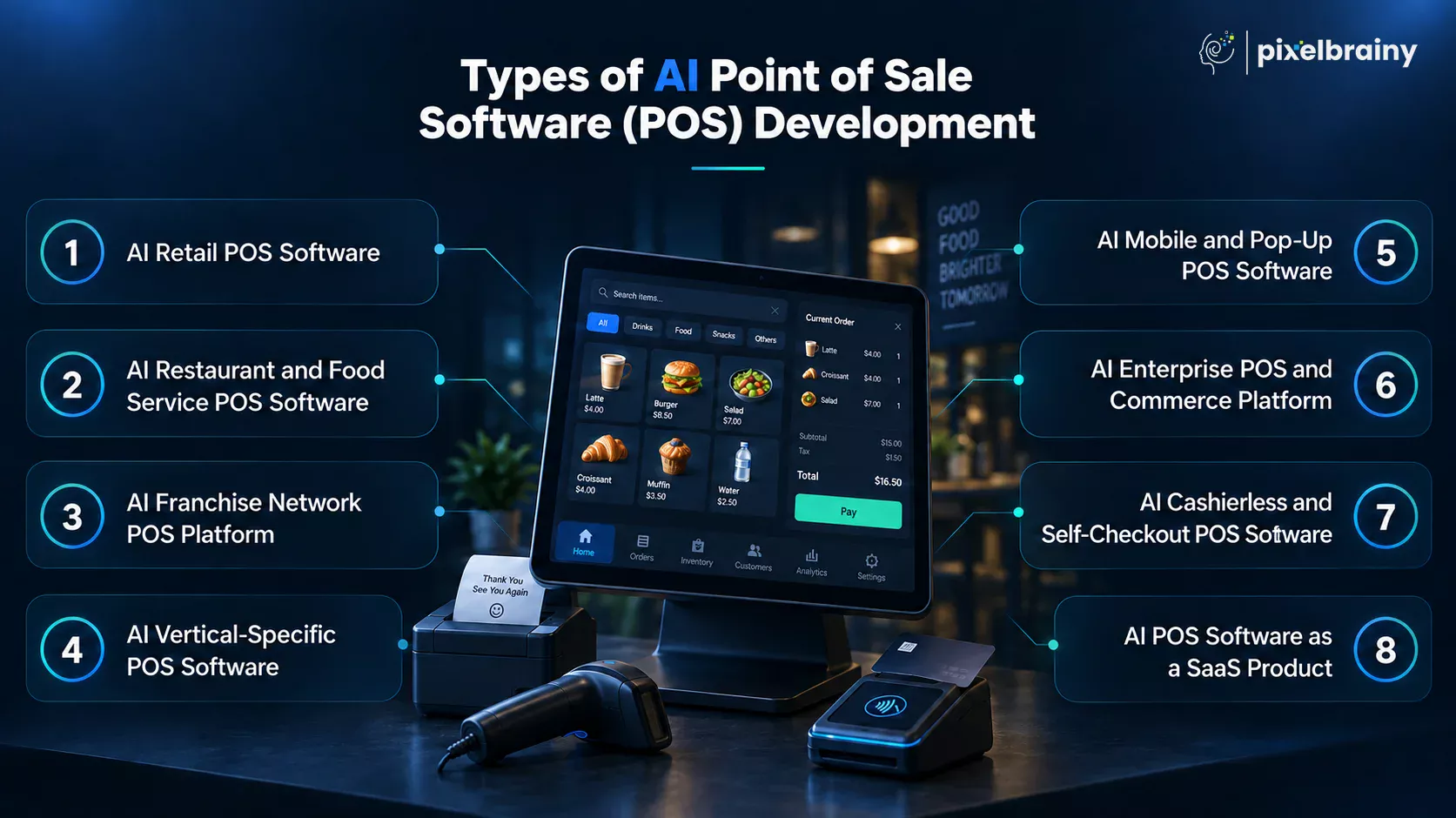
AI retail POS software is a comprehensive platform for brick-and-mortar retailers that combines transaction processing, inventory management, customer loyalty, AI demand forecasting, pricing recommendations, and multi-location management.
It can serve independent specialty stores as well as regional and national retail chains. Basic checkout functionality is increasingly commoditized, so differentiation comes from the quality of forecasting, inventory intelligence, personalization, and automated recommendations.
Key product design implication: Prioritize real-time inventory, predictive analytics, pricing intelligence, customer insights, and flexible multi-location architecture.
AI restaurant POS software is designed specifically for restaurants, quick-service businesses, cafes, and food service operations. It can include table management, kitchen display system integration, menu management, online ordering, tip management, food demand forecasting, menu engineering, labor optimization, and AI-powered upsell recommendations.
Restaurant workflows differ substantially from traditional retail because orders involve modifiers, preparation times, kitchen routing, table status, and service workflows.
Key product design implication: Design the POS around restaurant operations first, then embed AI into ordering, staffing, menu, kitchen, and customer decisions.
An AI franchise POS platform provides centralized visibility and control across franchise locations while allowing franchisees to manage approved local operations.
A common real-world requirement is: “We want to build a proprietary AI POS software that all franchisees are required to use, giving us network-wide sales visibility, AI-powered performance benchmarking across locations, and centralized control over pricing and menu updates. What features and architecture should the platform include?”
The platform can provide network-wide benchmarking, pricing compliance monitoring, centralized product or menu updates, franchise-level dashboards, and AI recommendations identifying locations that need operational support.
Key product design implication: Build centralized governance with location-level permissions, configurable workflows, standardized data models, and AI benchmarking across the entire franchise network.
AI vertical-specific POS software is purpose-built for an industry's unique operational, regulatory, and compliance requirements.
For example, a cannabis POS may require age verification, purchase-limit enforcement, seed-to-sale tracking integration, and state-specific regulatory reporting. A pharmacy POS may require prescription integrations and medication-related intelligence, while specialty food retail may require perishable inventory forecasting and waste reduction.
A real-world development requirement could be: “I am building an AI point of sale software specifically for the cannabis retail market, where age verification, purchase-limit enforcement, seed-to-sale tracking, and state-specific reporting create complexity that generic POS platforms handle inconsistently. What should the system include?”
Key product design implication: Regulatory compliance and industry-specific workflows must be embedded into the core architecture rather than added as optional modules.
AI mobile POS software is designed for food trucks, farmers markets, pop-up retailers, mobile vendors, and service businesses operating outside permanent locations.
The platform should support mobile payments, offline transactions, cloud synchronization, lightweight inventory management, and AI demand forecasting based on location, weather, events, and historical sales.
Key product design implication: Prioritize offline reliability, mobile-first UX, fast checkout, secure payment processing, and location-aware AI forecasting.
AI enterprise POS software is designed for large retail chains, typically with dozens or hundreds of locations. It can combine POS transactions with cross-location demand forecasting, centralized pricing optimization, supply chain intelligence, customer data platform integration, and real-time executive dashboards.
For businesses researching how to build scalable AI point of sale software for enterprise retail chains in 2026, the platform must also support high availability, security, disaster recovery, data governance, and integration with ERP, CRM, e-commerce, and supply chain systems.
Key product design implication: Build for enterprise scale from the beginning, including resilient infrastructure, centralized data governance, API-first integrations, role-based access, and real-time data processing.
AI cashierless and self-checkout POS software combines computer vision, sensors, product recognition, voice AI, and transaction processing to reduce or eliminate traditional cashier intervention.
An advanced drive-through use case could involve computer vision reading drive-through order boards, natural-language voice AI processing customer orders without manual item entry, and AI predicting the next likely add-on based on the current order and historical upsell patterns.
This type of POS requires much more than a conventional checkout application. It may involve computer vision models, speech recognition, natural-language processing, sensor fusion, product recognition, recommendation engines, and real-time payment processing.
Key product design implication: Design the AI perception, voice, recommendation, transaction, and payment layers as an integrated real-time system with human fallback when AI confidence is low.
AI POS SaaS is a commercial platform developed by a software company and offered to multiple retail or hospitality businesses through subscription pricing.
Unlike a custom enterprise POS, the SaaS product must support multiple business models through configuration while maintaining consistent AI performance. Multi-tenancy, data isolation, configurable workflows, subscription management, APIs, and scalable AI infrastructure become essential.
Key product design implication: Build a multi-tenant, API-first, configurable architecture that allows customers to customize products, pricing, permissions, workflows, and AI features without creating separate versions of the platform.
Ultimately, selecting the right AI POS model determines the regulatory requirements, integration complexity, AI architecture, development investment, and go-to-market strategy before development begins.
A modern retailer can now access sophisticated POS capabilities without building everything from scratch. Square supports real-time inventory synchronization and cross-location inventory visibility, while Lightspeed provides grocery-focused inventory and checkout capabilities. Toast currently offers grocery features such as real-time inventory tracking, AI invoice scanning, pricing insights, and its Toast IQ AI assistant.
The real question is not whether an off-the-shelf POS is capable. It is whether the platform can support the specific operational intelligence and competitive differentiation your business needs.
| Factor | Custom AI POS Software | Off-the-Shelf POS |
|---|---|---|
| Initial investment | Higher | Lower |
| Deployment speed | Slower | Faster |
| Custom workflows | Highly flexible | Limited to available configuration |
| AI capabilities | Built around business data and goals | Vendor-defined |
| Integrations | Fully customizable | Dependent on APIs and integrations |
| Data strategy | Greater control | Vendor-dependent |
| Maintenance | Your responsibility | Primarily vendor-managed |
| Scalability | Designed around your requirements | Depends on vendor platform |
| Competitive differentiation | High | Usually limited |
| Best for | Unique, complex operations | Standard retail requirements |
An off-the-shelf solution is usually the practical option when your business needs established POS capabilities such as payments, inventory, purchasing, employee management, reporting, loyalty, and multi-location operations.
For example, Square supports inventory synchronization across locations and stock transfers, while Toast provides real-time inventory tracking, low-stock alerts, offline functionality, and AI-assisted retail workflows.
Buying an established platform can therefore reduce development time, implementation risk, infrastructure responsibility, and ongoing software maintenance.
Custom AI POS software development becomes more compelling when standard platforms cannot accommodate your most important business processes.
A grocery chain may need proprietary fresh-food demand forecasting, cross-store inventory optimization, waste prediction, supplier intelligence, or an AI buyer copilot connected to internal purchasing rules.
A franchise network may require centralized pricing governance and AI benchmarking across hundreds of locations. A specialized retailer may require industry-specific compliance workflows that cannot be adequately represented through standard POS configuration.
In these situations, the objective to build AI point of sale software is not to recreate basic checkout functionality. It is to own the intelligence and workflows that provide a competitive advantage.
Before deciding to develop AI point of sale software, evaluate:
1. Are your workflows genuinely unique?
If most requirements are standard, buying is often more economical.
2. Do you have proprietary data?
Custom AI becomes more valuable when transaction, inventory, customer, and operational data can produce differentiated predictions.
3. Can existing APIs support your integrations?
If a platform cannot connect effectively with your ERP, supply chain, loyalty, e-commerce, or internal systems, custom development becomes more attractive.
4. Can AI improve measurable KPIs?
Focus on inventory turnover, waste, margins, labor productivity, checkout speed, stockouts, and customer retention.
5. Can your organization maintain the platform?
Custom software requires continuous investment in security, infrastructure, integrations, AI model monitoring, updates, and support.
The Hybrid Approach:
For many mid-size retailers, the strongest strategy is a hybrid model. Use an established POS for proven functions such as payments and transaction processing, then develop a custom AI layer for forecasting, analytics, recommendations, pricing intelligence, and automation.
This approach avoids rebuilding capabilities that are already mature while allowing the retailer to create proprietary intelligence where it matters most.
The best AI POS strategy is often to buy the commoditized transaction layer and build the proprietary intelligence that can create measurable competitive advantage.
A successful AI point of sale software development project begins with dependable POS fundamentals. Before retailers add advanced AI capabilities, the platform must reliably manage payments, checkout, products, inventory, customers, employees, reporting, and multiple locations.
A real business question illustrates this requirement clearly: “We operate an 18-location grocery chain with a 12-year-old POS that cannot process contactless payments or provide real-time inventory visibility. What core features should we prioritize when we build AI point of sale software?”
For this type of retailer, the answer starts with a modern operational foundation. AI POS software development should create accurate, connected, real-time data flows that can later support forecasting, recommendations, automation, and other advanced capabilities.
The following 15 features represent the essential foundation for businesses planning to develop AI POS software for retail, grocery, restaurant, or multi-location operations.
| Core Feature | Feature Explanation |
|---|---|
| Payment Processing | Supports cards, contactless payments, digital wallets, gift cards, and approved alternative methods while connecting securely with payment processors for reliable, fast, and compliant transaction completion across every store securely today. |
| POS Checkout | Provides a fast cashier interface for scanning products, searching items, managing quantities, applying approved discounts, accepting payments, and completing transactions with minimal steps during busy periods efficiently for customers quickly. |
| Product and SKU Management | Centralizes SKUs, barcodes, product names, categories, variants, units, taxes, prices, and attributes, allowing authorized teams to create, update, deactivate, and synchronize products consistently across multiple locations and online sales channels. |
| Inventory Management | Tracks inventory quantities across stores while supporting receiving, adjustments, counting, transfers, replenishment alerts, and synchronization, giving retailers accurate stock visibility for operational decisions and purchasing activities across the entire business. |
| Multi-Location Management | Provides headquarters with centralized control over stores, registers, products, inventory, pricing, and sales while allowing location-specific permissions and operational settings for distributed retail businesses across regions with consistent governance consistently. |
| Customer Management | Maintains customer profiles, purchase history, preferences, contact information, memberships, and account details, creating a unified foundation for service, loyalty programs, personalized communication, and future AI capabilities across channels and touchpoints. |
| Loyalty Management | Manages customer enrollment, points, rewards, membership tiers, coupons, and redemption rules while connecting loyalty activity directly with transactions for consistent benefits and improved customer engagement throughout the lifecycle across locations. |
| Employee Management | Controls employee accounts, roles, permissions, shifts, manager approvals, and activity records, helping retailers restrict sensitive actions such as refunds, discounts, voids, and pricing changes according to responsibilities and policies companywide. |
| Sales Reporting | Provides timely reporting for revenue, transactions, products, departments, taxes, refunds, discounts, and margins, replacing delayed reporting with centralized operational visibility for management teams and buyers across locations and departments organizationwide. |
| Returns and Refunds | Supports full and partial refunds, exchanges, transaction lookup, return reasons, approvals, and inventory adjustments while maintaining complete records for financial reconciliation, auditing, compliance, and employee accountability across every transaction channel. |
| Purchase Order Management | Enables retailers to create supplier orders, specify products and quantities, track expected deliveries, receive merchandise, and update inventory while improving purchasing accuracy and reducing duplicate data entry throughout procurement efficiently. |
| Pricing and Promotions | Manages standard prices, promotional pricing, discounts, coupons, bundles, and location-specific rules, helping retailers maintain consistent pricing while supporting approved variations across stores, regions, and customer groups while supporting centralized governance. |
| Offline POS Capability | Allows essential checkout operations during connectivity interruptions through local transaction processing, secure storage, synchronization queues, and conflict handling, helping stores continue selling until connectivity returns without major disruption for customers. |
| Hardware Integration | Connects scanners, receipt printers, cash drawers, customer displays, payment terminals, scales, and other retail hardware through standardized interfaces, simplifying deployment, maintenance, troubleshooting, and future equipment upgrades across different store formats. |
| API and Third-Party Integrations | Connects POS data with ERP, accounting, CRM, ecommerce, payment processors, loyalty platforms, suppliers, and applications through APIs, enabling consistent information flow across the retail technology ecosystem without fragmented data silos. |
These core capabilities create the operational foundation required for AI retail POS software development, ensuring transaction, inventory, customer, payment, and business data remain accurate and connected before advanced AI functionality is introduced.
A reliable AI POS starts with strong core functionality, because intelligent retail decisions depend on accurate transactions, inventory, customer data, and connected operations.
Once the core POS foundation is reliable, advanced AI capabilities can turn the platform from a transaction processing system into an intelligent retail decision engine. For businesses planning to build AI point of sale software, these features can help transform transaction, inventory, customer, and operational data into predictive insights and automated recommendations.
A real business query illustrates the opportunity: “We want to build an AI POS system that predicts which products each store will need, identifies fresh-food waste risks, detects suspicious transactions, recommends promotions, and gives managers actionable answers without requiring them to analyze multiple dashboards. Which advanced AI features should we prioritize?”
The right features should be selected according to measurable business objectives rather than simply adding AI for differentiation. The following capabilities are particularly relevant when developing an AI POS software for modern retail and grocery operations.
| Advanced Feature | Feature Explanation |
|---|---|
| AI Demand Forecasting | Analyzes historical sales, seasonality, promotions, holidays, weather, local events, and store-level patterns to predict future product demand and help retailers improve purchasing, replenishment, inventory allocation, and availability. |
| Predictive Inventory Replenishment | Uses predicted demand, current inventory, supplier lead times, safety stock, and sales velocity to recommend when and how much inventory each location should order, reducing stockouts and unnecessary overstock. |
| Fresh-Food Waste Prediction | Evaluates product shelf life, inventory levels, sales velocity, expiration dates, promotions, and local demand to identify products at risk of spoilage and recommend transfers, markdowns, or ordering adjustments. |
| AI Dynamic Pricing Recommendations | Analyzes demand, inventory levels, product performance, margins, promotions, and market conditions to recommend pricing adjustments while allowing authorized managers to review and approve changes before implementation across selected locations. |
| AI-Powered Product Recommendations | Examines purchase histories, basket relationships, customer preferences, and product associations to recommend relevant products, bundles, and complementary items during checkout, online ordering, loyalty interactions, or promotional campaigns. |
| Fraud and Anomaly Detection | Continuously analyzes transactions, refunds, voids, discounts, employee activity, and purchasing patterns to identify unusual behavior and generate alerts for management investigation before potential losses become significant. |
| Natural-Language Analytics | Allows managers and buyers to ask questions using everyday language, such as identifying declining products or low-stock stores, while the AI converts requests into data queries and presents understandable business insights. |
| AI Retail Management Copilot | Provides managers with contextual answers, performance explanations, inventory recommendations, and operational suggestions by combining POS, inventory, sales, and business data into a conversational decision-support experience for daily retail management. |
| AI Customer Personalization | Combines loyalty activity, purchase history, preferences, product interactions, and transaction behavior to generate personalized promotions, recommendations, offers, and customer segments that improve engagement and potentially increase basket value. |
| Computer Vision and AI Checkout | Uses computer vision, image recognition, sensors, and AI models to recognize products, support self-checkout, identify checkout anomalies, monitor shelf conditions, and create faster automated purchasing experiences for suitable retail environments. |
For companies making AI point of sale software, advanced capabilities should be introduced according to business impact, data availability, model accuracy, integration readiness, and operational risk.
Advanced AI features can transform a POS from a system that records retail activity into an intelligent platform that predicts demand, identifies problems, and recommends what businesses should do next.
Building an AI POS requires more than adding artificial intelligence to an existing checkout system. It combines retail workflows, payment processing, inventory, data engineering, cloud infrastructure, security, and AI.
A real business question is: “We want to replace our outdated retail POS with a system that provides real-time inventory, AI demand forecasting, smarter reporting, and personalized recommendations. What is the safest way to build and launch it without disrupting our stores?”
The following development process of AI Point of Sale (POS) Software explains how to move from an initial idea to a production-ready platform.
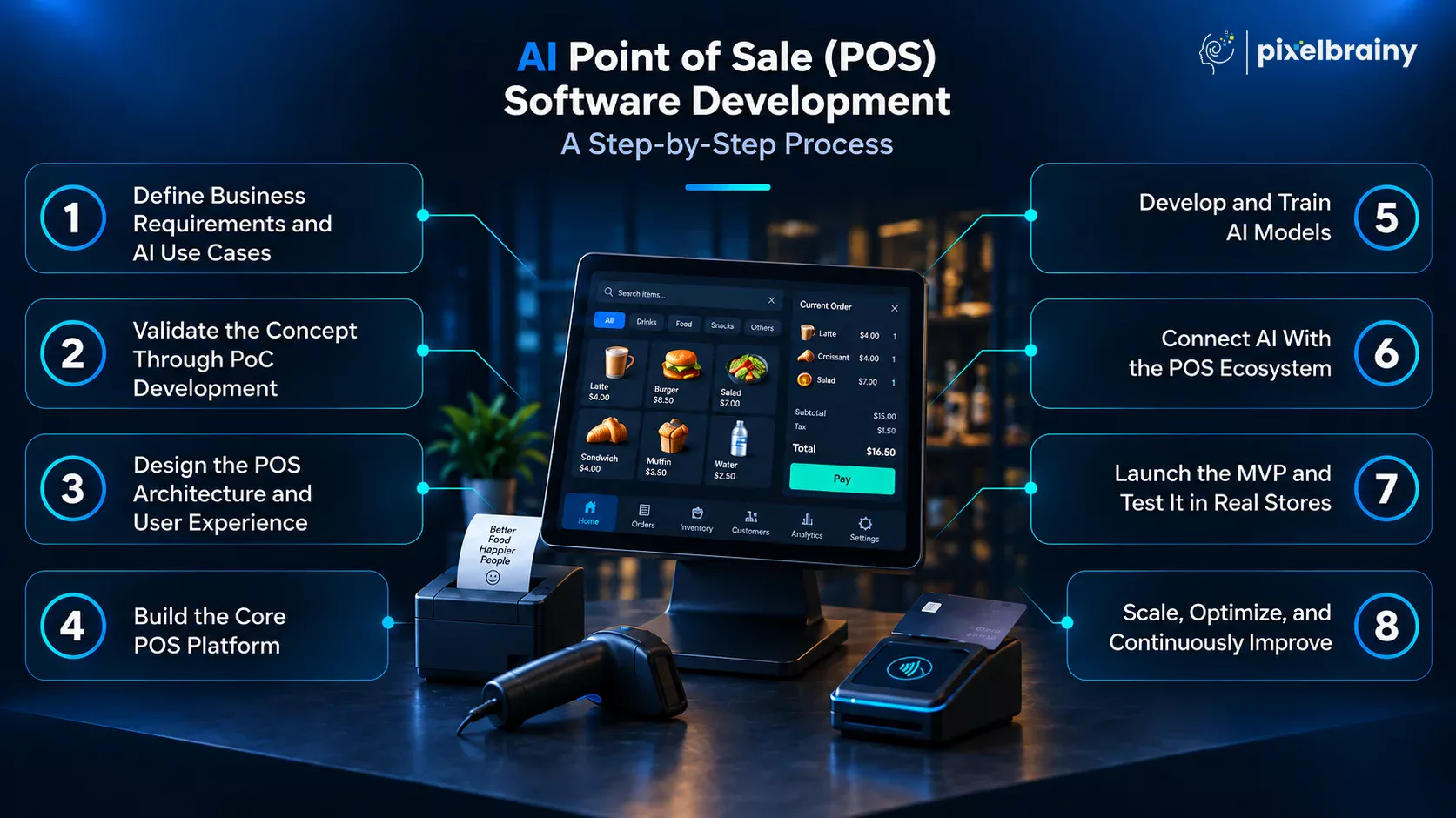
The first step is to understand how the business currently operates. Document checkout, inventory, purchasing, payments, customer management, reporting, employee workflows, and multi-location operations.
Identify the problems that the new system must solve. These may include stockouts, delayed reporting, payment limitations, inventory inaccuracies, fresh-food waste, or inefficient purchasing.
Next, determine where AI can create measurable value. Prioritize use cases according to business impact, available data, technical feasibility, and expected ROI.
An AI consultation can help define the product scope, technology roadmap, AI opportunities, integrations, and implementation priorities before development begins.
Deliverable: Business requirements document, AI use-case roadmap, feature priorities, KPIs, and development plan.
Before investing in the complete platform, validate the highest-risk technical and business assumptions.
PoC development can determine whether existing transaction data is sufficient for demand forecasting, whether legacy systems can provide required information, and whether proposed AI models can achieve acceptable accuracy.
For example, a grocery retailer could test whether historical sales data can accurately predict demand for selected products across several stores.
This stage helps identify data-quality problems, integration limitations, model performance issues, and technical risks before full development.
Deliverable: Validated proof of concept, technical findings, AI feasibility results, and refined project scope.
The architecture should define how the POS application, store systems, cloud backend, databases, APIs, payment services, inventory services, analytics, and AI components communicate.
Offline capability should also be considered because stores must continue processing essential transactions when internet connectivity fails.
The user experience requires equal attention. Cashiers need fast and simple workflows, while managers, buyers, and administrators require deeper dashboards and controls.
A specialized UI/UX design company can help create interfaces that keep AI useful without making checkout unnecessarily complicated.
Deliverable: Technical architecture, database design, API structure, user journeys, wireframes, and interface specifications.
Core POS functionality should be developed before advanced AI capabilities are introduced.
This includes checkout, payments, product management, inventory, customers, loyalty, employees, returns, reporting, pricing, purchase orders, and multi-location management.
Hardware integrations may include barcode scanners, receipt printers, cash drawers, payment terminals, scales, and customer displays.
Offline transaction processing and secure synchronization should also be implemented during this stage.
The objective is to create a stable transaction platform that can reliably collect and process the data required by future AI features.
Deliverable: Functional POS platform with core retail workflows and required hardware integrations.
Once reliable data pipelines are available, the development team can begin AI model development.
Potential models can support demand forecasting, inventory prediction, fraud detection, product recommendations, customer segmentation, waste prediction, and pricing recommendations.
Historical transaction, inventory, promotion, customer, and store data must first be cleaned and structured for model training.
Models should be evaluated using business metrics. For example, demand forecasting should be measured against forecast accuracy and its effect on stockouts, overstocking, and inventory turnover.
Deliverable: Tested AI models, evaluation metrics, training datasets, and model performance benchmarks.
Also Read: Top 12+ AI Model Development Companies in the USA
The next stage is AI integration with the operational POS environment.
AI recommendations should appear where employees can actually use them. A demand forecast might appear in a buyer's replenishment dashboard, while an anomaly alert could appear in a store manager's activity panel.
Critical financial or operational decisions should not depend entirely on uncontrolled AI outputs.
Use confidence thresholds, human approvals, audit trails, permissions, and fallback processes for high-impact recommendations.
Deliverable: Integrated AI workflows, recommendation interfaces, alerts, approval mechanisms, and data connections.
An MVP development strategy allows retailers to launch essential functionality before building every planned feature.
The initial version could include checkout, modern payment processing, inventory visibility, reporting, multi-location management, and one or two high-value AI capabilities.
Do not immediately deploy the system across every location. Start with a small group of representative stores.
Measure checkout speed, payment reliability, inventory accuracy, synchronization, AI performance, employee adoption, and customer experience.
Deliverable: Production MVP, pilot-store results, user feedback, performance data, and prioritized improvements.
Also Read: Top 10 AI MVP Development Companies in USA
After the pilot demonstrates reliability and measurable value, gradually expand the platform to additional stores and business functions.
Monitor uptime, transaction performance, security, inventory synchronization, API reliability, and AI model accuracy.
AI models should be retrained as new transaction data becomes available. Model drift should also be monitored because customer behavior, product demand, promotions, and market conditions change.
Experienced top AI development companies or AI product development companies can support scaling, model optimization, security improvements, integrations, and new AI capabilities.
The long-term objective is to develop AI POS system capabilities that continuously improve retail operations rather than treating the initial launch as the end of development.
From idea validation to store-wide deployment, a phased AI POS development process reduces risk while creating a scalable foundation for intelligent retail operations.
The cost to develop an AI point of sale software typically ranges from $30,000 to $200,000+, depending on the software scope, number of locations, AI capabilities, integrations, hardware requirements, security standards, and development team. A basic AI POS can be developed with a smaller budget, while an enterprise-grade platform with advanced AI, multi-location management, real-time analytics, and complex integrations can require a significantly larger investment.
For businesses planning the development budget of AI POS software, cost should not be estimated only from the number of screens or features. The AI POS software development cost also depends on data engineering, AI model development, payment integrations, cloud infrastructure, security, testing, migration, and ongoing maintenance.
So, what is the development pricing of AI POS software for a retail business? The following ranges provide a practical starting point for AI POS software cost estimation.
| AI POS Software Type | Estimated Development Cost | Typical Scope |
|---|---|---|
| Basic AI POS Software | $30,000 to $60,000 | Checkout, payment integration, product management, basic inventory, customer management, reporting, offline capability, and one or two basic AI features |
| Advanced AI POS Software | $60,000 to $120,000 | Multi-location management, advanced inventory, loyalty, analytics, AI demand forecasting, recommendations, anomaly detection, third-party integrations, and centralized dashboards |
| Enterprise AI POS Software | $120,000 to $200,000+ | Large-scale multi-location operations, enterprise integrations, advanced AI models, predictive analytics, custom workflows, high availability, security, data migration, extensive hardware integration, and dedicated support |
These are estimated development ranges. Actual AI POS software development cost can vary substantially based on project complexity and technology requirements.
Checkout, payments, product catalog, inventory, returns, employee management, customer profiles, reporting, and loyalty functionality determine the basic development effort.
Demand forecasting, predictive replenishment, personalization, fraud detection, pricing recommendations, and natural-language analytics can significantly increase the cost to develop an AI point of sale software.
Connecting payment gateways, contactless terminals, digital wallets, gift cards, and other payment methods adds integration, testing, and security requirements.
Managing multiple stores requires centralized inventory, pricing, product management, user permissions, transfers, reporting, and real-time synchronization.
ERP, CRM, accounting, e-commerce, loyalty, supplier, warehouse, payment, and workforce integrations can increase development costs depending on API availability and complexity.
Migrating data from a legacy POS may involve data extraction, cleansing, SKU mapping, validation, transformation, and synchronization.
Barcode scanners, payment terminals, receipt printers, cash drawers, customer displays, scales, and other POS hardware can require additional development and testing.
Authentication, encryption, access control, audit logs, secure APIs, monitoring, payment security, and applicable compliance requirements add to the overall development budget.
Cloud hosting, databases, APIs, storage, monitoring, backups, AI inference, and scalable infrastructure influence both initial development and ongoing operating costs.
After launch, businesses should budget for security updates, bug fixes, integrations, infrastructure, AI model monitoring, retraining, performance optimization, and new feature development.
For an accurate AI POS software development cost, businesses should first define the required POS scope, AI use cases, integrations, number of locations, hardware, and deployment model.
The right AI POS budget balances development investment with measurable gains in inventory efficiency, operational productivity, customer experience, and long-term retail growth.

A reliable AI point of sale software development project depends on the right combination of frontend technology, backend services, databases, payment infrastructure, cloud platforms, AI frameworks, APIs, security tools, and retail hardware integrations. The technology stack should support fast checkout, real-time inventory synchronization, offline operations, secure payments, multi-location management, and scalable AI workloads.
A practical real-world query is: “We want to build an AI POS system for multiple retail locations with contactless payments, real-time inventory, AI demand forecasting, customer analytics, and offline checkout. What technology stack should we use to make the system secure, scalable, and easy to integrate with our existing ERP?”
For businesses planning to build AI POS software, the stack should be selected according to transaction volume, store count, AI requirements, existing systems, security standards, and future scalability. A modular architecture also makes it easier to replace individual technologies without rebuilding the complete POS system.
| Technology Layer | Recommended Tools and Technologies | Purpose in AI POS Development |
|---|---|---|
| Frontend and POS Interface | React, Next.js, TypeScript, React Native | Build fast cashier interfaces, manager dashboards, inventory screens, customer applications, and responsive POS workflows across web, desktop, and mobile devices. |
| Backend Development | Node.js, NestJS, Python, FastAPI | Manage transactions, inventory, users, pricing, orders, APIs, business rules, and communication between the POS application and external systems. |
| Database | PostgreSQL, MySQL, Redis | Store transactional, product, inventory, customer, employee, and configuration data while Redis can support caching and low-latency operations. |
| Real-Time Data Processing | Apache Kafka, Amazon Kinesis, WebSockets | Synchronize transactions, inventory changes, store events, and operational data across locations while supporting real-time dashboards and AI data pipelines. |
| Cloud Infrastructure | AWS, Microsoft Azure, Google Cloud | Provide scalable computing, databases, storage, networking, monitoring, backups, AI infrastructure, and deployment capabilities for multi-location POS operations. |
| AI and Machine Learning | Python, PyTorch, TensorFlow, scikit-learn | Develop demand forecasting, inventory prediction, fraud detection, customer segmentation, recommendation, anomaly detection, and other machine learning capabilities. |
| Generative AI and LLMs | OpenAI, Azure OpenAI, Google Gemini, Anthropic Claude | Power natural-language analytics, AI management assistants, conversational reporting, product insights, and intelligent retail workflows where generative AI is appropriate. |
| Payment Integration | Stripe, Adyen, Square APIs, Worldpay | Connect the POS with payment processing infrastructure for card payments, contactless transactions, digital wallets, refunds, and other supported payment methods. |
| API and Integration Layer | REST APIs, GraphQL, API Gateway, MuleSoft | Connect the POS with ERP, CRM, accounting, e-commerce, loyalty, supplier, warehouse, payment, and workforce management systems. |
| Data and Analytics | Snowflake, BigQuery, Amazon Redshift, Power BI | Centralize retail data and provide analytics, dashboards, historical reporting, forecasting inputs, executive insights, and business intelligence. |
| POS Hardware Integration | Barcode scanners, receipt printers, cash drawers, payment terminals, scales | Connect physical retail hardware with the POS application to support scanning, payment, printing, weighing, cash management, and customer-facing workflows. |
| Offline Synchronization | Local database, synchronization queues, event-driven architecture | Keep essential POS operations running during connectivity interruptions and synchronize transactions, inventory, and updates after the connection is restored. |
| Security and Authentication | OAuth 2.0, OpenID Connect, AWS IAM, Azure AD | Protect user accounts, APIs, administrative functions, payment-related workflows, and sensitive retail information through authentication and role-based access controls. |
| DevOps and Deployment | Docker, Kubernetes, GitHub Actions, Terraform | Automate application deployment, infrastructure management, testing, scaling, monitoring, and release processes across development, staging, and production environments. |
| Monitoring and Observability | Datadog, Grafana, Prometheus, AWS CloudWatch | Monitor POS uptime, API performance, transaction failures, synchronization problems, infrastructure health, and AI service performance in real time. |
For businesses looking to develop AI POS software, this architecture creates a foundation where transaction data can move securely from stores into analytics and AI systems, then return actionable recommendations to buyers, managers, and operations teams.
A future-ready AI POS technology stack should combine reliable transaction infrastructure with real-time data, secure integrations, scalable cloud services, and AI capabilities that can evolve with the retailer.
An AI POS platform can generate revenue through several models, depending on whether the product is designed for independent retailers, restaurant groups, franchise networks, or large enterprise chains. The right model should balance predictable recurring revenue, customer acquisition costs, AI infrastructure expenses, payment economics, and the level of customization offered.
For example, a founder planning to build AI point of sale software as a commercial product may use a SaaS subscription, while an enterprise-focused provider could combine annual licensing with implementation, integration, and premium AI services.
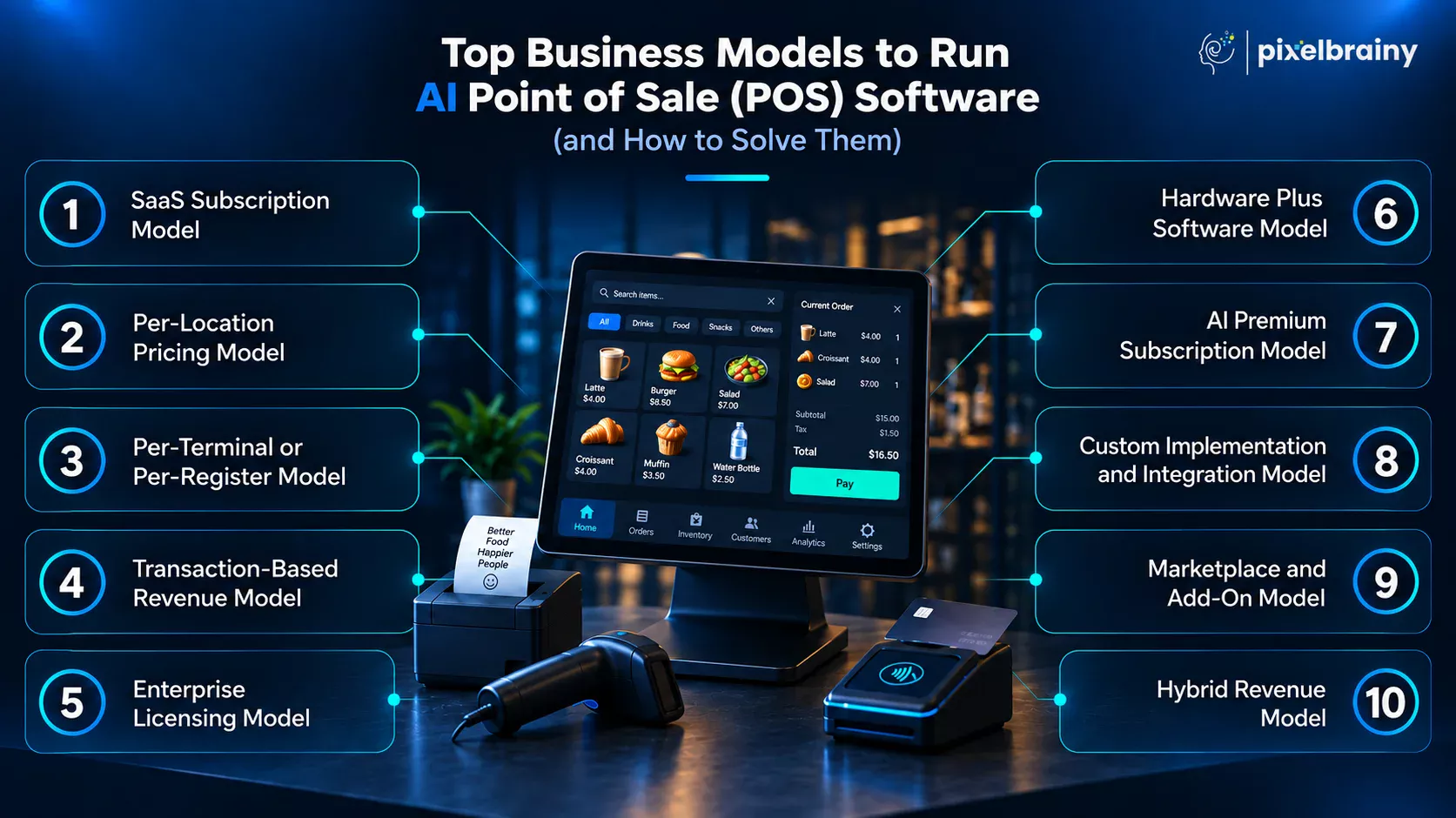
The SaaS model charges retailers a recurring monthly or annual fee for access to the AI POS platform.
Pricing can be based on stores, registers, users, locations, or subscription tiers. This model creates predictable recurring revenue while allowing the software provider to continuously deliver updates, security improvements, and new AI capabilities.
Best for: Retail SaaS startups, multi-location retailers, restaurants, and growing businesses.
Under this model, customers pay a fixed subscription for each store or operating location.
For example, a retailer with 10 locations pays more than a retailer operating three locations. This model is straightforward for customers and allows revenue to grow naturally as customers expand.
Best for: Franchise networks, grocery chains, retail groups, and multi-location businesses.
The provider charges according to the number of active POS terminals or registers.
This model works well when customers have different store sizes and register requirements. A small store with two terminals pays less than a high-volume store operating 15 terminals.
Best for: Supermarkets, restaurants, convenience stores, and high-volume retailers.
The platform generates revenue based on the number or value of transactions processed through the POS.
The provider may charge a fixed transaction fee, percentage-based fee, or combination of software and payment charges.
This model can create strong recurring revenue as customer transaction volumes increase.
Best for: Payment-integrated POS platforms, restaurants, retailers, and high-volume businesses.
Large retailers can purchase annual or multi-year licenses covering a defined number of stores, users, or business units.
Enterprise contracts can include dedicated infrastructure, advanced AI capabilities, premium support, security services, and customized integrations.
Best for: Large retailers, enterprise restaurant groups, franchise organizations, and businesses with complex technology environments.
The provider combines POS software with compatible hardware such as terminals, barcode scanners, receipt printers, cash drawers, scales, and payment devices.
Revenue comes from hardware sales or leasing combined with recurring software subscriptions.
Best for: New retailers, small businesses, restaurants, mobile vendors, and companies replacing outdated POS equipment.
A basic POS package can handle conventional operations, while advanced AI capabilities are offered through premium subscription tiers.
For example, the standard plan could provide POS, inventory, and reporting, while higher tiers provide demand forecasting, predictive replenishment, personalized recommendations, anomaly detection, and AI management assistants.
Best for: SaaS companies seeking higher average revenue per customer.
Revenue can also come from implementation services, data migration, custom integrations, hardware deployment, workflow configuration, employee training, and system customization.
This model is particularly useful when selling AI POS software to enterprise customers with complex technology ecosystems.
Best for: Enterprise AI POS providers and custom software development businesses.
An AI POS provider can create an ecosystem where third-party applications connect to the platform through APIs.
Additional revenue can come from premium integrations, partner applications, analytics modules, loyalty services, marketing tools, and specialized AI capabilities.
Best for: Mature POS platforms seeking ecosystem-based growth.
A hybrid model combines several revenue streams, such as SaaS subscriptions, payment processing, hardware, implementation, premium AI features, and enterprise services.
For example, an AI POS provider could charge a monthly platform fee, collect payment-related revenue, sell hardware, and offer advanced forecasting as an enterprise add-on.
Best for: Scalable AI POS businesses serving customers across multiple segments.
For most AI POS startups, a SaaS subscription plus premium AI features provides a strong foundation for recurring revenue. Enterprise providers can add implementation, integration, hardware, and transaction-based revenue to increase customer lifetime value.
A successful AI POS business model monetizes not only transactions, but also the intelligence, automation, integrations, and operational value delivered on top of the POS platform.
Building an AI POS involves much more than developing checkout screens and connecting an AI model. Retail POS software must process transactions reliably while handling payments, inventory, customer data, hardware, integrations, security, and real-time operations. Adding AI introduces additional requirements around data quality, model accuracy, governance, and human oversight.
A real business query captures the challenge: “We want to replace our legacy POS with an AI-powered system across multiple retail locations, but we are concerned about payment reliability, offline operation, inaccurate AI recommendations, data migration, and integration with our existing ERP. What are the biggest risks, and how can we reduce them before launch?”
For businesses planning to develop AI POS software, identifying these risks before development can reduce implementation costs and prevent operational disruptions.
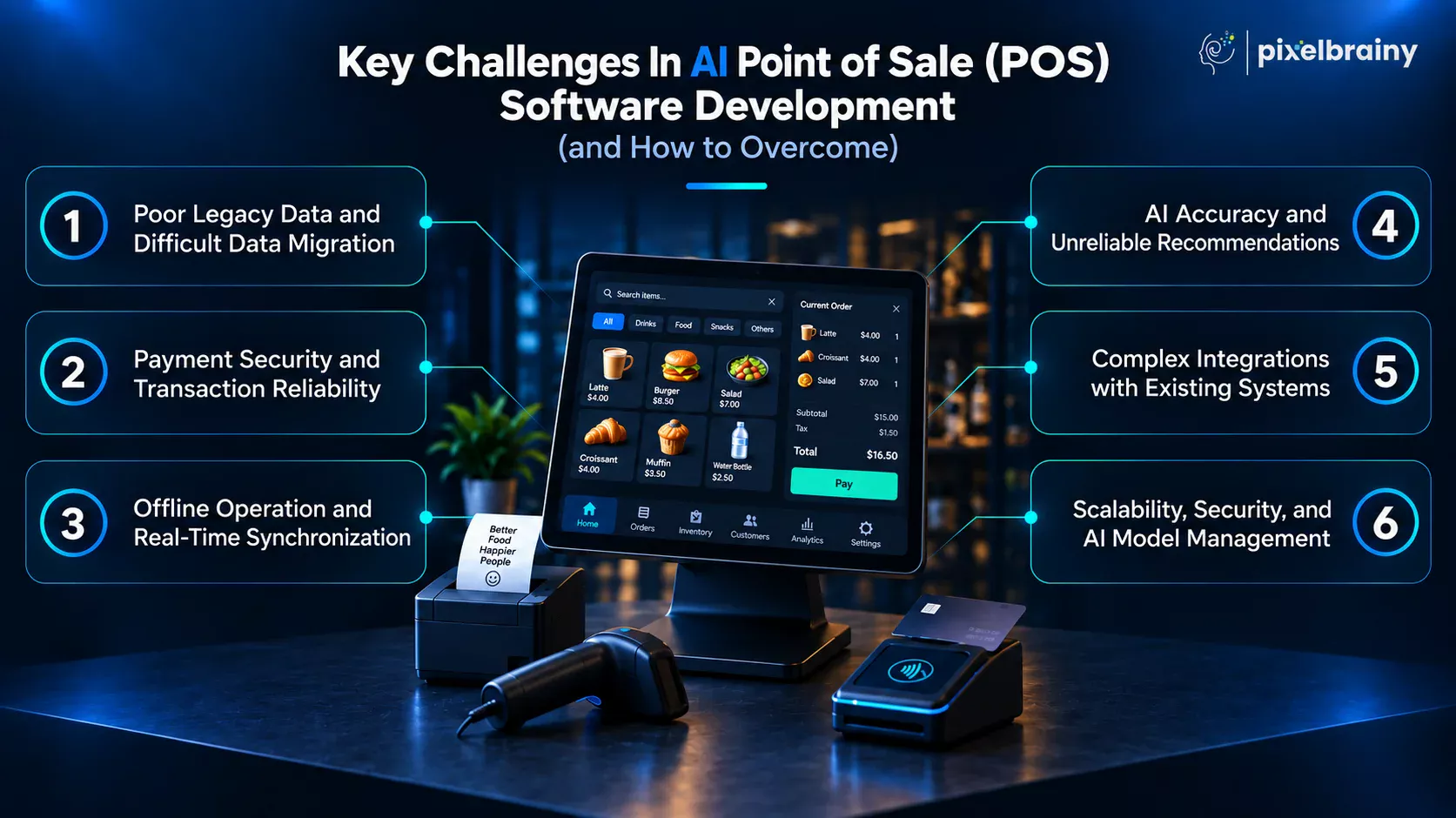
Challenge:
Legacy POS systems often contain inconsistent SKU records, duplicate products, outdated customer information, incomplete transaction histories, and incompatible database structures. Poor-quality historical data can also reduce the accuracy of AI models.
Solution:
Begin with a detailed data audit before migration. Clean duplicate records, standardize product information, map legacy fields to the new data model, and validate historical transactions. Use staged migration and reconciliation processes rather than moving everything at once.
For AI point of sale software development, clean transactional and inventory data should be treated as a core technology requirement, not a secondary task.
Challenge:
POS software handles financially sensitive transactions, making payment security, authentication, encryption, and compliance critical. A payment failure can immediately affect revenue and customer experience.
Solution:
Use established payment processors and secure payment technologies instead of unnecessarily storing sensitive card information. Implement encryption, access controls, audit logging, secure APIs, monitoring, and appropriate compliance processes.
The payment layer should remain deterministic and reliable, while AI operates around transaction intelligence rather than making unpredictable payment decisions.
Challenge:
Retail stores cannot always depend on continuous internet connectivity. A network outage can prevent transactions, create synchronization conflicts, or produce inaccurate inventory information if the architecture is not designed for offline operation.
Solution:
Implement local transaction processing, encrypted local storage, synchronization queues, conflict resolution, and automatic cloud synchronization after connectivity returns.
Businesses looking to build AI point of sale software should test offline scenarios during development, including internet outages, duplicate transactions, partial synchronization, and hardware failures.
Challenge:
AI forecasting or recommendation systems can produce incorrect results because of incomplete data, unusual purchasing patterns, seasonal changes, model drift, or insufficient training data.
An inaccurate demand forecast could cause overstocking, stockouts, or unnecessary waste.
Solution:
Start with clearly defined AI use cases and measurable performance thresholds. Validate models using historical data, continuously monitor accuracy, retrain models when conditions change, and introduce human approval for high-impact recommendations.
AI should support business decisions rather than automatically controlling critical operations without safeguards.
Challenge:
A modern POS often needs to connect with ERP, accounting, CRM, e-commerce, loyalty, payment, supplier, warehouse, and workforce management systems. Poor integration can create duplicate data, synchronization problems, and operational inconsistencies.
Solution:
Use an API-first architecture with standardized data models and a dedicated integration layer. Establish clear ownership for each data source and define how information moves between systems.
Before developing an AI POS software, document every required integration and identify whether the existing platform provides reliable APIs or requires custom connectors.
Challenge:
A POS that works for five stores may behave differently when deployed across 100 or more locations. Transaction volume, concurrent users, data storage, AI inference, integrations, and security requirements can increase significantly as the platform grows.
AI models also require ongoing monitoring for performance degradation, data drift, and unexpected outputs.
Solution:
Use scalable cloud infrastructure, modular services, monitoring, automated testing, role-based access, disaster recovery, and centralized observability. AI models should have version control, performance monitoring, retraining workflows, and rollback capabilities.
For enterprise AI POS software development, scalability and AI governance should be designed into the architecture from the beginning rather than added after launch.
The most successful AI POS projects manage reliability, data quality, security, integrations, and AI accuracy together instead of treating them as separate development challenges.
An AI POS system affects almost every part of a retail business, from checkout and payments to inventory, customer management, reporting, and purchasing. Before investing in AI point of sale software development, businesses should define what the system must accomplish, which AI capabilities are genuinely valuable, and how the new platform will operate alongside existing technology.
A real business query is: “We operate a growing retail chain and want to build an AI POS system, but we need to understand the technology, data, integrations, security, cost, and scalability requirements before committing to development. What should we evaluate first?”
The following six considerations can help businesses create a practical roadmap for developing an AI POS software and avoid expensive architectural or operational mistakes.
The first consideration is the exact scope of the POS system. Define whether the platform will support a single store, multiple locations, franchise operations, enterprise retail, restaurant workflows, or a specialized vertical.
Document essential system requirements such as checkout, payments, inventory, product management, customer profiles, loyalty, reporting, employee permissions, purchasing, returns, and multi-location management.
Then identify where AI adds measurable value, such as demand forecasting, inventory recommendations, fraud detection, personalization, or predictive analytics.
Key consideration: Build the system around specific business problems rather than adding AI features simply because they are technically possible.
AI capabilities depend on reliable data. Before building the system, evaluate the quality, structure, availability, and accessibility of historical POS transactions, inventory records, customer information, product catalogs, promotions, and supplier data.
Legacy systems may contain duplicate SKUs, inconsistent product names, missing transaction fields, or incomplete historical records.
The development team should establish a data architecture that supports real-time POS transactions and future AI model training.
Key consideration: Treat data quality as a foundational system requirement because inaccurate data can produce inaccurate AI recommendations.
A modern AI POS rarely operates independently. The system may need integrations with payment processors, ERP software, accounting platforms, CRM systems, e-commerce applications, loyalty programs, supplier platforms, warehouse systems, and retail hardware.
An API-first architecture can make these integrations easier to manage and expand.
The architecture should also define how store-level systems communicate with cloud services, how data is synchronized, and how the system behaves during connectivity failures.
Key consideration: Design the POS system as part of the broader technology ecosystem rather than as an isolated application.
POS systems process sensitive business and customer information, making security a critical consideration. Payment information, customer records, employee activity, transaction history, and operational data should be protected through appropriate security controls.
The system should include authentication, role-based permissions, encryption, audit logging, secure APIs, monitoring, backups, and disaster recovery.
Retailers should also identify applicable payment, privacy, tax, and industry-specific compliance requirements before development begins.
Key consideration: Security and compliance should be built into the system architecture from the beginning rather than added after development.
A POS system designed for five locations may not support the transaction volume and complexity of a 100-location retail chain. Scalability should therefore be considered from the earliest architecture stage.
The system should support increasing transactions, users, stores, products, integrations, and AI workloads without major redesign.
Businesses should also leave room for future capabilities such as AI assistants, predictive inventory, personalized promotions, intelligent pricing, and computer vision.
Key consideration: Build a modular system that can scale with business growth and accommodate new AI capabilities without rebuilding the entire platform.
Before building an AI point of sale software, businesses should establish a realistic budget covering development, hardware, cloud infrastructure, AI models, integrations, security, testing, deployment, training, and ongoing maintenance.
The investment should be connected to measurable business outcomes such as reduced inventory waste, fewer stockouts, faster checkout, improved margins, lower labor costs, or higher customer retention.
A phased MVP can reduce risk by validating the most valuable features before expanding the complete system.
Key consideration: Define ROI targets and prioritize development around features that can produce measurable business value.
A well-planned AI POS system aligns business goals, data, technology, security, scalability, and ROI before development resources are committed.
From the strategy, features, architecture, development process, and challenges discussed above, it is now time to identify the right development partner. An AI POS project requires strong retail understanding, AI expertise, integration capabilities, scalable architecture, and a clear focus on measurable business outcomes.
For a retailer asking, “We need to modernize our legacy POS, connect real-time inventory and payments, introduce AI forecasting, and support multiple locations. Which technology partner can help us build this system?”, PixelBrainy offers an end-to-end approach to custom AI product development.
PixelBrainy is an AI development company offering custom AI, machine learning, generative AI, AI agents, predictive analytics, and AI API integration services. Its approach focuses on creating business-specific AI solutions rather than relying only on generic platforms.
For businesses looking to build AI point of sale (POS) software, this approach can support custom POS architecture, AI services, APIs, dashboards, integrations, and scalable deployment.
PixelBrainy highlights retail AI capabilities including:
These capabilities can help transform a conventional POS into an intelligent platform that supports better inventory, customer, pricing, and operational decisions.
A modern POS needs to work with existing ERP, CRM, accounting, e-commerce, payment, loyalty, and inventory systems.
PixelBrainy provides AI API integration and works with technologies including OpenAI, Gemini, AWS, and Azure AI, which can support retailers modernizing legacy technology without completely replacing their existing ecosystem.
PixelBrainy's published portfolio includes a confidential project for a mid-sized U.S. fashion retailer involving AI-powered recommendations, smart inventory tracking, and an AR virtual try-on experience.
According to the published case study, the solution achieved a 27% reduction in return rates, 2.5x growth in customer engagement, and a 35% increase in sales conversion within three months.
While this was not presented as a complete POS replacement, it demonstrates experience applying AI to retail inventory, recommendations, customer engagement, and commerce workflows.
PixelBrainy can be a strong consideration for businesses seeking AI POS system development services that combine retail intelligence with custom software engineering.
The company can support businesses that want to develop AI POS software with custom AI capabilities, third-party integrations, scalable architecture, and ongoing product optimization.
For organizations seeking point of sale (POS) software development integrating AI, the priority should be a partner that understands both the technology and the commercial objectives behind the POS transformation.
Ready to modernize your POS with AI? Connect with PixelBrainy to discuss your project.
AI point of sale software is becoming an important technology investment for retailers seeking better visibility, faster decisions, and more efficient operations. However, successful AI point of sale software development is not about adding AI to a traditional checkout system. It requires a reliable POS foundation, real-time data, secure payment processing, scalable architecture, intelligent integrations, and carefully selected AI capabilities.
Businesses planning to build AI point of sale software should first identify the operational problems they want to solve, such as inventory shortages, fresh-food waste, delayed reporting, inefficient purchasing, or limited customer personalization. From there, an MVP can validate the most valuable use cases before the platform expands.
Whether you need to develop AI POS software for grocery retail, restaurants, franchises, specialty stores, or enterprise operations, the right technology strategy can turn POS data into actionable intelligence.
The future of POS is not simply faster checkout. It is a connected system that helps retailers understand what happened, predict what comes next, and make better decisions.
Ready to build a smarter AI POS system? Book an appointment with PixelBrainy today to discuss your project and roadmap.
Traditional POS development focuses primarily on transactions, payments, inventory, and reporting. AI point of sale software development adds intelligent data processing that can forecast demand, identify patterns, generate recommendations, detect anomalies, and provide decision support based on real-time business information.
A retailer can use a modular architecture that connects the new POS with existing ERP, CRM, accounting, e-commerce, payment, loyalty, and supply chain platforms through APIs. This approach allows businesses to build AI point of sale software while gradually modernizing legacy infrastructure instead of replacing everything simultaneously.
An AI POS typically benefits from transaction history, product catalogs, inventory records, pricing information, promotions, customer behavior, store information, supplier data, and seasonal patterns. Additional data such as weather or local events can improve specific AI use cases such as demand forecasting and fresh-food inventory planning.
Yes. AI demand forecasting models can analyze historical transactions, sales velocity, seasonality, promotions, store characteristics, and other relevant signals to estimate future demand. When retailers develop AI POS software with predictive forecasting, the system can turn historical POS data into actionable purchasing and replenishment recommendations.
AI can identify products with declining demand, recommend inventory adjustments, highlight unusual discounting, identify potential waste, and support pricing decisions. AI POS software development can therefore connect sales and operational data to margin-focused recommendations rather than limiting the system to transaction reporting.
Yes. Develop AI POS software around industry-specific workflows can provide significant advantages for grocery, restaurants, pharmacies, cannabis retailers, fashion businesses, hospitality, and specialty stores. Each vertical can incorporate its own product structures, compliance requirements, operational processes, inventory rules, and AI models.
A typical architecture can include a web or mobile POS interface, cloud backend, relational database, API layer, payment gateway, real-time data pipeline, analytics platform, cloud infrastructure, and machine learning or generative AI services. The exact stack should depend on transaction volume, offline requirements, integrations, security needs, and AI workloads.
A basic MVP may take several months, while a production-grade multi-location or enterprise platform can require substantially longer. Development time depends on the number of POS workflows, hardware integrations, data migration requirements, AI models, third-party integrations, security requirements, and pilot deployment strategy.
AI POS software can be valuable for mid-size retailers when the business has enough transaction and operational data to support meaningful intelligence. A phased implementation can start with core POS modernization and one or two high-value AI use cases before expanding into advanced forecasting, personalization, automation, and AI-assisted management.
Evaluate the company's experience with POS architecture, retail workflows, payment integrations, data engineering, AI model development, cloud infrastructure, security, legacy migration, and post-launch support. A strong partner should also demonstrate how its proposed AI point of sale software development approach connects technical capabilities with measurable business outcomes.

About The Author
Sagar Bhatnagar
Sagar Sahay Bhatnagar brings over a decade of IT industry experience to his role as Marketing Head at PixelBrainy. He's known for his knack in devising creative marketing strategies that boost brand visibility and market influence. Sagar's strategic thinking, coupled with his innovative vision and focus on results, sets him apart. His track record of successful campaigns proves his ability to utilize digital platforms effectively for impactful marketing efforts. With a genuine passion for both technology and marketing, Sagar continuously pushes PixelBrainy's marketing initiatives to greater success.

Working with the PixelBrainy team has been a highly positive experience. They understand the design requirements and create beautiful UX elements to meet the application needs. The dev team did an excellent job bringing my vision to life. We discussed usability and flow. Sagar worked with his team to design the database and begin coding. Working with Sagar was easy. He has the knowledge to create robust apps, including multi-language support, Google and Apple ID login options, Ad-enabled integrations, Stripe payment processing, and a Web Admin site for maintaining support data. I'm extremely satisfied with the services provided, the quality of the final product, and the professionalism of the entire process. I highly recommend them for Android and iOS Mobile Application Design and Development.

Great experience working with them. Had a lot of feedback and I found that unlike most contractors they were bugging me for updates instead of the other way around. They were extremely time conscience and great at communicating! All work was done extremely high quality and if not on time, early! They were always proactive when it comes to communication and the work is great/above par always. Very flexible and a great team to work with! Goes above and beyond to present us with multiple options and always provides quality. Amazing work per usual with Chitra. If you have UI/UX or branding design needs I recommend you go to them! Will likely work with them in the future as well, definitely recommended!

PixelBrainy is a joy to work with and is a great partner when thinking through branding, logo, and website layout. I appreciate that they spend time going into the "why" behind their decisions to help inform me and others about industry best practices and their expertise.

I hired them to design our software apps. Things I really like about them are excellent communication skills, they answer all project suggestions and collaborate right away, and their input on design and colors is amazing. This project was complex and needed patience and creativity. The team is amazing to do business with. I will be using them long-term. Glad to see there are some good people out there. I was afraid to try and outsource my project to someone but I am glad I met them! I really can't say enough. They went above and beyond on this project. I am very happy with everything they have done to make my business stand out from the competition.

It was great working with PixelBrainy and the team. They were very responsive and really owned the project. We'll definitely work with them again!

I recently worked with the PixelBrainy team on a project and I was blown away by their communication skills. They were prompt, clear, and articulate in all of our interactions. They listened and provided valuable feedback and suggestions to help make the project a success. They also kept me updated throughout the entire process, which made the experience stress-free and enjoyable.

PixelBrainy is very good at what it does. The team also presents themselves very professionally and takes care of their side of things very well. I could fully trust them taking up the design work in a timely and organised manner and their attention to detail saved us lots of effort and time. This particular project was quite intense and the team showed that they function very well under pressure. Very much looking forward to working with her again!

It's always an absolute pleasure working with them. They completed all of my requests quickly and followed every note I had for them to a T, which made our process go smoothly from start to finish. Everything was completed fast and following all of the guidelines. And I would recommend their services to anyone. If you need any design work done in the future, PixelBrainy should be your first call!

They took ownership of our requirements and designed and proposed multiple beautiful variants. The team is self-motivated, requires minimum supervision, committed to see-through designs with quality and delivering them on time. We would definitely love to work with PixelBrainy again when we have any requirements.

PixelBrainy was a big help with our SaaS application. We've been hard at work with a new UI/UX and they provided a lot of help with the designs. If you're looking for assistance with your website, software, or mobile application designs, PixelBrainy and the team is a great recommendation.

PixelBrainy designers are amazing. They are responsive, talented, and always willing to help craft the design until it matches your vision. I would recommend them and plan to continue them for my future projects and more!!!

They were awesome! Did a good job fast, and good communication. Will work with them again. Thank you

Creative, detail-oriented, and talented designers who take direction well and implement changes quickly and accurately. They consistently over-delivered for us.

PixelBrainy team is very talented and creative. Great designers and a pleasure to work with. PixelBrainy is an excellent communicator and I look forward to working with them again.

PixelBrainy has a very talented design team. Their work is excellent and they are very responsive. I enjoy working with them and hope to continue on all of our future projects.


Transform your ideas into reality with us.
Across these industries, each engagement brings unique challenges, from early-stage product development to scaling complex systems, helping us build a practical understanding of real-world product environments.