 AI Summary Powered by PixelBrainy
What would it take to build an AI tutor that does more than answer a student’s question and instead helps the student understand the concept, recognize mistakes, and solve the next problem independently?
For an EdTech entrepreneur targeting the U.S. K-12 education market, AI tutor platform development is about much more than integrating a large language model into an educational app. A production-grade AI tutoring platform should deliver genuinely personalized learning by assessing what each student already knows, identifying specific knowledge gaps, adapting instruction to the student’s grade and proficiency level, and using guided questioning to develop deeper understanding.
This is where tutor platform development with AI becomes strategically important. A well-designed platform can combine diagnostic assessments, learner modeling, curriculum alignment, adaptive learning, retrieval-augmented generation, Socratic questioning, personalized practice, progress analytics, and teacher oversight. Instead of immediately giving students the correct answer, the AI tutor can provide hints, ask follow-up questions, uncover misconceptions, and guide students through the reasoning process.
For an EdTech entrepreneur asking how to create an AI tutor platform, two questions matter most: How much does a production-grade AI tutor platform cost to build, and which AI tutoring platforms have documented evidence of improving student learning outcomes? These questions require more than vendor claims. For example, recent research involving Khanmigo has examined its effect on mathematics achievement in U.S. middle schools, while research on adaptive learning platforms has produced findings that vary by intervention, subject, study design, and student population.
Therefore, the custom AI tutor platform development process should begin with measurable educational outcomes rather than technology alone. This guide explains how to build an AI tutor platform for the U.S. market, including its core features, advanced capabilities, development process, technology stack, estimated cost, business models, real-world examples, challenges, and development considerations for creating a scalable, safe, and evidence-driven personalized learning experience for K-12 students.

An AI tutor platform is an intelligent education software system that uses artificial intelligence, machine learning, and learner data to provide personalized tutoring to students. Unlike a traditional educational chatbot that mainly responds to questions, an AI tutor platform is designed to understand a student’s learning level, identify knowledge gaps, adapt instruction, provide guided practice, and continuously adjust the learning experience based on student performance.
For K-12 education in the U.S., an AI tutor platform can support subjects such as mathematics, science, English, reading, coding, and test preparation. The platform can be delivered through a web application, mobile app, school learning management system, or integrated EdTech product.
The AI tutoring process generally follows a continuous learning cycle:
Student interaction → Diagnostic assessment → Learner profile → Personalized instruction → Guided practice → Performance analysis → Learning path adjustment
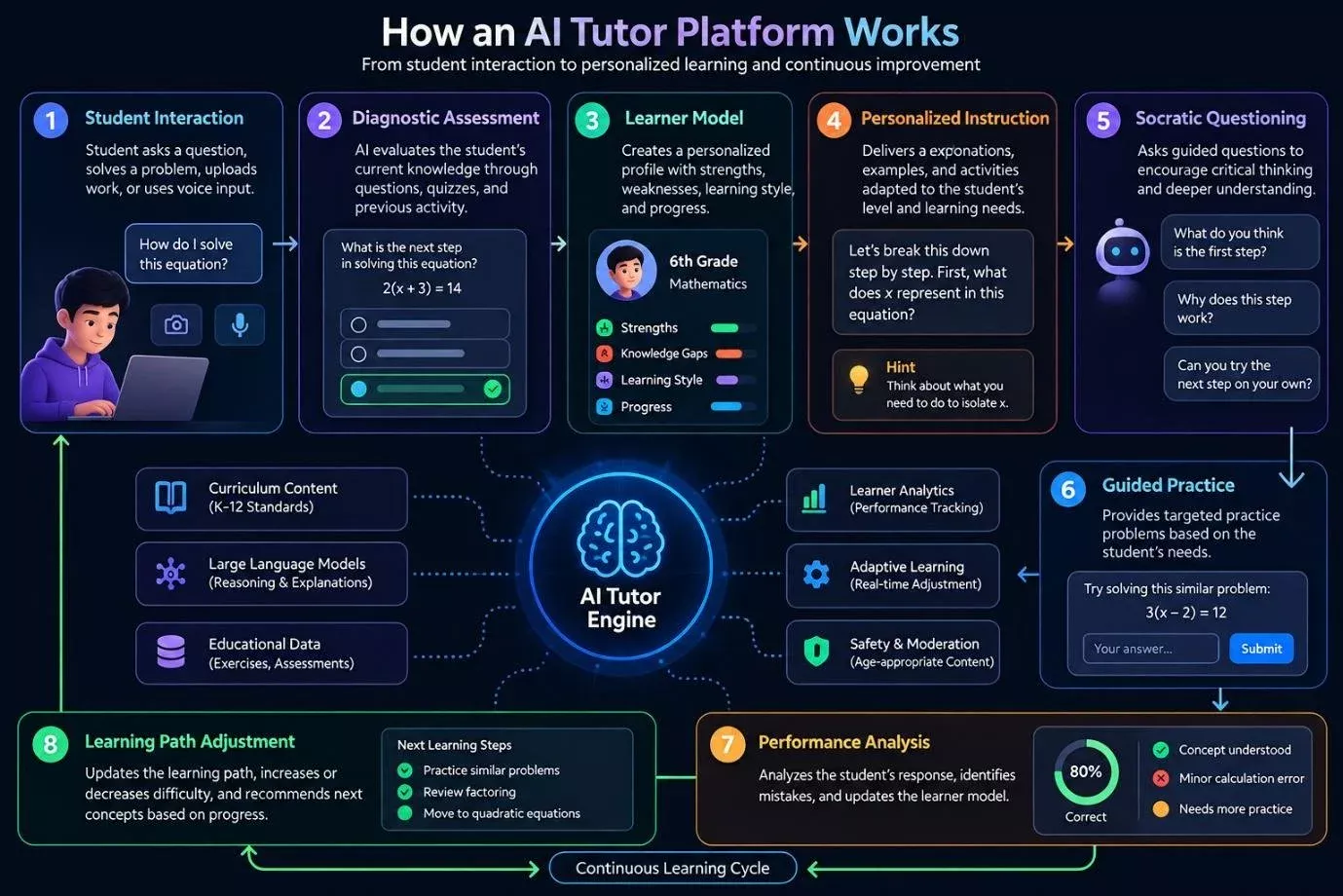
The process starts when a student interacts with the AI tutor. The student may ask a question, solve a problem, upload written work, complete a quiz, or communicate through voice.
For example, if a student asks, "How do I solve this algebra equation?", the AI tutor should not necessarily provide the final answer immediately. Instead, it can ask what the student has tried and determine where the reasoning has broken down.
The platform evaluates the student's existing knowledge through quizzes, questions, exercises, and previous learning activity. This helps identify mastered concepts, weak skills, misconceptions, and prerequisite knowledge gaps.
For example, if a student struggles with quadratic equations, the system may discover that the actual problem is a lack of understanding of factoring or basic algebraic operations.
The AI creates a continuously updated learner profile containing information such as grade level, subject proficiency, learning progress, previous mistakes, assessment results, and recommended difficulty.
This learner model is the foundation of personalized tutoring because the AI can use historical performance instead of treating every student the same way.
The platform selects an appropriate explanation, example, question, or activity based on the student's current learning state. A sixth-grade student and a tenth-grade student asking the same question may therefore receive different explanations.
A sophisticated AI tutor uses Socratic questioning to encourage students to think independently. Instead of immediately revealing an answer, it can provide a hint, ask a follow-up question, or break a complex problem into smaller steps.
After every interaction, the system analyzes the student's response and updates the learner model. If the student demonstrates mastery, the platform can increase difficulty. If the student continues making mistakes, it can provide remediation or revisit prerequisite concepts.
In this way, AI tutor platform development combines conversational AI, adaptive learning, educational content, learner analytics, and assessment technology to create a personalized learning environment that continuously adapts to each student's needs.
The growing demand for personalized education is creating a significant opportunity for EdTech companies, schools, publishers, and tutoring businesses to invest in AI-powered tutoring solutions. For educational businesses, the value of an AI tutor is not limited to automating student support. A well-designed platform can create personalized instruction at scale, improve learning accessibility, generate actionable student insights, and create new recurring revenue opportunities.
The global AI in education market is estimated at $11.4 billion in 2026 and is projected to reach $57.2 billion by 2033, representing a projected CAGR of 25.9% from 2026 to 2033. North America accounted for 37.5% of the market in 2025, while the U.S. held the largest share within North America. The same research identifies learning platforms and virtual facilitators as a major application area.
The AI tutors market itself is estimated at $2.7 billion in 2026 and is projected to reach $17.7 billion by 2033, with a forecast CAGR of 30.5%. North America represented 35.1% of the market in 2025.
These projections indicate why the future of AI tutoring in K-12 education is becoming an important strategic consideration for EdTech businesses.
According to CoSN's U.S. State of EdTech 2026 report, 67% of surveyed education technology leaders believed AI could have a positive impact on personalized education, compared with 30% in 2025. The share believing AI could positively impact student tutoring increased from 7% in 2025 to 46% in 2026.
For an EdTech company, this creates an opportunity to develop personalized AI learning software that can adapt instruction according to each student's proficiency, mistakes, learning pace, and academic goals.
A conventional tutoring model requires additional human tutors as student enrollment grows. An AI tutoring system can provide automated academic support to a much larger student population while maintaining individualized interaction.
This makes AI particularly valuable for:
The goal is not to replace teachers. Instead, an AI tutor for schools and EdTech businesses can provide an additional layer of personalized support while teachers focus on instruction, relationships, classroom management, and complex student needs.
Instructure's July 2026 research surveyed 1,125 educators, higher education students, and K-12 parents and guardians. The study reported that 90% of students surveyed use AI, while fewer than half of educators reported receiving formal AI training. The research also identified concerns around accuracy, critical thinking, and academic integrity.
This creates a clear product opportunity, but also an important requirement: educational businesses should build AI systems specifically for learning rather than simply embedding a general-purpose chatbot.
An AI tutoring business model can support several revenue streams, including:
The OECD's Digital Education Outlook 2026 emphasizes that generative AI can support learning when it is guided by sound teaching principles. It also warns that simply outsourcing cognitive tasks to general-purpose AI can improve task performance without necessarily producing genuine learning gains.
Therefore, the strongest reason to invest in AI tutoring software development is not simply market growth. It is the opportunity to combine AI with proven instructional methods, measurable learning outcomes, and scalable personalization.
For educational businesses, the next generation of competitive advantage will come from building AI tutors that help more students learn effectively, not merely from building AI systems that answer more questions.
What can an AI tutoring platform actually do for students, teachers, and educational businesses? The answer goes far beyond answering questions. A well-designed AI tutoring platform can understand a student's learning needs, identify weak areas, personalize lessons, provide guided practice, and support students whenever they need academic help.
For businesses exploring AI tutoring platform development, the most valuable use cases are those that solve real learning problems. From personalized K-12 education and AI homework help to exam preparation and teacher support, AI can create a learning experience that adapts to each student's progress.
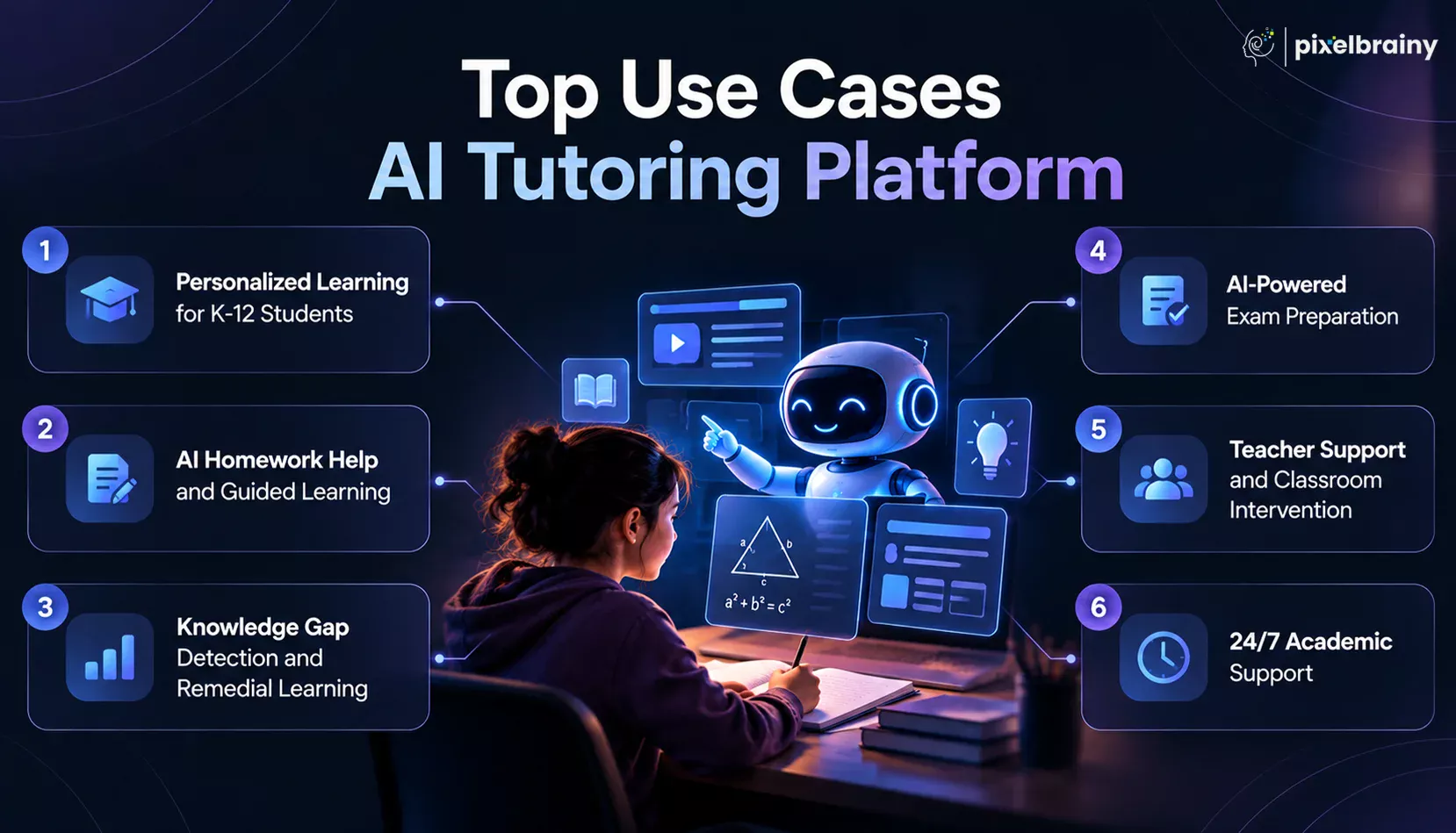
How can AI provide personalized learning to every student? An AI tutor can analyze a student's level, previous answers, mistakes, and learning progress. It can then adjust explanations, examples, questions, and difficulty.
For example, one student may need additional practice with fractions, while another can move directly to advanced algebra. This makes AI-powered personalized learning useful for students with different abilities and learning speeds.
Can an AI tutor help students with homework without simply giving them the answer? Yes. The tutor can ask what the student has tried, identify the point of confusion, and provide a hint or follow-up question.
This approach makes AI homework help more educational. Instead of completing the assignment, the AI guides students toward solving the problem themselves through explanations, questions, and step-by-step support.
How can AI find the exact topic a student does not understand? An intelligent tutoring platform can analyze incorrect answers, assessment results, repeated mistakes, and prerequisite skills.
For example, a student struggling with algebra may actually have difficulty with negative numbers. The platform can identify this underlying gap and recommend targeted practice. This makes AI-powered remedial learning useful for intervention, revision, and personalized learning paths.
How can AI help students prepare for exams more efficiently? An AI tutor can first evaluate the student's strengths and weaknesses and then create a personalized study plan.
It can generate practice questions, explain incorrect answers, revisit difficult concepts, and adjust question difficulty. An AI exam preparation platform can support SAT, ACT, AP, state assessments, and school examinations while focusing practice on the areas where students need the most improvement.
Can AI tutoring support teachers instead of replacing them? An AI tutor can provide teachers with useful insights into student performance, common mistakes, and learning gaps.
Teachers can use these insights to create differentiated assignments, recommend additional practice, and identify students who may need extra attention. This makes AI tutoring for schools a valuable support layer while teachers remain responsible for instruction, mentoring, and student relationships.
How can students receive personalized academic help when their teacher or tutor is unavailable? An AI tutor can provide on-demand support for homework, revision, concept explanations, and practice.
Students can return to difficult topics after school, ask follow-up questions, or request another explanation when they do not understand the first one. This makes 24/7 AI tutoring particularly useful for independent learning, after-school education, remote learning, and self-paced study.
By applying AI to these practical learning needs, educational businesses can build tutoring platforms that make personalized academic support more accessible, responsive, and scalable.
Not every educational business needs the same type of AI tutoring product. The right approach depends on the target learners, curriculum, delivery model, geographic market, and level of personalization required. If you are planning to build an AI tutor platform, identifying the platform type first helps determine the right AI architecture, features, content strategy, and scalability requirements.
Below are the major types of AI tutor platform development, including the use cases that matter most when building an AI student tutoring platform.
A consumer K-12 AI tutor platform provides personalized tutoring directly to students and parents through a web or mobile application.
Students can use the platform for homework help, concept revision, personalized practice, exam preparation, and skill development. The AI can maintain an individual learner profile and adjust lessons based on performance.
This model works well for EdTech startups that want to build an AI tutor platform for students and monetize it through subscriptions, freemium plans, or premium learning packages.
Best suited for: Parents, individual students, homeschooling, and direct-to-consumer EdTech businesses.
How can a school district serving 35,000 students build a proprietary AI tutor that provides after-school support aligned with its curriculum standards?
A district-level platform needs much more than a general AI chatbot. It should connect the AI tutor to approved curriculum materials, grade-level standards, student learning data, teacher dashboards, and district policies.
The platform can provide personalized after-school tutoring while giving educators visibility into student progress and knowledge gaps.
For large districts, how to build a scalable AI tutor platform becomes a major architectural consideration. The system needs strong identity management, security, privacy controls, role-based access, analytics, and infrastructure capable of supporting thousands of concurrent learners.
Best suited for: U.S. school districts, charter networks, public schools, and large private-school systems.
A higher education AI tutor platform is designed for college and university students who require subject-specific academic assistance.
The platform can support subjects such as mathematics, computer science, engineering, business, science, and writing. It can connect with university learning management systems and use institution-approved course materials.
Unlike a K-12 platform, a university AI tutor may need deeper subject reasoning, advanced problem solving, research guidance, and course-specific tutoring.
Best suited for: Universities, colleges, online degree providers, and higher education EdTech companies.
A test preparation AI tutor platform focuses on helping students prepare for specific examinations.
The AI can assess current performance, identify weak topics, create personalized study plans, generate practice questions, explain mistakes, and adjust difficulty.
For example, an SAT-focused platform could identify that a student needs more practice with algebra while another student requires support with reading comprehension.
This type of AI online tutoring platform development is particularly suitable for businesses targeting standardized tests and competitive examinations.
Best suited for: SAT, ACT, AP, state assessments, professional certification, and other test-preparation businesses.
How can you build an AI tutor platform that combines AI tutoring with human tutors?
A hybrid model combines automated tutoring with access to professional educators. The AI can handle routine questions, practice, diagnostics, and basic explanations. When a student needs deeper subject expertise or human intervention, the platform can connect them with a qualified tutor.
The marketplace can include tutor profiles, subject expertise, availability, booking, messaging, payments, reviews, and session management.
This model allows businesses to develop an AI tutor platform that combines scalable technology with human expertise.
Best suited for: Premium tutoring companies, tutoring marketplaces, and EdTech businesses offering AI plus human support.
How can an AI tutor be designed specifically for students with learning disabilities, ADHD, autism spectrum disorder, and processing differences?
A special education AI tutor should prioritize accessibility, flexible pacing, clear communication, repetition, multimodal instruction, and individualized learning experiences.
The platform can allow students to choose different explanation formats, break tasks into smaller steps, repeat instructions, and adjust interaction speed.
However, the AI should support educators and specialists rather than independently diagnosing students or determining educational accommodations.
Best suited for: Special education providers, schools, intervention programs, and EdTech companies focused on accessible learning.
How can you build an AI tutor that provides personalized tutoring in English, Spanish, Mandarin, Arabic, Portuguese, and French while adapting to different curricula?
A multilingual platform needs more than translation. The AI should understand the language, cultural context, educational terminology, curriculum standards, and appropriate teaching approaches for each target market.
The platform can provide multilingual explanations, voice tutoring, localized examples, and curriculum-specific learning paths.
This makes AI student tutoring platform development particularly valuable for international EdTech businesses targeting multiple education markets.
Best suited for: Global EdTech companies, international schools, language-learning businesses, and education publishers.
An educational publisher can build an AI tutor platform directly around its existing textbooks, digital courses, question banks, lesson plans, and curriculum content.
Using technologies such as retrieval-augmented generation, the AI can provide answers grounded in publisher-approved materials rather than relying entirely on general-purpose model knowledge.
The platform can also recommend relevant textbook chapters, exercises, videos, and assessments based on individual student performance.
Best suited for: Textbook publishers, digital curriculum providers, assessment companies, and educational content businesses.
The best platform type depends on the business objective:
| Platform Type | Primary Focus |
|---|---|
| Consumer K-12 | Personalized direct-to-student tutoring |
| School District | Curriculum-aligned institutional tutoring |
| Higher Education | College and university learning support |
| Test Preparation | Personalized exam preparation |
| AI + Human Marketplace | Automated and expert tutoring |
| Special Education | Accessible and adaptive learning |
| Multilingual | International personalized tutoring |
| Publisher-Integrated | AI grounded in proprietary content |
Whether you want to build an AI tutor platform for students, create an institutional solution, or launch an AI online tutoring platform, the platform architecture should be designed around the learner, curriculum, and measurable educational goals first.
Building an effective AI tutor starts with one important question: What does a student actually need from an AI tutor beyond getting an instant answer?
For an EdTech company planning to build an AI tutor platform, the answer lies in creating a complete personalized learning environment. The platform should understand where a student is academically, recognize areas where the student needs help, adjust the learning experience accordingly, and encourage the learner to think through problems independently.
A production-ready AI student tutoring platform therefore needs more than conversational AI. It should combine intelligent tutoring, assessment, personalization, adaptive practice, curriculum-based content, progress tracking, and teacher support.
These features work together to create a tutoring experience that can adapt to individual students while giving educators the visibility needed to support their learning journey.
| Core Feature | How It Supports AI Tutor Platform Development |
|---|---|
| AI Tutor Chat | An AI tutor chat provides students with conversational academic support through natural language. It can answer questions, explain concepts, provide examples, and guide learners through difficult topics based on their current learning level. |
| Student Diagnostic Assessment | Diagnostic assessments determine what students already understand before tutoring begins. The platform can use quizzes, questions, and performance data to identify strengths, weaknesses, prerequisite gaps, and concepts requiring additional instruction. |
| Personalized Learning Paths | Personalized learning paths automatically recommend lessons, exercises, and explanations according to individual student performance. This allows the AI tutor to create different learning journeys for students instead of delivering identical content to everyone. |
| Socratic Questioning | Socratic questioning encourages students to reason instead of immediately receiving answers. The AI can ask targeted questions, provide hints, and gradually guide learners toward solutions while maintaining active student participation. |
| Adaptive Difficulty | Adaptive difficulty adjusts question complexity according to student performance. When a learner demonstrates mastery, the platform can introduce harder problems. When difficulties continue, it can reduce complexity and provide additional practice. |
| Knowledge Gap Detection | Knowledge gap detection analyzes incorrect answers, repeated mistakes, assessments, and learning history to identify specific concepts students have not mastered. The AI can then recommend targeted remediation instead of generic revision. |
| Personalized Explanations | Personalized explanations adapt wording, examples, depth, and instructional approach according to student proficiency. A beginner can receive simple explanations, while an advanced learner can receive deeper conceptual reasoning and challenging examples. |
| AI Practice and Exercises | AI-generated practice allows the platform to create additional questions based on individual learning needs. Students can practice specific skills repeatedly while the system adjusts question types and difficulty according to their performance. |
| Progress Tracking Dashboard | A progress dashboard gives students, parents, and educators visibility into learning activity, mastered concepts, assessment performance, study time, and areas requiring improvement. This supports continuous monitoring of individual learning progress. |
| Student Learner Profile | A learner profile stores relevant academic information such as grade level, subjects, goals, previous performance, learning history, and mastery indicators. The AI uses this profile to deliver more context-aware tutoring interactions. |
| Teacher Dashboard | A teacher dashboard provides educators with insights into student performance, knowledge gaps, learning activity, and intervention needs. Teachers can use these insights to assign targeted activities and provide additional human support. |
| Parent Portal | A parent portal provides appropriate visibility into a student's learning progress, completed activities, strengths, and areas requiring additional practice. It can also communicate recommended learning activities without exposing unnecessary sensitive information. |
| Multimodal Learning Support | Multimodal support allows students to interact through text, images, diagrams, handwriting, audio, or other supported formats. This enables the AI tutor to provide richer learning experiences across different subjects and student needs. |
| Content and Curriculum Integration | Curriculum integration connects the AI tutor with approved educational materials, lessons, assessments, and standards. Retrieval-based architecture can help the platform provide responses grounded in relevant instructional content rather than unrestricted model knowledge. |
| Safety, Privacy, and Moderation | Safety and privacy controls protect students and help maintain age-appropriate interactions. The platform should include access controls, moderation, audit capabilities, secure data handling, and safeguards appropriate for educational environments and applicable regulations. |
A successful AI tutoring platform combines these core features into one connected learning system, allowing AI to personalize instruction while keeping student progress, safety, and meaningful learning at the center.
When planning to build an AI tutor platform, advanced features can determine whether the product simply answers questions or actually delivers a deeper personalized learning experience. A modern AI student tutoring platform can go beyond basic chat by understanding learning behavior, adapting instruction, supporting different learning formats, and giving educators stronger control over the tutoring experience.
For example, an EdTech company may ask: “How can we build an AI tutor platform that understands each student’s learning behavior, adapts instruction automatically, and gives teachers enough visibility to intervene when a student starts falling behind?”
Addressing this type of requirement requires advanced capabilities across personalization, analytics, AI reasoning, content intelligence, accessibility, and educator oversight. These features can make AI tutor platform development more scalable and suitable for K-12 schools, higher education, test preparation, and online tutoring businesses.
| Advanced Feature | Explanation |
|---|---|
| AI Learning Behavior Analytics | Analyze student interactions, response patterns, mistakes, session duration, and learning progress to identify behavioral trends and continuously improve personalized tutoring recommendations. |
| Emotion and Engagement Detection | Detect signals such as repeated mistakes, hesitation, disengagement, or frustration through interaction patterns and adapt explanations, activities, pacing, or encouragement accordingly. |
| Advanced Knowledge Graph | Map relationships between subjects, concepts, prerequisites, skills, and learning objectives so the AI tutor can identify missing foundations and recommend logically connected learning activities. |
| Retrieval-Augmented Generation (RAG) | Connect the AI tutor with trusted curriculum materials, textbooks, institutional resources, and approved knowledge bases so responses remain relevant, grounded, and aligned with learning content. |
| AI-Generated Personalized Content | Automatically create explanations, examples, quizzes, practice questions, hints, and revision materials based on each student's academic level, learning gaps, interests, and progress. |
| Multimodal AI Tutoring | Allow students to learn through text, voice, images, diagrams, documents, and other supported formats, enabling the platform to explain concepts using the format most appropriate for the learning task. |
| Predictive Learning Analytics | Use historical performance and engagement signals to identify students who may need additional support and help educators prioritize interventions before learning gaps become larger. |
| AI Curriculum Mapping | Map tutoring content to school curricula, academic standards, course objectives, and learning outcomes so personalized instruction remains connected to the educational framework being used by the institution. |
| Human Tutor Escalation | Automatically identify situations where additional human support may be useful and route students toward teachers, tutors, counselors, or other approved support resources within the platform. |
| Advanced AI Safety and Guardrails | Apply content filtering, age-appropriate responses, privacy controls, source restrictions, moderation, and escalation rules to create a safer and more controlled AI tutoring environment for students. |
These advanced capabilities can help develop an AI tutor platform that moves from simple question answering toward continuous, personalized, and educator-supported learning.
A successful AI tutor platform development project requires more than connecting a chatbot to an AI model. The development process should connect educational goals, student needs, curriculum requirements, personalization, AI capabilities, data systems, security, and a scalable technical architecture.
A common question from education leaders is: “We are a school district serving 35,000 students and we want to build a proprietary AI tutor platform that provides every student with after-school tutoring support aligned to our specific curriculum standards, integrated with our student information system for learning gap identification from assessment data, and accessible on the Chromebooks our students already use without requiring additional device procurement. Which development companies have built AI tutoring platforms for K-12 school districts with curriculum standards alignment and student information system integration at our scale?”
A requirement like this shows why building an AI tutor platform needs a structured process. From defining the learning objectives to launching a secure platform, each stage should validate both educational value and technical feasibility.
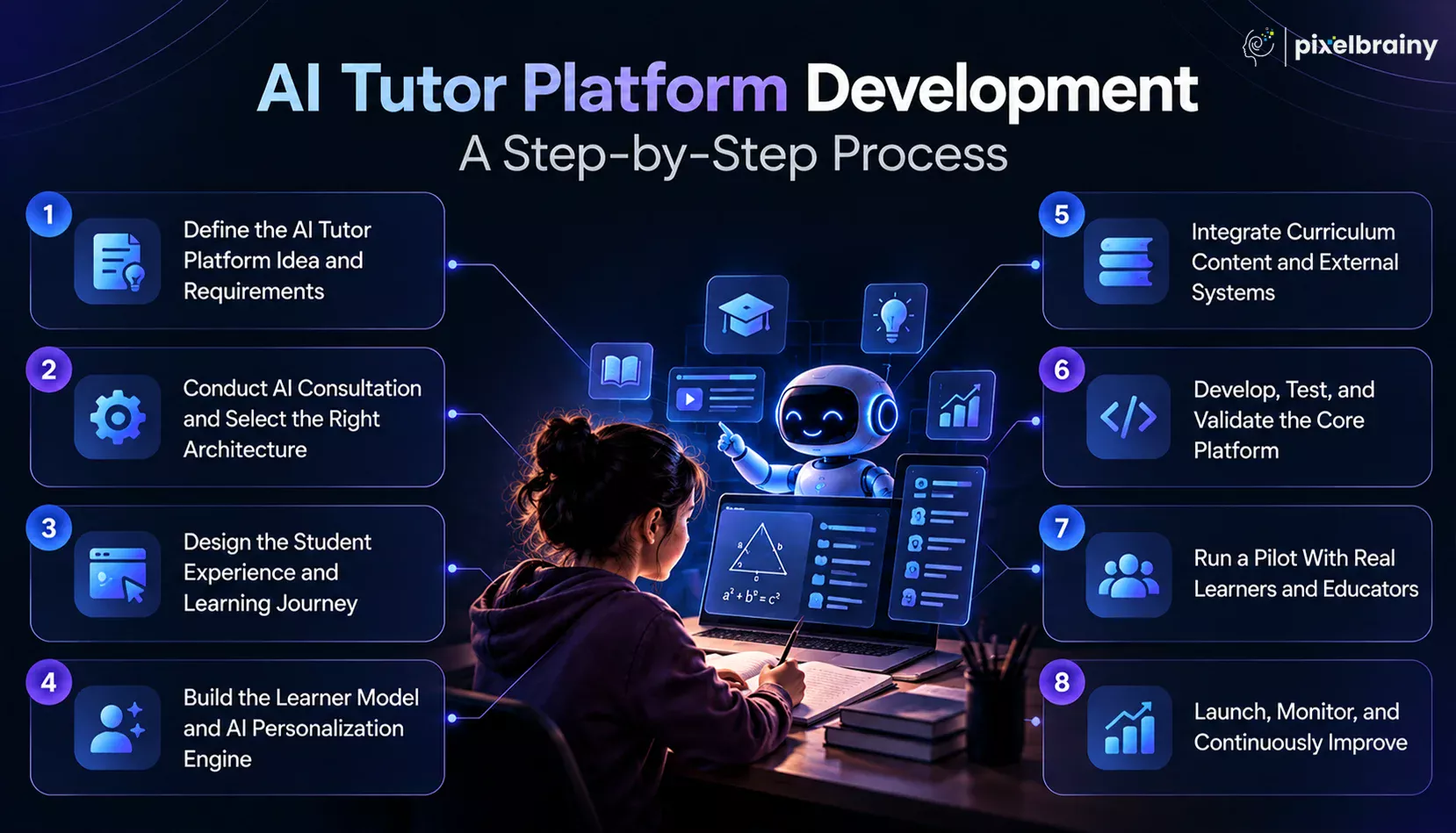
The first step is to clearly define what the platform needs to accomplish. Identify the target learners, subjects, grade levels, curriculum standards, tutoring scenarios, and expected learning outcomes.
For a K-12 platform, requirements may include personalized tutoring, homework assistance, assessment-based recommendations, teacher dashboards, parent visibility, and after-school learning support.
At this stage, document integrations with student information systems, learning management systems, assessment platforms, authentication providers, and existing school devices.
The goal is to establish a clear product scope before PoC development begins. A detailed requirements document also helps determine which AI capabilities are essential for the initial product and which can be introduced later.
The next stage focuses on deciding how artificial intelligence will power the tutoring experience. The architecture may combine large language models, RAG, learner profiles, recommendation engines, knowledge graphs, speech technologies, analytics, and traditional application logic.
An AI consultation can help determine which components should use third-party models and which capabilities should be developed specifically for the platform.
The architecture should also account for scalability, response latency, data privacy, curriculum alignment, API integrations, model costs, and monitoring.
For organizations planning to develop AI tutor platform solutions for thousands of students, architectural decisions made at this stage can significantly influence performance, operating costs, and future expansion.
Also Read: Top 10 AI Consulting Companies in USA
The third step converts educational requirements into an intuitive student experience. Map how students register, complete assessments, interact with the AI tutor, receive explanations, practice concepts, review mistakes, and track progress.
Design separate experiences for students, teachers, administrators, and parents where required.
The interface should make AI tutoring feel educational rather than simply conversational. For example, instead of immediately providing an answer, the system can provide hints, ask guiding questions, identify misconceptions, and encourage students to solve problems independently.
During MVP development, prioritize the most important learning journeys rather than attempting to launch every possible feature at once.
Also Read: Top 10 AI MVP Development Companies in USA
Personalization is one of the most important parts of developing an AI tutor platform. The platform should create a learner profile that can represent academic level, completed concepts, knowledge gaps, preferences, assessment results, learning progress, and interaction history.
The personalization engine can use this information to determine what the student should learn next and how the concept should be explained.
For example, two students asking the same mathematics question may receive different explanations based on their existing knowledge.
AI model development at this stage can involve prompt engineering, model selection, evaluation frameworks, recommendation logic, learner modeling, and domain-specific AI behavior.
Also Read: Top 12+ AI Model Development Companies in the USA
An AI tutor becomes more useful when its responses are connected to trusted educational content. Integrate approved textbooks, lesson materials, curriculum standards, question banks, assessments, institutional resources, and other relevant content.
AI integration should also connect the tutoring platform with systems already used by the organization.
For the 35,000-student school district described above, this could include student information system data, assessment results, authentication systems, learning management platforms, and Chromebook-compatible web access.
RAG can help the AI retrieve relevant information from approved sources instead of relying only on general model knowledge.
Also Read: Top 10+ AI Integration Companies in USA
Once the architecture and learning experience are established, development moves into implementation. Build the student application, teacher dashboard, administration portal, AI orchestration layer, databases, APIs, analytics, authentication, and content management system.
Testing should cover both software performance and educational behavior.
AI responses need to be evaluated for accuracy, relevance, age appropriateness, curriculum alignment, hallucination risk, consistency, and instructional quality.
Organizations can hire AI developers with experience in LLM applications, RAG, educational technology, cloud infrastructure, data engineering, and AI evaluation to build and validate these components.
Before a full launch, conduct a controlled pilot with a representative group of students and educators. The pilot should test the complete learning experience rather than only individual AI features.
Measure factors such as student engagement, tutoring completion, response quality, knowledge improvement, teacher satisfaction, system reliability, and recurring technical issues.
Educator feedback is especially important because teachers can identify problems that automated testing may not reveal.
This stage allows the product team to refine prompts, learning pathways, content retrieval, dashboards, accessibility, and intervention workflows before expanding the platform to a larger student population.
The final step is production deployment followed by continuous optimization. Launch the platform with monitoring for uptime, AI response quality, security events, usage patterns, infrastructure performance, and student feedback.
A scalable cloud architecture can support gradual expansion from a pilot group to thousands of students.
Organizations working with top AI development companies should also establish clear post-launch responsibilities for model evaluation, security updates, feature improvements, and infrastructure management.
The long-term objective is not simply to create AI tutor platform software once. It is to continuously improve the tutoring experience as new student data, curriculum requirements, educator feedback, and AI capabilities become available.
Following these steps creates a structured development process of AI tutor platform solutions that can move from an initial concept to a secure, scalable, and personalized
The cost to develop an AI tutor platform can range from $40,000 to $250,000+, depending on the product scope, AI capabilities, integrations, security requirements, accessibility, and level of personalization. A basic platform with conversational tutoring and limited personalization requires a significantly different development budget of AI tutor platform than an enterprise solution designed for schools, districts, or specialized learners.
A useful question for estimating the AI tutor platform development cost is: “What does a special education-specific AI tutor platform cost to build with IDEA compliance and accessibility standards, and which development companies have clinical special education expertise for AI tutoring design?”
For this type of platform, cost estimation of AI tutor platform development needs to account for specialized learning workflows, accessibility, individualized support, secure student data handling, curriculum integration, testing, and ongoing AI operations. Therefore, what is the development pricing of AI tutor platform depends heavily on the complexity of the educational and technical requirements.
AI Tutor Platform Development Cost Breakdown:
| Platform Type | Estimated Cost | Typical Scope |
|---|---|---|
| Basic AI Tutor Platform | $40,000 to $80,000 | AI tutor chat, basic student profiles, simple assessments, personalized responses, practice questions, basic progress tracking, web interface, and essential administration features. |
| Advanced AI Tutor Platform | $80,000 to $150,000 | Everything in a basic platform plus RAG, adaptive learning, knowledge-gap detection, multimodal learning, advanced analytics, teacher dashboards, curriculum integration, stronger personalization, and third-party integrations. |
| AI Tutor Platform | $150,000 to $250,000+ | Enterprise-grade tutoring with advanced AI personalization, large-scale student management, specialized learning workflows, extensive integrations, accessibility capabilities, advanced security, analytics, AI evaluation, and scalable infrastructure. |
These are planning-level estimates. Actual pricing can vary significantly based on requirements, development location, team composition, integrations, AI model usage, compliance scope, and ongoing infrastructure needs.
| Cost Factor | Estimated Cost | How It Affects the Budget |
|---|---|---|
| AI Model Integration | $8,000 to $25,000 | Integrating LLMs, AI APIs, prompt systems, model orchestration, and tutoring logic forms the foundation of an AI tutor platform. |
| Personalized Learning Engine | $10,000 to $30,000 | Learner profiles, adaptive learning paths, knowledge-gap detection, personalized recommendations, and student-specific tutoring increase development complexity. |
| RAG and Knowledge Base | $8,000 to $25,000 | Connecting the tutor with curriculum materials, textbooks, approved resources, vector databases, retrieval pipelines, and source-grounded responses adds engineering work. |
| Special Education Features | $15,000 to $40,000+ | Specialized pacing, content presentation, interaction patterns, individualized support, accessibility workflows, and special education learning requirements can substantially increase costs. |
| Accessibility Implementation | $8,000 to $25,000 | Screen-reader compatibility, keyboard navigation, alternative content formats, visual accessibility, captions, voice interaction, and accessibility testing require additional design and development. |
| Curriculum Integration | $8,000 to $30,000 | Mapping AI tutoring to curriculum standards, grade-level objectives, courses, assessments, and approved learning resources adds content and integration requirements. |
| Student Information System Integration | $10,000 to $30,000+ | Connecting student records, assessment data, authentication, enrollment information, and learning-gap data to the AI tutor requires secure APIs and data workflows. |
| Teacher Dashboard | $7,000 to $20,000 | Student progress, intervention alerts, performance analytics, assignments, and AI tutoring oversight require dedicated educator workflows. |
| Parent Portal | $5,000 to $15,000 | Parent accounts, progress reports, notifications, learning summaries, and communication features add another user experience and permission structure. |
| Multimodal AI | $10,000 to $35,000+ | Voice, images, documents, handwriting, diagrams, and other learning formats require additional AI services, interfaces, processing, and testing. |
| Security and Compliance | $10,000 to $35,000+ | Data protection, access controls, encryption, audit logs, privacy workflows, compliance requirements, and security testing can significantly affect the development budget. |
| Testing and AI Evaluation | $7,000 to $20,000 | AI response testing, educational accuracy, hallucination checks, safety evaluation, accessibility testing, performance testing, and user acceptance testing require dedicated effort. |
For a special education AI tutor, the final budget can move toward the higher end because specialized learning workflows, accessibility, compliance, expert validation, and individualized tutoring behavior require additional development and testing.
The final AI tutor platform development cost depends on the combination of AI capabilities, educational requirements, integrations, accessibility, compliance, and
A strong technology stack for AI tutor platform development needs to support more than conversational AI. The platform must handle student interactions, personalized learning, curriculum content, AI reasoning, assessments, progress tracking, security, and integrations with existing education systems.
A practical question for organizations planning AI tutor platform development is: “What technology stack should we use to build an AI tutor platform that supports personalized tutoring, curriculum-aligned responses, student data integration, and thousands of simultaneous learners without requiring students to change their existing devices?”
The answer depends on the platform's scale and requirements. Modern AI tutor architectures commonly combine a web frontend, API backend, LLM layer, RAG pipeline, vector database, relational database, cloud infrastructure, analytics, and security services. Real-world AI tutoring architectures also use combinations such as React, Python, FastAPI, PostgreSQL, vector databases, Redis, cloud services, and managed AI models.
| Technology Layer | Recommended Technologies | Purpose in AI Tutor Platform Development |
|---|---|---|
| Frontend | React.js, Next.js, TypeScript | Builds responsive student, teacher, parent, and administrator interfaces. Next.js can also support performance optimization and scalable web delivery. |
| UI and Design | Tailwind CSS, Material UI | Helps create accessible, responsive, and consistent interfaces for students using desktops, tablets, Chromebooks, and other supported devices. |
| Backend | Python, FastAPI, Node.js | Handles APIs, authentication, tutoring workflows, student data, assessments, integrations, and communication between application services. FastAPI is particularly useful when AI and machine learning services are closely integrated with the backend. GitHub |
| LLM Layer | OpenAI, Anthropic, Google Gemini, open-source LLMs | Powers conversational tutoring, explanations, hints, question generation, assessment feedback, and other AI-driven learning experiences. A model-agnostic architecture can make it easier to change models as requirements evolve. Kanopy Labs |
| AI Orchestration | LangChain, LlamaIndex, Custom AI Orchestration | Connects LLMs with student profiles, curriculum content, tools, retrieval systems, prompts, and tutoring workflows. |
| RAG Layer | RAG pipelines, embeddings, reranking, hybrid search | Grounds AI responses in approved curriculum materials, textbooks, assessments, and institutional content instead of relying only on general model knowledge. Forasoft |
| Vector Database | pgvector, Pinecone, Qdrant, Weaviate | Stores and retrieves embeddings from educational content, enabling semantic search and curriculum-aware AI responses. Forasoft |
| Primary Database | PostgreSQL, MySQL | Stores structured information such as student profiles, courses, assessments, learning progress, permissions, and platform configuration. |
| Caching and Queues | Redis, BullMQ, Celery | Supports caching, session management, asynchronous document processing, AI jobs, notifications, and other background workloads. GitHub |
| Cloud Infrastructure | AWS, Google Cloud, Microsoft Azure | Provides scalable computing, storage, databases, networking, monitoring, and security infrastructure for the tutoring platform. Real-world AI education deployments use managed cloud and serverless architectures to scale AI workloads. Google Cloud |
| Storage | Amazon S3, Google Cloud Storage, Azure Blob Storage | Stores textbooks, PDFs, lesson materials, student-uploaded documents, multimedia resources, and other educational assets. |
| Authentication | OAuth 2.0, OpenID Connect, SSO, JWT | Manages secure authentication and role-based access for students, teachers, parents, administrators, and institutional users. |
| Analytics | Power BI, Looker, custom dashboards | Tracks learning progress, engagement, assessment performance, tutoring usage, knowledge gaps, and educator interventions. |
| AI Monitoring | LangSmith, MLflow, custom evaluation systems | Helps evaluate AI response quality, retrieval accuracy, hallucinations, latency, model performance, and tutoring behavior. |
| DevOps and CI/CD | Docker, GitHub Actions, Kubernetes, Terraform | Automates testing, deployment, infrastructure management, scaling, and production releases. Kubernetes can be introduced when application scale and operational requirements justify it. GitHub |
| Security | TLS, encryption, RBAC, secrets management, audit logging | Protects student information, controls access to sensitive data, and supports the security requirements of education-focused applications. |
| Voice and Multimodal AI | Speech-to-Text, Text-to-Speech, vision-capable AI models | Enables voice tutoring, spoken questions, image-based problem solving, document analysis, diagrams, and other multimodal learning experiences. Google Cloud describes an AI tutoring deployment using text, voice, and screen-sharing capabilities. Google Cloud |
| Education Integrations | LMS APIs, SIS APIs, LTI, OneRoster, Google Workspace integrations | Connects the AI tutor with existing school systems for student enrollment, curriculum information, assessments, assignments, authentication, and learning data. |
The right stack should remain flexible enough to support changing AI models, increasing student traffic, new curriculum integrations, and evolving personalization requirements without requiring a complete platform rebuild.
A scalable technology stack gives an AI tutor platform the technical foundation needed to deliver personalized, secure, curriculum-aware, and reliable learning experiences at scale.
AI-powered tutoring has evolved from simple question-answering tools into learning platforms that combine personalized instruction, adaptive learning, AI-generated practice, assessment, curriculum content, and educator support. Reviewing established platforms can help businesses understand how AI is being applied to real student learning experiences and what capabilities may be relevant when building an AI tutor platform.
Khan Academy developed Khanmigo as an AI-powered tutor and teaching assistant. It uses conversational AI to guide students through problems rather than simply providing direct answers.
Its tutoring experience includes Socratic questioning, personalized support, writing assistance, coding help, and teacher-focused tools. This approach demonstrates how an AI tutor can be integrated with a broader educational content ecosystem.
Quizlet has integrated AI into its study experience to help learners create and use personalized learning materials.
Its AI capabilities support activities such as homework assistance, practice questions, study guides, flashcards, and content-based learning.
For businesses developing an AI student tutoring platform, Quizlet demonstrates how existing educational content can become the foundation for AI-powered personalized study experiences.
Squirrel Ai focuses on adaptive learning and uses AI to identify knowledge gaps and personalize learning pathways.
The platform's approach emphasizes diagnostic assessment, individualized learning paths, targeted practice, and continuous adjustment based on student performance.
This model is particularly relevant for AI tutor platform development because it demonstrates how learner data can influence what a student studies next.
Carnegie Learning developed MATHia as an AI-powered mathematics learning system designed to provide personalized support.
The platform uses student performance data to adapt instruction and provide targeted mathematics practice. It also connects AI-supported learning with curriculum and classroom instruction.
For organizations planning to develop AI tutor platform solutions, MATHia illustrates how AI tutoring can be embedded within a structured subject-specific curriculum.
ClearFluency uses speech recognition and AI-supported feedback to help students improve reading fluency.
Students read aloud while the system analyzes their performance and provides feedback and personalized practice. This demonstrates how AI tutoring can extend beyond text-based chat and support specialized learning skills through voice technology.
These platforms highlight several recurring capabilities that businesses can consider when building an AI tutor platform:
These real-world examples show that successful AI tutoring can take different forms depending on the learners, subject, curriculum, and educational delivery model.
For businesses planning AI tutor platform development, these platforms provide practical examples of how AI can transform personalized learning into an interactive and scalable experience.
Before businesses should develop AI tutor platform solutions, they need to determine how the product will generate sustainable revenue. The right business model affects pricing, feature access, customer acquisition, platform architecture, and long-term growth.
For example, a business planning to build an AI tutor platform for students may ask: “Should we monetize through student subscriptions, school district licensing, a freemium model, or a combination of AI tutoring and human tutoring?”
There is no single model that fits every EdTech product. Current AI tutoring products already demonstrate different approaches, including consumer subscriptions and district-level licensing. Khanmigo, for example, offers paid learner and family access while also providing district-focused plans with student access, reporting, SSO, rostering, and implementation support.
A subscription model gives students or parents recurring access to AI tutoring features through monthly or annual plans.
How it works:
This model works well for platforms focused on continuous learning, exam preparation, homework assistance, and personalized study plans.
A freemium model provides basic learning capabilities at no cost while reserving advanced AI features for paying users.
Possible free features:
Premium features can include:
Freemium can help building an AI tutor platform businesses reduce the barrier to user acquisition while creating opportunities to convert highly engaged learners into paying customers.
For K-12 EdTech businesses, institutional licensing can create a B2B revenue stream. Schools or districts purchase access for a defined number of students, educators, or campuses.
The model can include:
This model is particularly relevant for a real requirement such as: “We serve 35,000 students and want a proprietary AI tutor aligned with our curriculum standards and integrated with our student information system.”
Khan Academy currently offers district plans with features such as personalized learning, administrator reporting, SSO, privacy and security controls, and Clever or ClassLink rostering.
A B2B2C model allows an AI tutoring company to work with an institution while ultimately serving individual learners.
Potential customers include:
The institution pays for access while students use the platform as part of their learning experience. This approach can combine institutional distribution with large-scale student adoption.
An AI tutor can handle routine questions while human tutors provide deeper support for complex subjects or situations requiring human expertise.
Revenue opportunities include:
This model is particularly useful when businesses want to create AI tutor platform products that combine automated learning with access to human educators.
Instead of charging a recurring subscription, businesses can charge students based on AI usage or tutoring credits.
Possible pricing structure:
This approach can work for students who need occasional academic assistance rather than continuous tutoring.
AI tutor technology can also be licensed to other education businesses under their own branding.
Potential customers include:
The platform owner can charge implementation fees, recurring licensing fees, usage fees, or a combination of these. This model can turn an AI tutor platform development investment into infrastructure that serves multiple education businesses.
A hybrid model combines multiple revenue streams instead of relying on one source of income.
A possible combination could include:
For many AI tutor platform development projects, this approach provides flexibility because different customer segments can pay through different channels.
A well-designed business model should connect the AI tutor's educational value with a predictable revenue structure while keeping access, scalability, and student needs at the center.
Building an AI tutor platform involves more than integrating an LLM with a student-facing interface. Businesses developing an AI tutor platform must address educational accuracy, personalization, student privacy, accessibility, curriculum alignment, scalability, and responsible AI behavior.
A real-world query illustrates this complexity: “We are a school district serving 35,000 students and want an AI tutor aligned with our curriculum standards, connected to assessment data, and available on existing Chromebooks. How can we ensure the platform remains accurate, secure, personalized, and scalable?”
Here are the major challenges to consider during AI tutor platform development.
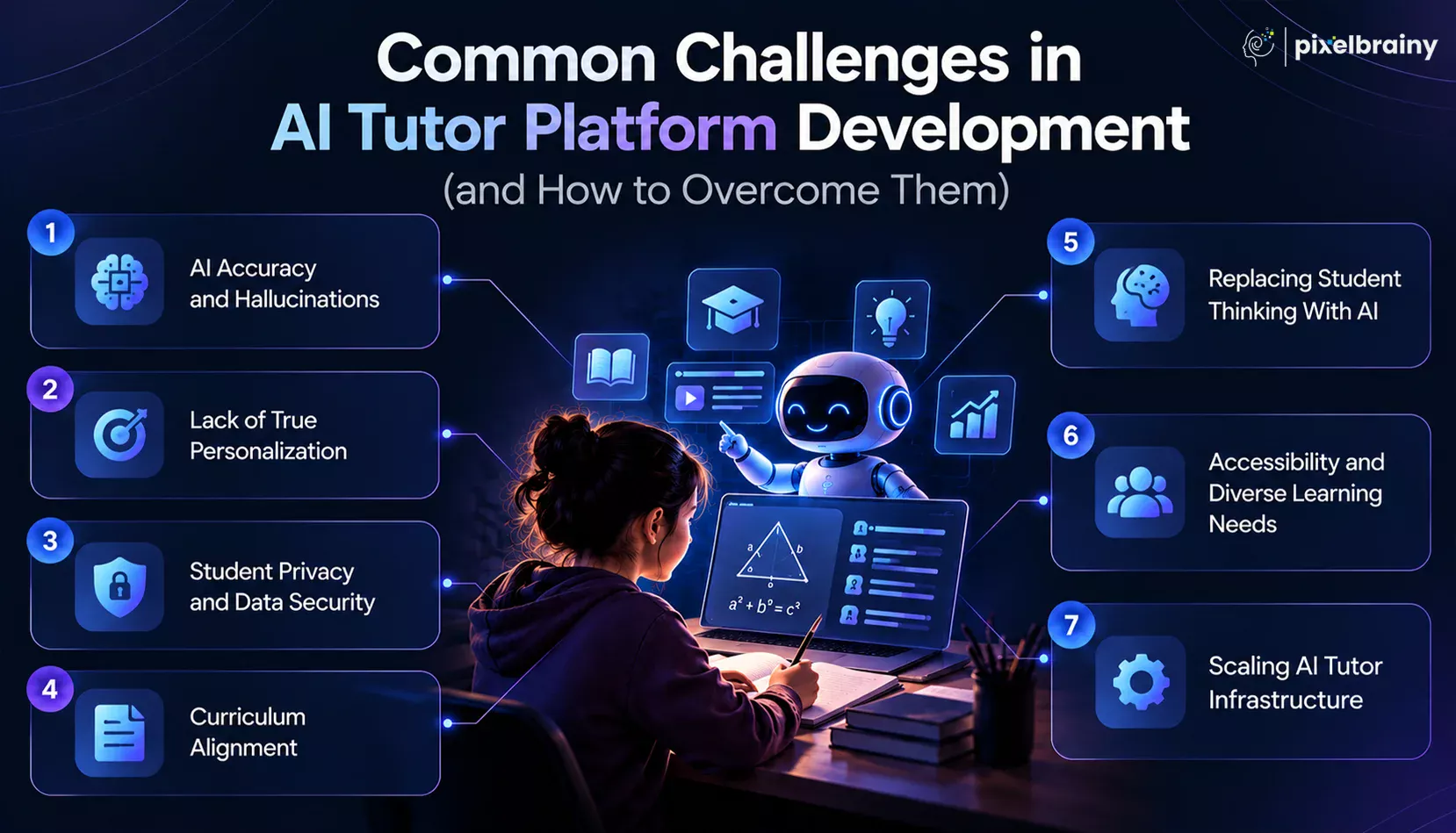
AI tutors can generate incorrect or misleading explanations, which can directly affect student learning.
How to overcome it:
A generic chatbot may provide the same type of explanation to every learner instead of understanding individual knowledge gaps.
How to overcome it:
AI tutoring platforms may process education records and other sensitive student information. U.S. Department of Education guidance emphasizes appropriate controls when educational services handle student data under FERPA.
How to overcome it:
Generic AI may produce responses that do not match a school's curriculum, grade level, instructional approach, or learning standards. Recent K-12 infrastructure research specifically identifies curriculum grounding as an important need.
How to overcome it:
If an AI tutor simply provides answers, students may become dependent on the system instead of developing independent problem-solving skills. Current education research highlights the importance of AI that supports student thinking through hints, feedback, and guided reasoning.
How to overcome it:
Students have different abilities, learning preferences, language needs, and accessibility requirements.
How to overcome it:
A platform serving thousands of students simultaneously needs reliable infrastructure, efficient AI requests, database optimization, monitoring, and cost controls.
How to overcome it:
Overcoming these challenges helps create an AI tutor platform that is accurate, personalized, secure, accessible, curriculum-aligned, and capable of supporting students at scale.
The success of an education product depends on more than AI capabilities. It requires strong product strategy, intuitive UX, reliable engineering, scalable architecture, and an understanding of how learners and educators interact with intelligent systems. PixelBrainy brings these capabilities together to help organizations turn complex AI concepts into practical digital products.
As a leading AI development company, PixelBrainy approaches education-focused products around real user needs, business objectives, and long-term scalability. Its services span AI product engineering, AI consulting, AI integration, RAG development, AI model development, and end-to-end product delivery.
PixelBrainy can support organizations that want AI tutor platform development services across the product lifecycle, from initial product discovery and UX strategy through development, integration, testing, deployment, and optimization.
The approach focuses on creating AI experiences that are understandable, usable, and reliable rather than simply adding AI features to an existing education product.
For an organization asking, “We serve 35,000 students and need an AI tutor aligned with our curriculum standards, integrated with our student information system, and accessible through the Chromebooks students already use,” the solution needs to address far more than conversational AI.
PixelBrainy can structure the product around curriculum-aware tutoring, student data integration, personalized learning workflows, secure authentication, scalable infrastructure, educator dashboards, and AI-powered content retrieval.
In one confidential EdTech engagement, PixelBrainy created an AI teaching assistant for a STEM learning platform. The solution combined NLP-based tutoring, course-aware Q&A, LMS integration, real-time feedback, progress nudges, and peer forum summaries.
According to the company's published case study, the implementation achieved an 80% reduction in student support tickets, 19% higher course completion, and 2x live class participation, with an MVP deployed in 10 weeks.
Organizations looking to create AI tutor platform products can work with a team covering:
This end-to-end approach can help develop AI tutor platform solutions that are designed around actual learners, educators, and institutional requirements rather than technology alone.
Ready to turn your AI tutoring idea into a scalable education product? Connect with PixelBrainy and discuss your project with our AI experts.
An AI tutor platform can transform how students learn by making tutoring more personalized, adaptive, accessible, and available beyond traditional classroom hours. However, successful AI tutor platform development requires more than adding a chatbot to an education product. Businesses need a clear learning strategy, reliable AI architecture, curriculum-aligned content, learner modeling, strong security, accessibility, scalable infrastructure, and continuous AI evaluation.
From understanding the steps to develop AI tutor platform from idea to launch to estimating development costs, selecting the right technology stack, defining business models, and addressing implementation challenges, every stage influences the final learning experience. Whether the goal is to build AI tutor platform for K-12 students, higher education, test preparation, special education, or institutional learning, the platform should ultimately help students understand concepts, practice effectively, and become more independent learners.
The right technology partner can turn this vision into a practical, scalable, and student-focused product.
Ready to turn your AI tutoring idea into reality? Book an appointment with PixelBrainy and discuss your project with our AI experts.
To build an AI tutor platform with genuine personalization, integrate diagnostic assessments, learner profiles, knowledge-gap detection, adaptive difficulty, and performance analytics. The AI can then adjust explanations, practice questions, pacing, and learning paths according to each student's progress.
To develop an AI tutor platform for a district serving thousands of students, the architecture should support curriculum alignment, student information system integration, secure authentication, role-based access, teacher dashboards, analytics, and scalable cloud infrastructure. Chromebook-compatible web access can also reduce the need for additional student hardware.
The cost to create an AI tutor platform for special education can range from approximately $100,000 to $250,000+, depending on accessibility requirements, AI personalization, integrations, specialized learning workflows, compliance requirements, multimodal capabilities, and testing. Specialized platforms generally require more development than basic AI tutoring products.
Yes. An AI tutor platform can integrate with LMS, SIS, assessment, authentication, rostering, and content-management systems through APIs and education interoperability standards. These integrations can allow the tutor to use relevant student and curriculum information while maintaining appropriate access controls.
A curriculum-aligned AI tutoring platform can use RAG, embeddings, knowledge bases, curriculum mapping, approved educational resources, and controlled AI prompts. This allows the system to retrieve relevant institutional content before generating an explanation or learning activity.
An AI online tutoring platform can include adaptive learning paths, diagnostic assessments, knowledge-gap detection, Socratic questioning, personalized explanations, AI-generated practice, progress analytics, multimodal learning, teacher dashboards, and human tutor escalation.
A basic AI tutor platform development project may take around 3 to 5 months, while advanced or enterprise platforms can require 6 to 12+ months. Timeline depends on AI complexity, integrations, curriculum requirements, accessibility, testing, compliance, and the number of user roles.
A large-scale launch requires a scalable AI architecture, cloud infrastructure, secure databases, curriculum content, authentication, monitoring, AI evaluation, accessibility testing, load testing, analytics, and a controlled pilot before broader deployment of AI tutor platform. This approach helps ensure the platform remains reliable as student usage increases.

About The Author
Sagar Bhatnagar
Sagar Sahay Bhatnagar brings over a decade of IT industry experience to his role as Marketing Head at PixelBrainy. He's known for his knack in devising creative marketing strategies that boost brand visibility and market influence. Sagar's strategic thinking, coupled with his innovative vision and focus on results, sets him apart. His track record of successful campaigns proves his ability to utilize digital platforms effectively for impactful marketing efforts. With a genuine passion for both technology and marketing, Sagar continuously pushes PixelBrainy's marketing initiatives to greater success.

Working with PixelBrainy has been a great experience. They took our vision for an AI-powered platform and turned it into a fully functional product. What impressed me most was their strong understanding of both design and development, and their ability to handle complex requirements with ease. The team was responsive, cooperative, and always open to feedback. They kept things organized, communicated clearly, and delivered quality work on time. I highly recommend PixelBrainy to anyone looking for a skilled and reliable development partner.

Working with the PixelBrainy team has been a highly positive experience. They understand the design requirements and create beautiful UX elements to meet the application needs. The dev team did an excellent job bringing my vision to life. We discussed usability and flow. Sagar worked with his team to design the database and begin coding. Working with Sagar was easy. He has the knowledge to create robust apps, including multi-language support, Google and Apple ID login options, Ad-enabled integrations, Stripe payment processing, and a Web Admin site for maintaining support data. I'm extremely satisfied with the services provided, the quality of the final product, and the professionalism of the entire process. I highly recommend them for Android and iOS Mobile Application Design and Development.

Great experience working with them. Had a lot of feedback and I found that unlike most contractors they were bugging me for updates instead of the other way around. They were extremely time conscience and great at communicating! All work was done extremely high quality and if not on time, early! They were always proactive when it comes to communication and the work is great/above par always. Very flexible and a great team to work with! Goes above and beyond to present us with multiple options and always provides quality. Amazing work per usual with Chitra. If you have UI/UX or branding design needs I recommend you go to them! Will likely work with them in the future as well, definitely recommended!

PixelBrainy is a joy to work with and is a great partner when thinking through branding, logo, and website layout. I appreciate that they spend time going into the "why" behind their decisions to help inform me and others about industry best practices and their expertise.

I hired them to design our software apps. Things I really like about them are excellent communication skills, they answer all project suggestions and collaborate right away, and their input on design and colors is amazing. This project was complex and needed patience and creativity. The team is amazing to do business with. I will be using them long-term. Glad to see there are some good people out there. I was afraid to try and outsource my project to someone but I am glad I met them! I really can't say enough. They went above and beyond on this project. I am very happy with everything they have done to make my business stand out from the competition.

It was great working with PixelBrainy and the team. They were very responsive and really owned the project. We'll definitely work with them again!

I recently worked with the PixelBrainy team on a project and I was blown away by their communication skills. They were prompt, clear, and articulate in all of our interactions. They listened and provided valuable feedback and suggestions to help make the project a success. They also kept me updated throughout the entire process, which made the experience stress-free and enjoyable.

PixelBrainy is very good at what it does. The team also presents themselves very professionally and takes care of their side of things very well. I could fully trust them taking up the design work in a timely and organised manner and their attention to detail saved us lots of effort and time. This particular project was quite intense and the team showed that they function very well under pressure. Very much looking forward to working with her again!

It's always an absolute pleasure working with them. They completed all of my requests quickly and followed every note I had for them to a T, which made our process go smoothly from start to finish. Everything was completed fast and following all of the guidelines. And I would recommend their services to anyone. If you need any design work done in the future, PixelBrainy should be your first call!

They took ownership of our requirements and designed and proposed multiple beautiful variants. The team is self-motivated, requires minimum supervision, committed to see-through designs with quality and delivering them on time. We would definitely love to work with PixelBrainy again when we have any requirements.

PixelBrainy was a big help with our SaaS application. We've been hard at work with a new UI/UX and they provided a lot of help with the designs. If you're looking for assistance with your website, software, or mobile application designs, PixelBrainy and the team is a great recommendation.

PixelBrainy designers are amazing. They are responsive, talented, and always willing to help craft the design until it matches your vision. I would recommend them and plan to continue them for my future projects and more!!!

They were awesome! Did a good job fast, and good communication. Will work with them again. Thank you

Creative, detail-oriented, and talented designers who take direction well and implement changes quickly and accurately. They consistently over-delivered for us.

PixelBrainy team is very talented and creative. Great designers and a pleasure to work with. PixelBrainy is an excellent communicator and I look forward to working with them again.

PixelBrainy has a very talented design team. Their work is excellent and they are very responsive. I enjoy working with them and hope to continue on all of our future projects.


Transform your ideas into reality with us.
Across these industries, each engagement brings unique challenges, from early-stage product development to scaling complex systems, helping us build a practical understanding of real-world product environments.