AI Summary Powered by PixelBrainy
What if a women’s safety app could recognize a potential threat before the user even reaches for the SOS button? Could it analyze signals from a smartphone, identify unusual activity, assess the safety of an unfamiliar route, and escalate an emergency based on the situation rather than relying on a single manual trigger? This is where AI is changing the possibilities for personal safety technology.
A conventional safety app may provide GPS tracking, emergency contacts, location sharing, and one-tap alerts. An AI-powered solution can go further by adding intelligence to these existing capabilities. Through AI Women Safety App Development, businesses can explore real-time threat detection, contextual risk assessment, intelligent route recommendations, voice or gesture-based activation, and automated emergency response.
Imagine a social entrepreneur with a clear objective: build an AI Women Safety App that offers genuine protection rather than simply adding AI as a feature. The proposed app uses phone sensors to detect potential threats, assigns safety scores to unfamiliar routes, and intelligently escalates alerts to emergency contacts. It can also assess whether an alert appears accidental or indicates a genuine emergency, helping reduce unnecessary escalations without delaying critical assistance.
Before seeking impact funding, however, the entrepreneur needs answers to practical questions: How much does it cost to develop an AI women safety app? What would a production-grade solution require? How much would AI model development, mobile engineering, location intelligence, cloud infrastructure, security, and testing contribute to the budget? They also need to know which development partners have relevant experience and can demonstrate meaningful outcomes rather than simply presenting a long list of features.
This guide explains how to develop AI Women Safety App solutions from concept to launch, including core features, technology, development stages, cost considerations, security, privacy, scalability, and ongoing maintenance. Whether you plan to develop AI Women Safety App capabilities from scratch or add intelligent functionality to an existing product, the goal is to create technology that is practical, reliable, and worthy of user trust.
An AI Women Safety App is a mobile safety solution that combines artificial intelligence with smartphone sensors, location services, wearable devices, and emergency communication tools to help users respond to potentially unsafe situations. Instead of depending only on a manually pressed SOS button, the app can analyze selected safety signals, identify unusual patterns, and initiate predefined actions when specific risk conditions are detected.
The goal of AI Women Safety App Development is to make safety support more responsive while keeping the user in control. Users can decide which permissions and safety features they want to activate, while the AI works in the background to evaluate relevant signals according to the app's safety rules.
How Does an AI Women Safety App Work?
The user experience can work through the following simple steps:
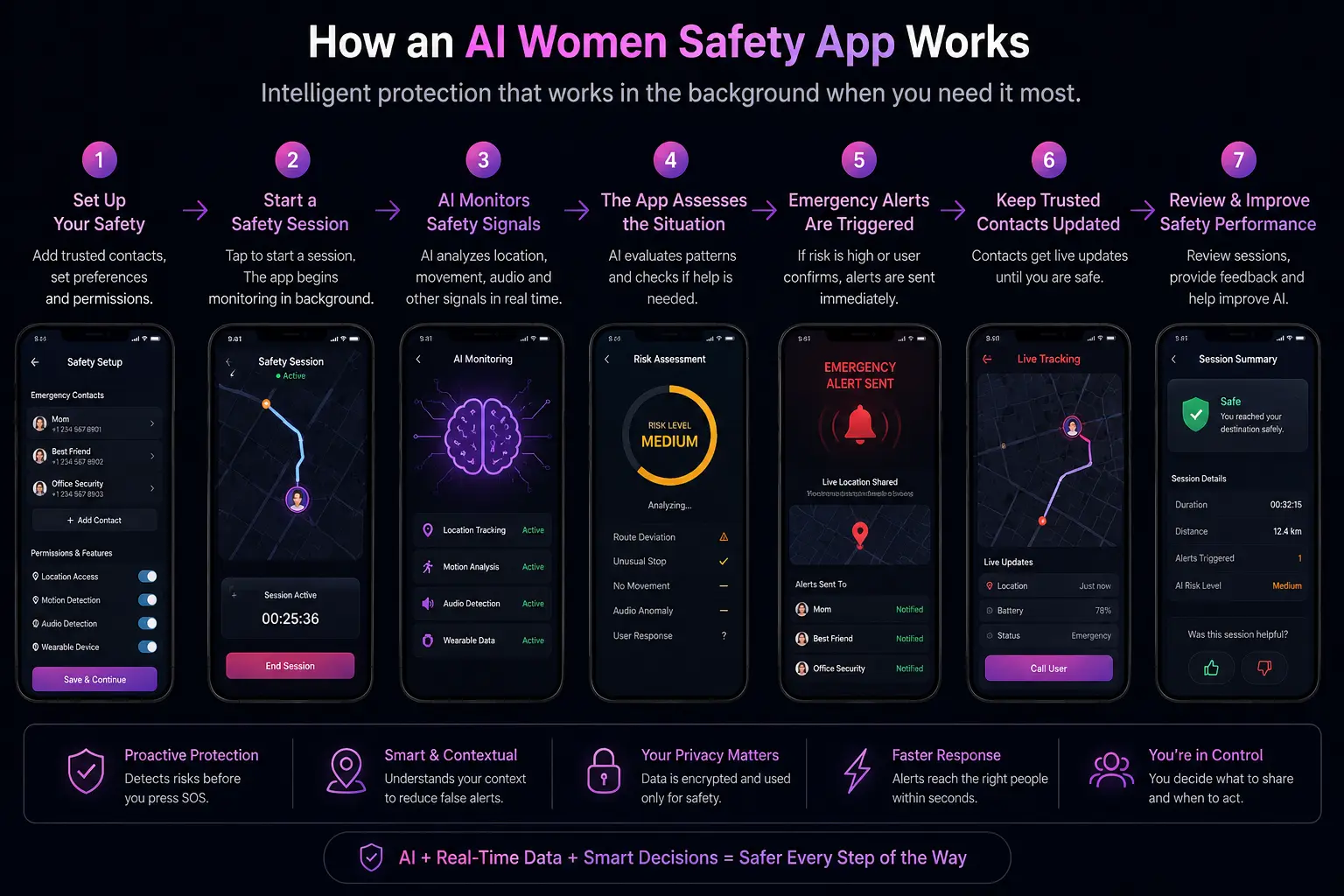
The user creates an account, adds trusted emergency contacts, and grants the permissions required for selected safety features. They can configure options such as location sharing, wearable connectivity, voice activation, emergency alerts, and other safety preferences.
When traveling alone, entering an unfamiliar area, or simply wanting additional protection, the user can start a safety session. The app begins processing permitted safety signals during that session.
The app can analyze information from GPS, accelerometer, gyroscope, microphone, or connected wearables. Depending on the app's design, AI can identify unusual movement, unexpected route deviations, sudden stops, or other predefined patterns that may require attention.
An unusual event does not automatically need to trigger an emergency. The AI can evaluate multiple signals together and, where appropriate, ask the user to confirm whether assistance is required. This approach can help reduce accidental alerts while maintaining a rapid response path for genuine emergencies.
When the user confirms an emergency or the configured safety conditions are met, the app can notify selected emergency contacts and share permitted information such as the user's current or live location. Other emergency workflows can be added according to the product's intended use and available integrations.
During an active emergency workflow, the app can continue sharing relevant updates based on the user's settings. This gives trusted contacts more context than a single SOS notification and can help them understand whether the situation is changing.
After a safety session or incident, users can review activity and provide feedback. Product teams can use appropriately handled performance data to evaluate false alerts, missed detections, and other issues, then improve the AI models, rules, and overall user experience.
A well-designed AI Women Safety App therefore combines user control, real-time monitoring, intelligent risk assessment, emergency escalation, and privacy-focused data handling. The technology should support users without creating unnecessary complexity, while safety decisions remain grounded in clearly defined rules, permissions, and tested AI behavior.
Why invest in an AI women safety app when traditional safety apps already offer SOS buttons, GPS tracking, and emergency contacts? The opportunity is to move from a basic alert utility toward a more intelligent safety platform that can interpret multiple signals, support faster decision-making, and create new possibilities for proactive personal security.
The need for effective safety technology is significant. The World Health Organization's latest 2026 update reports that approximately 1 in 3 women globally, representing about 840 million women and girls, have experienced physical and/or sexual violence during their lifetime. This persistent need creates a strong case for technology that can complement existing prevention, communication, and emergency response systems.
The market opportunity is also expanding. A 2026 analysis by 360iResearch estimates the global personal safety app market at $290.14 million in 2026, with a projection of $413.66 million by 2032, reflecting a CAGR of 6.51%. Another 2026 market analysis from Coherent Market Insights estimates the market at $2.03 billion in 2026 and projects it to reach $5.61 billion by 2033, at a 15.6% CAGR. The different estimates reflect differences in market definitions and research methodologies, so they should be treated as directional market indicators rather than a single definitive valuation.
The scale of violence against women means personal safety remains a substantial real-world problem, rather than a narrow technology niche. For entrepreneurs, this creates an opportunity to design solutions around specific scenarios such as solo travel, late-night commuting, campus safety, workplace mobility, or unfamiliar locations.
The strongest products will address identifiable safety problems and establish clear measures of effectiveness instead of relying on feature volume alone.
An AI Women Safety Mobile App can combine signals from GPS, accelerometers, gyroscopes, microphones, and connected wearables to support contextual safety workflows. AI can help identify predefined patterns, evaluate multiple signals together, and initiate configured actions when specific conditions are met.
This creates room for differentiated products built around real-time threat detection, route safety scoring, anomaly detection, and intelligent emergency escalation.
The personal safety app market already includes emergency alerts, location tracking, geofencing, wearable integration, silent alerts, and crime reporting. The 2026 Coherent Market Insights report specifically identifies AI-powered threat detection and emergency response automation among the trends shaping the market.
For an entrepreneur, this creates an opportunity to differentiate a new AI Women Safety App Development product through contextual intelligence rather than another basic panic-button experience.
A women’s safety platform does not have to depend entirely on individual consumer subscriptions. Potential customers can include universities, corporations, transportation companies, hospitality businesses, residential communities, NGOs, and public-sector safety programs.
This creates several possible commercialization paths, including B2B licensing, institutional subscriptions, white-label deployments, strategic partnerships, and consumer premium plans.
Modern smartphones already provide GPS, motion sensors, connectivity, microphones, and other capabilities that can support safety workflows. Wearables can contribute additional signals and provide discreet interaction options.
This technology foundation makes it increasingly practical to develop AI Women Safety App solutions that process multiple inputs instead of depending on a single manual action. On-device AI can also be considered for selected use cases where privacy, latency, or connectivity are important.
North America is estimated to hold 36.46% of the global personal safety app market in 2026, according to Coherent Market Insights, making it the leading regional market in its analysis. For founders considering the US market, this provides a relevant environment for partnerships with technology providers, safety organizations, universities, employers, and emergency-response ecosystems.
For a social entrepreneur seeking funding, the investment case becomes stronger when the product has measurable outcomes. Investors can evaluate metrics such as alert accuracy, false-trigger rates, emergency response time, user retention, route safety engagement, successful assistance workflows, and adoption across target communities.
The objective of AI Women Safety Application Development should therefore be to combine social impact with a sustainable product model and measurable evidence of real-world usefulness.
The investment opportunity is strongest when AI addresses a clearly defined safety problem, uses technology responsibly, protects sensitive user data, and demonstrates outcomes that can be measured beyond a list of features.
What benefits can an AI women safety app deliver that justify investing in technology beyond a basic SOS button? For a social entrepreneur preparing a production-grade safety solution for impact investors, this is an important question. The value of AI Women Safety App Development should be demonstrated through practical capabilities such as real-time threat detection, AI-powered route safety scoring, intelligent emergency escalation, discreet alert activation, and reliable support during potentially unsafe situations.
For example, an app that uses smartphone sensors to recognize unusual movement, evaluates the safety of an unfamiliar route, and distinguishes a genuine emergency from an accidental trigger can offer a more context-aware experience than a conventional safety application. These capabilities can also create measurable product outcomes, such as faster emergency communication, fewer accidental alerts, better route awareness, and stronger user engagement.
The following benefits explain where AI Women Safety Mobile App Development can create practical value for users, organizations, and businesses planning to build AI Women Safety App solutions.
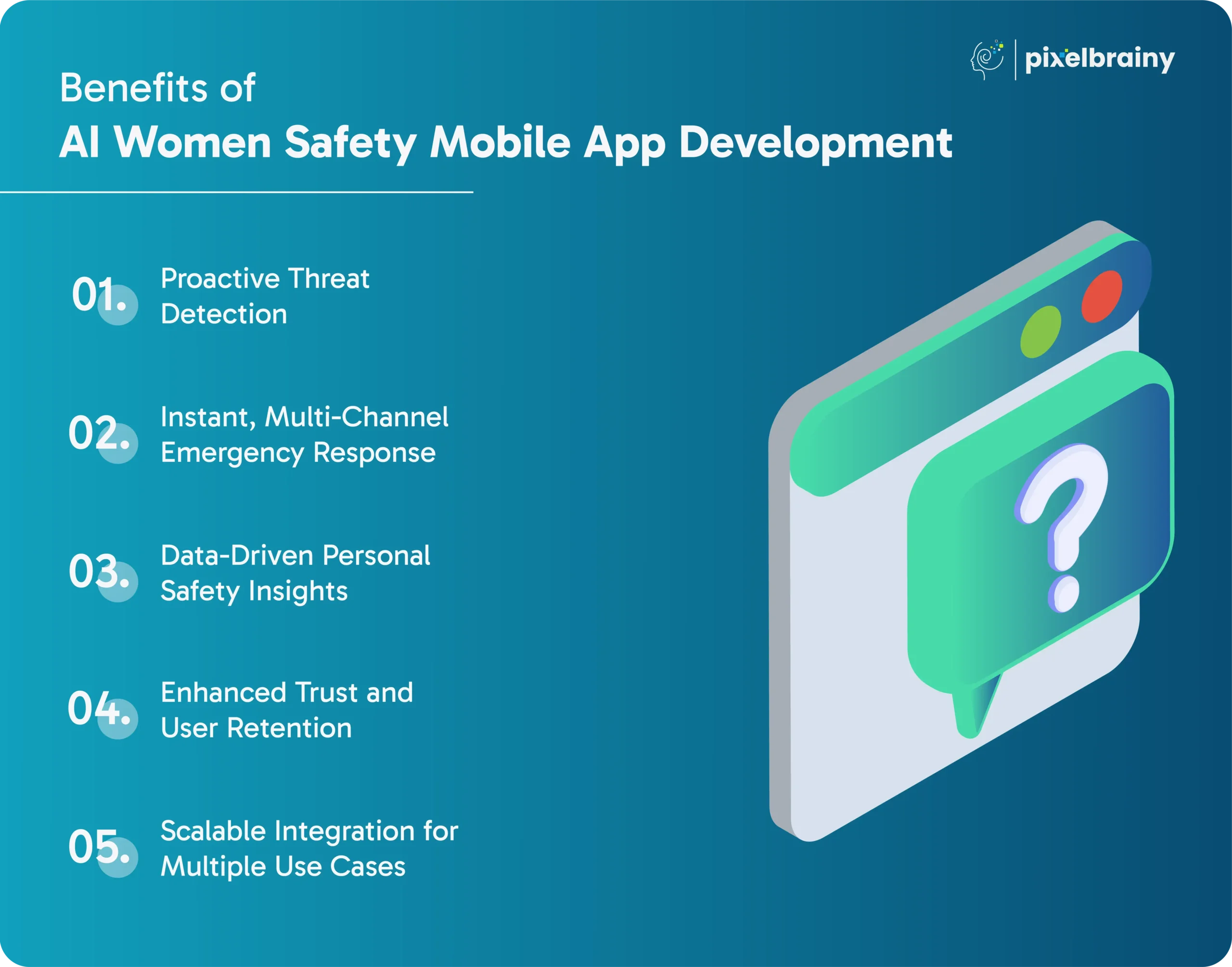
AI can help a safety app identify predefined risk patterns by analyzing permitted signals from GPS, accelerometers, gyroscopes, microphones, and connected devices. This allows the application to respond to unusual conditions without depending entirely on a manually pressed SOS button.
For example, an unexpected route deviation, sudden movement change, or prolonged inactivity could trigger a safety check based on the application's configured rules. Combining multiple signals can also help reduce unnecessary alerts compared with relying on a single event.
Additional Advantages:
When a user needs assistance, communicating the situation quickly can be critical. AI women safety app development can automate emergency workflows that notify selected contacts and share permitted information such as live location, timestamps, or incident status.
Rather than sending one generic alert, the app can follow a predefined escalation sequence. This allows emergency communication to become more structured and helps trusted contacts receive relevant information at the appropriate stage.
Additional Advantages:
There are situations where a user may not be able to unlock their phone and manually press an SOS button. An AI women safety app can provide alternative activation methods through voice commands, gestures, wearable devices, or predefined interactions.
This makes emergency assistance more accessible in situations where visible phone interaction may be difficult or unsafe. These controls can also be customized to the user's preferences and tested carefully to reduce accidental activation.
Additional Advantages:
An AI-enabled safety platform can provide users with more context about their journeys by analyzing permitted location patterns and available safety information. For example, AI-powered route safety scoring can help users compare routes according to factors such as available safety data, location context, or community reports.
This extends the app's role beyond emergency response and makes it useful during everyday travel. Instead of only reacting after an incident, the platform can help users make more informed decisions about where and how they travel.
Additional Advantages:
A personal safety product needs a strong foundation of trust. Users should understand what the app monitors, why specific permissions are needed, how alerts are triggered, and how their information is handled.
During AI women safety application development, privacy controls, transparent consent, secure data storage, dependable notifications, and predictable AI behavior should be treated as core product requirements. When users understand how the system works and experience reliable performance, continued engagement becomes easier to support.
Additional Advantages:
An AI women safety application can serve markets beyond individual consumers. Organizations can adapt the same platform for employee safety, university campuses, transportation services, hospitality, residential communities, and public safety programs.
A scalable architecture allows businesses to introduce different user roles, safety policies, branding, integrations, and deployment models without creating an entirely separate platform for every audience. This expands the commercial possibilities of AI women safety app development while keeping the underlying technology reusable.
Additional Advantages:
For businesses planning to develop AI Women Safety App solutions, the strongest value comes from solving specific safety problems with reliable, measurable AI capabilities. Proactive detection, faster emergency communication, discreet activation, route intelligence, user trust, and scalable deployment can make the product more useful while creating a stronger foundation for sustainable growth.
Not every women’s safety product needs the same AI capabilities. A consumer app may focus on discreet emergency activation, while a campus safety platform may prioritize location monitoring and safe-route guidance. A corporate solution could require employee tracking and escalation workflows, whereas a community platform may depend on crowdsourced incident reporting.
For businesses exploring AI Women Safety Mobile App Development, identifying the right app category first helps determine the required AI models, sensors, integrations, data architecture, security controls, and development scope. It also answers a practical question for entrepreneurs: which type of AI women safety app should I build to solve a specific user problem?
The following app types represent different ways to develop AI Women Safety App solutions, from emergency response and predictive safety to conversational support and post-incident assistance.
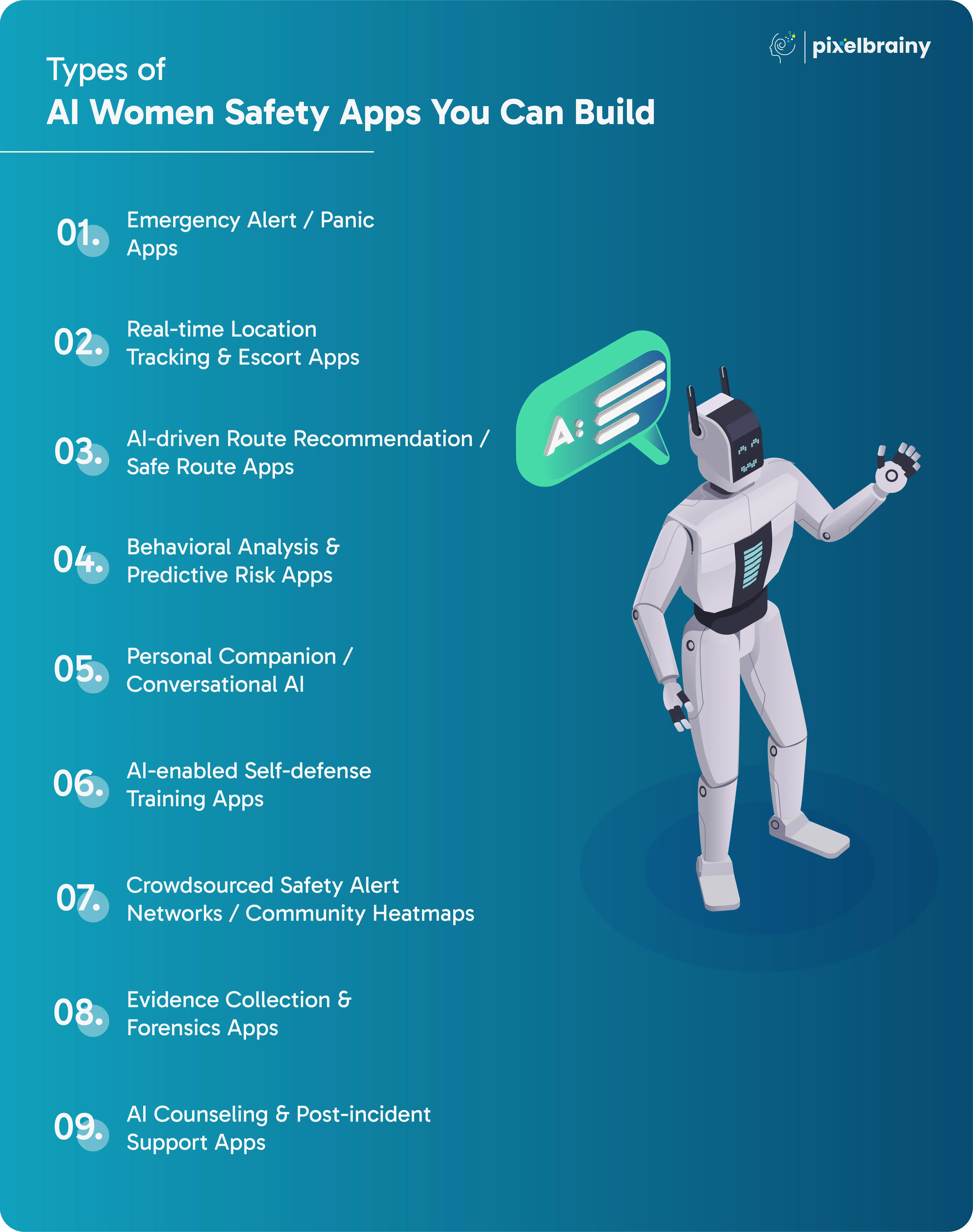
These applications focus on rapid emergency response when a user feels threatened or needs immediate assistance. Alongside manual SOS activation, AI can evaluate permitted signals such as unusual movement, voice cues, or location changes to support configured emergency workflows.
The app can be designed to distinguish routine activity from predefined risk conditions and trigger alerts when those conditions are met.
Key Features:
Extra Value: Suitable for personal safety products, corporate safety programs, NGOs, and emergency response initiatives.
These apps focus on helping users stay connected during commutes, solo travel, campus journeys, or other situations where additional monitoring may be useful. AI can identify route deviations, estimate journey progress, and notify designated contacts when configured conditions are reached.
A virtual escort workflow can also allow trusted contacts to follow a journey in real time.
Key Features:
Extra Value: Useful for employee safety, university campuses, transportation services, and travel-focused safety platforms.
These applications help users evaluate routes before or during travel rather than only tracking their current location. AI can combine available safety, environmental, mobility, and community data to generate route-level risk indicators.
For example, a user traveling through an unfamiliar area at night could compare available routes and receive contextual information about areas that may warrant additional caution.
Key Features:
Extra Value: Can be integrated with navigation platforms, mobility applications, ride-hailing services, and smart city initiatives.
These apps analyze permitted behavioral and movement signals to identify unusual patterns that may require attention. The system could compare current activity with user-configured safety sessions, travel patterns, or other relevant signals.
Wearables can provide additional inputs where appropriate, but any health or biometric data should be collected only with clear user consent and handled according to applicable requirements.
Key Features:
Extra Value: Relevant for frequent travelers, field workers, remote workers, and users who require additional monitoring during specific journeys.
A conversational safety companion gives users another way to interact with the application before, during, or after a potentially stressful situation. Natural language processing can help the system understand safety-related requests, provide approved guidance, and initiate configured emergency workflows when appropriate.
The experience should clearly distinguish supportive conversation from professional emergency or mental health services.
Key Features:
Extra Value: Can make the application more accessible and useful between emergency events while providing another interaction channel for users.
These applications focus on prevention and preparedness through interactive self-defense education. AI and AR can provide movement feedback, assess practice performance, and personalize training plans based on the user's progress.
Instead of presenting only static instructional content, the app can create more interactive learning experiences.
Key Features:
Extra Value: Suitable for consumer wellness platforms, educational programs, corporate initiatives, and community safety organizations.
These platforms use community participation to build location-based safety information. Users can submit incident reports, while AI can assist with classification, duplicate detection, spam filtering, and moderation.
Aggregated information can then be displayed through safety maps, trend indicators, or location alerts, subject to appropriate data quality and privacy controls.
Key Features:
Extra Value: Creates opportunities for community-based safety networks, mobility services, municipalities, and public safety initiatives.
These apps focus on preserving incident-related information through controlled and secure evidence workflows. Depending on user permissions and local requirements, the platform may capture relevant audio, video, location, or event metadata and protect it through encrypted storage.
AI can assist with tasks such as organization, transcription, noise reduction, or metadata processing, but claims around legal admissibility should always be validated against the relevant jurisdiction and use case.
Key Features:
Extra Value: Can support personal documentation, organizational incident management, and authorized investigation workflows.
These applications focus on the period after a safety incident by helping users access appropriate resources, information, and support. AI can provide guided conversations, recovery resources, or navigation toward qualified professionals, provided the system clearly communicates its limitations.
The application should not present AI-generated responses as a replacement for licensed medical or mental health care.
Key Features:
Extra Value: Extends the product experience beyond emergency response and connects users with longer-term support resources.
The right AI Women Safety App Development model depends on the problem being addressed, target users, available data, required response speed, and level of automation. Defining these requirements first helps businesses build a focused safety product instead of combining complex features that do not directly support the intended use case.
What should an AI Women Safety App include to provide meaningful protection without making the user experience complicated? The answer depends on how the app is intended to detect risk, communicate emergencies, support everyday safety, and protect sensitive user information.
For an entrepreneur planning to develop a production-ready solution, the feature set should go beyond a standard SOS button. AI can connect location data, device sensors, voice or gesture inputs, wearable signals, emergency contacts, and safety information to create a more responsive safety workflow. The key is to define clear conditions for each feature and ensure users understand what the app can monitor, when alerts can be triggered, and what information is shared.
These capabilities are particularly relevant when the objective is to build an AI Women Safety App that can support scenarios such as unfamiliar travel, unexpected route changes, discreet emergency activation, and automated contact escalation. Each feature should contribute to a specific safety use case while maintaining user consent, privacy, reliability, and accessibility.
Here are the core features to consider in women safety app development with AI:
| Feature | Description |
| AI-powered SOS Alerts | Instantly sends emergency signals through one-tap activation or automated AI triggers, ensuring help is on the way even if the user cannot reach the phone |
| Real-time GPS Tracking | Shares the user’s live location with trusted contacts while AI monitors for unusual route deviations or unexpected delays |
| Voice & Gesture Activation | Allows discreet emergency activation via pre-set voice commands or simple gestures, reducing the risk of alerting potential threats |
| Safe Route Recommendations | AI evaluates crime reports, street lighting, and crowd density to guide users through the safest possible paths |
| Behavioral Pattern Analysis | Learns a user’s daily habits and quickly detects unusual activities or unsafe patterns, triggering proactive alerts |
| Encrypted Evidence Recording | Captures audio, video, and GPS details automatically during emergencies, storing them securely for legal use |
| Multi-channel Emergency Notifications | Delivers alerts via SMS, push notifications, email, and automated calls to ensure rapid outreach |
| Community Safety Alerts | Enables real-time reporting of safety incidents with AI moderation to ensure credible, actionable information |
| Wearable Device Integration | Connects with smartwatches and fitness bands to detect stress signals or sudden movements that indicate danger |
| AI-driven Post-incident Support | Offers emotional support, recovery resources, and direct access to professional counselors after an incident |
A strong AI women safety application development strategy should connect these features into a clear safety journey, from risk awareness and discreet activation to emergency escalation and post-incident support. The priority should be reliable, user-controlled functionality that addresses real safety scenarios rather than simply increasing the number of features.
What advanced capabilities can take an AI Women Safety App beyond standard emergency alerts and make it more responsive to complex safety situations? Once the core features are established, businesses can introduce AI, IoT, geolocation, voice processing, computer vision, and other technologies to support more context-aware safety workflows.
For a founder planning to build AI Women Safety App solutions for real-world use, advanced functionality should be selected around specific scenarios rather than added simply to make the product appear more sophisticated. For example, predictive risk analysis may support unfamiliar travel, while wearable synchronization can provide another discreet channel for emergency interaction. Advanced features can also influence the technical architecture, data requirements, testing effort, privacy controls, and overall AI Women Safety App Development cost.
The following features can help extend a safety platform beyond basic SOS functionality while keeping the focus on practical use cases, user control, and reliable emergency workflows:
| Advanced Feature | Description |
| Predictive Threat Detection | AI analyzes environmental data, movement patterns, and location history to anticipate risks before they escalate |
| Voice Stress Analysis | Detects emotional distress in speech to automatically trigger alerts, even during normal conversations |
| Geo-fenced Safety Zones | Sends instant alerts when the user enters or exits predefined safe or unsafe locations |
| Crowd Density & Movement Analysis | Uses AI and IoT data to assess crowd behavior, alerting users to avoid potentially unsafe gatherings |
| Dynamic Route Re-Routing | Automatically changes navigation routes in real time based on crime data, road conditions, and suspicious activity |
| Wearable & IoT Device Sync | Integrates with wearables and connected devices for continuous health, location, and safety monitoring |
| Incident Auto-report to Authorities | AI compiles relevant evidence and sends it to law enforcement with verified location and timestamps |
| Augmented Reality Escape Guidance | AR overlays provide step-by-step visual cues for the fastest and safest exit during emergencies |
| Multilingual AI Assistance | Provides voice and text safety guidance in multiple languages, ensuring accessibility for global users |
| Blockchain-based Evidence Storage | Stores incident data securely on the blockchain to prevent tampering and ensure legal admissibility |
These advanced capabilities can expand AI women safety application development from basic alert functionality into a broader intelligent safety ecosystem. The right combination should be based on the target users, safety scenarios, available data, device capabilities, privacy requirements, and the level of automation the product can responsibly support.
After you finalized the features, now it’s time to turn the concept into a structured product roadmap. AI women safety app development requires more than mobile app coding because the product may depend on real-time location, device sensors, AI models, emergency communication, wearable connectivity, secure data handling, and carefully defined response workflows.
For founders asking how to build an AI women safety app from scratch, the development process should validate the safety use case first, then move through design, MVP creation, AI implementation, testing, deployment, and continuous improvement. This approach helps control technical risk while keeping the product focused on genuine user needs.
Below are the steps to build AI women safety app from idea to launch:
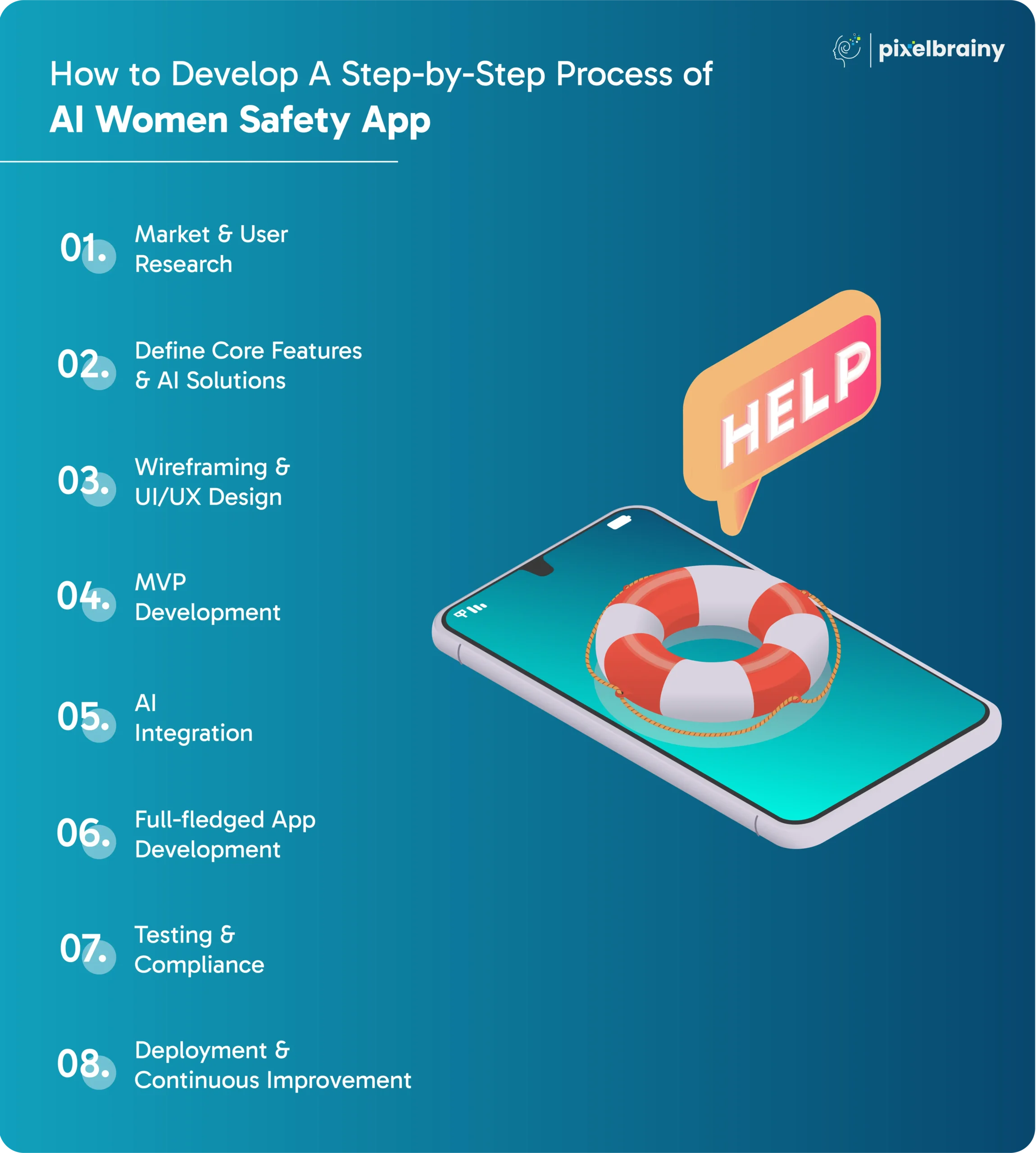
The first stage of AI women safety app development is understanding who the app serves, which safety situations users actually face, and where existing solutions fail to provide adequate support. Research should cover target demographics, travel patterns, emergency scenarios, competitor products, regional safety requirements, device usage, and user expectations around privacy.
Conduct interviews, surveys, competitor analysis, and market research to identify high-priority problems. For example, users may value discreet emergency activation, safer route guidance, or intelligent contact escalation more than a large collection of additional features.
Why this matters: Research helps you develop AI women safety app functionality around real safety needs instead of assumptions.
Once the user requirements are clear, convert them into a prioritized product scope. Separate essential safety capabilities from advanced features and decide where AI genuinely adds value.
Core functionality may include SOS alerts, live location sharing, emergency contacts, geofencing, route monitoring, voice or gesture activation, and incident logging. AI can then be considered for anomaly detection, route risk scoring, behavioral analysis, or contextual emergency assessment.
At this stage, AI consultation can help define which models, data sources, and processing methods are practical for the intended use case.
Why this matters: A clearly defined feature and AI scope reduces unnecessary complexity and gives the team a measurable development roadmap.
Also Read: Top 10 AI Consulting Companies in USA
Safety applications require interfaces that remain simple and easy to understand during stressful situations. Work with a UI/UX design company to map critical user journeys, including onboarding, safety-session activation, emergency triggering, contact management, location sharing, and incident review.
Design should minimize unnecessary interactions and make important actions easy to locate. Prototypes should be tested with representative users to identify confusing workflows before development begins. Accessibility, readable alerts, clear permissions, and transparent AI interactions should also be included in the design system.
Why this matters: Good UX can reduce hesitation and help users reach essential safety functions faster.
Instead of releasing every planned capability at once, move into MVP development with the features required to validate the core product concept. A practical MVP may include user registration, emergency contacts, SOS, GPS tracking, basic safety sessions, notifications, and one or two validated AI functions.
The development team can release the MVP to a controlled audience, collect feedback, and monitor how users interact with the product. This creates an evidence-based foundation for deciding which advanced features should come next.
Why this matters: A focused MVP reduces initial investment, limits scope creep, and allows safety workflows to be tested before full-scale expansion.
Also Read: Top 10 AI MVP Development Companies in USA
At this stage, AI capabilities become part of the live product architecture. The implementation may include sensor-based anomaly detection, route risk analysis, voice recognition, behavioral pattern analysis, or intelligent emergency escalation.
AI integration should be designed with clear trigger conditions, permission controls, fallback behavior, and monitoring. Depending on the use case, some AI functions may run on-device while others may use cloud infrastructure. Data should be handled according to applicable privacy and security requirements.
Teams may also hire AI developers with experience in mobile AI, machine learning, geolocation, speech processing, or edge inference depending on the planned features.
Why this matters: Proper AI implementation determines whether the application behaves consistently enough for real-world safety workflows.
After the MVP demonstrates technical and user value, expand the product into a complete platform. This can include advanced risk detection, wearable synchronization, safe-route intelligence, community reporting, multilingual assistance, evidence management, administrative dashboards, and organization-specific features.
During this stage, AI model development can move beyond initial prototypes toward stronger validation, optimization, and production monitoring. Backend services should also be scaled to support increasing users, data volume, notifications, and connected devices.
Why this matters: Full-scale development turns a validated concept into a market-ready product that can support broader audiences and more complex safety workflows.
Testing an AI safety application requires more than checking whether screens and buttons work correctly. QA teams should evaluate emergency workflows, GPS accuracy, sensor behavior, AI response consistency, false triggers, notification delivery, device compatibility, security, accessibility, and performance under poor connectivity.
Privacy and compliance reviews should also be conducted for location, audio, video, biometric, and other sensitive information collected by the application. Where the product operates across regions, applicable local data protection and safety requirements should be assessed.
A structured testing program should include simulated emergency scenarios to verify how the application behaves under realistic conditions.
Why this matters: Safety software must be dependable, secure, and predictable before it is trusted by users.
Once the application passes functional, security, AI, and usability testing, deploy it through the relevant app stores and production infrastructure. Launch activities should include analytics, crash monitoring, incident reporting, support processes, and performance dashboards.
After release, AI product development companies can continue improving the platform by analyzing false positives, missed detections, user feedback, feature adoption, and system performance. Model updates, security patches, API changes, and infrastructure optimization should be handled through a defined maintenance cycle.
Why this matters: The development process of AI women safety app does not end at launch. Continuous evaluation helps keep the product reliable as user needs, devices, data, and technology evolve.
Following this AI women safety app development using AI steps helps transform a safety concept into a structured, tested, scalable product built around real user needs and responsible AI implementation.
How much does it cost to develop an AI women safety app, and what explains the difference between a basic safety application and a production-grade platform? The answer depends on the level of AI, emergency automation, device integrations, security, and scalability you require.
Based on the existing cost framework, AI women safety app development cost can range from $30,000 to $200,000+. A basic MVP with essential SOS and location functionality requires a smaller investment, while an advanced or enterprise-grade platform can involve AI-driven risk detection, wearable integrations, real-time monitoring, and more complex infrastructure.
For example, if you are a social entrepreneur preparing a production-grade product for impact investors, your development budget of an AI women safety app should account for more than the mobile interface. AI model requirements, sensor integration, emergency communication, privacy, testing, and post-launch maintenance can all influence the final proposal.
| App Type | Typical Scope | Estimated Cost |
| Basic AI Women Safety App | SOS, GPS tracking, emergency contacts, manual alerts, basic notifications | $30,000 to $60,000 |
| Advanced AI Women Safety App | AI risk detection, route safety, voice or gesture activation, wearable integration, automated escalation | $60,000 to $120,000 |
| Enterprise AI Women Safety App | Advanced AI models, multi-device support, real-time monitoring, institutional dashboards, large-scale integrations | $120,000 to $200,000+ |
Basic features such as SOS, GPS tracking, and manual alerts require less development effort. Advanced capabilities such as predictive risk detection, behavioral analysis, voice processing, route intelligence, and wearable integration require additional engineering, testing, and AI infrastructure. The source framework identifies feature set and AI complexity as a major development cost factor.
The team structure and location can substantially affect the AI women safety app development cost. The existing cost framework notes indicative hourly ranges of $25 to $50 in Asia, $60 to $120 in Eastern Europe, and $100 to $200 in the US/UK.
Developing for one mobile platform generally requires less work than supporting both iOS and Android. Costs can increase further when you add smartwatches, fitness bands, Bluetooth devices, or other connected hardware because every device requires additional integration and testing.
Safety applications need exceptionally clear user flows, especially for emergency interactions. Budget increases when the project requires custom interfaces, rapid-access emergency controls, accessibility support, interactive prototypes, and testing with representative users. The source content also highlights UI/UX as a key investment area for emergency-focused applications.
The investment continues after launch. AI models may require monitoring and retraining, while mobile operating systems, APIs, security requirements, and integrations require ongoing maintenance. The source framework estimates annual maintenance and AI model training at approximately 15% to 25% of the initial development cost.
The factor ranges above are planning estimates, because the supplied source establishes the cost drivers and overall app ranges but does not provide a separate dollar allocation for each factor. The overall source framework places basic MVP development at $20,000 to $50,000, mid-range AI apps at $50,000 to $120,000, and full-scale advanced solutions at $120,000 to $200,000+.
A realistic AI women safety app development cost starts with the actual safety use case, then scales with AI complexity, device integrations, security requirements, and the level of reliability expected in real-world emergencies.
Also Read: AI App Development Cost: From MVPs to Full-Scale AI App
The technology behind an AI women safety app needs to support more than standard mobile functionality. When the product is expected to analyze movement, process location signals, enable discreet emergency activation, connect with wearables, and deliver rapid alerts, every technology layer must work reliably together.
For businesses planning to build AI women safety mobile app solutions, the technology stack should therefore be mapped to the actual safety use cases. Native or cross-platform mobile frameworks determine access to device capabilities, while backend services handle real-time communication. AI and ML technologies support risk analysis, voice processing, and behavioral pattern detection. Maps, geospatial services, wearables, cloud infrastructure, security, and compliance tools complete the ecosystem.
The right stack also depends on whether you are creating a new product or upgrading an existing application. Factors such as device compatibility, expected user volume, connectivity conditions, AI processing location, data sensitivity, and integration requirements should be evaluated before implementation. This makes technology selection a core part of women safety app development with AI, rather than a decision made after the feature list is finalized.
| Layer | Recommended Tools | Why it matters / How to use |
| Mobile Frontend | Kotlin for Android, SwiftUI for iOS, Flutter or React Native for cross-platform | Native frameworks offer better performance and access to device sensors, while cross-platform options help reduce time-to-market in AI Women Safety Application Development |
| UI Frameworks | Jetpack Compose, SwiftUI, Material 3, Tailwind for RN web panels | Helps create intuitive, accessible designs crucial for emergencies when you build AI Women Safety Mobile App |
| Backend API | Node.js with NestJS, Python FastAPI, or Django REST | Enables secure and scalable server-side operations, essential for managing real-time alerts in Women Safety App Development with AI |
| Real-time Services | WebSockets, Socket.IO, gRPC, MQTT | Supports instant communication for live tracking and emergency notifications in AI-driven safety apps |
| Databases | PostgreSQL, MongoDB, Redis | Store user data, incident logs, and AI-generated insights with high performance and encryption |
| Maps and Geospatial | Google Maps SDK, Mapbox, PostGIS | Powers safe route suggestions and geo-fencing features in AI Women Safety App Development |
| Notifications & Telephony | Firebase Cloud Messaging, APNs, Twilio, Vonage | Ensures critical safety alerts reach users instantly, even in low connectivity zones |
| AI & ML Inference | PyTorch, TensorFlow, TFLite, Core ML, ONNX Runtime | Supports predictive analytics, behavioral pattern detection, and on-device AI processing in AI Women Safety Application Development |
| NLP & Voice Processing | Vosk, Picovoice, Rasa | Enables voice-command SOS activation and distress detection, improving usability in real-time emergencies |
| Computer Vision | OpenCV, MediaPipe, TensorFlow Lite CV | Detects gestures or visual threats with user consent, enhancing proactive security features |
| Wearables & IoT Integration | HealthKit, Google Fit, Wear OS, Bluetooth LE | Adds AI-powered biometric monitoring for detecting sudden heart rate spikes or abnormal movement patterns |
| Security & Privacy | TLS 1.3, AES-256, OAuth 2.1, Vault or KMS | Protects sensitive user data, a non-negotiable requirement in Women Safety App Development with AI |
| Compliance Tools | Consent SDKs, Audit Logging, GDPR & CCPA frameworks | Ensures global compliance, helping your safety app gain user trust |
| DevOps & Cloud | AWS, GCP, Kubernetes, Terraform | Supports high availability and scalability for large-scale AI Women Safety App Development deployments |
| Analytics & Crash Monitoring | Firebase Analytics, Amplitude, Crashlytics | Tracks app performance, false positive rates, and user behavior to optimize AI models |
| Testing & QA | XCTest, Espresso, OWASP ZAP | Ensures app reliability and security before and after deployment |
A technology stack aligned with the app’s safety scenarios can help AI women safety mobile application development deliver responsive, secure, and scalable experiences while giving the product a stronger foundation for future AI capabilities and connected-device integrations.
What business model can make an AI women safety app financially sustainable while keeping essential safety functionality accessible to the people who need it? For founders and social entrepreneurs, monetization needs to balance revenue generation with affordability, trust, privacy, and the cost of running AI, cloud infrastructure, emergency communication, and connected-device services.
A strong AI women safety app development business model can combine consumer revenue with institutional opportunities. For example, basic safety functionality can support wider adoption, while advanced AI capabilities, organization-level controls, integrations, and specialized services can create paid revenue streams. This approach is especially relevant when the goal is to build AI women safety app solutions for consumers as well as universities, employers, transportation providers, NGOs, and other organizations.
The right model should also consider recurring operating expenses. AI processing, location services, notifications, cloud hosting, maintenance, security, and model improvements can continue after launch. Creating predictable revenue therefore becomes important for maintaining a dependable product over the long term.
Below are the key monetization models businesses can consider:
In this approach, you provide essential safety features at no cost to encourage mass adoption. Tools like SOS alerts, live location sharing, and basic community alerts remain free, creating trust and accessibility. Users who want more powerful options can upgrade to a paid plan that unlocks AI-driven predictive threat detection, advanced safe route mapping, wearable device integration, and blockchain-based evidence storage.
The freemium model works well in women safety app development with AI because it removes entry barriers while monetizing through value-added features.
This model charges users monthly or yearly for continued access to premium features. You can create tiered plans such as:
Subscriptions generate stable recurring revenue, which is critical for ongoing AI training, server costs, and feature updates.
In this model, you license the app to institutions like universities, corporate offices, transportation networks, and housing complexes. These clients deploy your safety app internally for employees, students, or passengers. Features can be customized per organization, including branding, security protocols, and integration with existing enterprise tools. This creates large-scale, long-term contracts that provide predictable revenue while extending the reach of your AI women safety application development.
Partner with wearable tech manufacturers, telecom companies, or ride-hailing services to embed your AI-powered safety features into their offerings. For example, a smartwatch brand could integrate your SOS alert system into their devices, or a rideshare company could offer in-app safety monitoring for passengers. These partnerships can be monetized through revenue-sharing agreements, one-time integration fees, or co-branded marketing campaigns.
Women’s safety initiatives can also be supported through government programs, nonprofit organizations, grants, and public safety projects. This model can help deploy AI women safety mobile app solutions across schools, communities, public transportation networks, and other high-priority environments where direct consumer monetization may not be appropriate.
Project-based funding can also support specialized deployments, research, pilot programs, and community-focused safety initiatives while expanding the app's reach.
A white-label model allows organizations to offer the underlying safety platform under their own brand. Businesses, institutions, or public-sector organizations can adopt an existing safety solution and customize branding, workflows, user roles, and integrations according to their requirements.
For the technology provider, this can create a scalable B2B revenue stream without requiring direct ownership of every end-user relationship.
A balanced monetization strategy can combine freemium access, subscriptions, B2B licensing, partnerships, public-sector funding, and white-label deployments. The best model depends on the target audience, operating costs, desired market reach, and the level of AI functionality offered.
What can make an AI women safety app development project difficult in real-world use? The challenge is not limited to adding AI features. A reliable safety application has to handle sensitive information, deliver consistent AI decisions, operate efficiently on mobile devices, connect with external systems, and maintain user trust under high-pressure situations.
For entrepreneurs planning to build AI women safety app solutions with capabilities such as real-time threat detection, route risk analysis, sensor-based monitoring, and intelligent emergency escalation, these considerations need to be addressed during planning rather than after launch. The right approach combines technical safeguards, careful testing, privacy controls, compliance planning, and user-centered design.
Below are the key challenges to consider:
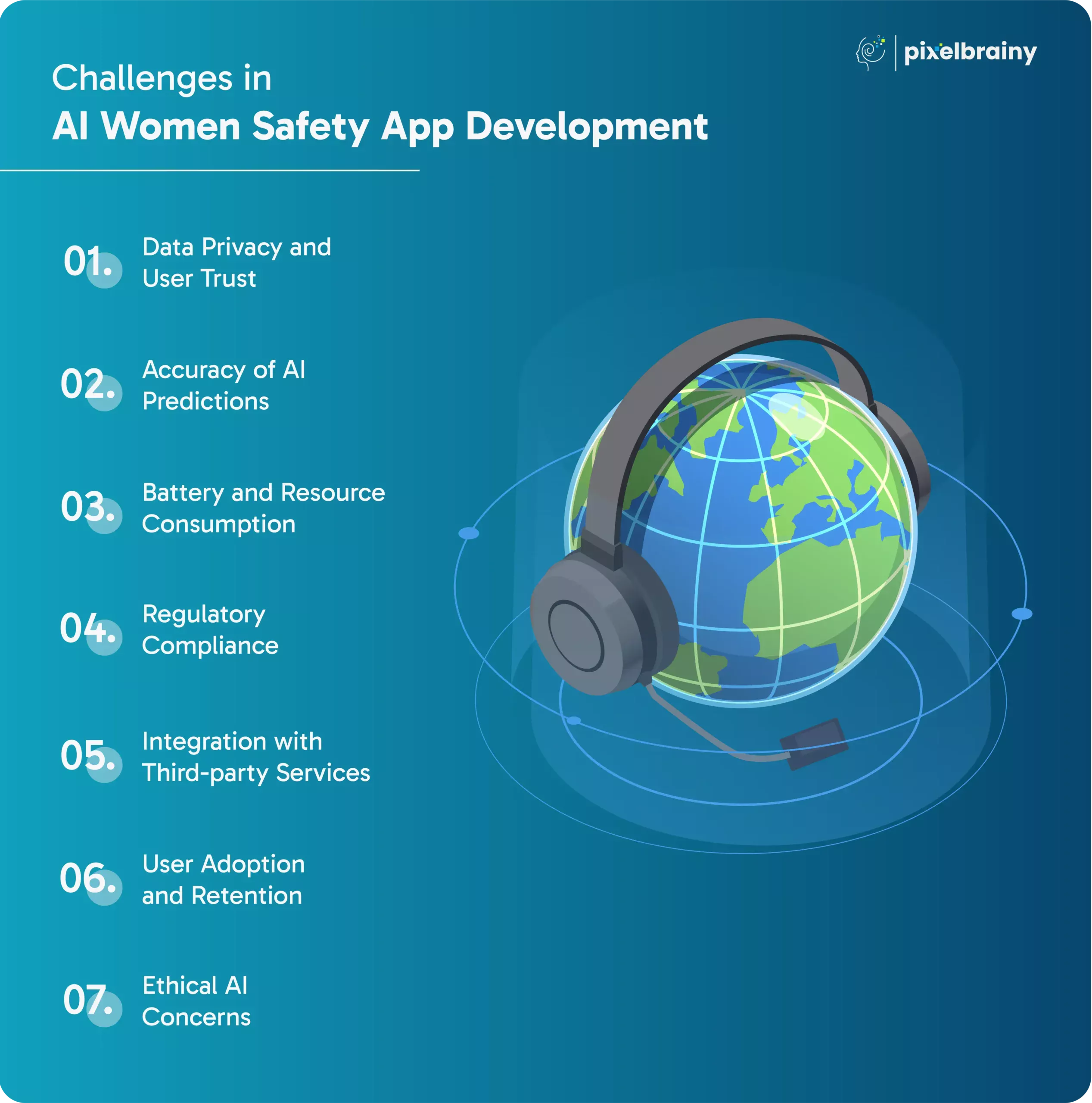
Collecting information such as live location, audio, video, and biometric readings creates serious privacy and trust considerations. Users need to understand what information is collected, why it is required, when it is processed, and who can access it.
How to Overcome:
False positives can trigger unnecessary emergency alerts, while false negatives may cause genuine incidents to be missed. Both can reduce confidence in the application and affect its real-world reliability.
How to Overcome:
Continuous GPS tracking, sensor monitoring, and AI processing can consume significant battery and device resources. This can become particularly challenging when users need the application active for extended periods.
How to Overcome:
Women’s safety applications may operate across multiple regions with different requirements for data collection, privacy, emergency communication, and AI usage. Compliance requirements can also vary based on the information the application processes and the markets it serves.
How to Overcome:
A safety platform may need to connect with mapping services, emergency communication systems, wearable devices, notification services, and other external platforms. Differences in APIs, authentication requirements, availability, and data formats can make these integrations complex.
How to Overcome:
An advanced safety app still needs regular user engagement to provide value when a safety session or emergency situation occurs. Complicated onboarding, unclear permissions, or excessive alerts can discourage continued use.
How to Overcome:
AI-enabled safety applications can raise ethical concerns when they process location, behavioral, audio, or biometric information. Features intended for protection could also be misused for unauthorized surveillance or tracking.
How to Overcome:
Addressing these challenges early helps develop AI women safety app solutions that are more secure, transparent, reliable, and suitable for real-world deployment. For a production-grade product, technical performance and user trust need to be treated as equally important development requirements.
From this above, it is now time to identify the right development partner, especially when your product needs to combine AI, mobile technology, real-time safety workflows, and strong privacy controls. PixelBrainy as an AI app development company brings full-stack expertise across AI integration, scalable backend systems, security, and mobile experiences. The existing company positioning also highlights experience with NLP, computer vision, predictive analytics, chatbot intelligence, and safety-focused solutions.
Our approach is centered on the actual safety use case. Whether the goal is to build AI women safety app capabilities around real-time threat detection, discreet SOS activation, route intelligence, wearable connectivity, or emergency escalation, we focus on creating a practical architecture rather than adding AI features simply for differentiation.
For a safety-focused mobile product, the development approach can bring together:
Specific client identifiers, project-sensitive details, and measurable outcomes are withheld because of confidentiality. The project approach reflects the same capabilities PixelBrainy positions around AI women safety app development services, including predictive analytics, AI integration, secure architecture, and mobile platform development.
Real-World AI Expertise: Experience across predictive analytics, NLP, computer vision, and conversational AI.
Safety-Focused Architecture: We prioritize reliability, privacy, secure data handling, and scalable infrastructure.
Custom Product Strategy: Our team helps develop AI women safety app functionality around specific user scenarios rather than generic feature bundles.
End-to-End Execution: From product strategy and UX through engineering, AI implementation, testing, deployment, and ongoing improvements.
Scalable Foundation: The architecture can support future wearable integrations, new AI capabilities, and broader deployment requirements.
For businesses planning women safety app development integrating AI, PixelBrainy can help translate a safety-focused product vision into a structured, scalable technology solution.
Ready to discuss your idea? Connect with PixelBrainy today.
AI Women Safety App Development is creating new possibilities for personal safety by combining intelligent risk analysis, real-time location monitoring, discreet SOS activation, route safety intelligence, wearable connectivity, and automated emergency communication. As explored throughout this guide, creating a reliable safety platform requires more than adding AI features. It requires thoughtful product planning, tested technology, strong privacy controls, secure data handling, and a development roadmap built around genuine user scenarios.
Whether you want to build AI Women Safety App solutions from scratch or upgrade an existing safety platform, the right combination of AI capabilities, mobile technologies, integrations, and infrastructure can help create a scalable product designed for real-world use. Cost, development complexity, compliance requirements, and post-launch maintenance should also be considered before moving into production.
With a focused strategy and experienced development partner, businesses can develop AI Women Safety App solutions that prioritize usability, reliability, trust, and measurable impact.
Ready to turn your AI safety app idea into reality? Schedule a call with PixelBrainy today.
The most practical AI women safety app features include real-time risk detection, behavioral anomaly analysis, AI-powered route safety scoring, voice or gesture-based SOS activation, intelligent emergency escalation, and wearable integration. The right combination depends on the specific safety scenarios the app is designed to address.
Yes, an AI women safety app development solution can be designed to identify predefined risk patterns using permitted inputs such as GPS, device movement sensors, voice signals, or connected wearables. The system can then initiate a safety check or configured emergency workflow. AI should support clearly defined scenarios rather than claim to predict every possible threat.
AI can evaluate multiple signals instead of reacting to one event alone. For example, an unusual movement pattern combined with a route deviation may receive a higher risk score than either event individually. A confirmation step can also be introduced before escalation when circumstances allow, helping AI Women Safety Application Development teams balance fast response with fewer false alerts.
The estimated AI women safety app development cost can range from $30,000 to $200,000+ depending on features, AI complexity, platform support, wearable integrations, infrastructure, security, testing, and maintenance. A basic MVP requires less investment than an enterprise solution with predictive risk detection and extensive real-time integrations.
A focused MVP can take several months, while a production-grade solution with advanced AI, real-time monitoring, wearable support, extensive testing, and compliance requirements can take longer. The timeline depends on the number of platforms, integrations, AI capabilities, and testing required before launch.
Yes. Businesses can enhance an existing platform with capabilities such as AI threat detection, route safety analysis, voice activation, behavioral monitoring, wearable connectivity, and intelligent emergency escalation without necessarily rebuilding the complete application. The feasibility and cost depend on the existing architecture, APIs, data availability, and mobile platform.
Look for a company with relevant experience in mobile AI, real-time systems, location intelligence, wearable integrations, privacy, and security. When evaluating AI app development companies in the USA, ask for comparable project experience, development methodology, testing approach, and measurable project outcomes rather than judging providers only by the number of features they offer.

About The Author
Sagar Bhatnagar
Sagar Sahay Bhatnagar brings over a decade of IT industry experience to his role as Marketing Head at PixelBrainy. He's known for his knack in devising creative marketing strategies that boost brand visibility and market influence. Sagar's strategic thinking, coupled with his innovative vision and focus on results, sets him apart. His track record of successful campaigns proves his ability to utilize digital platforms effectively for impactful marketing efforts. With a genuine passion for both technology and marketing, Sagar continuously pushes PixelBrainy's marketing initiatives to greater success.

Working with the PixelBrainy team has been a highly positive experience. They understand the design requirements and create beautiful UX elements to meet the application needs. The dev team did an excellent job bringing my vision to life. We discussed usability and flow. Sagar worked with his team to design the database and begin coding. Working with Sagar was easy. He has the knowledge to create robust apps, including multi-language support, Google and Apple ID login options, Ad-enabled integrations, Stripe payment processing, and a Web Admin site for maintaining support data. I'm extremely satisfied with the services provided, the quality of the final product, and the professionalism of the entire process. I highly recommend them for Android and iOS Mobile Application Design and Development.

Great experience working with them. Had a lot of feedback and I found that unlike most contractors they were bugging me for updates instead of the other way around. They were extremely time conscience and great at communicating! All work was done extremely high quality and if not on time, early! They were always proactive when it comes to communication and the work is great/above par always. Very flexible and a great team to work with! Goes above and beyond to present us with multiple options and always provides quality. Amazing work per usual with Chitra. If you have UI/UX or branding design needs I recommend you go to them! Will likely work with them in the future as well, definitely recommended!

PixelBrainy is a joy to work with and is a great partner when thinking through branding, logo, and website layout. I appreciate that they spend time going into the "why" behind their decisions to help inform me and others about industry best practices and their expertise.

I hired them to design our software apps. Things I really like about them are excellent communication skills, they answer all project suggestions and collaborate right away, and their input on design and colors is amazing. This project was complex and needed patience and creativity. The team is amazing to do business with. I will be using them long-term. Glad to see there are some good people out there. I was afraid to try and outsource my project to someone but I am glad I met them! I really can't say enough. They went above and beyond on this project. I am very happy with everything they have done to make my business stand out from the competition.

It was great working with PixelBrainy and the team. They were very responsive and really owned the project. We'll definitely work with them again!

I recently worked with the PixelBrainy team on a project and I was blown away by their communication skills. They were prompt, clear, and articulate in all of our interactions. They listened and provided valuable feedback and suggestions to help make the project a success. They also kept me updated throughout the entire process, which made the experience stress-free and enjoyable.

PixelBrainy is very good at what it does. The team also presents themselves very professionally and takes care of their side of things very well. I could fully trust them taking up the design work in a timely and organised manner and their attention to detail saved us lots of effort and time. This particular project was quite intense and the team showed that they function very well under pressure. Very much looking forward to working with her again!

It's always an absolute pleasure working with them. They completed all of my requests quickly and followed every note I had for them to a T, which made our process go smoothly from start to finish. Everything was completed fast and following all of the guidelines. And I would recommend their services to anyone. If you need any design work done in the future, PixelBrainy should be your first call!

They took ownership of our requirements and designed and proposed multiple beautiful variants. The team is self-motivated, requires minimum supervision, committed to see-through designs with quality and delivering them on time. We would definitely love to work with PixelBrainy again when we have any requirements.

PixelBrainy was a big help with our SaaS application. We've been hard at work with a new UI/UX and they provided a lot of help with the designs. If you're looking for assistance with your website, software, or mobile application designs, PixelBrainy and the team is a great recommendation.

PixelBrainy designers are amazing. They are responsive, talented, and always willing to help craft the design until it matches your vision. I would recommend them and plan to continue them for my future projects and more!!!

They were awesome! Did a good job fast, and good communication. Will work with them again. Thank you

Creative, detail-oriented, and talented designers who take direction well and implement changes quickly and accurately. They consistently over-delivered for us.

PixelBrainy team is very talented and creative. Great designers and a pleasure to work with. PixelBrainy is an excellent communicator and I look forward to working with them again.

PixelBrainy has a very talented design team. Their work is excellent and they are very responsive. I enjoy working with them and hope to continue on all of our future projects.


Transform your ideas into reality with us.
Across these industries, each engagement brings unique challenges, from early-stage product development to scaling complex systems, helping us build a practical understanding of real-world product environments.