AI Summary Powered by PixelBrainy
What if every receipt your restaurant issues could do more than prove a transaction, and instead become a searchable record, reconciliation tool, loyalty touchpoint, and source of customer insight?
Imagine you are the operations director of a 65-location restaurant chain. Every day, thousands of transactions generate paper receipts. Some receipts are lost, some are printed twice, some customers call because they cannot find their receipt, and finance teams spend valuable time matching transaction records across locations. Meanwhile, your loyalty program is missing customer information that could have been captured at checkout.
Now you are preparing to present a digital receipt management system investment to your CEO. The questions are practical: How much will custom development cost? What operational improvements can realistically be expected? Should the company build or buy? Which integrations are required? And which development companies in the USA have relevant experience with restaurant POS, loyalty, payments, and multi-location operations?
This is where digital receipt management system development becomes more than a paperless initiative. A modern platform can connect POS transactions with digital receipts, customer profiles, loyalty programs, refunds, analytics, email or SMS delivery, and operational reporting.
Restaurant technology platforms already demonstrate how digital receipts can connect checkout with customer engagement. Toast, for example, supports text, email, print, or no-receipt choices and can connect digital receipts with loyalty enrollment and guest feedback. Toast also reports that digital receipt data can contribute to guest and marketing reports.
For businesses researching how to build digital receipt management system, the objective should therefore be broader than replacing paper. Developing digital receipt management system software should create a secure transaction-data layer that works across locations and integrates with the existing POS environment.
This guide explains how to create digital receipt management system, including features, architecture, AI opportunities, privacy, integrations, development costs, business models, challenges, and vendor selection.

A digital receipt management system is a software platform that creates, delivers, stores, searches, retrieves, and manages transaction receipts electronically. Instead of relying entirely on printed receipts, restaurants, hotels, and retail businesses can deliver receipts through email, SMS, mobile applications, customer portals, QR codes, secure web links, or loyalty applications.
A modern system goes beyond replacing paper. It connects transaction data with POS systems, payment platforms, customer profiles, loyalty programs, CRM, accounting, and analytics.
The typical workflow is:
POS → Payment → Receipt Engine → Customer Identity → Loyalty → CRM → Analytics
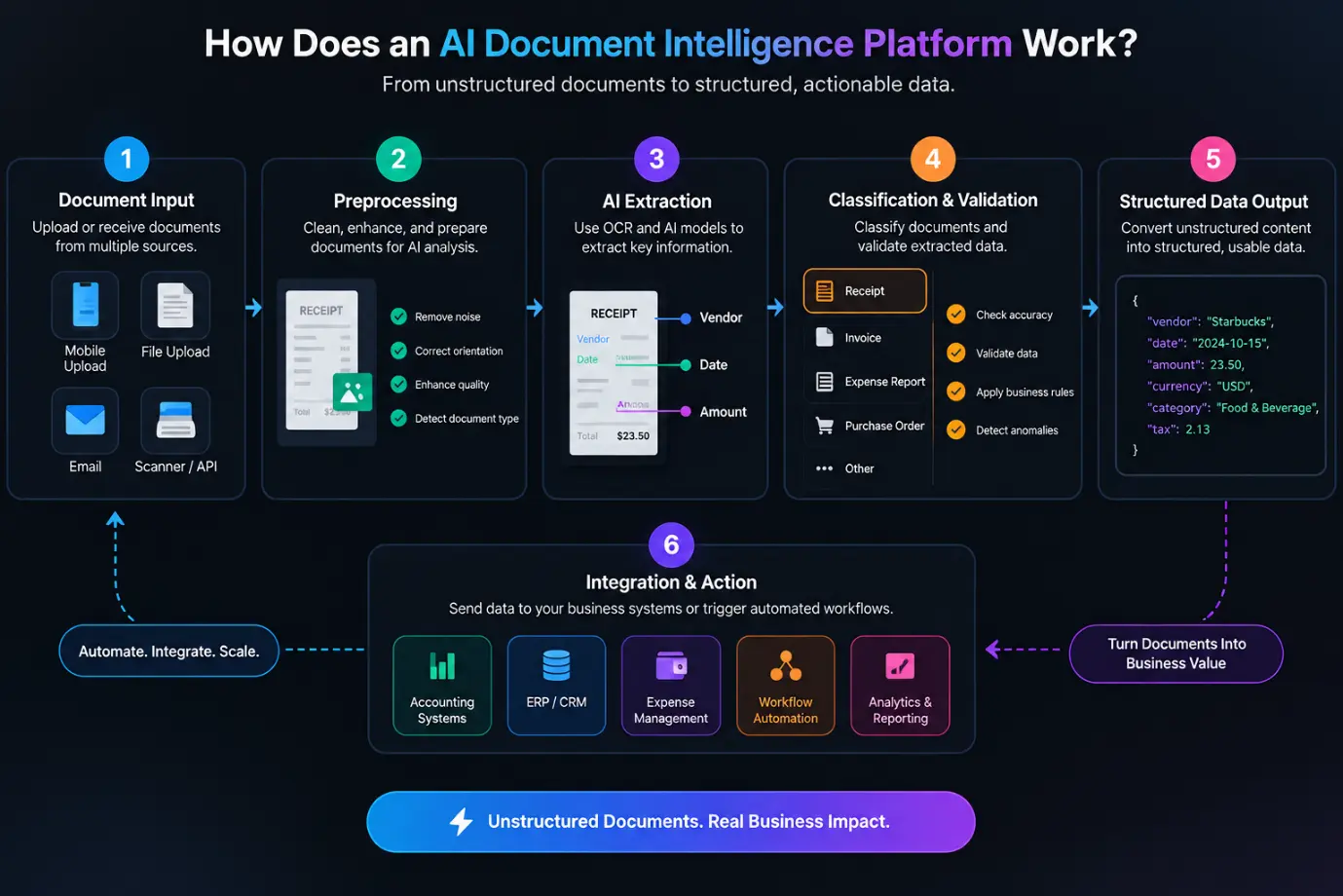
Consider a customer completing a $75 restaurant transaction. The POS sends transaction information to the receipt platform, where the transaction is validated and assigned a unique reference. The receipt engine then generates an itemized receipt containing items, prices, taxes, discounts, tips, payment details, and location information.
The customer selects an available delivery method, such as email, SMS, QR code, mobile application, or print. The digital receipt is securely stored, while the transaction can be associated with the relevant location and, where appropriate consent exists, a customer or loyalty profile.
Later, authorized employees can search and retrieve the receipt for duplicate requests, refunds, returns, or transaction verification. Finance teams can use the transaction record for reconciliation, while analytics systems can aggregate receipt data across multiple locations.
Restaurant POS platforms already demonstrate several elements of this workflow. For example, Toast supports printed, text, email, and no-receipt options and connects digital receipts with loyalty-related workflows.
A simple electronic receipt usually performs one function: sending a transaction receipt digitally instead of printing it.
A complete digital receipt management system manages the entire receipt lifecycle. It can provide:
This distinction directly affects digital receipt management system development cost. A basic digital delivery feature may require limited development, while an enterprise platform for a 65-location restaurant chain requires scalable infrastructure, multiple integrations, security, analytics, and customer-data management.
As adoption grows, an important question is: Can digital receipts replace paper receipts worldwide for restaurants, hotels & retail?
The answer is not completely and not immediately. Adoption depends on local tax regulations, electronic invoicing requirements, fiscal receipt laws, customer preferences, internet connectivity, smartphone access, and accessibility requirements.
For this reason, businesses should consider a digital-first receipt management system with paper fallback. Customers can choose digital or printed receipts while the company maintains one centralized transaction record.
This approach is especially valuable for international restaurant, hotel, and retail chains because different markets may have different requirements. The objective of building a digital receipt management system should therefore not be simply eliminating paper. It should be creating a secure, scalable, and flexible transaction infrastructure that connects receipts with POS, payments, loyalty, finance, analytics, and customer service while supporting different customer and regulatory requirements.
What happens when a restaurant, hotel, or retail chain processes thousands of transactions every day, but its receipt process still depends on paper, disconnected systems, and manual workflows? At a certain scale, receipts stop being a simple checkout document and become an important part of the business's transaction infrastructure.
The market scale makes this increasingly relevant. The National Restaurant Association projects U.S. restaurant and foodservice sales of $1.55 trillion in 2026, highlighting the enormous volume of transactions processed across the industry. The American Hotel & Lodging Association reports more than 64,000 U.S. lodging properties, nearly 5.7 million guestrooms, and approximately 1.3 billion room nights annually. Meanwhile, the National Retail Federation forecasts U.S. retail sales of approximately $5.6 trillion in 2026.
At this scale, digital receipt management system development becomes a technology infrastructure decision rather than simply a paperless initiative.
A multi-location business can generate thousands or millions of receipts across restaurants, stores, hotel departments, online orders, and payment terminals.
When receipt information remains distributed across individual POS systems and locations, retrieving and managing transaction records becomes more complicated. A centralized digital receipt platform establishes a consistent way to capture, organize, and access receipt information across the organization.
Today's restaurant, hotel, and retail transactions rarely involve the POS alone. A single transaction may interact with:
Investing in digital receipt management system development allows businesses to create a dedicated transaction layer that connects these systems through APIs and integrations.
Instead of developing separate receipt workflows for every application, businesses can establish one centralized receipt infrastructure.
The U.S. Census Bureau reported that e-commerce represented 17.1% of total U.S. retail sales in Q2 2026, with e-commerce sales reaching $316.1 billion for the quarter.
For retailers operating across physical stores, websites, mobile applications, and marketplaces, customers can complete transactions through multiple channels. A digital receipt architecture gives the business a way to manage receipt records consistently across these environments.
Hotel transactions can span rooms, restaurants, bars, spas, parking, events, room service, and other services. These transactions may originate from different systems but eventually need to be associated with a guest, reservation, folio, or payment record.
The hospitality industry's technology environment also faces interoperability challenges. AHLA and HTNG have identified fragmented systems, proprietary APIs, and inconsistent integration patterns among significant technology challenges for hospitality businesses.
A digital receipt platform can therefore be considered as part of a broader technology integration strategy.
Technology is increasingly being incorporated into restaurant operating strategies. The National Restaurant Association reported that 83% of restaurant operators say technology provides a clear competitive advantage, while 4 in 10 reported that technology investments directly improved overall customer satisfaction.
This creates a broader context for investing in receipt technology. A digital receipt platform can become one component of a restaurant's connected technology infrastructure rather than operating as an isolated paper-replacement project.
An AI digital receipt management system requires reliable and structured transaction data. Once receipt information is consistently captured, businesses can develop capabilities such as natural-language receipt search, automated reconciliation, transaction classification, anomaly identification, and AI-assisted reporting.
This is particularly relevant for large organizations where manually reviewing transaction records across dozens or hundreds of locations is difficult to scale.
Therefore, when you plan to invest in digital receipt management system development, look beyond replacing paper receipts. The right system should fit into your existing POS and business ecosystem while creating a reliable transaction-data foundation that can scale with your locations, customers, integrations, and future technology requirements.
Imagine you are the CTO of a growing hospitality and retail group that operates restaurants, hotels, and retail stores under the same parent company. Your leadership team wants to move away from paper receipts, but one question comes first: Should we build one centralized digital receipt management platform for every business unit, or develop specialized receipt systems for restaurants, hotels, and retail?
There is no universal answer. Each industry handles transactions differently. Restaurants deal with high-frequency POS transactions, tips, split payments, and loyalty programs. Hotels may need receipts connected to reservations, room charges, and digital folios. Retailers often require purchase history, returns, exchanges, warranties, and omnichannel transactions.
Understanding these different system types is therefore an important first step in digital receipt management system development. The right model depends on transaction volume, existing technology, customer journey, integration requirements, number of locations, and whether the platform is being built for one organization or offered as a commercial SaaS product.
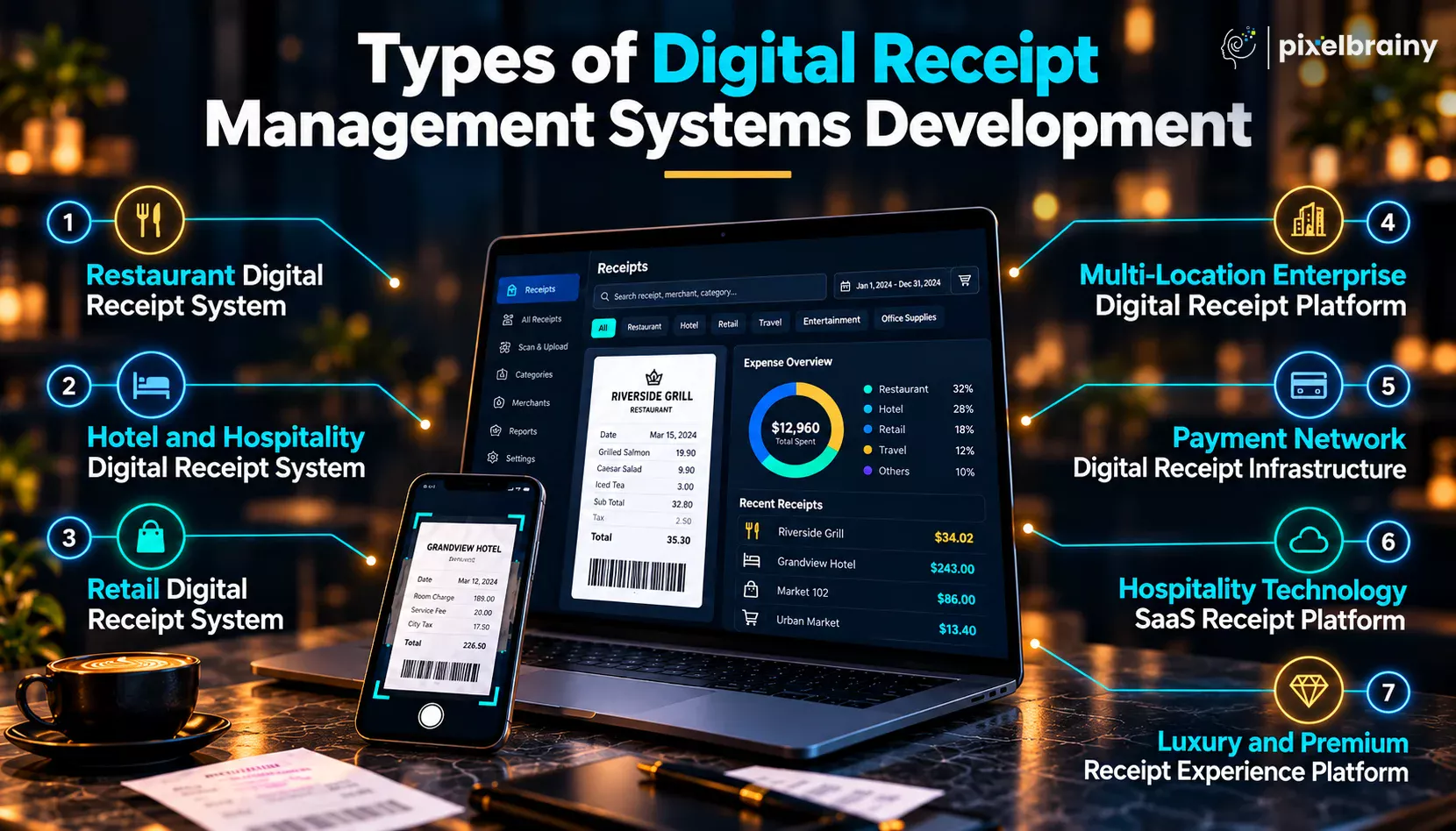
A restaurant digital receipt system is designed around fast, high-volume food and beverage transactions. It normally connects with restaurant POS systems and can deliver receipts through email, SMS, QR codes, mobile applications, or other digital channels.
Important requirements can include:
For a restaurant chain, the system can centralize receipt records while retaining location-specific transaction information. Modern restaurant platforms already demonstrate connections between digital receipts, customer engagement, and loyalty workflows.
If you plan to build digital receipt management system software for restaurants, POS integration, transaction accuracy, reliability, and rapid receipt delivery should be core architectural requirements.
Hotels have more complex receipt requirements because a guest can generate multiple charges during a single stay.
A hotel digital receipt or folio platform may integrate with:
The system can provide separate digital receipts for individual services or a consolidated digital folio depending on the hotel's operating model.
This makes electronic receipt management system development particularly relevant for hotel groups that want consistent receipt experiences across properties while connecting transaction information with reservations and guest profiles.
A retail digital receipt system is generally designed around purchases, returns, exchanges, warranties, customer accounts, and omnichannel transactions.
It can integrate with:
Digital receipts can also become part of the post-purchase customer experience. NCR Voyix, for example, includes digital receipts within its retail checkout technology.
For retailers operating both physical stores and online channels, the system should provide a consistent receipt experience regardless of where the transaction takes place.
A multi-location enterprise digital receipt platform is designed for organizations operating dozens, hundreds, or thousands of locations.
Its architecture can include:
This model is appropriate when a company wants one centralized platform to manage receipt infrastructure across different brands, regions, or business units.
When you build digital receipt management platform for restaurants hotels and retail, scalability becomes a major architectural requirement. The platform should process transactions centrally while allowing individual locations to operate reliably and independently.
Payment providers can build digital receipt infrastructure directly into their transaction ecosystem.
In this model, the receipt platform operates close to the payment transaction and can deliver receipts through payment terminals, merchant applications, digital wallets, or customer-facing interfaces.
Possible capabilities include:
Unlike a restaurant-specific solution, this model is designed to support multiple merchants and potentially very large transaction volumes.
A hospitality technology SaaS receipt platform provides digital receipt capabilities to multiple restaurants, hotels, or hospitality businesses through a cloud-based subscription model.
The provider maintains the core platform while allowing individual customers to configure:
This approach is suitable for technology companies planning to develop digital receipt management system software as a recurring-revenue SaaS product.
The architecture should therefore prioritize tenant isolation, scalable infrastructure, configurable workflows, API connectivity, and centralized platform administration.
Luxury retailers and premium hotels may require a different digital receipt strategy. The objective is not simply to provide proof of purchase but to extend the brand experience after checkout.
A premium receipt platform can include:
This model can be particularly relevant to luxury retail, premium hospitality, jewelry, automotive, and other high-value businesses where the receipt can become part of the broader ownership or guest experience.
The right system type ultimately depends on who uses the platform, how transactions are generated, which systems must be integrated, and how the receipt fits into the customer journey. Defining these requirements before development helps determine the appropriate architecture, features, technology stack, and investment level.
A restaurant, hotel, or retail chain can process thousands of transactions every day, yet still lose valuable information when receipts remain disconnected from customer profiles, loyalty programs, finance systems, and business analytics. This is why many business owners exploring digital receipt management system development ask a practical question: What measurable value can a digital receipt system actually create beyond replacing paper?
The answer depends on how the platform is designed and integrated into the existing business ecosystem. A basic electronic receipt feature may only deliver a receipt digitally, while a complete digital receipt management system can turn transaction records into structured, usable business data.
Below are the key benefits businesses can achieve by developing a digital receipt management system:
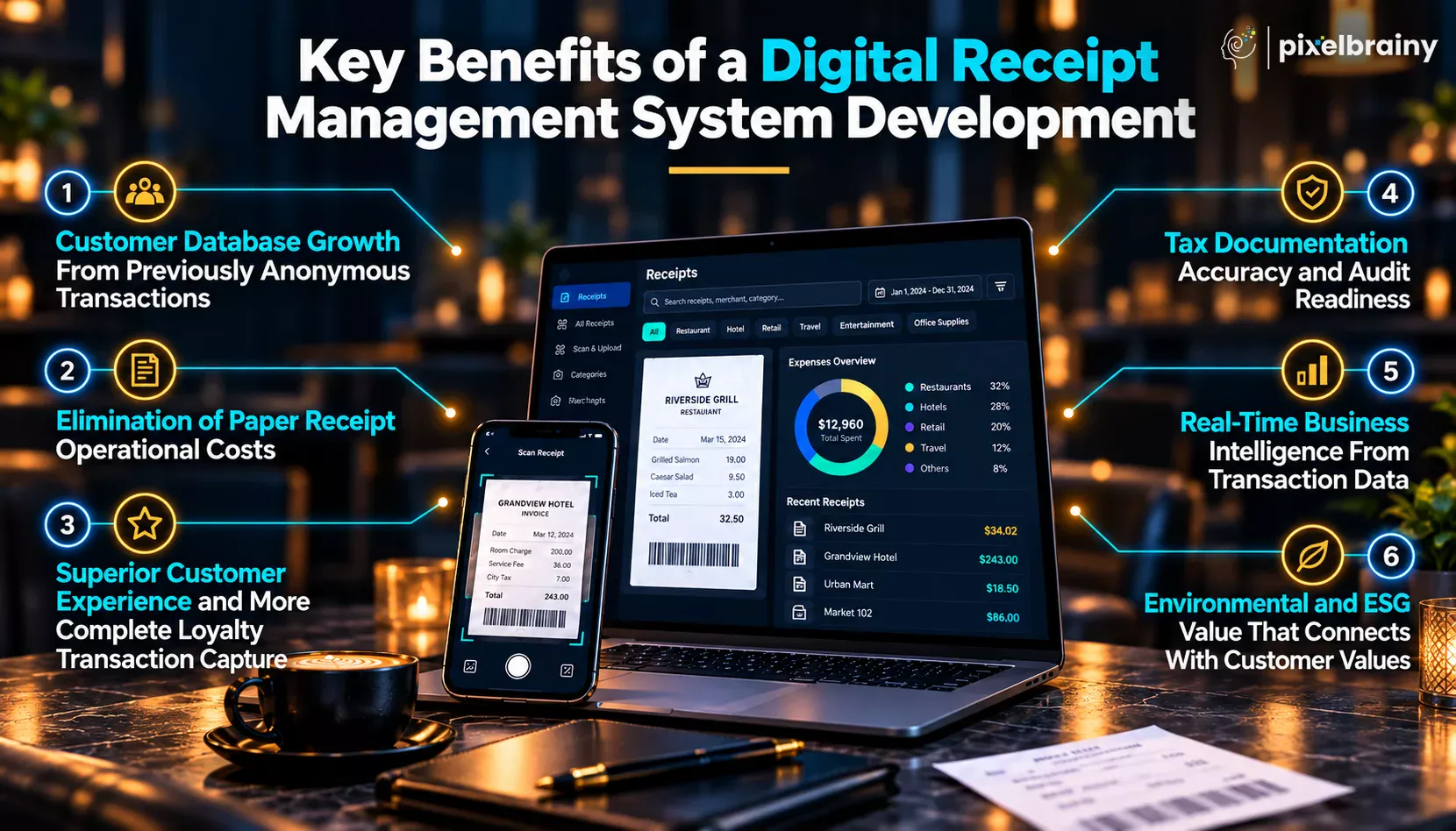
Many restaurant, hotel, and retail transactions take place without identifying the customer. A digital receipt system can create an opportunity to associate a transaction with an email address, phone number, loyalty account, or customer profile when the customer voluntarily provides the information and required consent.
This gradually increases the amount of first-party transaction data available to the business. The National Restaurant Association highlights the role of connected POS, loyalty, online ordering, reservation, and CRM data in understanding customer behavior and interactions.
Paper receipts create recurring expenses involving receipt rolls, printing, printer maintenance, storage, and replacement. Moving more transactions to digital delivery can reduce dependence on these physical processes.
The National Restaurant Association identifies reduced costs, improved data collection, and elimination of paper record storage among the potential advantages of electronic record management.
Digital receipt adoption can also support environmental reporting. Businesses can measure changes in paper consumption and digital receipt adoption as part of broader sustainability and ESG initiatives.
A digital receipt creates another direct interaction between the business and its customer. Customers can access their purchase records without keeping paper, while eligible transactions can be associated with loyalty accounts when appropriate identification and consent are available.
This matters because loyalty programs depend on accurate transaction capture. The National Restaurant Association reports that 52% of surveyed consumers participate in restaurant loyalty programs, while 96% of surveyed loyalty-program customers say these programs provide good value.
A properly integrated digital receipt management system can help reduce the gap between customer purchases and loyalty records, giving businesses a more complete view of customer activity.
Digital transaction records can create a clearer electronic trail when receipts are generated directly from validated POS and accounting data. Businesses can maintain transaction details, timestamps, location information, and connections between receipts and accounting records.
The IRS states that electronic business records should contain sufficient transaction-level detail to support and verify tax-related entries and maintain appropriate audit trails.
The IRS also explains that electronic accounting records can make examinations more efficient by allowing reviewers to examine digital records and trace transactions to their underlying details.
A digital receipt system does not automatically make a business tax compliant. The platform still needs to support applicable tax, invoicing, fiscal receipt, and record-retention requirements in each market.
A centralized receipt platform can turn individual transactions into structured data that management teams can analyze across locations. Instead of treating receipts as static documents, businesses can use transaction information for operational reporting and decision-making.
Restaurant groups can analyze transaction volumes, average transaction values, refund activity, product purchases, loyalty-linked transactions, and digital receipt adoption. Hotels can connect receipt activity with guest services, while retailers can analyze purchases across physical and digital channels.
The National Restaurant Association notes that connected technology can improve data collection and provide real-time information that helps restaurant managers make informed operational decisions.
Reducing printed receipts can contribute to lower paper consumption across high-volume businesses. For large restaurant, hotel, and retail chains, even a gradual shift toward digital delivery can provide measurable information about paper usage and digital adoption.
This can become relevant to ESG reporting and sustainability programs when businesses track appropriate metrics consistently. Customers can also be given a choice between digital and printed receipts rather than being forced into a single format.
For businesses developing a digital receipt management system, this makes sustainability part of the transaction experience itself. Digital receipt adoption can be measured alongside other operational metrics, giving management a clearer picture of how checkout practices are changing.
When you build a digital receipt management system, the value extends well beyond replacing paper. It creates a connected transaction layer that can strengthen customer data capture, loyalty, documentation, business intelligence, and sustainability efforts across the organization.

When a restaurant, hotel, or retail business decides to build digital receipt management system software, one of the first questions is usually: What features should the system include from day one to make it reliable, useful, and scalable?
The answer should focus on the core receipt lifecycle rather than adding every possible technology feature. A strong foundation should handle transaction capture, receipt generation, delivery, storage, retrieval, customer identification, administration, and reporting. Advanced capabilities such as AI-powered reconciliation, predictive analytics, fraud intelligence, and personalization can be added later as a separate layer.
Below are the 15 core features that should be considered when planning digital receipt management system development for restaurants, hotels, retail chains, and other transaction-heavy businesses.
| Core Feature | What It Should Do |
|---|---|
| POS Integration | The system should connect with POS platforms through APIs, webhooks, or middleware to capture transaction information accurately. This creates the foundation for digital receipt management system development and keeps receipt records synchronized with completed sales. |
| Digital Receipt Generation | The platform should automatically create itemized electronic receipts from validated transaction data. Each receipt should include relevant items, quantities, taxes, discounts, tips, totals, business details, transaction references, and applicable payment information. |
| Email Receipt Delivery | The system should allow customers to receive receipts through email immediately after checkout. It should support branded templates, delivery status tracking, failed-delivery handling, and receipt re-sending when customers cannot locate their original receipt. |
| SMS Receipt Delivery | Customers should be able to receive a secure receipt link through SMS when they prefer their phone instead of email. The system should manage delivery status and avoid exposing sensitive transaction information directly within the message. |
| QR Code Receipt Access | The platform should generate secure QR codes that allow customers to access their digital receipts through a web page. This is useful for restaurants, hotels, and retail environments where customers can scan directly from a POS or printed document. |
| Receipt Storage and Retrieval | Every digital receipt should be stored securely and remain searchable by authorized users. The system should support retrieval using transaction ID, receipt number, customer information, location, date, or other approved transaction attributes. |
| Receipt Re-Sending | Customers or authorized employees should be able to request a duplicate digital receipt without recreating the transaction. Existing POS platforms such as Square already support locating a transaction and sending the receipt again, making this an important core workflow. |
| Customer Profile Management | The platform should associate transactions with customer profiles when appropriate information and consent are available. Profiles can contain permitted contact details, purchase history, receipt preferences, and loyalty identifiers without unnecessarily storing sensitive information. |
| Loyalty Program Integration | The receipt system should connect eligible transactions with loyalty accounts so purchases can be correctly attributed to members. Toast, for example, supports loyalty enrollment through digital receipt workflows. |
| Multi-Location Management | Businesses operating multiple restaurants, hotels, or stores should be able to manage receipts by location while maintaining centralized administration. The system should support location-specific settings, receipt templates, users, transaction searches, and reporting. |
| Receipt Template Customization | Administrators should be able to customize logos, business information, contact details, return policies, item information, and other approved receipt content. Square currently provides similar customization capabilities for digital receipts. |
| Transaction Search and Filtering | Authorized users should be able to locate receipts quickly using filters such as transaction number, receipt ID, date, location, customer, amount, order number, or payment reference. Efficient search is essential for customer service and finance teams. |
| Refund and Return Verification | The system should connect receipts with their original transactions so authorized employees can verify purchases before processing eligible refunds or returns. This creates a consistent relationship between the receipt record and the underlying transaction. |
| Role-Based Access Control | The platform should provide different permissions for cashiers, store managers, finance teams, regional managers, and corporate administrators. Access should be limited according to job responsibilities so employees only see or modify information they are authorized to access. |
| Receipt Analytics and Reporting | The system should provide core reports covering receipt volume, digital delivery rates, failed deliveries, receipt retrievals, location activity, and customer identification. These reports give management visibility into how the receipt platform is being used across the organization. |
Modern POS platforms illustrate why these features matter in practice. Toast supports text, email, and print receipt options and can connect digital receipts with loyalty enrollment, while Square supports digital and printed receipts, receipt resending, customer profiles, loyalty, and multi-location management.
When you develop digital receipt management system software, these core features should form the dependable transaction and receipt foundation before advanced AI and intelligence capabilities are introduced.
Once the core receipt workflow is working reliably, businesses can add advanced capabilities that turn a basic receipt platform into a more intelligent transaction system. For a restaurant, hotel, or retail chain, the next question is often: How can we make our digital receipt management system smarter without making the checkout experience more complicated?
The answer lies in adding intelligence around the existing receipt infrastructure. AI, automation, predictive analytics, personalization, and stronger privacy controls can help businesses extract more value from transaction data while keeping the core receipt process simple.
Below are 10 advanced features to consider when you develop digital receipt management system software for restaurants, hotels, retail chains, payment providers, or enterprise environments.
| Advanced Feature | What It Should Do |
|---|---|
| AI-Powered Receipt Classification | AI can automatically classify receipt information by transaction type, product category, location, customer segment, or business purpose. This reduces manual categorization and creates structured data for analytics, reporting, reconciliation, and downstream business applications. |
| Natural-Language Receipt Search | Managers could search transaction records using ordinary language instead of complicated filters, such as asking for high-value transactions from a specific location or receipts associated with particular products. The system should convert the request into controlled database queries. |
| Automated Reconciliation | An advanced platform can compare POS transactions, payment records, receipts, refunds, and accounting information to identify mismatches. Exceptions can then be routed to finance teams for review instead of requiring employees to manually compare large transaction datasets. |
| AI-Powered Fraud and Anomaly Detection | Machine learning can identify unusual receipt or transaction patterns, including duplicates, suspicious refunds, manipulated receipts, abnormal transaction frequency, or behavior that differs significantly from established patterns. Flags should support human review rather than automatically treating unusual activity as confirmed fraud. |
| Personalized Receipt Experiences | The platform can dynamically tailor permitted receipt content according to customer preferences, loyalty status, purchase context, or brand requirements. Depending on consent, a receipt could include relevant loyalty information, product information, service details, or personalized post-purchase content without changing the underlying transaction record. |
| Predictive Transaction Analytics | Historical receipt data can be analyzed to identify purchasing patterns, transaction trends, unusual changes, and potential future demand. Management teams can use these insights alongside other business data for planning rather than relying exclusively on historical reporting. |
| AI Customer Service Assistant | An AI assistant can help authenticated customers locate receipts, answer basic receipt-related questions, explain transaction information, or guide users through supported refund and return processes. The assistant should retrieve information from authoritative transaction records rather than inventing receipt details. |
| Real-Time Event and Alert Engine | The platform can automatically trigger alerts when defined events occur, such as unusually high refund activity, repeated failed receipt deliveries, significant transaction discrepancies, or sudden changes in receipt volume. This gives operational teams faster visibility into exceptions. |
| Privacy and Consent Intelligence | Advanced consent controls can record customer permissions by purpose and channel, track changes, and support appropriate data-handling workflows. Purpose-specific consent, revocation, audit evidence, and privacy controls are increasingly important when receipt data is connected to customer profiles and personalization. |
| Receipt Data API and Partner Ecosystem | A secure API layer can allow authorized loyalty programs, banks, fintech companies, expense platforms, CRM systems, and other business applications to access approved receipt data. Platforms such as Banyan demonstrate how item-level receipt data can support commerce, financial services, offers, and expense-management use cases. |
These advanced capabilities should be introduced only after the core receipt infrastructure is reliable. When you build digital receipt management system software with AI, automation, and intelligent data capabilities, the objective should be to make transaction information more useful while keeping security, privacy, accuracy, and human oversight at the center of the platform.
After you finalized the features, now it’s time to plan the actual development process of digital receipt software. A privacy-first approach is important because the platform may handle customer names, phone numbers, email addresses, purchase history, loyalty information, hotel folios, and transaction records.
For example, a hospitality technology startup may ask:
“We are a hospitality technology startup and we want to build a digital receipt management system as a SaaS product for independent hotels and boutique hotel groups that want to replace paper folio receipts with a digital receipt experience that captures guest purchase data for loyalty program enrichment, enables post-checkout receipt queries without front desk involvement, and provides hotel management with unified transaction analytics across all revenue centers. Which development companies have built digital receipt management systems for hospitality clients with PMS integration and guest-facing digital receipt delivery?”
This type of product needs more than digital receipt generation. PMS integration, POS connectivity, guest identity, consent management, secure storage, receipt delivery, and transaction analytics must work together. Hotel technology integrations commonly connect PMS and POS environments so transaction and guest information can move between systems.
Below are the key steps to build digital receipt system from idea to launch.
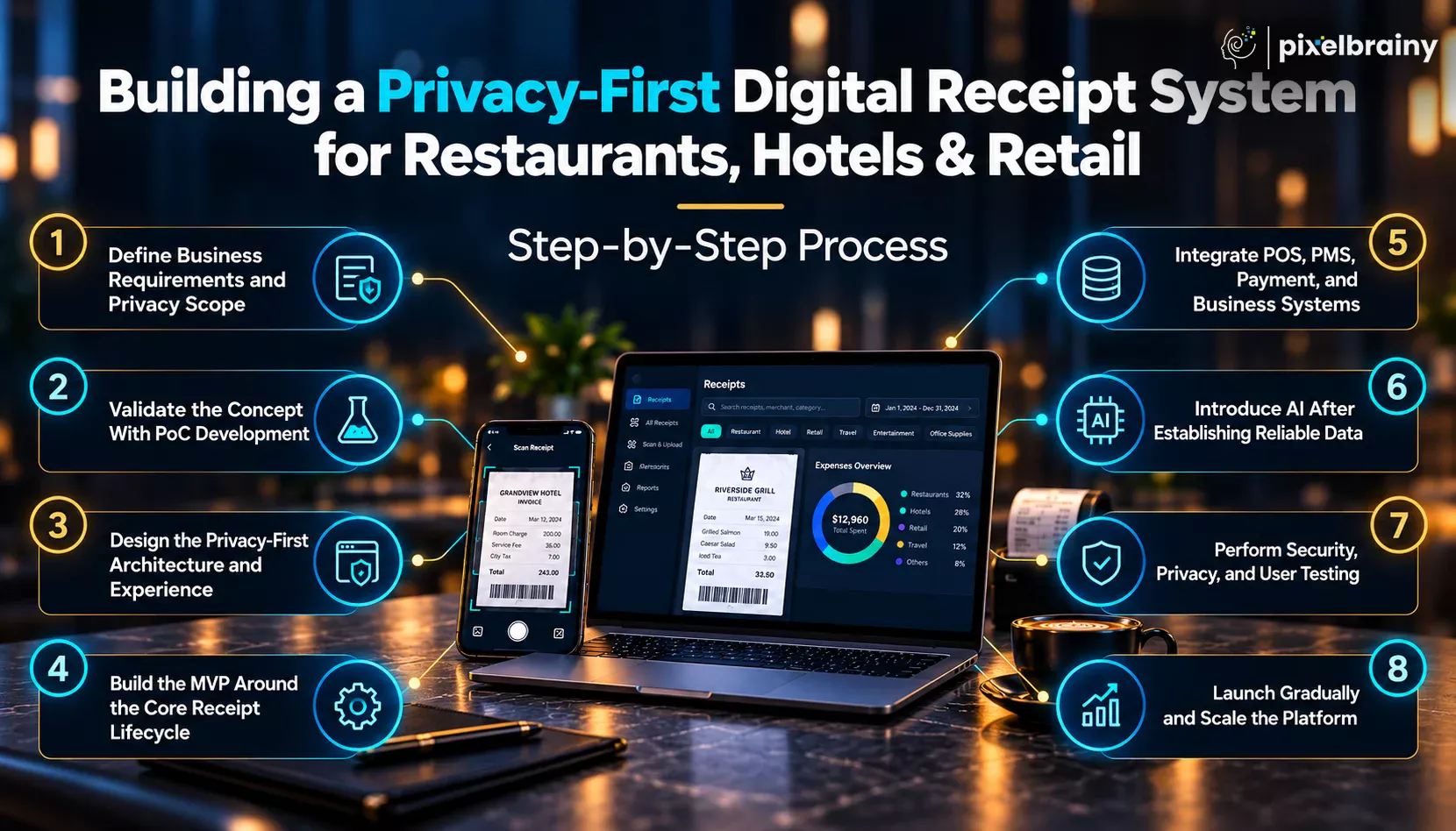
The first step is to clearly define what the digital receipt platform needs to accomplish. Identify the target businesses, users, transaction types, integrations, receipt formats, delivery channels, and administrative requirements.
Next, determine what customer information the system actually needs. Define data retention, access permissions, consent requirements, privacy policies, and geographic compliance requirements before development starts.
This gives the team a clear foundation to develop digital receipt system software without collecting unnecessary customer information.
Before investing heavily in the product, validate the most important technical assumptions. PoC development can demonstrate whether transaction data can move successfully from a POS or PMS into the proposed digital receipt platform.
For a hotel SaaS product, the PoC could connect one PMS with one POS, generate a digital folio receipt, deliver it to a guest, and store the transaction securely.
This helps uncover API limitations, authentication requirements, data-mapping issues, and integration problems before full development begins.
The next stage of building digital receipt system software is creating an architecture where privacy and security are considered from the beginning. Customer information, transaction records, and administrative data should have appropriate access controls.
Encryption, authentication, audit logs, permission management, and secure APIs should be included in the architecture. Data should only be accessible to users and systems that genuinely require it.
The customer-facing experience should also make data collection understandable. A UI/UX design company can help create simple receipt-access flows for guests, customers, cashiers, hotel staff, and administrators.
Also Read: Top 10+ UI/UX Design Companies in USA
Once the architecture is defined, move into MVP development. The MVP should focus on the minimum functionality required to process real transactions and deliver useful digital receipts.
Core functionality can include transaction ingestion, receipt generation, secure storage, email or SMS delivery, QR-based receipt access, receipt retrieval, customer identification, and basic administration.
For hospitality businesses, PMS and POS connectivity may need to be included from the beginning because hotel transactions can originate from restaurants, bars, room service, spas, and other revenue centers.
The objective is to create a working product that can be tested with real business workflows before adding more complex capabilities.
Also Read: Top 10 AI MVP Development Companies in USA
A digital receipt platform becomes valuable when it can reliably communicate with the systems already used by the business. Therefore, integrations should be planned around the target market and business model.
For hotels, this can include PMS, POS, payment, CRM, accounting, and loyalty platforms. A restaurant may require POS, payment, CRM, and loyalty integrations, while retail businesses may also require ecommerce and returns systems.
For hospitality, transaction mapping is particularly important. A restaurant or spa charge may need to connect with the correct guest folio and later appear within the appropriate digital receipt.
AI digital receipt system development for restaurants, hotels and retail businesses should begin with reliable and structured transaction data. AI becomes more useful when the underlying receipt information is accurate and consistently captured.
With AI integration, businesses can introduce capabilities such as automated receipt classification, anomaly detection, intelligent search, automated reconciliation, transaction analysis, and AI-assisted customer support.
For example, hotel management could use AI to identify unusual transaction patterns across room service, restaurants, bars, and spa operations.
This makes digital receipt system development like using AI more practical because AI is being applied to a reliable transaction foundation rather than replacing basic system controls.
Also Read: Top 10+ AI Integration Companies in USA
Before launching the product, test the system against realistic business conditions. Security testing should cover authentication, authorization, API protection, encryption, administrative access, and potential data exposure.
Privacy testing should verify consent management, data retention, customer-data visibility, and applicable deletion or access workflows.
Integration testing should confirm that POS and PMS transactions are correctly transferred and mapped. User testing should involve hotel staff, restaurant employees, customers, administrators, and management teams.
Testing should also cover multiple locations, transaction volumes, receipt formats, tax configurations, connectivity conditions, and different user permissions.
The final stage of how to build digital receipt software from scratch is controlled production deployment. Instead of immediately launching across every customer or location, begin with a smaller group and monitor actual usage.
Track receipt delivery rates, integration errors, customer access, system performance, support requests, and privacy or security events.
After the core platform proves reliable, expand into additional properties, locations, integrations, and transaction types. AI product development companies can also support the next stage when the business wants to introduce intelligent analytics, automated reconciliation, or other AI capabilities.
This gradual approach makes it easier to make digital receipt system improvements based on actual customer and operational feedback.
Therefore, a privacy-first digital receipt platform should move from requirements and validation to secure architecture, MVP development, integration, testing, and controlled launch before expanding into advanced AI capabilities.
Cost to build a digital receipt management system: $30,000 to $150,000+
When businesses start planning a digital receipt platform, one of the first questions is usually: “What is the development pricing of digital receipt software, and how much should we actually budget?”
The cost to develop digital receipt system software depends on the number of features, integrations, security requirements, platforms, locations, transaction volume, and level of customization. Current 2026 custom software benchmarks also show that integrations, security, scalability, AI capabilities, and project complexity can substantially change the final development budget.
For restaurants, hotels, and retail chains, a practical planning range is $30,000 to $150,000+. A focused digital receipt MVP may sit near the lower end, while a multi-location SaaS or enterprise platform with PMS/POS integrations, advanced analytics, AI, security controls, and high scalability can move considerably higher.
A business owner asking “How much does it cost to build digital receipt management software?” should first determine which type of platform they actually need. A simple system that generates and sends receipts is very different from an enterprise platform that connects hundreds of locations and multiple business systems.
| Digital Receipt System Type | Estimated Development Cost | What You Get |
|---|---|---|
| Basic Digital Receipt System | $30,000 to $50,000 | Suitable for a small restaurant, retail business, or single-location operation. Usually includes POS integration, digital receipt generation, email/SMS delivery, QR receipt access, receipt storage, customer profiles, basic admin controls, and simple reporting. |
| Advanced Digital Receipt System | $50,000 to $90,000 | Designed for growing restaurant groups, hotel groups, and retail chains. Can include multiple integrations, multi-location management, loyalty connectivity, advanced reporting, automated reconciliation, stronger security, customized receipt experiences, APIs, and more sophisticated administration. |
| Enterprise Digital Receipt System | $90,000 to $150,000+ | Built for large chains, SaaS providers, payment platforms, or enterprises operating across many locations. May include multi-tenant architecture, PMS/POS/payment integrations, enterprise security, high availability, advanced analytics, AI capabilities, extensive APIs, complex permissions, data migration, and scalable cloud infrastructure. |
These ranges are planning estimates rather than fixed quotations. Current software-development cost guides similarly show wide ranges because integrations, security, compliance, scalability, AI, and project complexity can significantly affect the final investment.
| Cost Factor | Estimated Cost Impact | How It Affects the Budget |
|---|---|---|
| UI/UX and Product Design | $3,000 to $10,000+ | A basic administrative interface costs less than a fully customized customer-facing receipt experience with separate workflows for customers, cashiers, hotel staff, managers, and administrators. |
| POS Integration | $5,000 to $15,000+ per major integration | Connecting the receipt platform with POS systems requires API development, authentication, transaction mapping, error handling, testing, and ongoing synchronization. Multiple POS platforms increase the budget. |
| Hotel PMS Integration | $7,000 to $20,000+ per integration | Hotel systems can require guest, room, folio, outlet, and transaction synchronization. PMS integration can therefore require more development and testing than a basic receipt-generation workflow. |
| Payment Gateway Integration | $3,000 to $10,000+ | Payment-related integrations require secure API communication, transaction references, payment status handling, refunds, and appropriate security controls. |
| Multi-Location Support | $5,000 to $15,000+ | Supporting multiple restaurants, hotels, or retail stores requires location-level configuration, permissions, reporting, receipt templates, and centralized administration. |
| Multi-Tenant SaaS Architecture | $10,000 to $30,000+ | A SaaS platform serving multiple independent businesses needs tenant isolation, subscription management, tenant-level settings, permissions, billing, and scalable infrastructure. |
| Security and Privacy | $5,000 to $20,000+ | Encryption, role-based access, audit logs, secure APIs, authentication, privacy controls, and security testing add development and QA work. Security and compliance requirements are recognized cost drivers in current software projects. |
| AI Features | $5,000 to $40,000+ | AI-powered receipt classification, anomaly detection, natural-language search, automated reconciliation, or intelligent analytics require additional AI engineering, data preparation, testing, and potentially ongoing model or API costs. |
| Advanced Analytics | $5,000 to $20,000+ | Custom dashboards, transaction trends, customer analytics, location comparisons, revenue-center analysis, and operational reporting require additional data processing and visualization work. |
| Mobile Application | $15,000 to $40,000+ | If customers, employees, or managers need dedicated iOS or Android applications instead of a responsive web experience, additional development and testing are required. |
| API Development | $5,000 to $20,000+ | A public or partner-facing API layer allows POS systems, loyalty platforms, CRM systems, payment providers, and other applications to exchange receipt data with the platform. |
| Data Migration | $3,000 to $15,000+ | Migrating historical receipts, customer records, loyalty information, or transaction data from existing systems requires data mapping, cleansing, validation, and testing. |
| Cloud Infrastructure and Scalability | $5,000 to $20,000+ initially | Enterprise platforms require scalable databases, monitoring, backups, deployment pipelines, load management, and cloud infrastructure designed around expected transaction volume. |
| Testing and Quality Assurance | $5,000 to $20,000+ | Testing becomes more extensive as integrations, locations, user roles, transaction volumes, security requirements, and supported devices increase. |
| Maintenance and Post-Launch Support | Typically 15% to 20% of development cost annually | After launch, businesses should budget for bug fixes, security updates, infrastructure management, API changes, monitoring, new integrations, and feature improvements. Current software cost benchmarks commonly include ongoing maintenance as a separate budget consideration. |
The biggest difference in digital receipt system development cost usually comes from complexity rather than the receipt itself.
For example, generating a PDF or HTML receipt and sending it through email is relatively straightforward. Building a platform that receives transactions from multiple POS systems, connects hotel PMS platforms, identifies guests, synchronizes loyalty data, supports hundreds of locations, and provides real-time analytics requires significantly more engineering.
AI can also change the development budget of digital receipt system software. A simple AI API integration may add a relatively limited amount, while production-grade AI with data pipelines, evaluation, guardrails, monitoring, and custom workflows can require substantially more investment.
Businesses can reduce unnecessary digital receipt system development cost by starting with the most important transaction workflows instead of building every feature at once.
A practical approach is to launch a focused MVP, validate it with selected locations, and then add advanced integrations, AI, analytics, and enterprise functionality based on actual business requirements.
Therefore, a realistic budget for digital receipt management system development is $30,000 to $150,000+, with the final cost primarily determined by integrations, security, scalability, AI requirements, and overall platform complexity.

A digital receipt platform sits between the systems that create transactions and the customers or employees who need to access receipt information. That means the technology stack must support reliable transaction processing, secure data storage, fast APIs, integrations, analytics, and scalable receipt delivery.
A common real-world question from a restaurant, hotel, or retail technology team is:
“We want to build a digital receipt management system that connects with our existing POS and, for hotels, PMS platforms. Which technologies should we use for the backend, database, APIs, cloud infrastructure, security, and AI so the system can support multiple locations and high transaction volumes?”
The answer depends on the product scope. A basic receipt application can use a relatively simple web and cloud architecture, while an enterprise platform needs stronger integration, security, scalability, monitoring, and data-processing capabilities.
For example, modern POS platforms expose APIs for transaction workflows and digital receipt delivery, while hospitality PMS platforms such as Oracle OPERA provide REST APIs and event-based integrations for guest, reservation, folio, and charge information.
| Technology Layer | Recommended Technologies | Role in Digital Receipt Management System |
|---|---|---|
| Frontend Web Application | React.js, Next.js, TypeScript | Used to build responsive dashboards for business administrators, hotel managers, restaurant operators, retail teams, and customer-facing receipt interfaces. TypeScript can improve maintainability as the application grows. |
| Mobile Application | Flutter or React Native | Useful when customers, employees, or managers require dedicated mobile applications. Cross-platform development can support both iOS and Android from a shared codebase. |
| Backend Development | Node.js with NestJS, Python with FastAPI, or Java with Spring Boot | Handles transaction processing, receipt generation, business rules, user management, integrations, APIs, notifications, and administrative operations. The choice depends on team expertise and expected system complexity. |
| API Layer | REST APIs, GraphQL where appropriate | Connects the receipt platform with POS, PMS, payment gateways, CRM, loyalty, accounting, ecommerce, and other business systems. Hospitality platforms commonly expose REST APIs for integration workflows. |
| Primary Database | PostgreSQL or MySQL | Stores structured information such as customers, transactions, receipts, locations, users, permissions, configurations, and integration records. PostgreSQL is particularly suitable for complex relational transaction data. |
| Receipt and Document Storage | Amazon S3, Google Cloud Storage, or Azure Blob Storage | Stores receipt PDFs, HTML versions, attachments, exported reports, and other documents separately from transactional database records. |
| Caching Layer | Redis | Improves response times for frequently accessed information such as sessions, configuration data, frequently requested receipts, API responses, and temporary processing states. |
| Message Queue | Amazon SQS, RabbitMQ, or Apache Kafka | Handles asynchronous workloads such as receipt generation, email delivery, SMS delivery, transaction synchronization, data processing, and integration events. This becomes particularly important as transaction volume increases. |
| Cloud Infrastructure | AWS, Microsoft Azure, or Google Cloud | Provides computing, databases, storage, networking, monitoring, backups, security services, and scalable infrastructure for the digital receipt platform. |
| Authentication and Authorization | OAuth 2.0, OpenID Connect, JWT, Auth0, or Amazon Cognito | Secures customer, employee, administrator, and API access. Role-based permissions can restrict access to receipts, locations, customer data, analytics, and system settings. |
| Payment Integration | Stripe, Adyen, Square APIs, or payment-provider APIs | Connects payment information with transaction records where required. Payment integrations should minimize unnecessary handling of sensitive payment data. Square, for example, provides APIs for POS and receipt workflows. |
| POS Integration | POS-specific REST APIs, webhooks, SDKs | Receives transaction information from restaurant and retail POS systems. Webhooks can help the receipt platform respond when transactions are completed or updated. |
| Hotel PMS Integration | Oracle OHIP, vendor APIs, REST APIs, webhooks, event streams | Connects hotel guest, reservation, folio, and charge information with the digital receipt platform. Oracle Hospitality documents REST APIs and event-based integration patterns for OPERA Cloud. |
| Email Delivery | Amazon SES, SendGrid, Mailgun | Sends digital receipts, receipt links, confirmations, and customer notifications at scale. |
| SMS Delivery | Twilio, Vonage, or regional SMS providers | Sends receipt links and transaction notifications through SMS when customers prefer mobile delivery. |
| QR Code Generation | QR code libraries or QR-generation APIs | Creates secure receipt-access links that customers can scan using smartphones instead of receiving a paper receipt. |
| Search Technology | PostgreSQL full-text search, Elasticsearch, or OpenSearch | Enables administrators and customers to search receipts by transaction ID, date, customer, location, order number, hotel folio, or other supported fields. |
| Analytics and Business Intelligence | Python, Pandas, Power BI, Tableau, or custom analytics dashboards | Converts transaction and receipt data into reports covering sales activity, customer engagement, receipt delivery, location performance, loyalty activity, and operational trends. |
| AI Layer | OpenAI APIs, cloud AI services, Python ML libraries, or custom models | Supports advanced capabilities such as receipt classification, natural-language search, anomaly detection, automated reconciliation, customer-service assistance, and intelligent transaction analysis. |
| Monitoring and Logging | AWS CloudWatch, Azure Monitor, Google Cloud Monitoring, Grafana, Sentry | Tracks application performance, API failures, integration errors, security events, receipt-delivery failures, and infrastructure health. |
| DevOps and CI/CD | Docker, Kubernetes where needed, GitHub Actions, GitLab CI/CD, Terraform | Automates testing, deployment, infrastructure management, scaling, and release processes. Kubernetes may be appropriate for larger enterprise environments but is not always necessary for an MVP. |
| Security | TLS, encryption at rest, secrets management, WAF, audit logging | Protects customer and transaction information while controlling access to APIs, databases, storage, and administrative interfaces. |
| Testing | Jest, PyTest, Postman, Playwright, Cypress | Supports unit, API, integration, end-to-end, and regression testing across receipt workflows and external system integrations. |
Therefore, the right technology stack for digital receipt management system development should create a secure and scalable foundation for transaction processing, POS/PMS integration, receipt delivery, analytics, and future AI capabilities.
A digital receipt management platform can generate revenue in different ways depending on its target customers, transaction volume, integrations, and level of functionality. A startup serving independent restaurants may use a subscription or freemium model, while a platform targeting hotel groups, retail chains, or enterprise customers may require licensing, usage-based pricing, or customized contracts.
A common question from a startup founder is:
“We want to build a digital receipt management system for restaurants, hotels, and retail businesses. Should we charge businesses a monthly subscription, charge per receipt, offer enterprise plans, or combine multiple revenue streams?”
For most digital receipt products, a hybrid approach can provide flexibility. The platform can combine recurring subscriptions with transaction-based pricing, implementation services, premium analytics, AI capabilities, or enterprise integrations.
The SaaS subscription model allows businesses to access the digital receipt platform by paying a recurring monthly or annual fee.
Pricing can be based on locations, users, transaction limits, storage, or available features. A basic plan could target independent restaurants, while higher plans could support multi-location restaurant groups, hotels, and retailers.
This model provides predictable recurring revenue for the software company and a clear technology expense for customers.
Under this model, customers pay according to the number of digital receipts generated, processed, or delivered through the platform.
For example, a restaurant could pay a small amount for every digital receipt instead of committing to a large monthly subscription. This can be useful for businesses with fluctuating transaction volumes.
The pricing structure should be designed carefully because customers with high transaction volumes will see their software costs increase as usage grows.
A freemium model provides basic digital receipt functionality at no cost and reserves advanced capabilities for paid plans.
The free version could include receipt generation, basic receipt storage, and email delivery. Paid plans could introduce multi-location management, loyalty integrations, advanced reporting, APIs, automation, and AI capabilities.
This model can help a new digital receipt startup attract small businesses and allow potential customers to experience the product before upgrading.
A tiered model provides different packages based on business size and requirements.
For example, the platform could offer Starter, Growth, Professional, and Enterprise plans. Each tier can increase transaction limits, locations, integrations, storage, reporting capabilities, and administrative controls.
This approach works well when the same digital receipt management system needs to serve independent businesses as well as growing restaurant, hotel, and retail chains.
Large hotel groups, retail chains, restaurant chains, payment providers, and technology companies may require customized enterprise agreements.
Instead of using standard public pricing, the vendor can calculate fees based on locations, transaction volume, integrations, security requirements, support levels, and deployment requirements.
Enterprise contracts can also include dedicated support, custom APIs, data migration, integration services, and service-level agreements.
A white-label model allows another company to offer the digital receipt platform under its own brand.
For example, a POS provider, payment company, hotel technology provider, or loyalty platform could integrate the receipt technology into its existing product and present it to its customers as part of its own solution.
Revenue can come from licensing fees, recurring platform charges, implementation costs, or usage-based pricing.
The basic receipt platform can handle receipt generation and management, while advanced intelligence becomes a premium offering.
Paid capabilities can include automated reconciliation, anomaly detection, natural-language receipt search, customer segmentation, predictive analytics, transaction intelligence, and AI-powered customer support.
This model allows customers to start with essential receipt functionality and pay more when they need advanced data and AI capabilities.
Some businesses need specialized services before they can start using the platform. These services may include POS integration, PMS integration, payment integration, CRM connectivity, historical data migration, custom APIs, security configuration, employee training, and enterprise deployment.
The provider can charge a separate implementation fee in addition to the recurring software subscription.
This model is particularly relevant for hotels, restaurant groups, and enterprise retailers because their existing technology environments may require customized integration work.
Therefore, when building a digital receipt management system, combining recurring software revenue with usage, enterprise, AI, and integration services can create a flexible business model that supports different customer segments.
When a restaurant, hotel, or retail business starts implementing a digital receipt platform, the biggest difficulties usually come from the surrounding technology and business environment rather than receipt generation itself.
A practical question many product teams face is:
“We already have POS, PMS, payment, CRM, and loyalty systems. How can we develop a digital receipt management system that connects all these systems securely, keeps transaction data accurate, protects customer privacy, and still works smoothly when internet connectivity or third-party APIs fail?”
These challenges become more significant as the platform expands across multiple locations. Hospitality environments, for example, can have PMS systems connected to POS, payment platforms, guest applications, CRM systems, and external partners, creating a larger integration and security surface.
Below are the 6 major challenges in digital receipt management system development and practical ways to overcome them.
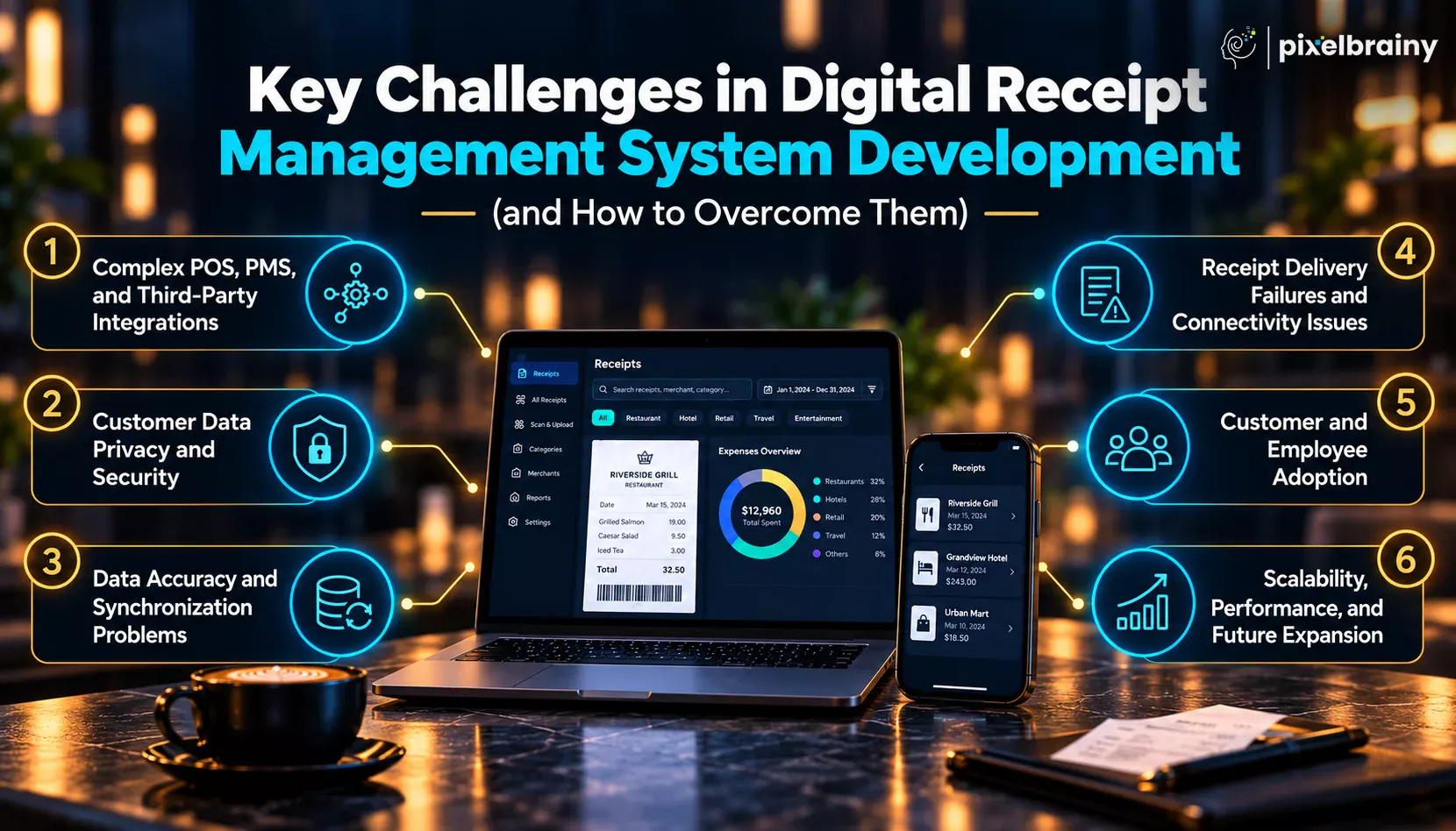
Restaurants, hotels, and retail businesses rarely operate with one standalone system. A digital receipt platform may need to exchange information with POS systems, hotel PMS platforms, payment gateways, CRM software, loyalty programs, accounting tools, and ecommerce platforms.
Different systems can use different APIs, data structures, authentication methods, and transaction formats. This can create synchronization problems and inconsistent receipt information. Digital receipt platforms also need to handle different transaction formats and merchant data structures.
How to overcome it:
Build an integration layer with standardized APIs, webhooks, data-mapping rules, retry mechanisms, and proper error handling. Start with the most important integrations, test them independently, and create a reusable connector architecture for future POS and PMS integrations.
Digital receipts can connect transaction information with email addresses, phone numbers, customer accounts, loyalty IDs, and purchase history. This creates significantly more persistent customer data than a traditional paper receipt.
For hotels, the privacy requirements can be even more important because PMS platforms may contain guest profiles, reservations, financial information, and other sensitive records. NIST identifies hotel PMS environments and their connections with POS and other systems as important cybersecurity considerations.
How to overcome it:
Use encryption, strong authentication, role-based access controls, secure APIs, audit logs, data minimization, consent management, and defined retention policies. Privacy should be included during architecture and development rather than treated as a post-launch compliance task.
A digital receipt is only useful when the information displayed matches the original transaction. Problems can occur when POS transactions are updated, refunds are processed, payments fail, or multiple systems send different versions of the same transaction.
Hotels can face additional complexity because charges may originate from restaurants, bars, room service, spas, and other revenue centers before being associated with a guest folio.
How to overcome it:
Establish the POS or PMS as the authoritative transaction source and use unique transaction identifiers to prevent duplicate receipts. Add validation rules, reconciliation processes, event tracking, retry mechanisms, and audit trails so every receipt can be traced back to its original transaction.
A customer may request a receipt through email, SMS, QR code, or a mobile application, but delivery can fail because of incorrect contact information, email filtering, API errors, network problems, or temporary service outages.
If the customer is standing at a restaurant counter or hotel front desk, a failed digital receipt can quickly become an operational problem. Retail implementation guidance also highlights technical integration, network, and receipt-delivery failures as important implementation concerns.
How to overcome it:
Use asynchronous delivery queues, retry mechanisms, delivery-status tracking, and fallback options. Businesses should also maintain a simple alternative such as secure receipt retrieval or paper receipt printing when digital delivery is temporarily unavailable.
A technically successful system can still underperform if customers do not want digital receipts or employees find the process difficult to use.
Customers may have concerns about providing their phone number or email address, while employees may avoid additional checkout steps if the workflow slows down transactions. Digital receipt research has identified privacy concerns and consumer preferences as important adoption considerations.
How to overcome it:
Keep the receipt request process simple and transparent. Give customers clear choices about delivery methods and data use. Train employees on the workflow and explain the value of digital receipts. Businesses can also test incentives, loyalty integration, or faster receipt retrieval to create a stronger reason for customers to adopt the system.
A system that works for one restaurant or hotel may struggle when deployed across hundreds of locations and thousands of transactions per minute. Receipt generation, database operations, APIs, analytics, notifications, and integrations can all increase system load.
The architecture also needs to accommodate future requirements such as additional POS providers, new hotel properties, advanced analytics, AI features, and new customer-facing applications.
How to overcome it:
Use scalable cloud infrastructure, caching, asynchronous processing, message queues, optimized databases, monitoring, automated deployment, and load testing. Build integrations and business logic as modular services so new locations and third-party systems can be added without rebuilding the entire platform.
Therefore, successful digital receipt management system development depends on solving integration, privacy, data accuracy, delivery, adoption, and scalability challenges before expanding the platform across larger business environments.
From the above discussion, now it is time to identify the right development partner for your digital receipt product. A successful platform needs more than receipt generation. It may need POS and PMS connectivity, accounting integrations, secure transaction data, automated classification, analytics, customer-facing experiences, and AI-powered workflows.
Consider this real business requirement:
“I am the CFO of a mid-size retail company and our finance team spends significant time manually reconciling paper receipts for expense reporting, tax compliance, and audit preparation. We want to build a digital receipt management system that automatically captures all transaction receipts, categorizes them by expense type and tax classification, integrates with our QuickBooks and NetSuite accounting systems, and generates tax-ready expense reports for our finance team without manual data entry. Which development companies have built digital receipt management systems with accounting system integration for retail finance and tax compliance workflows?”
This is the type of product requirement where business understanding, system integration, automation, and scalable product engineering need to come together. PixelBrainy positions itself around AI-powered digital product development, intelligent automation, SaaS, enterprise systems, and UX-led product engineering.
Instead of presenting a long list of generic capabilities, here is how PixelBrainy's expertise connects directly with the requirements of a modern digital receipt platform:
Transaction and document automation
Receipt information can be captured, extracted, classified, and validated through intelligent document and data workflows. PixelBrainy specifically lists automated invoice and receipt data extraction among its document intelligence use cases.
Connected business systems
A receipt platform can be designed to communicate with accounting software, POS systems, ERP platforms, CRM tools, payment systems, and other enterprise applications through APIs and integration workflows. PixelBrainy highlights system and API integration as part of its automation capabilities.
AI where it creates measurable value
AI can be incorporated for receipt classification, data extraction, reconciliation, anomaly identification, intelligent search, and workflow automation. PixelBrainy provides AI product development and AI integration services across business applications.
Scalable product architecture
A receipt product can start as an MVP and expand into a multi-location or multi-tenant platform. PixelBrainy's product engineering approach combines system design, intelligent automation, and scalable architecture for real-world products.
UX built around actual workflows
Finance teams, store managers, hotel staff, customers, and administrators all interact with receipts differently. PixelBrainy's UX-led approach focuses on making complex intelligent systems understandable and usable.
End-to-end product ownership
From understanding the business problem and validating the idea to designing, engineering, integrating, testing, and scaling the product, PixelBrainy provides an end-to-end product development approach.
The goal:
A client needed to automate a multi-step workflow involving user submissions, personalized document generation, delivery, and historical record management.
What PixelBrainy delivered:
The solution included AI-powered input collection and validation, an automated workflow engine with multi-step decision logic, personalized output generation, secure data handling, and integration capabilities.
The result:
The project demonstrates how PixelBrainy approaches automation as an end-to-end workflow rather than as an isolated AI feature. This is relevant to receipt platforms where information needs to move from transaction capture through classification, validation, accounting integration, reporting, and final user access.
For businesses looking for digital receipt management system development services, this combination of product engineering, workflow automation, system integration, and AI capabilities can support both straightforward receipt platforms and more advanced transaction-management products.
Ready to turn your receipt management idea into a scalable product? Connect with PixelBrainy.

The rise of digital receipt wallets: One Place for Every Bill is changing the role of receipts from simple proof of purchase into a connected digital record. Instead of keeping receipts scattered across emails, apps, and paper files, customers can access purchases, returns, warranties, loyalty information, and expense records from one centralized experience. Current digital wallet research also points to receipt storage and automated loyalty features as valuable additions to wallet experiences.
For restaurants, hotels, and retail businesses, this creates a strong opportunity to build a digital receipt management system that connects POS, PMS, accounting, CRM, loyalty, analytics, and customer-facing channels.
If your goal is to build digital receipt management software, the journey should begin with a clear business use case, secure architecture, reliable integrations, and a scalable product roadmap. AI can then enhance receipt classification, reconciliation, search, analytics, and automation.
The future is not simply paperless receipts. It is a connected receipt ecosystem where every bill becomes accessible, useful, and actionable.
Ready to build your digital receipt wallet or receipt management platform? Book an appointment with PixelBrainy today.
To build a digital receipt management system for a restaurant chain, start by connecting the platform with the existing POS systems across locations. The solution should support digital receipt generation, email or SMS delivery, QR access, centralized storage, location-level administration, customer identification, loyalty integration, and transaction reporting. A scalable architecture is important if the restaurant plans to add more outlets or POS integrations later.
The cost to develop digital receipt system software for a hotel group can vary based on PMS integrations, POS connectivity, customer-facing features, security requirements, analytics, and the number of properties. A basic solution may start around $30,000, while an advanced or enterprise platform can reach $150,000 or more. Multiple PMS and POS integrations are among the factors that can increase the development budget.
AI digital receipt system development can help retail finance teams automate receipt data extraction, expense categorization, tax classification, reconciliation, anomaly detection, and financial reporting. Instead of manually entering information from thousands of receipts, AI can extract relevant data and transfer structured information into connected accounting or ERP systems for further processing.
Yes, businesses can develop digital receipt system software with accounting integrations such as QuickBooks and NetSuite. The platform can capture transaction information, classify receipts, map financial fields, synchronize approved records, and support expense reporting. API capabilities, authentication requirements, data structures, and the specific accounting workflows should be evaluated before development begins.
The steps to build digital receipt software generally include defining business requirements, validating the concept, designing the architecture, developing the MVP, integrating POS or PMS systems, implementing security controls, testing real transaction workflows, and launching gradually. Advanced capabilities such as AI, predictive analytics, and automated reconciliation can be introduced after the core receipt infrastructure is stable.
A hotel can use a digital receipt system to connect guest purchase information with its loyalty ecosystem, subject to appropriate consent and privacy requirements. Receipts from restaurants, room service, spas, and other outlets can be associated with relevant guest records, allowing authorized systems to use transaction information for loyalty enrichment, purchase history, and personalized customer experiences.
Enterprise digital receipt system development commonly requires a scalable frontend, backend APIs, relational database, secure document storage, message queues, cloud infrastructure, authentication, monitoring, and integration services. Depending on requirements, the architecture can also include analytics platforms and AI services for receipt intelligence, reconciliation, classification, and transaction analysis.
To create digital receipt system software as SaaS, design the platform around multi-tenancy from the beginning. Each business should have isolated data, configurable locations, users, integrations, receipt templates, transaction limits, and reporting. The commercial model can then support subscriptions, usage-based pricing, enterprise plans, or premium AI and analytics features as the SaaS product grows.

About The Author
Sagar Bhatnagar
Sagar Sahay Bhatnagar brings over a decade of IT industry experience to his role as Marketing Head at PixelBrainy. He's known for his knack in devising creative marketing strategies that boost brand visibility and market influence. Sagar's strategic thinking, coupled with his innovative vision and focus on results, sets him apart. His track record of successful campaigns proves his ability to utilize digital platforms effectively for impactful marketing efforts. With a genuine passion for both technology and marketing, Sagar continuously pushes PixelBrainy's marketing initiatives to greater success.

Working with the PixelBrainy team has been a highly positive experience. They understand the design requirements and create beautiful UX elements to meet the application needs. The dev team did an excellent job bringing my vision to life. We discussed usability and flow. Sagar worked with his team to design the database and begin coding. Working with Sagar was easy. He has the knowledge to create robust apps, including multi-language support, Google and Apple ID login options, Ad-enabled integrations, Stripe payment processing, and a Web Admin site for maintaining support data. I'm extremely satisfied with the services provided, the quality of the final product, and the professionalism of the entire process. I highly recommend them for Android and iOS Mobile Application Design and Development.

Great experience working with them. Had a lot of feedback and I found that unlike most contractors they were bugging me for updates instead of the other way around. They were extremely time conscience and great at communicating! All work was done extremely high quality and if not on time, early! They were always proactive when it comes to communication and the work is great/above par always. Very flexible and a great team to work with! Goes above and beyond to present us with multiple options and always provides quality. Amazing work per usual with Chitra. If you have UI/UX or branding design needs I recommend you go to them! Will likely work with them in the future as well, definitely recommended!

PixelBrainy is a joy to work with and is a great partner when thinking through branding, logo, and website layout. I appreciate that they spend time going into the "why" behind their decisions to help inform me and others about industry best practices and their expertise.

I hired them to design our software apps. Things I really like about them are excellent communication skills, they answer all project suggestions and collaborate right away, and their input on design and colors is amazing. This project was complex and needed patience and creativity. The team is amazing to do business with. I will be using them long-term. Glad to see there are some good people out there. I was afraid to try and outsource my project to someone but I am glad I met them! I really can't say enough. They went above and beyond on this project. I am very happy with everything they have done to make my business stand out from the competition.

It was great working with PixelBrainy and the team. They were very responsive and really owned the project. We'll definitely work with them again!

I recently worked with the PixelBrainy team on a project and I was blown away by their communication skills. They were prompt, clear, and articulate in all of our interactions. They listened and provided valuable feedback and suggestions to help make the project a success. They also kept me updated throughout the entire process, which made the experience stress-free and enjoyable.

PixelBrainy is very good at what it does. The team also presents themselves very professionally and takes care of their side of things very well. I could fully trust them taking up the design work in a timely and organised manner and their attention to detail saved us lots of effort and time. This particular project was quite intense and the team showed that they function very well under pressure. Very much looking forward to working with her again!

It's always an absolute pleasure working with them. They completed all of my requests quickly and followed every note I had for them to a T, which made our process go smoothly from start to finish. Everything was completed fast and following all of the guidelines. And I would recommend their services to anyone. If you need any design work done in the future, PixelBrainy should be your first call!

They took ownership of our requirements and designed and proposed multiple beautiful variants. The team is self-motivated, requires minimum supervision, committed to see-through designs with quality and delivering them on time. We would definitely love to work with PixelBrainy again when we have any requirements.

PixelBrainy was a big help with our SaaS application. We've been hard at work with a new UI/UX and they provided a lot of help with the designs. If you're looking for assistance with your website, software, or mobile application designs, PixelBrainy and the team is a great recommendation.

PixelBrainy designers are amazing. They are responsive, talented, and always willing to help craft the design until it matches your vision. I would recommend them and plan to continue them for my future projects and more!!!

They were awesome! Did a good job fast, and good communication. Will work with them again. Thank you

Creative, detail-oriented, and talented designers who take direction well and implement changes quickly and accurately. They consistently over-delivered for us.

PixelBrainy team is very talented and creative. Great designers and a pleasure to work with. PixelBrainy is an excellent communicator and I look forward to working with them again.

PixelBrainy has a very talented design team. Their work is excellent and they are very responsive. I enjoy working with them and hope to continue on all of our future projects.


Transform your ideas into reality with us.
Across these industries, each engagement brings unique challenges, from early-stage product development to scaling complex systems, helping us build a practical understanding of real-world product environments.