 AI Summary Powered by PixelBrainy
Can a robotic manipulator understand natural-language instructions, identify objects, and execute complex physical tasks without requiring engineers to program every movement manually? This is the challenge that physical AI development aims to address, bringing artificial intelligence into real-world robotic operations through perception, reasoning, learning, and autonomous action.
Unlike traditional robotics, physical AI combines computer vision, sensors, actuators, embedded computing, and advanced AI models to help machines understand and interact with dynamic environments. Technologies such as vision-language-action (VLA) models enable robots to interpret human instructions and translate visual understanding into physical actions. For robotics companies looking to build physical AI systems, reinforcement learning and imitation learning also provide approaches to train robots for manipulation, movement, and adaptive task execution. Understanding how to create physical AI with reinforcement learning and imitation learning is particularly important when developing general-purpose robotic platforms that need to perform multiple tasks.
The commercial opportunity is growing rapidly. According to PwC Strategy&'s 2026 Physical AI analysis, the global physical AI market is projected to reach approximately €430 billion by 2030. This forecast highlights the growing importance of intelligent robotics and autonomous enterprise systems.
For robotics companies developing general-purpose manipulators, an important question is: Which physical AI development companies have successfully deployed VLA-based manipulation in production rather than just demonstrations? Companies such as Figure AI, NVIDIA's robotics ecosystem, and Hexagon Robotics are advancing embodied AI through robotic foundation models and industrial collaborations, although production deployments and experimental pilots must be evaluated separately.
To develop a physical AI platform that works reliably in real-world environments, businesses need expertise in AI model development, VLA integration, embedded software, real-time control, simulation, and hardware integration. Choosing the right physical AI development services can help robotics companies connect these capabilities and move from experimental prototypes toward scalable enterprise applications.
This guide explores physical AI architecture, essential technologies, development processes, enterprise applications, implementation costs, and best practices for building intelligent robotic systems.

Physical AI refers to artificial intelligence systems that can perceive, understand, and interact with the physical world through robotic hardware, sensors, and intelligent control mechanisms. It combines AI models, computer vision, machine learning, robotics, and embedded computing to enable machines to perform physical tasks and respond to environmental changes.
Unlike digital AI, which primarily processes information such as text, images, and datasets, physical AI extends intelligence into real-world environments. It enables robotic systems to move beyond information processing and interact with physical objects, equipment, and surroundings.
For example, a digital AI application can identify an object in an image and describe its characteristics. A physical AI-powered manipulator can identify the same object, estimate its position, select an appropriate grasp, and physically pick it up using robotic actuators and control systems.
| Comparison factor | Digital AI | Traditional robotics | Physical AI |
|---|---|---|---|
| Primary purpose | Processes and analyzes digital information | Automates predefined physical tasks | Enables intelligent physical interactions |
| Intelligence | AI models and algorithms | Programmed logic and control | AI-driven perception and decision-making |
| Environmental interaction | Digital inputs and outputs | Physical environments | Dynamic physical environments |
| Adaptability | Adapts to digital information | Often limited to programmed conditions | Can adapt within trained capabilities |
| Learning | Learns from digital datasets | Often requires manual reprogramming | Can learn through demonstrations and experience |
| Technologies | Machine learning, NLP, computer vision | Sensors, actuators, PLCs, controllers | AI models, robotics, sensor fusion, embedded AI |
| Applications | Chatbots, analytics, recommendation systems | Assembly lines, industrial automation | Intelligent manipulators, autonomous robots, adaptive manufacturing |
Traditional robotics generally relies on predefined instructions, programmed trajectories, and structured operating conditions. Physical AI introduces more advanced intelligence through machine learning, multimodal perception, and adaptive decision-making.
For example, a conventional robotic arm may require specific programming to handle objects in predefined positions. A physical AI-enabled manipulator can potentially recognize different object positions and select appropriate actions based on its trained capabilities.
Similarly, integrating vision-language-action models allows robotic systems to understand natural-language instructions and connect them with physical actions.
Overall, digital AI makes machines intelligent in digital environments, traditional robotics automates physical movements, and physical AI brings adaptive intelligence into the physical world. This distinction makes physical AI an important development area for companies building next-generation robotic and autonomous systems.
Physical AI architecture defines how AI models, sensors, robotic hardware, and embedded software work together to enable machines to perceive their surroundings, make intelligent decisions, and execute physical tasks. A physical AI system architecture connects perception, intelligence, planning, control, and feedback mechanisms to support autonomous and adaptive robotic operations.
For AI and robotics companies, understanding these physical AI components is essential to building scalable robotic platforms, particularly general-purpose manipulators, humanoid robots, and autonomous machines.
A typical physical AI architecture consists of five interconnected layers:
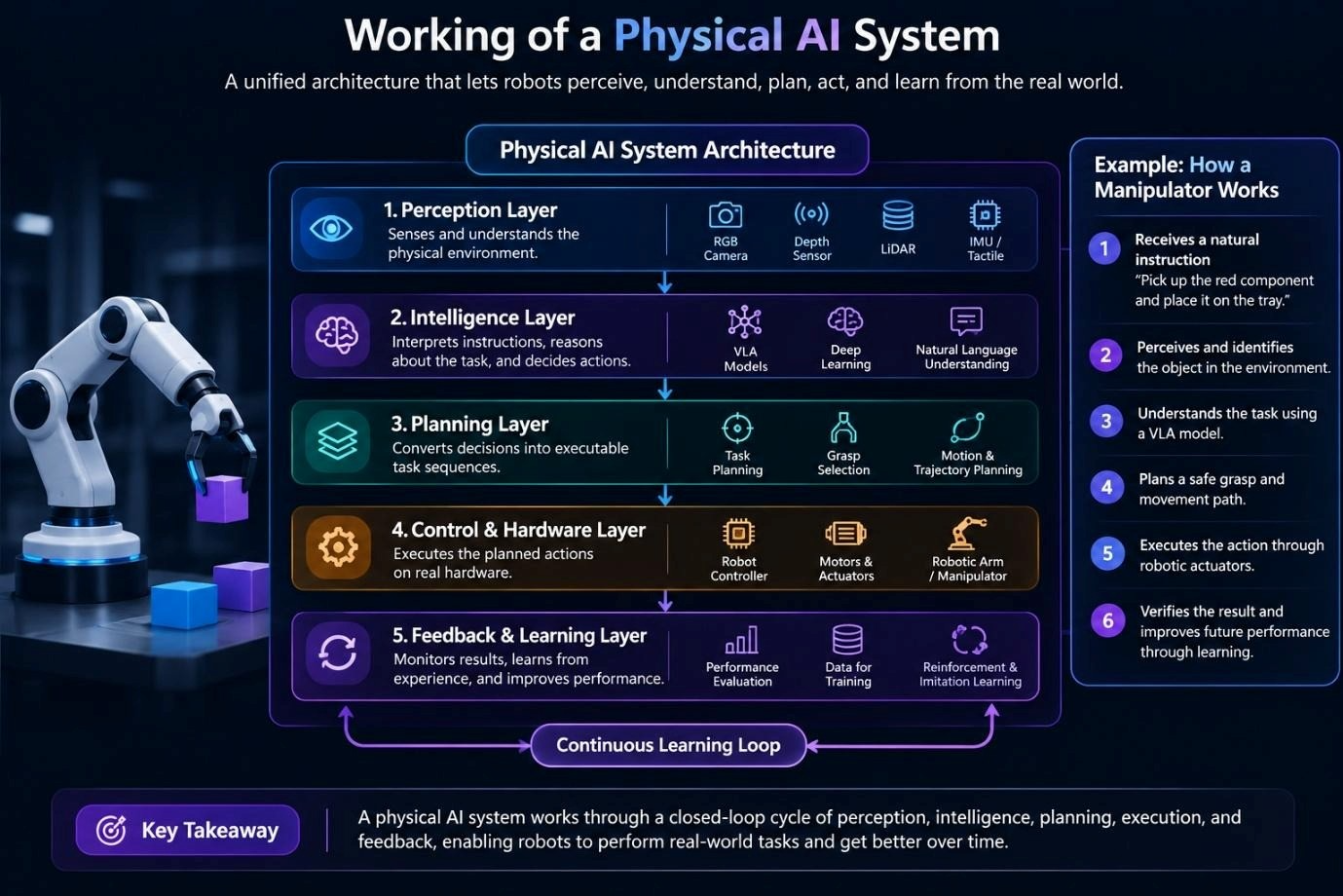
The perception layer collects and interprets real-world information through RGB cameras, depth sensors, LiDAR, radar, IMUs, and tactile sensors. Computer vision and sensor fusion help robotic systems identify objects, estimate positions, recognize obstacles, and understand spatial relationships within their operating environments.
This layer processes environmental information using machine learning, deep learning, computer vision, and vision-language-action (VLA) models. VLA models connect visual observations and natural-language instructions with robotic actions, enabling robots to understand assigned tasks and generate appropriate action representations.
The planning layer converts AI-generated decisions into executable task sequences. It includes task planning, grasp selection, inverse kinematics, trajectory generation, and collision avoidance to determine how robots should perform specific operations.
Robotics controllers translate planned actions into physical movements through motors, actuators, robotic arms, and other hardware components. Embedded computing and real-time control systems help maintain movement accuracy, responsiveness, and operational stability.
Sensors monitor robotic actions and provide feedback about execution results. This information helps identify errors, evaluate task performance, and improve robotic policies through reinforcement learning, imitation learning, and model optimization.
For example, when a general-purpose manipulator receives an instruction to pick up a specific object, its perception layer identifies the object, its VLA model interprets the instruction, its planning layer calculates the grasp, and its control system executes the movement. Sensor feedback then verifies the outcome.
A well-designed physical AI system architecture creates a continuous perception, intelligence, planning, execution, and feedback cycle. This modular approach helps robotics companies integrate advanced AI models, upgrade hardware, and develop scalable physical AI solutions for real-world applications.

Embedded engineering is a fundamental requirement for physical AI development because it connects AI intelligence with the robotic hardware responsible for executing real-world actions. While AI models enable robots to perceive environments, interpret instructions, and make decisions, embedded systems ensure these decisions are translated into accurate, timely, and reliable physical movements.
For robotics companies developing general-purpose manipulators, humanoid robots, and autonomous machines, an important question is: Why do physical AI systems require embedded software engineering, and how does embedded expertise improve real-time robotic performance?
The answer lies in the complexity of connecting AI models with physical hardware. Developers must manage sensor communication, actuator control, hardware compatibility, processing limitations, and real-time execution to ensure robotic systems perform as intended.
Here are the major areas where embedded expertise becomes essential for building reliable physical AI systems.
Embedded systems establish communication between AI software and robotic hardware components. They allow perception models, robotics applications, and control software to interact with physical devices.
Key integration components include:
For example, a robotic manipulator must receive accurate joint commands while continuously transmitting position and movement feedback. Reliable hardware-software integration ensures that the robot executes planned actions according to its physical and operational constraints.
Physical AI systems require timely communication between perception, decision-making, planning, and control components. Delayed sensor information or inconsistent actuator commands can affect robotic accuracy and operational safety.
Embedded engineering helps achieve real-time performance through:
For instance, high-level AI reasoning may determine how a robotic arm should grasp an object, while dedicated control loops continuously manage joint positions, velocity, and torque during execution.
Edge AI enables physical AI models to process information directly on robotic hardware or nearby computing devices instead of depending entirely on cloud infrastructure.
This is particularly useful for autonomous robots operating in environments with limited connectivity or strict response-time requirements.
Developers use technologies such as model quantization, GPU acceleration, optimized inference engines, and efficient data pipelines to support on-device AI execution.
Advanced AI models, particularly large VLA models, can require significant computing resources. However, robotic platforms have limitations involving memory, processing capacity, power consumption, and thermal management.
Physical AI development teams must evaluate:
For example, a large VLA model may require an accelerated computing platform, while smaller robotic control policies can run on embedded processors. Selecting the appropriate deployment architecture helps balance model performance with hardware limitations.
Physical AI systems operate in environments where hardware failures, sensor inaccuracies, and unexpected conditions can affect physical operations.
Embedded software supports system reliability through:
These capabilities are particularly important for industrial robots and collaborative robotic systems operating near human workers.
In physical AI development, embedded engineering connects intelligent software with real-world robotic execution, making hardware integration, real-time processing, and system reliability essential considerations for developing production-ready robotic solutions.
Also Read: Top 10 AI Product Development Companies in USA
Physical AI applications are expanding across industries by enabling intelligent machines to perceive physical environments, make autonomous decisions, and perform real-world tasks. By combining artificial intelligence, computer vision, robotics, sensors, and embedded systems, enterprise physical AI solutions are helping businesses improve industrial automation, material handling, inspection, and operational efficiency.
For organizations exploring physical AI adoption, an important question is: What are the real-world applications of physical AI, and which industries can benefit most from AI-powered robotics and autonomous systems?
From intelligent manufacturing robots to autonomous warehouse systems, physical AI development is creating opportunities to automate complex physical workflows. Here are the major industries where physical AI solutions are creating practical business opportunities.
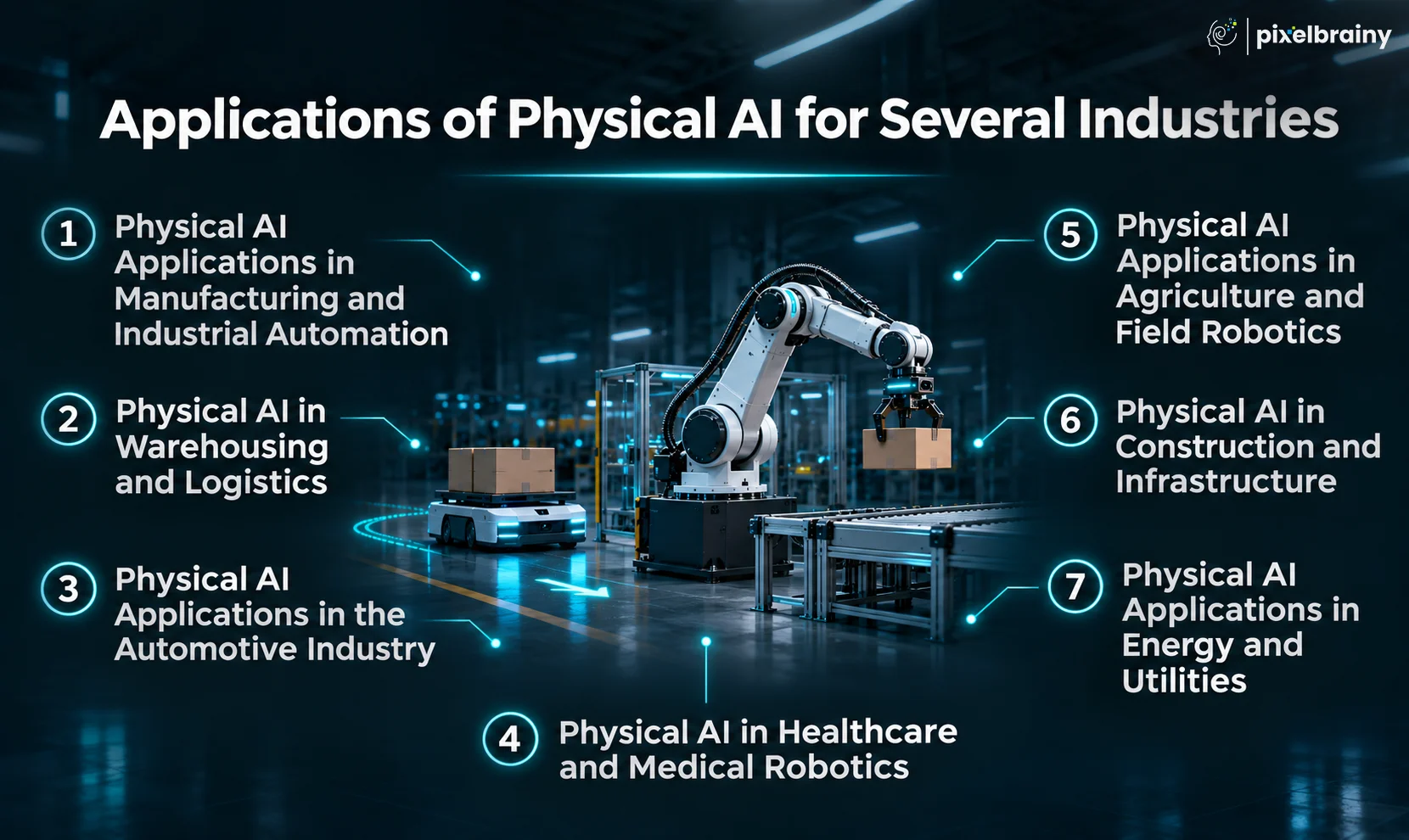
Manufacturing is one of the most promising areas for physical AI adoption. AI-powered robotics can help manufacturers automate complex production activities while adapting to variations in components, object positions, and operating conditions.
Key physical AI applications in manufacturing include:
For example, a physical AI-powered robotic arm can identify different components on a production line, select an appropriate grasp, and position them at designated assembly stations.
Physical AI in warehousing and logistics enables businesses to automate inventory handling, picking, sorting, and material transportation through intelligent robotic systems.
Key applications include:
For example, an AI-powered warehouse robot can identify inventory items, navigate storage areas, collect assigned materials, and transport them to designated locations.
These physical AI solutions can help logistics companies improve warehouse automation and manage repetitive material-handling operations.
The automotive industry is adopting physical AI technologies across vehicle manufacturing, component assembly, inspection, and autonomous mobility.
Key applications include:
Physical AI-powered robotics can help automotive manufacturers develop more adaptable production systems that respond to variations in components and manufacturing requirements.
Healthcare applications of physical AI focus on intelligent robotic systems that support selected medical, laboratory, rehabilitation, and hospital operations.
Key applications include:
For example, autonomous hospital robots can navigate designated indoor environments and transport medical supplies between departments.
Medical robotics applications require rigorous clinical validation, regulatory compliance, and appropriate human supervision.
Physical AI in agriculture enables intelligent machines to perform field operations while responding to changing terrain, weather conditions, and crop environments.
Key applications include:
For example, a physical AI-powered agricultural robot can use computer vision to distinguish crops from weeds and perform targeted operations based on its environmental perception.
Construction and infrastructure applications of physical AI focus on automating selected activities involving material movement, inspection, surveying, and equipment operation.
Key applications include:
For example, an autonomous inspection robot can navigate designated infrastructure areas, capture visual information, and identify visible structural abnormalities for further assessment.
Physical AI solutions in energy and utilities can support infrastructure inspection, equipment monitoring, and maintenance activities across large or difficult-to-access environments.
Key applications include:
For instance, an inspection robot can collect visual and sensor information from industrial equipment, identify potential abnormalities, and provide operational data for maintenance teams.
Across these industries, physical AI development is enabling businesses to move beyond traditional automation toward intelligent, adaptive, and context-aware robotic operations. By combining AI-powered robotics with scalable software architecture and enterprise integration, organizations can develop physical AI solutions that address specific operational challenges and support next-generation industrial automation.
When businesses look to improve operational efficiency, automate complex physical tasks, and build more adaptable robotic systems, physical AI development offers significant opportunities. By combining artificial intelligence, computer vision, robotics, and embedded technologies, physical AI enables machines to perceive real-world environments, make intelligent decisions, and execute physical tasks with greater flexibility.
For AI and robotics companies, an important question is: What are the key benefits of physical AI, and how can AI-powered robotics improve enterprise operations compared with traditional automation?
Here are six major benefits of physical AI development for businesses and robotics manufacturers.
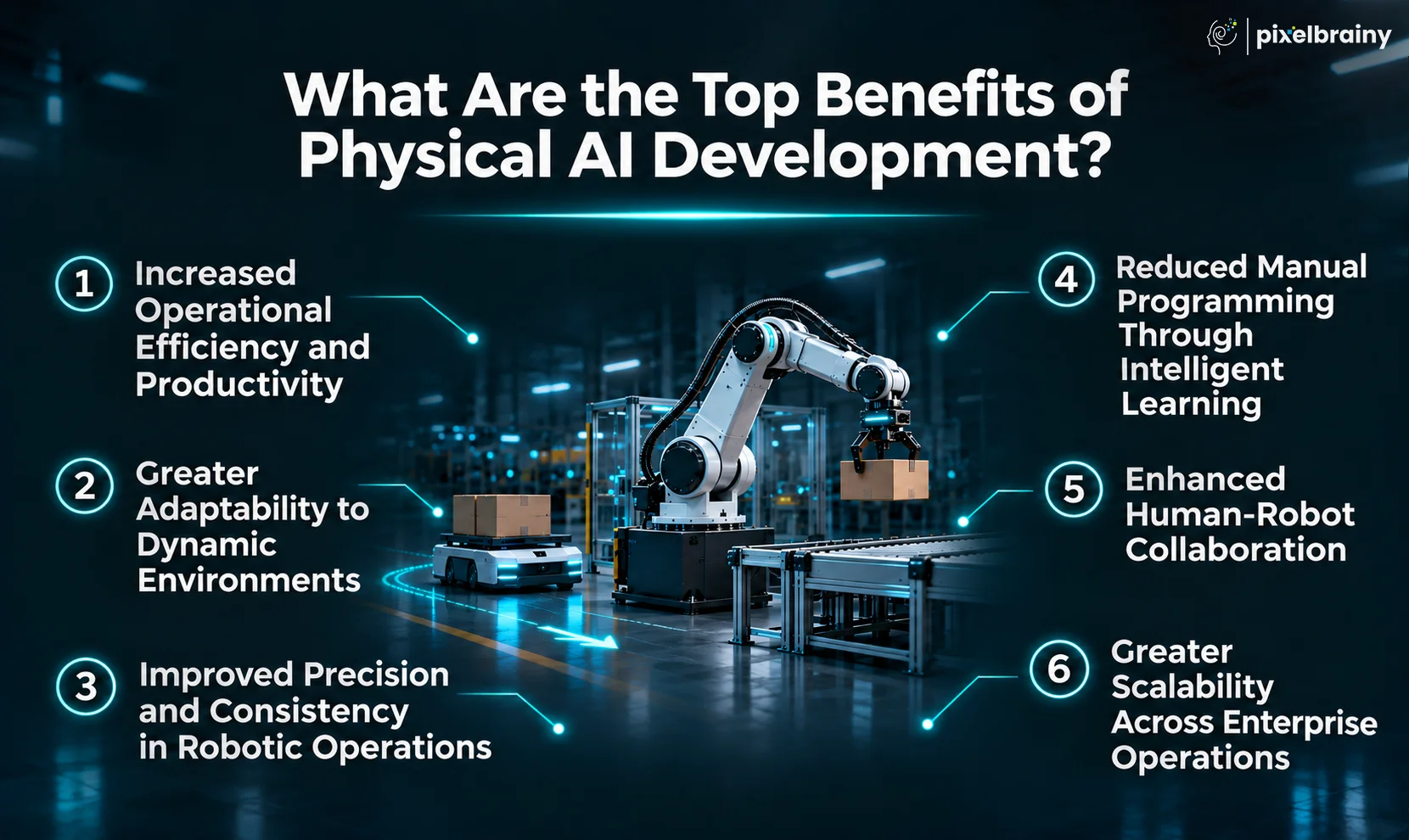
Physical AI systems can automate repetitive and complex physical tasks, helping businesses improve operational efficiency and streamline workflows.
AI-powered robots can perform selected activities such as material handling, product assembly, inspection, and warehouse transportation with consistent execution.
Key advantages include:
Unlike conventional robots that often depend on predefined instructions, physical AI systems can use environmental perception and learned policies to respond to changing conditions within their trained capabilities.
This adaptability helps robots:
For example, a physical AI-powered manipulator can identify an object placed at a different orientation and adjust its grasping approach accordingly.
Physical AI combines computer vision, sensor fusion, motion planning, and feedback-based control to support accurate robotic execution.
These capabilities are valuable for manufacturing, assembly, inspection, and object manipulation.
Major benefits include:
Actual precision depends on sensor quality, hardware capabilities, calibration, and control architecture.
Physical AI development enables robotics companies to use imitation learning and reinforcement learning to train robotic systems for specific tasks.
Instead of manually programming every movement, developers can use demonstrations, simulation, and interaction-based training to develop robotic policies.
Benefits include:
This approach is particularly useful for companies developing general-purpose manipulators and adaptive robotic platforms.
Physical AI can improve how robots interact with human operators by combining visual understanding, natural-language processing, and intelligent task execution.
With appropriate VLA model integration, robots can interpret natural-language instructions and perform supported tasks under defined safety constraints.
Key advantages include:
Scalable physical AI solutions allow organizations to extend intelligent robotic capabilities across multiple workflows, facilities, and operational environments.
A modular physical AI architecture can make it easier to integrate new models, upgrade hardware, and reuse software components.
Major advantages include:
Overall, physical AI development helps businesses move beyond conventional automation by introducing intelligent perception, adaptive learning, precision control, and scalable robotic capabilities. These advantages create new opportunities for AI and robotics companies to develop flexible systems for enterprise operations.
Developing a capable physical AI system involves integrating multiple functionalities that enable robots to perceive their surroundings, understand instructions, make decisions, and execute physical tasks. From environmental perception and object recognition to motion planning and feedback mechanisms, each feature contributes to the overall intelligence and reliability of a robotic platform.
For AI and robotics companies, an important question is: What features should a physical AI system include to support autonomous decision-making, intelligent manipulation, natural-language interaction, and real-world task execution?
The answer depends on the intended application, robotic hardware, and operational environment. However, the following 15 essential features provide a foundation for developing reliable physical AI systems.
| Essential feature | Description and importance |
|---|---|
| Environmental Perception | Environmental perception enables physical AI systems to understand their surroundings through visual and sensor inputs. It helps robots identify objects, recognize environmental conditions, and collect relevant information before performing physical tasks. |
| Object Detection and Recognition | Object detection and recognition allow robots to identify specific objects within their operating environments. Computer vision models help distinguish components, tools, products, and obstacles, supporting accurate object handling and task execution. |
| Spatial Awareness | Spatial awareness enables robotic systems to understand object positions, distances, orientations, and relationships within their surroundings. This capability supports navigation, grasp selection, workspace understanding, and accurate manipulation. |
| Sensor Integration | Sensor integration connects cameras, LiDAR, depth sensors, IMUs, and other sensing devices with the physical AI software architecture. It provides the environmental and operational data required for intelligent robotic behavior. |
| Sensor Fusion | Sensor fusion combines information from multiple sensors to create a more comprehensive understanding of physical environments. It helps robots improve object localization, environmental perception, and movement decisions using complementary sensor information. |
| Natural Language Understanding | Natural language understanding enables robots to interpret human instructions and convert them into meaningful task requirements. It supports intuitive interaction and allows operators to communicate with robotic systems using conversational commands. |
| AI-Based Decision-Making | AI-based decision-making enables physical AI systems to evaluate environmental information and select appropriate actions. It helps robots determine task priorities, respond to changing conditions, and execute supported operations autonomously. |
| Adaptive Learning | Adaptive learning allows robotic systems to improve selected behaviors using training data, demonstrations, and operational feedback. It helps robots handle task variations and improve performance within their trained capabilities. |
| Imitation Learning Support | Imitation learning enables robots to acquire skills by observing and learning from human or robotic demonstrations. It is useful for developing manipulation behaviors, object handling, assembly operations, and repetitive physical tasks. |
| Reinforcement Learning Support | Reinforcement learning allows robots to improve task execution through interactions with simulated or physical environments. Reward-based training helps develop policies for movement, manipulation, locomotion, and other application-specific robotic activities. |
| Motion Planning | Motion planning determines how a robot should move to complete a task while considering joint limits, obstacles, and workspace constraints. It supports feasible trajectories, coordinated movements, and accurate robotic execution. |
| Precision and Grasp Control | Precision and grasp control help robotic manipulators interact with objects using appropriate positions, forces, and movement adjustments. These capabilities are essential for picking, placing, rotating, and handling different components. |
| Real-Time Processing | Real-time processing enables physical AI systems to process sensor information and generate responses within required timing constraints. It supports responsive perception, movement adjustments, and coordination between AI software and robotic controllers. |
| Hardware and Software Integration | Hardware and software integration connects AI applications with robotic arms, motors, actuators, embedded processors, and controllers. It ensures that software-generated decisions can be translated into executable physical movements. |
| Feedback and Error Detection | Feedback and error detection allow robots to monitor task execution and identify deviations from expected outcomes. Sensor feedback helps detect failed operations, recognize unexpected changes, and support corrective actions. |
Integrating these essential features into a well-designed physical AI architecture helps robotics companies develop intelligent, adaptable, and reliable robotic systems capable of performing real-world tasks across diverse enterprise environments.
Building a physical AI system involves more than training an AI model. It requires integrating sensors, robotic hardware, perception, planning, control, and safety mechanisms into one working system.
For robotics teams exploring the steps to develop physical AI from idea to launch, a structured roadmap helps reduce integration risks and development costs. But how do you build physical AI from scratch when your AI team understands LLMs but has limited robotics experience?
A common requirement is a complete architecture for a mobile robot covering perception, planning, control, and safety. The following nine steps explain the development process of a physical AI system, from initial planning to deployment.
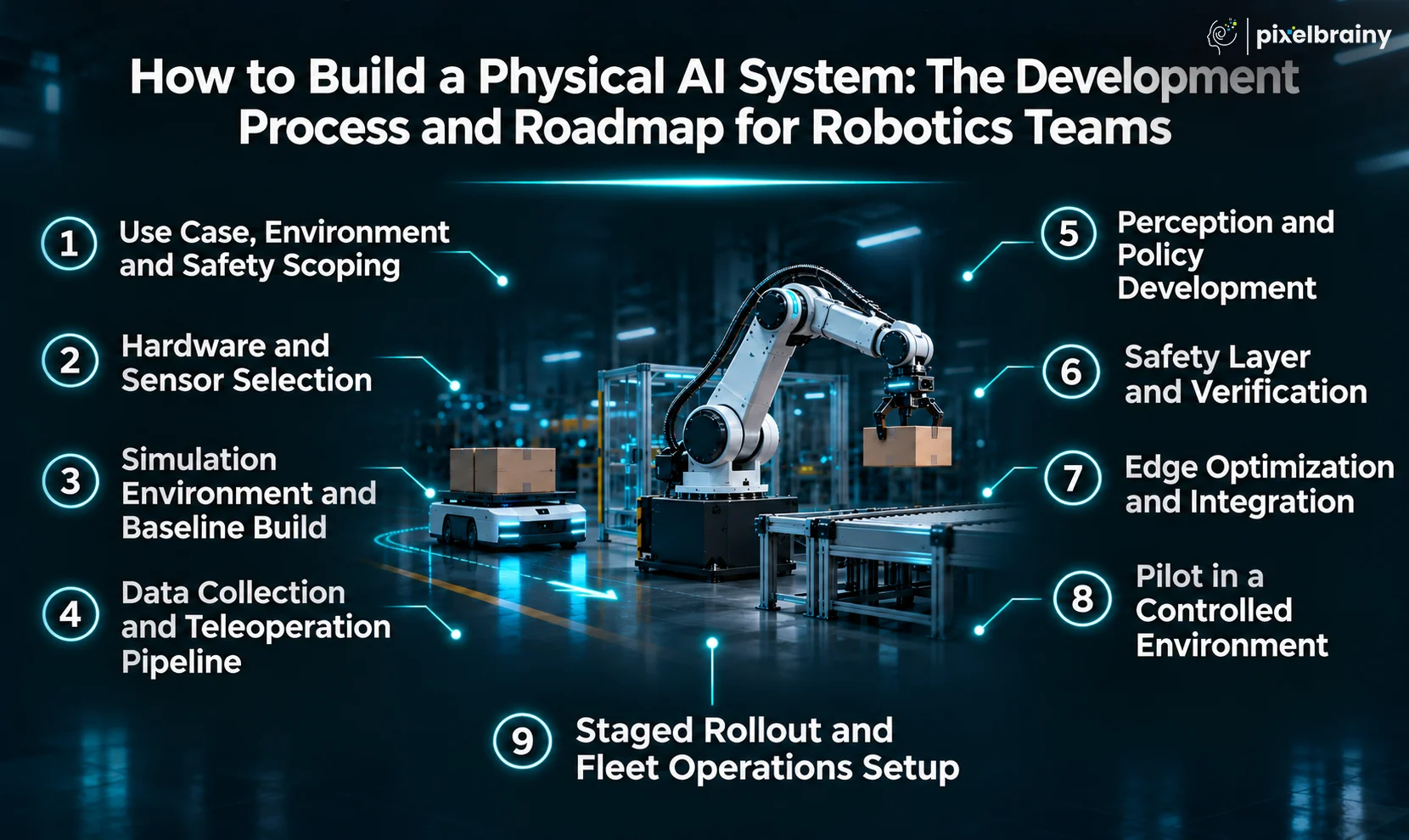
Define the tasks the robot must perform and the environment where it will operate. Identify autonomy requirements, operating conditions, performance targets, and potential hazards.
For example, a warehouse robot may need to navigate shared spaces, avoid obstacles, and transport materials. Establish safety limits, emergency-stop requirements, and measurable success criteria before development begins. Clear scoping also helps teams plan PoC development around real operational needs.
Also Read: Top 10+ AI PoC Development Companies In USA
Select robotic hardware based on the intended application. This may include cameras, LiDAR, depth sensors, IMUs, encoders, actuators, processors, and communication modules.
Evaluate sensor accuracy, processing requirements, power consumption, and hardware compatibility. For example, a mobile robot may use LiDAR for navigation and cameras for object recognition. Early hardware planning helps prevent integration issues later.
Create a virtual environment to test robot behavior before physical deployment. Tools such as NVIDIA Isaac Sim and Gazebo support simulation of robotic movement, navigation, perception, and interaction.
Build a baseline system with basic functions such as localization, sensor input, and obstacle avoidance. Simulation helps teams test different scenarios, identify technical issues, and reduce hardware testing costs.
Collect relevant data from sensors, cameras, robot movements, and task execution. Teleoperation allows human operators to demonstrate tasks, generating examples for imitation learning and other training approaches.
Organize data with timestamps, sensor information, task labels, and performance outcomes. Consistent, high-quality datasets help improve model training and real-world task execution.
Also Read: Top 10+ IoT Software Development Companies in USA
Develop perception capabilities such as object detection, scene understanding, depth estimation, and sensor fusion. These capabilities help robots interpret their surroundings.
Next, develop policies that convert environmental information into actions. Depending on the application, this may involve vision-language-action models, imitation learning, or reinforcement learning. Test perception accuracy, decision latency, and task performance before hardware deployment.
Add an independent safety layer to monitor robot behavior and prevent hazardous actions. This may include emergency stops, speed limits, collision detection, geofencing, and safe shutdown procedures.
Test sensor failures, communication interruptions, unexpected obstacles, and human-robot interactions. Document verification results and define when the robot must stop or request human intervention.
Optimize AI models for the robot's onboard computing hardware. Techniques such as quantization, pruning, and inference acceleration can reduce processing time and memory usage.
Integrate AI models with embedded software, middleware, motor controllers, and sensors. Test the complete system for latency, communication delays, and control stability. This stage requires coordinated AI integration and robotics engineering.
Also Read: Top 10+ AI Integration Companies in USA
Deploy the integrated robot in a controlled setting that represents its intended operating environment. Begin with limited tasks and human supervision.
Measure task completion, navigation accuracy, response time, and intervention frequency. Use pilot results to identify gaps between simulation and real-world performance, then refine the models, control systems, and safety mechanisms.
Expand deployment gradually after the pilot meets performance and safety targets. Start with a limited number of robots before moving to additional sites or operations.
Set up fleet monitoring, device management, software updates, diagnostics, and performance reporting. Connect robots with enterprise platforms where required. A staged rollout helps maintain system reliability as deployment scales.
Following these steps helps robotics teams move from initial concept to reliable physical AI deployment with an architecture designed for real-world performance and future expansion.
The cost of physical AI development depends on system complexity, robotic hardware, training requirements, safety validation, and deployment scale. A simulation prototype costs significantly less than a production-ready robotic platform operating across multiple sites.
For robotics companies researching the physical AI development cost breakdown for robotics companies in 2027, the key question is: How much does it cost to build a physical AI system that can move from a controlled demonstration to reliable enterprise operations?
The following estimates provide practical planning ranges. Actual costs vary by robot type, application, team location, and integration requirements.
| Development Stage | Estimated Cost | Typical Scope |
|---|---|---|
| Proof of Concept in Simulation and Lab | $150,000 to $400,000 | Basic hardware setup, simulation, initial perception models, and controlled task demonstrations. |
| Pilot-Ready Single Use Case System | $400,000 to $1,000,000 | Integrated robotic system, trained AI models, safety mechanisms, edge optimization, and controlled pilot deployment. |
| Production System With Fleet Operations | $1,000,000 to $3,000,000 | Production-grade architecture, fleet monitoring, diagnostics, deployment tooling, and operational validation. |
| Multi-Site Enterprise Platform | $3,000,000+ | Multi-location deployment, centralized management, enterprise integrations, and scalable infrastructure. |
| Cost Component | Typical Budget Consideration |
|---|---|
| Robotic Hardware and Sensors | Robots, cameras, LiDAR, actuators, processors, and sensor integration. |
| Data Collection and Teleoperation | Demonstration capture, labeling, dataset preparation, and data infrastructure. |
| Simulation Environment | Digital environments, physics simulation, and synthetic data generation. |
| AI Model Development | Perception, VLA models, policy training, and model evaluation. |
| Safety Engineering | Hazard analysis, safety controls, verification, and testing. |
| Edge Optimization | Model compression, inference acceleration, and embedded integration. |
| Fleet and Enterprise Tooling | Monitoring, device management, updates, and operational dashboards. |
| Pilot Deployment | Installation, testing, supervision, and performance evaluation. |
Physical AI budgets should also account for recurring expenses, including hardware maintenance, replacement sensors, cloud or edge infrastructure, data storage, model updates, software support, and fleet monitoring. These costs increase with robot count, operating hours, and deployment locations.
A budget of $900,000 over 36 weeks can reasonably target a pilot-ready single-use-case system, provided the project uses a defined robotic platform and avoids extensive custom hardware development.
A practical scope could include:
The budget should include contingency for hardware delays, additional data collection, and integration rework. It would not automatically cover a fully scaled multi-site enterprise rollout.
A realistic physical AI budget should account for the complete robotics stack, not just AI model development, to ensure the system can operate safely and reliably beyond a prototype.
Developing physical AI systems requires a combination of advanced AI models, robotics frameworks, simulation tools, embedded computing, and real-time control technologies. These technologies enable robots to understand their surroundings, interpret instructions, make decisions, and perform physical tasks with greater autonomy.
For robotics companies exploring advanced technologies for physical AI development, an important question is: Which technologies are required to build a physical AI system that combines perception, reasoning, motion planning, and safe robotic execution?
The technology stack depends on the application, hardware, and autonomy requirements. However, the following technologies form the foundation of modern physical AI solutions.
| Technology | Role in Physical AI Development |
|---|---|
| Vision-Language-Action (VLA) Models | VLA models connect visual perception, natural-language understanding, and robotic actions. They help robots interpret instructions and translate them into task-related movements, supporting more flexible human-robot interaction. |
| Computer Vision and 3D Perception | Computer vision enables robots to detect objects, recognize scenes, estimate depth, and understand spatial relationships. 3D perception supports accurate navigation, object localization, and robotic manipulation. |
| Reinforcement Learning (RL) | Reinforcement learning trains robotic policies through interaction with simulated or physical environments. It helps robots improve task execution, movement strategies, and decision-making through feedback and rewards. |
| Imitation Learning | Imitation learning enables robots to learn tasks from human demonstrations or expert-controlled robotic trajectories. It is useful for manipulation, assembly, and other tasks where manually designing every action is difficult. |
| Robotics Middleware and ROS 2 | ROS 2 provides communication, device integration, and software infrastructure for robotic systems. It helps connect sensors, controllers, perception modules, and planning components within a modular architecture. |
| Physics-Based Simulation and Digital Twins | Simulation tools reproduce robotic hardware, physical interactions, and operating environments. Digital twins support virtual testing, synthetic data generation, and validation before deployment on physical robots. |
| Edge AI and Embedded Computing | Edge computing platforms run AI inference close to robotic hardware. They reduce dependence on cloud connectivity and support low-latency perception, decision-making, and control. |
| Motion Planning and Control Systems | Motion planning calculates feasible robot movements, while control systems translate planned actions into motor commands. Together, they support accurate movement, obstacle avoidance, and stable task execution. |
| Sensor Fusion and Localization | Sensor fusion combines information from cameras, LiDAR, IMUs, and encoders. Localization technologies help robots estimate their position and orientation within changing environments. |
| AI Model Optimization and Inference Acceleration | Quantization, pruning, and hardware acceleration help models operate within edge-device limits. These techniques improve inference speed, reduce memory usage, and support efficient robotic deployment. |
These technologies work together to connect AI intelligence with physical perception, decision-making, and robotic execution, forming the technical foundation for scalable physical AI systems.
A successful physical AI prototype must also perform reliably across different robots, environments, and operating conditions. Achieving this requires modular architecture, reliable data pipelines, optimized AI models, continuous testing, and effective fleet management.
For robotics companies, an important question is: How can teams build scalable physical AI systems that maintain accuracy, safety, and performance across multiple real-world environments?
The following six best practices help robotics teams move from initial prototypes to reliable enterprise deployments.
Separate perception, decision-making, motion planning, and control into independent modules with standardized interfaces. Hardware abstraction makes it easier to integrate different sensors, processors, and robotic platforms without redesigning the entire system.
A modular physical AI architecture also simplifies debugging, maintenance, model upgrades, and future expansion.
Collect structured data from simulation, teleoperation, and real-world operations. Maintain records of sensor inputs, robot movements, task outcomes, and failure conditions.
Use consistent metrics to evaluate perception accuracy, task completion, decision latency, and policy performance. Dataset updates, model versioning, and regression testing help maintain performance as AI models evolve.
Use physics-based simulation and digital twins to test navigation, manipulation, and environmental variations before physical deployment.
Simulation alone cannot guarantee real-world reliability. Validate sim-to-real performance through controlled hardware testing and compare actual robot behavior with simulated results. Gradually introduce more complex environments to identify performance gaps.
Robots often need to process sensor data and execute decisions with minimal latency. Apply quantization, pruning, inference acceleration, and memory optimization to run AI models efficiently on onboard computing platforms.
Prioritize local processing for time-sensitive functions such as obstacle detection and motion control. This reduces cloud dependency and supports responsive robotic operations.
Include safety mechanisms throughout physical AI system development. Depending on the application, these may include emergency stops, collision monitoring, speed restrictions, geofencing, and independent safety controls.
Define human intervention procedures and test sensor failures, communication interruptions, and unexpected robot behavior. Regular safety verification supports reliable human-robot interaction.
Enterprise physical AI deployment requires centralized fleet management. Establish systems for device monitoring, task allocation, software updates, diagnostics, and operational reporting.
Track robot availability, task success rates, intervention frequency, and downtime. Use staged software rollouts, model version control, and rollback procedures to manage updates across multiple robots and locations.
These practices provide the technical foundation for scalable physical AI solutions, helping robotics companies maintain system reliability, operational safety, and consistent performance as deployments expand.
The future of physical AI development is moving toward intelligent robotic systems that can understand complex environments, learn new skills, and perform physical tasks with greater autonomy. Advances in foundation models, vision-language-action (VLA) models, simulation, and edge computing are creating new possibilities for next-generation physical AI solutions.
For AI and robotics companies, an important question is: What is the future of physical AI, and how will emerging technologies transform autonomous robotics, intelligent automation, and real-world decision-making?
The following six trends highlight the future of physical AI development and its growing role in enterprise robotics.
Vision-language-action models are becoming an important part of physical AI technology. They connect visual perception, natural-language instructions, and robotic actions, allowing robots to understand tasks and execute movements.
Future VLA-based systems may support general-purpose robots capable of performing multiple tasks across manufacturing, logistics, and service environments. This could reduce dependence on task-specific programming and expand the scope of AI-powered robotics.
Humanoid robotics is expected to become a major area of physical AI innovation. Improvements in robotic hands, actuators, perception, balance, and motion planning will support more complex physical operations.
Future humanoid robots may assist with material handling, industrial inspection, repetitive manufacturing tasks, and warehouse operations. Their commercial adoption will depend on reliability, safety, energy efficiency, and the cost of deployment.
Simulation and digital twin technologies will become increasingly important for physical AI system development. Robotics teams can generate synthetic training data, test robot policies, and evaluate different operating conditions in virtual environments.
Advances in sim-to-real transfer will help improve the transition from simulated training to physical execution. This approach can reduce testing time and support more efficient physical AI model development.
Reinforcement learning and imitation learning will remain essential technologies for training adaptive robotic systems. Reinforcement learning helps robots improve actions through feedback and rewards, while imitation learning enables them to learn from human demonstrations.
These approaches will support more advanced robotic manipulation, autonomous navigation, and adaptive task execution. They will also contribute to the development of intelligent physical AI systems that can handle changing environments.
Edge computing will play a critical role in future physical AI applications. Running optimized AI models directly on robotic hardware can reduce inference latency and dependence on cloud connectivity.
This will improve real-time perception, obstacle detection, motion planning, and autonomous control. Efficient edge AI deployment will be especially valuable for industrial robotics, autonomous mobile robots, and field robotics.
Enterprise adoption will be a major driver of physical AI development trends. Manufacturing, warehousing, healthcare, agriculture, construction, and energy companies are exploring intelligent robotic systems to improve operational efficiency and automate complex physical tasks.
Demand for scalable physical AI development solutions will increase as organizations move beyond isolated prototypes toward production-ready robotics, multi-robot coordination, and enterprise-wide automation.
The future of physical AI development will be shaped by VLA models, adaptive learning, simulation, edge intelligence, and enterprise robotics, creating opportunities for more autonomous and scalable physical AI systems.
Physical AI systems operate in unpredictable real-world environments, making their development more complex than traditional software or digital AI applications. Robotics teams must address hardware limitations, unreliable sensor data, model performance, real-time processing, and operational safety.
A common question among AI and robotics companies is: What are the biggest challenges in physical AI development, and how can businesses overcome them when moving from robotic prototypes to production-ready systems?
A capable physical AI development company can help address these challenges through expertise in AI model development, simulation, embedded engineering, hardware integration, edge optimization, and safety validation. Evaluating expertise across the complete robotic system is essential, rather than focusing only on the AI model layer.
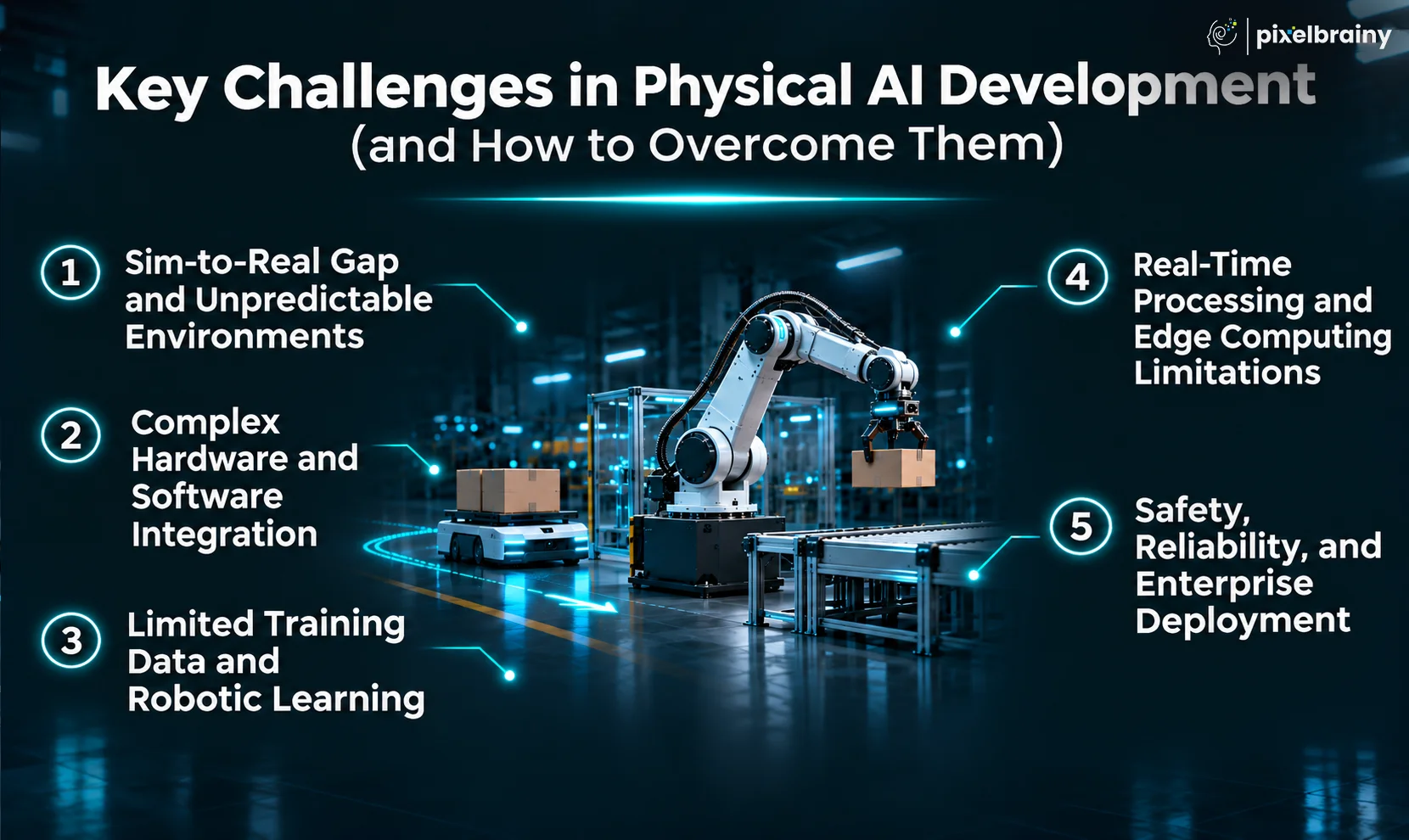
Challenge: Robots trained in simulation may behave differently in physical environments because of variations in lighting, friction, object positions, sensor noise, and unexpected obstacles. This sim-to-real gap can reduce task accuracy and reliability.
Solution: Combine physics-based simulation with real-world testing. Use domain randomization, synthetic data, and controlled pilot deployments to improve model generalization. Continuously evaluate robot performance under different environmental conditions.
Challenge: Physical AI requires AI models, sensors, actuators, embedded processors, and control systems to work together. Compatibility issues and communication delays can affect overall system performance.
Solution: Use modular architectures, standardized interfaces, and robotics middleware such as ROS 2. Validate hardware compatibility early and test communication between perception, planning, and control modules throughout development.
Challenge: Collecting high-quality physical interaction data can be expensive and time-consuming. Robots also need diverse examples to handle unfamiliar objects, movements, and operating conditions.
Solution: Combine teleoperation, human demonstrations, simulation-generated data, imitation learning, and reinforcement learning. Maintain structured datasets and regularly evaluate model performance against real-world task requirements.
Challenge: Large AI models can require more processing power and memory than robotic hardware provides. High inference latency can affect perception, decision-making, and movement execution.
Solution: Optimize models using quantization, pruning, and inference acceleration. Use suitable edge computing platforms and prioritize low-latency execution for safety-critical and time-sensitive robotic functions.
Challenge: Physical AI systems must operate safely around people, equipment, and changing environments. A successful demonstration does not guarantee reliable performance during continuous production operations.
Solution: Implement independent safety controls, emergency stops, collision monitoring, operational limits, and human intervention mechanisms. Conduct systematic testing, controlled pilots, and staged rollouts before expanding deployment.
Overcoming these challenges requires a complete engineering approach that connects intelligent models with reliable hardware, real-time control, and safety mechanisms for production-ready physical AI systems.

Businesses exploring intelligent robotics need more than standalone AI models. They need an integrated engineering approach that connects multimodal perception, decision-making, motion planning, embedded systems, and real-world robotic execution. PixelBrainy, positioned as a best AI development company in USA, supports businesses in planning and implementing AI-driven software solutions aligned with their technical and operational requirements.
For companies asking, "Our team needs multimodal perception, VLA policy, planning and control, simulation, digital twins, edge deployment, teleoperation data pipelines, fleet monitoring, OTA updates, and a safety layer within a $900,000 budget and 36-week timeline. Which developers can deliver this complete physical AI scope?" The answer requires evaluating end-to-end engineering capabilities, integration experience, and realistic delivery planning.
PixelBrainy can approach complex robotics initiatives through structured technical planning and AI engineering capabilities, helping businesses define the architecture required to develop physical AI solutions.
Key areas of support can include:
These capabilities provide a technical foundation for businesses looking for physical AI development services and planning to build physical AI system for business applications.
In one confidential robotics automation initiative, the project scope involved connecting perception, intelligent decision-making, and robotic execution within a unified software architecture. The work focused on defining system components, integration requirements, and deployment considerations for a complex automation workflow.
The client identity and confidential implementation details are not disclosed. This example should be treated as an illustrative project profile, not a verified claim of delivering the complete $900,000, 36-week specification.
Whether a business wants to create physical AI system capabilities for industrial automation or explore what it takes to make physical AI for businesses, the first step is defining the use case, hardware requirements, integration scope, safety expectations, and deployment targets.
PixelBrainy can help translate these requirements into a structured AI development roadmap with clear technical priorities and delivery milestones.
Have a physical AI project in mind? Connect with PixelBrainy to discuss your requirements and engineering roadmap.
Physical AI is transforming how machines interact with the real world by combining artificial intelligence, robotics, perception, learning, and autonomous control. As this technology advances, businesses have new opportunities to improve industrial automation, streamline operations, and develop intelligent robotic systems for complex environments.
However, successful physical AI development requires more than advanced AI models. It depends on the right combination of robotic hardware, sensor integration, simulation, embedded engineering, edge computing, and safety validation. Understanding the architecture, development process, technologies, costs, and implementation challenges helps robotics companies make informed investment decisions.
For organizations planning to build physical AI systems, the priority should be creating solutions that deliver measurable performance, operate reliably, and scale with business requirements. The right engineering approach can turn an experimental robotics concept into a practical enterprise solution.
Ready to explore physical AI for your business? Schedule a meeting with PixelBrainy to discuss your project requirements and development roadmap.
Physical AI is artificial intelligence that enables machines to perceive, understand, and interact with the physical world. It combines machine learning, computer vision, sensors, robotics, and autonomous control to perform real-world tasks through intelligent physical systems.
Traditional robotics primarily relies on predefined instructions and programmed movements, whereas physical AI combines robotic automation with perception, reasoning, and adaptive learning. This allows AI-powered robotics systems to respond to changing environments and perform tasks with greater flexibility.
A vision-language-action (VLA) model connects visual perception, natural-language understanding, and robotic actions. It enables physical AI systems to interpret human instructions, recognize surrounding objects, and translate commands into physical movements for intelligent robotic task execution.
Simulation is essential for physical AI development because it allows robotics teams to test movements, train AI models, and evaluate different environments before hardware deployment. Digital twins and physics-based simulation also support synthetic data generation and sim-to-real validation.
Yes. Physical AI models can run on edge computing platforms through quantization, pruning, and inference acceleration. Edge AI enables real-time perception, decision-making, and robotic control while reducing cloud dependency and supporting low-latency autonomous operations.
Safety in physical AI systems requires independent safety controls, emergency stops, collision monitoring, speed restrictions, and operational boundaries. Teams should validate learned robotic policies through simulation, hardware testing, and human supervision before production deployment.
Physical AI applications are expanding across manufacturing, warehousing, logistics, automotive, healthcare, agriculture, and construction. These industries use AI-powered robotics for autonomous navigation, material handling, inspection, robotic manipulation, and complex industrial automation tasks.
Physical AI training requires camera feeds, LiDAR readings, depth information, robot positions, joint states, movement commands, and task outcomes. Teleoperation demonstrations, synthetic datasets, and real-world feedback support imitation learning and reinforcement learning for robotic skill development.
The physical AI development timeline depends on hardware complexity, model requirements, simulation, integration, and safety validation. A pilot-ready single-use-case system may take several months, while production-ready physical AI platforms and enterprise deployments require longer development cycles.
Physical AI development cost can range from $150,000 for a simulation-based proof of concept to $1 million or more for production systems. Multi-site enterprise physical AI solutions may exceed $3 million depending on hardware, data, integration, and fleet requirements.
Major physical AI development challenges include sim-to-real transfer, limited training data, hardware integration, real-time processing, and robotic safety. Addressing these issues requires simulation, quality datasets, embedded engineering, edge optimization, and continuous real-world validation.
Evaluate a physical AI development company based on its expertise in AI model development, robotics integration, simulation, embedded systems, edge deployment, and safety engineering. PixelBrainy can be considered for AI development and integration discussions, subject to verifying relevant robotics capabilities and project experience.

About The Author
Sagar Bhatnagar
Sagar Sahay Bhatnagar brings over a decade of IT industry experience to his role as Marketing Head at PixelBrainy. He's known for his knack in devising creative marketing strategies that boost brand visibility and market influence. Sagar's strategic thinking, coupled with his innovative vision and focus on results, sets him apart. His track record of successful campaigns proves his ability to utilize digital platforms effectively for impactful marketing efforts. With a genuine passion for both technology and marketing, Sagar continuously pushes PixelBrainy's marketing initiatives to greater success.

Working with PixelBrainy has been a great experience. They took our vision for an AI-powered platform and turned it into a fully functional product. What impressed me most was their strong understanding of both design and development, and their ability to handle complex requirements with ease. The team was responsive, cooperative, and always open to feedback. They kept things organized, communicated clearly, and delivered quality work on time. I highly recommend PixelBrainy to anyone looking for a skilled and reliable development partner.

Working with the PixelBrainy team has been a highly positive experience. They understand the design requirements and create beautiful UX elements to meet the application needs. The dev team did an excellent job bringing my vision to life. We discussed usability and flow. Sagar worked with his team to design the database and begin coding. Working with Sagar was easy. He has the knowledge to create robust apps, including multi-language support, Google and Apple ID login options, Ad-enabled integrations, Stripe payment processing, and a Web Admin site for maintaining support data. I'm extremely satisfied with the services provided, the quality of the final product, and the professionalism of the entire process. I highly recommend them for Android and iOS Mobile Application Design and Development.

Great experience working with them. Had a lot of feedback and I found that unlike most contractors they were bugging me for updates instead of the other way around. They were extremely time conscience and great at communicating! All work was done extremely high quality and if not on time, early! They were always proactive when it comes to communication and the work is great/above par always. Very flexible and a great team to work with! Goes above and beyond to present us with multiple options and always provides quality. Amazing work per usual with Chitra. If you have UI/UX or branding design needs I recommend you go to them! Will likely work with them in the future as well, definitely recommended!

PixelBrainy is a joy to work with and is a great partner when thinking through branding, logo, and website layout. I appreciate that they spend time going into the "why" behind their decisions to help inform me and others about industry best practices and their expertise.

I hired them to design our software apps. Things I really like about them are excellent communication skills, they answer all project suggestions and collaborate right away, and their input on design and colors is amazing. This project was complex and needed patience and creativity. The team is amazing to do business with. I will be using them long-term. Glad to see there are some good people out there. I was afraid to try and outsource my project to someone but I am glad I met them! I really can't say enough. They went above and beyond on this project. I am very happy with everything they have done to make my business stand out from the competition.

It was great working with PixelBrainy and the team. They were very responsive and really owned the project. We'll definitely work with them again!

I recently worked with the PixelBrainy team on a project and I was blown away by their communication skills. They were prompt, clear, and articulate in all of our interactions. They listened and provided valuable feedback and suggestions to help make the project a success. They also kept me updated throughout the entire process, which made the experience stress-free and enjoyable.

PixelBrainy is very good at what it does. The team also presents themselves very professionally and takes care of their side of things very well. I could fully trust them taking up the design work in a timely and organised manner and their attention to detail saved us lots of effort and time. This particular project was quite intense and the team showed that they function very well under pressure. Very much looking forward to working with her again!

It's always an absolute pleasure working with them. They completed all of my requests quickly and followed every note I had for them to a T, which made our process go smoothly from start to finish. Everything was completed fast and following all of the guidelines. And I would recommend their services to anyone. If you need any design work done in the future, PixelBrainy should be your first call!

They took ownership of our requirements and designed and proposed multiple beautiful variants. The team is self-motivated, requires minimum supervision, committed to see-through designs with quality and delivering them on time. We would definitely love to work with PixelBrainy again when we have any requirements.

PixelBrainy was a big help with our SaaS application. We've been hard at work with a new UI/UX and they provided a lot of help with the designs. If you're looking for assistance with your website, software, or mobile application designs, PixelBrainy and the team is a great recommendation.

PixelBrainy designers are amazing. They are responsive, talented, and always willing to help craft the design until it matches your vision. I would recommend them and plan to continue them for my future projects and more!!!

They were awesome! Did a good job fast, and good communication. Will work with them again. Thank you

Creative, detail-oriented, and talented designers who take direction well and implement changes quickly and accurately. They consistently over-delivered for us.

PixelBrainy team is very talented and creative. Great designers and a pleasure to work with. PixelBrainy is an excellent communicator and I look forward to working with them again.

PixelBrainy has a very talented design team. Their work is excellent and they are very responsive. I enjoy working with them and hope to continue on all of our future projects.


Transform your ideas into reality with us.
Across these industries, each engagement brings unique challenges, from early-stage product development to scaling complex systems, helping us build a practical understanding of real-world product environments.