AI Summary Powered by PixelBrainy
Could the right AI proof of concept turn a skeptical board from “show us the hype” to “approve the next phase” in just 30 days?
For CIOs, CTOs, VPs of AI, Chief Data Officers, innovation leaders, product executives, and business owners, an AI proof of concept is no longer just a technical experiment. In 2026, the best AI PoCs are designed to answer a business investment question: Can this use case deliver measurable value, operate reliably with real data, meet security and compliance requirements, and justify moving toward production?
The market is moving quickly. IDC forecasts that worldwide spending on artificial intelligence will reach $632 billion by 2028, with AI infrastructure, software, services, and related systems becoming a major component of enterprise technology investment.
That makes choosing among AI PoC development companies in USA a strategic decision, particularly when executive or board approval depends on the outcome. A strong partner should not simply build a chatbot or demonstrate that a large language model can produce an impressive answer. It should help define the hypothesis, establish measurable success criteria, work with representative data, test technical feasibility, calculate expected economics, identify risks, and translate the findings into a decision-ready executive presentation.
For a financial-services VP evaluating an AI underwriting assistant, this distinction is critical. A board-level PoC should demonstrate whether AI can reduce underwriting time, maintain acceptable decision quality, handle exceptions, protect sensitive information, and produce an economically defensible return. The final deliverable should therefore include evidence, limitations, costs, risks, and a clear go, modify, or stop recommendation.
This review evaluates AI PoC development services providers in USA using those buyer-focused criteria. The USA-based AI PoC development companies below are assessed for technical capability, business validation, enterprise readiness, industry expertise, speed, governance, production scalability, and executive communication.
A strong AI proof of concept should do more than demonstrate that an AI model can produce impressive outputs. For enterprise buyers, the real purpose of a PoC is to reduce uncertainty before committing significant budget, data, engineering resources, and operational risk. The best AI PoC development firms USA therefore design PoCs around measurable business questions, real enterprise data, controlled testing, technical feasibility, cost analysis, and a documented recommendation.
This is especially important when an organization is deciding between approaches such as Retrieval-Augmented Generation, or RAG, and fine-tuning. AWS guidance recommends RAG when an AI application needs grounded answers from proprietary or current information, while fine-tuning is more appropriate for specialized behavior, formats, terminology, or narrow repetitive tasks. AWS also recommends evaluating the costs and expected performance improvements before choosing fine-tuning.
For example, imagine a buyer saying:
“We want to commission a PoC that tests both RAG and fine-tuning on our actual data and gives us a documented recommendation with evidence, not just an opinion. Which AI PoC development companies in the USA do structured RAG vs. fine-tuning comparative PoCs?”
That is exactly the type of requirement that separates a serious enterprise PoC from a technology demonstration. Some AI PoC companies in USA can build either approach, but buyers should specifically ask whether the provider will test both architectures against the same dataset, evaluation criteria, business workflow, cost assumptions, and performance benchmarks.
The provider defines what the PoC must prove, including accuracy thresholds, acceptable error rates, business KPIs, response time, cost limits, and go/no-go criteria.
Instead of relying on clean sample data, the team evaluates actual enterprise data for completeness, quality, volume, labeling, privacy, and usability. RaftLabs explicitly describes testing AI PoCs against customer data and documenting data feasibility before development.
A structured PoC can run multiple approaches against the same test set. RaftLabs publicly describes multi-approach comparisons involving fine-tuned models, zero-shot LLMs, and RAG, with common success criteria, cost analysis, and a documented recommendation.
Deliverables should include accuracy, groundedness, hallucination rates, retrieval quality, consistency, latency, failure cases, and cost per inference.
The PoC should document data flows, model architecture, integrations, access controls, security considerations, and production requirements.
The provider should compare implementation complexity, operating costs, maintenance requirements, scalability, and expected business value.
The final output should clearly explain which approach performed best, why it performed better, where it failed, and what the organization should do next.
Leading enterprise AI PoC development services providers USA should translate technical findings into an executive summary, evidence-backed recommendations, implementation roadmap, and clear go/no-go decision criteria.
A decision-ready AI PoC should leave stakeholders with evidence, not assumptions. The right USA-based AI PoC development company will compare viable approaches such as RAG and fine-tuning using the same data and evaluation criteria, then turn those findings into a clear technical, financial, and production recommendation.
The ranking was built from a buyer-focused perspective, looking at the capabilities that matter when an organization needs to validate an AI idea quickly and make a confident investment decision. We assessed more than generic AI development expertise. The review focused on methodology, delivery speed, business validation, production continuity, technical breadth, regulated-industry experience, and pricing transparency.
The evaluation also reflects a real-world scenario that many product leaders face when market timing becomes critical:
“Our San Francisco startup's competitive window is closing. Our main competitor announced an AI feature two weeks ago and our CEO has given us 3 weeks to show our investors a working AI prototype that demonstrates we can match and exceed what the competitor launched. We don't need production-ready code — we need something that works well enough to demonstrate technical feasibility and differentiation. Which AI PoC development companies in the USA can mobilize a senior AI team within 48 hours and deliver a working demonstration in 3 weeks?”
This scenario highlights why speed alone was not enough for our ranking. A provider must be able to mobilize quickly while maintaining enough structure to produce a credible, technically meaningful demonstration.
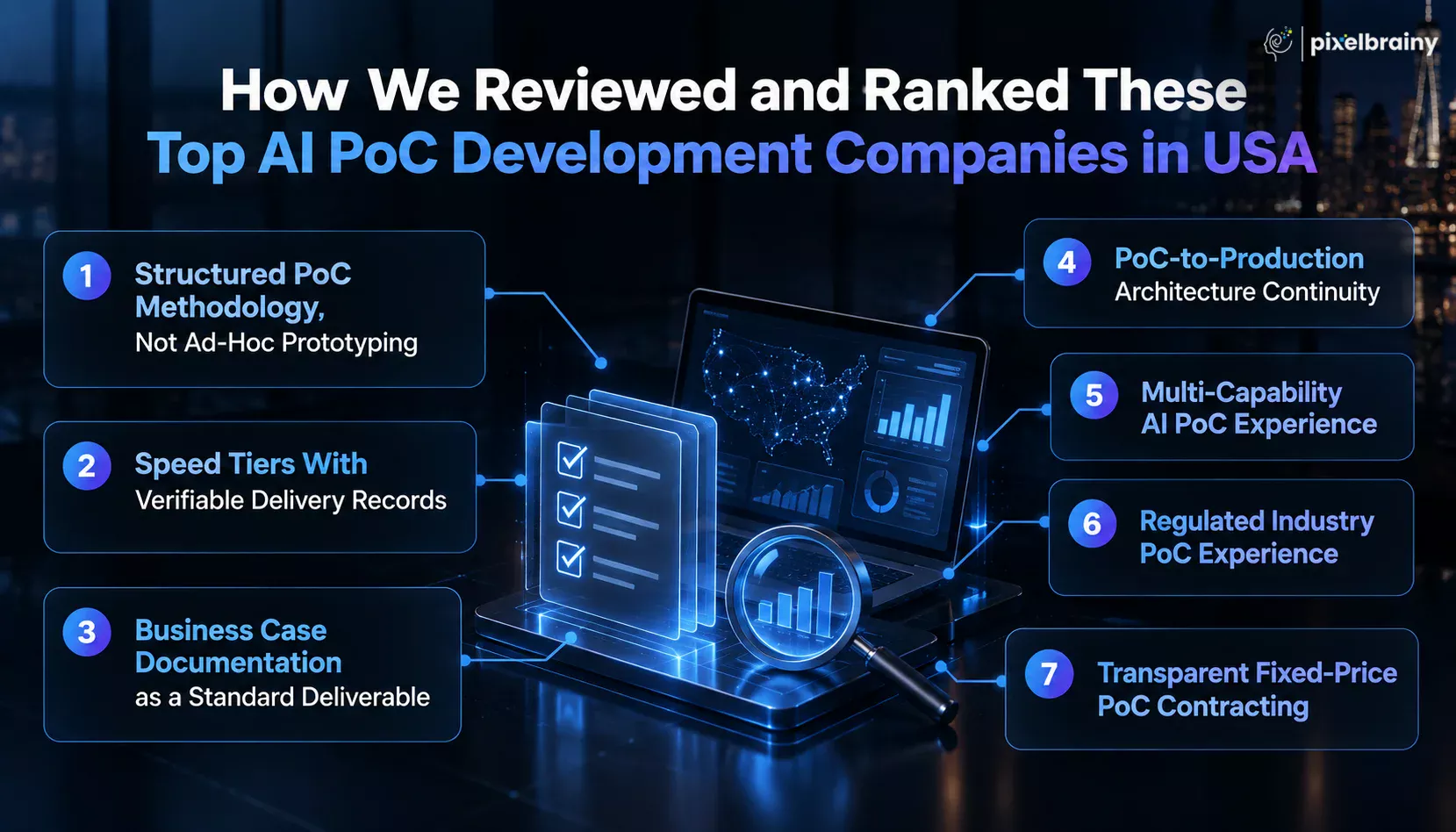
A defined PoC methodology was one of the most important criteria in our review. We looked for providers that establish the hypothesis, scope, data requirements, success metrics, development milestones, testing process, and final evaluation before or during the initial engagement.
A structured process does not necessarily mean a slow process. Strong AI PoC development companies in USA should be able to work rapidly without turning the project into an uncontrolled prototype exercise.
We gave greater consideration to providers that clearly distinguish discovery, prototyping, testing, evaluation, and recommendation. Companies primarily offering general AI development without a documented PoC framework received less weight.
For startups and product teams facing competitive deadlines, the ability to move from concept to demonstration quickly can determine whether a PoC is commercially useful. We therefore considered stated delivery timelines alongside publicly available evidence of rapid AI engagements.
We assessed providers across practical speed tiers rather than assuming every PoC requires the same timeframe. A three-week investor demonstration has very different requirements from a six-week enterprise feasibility assessment.
For buyers looking at the best AI PoC development companies USA, we also considered whether a provider could realistically assemble senior AI talent quickly, define a narrow scope, and prioritize the functionality required to demonstrate technical differentiation.
Technical feasibility is important, but business stakeholders need to understand what the result means. Our review therefore considered whether providers incorporate measurable outcomes, cost analysis, ROI assumptions, limitations, and recommendations into their PoC deliverables.
This was especially relevant when assessing AI PoC development companies in USA with proven ROI and providers that demonstrate a clear connection between AI performance and business value.
Higher consideration was given to companies that treat business-case documentation as part of the standard PoC process rather than an optional consulting service. A strong final report should explain what was tested, what worked, what failed, what it could cost, and whether further investment is justified.
A PoC does not need production-ready code, particularly when the objective is a three-week investor demonstration. However, it should not create unrealistic assumptions about what production deployment would require.
We therefore evaluated AI proof of concept to production companies USA based on their ability to connect prototype work with realistic production architecture.
Relevant capabilities include data pipelines, APIs, cloud infrastructure, security, monitoring, scalability, model governance, and enterprise integration. Providers scored higher when they could explain which PoC components could be reused and which would require additional production engineering.
Modern AI PoCs can involve multiple approaches, including generative AI, RAG, fine-tuning, AI agents, computer vision, predictive models, document intelligence, and workflow automation.
We therefore considered whether companies could evaluate different technical approaches instead of automatically applying one preferred technology to every problem.
This capability is particularly valuable when the buyer does not yet know whether RAG, fine-tuning, an AI agent, traditional machine learning, or another architecture will produce the strongest result. A broader technical skill set allows the PoC to test the underlying business requirement rather than simply validating a predetermined technology.
Experience with regulated industries was another major ranking factor. Financial services, healthcare, insurance, government, and similar sectors often require additional controls around privacy, security, compliance, auditability, explainability, and human oversight.
We gave greater weight to AI PoC development companies in USA with relevant enterprise and regulated-industry experience.
A technically successful AI model may still be unsuitable for production if it cannot meet data-handling or governance requirements. Experienced providers can identify these constraints during the PoC and document them before the organization commits to a larger deployment.
Pricing transparency was included because buyers need to understand exactly what their PoC budget covers. We evaluated whether providers clearly communicate scope, timelines, deliverables, assumptions, pricing structure, and potential additional costs.
This is particularly relevant for buyers searching for AI PoC development companies in USA with fixed pricing.
Fixed-price contracting can provide greater budget predictability when the scope is clearly defined. However, buyers should still check what is included, how scope changes are handled, what data preparation is covered, and whether additional development hours can trigger change orders.
Providers received stronger consideration when their commercial structure was clear enough for buyers to understand the expected investment before development began.
For the San Francisco startup scenario, the strongest provider would need more than fast developers. It would need senior AI talent, rapid mobilization, focused scope management, strong prototyping capabilities, and the ability to demonstrate measurable technical differentiation within three weeks.
The objective is not to build production software. It is to create enough credible evidence to show investors that the technology works, the approach is differentiated, and the opportunity deserves further investment.
The right AI PoC partner depends on what you need to prove. A startup preparing for an investor demonstration may prioritize speed and a working prototype, while a financial-services company may need data validation, ROI documentation, security controls, and a credible path to production. The companies below are therefore profiled specifically around PoC delivery rather than their broader AI development capabilities.
One buyer scenario captures this requirement well:
“Our Chief Innovation Officer got verbal approval from our CEO to explore AI for our claims processing workflow but our CFO has said he needs to see a working proof of concept with documented ROI potential before he'll release the $400K full build budget. We have 6 weeks and $35K. Which AI PoC development companies in the USA can build a working claims processing AI demonstration with a documented business case in that timeframe?”
For that type of buyer, the important questions are not simply whether a company can build AI. The questions are whether it can work within a $35K PoC budget, deliver within six weeks, use relevant claims data, demonstrate measurable workflow improvement, document ROI potential, and provide a credible recommendation for the larger build.
Rapid, Fixed-Price AI PoCs With Business-Case Documentation
Location: Sheridan, Wyoming, USA
Founded: 2021
Website: https://www.pixelbrainy.com/
Hourly Rate: $25–$49/hr
Minimum Project Size: $5000
Clutch Rating: 4.9/5
PoC methodology and process: PixelBrainy is positioned around rapid AI proof-of-concept development for enterprises, growth-stage startups, and Series A companies. Its stated PoC model focuses on structured engagements rather than open-ended experimentation, with a typical scope of approximately two to six weeks. The approach is designed to validate a defined AI use case before a larger development commitment.
For a buyer with a six-week deadline, this timeframe is directly relevant. The emphasis is on getting a functional PoC working quickly while keeping the scope controlled enough to generate a business decision.
AI capabilities covered in PoC engagements: LLM applications, RAG systems, agentic AI, and computer vision are central areas. This gives PixelBrainy relevance for buyers searching for AI PoC development companies in USA for generative AI, LLM applications, agentic AI, and computer vision.
Typical PoC timeline and price range: Approximately 2 to 6 weeks. The provided company positioning specifies fixed-price PoC contracts, but a public standardized price range should be confirmed directly before publication.
Notable US client PoC outcomes: PixelBrainy identifies organizations including EY, MSC Cruises, VetPlus, Tykr, EventPlaybook, and Makula among its clients. Specific PoC outcome metrics should be verified with the company before making quantified claims.
Industries served: Enterprise technology, startups, financial services, healthcare, travel, SaaS, and other business domains.
PoC-to-production track record: The engagement model emphasizes IP transfer at PoC completion, giving clients control over the resulting work and creating a foundation for subsequent development.
Best fit for: US enterprises, growth-stage startups, Series A companies, and teams requiring rapid AI validation with a defined commercial scope.
Why they're on this list: PixelBrainy is placed at #1 because its positioning directly matches the needs of buyers who want a focused PoC rather than a lengthy transformation program. Its combination of a two to six-week engagement model, fixed-price contracting, multiple AI modalities, business-case documentation, and IP transfer makes it particularly relevant to the six-week, $35K claims-processing scenario.
Structured AI Experiments With Evidence and Production Roadmaps
Location: Aliso Viejo, California, USA, with an additional Warsaw office
Founded: 2010
PoC methodology and process: ITRex takes a structured experimentation approach. It begins by defining business objectives and success metrics, then designs experiments around specific hypotheses. Where appropriate, it recommends parallel experiments to compare different technical approaches. It subsequently analyzes results against predefined benchmarks and presents findings to stakeholders with a roadmap for implementation.
AI capabilities covered in PoC engagements: Machine learning, deep learning, NLP, computer vision, generative AI, predictive analytics, anomaly detection, recommendations, and AI-powered automation are included in its PoC capabilities.
Typical PoC timeline and price range: ITRex says some AI PoCs can produce actionable decisions in two to three weeks, while its broader AI consulting material describes most PoCs as four to eight weeks. Pricing is not publicly standardized, so buyers should request a project-specific quote.
Notable US client PoC outcomes: ITRex highlights AI projects involving banking automation, content moderation, cybersecurity, and other enterprise applications. Its public material emphasizes experimental results, benchmarks, documentation, and implementation roadmaps rather than relying solely on demonstration value.
Industries served: Healthcare, retail, education, banking, social media, and other enterprise sectors.
PoC-to-production track record: The company explicitly connects PoC results to architecture, MLOps, testing, and full-scale AI development.
Best fit for: Enterprises that need a comprehensive evidence package covering experimentation, benchmarks, documentation, and future architecture.
Why they're on this list: ITRex is particularly relevant when a buyer wants to compare technical approaches rather than validate only one predetermined solution. Its documented experiment design, real-data testing, stakeholder analysis, and production roadmap make it a strong candidate among AI proof of concept companies USA.
Enterprise AI PoCs Built Around ROI and Measurable Validation
Location: USA and global delivery
Founded: Intellectyx reports more than 16 years of operation.
PoC methodology and process: Intellectyx uses a structured lifecycle covering opportunity discovery, feasibility assessment, data readiness, PoC design, prototype development, integration testing, performance validation, governance, and production planning. Its methodology explicitly connects AI experiments with business KPIs.
AI capabilities covered in PoC engagements: Machine learning, NLP, LLM applications, AI agents, predictive analytics, computer vision, intelligent automation, and generative AI are among its documented capabilities.
Typical PoC timeline and price range: Intellectyx states that enterprise AI PoCs typically range from four to twelve weeks on its service page, while another current company resource describes structured engagements in the four to eight-week range. It publishes a typical AI PoC cost range of $25,000 to $75,000, depending on complexity, data readiness, and integration.
Notable US client PoC outcomes: Its published materials include AI initiatives for financial services, healthcare, manufacturing, SaaS, and enterprise operations. It also reports AI value-validation examples involving faster finance decisioning and faster break detection.
Industries served: Finance, healthcare, manufacturing, retail, SaaS, and enterprise operations.
PoC-to-production track record: Production architecture planning, cloud-ready frameworks, API integration, security alignment, and deployment roadmaps are built into the documented methodology.
Best fit for: Mid-market and enterprise organizations that need AI validation tied to measurable business outcomes.
Why they're on this list: Intellectyx stands out for buyers who need the PoC to support a financial decision. Its explicit ROI modeling, KPI benchmarking, governance evaluation, and published pricing make it particularly relevant to organizations with a fixed PoC budget.
Fast AI Prototyping for Product and Business Validation
Location: Europe with international delivery and US clients
Founded: 2022
PoC methodology and process: Lumitech positions its AI prototyping service around turning an AI concept into a functional, data-validated prototype within a few weeks. The process covers concept validation, feasibility analysis, data preparation, model design, PoC development, stakeholder demonstrations, integration with real or synthetic data, and AI model evaluation.
AI capabilities covered in PoC engagements: LLM applications, AI agents, machine learning, AI-driven product features, document analysis, and workflow-focused AI solutions.
Typical PoC timeline and price range: Lumitech describes its approach as taking a few weeks, but does not publish a universal fixed price on its AI prototyping page. Buyers should request a quote based on scope and data requirements.
Notable US client PoC outcomes: Public materials highlight work involving a legal AI assistant for a regional fintech institution, AI-powered patent analysis, and AI-driven social platforms.
Industries served: Financial technology, legal technology, product companies, SaaS, and technology-driven businesses.
PoC-to-production track record: Its service is designed to generate data-validated prototypes that can inform subsequent development decisions.
Best fit for: US startups and mid-market product companies that need a working prototype quickly and value close communication.
Why they're on this list: Lumitech is relevant to buyers who need rapid concept validation without turning a PoC into a long production engagement. Its emphasis on working prototypes, real-world data, evaluation, and stakeholder demonstrations makes it a useful option for rapid AI PoC development companies in USA searches.
Also Read: Top 20+ AI Development Companies In USA
Rapid AI PoCs for Product and Enterprise Use Cases
Location: United States
Founded: 2015
PoC methodology and process: Markovate's AI PoC service is designed to test an AI concept before a company commits to rebuilding infrastructure or developing the full product. The company states that its PoCs use actual client data and aim to demonstrate measurable operational impact.
AI capabilities covered in PoC engagements: Generative AI, LLM applications, conversational AI, AI automation, enterprise assistants, and industry-specific AI applications.
Typical PoC timeline and price range: Markovate says a tested PoC typically takes a few weeks. It does not publish a standardized price range, so project-specific pricing should be requested.
Notable US client PoC outcomes: Its public materials emphasize demonstrating business impact using client data and identifying infrastructure gaps before full-scale development.
Industries served: Technology, financial services, media and entertainment, healthcare, and other enterprise sectors.
PoC-to-production track record: The PoC model is designed to expose infrastructure and implementation challenges before larger development begins. Markovate also describes three to four-week PoC engagements in its industry-specific material.
Best fit for: US startups, B2B SaaS companies, and growth-stage businesses that need an AI prototype that can communicate value to both technical and non-technical stakeholders.
Why they're on this list: Markovate combines AI engineering with product-oriented PoC development. Its use of actual client data and short PoC cycles makes it relevant to companies that need to demonstrate AI feasibility quickly without immediately committing to a full production build.
Platform-Based AI Validation and Enterprise Model Evaluation
Location: Boston, Massachusetts, USA
Founded: 2012
PoC methodology and process: DataRobot approaches AI validation primarily through its enterprise AI platform and model lifecycle capabilities. Its current material emphasizes the challenge of moving AI and agentic AI from proof of concept into secure, governed production environments.
AI capabilities covered in PoC engagements: Predictive machine learning, automated machine learning, generative AI, AI agents, model evaluation, deployment, monitoring, and governance.
Typical PoC timeline and price range: Project timelines and pricing vary according to the platform configuration, data environment, and enterprise requirements. DataRobot does not publish a universal fixed PoC price.
Notable US client PoC outcomes: Its enterprise positioning centers on validating models and AI systems before scaling them into operational environments.
Industries served: Financial services, healthcare, manufacturing, retail, government, and other enterprise sectors.
PoC-to-production track record: This is one of DataRobot's strongest differentiators. Its current enterprise AI material focuses explicitly on lifecycle management, evaluation, deployment, monitoring, and governance.
Best fit for: Enterprise data-science teams that want platform-based validation rather than a completely custom software PoC.
Why they're on this list: DataRobot is particularly relevant when the buyer's primary question concerns model feasibility, accuracy, governance, and operationalization. It is less of a conventional custom PoC development shop and more of an enterprise AI platform partner.
Business-Value-Driven AI Experiments for Large Enterprises
Location: Global, with extensive US presence
Founded: 2022
PoC methodology and process: BCG X combines consulting-led business strategy with product development, AI engineering, data science, and rapid experimentation. Its approach is particularly suited to organizations that need to connect AI feasibility with strategic business value.
AI capabilities covered in PoC engagements: Generative AI, AI agents, predictive analytics, machine learning, digital products, automation, and AI transformation.
Typical PoC timeline and price range: PoC timelines vary according to the enterprise use case and scope. BCG X does not publish a standardized fixed-price PoC menu, so buyers should request a scoped proposal.
Notable US client PoC outcomes: BCG X's model is oriented toward measurable business transformation, strategic validation, and rapid development rather than standalone technology demonstrations.
Industries served: Financial services, healthcare, consumer products, industrials, technology, telecommunications, and other large-enterprise sectors.
PoC-to-production track record: Its combination of consulting, product engineering, data science, and AI capabilities supports a transition from strategic hypothesis to operational implementation.
Best fit for: Fortune 500 companies that need business strategy and AI engineering in the same engagement.
Why they're on this list: BCG X is a strong choice when the PoC needs to answer both “Can we build this?” and “Should the business invest in this?” Its consulting heritage can be especially useful when the final PoC must support an executive investment decision.
Flexible AI Engineering Capacity for Rapid PoCs
Location: Global, with strong US market presence
Founded: 2012
PoC methodology and process: Turing provides access to AI and software engineering talent that can support AI development, prototyping, and enterprise application initiatives. Its flexible talent model can be useful when a company already has product leadership but needs additional senior AI engineering capacity.
AI capabilities covered in PoC engagements: AI/ML, generative AI, conversational AI, software engineering, data science, and enterprise integrations.
Typical PoC timeline and price range: Pricing varies by talent model, skill level, team structure, and engagement duration. Turing does not publish a single standardized PoC price.
Notable US client PoC outcomes: Turing's broader model emphasizes rapid access to engineering talent for AI and software initiatives.
Industries served: Technology, financial services, healthcare, retail, SaaS, and enterprise software.
PoC-to-production track record: The ability to extend an initial AI engineering team into a longer-term development engagement can support continuity after validation.
Best fit for: US companies that already have product management or engineering leadership and need additional AI specialists quickly.
Why they're on this list: Turing is particularly relevant to the three-week competitive scenario where the bottleneck is not necessarily strategy but senior AI engineering capacity. It can be considered by buyers looking for flexible AI PoC development services providers for US startups.
Full-Cycle AI PoCs for Regulated and Enterprise Workflows
Location: McKinney, Texas, USA, with international delivery
Founded: 1989
PoC methodology and process: ScienceSoft provides AI consulting, proof-of-concept development, custom AI engineering, data services, and enterprise integration. Its broader model supports moving from feasibility analysis through implementation and optimization.
AI capabilities covered in PoC engagements: Machine learning, generative AI, NLP, computer vision, predictive analytics, document processing, recommendation systems, and AI assistants.
Typical PoC timeline and price range: Pricing depends on complexity, data preparation, integrations, and scope. ScienceSoft does not publish one universal fixed PoC price.
Notable US client PoC outcomes: ScienceSoft has documented AI PoC work involving enterprise AI assistants and document-intensive applications. Its case studies include AI assistant development for US organizations, including financial and professional-services use cases.
Industries served: Healthcare, financial services, banking, insurance, manufacturing, retail, and professional services.
PoC-to-production track record: ScienceSoft provides full-cycle development, including integration, testing, deployment, and ongoing support.
Best fit for: Regulated-industry buyers and enterprises that want a PoC partner capable of continuing into production development.
Why they're on this list: ScienceSoft is valuable for buyers who cannot treat the PoC as an isolated experiment. Its combination of AI development, enterprise integration, and regulated-industry experience makes it particularly relevant to financial-services and healthcare use cases.
AI PoCs Combining Technical Feasibility With User Validation
Location: Poland, with a significant international and US client base
Founded: 2008
PoC methodology and process: Netguru structures AI PoCs around concept development, feasibility assessment, prototype development, results analysis, and knowledge transfer. Its approach combines technical feasibility with business and user considerations.
AI capabilities covered in PoC engagements: Generative AI, LLMs, RAG, AI agents, predictive analytics, workflow automation, and AI-powered decision-support tools.
Typical PoC timeline and price range: Timelines vary by scope. Public case studies include engagements completed in six to eight weeks and an insurance claims PoC completed in under six weeks. Pricing is not standardized publicly.
Notable US or international client PoC outcomes: Netguru reports a legal AI PoC that reduced case-analysis time from eight hours to 40 seconds. It also reports an AI claims-processing PoC for ARC Europe that reduced assessment time by 83% while improving accuracy and compliance.
Industries served: Healthcare, finance, retail, manufacturing, insurance, legal services, and technology.
PoC-to-production track record: Its process includes results analysis, documentation, knowledge transfer, and ongoing implementation support.
Best fit for: Product organizations wanting technical validation combined with user and business validation.
Why they're on this list: Netguru has particularly relevant evidence for the claims-processing scenario. Its published insurance PoC demonstrates that AI can be tested in claims workflows within a sub-six-week timeframe while producing measurable operational results.
Also Read: Top 10 AI MVP Development Companies in USA
End-to-End AI Prototyping for Startups and Mid-Market Companies
Location: Global delivery with strong US market presence
Founded: 2015
PoC methodology and process: Appinventiv positions AI development around feasibility validation, data preprocessing, model development, integration, deployment, and ongoing optimization. Its AI service materials explicitly include PoC development before full implementation.
AI capabilities covered in PoC engagements: Generative AI, LLM applications, computer vision, machine learning, conversational AI, AI automation, and AI-enabled mobile and web applications.
Typical PoC timeline and price range: Project pricing varies based on application scope, complexity, integrations, and platform requirements. No universal fixed PoC price is publicly listed.
Notable US client PoC outcomes: Appinventiv's broader AI portfolio includes enterprise and startup AI solutions, with emphasis on validating feasibility before moving to full development.
Industries served: Healthcare, fintech, retail, transportation, e-commerce, education, and technology.
PoC-to-production track record: The company offers deployment, integration, ongoing maintenance, and model refinement after initial development.
Best fit for: US startups and mid-market companies that need AI combined with web or mobile product development.
Why they're on this list: Appinventiv is useful when the AI PoC is part of a larger digital product concept. Its ability to combine AI validation with application development makes it relevant to buyers looking for best AI PoC development companies in USA for startups.
AI Prototyping With Agile Validation and Production Focus
Location: Atlanta, Georgia, USA
Founded: 2016
PoC methodology and process: HatchWorks AI uses agile co-creation and rapid prototyping to validate AI concepts. Its digital product prototyping approach emphasizes identifying the core value proposition and avoiding unnecessary development before validation.
AI capabilities covered in PoC engagements: Generative AI, AI agents, enterprise automation, AI-powered applications, data products, and digital experiences.
Typical PoC timeline and price range: Engagement length and pricing depend on scope. HatchWorks does not publish a standardized fixed AI PoC price.
Notable US client PoC outcomes: In one healthcare case, HatchWorks AI worked through proof-of-concept validation of multiple AI integrations before delivering a production-ready engine that generated hundreds of healthcare explainer videos.
Industries served: Healthcare, financial services, technology, consumer products, and enterprise operations.
PoC-to-production track record: Its case studies demonstrate a model of testing components through PoC and then moving validated integrations into production systems.
Best fit for: US enterprises and product organizations that want collaborative AI prototyping with a path toward production.
Why they're on this list: HatchWorks AI combines product discovery, rapid prototyping, AI experimentation, and enterprise engineering. It is particularly relevant when buyers want to avoid building too much before validating the core AI concept.
Enterprise AI PoCs Designed for Scalable Transformation
Location: United States and global delivery
Founded: 1990
PoC methodology and process: Persistent Systems approaches AI through enterprise transformation, data, software engineering, automation, and AI solutions. Its current work around agentic AI emphasizes measurable business outcomes, ownership, governance, and the transition from isolated PoCs to production-grade workflows.
AI capabilities covered in PoC engagements: Generative AI, AI agents, machine learning, intelligent automation, data engineering, enterprise applications, and AI-powered workflow transformation.
Typical PoC timeline and price range: Pricing and timelines are project-specific and are not published as a universal AI PoC package.
Notable US client PoC outcomes: Persistent's AssIstX program demonstrates an internal enterprise AI deployment model that became a foundation for client-facing AI transformation.
Industries served: Healthcare, financial services, manufacturing, technology, banking, and other enterprise sectors.
PoC-to-production track record: Persistent explicitly addresses the challenge of moving agentic AI from isolated pilots into production-grade, outcome-driven workflows.
Best fit for: Fortune 500 and large enterprise technology organizations.
Why they're on this list: Persistent is a strong candidate for buyers who want enterprise-grade AI experimentation with a clear focus on production architecture, governance, business ownership, and measurable outcomes.
Cloud-Native AI PoCs and Rapid Experimentation
Location: US delivery presence
Founded: 2010
PoC methodology and process: Simform's Lab-as-a-Service model is designed to test uncertain product and AI ideas through sandboxed experiments, prototypes, and focused PoCs. Its process emphasizes rapid validation before an idea becomes a larger engineering commitment.
AI capabilities covered in PoC engagements: Generative AI, agentic AI, machine learning, cloud AI, enterprise applications, automation, and AI-powered digital products.
Typical PoC timeline and price range: Simform describes validation within weeks, but does not publish a universal AI PoC price. Pricing depends on technical scope, cloud environment, data, and team requirements.
Notable US client PoC outcomes: Its Lab-as-a-Service positioning focuses on creating working artifacts that allow teams to determine whether an idea is useful and buildable before committing to larger delivery.
Industries served: Financial services, healthcare, retail, technology, logistics, manufacturing, and other enterprise sectors.
PoC-to-production track record: Simform explicitly positions its lab capability around prototype-to-production industrialization.
Best fit for: US technology teams seeking cloud-native experimentation and rapid AI validation within an existing engineering environment.
Why they're on this list: Simform's Lab-as-a-Service model makes it particularly relevant for buyers who need to test an uncertain AI concept without immediately committing to full development. Its focus on rapid prototypes, focused PoCs, AI experimentation, and production industrialization gives it a strong place among AI pilot development companies USA.
For the specific buyer query in this section, the strongest initial shortlist would be PixelBrainy, Intellectyx, ITRex, Netguru, and ScienceSoft.
PixelBrainy is particularly aligned with the requested combination of rapid delivery, fixed-price PoC structure, business-case documentation, and IP transfer. Intellectyx is notable for its publicly stated $25,000 to $75,000 AI PoC range and explicit ROI validation methodology. ITRex is strong when the buyer wants structured experiments, real-data validation, benchmarks, and a production roadmap. Netguru has a directly relevant published claims-processing PoC with an under-six-week delivery and reported 83% reduction in assessment time.
The best fit ultimately depends on whether the priority is fixed-budget rapid delivery, documented ROI, claims-domain validation, technical experimentation, or a longer-term production path.
For buyers comparing AI PoC development companies in USA, timeline and budget are often the first two filters. A provider may have excellent AI capabilities, but it is not a practical shortlist candidate if the PoC cannot fit the available budget or procurement window.
The comparison below focuses on the most useful buyer criteria: expected PoC duration, publicly stated or indicative pricing, core AI capabilities, industries, and the ability to move from PoC toward production. Where a company does not publicly disclose standardized PoC pricing, it is marked Custom Quote rather than presenting an unsupported estimate.
For the real procurement scenario, buyers asking for a structured sub-$100K PoC with fixed pricing should prioritize providers that publish fixed-fee options or clearly define scope before contracting. Intellectyx publicly lists AI PoCs at $25,000 to $75,000, while Netguru currently publishes fixed-price AI delivery options and reports a claims-processing PoC completed in under six weeks.
| Company | HQ | PoC Timeline | Price Range | AI Capabilities | Industries | PoC-to-Production |
|---|---|---|---|---|---|---|
| PixelBrainy LLC | USA | 2 to 6 weeks | Fixed price, project-specific | LLMs, RAG, Agentic AI, Computer Vision | Enterprise, SaaS, Finance, Healthcare, Startups | Yes |
| ITRex Group | California, USA | 2 to 8 weeks | Custom Quote | GenAI, ML, NLP, CV, Predictive AI, Anomaly Detection | Banking, Healthcare, Retail, Enterprise | Yes |
| Intellectyx | Denver, USA | 4 to 12 weeks | $25K to $75K | LLMs, RAG, Agents, ML, CV, GenAI | Finance, Healthcare, Manufacturing, SaaS | Yes |
| Lumitech | International | Few weeks | Custom Quote | LLMs, AI Agents, ML, AI Products | Fintech, SaaS, Legal Tech | Yes |
| Markovate | USA | Few weeks | Custom Quote | GenAI, LLMs, Conversational AI, Automation | Finance, Healthcare, SaaS, Media | Yes |
| DataRobot | Boston, USA | Project-specific | Custom Quote | AutoML, Predictive AI, GenAI, Agents | Finance, Healthcare, Manufacturing, Government | Strong |
| BCG X | USA / Global | Project-specific | Custom Quote | GenAI, Agents, ML, Automation | Fortune 500, Finance, Healthcare, Industrial | Strong |
| Turing | USA / Global | Project-specific | Custom Quote | AI/ML, GenAI, Conversational AI | Technology, Finance, Healthcare, SaaS | Yes |
| ScienceSoft | Texas, USA | Project-specific | Custom Quote, fixed-price available | ML, GenAI, NLP, CV, Predictive AI | Healthcare, Finance, Insurance, Manufacturing | Strong |
| Netguru | Global / US market | Under 6 weeks to 6 to 8 weeks | Fixed-price options | GenAI, LLMs, RAG, Agents, ML | Insurance, Finance, Healthcare, Retail | Strong |
| Appinventiv | USA / Global | Project-specific | Custom Quote | GenAI, LLMs, CV, ML, Conversational AI | Fintech, Healthcare, Retail, E-commerce | Yes |
| HatchWorks AI | Atlanta, USA | Project-specific | Custom Quote | GenAI, Agents, Automation, Data AI | Healthcare, Finance, Technology | Strong |
| Persistent Systems | USA / Global | Project-specific | Custom Quote | GenAI, Agents, ML, Automation | Healthcare, Finance, Manufacturing | Strong |
| Simform | USA market / Global | Few weeks | Custom Quote | GenAI, Agents, ML, Cloud AI | Finance, Healthcare, Retail, Technology | Yes |
Procurement note: “Custom Quote” means the provider does not publicly present a standardized PoC price that can be responsibly represented as a fixed market rate. For a sub-$100K procurement, buyers should request a written scope covering deliverables, timeline, number of iterations, data preparation, integrations, IP ownership, acceptance criteria, and change-order rules. ScienceSoft, for example, states that it offers several pricing models including fixed price, while Netguru currently publishes fixed-price AI delivery options.
For the specific sub-$100K structured PoC requirement, Intellectyx is the clearest publicly documented budget match, while Netguru provides particularly strong evidence for a fast, fixed-price delivery model and claims-processing validation.

Also Read: Top 10 AI Product Development Companies in USA
In 2026, US companies are using AI PoCs for more than technical experimentation. They are using them to determine whether an AI use case can deliver measurable business value before approving a larger production budget.
The validation criteria vary significantly by industry. A manufacturer may need to prove defect-detection accuracy, while an insurer may focus on claims-processing time and a healthcare provider may prioritize clinical accuracy and data security.
For buyers evaluating AI PoC development companies in USA, the right partner should understand these industry-specific requirements and build the PoC around measurable outcomes, real business data, and clearly defined success criteria.
Below are the industries where AI PoCs are generating some of the clearest business validation in 2026, along with the key metrics buyers should evaluate and the companies worth considering.
Financial-services PoCs commonly test underwriting assistants, fraud detection, document intelligence, financial analysis, and customer-service copilots.
PoC validation criteria: Accuracy against human decisions, processing-time reduction, explainability, auditability, and cost per transaction.
Primary risk: Whether the AI performs reliably on real financial data rather than controlled or synthetic examples.
Best companies to consider: PixelBrainy, Intellectyx, ITRex, ScienceSoft, and Persistent Systems.
For organizations looking for AI PoC development companies in USA for fintech, priority should go to providers that can combine AI validation with security, data governance, and financial workflow knowledge.
Insurance companies use PoCs to test claims triage, underwriting automation, document extraction, fraud detection, and policy analysis.
PoC validation criteria: Claims-processing time, extraction accuracy, reduction in manual review, exception rates, and compliance documentation.
Primary risk: Whether the system can process inconsistent and incomplete real-world claims files.
Best companies to consider: PixelBrainy, Netguru, Intellectyx, ScienceSoft, and ITRex.
A strong insurance PoC should demonstrate measurable workflow improvement instead of simply showing an AI model extracting information from a few sample documents.
Healthcare PoCs increasingly validate prior-authorization automation, clinical documentation assistance, patient scheduling, medical information retrieval, and diagnostic-support workflows.
PoC validation criteria: Clinical accuracy, hallucination rates, workflow-time reduction, response quality, and HIPAA-aware data handling.
Primary risk: Data preparation and clinical validation. Healthcare datasets often require substantial cleaning, normalization, access control, and de-identification before meaningful testing.
Best companies to consider: PixelBrainy, ScienceSoft, Intellectyx, Persistent Systems, and HatchWorks AI.
Clinical experts should participate in defining acceptance criteria and reviewing PoC outputs.
Manufacturers are using AI PoCs to validate computer vision inspection, predictive maintenance, production optimization, and supply-chain intelligence.
PoC validation criteria: Defect-detection accuracy, false-positive rate, inference speed, downtime reduction, and production-line performance.
Primary risk: A computer vision model may perform well in a controlled demonstration but fail under actual factory conditions.
Best companies to consider: PixelBrainy, ITRex, ScienceSoft, Persistent Systems, and Simform.
For the Seattle automotive supplier scenario, the PoC should test the required 99.9% defect-detection accuracy on the company's specific parts and defect datasets.
The testing should also account for lighting, camera positioning, production speed, hardware limitations, and network conditions.
SaaS companies use PoCs to validate AI copilots, RAG-powered product assistants, customer-support automation, and agentic workflows.
PoC validation criteria: Retrieval accuracy, answer quality, latency, task-completion rate, user adoption, and inference cost.
Primary risk: An AI feature may work in a demonstration but fail when exposed to customer-specific data and real product workflows.
Best companies to consider: PixelBrainy, Markovate, Lumitech, Netguru, and HatchWorks AI.
These providers are relevant for companies searching for AI PoC development companies in USA for LLM applications and AI PoC development companies in USA for agentic AI.
Legal and professional-services PoCs commonly test contract extraction, document comparison, legal research, summarization, and matter-management automation.
PoC validation criteria: Extraction accuracy, research relevance, review-time reduction, citation quality, and hallucination rates.
Primary risk: Incorrect AI output can create significant professional and reputational consequences.
Best companies to consider: PixelBrainy, Lumitech, ScienceSoft, ITRex, and Netguru.
The final validation should involve lawyers or senior domain professionals who assess whether the AI output is sufficiently accurate for the intended workflow.
Logistics companies can use AI PoCs to validate demand forecasting, route optimization, shipment-document processing, exception management, and intelligent planning agents.
PoC validation criteria: Forecast accuracy, transportation-cost reduction, processing time, exception-resolution time, and automation rate.
Primary risk: AI performance may deteriorate when exposed to changing demand, incomplete shipment information, or operational constraints.
Best companies to consider: PixelBrainy, ITRex, Simform, Persistent Systems, and ScienceSoft.
Where applicable, integrations with transportation management systems and warehouse management systems should be tested during the PoC.
Media companies are testing generative content, video assembly, metadata creation, recommendation engines, and audience personalization through AI PoCs.
PoC validation criteria: Creative approval rate, production-time reduction, content quality, personalization accuracy, and time to publish.
Primary risk: Technically impressive AI output may not meet professional creative standards.
Best companies to consider: PixelBrainy, Markovate, Appinventiv, and BCG X.
For entertainment companies, creative directors, editors, producers, or other relevant professionals should form part of the formal PoC evaluation process.
Government and defense organizations use PoCs to validate document intelligence, secure knowledge retrieval, administrative automation, and information synthesis.
PoC validation criteria: Accuracy, security, access controls, auditability, explainability, and deployment feasibility within secure environments.
Primary risk: Data security and deployment constraints can make an otherwise successful AI solution unusable.
Best companies to consider: DataRobot, ITRex, ScienceSoft, Persistent Systems, and BCG X.
For sensitive projects, security architecture should be validated during the PoC rather than postponed until production.
Biotech and life-sciences organizations can use AI PoCs for literature synthesis, clinical-trial intelligence, research-document processing, scientific knowledge assistants, and compound-analysis workflows.
PoC validation criteria: Scientific accuracy, source grounding, reproducibility, expert acceptance, and traceability.
Primary risk: AI-generated scientific conclusions may appear credible while containing subtle factual errors.
Best companies to consider: PixelBrainy, ScienceSoft, Intellectyx, Persistent Systems, and HatchWorks AI.
Domain experts should review the results, particularly when proprietary research or regulated workflows are involved.
Sports technology companies can test predictive analytics, player-performance analysis, odds intelligence, automated content, and customer segmentation through AI PoCs.
PoC validation criteria: Prediction accuracy, calibration, latency, model stability, and performance against historical baselines.
Primary risk: A model that performs well historically may not remain reliable under changing market or sports conditions.
Best companies to consider: PixelBrainy, DataRobot, ITRex, and Markovate.
Regulatory requirements and responsible-gaming considerations should be included in the PoC where the solution is intended for betting operations.
Trading and capital-markets PoCs can validate market-data analysis, research automation, financial-news intelligence, anomaly detection, and decision-support applications.
PoC validation criteria: Backtesting results, historical accuracy, latency, signal stability, false-positive rates, and data lineage.
Primary risk: A research-support PoC can be successful while still being unsuitable for automated live trading.
Best companies to consider: PixelBrainy, DataRobot, ITRex, Intellectyx, and Persistent Systems.
The PoC scope should clearly define whether the AI provides analyst assistance or makes automated investment decisions.
Real-estate companies can validate property-document extraction, valuation assistance, lead qualification, tenant support, market analysis, and AI-powered property search.
PoC validation criteria: Extraction accuracy, valuation variance, lead-conversion improvement, response time, and manual-review reduction.
Primary risk: AI performance may change considerably across property types, markets, and document formats.
Best companies to consider: PixelBrainy, Intellectyx, Markovate, Simform, and Appinventiv.
CRM, property-management, listing, and other core system integrations should be included when they are essential to the intended workflow.
Across these industries, the best AI PoCs answer five practical questions:
For the Seattle manufacturing scenario specifically, PixelBrainy, ITRex, ScienceSoft, Persistent Systems, and Simform are companies worth investigating based on their AI, computer vision, enterprise, and PoC capabilities.
The final decision should depend on the 99.9% accuracy requirement, available defect dataset, hardware environment, validation methodology, timeline, and budget.
The most valuable AI PoC is not the one that produces the most impressive demo. It is the one that produces enough real, measurable evidence for the business to confidently decide what happens next.
Finding an AI PoC partner is not simply about comparing technical capabilities or choosing a company with the largest AI portfolio. From the buyer's perspective, the better question is whether a provider can prove the specific business assumption behind your investment decision.
A strong partner should understand your data, define measurable success criteria, work within your timeline and budget, and explain what happens after the PoC. This becomes especially important when procurement, CFO approval, or board-level validation depends on the results.
For companies evaluating top AI PoC development companies in USA, the following six criteria provide a practical framework for comparing providers before signing a PoC contract.
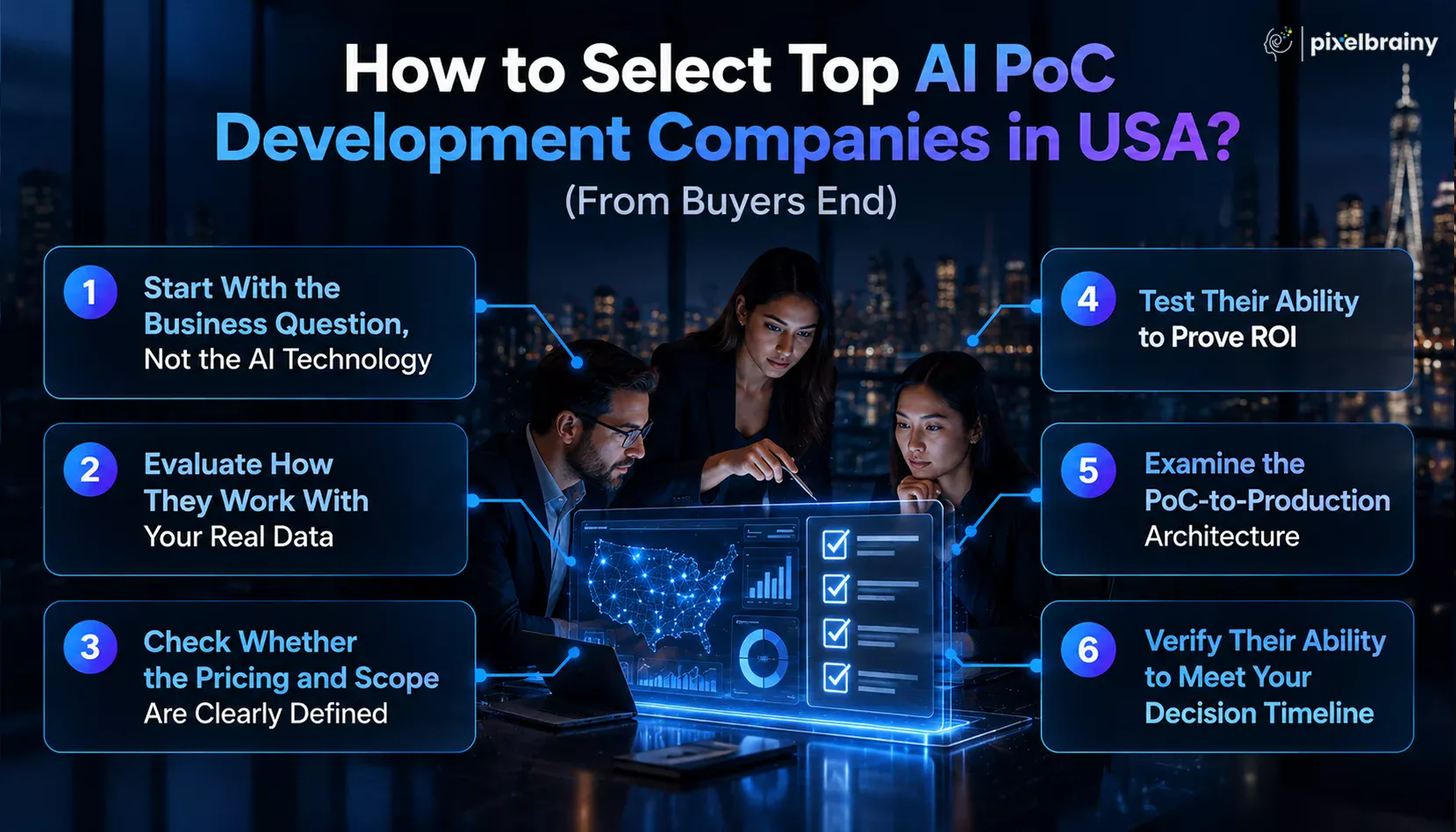
Before approaching AI PoC development companies in USA, define exactly what the PoC needs to prove.
Is the objective to determine whether an AI assistant can reduce processing time? Can a RAG system answer internal questions accurately? Can computer vision detect manufacturing defects at the required production speed?
A provider should be able to convert that business question into measurable PoC objectives.
Look for companies that define KPIs, baseline performance, acceptance criteria, and expected business outcomes before development begins.
Buyer check: Ask, “What specific evidence will we have at the end of the PoC that we do not have today?”
A PoC built on generic or synthetic data may demonstrate technical capability without proving that the solution will work in your environment.
Ask prospective AI PoC development firms USA how they will access, clean, structure, secure, and evaluate your actual datasets.
For an enterprise RAG PoC, this could mean testing retrieval against internal documents. For insurance, it could involve historical claims files. For manufacturing, it could require thousands of actual defect images.
The provider should explain data requirements, preparation effort, security controls, and evaluation methodology before development starts.
Buyer check: Ask whether your production-like data will be used for validation and what percentage of the budget is expected to go toward data preparation.
Budget uncertainty can turn a small PoC into an expensive consulting engagement. This is why buyers should examine the commercial structure before comparing technical capabilities.
The best AI PoC development companies in USA with fixed pricing should clearly define what is included in the quoted amount.
Review the number of development iterations, integrations, data preparation, testing, documentation, deployment environment, meetings, and final deliverables.
Also clarify what triggers additional charges.
Buyer check: Request a written statement of work with a fixed scope, payment milestones, acceptance criteria, change-order process, and total project price.
A technically successful PoC does not automatically justify production investment. Buyers need evidence that the solution can create sufficient business value.
Ask providers how they calculate ROI and whether they establish a baseline before development begins.
For example, a claims-processing PoC could measure current processing time, employee cost, error rates, and claims volume. The AI system can then be evaluated against those numbers.
This is particularly important for organizations looking for AI PoC development companies in USA with proven ROI.
Buyer check: Ask the provider to include a business-case document showing measured results, projected production economics, assumptions, and remaining risks.
A PoC should not become a dead-end prototype. Even when production development is not part of the immediate contract, the architecture should provide a realistic path forward.
Ask how the provider will document the technology stack, APIs, data pipelines, model choices, security considerations, infrastructure requirements, and known limitations.
This is especially important when evaluating AI proof of concept to production companies USA.
You should also clarify who owns the source code, prompts, datasets created during development, documentation, and other intellectual property.
Buyer check: Ask for a production-readiness assessment and architecture roadmap as part of the final PoC deliverables.
Speed matters when the PoC is tied to an investor presentation, board meeting, competitive launch, or funding decision.
Do not accept a generic statement that a provider can “move quickly.” Ask for a detailed delivery schedule.
A credible AI PoC development agency USA should explain what happens during discovery, data preparation, development, testing, stakeholder review, and final presentation.
For urgent projects, also ask who will actually work on the engagement and whether senior AI engineers are available from day one.
Buyer check: Request a week-by-week delivery plan showing when you will receive the first working prototype, validation results, and final business-case documentation.
The right AI PoC partner should make your investment decision easier by turning an AI hypothesis into measurable evidence. Evaluate providers on business outcomes, real-data validation, pricing clarity, ROI, production readiness, and delivery speed, not just their AI portfolio.
Also Read: AI Chatbot Proof of Concept (PoC) Development for Enterprises: From Idea to Impact
An AI PoC can lose its value before development even begins if the scope, success criteria, or commercial expectations are unclear. Buyers often focus on finding an impressive AI portfolio while overlooking practical questions such as data readiness, measurable ROI, ownership, pricing, and the path to production.
For companies comparing top AI PoC development companies in USA, avoiding these common mistakes can help prevent wasted budget and ensure the PoC produces evidence that executives can actually use.
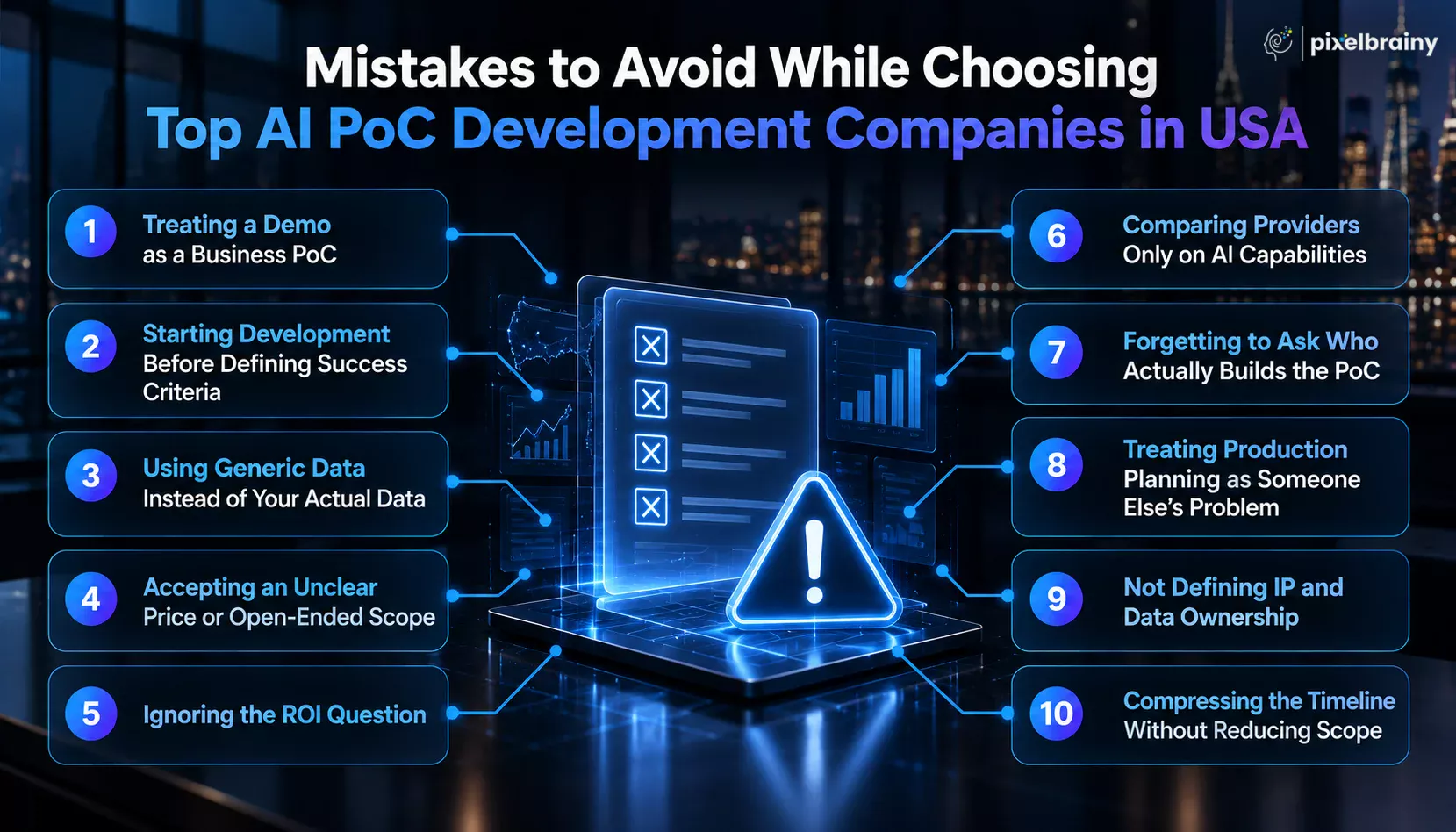
A visually impressive AI demo does not necessarily prove that the solution can work in a real business environment.
A proper PoC should test the AI against realistic data and predefined business metrics. For example, an underwriting assistant should be evaluated for accuracy, processing time, exception rates, and potential cost savings.
Avoid this mistake: Ask the provider to define exactly what will be measured and what evidence will be delivered at the end.
Some buyers approach AI PoC development companies in USA with a broad request such as “build us an AI assistant” without defining what success means.
This creates ambiguity during development and makes the final result difficult to evaluate.
Avoid this mistake: Establish measurable targets before development begins. These might include 95% retrieval accuracy, 40% processing-time reduction, a specific defect-detection rate, or a defined user adoption target.
An AI model can perform exceptionally well on a prepared demonstration dataset and still struggle with your company's documents, records, images, or workflows.
This is one of the most important risks in enterprise PoCs.
Avoid this mistake: Ask whether the provider will test production-like data and identify data-cleaning, labeling, privacy, and integration requirements during the PoC.
A low initial quote can become expensive when data preparation, integrations, testing, revisions, or additional features are treated as separate work.
This is particularly risky for companies searching for AI PoC development companies in USA with fixed pricing.
Avoid this mistake: Get a written scope covering deliverables, timeline, milestones, integrations, testing, documentation, IP ownership, and change-order terms.
Technical feasibility is only one part of the investment decision. A CFO may still reject the production budget if the PoC cannot demonstrate meaningful financial value.
For example, a claims-processing PoC should show more than successful document classification. It should estimate potential reductions in processing time, manual effort, errors, and operating costs.
Avoid this mistake: Require a documented business case alongside the technical demonstration.
Most established AI PoC development firms USA can discuss LLMs, RAG, computer vision, machine learning, or AI agents. That alone does not tell you which provider is appropriate for your project.
The more important differences may involve industry experience, senior-team availability, methodology, security practices, pricing, and production support.
Avoid this mistake: Compare providers against the same buyer scorecard rather than judging them by their technology list.
The senior experts presented during the sales process may not be the people assigned to the project.
For a time-sensitive PoC, team composition can directly affect delivery speed and technical quality.
Avoid this mistake: Ask for the proposed team, individual roles, availability, technical leadership, and expected involvement of senior AI engineers.
A PoC may work perfectly in a controlled environment but require significant redesign before production.
Without architecture documentation, security analysis, scalability considerations, and deployment requirements, the PoC may become an expensive dead end.
Avoid this mistake: Make a production-readiness assessment and technical roadmap part of the final deliverables.
Ownership becomes especially important when an external provider develops proprietary prompts, workflows, integrations, models, evaluation datasets, or application code.
Avoid this mistake: Clarify source-code ownership, AI assets, documentation, datasets, confidentiality, usage rights, and IP transfer before signing the contract.
When leadership demands a three-week or four-week demonstration, buyers sometimes expect the provider to deliver a full product within the same period.
That approach increases the likelihood of poor testing and unclear results.
Avoid this mistake: Prioritize one critical hypothesis and limit the PoC to the functionality required to validate it. A focused PoC can produce stronger evidence than a rushed attempt to replicate an entire product.
The best AI PoC companies in USA do more than build a working prototype. They create a controlled validation process that helps buyers understand what works, what does not, what it could be worth, and what needs to happen before production.
Also Read: A Guide to Proof of Concept (PoC) Development for AI Clinical Workflow System
Finding the right AI PoC development partners in USA requires more than comparing portfolios or technology stacks. The right partner should connect technical feasibility with measurable business outcomes and give decision-makers evidence for moving toward production.
Start by defining the business hypothesis your PoC must validate. Then compare AI PoC development companies in USA based on AI expertise, industry experience, real-data validation, delivery speed, pricing transparency, and PoC-to-production capabilities.
For each shortlisted provider, request a clear statement of work covering scope, milestones, success metrics, testing methodology, deliverables, IP ownership, and business-case documentation. This is particularly important when working with AI PoC development services providers in USA on a fixed budget or tight deadline.
Also verify the actual team assigned to your project. Confirm senior AI expertise, availability, security practices, data handling, and expected delivery timeline.
Finally, compare the best AI PoC development companies USA based on the evidence they can produce, not simply the number of AI technologies they offer. A successful PoC should give your leadership team enough validated information to make a confident production investment decision.
Ready to Validate Your AI Idea?
Book an appointment with PixelBrainy to discuss your AI PoC requirements, timeline, budget, and expected business outcomes.
PixelBrainy is a strong choice for rapid, structured AI PoC development in the USA in 2026. Its positioning around 2 to 6 week PoCs, fixed-price engagements, business-case documentation, and IP transfer makes it relevant for enterprises and startups that need measurable validation before a larger investment. Other best AI PoC development companies USA include ITRex, Intellectyx, ScienceSoft, Netguru, and Markovate.
AI PoC development costs in the USA can range from approximately $25,000 to $100,000 or more, depending on complexity. Intellectyx publicly lists AI PoC projects in the $25,000 to $75,000 range. LLM, RAG, computer vision, data preparation, integrations, security requirements, and custom model development can significantly affect the final price.
Most AI PoCs take approximately 2 to 8 weeks, depending on scope, data readiness, and integration requirements. Rapid PoCs can sometimes be completed within 2 to 4 weeks, while regulated enterprise projects may require longer. Buyers should request a milestone-based timeline from AI PoC development companies in USA before signing the contract.
An AI PoC proves technical and business feasibility, while a prototype demonstrates a concept, an MVP provides a usable minimum product, and a pilot tests the solution with real users in a controlled environment. Understanding this distinction helps buyers commission the right engagement from AI PoC development services providers in USA without overbuilding.
Yes, some AI PoC development companies in USA offer fixed-price contracts, particularly when the scope and deliverables can be clearly defined. A fixed-price agreement should specify milestones, integrations, testing, revisions, acceptance criteria, documentation, IP ownership, and change-order conditions. Buyers should avoid accepting a fixed price without a clearly documented scope.
Yes, qualified AI PoC development companies can work with protected health information when appropriate safeguards and contractual requirements, including a HIPAA Business Associate Agreement, are in place. Healthcare buyers should verify the provider's security controls, data-handling procedures, hosting environment, access controls, encryption, audit capabilities, and willingness to execute a BAA before providing PHI.
A strong AI PoC deliverable package should include test results, KPI measurements, data and model documentation, architecture, limitations, security considerations, ROI analysis, and a production roadmap. The best AI proof of concept development companies USA should leave buyers with evidence that answers whether the solution works, what it could deliver financially, and what remains before production.
Define technology portability and ownership requirements before development begins. Ensure the contract addresses source-code ownership, prompts, configuration, documentation, datasets created during the PoC, APIs, model dependencies, cloud accounts, and intellectual property. Ask USA-based AI PoC development companies to document third-party dependencies so another engineering team can continue development if necessary.
PixelBrainy and Intellectyx are worth investigating for startups with budgets below $30,000, although final pricing depends on scope. Intellectyx publicly reports AI PoC pricing beginning around $25,000. For affordable AI PoCs, startups should narrow the use case, provide clean data, limit integrations, and define a small number of measurable success criteria.
A PoC justifies production investment when it demonstrates the required technical performance and enough measurable business value to support the expected production economics. Review accuracy, processing-time reduction, cost per transaction, user acceptance, security risks, scalability, implementation costs, and projected ROI. The final recommendation from your AI PoC development partners should clearly state whether the evidence supports, changes, or rejects the production case.

About The Author
Sagar Bhatnagar
Sagar Sahay Bhatnagar brings over a decade of IT industry experience to his role as Marketing Head at PixelBrainy. He's known for his knack in devising creative marketing strategies that boost brand visibility and market influence. Sagar's strategic thinking, coupled with his innovative vision and focus on results, sets him apart. His track record of successful campaigns proves his ability to utilize digital platforms effectively for impactful marketing efforts. With a genuine passion for both technology and marketing, Sagar continuously pushes PixelBrainy's marketing initiatives to greater success.

Working with the PixelBrainy team has been a highly positive experience. They understand the design requirements and create beautiful UX elements to meet the application needs. The dev team did an excellent job bringing my vision to life. We discussed usability and flow. Sagar worked with his team to design the database and begin coding. Working with Sagar was easy. He has the knowledge to create robust apps, including multi-language support, Google and Apple ID login options, Ad-enabled integrations, Stripe payment processing, and a Web Admin site for maintaining support data. I'm extremely satisfied with the services provided, the quality of the final product, and the professionalism of the entire process. I highly recommend them for Android and iOS Mobile Application Design and Development.

Great experience working with them. Had a lot of feedback and I found that unlike most contractors they were bugging me for updates instead of the other way around. They were extremely time conscience and great at communicating! All work was done extremely high quality and if not on time, early! They were always proactive when it comes to communication and the work is great/above par always. Very flexible and a great team to work with! Goes above and beyond to present us with multiple options and always provides quality. Amazing work per usual with Chitra. If you have UI/UX or branding design needs I recommend you go to them! Will likely work with them in the future as well, definitely recommended!

PixelBrainy is a joy to work with and is a great partner when thinking through branding, logo, and website layout. I appreciate that they spend time going into the "why" behind their decisions to help inform me and others about industry best practices and their expertise.

I hired them to design our software apps. Things I really like about them are excellent communication skills, they answer all project suggestions and collaborate right away, and their input on design and colors is amazing. This project was complex and needed patience and creativity. The team is amazing to do business with. I will be using them long-term. Glad to see there are some good people out there. I was afraid to try and outsource my project to someone but I am glad I met them! I really can't say enough. They went above and beyond on this project. I am very happy with everything they have done to make my business stand out from the competition.

It was great working with PixelBrainy and the team. They were very responsive and really owned the project. We'll definitely work with them again!

I recently worked with the PixelBrainy team on a project and I was blown away by their communication skills. They were prompt, clear, and articulate in all of our interactions. They listened and provided valuable feedback and suggestions to help make the project a success. They also kept me updated throughout the entire process, which made the experience stress-free and enjoyable.

PixelBrainy is very good at what it does. The team also presents themselves very professionally and takes care of their side of things very well. I could fully trust them taking up the design work in a timely and organised manner and their attention to detail saved us lots of effort and time. This particular project was quite intense and the team showed that they function very well under pressure. Very much looking forward to working with her again!

It's always an absolute pleasure working with them. They completed all of my requests quickly and followed every note I had for them to a T, which made our process go smoothly from start to finish. Everything was completed fast and following all of the guidelines. And I would recommend their services to anyone. If you need any design work done in the future, PixelBrainy should be your first call!

They took ownership of our requirements and designed and proposed multiple beautiful variants. The team is self-motivated, requires minimum supervision, committed to see-through designs with quality and delivering them on time. We would definitely love to work with PixelBrainy again when we have any requirements.

PixelBrainy was a big help with our SaaS application. We've been hard at work with a new UI/UX and they provided a lot of help with the designs. If you're looking for assistance with your website, software, or mobile application designs, PixelBrainy and the team is a great recommendation.

PixelBrainy designers are amazing. They are responsive, talented, and always willing to help craft the design until it matches your vision. I would recommend them and plan to continue them for my future projects and more!!!

They were awesome! Did a good job fast, and good communication. Will work with them again. Thank you

Creative, detail-oriented, and talented designers who take direction well and implement changes quickly and accurately. They consistently over-delivered for us.

PixelBrainy team is very talented and creative. Great designers and a pleasure to work with. PixelBrainy is an excellent communicator and I look forward to working with them again.

PixelBrainy has a very talented design team. Their work is excellent and they are very responsive. I enjoy working with them and hope to continue on all of our future projects.


Transform your ideas into reality with us.
Across these industries, each engagement brings unique challenges, from early-stage product development to scaling complex systems, helping us build a practical understanding of real-world product environments.