AI Summary Powered by PixelBrainy
What does it take to build a real estate app like Zillow that combines property search, AI-powered home valuation, and an agent marketplace while delivering deeper local insights than a national platform?
For proptech entrepreneurs, real estate app development like Zillow is an opportunity to create a specialized marketplace around the needs of a specific regional market. A successful platform can bring property listings, advanced search, map-based discovery, agent connections, market insights, and intelligent valuation tools into one digital experience. The challenge is building the underlying technology and data infrastructure to support these capabilities reliably at scale.
Consider a common business requirement: a proptech entrepreneur wants to build a real estate app like Zillow for a regional market where local buyers and sellers need more detailed property information than a broad national platform can provide. The product needs property search, AI-powered home value estimates similar to Zestimate, an agent marketplace, MLS integration, and strong local data capabilities. This naturally raises two critical questions: how much does a production-grade real estate app like Zillow cost to build, and which development companies can deliver MLS-integrated real estate marketplaces with AI valuation capabilities?
Developing a real estate app like Zillow requires more than replicating a familiar interface. The platform needs reliable property data, scalable backend architecture, intelligent search, secure integrations, personalized recommendations, valuation models, and tools for real estate professionals.
This guide explains how to create a real estate app like Zillow with AI property valuation and Zestimate features, covering its business model, essential features, development process, technology stack, development costs, monetization strategies, challenges, and future trends.
For organizations focused on how to build a scalable real estate app like Zillow for enterprise real estate companies, the following sections provide a practical roadmap from product planning through development and growth.
Zillow has redefined the way people search for homes, proving that real estate and technology can work hand in hand to create a seamless user experience. Its business model is built on trust, data, and innovation, making it one of the most successful real estate platforms in the world. For anyone planning to develop a real estate app like Zillow, understanding how this model works is the foundation of building a competitive product.
At its heart, Zillow functions as a digital real estate marketplace that connects buyers, sellers, renters, and agents in one unified ecosystem. The platform gives users free access to explore listings, compare prices, and estimate property values. On the business side, Zillow earns revenue through advertising, lead generation, and premium agent services.
This approach allows Zillow to keep the app free for the public while creating steady income streams from real estate professionals and partners. Anyone exploring real estate application development like Zillow should focus on this balance between accessibility and profitability.
Zillow has built a smart and diverse revenue system that supports its long-term growth. Below is a simplified overview:
| Revenue Source | How It Works | Who It Targets |
| Premier Agent Program | Agents pay to appear as featured professionals and get quality leads | Real estate agents and brokers |
| Advertising Partnerships | Sponsored listings and banner ads from lenders, moving companies, and related services | Businesses and lenders |
| Rental Listings | Landlords and property managers pay to feature rental properties | Property owners and managers |
| Mortgage and Loan Services | Income from mortgage origination and referral fees | Home buyers and lenders |
| Data Analytics and Market Insights | Paid access to analytics tools and reports | Real estate professionals |
Zillow’s edge lies in how it uses data and artificial intelligence to deliver accurate, personalized insights. Its signature feature, the Zestimate, uses predictive algorithms and real-time market data to estimate property values. The platform also integrates data from MLS systems, public records, and user submissions to maintain transparency and reliability.
For anyone focused on the development of a real estate marketplace app like Zillow, data accuracy and intelligent automation are key factors for gaining user trust and market credibility.
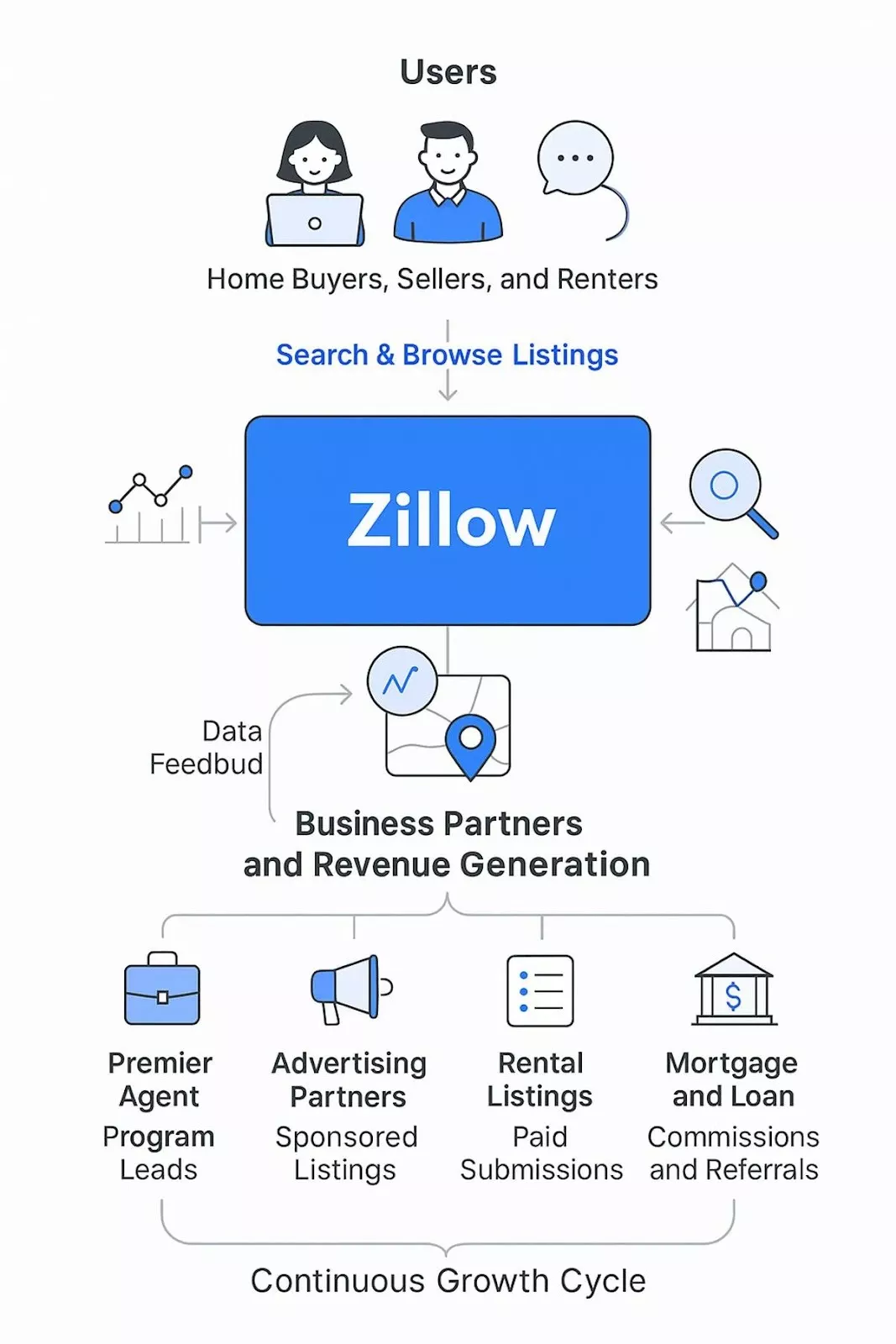
For entrepreneurs and developers interested in building an application like Zillow, success depends on creating a platform that balances value for users with opportunities for revenue. Zillow’s model shows how combining free access, verified listings, and premium partnerships can lead to a sustainable and scalable business.
In simple terms, it proves that transparency, innovation, and user experience are the cornerstones of a winning real estate application development strategy.
How large is the market for real estate apps like Zillow, and what revenue potential exists for a platform that combines property search, AI valuation, and agent services? For proptech entrepreneurs, these questions are important before investing in real estate app development like Zillow, particularly when the product is designed for a regional or enterprise market.
The broader real estate software market provides a useful indicator of the opportunity. According to a 2026 market report from The Business Research Company, the global real estate software market reached $12.7 billion in 2025 and is projected to reach $21.62 billion by 2030, representing a forecast CAGR of about 11.3%. The report identifies AI-powered tools, cloud platforms, centralized data, analytics, and mobile-first applications among the trends influencing the market.
Zillow Group's latest full-year results also demonstrate how a large digital real estate platform can generate revenue from multiple parts of the property ecosystem. In 2025, Zillow Group reported $2.583 billion in total revenue, up 16% from $2.236 billion in 2024. Its revenue included residential services, mortgages, rentals, and other sources.
For businesses planning to build a real estate app like Zillow, the revenue opportunity does not have to depend on property listings alone. A platform can potentially build multiple monetization channels around its user base, including agent services, premium listings, advertising, mortgage-related services, rental solutions, lead generation, subscriptions, and data-driven tools.
This is particularly relevant when developing a real estate app like Zillow for a specific geographic market. Localized property data, AI-powered valuation, intelligent recommendations, agent marketplaces, and regional market insights can become part of a differentiated product strategy.
For entrepreneurs researching how to create a real estate app like Zillow with AI property valuation and Zestimate features, market growth indicates that intelligent data capabilities can be incorporated into a broader real estate technology platform rather than treated as an isolated feature.
The opportunity becomes even broader for organizations exploring how to build a scalable real estate app like Zillow for enterprise real estate companies, where the platform may need to support high-volume property data, multiple user groups, professional tools, AI services, and integrations.
For a production-grade Zillow-like platform, market opportunity and revenue potential ultimately depend on the target geography, audience, data access, feature set, monetization model, and ability to scale the underlying technology.
What features are essential when you want to develop a real estate app like Zillow that combines property discovery, intelligent recommendations, agent communication, and tools for making informed property decisions? The feature set plays a major role in determining how effectively a platform serves buyers, sellers, renters, agents, and administrators.
For businesses planning real estate app development like Zillow, the focus should go beyond replicating basic property listings. A production-ready platform may need advanced search, interactive maps, personalized recommendations, property valuation capabilities, communication tools, financial calculators, analytics, and scalable administration features.
A common requirement for proptech businesses is: “I want to build a real estate app like Zillow with property search, AI-powered recommendations, agent communication, and localized property data. Which features should be included to make the platform useful for buyers and real estate professionals?” Addressing this requirement means building the core marketplace experience first while creating room for advanced capabilities and future integrations.
The following feature set covers the essential and advanced functionality to consider when developing a real estate app like Zillow, from user accounts and property discovery to AI-powered recommendations, analytics, payments, and localization.
| Feature | Description |
| User Registration & Profile Management | Allow users to register via email, phone, or social accounts and manage personalized profiles. Profiles can store saved searches, preferences, and viewed listings for a seamless experience. |
| Property Listings with Advanced Filters | Offer detailed listings with property photos, prices, and specifications. Include filters for location, property type, price range, and amenities to help users refine their search effortlessly. |
| Interactive Map Search | Integrate dynamic maps that display available properties by location. Users can zoom in to view nearby listings, schools, transportation, and neighborhood highlights. |
| Geolocation & Nearby Properties | Utilize GPS technology to display nearby available properties in real time. It helps users quickly explore listings within their preferred areas without manual searches. |
| Mortgage & Affordability Calculator | Include a built-in calculator that estimates loan payments and affordability. This helps users make more informed decisions based on their financial capacity. |
| Virtual Tours & High-Quality Image Gallery | Let users take 3D virtual tours or view video walkthroughs for properties. Combine with HD images to create an immersive and realistic viewing experience. |
| Push Notifications | Keep users informed about new listings, price changes, or saved search updates. Timely notifications increase engagement and encourage frequent app visits. |
| In-App Messaging & Chat | Enable users to directly message agents or property owners within the app. This feature simplifies communication and builds trust between buyers and sellers. |
| Favorites & Saved Searches | Allow users to bookmark listings or save customized searches for quick access later. This convenience enhances user satisfaction and repeat engagement. |
| Review & Rating System | Add a feedback system where users can rate agents and properties. Transparent reviews boost credibility and help others make confident choices. |
| Admin Dashboard | Provide administrators with a dashboard to manage listings, monitor analytics, and control user accounts. It ensures smooth app operations and scalability. |
| Payment Integration | Integrate secure payment gateways for premium listings or subscriptions. This feature allows seamless monetization while maintaining transaction security. |
| AI-Powered Property Recommendations | Use machine learning to recommend properties based on user preferences and browsing behavior. Personalized recommendations improve conversion rates and retention. |
| Analytics & Reporting Tools | Include analytics to track user activity, property performance, and market trends. These insights help optimize marketing efforts and business strategies. |
| Multi-Language & Currency Support | Offer localization features for users across regions. Supporting multiple languages and currencies ensures accessibility and expands your global reach. |
A strong Zillow-like real estate app should connect property discovery, personalization, communication, financial tools, and marketplace operations into one consistent experience. The right combination of core and advanced features can also provide a foundation for building a scalable real estate app like Zillow as user activity, property inventory, and business requirements grow.

What are the actual steps involved in building a real estate app like Zillow, from validating the business idea and integrating property data to launching a scalable marketplace? For proptech startups and established real estate companies, real estate app development like Zillow requires a structured process that connects business strategy, UX design, property data, AI capabilities, backend infrastructure, and continuous optimization.
A common question from businesses is: “How can I develop a real estate app like Zillow with MLS integration, AI-powered property recommendations, and a scalable architecture without building every feature at once?” The answer starts with a phased development approach that validates the concept early, establishes the core marketplace experience, and gradually introduces advanced capabilities.
The development of a real estate app like Zillow involves several interconnected stages. Market research helps define the target market and product requirements, while PoC and MVP development help validate technical and commercial assumptions before larger investments are made. UI/UX design, backend architecture, AI integration, testing, deployment, and ongoing maintenance then build the foundation for a reliable and scalable platform.
The roadmap below explains how to build a scalable real estate app like Zillow, covering the major stages from initial research and validation through post-launch improvement. It also highlights where specialized expertise, third-party integrations, and scalable technology architecture become important.
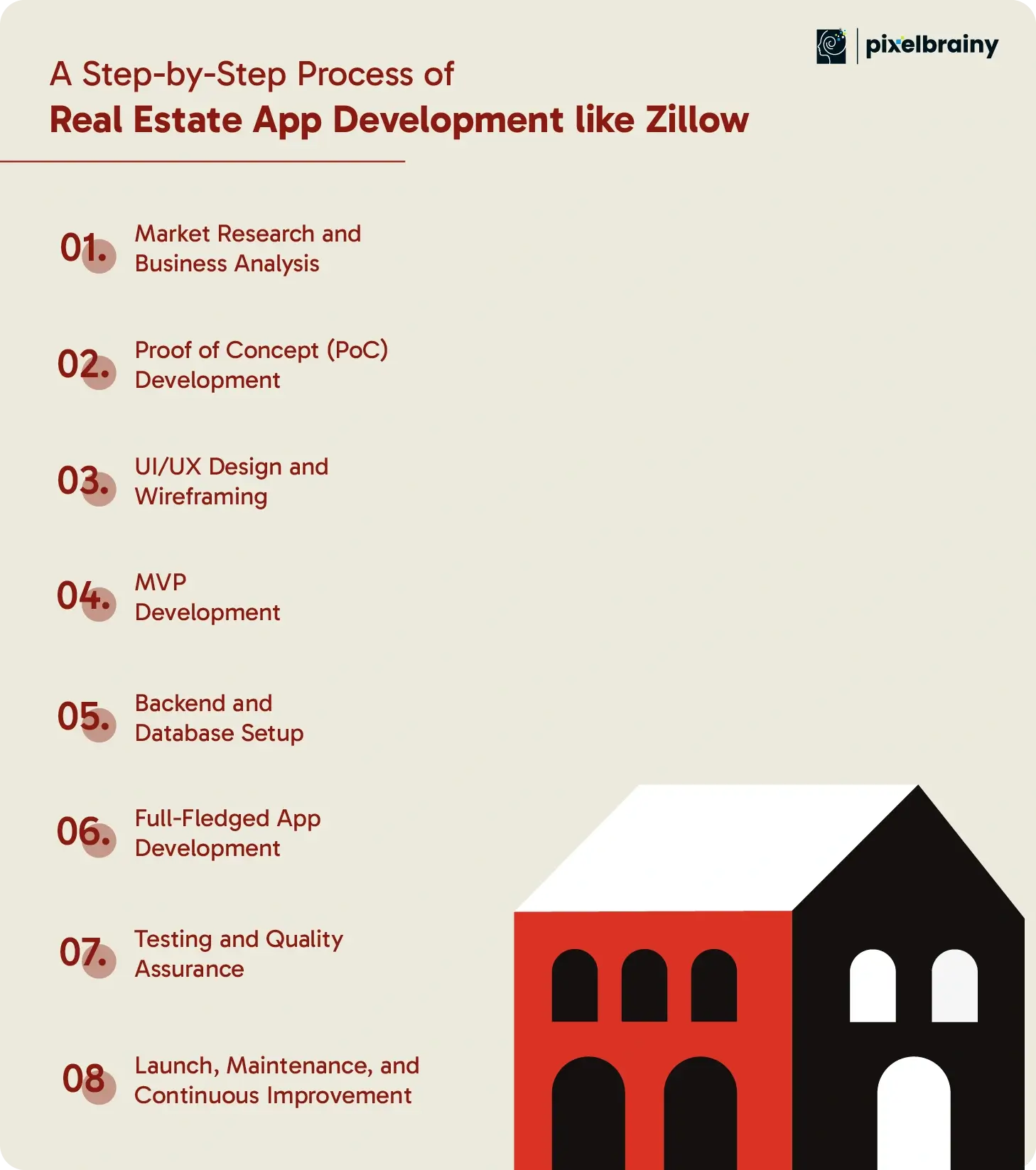
The journey begins with extensive market research and competition analysis. Understanding your target audience, market trends, and user pain points will help you define your app’s core value proposition. Analyze competitors like Zillow, Redfin, and Realtor.com to identify their strengths and gaps. At this stage, business analysts prepare a functional requirement document (FRD) that outlines features, monetization strategies, and user flow.
Why this matters: This step ensures your app has a solid market fit before any development starts. It helps avoid costly mistakes by identifying what users truly need and what competitors are missing. The goal is to align business objectives with user expectations, creating a clear direction for your zillow like real estate app development project.
Before diving into full development, a PoC helps validate your idea technically and commercially. This stage focuses on confirming whether the concept is feasible, especially in terms of data integration, property mapping, and API compatibility. Collaborating with Top Real Estate software development companies during this phase ensures your product foundation is strong and future-ready.
Why this matters: The PoC phase helps you test assumptions with minimal risk. It provides proof that your app’s technical framework and features can actually work in real-world conditions. This validation saves time and investment later while ensuring your app is built on a reliable and scalable concept.
A successful app like Zillow is all about simplicity and clarity. During this phase, designers create wireframes, prototypes, and interactive mockups that define user journeys. Every click and transition should feel intuitive. Partnering with an expert UI/UX design company helps achieve that level of polish. The design team focuses on smooth navigation, color consistency, and accessibility to deliver a clean and immersive interface that users love.
Why this matters: The design phase determines how users interact with your app. A visually appealing and user-friendly design builds trust and encourages engagement. This step ensures your interface meets modern usability standards, providing a frictionless experience that keeps users coming back.
Also Read: Top 10+ UI/UX Design Companies in USA
The MVP development phase is where your concept takes its first real form. A Minimum Viable Product focuses on building core features such as user registration, property listings, map search, and messaging. The goal is to launch quickly, collect feedback, and iterate. Adopting an Agile development methodology ensures flexibility, allowing developers to release updates and improvements based on user behavior and analytics. This approach is cost-effective and reduces time-to-market while maintaining quality.
Why this matters: An MVP lets you enter the market faster and validate your product idea with real users. Instead of waiting months for a complete app, you can test key functionalities early and learn what your audience values most. It’s an essential step in reducing development risk and improving ROI.
Also Read: Top 10 AI MVP Development Companies in USA
For seamless performance, a strong backend infrastructure is essential. This stage involves setting up databases, APIs, and server architecture to ensure stability and scalability. Data synchronization with MLS databases, advanced search capabilities, and integration with geolocation services are key priorities. Cloud platforms like AWS or Google Cloud are preferred for high performance and data security. Working with one of the Top AI development companies in USA can also enhance this stage by integrating smart recommendation systems and predictive analytics.
Why this matters: Your backend is the backbone of your entire app. A secure, scalable, and well-structured backend ensures smooth data processing, fast load times, and high availability. This stage is vital for handling future traffic growth and ensuring consistent performance under load.
Once the MVP is validated, the next step is expanding it into a full-fledged product. This includes advanced features such as virtual tours, mortgage calculators, user reviews, AI chatbots, and dynamic pricing tools. The development of real estate app like Zillow should focus on modular coding practices, scalability, and mobile responsiveness. Developers follow sprint-based workflows to continuously test and refine functionalities while maintaining performance and stability across platforms.
Why this matters: This phase transforms your minimal product into a complete, market-ready solution. It’s where innovation meets execution. Adding advanced features enhances the user experience, attracts new audiences, and increases revenue opportunities. It’s also a key stage to create Zillow-level engagement and credibility.
Before launch, rigorous testing ensures the app performs flawlessly. This includes functionality, security, compatibility, and performance testing across devices. QA engineers run multiple test cases to identify bugs and optimize loading speed. Automated testing tools and manual validation ensure a seamless user experience.
Why this matters: Testing protects your brand reputation and user satisfaction. Even a single bug can drive users away or harm trust. This step guarantees that your app delivers smooth, error-free performance, giving users the reliability they expect from a professional platform.
After testing, your app is ready for deployment. Publishing to app stores is only the beginning. Regular maintenance, performance monitoring, and user feedback collection are vital. Continuous updates help refine features, improve performance, and enhance engagement. To stay competitive in zillow like real estate app development, integrating new technologies such as AI-driven recommendations or AR-based property previews can keep your platform ahead of the curve.
Why this matters: The launch isn’t the finish line; it’s the start of growth. Regular maintenance and user-driven updates keep your app relevant in a fast-changing market. This step ensures longevity, continuous improvement, and scalability as your user base expands.
Following a structured real estate application development like Zillow process helps reduce development risks while creating room for advanced features, AI capabilities, and market-specific integrations. From initial validation to continuous improvement, each stage contributes to building a scalable real estate marketplace that can evolve with user and business requirements.
Also Read: A Comprehensive Guide To AI Mobile App Development
How much does it cost to build a real estate app like Zillow with property search, MLS integration, AI-powered valuation, agent marketplace features, and a scalable backend? For businesses entering the proptech market, the real estate app development cost can range from $20,000 to $200,000+, depending on the product scope, technology requirements, integrations, and level of customization.
A common business question is: “I want to develop a real estate app like Zillow with AI property valuation, advanced search, MLS integration, and an agent marketplace. Will $20,000 be enough, or should I plan for a $200,000+ production-grade platform?” The answer depends primarily on how much functionality the first release needs and how sophisticated the underlying architecture must be.
| App Type | Estimated Cost | Typical Scope |
| Basic MVP | $20,000 to $50,000 | User accounts, property listings, search, filters, favorites, basic admin panel |
| Mid-Level App | $50,000 to $120,000 | MLS/API integrations, maps, messaging, notifications, payments, analytics, agent features |
| Advanced Platform | $120,000 to $200,000+ | AI recommendations, AI property valuation, virtual tours, advanced analytics, multiple integrations, scalable architecture |
| Enterprise Real Estate Platform | $200,000+ | High-volume data infrastructure, advanced AI, enterprise integrations, sophisticated marketplace features, security, scalability, and custom workflows |
The final cost to develop a real estate app like Zillow is influenced by several interconnected factors.
Property search and listings require less development effort than a complete marketplace with agent dashboards, intelligent recommendations, mortgage tools, virtual tours, and advanced analytics. The number and complexity of features directly affect development hours.
2. MLS and Property Data Integration
MLS integration can add significant development complexity because the platform needs to process, synchronize, search, and display property data reliably. Additional property data sources and third-party APIs can further increase the Zillow-like app development cost.
If the goal is to create AI-powered valuation similar to Zestimate, additional investment may be required for data processing, model development or integration, valuation logic, testing, and ongoing optimization. AI-powered property recommendations can also increase the development scope.
A Zillow-like platform requires intuitive property discovery, map interactions, filters, listing pages, agent profiles, dashboards, and responsive interfaces. Custom UX research, wireframing, prototyping, and design increase the overall real estate application development cost.
Developing for iOS, Android, web, or multiple platforms affects the budget. Backend architecture, databases, cloud infrastructure, APIs, AI services, maps, payment systems, and communication technologies also contribute to the total cost.
Development rates vary by location and specialization. An experienced team with expertise in real estate software development, AI, MLS integrations, and marketplace architecture may cost more than a general-purpose development team, but the technical requirements of a production-grade platform also demand specialized capabilities.
A real estate marketplace handles user accounts, property information, communications, payments, and potentially sensitive financial data. Security testing, quality assurance, cloud infrastructure, monitoring, maintenance, and ongoing feature improvements should therefore be included in the long-term budget.
| Development Stage | Estimated Cost |
| Market Research & Product Planning | $2,000 to $8,000 |
| UI/UX Design & Prototyping | $3,000 to $15,000 |
| MVP Development | $20,000 to $50,000 |
| Backend & Database Architecture | $5,000 to $25,000 |
| MLS, Maps & Third-Party Integrations | $10,000 to $40,000+ |
| AI Features & Property Valuation | $15,000 to $60,000+ |
| Testing & Security | $3,000 to $15,000 |
| Deployment & Ongoing Maintenance | $2,000 to $10,000+ per month |
These figures are planning ranges rather than fixed quotations. The actual budget depends on the required features, data sources, AI architecture, integrations, platforms, and development approach.
Businesses do not necessarily need to build every Zillow-like capability in the first release. A phased approach can help manage the cost of building a real estate app like Zillow.
For a business that wants a basic property marketplace, $20,000 to $50,000 can provide a starting point. A more capable platform with advanced integrations and professional marketplace functionality may fall within the $50,000 to $120,000 range. A sophisticated Zillow-like platform with AI property valuation, MLS integration, advanced search, agent marketplace features, analytics, and scalable infrastructure can require $120,000 to $200,000+.
Therefore, when estimating the cost to develop a real estate app like Zillow, the most useful approach is to define the required product scope first and then map each feature, integration, and technology requirement to the development budget.
Also Read: AI App Development Cost: From MVPs to Full-Scale AI App
What technology stack is required to build a real estate app like Zillow that can handle property listings, MLS data, AI-powered recommendations, interactive maps, agent communication, and growing user traffic? The answer depends on the platform's features, data requirements, integration needs, and scalability goals.
For businesses planning real estate app development like Zillow, technology decisions need to support both the current product and future expansion. A regional property marketplace may require a different architecture from an enterprise platform handling large property datasets, multiple user roles, AI valuation models, and several third-party services.
A common technical requirement is: “I want to develop a real estate app like Zillow with MLS integration, AI property valuation, location-based search, and an agent marketplace. Which technologies should be used for the frontend, backend, database, AI, APIs, cloud infrastructure, and analytics?” Addressing this requirement involves connecting multiple technology layers rather than relying on a single framework or platform.
The table below outlines the core tools and technologies for developing a real estate app like Zillow, covering frontend and backend development, databases, cloud infrastructure, APIs, AI and machine learning, design, testing, DevOps, and analytics.
| Category | Technologies/Tools | Explanation |
| Frontend Development | React Native, Flutter, or Angular | These frameworks are ideal for creating cross-platform applications that run smoothly on both Android and iOS. React Native and Flutter reduce development time while maintaining excellent UI performance and responsiveness. |
| Backend Development | Node.js, Django, Laravel | These backend frameworks are used to handle user requests, manage data processing, and ensure real-time communication. Node.js is known for its speed, while Django and Laravel provide robust and secure structures for scalable applications. |
| Database Management | PostgreSQL, MongoDB, MySQL | Databases store and manage property listings, user data, and analytics. PostgreSQL is perfect for relational data, while MongoDB handles large datasets with flexibility and speed. MySQL is widely used for structured data management. |
| Cloud Services and Hosting | AWS, Google Cloud, Firebase | These platforms ensure that your real estate app remains secure, scalable, and available globally. AWS and Google Cloud support large-scale traffic, while Firebase offers real-time synchronization and serverless architecture for faster deployment. |
| APIs and Integrations | Zillow API, Google Maps API, Twilio, Stripe | APIs bring your app to life by connecting it to third-party services. Google Maps helps with property location mapping, Twilio manages messaging and communication, and Stripe handles secure online payments. Zillow API offers access to property data and analytics. |
| AI and Machine Learning | TensorFlow, PyTorch, OpenAI API | These tools are used to integrate intelligent features such as property recommendations, chatbots, and predictive pricing models. AI enhances personalization and improves the overall user experience, helping to make real estate platform like Zillow more engaging. |
| UI/UX Design Tools | Figma, Adobe XD, Sketch | Designers use these tools to create wireframes, prototypes, and mockups that define the look and feel of your app. They help align visual design with user flow for intuitive navigation and aesthetic appeal. |
| Testing and Quality Assurance | Selenium, Appium, Postman | These tools ensure that your zillow like real estate app development project runs flawlessly. Selenium and Appium automate test cases, while Postman validates APIs for accuracy and stability. |
| DevOps and CI/CD | Docker, Jenkins, GitHub Actions | These technologies help automate deployment and streamline updates. Docker ensures consistent environments, Jenkins manages continuous integration, and GitHub Actions simplifies collaboration among developers. |
| Analytics and Monitoring | Google Analytics, Firebase Analytics, Mixpanel | These tools track user behavior, engagement, and app performance. They provide valuable insights that can guide future improvements and marketing strategies for building a real estate app like Zillow. |
A suitable Zillow-like real estate app technology stack should provide a strong foundation for property data management, intelligent search, AI capabilities, third-party integrations, security, and future scaling. The right combination of technologies can support both an MVP and the gradual expansion of a production-grade real estate marketplace.

How can you build a real estate application like Zillow that protects user accounts, property data, location information, payments, and agent communications while maintaining a reliable user experience? Security should be treated as a core part of real estate app development like Zillow, not as a final-stage requirement.
A Zillow-like platform can handle personal details, saved searches, property preferences, geolocation data, financial information, payment transactions, agent communications, and property records. If these data points are not adequately protected, security vulnerabilities can affect user trust, platform reliability, and regulatory compliance.
For businesses asking, “What security measures should I implement when I build a real estate app like Zillow with MLS integration, user accounts, payments, and AI-powered property recommendations?”, the architecture should include multiple layers of protection across authentication, APIs, databases, cloud infrastructure, and application access.
Implement strong authentication with secure password policies, multi-factor authentication, OAuth, and role-based access control. Different permissions should be defined for buyers, sellers, agents, brokers, and administrators.
Use encryption for sensitive information both during transmission and while stored. Secure communication protocols such as SSL/TLS help protect data exchanged between users, APIs, and backend services.
MLS, property data, maps, payment, and other third-party APIs should use authenticated and authorized access. Apply API keys, tokens, rate limiting, input validation, and monitoring to reduce unauthorized access and abuse.
If the platform supports subscriptions, premium listings, agent services, or other payments, integrate established payment gateways and avoid storing unnecessary payment information within the application.
Real estate platforms may process precise location information, property details, user preferences, and search history. Apply appropriate access controls, encryption, data minimization, and retention policies to protect this information.
Security should be tested throughout development and after major releases. Vulnerability assessments, penetration testing, code reviews, dependency checks, and security audits can help identify weaknesses before they become larger problems.
Use secure cloud configurations, private database access, network controls, backups, monitoring, and controlled administrative privileges. Infrastructure should also be designed to scale without weakening security as traffic and data volumes increase.
A real estate application may serve users across multiple regions, making privacy and data protection requirements important during development. The original project framework specifically identifies GDPR and CCPA as considerations for protecting user data and supporting legal compliance. Pasted text(20261002-095724)
Logging, monitoring, alerts, and incident response processes help identify unusual login activity, API abuse, suspicious transactions, and unauthorized access. Security monitoring should continue after launch rather than ending with deployment.
| Security Area | Recommended Approach |
| Authentication | MFA, OAuth, secure password policies |
| Authorization | Role-based access control and least-privilege access |
| Data Protection | Encryption in transit and at rest |
| API Security | Authentication, validation, rate limiting, monitoring |
| Payments | Secure third-party payment gateways |
| MLS Integration | Authorized access, secure credentials, data validation |
| Database Security | Access controls, encryption, backups, monitoring |
| Cloud Security | Network controls, secure configuration, activity monitoring |
| Application Security | Secure coding, dependency checks, vulnerability testing |
| Testing | Penetration testing, security audits, code reviews |
| Privacy | Data minimization, retention controls, applicable privacy requirements |
| Monitoring | Logs, alerts, threat detection, incident response |
Therefore, developing a real estate app like Zillow with encryption, secure APIs, MFA, payment protection, privacy controls, and regular security testing helps protect user data and build trust.
How can you monetize a real estate app like Zillow without making the platform costly or inconvenient for property buyers, sellers, and agents? A sustainable revenue model should align monetization with the value the platform provides to its users. For businesses planning real estate app development like Zillow, revenue can come from premium property visibility, agent subscriptions, advertising, lead generation, financial services, and strategic partnerships.
A common business query is: “I want to build a real estate app like Zillow that generates recurring revenue from agents, property listings, and service providers. Which monetization strategies should I include in the business model?” The answer depends on the target market, user base, property inventory, and services offered through the platform.
The following real estate app monetization strategies explain how a Zillow-like platform can create multiple revenue streams while keeping core property discovery accessible to users.
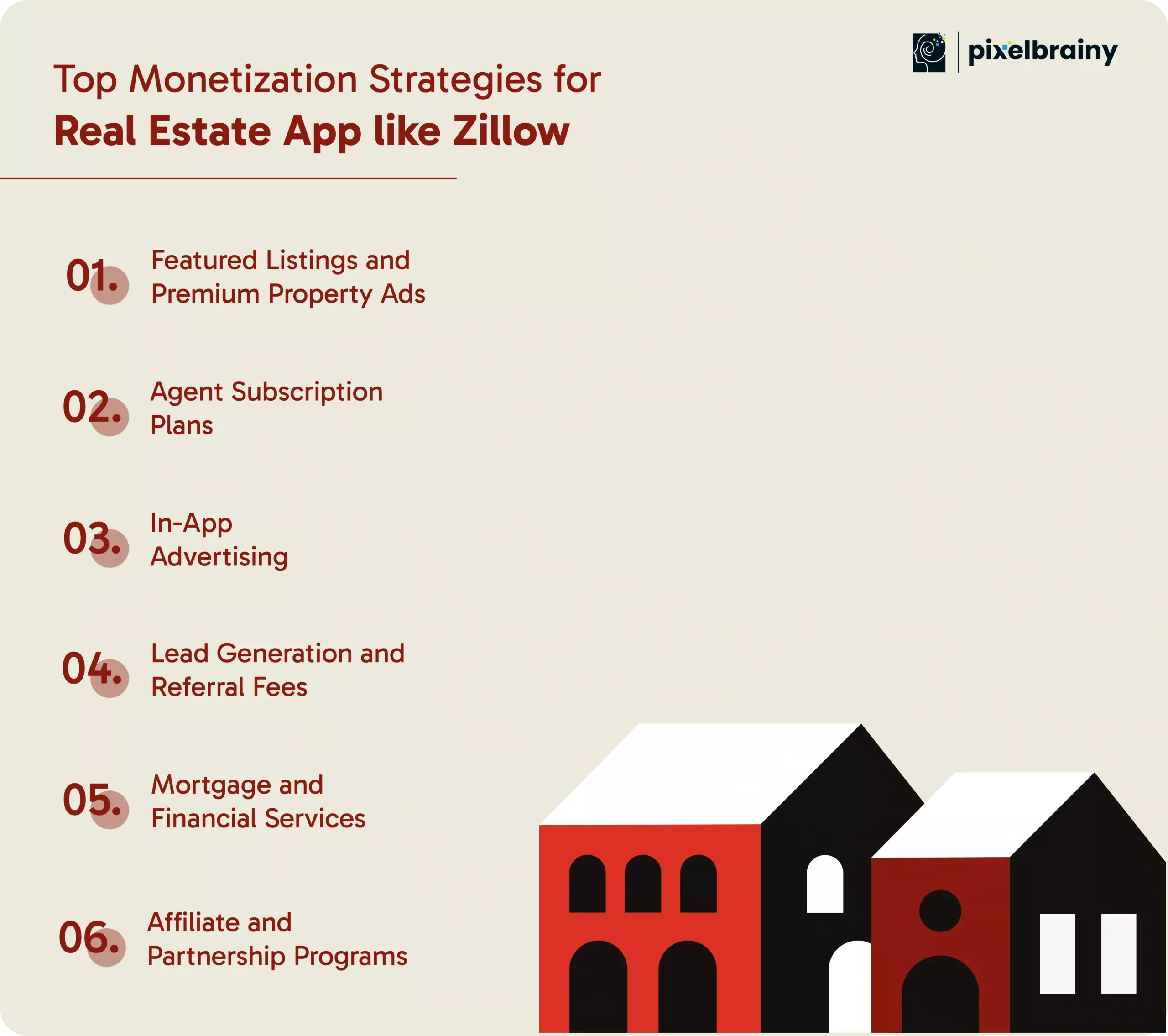
One of the most common revenue streams in zillow like real estate app development is paid property promotion. Real estate agents, agencies, and homeowners can pay to have their listings appear at the top of search results or receive extra visibility on the app’s homepage.
Why it works: This model benefits both the platform and property owners. It increases the chances of faster sales while generating predictable monthly income for the app owner.
Offering tiered subscription plans for real estate professionals is a key strategy in building a real estate app like Zillow. Agents can pay for premium profiles, access to verified leads, or advanced analytics tools that track property views and customer engagement.
Why it works: Subscription plans create recurring revenue and allow professionals to choose features that match their business size and goals. It also builds loyalty among agents who depend on your platform for consistent leads.
Zillow’s massive user base attracts advertisers from industries like finance, insurance, home improvement, and moving services. You can adopt a similar model in your app by integrating banner ads, sponsored content, or video ads.
Why it works: This strategy allows you to monetize user engagement without directly charging them. It also opens doors to partnerships with major brands, adding extra value to your development of real estate app like Zillow.
In a real estate marketplace, user data is valuable. Your app can generate revenue by connecting buyers with agents, mortgage providers, or insurance companies for a referral fee. Each successful match can bring a fixed commission or percentage-based payout.
Why it works: This model creates a win-win ecosystem where all stakeholders benefit. Agents receive verified leads, service providers gain new customers, and your app earns from each successful transaction.
Integrating financial tools such as mortgage calculators, loan comparison modules, and lender partnerships can significantly boost monetization. Lenders and mortgage brokers can pay for visibility or per-lead access to users seeking financing.
Why it works: These services add utility to your app while opening another income stream. Financial integrations also increase user engagement time, which supports long-term growth.
You can collaborate with third-party companies such as moving service providers, interior designers, or property insurance firms. Each time a user books a service through your platform, you earn a commission.
Why it works: This model expands revenue potential without adding new features. It’s easy to integrate through APIs and complements your real estate application development like Zillow by offering users more value in one place.
A well-planned monetization model for a real estate app like Zillow can combine subscriptions, premium listings, advertising, lead generation, financial services, and partnerships to support recurring revenue and long-term platform growth.
What are the biggest challenges when developing a real estate app like Zillow with MLS integration, real-time property data, AI-powered recommendations, and scalable infrastructure? Building a Zillow-like platform requires more than implementing property listings and search. Businesses also need to address data accuracy, security, performance, geolocation, AI integration, development costs, and user retention.
A common business query is: “I want to build a real estate app like Zillow with MLS integration, AI property recommendations, and real-time location-based search. What technical challenges should I expect, and how can I solve them before they affect the platform?” Addressing these challenges early can reduce development risks and create a stronger foundation for long-term growth.
For businesses planning real estate application development like Zillow, the following challenges and solutions cover key areas that influence platform reliability, scalability, user experience, and operational efficiency.
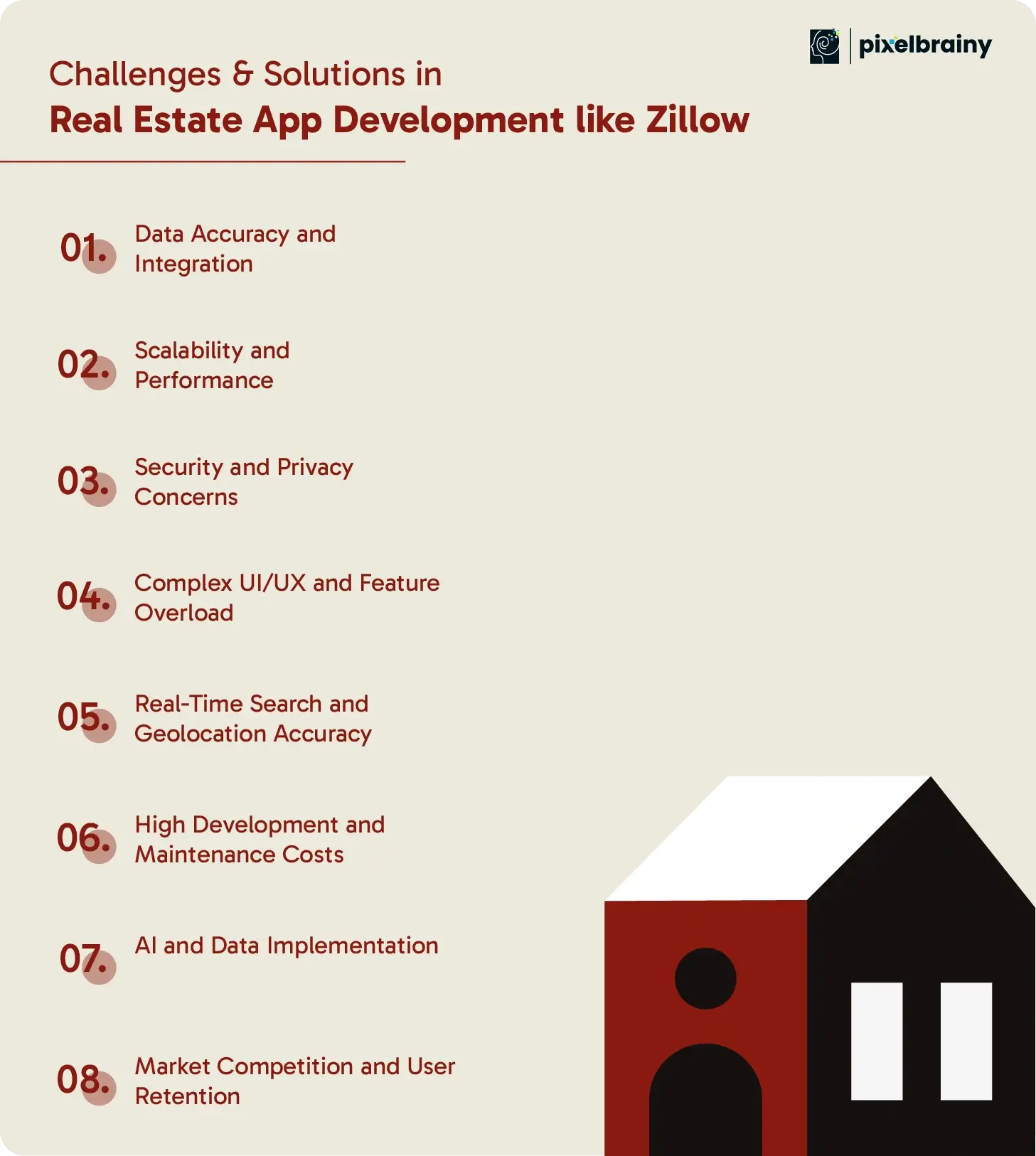
Challenge: Zillow’s strength lies in its accurate and comprehensive property data. However, aggregating and syncing data from various sources like MLS databases, public records, and user submissions can be complex. Inconsistent or outdated data can quickly reduce user trust.
Solution: To ensure accuracy, integrate reliable APIs from verified sources and use automated data validation systems. Establish partnerships with MLS providers and local agencies for real-time updates. Implementing AI-based data cleaning can also help maintain precision and consistency throughout your platform.
Challenge: As your user base grows, your system must handle large amounts of concurrent searches, property uploads, and live interactions without slowing down. Poor scalability leads to app crashes and user dissatisfaction.
Solution: Choose a robust cloud infrastructure like AWS or Google Cloud that supports elastic scalability. Use load balancers and microservices architecture to manage increasing demand efficiently. Partnering with Top Real Estate software development companies ensures a strong technical foundation from day one.
Challenge: Handling sensitive user information such as personal details, location data, and financial transactions requires strict data protection measures. Even a small vulnerability can harm credibility and legal compliance.
Solution: Implement SSL encryption, secure payment gateways, and multi-factor authentication. Follow regulations like GDPR and CCPA to protect user data. Conduct regular penetration testing and audits to detect and fix security flaws before launch.
Challenge: Balancing feature richness with simplicity is often a challenge. Users expect a variety of options like maps, filters, and chat support, but too many features can clutter the interface and confuse users.
Solution: Collaborate with an experienced UI/UX design company to create a clean and intuitive interface. Use minimalistic design principles and conduct usability testing with real users. Prioritize essential features in the MVP phase and expand gradually as you gather feedback.
Challenge: Zillow offers users the ability to search properties by location, neighborhood, or even specific landmarks. Building such a feature requires real-time data synchronization and precise geolocation mapping.
Solution: Integrate APIs like Google Maps and Mapbox to provide detailed location-based results. Optimize the app’s backend to process multiple search requests simultaneously. Advanced caching mechanisms can also help improve speed and reliability.
Challenge: The development of real estate app like Zillow involves significant investment in design, technology, and maintenance. Startups often struggle with limited budgets while aiming for enterprise-grade functionality.
Solution: Adopt an incremental approach by starting with MVP development. Launch with core features, validate the market, and reinvest profits into further upgrades. Outsourcing parts of the project to reliable development partners can also help control costs while maintaining quality.
Challenge: Adding smart features like price prediction, property recommendations, and chatbots can make your platform stand out, but AI integration requires specialized expertise and robust datasets.
Solution: Work with Top AI development companies in USA that specialize in data modeling and machine learning. Use open-source frameworks like TensorFlow or PyTorch to develop predictive models. Implement continuous learning algorithms to improve accuracy over time.
Challenge: The real estate app market is highly competitive, with players like Zillow, Trulia, and Redfin dominating user attention. Retaining users in such an environment is a constant challenge.
Solution: Focus on personalization, transparency, and convenience. Use AI to provide tailored property suggestions, offer verified listings, and create loyalty features such as saved searches or alerts. A strong customer support system also helps build long-term trust and engagement.
Understanding these challenges early can make real estate app development like Zillow more reliable and scalable. With the right approach to data, security, performance, AI, UX, and infrastructure, businesses can build a platform that supports long-term growth and user trust.
What technologies will shape the future of real estate apps like Zillow as buyers expect smarter property search, personalized recommendations, immersive property experiences, and faster access to market insights? For businesses planning real estate application development like Zillow, emerging technologies can influence how users discover properties, evaluate opportunities, communicate with agents, and make real estate decisions.
A common business query is: “I want to build a real estate app like Zillow with AI-powered recommendations, virtual property tours, conversational search, and localized market insights. Which emerging technologies should I consider for the platform?” Addressing this requires looking beyond current features and understanding how AI, AR/VR, blockchain, IoT, voice technology, big data, and sustainable property information can contribute to future platform capabilities.
The following trends highlight key technologies businesses should consider when developing a real estate app like Zillow and planning for long-term scalability, personalization, and user engagement.
AI has already transformed how users interact with real estate platforms, but its potential is just beginning. Advanced machine learning algorithms analyze user preferences, search history, and market data to recommend properties that match individual needs. Predictive analytics also help forecast property prices, identify investment opportunities, and detect fraudulent listings.
Impact: For developers aiming to make real estate platform like Zillow, integrating AI ensures personalized experiences and smarter decision-making. It increases user satisfaction, engagement, and ultimately, conversion rates.
Also Read: Top 20+ AI Development Companies In USA
AR and VR technologies are redefining property visualization. Instead of scheduling physical visits, users can explore 3D property models, walk through rooms, and visualize interiors directly from their phones. This innovation enhances convenience, especially for remote buyers or renters.
Impact: Integrating AR/VR during zillow like real estate app development offers a competitive edge by allowing users to “experience” properties before they visit. It builds trust and helps buyers make faster, more confident decisions.
Blockchain technology is emerging as a game-changer for real estate transactions. It enables secure, transparent, and tamper-proof digital records for property ownership, contracts, and payments. Smart contracts can automate deals between buyers and sellers without intermediaries, reducing processing time and costs.
Impact: Incorporating blockchain during the development of real estate app like Zillow enhances trust and security. It minimizes paperwork, prevents fraud, and simplifies property transfers, making the buying and selling process smoother and more reliable.
IoT devices are connecting homes like never before. From smart locks and thermostats to security systems and lighting, IoT-enabled properties offer enhanced comfort and control. Future real estate apps will showcase these connected features as selling points, providing users with deeper insights into property efficiency and energy use.
Impact: Developers building a real estate app like Zillow can integrate IoT data to help buyers compare smart homes and track energy performance. This creates more informed buyers and elevates the overall app experience.
Also Read: Top 10+ IoT Software Development Companies in USA
Voice assistants like Alexa, Siri, and Google Assistant are influencing how users search for homes. Integrating voice-based property search and conversational chatbots allows users to find listings or connect with agents through simple commands.
Impact: Adding voice search capabilities during real estate application development like Zillow improves accessibility and convenience. It also aligns your app with the growing trend of hands-free technology, making it more inclusive and user-friendly.
Big data allows platforms to gather, analyze, and visualize massive amounts of property and demographic information. It helps identify emerging real estate trends, price shifts, and buyer preferences in specific regions.
Impact: Using big data analytics to create Zillow-like insights gives your platform an advantage by offering valuable tools such as price trend charts, neighborhood reports, and investment recommendations.
Environmental consciousness is influencing modern real estate decisions. Future real estate apps will include sustainability metrics such as energy ratings, solar power integration, and eco-friendly materials.
Impact: Highlighting green certifications and energy efficiency scores within your app enhances credibility and appeals to eco-conscious buyers, making your real estate app development like Zillow future-ready.
These technologies can expand what a Zillow-like real estate app can offer beyond property listings and basic search. Incorporating relevant innovations such as AI, AR/VR, conversational interfaces, big data, and connected property data can help create a more intelligent and adaptable real estate platform as user and market requirements evolve.
Building a real estate app like Zillow requires more than standard app development. It involves property data management, intelligent search, AI-powered recommendations, location-based services, marketplace functionality, secure integrations, and scalable infrastructure. PixelBrainy is a real estate AI software development company focused on building intelligent real estate platforms that combine AI capabilities with reliable application architecture.
Our team helps businesses develop a real estate app like Zillow with capabilities tailored to their target market, business model, and property data requirements. From MVP development to advanced AI-powered platforms, we focus on creating solutions that can evolve as the marketplace grows.
When you plan to build a real estate app like Zillow, PixelBrainy can support key areas of the product, including:
PixelBrainy has worked on a real estate platform that incorporated AI-powered property matching, real-time geolocation mapping, mortgage calculators, and AR-based virtual property tours. The project focused on combining intelligent property discovery with interactive tools that support users throughout the property search journey.
This project experience provides a practical foundation for businesses looking to develop a Zillow-like real estate app with AI-powered recommendations, location-based discovery, financial tools, and immersive property experiences.
PixelBrainy approaches Zillow-like real estate app development by combining real estate domain requirements with AI engineering, application development, data integration, and scalable architecture. Rather than simply replicating Zillow's interface, we help businesses develop a platform around their specific market, audience, property data, and monetization strategy.
Whether you want to build a real estate platform like Zillow, develop an AI-powered property marketplace, or add intelligent valuation and recommendation features to an existing real estate product, PixelBrainy can support the development journey from product planning through deployment and ongoing enhancement.
Planning to develop a real estate app like Zillow? PixelBrainy can help turn your real estate platform concept into a scalable, AI-powered software solution tailored to your business requirements. So let’s connect!

Building a real estate app like Zillow is not simply about replicating an existing platform. It requires a strong combination of property data, intelligent search, AI-powered valuation and recommendations, agent marketplace capabilities, secure integrations, and scalable technology. As the earlier sections show, the right features, development process, technology stack, security strategy, monetization model, and future-ready capabilities all play an important role in creating a successful real estate platform.
For businesses looking to build a real estate app like Zillow, the opportunity lies in creating a platform that addresses the needs of a specific market while delivering a smooth and intelligent property discovery experience. AI can further strengthen the platform by helping users find relevant properties, understand market information, and make more informed decisions.
PixelBrainy brings together real estate AI software development and application engineering expertise to help businesses turn these requirements into scalable digital products. Whether you are starting with an MVP or planning a complete Zillow-like marketplace, our team can support the development journey from strategy and design to AI integration, deployment, and ongoing enhancement.
Ready to develop your real estate app like Zillow? Book an appointment with PixelBrainy and discuss your project requirements.
The cost to build a real estate app like Zillow can range from $20,000 to $200,000+, depending on the feature set, MLS integration, AI property valuation, advanced search, agent marketplace, platforms, and scalability requirements.
To develop a real estate app like Zillow with AI property valuation, you need relevant property and market data, valuation models, data processing capabilities, and a scalable backend. AI can also support personalized property recommendations and predictive market insights.
Real estate app development like Zillow can include property listings, advanced search and filters, interactive maps, geolocation, saved searches, agent profiles, messaging, mortgage calculators, notifications, AI recommendations, property valuation, analytics, and administrative tools.
To build a real estate app like Zillow with MLS integration, the development process needs to account for applicable MLS data access, API connectivity, property data synchronization, search functionality, data validation, and secure handling of listing information.
To build a scalable real estate app like Zillow, start with the core marketplace functionality for the target region while designing the backend, database, APIs, and cloud infrastructure for future expansion. Additional markets, AI capabilities, and integrations can then be introduced progressively.
Yes. A Zillow-like real estate app can combine property discovery with an AI-powered agent marketplace. Features can include AI property recommendations, agent matching, agent profiles, lead management, messaging, subscriptions, and personalized buyer or seller experiences.
The technology stack for developing a real estate application like Zillow can include frontend frameworks, scalable backend technologies, relational or NoSQL databases, cloud infrastructure, mapping APIs, MLS or property data APIs, AI and machine learning tools, analytics platforms, payment systems, and security technologies.
AI can strengthen real estate application development like Zillow through property recommendations, AI-powered valuation, intelligent search, conversational assistants, predictive analytics, and automated insights. These capabilities can make property discovery more personalized and data-driven.

About The Author
Sagar Bhatnagar
Sagar Sahay Bhatnagar brings over a decade of IT industry experience to his role as Marketing Head at PixelBrainy. He's known for his knack in devising creative marketing strategies that boost brand visibility and market influence. Sagar's strategic thinking, coupled with his innovative vision and focus on results, sets him apart. His track record of successful campaigns proves his ability to utilize digital platforms effectively for impactful marketing efforts. With a genuine passion for both technology and marketing, Sagar continuously pushes PixelBrainy's marketing initiatives to greater success.

Working with the PixelBrainy team has been a highly positive experience. They understand the design requirements and create beautiful UX elements to meet the application needs. The dev team did an excellent job bringing my vision to life. We discussed usability and flow. Sagar worked with his team to design the database and begin coding. Working with Sagar was easy. He has the knowledge to create robust apps, including multi-language support, Google and Apple ID login options, Ad-enabled integrations, Stripe payment processing, and a Web Admin site for maintaining support data. I'm extremely satisfied with the services provided, the quality of the final product, and the professionalism of the entire process. I highly recommend them for Android and iOS Mobile Application Design and Development.

Great experience working with them. Had a lot of feedback and I found that unlike most contractors they were bugging me for updates instead of the other way around. They were extremely time conscience and great at communicating! All work was done extremely high quality and if not on time, early! They were always proactive when it comes to communication and the work is great/above par always. Very flexible and a great team to work with! Goes above and beyond to present us with multiple options and always provides quality. Amazing work per usual with Chitra. If you have UI/UX or branding design needs I recommend you go to them! Will likely work with them in the future as well, definitely recommended!

PixelBrainy is a joy to work with and is a great partner when thinking through branding, logo, and website layout. I appreciate that they spend time going into the "why" behind their decisions to help inform me and others about industry best practices and their expertise.

I hired them to design our software apps. Things I really like about them are excellent communication skills, they answer all project suggestions and collaborate right away, and their input on design and colors is amazing. This project was complex and needed patience and creativity. The team is amazing to do business with. I will be using them long-term. Glad to see there are some good people out there. I was afraid to try and outsource my project to someone but I am glad I met them! I really can't say enough. They went above and beyond on this project. I am very happy with everything they have done to make my business stand out from the competition.

It was great working with PixelBrainy and the team. They were very responsive and really owned the project. We'll definitely work with them again!

I recently worked with the PixelBrainy team on a project and I was blown away by their communication skills. They were prompt, clear, and articulate in all of our interactions. They listened and provided valuable feedback and suggestions to help make the project a success. They also kept me updated throughout the entire process, which made the experience stress-free and enjoyable.

PixelBrainy is very good at what it does. The team also presents themselves very professionally and takes care of their side of things very well. I could fully trust them taking up the design work in a timely and organised manner and their attention to detail saved us lots of effort and time. This particular project was quite intense and the team showed that they function very well under pressure. Very much looking forward to working with her again!

It's always an absolute pleasure working with them. They completed all of my requests quickly and followed every note I had for them to a T, which made our process go smoothly from start to finish. Everything was completed fast and following all of the guidelines. And I would recommend their services to anyone. If you need any design work done in the future, PixelBrainy should be your first call!

They took ownership of our requirements and designed and proposed multiple beautiful variants. The team is self-motivated, requires minimum supervision, committed to see-through designs with quality and delivering them on time. We would definitely love to work with PixelBrainy again when we have any requirements.

PixelBrainy was a big help with our SaaS application. We've been hard at work with a new UI/UX and they provided a lot of help with the designs. If you're looking for assistance with your website, software, or mobile application designs, PixelBrainy and the team is a great recommendation.

PixelBrainy designers are amazing. They are responsive, talented, and always willing to help craft the design until it matches your vision. I would recommend them and plan to continue them for my future projects and more!!!

They were awesome! Did a good job fast, and good communication. Will work with them again. Thank you

Creative, detail-oriented, and talented designers who take direction well and implement changes quickly and accurately. They consistently over-delivered for us.

PixelBrainy team is very talented and creative. Great designers and a pleasure to work with. PixelBrainy is an excellent communicator and I look forward to working with them again.

PixelBrainy has a very talented design team. Their work is excellent and they are very responsive. I enjoy working with them and hope to continue on all of our future projects.


Transform your ideas into reality with us.
Across these industries, each engagement brings unique challenges, from early-stage product development to scaling complex systems, helping us build a practical understanding of real-world product environments.