AI Summary Powered by PixelBrainy
How much does it cost to develop a dating app like Grindr, and how much can a startup save by launching an MVP first? For businesses entering the LGBTQ+ dating market, the answer depends on the features they need, the audience they serve, and their plans for growth. The dating app development cost like Grindr typically ranges from $30,000 to $200,000+, depending on the product scope, technical complexity, security requirements, and scalability goals.
Grindr provides a useful reference for understanding how location-based discovery, user profiles, real-time messaging, privacy controls, and premium subscriptions work together in a niche dating platform. However, replicating every feature from the beginning is not always necessary. An MVP with geolocation, profile creation, and messaging can help a business validate its concept and gather user feedback before investing in advanced matchmaking, video calls, AI-powered recommendations, or sophisticated monetization features.
Consider an LGBTQ+ media company that wants to turn its existing audience into a dating app community. Its key question might be: “What is the cost difference between building a full-featured dating app like Grindr from scratch and launching an MVP with geolocation, profiles, and messaging? Which development companies have delivered LGBTQ-focused dating apps with documented launch success and post-launch growth?” Answering this requires comparing initial development budgets, launch timelines, essential features, security measures, and the cost of scaling after launch.
A practical cost to build dating app like Grindr estimate should account for both initial development and ongoing expenses, including cloud hosting, third-party services, moderation, maintenance, and user acquisition. Businesses should also evaluate privacy protections carefully because location data, personal profiles, and private conversations require responsible handling.
This guide explores the niche dating app development cost like Grindr, including feature-wise pricing, development estimates, technology choices, hidden expenses, monetization strategies, and cost optimization. It also explains how to prepare a realistic dating app development cost estimate like Grindr by comparing an MVP with a more advanced platform, helping founders make informed investment decisions before development begins.

Launched in 2009, Grindr made it easier for gay, bisexual, transgender, and queer people to connect with others nearby. Its growth shows how a dating app focused on a specific community can scale through location-based discovery, user engagement, and subscription monetization.
Over time, Grindr expanded its features, premium subscriptions, and safety tools. Its journey offers useful lessons for businesses planning an LGBTQ+ dating app, from choosing essential features to estimating development costs and planning long-term growth.
Grindr built its early appeal around simple nearby discovery and communication. By focusing on a specific audience, it developed a distinct position in the dating app market. Today, it operates in more than 190 countries and territories.
Grindr’s 2025 annual results and second-quarter 2026 financial results highlight its audience size and business growth.
| Growth metric | Reported figure |
| Average monthly active users in 2025 | 15.0 million |
| Average monthly active users in 2024 | 14.2 million |
| Full-year revenue in 2025 | $439.9 million |
| Revenue growth in 2025 | 27.60% |
| Average paying users in 2025 | 1.3 million |
| Revenue in Q2 2026 | $138.1 million |
| Revenue growth in Q2 2026 | 32.50% |
| Growth metric | Reported figure |
| Average monthly active users in 2025 | 15.0 million |
| Average monthly active users in 2024 | 14.2 million |
| Full-year revenue in 2025 | $439.9 million |
| Revenue growth in 2025 | 27.60% |
| Average paying users in 2025 | 1.3 million |
| Revenue in Q2 2026 | $138.1 million |
| Revenue growth in Q2 2026 | 32.50% |
These figures show that Grindr grew its average monthly active users from 14.2 million in 2024 to 15.0 million in 2025, while annual revenue reached $439.9 million. Its Q2 2026 revenue rose to $138.1 million, up 32.5% year over year.
For businesses planning a similar app, these results demonstrate the potential of a focused dating platform. However, Grindr’s performance reflects years of brand building, product development, and community growth, so its results should not be treated as guaranteed outcomes for a new app.
Location-based dating apps become more useful when enough relevant users are active in the same area. However, growth also depends on authentic profiles, reliable messaging, privacy controls, and effective moderation.
A new LGBTQ+ dating app may benefit from launching in selected cities before expanding further. An existing media audience can help attract initial users, but sustained engagement requires a clear value proposition and a positive user experience.
Grindr also demonstrates how free access, premium subscriptions, paid features, and advertising can support revenue generation. New platforms should choose a model that fits their audience and business goals.
Grindr’s growth shows how a focused dating platform can expand through community relevance, product improvements, and sustainable monetization. For businesses estimating the cost to develop a dating app like Grindr, starting with an MVP and expanding based on user feedback can help manage initial investment while preparing for future growth.
The cost to build a dating app like Grindr typically ranges from $30,000 to $200,000+, depending on the features, platform choice, security requirements, and scalability goals. For a startup with a $150,000 budget in 2026, a well-designed app with essential dating features is achievable, but replicating Grindr’s complete feature set and mature infrastructure may require a larger investment.
Starting with a focused minimum viable product (MVP) helps control initial costs while allowing the business to validate demand before investing in advanced features.
This tier suits startups testing their concept with an MVP that includes the core features needed to attract initial users.
Features:
Example: Users can create profiles, discover nearby people, and start conversations. This provides a foundation for testing the app's value with an initial audience.
This tier suits businesses that need more personalization, moderation, and monetization features as their audience grows.
Features:
Example: The app offers more control over discovery and supports paid features while giving administrators tools to monitor activity and manage users.
This tier is suited to businesses planning a feature-rich platform with more complex integrations and scalability requirements.
Features:
Privacy and security requirements should be considered at every tier, not added only when the app becomes more advanced.
A preliminary estimate can be calculated using this formula:
Development Cost = Total Development Hours × Hourly Rate
| App type | Estimated hours | Hourly rate | Estimated cost |
| Basic MVP | 1,000 to 1,500 | $30 to $40 | $30,000 to $60,000 |
| Mid-level app | 1,500 to 3,000 | $40 to $50 | $60,000 to $150,000 |
| Advanced app | 3,000 to 5,000+ | $40 to $60 | $120,000 to $300,000+ |
These figures are indicative estimates. Actual costs depend on project scope, team location, technical complexity, testing requirements, and the services included in the contract.
Example: If a mid-level dating app requires 2,000 development hours at $45 per hour, the estimated development cost is:
2,000 × $45 = $90,000
The remaining budget can support design, testing, security improvements, launch preparation, and contingency, depending on the project's requirements.
A $150,000 budget can support a substantial first release if features are prioritized carefully.
Version 1: Essential features
Version 2: Features to add later
For user retention, Version 1 should focus on helping people find relevant connections, communicate reliably, and feel safe using the platform. Advanced features can be introduced as user activity and business needs become clearer.
| Budget area | Estimated allocation |
| Product discovery and UI/UX design | $12,000 |
| Mobile app development | $38,000 |
| Backend, geolocation, and messaging | $32,000 |
| Privacy, security, and moderation | $18,000 |
| Admin dashboard and analytics | $12,000 |
| QA, testing, and launch | $13,000 |
| Contingency and scope changes | $10,000 |
| Initial hosting and third-party services | $5,000 |
| Total allocated | $140,000 |
| Remaining budget | $10,000 |
This is an illustrative budget, not a vendor quote. Marketing, ongoing maintenance, moderation operations, and future feature development may require additional funding.
A $150,000 investment can deliver a strong foundation for a Grindr-like dating app when the initial scope is realistic. Launch with essential discovery, messaging, privacy, and safety features, then prioritize Version 2 based on user feedback and retention.
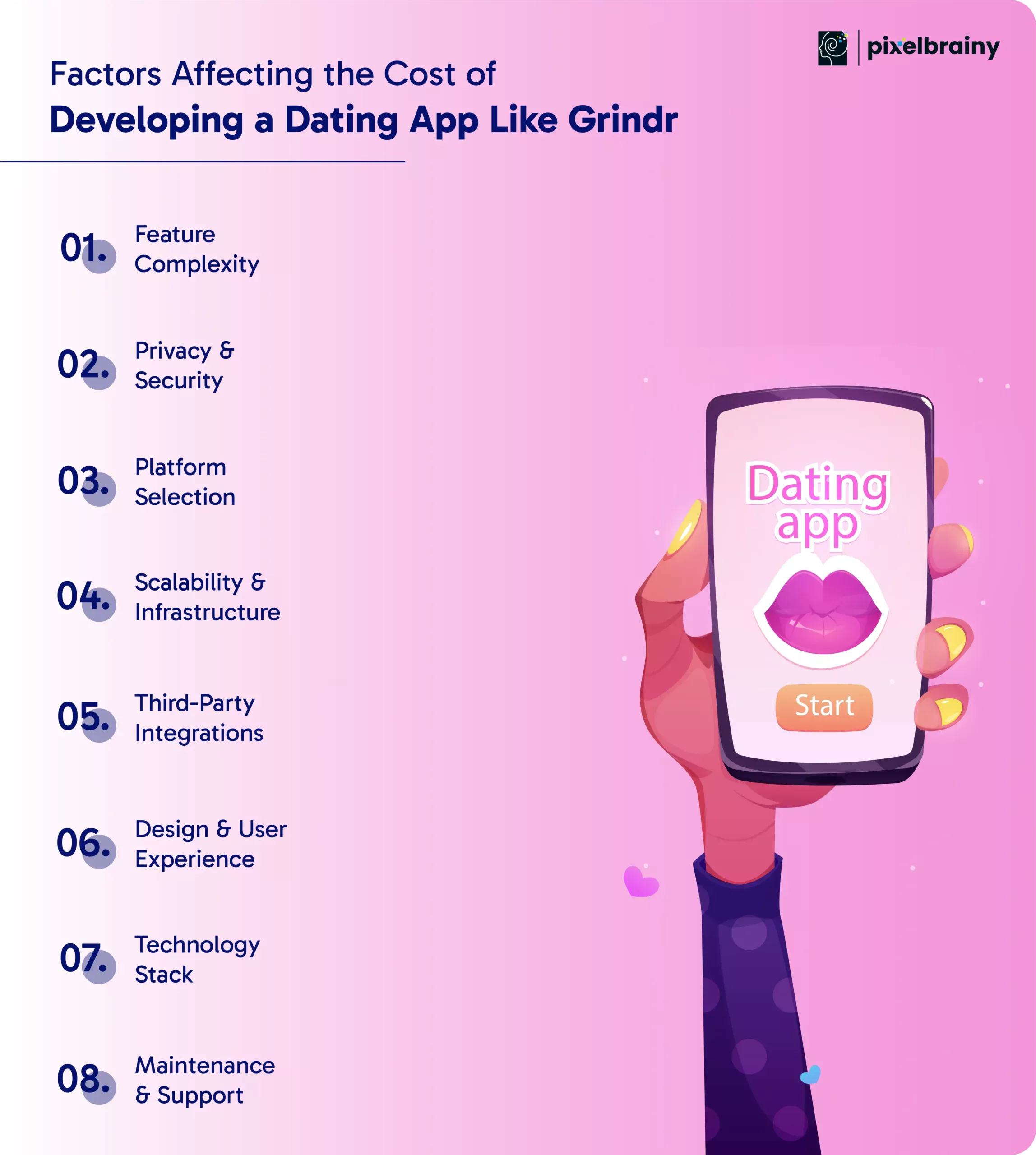
The dating app development cost like Grindr typically ranges from $30,000 to $200,000+, depending on feature complexity, platform selection, privacy requirements, design, and infrastructure. For businesses planning a niche dating platform, understanding these factors helps explain why apps with similar core features can have significantly different budgets.
A key question is: Which features and technical decisions have the biggest impact on the cost of building a dating app like Grindr, and where can startups reduce expenses without compromising user experience, privacy, or safety? From real-time geolocation and messaging to third-party integrations and ongoing maintenance, each factor affects both the initial investment and long-term operating costs. The following breakdown explores these cost drivers to help you plan a realistic budget.
Estimated Cost Impact: $10,000 – $80,000+
The depth and variety of features you include are the single biggest cost driver. A basic dating app with profile creation, messaging, and location-based search can be developed for a relatively low investment. However, once you add premium functionalities such as AI-driven matchmaking, video chat, advanced filters, or social sharing, the development time and cost rise sharply.
Example:
The more complex the functionality, the more development hours and specialized expertise you’ll need, which directly increases your project cost.
Estimated Cost Impact: $5,000 – $25,000+
Dating platforms handle sensitive user data, so strong privacy and security measures are essential. Implementing data encryption, secure authentication, GDPR compliance, and fraud detection tools increases trust but also adds to the cost.
Example:
While it’s tempting to cut corners here, investing in strong security from the start is crucial for protecting your brand and maintaining user confidence.
Estimated Cost Impact: $8,000 – $50,000+
The platforms you target will significantly influence your development budget. Launching on a single platform like Android or iOS costs less, but building native apps for both or opting for a cross-platform solution will raise the total cost.
Example:
If your goal is rapid user acquisition and market reach, supporting both platforms is the smarter long-term choice despite the higher upfront cost.
Estimated Cost Impact: $5,000 – $30,000+
A dating app must be prepared to scale as user numbers grow. This involves backend development, server infrastructure, cloud hosting, and database optimization. Basic apps can run on simple hosting, but apps built for millions of users require advanced infrastructure with high availability and load balancing.
Example:
Investing early in a scalable backend ensures smooth performance as the platform expands.
Estimated Cost Impact: $3,000 – $20,000+
Most dating apps integrate third-party services like payment gateways, social media logins, push notifications, or analytics tools. These integrations improve user experience but increase development time and costs.
Example:
Choosing reliable third-party tools also reduces long-term maintenance costs and improves user satisfaction.
Estimated Cost Impact: $5,000 – $30,000+
A dating app’s success depends heavily on its design and how users interact with it. While simple UI templates can be built quickly and cheaply, a custom design with animations, smooth transitions, and branded aesthetics will require more investment.
Example:
A polished and intuitive design leads to higher user retention, better reviews, and improved monetization potential.
Also Read: How To Create A Mobile App Prototype: A Step-by-Step Process
Estimated Cost Impact: $5,000 – $25,000+
The choice of programming languages, backend frameworks, and databases directly affects both development time and cost. Basic tech stacks cost less, while more advanced stacks involving AI, machine learning, or microservices require specialized skills and increase the budget.
Example:
Selecting the right technology from the start ensures better scalability, performance, and long-term cost efficiency.
Estimated Cost Impact: $5,000 – $30,000+ per year
Development costs do not end with launch. Ongoing maintenance, bug fixes, new feature rollouts, server monitoring, and security updates are essential for keeping the app functional and competitive.
Example:
Regular updates and improvements also boost app store rankings and user satisfaction, both of which are vital for long-term growth.
By understanding how each factor affects the total Grindr-like app development cost, you can make smarter decisions, plan your budget more accurately, and build a product that balances functionality, user experience, and long-term growth potential.
Also Read: Gay Dating App Development Like Sniffies: Benefits, Features and Cost
When you plan to develop an AI dating app like Grindr, your development team's expertise, location, and engagement model can significantly affect the total cost. With a budget of $30,000 to $200,000+, you can build anything from a basic dating app with geolocation and messaging to an advanced platform with AI-powered matching, personalized recommendations, and premium features.
In-house teams, specialized development agencies, freelancers, and offshore partners offer different pricing structures and technical capabilities. Comparing these options helps you estimate the cost of building a dating app like Grindr and choose a development team that fits your budget and long-term goals.
| Development team | Typical hourly rate | Estimated project cost | Best suited for |
| In-house team | $80 to $180+ | $150,000 to $200,000+ | Long-term development |
| US-based AI development agency | $100 to $180 | $100,000 to $200,000+ | Complex AI dating apps |
| Freelance team | $25 to $100 | $30,000 to $100,000+ | MVPs and focused features |
| Eastern European team | $40 to $90 | $50,000 to $180,000+ | Mid-level and advanced apps |
| South Asian team | $20 to $60 | $30,000 to $150,000+ | Cost-conscious development |
These are indicative estimates. Actual costs depend on team size, feature scope, project duration, and included services.
Estimated project budget: $150,000 to $200,000+
An in-house team provides direct control over product decisions, development, and ongoing improvements. It may include mobile and backend developers, AI specialists, designers, QA engineers, and a product manager.
However, salaries, recruitment, benefits, and infrastructure increase costs. This model suits businesses planning continuous product development.
Typical rate: $100 to $180 per hour
Estimated project budget: $100,000 to $200,000+
A specialized agency can handle mobile development, AI integration, security testing, and project management. It suits businesses building advanced dating apps with intelligent matching, subscriptions, and personalized recommendations.
The higher hourly rate may provide access to an established team, depending on the agency's expertise and project scope.
Typical rate: $25 to $100 per hour
Estimated project budget: $30,000 to $100,000+
Freelancers can develop MVPs with profiles, geolocation, messaging, and basic AI integrations. This approach offers flexibility and works well for clearly defined projects.
However, businesses must coordinate specialists and account for testing, security, documentation, deployment, and maintenance.
Typical rate: $40 to $90 per hour
Estimated project budget: $50,000 to $180,000+
Eastern European teams may offer expertise in mobile development, AI integration, cloud infrastructure, and quality assurance. They can suit mid-level or advanced dating apps requiring multiple technical skills.
Costs depend on experience with real-time messaging, location-based discovery, and recommendation systems.
Typical rate: $20 to $60 per hour
Estimated project budget: $30,000 to $150,000+
South Asian teams can provide mobile development, backend engineering, UI/UX design, AI integration, and testing. This option can help startups manage initial spending while building a custom dating platform.
Evaluate technical expertise, data security, communication, and post-launch support rather than comparing hourly rates alone.
The right team depends on your budget, feature requirements, and long-term plans. Freelancers or specialized agencies may suit an MVP, while an in-house team can support continuous development.
Compare project scope, AI experience, security practices, delivery timelines, and maintenance costs to find a team that can deliver a reliable app within your $30,000 to $200,000+ budget.
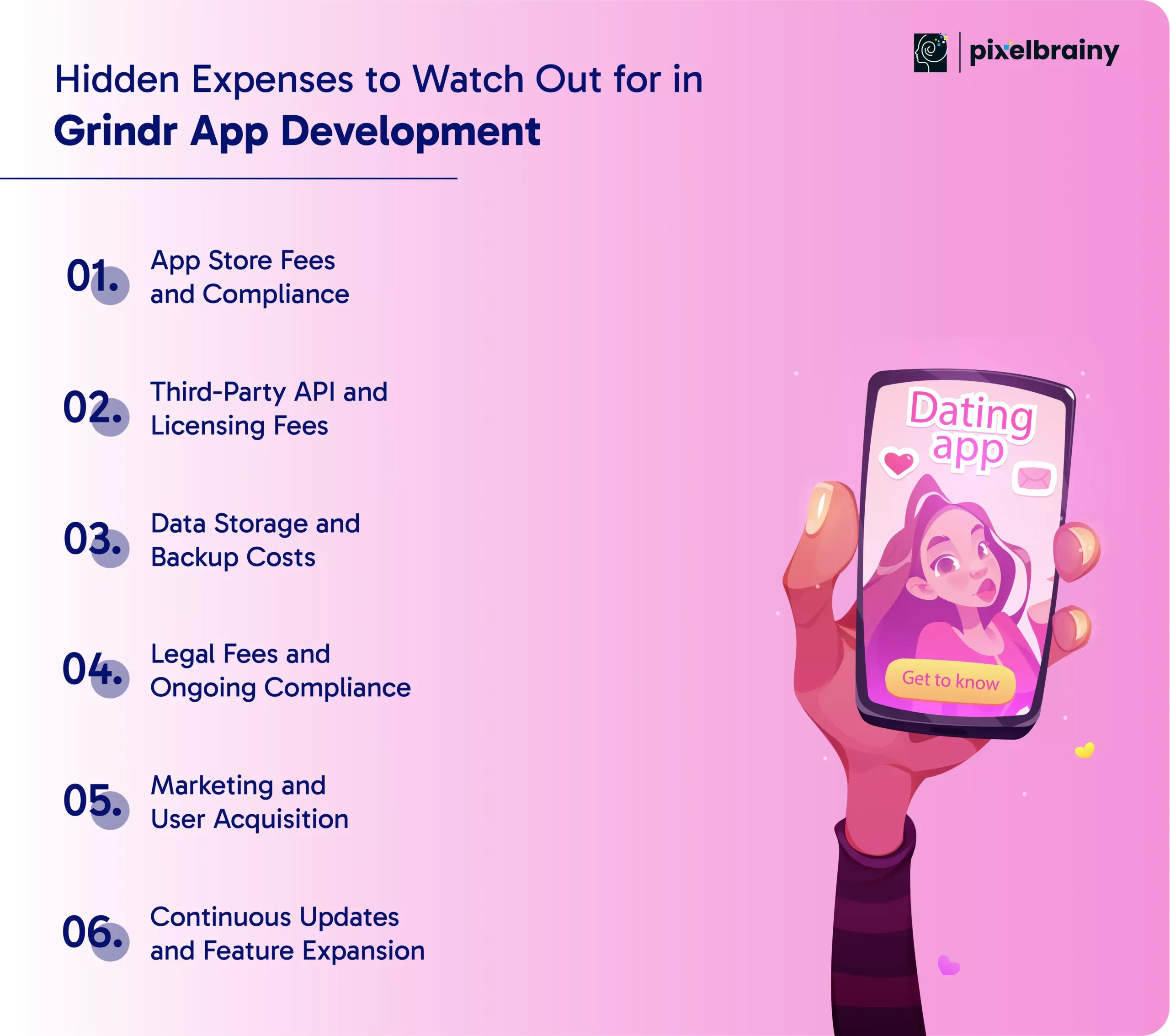
The cost of building a dating app like Grindr extends beyond design, coding, and backend development. Recurring expenses such as third-party APIs, cloud storage, legal compliance, app store fees, marketing, and post-launch updates can increase the total investment significantly. Factoring these expenses into your dating app development cost estimate helps you avoid budget shortfalls and plan for sustainable growth.
For example, if your dating app attracts more users than expected, how much extra should you budget for hosting, media storage, moderation, and user acquisition? These costs can grow alongside usage, making it important to distinguish one-time development expenses from recurring operating costs. Here are six hidden expenses to consider when planning your Grindr-like dating app.
Estimated Cost: $100 – $500 per year (per platform)
Once your dating app is developed, publishing it on major platforms like Google Play and Apple App Store is essential. Both stores charge annual fees for developer accounts:
Examples:
Beyond registration, you must also comply with platform policies, including privacy guidelines, security requirements, and content standards. Failing to meet these requirements could result in penalties or app removal, adding to the cost to make a dating app like Grindr through legal consultations or re-development efforts.
Also Read: How To Publish An App On Google Play Store In 10+ Easy Steps
Estimated Cost: $2,000 – $15,000+ annually
Most dating apps rely on third-party APIs for key features such as push notifications, maps, chat services, analytics, payment gateways, and AI recommendations. While these integrations save development time, they often require monthly or annual subscriptions based on usage.
Examples:
Ignoring these recurring costs can underestimate the cost of building a dating app like Grindr by thousands of dollars each year.
Estimated Cost: $1,000 – $10,000+ annually
Dating apps generate massive amounts of user data, including messages, media, and location history. Storing this data securely and ensuring regular backups are critical for smooth operations and user trust. Cloud storage solutions such as AWS, Google Cloud, or Azure typically charge based on storage volume and retrieval frequency.
Examples:
As your user base grows, data costs rise proportionally. Planning for scalable and secure storage from the beginning helps avoid unexpected infrastructure bills later.
Estimated Cost: $2,000 – $20,000+ annually
Dating apps deal with sensitive personal data, making legal compliance a non-negotiable aspect of development. You will need legal consultation for terms of service, privacy policies, intellectual property protection, and compliance with data protection regulations like GDPR or CCPA.
Examples:
Failing to stay compliant can result in hefty fines, reputational damage, or app suspension, all of which can drastically increase the cost of developing a dating app like Grindr.
Estimated Cost: $5,000 – $100,000+ annually
Building an app is only half the journey. Attracting and retaining users requires ongoing marketing investments, including social media ads, influencer partnerships, referral programs, and app store optimization (ASO). For competitive categories like dating apps, acquisition costs can be high, especially in the early stages.
Examples:
Without a strong marketing plan, even the most feature-rich app can struggle to gain traction, impacting your revenue potential and ROI.
Estimated Cost: $5,000 – $50,000+ annually
User expectations evolve quickly, and continuous improvements are essential to stay competitive. Regular updates, bug fixes, and the introduction of new features require ongoing development resources. If you ignore this, your app risks becoming outdated and losing users.
Examples:
These costs are often overlooked during initial budgeting but are critical to the long-term success and sustainability of your platform.
Planning for these expenses alongside your initial development budget gives you a clearer picture of the total cost to develop a dating app like Grindr. By accounting for recurring services, compliance, marketing, and ongoing improvements early, you can reduce unexpected spending and allocate more resources to user retention and long-term growth.
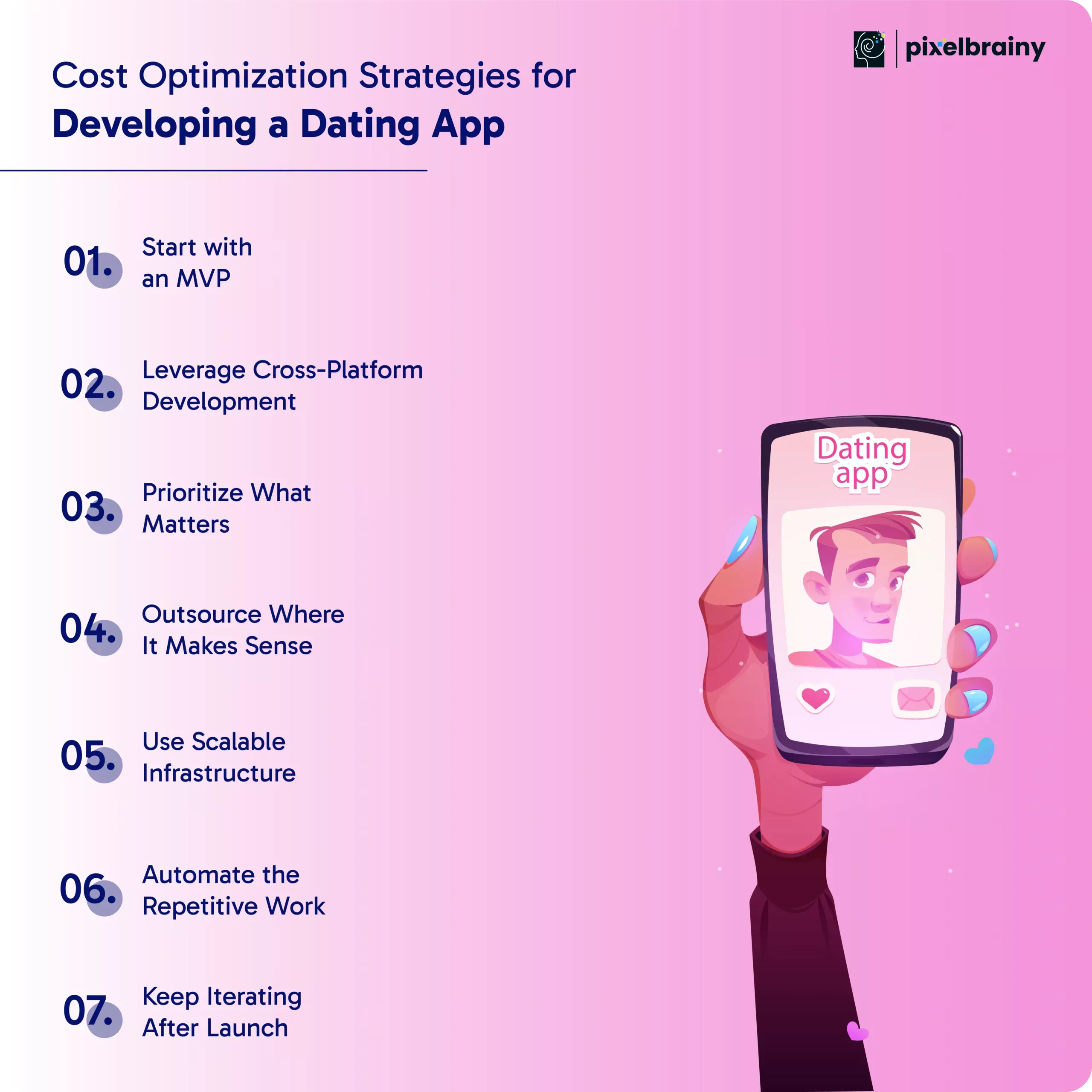
The cost of developing a dating app like Grindr typically ranges from $30,000 to $200,000+, depending on feature complexity, technology choices, and scalability requirements. With careful planning, startups can potentially save anywhere from 20% to 50% on development costs by prioritizing essential features, using cross-platform technologies, and introducing advanced capabilities in phases.
For example, if your team is developing a Grindr-like app for a professional community, you may want to combine geolocation matching with AI-powered compatibility and interest-based recommendations. Should you invest in AI matching from the beginning, or launch with proximity-based discovery and add intelligent recommendations later? The answer depends on your budget, available user data, and product goals. The following strategies explain how to optimize development spending while maintaining performance, user experience, and long-term scalability.
Potential Cost Savings: 30% – 40%
Instead of launching a fully-featured dating platform from day one, start with an MVP — a lean version of your app with only the most essential features such as profile creation, location-based discovery, and chat. This approach drastically cuts development time and cost while still allowing you to validate your concept, attract early users, and gather feedback.
Once your MVP gains traction, you can gradually add premium features like video calling, AI-based recommendations, or in-app purchases based on actual user needs rather than assumptions.
Example: If a full-featured app costs around $150,000, building an MVP first could bring the initial investment down to around $90,000 – $100,000.
Also Read: Top 10 AI MVP Development Companies in USA
Potential Cost Savings: 25% – 35%
Developing separate native apps for iOS and Android is expensive and time-consuming. Instead, use cross-platform frameworks like Flutter or React Native to build a single codebase that runs on both platforms. This not only reduces development costs but also accelerates the launch timeline.
Example: A dual-platform native app might cost $120,000 – $150,000. With cross-platform development, that number could drop to around $80,000 – $100,000 while still delivering excellent performance and user experience.
Potential Cost Savings: 15% – 25%
Not every feature needs to be built in the first version of your app. Identify and prioritize the core features that truly enhance user experience and drive engagement. For example, focus on messaging, profile creation, and location-based discovery before adding more complex features like AI recommendations or video calls.
This phased approach allows you to allocate your budget strategically and expand the app’s capabilities gradually as revenue grows.
Example: By cutting non-essential features in the initial build, you could reduce a $120,000 project to around $90,000 – $100,000 without sacrificing quality.
Potential Cost Savings: 20% – 40%
Hiring a full in-house development team can be expensive, especially for startups. Outsourcing certain parts of development — such as UI/UX design, backend setup, or QA testing — to skilled offshore or nearshore teams can significantly lower costs while maintaining quality.
Example: If hiring an in-house team for a complete project costs $150,000, strategic outsourcing can reduce the total to $90,000 – $120,000, depending on the region and expertise level.
Potential Cost Savings: 10% – 20% in the long run
Instead of investing heavily in expensive server infrastructure from the start, use scalable cloud solutions like AWS, Google Cloud, or Azure that grow with your user base. Pay-as-you-go pricing allows you to scale resources as needed, reducing upfront infrastructure costs and avoiding overprovisioning.
Example: A fixed infrastructure setup might cost $30,000+ annually. Using scalable solutions can lower that to $10,000 – $20,000 during the initial stages.
Potential Cost Savings: 10% – 15%
Automation can significantly reduce both development time and long-term operational costs. Use automated testing, deployment pipelines (CI/CD), and analytics tracking to minimize manual intervention and speed up delivery. This not only saves money but also ensures higher code quality and faster release cycles.
Example: Automation tools could cut down project timelines by 15% and save $10,000 – $20,000 over the course of development.
Potential Cost Savings: 20% – 30% over time
Launching an initial version and then iterating based on real user feedback helps you avoid costly mistakes and unnecessary feature development. By focusing on user behavior and adding features gradually, you invest in what truly matters and reduce the risk of wasted budget.
Example: Instead of spending $200,000 upfront on a fully loaded product, launching a $100,000 version and improving it over time could save $40,000 – $60,000 in the first year.
Managing the cost of building a dating app like Grindr is about investing in features that deliver measurable value rather than developing everything at launch. Start with reliable proximity matching and essential user features, then introduce AI-powered compatibility and recommendations when user data and engagement justify the investment.
Also Read: Top 15 Apps Like Wizz: Develop a Friends-Making App
After defining the features and budget for a dating platform, the next step is to address the technical and operational challenges that can affect its success. The cost of developing a dating app like Grindr ranges from $30,000 to $200,000+, but privacy risks, fake profiles, low user retention, and scalability issues can increase expenses if they are not addressed early.
What challenges should businesses anticipate when developing a Grindr-like dating app, and how can they manage these risks without exceeding their budget? From securing sensitive location data to improving engagement and controlling infrastructure costs, the following six challenges highlight practical solutions for building a reliable, secure, and scalable dating platform.
The Challenge: Dating apps deal with highly sensitive user data, including location, identity, and private conversations. A single security flaw can lead to breaches, legal consequences, and reputational damage.
The Solution:
Prioritizing privacy from day one not only reduces risks but also builds trust — a crucial factor in user retention and growth.
The Challenge: Many dating apps struggle with fake profiles, catfishing, and harassment, all of which can damage credibility and push users away.
The Solution:
A safe, authentic environment is critical for user satisfaction and retention, especially in a platform built for LGBTQ+ communities.
The Challenge: Simply connecting users is not enough. Without ongoing engagement, users quickly lose interest and uninstall the app.
The Solution:
Strong engagement features can dramatically increase retention rates and reduce churn, helping you maximize the ROI of your grindr like app development cost.
The Challenge: The dating app market is crowded, with many established players dominating user attention. Breaking through requires differentiation.
The Solution:
Differentiation is key to capturing attention and achieving organic growth in a saturated market.
The Challenge: As your user base grows, so do technical demands. Poorly optimized infrastructure can lead to slow performance, crashes, or downtime — all of which hurt user experience.
The Solution:
Planning for scalability from the start ensures smooth operations even as your app scales to millions of users.
The Challenge: Without careful planning, your cost to make a dating app like Grindr can exceed initial estimates due to feature creep, delays, or unexpected technical issues.
The Solution:
Careful budgeting and agile development practices help keep costs under control while still delivering a high-quality product.
Addressing privacy, safety, engagement, and scalability early helps control the cost of developing a dating app like Grindr while creating a reliable user experience. A proactive approach reduces avoidable rework and provides a stronger foundation for long-term growth.
Building a dating app like Grindr requires more than mobile development. It involves real-time geolocation, secure messaging, intelligent matchmaking, user privacy, and a monetization strategy that supports long-term growth. As an AI dating app development company in USA, PixelBrainy helps businesses turn dating app ideas into scalable digital products with practical feature planning and budget-conscious development.
Our AI development solutions for dating apps combine AI integration, custom app development, and strategic planning to help businesses manage the cost of developing a dating app like Grindr without compromising essential functionality.
PixelBrainy helps businesses explore AI-powered matchmaking, personalized recommendations, behavioral analytics, and other intelligent features for dating platforms. These capabilities can complement traditional proximity-based matching and help create more relevant user experiences. The right AI features depend on your audience, available data, privacy requirements, and product goals.
A feature-first development strategy helps control costs without sacrificing the core user experience. We can help prioritize essential features for an MVP, use suitable development frameworks, and introduce advanced capabilities in later releases. Depending on the project's scope and starting point, phased development may reduce initial investment and help avoid unnecessary spending.
From product discovery and UI/UX design to mobile development, backend engineering, quality assurance, and post-launch support, PixelBrainy can help coordinate the major stages of your project. A unified development process can simplify communication, improve consistency, and make it easier to track the budget and timeline.
A dating app needs to support location-based discovery, real-time communication, growing user activity, and secure data handling. We plan architecture around the app's expected usage and future requirements, helping businesses scale infrastructure as demand grows instead of investing prematurely in unnecessary complexity.
Clear requirements and milestone-based planning make development costs easier to manage. PixelBrainy can help define feature priorities, estimate development effort, and identify potential third-party and ongoing expenses before development progresses. This gives you a clearer view of where your budget goes and which decisions could affect the final cost.
For businesses considering a Grindr-like platform, a project budget should account for both core dating functionality and any AI capabilities planned for launch.
Illustrative project details
Important: The project details and performance figures should be published as a real case study only if PixelBrainy can substantiate them. Claims such as 70,000 active users in the first quarter, a 45% cost reduction, and a completed launch in 15 weeks require verifiable project records. If these figures are illustrative rather than documented results, label the example accordingly and do not present it as a completed client project.
PixelBrainy helps businesses plan AI-enabled dating platforms around their feature requirements, target audience, and growth objectives. If you're estimating the cost of building a dating app like Grindr, contact our team to discuss your MVP, AI matching requirements, development timeline, and budget.

Building a dating app like Grindr starts with understanding your audience, defining the right features, and setting a realistic development budget. Whether you plan to launch an MVP with geolocation, profiles, and messaging or invest in advanced AI matchmaking and personalized recommendations, the key is to build around your users' needs and scale as your platform grows.
With development costs typically ranging from $30,000 to $200,000+, the right technology partner can help you prioritize features, avoid unnecessary expenses, and plan for long-term success.
PixelBrainy LLC, an AI dating app development company in the USA, helps businesses turn dating app ideas into scalable solutions through AI integration, custom development, and strategic planning.
Ready to build your own Grindr-like dating app? Book a consultation with PixelBrainy to discuss your app concept, must-have features, AI capabilities, and budget.
The dating app development cost like Grindr typically ranges from $30,000 to $200,000+, depending on features, platform selection, security requirements, and scalability. An MVP with profiles, geolocation, and messaging costs less than a full-featured app with AI matchmaking, video calls, and premium subscriptions.
The cost to build a dating app like Grindr MVP may range from $30,000 to $60,000, while a feature-rich platform can cost $120,000 to $200,000 or more. The final estimate depends on functionality, integrations, design complexity, and the infrastructure required to support user growth.
The additional dating app development cost like Grindr depends on whether you use third-party AI services, recommendation algorithms, or a custom compatibility model. Basic recommendations may require a modest additional investment, while custom AI matching can add tens of thousands of dollars for data preparation, model development, testing, and optimization.
The primary cost drivers include geolocation, real-time messaging, profile verification, advanced search filters, AI-powered recommendations, video calls, subscriptions, and content moderation. Privacy controls and secure location handling also influence the cost of developing a dating app like Grindr, particularly for LGBTQ+ dating platforms.
To obtain a reliable dating app development cost estimate like Grindr, define your target audience, launch platforms, essential features, AI requirements, and expected user volume. Request a feature-wise breakdown covering UI/UX design, frontend and backend development, integrations, testing, deployment, and post-launch maintenance.
The niche dating app development cost like Grindr depends primarily on the product scope and technical requirements, not just the audience size. An existing LGBTQ+ community may reduce the initial user acquisition burden, but the app still needs secure profiles, location-based discovery, messaging, privacy controls, and moderation.
The ongoing cost to develop and maintain a dating app like Grindr includes cloud hosting, database management, API usage, security updates, bug fixes, moderation, and feature improvements. Expenses increase with active users, message volume, media storage, and infrastructure demands, so maintenance should be budgeted separately from initial development.
Look for an AI dating app development company in the USA with experience in geolocation, real-time communication, AI integration, subscriptions, and data privacy. Review relevant case studies, technical expertise, project estimates, and post-launch support. PixelBrainy offers AI development services for businesses planning custom AI-powered applications.

About The Author
Sagar Bhatnagar
Sagar Sahay Bhatnagar brings over a decade of IT industry experience to his role as Marketing Head at PixelBrainy. He's known for his knack in devising creative marketing strategies that boost brand visibility and market influence. Sagar's strategic thinking, coupled with his innovative vision and focus on results, sets him apart. His track record of successful campaigns proves his ability to utilize digital platforms effectively for impactful marketing efforts. With a genuine passion for both technology and marketing, Sagar continuously pushes PixelBrainy's marketing initiatives to greater success.

Working with the PixelBrainy team has been a highly positive experience. They understand the design requirements and create beautiful UX elements to meet the application needs. The dev team did an excellent job bringing my vision to life. We discussed usability and flow. Sagar worked with his team to design the database and begin coding. Working with Sagar was easy. He has the knowledge to create robust apps, including multi-language support, Google and Apple ID login options, Ad-enabled integrations, Stripe payment processing, and a Web Admin site for maintaining support data. I'm extremely satisfied with the services provided, the quality of the final product, and the professionalism of the entire process. I highly recommend them for Android and iOS Mobile Application Design and Development.

Great experience working with them. Had a lot of feedback and I found that unlike most contractors they were bugging me for updates instead of the other way around. They were extremely time conscience and great at communicating! All work was done extremely high quality and if not on time, early! They were always proactive when it comes to communication and the work is great/above par always. Very flexible and a great team to work with! Goes above and beyond to present us with multiple options and always provides quality. Amazing work per usual with Chitra. If you have UI/UX or branding design needs I recommend you go to them! Will likely work with them in the future as well, definitely recommended!

PixelBrainy is a joy to work with and is a great partner when thinking through branding, logo, and website layout. I appreciate that they spend time going into the "why" behind their decisions to help inform me and others about industry best practices and their expertise.

I hired them to design our software apps. Things I really like about them are excellent communication skills, they answer all project suggestions and collaborate right away, and their input on design and colors is amazing. This project was complex and needed patience and creativity. The team is amazing to do business with. I will be using them long-term. Glad to see there are some good people out there. I was afraid to try and outsource my project to someone but I am glad I met them! I really can't say enough. They went above and beyond on this project. I am very happy with everything they have done to make my business stand out from the competition.

It was great working with PixelBrainy and the team. They were very responsive and really owned the project. We'll definitely work with them again!

I recently worked with the PixelBrainy team on a project and I was blown away by their communication skills. They were prompt, clear, and articulate in all of our interactions. They listened and provided valuable feedback and suggestions to help make the project a success. They also kept me updated throughout the entire process, which made the experience stress-free and enjoyable.

PixelBrainy is very good at what it does. The team also presents themselves very professionally and takes care of their side of things very well. I could fully trust them taking up the design work in a timely and organised manner and their attention to detail saved us lots of effort and time. This particular project was quite intense and the team showed that they function very well under pressure. Very much looking forward to working with her again!

It's always an absolute pleasure working with them. They completed all of my requests quickly and followed every note I had for them to a T, which made our process go smoothly from start to finish. Everything was completed fast and following all of the guidelines. And I would recommend their services to anyone. If you need any design work done in the future, PixelBrainy should be your first call!

They took ownership of our requirements and designed and proposed multiple beautiful variants. The team is self-motivated, requires minimum supervision, committed to see-through designs with quality and delivering them on time. We would definitely love to work with PixelBrainy again when we have any requirements.

PixelBrainy was a big help with our SaaS application. We've been hard at work with a new UI/UX and they provided a lot of help with the designs. If you're looking for assistance with your website, software, or mobile application designs, PixelBrainy and the team is a great recommendation.

PixelBrainy designers are amazing. They are responsive, talented, and always willing to help craft the design until it matches your vision. I would recommend them and plan to continue them for my future projects and more!!!

They were awesome! Did a good job fast, and good communication. Will work with them again. Thank you

Creative, detail-oriented, and talented designers who take direction well and implement changes quickly and accurately. They consistently over-delivered for us.

PixelBrainy team is very talented and creative. Great designers and a pleasure to work with. PixelBrainy is an excellent communicator and I look forward to working with them again.

PixelBrainy has a very talented design team. Their work is excellent and they are very responsive. I enjoy working with them and hope to continue on all of our future projects.


Transform your ideas into reality with us.
Across these industries, each engagement brings unique challenges, from early-stage product development to scaling complex systems, helping us build a practical understanding of real-world product environments.