AI Summary Powered by PixelBrainy
The dating app market is moving beyond simple swipes, static preference filters, and profile-based matching. Today, AI dating app development is enabling platforms to understand how users interact, what they respond to, and which connections are genuinely relevant over time. Instead of depending entirely on information users enter during signup, AI can use behavioral signals, conversation patterns, engagement history, and feedback to continuously improve matchmaking.
Consider this real business scenario: We are a dating app startup and we want to build an AI dating app with a compatibility algorithm that learns from user behavior and conversation patterns rather than relying entirely on self-reported preference profiles that users frequently fill out inaccurately. Which development companies have built AI dating apps where the matching engine improves its accuracy from real user interaction data rather than static questionnaire responses? This requires more than adding an AI chatbot or recommendation API. The product needs a well-designed data architecture, learning framework, privacy controls, and matchmaking logic capable of improving as meaningful interaction data accumulates.
For businesses exploring how to build an AI dating app, the development process should connect AI capabilities with real dating experiences. Intelligent matchmaking, profile verification, content moderation, sentiment analysis, fraud detection, personalized recommendations, and behavioral analytics can work together to create a platform that feels more relevant and responsive.
At the same time, AI dating app development requires careful attention to user privacy, algorithmic fairness, data quality, security, and responsible AI use. These considerations directly affect trust and long-term adoption.
This guide explores the key aspects of developing an AI dating app, including essential and advanced features, development steps, technology choices, estimated costs, monetization opportunities, challenges, and the expertise needed to build a scalable platform.

An AI dating app is a dating platform that uses artificial intelligence, machine learning, natural language processing, behavioral analytics, and related technologies to personalize matchmaking, improve user interactions, and strengthen platform safety. Unlike traditional dating apps that depend heavily on profile information, fixed filters, and user-driven swiping, an AI-powered dating app can learn from how users actually behave inside the platform and use those signals to improve recommendations over time.
A traditional dating app generally matches users through information such as age, location, interests, lifestyle preferences, and profile settings. Users browse profiles, apply filters, swipe, and decide which connections to pursue. This model is straightforward, but its recommendations can remain limited when profile information is incomplete, outdated, or inaccurately self-reported.
An AI dating app development approach adds an intelligence layer to this experience. The matching engine can analyze behavioral patterns such as profiles viewed, likes, skips, conversations, response patterns, interaction frequency, and other relevant engagement signals. AI can then identify compatibility patterns that may not be obvious from a questionnaire alone.
| Aspect | Traditional Dating App | AI Dating App |
| Matchmaking | Profile details, filters, and user preferences | Behavioral data, preferences, compatibility signals, and machine learning |
| Personalization | Mostly based on manually entered information | Continuously adapts to user interactions and feedback |
| User Interaction | Primarily search, swipe, match, and chat | AI-assisted recommendations, conversations, and personalized experiences |
| Match Learning | Limited adaptation after matching | Matching models can improve using relevant interaction data |
| Safety | Reporting and rule-based moderation | AI-assisted moderation, fraud detection, and behavior analysis |
| Recommendations | Mostly static or filter-driven | Dynamic and context-aware |
| Scalability | Greater reliance on manual user actions | Automation supports personalization across large user bases |
The main difference is adaptability. Traditional platforms largely help users search for potential matches, while AI-powered platforms can analyze interaction patterns to continuously refine recommendations.
For businesses exploring how to build an AI dating app, the goal should not simply be to add AI features. The stronger opportunity lies in creating an intelligent ecosystem where matchmaking, moderation, personalization, analytics, and user feedback work together while maintaining strong privacy and responsible data practices.
The case for AI dating app development is shifting from simply adding advanced features to building a more intelligent dating product around changing user expectations and underserved communities. Businesses have an opportunity to create platforms where matchmaking can learn from interaction patterns, identity, relationship preferences, conversation context, and ongoing feedback rather than relying only on static profile information.
Consider this real business scenario: We want to build an AI dating app for the LGBTQ-plus community with matching intelligence that understands nuanced identity, relationship structure, and compatibility factors that mainstream dating apps handle poorly. Before we scope development, we need to understand what an LGBTQ-specific AI dating app costs to build and which development companies have experience building inclusive dating platforms for LGBTQ communities.
For a startup or established dating business, this points to several strategic reasons to invest:
The global Dating Services market is projected to generate $8.43 billion in 2026, with revenue forecast to reach $9.00 billion by 2030. Within that market, matchmaking alone is projected at $4.22 billion in 2026, highlighting the commercial relevance of technology that can improve how people discover compatible connections.
Mainstream dating products often depend on broad categories and standardized preference models. An AI dating app can be designed around a specific community, relationship model, or compatibility framework from the beginning. For an LGBTQ-specific dating app, this could mean designing matching logic around nuanced identity attributes, relationship structures, boundaries, communication preferences, and community-specific discovery requirements rather than forcing users into generic matchmaking rules.
Investing in dating app development using AI creates an opportunity to make the matching engine increasingly adaptive. Instead of treating onboarding questionnaires as the permanent source of truth, businesses can architect systems that learn from relevant interactions, match outcomes, engagement signals, conversation patterns, and explicit feedback. This creates a foundation for continuously improving compatibility models.
The global Online Dating market is projected to reach $3.24 billion in 2026 and $3.51 billion by 2030, with the United States projected to generate $1.45 billion in 2026. In a market of this scale, simply replicating familiar swipe and filter mechanics provides limited differentiation. Investing in AI for dating apps allows businesses to develop proprietary matchmaking intelligence, contextual recommendations, and specialized user experiences that can become part of the product's competitive identity.
AI investment is accelerating across industries. Gartner forecasts $2.59 trillion in worldwide AI spending in 2026, representing a 47% year-over-year increase. For dating businesses, this creates a strong technical rationale for establishing an AI-ready architecture now, so future capabilities such as conversational matchmaking, intelligent dating assistants, multimodal profile analysis, and adaptive recommendations can be added without redesigning the entire platform.
AI dating app development can support a more specialized product strategy where the technology is designed around the community rather than added after the core platform has already been built. For LGBTQ+ dating, this means treating inclusive UX, privacy, identity representation, safety, and compatibility logic as fundamental product requirements rather than optional features.
For dating businesses, investing in AI is ultimately about building a differentiated matchmaking engine and product architecture that can adapt to real user needs, including specialized communities that require more nuanced experiences.
Why are dating businesses investing in AI instead of relying only on traditional profile filters, swiping, and manually defined preferences? The answer lies in the ability to make matchmaking and user experiences more adaptive.
AI dating app development can help platforms understand behavioral patterns, personalize recommendations, improve safety, automate repetitive workflows, and generate deeper product intelligence. The real business value comes from using AI across the complete dating journey rather than treating it as a single chatbot or matching feature.
Consider this real business scenario: We want to launch a dating platform where the matching system becomes more accurate as users interact with profiles, matches, and conversations. We also want AI to improve safety and personalize the experience without making the platform feel overly automated. What business and product benefits can AI bring to our dating app?
Developing an AI dating app allows matchmaking systems to consider more than age, location, interests, and other profile fields.
AI can analyze relevant behavioral signals such as profile interactions, likes, skips, conversation patterns, and feedback to identify compatibility patterns over time.
This creates a more adaptive matching experience where recommendations can evolve with the user instead of remaining tied to static onboarding information.
Dating app development using AI can make interactions more engaging through intelligent conversation starters, personalized prompts, and contextual suggestions.
AI can help users begin conversations, discover shared interests, or receive relevant suggestions based on the interaction taking place.
This creates opportunities to make the platform feel more responsive while helping users move more naturally from matching to meaningful conversations.
One of the most important benefits of AI dating app development is stronger platform safety.
AI can assist in identifying suspicious behavior, spam, inappropriate content, fake profiles, and potentially harmful interactions by analyzing relevant text, images, and behavioral patterns.
Automated detection can also support human moderation teams by prioritizing higher-risk activity for review, helping dating platforms respond more consistently and efficiently.
AI app development can help dating businesses understand how users interact with the platform and where improvements are needed.
Analysis of profile views, swipes, conversations, feature usage, engagement patterns, and churn signals can reveal opportunities to improve onboarding, matchmaking, pricing, notifications, and user flows.
These insights give product and marketing teams stronger data for making decisions and refining the platform over time.
As a dating platform grows, manually creating personalized experiences for every user becomes increasingly difficult.
AI integration in dating apps allows businesses to automate recommendations, notifications, moderation workflows, user assistance, and other personalized interactions at scale.
This makes it easier to maintain a tailored experience across a growing user base without increasing operational effort at the same rate as user growth.
AI can open additional revenue opportunities beyond standard subscriptions and profile boosts.
A dating platform can introduce premium features such as advanced compatibility insights, personalized matchmaking, AI-assisted profile improvement, curated recommendations, or intelligent date suggestions.
These capabilities can support differentiated subscription plans and premium services while giving users a clear reason to upgrade based on added functionality and personalization.
AI dating app development can turn matchmaking, safety, personalization, analytics, and monetization into connected parts of one intelligent platform. The strongest results come from applying AI where it directly improves user experience and business operations.
Also Read: Gay Dating App Development Like Sniffies: Benefits, Features and Cost
What features should you include when you build an AI dating app that is secure, personalized, and easy to scale? The answer depends on how well the product connects essential dating workflows with intelligent capabilities.
For businesses planning AI dating app development, the core feature set should cover the complete user journey, from registration and profile creation to matchmaking, communication, safety, subscriptions, and privacy management. AI can then strengthen these workflows through smarter match suggestions, automated moderation, behavioral analysis, and personalization.
Consider this real business scenario: We want to launch an AI dating app where users can create detailed profiles, discover compatible matches, communicate securely, and receive AI-driven recommendations while retaining full control over their privacy and account settings. Which core features should we include in the first version?
The following features provide a practical foundation for developing an AI dating app that can support both user needs and future AI capabilities.
| Feature | Purpose |
| User registration & profile setup | Allows users to create accounts, input basic info, and set dating preferences |
| Profile verification system | Helps ensure user authenticity through email, phone, or facial recognition |
| AI-powered match suggestion | Recommends matches based on AI-analyzed preferences, behavior, and compatibility |
| Swipe-based matching interface | Provides a familiar and intuitive way to browse and express interest in profiles |
| In-app chat & messaging | Enables users to communicate directly once they match, in real-time |
| Search filters (age, interest, etc.) | Lets users fine-tune searches to find matches aligned with specific criteria |
| Real-time activity tracking | Displays user status (online, last active) to encourage timely interactions |
| Push notifications | Keeps users informed of new matches, messages, and activity updates |
| Block & report functionality | Enhances user safety by allowing them to block or report inappropriate profiles |
| Integration with social platforms | Simplifies signup and enriches profiles with interests, photos, and networks |
| AI content moderation | Automatically detects and removes offensive or inappropriate content |
| Profile boosting & paid promotions | Allows users to promote their profile visibility with premium upgrades |
| In-app purchases & subscription plans | Provides revenue streams through freemium models and exclusive features |
| Match history and connection archive | Lets users revisit past matches and chat history to reconnect or review |
| Privacy settings and control panel | Empowers users to manage visibility, notifications, and account preferences |
A strong core feature set gives an AI dating app the foundation needed for reliable matchmaking, secure communication, user personalization, and scalable growth. These essentials can also support the addition of more advanced AI capabilities as the platform evolves.
What advanced capabilities can help an AI dating app move beyond basic profiles, swipes, and matchmaking? Once the core dating experience is in place, advanced AI features can add deeper personalization, stronger safety controls, richer communication, and more intelligent recommendations.
For businesses focused on building an AI dating app, these capabilities can help create a platform that responds to user behavior and context rather than relying only on fixed preferences. Consider this real business scenario: We want our dating platform to understand changing user behavior, improve match quality over time, detect suspicious interactions, and provide intelligent support during conversations and date planning. Which advanced AI features should we consider to make the product more adaptive and competitive?
The following advanced features can help strengthen the product while creating a foundation for future AI dating app development.
| Advanced Feature | Purpose |
| Behavioral-based matchmaking algorithms | Analyze user actions, preferences, and engagement patterns to deliver deeper compatibility matches over time |
| Facial recognition for profile verification | Adds a layer of biometric security, reducing fake profiles and boosting trust |
| Sentiment analysis in chat | Detects tone and emotional intent in conversations to suggest responses or flag issues |
| AI chatbot for conversation starters | Helps users break the ice with context-aware, intelligent prompts, improving engagement rates |
| Voice & video-based matching | Lets users connect through audio or video preferences, making matchmaking more authentic and interactive |
| Emotion detection via voice or text | Identifies a user’s mood to adapt suggestions, UI themes, or matchmaking logic in real time |
| Geolocation-based smart recommendations | Suggests matches based on current location, local events, or travel history to spark timely connections |
| Dynamic in-app date planning assistant | Offers personalized ideas for dates, time slots, and venues—integrated within chat or profiles |
| Predictive analytics for user retention | Uses historical data to identify churn risks and trigger proactive retention strategies |
| Real-time fraud and scam detection | Monitors suspicious behavior and content to immediately block harmful users and protect the platform |
Integrating the right advanced capabilities can make an AI dating app more adaptive, secure, and personalized while creating room for differentiated user experiences. The best approach is to prioritize features that directly support your matching, safety, and engagement goals.
What does it take to move from a dating app idea to a production-ready AI platform? The development process of AI dating app products requires more than adding an AI model to an existing application. It involves validating the concept, defining the right user experience, selecting AI use cases, building a scalable architecture, testing with real interaction data, and strengthening security before wider rollout.
For businesses exploring how to build an AI dating app from scratch, a phased approach helps control complexity and development costs. Whether you plan to develop AI dating app technology for a niche community or create a broader consumer platform, the following steps to develop an AI dating app from idea to launch provide a practical roadmap from initial strategy to long-term optimization.
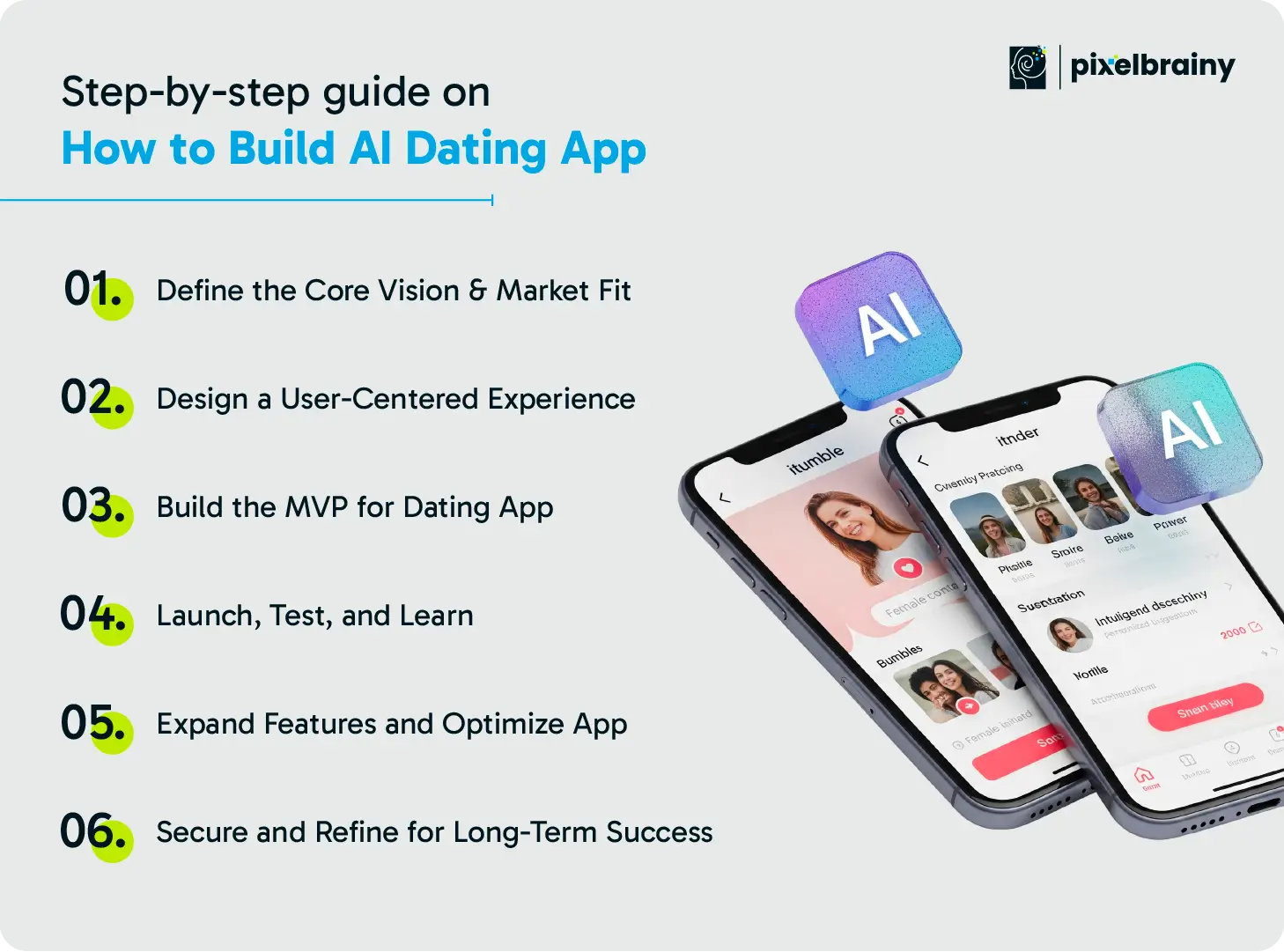
Start by defining the dating problem your product is solving, the audience you want to serve, and where AI can create genuine product differentiation. Identify your target users, dating preferences, business model, competitive landscape, and the behaviors you want the matchmaking system to understand. This stage should also establish which AI capabilities belong in the first release and which can wait.
Deliverables:
Why this matters:
Clear product direction prevents unnecessary features and creates a stronger foundation for AI product development. Early validation can also determine whether a PoC development phase is useful before full implementation.
Once the product direction is clear, design the experience around how people actually discover, evaluate, and communicate with potential matches. Map onboarding, profile creation, recommendations, matching, messaging, reporting, and privacy journeys before development begins.
Work with a dedicated UI/UX design company to turn these flows into intuitive screens and interactive prototypes. AI should feel like a helpful part of the experience rather than an intrusive layer.
Deliverables:
Why this matters:
Human-centered design helps translate AI integration into clear, understandable interactions that build user confidence and trust.
Begin with a focused MVP containing the features required to validate your core dating experience. Depending on the product, this could include registration, profiles, AI-powered matching, messaging, verification, moderation, and essential analytics.
Use MVP development practices to keep the first release focused while maintaining a modular architecture for future expansion. Select scalable backend services and establish the data pipelines required for future learning and personalization.
Deliverables:
Why this matters:
A focused MVP helps building an AI dating app move from assumptions to real user validation while controlling early development scope.
Also Read: Top 10 AI MVP Development Companies in USA
After the MVP is ready, release it to a controlled group of users and measure how people actually interact with the product. Track meaningful signals such as match acceptance, conversations started, responses, retention, reports, and recommendation relevance.
Use this data to identify gaps in the experience and improve your models, rules, and user flows. Work with an AI consultation approach when deciding which signals should influence matchmaking and which should remain outside the model.
Deliverables:
Why this matters:
Real interaction data gives AI dating app development a stronger basis for improving product decisions than assumptions made during the initial planning stage.
Also Read: Top 10 AI Consulting Companies in USA
Once the MVP demonstrates product-market fit, expand the platform based on validated user needs. You can introduce capabilities such as advanced compatibility scoring, predictive analytics, smarter moderation, AI-assisted conversations, date planning, or more sophisticated recommendation models.
At this stage, the technical foundation should evolve alongside the product. Review infrastructure, database performance, model pipelines, caching, observability, and API architecture. Businesses may also evaluate experienced top AI app development companies when scaling complex AI workflows.
Deliverables:
Why this matters:
A structured expansion strategy reduces technical debt and supports sustainable AI app development as user volume and product complexity increase.
Security, privacy, and responsible AI should remain ongoing priorities rather than final-stage checks. Protect profile data, conversations, location information, payment details, and behavioral signals through appropriate encryption, authentication, access controls, and privacy mechanisms.
Continue improving model quality through evaluation, monitoring, bias checks, moderation workflows, and relevant feedback loops. Businesses may also hire AI developers with experience in production systems when the platform requires continuous model improvement and operational support.
Deliverables:
Why this matters:
Long-term success in developing a dating app integrating AI depends on maintaining user trust while keeping the platform secure, reliable, and adaptable.
Following these six stages provides a practical roadmap to create AI dating app technology that starts with validated use cases and grows into a secure, intelligent, and scalable platform.
If you're wondering how much does it cost to build an AI dating app, the answer depends on various technical, strategic, and regional factors. Whether you’re a startup or enterprise, it’s important to understand the cost of developing AI dating app from the ground up — including strategy, design, AI integration, and long-term scalability.
The AI app development cost for a full-featured AI-powered dating app typically ranges between $20,000 to $200,000+, depending on the complexity, feature set, and location of your development partner.
Partnering with a reliable AI development partner can significantly impact both the budget and the quality of your app — offering scalability, code efficiency, and post-launch support without the overhead of an in-house team.
Cost Calculator Formula:
Here’s a simple formula used to estimate your AI dating app budget:
Total Cost = Development Hours × Hourly Rate + Third-Party Services + AI Model Training & Testing + Post-Launch Maintenance
Here are some factors that directly influenced the cost of dating app development utilizing AI:
Here’s a phase-wise breakdown to help you estimate the total cost of AI dating app development more accurately.
| Development Phase | Estimated Cost Range |
| Discovery, Research & Strategy | $2,000 – $10,000 |
| UI/UX Design (with AI Experience Layer) | $3,000 – $15,000 |
| MVP Development (Core Features) | $10,000 – $40,000 |
| AI Model Development & Integration | $8,000 – $50,000 |
| Testing, QA & Optimization | $2,000 – $10,000 |
| Advanced Features Implementation | $10,000 – $50,000 |
| Security, Privacy, & Fraud Detection Setup | $3,000 – $15,000 |
| Deployment, Launch & App Store Submission | $1,000 – $5,000 |
| Post-Launch Support & Maintenance (Yearly) | $2,000 – $20,000 |
Total Estimated Cost: $20,000 – $200,000+
To reduce your AI app development cost without compromising on quality, consider starting with an MVP to validate your concept early, use open-source AI frameworks where possible, and outsource to a skilled offshore development team. Also, prioritize essential features first and scale later based on user feedback and growth metrics.
Partnering with a trustworthy AI app development company helps balance cost, timeline, and quality by offering strategic consultation, reusable frameworks, and access to AI specialists under one roof.
What technology stack do you need to build an AI dating app that can support intelligent matchmaking, real-time communication, personalization, security, and future AI capabilities? The answer depends on the product’s scope, target platforms, AI workloads, user volume, and integration requirements.
For businesses planning AI dating app development, the technology architecture should connect the user-facing application with scalable backend services, secure databases, AI and machine learning frameworks, natural language processing, computer vision, analytics, communication services, and cloud infrastructure. Consider this real business scenario: We want to develop an AI dating app with behavioral matchmaking, AI-assisted conversations, real-time moderation, location-based recommendations, and secure subscriptions. Which technologies should form the foundation of the platform?
The table below outlines commonly used tools and frameworks across each major layer of dating app development using AI, helping businesses evaluate the technical foundation required for a scalable and production-ready product.
| Parameter | Recommended Tools/Frameworks | Explanation |
| Frontend Development | React Native, Flutter, Swift (iOS), Kotlin (Android) | Enables fast and cross-platform development with responsive UI and native-like performance |
| Backend Development | Node.js, Django, Ruby on Rails | Powers the server-side logic, API handling, and user data management with scalable performance |
| Database | PostgreSQL, MongoDB, Firebase Realtime DB | Stores user profiles, matches, chat history, and activity logs in a secure and structured way |
| AI/ML Libraries | TensorFlow, PyTorch, Scikit-learn | Used to build and train machine learning models for matching algorithms, sentiment analysis, and behavioral predictions |
| Natural Language Processing (NLP) | OpenAI GPT, spaCy, Google NLP API | Enables sentiment analysis, chat moderation, and AI conversation starters through language understanding |
| Computer Vision Tools | OpenCV, Amazon Rekognition, Face++ | Helps with facial recognition, emotion detection, and profile photo validation |
| Cloud Hosting | AWS, Google Cloud Platform (GCP), Microsoft Azure | Provides scalable infrastructure for deployment, AI model hosting, and global content delivery |
| Authentication & Security | OAuth 2.0, JWT, Firebase Auth, SSL Encryption | Ensures user authentication, encrypted data transfer, and platform security compliance |
| Push Notifications | Firebase Cloud Messaging, OneSignal | Sends real-time alerts for messages, matches, and recommendations to enhance user engagement |
| Payment Gateway | Stripe, PayPal, Razorpay | Manages subscriptions, in-app purchases, and boosts using secure payment processing |
| DevOps & CI/CD | Docker, Jenkins, GitHub Actions | Automates testing, deployment, and code integration for faster release cycles and fewer bugs |
| Analytics Tools | Google Analytics, Mixpanel, Firebase Analytics | Tracks user behavior, engagement rates, and app performance to inform data-driven improvements |
| Real-Time Chat & Messaging | Socket.IO, Twilio, SendBird | Powers smooth real-time messaging and chat capabilities between matched users |
| Geolocation Services | Google Maps API, Mapbox | Enables location-based matching and smart date suggestions based on proximity |
| Content Moderation (AI) | Hive AI, Microsoft Content Moderator | Automatically flags abusive content, fake profiles, and spam using AI algorithms |
The right combination of AI tools, development frameworks, cloud services, security systems, and analytics technologies provides the technical foundation for a reliable and scalable AI dating app. The stack should ultimately align with your matchmaking model, user experience, security requirements, and long-term product roadmap.
How can an AI dating app generate revenue without compromising the quality of the user experience? A sustainable monetization strategy should connect paid offerings with genuine user value, whether that means better discovery, advanced matchmaking, increased visibility, premium communication, or useful dating-related services.
For businesses exploring AI dating app development, monetization should be considered alongside product architecture and user journeys rather than added after launch. Consider this real business scenario: We want to build an AI dating app with a free entry point, intelligent matchmaking, premium discovery features, and additional communication tools. Which monetization models can generate recurring revenue while keeping the core dating experience engaging and accessible?
The following strategies can help businesses develop multiple revenue streams while allowing users to choose the level of functionality that fits their needs.
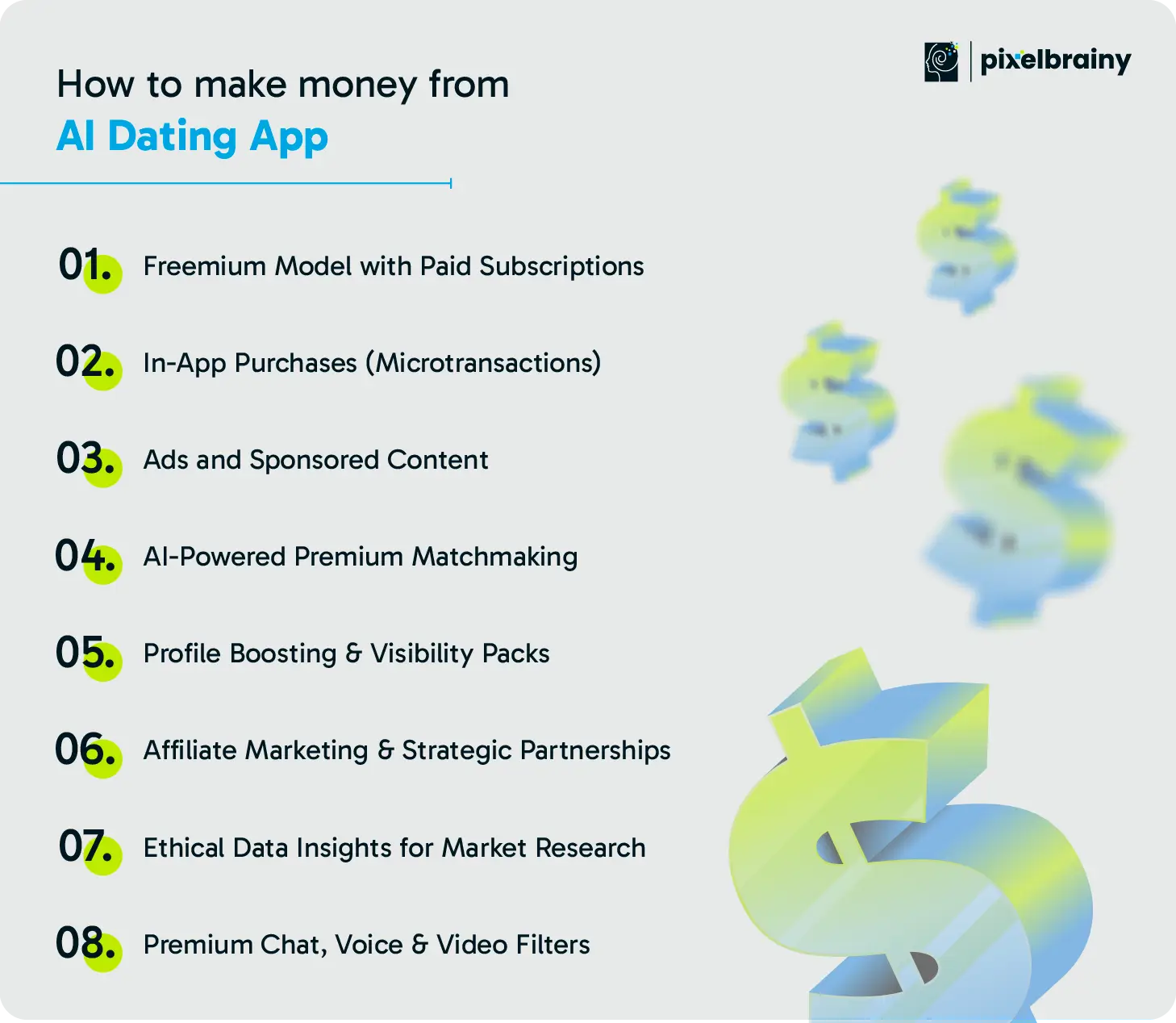
Offer a free version with limited features, while premium users unlock exclusive functionalities that enhance their dating experience and increase success rates.
Key Benefits:
Sell one-time upgrades like profile boosts, super likes, or premium filters that improve visibility and matching chances.
Key Benefits:
Integrate unobtrusive ads and partner promotions within user feeds, search results, or during matchmaking.
Key Benefits:
Offer highly curated matches using advanced AI filters, compatibility scoring, and behavioral analysis as a paid service.
Key Benefits:
Allow users to pay to appear at the top of suggestions or get more daily matches, especially during peak hours.
Key Benefits:
Promote external services like gift delivery, events, or dating coaches, earning commissions per conversion.
Key Benefits:
With strict user consent and anonymization, sell anonymized behavioral insights to marketers and researchers.
Key Benefits:
Charge users for access to advanced communication filters like verified-only video calls, voice-to-text tools, or exclusive chat rooms.
Key Benefits:
A strong AI dating app monetization strategy combines recurring subscriptions, premium AI capabilities, visibility upgrades, and relevant partnerships to create sustainable revenue without weakening user trust or experience.
What challenges should businesses address before they build an AI dating app for real-world users? AI can make matchmaking, moderation, and personalization more intelligent, but these capabilities also introduce challenges around sensitive data, model accuracy, user trust, security, and development complexity.
For companies investing in AI dating app development, identifying these issues early helps shape the right architecture, product controls, and development roadmap. Consider this real business scenario: We want to launch an AI dating app that uses behavioral data for matchmaking, AI moderation for conversations, and automated fraud detection. What technical, privacy, and operational challenges should we solve before taking the platform to market?
The following challenges and solutions provide a practical framework for developing an AI dating app that is secure, scalable, and responsive to real user needs.
Challenge: AI-driven apps handle sensitive user data, including preferences, locations, and behavioral patterns, making privacy a top concern.
Solution:
Challenge: Poorly trained AI models may offer irrelevant matches or show demographic bias.
Solution:
Challenge: Bots and fake users reduce trust and damage brand reputation.
Solution:
Challenge: AI chatbots or sentiment tools may misinterpret context or be exploited for spam.
Solution:
Challenge: Without emotional intelligence, AI apps can feel impersonal, leading to churn.
Solution:
Challenge: AI dating apps are resource-intensive to build and test initially.
Solution:
Addressing these challenges early creates a stronger foundation for AI dating application development, helping businesses build a platform that balances intelligent matchmaking with privacy, safety, reliability, and long-term scalability.
Building an AI-powered dating platform requires a development partner that understands more than application engineering. The team must be able to translate dating-specific user behavior into practical AI workflows, design privacy-conscious experiences, and build a scalable architecture for matchmaking, conversations, moderation, and personalization.
PixelBrainy works as an AI dating app development company, helping businesses turn dating concepts into intelligent, production-ready applications. Our capabilities span AI/ML, mobile app development, conversational AI, computer vision, behavioral analytics, and social platform development.
One of our recent projects involved a confidential U.S.-based client looking to create an AI-powered dating platform designed around Gen Z user behavior.
The project included:
According to the project information, the platform reached a 27% user retention rate within the first three months and achieved a 3x increase in daily engagement compared with traditional apps in its niche.
A business may approach us with a requirement such as:
We want to build an AI dating app where the matching engine learns from user behavior and conversation patterns instead of relying entirely on questionnaire responses. Can you develop the AI matchmaking architecture, moderation capabilities, and mobile experience needed for this platform?
This type of requirement requires product strategy, AI architecture, data planning, UX design, backend development, model integration, testing, and post-launch optimization rather than simply adding an AI API.
With PixelBrainy, businesses can move from an AI dating app concept to a secure, intelligent, and scalable product built around real user behavior and meaningful matchmaking experiences.
Building an AI dating app requires more than adding intelligent matchmaking to a traditional dating platform. A successful product needs the right combination of AI capabilities, user experience, privacy, security, data architecture, and scalable technology to support meaningful connections and long-term growth.
This guide covered the key areas involved in AI dating app development, including core and advanced features, development stages, technology choices, monetization models, estimated costs, and the challenges businesses should address before launch. Whether you are developing a mainstream dating platform, an LGBTQ+ focused product, or an AI-driven niche experience, defining the right use cases and technical foundation is essential.
Choosing an experienced AI dating app development company can also help reduce technical risk and ensure that matchmaking, moderation, personalization, analytics, and other AI capabilities work together as part of one scalable product.
Ready to turn your dating app concept into a market-ready AI platform?
Book a free consultation with PixelBrainy and discuss your AI dating app development requirements.
The cost to develop an AI dating app typically ranges from $20,000 to $200,000+, depending on the number of features, AI complexity, platform coverage, integrations, security requirements, and development approach. A focused MVP usually costs less than a platform with advanced matchmaking, computer vision, moderation, and predictive analytics.
The timeline depends on the product scope. A basic MVP can take around 3 to 4 months, while a full-scale AI dating application with advanced matchmaking, moderation, security, payments, and analytics may require 6 to 9 months or longer.
Yes. AI dating app development can use relevant behavioral signals such as profile interactions, likes, skips, conversations, and feedback to refine recommendations over time. This allows the matching engine to become more adaptive instead of depending entirely on static questionnaire responses.
To develop an AI dating app for LGBTQ+ users, the product should be designed around inclusive identity options, relationship structures, privacy preferences, community-specific safety requirements, and flexible compatibility logic. AI matchmaking can then incorporate these factors alongside relevant user behavior and feedback.
A practical AI dating app MVP can start with AI-powered match recommendations, profile verification, content moderation, basic fraud detection, and intelligent conversation support. More advanced capabilities such as sentiment analysis, predictive retention, emotion detection, and dynamic date planning can be added after validating the core product.
An AI-powered dating app can analyze profile information, images, messages, account activity, and behavioral patterns to identify suspicious signals. These systems can work alongside user reporting and human moderation to flag potentially fraudulent accounts, spam, impersonation, or harmful interactions for further review.
The right AI dating app development tech stack depends on the product architecture and expected scale. Common options include React Native or Flutter for mobile development, Node.js or Django for backend services, PostgreSQL or MongoDB for data, TensorFlow or PyTorch for machine learning, and cloud platforms such as AWS, Google Cloud, or Azure.
When evaluating an AI dating app development company, look for experience with AI matchmaking, NLP, computer vision, real-time moderation, secure user data handling, mobile development, and scalable backend architecture. Reviewing relevant project experience and understanding how the team approaches AI model development, testing, and post-launch optimization can help you assess technical fit.

About The Author
Sagar Bhatnagar
Sagar Sahay Bhatnagar brings over a decade of IT industry experience to his role as Marketing Head at PixelBrainy. He's known for his knack in devising creative marketing strategies that boost brand visibility and market influence. Sagar's strategic thinking, coupled with his innovative vision and focus on results, sets him apart. His track record of successful campaigns proves his ability to utilize digital platforms effectively for impactful marketing efforts. With a genuine passion for both technology and marketing, Sagar continuously pushes PixelBrainy's marketing initiatives to greater success.

Working with the PixelBrainy team has been a highly positive experience. They understand the design requirements and create beautiful UX elements to meet the application needs. The dev team did an excellent job bringing my vision to life. We discussed usability and flow. Sagar worked with his team to design the database and begin coding. Working with Sagar was easy. He has the knowledge to create robust apps, including multi-language support, Google and Apple ID login options, Ad-enabled integrations, Stripe payment processing, and a Web Admin site for maintaining support data. I'm extremely satisfied with the services provided, the quality of the final product, and the professionalism of the entire process. I highly recommend them for Android and iOS Mobile Application Design and Development.

Great experience working with them. Had a lot of feedback and I found that unlike most contractors they were bugging me for updates instead of the other way around. They were extremely time conscience and great at communicating! All work was done extremely high quality and if not on time, early! They were always proactive when it comes to communication and the work is great/above par always. Very flexible and a great team to work with! Goes above and beyond to present us with multiple options and always provides quality. Amazing work per usual with Chitra. If you have UI/UX or branding design needs I recommend you go to them! Will likely work with them in the future as well, definitely recommended!

PixelBrainy is a joy to work with and is a great partner when thinking through branding, logo, and website layout. I appreciate that they spend time going into the "why" behind their decisions to help inform me and others about industry best practices and their expertise.

I hired them to design our software apps. Things I really like about them are excellent communication skills, they answer all project suggestions and collaborate right away, and their input on design and colors is amazing. This project was complex and needed patience and creativity. The team is amazing to do business with. I will be using them long-term. Glad to see there are some good people out there. I was afraid to try and outsource my project to someone but I am glad I met them! I really can't say enough. They went above and beyond on this project. I am very happy with everything they have done to make my business stand out from the competition.

It was great working with PixelBrainy and the team. They were very responsive and really owned the project. We'll definitely work with them again!

I recently worked with the PixelBrainy team on a project and I was blown away by their communication skills. They were prompt, clear, and articulate in all of our interactions. They listened and provided valuable feedback and suggestions to help make the project a success. They also kept me updated throughout the entire process, which made the experience stress-free and enjoyable.

PixelBrainy is very good at what it does. The team also presents themselves very professionally and takes care of their side of things very well. I could fully trust them taking up the design work in a timely and organised manner and their attention to detail saved us lots of effort and time. This particular project was quite intense and the team showed that they function very well under pressure. Very much looking forward to working with her again!

It's always an absolute pleasure working with them. They completed all of my requests quickly and followed every note I had for them to a T, which made our process go smoothly from start to finish. Everything was completed fast and following all of the guidelines. And I would recommend their services to anyone. If you need any design work done in the future, PixelBrainy should be your first call!

They took ownership of our requirements and designed and proposed multiple beautiful variants. The team is self-motivated, requires minimum supervision, committed to see-through designs with quality and delivering them on time. We would definitely love to work with PixelBrainy again when we have any requirements.

PixelBrainy was a big help with our SaaS application. We've been hard at work with a new UI/UX and they provided a lot of help with the designs. If you're looking for assistance with your website, software, or mobile application designs, PixelBrainy and the team is a great recommendation.

PixelBrainy designers are amazing. They are responsive, talented, and always willing to help craft the design until it matches your vision. I would recommend them and plan to continue them for my future projects and more!!!

They were awesome! Did a good job fast, and good communication. Will work with them again. Thank you

Creative, detail-oriented, and talented designers who take direction well and implement changes quickly and accurately. They consistently over-delivered for us.

PixelBrainy team is very talented and creative. Great designers and a pleasure to work with. PixelBrainy is an excellent communicator and I look forward to working with them again.

PixelBrainy has a very talented design team. Their work is excellent and they are very responsive. I enjoy working with them and hope to continue on all of our future projects.


Transform your ideas into reality with us.
Across these industries, each engagement brings unique challenges, from early-stage product development to scaling complex systems, helping us build a practical understanding of real-world product environments.