AI Summary Powered by PixelBrainy
What would it take to turn 12 years of astrology expertise into an AI astrology app that can understand a user's complete natal chart instead of giving another generic sun sign reading?
Imagine I have been an astrology practitioner for twelve years and now want to take my expertise beyond one-to-one consultations. I want to build an AI astrology app where users can enter their date, exact time, and place of birth, generate their complete natal chart, and ask natural-language questions about their career, relationships, finances, personality, or important life periods. I do not want the app to respond with generic horoscope content. I want the AI to understand planetary positions, houses, aspects, and other chart elements and generate personalized interpretations that an experienced astrologer would find credible and relevant. I understand astrology deeply, but I have no technical background. So, before approaching a development company, I need to know what it actually takes to build this kind of AI-powered astrology experience.
That is where AI astrology app development becomes significantly more complex than creating a conventional horoscope app. To build an AI astrology app around genuine personalization, the product needs an accurate astrology calculation engine, structured natal chart data, an AI interpretation layer, conversation memory, user context, secure data handling, and an interface that makes complex astrological information easy to understand.
The market opportunity is also expanding. According to a 2026 report from 360iResearch, the global horoscope and astrology apps market is estimated at $1.26 billion in 2026 and is projected to reach $2.16 billion by 2032, growing at a 9.28% CAGR.
For astrology practitioners, spirituality founders, wellness businesses, and startups, this creates an opportunity to combine domain expertise with astrology app development with AI. Businesses can also connect AI readings with live astrologer consultation, creating a hybrid experience where AI handles everyday questions while professional astrologers provide deeper guidance.
This step-by-step guide to building an AI astrology app explains the essential features, development process, technology stack, AI architecture, monetization strategies, challenges, and development costs you should understand before turning your astrology product idea into a scalable application.
An AI astrology app is a digital astrology application that combines artificial intelligence with structured astrological data to deliver personalized readings, interpretations, and conversational guidance. Unlike a conventional horoscope app that primarily assigns content according to a user's sun sign, an AI-powered astrology app can be designed around the individual's birth date, exact birth time, birth location, natal chart, planetary placements, houses, aspects, and other relevant astrological factors.
For example, imagine two users who are both Aries. A generic horoscope app may show essentially the same daily prediction to both people because they share the same sun sign. A genuine AI astrology experience should be capable of distinguishing between their individual charts and providing different interpretations based on their personal astrological configurations. Current AI astrology products are already positioning themselves around full birth-chart analysis, personalized conversations, and chart-based guidance rather than only generic zodiac content.
The primary difference is personalization. Instead of treating the zodiac sign as the complete input, the application can use the user's full natal chart as the foundation for AI-generated interpretations.
A strong AI astrology app can include:
| Generic Horoscope App | AI Astrology App |
| Primarily uses sun sign | Uses complete natal chart |
| Generic predictions | Personalized interpretations |
| Pre-written content | AI-generated contextual responses |
| Limited interaction | Conversational experience |
| Same content for many users | User-specific insights |
| Static horoscope experience | Dynamic personalization |
The AI component should also not be treated as a replacement for the underlying astrology logic. The quality of the experience depends on how accurately the application represents the user's astrological data and how effectively AI interprets that information.
For businesses planning AI astrology app development, the goal should therefore be to create an experience where AI makes complex astrology more accessible, conversational, and personalized while remaining grounded in the application's chosen astrology methodology. This distinction is what can transform an ordinary horoscope product into a genuine AI-powered astrology platform.
An AI astrology app works by connecting an astrology calculation engine with structured birth-chart data, an AI model, application backend, and a conversational user interface. The astrology engine provides the underlying planetary and chart information, while AI uses that structured information to generate personalized interpretations in natural language.
This approach is important because the AI should interpret validated astrology data rather than independently inventing planetary positions or chart details.
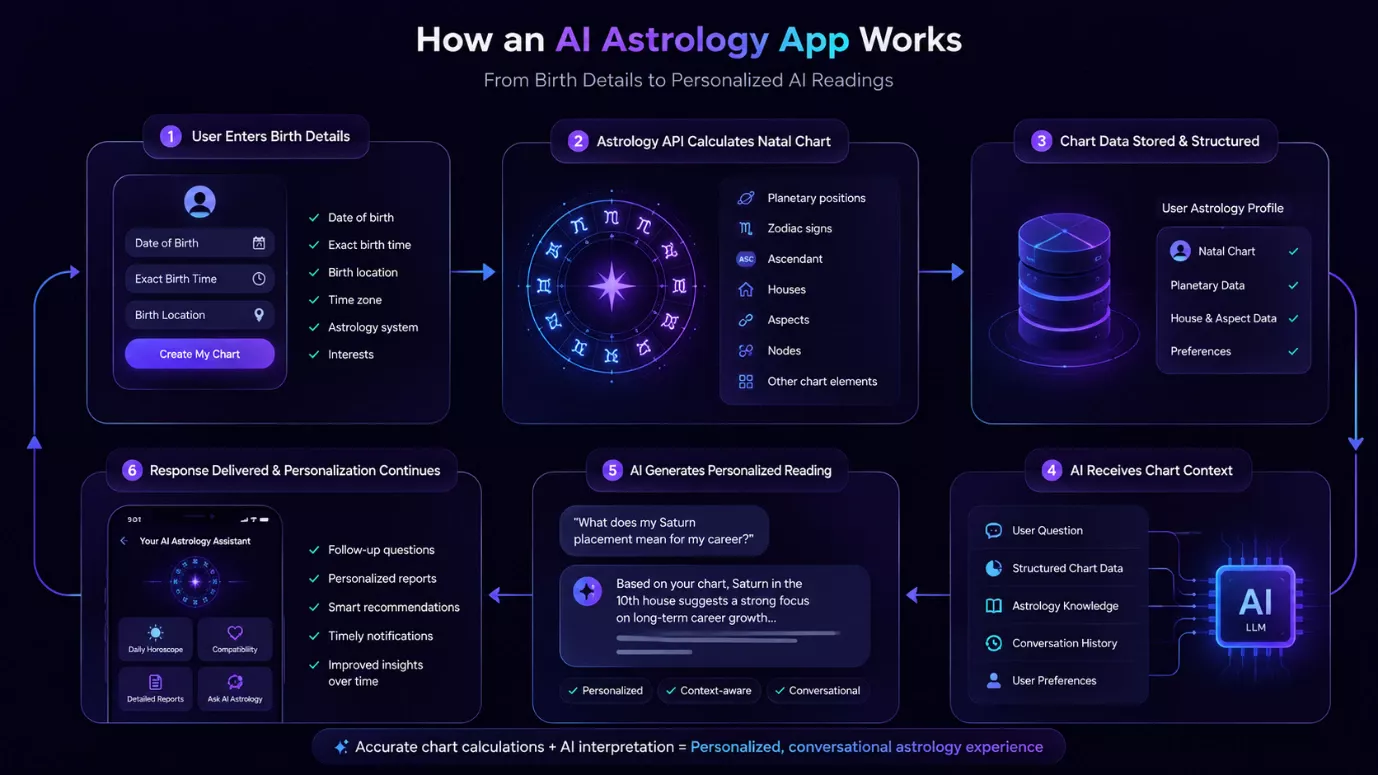
The process starts when users create their astrology profile and provide:
The application validates these inputs before generating the user's chart.
The backend sends the required birth information to an astrology API or calculation engine. It can generate structured information such as:
This data becomes the foundation for personalized astrology readings.
The application stores the user's relevant chart information in its database. Structuring this information allows the AI system to retrieve specific chart elements whenever the user asks a question.
For example, if a user asks, "What does my Saturn placement mean for my career?", the system can identify the relevant Saturn position, sign, house, and associated aspects.
The backend sends the user's question and relevant astrology data to the AI or LLM layer. Depending on the product architecture, the system can also provide approved astrology knowledge, previous conversation context, and user preferences through retrieval or contextual prompting.
This helps prevent generic responses and improves the relevance of AI-generated interpretations.
The AI interprets the supplied information and converts it into a conversational response. Users can ask follow-up questions, request simpler explanations, or explore another part of their chart through an AI astrology chatbot or assistant.
The final response is displayed in the application. With appropriate privacy controls, conversation history and preferences can help personalize future readings, reports, recommendations, and notifications.
User Interface → Backend → Astrology API → Structured Chart Data → AI/LLM Layer → Context/Retrieval → Personalized Response
In short, AI astrology app development combines reliable natal chart calculations with AI-powered interpretation to turn individual astrology data into personalized, conversational experiences.
For astrology practitioners, spirituality founders, wellness businesses, and startups, AI astrology app development can turn specialized astrology knowledge into a scalable digital product that delivers personalized experiences beyond traditional one-to-one consultations. The opportunity is not simply about adding AI to an existing horoscope application. It is about creating a product that can combine personalized birth-chart insights, conversational experiences, automated services, and human astrologer consultations within one platform.
The market outlook supports this opportunity. According to The Business Research Company, the global astrology app market is projected to grow from $5.69 billion in 2026 to $11.71 billion by 2030, representing a 19.8% CAGR. The report specifically identifies AI-based prediction models, personalized horoscope generation, AI-driven birth-chart analysis, subscription-based platforms, and real-time insights as key trends shaping future growth.
Traditional astrology businesses depend heavily on astrologers for consultations and personalized readings. An AI astrology app can handle routine questions, chart explanations, basic reports, and everyday interactions automatically.
This allows businesses to serve more users while reserving professional astrologer time for complex and premium consultations.
Generic horoscope content is difficult to differentiate. An AI-powered astrology platform can personalize the experience around each user's:
This creates a stronger product proposition than simply displaying the same horoscope to users who share a zodiac sign.
A conversational AI astrology chatbot allows users to ask questions in their own words instead of navigating predefined horoscope categories.
For example, users can ask about career prospects, relationship compatibility, planetary placements, or a specific transit and continue with follow-up questions.
This conversational model can encourage users to return to the application more frequently.
Businesses can monetize an AI astrology platform through:
A business can therefore design several revenue layers around the same core platform.
AI does not have to replace professional astrologers. A hybrid astrology platform can use AI for instant, everyday guidance and connect users with professional astrologers when they want deeper interpretation.
A potential user journey could be:
AI reading → follow-up questions → need for deeper guidance → live astrologer consultation
This creates an opportunity to use AI as an engagement and discovery layer for premium human services.
Businesses entering the astrology market need a clear reason for users to choose their product.
An AI astrology app can differentiate through:
The combination of proprietary astrology expertise and personalized AI experiences can become a stronger competitive proposition.
The opportunity does not necessarily end with astrology. A business can potentially expand its personalized experience into related areas such as numerology, tarot, meditation, spiritual content, self-reflection, and other wellness experiences.
This aligns with the broader growth of spiritual wellness applications and the increasing integration of AI into personalized digital experiences.
An AI-powered application can provide its core digital experience 24/7 without being restricted by an astrologer's location or consultation schedule. With multilingual AI, localized content, international payment support, and cloud infrastructure, businesses can design their product for global audiences.
The strongest investment case is the combination of market growth, personalization, scalability, conversational engagement, and recurring monetization. For businesses with genuine astrology expertise, AI provides an opportunity to make that expertise accessible to a significantly larger digital audience while still incorporating human astrologers where their expertise adds the most value.
In short, AI astrology app development can help businesses move from a traditional astrology service to a scalable, personalized, interactive, and monetizable digital astrology platform.
Businesses planning to develop an AI astrology app can choose from several product models based on their target audience, astrology methodology, personalization requirements, and revenue strategy. An AI horoscope app may focus on daily engagement, while a natal chart assistant can provide deeper personalization. Other models can combine relationship compatibility, conversational AI, or professional astrologer consultations.
For example, imagine I am an astrology entrepreneur planning custom AI astrology app development. I have years of astrology expertise and know that my audience wants personalized guidance, but I am unsure whether to build a daily horoscope application, a conversational birth-chart assistant, a compatibility platform, or an AI product connected to live astrologers. I also want to know whether I should make an AI astrology app for iOS and Android or start with a focused MVP. Understanding the available app types can help me determine which product model best fits my audience and business goals.
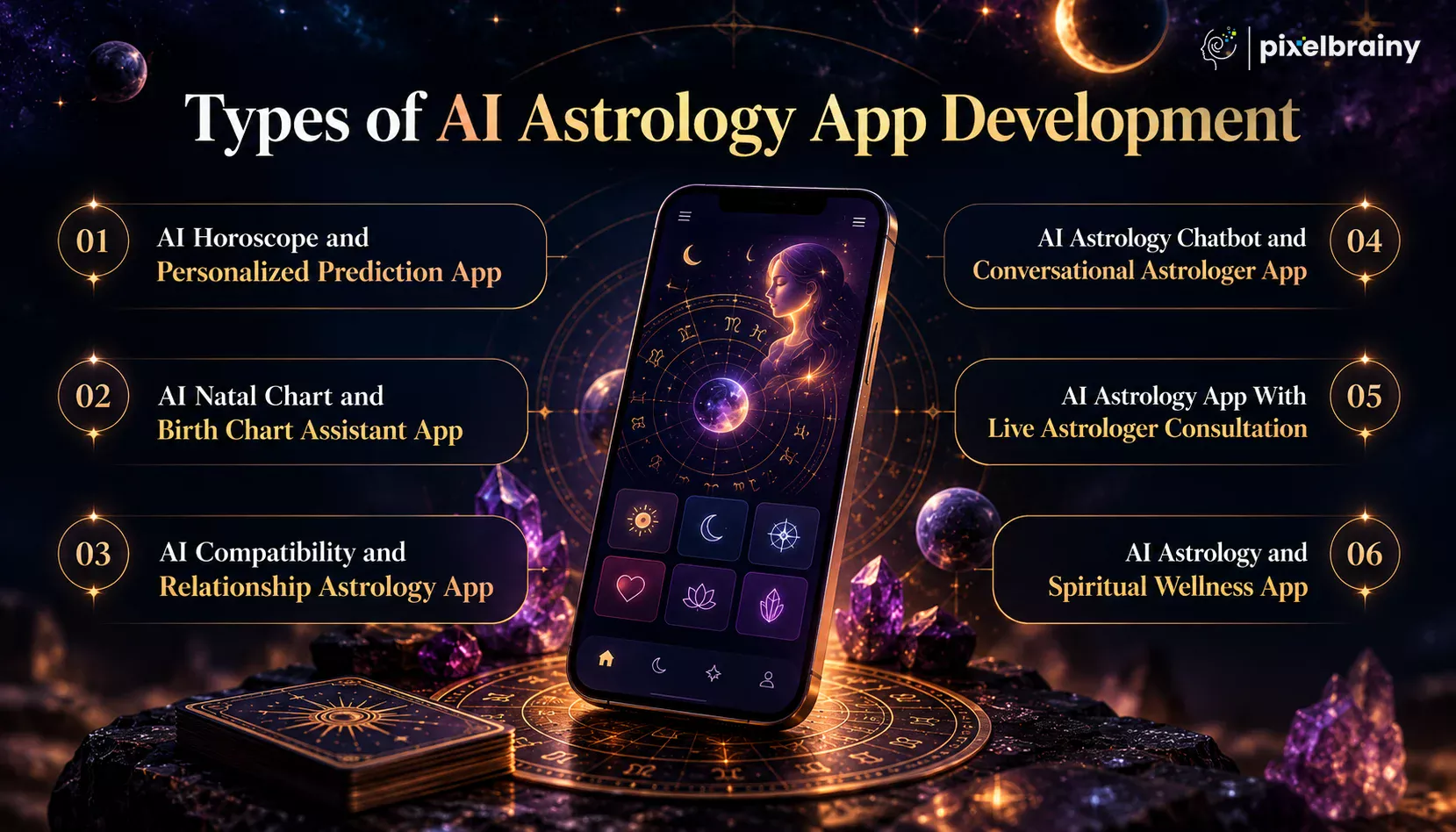
An AI horoscope app focuses on delivering personalized daily, weekly, and monthly astrology insights.
Instead of displaying identical content for everyone sharing the same zodiac sign, the application can use birth information and relevant astrological data to generate more individualized readings.
Businesses can include personalized notifications, planetary transit insights, career guidance, relationship predictions, and premium horoscope content.
This model works well for businesses seeking frequent engagement and subscription-based revenue. It can also serve as an initial MVP for creating an AI astrology app.
An AI natal chart assistant helps users understand their complete birth chart through conversational AI.
Users can enter their birth date, exact time, and location to generate information about planetary positions, houses, aspects, ascendant, and other relevant chart elements.
They can then ask questions such as, "What does my Saturn placement mean for my career?" and receive an interpretation based on their individual chart.
This model is particularly suitable for businesses seeking deeper personalization through astrology app development using AI.
An AI compatibility application focuses on analyzing the astrological relationship between two or more people.
Users can provide their birth details and receive insights into areas such as emotional compatibility, communication, relationship dynamics, and partnership patterns.
Depending on the chosen astrology methodology, businesses can also incorporate kundli matching, guna milan, synastry, or other compatibility calculations.
Premium compatibility reports and detailed relationship analysis can provide additional monetization opportunities.
In this model, conversation becomes the primary product experience.
Users can ask natural-language questions about their chart, relationships, career, planetary placements, or upcoming transits instead of navigating through predefined horoscope categories.
The AI astrology chatbot can support follow-up questions, conversation history, user preferences, and contextual responses.
For businesses looking to to make AI astrology app experiences more interactive, the conversational model can later be extended with voice interaction, multilingual support, personalized reports, and other AI capabilities.
Also Read: How To Build A Conversational AI Chatbot App Like DeepSeek?
This model combines automated AI guidance with professional human astrology services.
A user can begin with an AI-generated reading, ask additional questions, and then connect with an astrologer when deeper consultation is required.
The application can include astrologer profiles, availability, appointment scheduling, in-app chat, voice and video consultations, ratings, payments, and consultation history.
This hybrid approach allows businesses to use AI for scalable everyday interactions while creating opportunities for premium human consultations.
An AI astrology application can also become part of a broader spiritual wellness platform.
Alongside astrology readings, businesses can integrate numerology, tarot, meditation, journaling, spiritual content, and other personalized experiences.
AI can provide a unified conversational interface through which users explore different services according to their interests.
For founders pursuing custom AI astrology app development, this model can create opportunities to expand from an astrology product into a wider digital spirituality ecosystem.
From personalized horoscope applications to AI astrologer assistants and hybrid consultation platforms, each model offers a different path for building an engaging and scalable astrology business with AI.
A successful AI astrology app development project needs more than an AI chatbot or horoscope generator. The core product should provide users with accurate birth-chart information, personalized AI interpretations, secure profiles, convenient navigation, and reliable access to essential astrology services.
For example, imagine I am planning to build an AI astrology app for my astrology business. I want users to enter their birth details once, generate their natal chart, ask questions about their astrology profile, receive personalized readings, save their conversations, and access premium services. Before approaching an AI astrology app development company, I need to understand which features are essential for creating a useful first version without unnecessarily adding advanced functionality.
The following table covers the 15 must-have features that can form the foundation of an AI-powered astrology application.
| Must-Have Feature | Explanation |
|---|---|
| User Registration and Profiles | User registration allows people to create secure accounts using email, phone numbers, or supported social login options. Profiles can store birth details, astrology preferences, saved readings, subscription information, and personalization settings, making future interactions more convenient and relevant. |
| Birth Details Input | Birth details are essential for personalized astrology experiences. The application should allow users to enter their date of birth, exact birth time, birthplace, and applicable timezone, with clear guidance to help users provide accurate information for natal chart generation. |
| Natal Chart Generation | Natal chart generation converts the user's birth information into a visual and structured birth chart. Users should be able to view relevant planetary placements, zodiac signs, houses, ascendant, aspects, and other chart elements supported by the selected astrology methodology. |
| Astrology Calculation Engine | An astrology calculation engine provides the underlying astrological calculations required by the application. It can calculate planetary positions, houses, aspects, ascendant, and other parameters according to the selected astrology system, giving the AI structured information to interpret. |
| AI Astrology Assistant | An AI astrology assistant allows users to ask natural-language questions about their individual charts and receive contextual responses. It can explain astrology concepts, interpret relevant chart information, answer follow-up questions, and provide conversational guidance based on the application's defined methodology. |
| Personalized Horoscope | Personalized horoscope functionality generates daily, weekly, or monthly astrology content using individual user information. Businesses can organize readings around relationships, career, finances, personal growth, or other topics instead of providing identical horoscope content to everyone sharing the same zodiac sign. |
| Planetary Position Analysis | Planetary position analysis helps users understand the significance of planets within their individual astrology profiles. The application can explain planetary signs, houses, and relevant relationships in accessible language, allowing users to explore important elements of their natal chart through AI-powered interpretations. |
| Houses and Aspects Interpretation | Houses and aspects add important context to natal chart interpretation. An AI-powered astrology app can explain these relationships in understandable language and help users explore how different chart areas may relate to subjects such as relationships, career, communication, and personal development. |
| Astrology Reports | Personalized astrology reports provide users with structured interpretations beyond conversational interactions. Businesses can offer reports covering natal charts, personality, relationships, career, compatibility, or other selected topics and make detailed reports available as paid or subscription-based offerings. |
| Conversation History | Conversation history allows users to revisit previous interactions with the AI astrology assistant. With appropriate privacy controls, relevant context can be retained so returning users can continue discussions without repeatedly entering the same information or explaining earlier questions. |
| Personalized Notifications | Personalized notifications can bring users back to the application with relevant horoscope updates, astrology content, reminders, or newly available readings. Notification preferences should allow users to control frequency and topics while helping businesses encourage meaningful recurring engagement. |
| Search and Content Discovery | Search and content discovery help users find astrology concepts, chart interpretations, reports, and educational resources quickly. A well-organized discovery system can make complex astrology information easier to navigate while complementing the application's AI-powered conversational experience. |
| Subscription and Payment | Subscription and payment functionality enables businesses to monetize premium astrology experiences. Depending on the business model, users can pay for premium reports, additional AI interactions, personalized readings, subscription plans, or other astrology services available through the application. |
| Ratings and Feedback | Ratings and feedback allow businesses to understand how users perceive AI-generated readings and the overall application experience. Feedback can reveal confusing responses, frequently requested features, usability issues, and areas where astrology content or AI responses require improvement. |
| Admin Dashboard | An admin dashboard provides centralized control over users, subscriptions, astrology content, reports, AI configurations, notifications, feedback, and application activity. It gives the business the operational tools needed to manage content, monitor application activity, handle users, and maintain the AI astrology platform after launch. |
These core features provide the essential foundation for developing a personalized and commercially viable AI astrology app, while more advanced capabilities can be introduced as the product and user base grow.
Once the core features of an AI astrology app are in place, businesses can introduce more distinctive capabilities to make the product feel intelligent, personalized, and engaging. These features can help an astrology platform stand apart from conventional horoscope and birth-chart applications.
For example, imagine I am planning to build an AI astrology app for a growing astrology business. My basic product already offers natal charts, AI readings, personalized horoscopes, and astrology reports, but I want to create something more differentiated. I want users to be able to talk to the AI astrologer using their voice, receive insights when important planetary transits occur, continue conversations with remembered preferences, and move from AI guidance to a professional astrologer when needed. I need to understand which advanced features can create meaningful user value without making the initial product unnecessarily complex.
The following 10 non-ordinary features can help businesses create a more differentiated AI-powered astrology platform:
| Non-Ordinary Feature | Explanation |
|---|---|
| AI Voice Astrology Assistant | A voice-enabled astrology assistant allows users to speak naturally instead of typing questions. The AI can understand voice input, process relevant astrology context, and respond verbally, creating a more immersive experience similar to having a conversational astrology session. |
| Real-Time Transit Tracking | Real-time transit tracking monitors planetary movements and connects relevant changes with elements of a user's natal chart. The application can use these events to generate timely insights, personalized notifications, and contextual interpretations based on the selected astrology methodology. |
| Predictive Astrology Insights | Predictive AI features can analyze selected astrological patterns and generate personalized insights about upcoming periods. Businesses can structure these experiences around their chosen astrology methodology while presenting results as interpretive guidance rather than guaranteed predictions or factual outcomes. |
| AI-Powered Compatibility Matching | An advanced compatibility engine can compare multiple astrology profiles and generate detailed relationship insights. It can evaluate selected planetary relationships, chart placements, and compatibility factors before presenting the results through an understandable AI-generated interpretation tailored to the users. |
| Personalized Astrology Memory | AI memory can retain relevant user preferences, previously discussed topics, and selected conversational context. This allows the astrology assistant to provide more consistent interactions while reducing the need for users to repeatedly explain their interests, questions, or preferred astrology approach. |
| Multilingual AI Astrology | Multilingual AI support allows businesses to offer astrology experiences across different languages. Users can ask questions and receive interpretations in their preferred language, helping astrology platforms expand internationally while maintaining a consistent personalized experience across supported markets. |
| AI-Generated Personalized Reports | The application can automatically create detailed astrology reports using a user's natal chart, selected topics, and preferences. Businesses can offer personalized reports covering relationships, career, personality, planetary placements, or other astrology categories as premium digital products. |
| AI Astrology With Human Expert Handoff | An intelligent handoff system can connect users with professional astrologers when human expertise is appropriate. Users can begin with AI-powered guidance and then move to chat, voice, or video consultation with an astrologer for deeper personalized discussions. |
| Contextual Astrology Notifications | Advanced notifications can use individual chart information, user preferences, and relevant planetary events to deliver more meaningful alerts. Instead of sending identical messages to everyone, the application can notify users when selected astrological events become relevant to their individual profiles. |
| AI Astrology Recommendation Engine | An AI recommendation engine can analyze user interests, interactions, astrology preferences, and content consumption to recommend relevant readings, reports, educational resources, compatibility tools, or astrologer consultations. This can improve content discovery while creating additional personalization and monetization opportunities. |
These distinctive capabilities can help an AI astrology app move beyond conventional horoscope functionality by delivering deeper personalization, richer interaction, and more differentiated digital astrology experiences.
Turning an astrology concept into a functional AI product requires more than connecting an LLM to an astrology API. The development process of AI astrology app needs to bring together astrology calculations, AI interpretation, user experience, backend infrastructure, data security, testing, and monetization requirements.
For founders searching for the steps to build AI astrology app development from idea to launch, the process should begin with defining the astrology methodology and target audience before selecting technologies. This is especially important when the product needs to interpret complete natal charts, planetary positions, houses, aspects, transits, or other domain-specific calculations.
Consider a founder who has shortlisted several development partners but is struggling to find one that understands both software engineering and astrology. The founder may ask: I have found developers who can build mobile apps and integrate AI, but how can I make sure they understand the difference between calculating a natal chart and simply generating an AI interpretation? What should I verify before giving a team responsibility for building my astrology product?
The following eight steps explain how to build AI astrology app from scratch, from validating the concept to launching and improving the product.
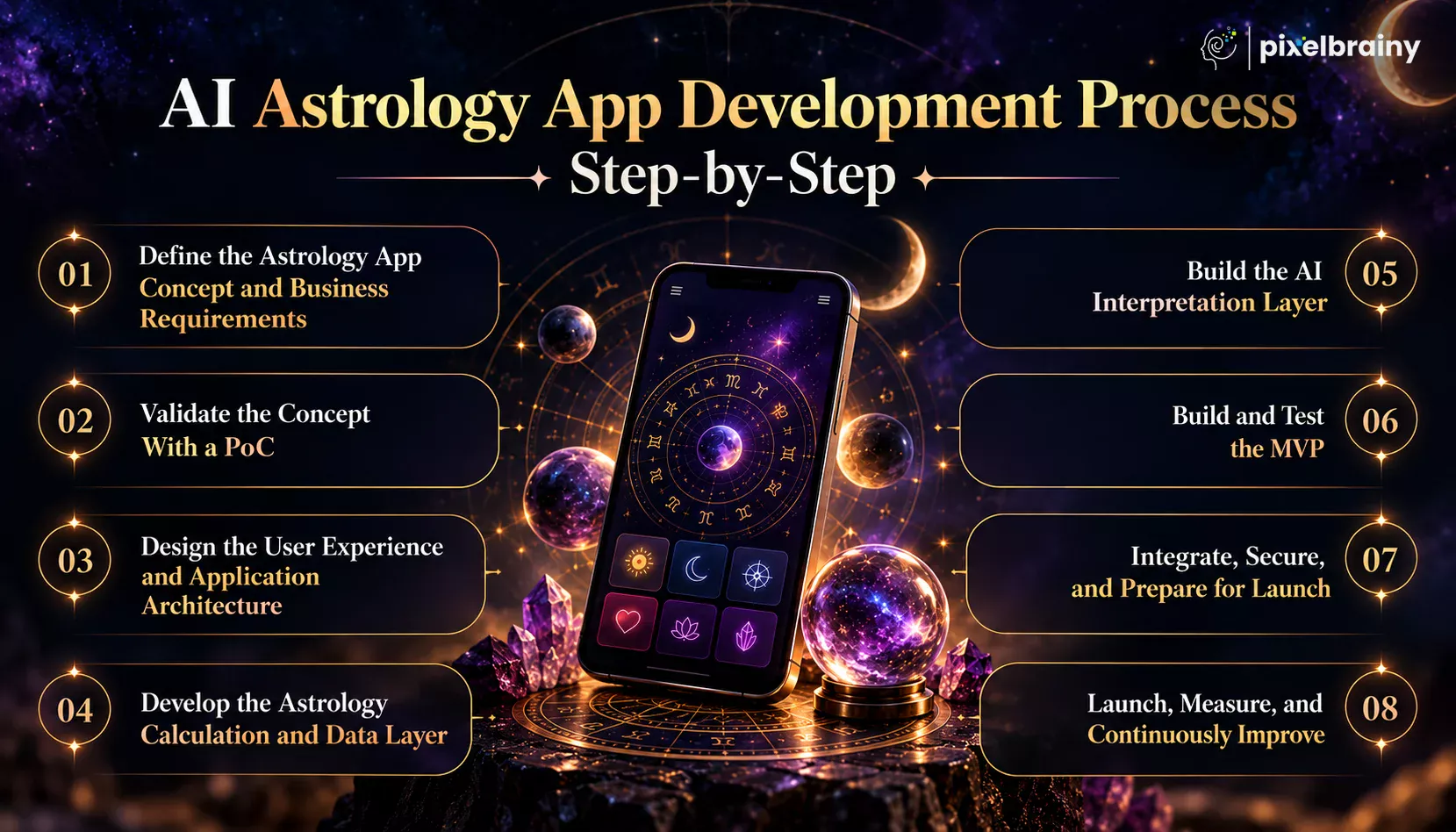
The first step in AI astrology app development is defining exactly what the application should accomplish. Businesses should identify the target users, astrology system, primary use cases, monetization model, supported platforms, and level of AI personalization required.
For example, an astrology practitioner may want an application that generates complete natal charts and allows users to ask AI-powered questions about their placements. Another business may want a compatibility application with paid reports and live astrologer consultations.
At this stage, document the essential user journeys, business objectives, required integrations, privacy requirements, and expected outcomes. A clear product specification prevents unnecessary features from increasing the development scope and provides the technical team with a defined foundation for building an AI astrology app.
Before investing in full-scale development, businesses can validate the most technically uncertain part of the product through PoC development.
For an AI astrology application, the proof of concept can test whether the selected astrology calculation engine produces the expected chart data and whether the AI can interpret that structured information according to the business's astrology methodology.
The team can test sample birth details, planetary positions, houses, aspects, and interpretation prompts against results reviewed by an astrology expert.
This stage is particularly valuable when founders are evaluating top AI app development companies because it provides evidence of technical capability before a larger development commitment is made.
Once the concept has been validated, the product team can design the application structure and user journeys. The interface should make complex astrology information understandable for both experienced astrology users and beginners.
The UI/UX design company or product design team can create wireframes and prototypes for onboarding, birth-detail entry, natal charts, AI conversations, reports, subscriptions, and account management.
At the same time, developers define the technical architecture covering the mobile or web frontend, backend services, database, astrology engine, AI layer, authentication, payment infrastructure, and third-party integrations.
The objective is to create a scalable foundation where astrology calculations and AI interpretation remain separate but communicate reliably through structured data.
The astrology engine is one of the most important components when creating an AI astrology app. The development team needs to determine how planetary positions, houses, aspects, ascendants, transits, and other calculations will be generated.
Businesses can integrate a suitable astrology API or develop specialized calculation functionality depending on requirements. The selected system should support the astrology methodology the product intends to provide.
The resulting information should be converted into structured data that the AI can understand and reference. Astrology experts should validate sample outputs to identify calculation discrepancies before the AI interpretation layer is built extensively.
This separation helps ensure that the AI is interpreting reliable chart information instead of attempting to calculate complex astrological data itself.
After establishing the astrology data foundation, the next stage is AI model development for the application's interpretation and conversational capabilities.
The AI layer can receive structured chart information, user questions, approved astrology knowledge, and relevant conversational context. Prompt engineering, retrieval mechanisms, response validation, and guardrails can be implemented to improve consistency and reduce unsupported interpretations.
The objective is not simply to generate convincing astrology language. The system should connect responses to the relevant chart elements and follow the business's defined astrology methodology.
Businesses can also establish response rules for sensitive topics, uncertainty, disclaimers, and situations where users should be directed toward qualified human professionals.
Also Read: Top 12+ AI Model Development Companies in the USA
The next stage is MVP development, where the validated concept becomes a usable product containing the most important features.
An initial AI astrology application might include user registration, birth-detail collection, natal chart generation, AI astrology conversations, personalized readings, conversation history, subscriptions, and an administration panel.
Testing should occur throughout development rather than only before launch. Developers and astrology experts should evaluate chart calculations, AI responses, application performance, authentication, payments, and usability.
A focused MVP allows businesses to launch sooner, gather genuine user feedback, and identify which features deserve further investment before expanding the product.
Also Read: Top 10 AI MVP Development Companies in USA
Before launch, all major components need to work together reliably. AI integration should connect the application interface, backend, astrology engine, AI services, database, payment systems, analytics, and notification infrastructure.
Security should also receive dedicated attention because astrology applications may collect sensitive personal information such as birth date, birth time, location, and private conversations. Appropriate authentication, encryption, access controls, privacy policies, data retention practices, and secure API communication should be implemented.
The application should then undergo functional, performance, security, compatibility, and user acceptance testing across supported devices and operating systems.
Launching the application is the beginning of product optimization rather than the final development activity. After release, businesses should monitor user engagement, subscription conversion, retention, AI response quality, frequently asked questions, technical performance, and customer feedback.
The development team can use these insights to improve prompts, expand astrology knowledge, refine the user experience, introduce additional capabilities, and optimize monetization.
Businesses can also use AI consultation to identify opportunities for improving the product strategy, AI architecture, or personalization approach. As requirements evolve, AI product development companies can help scale infrastructure and introduce new capabilities based on actual user behavior rather than assumptions.
A structured development process helps businesses create an AI astrology app that combines reliable astrological calculations, meaningful AI personalization, strong user experience, and a scalable foundation for future growth.
The cost to develop an AI astrology app typically ranges from $30,000 to $200,000+, depending on the application's complexity, AI capabilities, astrology calculation requirements, platforms, integrations, and development team location. A basic application with AI-powered horoscope generation will require a considerably smaller development budget of AI astrology app than an enterprise platform with advanced personalization, real-time planetary calculations, multilingual AI, live astrologer consultations, and large-scale infrastructure.
The cost estimation of AI astrology app should therefore be based on the actual product scope rather than a single fixed development price. Businesses planning AI astrology app development should evaluate the number of features, type of AI model, astrology engine, third-party APIs, user volume, security requirements, and post-launch maintenance before finalizing their budget.
For example, imagine I want to launch an AI astrology platform that generates complete natal charts, answers personalized questions through an AI assistant, provides paid astrology reports, and eventually connects users with professional astrologers. I need to know whether a $30,000 budget can support the first version or whether I should plan closer to $100,000 or more for a scalable product. This is why understanding what is the development pricing of AI astrology app at different complexity levels is important before approaching a development partner.
| AI Astrology App Type | Estimated Development Cost | Typical Scope |
|---|---|---|
| Basic AI Astrology App | $30,000 to $60,000 | User registration, birth details, basic natal chart, AI-generated horoscope, basic AI chatbot, astrology API integration, simple reports, basic admin panel, and subscription functionality. |
| Advanced AI Astrology App | $60,000 to $120,000 | Everything in the basic version plus personalized natal-chart interpretation, conversational AI, compatibility analysis, personalized reports, notifications, payment integration, enhanced admin tools, analytics, and iOS and Android applications. |
| Enterprise AI Astrology App | $120,000 to $200,000+ | Advanced AI architecture, highly personalized astrology experiences, large-scale infrastructure, multilingual AI, real-time planetary insights, sophisticated recommendation systems, astrologer marketplace, voice capabilities, enterprise security, analytics, and custom integrations. |
The final AI astrology app development cost can vary significantly because every product has a different technical scope. The following factors can influence the overall development budget.
| Cost-Affecting Factor | Estimated Cost |
|---|---|
| UI/UX Design | $3,000 to $15,000 |
| Mobile App Development | $10,000 to $50,000+ |
| Backend Development | $8,000 to $30,000+ |
| Astrology Engine or API Integration | $3,000 to $15,000+ |
| AI Model Integration | $5,000 to $30,000+ |
| Custom AI Model Development | $20,000 to $80,000+ |
| Personalization and Recommendation Engine | $5,000 to $25,000+ |
| AI Chatbot Development | $5,000 to $25,000+ |
| Compatibility and Advanced Chart Analysis | $5,000 to $20,000+ |
| Voice AI Integration | $5,000 to $20,000+ |
| Multilingual Support | $3,000 to $15,000+ |
| Payment and Subscription Integration | $2,000 to $8,000+ |
| Live Astrologer Marketplace | $10,000 to $40,000+ |
| Cloud Infrastructure and Deployment | $2,000 to $10,000+ |
| Security and Compliance Implementation | $3,000 to $15,000+ |
| Testing and Quality Assurance | $4,000 to $15,000+ |
| Maintenance and AI Optimization | $1,500 to $10,000+ per month |
These figures are indicative development ranges, not fixed quotations. Several factors can overlap, and the same feature can have very different costs depending on whether it uses an existing API or requires custom development.
Platform selection: Building for a single platform can reduce the initial budget, while developing AI astrology app development for iOS and Android increases the scope.
AI complexity: Integrating an existing LLM generally costs less than developing, fine-tuning, evaluating, and maintaining a specialized AI system.
Astrology methodology: Supporting one astrology system can be simpler than building a platform that supports multiple systems with different calculation rules.
Data and API requirements: Third-party astrology APIs, planetary data, mapping services, AI APIs, payment gateways, and communication services can introduce both development and recurring usage costs.
Feature complexity: Basic horoscope generation is considerably less expensive than conversational natal-chart analysis, compatibility calculations, real-time transit insights, recommendations, voice interaction, and astrologer marketplaces.
Development team location: Development rates vary based on the team's location, expertise, and engagement model. A specialist team with experience in both AI and domain-specific applications may command higher rates but can reduce technical risks.
Post-launch infrastructure: AI API usage, cloud hosting, databases, analytics, maintenance, security updates, and model optimization create ongoing operational expenses beyond the initial development budget.
Businesses can start with a focused MVP containing essential functionality such as user registration, birth-detail collection, natal chart generation, AI astrology conversations, basic personalized readings, and subscriptions. Once users validate the product, advanced capabilities can be introduced according to demand.
This approach helps avoid spending the entire budget on features before understanding which experiences users actually value.
In short, the $30,000 to $200,000+ range provides a practical starting point for estimating AI astrology app development cost, while the final investment depends primarily on the product's AI complexity, astrology functionality, platform scope, integrations, and scalability requirements.
A reliable AI astrology app development project needs a technology stack that can handle accurate astrological calculations, AI-powered interpretation, personalized user data, secure payments, real-time communication, and scalable mobile infrastructure. The right tools depend on the application's scope, but the architecture should keep the astrology calculation layer, application backend, database, and AI layer clearly connected.
For example, imagine I am building an AI astrology application that generates complete natal charts and allows users to ask personalized questions about planetary placements, houses, aspects, and transits. I want to launch it on iOS and Android, support subscriptions, and eventually add live astrologer consultations. I need to know which technologies can handle accurate astrology calculations, which AI stack is appropriate for conversational readings, and which backend and cloud technologies can support the product as my user base grows.
The following technology stack provides a practical foundation for building an AI astrology app and can be adapted according to the product's features, budget, and scalability requirements.
| Technology Layer | Recommended Tools and Technologies | Role in AI Astrology App Development |
|---|---|---|
| Mobile App Development | Flutter, React Native, Swift, Kotlin | Flutter or React Native can support cross-platform AI astrology app development for iOS and Android, while Swift and Kotlin can be used for platform-specific applications requiring native functionality. |
| Web Application | React.js, Next.js | React.js and Next.js can power web-based astrology dashboards, customer portals, landing pages, and administration interfaces that complement the mobile application. |
| Backend Development | Node.js, Python, FastAPI, Django | The backend manages users, authentication, astrology calculations, AI requests, subscriptions, notifications, reports, and communication between application components. |
| AI and LLM Layer | OpenAI API, Anthropic API, Google Gemini API | LLM APIs can provide conversational astrology experiences, natural-language interpretation, personalized explanations, and AI-generated content using structured astrology information supplied by the application. |
| AI Frameworks | LangChain, LlamaIndex | These frameworks can help developers connect AI models with structured astrology data, retrieval systems, conversation context, tools, and external knowledge sources where required. |
| Astrology Calculation Engine | Swiss Ephemeris, Astrology APIs | Astrology calculation tools can generate planetary positions, houses, aspects, ascendants, and other chart information that the AI layer can interpret. |
| Database | PostgreSQL, MySQL, MongoDB | Databases can store user profiles, birth information, chart data, preferences, subscriptions, reports, conversation metadata, and other application records. |
| Vector Database | Pinecone, Weaviate, pgvector | Vector storage can support retrieval of relevant astrology knowledge, proprietary content, and other approved information when building retrieval-augmented AI experiences. |
| Authentication | Auth0, Firebase Authentication, Amazon Cognito | Authentication services can support secure account creation, login, social authentication, session management, and user access controls. |
| Cloud Infrastructure | AWS, Google Cloud, Microsoft Azure | Cloud platforms provide computing, storage, databases, networking, monitoring, and scalable infrastructure required to operate an AI astrology application. |
| Payments and Subscriptions | Stripe, Apple App Store, Google Play Billing | Payment technologies can support subscriptions, premium reports, in-app purchases, and other monetization models across web and mobile platforms. |
| Real-Time Communication | WebSockets, Firebase, Twilio | These technologies can support real-time chat, notifications, voice communication, video consultations, and interactions between users and professional astrologers. |
| Push Notifications | Firebase Cloud Messaging, Apple Push Notification Service | Push notification services can deliver personalized horoscope updates, astrology alerts, reminders, subscription information, and other relevant application notifications. |
| Analytics and Monitoring | Google Analytics, Firebase Analytics, Mixpanel, Sentry | Analytics tools help businesses understand user behavior, engagement, conversion, retention, crashes, and application performance so the product can be continuously improved. |
| Security and API Management | OAuth 2.0, JWT, API Gateway, Cloudflare | Security technologies can protect user accounts, APIs, application traffic, and sensitive birth information while helping developers control access to backend services. |
Therefore, as well-planned technology stack gives an AI astrology app the technical foundation needed to deliver accurate chart data, personalized AI experiences, secure user management, and scalable performance as the product grows.
Building an AI astrology app can create multiple revenue opportunities when paid features are aligned with what users actually value. Instead of relying only on advertisements, businesses can monetize personalized AI readings, detailed reports, subscriptions, premium astrology services, and access to professional astrologers.
For example, imagine I have developed an astrology application that offers free natal chart generation and limited AI conversations. I now want to turn the application into a profitable business without making the free experience too restrictive. I want to know how to monetize an AI astrology app, whether users are more likely to pay for unlimited AI readings, personalized reports, monthly subscriptions, or live astrologer consultations, and which monetization model can generate recurring revenue while keeping users engaged.
For businesses planning AI astrology app development, the following six monetization models can provide practical ways to generate revenue.
The freemium model for an AI astrology app provides essential features for free while placing advanced functionality behind a premium plan.
Free users can access basic birth-chart generation, limited AI questions, and general horoscope content. Paid users can receive unlimited AI conversations, detailed natal-chart interpretations, compatibility analysis, advanced reports, and personalized insights.
This model allows users to experience the application before paying and can help businesses build a larger user base before converting engaged users into subscribers.
A subscription model can create recurring revenue by giving users continuous access to premium astrology experiences.
Businesses can offer monthly, quarterly, or annual plans containing features such as unlimited AI astrology conversations, personalized horoscopes, advanced chart analysis, premium reports, and transit-based insights.
Different subscription tiers can be created according to usage limits and feature access. For an AI astrology app development business, subscriptions can provide more predictable revenue than relying entirely on one-time purchases.
Businesses can allow users to purchase individual astrology experiences instead of requiring a recurring subscription.
Paid products can include detailed natal-chart reports, relationship compatibility reports, career readings, yearly forecasts, and specialized AI-generated astrology reports.
This model works particularly well for occasional users who may not want a monthly subscription but are willing to pay for a specific personalized reading.
An AI credit model allows users to purchase a predefined number of premium questions, readings, reports, or AI interactions.
For example, users can receive a limited number of free questions and purchase additional credits when they reach their usage limit.
This approach can be useful for businesses where AI usage creates variable API or infrastructure expenses. Credits can connect user consumption directly with revenue while giving customers more flexibility than a fixed subscription.
A business can combine AI astrology with paid human consultations by creating an astrologer marketplace inside the application.
Users can first receive AI-powered guidance and then book professional astrologers for deeper discussions through text chat, voice calls, or video consultations.
The business can earn revenue through commissions on completed consultations, astrologer subscription plans, booking fees, or other marketplace models.
This creates a strong hybrid experience where AI supports scalable engagement while professional astrologers deliver higher-value personalized services.
Advertising can generate additional revenue from users who access the application without paying for premium services.
Businesses can display advertisements, sponsored astrology content, or relevant promotional offers within free sections while providing an ad-free experience to subscribers.
However, advertisements should not interrupt important user interactions or reduce trust in the astrology experience. For many premium-focused products, advertising works better as a secondary revenue source alongside subscriptions and paid astrology services.
A hybrid monetization strategy for an AI astrology app can provide greater flexibility than depending on one revenue source. For example, businesses can offer free basic readings, monetize unlimited AI conversations through subscriptions, sell detailed reports separately, and earn commissions from live astrologer consultations.
This gives users different payment options based on how they use the platform while allowing the business to diversify revenue.
For businesses looking to monetize an AI astrology app, combining free acquisition features with personalized premium experiences and recurring services can create a stronger path toward sustainable revenue.
Developing an AI astrology app involves challenges that go beyond conventional mobile application development. Businesses need to manage accurate astrological calculations, AI response quality, personalization, privacy, scalability, and the expectations of users who may already have strong knowledge of astrology.
For example, imagine I want to develop an AI astrology app that can interpret complete natal charts and answer users' questions conversationally. I have the astrology expertise, but I am concerned that the AI may generate incorrect planetary interpretations, misunderstand different astrology systems, or provide generic answers that do not actually reflect a user's chart. I also need to understand how a development team can solve these issues before they affect user trust and the reputation of my astrology business.
The following challenges are particularly important during AI astrology app development and should be addressed during architecture, development, and testing.
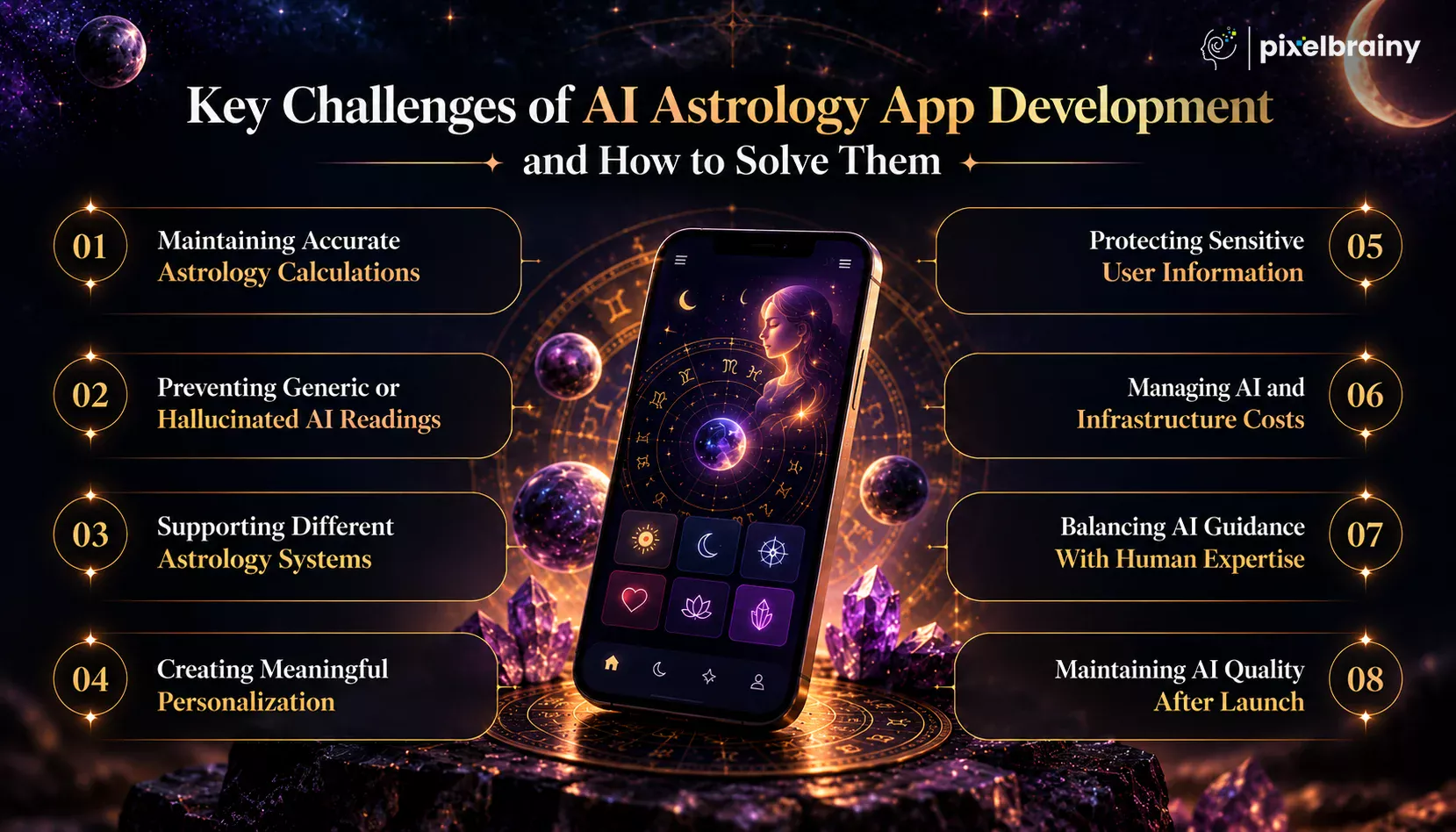
Challenge: An AI model should not be responsible for independently calculating planetary positions, houses, aspects, or other astrological parameters. Even a small calculation error can result in an incorrect natal chart and undermine the credibility of the application.
Solution: Integrate a reliable astrology calculation engine or API and keep the calculation layer separate from the AI interpretation layer. Validate sample charts against trusted astrological references and have domain experts review the results before launch.
Challenge: Large language models can produce fluent responses that sound convincing but may contain unsupported astrology interpretations or information that is not actually present in the user's chart.
Solution: Provide the AI with structured chart data and approved astrology knowledge before generating responses. Retrieval mechanisms, carefully designed prompts, response validation, and appropriate AI guardrails can help keep interpretations relevant to the available chart information.
Challenge: Astrology is not based on one universal methodology. Western astrology, Vedic astrology, and other systems can use different calculations, terminology, house systems, and interpretation approaches.
Solution: Define the supported methodology during the planning stage. Build the application architecture so the calculation engine and interpretation rules can accommodate the selected system without mixing incompatible methodologies.
Challenge: Simply adding a user's name or zodiac sign does not create genuine personalization. Users expect an AI astrology application to understand their individual chart and provide contextually relevant responses.
Solution: Structure user profiles around relevant birth-chart information, preferences, conversation context, and selected topics. The AI should retrieve only the information needed for each query so responses remain relevant and consistent.
Challenge: An astrology application may collect birth dates, exact birth times, locations, personal preferences, and private conversations. Poor data handling can create privacy and security risks.
Solution: Implement secure authentication, encryption, access controls, protected APIs, appropriate data retention policies, and transparent privacy practices. Businesses should also minimize unnecessary data collection and clearly explain how information is used.
Challenge: AI-powered conversations can generate ongoing costs based on model usage, while astrology APIs, cloud infrastructure, databases, notifications, and other third-party services can add recurring expenses.
Solution: Use appropriate AI models for different tasks, optimize prompts and context size, cache reusable calculations, monitor API consumption, and establish usage limits where appropriate. Businesses can also align premium AI usage with subscriptions or credit-based monetization.
Challenge: Users may expect AI-generated astrology guidance to have the same depth and nuance as an experienced astrologer. At the same time, sensitive personal questions can require greater care than automated responses can provide.
Solution: Position AI as a personalized digital assistant rather than an unquestionable authority. Businesses can introduce clear boundaries, appropriate disclaimers, and escalation paths to professional astrologers for deeper consultations.
Challenge: Launching the application does not guarantee consistent AI response quality. New user questions, model updates, changing APIs, and emerging edge cases can affect the experience over time.
Solution: Continuously evaluate AI responses using predefined quality criteria, user feedback, expert reviews, analytics, and testing datasets. Regular prompt optimization, knowledge updates, model evaluation, and technical monitoring can help maintain a reliable AI astrology app experience.
Addressing these challenges early helps businesses build an AI astrology application that is technically reliable, astrologically consistent, secure, personalized, and capable of earning long-term user trust.
From this point onward, it is time to identify the right development partner who can translate an astrology business idea into a reliable, user-focused digital product. For wellness entrepreneurs, astrology practitioners, spirituality platforms, and startups, the ideal partner needs to understand both the AI astrology app development requirements and the domain-specific nature of astrology.
PixelBrainy works with businesses that want to turn specialized concepts into AI-powered applications. As an AI astrology app development company, PixelBrainy can help businesses move from product ideation and technical planning to design, development, AI implementation, testing, and launch.
For founders evaluating potential technology partners, an important question is whether the development team can actually understand the technical foundations behind astrology AI.
Real Query: I am evaluating development companies for our AI astrology app project and I want to understand what specific technical questions I should ask to identify whether a development company can build a genuinely accurate astrological AI versus one that generates spiritually-toned content with no real astrological grounding. The difference between a real AI astrology engine and a generic content generator dressed up with astrology language is immediately obvious to our target audience who are sophisticated astrology enthusiasts.
This distinction is central to PixelBrainy's approach. Rather than treating astrology as generic content generation, the development process can account for structured astrological data, calculation requirements, AI interpretation, personalization, and the specific product goals defined by the business.
For one confidential spirituality and wellness project, the team worked on an AI-powered application designed to deliver personalized guidance using user-provided information and structured domain knowledge. The solution incorporated conversational AI, personalized content generation, secure user profiles, and scalable backend architecture.
Because the client's identity and commercially sensitive information are confidential, specific business names and proprietary implementation details cannot be disclosed. The project demonstrates how specialized domain requirements can be translated into a practical AI product architecture.
Whether you want to build AI astrology app functionality into an existing wellness platform or develop AI astrology app from scratch, PixelBrainy can help define the product scope, architecture, user experience, and astrology app development integrating AI according to your business objectives.
Ready to turn your astrology idea into an AI-powered product? Connect with PixelBrainy to discuss your project.
An AI astrology app can turn traditional astrology expertise into a personalized digital experience that users can access anytime. However, successful AI astrology app development requires more than integrating an AI chatbot. Accurate astrology calculations, structured natal chart data, meaningful AI interpretation, intuitive UX, secure user information, and scalable technology all contribute to a credible product.
From understanding the different types of astrology applications to defining must-have features, advanced capabilities, development stages, technology requirements, monetization models, and potential challenges, businesses now have a practical roadmap for building an AI astrology app.
For astrology practitioners, wellness founders, spirituality businesses, and startups, astrology app development using AI can create new opportunities to deliver personalized readings, automate everyday interactions, expand customer reach, and introduce recurring digital revenue streams.
The right development partner can further help transform an astrology concept into a market-ready product while aligning AI capabilities with your specific astrology methodology and business objectives.
Ready to turn your astrology idea into a scalable AI product? Book an appointment with PixelBrainy today.
To build an AI astrology app that delivers personalized readings, the application should combine an accurate astrology calculation engine with an AI interpretation layer. The system can use birth date, time, location, planetary positions, houses, and aspects to generate readings based on each user's individual natal chart rather than generic zodiac content.
To develop an AI astrology app from scratch, businesses typically need an astrology calculation engine, AI model, backend infrastructure, mobile or web application, database, user authentication, payment system, and administration dashboard. The development process also includes astrology methodology validation, AI testing, UI/UX development, security implementation, and post-launch optimization.
Astrology app development using AI can personalize readings by combining structured astrological calculations with user-specific information. Instead of producing predefined horoscope text, the AI can interpret relevant natal chart elements and respond to individual questions about relationships, career, personality, planetary placements, and other astrology topics.
The AI astrology app development cost can range from approximately $30,000 to $200,000+, depending on the application's complexity. Features such as custom AI model development, natal chart calculations, conversational AI, multilingual support, voice capabilities, astrologer consultations, third-party integrations, and enterprise infrastructure can significantly increase the overall development budget.
Yes. Businesses can create an AI astrology app around their specific methodology by defining calculation rules, interpretation principles, terminology, and approved astrology knowledge. The development team can structure this information within the application so the AI generates responses that align with the business's chosen astrology approach.
Yes. An AI astrology app development project can include a hybrid AI and human consultation model. Users can receive instant AI-powered readings and then connect with professional astrologers through chat, voice, or video consultations. This model can also create additional monetization opportunities through consultation fees or platform commissions.
When developing an AI astrology app, essential features can include user profiles, birth-detail collection, natal chart generation, personalized horoscopes, AI astrology conversations, planetary analysis, astrology reports, conversation history, notifications, subscriptions, payments, feedback, and an admin dashboard. Advanced features can be introduced as the product scales.
Businesses can monetize an AI astrology app through subscriptions, premium AI readings, pay-per-report services, AI credits, personalized astrology reports, live astrologer consultations, and advertising. A hybrid model can allow users to access basic features for free while generating revenue from premium personalized experiences and recurring services.

About The Author
Sagar Bhatnagar
Sagar Sahay Bhatnagar brings over a decade of IT industry experience to his role as Marketing Head at PixelBrainy. He's known for his knack in devising creative marketing strategies that boost brand visibility and market influence. Sagar's strategic thinking, coupled with his innovative vision and focus on results, sets him apart. His track record of successful campaigns proves his ability to utilize digital platforms effectively for impactful marketing efforts. With a genuine passion for both technology and marketing, Sagar continuously pushes PixelBrainy's marketing initiatives to greater success.
Working with the PixelBrainy team has been a highly positive experience. They understand the design requirements and create beautiful UX elements to meet the application needs. The dev team did an excellent job bringing my vision to life. We discussed usability and flow. Sagar worked with his team to design the database and begin coding. Working with Sagar was easy. He has the knowledge to create robust apps, including multi-language support, Google and Apple ID login options, Ad-enabled integrations, Stripe payment processing, and a Web Admin site for maintaining support data. I'm extremely satisfied with the services provided, the quality of the final product, and the professionalism of the entire process. I highly recommend them for Android and iOS Mobile Application Design and Development.

Great experience working with them. Had a lot of feedback and I found that unlike most contractors they were bugging me for updates instead of the other way around. They were extremely time conscience and great at communicating! All work was done extremely high quality and if not on time, early! They were always proactive when it comes to communication and the work is great/above par always. Very flexible and a great team to work with! Goes above and beyond to present us with multiple options and always provides quality. Amazing work per usual with Chitra. If you have UI/UX or branding design needs I recommend you go to them! Will likely work with them in the future as well, definitely recommended!

PixelBrainy is a joy to work with and is a great partner when thinking through branding, logo, and website layout. I appreciate that they spend time going into the "why" behind their decisions to help inform me and others about industry best practices and their expertise.

I hired them to design our software apps. Things I really like about them are excellent communication skills, they answer all project suggestions and collaborate right away, and their input on design and colors is amazing. This project was complex and needed patience and creativity. The team is amazing to do business with. I will be using them long-term. Glad to see there are some good people out there. I was afraid to try and outsource my project to someone but I am glad I met them! I really can't say enough. They went above and beyond on this project. I am very happy with everything they have done to make my business stand out from the competition.

It was great working with PixelBrainy and the team. They were very responsive and really owned the project. We'll definitely work with them again!

I recently worked with the PixelBrainy team on a project and I was blown away by their communication skills. They were prompt, clear, and articulate in all of our interactions. They listened and provided valuable feedback and suggestions to help make the project a success. They also kept me updated throughout the entire process, which made the experience stress-free and enjoyable.

PixelBrainy is very good at what it does. The team also presents themselves very professionally and takes care of their side of things very well. I could fully trust them taking up the design work in a timely and organised manner and their attention to detail saved us lots of effort and time. This particular project was quite intense and the team showed that they function very well under pressure. Very much looking forward to working with her again!

It's always an absolute pleasure working with them. They completed all of my requests quickly and followed every note I had for them to a T, which made our process go smoothly from start to finish. Everything was completed fast and following all of the guidelines. And I would recommend their services to anyone. If you need any design work done in the future, PixelBrainy should be your first call!

They took ownership of our requirements and designed and proposed multiple beautiful variants. The team is self-motivated, requires minimum supervision, committed to see-through designs with quality and delivering them on time. We would definitely love to work with PixelBrainy again when we have any requirements.

PixelBrainy was a big help with our SaaS application. We've been hard at work with a new UI/UX and they provided a lot of help with the designs. If you're looking for assistance with your website, software, or mobile application designs, PixelBrainy and the team is a great recommendation.

PixelBrainy designers are amazing. They are responsive, talented, and always willing to help craft the design until it matches your vision. I would recommend them and plan to continue them for my future projects and more!!!

They were awesome! Did a good job fast, and good communication. Will work with them again. Thank you

Creative, detail-oriented, and talented designers who take direction well and implement changes quickly and accurately. They consistently over-delivered for us.

PixelBrainy team is very talented and creative. Great designers and a pleasure to work with. PixelBrainy is an excellent communicator and I look forward to working with them again.

PixelBrainy has a very talented design team. Their work is excellent and they are very responsive. I enjoy working with them and hope to continue on all of our future projects.


Transform your ideas into reality with us.
Across these industries, each engagement brings unique challenges, from early-stage product development to scaling complex systems, helping us build a practical understanding of real-world product environments.