
 AI Summary Powered by PixelBrainy
Imagine having a personal nutritionist who truly understands your health goals, eating habits, and lifestyle, available anytime and anywhere on your smartphone. That is exactly what AI Diet and Nutrition Planner Apps deliver today. As the health and fitness industry continues to expand rapidly, these intelligent applications have become a vital part of people’s daily wellness routines. For startups, fitness brands, and healthcare businesses, knowing how to develop an AI Diet and Nutrition Planner App offers a golden opportunity to enter a billion-dollar market driven by personalization and technology.
Building an AI-powered diet planner goes far beyond simple calorie tracking. It focuses on creating a holistic, data-driven wellness ecosystem that uses machine learning, behavioral analytics, and personalized recommendations to promote better health outcomes. These apps can analyze users’ dietary patterns, fitness levels, and medical conditions to design tailored meal plans, suggest nutrient-rich food options, and even generate smart grocery lists.
AI Diet and Nutrition Planner App Development transforms how individuals approach healthy living by providing customized, science-backed nutritional guidance at their fingertips. For businesses, it represents a chance to innovate, engage users deeply, and deliver real value through advanced AI-driven features.
In this comprehensive guide, we will explore everything you need to know about this transformative technology—from what an AI Diet and Nutrition Planner App is, to its architecture, features, tools, and a detailed step-by-step development process. Whether you want to create an AI Diet Planner App or explore AI Nutrition Planner App development, this article will serve as your complete roadmap to success.
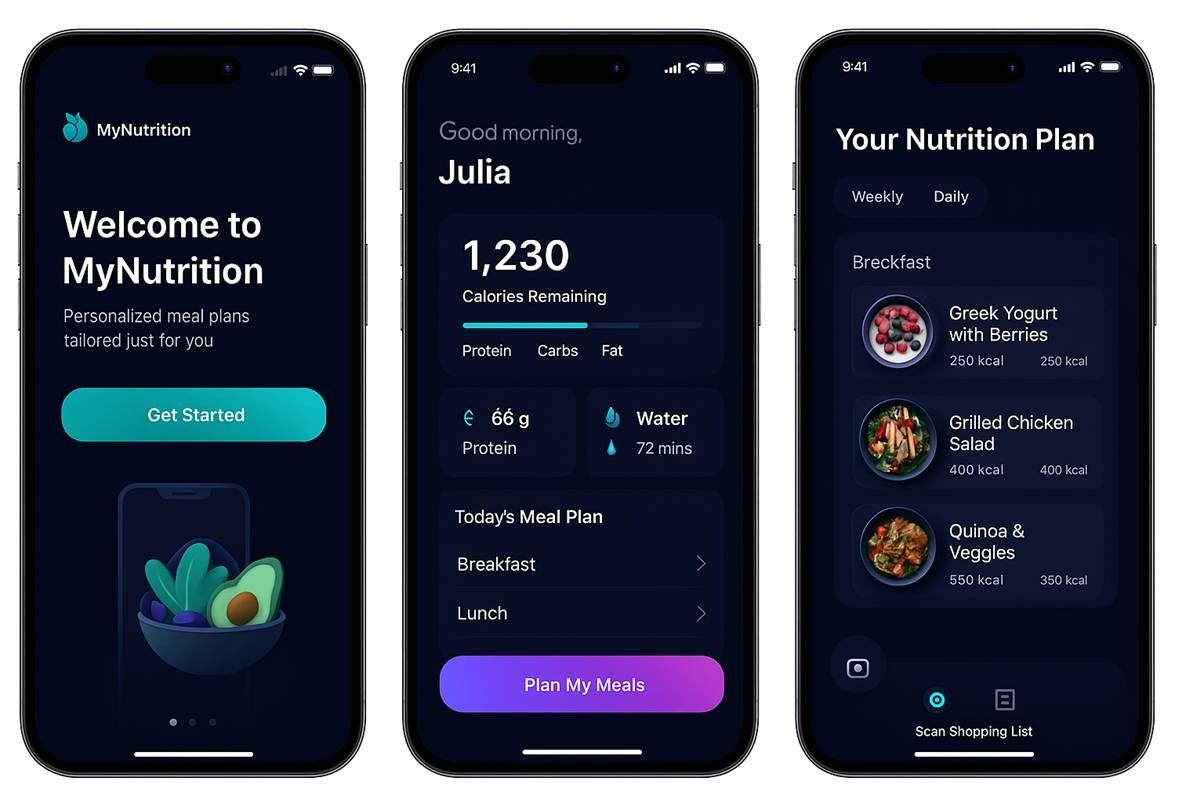
An AI Diet and Nutrition Planner App is an intelligent health application that helps users plan, monitor, and improve their daily nutrition using artificial intelligence. Unlike traditional diet apps that depend on manual entries and generic meal plans, AI-based apps analyze user data to offer personalized guidance. They consider factors such as age, weight, activity level, dietary preferences, allergies, and health goals to create nutrition plans that fit each individual’s lifestyle and body needs.
These apps go beyond simple calorie counting. They can suggest balanced meal options, identify nutrient gaps, and even adapt recommendations as a user’s health data changes over time. Many AI Diet and Nutrition Planner Apps integrate with wearable devices and health trackers to gather real-time data on steps, heart rate, and energy expenditure. Some advanced versions can even recognize food items from images, making tracking quick and effortless.
An AI Diet and Nutrition Planner App provides users with a smarter, more dynamic way to achieve their health and fitness goals through technology that understands and evolves with them.
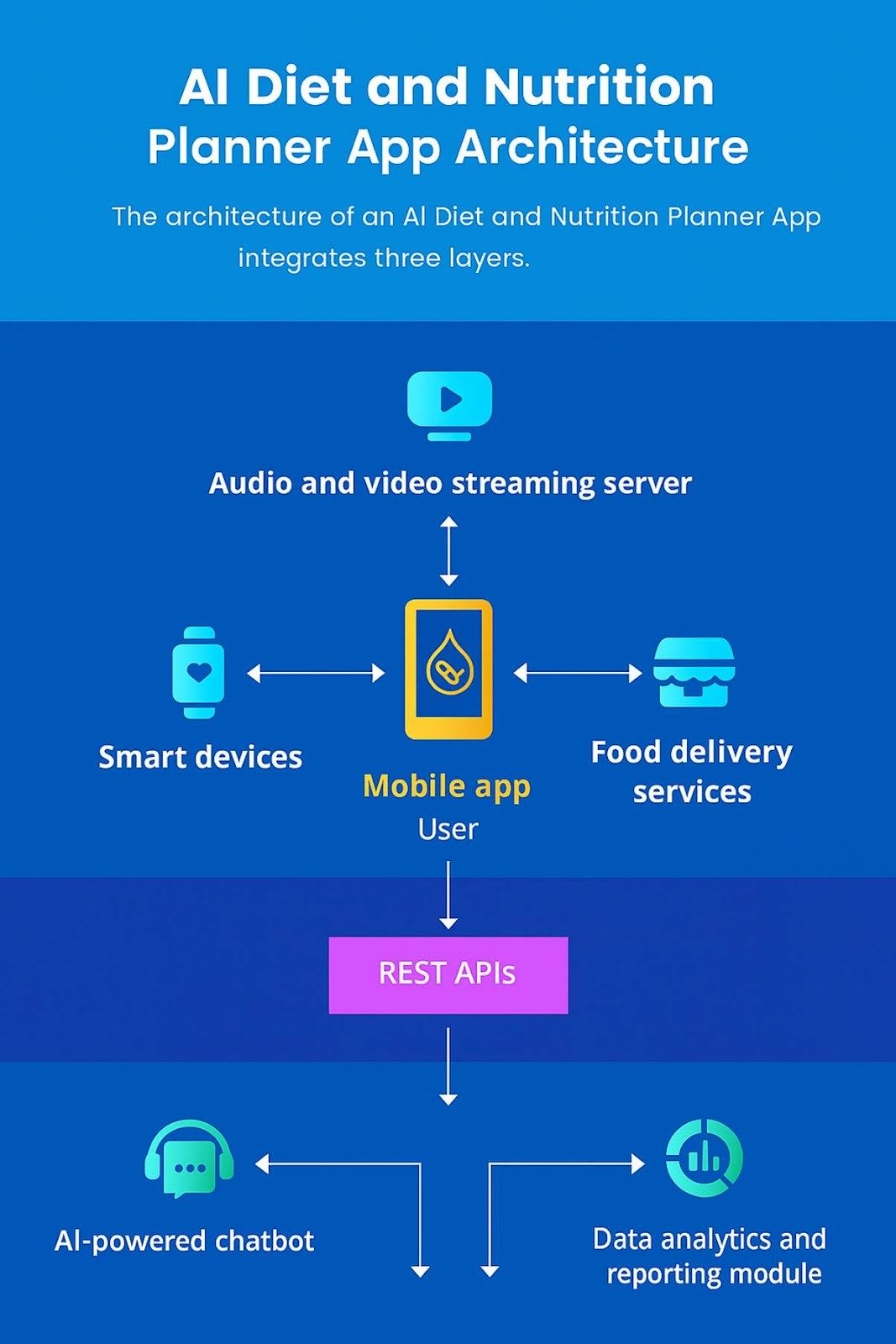
The AI Diet and Nutrition Planner App architecture is built to deliver a seamless and intelligent user experience. It connects multiple layers of technology that work together to collect, process, and personalize nutrition data for each user. The structure is divided into three main layers: the User Interface Layer, Routing Layer, and Container Ecosystem.
This is the front-end experience where users interact through a mobile app. It connects with smart devices like fitness trackers or health monitors to gather real-time data and can link to food delivery services for convenient meal ordering. It may also integrate with audio or video streaming for coaching and educational sessions.
The Routing Layer acts as a bridge that ensures smooth communication between the app and backend systems. It uses REST APIs to securely transmit data, making it possible for the user interface and backend services to work together in real time.
This backend system houses the intelligence of the app. It includes several microservices such as the AI-powered chatbot, nutrition and fitness modules, user profile service, data analytics, recommendation engine, and payment processing. Each microservice operates independently yet coordinates to provide personalized insights and seamless functionality.
This layered architecture ensures the app remains scalable, secure, and responsive while delivering customized diet and nutrition recommendations tailored to every user’s needs.
In an era where health and wellness take centre stage, developing an AI-driven diet and nutrition planner app offers businesses a timely and strategic opportunity. Today’s consumers demand personalization, convenience and data-driven support for their wellness journeys. This shift places such apps at the heart of new digital health offerings.
The global market for diet and nutrition apps is projected to reach USD 5.76 billion in 2025 and grow to about USD 10.15 billion by 2030, with a compound annual growth rate (CAGR) of nearly 12%.
Additionally, the AI-in-personalised-nutrition segment is forecast to grow from around USD 4.89 billion in 2025 to USD 21.54 billion by 2034.
These numbers reflect strong demand and significant growth prospects for businesses that build and monetise apps in this space.
By moving into this space now and capturing early market share with a high-quality product, businesses can position themselves as leaders in the growing wellness-tech ecosystem.
The value of AI Diet and Nutrition Planner App Development emerges when technology meets real-world nutrition and wellness needs. When you’re looking to build AI Diet and Nutrition Planner App, consider how each use case can deliver meaningful benefits to users and differentiate your product.
Below are six detailed use cases that show how such apps evolve beyond tracking to truly supporting health journeys.
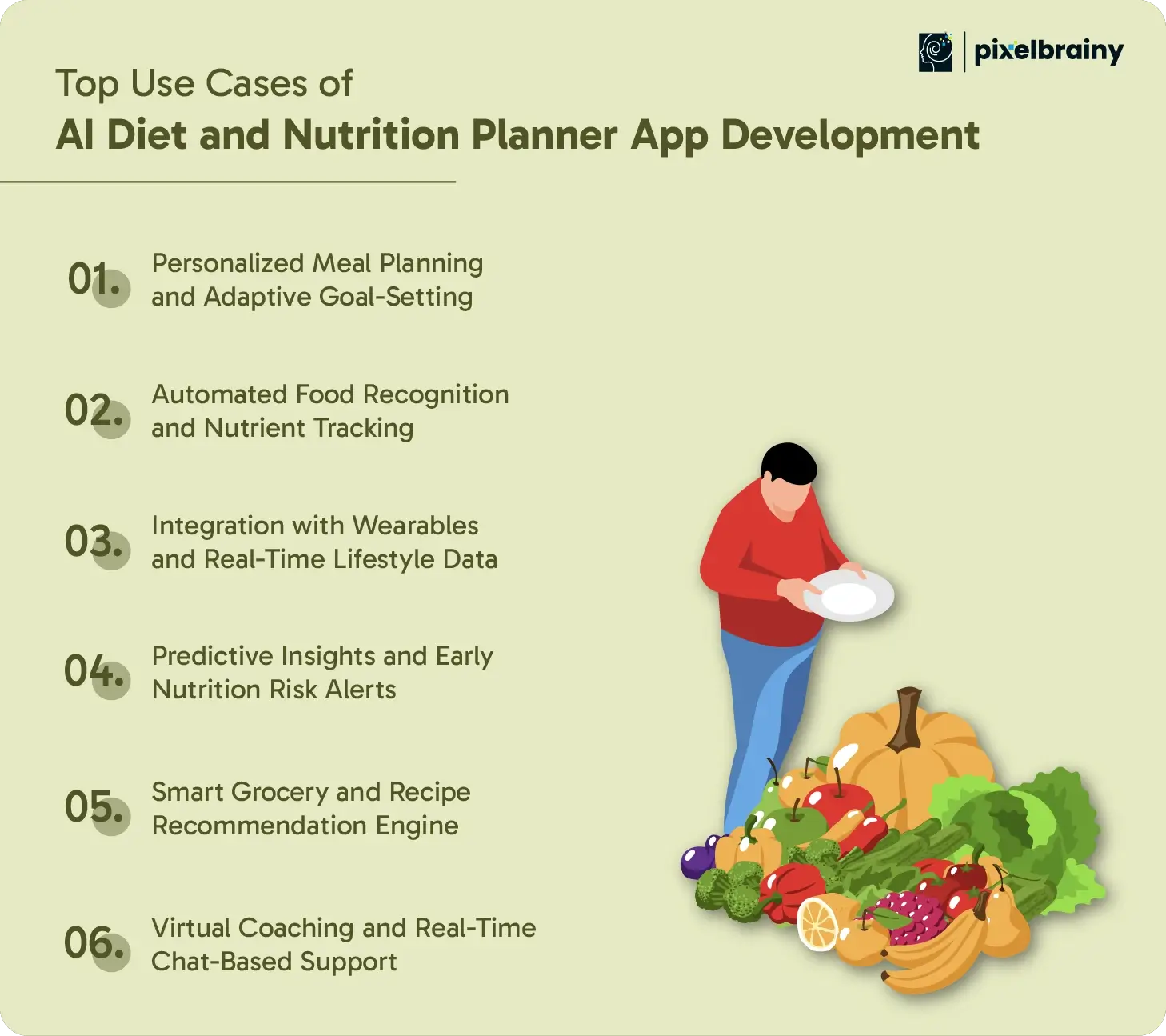
In this use case the app doesn’t simply generate a one-time meal chart; instead it creates dynamic plans tailored to each user’s body metrics, lifestyle, dietary preferences, and progress. When you’re creating AI Diet and Nutrition Planner Application, the system learns from logged meals, workouts, sleep quality and adjusts next meals accordingly.
Example: The app HealthifyMe features “Ria”, a digital nutritionist that builds custom diet plans and modifies them as users’ habits evolve
Instead of expecting the user to manually enter every meal, the app uses image processing and smart algorithms to recognise food items, estimate portion sizes and calculate macronutrients. This smooths the logging process and increases user engagement. For an app built to build AI Diet and Nutrition Planner App, this is a strong differentiator.
Example: The widely used MyFitnessPal allows users to log meals and track macros; with AI-powered recognitions it could evolve into fully automatic food logging.
When the app connects with wearable devices, smart scales, and fitness trackers it can gather data such as steps, heart rate, activity intensity and sleep. By combining these with diet metrics, your app can refine meal and nutrition suggestions in real time. This is a core advantage of AI Diet and Nutrition Planner App Development.
Example: An app that syncs with Apple Health or Fitbit can detect a high-calorie-burn day and recommend slightly higher carb intake for recovery, or on low-sleep nights may suggest lighter meals. While MyFitnessPal provides device integrations, newer apps push this further with AI-driven adjustments.
Instead of simply reporting what has happened, the app anticipates trends and alerts users to potential nutrition gaps or unhealthy patterns. When you’re creating AI Diet and Nutrition Planner Application, this forward-looking capability adds significant value. For example, if a user consistently underconsumes protein or iron or has irregular meals, the app will flag the concern before it becomes a major issue.
Example: According to the article “AI in Nutrition: 9 Use Cases and Real Examples”, AI-integrated apps generate weekly meal plans and monitor habit patterns to predict shortfalls.
A powerful use case when you build AI Diet and Nutrition Planner App is to assist users in planning meals based on what’s in their pantry, creating grocery lists, and recommending recipes aligned with their diet goals. This blends nutrition coaching with real-life execution.
Example: Suppose a user logs “chicken, spinach, quinoa” in their pantry. The app generates a recipe fielding those ingredients, adds missing items to a grocery list, and schedules meals accordingly. While not always fully implemented, the move toward smart grocery integration is increasingly seen in wellness apps.
With conversational AI assistants built into the app, users have access to 24/7 guidance, feedback and motivation. When you invest in AI Diet and Nutrition Planner App Development, adding a chatbot or virtual coach enriches the user experience and retention. This coach can answer questions (“Can I eat this after workout?”), suggest alternatives, and adapt plans on the fly when users deviate.
Example: Fitia offers an AI Coach that helps users log food via conversation, adjust settings and stay consistent.
These use cases reveal how you can design your app not just as a food logger but as a comprehensive nutrition companion. By choosing the right use cases in your AI Diet and Nutrition Planner App Development you create value that resonates with modern users seeking personalization, convenience, and intelligent guidance.
Developing a powerful and user-friendly AI Diet and Nutrition Planner App requires more than just calorie tracking. It needs a combination of smart technology, intuitive design, and real-time personalization.
The following key features define what makes a truly successful product when you plan to build an AI Diet and Nutrition Planner App or start AI Nutrition Planner App development for your business.
| Feature | Description |
| Personalized Meal Planning | The app uses AI algorithms to create individualized meal plans based on user data such as goals, age, BMI, allergies, and food preferences. It continuously adapts recommendations as users log meals or update progress, ensuring dynamic and relevant meal suggestions. |
| Smart Calorie and Nutrient Tracking | This feature automates food tracking through AI-based image recognition. By scanning meal photos, the app detects ingredients, portion sizes, and nutrients, reducing manual input and improving accuracy. |
| AI-Powered Food Recognition | Using computer vision, the app can recognize thousands of dishes and packaged foods from a photo. It makes logging meals faster and more interactive while offering accurate nutritional breakdowns. |
| Integration with Fitness and Health Devices | The app syncs with smartwatches, fitness trackers, and IoT devices like Fitbit or Apple Health to collect real-time health metrics such as steps, heart rate, and sleep data, which influence personalized meal planning. |
| Real-Time Health Insights | AI analyzes ongoing data to give users insights into their dietary habits, suggesting timely improvements such as increased hydration, balanced macros, or reduced sugar intake. |
| Predictive Health Analytics | The app identifies potential nutrition deficiencies or unhealthy eating patterns before they escalate. This proactive approach helps users make early dietary adjustments. |
| AI Chatbot and Virtual Coaching | A built-in chatbot offers instant support, answers dietary questions, and provides motivational reminders. It acts like a personal coach, available anytime, to enhance user engagement. |
| Recipe Suggestions and Smart Grocery Lists | The app recommends recipes based on the user’s goals and available ingredients. It can automatically generate grocery lists and integrate with local or online food delivery platforms. |
| Multi-Language and Voice Assistance | The inclusion of voice input and multilingual support makes the app more accessible and convenient for global users. Users can log meals or ask for suggestions using voice commands. |
| Gamification and Progress Rewards | Gamified features like streaks, achievement badges, and leaderboards keep users motivated and consistent in their fitness and nutrition goals. |
| Data Security and Privacy Controls | Given the sensitive nature of health data, the app includes end-to-end encryption, GDPR compliance, and secure login methods like biometric authentication. |
| Social Community Integration | The app can feature community groups or forums where users share recipes, experiences, and challenges, fostering motivation through shared goals. |
| AI-Driven Recommendation Engine | The core AI system analyzes food logs, preferences, and behavior patterns to provide continuous, personalized diet and workout recommendations. |
| Integration with Healthcare Professionals | The app can allow users to share their progress and data with nutritionists or doctors for expert analysis, bridging the gap between self-care and professional guidance. |
| Offline Tracking and Cloud Syncing | Users can log meals offline, with automatic cloud syncing when connected to the internet. This ensures uninterrupted tracking and data consistency across devices. |
A well-designed AI Diet and Nutrition Planner App combines intelligence, personalization, and usability to deliver lasting health impact and strong user loyalty.
After finalizing the core features and functionality, now it’s time to pick the right development team and bring your idea to life. Whether you partner with a UI/UX design company or collaborate with one of the top AI development companies in the USA, having a clear roadmap is essential.
The process of developing an AI Diet and Nutrition Planner App involves structured steps that ensure your app is efficient, scalable, and truly personalized for users’ health goals.
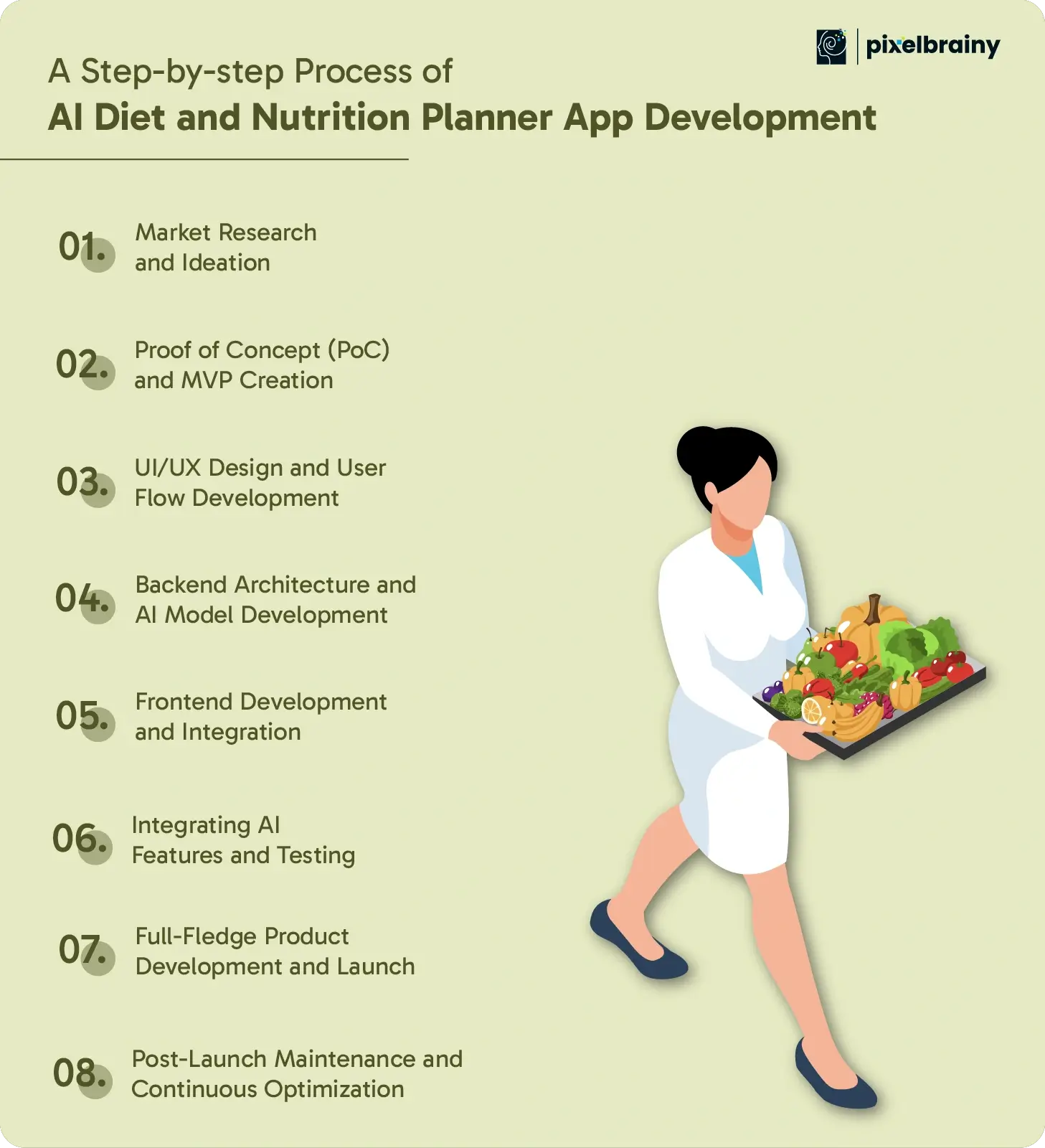
Aim of this: To identify your target audience, analyze competitors, and define the unique value your app will deliver.
Why this matters: A clear understanding of market demand helps you design a product that solves real user problems and stands out from other wellness apps. This stage also helps you validate whether there is a real opportunity to make an AI Diet and Nutrition Planner App that meets user expectations and fits current trends.
Key actions include:
Aim of this: To test the feasibility of your idea before full-scale development.
Why this matters: A PoC verifies if your AI algorithms and data models can deliver accurate nutrition insights, while an MVP (Minimum Viable Product) helps you launch quickly and gather early feedback.
During this stage:
Building an MVP allows you to move confidently into full-scale AI Diet and Nutrition Planner App Development with minimal risk and data-driven improvements.
Aim of this: To create a visually appealing and easy-to-navigate interface.
Why this matters: The design directly impacts user engagement and retention. A reliable UI/UX design company ensures your app feels intuitive and motivates users to return daily.
Key design principles:
This step sets the emotional tone of your app and ensures it appeals to health-conscious users.
Aim of this: To create a secure, scalable, and intelligent system that powers the app.
Why this matters: This is the backbone of developing AI Diet and Nutrition Planner App where real intelligence comes to life. The backend handles data storage, API integration, and AI algorithms for meal recognition and recommendations.
Activities include:
This phase ensures the app functions smoothly and provides real-time, accurate nutrition data.
Aim of this: To translate design and AI logic into a fully interactive mobile or web app.
Why this matters: The frontend determines how users experience your app. It should be fast, responsive, and user-friendly across devices.
Core tasks:
This step turns your concept into a usable product ready for testing and real-world interaction.
Aim of this: To ensure the AI features perform accurately in real-world scenarios.
Why this matters: The success of Diet and Nutrition Planner App development Integrating AI lies in how efficiently the algorithms process user data and deliver personalized insights.
Testing involves:
Thorough testing ensures your app performs reliably and maintains high user trust.
Aim of this: To develop a complete, market-ready version of the app with all features and scalability built-in.
Why this matters: The full fledge phase is where your app transitions from a prototype to a commercial product that can handle thousands of users.
Key steps include:
At this stage, your app is ready for public launch and long-term growth.
Aim of this: To monitor performance, gather feedback, and introduce regular updates.
Why this matters: Sustained success in AI Diet and Nutrition Planner App Development depends on continuous learning, just like the AI models within the app.
Important activities:
Ongoing optimization keeps your app competitive, relevant, and engaging for users over time.
Each of these steps contributes to creating a scalable, user-focused product. When executed strategically, the development of AI Diet and Nutrition Planner App not only improves user wellness but also builds a strong brand identity in the growing digital health market.
Also Read: A Comprehensive Guide To AI Mobile App Development
Choosing the right tools and technologies is crucial for successful AI Diet and Nutrition Planner App Development. The tech stack determines how efficiently the app performs, how scalable it is, and how well it delivers personalized insights.
Below is a detailed table outlining the core technologies, frameworks, and tools required to make an AI Diet and Nutrition Planner App.
| Category | Tools & Technologies | Purpose / Description |
| Programming Languages | Python, Kotlin, Swift, JavaScript | Python powers AI and ML development, while Kotlin and Swift are used for Android and iOS app development respectively. JavaScript supports web app interfaces. |
| AI & Machine Learning Frameworks | TensorFlow, PyTorch, Scikit-learn | These frameworks help in training, testing, and deploying AI models for food recognition, nutrient analysis, and personalized recommendations. |
| Natural Language Processing (NLP) | Dialogflow, OpenAI API, spaCy | Used to build intelligent chatbots and virtual nutrition assistants that understand and respond to user queries naturally. |
| Data Storage & Databases | Firebase, MongoDB, PostgreSQL | Securely store user data, meal logs, nutrition details, and AI model outputs. Enable quick access and real-time synchronization. |
| Cloud Platforms | AWS, Google Cloud AI, Microsoft Azure | Support app hosting, AI processing, and scalable infrastructure for global user access and data management. |
| APIs & Integrations | Nutritionix, Spoonacular, Fitbit API, Apple HealthKit | Provide real-time nutritional data, recipe suggestions, and integrate fitness tracking for holistic health insights. |
| Frontend Frameworks | React Native, Flutter, Angular | Used for creating cross-platform mobile apps with smooth interfaces and consistent performance on Android and iOS. |
| Backend Frameworks | Node.js, Django, Flask | Handle API requests, user authentication, and data communication between frontend and AI systems. |
| Image Recognition Tools | Google Vision AI, AWS Rekognition, OpenCV | Identify and classify food items from user-uploaded photos for calorie and nutrient estimation. |
| Analytics & Monitoring | Google Analytics, Mixpanel, Firebase Analytics | Track user behavior, engagement, and app performance for continuous improvement. |
| Security & Compliance | OAuth 2.0, SSL Encryption, GDPR & HIPAA Compliance | Ensure secure data transfer, protect sensitive health information, and comply with international privacy standards. |
| Payment Gateways | Stripe, PayPal, Razorpay | Enable seamless subscription management and in-app purchase functionality. |
| Testing Tools | Appium, Selenium, Postman | Perform end-to-end testing for functionality, performance, and API reliability across devices. |
| DevOps & CI/CD | Docker, Jenkins, Kubernetes | Automate deployment, testing, and scaling for efficient app delivery and maintenance. |
| Design & Prototyping Tools | Figma, Adobe XD, Sketch | Used by UI/UX Design Company teams to create user-friendly interfaces and wireframes before development. |
By combining these right tools ensures the development of AI Diet and Nutrition Planner App is robust, secure, and capable of delivering accurate, data-driven insights that keep users engaged.
When planning AI Diet and Nutrition Planner App Development, one of the most strategic decisions you’ll make is how to build your development team. The sourcing model you choose impacts cost, timeline, and the overall quality of your final product.
Whether you’re a startup testing an MVP or an established wellness brand scaling globally, selecting the right approach to make an AI Diet and Nutrition Planner App ensures efficiency, flexibility, and innovation throughout the process.
Overview: In this model, your internal team manages the entire development of AI Diet and Nutrition Planner App, from design to launch. It gives complete control over the process and ensures alignment with your brand vision.
When to Choose:
Benefits:
Overview: Here, you delegate the project to an external software development agency or one of the top AI development companies in the USA. They manage everything from design to delivery using their expertise and resources.
When to Choose:
Benefits:
Overview: This approach involves hiring a remote team that works exclusively on your project but operates as an extension of your company. It’s best for long-term projects needing consistent collaboration.
When to Choose:
Benefits:
Overview: The hybrid approach combines in-house strategic management with outsourced technical execution. Your internal team handles business strategy, while external specialists manage AI modeling, backend, or app development.
When to Choose:
Benefits:
Overview: You hire independent professionals for specific tasks such as AI model development, UI/UX design, or API integration. This model is flexible but requires strong management oversight.
When to Choose:
Benefits:
Selecting the right sourcing model depends on your project size, budget, and long-term goals. Businesses aiming for innovation, reliability, and scalability often collaborate with experienced AI Diet and Nutrition Planner App Development partners to ensure a seamless blend of technology and strategy.
Selecting the right business model is one of the most important decisions during AI Diet and Nutrition Planner App Development. It defines how your app will generate revenue, attract users, and sustain long-term growth. With the global wellness and health tech industry booming, businesses have several proven monetization paths to make an AI Diet and Nutrition Planner App profitable while delivering real value to users.
Below are the most effective and scalable business models that align with the nature of AI-powered wellness solutions.
The freemium approach allows users to access the app’s basic features for free while offering premium upgrades for advanced functionalities. This model helps you attract a large user base quickly and convert loyal users into paying customers.
Example Features in Free Plan:
Example Features in Premium Plan:
Why It Works: Freemium models encourage trial usage and increase user trust before payment. Apps like MyFitnessPal and Yazio have successfully used this approach to build massive audiences and consistent recurring revenue.
In this model, users pay a recurring fee (monthly, quarterly, or yearly) to unlock all premium features. Subscription-based apps thrive in the wellness industry because users value ongoing guidance and data insights.
Revenue Sources:
Why It Works: Predictable revenue streams and high user retention make subscriptions one of the most stable models. Apps like Noom and Fitbod use this strategy effectively by offering continuous updates, live coaching, and personalized AI tracking.
Users can buy specific features, recipes, or personalized diet plans directly within the app. This allows flexibility for users who prefer one-time payments over subscriptions.
Examples of Purchasable Items:
Why It Works: Microtransactions work well for users who want premium content without long-term commitments. It also helps developers monetize specific high-value features without restricting access to the full app.
Many businesses now prioritize employee wellness. You can partner with organizations and offer AI-powered nutrition and health tracking as part of their corporate wellness programs.
How It Works:
Why It Works: This B2B model brings consistent revenue and brand visibility. It positions your app as a trusted wellness solution provider in the corporate sector while helping companies improve employee productivity and well-being.
Your app can generate revenue by promoting partner products like supplements, fitness equipment, or healthy food brands. Every time a user makes a purchase through affiliate links, you earn a commission.
Possible Collaborations:
Why It Works: Affiliate marketing blends seamlessly with AI diet apps because recommendations feel natural and data-driven. Apps like Lifesum often suggest affiliate products that complement users’ meal plans or goals.
The app can offer paid access to certified nutritionists, dietitians, or fitness experts through chat, video calls, or consultation bookings.
Monetization Options:
Why It Works: This model enhances user trust and satisfaction by combining AI insights with human expertise. It’s ideal for users seeking accountability and professional guidance alongside automated tracking.
Anonymized user data can be valuable for healthcare institutions, nutrition research firms, and food companies. With user consent and strict compliance, you can license insights for research or product development.
Use Cases:
Why It Works: Data monetization supports long-term scalability while helping advance global nutrition research. However, it must adhere to strict privacy and ethical standards such as GDPR and HIPAA.
You can develop a customizable AI Diet and Nutrition Planner App framework and license it to fitness startups, healthcare providers, or wellness brands that want to rebrand it under their name.
How It Works:
Why It Works: This model generates passive revenue and expands your app’s reach without additional marketing costs. It’s particularly effective for AI developers and agencies offering end-to-end wellness app solutions.
The app displays targeted, non-intrusive advertisements related to fitness, nutrition, and wellness products. Revenue is generated through clicks, impressions, or partnerships with advertisers.
Example Ad Types:
Why It Works: When managed carefully, ads can supplement income without compromising user experience. Personalization through AI ensures ads remain relevant and helpful.
Many successful apps combine multiple revenue models to maximize growth. For instance, an app may offer freemium access, premium subscriptions, and in-app purchases while featuring affiliate promotions.
Why It Works: This hybrid model ensures steady income from diverse channels and allows users to choose how they engage with the app financially. It’s flexible, scalable, and sustainable for long-term success.
Choosing the right business model during AI Diet and Nutrition Planner App Development depends on your audience, app goals, and market positioning. The most successful health and wellness apps often blend user-centric design with monetization strategies that deliver both value and profitability.
The development of AI Diet and Nutrition Planner App can be both exciting and complex. While AI brings personalization and automation, it also introduces several technical, regulatory, and operational challenges. Addressing these effectively ensures your app performs smoothly, builds trust, and stands out in a competitive wellness market.
Below are the most common challenges and practical solutions encountered during AI Diet and Nutrition Planner App Development.
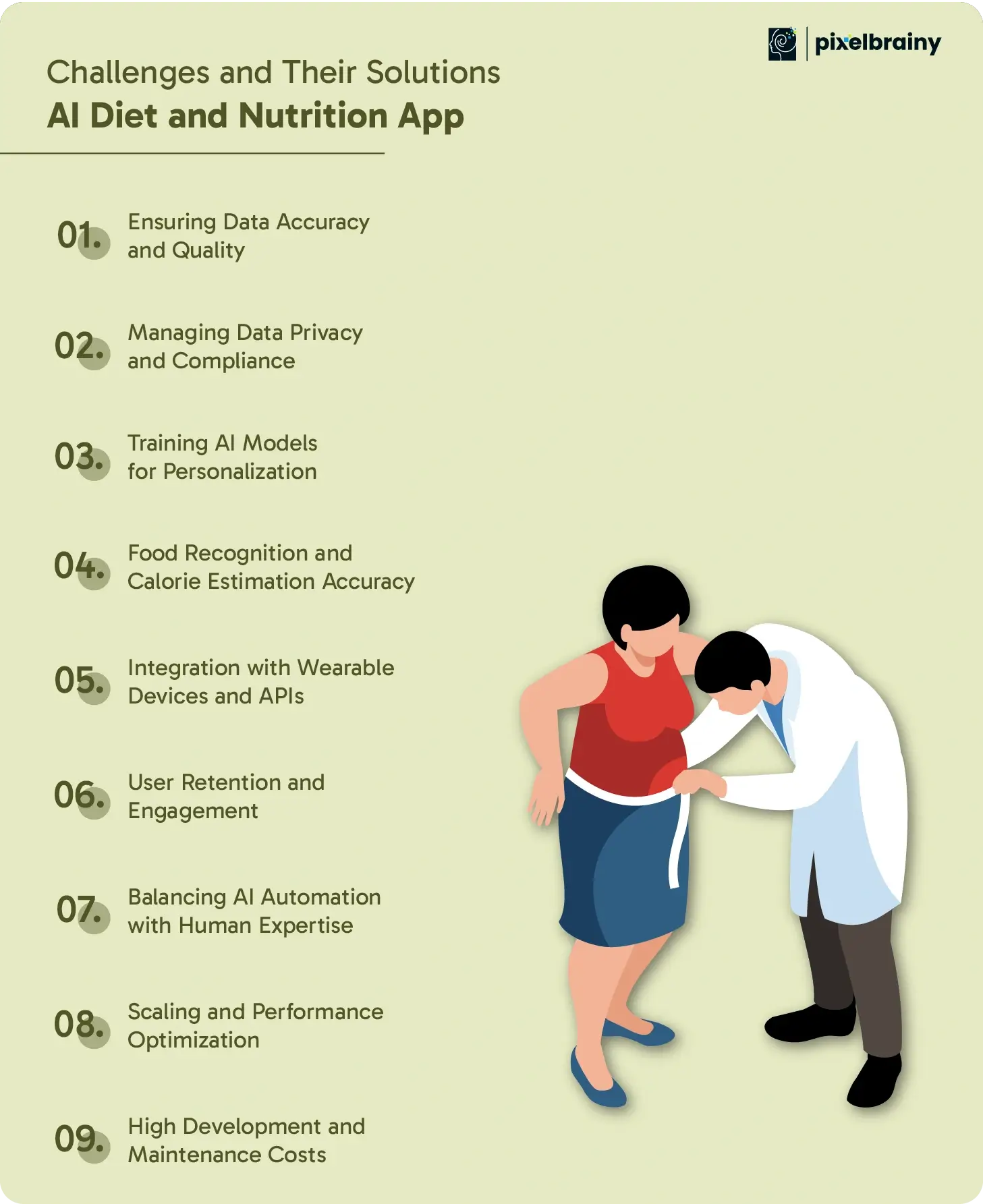
AI models depend on accurate and diverse datasets for precise predictions and recommendations. Inaccurate or incomplete nutritional data can lead to wrong diet suggestions, affecting user trust.
Solution:
Health and dietary data are highly sensitive. A single privacy breach can damage brand reputation and user confidence.
Solution:
Building AI systems that accurately predict user preferences, dietary needs, and health outcomes requires complex and extensive training.
Solution:
AI-powered food recognition systems often struggle with diverse cuisines, portion sizes, and mixed dishes. This affects calorie and nutrient tracking.
Solution:
Connecting multiple APIs (Fitbit, Apple HealthKit, Garmin, etc.) can cause compatibility issues and inconsistent data synchronization.
Solution:
Many wellness apps see drop-offs after initial downloads due to lack of motivation or poor user experience.
Solution:
Over-reliance on AI may lead to generic suggestions, while users often seek a personal, human touch.
Solution:
As user data grows, maintaining app speed, AI model responsiveness, and data processing efficiency becomes more difficult.
Solution:
Integrating AI, nutrition databases, and real-time analytics can lead to high upfront and ongoing costs.
Solution:
Addressing these challenges early in the AI Diet and Nutrition Planner App Development process ensures the final product is accurate, secure, and user-focused. By combining robust technology with empathy-driven design, businesses can build AI nutrition apps that inspire trust, engagement, and long-term loyalty.
PixelBrainy has established itself as a leading AI development company in USA, specializing in intelligent health and wellness solutions. With years of expertise in AI Diet and Nutrition App Development, our team blends data science, machine learning, and intuitive design to craft products that inspire healthier lifestyles and stronger user engagement.
We take pride in our deep technical expertise across AI Diet Planner App Development and AI Nutrition Planner App Development, helping startups, healthcare providers, and fitness brands to create AI Diet and Nutrition Planner App that are both scalable and user-centric.
We recently developed an advanced AI Diet and Nutrition Planner App for a major wellness brand (client confidential). The app leveraged computer vision to detect food items and machine learning to craft personalized nutrition insights. Within three months, it achieved:
PixelBrainy isn’t just a service provider — it’s your innovation partner. As a trusted AI development company in USA, we’re dedicated to transforming wellness ideas into intelligent digital products that make healthy living effortless and enjoyable.
From the above, it is clear that AI Diet and Nutrition Planner App Development is revolutionizing how people approach health and wellness. These apps combine artificial intelligence, personalization, and real-time insights to create smarter and more engaging nutrition experiences. Whether you are a startup or an established brand, investing to create an AI Diet and Nutrition Planner App can open new opportunities in the booming digital health market. With the right technology, user experience, and development partner, your app can empower users to make better lifestyle choices and achieve lasting results.
If you’re ready to bring your vision to life, book an appointment with PixelBrainy today—the most trusted AI development company in USA for building intelligent, user-driven health and wellness solutions.
Unlike traditional diet apps that rely on manual input, AI-powered apps use machine learning to analyze user habits, preferences, and health data to deliver personalized meal plans, predictive insights, and real-time recommendations.
The development timeline typically ranges from 3 to 6 months, depending on app complexity, AI integrations, and custom features such as food recognition, wearable sync, and chat support.
Yes. By starting with a Minimum Viable Product (MVP), startups can launch quickly, test the concept, and scale later based on user feedback and funding.
Core technologies include TensorFlow or PyTorch for AI modeling, Firebase or MongoDB for data storage, React Native or Flutter for frontend, and APIs like Nutritionix or Fitbit for data integration.
AI enhances engagement through smart notifications, adaptive meal plans, gamified progress tracking, and predictive health insights that evolve with each user’s behavior.
PixelBrainy is a top-rated AI development company in USA with expertise in building secure, scalable, and user-centric AI wellness apps that deliver measurable results and long-term user satisfaction.

About The Author
Sagar Bhatnagar
Sagar Sahay Bhatnagar brings over a decade of IT industry experience to his role as Marketing Head at PixelBrainy. He's known for his knack in devising creative marketing strategies that boost brand visibility and market influence. Sagar's strategic thinking, coupled with his innovative vision and focus on results, sets him apart. His track record of successful campaigns proves his ability to utilize digital platforms effectively for impactful marketing efforts. With a genuine passion for both technology and marketing, Sagar continuously pushes PixelBrainy's marketing initiatives to greater success.

Transform your ideas into reality with us.
Working with the PixelBrainy team has been a highly positive experience. They understand the design requirements and create beautiful UX elements to meet the application needs. The dev team did an excellent job bringing my vision to life. We discussed usability and flow. Sagar worked with his team to design the database and begin coding. Working with Sagar was easy. He has the knowledge to create robust apps, including multi-language support, Google and Apple ID login options, Ad-enabled integrations, Stripe payment processing, and a Web Admin site for maintaining support data. I'm extremely satisfied with the services provided, the quality of the final product, and the professionalism of the entire process. I highly recommend them for Android and iOS Mobile Application Design and Development.

Great experience working with them. Had a lot of feedback and I found that unlike most contractors they were bugging me for updates instead of the other way around. They were extremely time conscience and great at communicating! All work was done extremely high quality and if not on time, early! They were always proactive when it comes to communication and the work is great/above par always. Very flexible and a great team to work with! Goes above and beyond to present us with multiple options and always provides quality. Amazing work per usual with Chitra. If you have UI/UX or branding design needs I recommend you go to them! Will likely work with them in the future as well, definitely recommended!

PixelBrainy is a joy to work with and is a great partner when thinking through branding, logo, and website layout. I appreciate that they spend time going into the "why" behind their decisions to help inform me and others about industry best practices and their expertise.

I hired them to design our software apps. Things I really like about them are excellent communication skills, they answer all project suggestions and collaborate right away, and their input on design and colors is amazing. This project was complex and needed patience and creativity. The team is amazing to do business with. I will be using them long-term. Glad to see there are some good people out there. I was afraid to try and outsource my project to someone but I am glad I met them! I really can't say enough. They went above and beyond on this project. I am very happy with everything they have done to make my business stand out from the competition.

It was great working with PixelBrainy and the team. They were very responsive and really owned the project. We'll definitely work with them again!

I recently worked with the PixelBrainy team on a project and I was blown away by their communication skills. They were prompt, clear, and articulate in all of our interactions. They listened and provided valuable feedback and suggestions to help make the project a success. They also kept me updated throughout the entire process, which made the experience stress-free and enjoyable.

PixelBrainy is very good at what it does. The team also presents themselves very professionally and takes care of their side of things very well. I could fully trust them taking up the design work in a timely and organised manner and their attention to detail saved us lots of effort and time. This particular project was quite intense and the team showed that they function very well under pressure. Very much looking forward to working with her again!

It's always an absolute pleasure working with them. They completed all of my requests quickly and followed every note I had for them to a T, which made our process go smoothly from start to finish. Everything was completed fast and following all of the guidelines. And I would recommend their services to anyone. If you need any design work done in the future, PixelBrainy should be your first call!

They took ownership of our requirements and designed and proposed multiple beautiful variants. The team is self-motivated, requires minimum supervision, committed to see-through designs with quality and delivering them on time. We would definitely love to work with PixelBrainy again when we have any requirements.

PixelBrainy was a big help with our SaaS application. We've been hard at work with a new UI/UX and they provided a lot of help with the designs. If you're looking for assistance with your website, software, or mobile application designs, PixelBrainy and the team is a great recommendation.

PixelBrainy designers are amazing. They are responsive, talented, and always willing to help craft the design until it matches your vision. I would recommend them and plan to continue them for my future projects and more!!!

They were awesome! Did a good job fast, and good communication. Will work with them again. Thank you

Creative, detail-oriented, and talented designers who take direction well and implement changes quickly and accurately. They consistently over-delivered for us.

PixelBrainy team is very talented and creative. Great designers and a pleasure to work with. PixelBrainy is an excellent communicator and I look forward to working with them again.

PixelBrainy has a very talented design team. Their work is excellent and they are very responsive. I enjoy working with them and hope to continue on all of our future projects.


