AI Summary Powered by PixelBrainy
Can a single photo of a beloved dog or cat become a personalized oil painting, watercolor portrait, or anime character in minutes, and can that experience become a profitable AI-powered business in 2026?
Imagine this scenario: you are a pet owner turned entrepreneur with an idea for an AI pet artwork app. You want users to upload a photo of their dog, cat, or other companion animal and transform it into different artistic styles such as oil painting, watercolor, pencil sketch, cartoon, fantasy, or anime. However, you have no technical background and need clear answers before investing. What should the development scope include? How long will development take? Which AI technologies will be required? How much should you realistically budget for building the app from scratch in 2026?
This is where AI pet artwork app development becomes more than simply connecting an image-generation API to a mobile application. A commercially viable product requires AI image processing, pet detection, image-to-image generation, style customization, cloud infrastructure, secure image storage, payments, subscriptions, content moderation, analytics, and an intuitive user experience.
The market opportunity is also expanding across both pet technology and generative AI. According to Fortune Business Insights, the global pet tech market is projected to grow from USD 19.98 billion in 2026 to USD 53.71 billion by 2034, representing a CAGR of 13.16%. Meanwhile, Grand View Research estimates that the global generative AI in content creation market will grow from USD 26.0 billion in 2026 to USD 80.1 billion by 2030, at a 32.5% CAGR.
For entrepreneurs researching pet artwork app development with AI, these trends create an attractive intersection between personalized pet experiences and generative creativity. This guide explains how to create an AI pet artwork app, covering its types, essential features, advanced functionality, development process, estimated cost, technology stack, monetization strategies, challenges, and the role of AI pet artwork app development services in taking the concept from idea to launch.
An AI pet artwork app is an AI-powered mobile or web application that transforms ordinary pet photographs into personalized digital artwork. Instead of manually editing photos or hiring a professional artist, pet owners can upload an image of their dog, cat, rabbit, bird, or other companion animal and use artificial intelligence to create artwork in different visual styles. Popular options can include oil painting, watercolor, pencil sketch, cartoon, anime, pop art, fantasy, vintage illustration, and realistic digital painting.
From a business perspective, AI pet artwork app development combines generative AI, computer vision, image processing, cloud infrastructure, and an intuitive user interface. The main objective is to make a technically complex image-generation process feel simple for the end user. A typical experience can follow this flow:
Upload Pet Photo → Analyze Image → Detect Pet → Enhance Photo → Select Art Style → Generate Artwork → Improve Output → Preview → Download or Share
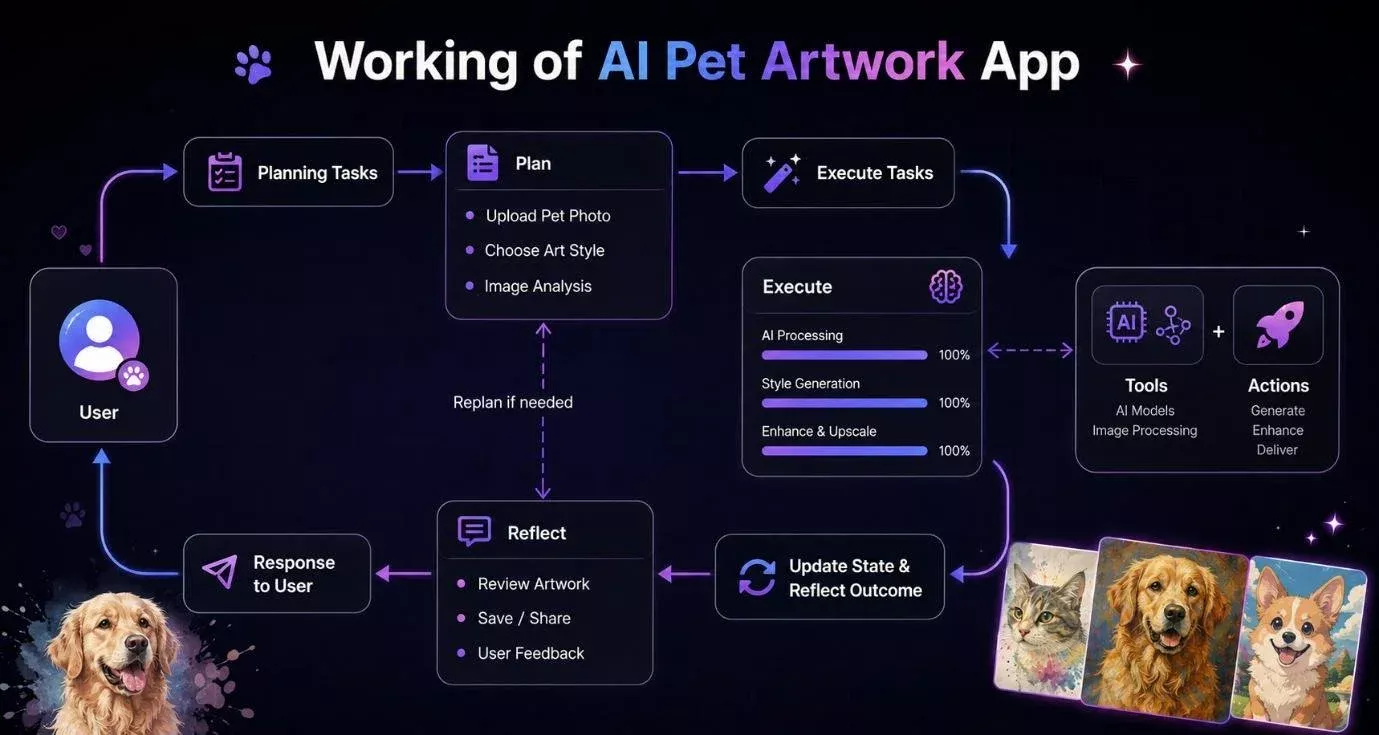
The process starts when a user uploads a pet photograph from a smartphone gallery, camera, computer, or connected photo library. The application can automatically evaluate the image for resolution, file size, lighting, sharpness, orientation, and subject visibility. This helps prevent unsuitable images from entering the AI generation workflow.
The next stage uses computer vision to identify the pet within the uploaded photograph. Depending on the application's capabilities, the system can analyze facial characteristics, fur color, body structure, markings, eyes, ears, and overall positioning.
Pet detection is particularly important for AI pet portrait app development because the generated artwork should maintain the recognizable characteristics of the original animal.
Before artwork generation, the system may improve the source image using image enhancement techniques. These can include background removal, cropping, noise reduction, sharpening, color correction, lighting adjustment, and resolution enhancement.
Better source-image preparation can improve the consistency and visual quality of AI-generated pet artwork.
The user can then choose a preferred artistic style. An AI pet artwork generator app may provide categories such as watercolor, oil painting, anime, cartoon, realistic portrait, pencil drawing, fantasy, pop art, or vintage artwork.
Advanced applications can also allow users to customize the background, color palette, composition, artistic intensity, or text prompt.
After the style is selected, the application sends the image and relevant instructions to an AI image-generation model. The model processes the reference photograph and generates a new artistic representation while attempting to preserve important characteristics of the pet.
Depending on the selected model and application architecture, the system can generate one image or multiple variations for the user to compare.
The initial AI output may then pass through additional image-processing stages. These can improve resolution, sharpen details, reduce artifacts, and prepare the artwork for digital downloads or physical printing.
For pet artwork app development with AI, this stage is important because users may expect the same artwork to look good both on a smartphone screen and on a high-resolution canvas print.
Once the artwork is ready, users can compare it with the original photo, regenerate another version, save it to their account, download the finished image, or share it on social media. A monetized application can also offer premium HD downloads, additional generations, exclusive styles, or physical products such as posters, framed portraits, mugs, and canvas prints.
The complete custom AI pet artwork app development process therefore connects several technologies behind one simple customer experience. A well-designed platform allows users to move from an ordinary pet photograph to a personalized AI artwork with minimal effort, while the underlying system handles image analysis, AI generation, processing, storage, delivery, and monetization.
Is 2026 the right time for a business owner to invest in an AI pet artwork app, especially when pet owners are becoming more selective about where they spend their money?
For entrepreneurs exploring AI pet artwork app development, the opportunity is not simply about adding an AI feature to an existing pet business. It is about identifying a specific intersection between the growing pet economy, personalized digital experiences, and the rapidly maturing capabilities of generative AI. A business owner considering pet artwork app development with AI should therefore evaluate the investment from a market, customer, technology, and scalability perspective.
According to the American Pet Products Association, the US pet industry is projected to reach $165 billion in sales in 2026, compared with $158 billion in 2025. This indicates that the underlying pet economy remains substantial even as consumers become more selective about discretionary spending. Morgan Stanley also projects US pet spending could reach $242 billion by 2030, with industry expansion expected to continue through the decade.
Pet businesses are no longer limited to food, toys, grooming, and veterinary products. The broader pet economy increasingly includes services, experiences, technology, personalization, and digital products.
For an entrepreneur, this creates a reason to examine AI pet artwork app development as a specialized digital offering within the wider pet ecosystem. The key question is not whether pet owners spend money, but which personalized experiences they consider worth paying for.
An AI artwork platform can be positioned around a specific customer need, such as creating a personalized portrait, preparing a pet gift, preserving a memory, or turning a favorite photograph into decorative artwork.
Another important reason to consider investment is the maturity of generative AI technology.
Earlier AI applications often required significant machine learning infrastructure and specialized technical expertise. Today, businesses can evaluate commercial AI models, hosted models, image-generation APIs, and open-source technologies before deciding whether they need proprietary AI development.
This changes the economics of how to create an AI pet artwork app. A startup does not necessarily need to build its own image-generation model from the beginning. It can validate the product using an appropriate existing model and gradually introduce customized AI capabilities as usage grows.
Generic AI image generators serve a broad audience. An AI pet artwork platform can take a narrower approach by designing the entire experience around pets.
That means the product can be built specifically around questions such as:
This focused product direction gives entrepreneurs a clearer scope when planning the custom AI pet artwork app development process.
An entrepreneur does not have to define the application as only an AI portrait generator.
The initial product can be designed around pet artwork while leaving room for future product categories such as:
This makes the initial technology investment more strategically important because the underlying image-processing and generation infrastructure can potentially support several related experiences.
The 2026 market is not simply a story of unlimited pet spending. Morgan Stanley reports that rising costs are making consumers more selective, with US pet industry growth expected to moderate to approximately 4% annually through 2030.
For someone asking, "Should I invest in an AI pet artwork app in 2026?", this is an important consideration.
The answer should not be based solely on market growth. Entrepreneurs need to determine whether their product has a clear reason for customers to spend money on it. An AI pet artwork app therefore needs focused positioning, carefully selected styles, predictable output quality, and a pricing structure aligned with the perceived value of personalized artwork.
One of the strongest reasons to consider investment is the ability to start with a controlled MVP.
A business does not necessarily need to launch with:
Instead, the initial AI pet artwork app development scope can focus on a smaller workflow:
Upload Photo → Select Style → Generate Artwork → Review → Download
This allows entrepreneurs to test the fundamental product assumption before committing to a much larger technical architecture.
AI applications have a unique investment consideration because every generation can create a variable technology cost.
A business owner should therefore evaluate metrics such as:
This makes building an AI pet artwork app different from launching a conventional content or photo-editing application. The financial model needs to account for both customer revenue and the computational cost of generating each artwork.
A pet artwork application can be tested across several customer groups without changing the fundamental technology.
For example, an entrepreneur could initially target:
Pet Owners: Personalized portraits and social content.
Gift Buyers: Custom artwork for birthdays and special occasions.
Pet Photographers: AI-enhanced creative services for their customers.
Pet Businesses: Branded artwork and customer engagement experiences.
Memorial Customers: Personalized artwork designed around meaningful pet memories.
This segmentation allows the business to identify which audience has the strongest commercial demand before expanding the product.
For a nontechnical founder, one of the biggest mistakes would be treating AI pet artwork app development as a requirement to build a sophisticated proprietary AI platform immediately.
A more practical investment approach is to validate:
Once these assumptions are validated, the company can decide whether to invest further in custom AI models, advanced personalization, physical products, or additional platforms.
For business owners, the real investment question is therefore not simply whether to build an AI pet artwork app, but whether they can identify a focused pet audience, validate willingness to pay, and build a sustainable AI-powered product around that demand.
The AI pet artwork app market is not limited to one product format. A founder can develop an application for everyday pet owners, professional artists, pet brands, e-commerce companies, social communities, memorial services, or digital collectible businesses.
Each model serves a different customer need and requires a different approach to AI pet artwork app development, from the AI architecture and user experience to integrations, pricing, and customer acquisition.
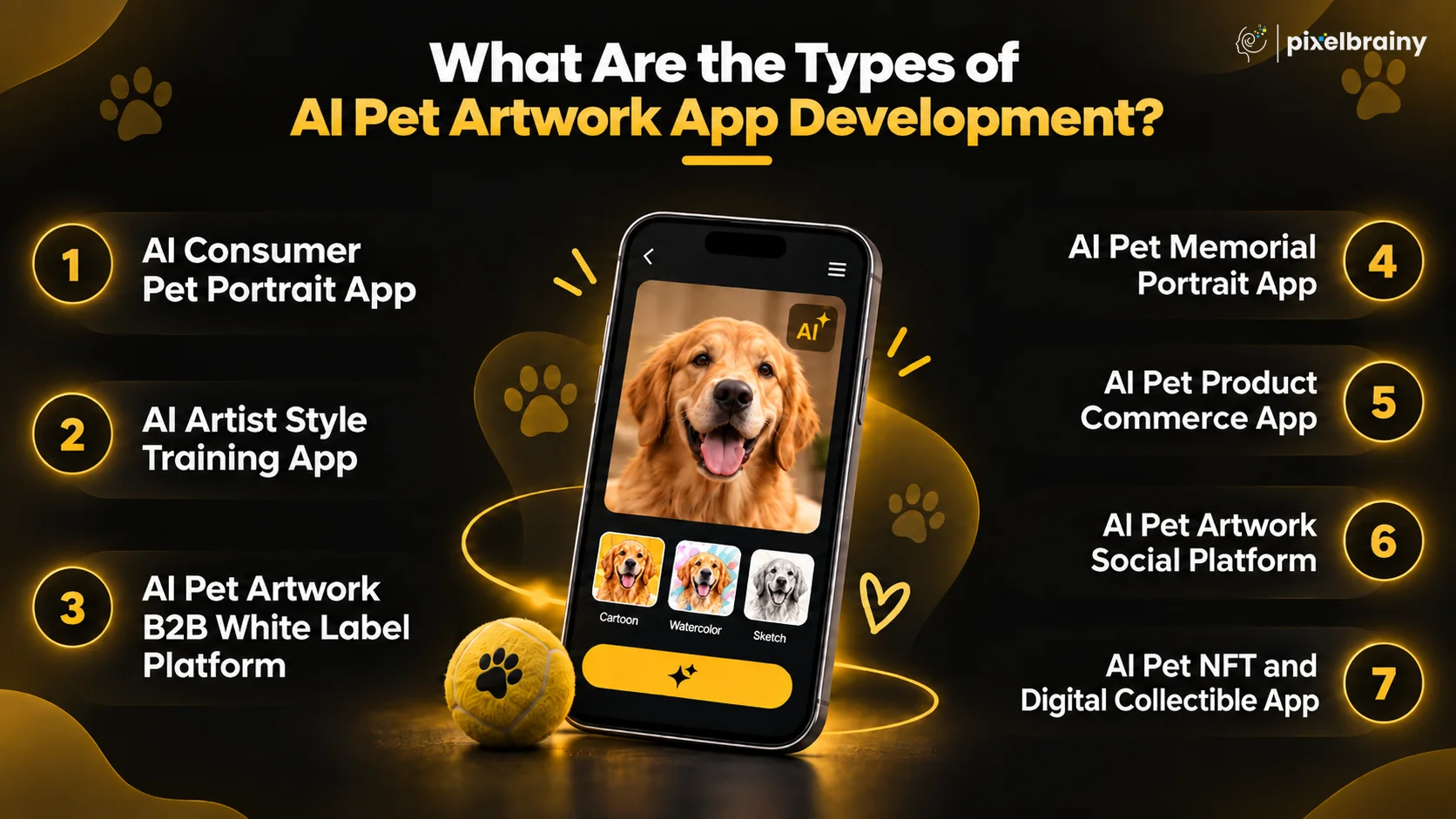
An AI consumer pet portrait app allows pet owners to upload photographs of their dogs, cats, or other animals and generate personalized artwork in styles such as watercolor, oil painting, anime, cartoon, sketch, or digital illustration. The artwork can be used for personal enjoyment, social sharing, gifting, or ordering physical prints.
Key product design implication: This is the broadest consumer category and one of the most competitive in 2026. To build an AI pet artwork app for this market, the product needs strong pet identity fidelity, a deep and consistently high-quality style library, fast generation, simple navigation, and a seamless connection between digital artwork and print ordering.
An AI artist style training app is built around the distinctive artistic identity of a professional pet portrait artist. With properly authorized artwork and appropriate model training or fine tuning, the application can generate portraits that reflect the artist's established visual language while allowing more customers to access the style without requiring every portrait to be hand painted.
Key product design implication: The application needs carefully controlled style generation, authorized training data, artist review workflows, quality controls, licensing considerations, and tools that protect the artist's creative identity. This model can be particularly relevant to a professional pet portrait artist looking to scale beyond the number of commissions that can be completed manually.
An AI pet artwork B2B white label platform allows pet brands, veterinary clinics, pet insurance providers, retailers, and other organizations to offer AI-generated pet artwork under their own branding. The underlying platform can support multiple business clients, with each tenant receiving customized branding, artwork styles, user journeys, analytics, and product integrations.
Key product design implication: A multi-tenant architecture becomes essential. The platform may require separate client configurations, APIs, authentication, billing, analytics, style libraries, permissions, and brand controls. This approach is especially relevant to businesses exploring how to build scalable AI pet artwork app for pet brands and veterinary clinic partnerships in 2026.
An AI pet memorial portrait app focuses on pet owners who have lost a beloved animal and want to create a lasting artistic tribute from existing photographs. Unlike general-purpose portrait applications, this model must account for older, damaged, blurry, or low-resolution photographs while providing an emotionally sensitive experience throughout the creation process.
Key product design implication: Image restoration and enhancement should be core capabilities, alongside pet feature preservation, privacy controls, memorial templates, personalized text, and high-resolution printing. For a founder targeting this niche, the product experience should feel respectful and supportive rather than overly focused on entertainment or social engagement.
An AI pet product commerce app uses artwork generation as the entry point to a larger personalized shopping experience. A customer could upload a pet photograph, generate an AI portrait, and immediately apply that artwork to canvas prints, greeting cards, photo books, mugs, phone cases, apparel, blankets, posters, and other personalized products.
Key product design implication: AI generation must connect directly with product customization and commerce infrastructure. A company that already sells greeting cards or personalized gifts can use the AI artwork experience to introduce personalization earlier in the customer journey, while product catalogs, pricing, checkout, print-on-demand, order management, and fulfillment operate behind the experience.
An AI pet artwork social platform combines generative AI with a community experience where pet owners can create artwork, share their creations, follow pet accounts, participate in style challenges, comment on artwork, and discover popular creations. The social layer gives users additional reasons to return after generating their first portrait.
Key product design implication: Beyond the AI generation engine, the platform needs profiles, feeds, likes, comments, sharing, notifications, discovery, moderation, challenges, and scalable image delivery. This model can be attractive to founders who understand consumer social products and want AI generation to become a recurring engagement mechanism rather than a one-time creative tool.
An AI pet NFT and digital collectible app combines personalized AI artwork with blockchain infrastructure. Users can generate several variations of their pet portrait, select a preferred creation, and potentially mint it as a unique digital collectible with associated ownership and metadata records.
Key product design implication: This model requires blockchain and wallet integration in addition to AI generation. The technical architecture may include smart contracts, metadata storage, minting infrastructure, wallet connectivity, transaction management, marketplace functionality, and appropriate compliance considerations. It is best suited to founders with experience in blockchain, digital collectibles, and Web3 products.
The type of AI pet artwork app development selected at the beginning directly influences the monetization model, technology architecture, third-party integrations, development scope, target customers, and user acquisition strategy, so the product model needs to be defined before the development roadmap and technical specifications are finalized.
A successful AI pet artwork app needs more than an AI image generator. The core product should provide a smooth journey from uploading a pet photo to generating, reviewing, saving, sharing, and purchasing artwork. For businesses planning AI pet artwork app development, these essential features establish the minimum product experience users expect while creating a reliable foundation for future functionality.
For example, if you are asking, “What features should I include when I develop an AI pet artwork app that lets users upload pet photos, choose artistic styles, generate portraits, and download or share the results?”, the priority should be a simple, reliable, and visually engaging core workflow rather than an overloaded application.
The following 15 features represent the essential functionality that should be considered when you build an AI pet artwork app for consumers or commercial use.
| Feature | Description |
|---|---|
| User Registration and Login | Users should be able to create accounts using email, Google, Apple, or other supported authentication methods. Account access allows artwork history, saved creations, purchases, and subscription information to remain synchronized across supported devices. |
| Pet Photo Upload | The app should allow users to upload pet photographs directly from their device gallery, camera, or file storage. Supporting common image formats and appropriate file sizes creates a smooth starting point for AI pet portrait generation. |
| Image Quality Check | Before processing begins, the application should evaluate image quality, resolution, brightness, sharpness, and pet visibility. Clear recommendations can help users upload better photographs and reduce unsuccessful AI generations caused by unsuitable source images. |
| Pet Photo Preview | Users should see their uploaded photograph before beginning generation, with options to confirm, replace, or remove the image. A preview step gives users confidence that the correct pet photograph has been selected. |
| Art Style Selection | A dedicated style selection interface should let users choose popular options such as watercolor, oil painting, anime, cartoon, sketch, realistic art, or pop art before starting AI artwork generation. |
| Style Categories | Organizing available artwork styles into clear categories makes discovery easier for users. Categories such as Classic, Artistic, Cartoon, Modern, and Illustration can help users quickly find suitable visual treatments without navigating an overwhelming list. |
| AI Artwork Generation | The central feature should process the uploaded pet photograph using an appropriate AI image-generation model and create artwork according to the selected style while maintaining important visual characteristics of the original animal. |
| Generation Progress Indicator | AI generation can take longer than conventional photo editing, so users should receive clear progress feedback. Processing indicators, status messages, or animated generation screens reduce uncertainty and make waiting feel more purposeful. |
| Multiple Artwork Results | The application should provide multiple generated variations when appropriate, allowing users to compare different results from the same photograph and select the version that best represents their preferred artistic appearance. |
| Artwork Preview | Users should be able to view the generated artwork at an appropriate resolution before downloading or purchasing it. A clear preview interface helps users evaluate composition, details, colors, and overall visual quality. |
| Regenerate Artwork | A regeneration option should allow users to request another result when the first artwork does not meet expectations. This feature is particularly important because generative AI results can vary between individual generations. |
| Download Artwork | Users should be able to save completed artwork directly to their devices. Download options can include standard digital resolution for social sharing and higher resolution for customers who intend to print their personalized pet artwork. |
| Social Sharing | Social sharing allows customers to publish their AI-generated pet portraits through supported platforms and messaging applications. Easy sharing can encourage organic product discovery while giving users a convenient way to showcase their personalized artwork. |
| Artwork History | A generation history should store previously created artworks within the user's account. This allows customers to revisit older portraits, download them again, compare different styles, or create additional versions without uploading the original photograph repeatedly. |
| Payment and Subscription Management | Commercial applications should provide secure payment functionality for premium generations, downloads, subscriptions, or artwork packages. Users should also be able to view plans, manage purchases, restore transactions, and access their available generation credits. |
These core features create the fundamental experience expected from modern AI pet portrait app development. They also give product teams a clear MVP structure without introducing advanced capabilities that require separate AI research, specialized infrastructure, or significantly higher development investment.
For entrepreneurs planning AI pet artwork app development, the essential workflow should remain straightforward: upload a suitable pet photo, choose an artwork style, generate the result, review the creation, and save, share, or purchase the finished artwork.
Once the core functionality of an AI pet artwork app is established, advanced capabilities can make the platform more personalized, intelligent, and commercially differentiated. These features are particularly useful for businesses planning to develop an AI pet artwork app that goes beyond basic photo-to-art generation and wants to support higher engagement, premium pricing, personalization, and additional revenue opportunities.
For example, a founder may ask, “What advanced features should I add when building an AI pet artwork app that can preserve a pet’s identity, create personalized scenes, support multiple pets, and eventually expand into premium digital and physical products?” The answer depends on the target audience and business model, but the following capabilities can provide a strong foundation for a more sophisticated product.
| Advanced Feature | Description |
|---|---|
| Pet Identity Preservation | Advanced AI can be designed to preserve distinctive characteristics such as facial structure, fur patterns, eye color, markings, ears, and breed-specific features across different artistic styles, helping generated artwork remain recognizable as the user's actual pet. |
| AI Background Generation | Users can replace ordinary backgrounds with AI-generated environments such as beaches, forests, royal rooms, fantasy landscapes, professional studios, or seasonal scenes while keeping the pet as the primary visual subject within the artwork. |
| Multi-Pet Artwork Generation | This capability allows users to upload photographs containing multiple pets or combine separate pet photographs into one artistic composition. The AI should maintain the recognizable characteristics and positioning of each animal within the generated artwork. |
| AI Style Recommendation | The application can analyze the uploaded pet photograph and recommend artistic styles based on composition, lighting, subject position, and image quality. This reduces decision fatigue and helps users discover styles that may produce stronger results. |
| Custom Prompt-Based Artwork | Advanced users can describe a desired scene or concept using natural language while providing their pet photograph as a reference. The AI can combine the pet's visual characteristics with instructions for environments, themes, poses, colors, and artistic direction. |
| AI Pet Character Creation | Users can transform their pets into customized fictional characters such as superheroes, astronauts, royalty, fantasy warriors, cartoon characters, or storybook personalities. This can turn an AI pet portrait app into a more entertainment-focused creative experience. |
| AI Image Restoration and Enhancement | Advanced restoration can improve old, damaged, blurry, faded, or low-resolution pet photographs before artwork generation. This is particularly valuable for memorial portraits and customers working with photographs that were captured many years ago. |
| High-Resolution AI Upscaling | AI-powered upscaling can increase the resolution of generated artwork while preserving important details. This becomes particularly useful when customers want to convert digital creations into large canvas prints, posters, framed portraits, or other physical products. |
| AI Pet Video Generation | A future-ready platform can transform static pet artwork into short animated videos using AI. Users could create subtle movements, cinematic camera effects, animated backgrounds, or short social media clips from their personalized pet artwork. |
| Print and Merchandise Personalization | Advanced product integration can allow users to automatically place generated artwork onto products such as canvases, mugs, apparel, phone cases, blankets, greeting cards, and photo books, connecting AI creation directly with personalized commerce. |
These advanced capabilities can help AI pet artwork app development move beyond a basic image-generation utility toward a more personalized creative platform. However, they can also increase AI infrastructure requirements, development time, model complexity, storage costs, and operational expenses, so each feature should be introduced according to the product's target audience and validated business demand.
For businesses looking to build an AI pet artwork app at scale, advanced functionality should complement the core generation experience rather than make the application unnecessarily complicated for first-time users.
Developing an AI pet artwork app involves much more than connecting an image-generation model to a mobile application. The process starts with identifying the right market opportunity and defining the product concept, then moves through AI validation, MVP planning, UI/UX design, application development, AI implementation, testing, launch, and continuous improvement.
For entrepreneurs searching for the steps to build an AI pet artwork app from idea to launch, each stage should have a clear purpose and measurable outcome. A structured AI pet artwork app development process can help startups control costs, reduce technical risks, and create a product that is ready to scale.
Whether you want to develop AI pet artwork app technology for consumers, professional artists, pet brands, or personalized product businesses, these eight steps provide a practical development roadmap.
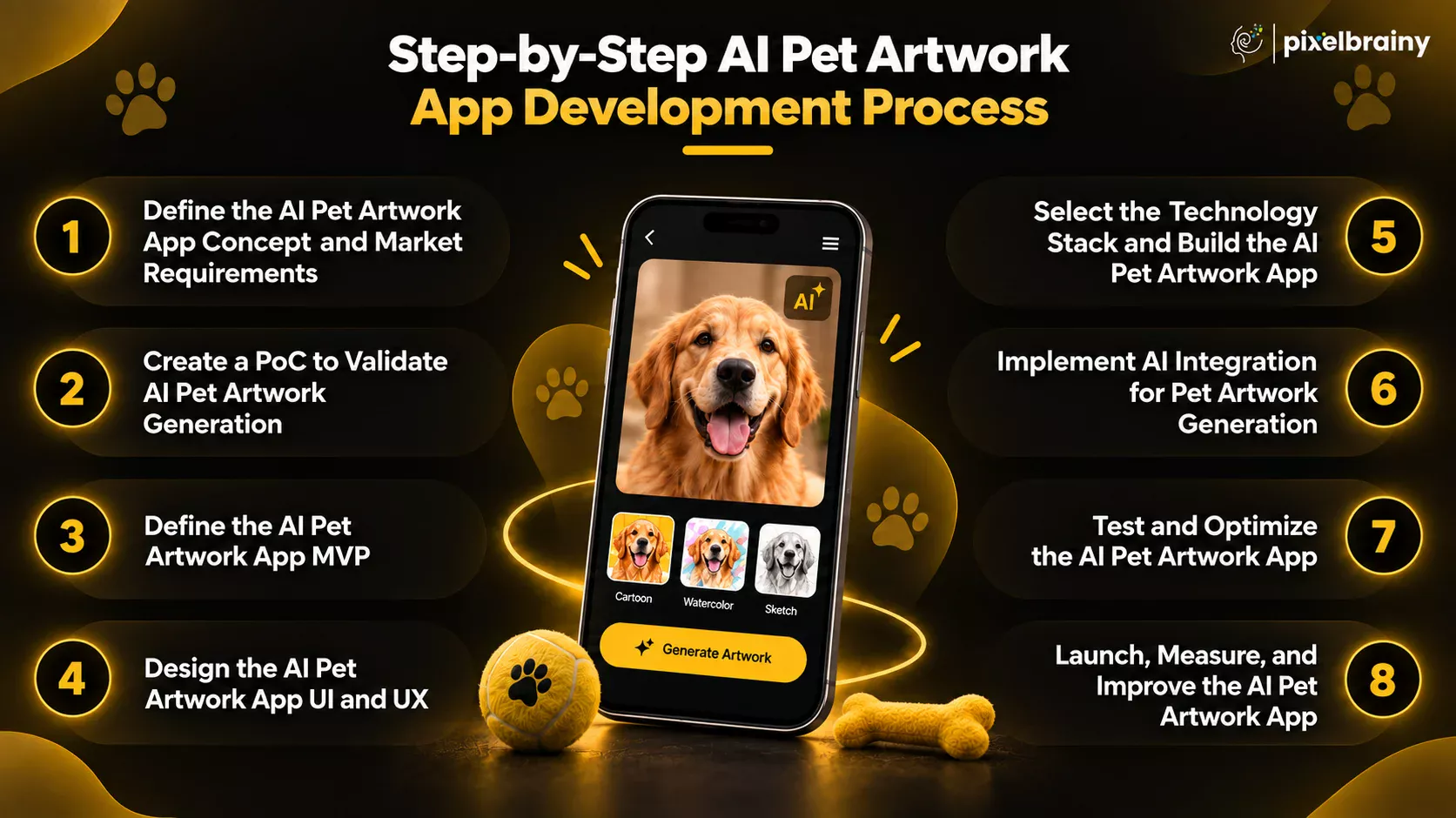
The first step in AI pet artwork app development is defining exactly what the product will offer, who will use it, and why customers would choose it over competing solutions.
A founder should determine whether the AI pet artwork app will focus on consumer portraits, memorial artwork, personalized merchandise, professional artists, pet businesses, or B2B partnerships.
Market research should examine competitors, artwork styles, pricing models, customer expectations, generation quality, and existing gaps. This helps establish a clear product position before technical development begins.
For startups, this stage can prevent unnecessary investment in features that customers may not actually need. Businesses can use AI consultation to evaluate the product concept, technical feasibility, target audience, monetization strategy, and long-term roadmap.
Before building the complete application, the core AI pet artwork functionality should be tested through a small technical experiment.
PoC development can determine whether the selected AI approach can transform real pet photographs into attractive artwork while maintaining recognizable characteristics such as facial structure, fur patterns, colors, and distinctive markings.
Developers can test different image-generation models, image-to-image workflows, prompts, preprocessing methods, and enhancement techniques using photographs of different breeds and image qualities.
The goal at this stage is not to create a finished AI pet artwork app. Instead, the objective is to establish whether the AI technology can consistently deliver the quality required for the intended product.
Once the AI concept demonstrates technical feasibility, the next stage is defining the minimum viable product. MVP development should concentrate on the essential customer journey rather than attempting to include every possible feature from the beginning.
A practical AI pet artwork app MVP could include user registration, pet photo upload, image quality validation, artwork style selection, AI generation, preview, regeneration, download, sharing, payment, and artwork history.
The product requirements should also establish supported platforms, expected generation time, image resolution, storage requirements, pricing, generation limits, and estimated AI costs.
A focused MVP allows businesses to launch sooner, collect real customer feedback, and determine whether users are actually willing to pay for AI-generated pet artwork before investing in advanced functionality.
Also Read: Top 10 AI MVP Development Companies in USA
The user experience should make the complex AI pet artwork generation process feel simple. Users should not need technical knowledge to create a personalized portrait.
During this stage, designers create wireframes, user journeys, prototypes, visual designs, and interaction patterns for screens such as onboarding, photo upload, style selection, generation progress, artwork preview, payment, and artwork history.
Working with a professional UI/UX design company can help create an interface that is visually engaging while maintaining a simple customer journey.
The central workflow should remain easy to understand:
Upload Pet Photo → Choose Artwork Style → Generate → Review → Save, Share, or Purchase
Clear generation progress indicators should also be included because AI image processing can take longer than conventional photo-editing operations.
The technology architecture should be selected according to the application's expected user volume, AI requirements, budget, supported platforms, and future expansion plans.
The frontend may use native or cross-platform technologies, while the backend can use technologies such as Python, Node.js, or other suitable frameworks. Cloud infrastructure can support authentication, databases, image storage, processing, content delivery, and application scaling.
At this stage, AI model development may involve selecting, configuring, evaluating, or fine-tuning image-generation models according to the application's requirements.
The development team also builds APIs, database structures, payment functionality, image storage, analytics, user management, and administrative tools that allow the AI pet artwork platform to operate as a complete product.
The AI layer connects the application with the image-generation infrastructure. AI integration can include pet photo uploading, image validation, pet detection, preprocessing, model inference, artistic style application, output validation, enhancement, upscaling, and final image delivery.
The development team also needs to establish how images move securely through the system and how generation requests are handled when many customers request artwork simultaneously.
AI infrastructure costs should be monitored carefully because each artwork generation can create a variable operational expense. The team should therefore evaluate generation speed, model quality, GPU or API costs, storage, and scalability during implementation.
Depending on the product requirements, the AI pet artwork app may use a commercial AI API, hosted model, open-source model, or customized AI solution.
Testing an AI pet artwork app requires more than checking whether buttons and screens work correctly. The generated artwork itself must be evaluated across a wide range of real-world photographs.
Testing should include different dog and cat breeds, fur colors, poses, lighting conditions, backgrounds, image resolutions, and multi-pet photographs. The development team should evaluate whether the AI preserves important characteristics and produces consistent artistic results.
The application should also undergo functional testing for authentication, payments, downloads, subscriptions, storage, notifications, and account management.
AI outputs should be assessed for identity preservation, unwanted artifacts, resolution, style accuracy, and overall visual quality. Businesses can also compare their development approach with practices followed by top AI app development companies to identify potential scalability, security, and performance gaps.
A controlled beta launch can then provide feedback from real pet owners before the AI pet artwork application reaches a wider audience.
Launching an AI pet artwork app is not the end of the development process. Once the product reaches the market, continuous measurement and optimization become essential.
Businesses should monitor metrics such as user acquisition, activation, number of artwork generations, generation success rate, processing time, AI cost per generation, downloads, sharing, purchases, subscriptions, retention, and customer feedback.
These metrics can reveal which artwork styles customers prefer, how frequently users generate new portraits, which pricing model performs best, and whether the AI generation cost is sustainable.
AI product development companies can support ongoing improvements through model optimization, infrastructure scaling, product experimentation, and new feature development.
New capabilities should be introduced according to measurable customer demand rather than assumptions. This allows the AI pet artwork app development for startups to evolve while maintaining sustainable technology costs and a strong customer experience.
A structured development process helps entrepreneurs move from an initial concept to a validated, scalable AI pet artwork app while keeping business objectives, AI performance, user experience, and development investment aligned.
Also Read: AI Mobile App Development for Startups and Enterprises
The cost to develop an AI pet artwork app can vary significantly depending on the application's features, AI architecture, supported platforms, design complexity, development team, integrations, and expected user volume. For a realistic 2026 planning range, an AI pet artwork app development cost can start around $30,000 for a focused MVP and exceed $250,000 for an enterprise-grade platform with advanced AI capabilities, complex integrations, and scalable infrastructure.
Recent 2026 development-cost research also shows that AI applications can range from tens of thousands of dollars for focused products to several hundred thousand dollars for complex production systems. Zoho's 2026 analysis places complex applications with AI, machine learning, or AR/VR capabilities at $250,000+, while Iternal estimates production AI applications at approximately $80,000 to $250,000, with enterprise platforms exceeding $250,000.
So, if a founder asks, “What is the development pricing of an AI pet artwork app in 2026 if I want users to upload pet photos, generate multiple artistic styles, download high-resolution artwork, and eventually support subscriptions and physical products?”, the answer depends primarily on the required product scope and AI implementation approach.
| AI Pet Artwork App Type | Estimated Development Cost | Typical Scope |
|---|---|---|
| Basic AI Pet Artwork App | $30,000 to $60,000 | Core AI image generation, photo upload, limited art styles, user accounts, basic backend, artwork download, basic payments, and admin functionality |
| Advanced AI Pet Artwork App | $60,000 to $150,000 | Multiple AI styles, improved pet identity preservation, image enhancement, subscriptions, social sharing, generation history, advanced backend, analytics, cloud infrastructure, and multi-platform support |
| Enterprise AI Pet Artwork App | $150,000 to $250,000+ | Custom AI workflows, advanced personalization, high-volume generation, multi-tenant architecture, enterprise integrations, e-commerce, print fulfillment, advanced security, analytics, scalable infrastructure, and custom AI capabilities |
These figures represent development planning ranges rather than fixed quotations. Current 2026 market estimates similarly show that project scope, complexity, platform choice, integrations, infrastructure, and AI requirements can move an application from a relatively small MVP budget to several hundred thousand dollars.
The AI pet artwork app development cost depends mainly on the application's AI complexity, feature scope, platform requirements, and expected scale. The major cost factors include:
The choice between a third-party AI image-generation API, hosted open-source model, fine-tuned model, or custom AI model has a major impact on the budget. API-based solutions generally require lower upfront investment, while custom AI model development requires additional expertise, training, testing, GPU infrastructure, and maintenance.
If the app only applies basic artistic effects, development can remain relatively straightforward. However, accurately preserving a pet's facial features, fur patterns, eye color, markings, and breed characteristics requires more sophisticated AI workflows, image processing, testing, and potentially model customization.
An application offering a few styles such as watercolor, cartoon, and oil painting will generally require less development than one supporting dozens or hundreds of specialized styles. Each style needs appropriate AI configuration, quality testing, prompt optimization, and potentially different processing workflows.
Developing for iOS, Android, and web requires more resources than launching on a single platform. The number of screens, customization options, animations, onboarding flows, artwork previews, payment screens, and user journeys also affects the overall cost estimation of AI pet artwork app development.
The backend must handle user accounts, image uploads, AI processing requests, storage, downloads, payments, and artwork history. AI applications also generate ongoing costs for GPU processing or API calls, image storage, bandwidth, and scaling, particularly when users generate multiple high-resolution artworks.
Integrations with payment gateways, AI APIs, cloud storage, print-on-demand services, e-commerce platforms, analytics tools, and social platforms can increase both development and testing requirements. More integrations generally mean more engineering work and ongoing maintenance.
Subscriptions, credit systems, premium artwork, print ordering, white-label functionality, B2B accounts, and multi-tenant capabilities can significantly increase development complexity. An application designed for enterprise customers will typically require more sophisticated billing, permissions, analytics, and administration than a basic consumer app.
A production-ready AI pet artwork app needs secure image storage, authentication, data protection, monitoring, backups, and scalable infrastructure. Businesses should also budget for post-launch maintenance, AI model updates, API changes, bug fixes, cloud optimization, and new operating-system versions.
These factors should be evaluated together when calculating the AI pet artwork app development cost, because reducing the initial build price without considering AI operating expenses and future scalability can lead to a higher total cost over time.
For a startup validating the concept, $30,000 to $60,000 is a reasonable planning range for a focused basic AI pet artwork MVP using existing AI services and a controlled feature set.
For a commercially mature application with multiple styles, subscriptions, advanced image processing, stronger pet identity preservation, analytics, and multi-platform support, the budget can move toward $60,000 to $150,000.
For an enterprise-grade platform requiring custom AI workflows, high-volume generation, e-commerce integrations, white-label functionality, advanced security, and scalable infrastructure, the budget can reach $150,000 to $250,000+.
The most important distinction is between the one-time development budget and the ongoing operating cost. AI inference, cloud infrastructure, image storage, monitoring, maintenance, third-party APIs, and support can continue generating expenses after launch, so these costs should be included in the financial model from the beginning.
A realistic AI pet artwork app development cost therefore depends less on the fact that the product uses AI and more on the level of AI sophistication, application complexity, expected scale, integrations, and business requirements defined before development begins.
Also Read: AI App Development Cost in 2026: From MVPs to Full-Scale AI App
An AI pet artwork app business model determines how the application generates revenue from AI-powered pet artwork while covering image-generation, infrastructure, storage, marketing, and operational costs. For founders planning AI pet artwork app development, monetization should be considered alongside the product concept because the chosen revenue model affects features, pricing, AI usage limits, payment infrastructure, customer retention, and overall product strategy.
A common question from entrepreneurs is: “How can I monetize an AI pet artwork app if users want to generate pet portraits in different styles, download high-resolution artwork, and potentially order personalized products?” The answer depends on whether the application targets individual pet owners, frequent creators, professional artists, e-commerce customers, pet brands, or enterprise clients.
The following business models cover the major ways an entrepreneur can generate revenue from an AI pet artwork platform.
The freemium model allows users to experience the core AI pet artwork functionality without paying initially. Users may receive a limited number of free generations, while premium features such as additional artwork styles, HD downloads, watermark removal, faster processing, and increased generation limits require payment.
This model works because users can evaluate the quality of the AI pet portraits before committing financially. The free experience can also help the business attract a larger audience through social sharing and word-of-mouth discovery.
Revenue source: Premium upgrades, paid generations, subscriptions, and digital downloads.
Best suited for: Consumer-facing AI pet portrait apps focused on user acquisition and conversion.
A credit-based model charges users according to how much they use the AI artwork-generation service. Customers purchase a specific number of credits, and each generation consumes credits depending on the selected style, resolution, or processing requirements.
For example, a basic generation could consume one credit, while an HD generation or advanced processing workflow could require multiple credits.
This approach is particularly relevant to AI applications because revenue can be linked directly to usage, making it easier to manage variable AI inference costs.
Revenue source: Credit packs and individual generation purchases.
Best suited for: Users who generate pet artwork occasionally and do not want a recurring subscription.
A subscription-based AI pet artwork app monetization strategy provides users with recurring access to a defined number of generations and premium capabilities.
A platform could offer:
Basic Plan: Limited monthly generations and standard artwork styles.
Pro Plan: More monthly generations, premium styles, HD downloads, and faster processing.
Premium Plan: Higher generation limits, exclusive styles, priority processing, and additional customization.
Subscriptions provide recurring revenue and can encourage customers to use the application regularly rather than making only one purchase.
Revenue source: Monthly or annual subscription fees.
Best suited for: Frequent users, pet content creators, influencers, and customers who regularly create new artwork.
The pay-per-artwork model allows customers to purchase individual AI-generated pet portraits rather than subscribing to the platform.
For example, a user could pay for one premium digital portrait, a high-resolution printable version, or a professionally enhanced artwork package.
This model can be particularly relevant for emotionally significant purchases such as memorial portraits, birthday gifts, adoption celebrations, or special occasions.
Revenue source: Individual artwork purchases.
Best suited for: Occasional users and customers seeking high-value personalized artwork.
In this model, AI artwork generation becomes the starting point for a personalized product-commerce experience. After creating a pet portrait, customers can apply it to physical products such as canvas prints, framed artwork, mugs, greeting cards, phone cases, apparel, blankets, posters, and photo books.
Here, the AI artwork acts as the personalization engine, while the physical product becomes the primary revenue generator.
This model can be particularly attractive for a company that already operates in personalized gifts, greeting cards, or e-commerce.
Revenue source: Product sales and profit margins from personalized merchandise.
Best suited for: E-commerce companies, personalized gift businesses, and print-on-demand brands.
A B2B white-label model allows other organizations to offer AI-generated pet artwork under their own brand identity.
For example, pet brands, veterinary clinics, pet insurance companies, retailers, and animal-focused organizations could integrate personalized AI artwork into customer engagement campaigns.
The technology provider manages the underlying AI infrastructure while each business receives customized branding, artwork styles, user flows, and potentially its own product catalog.
Revenue source: Setup fees, monthly licensing, annual contracts, usage-based charges, or enterprise packages.
Best suited for: Companies building an AI pet artwork platform for multiple business clients.
Professional pet portrait artists can use AI to extend their creative capacity beyond manually painted commissions.
The application can be developed around an artist's authorized artwork and distinctive visual style, allowing customers to purchase AI-generated portraits that reflect the artist's established aesthetic.
Revenue can come from individual artwork sales, subscriptions, style licensing, or revenue-sharing arrangements.
This model combines the commercial value of an established artist's reputation with the scalability of AI-generated artwork.
Revenue source: Artwork purchases, licensing fees, commissions, or revenue sharing.
Best suited for: Professional pet artists, creative studios, and established art brands.
An AI pet artwork marketplace can allow artists and creators to publish specialized styles, templates, backgrounds, or creative packages for customers to purchase.
For example, one artist could create a watercolor pet style while another offers fantasy character templates. Customers can browse the marketplace and select the creative experience they prefer.
The platform earns a percentage from every transaction while creators receive a share of the revenue.
Revenue source: Transaction commissions and creator marketplace fees.
Best suited for: Platforms aiming to build a creator ecosystem around AI pet artwork.
An established AI pet artwork company can eventually offer its image-generation capabilities through an API.
Third-party businesses could integrate the technology into their own websites, mobile applications, e-commerce platforms, pet photography services, or customer loyalty programs.
The provider can charge based on API requests, generated images, resolution, monthly usage, or enterprise licensing.
This approach changes the business from an individual consumer application into an AI pet artwork technology platform.
Revenue source: API usage charges, enterprise licensing, and monthly contracts.
Best suited for: AI startups and technology companies targeting B2B customers.
A free AI pet artwork application can generate revenue through advertising and sponsored partnerships with relevant pet businesses.
Potential partners include:
Advertising should remain relevant to the user's experience. Excessive advertising can interfere with artwork creation and reduce premium conversion.
Revenue source: Advertising placements and sponsored campaigns.
Best suited for: Consumer platforms with significant traffic and strong user engagement.
An AI pet artwork application can recommend complementary products after users create their artwork.
For example, the application could recommend frames, canvas products, personalized gifts, pet accessories, or related services.
When customers purchase through an affiliate link or integrated recommendation, the application receives a commission.
Affiliate revenue is generally more suitable as a supplementary monetization channel rather than the primary revenue model.
Revenue source: Affiliate commissions.
Best suited for: Consumer applications with strong product discovery and shopping activity.
A hybrid model combines multiple monetization strategies within one application.
For example:
Free Generations + Credits + Subscription + Print-on-Demand
A new user could receive several free generations, purchase additional credits when needed, subscribe for frequent usage, or order physical products featuring their AI-generated pet artwork.
This approach allows different customer segments to choose the payment method that best matches their behavior.
Occasional users can pay for individual artwork, frequent users can subscribe, and high-value customers can purchase premium physical products.
Revenue source: Multiple complementary revenue streams.
Best suited for: Scalable consumer platforms with different customer segments and multiple product opportunities.
The best AI pet artwork app business model depends on the target market, expected usage frequency, AI generation cost, customer willingness to pay, and whether the company sells digital artwork, physical products, or technology services.
| Business Model | Best Target Market | Main Revenue Source |
|---|---|---|
| Freemium | Mass consumer audience | Premium upgrades |
| Credit-Based | Occasional AI users | Credit purchases |
| Subscription | Frequent users | Recurring payments |
| Pay-Per-Artwork | One-time customers | Individual artwork |
| Print-on-Demand | E-commerce customers | Physical products |
| B2B White Label | Pet brands and organizations | Licensing and contracts |
| Artist Licensing | Professional artists | Artwork and licensing |
| Marketplace | Creators and artists | Transaction commissions |
| API | B2B technology customers | Usage-based pricing |
| Advertising | Large free platforms | Advertising revenue |
| Affiliate | Product-focused audiences | Referral commissions |
| Hybrid | Broad consumer market | Multiple revenue streams |
The right AI pet artwork app revenue model depends on the target audience, usage frequency, AI generation costs, and whether the business focuses on digital artwork, physical products, or B2B services. Pricing should balance customer value with AI, infrastructure, and operational costs to maintain sustainable growth.
An AI pet artwork app brings together several technologies rather than relying on a single AI model. The application needs a frontend for uploading photos and displaying artwork, a backend for managing users and generation requests, AI models for image transformation, cloud infrastructure for processing and storage, and APIs for payments, analytics, and other services.
For entrepreneurs asking, “What technologies do I need to develop an AI pet artwork app that can transform pet photos into multiple artistic styles while remaining scalable and cost-efficient?”, the answer depends on the application's scope, expected traffic, AI quality requirements, and business model. A basic AI pet portrait app development project can use existing AI APIs and cloud services, while an enterprise platform may require customized models, GPU infrastructure, advanced computer vision, and multi-tenant architecture.
The technology stack used for AI pet artwork app development should therefore be planned around four core requirements: image quality, generation speed, scalability, and operating cost. The following technologies form the primary foundation of an AI-powered pet artwork platform.
| Technology Layer | Common Technologies | Role in an AI Pet Artwork App |
|---|---|---|
| Mobile App Development | Flutter, React Native, Swift, Kotlin | Builds the iOS and Android experience for photo uploads, style selection, artwork generation, previews, downloads, and account management. |
| Web Development | React, Next.js, TypeScript | Supports browser-based AI pet artwork platforms, customer dashboards, web generation workflows, and e-commerce experiences. |
| Backend Development | Python, Node.js, FastAPI, Django | Handles user accounts, API requests, artwork-generation jobs, payments, business logic, authentication, and communication between application components. |
| AI Image Generation | Diffusion models, commercial image APIs, hosted AI models | Converts pet photographs into artistic outputs while following selected styles, prompts, and image-generation instructions. |
| Computer Vision | OpenCV, image segmentation models, vision models | Detects pets, analyzes photographs, separates subjects from backgrounds, and prepares images for AI artwork generation. |
| AI Model Development | PyTorch, TensorFlow, model fine tuning | Supports custom AI workflows, model experimentation, fine tuning, evaluation, and specialized pet artwork capabilities. |
| Image Enhancement | AI upscaling, restoration models, image-processing libraries | Improves source photographs and generated artwork through restoration, sharpening, resolution enhancement, and artifact reduction. |
| Cloud Infrastructure | AWS, Google Cloud, Microsoft Azure | Provides scalable computing, GPU processing, object storage, databases, networking, monitoring, and application deployment. |
| Database | PostgreSQL, MySQL, MongoDB, Redis | Stores user accounts, artwork metadata, subscriptions, transactions, generation history, preferences, and application data. |
| Cloud Image Storage | Amazon S3, Google Cloud Storage, Azure Blob Storage | Stores uploaded pet photographs and AI-generated artwork securely while supporting scalable access and delivery. |
| API and Integration Layer | REST APIs, GraphQL, webhooks | Connects the AI pet artwork application with AI models, payment systems, storage services, analytics platforms, and external business tools. |
| Payment Technology | Stripe, Apple In-App Purchase, Google Play Billing | Enables subscriptions, credit purchases, premium artwork payments, and other monetization options within supported platforms. |
| Analytics | Google Analytics, Firebase Analytics, Mixpanel | Tracks user behavior, artwork generation activity, conversion rates, retention, revenue, and feature performance. |
| Security and Authentication | OAuth, JWT, Firebase Authentication, cloud security services | Protects user accounts, uploaded photographs, payment information, APIs, and other application data. |
| AI Monitoring and Operations | Cloud monitoring, logging, model evaluation tools | Tracks AI performance, generation failures, processing times, infrastructure usage, API costs, and system reliability. |
A typical AI pet artwork app development using AI architecture can follow this structure:
Mobile/Web App → Backend API → Image Processing → AI Generation Model → Quality Enhancement → Cloud Storage → Artwork Delivery
Supporting services can connect around this architecture for authentication, payments, analytics, notifications, monitoring, and administration.
The technology stack should ultimately match the product's AI requirements, target users, expected scale, budget, and long-term business model rather than simply using the newest technology available.
Developing an AI pet artwork app involves several challenges that can affect image quality, user satisfaction, operating costs, and long-term scalability. While generative AI can transform pet photographs into impressive artwork, businesses need to address the technical and commercial limitations before launching the product.
For founders asking, “What are the biggest challenges when developing an AI pet artwork app, and how can I solve them without increasing development costs unnecessarily?”, the following six challenges deserve the most attention during planning and development.
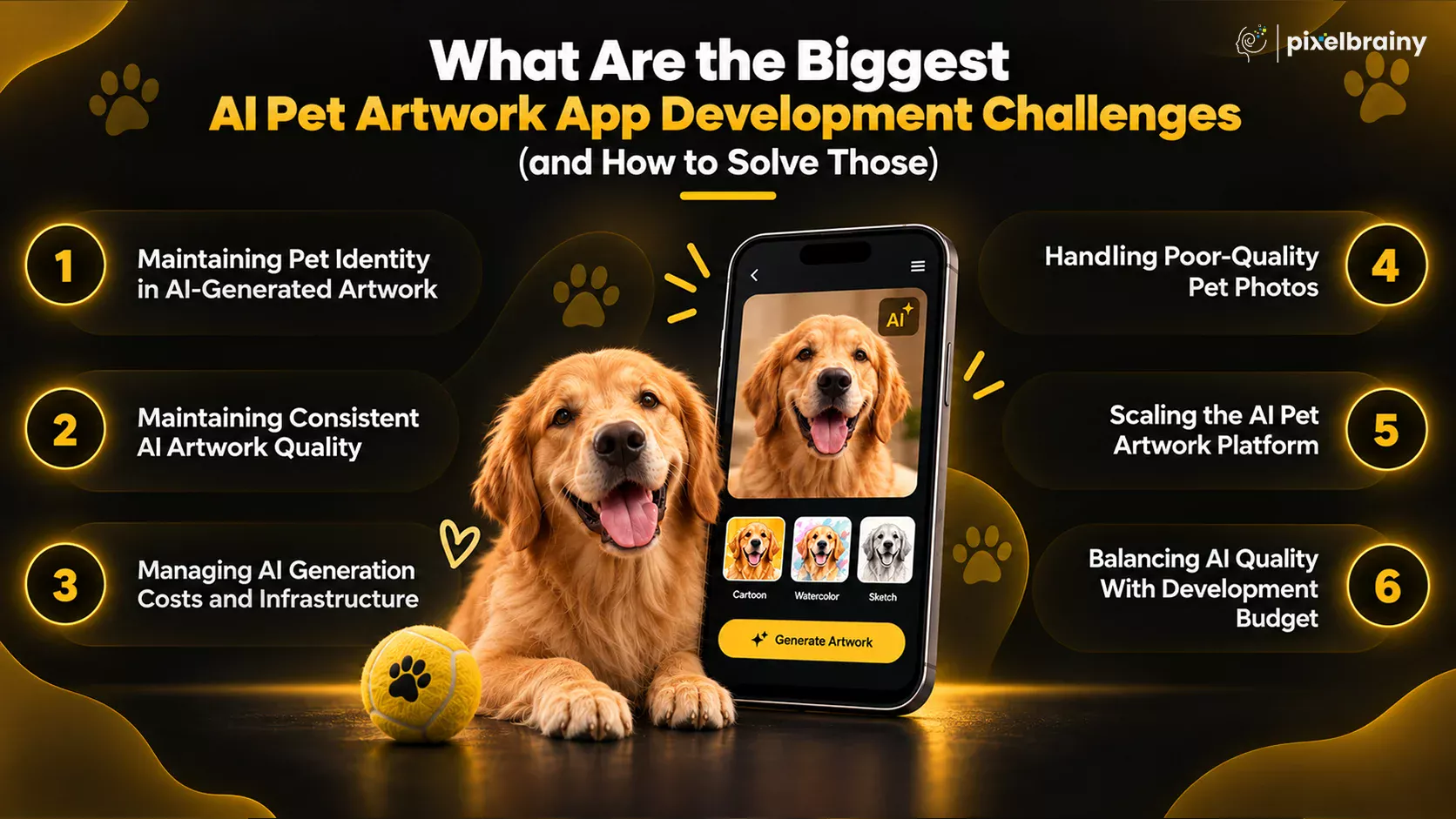
The biggest challenge in AI pet portrait app development is making sure the generated artwork still looks like the user's actual pet.
AI models can sometimes change important characteristics such as fur patterns, eye color, facial structure, ear shape, nose characteristics, or distinctive markings. A beautiful image that does not resemble the customer's pet can significantly reduce the perceived value of personalized artwork.
How to solve it: Use image-to-image generation, reference conditioning, segmentation, preprocessing, and identity-preservation techniques. Test the system across different breeds, colors, poses, and photographs to evaluate how consistently the AI preserves recognizable pet characteristics.
Generative AI does not guarantee the same quality for every photograph or generation. One pet image may produce an excellent watercolor portrait, while another may contain distorted features, unnatural anatomy, strange backgrounds, or other visual artifacts.
This becomes particularly important when users are paying for individual generations or premium artwork.
How to solve it: Use carefully tested AI models, prompts, preprocessing workflows, output validation, and image enhancement. Providing multiple variations and a regeneration option can also give customers more control over the final artwork.
Every artwork generation can create costs related to AI API usage, GPU processing, image storage, bandwidth, and additional image enhancement. These expenses can increase quickly when users generate multiple high-resolution variations.
An unlimited subscription model can become particularly risky if the average customer's AI usage costs more than the revenue generated from that customer.
How to solve it: Monitor the cost per generation and optimize model selection, image resolution, inference settings, GPU utilization, and processing workflows. Credit-based pricing, generation limits, and carefully structured subscription plans can help maintain healthier unit economics.
Users will not always upload professional-quality photographs. Some images may be blurry, dark, low resolution, poorly framed, or partially obstructed. Sending these photographs directly into an AI generation workflow can produce disappointing artwork.
This challenge is especially important for AI pet artwork apps targeting memorial portraits because customers may only have access to old or damaged photographs.
How to solve it: Add automated image-quality analysis before generation. The application can detect poor lighting, blur, low resolution, or unclear pet visibility and recommend a better photograph. AI image restoration and enhancement can also improve older photographs before artwork generation.
An application may work smoothly during beta testing but encounter performance problems when thousands of customers begin generating artwork simultaneously. Increased demand can create GPU shortages, longer processing times, API limits, storage requirements, and rapidly increasing infrastructure expenses.
Scalability therefore needs to be considered during the initial AI pet artwork app development process rather than after the platform experiences performance problems.
How to solve it: Use scalable cloud infrastructure, processing queues, load management, autoscaling, CDN delivery, efficient storage, and continuous monitoring. The architecture should allow computing resources to increase according to actual demand.
Founders often want advanced AI models, dozens of artwork styles, high-resolution generation, custom model development, e-commerce, subscriptions, social features, and personalization in the first version.
Building everything simultaneously can significantly increase development costs without proving whether customers actually want those capabilities.
How to solve it: Begin with a focused MVP containing the essential experience and a limited number of high-quality styles. Measure generation costs, customer satisfaction, conversion, repeat usage, and retention before investing in advanced AI capabilities.
Addressing these six challenges early can help an AI pet artwork app deliver recognizable artwork, maintain sustainable AI costs, handle growing demand, and provide a reliable experience for customers.
From the above discussion, it is now time to identify a development partner that can turn an AI pet artwork concept into a practical, scalable, and market-ready product. The right partner should understand not only AI image generation, but also product strategy, user experience, application engineering, cloud infrastructure, and long-term product growth.
A common founder query is, “I have an AI pet artwork idea but no technical team. How can I turn my concept into a reliable application with AI image generation, personalized pet portraits, payments, and a scalable backend?” The answer starts with finding a technology partner capable of connecting the creative idea with the right technical architecture.
PixelBrainy is positioned as an AI app development company offering expertise across generative AI, computer vision, AI integration, and AI product development.
An AI pet artwork product can become a consumer portrait application, memorial artwork platform, artist-focused solution, personalized merchandise product, or B2B platform. Each direction requires a different technical and commercial approach.
PixelBrainy can help define the target audience, core use case, MVP scope, AI workflow, monetization approach, and technology roadmap before development begins.
Its generative AI capabilities can support applications involving AI image generation, customized visual experiences, and intelligent image-processing workflows.
AI pet artwork app development services need to cover more than simply connecting an image-generation API.
A complete product may require:
PixelBrainy's end-to-end approach can help businesses move from product validation and UX through AI implementation, application development, deployment, and ongoing optimization.
A founder does not necessarily need to invest in the complete application from day one. A focused proof of concept can first validate whether AI can generate recognizable and commercially useful pet artwork.
PixelBrainy can support PoC and MVP development, helping businesses test the core idea before committing to a larger platform.
As the product grows, scalable architecture becomes increasingly important for managing image generation, storage, processing queues, cloud resources, and growing user demand.
An AI pet artwork application should make complex technology feel simple for ordinary pet owners. The primary experience can remain straightforward:
Upload Photo → Select Style → Generate → Review → Save or Purchase
PixelBrainy's UX and AI integration capabilities can help connect the visual experience with the underlying AI technology while maintaining a user-friendly workflow.
Flexible integration is also important because AI models and providers continue to evolve. A well-structured application can make it easier to introduce improved models, new artwork styles, or additional AI capabilities as the business grows.
For confidentiality, the client's identity and commercially sensitive information are not disclosed.
Project requirement: A business needed an AI-powered computer vision system to automate visual inspection and reduce manual processes.
PixelBrainy's approach: The team developed a real-time AI visual inspection workflow designed to analyze visual information automatically and support operational decision-making.
Reported results: The published case study achieved 94% detection accuracy, 68% reduction in manual inspection effort, 40% reduction in downstream rework during the first quarter, and production deployment within 12 weeks.
While the project was not a pet artwork application, the experience demonstrates the importance of developing reliable visual AI pipelines, integrating AI into real-world workflows, and preparing AI systems for production use.
For businesses looking to build AI pet artwork app technology for consumers, professional artists, pet brands, personalized gift companies, or B2B customers, PixelBrainy can help connect the product vision with AI engineering, application development, and scalable technology.
For businesses exploring pet artwork app development integrating AI, the right development partner can make the difference between an interesting AI concept and a reliable commercial product.
Ready to Turn Your AI Pet Artwork Idea Into Reality?
Connect with PixelBrainy to discuss your app concept, development scope, AI technology, and product roadmap.

An AI pet artwork app can turn a simple pet photograph into a highly personalized digital experience, but its success depends on much more than the AI generation model. The right app concept, artwork styles, core features, AI technology, development approach, monetization strategy, and scalable architecture all need to work together to create a product that customers are willing to use and pay for.
As explored throughout this guide, the cost to develop an AI pet artwork app can range from approximately $30,000 to $250,000+, depending on the product scope, AI complexity, platforms, integrations, and scalability requirements. Starting with a focused MVP can help validate the concept before moving toward advanced AI capabilities, personalized products, B2B solutions, or larger marketplace opportunities.
For entrepreneurs planning to build an AI pet artwork app, the next step is turning the idea into a practical development roadmap with clearly defined features, technology, timeline, and budget.
Ready to turn your AI pet artwork idea into a market-ready product? Book an appointment with PixelBrainy today.
An AI pet artwork app can generate styles such as oil painting, watercolor, anime, cartoon, pencil sketch, pop art, realistic digital painting, vintage illustration, fantasy artwork, and storybook designs. The available styles depend on the AI model, image-generation workflow, and level of customization implemented during development.
The development timeline depends on the application's complexity, AI integration, number of platforms, custom features, and testing requirements. A basic MVP may take around 3 to 5 months, while an advanced or enterprise-level AI pet artwork app development project can take 6 to 12 months or longer, particularly when custom AI models, e-commerce, B2B functionality, or complex integrations are involved.
The cost to develop an AI pet artwork app can range from approximately $30,000 to $250,000+. A basic application with core AI generation may fall around $30,000 to $60,000, an advanced product may cost $60,000 to $150,000, and an enterprise platform with custom AI, integrations, and scalable infrastructure can exceed $150,000.
The right company should have proven experience in AI app development, generative AI, computer vision, mobile or web development, cloud infrastructure, and AI model integration. For businesses looking for an experienced technology partner, PixelBrainy offers AI application development, generative AI, computer vision, and AI product development services for businesses planning to build AI-powered products.
Yes. A startup can initially use existing AI image-generation APIs or hosted models rather than developing a proprietary model from scratch. This can reduce the initial AI pet artwork app development cost and speed up MVP development. A custom or fine-tuned model can be considered later when the business needs greater control over artwork quality, pet identity preservation, style consistency, or generation costs.
A practical MVP should include user registration, pet photo upload, image-quality checking, artwork style selection, AI artwork generation, generation progress, artwork preview, regeneration, download, sharing, artwork history, and payment functionality. The MVP should focus on delivering a smooth photo-to-artwork experience before adding advanced capabilities.
An AI pet artwork app can use several monetization models, including subscriptions, credit packages, pay-per-artwork purchases, premium downloads, print-on-demand products, B2B white-label licensing, artist licensing, API usage, and marketplace commissions. A hybrid model combining free generations, paid credits, subscriptions, and personalized physical products can serve multiple customer segments.
A scalable platform should use a modular AI architecture, cloud infrastructure, secure image storage, processing queues, multi-tenant capabilities, APIs, analytics, and flexible AI model integration. For pet brands and veterinary clinics, the platform can additionally support white-label branding, customized artwork styles, client-specific dashboards, usage-based billing, and integrations with existing customer engagement systems.

About The Author
Sagar Bhatnagar
Sagar Sahay Bhatnagar brings over a decade of IT industry experience to his role as Marketing Head at PixelBrainy. He's known for his knack in devising creative marketing strategies that boost brand visibility and market influence. Sagar's strategic thinking, coupled with his innovative vision and focus on results, sets him apart. His track record of successful campaigns proves his ability to utilize digital platforms effectively for impactful marketing efforts. With a genuine passion for both technology and marketing, Sagar continuously pushes PixelBrainy's marketing initiatives to greater success.
Working with the PixelBrainy team has been a highly positive experience. They understand the design requirements and create beautiful UX elements to meet the application needs. The dev team did an excellent job bringing my vision to life. We discussed usability and flow. Sagar worked with his team to design the database and begin coding. Working with Sagar was easy. He has the knowledge to create robust apps, including multi-language support, Google and Apple ID login options, Ad-enabled integrations, Stripe payment processing, and a Web Admin site for maintaining support data. I'm extremely satisfied with the services provided, the quality of the final product, and the professionalism of the entire process. I highly recommend them for Android and iOS Mobile Application Design and Development.

Great experience working with them. Had a lot of feedback and I found that unlike most contractors they were bugging me for updates instead of the other way around. They were extremely time conscience and great at communicating! All work was done extremely high quality and if not on time, early! They were always proactive when it comes to communication and the work is great/above par always. Very flexible and a great team to work with! Goes above and beyond to present us with multiple options and always provides quality. Amazing work per usual with Chitra. If you have UI/UX or branding design needs I recommend you go to them! Will likely work with them in the future as well, definitely recommended!

PixelBrainy is a joy to work with and is a great partner when thinking through branding, logo, and website layout. I appreciate that they spend time going into the "why" behind their decisions to help inform me and others about industry best practices and their expertise.

I hired them to design our software apps. Things I really like about them are excellent communication skills, they answer all project suggestions and collaborate right away, and their input on design and colors is amazing. This project was complex and needed patience and creativity. The team is amazing to do business with. I will be using them long-term. Glad to see there are some good people out there. I was afraid to try and outsource my project to someone but I am glad I met them! I really can't say enough. They went above and beyond on this project. I am very happy with everything they have done to make my business stand out from the competition.

It was great working with PixelBrainy and the team. They were very responsive and really owned the project. We'll definitely work with them again!

I recently worked with the PixelBrainy team on a project and I was blown away by their communication skills. They were prompt, clear, and articulate in all of our interactions. They listened and provided valuable feedback and suggestions to help make the project a success. They also kept me updated throughout the entire process, which made the experience stress-free and enjoyable.

PixelBrainy is very good at what it does. The team also presents themselves very professionally and takes care of their side of things very well. I could fully trust them taking up the design work in a timely and organised manner and their attention to detail saved us lots of effort and time. This particular project was quite intense and the team showed that they function very well under pressure. Very much looking forward to working with her again!

It's always an absolute pleasure working with them. They completed all of my requests quickly and followed every note I had for them to a T, which made our process go smoothly from start to finish. Everything was completed fast and following all of the guidelines. And I would recommend their services to anyone. If you need any design work done in the future, PixelBrainy should be your first call!

They took ownership of our requirements and designed and proposed multiple beautiful variants. The team is self-motivated, requires minimum supervision, committed to see-through designs with quality and delivering them on time. We would definitely love to work with PixelBrainy again when we have any requirements.

PixelBrainy was a big help with our SaaS application. We've been hard at work with a new UI/UX and they provided a lot of help with the designs. If you're looking for assistance with your website, software, or mobile application designs, PixelBrainy and the team is a great recommendation.

PixelBrainy designers are amazing. They are responsive, talented, and always willing to help craft the design until it matches your vision. I would recommend them and plan to continue them for my future projects and more!!!

They were awesome! Did a good job fast, and good communication. Will work with them again. Thank you

Creative, detail-oriented, and talented designers who take direction well and implement changes quickly and accurately. They consistently over-delivered for us.

PixelBrainy team is very talented and creative. Great designers and a pleasure to work with. PixelBrainy is an excellent communicator and I look forward to working with them again.

PixelBrainy has a very talented design team. Their work is excellent and they are very responsive. I enjoy working with them and hope to continue on all of our future projects.

Transform your ideas into reality with us.
Across these industries, each engagement brings unique challenges, from early-stage product development to scaling complex systems, helping us build a practical understanding of real-world product environments.