AI Summary Powered by PixelBrainy
What if a real estate investor could review a potential property deal in minutes instead of spending hours gathering data, building spreadsheets, and checking market conditions? For an investor evaluating fifteen to twenty deals every week across residential, small multifamily, and commercial properties, analysis speed can directly affect how many opportunities receive serious consideration.
Today, the process may involve pulling comparable sales from MLS, manually preparing a cash flow spreadsheet in Excel, researching neighborhood rental rates, estimating renovation expenses, and checking whether the projected returns satisfy predefined investment criteria. When this takes three to four hours per property, valuable opportunities can be missed simply because the analysis cannot be completed quickly enough.
This is where an AI Property Deal Analysis App can create a meaningful advantage. Instead of treating each property as a separate manual research project, the application can bring property data, comparable sales, rental information, financial assumptions, renovation estimates, and investment metrics into a connected analysis workflow. AI can then help interpret these inputs, identify patterns, calculate financial outcomes, and surface factors that deserve the investor's attention.
The purpose of AI Property Deal Analysis App development is therefore to make deal evaluation faster, more consistent, and easier to scale. It can help investors move from raw property information to an actionable investment assessment without depending entirely on repetitive spreadsheet work.
This guide explains how to create an AI Property Deal Analysis App, covering its core and advanced features, working process, technology stack, development cost, business model, challenges, and opportunities for building a scalable AI-powered real estate solution.
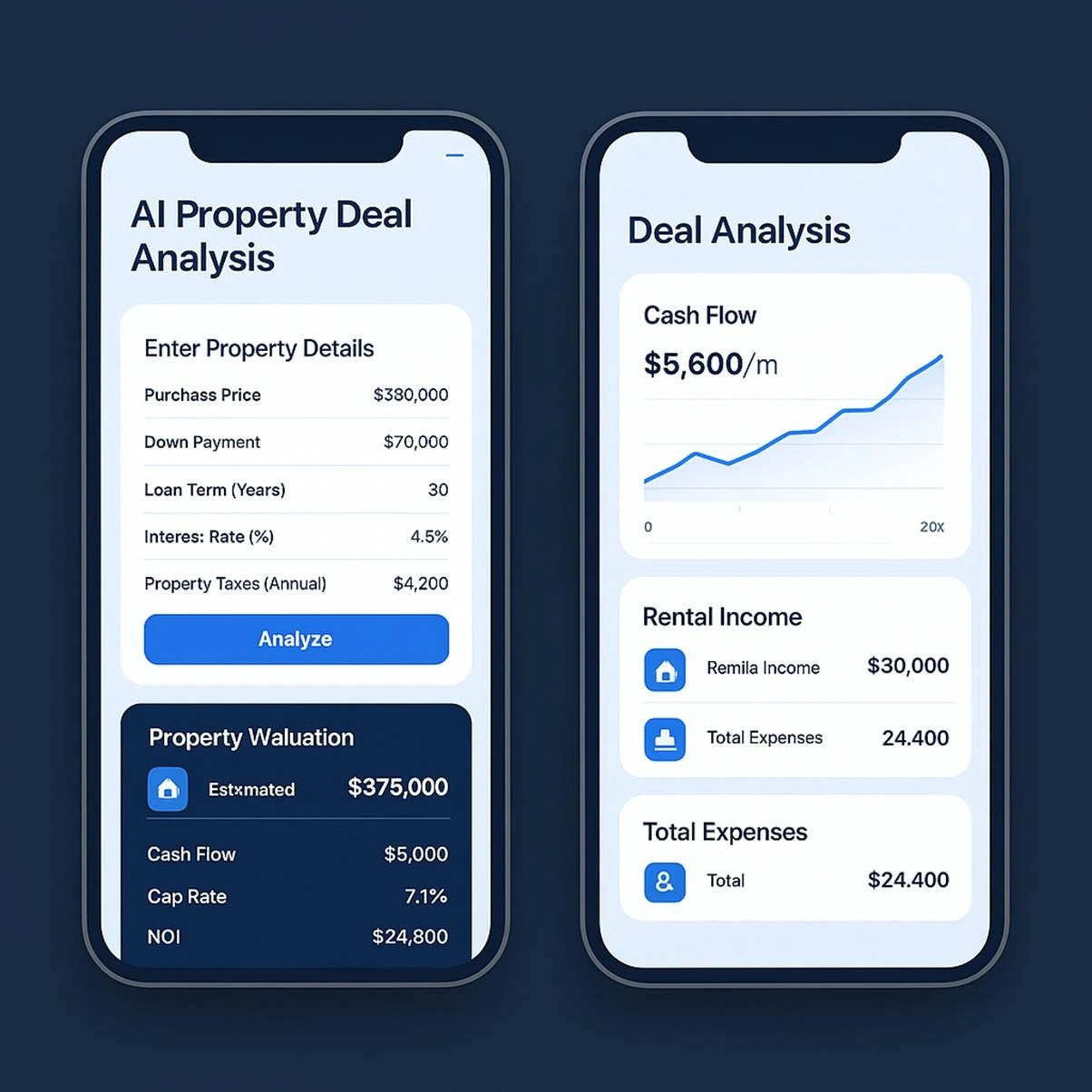
An AI Property Deal Analysis App is a modern digital solution designed to simplify and enhance the way investors and real estate professionals evaluate property deals. Unlike traditional methods that rely on manual spreadsheets and time-consuming research, this type of app leverages artificial intelligence to deliver fast, accurate, and data-driven insights into potential investments.
The primary goal of an AI Property Deal Analysis App is to help users assess whether a property is a profitable opportunity. It does so by combining multiple layers of property, financial, and market data into one unified platform. The app becomes a smart assistant that highlights the strengths, weaknesses, and risks of a deal, enabling investors to make decisions with greater confidence.
Beyond just property evaluation, these apps are tailored to the real estate market’s evolving needs. They can be adapted for residential, commercial, or rental property investments, offering flexibility to a wide range of users. By presenting complex real estate analysis in a simplified and actionable way, they make investment decision-making accessible not only to experienced professionals but also to new investors entering the market.
Ultimately, an AI Property Deal Analysis App is not just a tool; it is a strategic companion that helps investors save time, minimize risks, and identify profitable opportunities in today’s highly competitive real estate landscape.
An AI Property Deal Analysis App works by combining property data, market information, financial inputs, and artificial intelligence into a single deal evaluation workflow. Instead of manually collecting comparable sales, researching neighborhood rents, estimating expenses, and building an Excel model for every opportunity, an AI-powered deal analysis app can automate much of this process and present the results in a structured format.
For an investor reviewing numerous residential, multifamily, and commercial opportunities each week, this workflow can significantly reduce repetitive analysis. The application can collect data from connected sources, prepare it for analysis, evaluate the property's financial potential, identify relevant risks, and generate reports that make opportunities easier to compare.
The typical workflow of an AI property deal analysis app development project includes six key stages:
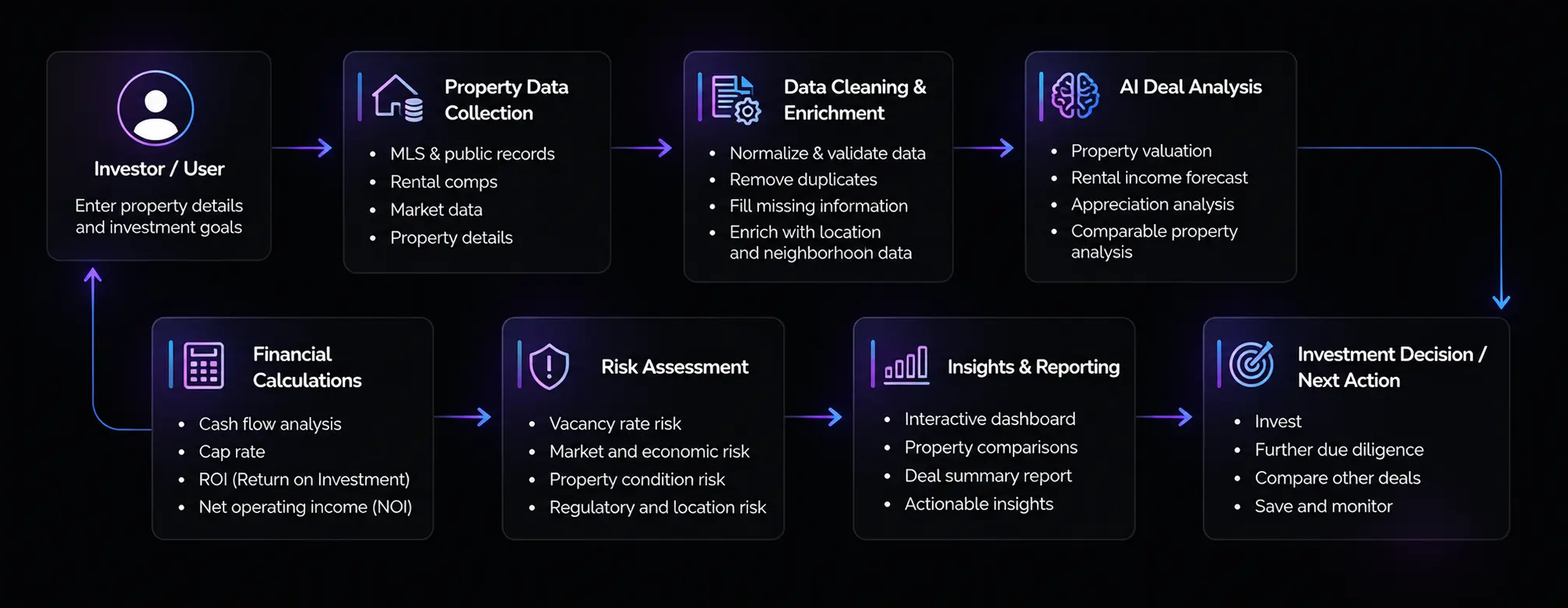
The app first gathers property and market information from connected data sources and organizes it for analysis.
Depending on data availability and licensing, sources may include MLS databases, property portals, public records, rental listings, demographic datasets, and other real estate data providers. The collected information can include property characteristics, comparable sales, rental rates, historical transactions, location details, and market indicators.
Centralizing these inputs reduces manual research and gives the application a consistent data foundation for real estate deal analysis.
The application cleans, standardizes, and enriches raw property data before sending it into the analytical workflow.
Real estate datasets can contain missing values, duplicates, inconsistent formats, or outdated records. Data processing can identify these issues, standardize property attributes, and organize comparable properties and rental information into a usable structure.
The system can also enrich records with relevant neighborhood and market information. Better data preparation supports more dependable AI real estate analytics and reduces the chance that incomplete inputs distort an investment analysis.
AI models analyze property, market, and historical data to identify patterns and generate investment-related insights.
Depending on the application, machine learning models can support property valuation, rental income forecasting, appreciation analysis, comparable-property analysis, and other predictive use cases. The models can evaluate large datasets much faster than manual research and surface information that may deserve closer attention.
For investors, this creates an automated property analysis workflow that helps move from raw information to an initial assessment more efficiently. AI should support investment judgment rather than replace proper financial and property due diligence.
The app converts property and financing inputs into the financial metrics investors use to evaluate potential returns.
The system can calculate cash flow, ROI, cap rate, net operating income (NOI), financing costs, operating expenses, and projected returns based on the user's assumptions. Investors can enter values such as purchase price, down payment, interest rate, expected rent, vacancy, taxes, insurance, and renovation costs.
Instead of recreating an Excel model for each opportunity, the application can apply the same calculation framework consistently across properties, making investment property analysis faster and easier to compare.
The application evaluates factors that could negatively affect a property's expected financial performance and highlights potential risks.
Depending on available datasets, the system can consider vacancy trends, neighborhood conditions, market indicators, property expenses, regulatory factors, and other relevant signals. A risk layer can flag unusual assumptions, identify sensitive variables, and show where an investment may require deeper investigation.
This gives users a more balanced view of a deal by presenting both potential returns and possible downside factors within the AI property deal analysis workflow.
The final stage converts complex analysis into dashboards, comparisons, summaries, and reports that investors can act on.
Users can compare multiple properties based on projected cash flow, ROI, cap rate, valuation, rental potential, assumptions, and risk indicators. Visual dashboards can make large datasets easier to interpret, while downloadable reports can support internal reviews, investment discussions, or further due diligence.
This reporting layer makes the platform more than a calculator. It becomes a repeatable real estate deal analysis app that helps investors screen opportunities consistently and focus their time on deals that warrant deeper evaluation.
Overall, an AI Property Deal Analysis App connects data collection, preparation, machine learning, financial modeling, risk assessment, and reporting to create a faster and more consistent investment analysis workflow.
For real estate investors and property firms, the value of an AI Property Deal Analysis App comes down to one practical question: how quickly can a potential deal move from raw property information to an informed investment decision? Consider an investment team reviewing properties across several markets while analysts manually collect comparables, rental data, operating expenses, financing assumptions, and neighborhood information before preparing each deal model. As the pipeline grows, the same research is repeated across property after property, limiting how many opportunities the team can properly evaluate.
An AI-powered platform can centralize this workflow and help users analyze properties against predefined investment criteria. Instead of treating every deal as a separate spreadsheet exercise, the application can combine property data, comparable sales, rental information, financial modeling, market signals, and risk indicators within one AI property deal analysis workflow.
The market opportunity is also expanding rapidly. The Business Research Company reports that the global AI in real estate market is projected to reach $404.9 billion in 2026 and grow to $1.303 trillion by 2030, representing a 33.9% CAGR from 2026 to 2030. The report also identifies investment analysis, property valuation, predictive market analysis, and data-driven investment insights among key application areas.
Real estate investors often evaluate multiple opportunities before deciding which ones deserve deeper due diligence. An AI Property Deal Analysis App can automate initial data gathering, financial calculations, comparable analysis, and screening against predefined investment criteria.
This can help teams review more opportunities within the same working period and concentrate human attention on deals that warrant detailed investigation. Faster screening is particularly valuable in competitive markets where investment teams need to respond quickly to attractive properties.
Property decisions depend on more than the asking price. Rental demand, comparable sales, operating expenses, financing conditions, neighborhood characteristics, and market trends can all influence investment potential.
An AI-powered property deal analysis platform can bring these data points together and organize them into a consistent evaluation framework. This gives investors a clearer basis for comparing opportunities instead of relying heavily on disconnected spreadsheets, manual research, or assumptions that are difficult to standardize.
Manual analysis becomes increasingly difficult as the investment pipeline expands. An investor evaluating a handful of properties can manage the workload with spreadsheets, but analyzing dozens or hundreds of opportunities across multiple markets requires a more scalable approach.
AI property deal analysis app development can automate repeatable evaluation workflows and support simultaneous analysis of multiple properties. This helps investment firms expand their deal pipeline without increasing manual research at the same rate.
A promising return projection does not automatically make a property a good investment. Vacancy assumptions, operating expenses, rental demand, property condition, financing costs, and local market conditions can materially affect outcomes.
An AI-based platform can organize relevant risk indicators alongside projected returns and highlight assumptions that deserve additional attention. This creates a more balanced evaluation process where users can examine potential upside and downside before committing resources to deeper due diligence.
Different analysts can produce different results when they rely on individual spreadsheets, assumptions, and research methods. A centralized AI real estate investment analysis platform can apply consistent calculation rules, data structures, and evaluation criteria across the deal pipeline.
Standardization is valuable for investment firms because it makes properties easier to compare and helps decision-makers understand how a particular opportunity was assessed. It also creates a repeatable workflow that can be refined as the organization's investment strategy evolves.
The purpose of AI is not to make the investment decision independently. Its value lies in helping investors reach that decision with organized information and faster analysis.
An AI Property Deal Analysis App can surface key financial metrics, valuation insights, comparable properties, projected rental performance, and risk indicators through dashboards and reports. This allows investors to spend less time assembling information and more time evaluating whether the opportunity aligns with their investment strategy.
For entrepreneurs and proptech companies, an AI Property Deal Analysis App can become a standalone software product rather than simply an internal investment tool. Subscription plans, pay-per-analysis models, enterprise licensing, and data-driven services can create different revenue opportunities based on the target market.
The broader market outlook supports this opportunity, with AI in real estate forecast to grow from $404.9 billion in 2026 to $1.303 trillion by 2030.
Investing in AI Property Deal Analysis App development can therefore create value at two levels: helping investors evaluate opportunities more efficiently and giving proptech businesses a scalable platform for delivering data-driven investment intelligence.
For real estate investors, the value of an AI-powered deal analysis solution is closely tied to how quickly and consistently they can screen investment opportunities. Consider an investor comparing multiple residential, multifamily, and commercial properties while manually reviewing comparable sales, rental rates, renovation assumptions, financing costs, and projected returns. Even when the required data is available, switching between spreadsheets, property sources, and market reports can slow the underwriting process and make it harder to compare opportunities using the same criteria.
An AI Property Deal Analysis App brings these activities into a unified workflow and uses artificial intelligence to support faster property evaluation. It can automate repetitive calculations, organize relevant market data, identify potential risks, and present financial outcomes through dashboards and reports. For investors dealing with a growing deal pipeline, this can turn property analysis into a more repeatable and scalable process.
The benefits of AI Property Deal Analysis App Development extend beyond speed. When the application is designed around reliable data, defined investment criteria, and practical AI use cases, it can support better forecasting, risk visibility, portfolio analysis, and investment decision-making.
Here are the key benefits businesses and investors can gain from developing an AI Property Deal Analysis App.
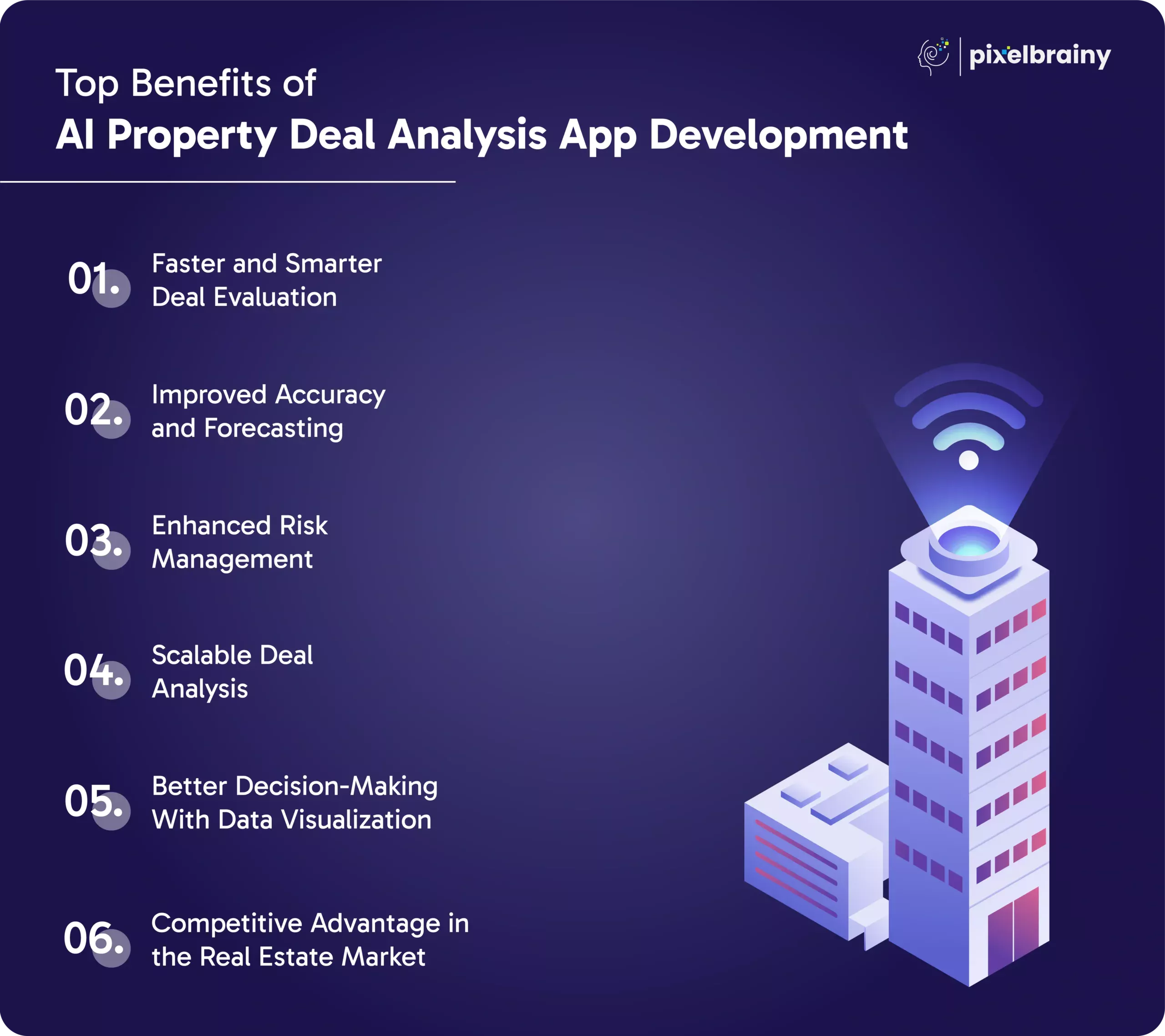
Traditional deal analysis can take hours or even days, but AI enables instant processing of property data, financial metrics, and market insights. This speed allows investors to act quickly and secure deals before competitors. By using AI, the evaluation process becomes smarter and less prone to human error, creating more reliable investment outcomes.
One of the strongest benefits of creating an AI Property Deal Analysis App is its ability to deliver precise predictions about property value, rental income, and long-term appreciation. AI models continuously learn from historical data and market trends, making forecasts more reliable than traditional methods.
Every property investment carries risks, but AI helps minimize uncertainties by analyzing factors like vacancy rates, neighborhood crime, and economic conditions. With this proactive approach, investors can make more balanced decisions instead of being blindsided by unexpected issues.
For businesses handling multiple properties, scalability is critical. One of the core advantages of developing an AI Property Deal Analysis App is the ability to handle hundreds of deals at once. Whether evaluating single-family homes or commercial buildings, the app scales seamlessly without adding more manual work.
Numbers alone can be overwhelming, which is why modern AI apps present insights through dashboards, charts, and easy-to-read reports. This ensures that investors, even those without technical expertise, can interpret financials and market trends effectively.
To stay ahead, investors and real estate firms must embrace innovation. Choosing to build an AI Property Deal Analysis App provides a clear edge over competitors still relying on outdated methods. By offering faster analysis and more accurate forecasts, businesses can position themselves as industry leaders.
Overall, an AI Property Deal Analysis App can help investors move from manual property research toward a faster, more consistent, and data-driven approach to evaluating real estate opportunities.

A useful AI Property Deal Analysis App needs a reliable core feature set before advanced intelligence can deliver meaningful investment insights. Consider an investor reviewing several properties in a week who needs to pull comparable sales, calculate cash flow, check financing assumptions, estimate rental income, and identify potential risks before deciding which opportunities deserve deeper due diligence. When these activities are spread across MLS records, spreadsheets, property databases, and separate market resources, analysis can become repetitive and difficult to standardize.
The foundation of AI Property Deal Analysis App development is therefore built around bringing these essential workflows into one application. Property data integration, investment calculations, market comparisons, reporting, security, and mobile accessibility create the infrastructure that allows investors to evaluate opportunities consistently. These capabilities are also important for businesses planning to develop an AI Property Deal Analysis App that can later support predictive models, automated insights, and other advanced AI functionality.
| Must-Have Feature | Explanation |
| Property Data Integration | The app should integrate with MLS, Zillow, Realtor, and public records APIs to gather real-time property listings and transaction details, ensuring accuracy in deal evaluation |
| ROI & Cash Flow Calculator | A built-in calculator that computes ROI, NOI, and monthly cash flow helps investors instantly determine profitability without manual spreadsheets |
| Comparative Market Analysis (CMA) | Provides side-by-side comparisons of similar properties in the neighborhood to ensure fair valuation and identify better opportunities |
| Mortgage & Financing Tools | Allows users to input loan terms, down payments, and interest rates, automatically generating payment schedules and financial impact projections |
| Rental Yield Estimator | Estimates rental income potential using rental comps and occupancy data, giving investors a clear view of future returns |
| Interactive Dashboards | Converts raw financial data into charts, graphs, and KPIs, making it easier for users to visualize and understand deal performance |
| Deal Reports & Export Options | Enables exporting deal analysis reports into PDF or Excel for investor presentations and client communications |
| Risk Indicator Alerts | Flags potential risks such as high vacancy rates, declining local trends, or sudden tax hikes, helping investors avoid risky deals |
| User Authentication & Security | Protects sensitive financial and property data with secure logins, encryption, and role-based access |
| Mobile-Friendly Interface | Ensures seamless accessibility on smartphones and tablets so investors can analyze deals on the go |
These core capabilities give an AI property deal analysis app the dependable foundation required to organize property information, evaluate financial potential, compare opportunities, and support investment decisions consistently.
Once the core deal evaluation workflow is established, advanced capabilities can extend what an AI property deal analysis app can do for investors, analysts, and real estate firms. Consider an investment team that has moved beyond analyzing a few properties and now needs to compare opportunities across multiple markets, test different financing assumptions, monitor portfolio performance, and identify changing market risks. At this stage, basic calculators and dashboards may not provide enough decision support.
For businesses planning AI property deal analysis app development, advanced features can help transform the application from a property evaluation tool into a broader investment intelligence platform. Predictive analytics, automated scenarios, portfolio tools, AI assistance, and machine learning recommendations can help users process more information and evaluate opportunities from multiple perspectives.
The features below can be introduced according to the application's investment model, available data, target users, and technical roadmap.
| Advanced Feature | Explanation |
| Predictive Market Trends | Uses AI models to forecast neighborhood growth, price appreciation, and rental demand for smarter long-term decisions |
| AI Chatbot Assistant | Offers real-time Q&A support inside the app, guiding users through deal analysis and simplifying complex metrics |
| Blockchain-Based Transactions | Ensures secure and transparent deal records, reducing fraud risks and improving investor confidence |
| Automated Scenario Analysis | Runs multiple scenarios such as best case, base case, and worst case to show how deals perform under different conditions |
| Portfolio Management Tools | Helps investors track and manage multiple properties at once with consolidated dashboards and insights |
| AR/VR Property Tours | Integrates augmented and virtual reality to provide immersive property viewing experiences tied to financial analysis |
| Predictive Risk Modeling | Goes beyond traditional risk alerts by forecasting potential downturns, regulatory impacts, or climate-related risks |
| Multi-Currency and Global Support | Enables cross-border investors to evaluate deals in different currencies and adapt analysis to global markets |
| API Marketplace Integration | Allows adding third-party services like insurance, legal documentation, or loan providers directly into the app ecosystem |
| Machine Learning-Based Recommendations | Suggests the most profitable properties or investment strategies by learning from user preferences and past deal history |
These advanced capabilities can help an AI-powered property deal analysis app move beyond basic financial calculations toward predictive, scenario-based, and portfolio-level investment intelligence. Their value depends on reliable data, clearly defined investment use cases, and a development roadmap that prioritizes the features with the greatest practical impact.
Also Read: AI Real Estate Website Development: Features and Steps
How can a real estate investment firm turn a property address into a reliable preliminary investment analysis in under thirty minutes when good deals may require an offer within twenty-four to forty-eight hours? Consider a real estate investment firm with three analysts that consistently loses opportunities because its manual analysis process is too slow for today's competitive market. Analysts may need to collect comparable sales, research rental rates, estimate operating expenses and renovation costs, calculate returns, and review market conditions before they can confidently recommend an offer.
An AI property deal analysis app can be designed to compress these activities into a structured, repeatable workflow. The application can begin with a property address, retrieve relevant data from connected sources, organize comparable properties and market information, calculate investment metrics, evaluate predefined criteria, and produce a preliminary analysis for analyst review.
The goal of AI property deal analysis app development is not to remove analytical rigor from the investment process. Instead, the application should automate repetitive research and calculations while giving analysts a consistent framework for reviewing opportunities. A properly planned solution can help a small investment team handle a larger deal pipeline without requiring the same amount of manual work for every property.
The following AI property deal analysis app development process explains how to validate the concept, define the feature scope, test AI feasibility, create an MVP, design the user experience, develop the full application, perform quality assurance, and maintain the platform after launch.
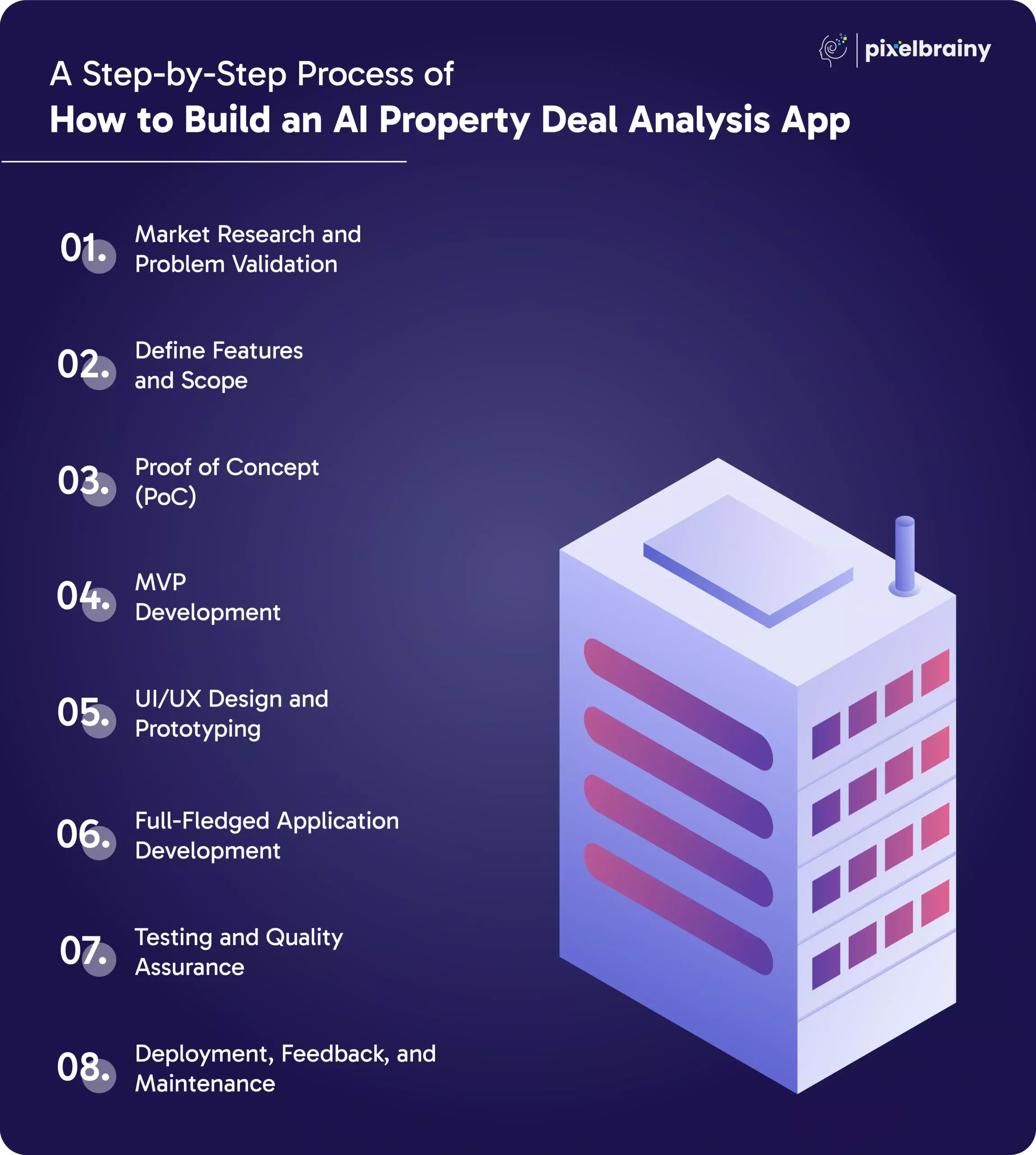
Every successful application starts with understanding the market and the problems investors face. At this stage, you should analyze competitors, identify gaps in existing tools, and define what unique value your app will deliver. This step ensures that the product solves real challenges rather than just adding another generic solution.
Aim of this step: To confirm that there is a real demand for the app, identify opportunities, and shape the product idea around market gaps.
Before development begins, it is crucial to decide on must-have and advanced features. This includes property data integration, ROI calculators, dashboards, and predictive analysis. Having a clear feature roadmap helps avoid unnecessary complexity and allows developers to focus on functionality that matters most to users.
Aim of this step: To establish a clear development plan that outlines exactly what the app should do, avoiding confusion during later stages.
Building a PoC allows you to test whether the app idea is technically and financially viable. A PoC is a small-scale version that demonstrates the use of AI models for property deal analysis. It helps stakeholders validate feasibility and refine the approach before committing resources to full development.
Aim of this step: To minimize risks by proving the technical feasibility of the app and gaining stakeholder confidence early in the process.
Once the PoC is validated, the next step is MVP Development. An MVP or Minimum Viable Product focuses on core features such as deal evaluation, ROI calculations, and reporting tools. The goal here is to launch a working version quickly, test it with real users, and gather feedback to improve functionality before scaling further.
Aim of this step: To create a basic yet usable product that can be tested in the real market with minimal investment, providing valuable insights for improvement.
Also Read: Top AI MVP Development Companies in USA
A seamless user experience is critical in real estate apps, which is why working with a professional UI/UX Design company is highly recommended. This step focuses on creating intuitive dashboards, clear navigation, and visually appealing charts that make property analysis simple even for non-technical users. A well-designed interface directly improves adoption and user satisfaction.
Aim of this step: To ensure that the app is user-friendly, attractive, and functional, enhancing usability and overall customer satisfaction.
After validating the MVP, the next stage is building a full-featured application. This step involves integrating advanced AI models, risk assessment tools, AR/VR tours, and multi-currency support. Security, scalability, and compliance should be prioritized here. Partnering with one of the top AI development companies in USA ensures best practices, robust coding standards, and reliable performance.
Aim of this step: To transform the app into a fully functional solution with all advanced features that can compete in the real estate market.
Comprehensive testing ensures that the app functions as expected across devices and markets. Functional, performance, security, and usability tests are carried out to detect bugs and refine the user journey. This guarantees that the app is stable and trustworthy before release.
Aim of this step: To eliminate issues and ensure the app is reliable, secure, and delivers a smooth experience to end users.
Once testing is complete, the app is deployed to the market. Continuous monitoring, updates, and performance improvements are necessary to keep it relevant. This is where Property Deal Analysis App Development With AI really shows long-term value, as machine learning models improve over time with real user data. Regular updates and enhancements maintain competitiveness and market trust.
Aim of this step: To launch the product successfully, gather user feedback, and ensure continuous evolution with updates and AI-driven improvements.
Following these stages can help investment firms build an AI property deal analysis app solution that delivers faster preliminary assessments while keeping analysts involved in validating assumptions, reviewing risks, and making the final investment decision.
One of the first questions businesses ask before starting AI property deal analysis app development is: what will the project actually cost? A realistic estimate depends on the app's scope, required features, AI model complexity, data sources, integrations, user experience, security requirements, and development team. For a real estate investment firm that wants to generate a preliminary investment analysis from a property address in under thirty minutes, the budget may also be influenced by data ingestion, automated financial modeling, comparable analysis, and AI-driven decision support.
The AI property deal analysis app development cost can range from $20,000 to $200,000+ based on whether the product is a focused MVP, a more comprehensive investment analysis platform, or an advanced enterprise solution. The development budget should account for both the initial product and the infrastructure required to keep property data, financial calculations, integrations, and AI models working reliably after launch.
If you are evaluating how much it costs to create an AI property deal analysis app, breaking the investment into application tiers provides a clearer starting point.
| Type of App | Estimated Cost Range | Explanation |
| Basic AI Property Deal Analysis App | $20,000 – $50,000 | A lightweight app with essential features such as property data integration, ROI and cash flow calculators, basic dashboards, and reporting. Suitable for startups and small businesses wanting to validate their idea before scaling further |
| Medium AI Property Deal Analysis App | $50,000 – $120,000 | Includes everything in the basic version plus additional features like advanced ROI forecasting, risk indicators, comparative market analysis, and improved UI/UX. This option is ideal for growing businesses and real estate firms looking to offer robust solutions |
| Advanced AI Property Deal Analysis App | $120,000 – $200,000+ | A fully loaded app with advanced AI features such as predictive market trends, automated scenario analysis, blockchain integration, AR/VR property tours, and portfolio management tools. Designed for enterprises and large-scale real estate companies aiming for a market-leading solution |
The final cost of developing an AI property deal analysis app also depends on whether the project is developed in-house, outsourced, or delivered through a hybrid model. For an investment firm with a small analyst team, a phased approach can be useful: validate the highest-value analysis workflow first, then expand into advanced forecasting, portfolio intelligence, and additional integrations based on actual usage.
Ultimately, the right budget should reflect the investment workflow you want to automate, the speed and reliability required from the analysis, and the scale you expect the platform to reach.
Also Read: AI Real Estate App Development Cost: Factors and Examples
A reliable AI property deal analysis app needs a technology foundation that can process property data quickly, run financial calculations consistently, support machine learning workloads, and remain responsive as deal volume increases. This becomes especially important for an investment firm with three analysts that needs to turn a property address into a preliminary investment analysis within thirty minutes because attractive deals may require an offer within a twenty-four to forty-eight-hour window.
For AI property deal analysis app development, the architecture should therefore support rapid data ingestion, comparable-property analysis, financial modeling, predictive analytics, geospatial processing, secure integrations, and scalable AI inference. The frontend must present investment metrics clearly, while backend services, databases, data pipelines, and MLOps components work together to process and maintain the underlying information.
The technology stack should also support the broader development of AI property deal analysis app solutions without creating unnecessary infrastructure complexity. Tools for caching, messaging, observability, testing, security, and deployment become particularly important when multiple properties need to be analyzed simultaneously or when AI models are updated over time.
Below is a practical technology stack covering the core application layers and the advanced AI tools for real estate that can support production-ready deal analysis workflows.
| Layer / Parameter | Tools and Libraries | Why it matters |
| Frontend (Web) | React, Next.js, TypeScript, Tailwind CSS, Chart.js / Recharts | Modern SPA/SSR for fast pages, strong typing for reliability, utility-first styling for speed, and charting for investment KPIs and comps visualization. Great baseline for the best tech stack for proptech builds |
| Frontend (Mobile) | React Native or Flutter | Single codebase for iOS and Android, native performance for map-heavy and chart-heavy screens, rapid iteration for investor workflows on the go |
| Backend | Node.js with NestJS, or Python with FastAPI / Django | Opinionated frameworks that speed up API development, background jobs, and integrations. Python stacks pair naturally with AI pipelines |
| Databases | PostgreSQL, TimescaleDB, MongoDB | Relational for deals, cash flows, and users. Time-series for rent, sales, and market signals. Document store for unstructured property data and ingestion buffers |
| Caching & Messaging | Redis, RabbitMQ / Kafka | Sub-second metric lookups for dashboards and scenario tests, reliable queues for ETL and model inference at scale |
| AI / ML Frameworks | PyTorch, TensorFlow, scikit-learn, XGBoost, LightGBM | The AI frameworks for property valuation and rent forecasting. Classic boosters excel with tabular comps, deep learning helps with complex, nonlinear effects |
| Geospatial & Mapping | PostGIS, GeoPandas, Mapbox / Google Maps | Proximity scores, isochrones, and neighborhood features. Visual layers for schools, transit, crime indices, and zoning overlays |
| Data Pipelines & ETL | Apache Airflow, dbt, Pandas, Great Expectations | Orchestrate MLS and public-record pulls, clean and feature-engineer comps, validate data quality rules, document lineage for auditability |
| MLOps | MLflow, Weights & Biases, Feast (feature store), BentoML / TorchServe | Track experiments, register models, manage versioned features, and serve inference behind consistent APIs. This is the backbone for production AI reliability |
| Cloud & DevOps | AWS (EKS, Lambda, S3, RDS), GCP or Azure equivalents, Terraform | Elastic compute for training and inference, object storage for datasets, managed Postgres, infrastructure as code for reproducible environments |
| Security & Compliance | OAuth 2.0 / OpenID Connect, JWT, Vault, KMS, VPC, WAF | Protect investor data and financial assumptions, encrypt secrets, isolate services, and meet SOC2-ready patterns from day one |
| Analytics & Observability | Metabase / Looker, Grafana, Prometheus, OpenTelemetry, Sentry | Business analytics for adoption and ROI, system metrics to keep APIs fast, tracing to debug ETL and inference paths, error monitoring for client apps |
| Testing & QA | Jest, React Testing Library, Cypress, PyTest | Unit, integration, and end-to-end tests that keep valuation math, risk rules, and UI flows dependable through rapid releases |
| APIs & Integrations | MLS/RETS bridges, Zillow/Redfin data partners, Census, BLS, crime and school APIs, Stripe | Trusted sources for comps and demographics, payments for subscriptions, and clean connectors that power model features |
| Document & Report Generation | PDFKit, Puppeteer/Playwright, Excel exporters | Produce lender-ready and investor-ready deal packets with scenario tables, IRR waterfalls, and risk notes |
A well-structured AI-powered property deal analysis stack can help investment teams move from raw property data to preliminary financial and market intelligence faster, while providing the scalability needed for larger deal pipelines and future AI capabilities.

A strong AI property deal analysis app needs a revenue model that matches how investors actually use deal analysis tools. Consider a real estate investment firm with a small analyst team that evaluates a high volume of opportunities under tight offer deadlines. For such a business, paying for every analysis, subscribing to a platform, or licensing the system across the organization can have very different financial implications. The right model depends on the target customer, analysis volume, premium functionality, and the level of access or customization the platform provides.
For entrepreneurs planning AI property deal analysis app development, monetization should be considered alongside product scope and user segmentation. A platform serving individual investors may benefit from accessible subscription or usage-based pricing, while firms and enterprises may require broader licenses, integrations, dedicated environments, and custom support. Data-driven services and strategic partnerships can provide additional revenue streams as the platform grows.
Below are the most practical business models for monetizing an AI-powered property deal analysis app.
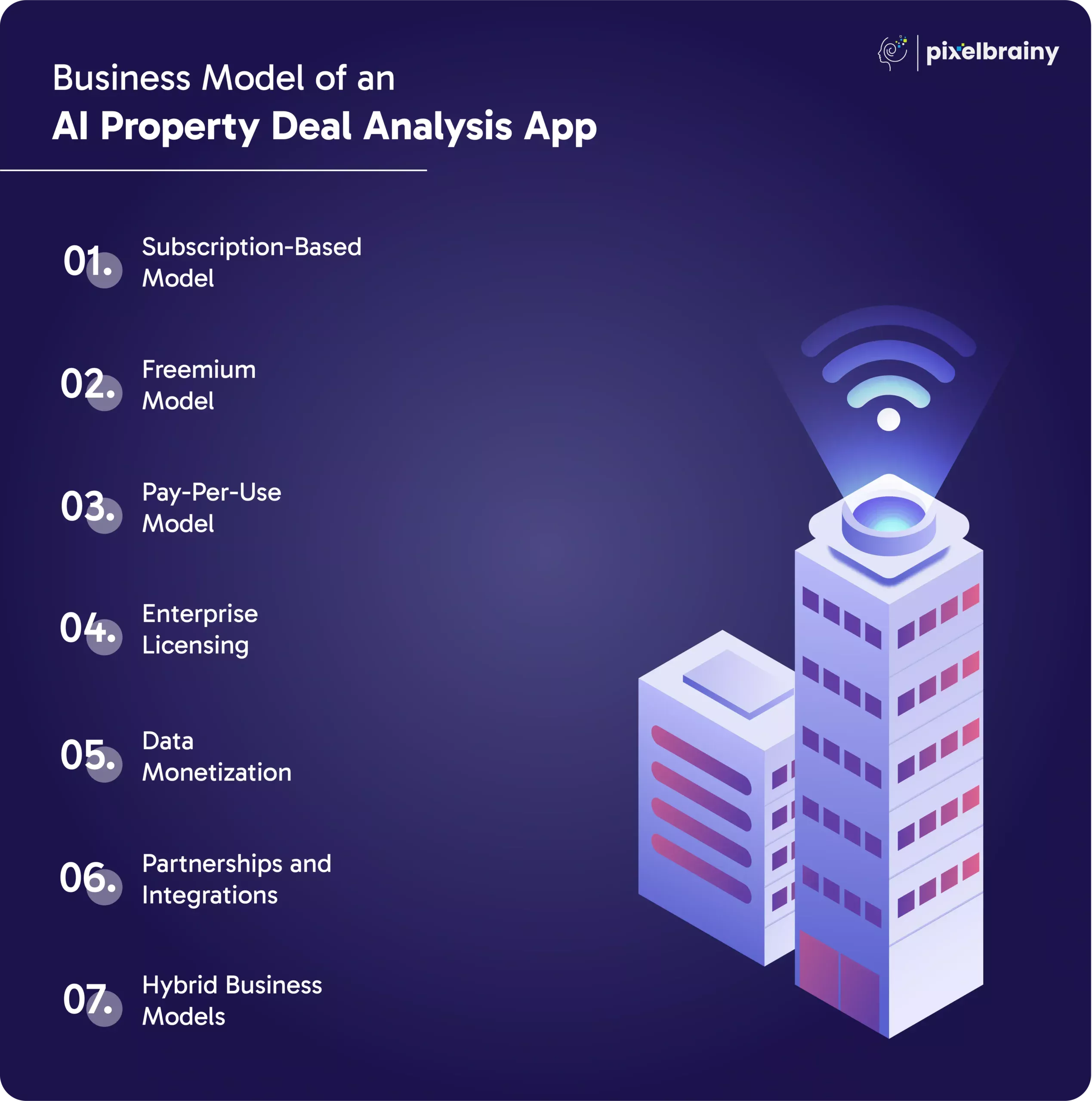
The subscription model is one of the most widely adopted approaches in proptech. Users pay a fixed fee on a monthly, quarterly, or annual basis to access the app’s core and premium features. Subscriptions ensure consistent, recurring revenue for the business while giving users predictable access to tools they need. Investors can choose a plan that suits their activity level, while enterprises may opt for larger packages that cover multiple team members.
The freemium model works by offering basic features for free, while charging users for advanced tools such as AI-powered forecasting, advanced risk analysis, or portfolio management. This lowers the barrier to entry and attracts a wide audience, especially first-time investors. Once users experience value from the free features, they are more likely to upgrade to paid plans.
For investors who do not want to commit to ongoing subscriptions, the pay-per-use model is an attractive alternative. In this model, users are charged based on the number of properties analyzed, reports generated, or premium features accessed. It is particularly effective for part-time investors or smaller firms that may only need advanced analysis occasionally.
Large real estate brokerages, investment firms, and corporate clients often require more comprehensive solutions. An enterprise licensing model allows these organizations to purchase unlimited or large-scale access to the platform. This approach often includes custom integrations, advanced security features, and dedicated support. It is a high-value model that builds strong, long-term relationships with enterprise clients.
Over time, the app collects vast amounts of anonymized data related to property performance, user behavior, and market trends. With proper compliance and privacy safeguards, this data can be monetized by offering insights to financial institutions, research firms, or government agencies. These data-driven services can serve as a strong secondary revenue stream.
The app can also generate revenue by partnering with third-party service providers such as mortgage lenders, insurance companies, or property management firms. By integrating their services directly into the app, you create an ecosystem where users can access complementary services, while the app earns referral fees or commissions.
In many cases, a hybrid model combining subscriptions, freemium access, and enterprise licensing proves most effective. This ensures that the app can cater to individual investors who want affordable access, growing firms that require advanced features, and enterprises that demand large-scale solutions. Hybrid models maximize revenue opportunities while ensuring flexibility for diverse user groups.
A well-planned monetization strategy can help an AI property deal analysis app generate recurring revenue while keeping pricing aligned with analysis volume, feature usage, customer size, and the value delivered to real estate investors and firms.
When you think about AI property deal analysis app development, speed and intelligence are only useful when the underlying system can produce dependable results. Consider a real estate investment firm with three analysts that needs to turn a property address into a preliminary investment analysis within thirty minutes because attractive deals can require an offer within twenty-four to forty-eight hours. If the application depends on incomplete property data, unstable integrations, unreliable AI predictions, or slow financial calculations, the intended productivity advantage can quickly disappear.
For businesses planning to develop an AI property deal analysis app, the technical challenge extends across data quality, compliance, model performance, user experience, integrations, scalability, security, development costs, and ongoing maintenance. These areas are closely connected. Poor data can weaken AI outputs, complex workflows can reduce adoption, and weak architecture can create performance problems as the number of properties and users increases.
Below are the major challenges businesses should address when developing an AI-powered property deal analysis app, along with practical approaches to overcome them.
Challenge: Real estate data comes from multiple sources such as MLS listings, government records, and property portals. These datasets are often inconsistent, incomplete, or outdated. Poor data quality directly impacts the accuracy of AI models and weakens user trust.
How to Overcome:
Challenge: Real estate data often comes with regulatory constraints, including licensing agreements, data usage restrictions, and privacy laws like GDPR and CCPA. Violating these can lead to fines and reputational damage.
How to Overcome:
Challenge: AI predictions are only as good as the data they are trained on. If the dataset is biased or incomplete, the app may overvalue or undervalue properties, leading to poor investment decisions.
How to Overcome:
Challenge: Even if the app is powerful, real estate professionals may find it intimidating if the user experience is complex. Low adoption rates can undermine the app’s success.
How to Overcome:
Challenge: The app must work seamlessly with MLS databases, mortgage calculators, CRM tools, and third-party APIs. Integration errors or delays can reduce the app’s usability.
How to Overcome:
Challenge: As the number of users and properties analyzed grows, the app must handle large-scale datasets and complex computations without delays. Poor scalability leads to performance bottlenecks.
How to Overcome:
Challenge: Property data, user financial details, and investment metrics are highly sensitive. Weak security measures can lead to data breaches and loss of credibility.
How to Overcome:
Challenge: The development of a feature-rich AI Property Deal Analysis App requires significant investment in AI models, infrastructure, and integrations. Costs may rise if the scope is not well-defined.
How to Overcome:
Challenge: AI models and real estate markets are constantly evolving. Without ongoing improvements, the app can quickly become outdated.
How to Overcome:
Therefore, addressing the major technical, data, security, and operational challenges early can help create an AI property deal analysis app that delivers faster analysis without compromising reliability, scalability, or investor confidence.
From the technical considerations above, now it is time to identify the right development partner for an investment-focused AI solution. PixelBrainy as an AI real estate software development company brings together artificial intelligence, real estate technology, data engineering, and product development expertise to help businesses turn complex investment workflows into practical digital products.
For an investment firm reviewing fifteen to twenty potential properties every week, spending three to four hours analyzing each opportunity can create a serious bottleneck. Analysts may need to collect MLS comparables, research rental rates, estimate renovation expenses, calculate cash flow, and review investment metrics before deciding whether a property deserves further attention. PixelBrainy can help structure these activities into a unified application workflow designed to reduce repetitive analysis and support faster preliminary deal evaluation.
Our AI property deal analysis app development services can support solutions involving property data integration, financial calculations, comparative market analysis, predictive analytics, risk indicators, dashboards, reporting, and AI-assisted investment insights. The application architecture can be planned around the client's data sources, investment criteria, user roles, and expected deal volume.
PixelBrainy recently completed a confidential project for a USA-based client requiring a full-scale property deal analysis solution. The application integrated live MLS data, automated ROI and cap rate calculations, and predictive models for rental yield and property appreciation. The solution helped the client's investment team simplify deal evaluation and make faster, data-driven decisions while reducing the time spent on manual analysis.
Businesses looking to build AI property deal analysis app solutions need more than generic AI expertise. Our approach combines domain-focused product planning with data pipelines, machine learning, scalable architecture, security, and user-friendly investment workflows. This allows the application to evolve as deal volume, property coverage, and analytical requirements increase.
For teams that want to develop AI property deal analysis app platforms, PixelBrainy can support the journey from market validation and PoC through MVP, full-scale development, testing, deployment, and maintenance. We also understand that property deal analysis app development integrating AI requires careful coordination between real estate data, financial logic, AI models, and human investment judgment.
The objective is to create an application that supports the investment team's existing decision process while making analysis faster, more consistent, and scalable.
Connect with PixelBrainy to discuss your AI property deal analysis project.

An AI property deal analysis app can help real estate investors move from fragmented research and spreadsheet-based calculations to a more structured, data-driven investment workflow. By bringing property data, comparable sales, rental information, financial metrics, market signals, and risk indicators into one platform, investors can evaluate opportunities with greater consistency and spend less time on repetitive analysis.
The value of AI property deal analysis app development depends on how effectively the application connects reliable data with practical investment workflows. Features such as automated deal screening, cash flow analysis, predictive market insights, scenario modeling, and intelligent reporting can help investment teams review more opportunities while keeping human judgment central to the final decision.
For businesses planning to develop an AI-powered property analysis solution, the right architecture, technology stack, data strategy, security controls, and development roadmap are equally important. Starting with a focused use case and expanding based on actual investment requirements can create a more sustainable product.
Book an appointment with PixelBrainy to discuss your AI Property Deal Analysis App development project.
Yes, a properly designed AI property deal analysis app can begin the analysis workflow with a property address and retrieve available property, comparable, rental, location, and market information from connected data sources. The application can then calculate investment metrics and generate a preliminary deal summary for further investor review.
A robust AI property deal analysis app can calculate metrics such as cash flow, ROI, cap rate, net operating income (NOI), projected rental income, financing costs, operating expenses, and return scenarios. Investors can use these metrics to compare properties against their predefined investment criteria.
AI can help identify properties that appear potentially mispriced by comparing available property data, comparable sales, rental performance, market conditions, and other relevant indicators. However, an AI property deal analysis app should present these findings as analytical signals that require investor validation rather than treating them as guaranteed investment outcomes.
AI can automate repetitive research, organize large datasets, perform calculations, identify patterns, and generate preliminary insights. In an AI-powered property deal analysis workflow, these capabilities can reduce manual spreadsheet work and help investors screen opportunities faster while keeping analysts responsible for reviewing assumptions and final investment decisions.
Yes. The application can be designed to analyze residential, multifamily, commercial, and rental properties, provided the underlying data, financial models, and investment criteria are configured appropriately. Each property type may require different assumptions, calculations, comparable methods, and risk indicators within the AI real estate investment analysis workflow.
The AI property deal analysis app development timeline depends on the product scope, data integrations, AI models, financial calculations, platforms, security requirements, and testing needs. A focused MVP can be delivered faster than a full-scale platform with predictive analytics, portfolio management, automated scenario analysis, and multiple external data integrations.
The AI property deal analysis app development cost can range from approximately $20,000 to $200,000+, depending on the application's complexity and capabilities. A basic solution may focus on property data, financial calculations, dashboards, and reporting, while advanced platforms require greater investment in AI models, data infrastructure, integrations, scalability, and security.
No. The strongest use case is to support analysts rather than remove human oversight. An AI property deal analysis app can handle repetitive data collection, calculations, screening, and reporting so analysts can spend more time reviewing assumptions, validating risks, conducting due diligence, and deciding whether a property fits the firm's investment strategy.

About The Author
Sagar Bhatnagar
Sagar Sahay Bhatnagar brings over a decade of IT industry experience to his role as Marketing Head at PixelBrainy. He's known for his knack in devising creative marketing strategies that boost brand visibility and market influence. Sagar's strategic thinking, coupled with his innovative vision and focus on results, sets him apart. His track record of successful campaigns proves his ability to utilize digital platforms effectively for impactful marketing efforts. With a genuine passion for both technology and marketing, Sagar continuously pushes PixelBrainy's marketing initiatives to greater success.

Working with the PixelBrainy team has been a highly positive experience. They understand the design requirements and create beautiful UX elements to meet the application needs. The dev team did an excellent job bringing my vision to life. We discussed usability and flow. Sagar worked with his team to design the database and begin coding. Working with Sagar was easy. He has the knowledge to create robust apps, including multi-language support, Google and Apple ID login options, Ad-enabled integrations, Stripe payment processing, and a Web Admin site for maintaining support data. I'm extremely satisfied with the services provided, the quality of the final product, and the professionalism of the entire process. I highly recommend them for Android and iOS Mobile Application Design and Development.

Great experience working with them. Had a lot of feedback and I found that unlike most contractors they were bugging me for updates instead of the other way around. They were extremely time conscience and great at communicating! All work was done extremely high quality and if not on time, early! They were always proactive when it comes to communication and the work is great/above par always. Very flexible and a great team to work with! Goes above and beyond to present us with multiple options and always provides quality. Amazing work per usual with Chitra. If you have UI/UX or branding design needs I recommend you go to them! Will likely work with them in the future as well, definitely recommended!

PixelBrainy is a joy to work with and is a great partner when thinking through branding, logo, and website layout. I appreciate that they spend time going into the "why" behind their decisions to help inform me and others about industry best practices and their expertise.

I hired them to design our software apps. Things I really like about them are excellent communication skills, they answer all project suggestions and collaborate right away, and their input on design and colors is amazing. This project was complex and needed patience and creativity. The team is amazing to do business with. I will be using them long-term. Glad to see there are some good people out there. I was afraid to try and outsource my project to someone but I am glad I met them! I really can't say enough. They went above and beyond on this project. I am very happy with everything they have done to make my business stand out from the competition.

It was great working with PixelBrainy and the team. They were very responsive and really owned the project. We'll definitely work with them again!

I recently worked with the PixelBrainy team on a project and I was blown away by their communication skills. They were prompt, clear, and articulate in all of our interactions. They listened and provided valuable feedback and suggestions to help make the project a success. They also kept me updated throughout the entire process, which made the experience stress-free and enjoyable.

PixelBrainy is very good at what it does. The team also presents themselves very professionally and takes care of their side of things very well. I could fully trust them taking up the design work in a timely and organised manner and their attention to detail saved us lots of effort and time. This particular project was quite intense and the team showed that they function very well under pressure. Very much looking forward to working with her again!

It's always an absolute pleasure working with them. They completed all of my requests quickly and followed every note I had for them to a T, which made our process go smoothly from start to finish. Everything was completed fast and following all of the guidelines. And I would recommend their services to anyone. If you need any design work done in the future, PixelBrainy should be your first call!

They took ownership of our requirements and designed and proposed multiple beautiful variants. The team is self-motivated, requires minimum supervision, committed to see-through designs with quality and delivering them on time. We would definitely love to work with PixelBrainy again when we have any requirements.

PixelBrainy was a big help with our SaaS application. We've been hard at work with a new UI/UX and they provided a lot of help with the designs. If you're looking for assistance with your website, software, or mobile application designs, PixelBrainy and the team is a great recommendation.

PixelBrainy designers are amazing. They are responsive, talented, and always willing to help craft the design until it matches your vision. I would recommend them and plan to continue them for my future projects and more!!!

They were awesome! Did a good job fast, and good communication. Will work with them again. Thank you

Creative, detail-oriented, and talented designers who take direction well and implement changes quickly and accurately. They consistently over-delivered for us.

PixelBrainy team is very talented and creative. Great designers and a pleasure to work with. PixelBrainy is an excellent communicator and I look forward to working with them again.

PixelBrainy has a very talented design team. Their work is excellent and they are very responsive. I enjoy working with them and hope to continue on all of our future projects.


Transform your ideas into reality with us.
Across these industries, each engagement brings unique challenges, from early-stage product development to scaling complex systems, helping us build a practical understanding of real-world product environments.