AI Summary Powered by PixelBrainy
Can an AI voice agent handle thousands of customers calls every month with the same speed, accuracy, and conversational quality as a human representative while significantly reducing operational costs?
That is one of the biggest questions business leaders are asking in 2026 as conversational AI transforms customer service across industries. Organizations in healthcare, insurance, banking, retail, SaaS, and logistics are rapidly investing in AI voice agent development to automate high volume customer interactions while maintaining exceptional customer experiences. However, successfully building an AI voice agent involves much more than integrating speech recognition or deploying a chatbot with voice capabilities. It requires intelligent conversation design, enterprise system integrations, advanced language models, robust security, and continuous optimization to deliver human-like conversations at scale.
Consider a practical business scenario. You manage operations for a health insurance company that receives more than 40,000 inbound member calls every month. Nearly 60% of these calls involve routine tasks such as checking claim status, confirming coverage details, updating member information, and scheduling pre-authorization appointments. Every interaction follows a predictable workflow, yet these repetitive requests consume a significant portion of your customer support budget and keep experienced agents occupied with tasks that require little or no human judgment. This naturally raises an important question. Has voice agent development with AI evolved enough for members to have natural, seamless conversations without realizing they are speaking with an AI assistant? More importantly, what does the complete development process look like for deploying such a solution at enterprise scale while ensuring security, compliance, and reliability?
If you are searching for how to create a custom AI voice agent, evaluating whether AI can replace repetitive customer service workflows, or looking for the steps to develop AI voice agent solutions for your business, this guide provides the answers. From understanding how AI voice agents work and exploring their essential features to estimating development costs, selecting the right technology stack, overcoming implementation challenges, and choosing the right development partner, this comprehensive guide will help you make informed decisions about investing in AI powered voice automation in 2026 and beyond.
As customer expectations evolve, businesses are moving beyond traditional call automation and investing in AI voice agent development to deliver faster, more personalized customer experiences. However, many organizations still confuse AI voice agents with IVR systems and chatbots, even though they serve very different purposes.
An AI voice agent is an AI-powered system that conducts natural spoken conversations over phone calls and other voice channels. Instead of asking callers to follow fixed menus, it understands what people say in their own words, identifies their intent, retrieves information from connected business systems, performs actions such as checking claim status or scheduling appointments, and responds instantly using natural-sounding synthesized speech. Modern AI conversational voice agent development combines speech recognition, natural language understanding, large language models, business logic, and text-to-speech technology to create conversations that feel natural and human-like.
The biggest difference lies in how customers interact with each solution. Traditional IVR systems require callers to navigate menus by pressing keypad buttons. Chatbots support conversational interactions, but they are designed for text-based communication. In contrast, voice agent development with AI enables free-flowing voice conversations where callers can ask questions naturally, interrupt, change topics, and receive context-aware responses without following scripted prompts.
AI voice agents are also far more advanced from a technical perspective. They must process speech with sub-500-millisecond latency, understand different accents and phone-quality audio, manage interruptions, retain conversation context, and generate realistic voice responses in real time.
Businesses typically deploy AI voice agents in two ways:
| Factor | IVR System | Chatbot | AI Voice Agent |
|---|---|---|---|
| Interface | Touch-tone keypad navigation | Text input and output | Natural spoken conversation |
| Input Method | Button press from menu options | Typed text | Free-form spoken language |
| NLU Capability | None. Requires exact menu navigation | Text-based intent recognition | Real-time speech understanding |
| Conversation Naturalness | Robotic and menu constrained | Text-based conversations | Human-like conversational experience |
| Interruption Handling | Not supported | Limited | Real-time interruption detection |
| Response Latency Requirement | Not critical | 1 to 2 seconds acceptable | Sub-500 milliseconds required |
| System Integration | Basic call routing | API integrations | Full CRM and business system integration |
| Caller Satisfaction | Low | Moderate | High when well developed |
| Cost per Interaction | Very low but limited resolution | Low | Low with high resolution rates |
In short, AI voice agents are redefining customer communication by replacing rigid, scripted interactions with intelligent, human-like conversations that deliver faster resolutions, better customer experiences, and significantly lower operational costs than traditional IVR systems or chatbots.
An AI voice agent may sound like a human representative, but behind every conversation is a sequence of AI technologies working together in real time. From understanding a caller's speech to retrieving information from business systems and generating a natural response, every step happens within milliseconds.
This seamless coordination is what makes modern AI voice agent development capable of delivering fast, accurate, and human-like customer interactions.
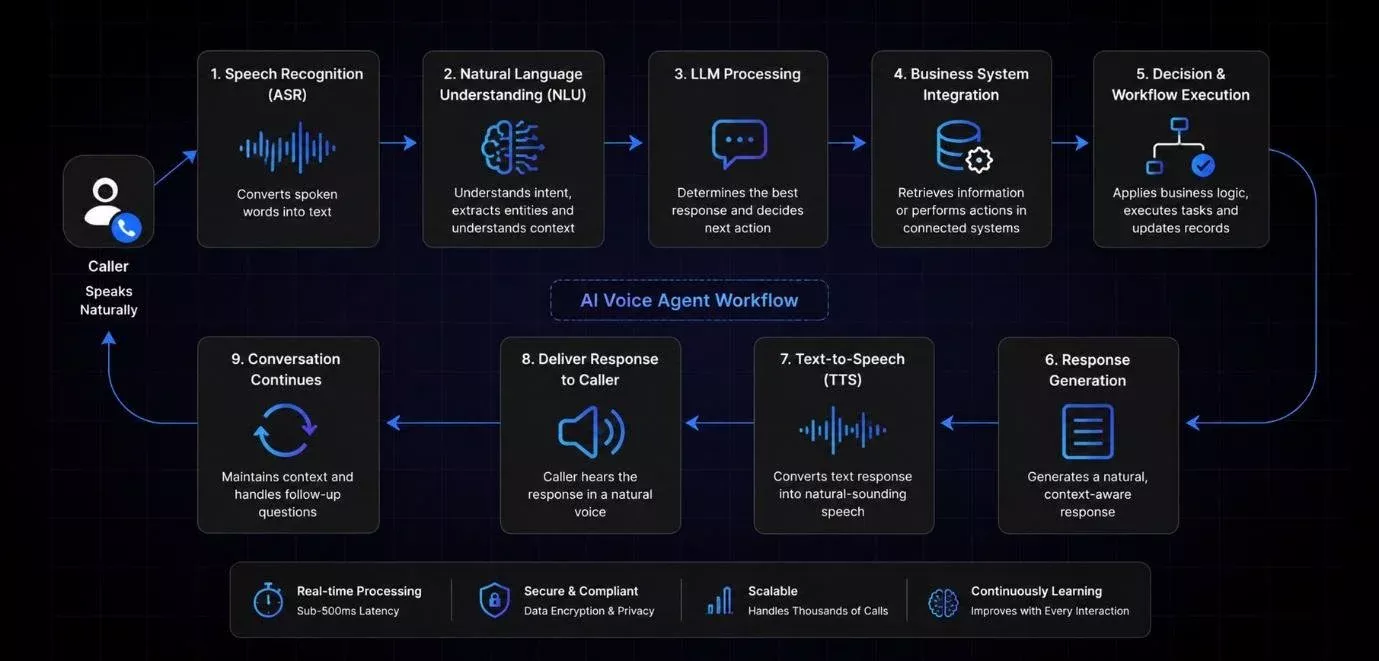
The conversation begins when a customer speaks. An Automatic Speech Recognition (ASR) engine converts the caller's voice into text while filtering out background noise and recognizing different accents and speaking styles.
Example:
Customer: "I'd like to check the status of my insurance claim."
The AI instantly converts this spoken request into text for further processing.
Once the speech is converted into text, the AI analyzes its meaning rather than just matching keywords. It identifies the customer's intent, extracts important details such as policy numbers or appointment dates, and understands the context of the conversation.
For example, these requests all represent the same intent:
The interpreted request is then processed by a Large Language Model (LLM), which determines the most relevant response based on conversation history, business rules, and customer context. This enables the AI to provide dynamic, personalized responses instead of relying on predefined scripts.
To complete a customer's request, the AI connects with enterprise applications such as CRM platforms, policy management systems, ERP software, payment gateways, appointment scheduling tools, or internal knowledge bases.
For example, if a customer asks about their policy coverage, the AI securely retrieves the latest information before responding.
Based on the retrieved data and predefined business rules, the AI performs the required action. This may include verifying customer identity, updating account details, booking appointments, creating support tickets, processing payments, or escalating complex requests to a live agent.
After completing the required action, the AI generates a personalized response that reflects the customer's request and the latest information from connected systems. The response is conversational, context-aware, and easy to understand.
Example:
"Your claim was approved yesterday, and the reimbursement will be deposited into your registered bank account within three business days."
Finally, the response is converted into natural-sounding speech using advanced Text-to-Speech (TTS) technology. Modern AI voices include natural pauses, emotional tone, and realistic pronunciation, making conversations feel smooth and engaging.
The entire process typically takes less than a second, enabling AI voice agents to deliver fast, intelligent, and natural conversations that closely replicate interactions with a trained human representative.
"Can investing in AI voice agent development actually improve customer satisfaction while reducing support costs, or is it simply another automation trend?" This is one of the most common questions asked by enterprise leaders evaluating conversational AI. Whether you manage a healthcare provider, insurance company, bank, ecommerce platform, or SaaS business, the objective remains the same: resolve more customer inquiries efficiently without compromising service quality.
This is where AI voice agent development creates measurable business value. By combining conversational AI, natural language understanding, and enterprise integrations, voice agent development with AI enables organizations to automate routine conversations, reduce operational costs, improve response times, and deliver personalized customer experiences at scale.
Below are the key benefits businesses can expect when they build an AI voice agent for customer support and business operations.
Handling thousands of repetitive customer calls every month requires substantial investments in staffing, training, and infrastructure. Routine inquiries such as checking account information, tracking orders, verifying insurance claims, or scheduling appointments often consume valuable agent time despite following predictable workflows.
AI voice agents automate these repetitive interactions, allowing businesses to lower operational expenses while enabling customer support teams to focus on complex cases that require human expertise. This results in a lower cost per interaction without sacrificing service quality.
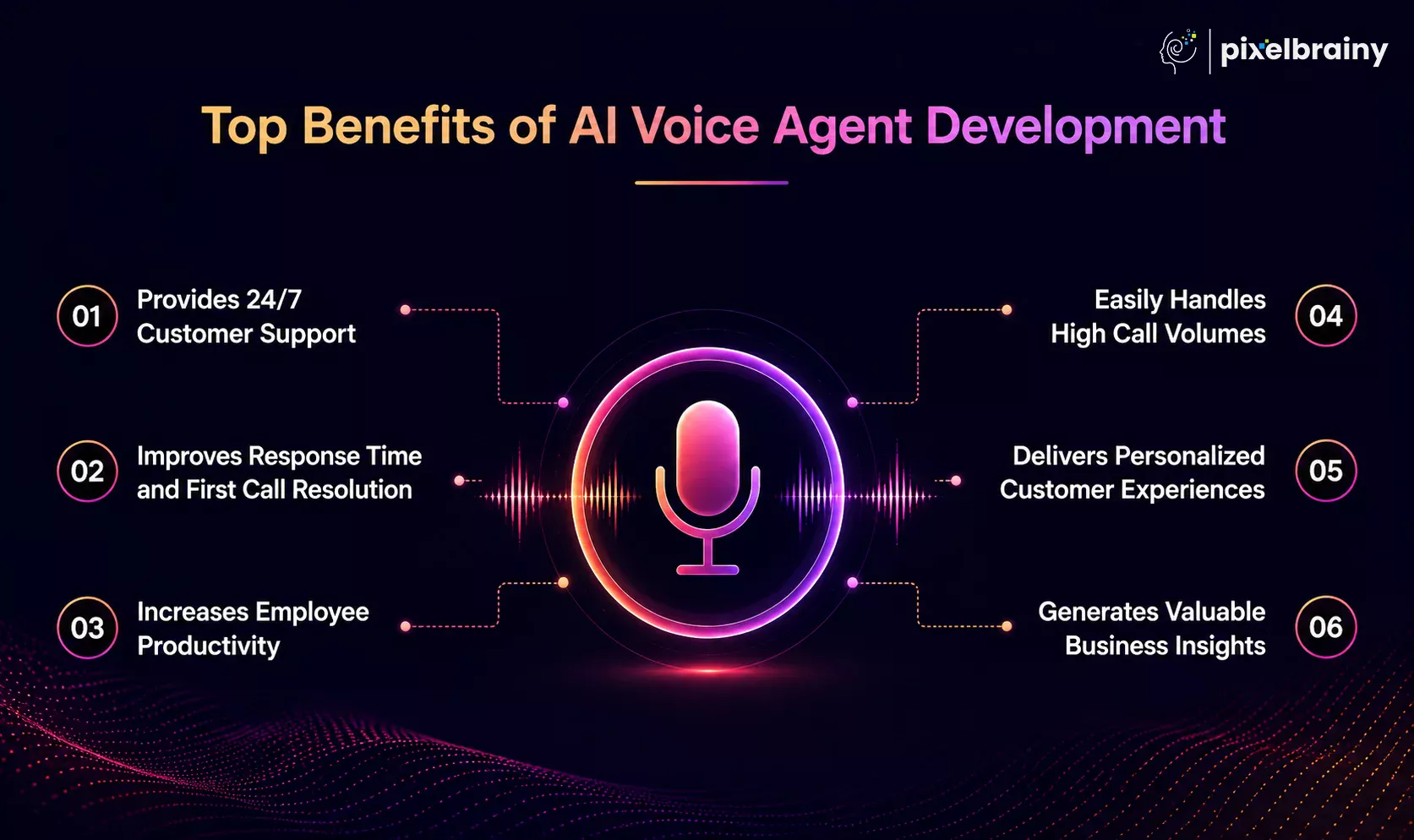
Customer expectations are no longer limited to standard business hours. People expect immediate assistance whenever they need it, regardless of weekends, holidays, or time zones.
AI voice agents operate around the clock, answering calls instantly and assisting customers at any time. Continuous availability improves customer satisfaction, minimizes missed opportunities, and ensures businesses maintain consistent support without increasing staffing requirements.
Long wait times and repeated call transfers are among the biggest causes of customer frustration. AI voice agents eliminate unnecessary delays by answering calls immediately and understanding customer requests in real time.
By retrieving information directly from connected business systems, AI resolves routine inquiries faster and increases first call resolution rates. Customers receive accurate answers quickly, creating a smoother and more efficient support experience.
Customer service teams often spend a large portion of their workday answering repetitive questions that require little judgment. This limits their ability to focus on more valuable customer interactions.
AI voice agents handle these routine conversations automatically, allowing support representatives to dedicate their time to escalations, complaints, technical issues, and relationship building. The result is better workforce utilization and improved overall productivity.
Many industries experience sudden spikes in customer inquiries during seasonal campaigns, product launches, enrollment periods, or emergencies. Scaling a traditional call center during these periods can be expensive and time-consuming.
AI voice agents can manage thousands of simultaneous conversations without affecting response quality. This allows businesses to scale customer support instantly while maintaining consistent service levels and avoiding long customer wait times.
Modern voice agent development with AI integrates seamlessly with CRM platforms, ERP systems, and other enterprise applications. Before responding, the AI can access customer profiles, interaction history, account details, and previous support requests.
This enables highly personalized conversations where customers receive responses tailored to their specific needs instead of generic scripted answers. Personalized interactions improve customer trust, engagement, and overall satisfaction.
Every customer conversation provides useful information about customer behavior, common issues, and service performance. AI voice agents automatically capture conversation data, customer intent, sentiment, frequently asked questions, and call outcomes.
These insights help organizations identify recurring problems, improve workflows, optimize customer journeys, and continuously enhance both their AI systems and overall customer service strategy through data-driven decision making.
AI voice agent development delivers more than automation by helping businesses reduce costs, improve customer experiences, increase operational efficiency, and scale support services without compromising quality.
Deploying an AI voice agent is not simply about enabling voice conversations. The real challenge is building a solution that understands customer intent accurately, integrates with enterprise systems, protects sensitive data, and consistently delivers natural, reliable interactions. This is why organizations evaluating AI voice agent development often ask a practical question: "Which features are essential for building an AI voice agent that can automate customer calls without compromising accuracy, security, or user experience?"
The answer lies in selecting the right combination of conversational AI capabilities and business functionalities. A production-ready solution should do far more than answer customer queries. It should authenticate users securely, access real-time business data, execute workflows, maintain conversational context, and seamlessly transfer complex conversations to human agents when necessary.
Whether you are planning voice agent development with AI for healthcare, insurance, banking, ecommerce, or customer support, the following features form the foundation of a scalable and enterprise-ready solution that delivers measurable business value.
| Feature | Description |
|---|---|
| Natural Language Understanding (NLU) | Enables the AI voice agent to understand customer intent, context, and conversational meaning instead of relying on keywords. This allows natural conversations and improves response accuracy across different customer requests and speaking styles. |
| Automatic Speech Recognition (ASR) | Converts spoken language into text with high accuracy, even in noisy environments or across different accents. Reliable speech recognition ensures the AI correctly understands customer requests before generating responses. |
| Natural Text-to-Speech (TTS) | Converts AI-generated responses into clear, natural-sounding speech with realistic pronunciation, pacing, and intonation. High-quality voice synthesis creates conversations that feel comfortable and engaging for customers throughout every interaction. |
| Context Awareness | Allows the AI to remember information shared earlier during a conversation, preventing customers from repeating details and enabling smooth, personalized interactions from the beginning of the call until completion. |
| CRM Integration | Connects the AI voice agent with customer relationship management platforms to retrieve account details, interaction history, preferences, and support records, enabling personalized conversations and faster issue resolution during every call. |
| Business System Integration | Integrates seamlessly with ERP platforms, billing software, scheduling tools, healthcare systems, payment gateways, and internal databases, allowing the AI to complete real business tasks instead of providing information only. |
| Secure User Authentication | Verifies customer identity using secure methods such as one-time passwords, account verification, or multi-factor authentication before accessing confidential information or completing sensitive business transactions safely. |
| Intelligent Call Routing | Detects conversations requiring human expertise and automatically transfers callers to the appropriate department while sharing customer information and conversation history for a seamless support experience. |
| Multi-language Support | Enables businesses to communicate with customers in multiple languages and regional dialects, helping improve accessibility, customer satisfaction, and support coverage across diverse geographic markets and audiences. |
| Workflow Automation | Automates routine business processes such as appointment scheduling, payment processing, ticket creation, order updates, and policy verification, reducing manual work while improving operational efficiency and response consistency. |
| Knowledge Base Integration | Retrieves accurate information from company documentation, FAQs, policies, and internal knowledge repositories, ensuring customers receive consistent, reliable, and up-to-date answers during every conversation. |
| Conversation Analytics | Captures valuable insights including customer intent, sentiment, frequently asked questions, response quality, call duration, and resolution rates, helping businesses continuously optimize AI performance and customer service operations. |
| Compliance and Data Security | Protects sensitive customer information through encryption, secure access controls, audit logs, and regulatory compliance measures such as HIPAA, GDPR, or PCI DSS, depending on industry requirements. |
| Omnichannel Connectivity | Maintains a consistent customer experience across voice calls, websites, mobile applications, live chat, and messaging platforms by synchronizing customer information and conversation history across all communication channels. |
| Human Agent Handoff | Seamlessly transfers complex conversations to live agents while preserving customer context and previous interactions, allowing representatives to continue the discussion without asking customers to repeat information. |
Together, these essential features form the foundation of successful AI voice agent development, enabling businesses to deliver secure, intelligent, and scalable voice experiences that improve customer satisfaction and operational efficiency.
Also Read: Top 15+ AI Agent Development Companies In USA
Building a production-ready AI voice agent requires more than implementing the core features needed for handling customer conversations. As businesses scale their AI initiatives, advanced capabilities become essential for delivering highly personalized experiences, improving automation accuracy, and supporting complex enterprise workflows. A common question organization ask during AI voice agent development is: "Which advanced features should we include today to ensure our AI voice agent remains future-ready and competitive?"
The answer depends on your business objectives, customer expectations, and operational complexity. While essential features provide the foundation, advanced capabilities enable your solution to understand customer emotions, support multilingual conversations, learn continuously, and automate sophisticated workflows. If you are planning voice agent development with AI for enterprise-scale deployment, the following advanced features can significantly enhance performance, customer satisfaction, and long-term business value.
| Advanced Feature | Description |
|---|---|
| Sentiment Analysis | Analyzes the customer's tone, emotion, and speaking patterns during conversations. This enables the AI to detect frustration, urgency, or satisfaction and adjust responses or escalate calls whenever appropriate. |
| Voice Biometrics | Authenticates users through their unique voice characteristics instead of relying only on passwords or verification questions. This strengthens security while providing a faster and more seamless customer authentication experience. |
| Real-Time Language Translation | Enables conversations between customers and businesses speaking different languages by translating speech instantly. This helps organizations deliver multilingual customer support without maintaining separate language-specific teams. |
| Personalized Conversation Memory | Remembers customer preferences, previous interactions, and communication history across multiple conversations. This allows the AI to provide highly personalized responses and eliminates the need for customers to repeat information. |
| Predictive Customer Assistance | Uses customer history and behavioral insights to anticipate user needs before they are explicitly requested. The AI can proactively recommend services, reminders, or next steps based on previous interactions. |
| Custom AI Voice and Brand Personality | Allows businesses to create unique AI voices with customized tone, speaking style, pronunciation, and personality that align with their brand identity, delivering a consistent customer experience across every interaction. |
| Continuous Learning and Model Optimization | Continuously improves response quality by analyzing conversation outcomes, identifying failed interactions, and incorporating approved feedback to enhance intent recognition, workflows, and conversational accuracy over time. |
| Proactive Workflow Automation | Automatically initiates actions such as appointment reminders, payment notifications, policy renewals, follow-up calls, or customer surveys based on predefined business rules and real-time events from connected systems. |
| Advanced Analytics and AI Insights | Provides deeper insights into customer sentiment, conversation trends, automation success rates, intent distribution, and operational performance, helping businesses make informed decisions and continuously improve customer service. |
| Custom API and Enterprise Integrations | Supports secure integration with proprietary business applications, legacy systems, third-party platforms, and industry-specific software, enabling the AI voice agent to automate complex enterprise workflows without disrupting existing operations. |
By incorporating these advanced capabilities, businesses can transform AI voice agents from simple automation tools into intelligent digital assistants that deliver personalized, secure, and enterprise-grade customer experiences at scale.
Building a successful AI voice agent requires much more than integrating speech recognition and deploying a language model. The real challenge lies in designing an intelligent system that can understand customer intent, manage unpredictable conversations, retrieve accurate information from enterprise systems, and deliver human-like responses in real time. This is why businesses investing in AI voice agent development often ask a technical question: "How do I build the dialogue management layer that controls conversation flow, handles topic changes, remembers context throughout long conversations, and decides when to transfer a caller to a human agent?"
The answer lies in following a structured development process of AI voice agent solutions that combines conversational AI, business logic, enterprise integrations, and continuous optimization. Whether you want to develop an AI voice agent from scratch, build a voice agent with AI, or deploy one for enterprise customer support, following the right development approach ensures higher automation accuracy, better customer experiences, and long-term scalability.
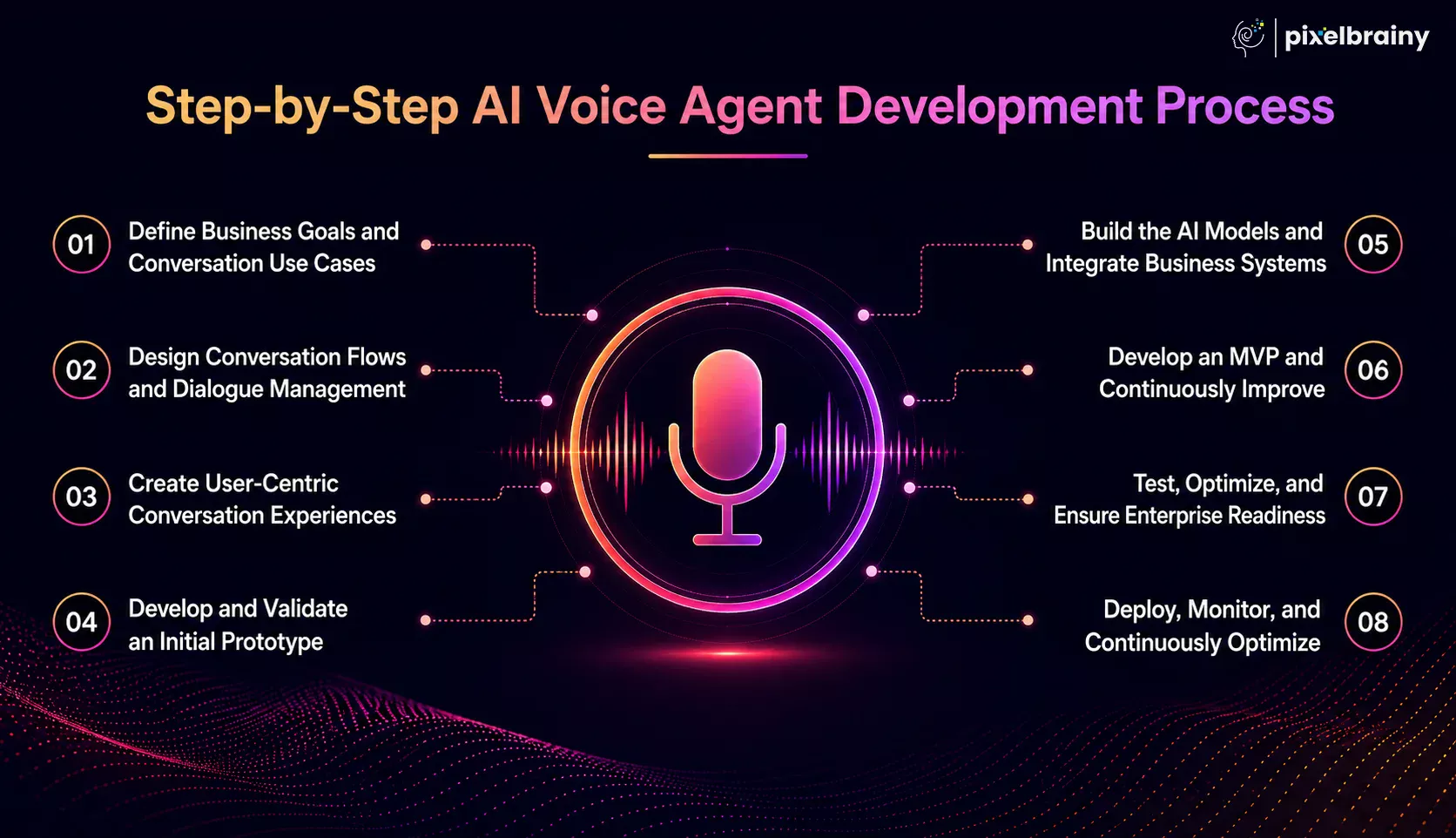
Every successful development of AI voice agent begins with understanding what problems the solution is expected to solve. Rather than trying to automate every possible customer interaction, businesses should first identify high-volume, repetitive conversations that follow predictable workflows. Common examples include appointment scheduling, claim status inquiries, payment reminders, order tracking, account verification, and policy information requests.
During this stage, define customer personas, expected call volumes, success metrics, escalation scenarios, and key business outcomes. Mapping every conversation path early helps identify where AI can resolve requests independently and where human intervention is still required. Establishing these objectives creates a strong foundation for building scalable conversational workflows that align with business priorities and customer expectations.
Dialogue management is the intelligence that controls how an AI voice agent conducts conversations. Instead of following fixed scripts like traditional IVR systems, the AI should understand customer intent, manage interruptions, handle topic changes, and remember information shared throughout the interaction.
For example, a customer may begin by asking about a claim, then switch to updating their address before returning to the original question. A well-designed dialogue manager preserves the conversation context while seamlessly handling these transitions. It should also recognize when confidence levels are low or requests become too complex, allowing the AI to escalate the call to a human representative with the complete conversation history. Designing these conversational pathways is one of the most critical stages in building an AI voice agent.
Even the most advanced AI models cannot compensate for poorly designed customer interactions. Before development begins, businesses should carefully design how conversations will sound, how responses will be structured, and how users will navigate different scenarios naturally.
This stage focuses on creating intuitive conversational experiences that reduce customer effort and increase engagement. Conversation designers work alongside a UI/UX design company to map customer journeys, define prompts, optimize confirmation messages, and eliminate unnecessary friction throughout the interaction. The result is an AI voice agent that feels helpful, conversational, and easy to communicate with instead of sounding robotic or overly scripted.
Before investing in full-scale implementation, organizations should validate the solution through a limited prototype. This phase helps confirm whether the selected AI models, conversation flows, integrations, and business logic perform effectively in real customer scenarios.
Many businesses begin with PoC development to evaluate technical feasibility and automation accuracy before expanding functionality. The prototype should test speech recognition quality, intent detection, dialogue management, response latency, and escalation workflows using representative customer conversations. Early validation reduces implementation risks, identifies design improvements, and provides stakeholders with measurable insights before proceeding to enterprise deployment.
Once the conversation flows are finalized, the next step is building an AI voice agent by integrating the core AI technologies with enterprise applications. This includes implementing Automatic Speech Recognition (ASR), Natural Language Understanding (NLU), Large Language Models (LLMs), dialogue management, and Text-to-Speech (TTS) capabilities. At the same time, the voice agent should securely connect with CRM platforms, ERP systems, payment gateways, scheduling software, knowledge bases, and other business applications through APIs.
Many organizations also leverage AI integrating services to streamline integrations with existing technology stacks and accelerate deployment. These integrations enable the AI voice agent to retrieve customer information, perform real-time transactions, update records, and automate business workflows instead of providing information alone.
Instead of launching a fully featured solution immediately, businesses should begin with a focused Minimum Viable Product that automates a limited set of high-volume customer requests. This allows teams to evaluate conversation quality, identify operational challenges, and collect valuable customer feedback before expanding automation capabilities.
A structured MVP development approach minimizes project risks while reducing implementation costs and development time. Once deployed, businesses should continuously improve the AI by refining intent recognition, expanding conversation flows, enhancing dialogue management, and incorporating new customer scenarios based on real interaction data. This iterative approach ensures the voice agent becomes more accurate and effective over time.
Comprehensive testing is essential before deploying an AI voice agent into production. Every conversation flow should be validated across different customer intents, speaking styles, accents, background noise conditions, and unexpected conversation paths. Special attention should be given to dialogue management, ensuring the AI correctly handles interruptions, topic switching, context retention, and escalation decisions.
Organizations should also evaluate response latency, speech quality, API performance, data security, compliance requirements, and failover mechanisms. Many enterprises work with top AI app development companies to conduct large-scale testing, optimize system performance, and ensure the solution meets enterprise-grade reliability, scalability, and security standards before deployment.
Deployment marks the beginning rather than the completion of the development process of AI voice agent solutions. After launching into production, businesses should continuously monitor conversation quality, customer satisfaction, automation rates, escalation frequency, and operational performance using real-time analytics.
Regular performance reviews help identify failed conversations, misunderstood intents, and workflow bottlenecks that require improvement. Many organizations also seek AI consultation solutions to optimize AI models, expand automation capabilities, and adapt the voice agent to evolving business requirements. Continuous optimization ensures the AI remains accurate, scalable, and capable of delivering consistent customer experiences as business needs grow.
Also Read: How To Build An AI Agent: A Step-by-Step Guide
One of the first questions businesses ask before investing in AI voice agent development is: "What is the cost to build an AI voice agent in 2026, and what features can I expect within my budget?" The answer depends on several factors, including the complexity of conversation flows, AI capabilities, third-party integrations, deployment scale, security requirements, and ongoing maintenance.
On average, the AI voice agent development cost in 2026 ranges from $15,000 to $150,000+, with enterprise-grade solutions requiring a larger investment due to advanced AI models, custom integrations, and compliance requirements.
Understanding the AI voice agent cost breakdown helps businesses estimate budgets accurately and choose a solution that aligns with their operational goals and customer service requirements.
| AI Voice Agent Type | Estimated Cost (USD) | What You Will Get |
|---|---|---|
| Basic AI Voice Agent | $15,000 to $35,000 | Supports common customer queries, speech recognition, text-to-speech, basic conversation flows, limited integrations, and suitable for startups or small businesses handling routine inquiries. |
| Advanced AI Voice Agent | $35,000 to $80,000 | Includes intelligent dialogue management, CRM integration, multilingual support, workflow automation, analytics dashboard, secure authentication, and personalized customer conversations for growing businesses. |
| Enterprise AI Voice Agent | $80,000 to $150,000+ | Offers enterprise integrations, custom AI models, advanced security, compliance support, omnichannel capabilities, high-volume call handling, analytics, monitoring, and scalable deployment for large organizations. |
The sophistication of your AI model has a significant impact on the overall cost of building an AI voice agent in 2026. A basic conversational model designed to answer FAQs requires far less development than an enterprise solution capable of handling complex, multi-turn conversations.
Estimated Cost: $5,000 to $30,000
Designing natural conversation flows involves mapping customer journeys, handling interruptions, managing context, and creating fallback scenarios for unexpected requests. More complex workflows require additional design, testing, and optimization.
Estimated Cost: $3,000 to $15,000
High-quality Automatic Speech Recognition (ASR) and realistic Text-to-Speech (TTS) engines improve customer experience but also increase development and licensing costs. Businesses often select premium speech providers for higher accuracy and natural voice quality.
Estimated Cost: $2,000 to $15,000
Connecting the AI voice agent with CRM systems, ERP platforms, payment gateways, scheduling software, healthcare systems, or custom business applications requires API development and integration testing.
Estimated Cost: $5,000 to $25,000
Industries such as healthcare, banking, and insurance require enterprise-grade security, encryption, audit logging, identity verification, and compliance with standards such as HIPAA, GDPR, or PCI DSS.
Estimated Cost: $5,000 to $20,000
Training the AI using business-specific conversations, improving intent recognition, testing different customer scenarios, and optimizing dialogue management are essential for achieving high automation accuracy.
Estimated Cost: $5,000 to $20,000
The deployment environment also affects pricing. Cloud hosting, telephony infrastructure, monitoring systems, backup mechanisms, and scalability requirements determine ongoing infrastructure costs.
Estimated Cost: $2,000 to $15,000
An AI voice agent requires ongoing monitoring, model updates, conversation optimization, feature enhancements, security updates, and infrastructure maintenance to ensure long-term performance and reliability.
Estimated Annual Cost: 15% to 25% of the initial development cost
Investing in the right AI voice agent solution is not just about reducing costs but about building a scalable, intelligent customer service platform that delivers measurable business value for years to come.
Also Read: AI Agent Development Cost ($10K-$100K+): Factors and Cost Optimization Tips
Building a high-performing AI voice agent is not determined by a single AI model or development framework. Instead, it depends on how well multiple technologies work together to deliver fast, accurate, and natural conversations. Businesses evaluating AI voice agent development often ask a practical question: "Which technology stack should we use to build an AI voice agent that understands customer intent, integrates with our existing CRM and business applications, and handles thousands of simultaneous calls without compromising performance?"
A production-ready AI voice agent relies on a carefully designed architecture that combines speech recognition, natural language processing, large language models, voice synthesis, backend services, databases, telephony platforms, cloud infrastructure, and enterprise integrations. Every layer has a specific responsibility, from converting spoken language into text and generating contextual responses to executing business workflows and monitoring system performance.
Whether you are developing an AI voice solution for healthcare, insurance, banking, ecommerce, or enterprise customer support, choosing proven technologies helps reduce development complexity, improve scalability, and ensure reliable customer experiences. The following tech stack represents the technologies most widely adopted for AI voice agent development in 2026.
| Technology Layer | Recommended Technologies | Purpose |
|---|---|---|
| Programming Languages | Python, Node.js, Java | Build AI models, backend services, APIs, and enterprise applications with high performance, flexibility, and scalability. |
| Frontend Dashboard | React.js, Next.js, Angular | Develop intuitive dashboards for monitoring conversations, managing workflows, viewing analytics, and configuring AI voice agents. |
| Backend Frameworks | FastAPI, Django, Express.js, Spring Boot | Create secure APIs, business logic, authentication services, and enterprise integrations for seamless application performance. |
| Speech Recognition (ASR) | OpenAI Whisper, Deepgram, Google Speech-to-Text, Azure Speech Services | Convert customer speech into text with high accuracy while supporting different accents, noisy environments, and real-time processing. |
| Large Language Models (LLMs) | GPT, Claude, Gemini, Llama | Understand customer intent, manage conversations, maintain context, and generate intelligent, human-like responses. |
| Natural Language Processing (NLP) | LangChain, LlamaIndex, spaCy | Improve intent recognition, entity extraction, retrieval, and conversation orchestration for more accurate customer interactions. |
| Text-to-Speech (TTS) | ElevenLabs, Azure Neural TTS, Google Cloud Text-to-Speech, Amazon Polly | Transform AI-generated responses into realistic voice output with natural pronunciation, pacing, and multilingual support. |
| Vector Database | Pinecone, Weaviate, Milvus, ChromaDB | Store vector embeddings and retrieve relevant business knowledge to deliver accurate, context-aware responses. |
| Database | PostgreSQL, MongoDB, MySQL, Redis | Securely store customer profiles, conversation history, workflow data, and application records for efficient retrieval. |
| CRM & Enterprise Integrations | Salesforce, HubSpot, Microsoft Dynamics, SAP, Oracle | Connect AI voice agents with customer records, business workflows, billing systems, and operational databases. |
| Telephony Platforms | Twilio, Vonage, Plivo, Amazon Connect | Enable inbound and outbound calling, SIP connectivity, intelligent call routing, and voice communication infrastructure. |
| Cloud Infrastructure | AWS, Microsoft Azure, Google Cloud Platform | Provide scalable hosting, AI services, storage, networking, monitoring, and enterprise-grade deployment capabilities. |
| Authentication & Security | OAuth 2.0, JWT, Auth0, Okta | Protect customer data through secure authentication, authorization, identity management, and API security mechanisms. |
| Monitoring & Analytics | Grafana, Prometheus, ELK Stack, Datadog | Monitor system health, API performance, conversation quality, infrastructure utilization, and operational metrics in real time. |
| DevOps & Deployment | Docker, Kubernetes, GitHub Actions, Jenkins | Automate application deployment, container orchestration, continuous integration, scaling, and infrastructure management. |
A well-architected technology stack forms the foundation of successful AI voice agent development, enabling businesses to build secure, scalable, and intelligent voice solutions that consistently deliver exceptional customer experiences.
Finding the right technology partner is just as important as choosing the right AI models or development framework. An experienced AI voice agent development company should be capable of building production-ready solutions that support natural conversations, low response latency, enterprise integrations, and secure deployments. Businesses searching for companies that develop AI voice agents in USA often ask: "Which development company has the technical expertise to build a scalable AI voice agent that can handle real-world customer conversations instead of scripted demos?"
The answer depends on evaluating each company's technical capabilities, industry experience, deployment methodology, and ability to build customized AI solutions. While some providers offer no-code platforms for rapid deployment, others specialize in fully customized AI powered voice agent development services designed for complex enterprise workflows.
The companies below are among the leading providers helping businesses implement intelligent voice automation across customer service, healthcare, banking, insurance, retail, and other industries.
| Company | Location | Specialization |
|---|---|---|
| PixelBrainy LLC | Sheridan, WY, USA | Specializes in custom AI voice agent development with low-latency pipeline architecture, enterprise CRM integration, telephony platforms, workflow automation, and scalable solutions for customer service, healthcare, insurance, sales, and enterprise operations. PixelBrainy focuses on building production-ready AI voice agents tailored to unique business processes rather than one-size-fits-all platforms. |
| Voiceflow | USA Presence | Conversational AI platform that enables businesses to design, prototype, and deploy AI voice agents for enterprise customer support and automation use cases. |
| Cognigy | USA Offices | Enterprise conversational AI platform focused on contact center automation, omnichannel customer experiences, and intelligent voice agent deployments. |
| Nuance Communications (Microsoft) | Burlington, MA | Develops enterprise AI voice solutions with strong expertise in healthcare, financial services, speech recognition, and conversational AI technologies. |
| Retell AI | San Francisco, CA | Provides a real-time AI voice agent platform designed for developers building production-grade voice applications with low-latency conversations. |
| Bland AI | San Francisco, CA | Offers AI phone agents for high-volume inbound and outbound calling, customer support, appointment scheduling, and sales automation. |
| Vapi | San Francisco, CA | API-first AI voice platform that helps developers build customizable voice agents using modern language models and telephony services. |
| Synthflow | USA Presence | No-code and low-code platform for building AI voice agents, making conversational automation accessible for businesses with minimal development effort. |
| Parloa | USA Offices | Enterprise AI voice platform focused on modernizing contact centers with scalable conversational AI and intelligent voice automation. |
| Tenyx (Acquired by Salesforce) | USA | Specializes in enterprise AI voice agents for customer service automation, helping businesses improve customer interactions through conversational AI technologies. |
Before selecting an AI voice agent development company, evaluate each provider based on technical expertise rather than marketing claims. Key factors to consider include:
The right AI voice agent development partner combines deep AI expertise, enterprise integration capabilities, and production deployment experience to build intelligent voice solutions that deliver measurable business results from day one.
Building an AI voice agent involves much more than integrating speech recognition and deploying a large language model. A production-ready solution must understand natural conversations, respond with minimal latency, protect sensitive customer data, and integrate seamlessly with existing business systems.
This is why organizations investing in AI voice agent development often ask: "What are the biggest challenges in developing an AI voice agent, and how can they be addressed before deployment?" The answer lies in identifying technical, operational, and compliance challenges early and implementing the right architecture, AI models, and testing strategies.
Below are the most common challenges businesses face during AI voice agent development and the best practices to overcome them.
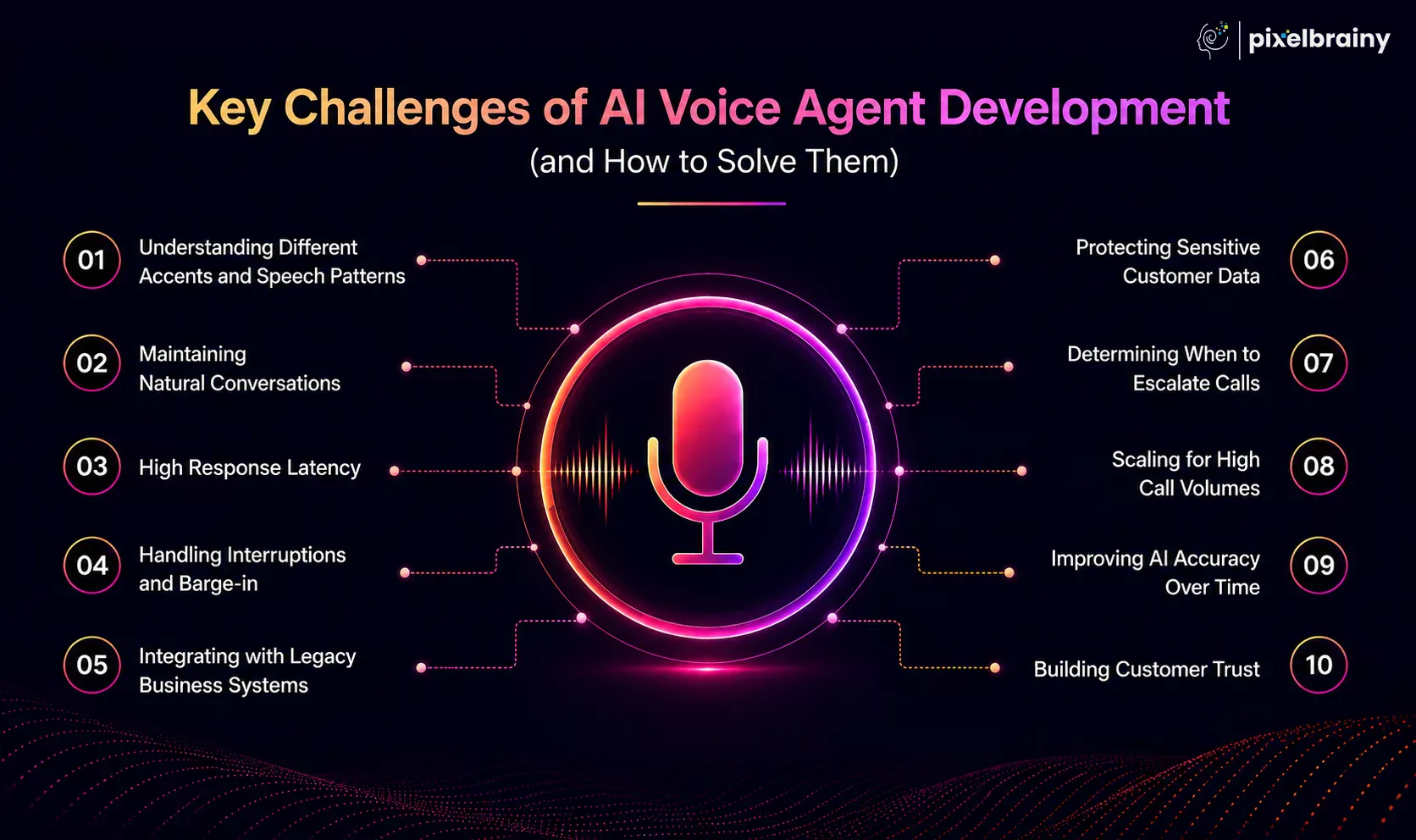
| Challenge | Solution |
|---|---|
| Understanding Different Accents and Speech Patterns | Train speech recognition models using diverse voice datasets and use advanced ASR engines capable of accurately recognizing regional accents, dialects, speaking speeds, and background noise. |
| Maintaining Natural Conversations | Implement robust dialogue management that remembers context, understands follow-up questions, handles topic changes, and supports multi-turn conversations without forcing customers to repeat information. |
| High Response Latency | Optimize the AI pipeline using low-latency speech recognition, efficient language models, response streaming, and scalable cloud infrastructure to achieve near real-time conversations. |
| Handling Interruptions and Barge-in | Build conversation management logic that detects when customers interrupt the AI, pauses speech immediately, processes the new request, and continues the conversation naturally. |
| Integrating with Legacy Business Systems | Use secure APIs, middleware, and integration frameworks to connect AI voice agents with CRM platforms, ERP systems, healthcare software, payment gateways, and other enterprise applications. |
| Protecting Sensitive Customer Data | Implement end-to-end encryption, role-based access control, secure authentication, audit logs, and compliance measures aligned with regulations such as HIPAA, GDPR, or PCI DSS. |
| Determining When to Escalate Calls | Define confidence thresholds and business rules that automatically transfer complex, emotional, or sensitive conversations to live agents while preserving conversation history. |
| Scaling for High Call Volumes | Deploy cloud-native infrastructure with load balancing, auto-scaling, distributed processing, and monitoring tools to support thousands of simultaneous customer conversations. |
| Improving AI Accuracy Over Time | Continuously analyze conversation data, retrain AI models using approved feedback, monitor failed interactions, and refine conversation flows based on real customer behavior. |
| Building Customer Trust | Design transparent conversations, clearly identify AI interactions when required, provide accurate responses, and ensure seamless human handoff whenever customers need additional assistance. |
Addressing these challenges proactively enables businesses to build AI voice agents that are accurate, secure, scalable, and capable of delivering reliable customer experiences in real-world production environments.
Finding the right development partner can determine whether your AI voice agent becomes a competitive business asset or another underperforming automation project. Many organizations evaluating AI voice agent development ask a practical question: "Which AI agent development company in the USA can build a production-ready voice agent that integrates with our existing systems, supports natural conversations, and scales as our business grows?"
The answer lies in choosing a partner with proven technical expertise, enterprise development experience, and a customer-first approach.
That is why businesses across healthcare, insurance, finance, retail, and enterprise services choose PixelBrainy, a trusted AI agent development company in USA, for building secure, intelligent, and scalable AI voice solutions tailored to their unique operational requirements.
Every business has different customer journeys, workflows, and operational challenges. Instead of relying on generic templates, PixelBrainy designs and develops fully customized AI voice agents that align with your business objectives, customer interactions, and enterprise processes.
PixelBrainy develops AI voice agents using scalable architectures that support real-time conversations, low response latency, secure APIs, cloud deployment, and seamless integration with CRM, ERP, telephony platforms, and other enterprise applications.
From healthcare and insurance to banking, ecommerce, logistics, and customer support, PixelBrainy develops AI voice agents that address industry-specific workflows, compliance requirements, and customer expectations while maintaining high automation accuracy.
Whether you want to understand how to develop an AI voice agent, build a proof of concept, launch an MVP, or deploy a production-ready enterprise solution, PixelBrainy provides complete development services from strategy and architecture to deployment, optimization, and ongoing support.
PixelBrainy measures success through business impact rather than feature delivery. Every solution is designed to reduce operational costs, improve customer satisfaction, automate repetitive processes, and deliver measurable return on investment.
A leading insurance organization approached PixelBrainy with a challenge of managing more than 45,000 inbound customer calls every month, where a majority of conversations involved repetitive policy inquiries, claim status updates, and appointment scheduling. The objective was to automate these routine interactions while maintaining a natural customer experience.
PixelBrainy designed and deployed a custom AI voice agent integrated with the client's CRM, policy management platform, and appointment scheduling system. Within the first few months of deployment, the solution successfully automated a significant percentage of routine customer inquiries, reduced average call handling time, improved first-call resolution rates, and allowed human agents to focus on more complex customer requests. Due to confidentiality agreements, the client's identity cannot be disclosed.
Ready to build an AI voice agent that delivers real business value? Connect with PixelBrainy, the trusted AI agent development company in USA, to discuss your requirements and create a production-ready voice solution tailored to your business goals.
AI voice agents have evolved from simple automation tools into intelligent business solutions capable of transforming customer service, streamlining operations, and reducing support costs. Whether your objective is to automate routine customer inquiries, improve response times, or scale support without increasing operational expenses, investing in AI voice agent development can deliver measurable business value. However, success depends on following the right development process of AI voice agent, selecting the appropriate technology stack, implementing essential and advanced features, and integrating the solution seamlessly with your existing business systems.
If you are planning to build an AI voice agent, understanding the development process, estimated costs, technical architecture, and implementation challenges will help you make informed decisions and maximize your return on investment. From startups to large enterprises, organizations that embrace voice agent development with AI are creating faster, smarter, and more personalized customer experiences while gaining a significant competitive advantage.
Ready to Build an AI Voice Agent?
Whether you're exploring your first AI initiative or planning an enterprise-scale deployment, PixelBrainy can help you design, develop, and launch a custom AI voice agent tailored to your business goals. Schedule a free consultation call with our AI experts today and discover how the right AI voice solution can transform your customer experience while driving long-term business growth.
The timeline for AI voice agent development depends on the project's complexity, required integrations, and customization level. A basic solution may take 4 to 8 weeks, while an enterprise-grade AI voice agent with CRM integration, compliance features, and advanced conversation management typically requires 3 to 6 months for development, testing, and deployment.
Yes. Modern AI voice agent development supports seamless integration with CRM platforms, ERP systems, payment gateways, scheduling software, healthcare applications, and custom business solutions through secure APIs. These integrations allow the AI to retrieve customer information, update records, automate workflows, and provide personalized responses in real time.
Although almost every industry can benefit, AI voice agent development delivers the greatest value for healthcare, insurance, banking, financial services, ecommerce, retail, logistics, telecommunications, travel, and customer support. Organizations handling large volumes of repetitive customer calls often achieve the fastest return on investment through voice automation.
Unlike traditional IVR systems, modern AI voice agents use natural language understanding and large language models to interpret customer intent rather than following fixed scripts. They can manage topic changes, maintain conversation context, answer follow-up questions, and intelligently escalate complex requests to human agents whenever necessary.
Absolutely. Businesses do not need enterprise-level budgets to build an AI voice agent. Many organizations begin with a focused solution that automates frequently asked questions, appointment scheduling, or customer support before gradually expanding functionality as business requirements and customer demand increase.
Security is a critical part of AI voice agent development. Enterprise solutions typically include encrypted communication, secure authentication, role-based access controls, audit logs, and compliance with regulations such as HIPAA, GDPR, or PCI DSS, depending on the industry and the type of customer data being processed.
If your business receives a high volume of repetitive customer calls, experiences long wait times, or wants to improve operational efficiency while reducing support costs, it is a strong candidate for building an AI voice agent. A technical discovery session can help identify the best automation opportunities and estimate the expected return on investment.
No-code platforms are suitable for basic automation and rapid deployment, but businesses with unique workflows, complex integrations, compliance requirements, or enterprise-scale operations typically benefit more from partnering with an experienced AI voice agent development company. A custom-built solution offers greater flexibility, scalability, security, and long-term business value.

About The Author
Sagar Bhatnagar
Sagar Sahay Bhatnagar brings over a decade of IT industry experience to his role as Marketing Head at PixelBrainy. He's known for his knack in devising creative marketing strategies that boost brand visibility and market influence. Sagar's strategic thinking, coupled with his innovative vision and focus on results, sets him apart. His track record of successful campaigns proves his ability to utilize digital platforms effectively for impactful marketing efforts. With a genuine passion for both technology and marketing, Sagar continuously pushes PixelBrainy's marketing initiatives to greater success.

Working with PixelBrainy has been a great experience. They took our vision for an AI-powered platform and turned it into a fully functional product. What impressed me most was their strong understanding of both design and development, and their ability to handle complex requirements with ease. The team was responsive, cooperative, and always open to feedback. They kept things organized, communicated clearly, and delivered quality work on time. I highly recommend PixelBrainy to anyone looking for a skilled and reliable development partner.

Working with the PixelBrainy team has been a highly positive experience. They understand the design requirements and create beautiful UX elements to meet the application needs. The dev team did an excellent job bringing my vision to life. We discussed usability and flow. Sagar worked with his team to design the database and begin coding. Working with Sagar was easy. He has the knowledge to create robust apps, including multi-language support, Google and Apple ID login options, Ad-enabled integrations, Stripe payment processing, and a Web Admin site for maintaining support data. I'm extremely satisfied with the services provided, the quality of the final product, and the professionalism of the entire process. I highly recommend them for Android and iOS Mobile Application Design and Development.

Great experience working with them. Had a lot of feedback and I found that unlike most contractors they were bugging me for updates instead of the other way around. They were extremely time conscience and great at communicating! All work was done extremely high quality and if not on time, early! They were always proactive when it comes to communication and the work is great/above par always. Very flexible and a great team to work with! Goes above and beyond to present us with multiple options and always provides quality. Amazing work per usual with Chitra. If you have UI/UX or branding design needs I recommend you go to them! Will likely work with them in the future as well, definitely recommended!

PixelBrainy is a joy to work with and is a great partner when thinking through branding, logo, and website layout. I appreciate that they spend time going into the "why" behind their decisions to help inform me and others about industry best practices and their expertise.

I hired them to design our software apps. Things I really like about them are excellent communication skills, they answer all project suggestions and collaborate right away, and their input on design and colors is amazing. This project was complex and needed patience and creativity. The team is amazing to do business with. I will be using them long-term. Glad to see there are some good people out there. I was afraid to try and outsource my project to someone but I am glad I met them! I really can't say enough. They went above and beyond on this project. I am very happy with everything they have done to make my business stand out from the competition.

It was great working with PixelBrainy and the team. They were very responsive and really owned the project. We'll definitely work with them again!

I recently worked with the PixelBrainy team on a project and I was blown away by their communication skills. They were prompt, clear, and articulate in all of our interactions. They listened and provided valuable feedback and suggestions to help make the project a success. They also kept me updated throughout the entire process, which made the experience stress-free and enjoyable.

PixelBrainy is very good at what it does. The team also presents themselves very professionally and takes care of their side of things very well. I could fully trust them taking up the design work in a timely and organised manner and their attention to detail saved us lots of effort and time. This particular project was quite intense and the team showed that they function very well under pressure. Very much looking forward to working with her again!

It's always an absolute pleasure working with them. They completed all of my requests quickly and followed every note I had for them to a T, which made our process go smoothly from start to finish. Everything was completed fast and following all of the guidelines. And I would recommend their services to anyone. If you need any design work done in the future, PixelBrainy should be your first call!

They took ownership of our requirements and designed and proposed multiple beautiful variants. The team is self-motivated, requires minimum supervision, committed to see-through designs with quality and delivering them on time. We would definitely love to work with PixelBrainy again when we have any requirements.

PixelBrainy was a big help with our SaaS application. We've been hard at work with a new UI/UX and they provided a lot of help with the designs. If you're looking for assistance with your website, software, or mobile application designs, PixelBrainy and the team is a great recommendation.

PixelBrainy designers are amazing. They are responsive, talented, and always willing to help craft the design until it matches your vision. I would recommend them and plan to continue them for my future projects and more!!!

They were awesome! Did a good job fast, and good communication. Will work with them again. Thank you

Creative, detail-oriented, and talented designers who take direction well and implement changes quickly and accurately. They consistently over-delivered for us.

PixelBrainy team is very talented and creative. Great designers and a pleasure to work with. PixelBrainy is an excellent communicator and I look forward to working with them again.

PixelBrainy has a very talented design team. Their work is excellent and they are very responsive. I enjoy working with them and hope to continue on all of our future projects.


Transform your ideas into reality with us.
Across these industries, each engagement brings unique challenges, from early-stage product development to scaling complex systems, helping us build a practical understanding of real-world product environments.