AI Summary Powered by PixelBrainy
Women’s health is at the forefront of innovation, and artificial intelligence is rapidly transforming how healthcare services are delivered, personalized, and accessed. From fertility tracking and pregnancy care to menopause management and chronic disease prediction, AI Women’s Health Platforms are revolutionizing the way women interact with healthcare technology.
The demand for smarter, more personalized digital health solutions has never been greater. Startups, healthcare organizations, and digital health entrepreneurs are actively exploring AI Women’s Health Platform Development to bridge the gap between data-driven insights and individual care needs. By integrating AI into women’s health technology, developers can build intelligent systems that predict, analyze, and personalize care pathways like never before.
Building an AI Women’s Health Platform is not just about creating an app — it is about designing a holistic digital ecosystem that empowers women with accurate, accessible, and proactive health management tools. As the FemTech market grows exponentially, businesses are realizing that investing in Women’s Health Platform Development Integrating AI is a strategic move toward innovation, inclusivity, and impact.
In this guide, we will walk you through everything you need to know to Develop an AI Women’s Health Platform — from understanding what it is and why it matters to its features, architecture, cost, and development process. Whether you are a healthcare startup, an investor, or a technology leader, this step-by-step roadmap will help you create an AI Women’s Health Platform that delivers real-world results and long-term value.
An AI Women’s Health Platform is a digital healthcare solution that leverages artificial intelligence, data analytics, and machine learning to address women’s unique health needs. It can include functionalities such as menstrual tracking, fertility prediction, pregnancy monitoring, and hormonal health analysis.
These platforms gather and process large volumes of user health data to generate personalized insights, detect early warning signs, and recommend preventive measures. Unlike traditional health apps, AI-driven platforms continuously learn from user data, improving their predictive accuracy and personalization over time.
Such platforms not only empower women with actionable insights but also support healthcare providers with data-driven decision-making, ensuring more effective and timely interventions.
The growing focus on AI Women’s Health Platform Development is not just a passing trend; it reflects a deeper transformation in how healthcare is designed, delivered, and personalized for women. In 2025, the convergence of technology, healthcare innovation, and inclusivity has created the perfect environment for organizations to invest in building intelligent, data-driven women’s health solutions.
The traditional healthcare system often overlooks or generalizes women’s health needs. This lack of gender-specific research and digital tools has left millions of women underserved, especially in areas like reproductive health, hormonal imbalance, menopause, and chronic condition management. Developing an AI Women’s Health Platform fills this gap by combining medical data, behavioral insights, and predictive analytics to deliver more targeted healthcare experiences.
From an industry perspective, the FemTech market is witnessing record-breaking growth and investment. According to Grand View Research (2025), the global FemTech market was valued at USD 39.29 billion in 2024 and is expected to reach USD 97.25 billion by 2030, growing at a CAGR of 16.4%. Similarly, Research and Markets (2025) projects that the FemTech industry will reach USD 46.7 billion in 2025 and surpass USD 100 billion by 2029.
This consistent upward trend highlights how integrating AI into healthcare platforms is becoming a key differentiator for digital health innovators.
Ultimately, to build an AI Women’s Health Platform is to participate in shaping the future of personalized healthcare. It represents a strategic step toward innovation that balances profitability, accessibility, and meaningful impact for women worldwide.
Developing an AI Women’s Health Platform goes far beyond creating a digital tool. It represents a strategic advancement in healthcare that blends innovation, data science, and personalized medicine to address women’s unique health needs.
Below are the top benefits of AI Women’s Health Platform Development, demonstrating how AI transforms care experiences, outcomes, and opportunities.
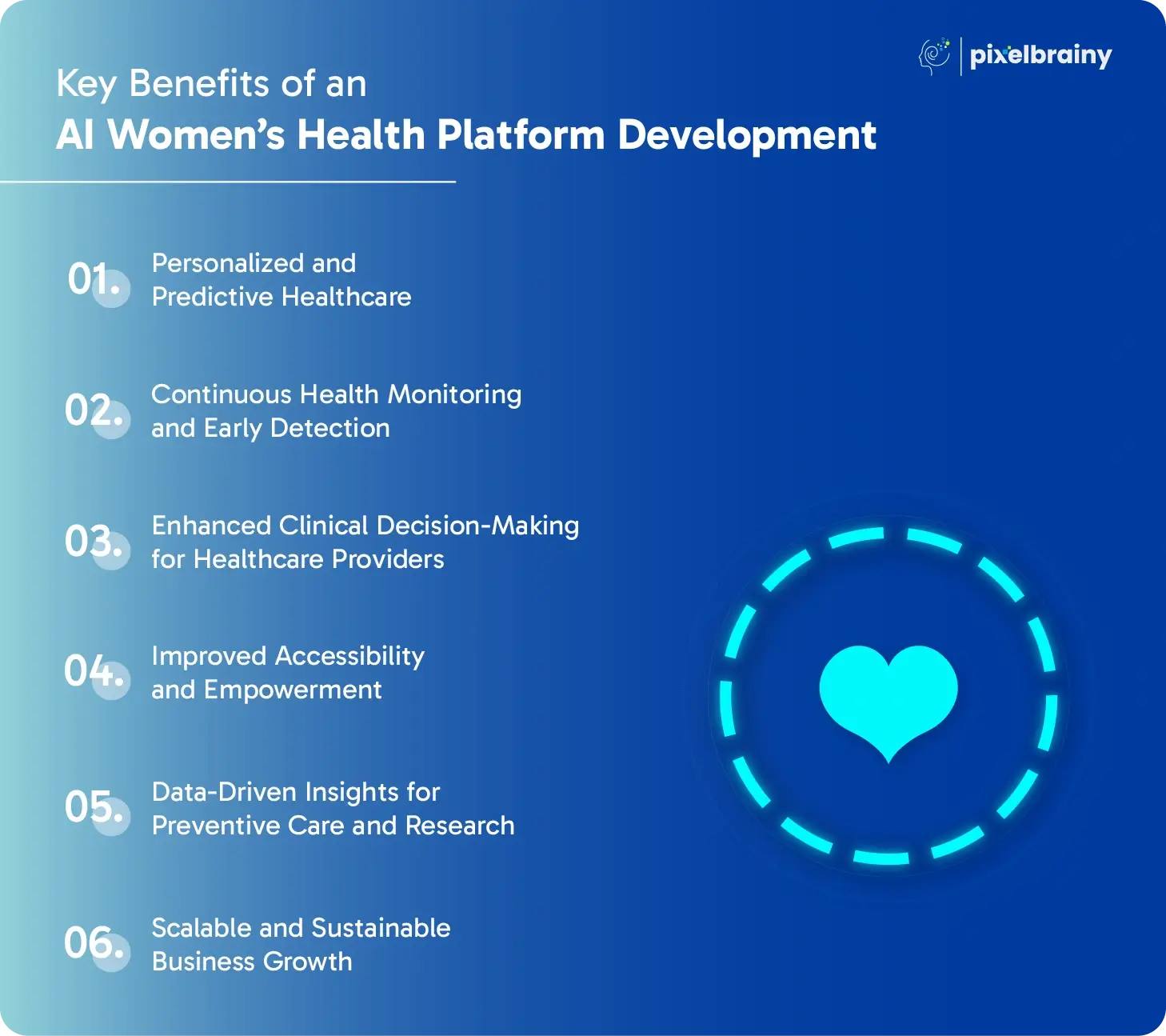
One of the leading advantages of an AI Women’s Health Platform Development is the ability to deliver personalized healthcare at scale. By leveraging machine learning algorithms, the platform studies individual health data such as menstrual cycles, lifestyle habits, genetics, and medical history.
This allows it to predict potential risks, identify irregularities, and recommend preventive measures tailored to each user. Predictive modeling helps users understand their fertility patterns, hormonal fluctuations, and reproductive health with greater accuracy.
As a result, developing an AI Women’s Health Software enables healthcare providers to shift from generalized advice to precise, data-informed care that truly adapts to each woman’s biological profile.
AI systems provide round-the-clock tracking and analysis of a woman’s health indicators. By integrating with wearables and IoT devices, these platforms collect continuous data such as sleep quality, stress levels, heart rate, and hormone-related changes.
Through this ongoing monitoring, the platform can detect subtle physiological shifts that may signal early stages of conditions like PCOS, thyroid dysfunction, or anemia. Early detection means timely intervention, reduced healthcare costs, and improved outcomes.
This ability to transform reactive healthcare into proactive wellness management stands as one of the key benefits of an AI Women’s Health Platform for both users and medical professionals.
An AI-powered platform benefits not only patients but also healthcare practitioners. The system’s analytics engine can compile and interpret massive datasets, offering healthcare professionals actionable insights during consultations.
By identifying correlations across symptoms, test results, and user behaviors, AI assists doctors in making faster and more accurate diagnoses. It can also recommend evidence-based treatment options, ensuring that care decisions are data-supported rather than assumption-based.
This integration of clinical intelligence into practice allows medical teams to deliver higher-quality, efficient, and personalized care across various stages of women’s health.
A major benefit of developing an AI Women’s Health Platform is its capacity to make healthcare accessible to all women, regardless of location or income. Digital platforms equipped with AI chatbots and teleconsultation modules bridge the gap between women and healthcare providers.
Women in rural or underserved areas can now consult specialists, access reliable information, and receive real-time support through their smartphones. This accessibility empowers women to take active control over their reproductive, mental, and physical well-being.
By developing an AI Women’s Health Software, organizations promote inclusivity and ensure that quality healthcare reaches every woman who needs it.
Every interaction within an AI-driven health platform generates valuable data. When anonymized and aggregated responsibly, this data becomes a goldmine for public health research, pharmaceutical studies, and policy development.
Researchers can use this information to understand population-level health patterns, study fertility and menopause trends, and identify risk factors associated with women-specific conditions.
This continuous feedback loop between AI analytics and research not only strengthens the platform’s predictive accuracy but also fuels global advancements in women’s healthcare innovation.
From a business standpoint, AI Women’s Health Platform Development presents immense commercial potential. The scalable nature of AI technology allows startups and healthcare enterprises to expand services across geographies and specializations with minimal infrastructure costs.
Features like subscription-based models, premium analytics, and teleconsultation offerings create recurring revenue streams. With the FemTech market projected to surpass USD 100 billion by 2029, developing such platforms now positions companies at the forefront of a rapidly growing global industry.
This fusion of purpose and profitability makes it one of the most strategic advantages of an AI Women’s Health Platform Development in today’s digital economy.
These benefits of an AI Women’s Health Platform extend far beyond convenience or automation. They redefine healthcare delivery for women through precision, inclusivity, and intelligence—building a foundation for a healthier, more empowered future.

A successful AI Women’s Health Platform Development depends on features that combine usability, personalization, and secure data intelligence. These functionalities help in enhancing user engagement, supporting clinical efficiency, and ensuring safe digital healthcare experiences.
| Feature | Description |
| User Registration and Profile Setup | Allows women to create secure accounts and input health information for customized recommendations |
| Menstrual Cycle Tracking | Tracks and predicts menstrual cycles using AI algorithms to identify patterns and irregularities |
| Fertility and Ovulation Monitoring | Uses predictive modeling to help users plan pregnancies or understand fertility windows with accuracy |
| Symptom Checker | Employs AI to analyze symptoms and provide preliminary guidance for possible conditions or treatments |
| Pregnancy Tracking Module | Offers stage-wise monitoring, wellness insights, and fetal growth updates based on user data |
| Medication and Appointment Reminders | Sends automatic notifications to ensure consistent treatment adherence and timely checkups |
| Secure Health Record Management | Stores test results and medical reports safely under HIPAA-compliant data security protocols |
| Telemedicine Integration | Connects patients with certified healthcare experts for virtual consultations and remote assessments |
| Lifestyle and Nutrition Guidance | Delivers diet and exercise suggestions customized to each woman’s health profile and goals |
| Chatbot Support (NLP-based) | Provides instant conversational support for health queries and general assistance |
| Wearable Device Connectivity | Integrates with smartwatches or fitness trackers to collect continuous health metrics |
| Personalized Health Reports | Generates AI-driven summaries of overall progress and provides actionable health recommendations |
| Multi-language Support | Promotes inclusivity by allowing users to interact with the platform in their preferred languages |
| Community Support Forum | Encourages engagement and knowledge-sharing through safe, moderated peer discussions |
| Data Privacy and Consent Management | Ensures transparency and user trust through secure consent handling and privacy control mechanisms |
By including these essential features, developing an AI Women’s Health Platform becomes a foundation for innovation, personalization, and user trust.
As technology advances, integrating sophisticated features into AI Women’s Health Software enhances the intelligence, precision, and value of the platform. These next-level functionalities position the solution as a future-ready digital healthcare ecosystem.
| Advanced Feature | Description |
| Predictive Analytics for Health Risks | Uses AI models to identify and forecast potential health concerns like PCOS, thyroid imbalance, or infertility |
| Emotional and Mental Health Monitoring | Leverages NLP and sentiment analysis to assess mood patterns and mental well-being trends |
| AI-Powered Virtual Health Assistant | Offers real-time assistance through intelligent chat or voice interactions for medical and wellness queries |
| Genetic and Hormonal Analysis Integration | Incorporates genomic and hormonal data to improve diagnosis accuracy and personalized care |
| Computer Vision for Medical Imaging | Assists doctors by analyzing ultrasound and scan images for early detection and clinical support |
| Adaptive Learning Algorithms | Continuously improves predictions and recommendations as user data evolves |
| Personalized Preventive Care Plans | Creates customized preventive strategies based on predictive modeling and user health trends |
| Blockchain-Based Data Security | Enhances transparency and protects medical records with secure, tamper-proof blockchain technology |
| Cross-Platform Data Synchronization | Combines health data from multiple devices, apps, and medical sources for unified insights |
| Advanced Analytics Dashboard for Clinicians | Provides healthcare providers with data visualization tools and predictive insights for better decision-making |
Integrating these advanced features for AI Women’s Health Platform Development transforms a standard app into an intelligent, future-ready healthcare platform.
To truly understand what is the process to build AI Women’s Health Platform, one must see it as a combination of medical science, data engineering, and user-centered design. The development of AI Women’s Health Platform is not a linear build—it’s a multi-stage process that merges empathy, technology, and compliance to create a digital ecosystem women can trust.
Below is a comprehensive guide outlining each step in the journey of developing AI Women’s Health Platform, from idea to implementation.
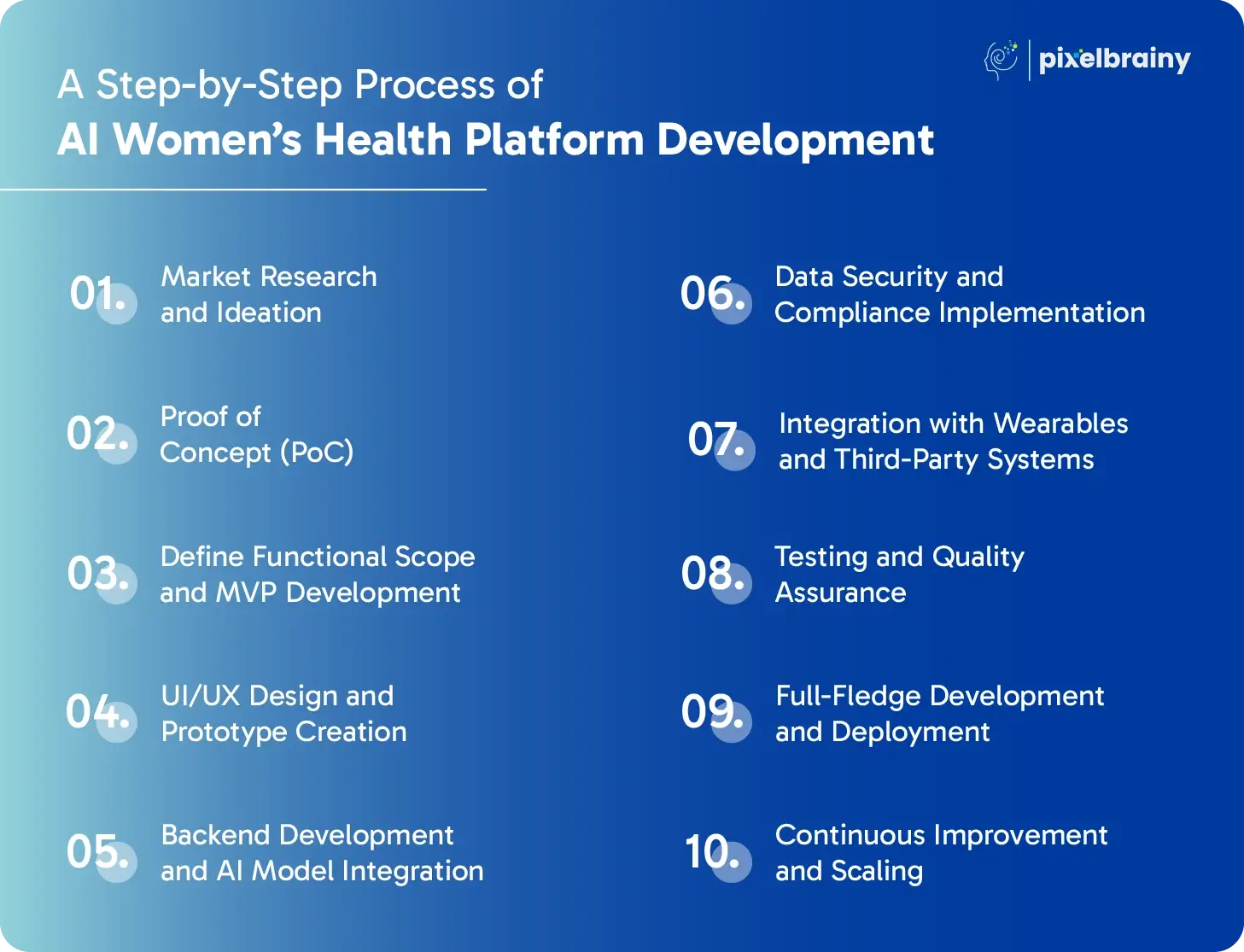
Aim of This: The goal of this phase is to explore real-world problems women face across different health domains such as reproductive care, menopause management, and chronic disease monitoring. It helps in defining the platform’s scope, audience, and unique value proposition.
Why This Matters: Strong research ensures that the product has a clear direction and addresses genuine needs. Teams analyze user pain points, review existing FemTech competitors, and identify innovation gaps. This step shapes the foundation of success because it aligns technical possibilities with medical realities and ensures that the platform concept resonates with real users.
Aim of This: To validate the feasibility and practical application of AI models before committing to large-scale investment. The PoC focuses on testing whether the envisioned features—such as data analysis, health prediction, or chatbots—can deliver meaningful and accurate results.
Why This Matters: Creating a PoC avoids costly misdirection. It gives stakeholders a tangible preview of how AI can process health data and what kind of insights it can generate. It also helps technical teams refine algorithms, identify integration barriers, and build confidence in the technological underpinnings before moving forward.
Also Read: AI Chatbot Proof of Concept (PoC) Development for Enterprises: From Idea to Impact
Aim of This: The objective is to craft a Minimum Viable Product (MVP) that focuses on essential functionality while excluding complex or costly features. The MVP typically includes symptom tracking, data storage, user dashboards, and basic AI-driven insights.
Why This Matters: This stage allows real users to interact with a functioning version of the platform. Early feedback uncovers usability issues, data inaccuracies, and performance limitations. By launching an MVP, businesses reduce financial risk, accelerate time to market, and ensure that the final product is based on validated user behavior rather than assumptions.
Aim of This: To translate research insights into an intuitive, inclusive, and emotionally engaging digital experience. Partnering with a skilled UI/UX design company ensures that every element—from navigation to typography—supports both ease of use and trustworthiness.
Why This Matters: Women engage better with platforms that feel safe, personalized, and accessible. Design prototypes allow teams to visualize workflows and simulate user journeys before coding begins. This step guarantees usability, accessibility for diverse users, and compliance with design standards in healthcare applications.
Aim of This: To create a scalable backend system capable of processing vast amounts of data while integrating machine learning, natural language processing, and predictive algorithms seamlessly.
Why This Matters: The AI core determines how effective and intelligent the platform will be. The AI Women’s Health Platform Development Integrating AI ensures that the platform can analyze structured and unstructured health data accurately. Collaborating with the top AI development companies in USA can provide access to advanced data pipelines, strong model architectures, and compliance expertise, all of which help maintain performance and reliability at scale.
Aim of This: To establish airtight data security protocols that protect personal health information and align with regulations like HIPAA, GDPR, and regional medical data laws.
Why This Matters: Trust is the cornerstone of healthcare technology. Women must feel confident that their health data is private and protected. This phase includes encryption of sensitive data, anonymization of identifiers, and implementation of consent-based sharing. A secure system reinforces credibility and meets global compliance expectations required for medical applications.
Aim of This: To connect external devices, sensors, and healthcare databases so that the platform can collect real-time, multifaceted health data.
Why This Matters: Integrating wearables such as smartwatches and medical sensors adds enormous value by transforming the platform to make AI Women’s Health Platform more interactive and accurate. Third-party APIs from labs, telemedicine providers, or insurance systems expand functionality and provide a holistic picture of the user’s health, supporting proactive care.
Aim of This: To rigorously validate that every component—from AI predictions to data handling—functions correctly and safely across devices and platforms.
Why This Matters: Testing identifies vulnerabilities, inconsistencies, and performance issues before launch. Teams evaluate algorithm accuracy, load performance, user experience, and compliance adherence. In healthcare technology, precision and reliability are non-negotiable, and this step ensures that the platform delivers accurate insights without compromising safety or ethics.
Aim of This: To expand the MVP into a comprehensive full fledge solution featuring all planned modules, integrations, and enhancements. Deployment involves setting up secure cloud hosting, database scaling, and continuous delivery pipelines for stability.
Why This Matters: This stage transforms a prototype into a market-ready, sustainable product. Proper deployment strategies minimize downtime and guarantee that healthcare providers and patients can rely on uninterrupted access. Post-deployment monitoring ensures that the development of AI models maintain performance and continue learning as more user data becomes available.
Aim of This: To continuously evolve the platform by incorporating new data, refining models, and expanding features to meet changing user and industry needs.
Why This Matters: Healthcare is dynamic, and technology never stops advancing. Regular updates, feedback-driven improvements, and model retraining ensure that the developing AI Women’s Health Platform remains accurate, compliant, and innovative. Continuous enhancement also helps scale the product into new markets and demographics while maintaining user trust and satisfaction.
The AI Women’s Health Platform Development journey is both scientific and human-centered. Each phase builds on the previous one to produce an intelligent healthcare ecosystem that empowers women with data-driven insights, proactive care, and a secure digital experience designed for long-term impact
Estimating what is the cost to build AI Women’s Health Platform can vary widely based on complexity, AI integrations, platform type and geographic development rates. According to industry sources, custom FemTech or women’s health apps can cost between USD 20,000 and USD 250,000+ depending on scope and sophistication.
| Platform Type | Description / Typical Inclusions | Estimated Cost (USD) |
| Basic AI Women’s Health Platform | Core features like profile setup, menstrual/fertility tracking, reminders, dashboard for one platform (iOS or Android) | ~$20,000 – $60,000 |
| Medium AI Women’s Health Platform | Adds multi-platform (iOS + Android + Web), additional modules such as symptom checker, basic AI insights and wearable integration | ~$60,000 – $150,000 |
| Advanced AI Women’s Health Platform | Full-scale platform with advanced AI analytics, natural language chatbot, telemedicine integration, clinician dashboard, data lake, multi-region deployment | ~$150,000 – $250,000+ |
These cost ranges reflect cost to make AI Women’s Health Platform inclusive of design, core development, backend infrastructure and initial AI model development (not including long-term maintenance or upgrades).
Selecting the right technology stack is crucial in the development of AI Women’s Health Platform, as it defines performance, scalability, and security. The stack combines front-end and back-end technologies, AI frameworks, and cloud infrastructure that together enable seamless data flow and predictive intelligence.
Using the right combination helps ensure a robust and compliant product while reducing long-term operational costs.
| Category | Tools / Technologies | Purpose & Key Notes |
| Frontend Development | React.js, Angular, Flutter, Swift, Kotlin | These tools help build responsive mobile and web interfaces for smooth user interaction and engagement across devices |
| Backend Development | Node.js, Python (Django, Flask), Ruby on Rails | Ensures efficient server-side operations, secure APIs, and data flow management for AI Women’s Health Platform Development |
| Database Management | PostgreSQL, MongoDB, MySQL, Firebase | Stores structured and unstructured health data with scalability and real-time syncing capabilities |
| AI and Machine Learning Frameworks | TensorFlow, PyTorch, Scikit-learn, Keras | Used to build and train models for predictive analytics, pattern recognition, and intelligent insights while developing AI Women’s Health Platform |
| Natural Language Processing (NLP) | spaCy, OpenAI GPT API, Dialogflow | Powers chatbots, symptom analyzers, and voice assistants to enhance user engagement |
| Cloud Infrastructure | AWS, Microsoft Azure, Google Cloud | Provides scalability, data hosting, and storage solutions for AI Women’s Health Platform Development Integrating AI |
| Data Security and Compliance | OAuth 2.0, SSL Encryption, HIPAA, GDPR frameworks | Protects user data, ensures privacy, and maintains compliance with global healthcare standards |
| Analytics and Visualization Tools | Power BI, Tableau, Apache Superset | Converts health data into easy-to-understand dashboards for both users and clinicians |
| Integration & APIs | Twilio (communication), Stripe (payments), Fitbit API, Apple HealthKit | Adds functionalities such as messaging, payments, and wearable data syncing to make AI Women’s Health Platform comprehensive |
| Testing & Quality Assurance | Selenium, JMeter, Postman, Appium | Conducts functional, performance, and security testing to ensure the platform runs smoothly under different user conditions |
Using this modern tech stack for AI Women’s Health Platform Development ensures flexibility, data integrity, and long-term scalability while meeting compliance and innovation goals.
The journey of AI Women’s Health Platform Development is filled with innovation potential but also comes with unique challenges. From managing sensitive health data to ensuring clinical accuracy, every stage requires precision and accountability.
Recognizing these pitfalls early and implementing strong mitigation strategies can help ensure the platform’s success and sustainability.
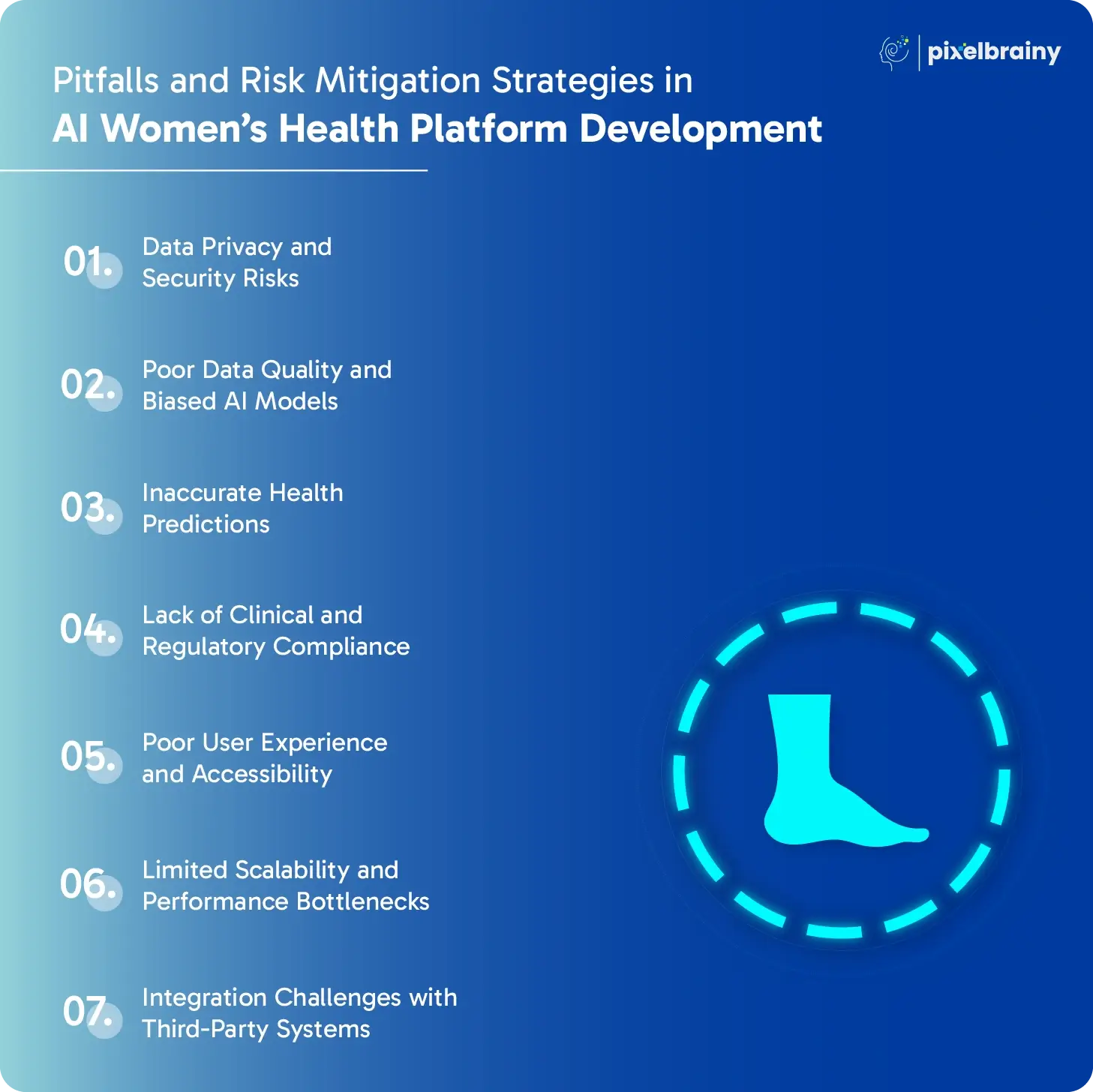
Pitfall: Handling personal and medical data of women across multiple geographies involves significant privacy concerns. A lack of encryption, poor authentication, or non-compliance with healthcare laws can lead to data breaches and legal consequences.
Mitigation Strategy: Implement HIPAA, GDPR, and local healthcare data regulations from the very beginning. Use SSL encryption, token-based authentication (OAuth 2.0), and anonymization of sensitive information. Conduct regular penetration testing and audits to ensure all systems remain compliant and secure.
Pitfall: AI models trained on incomplete, inaccurate, or biased datasets can lead to misleading predictions. This is especially critical in women’s health, where diverse demographic and biological data are essential.
Mitigation Strategy: Use diverse datasets that represent different age groups, ethnicities, and health conditions. Collaborate with medical experts and data scientists to validate training data. Continuously retrain AI models with updated, verified, and unbiased data sources to ensure fairness and accuracy.
Pitfall: If AI algorithms are not properly validated, the platform may generate false alerts or overlook key symptoms, leading to loss of user trust and potential harm.
Mitigation Strategy: Adopt multi-stage testing, including clinical validation with real-world medical experts. Incorporate human-in-the-loop approaches where doctors review AI-generated insights before public deployment. Maintain algorithm transparency for regulatory approval and user confidence.
Pitfall: Many startups overlook compliance during the development of AI Women’s Health Platform, leading to complications during launch or partnership approvals.
Mitigation Strategy: Engage with healthcare compliance consultants early in the process. Document all clinical decision-making processes and follow local health authority standards. Obtain necessary certifications before release to avoid costly reworks or penalties.
Pitfall: Even advanced AI features may fail if the user interface is confusing or inaccessible. Women from various age groups and regions may abandon the app due to poor usability or lack of language options.
Mitigation Strategy: Work with experienced designers who understand healthcare UX. Include voice guidance, multiple language options, and inclusive design principles. Conduct usability testing across different demographics to ensure comfort and engagement.
Pitfall: As the platform grows, it may experience slow performance or downtime due to an unoptimized backend or infrastructure limitations.
Mitigation Strategy: Adopt scalable cloud infrastructure using platforms like AWS or Azure. Implement load balancing, caching mechanisms, and microservices architecture for smooth performance. Continuous monitoring helps detect and resolve performance issues proactively.
Pitfall: Integrating wearables, telemedicine APIs, or electronic health records can lead to data mismatches or synchronization errors.
Mitigation Strategy: Use standardized APIs and healthcare interoperability frameworks such as HL7 or FHIR. Establish continuous integration testing pipelines to verify data consistency across all connected systems.
By addressing these challenges early and implementing effective mitigation strategies, organizations can build a trustworthy, compliant, and future-ready AI Women’s Health Platform that delivers real impact for women worldwide.
Partnering with the right AI development company is essential to ensure precision, scalability, and compliance in digital healthcare innovation. PixelBrainy stands out as a trusted technology partner with deep expertise in healthcare AI, user-centric design, and end-to-end product engineering. Our mission is to create AI Women’s Health Platform solutions that combine medical accuracy with human empathy, empowering women through intelligent, data-driven healthcare tools.
PixelBrainy’s development approach focuses on innovation, quality, and reliability at every stage—from ideation and design to post-launch optimization. With a team of experienced AI engineers, data scientists, and health-tech experts, we ensure that each AI Women’s Health Platform Creation meets regulatory standards while offering a personalized and engaging experience to users.
PixelBrainy recently worked on a women’s digital health initiative focusing on reproductive and hormonal wellness. The project involved creating a predictive analytics engine powered by AI and wearable integrations. The platform successfully processed thousands of real-time data points daily, offering personalized cycle predictions, early risk alerts, and remote doctor consultations. The result was a clinically validated digital ecosystem that improved user engagement by 40% and enhanced diagnostic accuracy across multiple health indicators.
This project showcases PixelBrainy’s capability to make AI Women’s Health Platform solutions that are clinically sound, AI-driven, and user-centered.
At PixelBrainy, we do not just build software; we build intelligent healthcare ecosystems that shape the future of women’s wellness through innovation, trust, and technology.
From the above, it is clear that AI Women’s Health Platform Development represents the next major leap in digital healthcare innovation. By combining artificial intelligence with personalized wellness insights, these platforms empower women to take control of their reproductive, mental, and physical health. The journey to make AI Women’s Health Platform requires strategic planning, medical expertise, and a deep understanding of user needs. Partnering with an experienced team ensures scalability, data integrity, and long-term success. As the healthcare industry continues to evolve, investing in intelligent, AI-driven women’s health solutions today can define the future of accessible and preventive care.
Ready to bring your vision to life?
Contact PixelBrainy today to book an appointment and start building your transformative AI Women’s Health Platform.
An AI Women’s Health Platform aims to personalize healthcare for women by leveraging artificial intelligence to monitor health patterns, predict potential risks, and provide actionable wellness recommendations. It focuses on preventive care, reproductive health, and chronic condition management through intelligent data insights.
The development timeline depends on the scope and complexity of the project. A basic version may take around 3 to 6 months, while a full-featured, AI-integrated platform can require 9 to 14 months, including design, testing, and compliance validation.
Beyond healthcare, industries such as fitness, insurance, pharmaceuticals, telemedicine, and wellness technology can benefit from creating AI-driven women’s health platforms. These solutions enhance customer engagement, data analytics, and preventive care models.
The platform utilizes diverse data sources including menstrual cycles, wearable device inputs, clinical records, genetic data, and lifestyle habits. This information allows machine learning models to generate accurate and personalized insights for every user.
Yes. When developed under strict security standards like HIPAA and GDPR, the platform ensures complete data protection. Encryption, access control, and anonymization techniques make the system safe and trustworthy for users worldwide.
PixelBrainy is an expert AI development company specializing in healthcare innovation. They provide end-to-end services — from concept ideation and AI model design to deployment and compliance management — ensuring your platform is intelligent, secure, and market-ready.

About The Author
Sagar Bhatnagar
Sagar Sahay Bhatnagar brings over a decade of IT industry experience to his role as Marketing Head at PixelBrainy. He's known for his knack in devising creative marketing strategies that boost brand visibility and market influence. Sagar's strategic thinking, coupled with his innovative vision and focus on results, sets him apart. His track record of successful campaigns proves his ability to utilize digital platforms effectively for impactful marketing efforts. With a genuine passion for both technology and marketing, Sagar continuously pushes PixelBrainy's marketing initiatives to greater success.

Working with the PixelBrainy team has been a highly positive experience. They understand the design requirements and create beautiful UX elements to meet the application needs. The dev team did an excellent job bringing my vision to life. We discussed usability and flow. Sagar worked with his team to design the database and begin coding. Working with Sagar was easy. He has the knowledge to create robust apps, including multi-language support, Google and Apple ID login options, Ad-enabled integrations, Stripe payment processing, and a Web Admin site for maintaining support data. I'm extremely satisfied with the services provided, the quality of the final product, and the professionalism of the entire process. I highly recommend them for Android and iOS Mobile Application Design and Development.

Great experience working with them. Had a lot of feedback and I found that unlike most contractors they were bugging me for updates instead of the other way around. They were extremely time conscience and great at communicating! All work was done extremely high quality and if not on time, early! They were always proactive when it comes to communication and the work is great/above par always. Very flexible and a great team to work with! Goes above and beyond to present us with multiple options and always provides quality. Amazing work per usual with Chitra. If you have UI/UX or branding design needs I recommend you go to them! Will likely work with them in the future as well, definitely recommended!

PixelBrainy is a joy to work with and is a great partner when thinking through branding, logo, and website layout. I appreciate that they spend time going into the "why" behind their decisions to help inform me and others about industry best practices and their expertise.

I hired them to design our software apps. Things I really like about them are excellent communication skills, they answer all project suggestions and collaborate right away, and their input on design and colors is amazing. This project was complex and needed patience and creativity. The team is amazing to do business with. I will be using them long-term. Glad to see there are some good people out there. I was afraid to try and outsource my project to someone but I am glad I met them! I really can't say enough. They went above and beyond on this project. I am very happy with everything they have done to make my business stand out from the competition.

It was great working with PixelBrainy and the team. They were very responsive and really owned the project. We'll definitely work with them again!

I recently worked with the PixelBrainy team on a project and I was blown away by their communication skills. They were prompt, clear, and articulate in all of our interactions. They listened and provided valuable feedback and suggestions to help make the project a success. They also kept me updated throughout the entire process, which made the experience stress-free and enjoyable.

PixelBrainy is very good at what it does. The team also presents themselves very professionally and takes care of their side of things very well. I could fully trust them taking up the design work in a timely and organised manner and their attention to detail saved us lots of effort and time. This particular project was quite intense and the team showed that they function very well under pressure. Very much looking forward to working with her again!

It's always an absolute pleasure working with them. They completed all of my requests quickly and followed every note I had for them to a T, which made our process go smoothly from start to finish. Everything was completed fast and following all of the guidelines. And I would recommend their services to anyone. If you need any design work done in the future, PixelBrainy should be your first call!

They took ownership of our requirements and designed and proposed multiple beautiful variants. The team is self-motivated, requires minimum supervision, committed to see-through designs with quality and delivering them on time. We would definitely love to work with PixelBrainy again when we have any requirements.

PixelBrainy was a big help with our SaaS application. We've been hard at work with a new UI/UX and they provided a lot of help with the designs. If you're looking for assistance with your website, software, or mobile application designs, PixelBrainy and the team is a great recommendation.

PixelBrainy designers are amazing. They are responsive, talented, and always willing to help craft the design until it matches your vision. I would recommend them and plan to continue them for my future projects and more!!!

They were awesome! Did a good job fast, and good communication. Will work with them again. Thank you

Creative, detail-oriented, and talented designers who take direction well and implement changes quickly and accurately. They consistently over-delivered for us.

PixelBrainy team is very talented and creative. Great designers and a pleasure to work with. PixelBrainy is an excellent communicator and I look forward to working with them again.

PixelBrainy has a very talented design team. Their work is excellent and they are very responsive. I enjoy working with them and hope to continue on all of our future projects.


Transform your ideas into reality with us.
Across these industries, each engagement brings unique challenges, from early-stage product development to scaling complex systems, helping us build a practical understanding of real-world product environments.