AI Summary Powered by PixelBrainy
What if your sports media company could turn its existing audience, editorial expertise, and content library into a differentiated AI-powered sports prediction product?
We are a sports media company with 3 million registered users and we have been watching Rithmm grow its subscription base by offering AI generated sports picks. We want to build a competing AI sports betting predictions app that integrates with our existing sports content and gives our audience a reason to pay for a premium subscription on top of their existing free content access. Our differentiation versus Rithmm is that our AI picks will be grounded in our editorial team's analysis as a knowledge base rather than purely data-driven model outputs. Which AI development companies in the USA have experience building AI sports prediction products for media companies that combine editorial expertise with machine learning?
This scenario represents a significant opportunity for established sports publishers looking to build an AI sports betting prediction app like Rithmm without simply replicating an existing product. A media company already possesses valuable assets that a standalone sports prediction startup may need years to develop, including a large registered audience, proprietary sports journalism, expert analysis, historical content, brand recognition, and established subscription infrastructure.
The product can combine sports statistics, real-time information, machine learning models, betting market data, and editorial intelligence into a single prediction experience. Generative AI can then explain predictions using verified model outputs and relevant editorial analysis, giving users more context around why a prediction was generated.
The market opportunity is substantial. According to Fortune Business Insights, the global sports betting market is projected to grow from $126.51 billion in 2026 to $295.29 billion by 2034, representing a 11.18% CAGR during the forecast period.
For organizations researching how to create an AI sports betting predictions app like Rithmm, the key challenge is not simply reproducing Rithmm's features. It is creating a trustworthy prediction experience that combines proprietary content, AI, real-time sports data, personalization, subscription monetization, and responsible gaming.
This guide explains the steps to build an AI sports picks app like Rithmm from idea to launch, including business models, features, technology, development costs, challenges, competitive alternatives, and considerations for selecting an AI development company in USA.
Rithmm is an AI-powered sports betting prediction and analytics platform that helps bettors research games, player props, and betting markets using predictive analytics, probability estimates, sports data, and AI-powered insights. Instead of placing bets for users, Rithmm positions its platform as a research and decision-support tool for bettors looking to evaluate potential opportunities.
For businesses researching Rithmm app features and development, the platform is an important benchmark because it combines AI-powered predictions with practical betting research tools. Rithmm offers prediction experiences across major sports including NFL, NBA, and MLB, along with additional sports and markets. Its product features include game and player predictions, Smart Signals, custom models, line shopping, bet tracking, parlay analysis, and Scout AI.
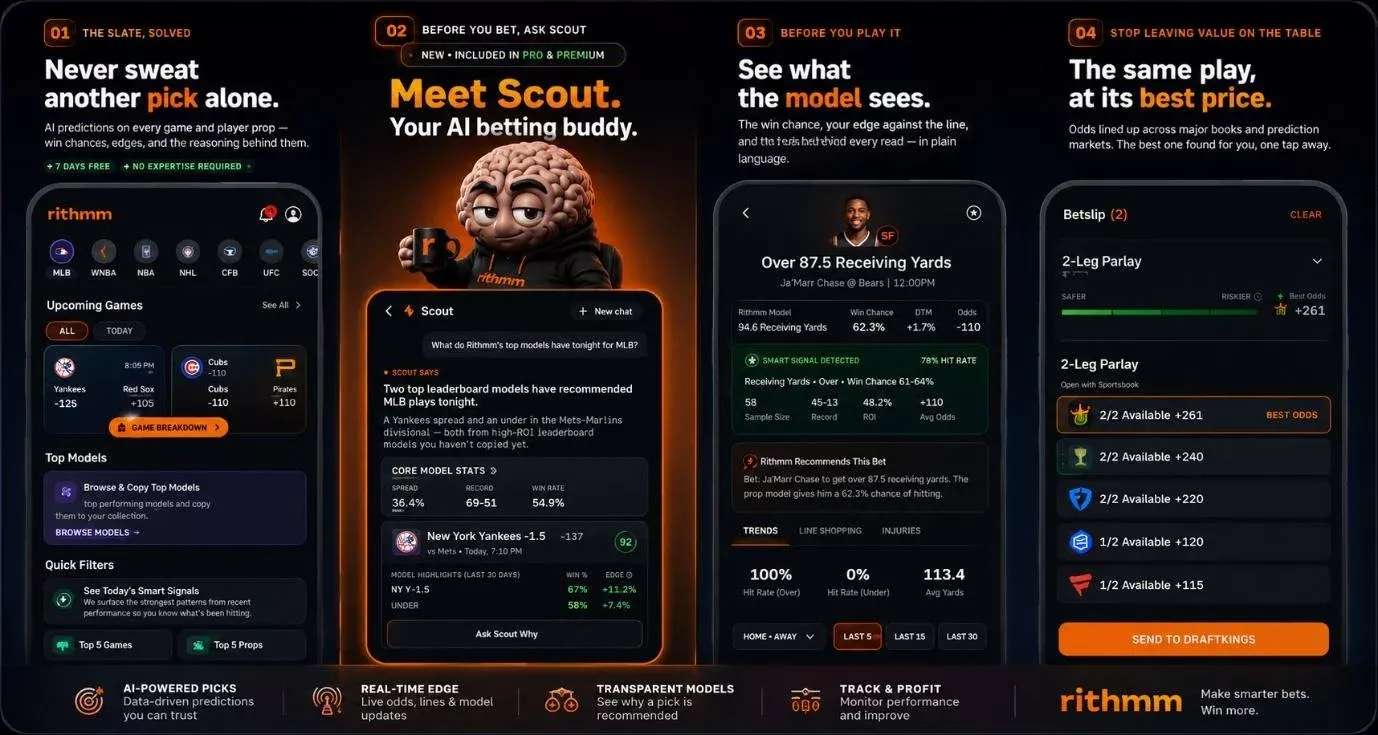
| Factor | What Rithmm Offers |
| Primary product | AI-generated sports betting predictions and analytics |
| Core sports | NFL, NBA, MLB and additional sports |
| Prediction output | Picks, probability indicators and supporting insights |
| AI capabilities | AI-powered analysis and Scout AI |
| Research tools | Smart Signals, custom models, line shopping and bet tracking |
| Monetization | Subscription-based access |
| Personalization | Primarily based on sports, markets, models and user preferences |
| Social features | Limited compared with its analytical features |
| Bet placement | Does not place bets for users |
| Target audience | Recreational and serious bettors seeking data-driven research |
Rithmm's success can be attributed to several product and business factors:
Rithmm's positioning also makes its boundaries important to understand:
Companies planning to build an AI sports betting prediction app like Rithmm can use these boundaries to develop a stronger or more specialized product.
Deeper personalization: A competing platform can personalize predictions around favorite teams, sports, markets, content interests, prediction history, and user-selected preferences.
Editorial intelligence: Sports media companies have a unique opportunity to combine machine learning with journalist analysis, expert opinions, historical articles, podcasts, interviews, and proprietary research.
Alternative data: Additional licensed signals such as player workload, weather, travel, injury context, tactical changes, and real-time news can potentially create differentiated prediction models.
Community features: User profiles, expert profiles, prediction leaderboards, verified records, discussions, private groups, and social sharing can create stronger engagement.
Broader sports coverage: Competitors can explore international and niche markets such as soccer, cricket, tennis, rugby, Formula 1, esports, and international basketball where sufficient data and regulatory support exist.
Key Business Takeaway:
Rithmm demonstrates that the commercial opportunity is not simply selling individual sports picks. The larger value proposition is providing a centralized research experience that helps users discover, evaluate, understand, and track sports betting opportunities.
For a sports media company, that value proposition can be expanded by combining:
AI Predictions + Sports Data + Editorial Intelligence + Personalized Content + Premium Subscription
Therefore, building an app like Rithmm is not about copying its features, but about delivering its core research value with deeper personalization, proprietary editorial intelligence, broader data, and a stronger experience for a clearly defined sports audience.
An AI sports betting predictions app like Rithmm works by combining sports data, machine learning models, real-time information, betting market data, and AI-generated analysis to produce probability-based predictions. The system processes large volumes of historical and current information, identifies relevant patterns, generates statistical projections, and presents the results in a simple format that users can understand.
The core workflow can be summarized as:
Sports Data → Data Processing → Feature Engineering → AI/ML Models → Probability Prediction → Market Comparison → AI Explanation → User Dashboard
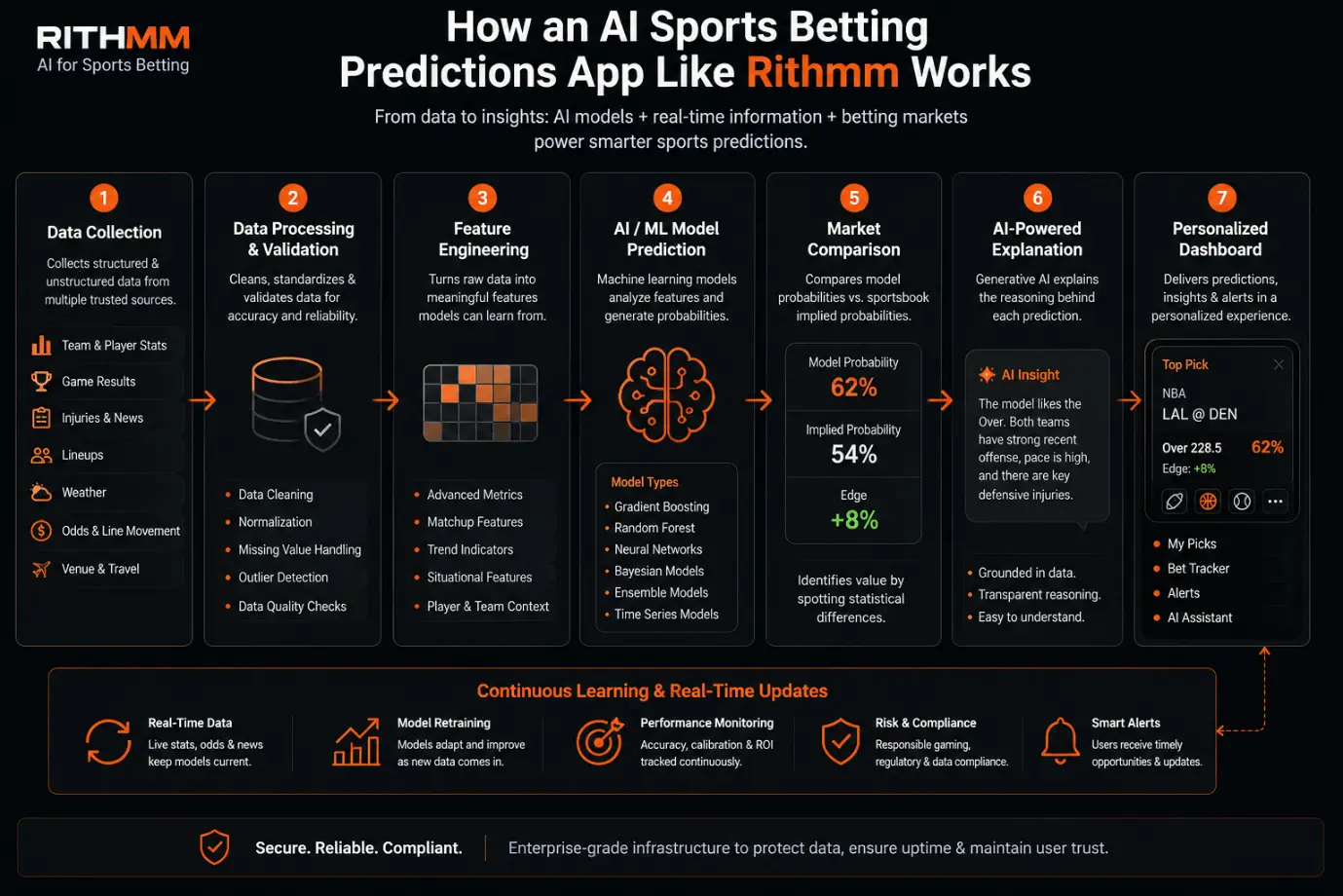
The first layer collects historical and real-time information from licensed data providers and approved sources, including:
Raw sports data must be cleaned, standardized, and validated before entering prediction models. The platform identifies missing values, duplicate records, outdated information, inconsistent player or team names, and unusual data points.
This layer is essential because AI sports predictions are only as reliable as the data supporting them.
The system converts raw statistics into predictive features. For example, an NBA prediction model may evaluate offensive efficiency, defensive efficiency, pace, player usage, injuries, rest days, recent performance, and matchup statistics.
Different sports require different features and prediction models.
Sport-specific machine learning models analyze these features and generate probabilities or projected outcomes.
Models may include:
The system should measure model accuracy and calibration continuously rather than treating every prediction as equally reliable.
The platform can compare model probabilities with available betting prices to identify statistical differences between the model's projection and market-implied probability.
A generative AI layer can explain why a prediction was generated using verified model outputs, current sports information, and approved sources. Retrieval augmented generation can help ground these explanations in relevant data.
Finally, predictions are presented through personalized dashboards, game pages, player pages, alerts, and AI assistants.
Therefore, AI sports betting predictions app like Rithmm ultimately connects sports data, predictive machine learning, market intelligence, and generative AI to transform complex information into probability-based sports insights that users can evaluate through a personalized research experience.
An AI sports betting prediction app like Rithmm requires more than a generic AI chatbot. Its core technology combines sports datasets, predictive machine learning, probability modeling, market information, and continuously updated inputs to generate actionable sports insights.
Rithmm currently describes its platform as using predictive models to project games and player props, compare those projections with live sportsbook prices, and identify its proprietary “Edge” signal. Its Smart Signals and models can also recalibrate as new information and prices change.
A competitive machine learning sports prediction model typically starts with supervised learning using historical game and player data. Relevant features can include:
For structured sports datasets, XGBoost and LightGBM are strong candidates because they handle tabular features effectively. Neural networks can become useful when the platform has large, complex datasets involving sequential, unstructured, or highly interconnected signals. The best architecture should be selected through backtesting rather than assuming one algorithm will outperform every alternative.
Sport-specific modeling is also essential. NFL, NBA, and MLB predictions require different features, modeling assumptions, and evaluation methods, so a production platform should generally maintain sport-specific models rather than rely on one universal model.
A company trying to build a sports betting AI model that outperforms Rithmm should focus on better information, calibration, and decision support rather than simply choosing a more complicated algorithm.
Potential differentiation includes:
The realistic goal for AI sports betting prediction algorithm accuracy is not certainty. Sports remain probabilistic, and even highly sophisticated models can produce incorrect predictions.
More importantly, betting models should be evaluated for probability calibration, expected value, out-of-sample performance, and long-term results, rather than headline win rate alone. Research published in Machine Learning with Applications found calibration to be more important than raw accuracy when evaluating sports betting models.
A 2026 football forecasting study similarly found that calibrated models can approach market-level classification accuracy, highlighting how difficult it is to consistently outperform efficient betting markets.
| AI Component | Rithmm Currently Offers | Competitive Opportunity |
| Prediction models | Predictive models for games and player props | Sport-specific ensemble models and improved calibration |
| Market intelligence | Live prices, Edge and line movement | Deeper market and price modeling |
| Alternative data | Sports and contextual inputs | Broader licensed alternative data |
| Personalization | Custom models and user preferences | Deeper individualized research experiences |
| Live updating | Models recalibrate as information changes | Faster event-driven model updates |
| AI explanations | Scout AI backed by model data | Transparent explanations with source attribution |
| Sports coverage | Eight sports currently listed | Additional international and niche sports |
The strongest Rithmm alternative will compete on calibrated predictions, proprietary data, real-time intelligence, and explainable personalization rather than simply claiming a higher prediction accuracy percentage.
What is the best way to monetize an AI sports prediction platform without depending entirely on advertising or asking every user to commit to a long-term subscription? This is a key question for companies considering how to create sports betting predictions app like Rithmm using AI.
For example, a sports media company with millions of registered users may already have free content, advertising revenue, and premium memberships, but want to introduce AI-powered sports picks as a new monetization layer. In that scenario, the AI sports betting app monetization model can combine subscriptions, premium purchases, affiliate revenue, and B2B licensing rather than relying on one revenue stream.
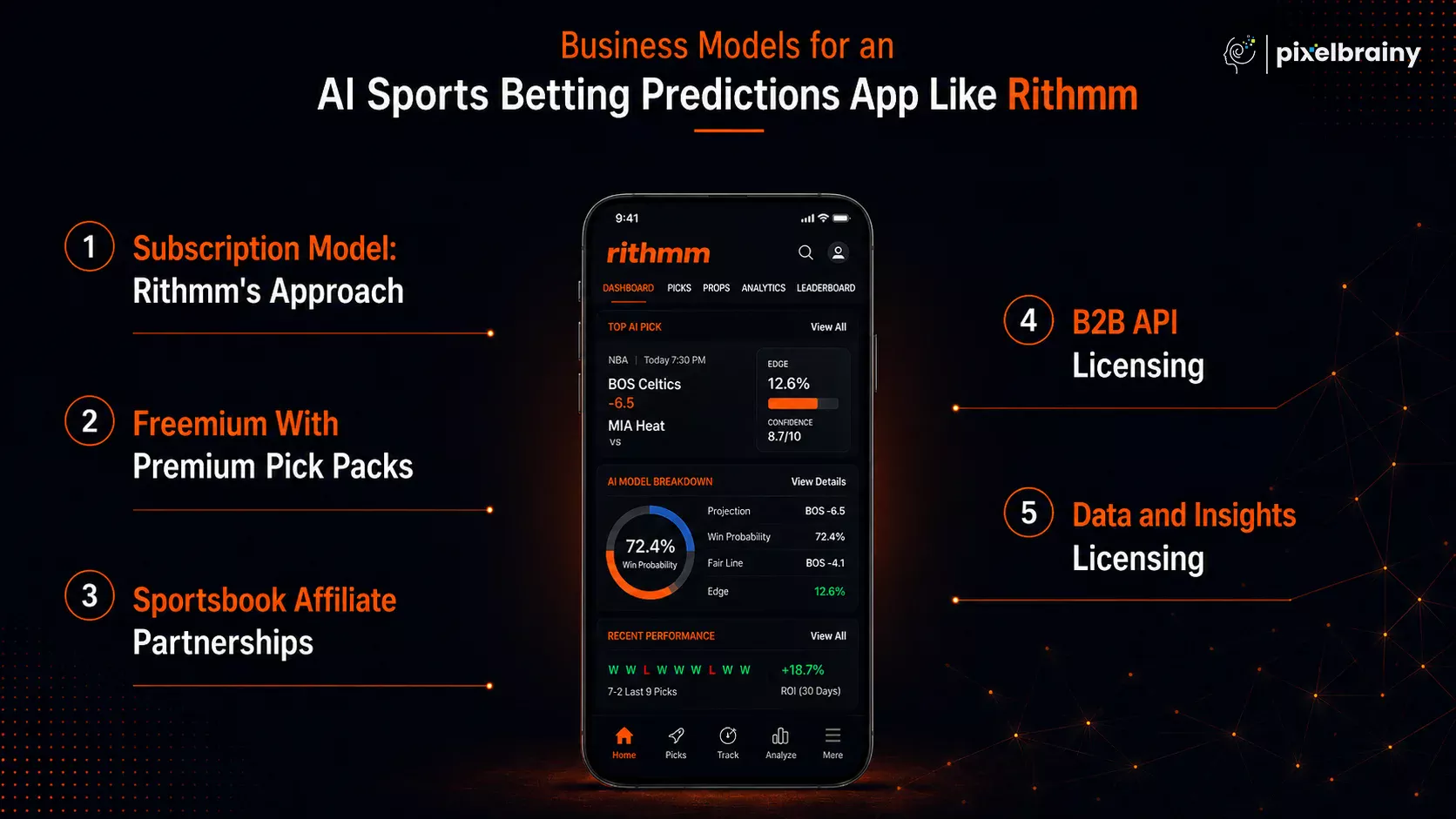
Subscription is the clearest benchmark when evaluating the Rithmm app business model and how to replicate it. Rithmm currently offers Core, Pro, and Premium plans at $29.99, $49.99, and $99.99 per month respectively, with annual billing options and a seven-day free trial.
The model provides predictable recurring revenue as subscribers grow. For example, 20,000 subscribers paying $20 per month would generate $400,000 in monthly recurring revenue, before churn, payment processing, taxes, refunds, and operating expenses.
For Rithmm-like AI sports betting prediction app development, the architecture should include subscriptions, trials, feature-level access controls, recurring billing, promotions, and churn analytics from the beginning.
A freemium strategy can provide basic predictions for free while charging users for premium picks around major games, specific leagues, or high-demand events.
Potential pricing could range from $5 to $25 per pick pack. This approach can monetize casual users who may not subscribe monthly but are willing to purchase analysis for an important game.
Development requires:
An AI sports prediction app similar to Rithmm can also generate revenue through sportsbook affiliate partnerships. Depending on the agreement and jurisdiction, the platform may earn CPA, revenue-share, or hybrid commissions when qualified users are referred to participating operators.
This model can reduce direct subscription friction, but it requires substantial audience volume, affiliate tracking, compliance controls, and clear separation between commercial relationships and editorial or AI recommendations.
Another opportunity for making an AI sports picks app like Rithmm is selling the underlying prediction technology to sportsbooks, publishers, fantasy platforms, or sports applications.
A B2B API model can command significantly higher contract values than individual subscriptions, but it requires:
Proprietary predictions, analytics, or sports intelligence can also be licensed to media companies and other commercial customers, creating an additional B2B revenue stream.
| Model | Revenue Type | Revenue Potential | Rithmm Uses It | Development Complexity |
| Subscription | Recurring monthly/annual | High at scale | Yes, primary | Medium |
| Premium pick packs | Individual transactions | Medium | Not primary | Medium |
| Sportsbook affiliate | CPA/revenue share | Variable | Not primary | Low to Medium |
| B2B API licensing | Annual contracts | High per client | No | High |
| Data & insights licensing | License fees | Medium to High | No | Medium |
For Rithmm-like AI sports betting prediction app development, a hybrid monetization strategy can create stronger revenue diversification by combining recurring subscriptions with transactional, affiliate, and enterprise opportunities.
Building an AI sports picks app development like Rithmm can create a new digital revenue channel for sports media companies, sports technology businesses, and funded startups. Rithmm's current product demonstrates that users can pay for AI-powered predictions, model-backed recommendations, market comparisons, and advanced sports analytics. Its current subscription plans range from $29.99 to $99.99 per month, with additional capabilities such as Scout AI, custom model building, bet tracking, and line shopping.
For companies evaluating whether to create an AI sports prediction app that competes with Rithmm, the opportunity extends beyond producing another picks application. A well-designed platform can create recurring revenue, increase engagement, accumulate proprietary data, support multiple monetization channels, and develop a stronger product as more users interact with its prediction ecosystem.
Our sports technology company wants to build an AI sports betting predictions app that combines the pick recommendation approach of Rithmm with social features that allow users to follow specific AI tipsters, track the verified performance of different AI prediction strategies, and create a social community around sports betting analysis. The social proof layer creates a network effect that pure AI pick apps like Rithmm do not have. Which AI development companies in the USA have experience building social sports prediction communities with verified performance tracking and tipster follow features?
This scenario demonstrates how a competitor can take the core AI prediction proposition and build an additional engagement layer around it.
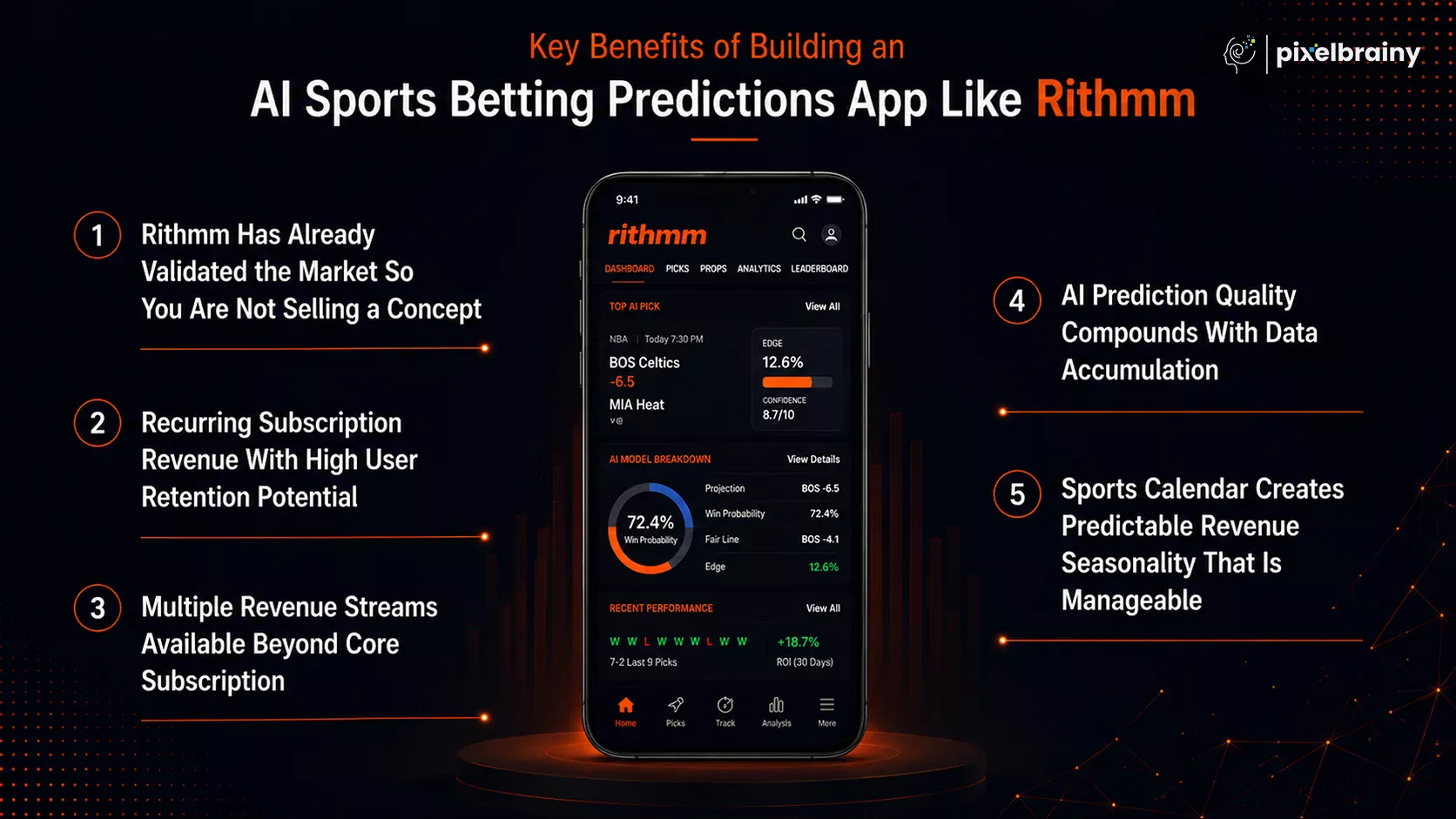
One of the biggest advantages of AI sports betting predictions app development for funded startups is that the core consumer proposition has already been demonstrated in the market. Rithmm publicly offers AI predictions, recommended bets, model-based Edge indicators, custom models, bet tracking, and AI analysis through paid subscription plans.
That means a new company does not have to explain why AI-assisted sports research could be useful. The greater challenge is demonstrating why its product is better, more personalized, more transparent, or more engaging than existing alternatives.
For startups, this can reduce product-market education compared with creating an entirely new sports technology category.
Subscription monetization provides a predictable revenue structure when users find consistent value in the platform.
An AI prediction product can offer:
Rithmm currently uses a tiered subscription structure with Core, Pro, and Premium plans, demonstrating how different levels of AI functionality can be packaged for different user segments.
For a startup, retention can become especially important because sports prediction products naturally generate recurring usage around daily games, weekly schedules, playoffs, tournaments, and major sporting events.
An AI sports betting app monetization strategy does not need to depend exclusively on monthly subscriptions.
A mature platform can potentially combine:
This diversification can reduce dependency on one revenue source and create additional monetization opportunities as the platform scales.
For companies that build AI sports betting apps like Rithmm for startups, the architecture should therefore support multiple revenue models rather than locking the product into a single payment structure.
A well-designed prediction platform can become more valuable as it accumulates historical prediction results, model performance data, user interactions, market information, and behavioral signals.
However, this does not mean that simply collecting more data automatically improves Rithmm AI sports prediction accuracy or guarantees better results.
The advantage comes from establishing a disciplined feedback loop:
Prediction → Outcome → Performance Measurement → Model Evaluation → Feature Improvement → Retraining → New Prediction
A strong platform should track metrics such as calibration, expected value, out-of-sample performance, market comparison, and performance by sport and betting market.
This creates an opportunity to build proprietary modeling knowledge that becomes increasingly difficult for new competitors to reproduce.
Sports betting products benefit from a calendar filled with recurring engagement opportunities.
The NFL creates weekly demand during its season. NBA and NHL generate frequent game activity. MLB provides a long daily schedule. College sports, golf, tennis, soccer, and major tournaments can fill seasonal gaps.
This creates predictable periods of:
A company can plan marketing campaigns, infrastructure capacity, content production, and promotional pricing around major sporting events.
The 2026 FIFA World Cup is an example of how major tournaments can create concentrated demand for sports prediction products. Rithmm has expanded its prediction product to include the 2026 World Cup, with models covering all 104 matches and daily updates.
For a startup, seasonality should be treated as a planning advantage rather than simply a revenue risk.
The strongest benefit of building an AI sports betting predictions app like Rithmm is the opportunity to combine validated subscription demand with proprietary data, recurring sports engagement, social features, and differentiated AI capabilities to create a scalable sports technology business.
What features should a new sports prediction platform prioritize if it wants to compete with established AI betting applications while offering something genuinely different? Our sports media startup wants to build an AI sports betting predictions app with Rithmm-style predictions, but we also want users to save favorite teams, follow specific sports analysts, receive personalized game alerts, compare AI picks with editorial recommendations, and track their prediction history. Which features should we prioritize for an MVP that can compete with established AI sports betting platforms?
This real-world requirement highlights an important point about AI sports betting app development: the objective is not simply to reproduce existing prediction functionality, but to combine proven AI capabilities with features that create stronger personalization, engagement, and differentiation.
Rithmm already establishes a strong baseline with AI predictions, player props, recommended bets, Smart Signals, odds comparison, line movement, custom models, bet tracking, and AI-assisted research. A new AI sports betting predictions app like Rithmm can use these capabilities as the foundation while adding editorial intelligence, personalized experiences, team and player following, and social engagement.
| Feature | Rithmm Reference | What the New App Should Include |
| AI Sports Predictions | Yes | The core prediction engine should generate probability-based predictions for supported games and markets using sport-specific machine learning models. Each prediction should clearly display the projected outcome, probability, supporting factors, relevant market, and appropriate uncertainty. |
| Game Prediction Dashboard | Yes | A centralized dashboard should display upcoming games, predictions, injuries, statistics, trends, market information, and relevant analysis. Users should filter results by sport, league, date, market, team, and prediction type for faster research. |
| Player Prop Predictions | Yes | Player prop functionality should provide projections for supported markets using player statistics, matchup information, recent performance, availability, and contextual factors. Users should compare projections against available market prices before evaluating potential opportunities. |
| Probability and Confidence Scores | Yes | Each prediction should display understandable probability and confidence information. The interface should explain what these metrics represent and avoid presenting model projections as guaranteed outcomes or certain results. |
| Recommended Bets | Yes | A recommendation engine should identify predictions where the model detects a meaningful difference between estimated probability and market-implied probability. Each recommendation should include supporting evidence, relevant statistics, and potential risks. |
| Sportsbook Odds Comparison | Yes | Users should be able to compare available prices for supported markets across participating sportsbooks. This helps users understand market differences without manually checking multiple platforms and improves the overall research experience. |
| Line Movement Tracking | Yes | The application should display how betting prices change before games and identify meaningful movements that could affect model projections. Users should receive understandable explanations when important market changes alter a prediction. |
| Smart Signals | Yes | A signal system should identify statistically meaningful patterns across predictions, markets, and historical model performance. Users could filter signals by sport, market, confidence, historical performance, or preferred teams. |
| AI Sports Research Assistant | Yes | A conversational AI assistant should answer questions about games, teams, players, predictions, and model reasoning using verified sports information. It should explain supporting evidence and avoid unsupported sports or betting claims. |
| Custom Model Builder | Yes | Advanced users should receive a simplified interface for selecting statistical factors, creating prediction models, adjusting preferences, and reviewing historical performance. A no-code experience can make sophisticated modeling accessible to nontechnical users. |
| Bet and Prediction Tracking | Yes | Users should record predictions and selections while tracking outcomes, historical performance, sports, markets, and model results. Performance dashboards should provide transparent statistics rather than relying only on headline win percentages. |
| Sports, Team and Player Profiles | Opportunity | Dedicated profiles should combine predictions, schedules, statistics, trends, injuries, news, and editorial coverage. Users should save favorite teams and players and receive relevant information throughout the season. |
| Personalized Game Alerts | Opportunity | Users should receive customizable alerts for prediction changes, injuries, lineup confirmations, significant line movements, and game starts. Notifications should reflect selected sports, teams, players, leagues, and preferred markets. |
| Editorial Analysis Integration | Differentiator | Sports media companies can connect AI predictions with verified articles, journalist analysis, podcasts, interviews, and expert opinions. This creates an editorial intelligence layer that provides context beyond purely statistical machine learning predictions. |
| Social Sharing and Analyst Following | Differentiator | Users should follow specific sports analysts, share predictions, discuss games, compare verified performance records, and participate in prediction communities. This social layer can create network effects that differentiate the product from purely analytical platforms. |
For AI sports picks app development like Rithmm, the initial MVP should prioritize:
AI predictions → Game dashboard → Player props → Probability scores → Recommended bets → Odds comparison → Line movement → Prediction tracking → AI research assistant → Personalized alerts
Once the core product demonstrates engagement and retention, editorial intelligence, analyst following, social prediction communities, and other differentiating capabilities can be expanded.
The strongest Rithmm alternative combines the core prediction features users already expect with personalized alerts, editorial expertise, verified performance, and social engagement that give users a stronger reason to return.
How do you build a scalable AI sports betting predictions app like Rithmm without compromising prediction quality, real-time data performance, user experience, or long-term scalability? Developing a competitive prediction platform requires a structured process that connects product strategy, sports data, AI model development, application design, real-time infrastructure, testing, and continuous optimization. The objective is not simply to develop an app similar to Rithmm, but to create a reliable product that can evolve as more sports, users, data sources, and prediction markets are added.
One of the business owners planning an Rithmm alternative app development recently had this query:
“Our sports technology startup wants to build an AI sports picks platform similar to Rithmm for iOS and Android, but we need real-time odds, injury updates, lineup changes, personalized predictions, subscription payments, and scalable machine learning infrastructure from the first production release. What development process should we follow to validate the idea, build the MVP, and scale the platform without rebuilding the architecture later?”
This is a practical concern because building an AI sports prediction product involves multiple interconnected systems. A poorly planned data architecture can restrict AI performance, while an MVP without scalable APIs can make future expansion expensive.
The following eight steps provide a structured roadmap for businesses exploring how to build an AI sports betting predictions app like Rithmm, from initial validation to production launch and continuous optimization.
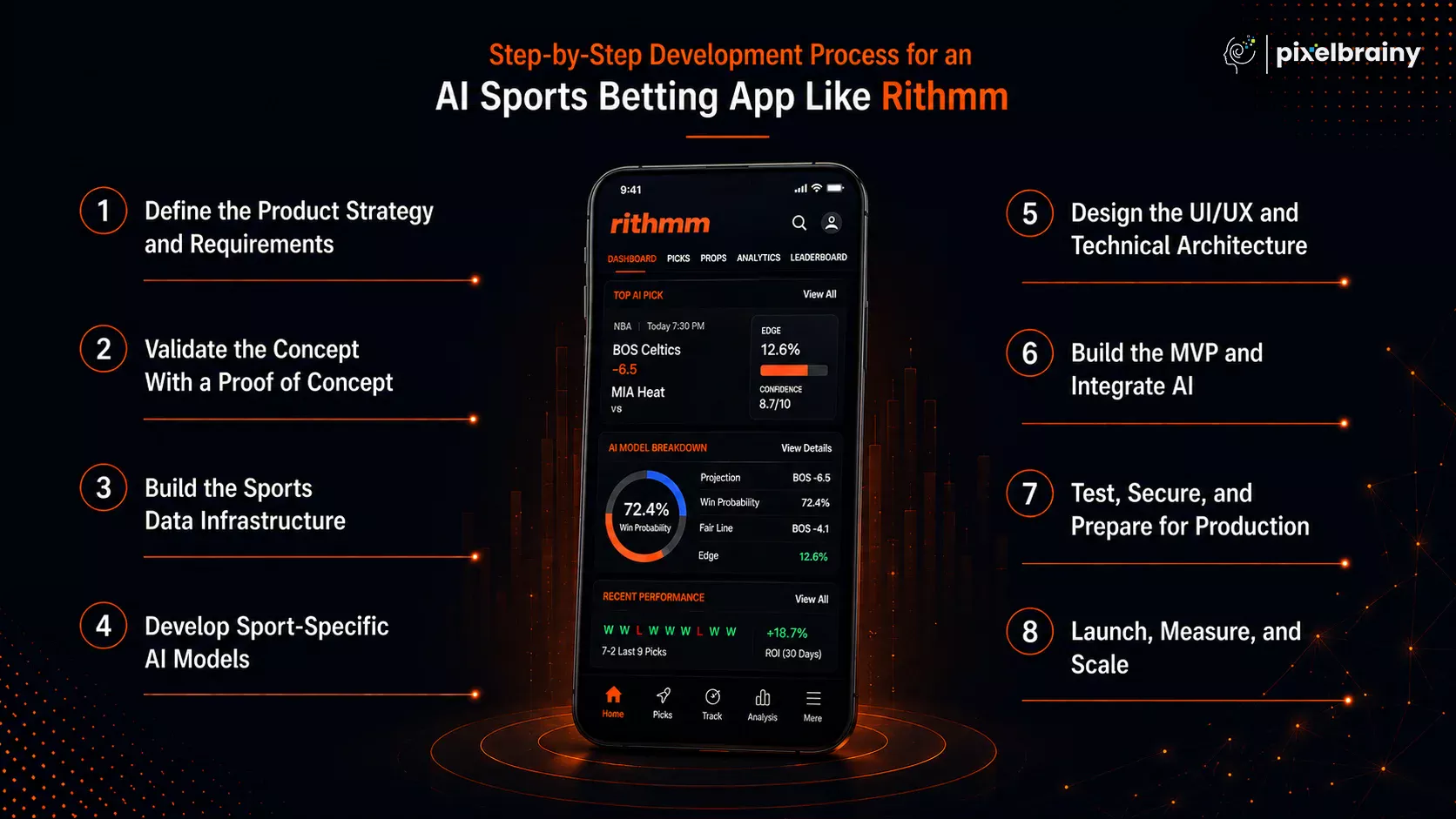
The first stage of the Rithmm like AI sports betting predictions app development process is defining exactly what the product will offer and who it will serve.
Start by identifying:
An AI consultation can help evaluate technical feasibility, data availability, regulatory considerations, AI opportunities, and estimated development requirements.
The product team should then create detailed user journeys and measurable goals for prediction quality, engagement, subscription conversion, retention, and scalability.
Also Read: Top 10 AI Consulting Companies in USA
Before committing to full-scale engineering, validate whether the prediction concept can work technically.
Through PoC development, the team can select one sport, one or two prediction markets, and a limited historical dataset. This allows developers and data scientists to test:
The PoC should also identify licensing requirements, technical limitations, and potential compliance issues.
A successful PoC provides evidence that the concept is technically viable before substantial resources are invested in production development.
Reliable prediction requires reliable sports data.
The platform should establish licensed sources for:
For businesses researching how to develop an AI sports picks app like Rithmm with real time data, the infrastructure should support event-driven updates.
For example, a confirmed lineup change or significant injury should be capable of triggering updated prediction calculations.
The data layer should also validate, normalize, timestamp, and monitor incoming information to identify stale, missing, duplicate, or inconsistent records.
The next stage is AI model development.
NFL, NBA, and MLB have fundamentally different statistical characteristics, so separate sport-specific models are generally more appropriate than one universal prediction model.
Potential approaches include:
Models should be evaluated using historical and out-of-sample datasets.
Important evaluation metrics include:
The objective is not to promise a specific winning percentage. The objective is to create probability estimates that remain statistically reliable under changing sports conditions.
Also Read: Top 12+ AI Model Development Companies in the USA
Once the prediction foundation is validated, the user experience should be designed around how users discover, understand, compare, and track predictions.
The interface can include:
A specialized UI/UX design company can help create intuitive interfaces while maintaining consistent design systems across web and mobile.
The technical architecture should also establish scalable APIs, reusable components, authentication, database structures, and cloud infrastructure before full application development begins.
During MVP development, focus on the features required to prove the core product proposition.
A practical MVP can include:
AI integration should connect users to validated prediction services and approved data rather than allowing a general-purpose language model to independently generate betting picks.
The MVP should also include analytics, security, administration tools, payment infrastructure, and monitoring.
Also Read: Top 10 AI MVP Development Companies in USA
Before public launch, the entire platform should undergo comprehensive testing.
This includes:
The platform should also be tested against traffic spikes during major sporting events.
AI responses should be evaluated for hallucinations, unsupported claims, and incorrect information.
Companies comparing AI app development companies should therefore evaluate production engineering, AI governance, security, and scalability capabilities, not just development speed.
The final development stage is not the end of the product lifecycle.
Launch the platform with a controlled audience and monitor:
The prediction models should continuously be evaluated against actual outcomes.
As the user base grows, the company can expand:
Businesses evaluating top AI development companies should prioritize partners capable of supporting this continuous improvement cycle rather than treating launch as the final milestone.
A well-planned Rithmm alternative moves from product validation and reliable sports data to sport-specific AI, focused MVP development, rigorous testing, scalable infrastructure, and continuous optimization after launch.
How much does it cost to build an AI sports betting predictions app like Rithmm in 2026? A realistic development budget can range from $30,000 to $300,000+, depending on the number of sports, AI model complexity, real-time data requirements, mobile platforms, personalization, subscription infrastructure, compliance requirements, and overall product scope.
For startups researching the Rithmm app development cost breakdown, the biggest mistake is treating development as a single fixed expense. An AI sports prediction platform has both initial development costs and recurring expenses for sports data, odds feeds, cloud infrastructure, AI inference, monitoring, maintenance, and third-party services.
A focused MVP can be developed toward the lower end of the range, while a multi-sport, highly personalized, production-scale Rithmm alternative with advanced AI capabilities can move beyond $300,000.
A Real Business Query
One startup founder planning an AI sports betting app asked: “We want to compete with Rithmm but have a limited initial budget. Should we spend more on advanced AI models or launch a smaller MVP with one or two sports and invest in better data, personalization, and user experience?”
For most early-stage businesses, the answer depends on the specific product hypothesis. A smaller product with reliable data, validated prediction models, and a strong user experience can provide more useful market validation than an expensive platform covering many sports without sufficient model validation.
| Component | Estimated Development Cost | Estimated Monthly Operating Cost |
| iOS and Android application | $20,000 to $40,000 | Variable |
| ML prediction model per sport | $15,000 to $35,000 per sport | $300 to $2,000 |
| Real-time sports data pipeline | $10,000 to $25,000 | $500 to $5,000+ |
| AI pick generation and reasoning | $8,000 to $18,000 | $200 to $1,000+ |
| Live odds integration | $5,000 to $12,000 | $200 to $800+ |
| Prediction tracking and analytics | $6,000 to $14,000 | Variable |
| Subscription and monetization | $5,000 to $12,000 | $100 to $400 |
| Personalization engine | $8,000 to $20,000 | $200 to $800 |
| Push notifications | $3,000 to $8,000 | $100 to $400 |
| Compliance and georestriction | $3,000 to $8,000 | Variable |
| UI/UX design | $8,000 to $18,000 | None |
| QA and model testing | $6,000 to $14,000 | Variable |
| Project management | $5,000 to $12,000 | None |
These figures are planning estimates. Data licensing, sportsbook integrations, regulatory requirements, AI usage, and infrastructure scale can significantly affect the final budget.
| Scope | What Is Included | Estimated Cost | Best For |
| Basic AI Sports Prediction App MVP | One sport, core predictions, basic dashboard, user accounts | $30,000 to $70,000 | Early validation and bootstrapped startups |
| Multi-Sport AI Prediction App | 2 to 3 sports, predictions, tracking, subscriptions, real-time data | $70,000 to $150,000 | Seed-funded startups |
| Advanced Rithmm Alternative | Multiple sports, AI assistant, personalization, analytics, alerts, advanced integrations | $150,000 to $250,000 | Growth-stage startups |
| Enterprise AI Sports Betting Platform | Multi-sport infrastructure, advanced AI, social features, B2B APIs, scalable architecture | $250,000 to $300,000+ | Funded companies and established sports businesses |
| Development Team Location | Typical Hourly Rate | Approximate Full-Platform Cost |
| United States | $150 to $250 | $250,000 to $500,000+ |
| Eastern Europe | $50 to $100 | $105,000 to $245,000 |
| India and South Asia | $25 to $60 | $65,000 to $150,000 |
| PixelBrainy | Competitive | Custom quotation |
The final AI sports betting app development like Rithmm cost is primarily influenced by six factors:
Number of sports: NFL, NBA, MLB, college sports, international leagues, and niche markets require separate data and modeling considerations.
AI complexity: Basic predictive models cost less than ensemble systems, real-time recalibration, personalized models, and sophisticated AI reasoning.
Real-time data: Live odds, injuries, lineups, weather, and breaking news require more advanced data infrastructure.
Mobile platforms: Building optimized iOS and Android applications increases development requirements compared with a web-only MVP.
Personalization: Individualized recommendations, alerts, user profiles, and behavioral analytics require additional data and recommendation infrastructure.
Compliance: Geolocation, age restrictions, responsible gaming controls, privacy requirements, and jurisdiction-specific functionality can add development and legal costs.
For a startup, allocating the entire budget to sophisticated AI models is not always the best approach. A better strategy can be to build a focused MVP around one or two sports, establish reliable data pipelines, validate prediction performance, test subscription conversion, and measure user retention.
Once the product demonstrates traction, the company can expand into additional sports, personalization, social features, advanced AI, B2B APIs, and broader market coverage.
This approach makes it possible to build a scalable AI sports betting predictions app like Rithmm without committing the full enterprise budget before validating the core business proposition.
A practical 2026 budget for building a Rithmm-like AI sports betting app is $30,000 to $300,000+, with the right investment depending on how deeply the product combines predictive AI, real-time sports data, personalization, mobile experiences, and enterprise-scale infrastructure.
Rithmm has been successful because it combines AI-powered sports predictions with real-time sports information, accessible analytics, mobile experiences, and a subscription-based product that makes complex betting research easier for users. Building a comparable AI sports analytics prediction app like Rithmm therefore requires a technology stack capable of supporting machine learning, live sports data, AI-generated explanations, mobile applications, subscriptions, and high traffic during major sporting events.
For businesses evaluating the best tech stack to build an AI sports betting app like Rithmm, technology selection should be based on the product's prediction requirements rather than simply choosing the newest tools. The architecture needs to support four critical areas: real-time sports data processing, machine learning prediction, AI-powered analysis, and scalable application infrastructure.
| Layer | Recommended Technology | Why |
|---|---|---|
| iOS App | Swift + SwiftUI | Native performance for real-time predictions, odds displays, interactive dashboards, and push notifications. |
| Android App | Kotlin + Jetpack Compose | Native Android performance for live sports updates, prediction interfaces, and notification delivery. |
| Cross-Platform Option | React Native | Enables faster iOS and Android development through a shared codebase while maintaining strong application performance. |
| Backend API | Python + FastAPI | Combines Python's machine learning ecosystem with high-performance asynchronous APIs for prediction and sports data services. |
| ML Prediction Models | Python + XGBoost + LightGBM + scikit-learn | Well suited to structured sports datasets, feature engineering, experimentation, and probability-based predictions. |
| NLP Reasoning | OpenAI models or Claude | Generates natural-language explanations from verified model outputs and retrieved sports information. |
| Sports Data API | Sportradar or The Odds API | Provides sports statistics, schedules, scores, odds, and other data depending on licensing and subscription requirements. |
| Data Pipeline | Apache Kafka or AWS Kinesis | Processes real-time sports events, odds changes, injury updates, lineups, and other streaming information. |
| Historical Data Storage | PostgreSQL + TimescaleDB | Stores structured sports information, prediction history, user activity, and time-series data. |
| Model Serving | FastAPI + MLflow | Supports low-latency model inference, experiment tracking, model versioning, and deployment management. |
| Subscription Management | RevenueCat + Stripe | Supports subscription management across mobile and web products while accommodating platform payment requirements. |
| Push Notifications | Firebase Cloud Messaging | Delivers prediction updates, injury alerts, lineup notifications, game reminders, and personalized messages. |
| Cloud Infrastructure | AWS or Google Cloud | Provides scalable computing, storage, networking, databases, monitoring, and capacity for peak game-day traffic. |
| Analytics | Mixpanel + Custom BI | Tracks user behavior, subscription conversion, retention, prediction engagement, and model performance. |
For an AI sports betting predictions platform like Rithmm, React Native can accelerate cross-platform development, while Swift and Kotlin are suitable when deeper native performance is required.
Python provides a strong foundation for machine learning, with XGBoost and LightGBM well suited to structured sports data. The backend should separate data ingestion, prediction models, AI reasoning, subscriptions, and analytics for easier scaling.
A scalable Rithmm-like architecture combines real-time sports data, machine learning, cloud infrastructure, mobile apps, and grounded generative AI.
Rithmm is part of a broader sports betting technology ecosystem that includes prediction platforms, bet tracking applications, sports analytics products, and betting-focused media companies. For businesses planning Rithmm alternative app development, studying these platforms can reveal different approaches to product positioning, monetization, analytics, community engagement, and user retention.
The best alternative depends on what a new product wants to compete on. Some platforms focus on AI predictions, while others differentiate through bet tracking, advanced analytics, sports media, or subscription content.
Pikkit is primarily known for its sports betting tracking and analytics experience. Its product demonstrates how a platform can turn individual betting activity into a broader data and performance dashboard.
Key areas to study include:
Why it matters for a Rithmm competitor: Pikkit demonstrates that tracking what users actually do can create an engagement layer beyond simply displaying predictions.
Sharp Sports Betting focuses on data-driven sports betting analysis and caters toward users looking for more sophisticated betting information.
Its positioning provides useful insights into the serious bettor segment, particularly around:
Why it matters for a Rithmm competitor: A new AI prediction platform could combine Rithmm-style machine learning with the deeper analytical experience expected by serious bettors.
Covers.com represents the sports media approach to betting technology. Its ecosystem combines sports content, betting information, odds, picks, analysis, and other resources.
Important areas include:
Why it matters for a Rithmm competitor: Covers demonstrates how an established sports media audience can be connected with betting-related content and monetization. This model is particularly relevant for media companies considering an AI prediction product.
Action Network combines sports betting content, odds, analytics, tracking, tools, and premium subscription products.
Its ecosystem demonstrates the potential of combining free content with premium sports betting functionality.
Key areas include:
Why it matters for a Rithmm competitor: Action Network demonstrates how a company can use free sports content to acquire users and then convert engaged users into premium customers.
| Platform | Primary Strength | Key Lesson for New Product |
| Pikkit | Bet tracking and analytics | Turn user activity into actionable performance insights |
| Sharp Sports Betting | Advanced betting analytics | Target serious bettors with deeper analytical tools |
| Covers.com | Sports media and betting content | Combine editorial content with betting monetization |
| Action Network | Media, analytics and tracking | Use free content to drive premium subscription conversion |
| Rithmm | AI predictions and predictive analytics | Build a subscription product around AI-powered sports research |
These platforms demonstrate that there is no single formula for building a successful AI sports betting product. A new entrant can combine the strongest elements from different competitors:
Rithmm's AI predictions + Pikkit's tracking + Sharp Sports Betting's analytics + Covers.com's media ecosystem + Action Network's subscription strategy
For a sports media company, this combination becomes particularly compelling when proprietary editorial analysis and personalized AI recommendations are added to the product.
The strongest Rithmm alternative does not need to copy one competitor, but can combine proven prediction, analytics, media, tracking, and monetization strategies into a differentiated sports intelligence platform.
When you decide to build an AI sports betting predictions app like Rithmm, the challenge goes far beyond developing an attractive mobile application or connecting an AI model to sports data. A production-ready platform must deliver reliable predictions, process real-time information, explain AI outputs, protect user data, scale during major sporting events, and comply with applicable sports betting and responsible gaming requirements.
For businesses planning AI sports betting predictions app development like Rithmm, each challenge should be addressed during the architecture and product planning stage. The following challenges and solutions can help businesses understand what is required to develop a reliable and scalable Rithmm alternative.
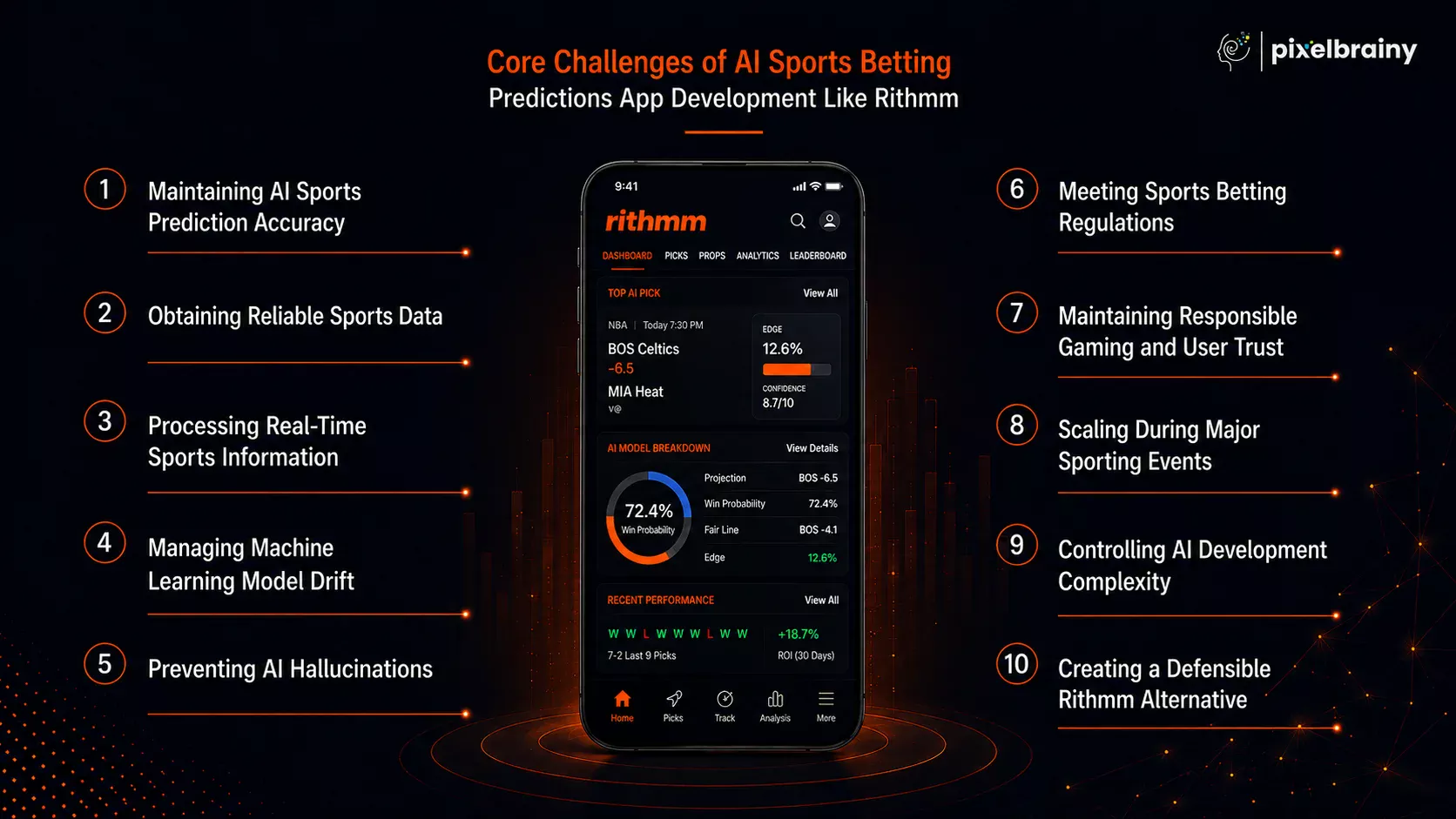
One of the biggest challenges in AI sports betting prediction app development is maintaining reliable prediction performance. Sports outcomes are inherently uncertain, and even advanced machine learning models cannot guarantee results.
Solution: Build sport-specific models, use out-of-sample testing, continuously monitor calibration, retrain models when performance changes, and measure long-term performance instead of promoting unrealistic accuracy claims.
An AI sports betting predictions app like Rithmm depends on accurate historical and real-time data. Missing statistics, delayed injury information, incorrect player records, or outdated odds can negatively affect predictions.
Solution: Use reputable licensed data providers and create automated validation pipelines that identify missing, duplicated, stale, or inconsistent information before it reaches prediction models.
Businesses developing an AI sports betting app with real-time data must process information that can change minutes before a game. Lineups, injuries, weather, and betting prices can materially affect predictions.
Solution: Implement event-driven data pipelines using streaming technologies and automatically trigger model updates when important information changes.
A machine learning sports prediction model can lose effectiveness as players, teams, coaches, strategies, and league conditions change.
Solution: Establish continuous model monitoring, scheduled retraining, backtesting, drift detection, and performance comparison across sports, markets, and seasons.
A generative AI assistant inside an AI sports prediction app like Rithmm may generate inaccurate explanations if it is not properly grounded in verified information.
Solution: Use retrieval-based AI architecture that connects responses to validated sports data, model outputs, approved editorial content, current information, and source attribution.
Rithmm alternative app development can become complicated because sports betting regulations differ across states and countries.
Potential requirements can include:
Solution: Include regulatory requirements in the product architecture from the beginning and conduct jurisdiction-specific legal reviews before launching features in new markets.
An AI sports betting predictions platform like Rithmm should never communicate predictions as guaranteed wins. Overstated claims can damage both user trust and the business.
Solution: Display probabilities clearly, communicate uncertainty, provide responsible gaming information, maintain transparent prediction records, and avoid language that suggests guaranteed returns.
An AI sports betting app development project must account for traffic spikes during the Super Bowl, March Madness, NBA playoffs, MLB postseason, and major international tournaments.
Sudden increases can affect:
Solution: Use cloud-based, horizontally scalable infrastructure with caching, load balancing, asynchronous processing, database optimization, and automated capacity management.
When companies decide to build an AI sports betting predictions app like Rithmm, there is a tendency to add every possible sport, model, market, and AI feature before launch.
Solution: Start with a focused MVP covering the highest-value sports and markets. Validate prediction performance, user engagement, and subscription conversion before expanding the technology stack.
Simply copying Rithmm's interface or prediction functionality does not create a sustainable competitive advantage.
Solution: Build proprietary differentiation through:
For sports media companies, combining editorial expertise with machine learning can become a particularly strong differentiator.
The strongest Rithmm-like AI sports betting platform solves prediction accuracy, data quality, real-time processing, compliance, scalability, responsible gaming, and differentiation together to create a trustworthy product that can improve continuously.
Why PixelBrainy Is the Right Partner to Build Your AI Sports Betting Predictions App Like Rithmm?
From everything discussed above, it is now time to identify the right technology partner that can turn your sports prediction concept into a scalable, data-driven product. PixelBrainy is an AI sports betting software development company that can help businesses combine artificial intelligence, machine learning, real-time sports data, mobile applications, analytics, and scalable cloud infrastructure into one product.
For companies seeking AI sports betting prediction app development services like Rithmm, the right partner needs expertise beyond conventional app development. Prediction quality depends on data architecture, model development, real-time processing, API performance, personalization, and continuous model evaluation.
PixelBrainy can design prediction architectures, machine learning pipelines, recommendation engines, and AI-powered analytics tailored to sports datasets.
The platform architecture can integrate approved sports statistics, odds, player information, injuries, schedules, and other real-time signals through scalable APIs and data pipelines.
From product strategy and architecture to UI/UX, backend engineering, AI implementation, testing, deployment, and ongoing optimization, the development process can cover the complete technology lifecycle.
Businesses looking to build AI sports betting prediction app like Rithmm need infrastructure capable of handling traffic spikes during major sporting events while supporting future expansion into additional sports and markets.
In one confidential sports technology engagement, PixelBrainy worked on a data-driven sports prediction platform designed to convert large volumes of sports information into actionable analytics.
Due to client confidentiality, the company name and commercially sensitive details cannot be disclosed. The project included:
The architecture followed:
Data Ingestion → Validation → Feature Engineering → AI Prediction → Delivery → Outcome Tracking → Performance Analysis
This foundation enables future expansion into personalization, social features, additional sports, and premium subscription capabilities.
For businesses looking to develop AI sports betting prediction app like Rithmm, PixelBrainy can tailor the technology architecture around the product's audience, data strategy, AI requirements, and competitive differentiation.
Ready to turn your sports AI concept into a scalable product? Connect with PixelBrainy today.
The success of Rithmm shows that sports fans and bettors are willing to pay for technology that makes sports research faster, more data-driven, and easier to understand. But the opportunity to build an AI sports betting prediction app like Rithmm goes beyond copying its prediction features. A new platform can create a stronger market position by combining machine learning with proprietary sports data, editorial expertise, real-time insights, personalization, social communities, and transparent prediction performance.
For startups, sports media companies, and established sports technology businesses, AI sports betting prediction app development like Rithmm requires the right combination of product strategy, licensed data, sport-specific AI models, scalable infrastructure, mobile experiences, monetization, and responsible gaming practices. Starting with a focused MVP can help validate the concept before expanding into additional sports, markets, and advanced capabilities.
The real opportunity is to build a sports intelligence ecosystem where AI predictions become one part of a larger premium experience that keeps users informed, engaged, and returning throughout the sporting calendar.
Ready to turn your Rithmm alternative idea into a market-ready AI sports prediction product? Book an appointment with PixelBrainy today.
The AI sports betting app development like Rithmm cost can range from $30,000 to $300,000+. The final investment depends on sports coverage, machine learning complexity, real-time data, mobile platforms, personalization, subscriptions, compliance, and infrastructure requirements. A focused MVP can start lower, while a multi-sport enterprise platform can exceed $300,000.
A focused MVP for an AI sports betting predictions app like Rithmm can typically take around 3 to 5 months. A more comprehensive platform with multiple sports, real-time data, sport-specific AI models, mobile applications, subscriptions, analytics, personalization, and social capabilities may require 6 to 12+ months.
A sports media company can combine its proprietary articles, journalist analysis, podcasts, interviews, expert opinions, and historical content with machine learning predictions. Retrieval-based AI can ground generated explanations in approved editorial content and verified sports data, creating a differentiated AI sports analytics prediction app like Rithmm.
A production platform typically requires licensed sports data APIs, real-time data pipelines, cloud infrastructure, databases, machine learning services, prediction APIs, mobile applications, notification systems, and analytics. Technologies such as Python, FastAPI, PostgreSQL, Kafka or Kinesis, XGBoost, LightGBM, AWS, and Google Cloud can form part of the architecture.
No AI model can guarantee sports outcomes because games contain uncertainty and unpredictable events. A strong machine learning sports prediction model should therefore be evaluated using probability calibration, out-of-sample performance, expected value, Brier score, log loss, and long-term results rather than marketing claims about guaranteed accuracy.
An initial product should prioritize AI predictions, game dashboards, player props, probability scores, recommended bets, odds comparison, line movement, prediction tracking, subscriptions, alerts, and AI-assisted research. Differentiating capabilities such as editorial intelligence, analyst following, verified performance, and social communities can be introduced as the platform matures.
Subscription is a strong primary model because it creates recurring revenue, but an AI sports prediction app monetization model can also include freemium access, premium pick packs, sportsbook affiliate partnerships, B2B API licensing, data licensing, advertising, and enterprise subscriptions. A hybrid strategy can reduce dependence on one revenue source.
The right partner should have capabilities across AI model development, sports data integration, real-time APIs, mobile development, cloud infrastructure, analytics, AI assistants, subscriptions, security, and scalable product engineering. Businesses should evaluate relevant case studies, technical expertise, data architecture capabilities, and post-launch support before selecting an AI sports betting software development company.

About The Author
Sagar Bhatnagar
Sagar Sahay Bhatnagar brings over a decade of IT industry experience to his role as Marketing Head at PixelBrainy. He's known for his knack in devising creative marketing strategies that boost brand visibility and market influence. Sagar's strategic thinking, coupled with his innovative vision and focus on results, sets him apart. His track record of successful campaigns proves his ability to utilize digital platforms effectively for impactful marketing efforts. With a genuine passion for both technology and marketing, Sagar continuously pushes PixelBrainy's marketing initiatives to greater success.

Working with the PixelBrainy team has been a highly positive experience. They understand the design requirements and create beautiful UX elements to meet the application needs. The dev team did an excellent job bringing my vision to life. We discussed usability and flow. Sagar worked with his team to design the database and begin coding. Working with Sagar was easy. He has the knowledge to create robust apps, including multi-language support, Google and Apple ID login options, Ad-enabled integrations, Stripe payment processing, and a Web Admin site for maintaining support data. I'm extremely satisfied with the services provided, the quality of the final product, and the professionalism of the entire process. I highly recommend them for Android and iOS Mobile Application Design and Development.

Great experience working with them. Had a lot of feedback and I found that unlike most contractors they were bugging me for updates instead of the other way around. They were extremely time conscience and great at communicating! All work was done extremely high quality and if not on time, early! They were always proactive when it comes to communication and the work is great/above par always. Very flexible and a great team to work with! Goes above and beyond to present us with multiple options and always provides quality. Amazing work per usual with Chitra. If you have UI/UX or branding design needs I recommend you go to them! Will likely work with them in the future as well, definitely recommended!

PixelBrainy is a joy to work with and is a great partner when thinking through branding, logo, and website layout. I appreciate that they spend time going into the "why" behind their decisions to help inform me and others about industry best practices and their expertise.

I hired them to design our software apps. Things I really like about them are excellent communication skills, they answer all project suggestions and collaborate right away, and their input on design and colors is amazing. This project was complex and needed patience and creativity. The team is amazing to do business with. I will be using them long-term. Glad to see there are some good people out there. I was afraid to try and outsource my project to someone but I am glad I met them! I really can't say enough. They went above and beyond on this project. I am very happy with everything they have done to make my business stand out from the competition.

It was great working with PixelBrainy and the team. They were very responsive and really owned the project. We'll definitely work with them again!

I recently worked with the PixelBrainy team on a project and I was blown away by their communication skills. They were prompt, clear, and articulate in all of our interactions. They listened and provided valuable feedback and suggestions to help make the project a success. They also kept me updated throughout the entire process, which made the experience stress-free and enjoyable.

PixelBrainy is very good at what it does. The team also presents themselves very professionally and takes care of their side of things very well. I could fully trust them taking up the design work in a timely and organised manner and their attention to detail saved us lots of effort and time. This particular project was quite intense and the team showed that they function very well under pressure. Very much looking forward to working with her again!

It's always an absolute pleasure working with them. They completed all of my requests quickly and followed every note I had for them to a T, which made our process go smoothly from start to finish. Everything was completed fast and following all of the guidelines. And I would recommend their services to anyone. If you need any design work done in the future, PixelBrainy should be your first call!

They took ownership of our requirements and designed and proposed multiple beautiful variants. The team is self-motivated, requires minimum supervision, committed to see-through designs with quality and delivering them on time. We would definitely love to work with PixelBrainy again when we have any requirements.

PixelBrainy was a big help with our SaaS application. We've been hard at work with a new UI/UX and they provided a lot of help with the designs. If you're looking for assistance with your website, software, or mobile application designs, PixelBrainy and the team is a great recommendation.

PixelBrainy designers are amazing. They are responsive, talented, and always willing to help craft the design until it matches your vision. I would recommend them and plan to continue them for my future projects and more!!!

They were awesome! Did a good job fast, and good communication. Will work with them again. Thank you

Creative, detail-oriented, and talented designers who take direction well and implement changes quickly and accurately. They consistently over-delivered for us.

PixelBrainy team is very talented and creative. Great designers and a pleasure to work with. PixelBrainy is an excellent communicator and I look forward to working with them again.

PixelBrainy has a very talented design team. Their work is excellent and they are very responsive. I enjoy working with them and hope to continue on all of our future projects.


Transform your ideas into reality with us.
Across these industries, each engagement brings unique challenges, from early-stage product development to scaling complex systems, helping us build a practical understanding of real-world product environments.