AI Summary Powered by PixelBrainy
Are you wondering whether continuing to spend hundreds of thousands of dollars on AI subscriptions makes sense when you could potentially own the technology that powers your business?
If you are a business owner, hospital administrator, healthcare leader, or health-tech founder, chances are you have asked a difficult question recently: "We're spending $400K/year on Claude API. Is building our own enterprise LLM actually worth it, and where do we even start?" You may also be preparing for board discussions and trying to answer another important question: "What does building an LLM like Claude actually mean before we commit budget and resources?"
The reality is that AI has evolved from an experimental tool into a critical business asset. Your organization may rely on AI for customer support, patient engagement, clinical documentation, operational workflows, knowledge management, analytics, or decision support. As usage grows, so do API costs, customization limitations, compliance concerns, and data governance challenges. What starts as a convenient solution can eventually become an expensive dependency that limits your ability to innovate and scale.
This growing pressure is one of the biggest reasons why enterprise LLM development like Claude has become a strategic priority for organizations in 2026. Companies are actively exploring how to build an AI model like Claude for business to gain greater control over security, intellectual property, performance, compliance, and long-term operational costs. At the same time, many executives are evaluating whether developing a private enterprise LLM is the right move and how custom LLM development 2026 strategies can create a competitive advantage without introducing unnecessary risk.
In this guide, you will learn what an enterprise LLM is, why organizations are building their own AI models, how Claude-like systems are architected, the essential features required for enterprise-grade performance, development approaches, technology stacks, cost expectations, and the biggest challenges you must overcome. By the end, you will have a clear understanding of whether building an enterprise LLM is the right investment for your organization and how to approach it successfully.
If you are evaluating AI adoption for your organization, one of the first questions you need answered is: what is an enterprise LLM, and how is it different from simply using Claude or another AI model through an API?
An enterprise LLM is a large language model that is trained, fine-tuned, or architecturally customized around your organization's proprietary data, workflows, security requirements, compliance policies, and industry knowledge. Unlike general-purpose AI services, enterprise LLMs are designed specifically for how your business operates and can be deployed in private cloud environments, dedicated infrastructure, or even on-premise systems.
This distinction is important when understanding the difference between enterprise LLM and Claude API.
When you use Claude through an API, you are essentially renting intelligence. The model is already built, maintained, and improved by Anthropic. You simply send requests and receive responses. This approach is fast, affordable, and ideal for many organizations getting started with AI.
However, API-based AI comes with limitations. Your data may need to leave your infrastructure, customization options are restricted, costs can increase significantly with scale, and your AI strategy becomes dependent on a third-party vendor's roadmap, pricing, and policies.
| Approach | What It Means |
| Public API Wrapper | Connect your applications directly to Claude or GPT APIs without building a model yourself. |
| Fine-Tuned Open-Source Model | Customize an existing open-source model using your business data and workflows. |
| Proprietary Enterprise LLM | Build and own a highly customized model and infrastructure designed specifically for your organization. |
| Factor | API Usage | Fine-Tuned Model | Custom Enterprise LLM |
| Data Privacy | Medium | High | Very High |
| Cost at Scale | Can become expensive | Moderate | High upfront, lower long-term |
| Customization | Limited | High | Maximum |
| Time to Deploy | Days | Weeks | Months |
| Performance Ceiling | Vendor-defined | Higher | Highest |
| Vendor Independence | Low | Medium | Very High |
Many leaders hear terms like fine-tuning, RAG, and model training but are unsure what they actually mean.
To understand the build vs use Claude API decision, you must understand why Claude is considered one of the most advanced enterprise AI systems available today.
Claude is known for its Constitutional AI approach, which uses predefined principles to guide model behavior and improve safety. It also incorporates Reinforcement Learning from Human Feedback (RLHF) to improve response quality and alignment with user expectations. Additionally, Claude's large context window allows it to process and reason over extremely large documents and conversations, making it highly valuable for enterprise use cases involving contracts, research, compliance records, and operational documentation.
Ultimately, the choice between a private LLM vs cloud LLM depends on your business goals, compliance requirements, budget, and long-term AI strategy. For many organizations, the smartest path is not choosing between a custom LLM vs fine-tuned model, but identifying which level of ownership and control delivers the greatest business value.
For many executives, the biggest question is not whether AI can create value. The real question is: why build an enterprise LLM when enterprise-grade APIs like Claude are already available?
The answer comes down to control, economics, competitive advantage, and long-term strategy.
The momentum behind enterprise AI is accelerating rapidly. According to Deloitte's State of AI in the Enterprise Report, organizations are moving from AI experimentation to large-scale production deployments faster than ever before. Industry forecasts from Grand View Research's AI Market Analysis project the global AI market to reach multi-trillion-dollar levels over the next decade, while enterprise AI spending continues to rise as companies seek ownership of their data, models, and AI infrastructure. This shift is one of the strongest indicators that custom AI is becoming a strategic asset rather than simply a software expense.
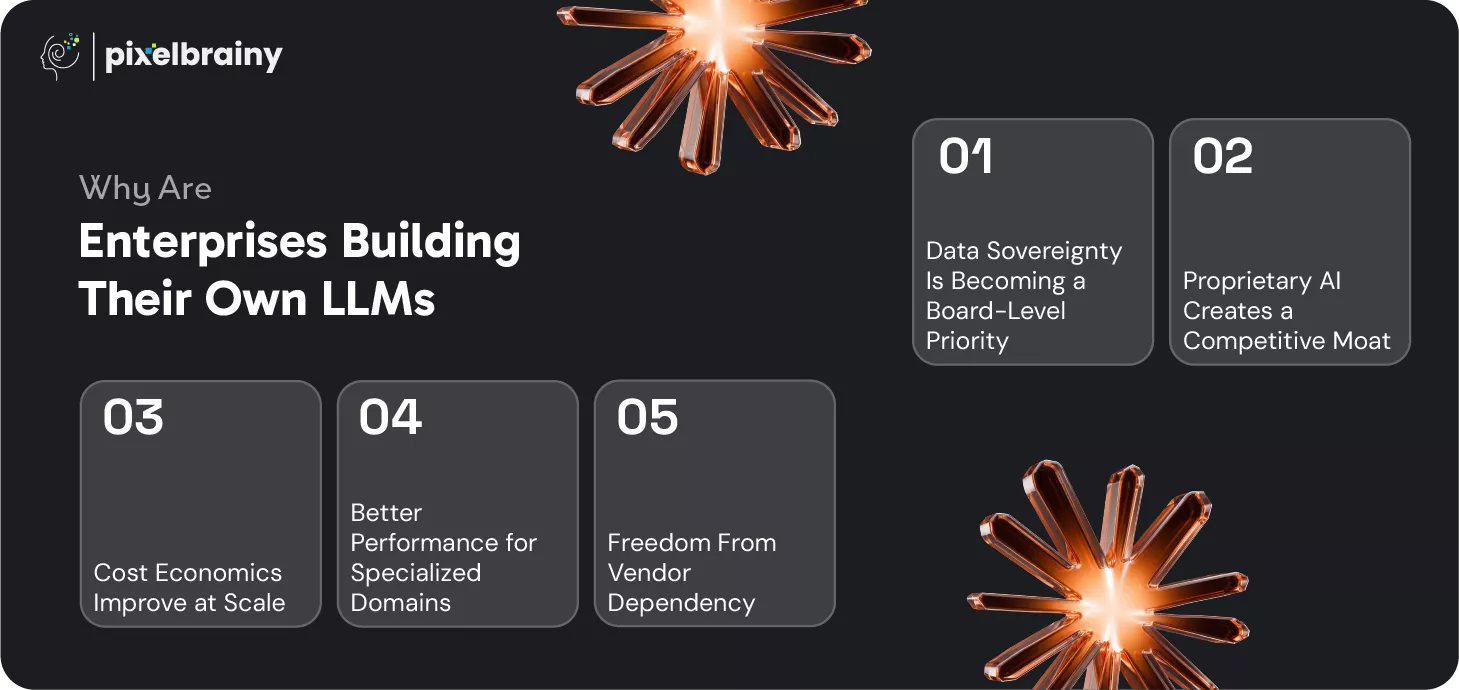
One of the strongest arguments in the business case for developing custom LLM solutions is data sovereignty.
Organizations in healthcare, finance, legal services, and government sectors manage highly sensitive information every day. Patient records, legal contracts, financial reports, proprietary research, and confidential business intelligence often cannot be freely transmitted outside controlled environments.
A private LLM for regulated industries allows organizations to keep sensitive information within their own infrastructure while maintaining compliance with industry regulations and internal governance requirements. This strengthens enterprise AI model data sovereignty and reduces dependency on external platforms for mission-critical operations.
Every company can access the same public AI models.
Very few companies can access your organization's internal expertise, historical knowledge, customer interactions, workflows, and proprietary datasets.
When a custom model is trained or optimized using this information, the resulting AI becomes a strategic asset that competitors cannot easily replicate. Over time, the model accumulates institutional knowledge that improves productivity, decision-making, and operational efficiency.
This is one of the primary reasons why enterprises are investing in custom AI capabilities rather than relying entirely on publicly available models.
A common question from CFOs is:
"How do I justify the cost of building our own LLM when Claude's enterprise API already exists?"
The answer depends heavily on usage volume.
For organizations processing millions of AI interactions every month, API costs can increase substantially over time. In many enterprise deployments, the three-year total cost of ownership for a focused fine-tuning initiative typically runs only 30% to 40% of the equivalent API spend for the same workload volume.
While custom development requires upfront investment, the long-term economics often become more favorable as adoption grows across departments and business units.
General-purpose AI models are designed to work reasonably well across thousands of use cases.
However, enterprises often need expertise in highly specialized areas.
A healthcare provider requires deep understanding of clinical terminology and medical workflows. A legal organization needs expertise in contracts, regulations, and case law. Financial institutions depend on precise understanding of compliance frameworks, risk analysis, and regulatory reporting.
Fine-tuned enterprise models frequently outperform general-purpose systems on domain-specific tasks because they are optimized around a particular knowledge area instead of broad internet-scale information.
Another major factor in the build vs buy LLM enterprise decision is vendor independence.
When your AI strategy relies entirely on a third-party provider, pricing changes, feature limitations, service interruptions, or policy updates can directly impact business operations.
Owning critical AI infrastructure gives your organization greater control over future innovation, security policies, deployment options, and product roadmaps.
Building a custom enterprise LLM is not necessary for every organization. However, it deserves serious consideration if you fall into one or more of the following categories:
| Evaluation Criteria | Build | Don't Build |
| Sensitive regulated data must remain internal | Yes | No |
| Monthly AI usage exceeds 10M tokens | Yes | No |
| Proprietary datasets create business value | Yes | No |
| Deep workflow customization is required | Yes | No |
| Primary goal is quick deployment with minimal investment | No | Yes |
| Market Indicator | Forecast |
| Global AI Market | Multi-trillion-dollar opportunity by the early 2030s |
| Enterprise AI Adoption | Rapid expansion across regulated industries |
| Generative AI Investment | Significant year-over-year growth through 2030+ |
| Enterprise-Owned AI Infrastructure | Expected to become a major strategic priority |
| AI-Powered Business Operations | Core component of digital transformation initiatives |
Ultimately, the strongest answer to why build an enterprise LLM is not technology. It is business leverage. Organizations that own their models, data, and AI capabilities gain greater control over costs, compliance, innovation, and competitive differentiation. As enterprise AI adoption accelerates throughout 2026 and beyond, companies that strategically invest in private AI infrastructure will be better positioned to capture long-term value while reducing dependence on external platforms.
Many executives assume that building a Claude-like AI system means training a large model and connecting it to a chatbot interface. In reality, a modern enterprise LLM architecture consists of multiple interconnected layers working together to deliver accuracy, safety, scalability, security, and business value.
If even one layer is poorly implemented, the entire system can become unreliable, expensive, or unsafe. Understanding these layers helps answer a common question: "What does the actual architecture of a Claude-like enterprise LLM look like, and how do all the pieces connect?"
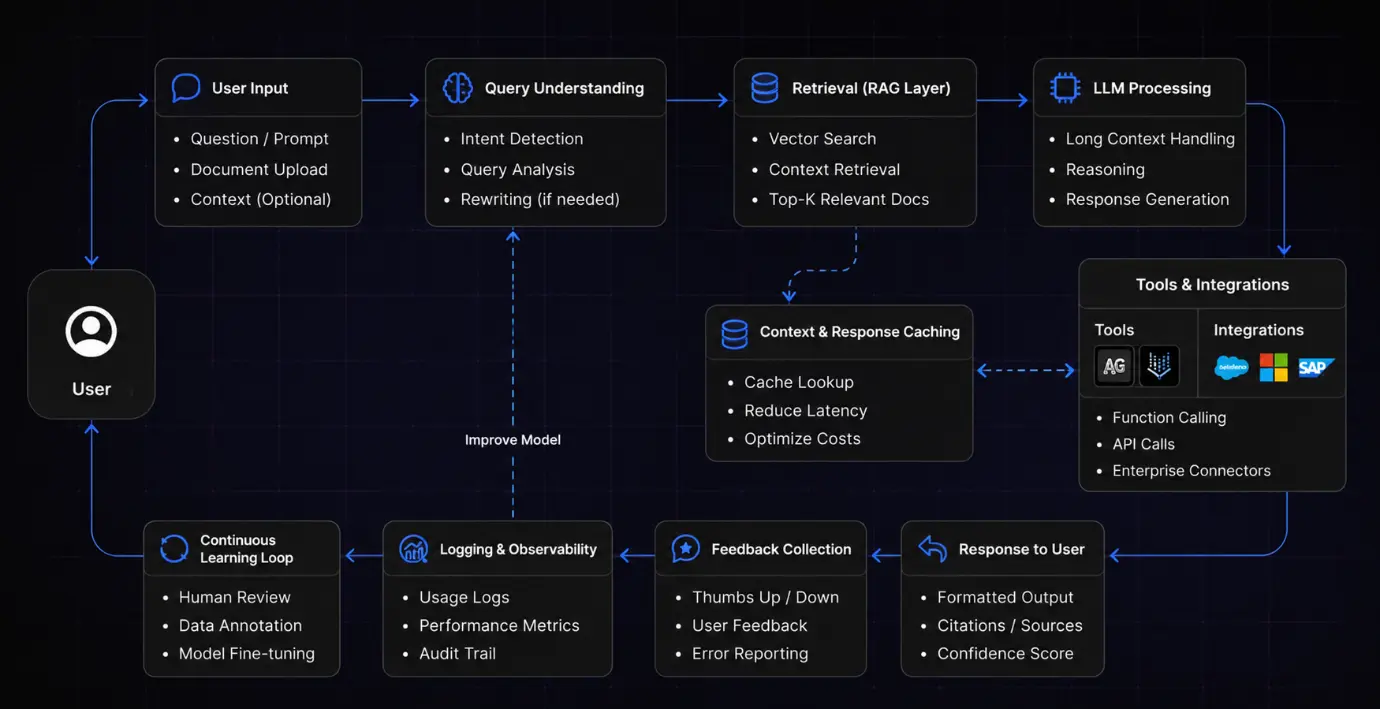
This is the core intelligence of the system.
Most enterprise LLMs are built on Transformer-based decoder architectures similar to GPT, Claude, Llama, and Mistral. Organizations must decide whether to use a smaller model such as 7B parameters, a mid-sized model around 70B parameters, or a large-scale model exceeding hundreds of billions of parameters.
The model is initially pretrained on massive text datasets containing books, websites, research papers, code, and other public knowledge.
Without this layer: There is no reasoning engine capable of understanding or generating language.
A foundation model becomes enterprise-ready only after exposure to domain-specific knowledge.
This layer handles:
For example, a healthcare company may inject clinical guidelines, medical terminology, and internal knowledge repositories into training pipelines.
Without this layer: The model remains generic and lacks business-specific expertise.
This is often the most difficult component of RLHF LLM development enterprise projects.
RLHF, or Reinforcement Learning from Human Feedback, trains models using human preference rankings. A reward model learns which responses are preferred and optimization methods such as PPO improve model behavior over time.
Claude introduced a unique approach called constitutional AI enterprise model alignment. Instead of relying exclusively on humans, the model evaluates its own outputs against a predefined set of safety and ethical principles. AI-generated feedback helps guide behavior at scale.
Without this layer: Models may generate unsafe, misleading, biased, or non-compliant responses.
One reason Claude became popular is its ability to process extremely large amounts of information.
Modern systems use:
A robust RAG architecture enterprise LLM implementation typically connects the model to vector databases such as Pinecone, Weaviate, or pgvector.
This enables the model to retrieve current enterprise knowledge before generating answers.
Without this layer: The model forgets important context and struggles with large documents.
This layer determines how efficiently the model operates in production.
Key technologies include:
The goal is to reduce latency while controlling infrastructure costs.
Without this layer: Response times become slow and operational costs increase dramatically.
This is where AI becomes a business system rather than a standalone model.
Typical integrations include:
This layer is especially important for private LLM deployment on-premise environments where compliance and governance requirements are strict.
Without this layer: The model cannot safely operate within enterprise workflows.
Enterprise AI is never truly finished.
Organizations must continuously monitor:
Modern LLMOps platforms collect feedback, detect degradation, and trigger retraining pipelines when necessary.
Without this layer: Model quality declines over time and business value erodes.
The short answer is partially.
Organizations can successfully reproduce large portions of how to build LLM from scratch architecture, including foundation models, RAG systems, enterprise integrations, deployment infrastructure, and RLHF pipelines. However, Claude's Constitutional AI framework represents years of specialized research, large-scale experimentation, and alignment engineering. While enterprises can implement principle-based safety systems inspired by Constitutional AI, achieving the same level of sophistication requires substantial investment in data, evaluation frameworks, model alignment, and AI safety expertise.
Ultimately, the most successful enterprise LLMs are not defined by model size alone. They are defined by how effectively all seven architectural layers work together to deliver secure, scalable, and business-specific intelligence.
Building an enterprise LLM is not simply about choosing a large model and connecting it to company data. Organizations that want to build a custom LLM like Claude for business must understand that enterprise-grade performance comes from a combination of foundational capabilities and advanced intelligence layers working together.
This is where many projects fail. Companies invest heavily in infrastructure and model training but overlook critical features that determine whether the system can actually deliver reliable business outcomes. A model may generate impressive responses during demos yet struggle with security, compliance, context retention, scalability, or workflow integration once deployed across the organization.
If your goal is to build AI model like Claude for companies, the focus should not be on copying a single model. Instead, you should identify the features that make enterprise AI trustworthy, scalable, and useful in real-world business environments.
A question many executives ask is:
"If we're investing millions into building proprietary AI, what specific features separate an enterprise-grade LLM from a basic chatbot that anyone can deploy in a weekend?"
The answer lies in two categories: core capabilities that every enterprise LLM must have and advanced capabilities that enable Claude-level performance, reasoning, and enterprise adoption.
These are the foundational capabilities every organization should prioritize when building proprietary LLM like GPT or Claude.
| Core Feature | Why It Matters | Business Impact |
| Natural Language Understanding | Accurately interprets user intent and context | Better user interactions and reduced misunderstandings |
| Context Retention | Maintains conversation history and relevant context | More coherent and useful responses |
| Knowledge Retrieval (RAG) | Accesses enterprise documents and databases | Reduces hallucinations and improves accuracy |
| Security & Access Control | Protects sensitive information through authentication and permissions | Compliance and data protection |
| Multi-Source Data Integration | Connects with ERP, CRM, databases, and internal systems | Unified enterprise intelligence |
| Scalability | Supports thousands of concurrent users and requests | Reliable enterprise-wide deployment |
| Monitoring & Audit Trails | Tracks model behavior and user activity | Governance and regulatory compliance |
| API & Workflow Integration | Embeds AI into existing business processes | Increased operational efficiency |
These capabilities form the foundation of every successful enterprise AI platform. Without them, even the most advanced model will struggle to deliver consistent business value. For example, a highly intelligent model without proper security controls can create compliance risks, while a model without RAG capabilities may provide inaccurate answers despite strong reasoning abilities.
This is why core features to consider while making an enterprise LLM like Claude should always be prioritized before investing in advanced AI enhancements.
Once the foundation is established, organizations can implement advanced capabilities that differentiate enterprise-grade AI from standard chatbot solutions.
| Advanced Feature | Purpose | Enterprise Benefit |
| Long Context Window (100K+ Tokens) | Processes large documents and conversations | Better handling of contracts, reports, and research |
| Constitutional AI Alignment | Uses predefined principles to guide behavior | Safer and more trustworthy outputs |
| RLHF Optimization | Learns from feedback and preferences | Improved response quality |
| Agentic Task Execution | Performs multi-step workflows autonomously | Increased productivity and automation |
| Tool Calling & Function Execution | Interacts with external systems and applications | Real-world business action capability |
| Multimodal Processing | Understands text, images, PDFs, and charts | Enhanced enterprise use cases |
| Personalized Memory Layer | Remembers user and organizational preferences | Better user experience |
| Self-Evaluation & Reflection | Reviews outputs before responding | Higher accuracy and reduced errors |
| AI Governance Framework | Applies compliance, ethics, and policy controls | Enterprise risk management |
| Continuous Learning Loop | Improves performance through feedback and retraining | Long-term model evolution |
The capabilities above are what transform a language model into a true enterprise intelligence platform.
For example, Claude's reputation is largely driven by features such as Constitutional AI, large context processing, strong reasoning capabilities, and safety-focused alignment. These advanced layers enable the system to handle complex business workflows, analyze lengthy documents, and produce more reliable outputs than traditional conversational AI systems.
Organizations seeking to build AI model like Claude for companies should recognize that these capabilities require significant investment in engineering, data pipelines, evaluation systems, and AI governance frameworks. They cannot simply be added through a basic fine-tuning process.
The most successful organizations approach advanced features required for the development of enterprise LLM like Claude as a phased roadmap rather than a single project. They first establish strong foundations through security, RAG, integrations, and scalability. Only then do they invest in sophisticated capabilities such as Constitutional AI, autonomous agents, multimodal intelligence, and continuous learning systems.
Ultimately, Claude-level performance is not achieved through model size alone. It is the result of combining robust core capabilities with advanced intelligence layers that enable the system to reason, learn, adapt, and operate safely within enterprise environments.
Building a Claude-like enterprise AI system is not a single engineering project. It is a multi-stage initiative involving data strategy, AI model development, infrastructure, security, compliance, and continuous optimization. Organizations that succeed typically follow a structured roadmap rather than jumping directly into model training.
If you are wondering how to develop an enterprise LLM step by step, the process below outlines what happens at each stage, who is responsible, how long it typically takes, and what can go wrong if the step is skipped.
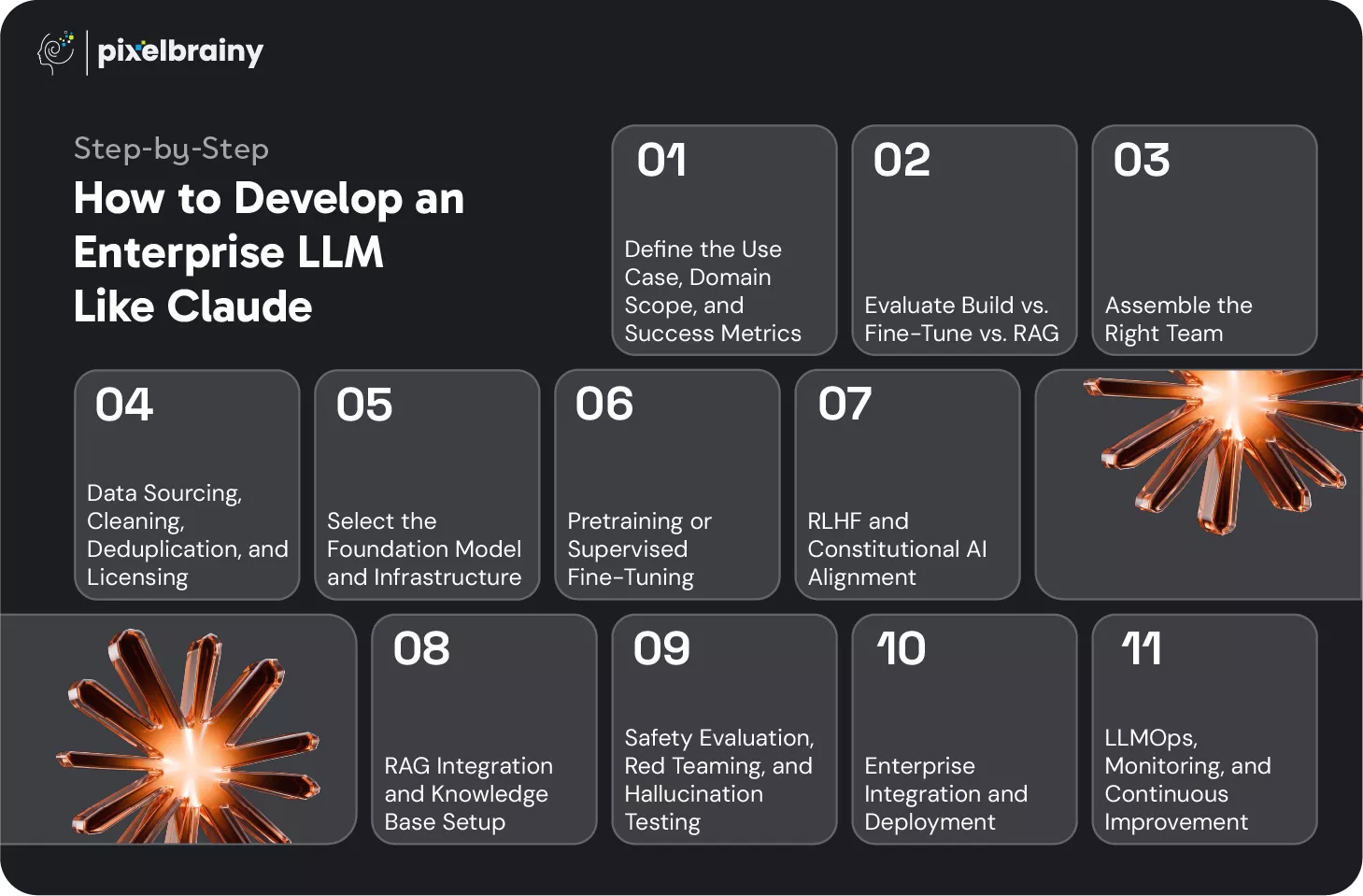
What happens: Identify the exact business problem the model will solve, such as customer support, document analysis, healthcare workflows, legal research, or enterprise search.
Who does it: Product leaders, business stakeholders, domain experts.
Timeline: 1 to 3 weeks.
Failure if skipped: The project becomes a technology experiment without measurable business outcomes.
What happens: Determine whether a custom model, fine-tuned model, or Retrieval-Augmented Generation solution best fits your goals.
Who does it: AI architects, technical leadership, data scientists.
Timeline: 1 to 2 weeks.
Failure if skipped: Significant overspending on unnecessary infrastructure and development.
What happens: Build a cross-functional team responsible for development and deployment.
Key roles include:
Many organizations begin with a small PoC development team before expanding into full-scale implementation.
Timeline: 2 to 6 weeks.
Failure if skipped: Skill gaps delay delivery and reduce model quality.
What happens: Collect enterprise data, remove duplicates, clean records, validate quality, and verify licensing rights.
Who does it: Data engineers, legal teams, domain experts.
Timeline: 4 to 8 weeks.
Failure if skipped: Poor-quality data creates poor-quality models.
What happens: Choose the base model and deployment environment.
Typical decisions include:
Organizations working with a specialized AI product development companies in USA often complete this assessment faster.
Timeline: 2 to 4 weeks.
Failure if skipped: Infrastructure bottlenecks increase costs and slow training.
What happens: Train the model using enterprise-specific datasets and business knowledge.
This stage is the core of the enterprise LLM fine-tuning process.
Who does it: ML engineers and data scientists.
Timeline: 4 to 16 weeks.
Failure if skipped: The model remains generic and lacks domain expertise.
What happens: Improve model behavior using human feedback, reward models, preference optimization, and Constitutional AI principles.
Key activities include:
Timeline: 4 to 12 weeks.
Failure if skipped: Higher hallucination rates, safety risks, and unreliable outputs.
What happens: Connect the model to enterprise knowledge repositories through vector databases and retrieval systems.
Typical tools include:
Who does it: AI engineers and platform teams.
Timeline: 2 to 6 weeks.
Failure if skipped: The model cannot access current business knowledge.
What happens: Stress-test the model for security vulnerabilities, factual errors, bias, and compliance issues.
Who does it: AI safety teams, security experts, domain specialists.
Timeline: 2 to 6 weeks.
Failure if skipped: Production failures and compliance risks become likely.
What happens: Connect the AI system to enterprise applications and workflows.
Common integrations include:
This phase often requires collaboration with a specialized UI/UX design company to ensure enterprise adoption and usability.
Timeline: 4 to 8 weeks.
Failure if skipped: Employees struggle to use the system effectively.
What happens: Establish monitoring, feedback collection, drift detection, retraining workflows, and governance processes.
Key components include:
Many organizations transition from MVP development to full-scale production during this stage.
Timeline: Ongoing.
Failure if skipped: Model performance gradually deteriorates over time.
| Project Type | Typical Timeline |
| Fine-Tuned Enterprise Model | 2 to 4 Months |
| Mid-Scale Custom Enterprise LLM | 6 to 12 Months |
| Full Claude-Scale Enterprise LLM | 18 Months to 3 Years |
What Should You Be Doing in Month 1, Month 3, and Month 6?
| Timeline | Primary Focus |
| Month 1 | Define use cases, assess data readiness, select build strategy, assemble team |
| Month 3 | Complete data preparation, infrastructure setup, model selection, begin fine-tuning |
| Month 6 | Implement RAG, complete alignment, conduct testing, begin enterprise deployment |
The reality of building a custom LLM from scratch process is that success depends far more on planning, data quality, safety alignment, and operational maturity than on model size alone. Organizations that follow a structured LLM development process 2026 roadmap are far more likely to achieve meaningful business outcomes than those that focus solely on training a larger model.
Whether your goal is to how to create an enterprise AI model like Claude for healthcare, finance, legal operations, or enterprise automation, the most successful initiatives treat AI development as a long-term business capability rather than a one-time technology project. Many enterprises also benchmark their strategy against the top AI model development companies in USA to understand best practices, infrastructure requirements, and realistic implementation timelines before making major investments.
If there is one decision that determines the success or failure of your AI initiative, it is choosing the right development approach.
Many organizations immediately assume they need to build their own model. Others default to using Claude or GPT APIs because it seems faster and less expensive. The reality is that the best option depends on your business objectives, data assets, compliance requirements, budget, and long-term AI strategy.
This is why the build vs fine-tune vs RAG enterprise LLM debate is one of the most important conversations happening in enterprise AI today.
A question we hear frequently from executives is:
"Should we build our LLM from scratch, fine-tune Llama, or just do RAG on top of Claude's API, and how do we avoid making a million-dollar mistake?"
The answer starts with understanding what each path actually delivers.
This approach combines Claude, GPT, or another hosted model with Retrieval-Augmented Generation (RAG). Instead of training a new model, you connect enterprise data sources and allow the AI to retrieve relevant information before generating responses.
Best For:
Cost: $50K–$300K
Timeline: 6–16 Weeks
Advantages:
Limitations:
For most organizations evaluating when to build custom LLM vs use API, RAG is the recommended starting point.
This approach involves taking a model such as Llama 3 70B or Mistral and training it on your proprietary data and workflows.
Best For:
Cost: $150K–$750K
Timeline: 3–6 Months
Advantages:
Limitations:
For organizations exploring fine-tuning open source LLM for enterprise, this often provides the best balance between ownership, performance, and cost.
This is the most ambitious and resource-intensive option.
Organizations collect massive datasets, train a foundation model from the ground up, and develop proprietary alignment, safety, and deployment infrastructure.
Best For:
Cost: $3M–$50M+
Timeline: 18 Months–3 Years
Advantages:
Limitations:
This path only makes sense when the AI itself becomes a strategic business asset.
| Decision Factor | RAG + API | Fine-Tuned Open-Source Model | Custom LLM From Scratch |
| Budget Under $500K | ✓ Recommended | Possible | No |
| Budget Above $5M | Possible | Recommended | Recommended |
| Limited Internal AI Team | ✓ Best Choice | Moderate | No |
| Strong Compliance Requirements | Moderate | ✓ Strong Fit | ✓ Strong Fit |
| Need Deployment Within 6 Months | ✓ Best Choice | Possible | No |
| High Vendor Risk Concerns | Limited | ✓ Good Fit | ✓ Best Fit |
| Highly Specialized Domain Knowledge | Moderate | ✓ Strong Fit | ✓ Strong Fit |
The real value of enterprise AI is not the model itself.
The value comes from the knowledge embedded inside it.
If your AI system captures proprietary datasets, internal operating procedures, historical decisions, customer insights, and organizational expertise that competitors cannot access, the model becomes much more than a technology asset. It becomes a competitive moat.
This is where the RAG vs fine-tuning enterprise AI decision becomes strategic. RAG allows your model to access proprietary knowledge without retraining. Fine-tuning teaches the model how your organization thinks and operates. Building from scratch allows you to encode unique institutional intelligence directly into the foundation model itself.
The simplest answer to this custom LLM development path comparison is:
For most enterprises in 2026, the smartest strategy is not building from scratch. It is starting with RAG, validating business value, and then evolving toward fine-tuning or custom model development as AI becomes a core competitive capability.
For most executives, the first question is not whether a custom AI model is possible. It is whether the investment makes financial sense.
If you're preparing a budget proposal, board presentation, or CFO review, understanding the enterprise LLM development cost 2026 landscape is critical. The reality is that there is no single price tag for building an enterprise LLM. Costs vary dramatically depending on whether you implement a RAG-based solution, fine-tune an open-source model, or build a foundation model from scratch.
A question we hear frequently is:
"I need real numbers to bring to my CFO. What does it actually cost to build an enterprise LLM at different levels of ambition?"
The answer depends on the development path you choose.
For most enterprises, Retrieval-Augmented Generation provides the highest ROI and fastest time to value.
| Cost Component | Estimated Cost |
| Vector Database Setup | $5K–$25K |
| Data Pipeline Engineering | $15K–$80K |
| Knowledge Base Integration | $10K–$50K |
| Embedding Pipeline | Up to $12K/month at scale |
| Security & Access Controls | $10K–$40K |
| Testing & Deployment | $10K–$50K |
| Total Project Cost | $50K–$300K |
Best for: Enterprises seeking fast deployment with lower risk and minimal infrastructure investment.
Organizations requiring domain-specific intelligence often choose fine-tuning.
| Cost Component | Estimated Cost |
| Data Preparation & Annotation | $20K–$100K |
| Model Fine-Tuning | $25K–$150K |
| GPU Training Compute | $30K–$200K |
| RLHF & Alignment Layer | $40K–$150K |
| Evaluation & Safety Testing | $15K–$70K |
| Deployment Infrastructure | $20K–$80K |
| Total Project Cost | $150K–$750K |
This range represents a realistic cost to build custom LLM like Claude for specialized enterprise use cases without training a foundation model from scratch.
This approach is closest to building a Claude-like foundation model.
| Cost Component | Estimated Cost |
| GPU Cluster Infrastructure | $500K–$5M |
| Data Acquisition & Licensing | $100K–$2M |
| Model Pretraining | $500K–$10M+ |
| Safety & Alignment Research | $500K–$3M |
| Evaluation & Benchmarking | $100K–$1M |
| Engineering & Operations | $500K–$5M |
| Total Project Cost | $3M–$50M+ |
This represents the highest level of investment in any building private LLM budget guide and is generally reserved for large enterprises with substantial AI ambitions.
People are often the largest expense in enterprise AI development.
| Role | Annual Salary Range |
| ML Engineer | $150K–$250K |
| Data Scientist | $120K–$200K |
| AI Safety Researcher | $180K–$300K |
| Infrastructure Engineer | $140K–$220K |
| MLOps Engineer | $140K–$220K |
| AI Product Manager | $130K–$220K |
For a full custom model project, team salaries alone can reach $2M–$10M+ over an 18-month development cycle.
Many organizations focus only on development costs and underestimate long-term operations.
| Cost Category | Annual Cost |
| Model Inference | $50K–$200K+ |
| Retraining & Updates | $100K–$500K |
| LLMOps Monitoring | $30K–$100K |
| Security & Compliance | $25K–$150K |
| Infrastructure Maintenance | $50K–$300K |
| Data Management | $20K–$100K |
What $500K vs $2M vs $10M+ Actually Gets You
| Budget | What You Can Build |
| $500K | Production-ready RAG platform or highly specialized fine-tuned model |
| $2M | Enterprise-grade private LLM with advanced integrations, governance, and alignment |
| $10M+ | Large-scale proprietary foundation model with extensive training, safety systems, and long-term ownership |
One of the most important considerations is long-term economics.
| Approach | Estimated 3-Year Cost |
| Claude Enterprise API (High Usage Enterprise) | $1M–$5M+ |
| Enterprise RAG Platform | $200K–$750K |
| Fine-Tuned Open-Source Model | $500K–$2M |
| Custom Enterprise LLM | $3M–$50M+ |
The tipping point usually occurs when AI becomes deeply embedded across multiple departments and generates millions of interactions every month. At that scale, owning part of the AI stack often becomes more economical than paying perpetual API fees.
When evaluating how much does it cost to develop an enterprise AI model, the answer depends on the level of ownership you want. Most enterprises can achieve excellent results with a $50K–$750K investment through RAG or fine-tuning. Only a small percentage of organizations need to invest millions in a fully custom foundation model.
For most businesses in 2026, the smartest strategy is to start with RAG, validate ROI, expand into fine-tuning, and only pursue full model development when proprietary AI becomes a genuine competitive advantage. This phased approach minimizes risk while maximizing long-term return on investment.

Also Read: AI Software Development Cost: A Complete Software Cost Guide
Building an enterprise-grade AI model comparable to Claude requires far more than selecting a large language model and deploying it in production. Modern enterprise LLMs rely on an extensive ecosystem of technologies that support data processing, model training, fine-tuning, inference optimization, retrieval systems, security, monitoring, and continuous improvement.
Organizations exploring enterprise LLM development tools, technologies required for custom LLM development, or advanced AI infrastructure for enterprise LLMs often underestimate the complexity involved. A successful enterprise AI platform combines multiple technology layers that work together seamlessly to deliver secure, scalable, and high-performing AI experiences.
Whether your goal is to develop a healthcare AI assistant, legal research platform, financial intelligence system, or enterprise knowledge assistant, selecting the right technology stack can significantly impact development speed, operational costs, scalability, and long-term maintainability.
| Technology Layer | Recommended Tools & Technologies | Purpose |
| Foundation Models | Llama 3 70B, Mistral, Falcon, Mixtral | Core language reasoning and generation |
| Training Frameworks | PyTorch, DeepSpeed, Hugging Face Transformers | Model training and optimization |
| Fine-Tuning Frameworks | LoRA, QLoRA, PEFT | Efficient domain adaptation |
| Distributed Training | Ray, DeepSpeed, FSDP | Large-scale model training |
| GPU Infrastructure | NVIDIA H100, A100, AMD MI300X | High-performance compute resources |
| Data Processing | Apache Spark, Airflow, Pandas | Data preparation and pipeline management |
| Embedding Models | BGE, E5, OpenAI Embeddings | Semantic search and retrieval |
| Vector Databases | Pinecone, Weaviate, pgvector, Milvus | RAG and long-term knowledge retrieval |
| Orchestration Frameworks | LangChain, LlamaIndex, Haystack | Workflow and agent management |
| Inference Serving | vLLM, Hugging Face TGI, TensorRT-LLM | Fast and scalable model serving |
| Deployment Platforms | AWS SageMaker, Azure ML, Google Vertex AI, Kubernetes | Production deployment and scaling |
| Security & Access Control | Okta, Azure AD, SAML, OAuth | Enterprise authentication and authorization |
| Monitoring & Observability | LangSmith, Weights & Biases, Arize AI | Performance tracking and evaluation |
| LLMOps Platforms | MLflow, Kubeflow, Dataiku | Model lifecycle management |
| Feedback & Evaluation | Humanloop, TruLens, Promptfoo | Quality assessment and improvement |
| Proof of Concept | LangChain, Pinecone, GPT/Claude APIs |
| Fine-Tuned Enterprise Model | Llama 3, LoRA, vLLM, Weaviate |
| Production Enterprise AI Platform | Kubernetes, LangSmith, MLflow, RBAC Security |
| Claude-Level Advanced System | DeepSpeed, RLHF Pipelines, Multi-Agent Architecture, Continuous Alignment Frameworks |
The organizations that successfully develop enterprise LLMs are not those with the largest models, but those that build the right combination of infrastructure, tooling, security, and operational processes around them.
Also Read: How to Develop a Multi-Agent AI System: Steps and Cost
One of the biggest mistakes organizations make in 2026 is assuming that building a custom LLM is automatically the best long-term strategy. In reality, the smartest decision is often not the most ambitious one.
Many executives ask:
"How do I know if our company actually needs to build a custom LLM or if we're just chasing prestige when the Claude API would do the job better and cheaper?"
The answer requires an honest assessment of your business needs, data assets, compliance requirements, and AI maturity.
When evaluating the build vs buy enterprise AI model decision, remember that building an LLM should solve a business problem, not satisfy a technology trend.
Build Your Own LLM If...
A custom enterprise LLM makes strategic sense when several of the following conditions apply:
If these conditions describe your organization, when to build enterprise LLM vs use API becomes a strategic conversation rather than a technical one.
For many companies, building a model is unnecessary.
You should strongly consider using Claude, GPT, or another frontier model if:
In these situations, a hosted model often delivers better outcomes with lower risk and significantly lower cost.
The reality is that the future is not "build everything" or "buy everything."
The most successful organizations are adopting a hybrid LLM strategy for enterprises that combines the strengths of both approaches.
A typical architecture looks like this:
This approach balances cost, performance, flexibility, and compliance while avoiding unnecessary infrastructure investments.
One of the most valuable lessons from enterprise AI projects is that organizations often overestimate what they need.
Many companies begin with plans for a $10 million proprietary model when their actual business requirements can be solved by a $500,000 fine-tuned model paired with a robust retrieval system.
This concept of enterprise AI model right-sizing is becoming increasingly important as leaders focus on ROI rather than technological prestige.
| Business Need | Recommended Approach |
| Internal knowledge assistant | RAG + Claude API |
| Customer support automation | RAG + Frontier Model |
| Healthcare or Legal AI Assistant | Fine-Tuned Open-Source Model + RAG |
| Enterprise-Wide AI Platform | Hybrid Architecture |
| Proprietary AI Competitive Moat | Custom Enterprise LLM |
If you are asking should my company build its own LLM, the answer is usually simpler than many vendors make it sound.
Build only when ownership, compliance, proprietary knowledge, or long-term economics justify the investment. Otherwise, leverage existing frontier models and focus on creating business value faster.
In 2026, the most successful enterprises are not necessarily the ones building the largest models. They are the ones choosing the right level of AI investment for their actual business needs.
Building a Claude-like enterprise AI system is not primarily a technology challenge. It is a data, governance, infrastructure, and organizational challenge. In fact, many enterprise AI initiatives fail long before deployment because leaders underestimate the complexity involved.
If you are evaluating the challenges in building enterprise LLM systems, understanding these risks early can save millions of dollars and months of development effort.
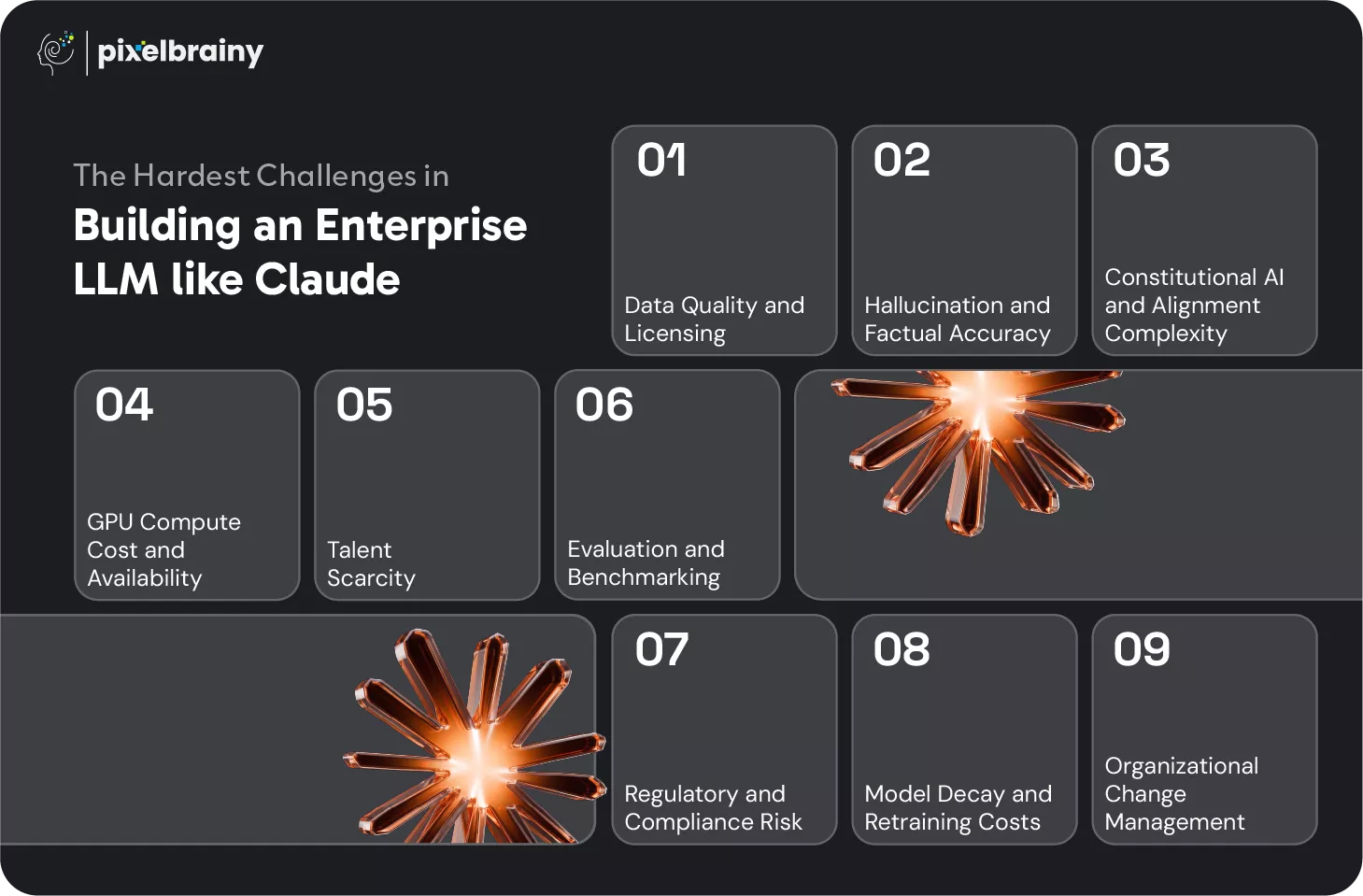
What it is: Poor-quality datasets, duplicate content, outdated information, personally identifiable information (PII), and copyrighted content entering training pipelines.
Why it's harder than expected: Most enterprise data is fragmented, inconsistent, and not AI-ready.
How to survive it: Implement strict data governance, automated cleaning pipelines, PII detection, legal review processes, and licensing verification before training begins.
What it is: Models generate confident but incorrect information.
Why it's harder than expected: Fine-tuning improves domain knowledge but does not eliminate hallucinations.
How to survive it: The most effective LLM hallucination mitigation enterprise strategy combines RAG, RLHF, grounding mechanisms, confidence scoring, and human review for high-risk workflows.
What it is: Ensuring the model behaves safely, ethically, and consistently.
Why it's harder than expected: Replicating Claude's safety framework requires extensive research, evaluation, and iterative training.
How to survive it: Start with RLHF, rule-based guardrails, policy frameworks, and continuous safety testing before attempting advanced Constitutional AI systems.
This remains one of the most difficult constitutional AI challenges custom model developers face today.
What it is: Training and serving enterprise LLMs require significant compute resources.
Why it's harder than expected: H100 availability remains limited, cloud costs fluctuate, and infrastructure planning is complex.
How to survive it: Use efficient fine-tuning techniques, optimize inference workloads, and evaluate hybrid cloud and on-premise strategies.
What it is: Shortage of experienced AI professionals.
Why it's harder than expected: ML engineers, alignment researchers, and LLMOps specialists command premium salaries and are difficult to recruit.
How to survive it: Partner with experienced AI development teams, invest in internal training, and prioritize automation wherever possible.
What it is: Measuring model quality and business readiness.
Why it's harder than expected: There is no universal benchmark for healthcare, legal, financial, or proprietary enterprise use cases.
How to survive it: Develop domain-specific evaluation frameworks, establish human review processes, and continuously track business KPIs.
What it is: Legal and governance obligations surrounding AI systems.
Why it's harder than expected: Regulations are evolving rapidly across regions and industries.
How to survive it: Build governance into the development process from day one and continuously monitor emerging requirements.
These are among the most significant enterprise AI model compliance risks facing organizations today, especially under regulations such as the EU AI Act, GDPR, and healthcare-specific requirements.
What it is: Models become less relevant as business information changes.
Why it's harder than expected: Enterprise knowledge evolves continuously, requiring ongoing maintenance.
How to survive it: Implement automated retraining workflows, RAG architectures, and structured data refresh schedules.
What it is: Employees resist adoption or bypass approved AI tools.
Why it's harder than expected: Trust, training, and workflow integration often receive less attention than model development.
How to survive it: Focus on user education, transparent governance, executive sponsorship, and seamless integration into existing workflows.
Most enterprise LLM development risks are not caused by model architecture. They stem from poor data quality, weak governance, inadequate evaluation, unrealistic expectations, and lack of organizational readiness. The enterprises that succeed are not necessarily those with the largest models, but those that proactively identify these challenges and build mitigation strategies into every stage of the AI development lifecycle.
By now, you've seen the reality of enterprise LLM development.
Building a Claude-like AI system is not simply about training a model. It involves strategic planning, data governance, security architecture, alignment engineering, compliance requirements, infrastructure decisions, and long-term operational support. Most organizations do not fail because the technology is impossible. They fail because they choose the wrong development path, underestimate complexity, or work with partners who prioritize buzzwords over business outcomes.
This is where PixelBrainy enterprise LLM development takes a different approach.
Instead of pushing every client toward the largest and most expensive solution, PixelBrainy focuses on identifying the fastest, safest, and most cost-effective path to measurable business value.
"I Don't Know If We Need to Build From Scratch or Fine-Tune"
One of the most common mistakes enterprises make is deciding on a technology approach before defining the business objective.
At PixelBrainy, we begin every engagement with a structured LLM strategy workshop. During the first week, our team evaluates your use cases, compliance requirements, data assets, expected AI usage volume, and business goals before recommending a solution.
Sometimes the answer is RAG.
Sometimes it is fine-tuning.
Sometimes it is a fully private model.
The goal is not to sell the largest project. The goal is to identify the architecture that creates the highest ROI.
This consultative approach is one of the reasons organizations choose PixelBrainy custom AI model development services over generic AI development vendors.
"I'm Worried About Data Privacy During Training"
Data privacy concerns are often the biggest obstacle preventing enterprises from moving forward with AI initiatives.
PixelBrainy addresses this challenge through secure data pipeline architecture that includes:
Whether you're building a healthcare assistant, financial intelligence platform, or internal knowledge system, data governance is built into the development process from day one.
"We Can't Afford to Fail. We've Been Burned by Vendors Before."
Many AI projects become expensive because requirements keep changing, budgets keep expanding, and deliverables remain unclear.
PixelBrainy solves this through a phased delivery model designed around transparency and accountability.
Our approach includes:
Instead of open-ended retainers, clients receive a structured roadmap that reduces risk while maintaining flexibility as requirements evolve.
"We Need Safety and Alignment Built In, Not Added Later"
Safety cannot be treated as an afterthought.
Many organizations focus on model performance first and attempt to address governance issues later. This often creates expensive rework and deployment delays.
As an experienced enterprise LLM development company PixelBrainy, we implement:
These safeguards are incorporated from the earliest development stages, helping organizations deploy AI with greater confidence.
"We Need It to Work With Our Existing Enterprise Stack"
A powerful AI model has limited value if it cannot integrate into existing business operations.
PixelBrainy has extensive experience connecting enterprise AI systems with:
Our objective is to ensure AI becomes part of your operational ecosystem rather than another disconnected software tool.
"We Need Someone Who Understands Compliance"
Regulated industries face challenges that generic AI vendors often overlook.
Organizations in healthcare, finance, insurance, legal services, and government sectors must address strict governance requirements before deploying AI systems at scale.
PixelBrainy's compliance-focused development methodology supports frameworks and regulations including:
This enables organizations to build private LLM with PixelBrainy while maintaining compliance and reducing regulatory risk.
The biggest difference between PixelBrainy and a typical AI development company is our focus on business outcomes.
We do not start by asking how large a model you want.
We start by asking:
The answers to those questions determine the architecture, investment level, and implementation roadmap.
That is why our PixelBrainy AI development services are designed around practical business objectives rather than technology trends.
Stop overpaying for Claude API access you can't customize.
Let's scope what your enterprise actually needs and build the LLM that gives you the data ownership, domain performance, and competitive moat your business deserves.
Book a free 30-minute architecture consultation with PixelBrainy's AI team and discover the fastest path to a secure, scalable, and enterprise-ready AI solution.
Developingan enterprise LLM like Claude is no longer reserved for technology giants with billion-dollar AI budgets. Today, organizations have multiple paths available, ranging from RAG-powered enterprise assistants and fine-tuned open-source models to fully proprietary AI systems. The key is not choosing the most ambitious option, but selecting the approach that aligns with your business goals, data assets, compliance requirements, and long-term AI strategy.
For most enterprises, the winning formula is not training a foundation model from scratch. It is combining domain-specific fine-tuning, a robust RAG architecture, strong safety and alignment mechanisms, and enterprise-grade integrations that deliver measurable business value. The organizations seeing the greatest ROI are focusing on ownership of their knowledge, workflows, and competitive advantages rather than simply owning a larger model.
The opportunity is significant, but the window is narrowing. With more than 80% of enterprises actively deploying or scaling generative AI initiatives, the race to build differentiated, proprietary AI capabilities is already underway.
If you're evaluating your next move, now is the time to define the right strategy. Connect with PixelBrainy's AI experts for a consultation and discover the most practical, cost-effective path to building an enterprise LLM that gives your organization lasting competitive advantage.
An enterprise LLM is a large language model that is trained, fine-tuned, or customized specifically for an organization's data, workflows, compliance requirements, and business objectives. Unlike Claude's API, where you access a third-party model through cloud-based requests, an enterprise LLM can be deployed in a private cloud or on-premise environment with greater control over data, security, and customization. Organizations choose enterprise LLMs when they need domain-specific intelligence, regulatory compliance, data sovereignty, or reduced long-term dependence on external AI providers.
The cost varies depending on the development approach. A RAG-based enterprise AI solution typically costs between $50,000 and $300,000. Fine-tuning an open-source model such as Llama 3 or Mistral generally costs between $150,000 and $750,000. Building a foundation model from scratch can cost anywhere from $3 million to over $50 million. The final investment depends on model size, infrastructure requirements, training data, alignment systems, compliance requirements, and ongoing operational costs.
The timeline depends on the complexity of the project. A RAG-powered enterprise assistant can often be deployed within 6 to 16 weeks. A fine-tuned enterprise model typically requires 3 to 6 months, including data preparation, training, evaluation, and deployment. A fully custom foundation model may require 18 months to 3 years. Most organizations achieve the fastest return on investment by starting with RAG or fine-tuning before considering large-scale custom model development.
Constitutional AI is an AI alignment approach that uses predefined principles and rules to guide model behavior and improve safety. Instead of relying only on human feedback, the model evaluates its own responses against a set of approved guidelines. While enterprises can implement principle-based safety frameworks inspired by Constitutional AI, fully replicating Anthropic's approach requires extensive research, evaluation infrastructure, and alignment expertise. Most organizations combine RLHF, governance rules, and safety testing to achieve similar business outcomes.
Fine-tuning involves taking an existing model and training it further using domain-specific data, terminology, and workflows. It is faster, less expensive, and requires significantly less infrastructure. Building from scratch involves creating a foundation model from the ground up using massive datasets and large-scale compute resources. Fine-tuning is ideal for most enterprises, while building from scratch is typically reserved for organizations with unique datasets, substantial budgets, and long-term AI ownership goals.
The answer depends on your business requirements. Claude's API is often the best option for organizations seeking fast deployment, lower costs, and minimal infrastructure management. Building an enterprise LLM becomes attractive when compliance requirements, proprietary datasets, vendor independence, or large-scale AI usage justify the investment. Many enterprises now adopt a hybrid strategy that combines frontier AI APIs with fine-tuned private models and RAG systems to balance cost, flexibility, and performance.
Compliance requirements vary by industry and geography. Organizations may need to comply with GDPR in Europe, DPDP regulations in India, HIPAA in healthcare environments, and emerging AI governance frameworks such as the EU AI Act. Financial institutions, healthcare providers, and government organizations often face additional industry-specific requirements. Compliance planning should begin during data collection and model development rather than after deployment to avoid costly redesigns and regulatory risks.
A typical enterprise LLM stack includes foundation models such as Llama 3 or Mistral, training frameworks like PyTorch and DeepSpeed, vector databases such as Pinecone or Weaviate, orchestration frameworks like LangChain, serving platforms such as vLLM, and deployment environments including AWS, Azure, or Kubernetes. Additional components include monitoring tools, security frameworks, LLMOps platforms, and evaluation systems. The exact stack depends on performance requirements, compliance needs, and deployment preferences.
Hallucinations cannot be completely eliminated, but they can be significantly reduced. The most effective approach combines Retrieval-Augmented Generation, high-quality enterprise knowledge sources, RLHF, response validation systems, and continuous evaluation. RAG enables the model to retrieve current information rather than relying entirely on training data. Human feedback loops and domain-specific testing also improve factual accuracy. Organizations deploying AI in high-risk environments should implement human review processes for critical decisions and outputs.
A successful enterprise LLM project typically requires machine learning engineers, data scientists, infrastructure engineers, AI safety specialists, domain experts, product managers, and LLMOps professionals. Smaller projects may operate with a lean team, while large-scale initiatives often require dedicated specialists for model alignment, compliance, security, and deployment. Many organizations choose to partner with experienced AI vendors to accelerate development and reduce hiring challenges while maintaining access to specialized expertise.

About The Author
Sagar Bhatnagar
Sagar Sahay Bhatnagar brings over a decade of IT industry experience to his role as Marketing Head at PixelBrainy. He's known for his knack in devising creative marketing strategies that boost brand visibility and market influence. Sagar's strategic thinking, coupled with his innovative vision and focus on results, sets him apart. His track record of successful campaigns proves his ability to utilize digital platforms effectively for impactful marketing efforts. With a genuine passion for both technology and marketing, Sagar continuously pushes PixelBrainy's marketing initiatives to greater success.

Working with the PixelBrainy team has been a highly positive experience. They understand the design requirements and create beautiful UX elements to meet the application needs. The dev team did an excellent job bringing my vision to life. We discussed usability and flow. Sagar worked with his team to design the database and begin coding. Working with Sagar was easy. He has the knowledge to create robust apps, including multi-language support, Google and Apple ID login options, Ad-enabled integrations, Stripe payment processing, and a Web Admin site for maintaining support data. I'm extremely satisfied with the services provided, the quality of the final product, and the professionalism of the entire process. I highly recommend them for Android and iOS Mobile Application Design and Development.

Great experience working with them. Had a lot of feedback and I found that unlike most contractors they were bugging me for updates instead of the other way around. They were extremely time conscience and great at communicating! All work was done extremely high quality and if not on time, early! They were always proactive when it comes to communication and the work is great/above par always. Very flexible and a great team to work with! Goes above and beyond to present us with multiple options and always provides quality. Amazing work per usual with Chitra. If you have UI/UX or branding design needs I recommend you go to them! Will likely work with them in the future as well, definitely recommended!

PixelBrainy is a joy to work with and is a great partner when thinking through branding, logo, and website layout. I appreciate that they spend time going into the "why" behind their decisions to help inform me and others about industry best practices and their expertise.

I hired them to design our software apps. Things I really like about them are excellent communication skills, they answer all project suggestions and collaborate right away, and their input on design and colors is amazing. This project was complex and needed patience and creativity. The team is amazing to do business with. I will be using them long-term. Glad to see there are some good people out there. I was afraid to try and outsource my project to someone but I am glad I met them! I really can't say enough. They went above and beyond on this project. I am very happy with everything they have done to make my business stand out from the competition.

It was great working with PixelBrainy and the team. They were very responsive and really owned the project. We'll definitely work with them again!

I recently worked with the PixelBrainy team on a project and I was blown away by their communication skills. They were prompt, clear, and articulate in all of our interactions. They listened and provided valuable feedback and suggestions to help make the project a success. They also kept me updated throughout the entire process, which made the experience stress-free and enjoyable.

PixelBrainy is very good at what it does. The team also presents themselves very professionally and takes care of their side of things very well. I could fully trust them taking up the design work in a timely and organised manner and their attention to detail saved us lots of effort and time. This particular project was quite intense and the team showed that they function very well under pressure. Very much looking forward to working with her again!

It's always an absolute pleasure working with them. They completed all of my requests quickly and followed every note I had for them to a T, which made our process go smoothly from start to finish. Everything was completed fast and following all of the guidelines. And I would recommend their services to anyone. If you need any design work done in the future, PixelBrainy should be your first call!

They took ownership of our requirements and designed and proposed multiple beautiful variants. The team is self-motivated, requires minimum supervision, committed to see-through designs with quality and delivering them on time. We would definitely love to work with PixelBrainy again when we have any requirements.

PixelBrainy was a big help with our SaaS application. We've been hard at work with a new UI/UX and they provided a lot of help with the designs. If you're looking for assistance with your website, software, or mobile application designs, PixelBrainy and the team is a great recommendation.

PixelBrainy designers are amazing. They are responsive, talented, and always willing to help craft the design until it matches your vision. I would recommend them and plan to continue them for my future projects and more!!!

They were awesome! Did a good job fast, and good communication. Will work with them again. Thank you

Creative, detail-oriented, and talented designers who take direction well and implement changes quickly and accurately. They consistently over-delivered for us.

PixelBrainy team is very talented and creative. Great designers and a pleasure to work with. PixelBrainy is an excellent communicator and I look forward to working with them again.

PixelBrainy has a very talented design team. Their work is excellent and they are very responsive. I enjoy working with them and hope to continue on all of our future projects.

Transform your ideas into reality with us.
Across these industries, each engagement brings unique challenges, from early-stage product development to scaling complex systems, helping us build a practical understanding of real-world product environments.