AI Summary Powered by PixelBrainy
Are your doctors spending more time typing notes than actually treating patients?
Across the U.S. healthcare system, documentation burden has quietly become one of the biggest barriers to delivering quality care. With the rapid adoption of digital health records, clinicians are expected to capture every detail with precision. However, this often comes at the cost of meaningful patient interaction, reducing face-to-face engagement and impacting trust.
According to a recent report by Grand View Research, the global clinical documentation improvement market is projected to grow significantly, fueled by AI-driven solutions and expected to reach a multi-billion-dollar valuation by 2030.
This rapid growth highlights a clear shift. Healthcare providers are actively seeking smarter, compliant, and scalable solutions to reduce documentation burden without compromising patient care.
Let’s take a closer look at the everyday challenges clinicians face:
These issues are not just operational inefficiencies. They directly affect clinician well-being, patient satisfaction, and overall healthcare outcomes.
That is exactly why the demand for a HIPAA-compliant medical voice assistant is rapidly increasing. Clinics and hospitals are now exploring how to create a HIPAA-compliant medical voice assistant for healthcare providers that can enable real-time doctor-patient transcription while maintaining strict compliance and data security.
If your thought process sounds like this: “We are running a clinic in the US and looking for a US based company that can develop a HIPAA compliant medical voice assistant for us,” you are part of a growing movement adopting AI to transform clinical workflows.
This blog is a complete, practical guide to building a HIPAA-compliant medical voice assistant for doctor-patient transcription, covering features, development process, cost, and challenges in detail.
A HIPAA-compliant AI medical voice assistant is a purpose-built solution that captures doctor-patient conversations and converts them into structured clinical documentation in real time, while ensuring full compliance with healthcare data privacy regulations.
It works as an intelligent assistant during consultations, automatically recording conversations, transcribing speech into text, and organizing the information into clinically relevant formats such as SOAP notes. This removes the need for manual note-taking and allows clinicians to stay engaged with patients.
Unlike general voice tools, this system is trained on medical language and understands clinical context. It can identify symptoms, diagnoses, medications, and treatment plans from natural conversations and structure them accurately.
A key aspect of this technology is compliance. It is designed to meet HIPAA requirements through features like end-to-end encryption, secure data storage, access control, and audit trails, ensuring that protected health information remains safe at all times.
It also integrates with Electronic Health Record systems, allowing documentation to be updated instantly without additional administrative effort.
Overall, it transforms clinical conversations into accurate, secure, and ready-to-use medical records without disrupting the consultation workflow.
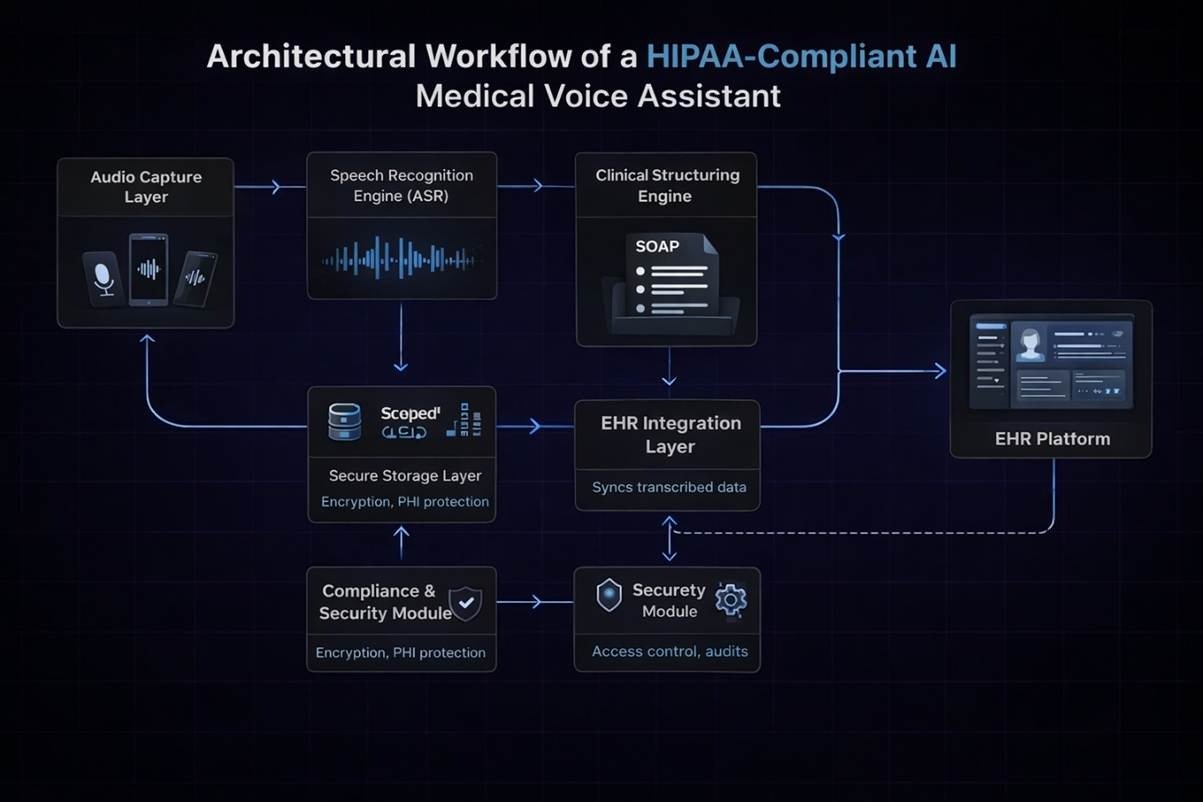
To understand how a HIPAA-compliant AI medical voice assistant works, it helps to look at the system as a combination of intelligent layers working together in real time. Each layer has a specific role, from capturing audio to delivering structured clinical notes securely.
It starts with the audio capture layer. During a consultation, the system records the conversation using a secure device such as a mobile app, tablet, or in-room microphone. The captured audio is encrypted right from the source to protect sensitive patient data.
Next comes the speech recognition engine. This component converts spoken language into text. Unlike general speech tools, it is trained on medical vocabulary, accents, and clinical conversation patterns, which improves accuracy in real-world healthcare settings.
Once the conversation is transcribed, the natural language processing layer takes over. This is where the system understands context. It identifies key medical entities such as symptoms, diagnoses, medications, and procedures. It also distinguishes between speakers, so it knows what the doctor said versus what the patient said.
The processed data is then passed to the clinical structuring engine. Here, unstructured text is organized into standardized formats like SOAP notes. This step ensures that the output is ready for clinical use and meets documentation standards.
All information is handled within a secure infrastructure layer. Data is encrypted both in transit and at rest. Access is controlled through authentication mechanisms, and every interaction is logged for audit purposes to maintain HIPAA compliance.
Finally, the integration layer connects the system with EHR platforms. Through APIs and healthcare standards like FHIR, the generated notes are automatically pushed into patient records without manual effort.
Together, these components create a seamless flow where conversations are captured, understood, structured, and securely stored in real time, making the entire documentation process faster and more reliable.
We are evaluating AI solutions for our healthcare business is it worth investing in a HIPAA compliant voice assistant for doctor patient transcription in terms of ROI and efficiency.
This is one of the most common and important questions healthcare providers are asking today. Clinics and hospitals are under constant pressure to improve efficiency, reduce operational costs, and enhance patient care while maintaining strict compliance with data privacy regulations. At the same time, clinicians are overwhelmed with documentation tasks that take away valuable time from patient interaction.
This is where a HIPAA-compliant medical voice assistant becomes a strategic investment rather than just a technology upgrade. It is not only about automating transcription. It is about transforming clinical workflows, improving accuracy, and unlocking measurable business value.
Doctors spend a significant portion of their day writing notes and updating patient records. A real time voice assistant automatically converts conversations into structured documentation during consultations. This reduces manual effort, eliminates after hours charting, and allows clinicians to focus more on patient care instead of administrative tasks.
Healthcare businesses can achieve strong ROI by reducing reliance on human scribes and minimizing administrative overhead. Automating transcription saves time per consultation, enabling doctors to see more patients daily. Over time, this leads to increased revenue, lower operational costs, and better utilization of clinical resources across the organization.
Manual note taking often leads to missed details and inconsistent records. AI voice assistants capture complete conversations and generate structured notes in standardized formats. This improves documentation accuracy, reduces errors, and ensures consistency across providers, which is essential for quality care, compliance, and effective medical decision making.
When doctors are not focused on typing, they can give full attention to patients. This leads to better communication, stronger trust, and more meaningful interactions during consultations. Patients feel heard and valued, while clinicians can concentrate on diagnosis and treatment, improving overall satisfaction and care quality.
A HIPAA compliant voice assistant is designed to securely handle sensitive patient data. It includes encryption, access control, and audit logging to protect information at every stage. This reduces the risk of data breaches, ensures regulatory compliance, and provides healthcare organizations with confidence when adopting AI solutions.
As healthcare organizations grow, managing documentation manually becomes inefficient. AI voice assistants scale easily across multiple providers, departments, and locations. They support higher patient volumes and integrate with digital systems, helping organizations transition toward more efficient, technology driven healthcare operations.
That’s why investing in a HIPAA-compliant medical voice assistant is not just about adopting AI. It is about solving real operational challenges, improving efficiency, and delivering better patient care.
For healthcare businesses evaluating ROI and efficiency, the value becomes clear when you consider the combined impact of time savings, cost reduction, improved accuracy, and enhanced patient experience.
Also Read: AI Medical Diagnosis App Development: Features & Cost
When you look closely at how clinical workflows operate on a daily basis, one thing becomes very clear. A large portion of a provider’s time is spent capturing, organizing, and updating patient information rather than actually delivering care. This is where a HIPAA-compliant AI medical voice assistant starts to show its real value.
Instead of being just another tool, it becomes an active part of the consultation process. It listens, understands, and documents without interrupting the natural flow between doctor and patient. Whether it is a busy primary care clinic, a virtual consultation, or a high-pressure emergency setting, the assistant adapts to different environments and reduces the documentation burden significantly.
What makes it even more powerful is its ability to work across multiple use cases, improving efficiency, accuracy, and consistency in each scenario. Below are some of the most practical ways healthcare providers are using this technology today, along with real-world examples.
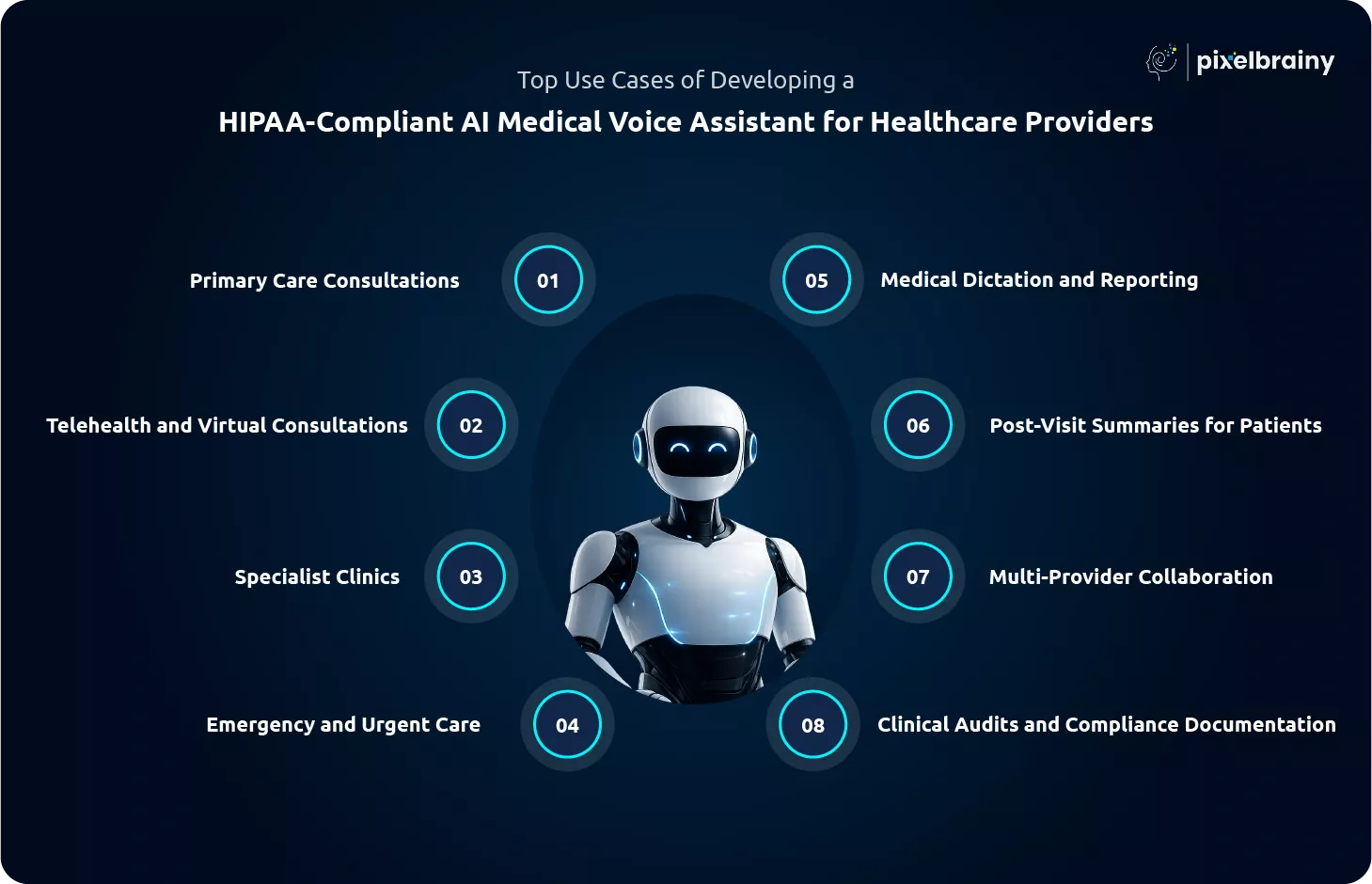
Primary care physicians handle a high volume of patients daily, which makes documentation repetitive and time-consuming.
Example: A doctor consults a patient with symptoms like fever, fatigue, and cough. While the conversation flows naturally, the assistant captures everything in real time and converts it into a structured SOAP note. By the time the consultation ends, the documentation is already prepared, requiring only a quick review instead of starting from scratch.
Telehealth has increased significantly, but documenting virtual visits often adds extra steps for clinicians.
Example: During an online consultation, the assistant records and transcribes the interaction live. It identifies key clinical details such as symptoms, diagnosis, and prescriptions, then automatically updates the patient record. This eliminates the need for doctors to revisit recordings or manually type notes after the session.
Specialists often deal with complex cases that require detailed and precise documentation.
Example: In a dermatology clinic, a doctor evaluates a skin condition and discusses treatment options. The assistant captures specific medical terms, observations, and recommendations, organizing them into structured notes. This ensures accuracy even when dealing with condition-specific language and detailed explanations.
In fast-paced environments, clinicians prioritize immediate care over documentation, which can lead to incomplete or delayed records.
Example: An emergency physician treating a patient with severe injuries can verbally describe findings and actions while working. The assistant records these inputs and converts them into real-time documentation, ensuring that critical details are not missed despite the urgency.
Even when doctors dictate notes instead of typing, it still takes time to structure and finalize reports.
Example: After examining a patient, a doctor dictates clinical findings. The assistant not only transcribes the speech but also organizes it into proper formats, such as discharge summaries or progress notes, aligned with hospital documentation standards.
Clear communication after a consultation is essential for patient understanding and treatment adherence.
Example: Once the visit is complete, the assistant generates a simplified summary that includes diagnosis, medications, and follow-up instructions. This can be shared through a patient portal, helping patients remember what was discussed without confusion.
Healthcare often involves multiple providers working together on a single patient case.
Example: During hospital rounds, several clinicians discuss a patient’s condition and treatment plan. The assistant captures the entire discussion, updates the shared record, and ensures that every provider has access to the same accurate and up-to-date information.
Maintaining accurate and complete records is essential for audits and regulatory compliance.
Example: The assistant automatically logs interactions, timestamps entries, and maintains audit trails. This makes it easier for healthcare organizations to meet compliance requirements without additional manual effort.
These use cases highlight that building a HIPAA-compliant medical voice assistant for doctor-patient transcription is not just about reducing typing effort. It improves documentation quality, enhances collaboration, supports compliance, and allows healthcare providers to dedicate more time to patient care.
When you plan to build a HIPAA compliant AI medical voice assistant for clinics and hospitals, the outcome depends on how well the core features are defined and implemented. This is not just a voice-to-text tool. It is a clinical-grade system that must balance accuracy, security, usability, and compliance at every level.
Healthcare providers often ask: Which essential features should be included when developing a HIPAA compliant AI medical voice assistant for secure and accurate clinical documentation? The answer lies in building a solution that not only understands conversations but also transforms them into structured, secure, and actionable medical records.
Below is a detailed breakdown of the essential features required for effective HIPAA compliant AI medical voice assistant development.
| Feature | Description |
|---|---|
| Real-Time Speech-to-Text Transcription | The system must convert doctor-patient conversations into text instantly during the consultation. This ensures that documentation is created as the interaction happens without any delay. It significantly reduces the need for after-hours note writing and improves overall workflow efficiency. |
| Medical Vocabulary Recognition | The assistant should be trained on a wide range of medical terminology, including clinical phrases, abbreviations, and drug names. This allows it to accurately capture complex medical discussions without frequent corrections. It also reduces the chances of misinterpretation that can affect patient care. |
| Speaker Identification | The system must be able to distinguish between multiple speakers, especially the doctor and the patient. This helps in organizing the conversation correctly within the documentation. It also ensures that statements are attributed accurately, which is critical for clinical clarity. |
| Natural Language Processing for Clinical Context | NLP enables the assistant to understand the meaning behind conversations rather than just transcribing words. It identifies key elements such as symptoms, diagnoses, medications, and treatment plans. This allows the system to generate clinically relevant and structured outputs. |
| Automated SOAP Note Generation | The assistant should automatically organize extracted data into structured formats like SOAP notes. This removes the need for manual formatting and saves significant time for clinicians. It also ensures consistency in documentation across different providers and departments. |
| HIPAA-Compliant Data Encryption | All patient data must be encrypted both during transmission and while stored in the system. This ensures that sensitive health information is protected from unauthorized access. Strong encryption practices are essential to meet HIPAA compliance requirements and avoid legal risks. |
| Role-Based Access Control | The system should allow access based on predefined roles such as physicians, nurses, and administrative staff. This ensures that only authorized users can view or edit specific data. It adds an extra layer of security and helps maintain data integrity. |
| Audit Logs and Activity Tracking | Every action performed within the system should be recorded, including access, edits, and data transfers. These logs are essential for monitoring system usage and ensuring compliance with regulations. They also help in identifying and resolving any security issues quickly. |
| EHR Integration Capability | The assistant must seamlessly integrate with Electronic Health Record systems using standard protocols. This allows automatic syncing of generated notes directly into patient records. It eliminates duplicate data entry and improves operational efficiency. |
| Voice Commands for Navigation | The system should support voice commands that allow clinicians to control its functions without using hands. Doctors can start or stop recordings, highlight sections, or navigate through notes using simple commands. This enhances usability during live consultations. |
| Context-Aware Summarization | The assistant should generate concise summaries that highlight the most important clinical information. This helps doctors quickly review key points without going through the entire transcript. It also improves communication between healthcare providers. |
| Multi-Language Support | The system should support multiple languages and different accents to serve diverse patient populations. This ensures accurate transcription regardless of the patient’s language preference. It also improves inclusivity and accessibility in healthcare delivery. |
| Low Latency Processing | The assistant must process audio and generate outputs with minimal delay. Fast response times are crucial for real-time usage in clinical settings. Any lag can disrupt the consultation flow and reduce efficiency. |
| Secure Cloud Infrastructure | Data should be hosted on HIPAA-compliant cloud platforms that offer high security and scalability. This ensures that patient information is stored safely and can be accessed when needed. It also supports system reliability and disaster recovery. |
| Customizable Templates and Workflows | The system should allow clinics to customize documentation templates and workflows based on their needs. Different specialties require different formats, and flexibility is important for adoption. Customization improves usability and aligns the system with existing processes. |
A strong combination of these features ensures that HIPAA compliant AI medical voice assistant development delivers secure, accurate, and scalable clinical documentation for modern healthcare environments.
When healthcare providers start exploring the development process of HIPAA compliant AI medical voice assistant for clinics and hospitals, the journey often feels complex. It is not just about building a transcription tool. It involves combining AI intelligence, healthcare workflows, data security, and seamless integrations into one reliable system.
Many clinics today are asking: We want to hire a healthcare AI development company that can develop a secure voice assistant with real time transcription and EHR integration, who are the best vendors for this? The answer lies in choosing experienced partners such as top AI healthcare software development companies or top AI development companies in USA that understand both compliance and clinical needs.
Below is a step-by-step process that explains how building an HIPAA compliant AI medical voice assistant actually works in real-world scenarios.
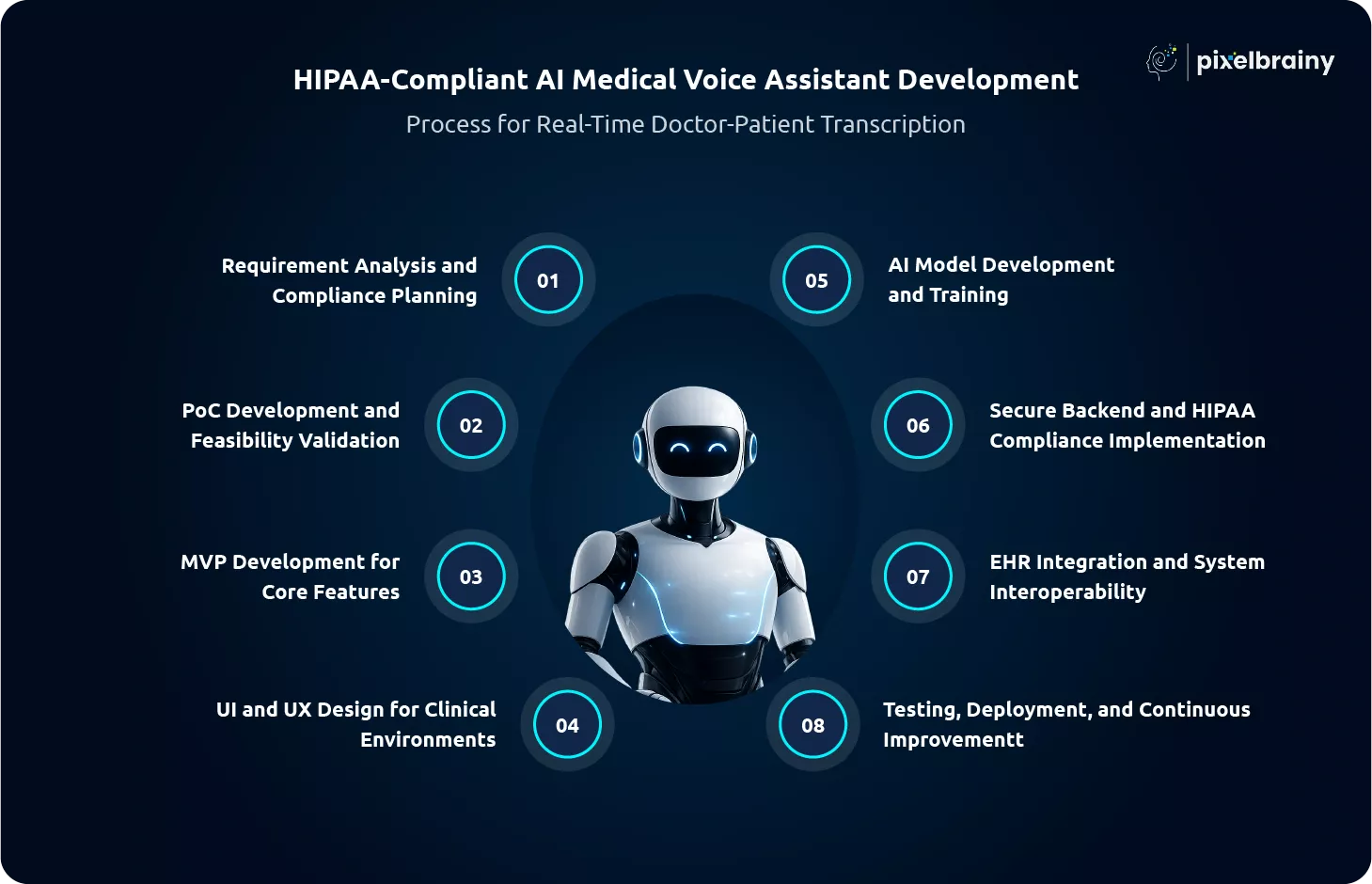
The first step in the creation of HIPAA compliant AI medical voice assistant is understanding clinical workflows, user needs, and compliance requirements. This involves discussions with doctors, administrative staff, and IT teams to identify pain points and expectations. At this stage, regulatory considerations such as HIPAA guidelines, data privacy, and security protocols are clearly defined. The scope of features, integrations, and performance expectations is also finalized.
Aim of this: To build a strong foundation by aligning technical development with clinical needs and compliance standards from the very beginning.
Before investing in full-scale development, teams often create a Proof of Concept to validate the idea. This includes testing basic speech recognition, transcription accuracy, and initial NLP capabilities using limited datasets. PoC development helps identify technical challenges early, such as handling medical terminology or real-time processing limitations. It also gives stakeholders a clear view of how the system will function.
Aim of this: To validate the technical feasibility and reduce risks before moving into full product development.
Once feasibility is confirmed, the next step is MVP development. This version includes essential features such as real-time transcription, basic NLP, and secure data handling. MVP allows healthcare providers to test the system in real environments and gather feedback from clinicians. It also helps in refining workflows and identifying areas for improvement before scaling the product.
Aim of this: To launch a functional version quickly and gather real user feedback for iterative improvements.
Also Read: Top 10 AI MVP Development Companies in USA
A reliable system is not just about functionality but also about usability. A specialized UI/UX design company focuses on creating intuitive interfaces that fit seamlessly into clinical workflows. The design ensures that doctors can use the system without distractions during consultations. Elements like voice controls, minimal screens, and easy navigation are prioritized.
Aim of this: To ensure that the assistant enhances the consultation experience rather than interrupting it.
At this stage, the core intelligence of the system is built. Speech recognition models are trained on medical datasets, and NLP models are developed to understand clinical context. This includes identifying symptoms, medications, and treatment plans from conversations. Continuous training improves accuracy over time and adapts the system to different specialties.
Aim of this: To create a highly accurate and context-aware AI engine that can handle real-world medical conversations.
View This: AI Model Development Company
Security is a critical part of HIPAA compliant AI medical voice assistant development. The backend infrastructure is designed with encryption, access control, and audit logging. Data is secured both in transit and at rest. Compliance measures are implemented to ensure that all patient information is protected according to regulations.
Aim of this: To ensure complete data security and meet all legal and regulatory requirements.
The assistant must work seamlessly with existing healthcare systems. Integration with EHR platforms is done using standards like FHIR and HL7. APIs are developed to enable real-time data exchange between the voice assistant and clinical systems. This ensures that documentation is automatically updated without manual effort.
Aim of this: To create a connected ecosystem where data flows smoothly across systems without duplication.
Before final deployment, the system undergoes rigorous testing for accuracy, performance, and compliance. This includes real-world testing with clinicians to ensure reliability. After deployment, continuous monitoring and updates are essential to improve performance and adapt to evolving needs.
Aim of this: To deliver a stable, scalable, and continuously improving solution that meets clinical and operational expectations.
Following this structured approach ensures that the creation of HIPAA compliant AI medical voice assistant is not only technically sound but also aligned with real healthcare needs, making it a valuable long-term investment for clinics and hospitals.
Also Read: AI Medical Diagnosis Chatbot Development: Features and Cost
When healthcare providers start planning the development of a secure voice assistant, one of the first questions that comes up is cost. The reality is that building a HIPAA compliant AI medical voice assistant is not a fixed-price project. The cost depends on multiple factors such as feature complexity, AI capabilities, integrations, and compliance requirements.
If you are a clinic thinking, “We want to build a secure, real-time transcription system with EHR integration, how much should we budget?”, the answer typically falls within a broad range.
An average cost to develop a HIPAA compliant AI medical voice assistant ranges between $30,000 to $200,000+, depending on the scope and sophistication of the solution.
Below is a breakdown of different development levels to help you understand where your project might fit.
| Type | Description | Estimated Cost |
|---|---|---|
| Basic HIPAA Compliant AI Medical Voice Assistant (MVP) | This version focuses on core functionality such as real-time speech-to-text transcription, basic medical vocabulary recognition, and secure data storage. It may include limited NLP capabilities and minimal UI. Ideal for testing ideas and early-stage deployment in small clinics. | $30,000 – $70,000 |
| Advanced HIPAA Compliant AI Medical Voice Assistant | This includes enhanced NLP for clinical context, speaker identification, SOAP note generation, and EHR integration. It also offers improved UI/UX, better accuracy, and stronger security layers. Suitable for growing clinics and multi-specialty practices. | $70,000 – $150,000 |
| Enterprise-Level HIPAA Compliant AI Medical Voice Assistant | A fully scalable solution with advanced AI models, multi-language support, deep EHR integration, analytics, role-based access, and enterprise-grade security. It is designed for hospitals and large healthcare networks with high data volumes. | $150,000 – $200,000+ |
Understanding what drives the cost will help you plan your budget more effectively.
Advanced AI models for speech recognition and NLP require more training, fine-tuning, and testing.
Estimated Impact: $10,000 – $50,000+
Building low-latency, real-time processing systems increases infrastructure and development effort.
Estimated Impact: $5,000 – $25,000+
Integrating with EHR systems using FHIR or HL7 standards adds complexity and requires custom API development.
Estimated Impact: $10,000 – $40,000+
Implementing encryption, audit logs, access control, and secure cloud infrastructure is critical and adds to cost.
Estimated Impact: $8,000 – $30,000+
Working with a professional UI/UX design company ensures better usability but increases design costs.
Estimated Impact: $5,000 – $20,000+
Using HIPAA-compliant cloud platforms like AWS or Azure involves setup and ongoing costs.
Estimated Impact: $3,000 – $15,000+ (initial setup)
Features like multilingual support, analytics dashboards, and workflow customization increase development effort.
Estimated Impact: $10,000 – $50,000+
Extensive testing for accuracy, performance, and compliance is essential before launch.
Estimated Impact: $5,000 – $20,000+
The total cost of HIPAA compliant AI medical voice assistant development ultimately depends on your clinic’s goals, scale, and required level of intelligence. A well-planned investment not only reduces documentation burden but also improves clinical efficiency and patient care outcomes.
Also Read: AI Medical Imaging Software Development: Architecture, Process, Costs & Key Challenges Explained
When you move forward with HIPAA compliant AI medical voice assistant development, choosing the right technology stack becomes a critical decision. The tools and technologies you select will directly impact system performance, accuracy, scalability, and most importantly, compliance.
Building a secure and intelligent system for real-time doctor-patient transcription requires a combination of AI frameworks, backend infrastructure, cloud services, and healthcare-specific standards. Below is a structured overview of the advanced tools and technologies commonly used by top AI healthcare software development companies.
| Layer | Tools / Technologies | Description |
|---|---|---|
| Frontend (User Interface) | React, Angular, Flutter | These frameworks are used to build responsive and user-friendly interfaces for web and mobile applications. They ensure smooth interaction for doctors during consultations. A clean UI reduces friction and improves adoption in clinical environments. |
| Backend Development | Node.js, Python (Django, Flask) | Backend technologies handle data processing, API management, and system logic. Python is widely used for AI integration, while Node.js ensures scalable and fast performance. Together, they create a robust server-side architecture. |
| Speech Recognition (ASR) | OpenAI Whisper, Google Speech-to-Text, AWS Transcribe Medical | These tools convert spoken language into text with high accuracy. Medical-grade speech recognition is essential for handling clinical vocabulary. They also support real-time transcription capabilities. |
| Natural Language Processing (NLP) | spaCy, BioBERT, ClinicalBERT, Hugging Face Transformers | NLP frameworks help the system understand medical context from conversations. They extract entities such as symptoms, diagnoses, and medications. This enables structured clinical documentation. |
| AI Model Training & Deployment | TensorFlow, PyTorch | These frameworks are used to build, train, and deploy machine learning models. They support customization and continuous improvement of AI performance. They are essential for handling complex healthcare datasets. |
| Cloud Infrastructure (HIPAA-Compliant) | AWS (HIPAA eligible services), Microsoft Azure Health Cloud, Google Cloud Healthcare API | These platforms provide secure, scalable, and compliant hosting environments. They support encryption, access control, and data storage. Cloud infrastructure ensures reliability and scalability for healthcare applications. |
| Database Management | PostgreSQL, MongoDB | Databases store patient data, transcripts, and system logs securely. PostgreSQL is ideal for structured data, while MongoDB handles flexible and unstructured data. Proper database design ensures fast retrieval and data integrity. |
| Security & Compliance | AES-256 Encryption, OAuth 2.0, TLS/SSL, IAM | These technologies ensure data protection and secure access. Encryption safeguards sensitive information, while authentication protocols control user access. Compliance tools help meet HIPAA requirements. |
| EHR Integration Standards | HL7, FHIR APIs | These standards enable seamless communication between the voice assistant and EHR systems. They allow real-time data exchange and interoperability. This ensures that clinical notes are automatically updated in patient records. |
| API Management | REST APIs, GraphQL | APIs enable communication between different system components. They ensure smooth data flow between frontend, backend, and external systems. Efficient API design improves system performance and scalability. |
| DevOps & Deployment | Docker, Kubernetes, CI/CD pipelines | These tools help automate deployment, scaling, and maintenance. Containerization ensures consistency across environments. CI/CD pipelines enable faster updates and continuous improvement. |
| Monitoring & Logging | ELK Stack, Prometheus, Grafana | Monitoring tools track system performance and detect issues in real time. Logging ensures transparency and helps with compliance audits. These tools are essential for maintaining system reliability. |
Selecting the right combination of these technologies ensures that your HIPAA compliant AI medical voice assistant is not only powerful and accurate but also secure, scalable, and ready for real-world healthcare environments.
When you move from a small deployment to enterprise-level implementation, integrating a HIPAA compliant AI medical voice assistant with EHR systems becomes far more than just sending transcribed notes into a database. At scale, integration is about reliability, interoperability, data accuracy, and maintaining clinical context across multiple systems without failure.
Healthcare organizations often underestimate this step, but in reality, it is one of the most complex parts of HIPAA compliant AI medical voice assistant development. A well-integrated system ensures that real-time doctor-patient transcription flows seamlessly into clinical records while maintaining compliance and performance.
Below is a structured and practical breakdown of how large-scale AI-EHR integration actually works.
| Integration Area | Enterprise Objective | Technical Implementation |
|---|---|---|
| Healthcare Data Standards | Ensure seamless interoperability across multiple EHR platforms and healthcare systems | Use HL7 for legacy systems and FHIR APIs for modern structured data exchange. Implement SMART on FHIR for secure application-level access and authorization. |
| Real-Time Data Synchronization | Enable instant availability of transcribed notes across systems | Use event-driven architecture with message queues like Kafka or RabbitMQ. Ensure real-time encounter linking and API orchestration across services. |
| Patient Identity Matching | Maintain accurate patient mapping across different systems and records | Implement Master Patient Index systems with deterministic and probabilistic matching. Include encounter ID validation and duplicate record prevention mechanisms. |
| Clinical Context Mapping | Preserve the meaning and structure of clinical data during transfer | Map AI-generated notes to EHR templates such as SOAP format. Include metadata like timestamps, provider IDs, and department-level classifications. |
| API Reliability and Retry Logic | Ensure system stability even during failures or network disruptions | Use idempotent APIs, exponential backoff retry strategies, and transaction logging. This prevents data loss and duplicate entries during failures. |
| Conflict Resolution Mechanisms | Avoid overwriting or duplication of clinical documentation | Implement version control systems, validation rules, and concurrency handling. Ensure that updates do not override existing verified data. |
| Data Reconciliation and Validation | Maintain data accuracy across systems over time | Perform periodic cross-system validation and automated discrepancy detection. Use audit-based verification to ensure consistency in patient records. |
| Security and Compliance Layer | Protect sensitive patient data during integration and transfer | Apply end-to-end encryption, token-based authentication, and strict access control. Maintain detailed audit logs to meet HIPAA compliance requirements. |
At scale, integration is not just about connectivity. It is about controlled and intelligent data movement across systems. Every piece of data must be:
Another important aspect is system resilience. Healthcare systems cannot afford downtime or data inconsistencies. That is why modern architectures rely on event-driven systems, fail-safe APIs, and continuous monitoring to ensure smooth operations even under high load.
If you are planning to build or scale a HIPAA compliant AI medical voice assistant, EHR integration should be treated as a core architectural priority, not an afterthought. Partnering with experienced teams that understand both healthcare standards and scalable system design is critical.
At enterprise scale, successful integration is not about pushing data into an EHR. It is about ensuring that clinical information flows securely, accurately, and reliably across the entire healthcare ecosystem without breaking context or compliance.
When organizations begin building a HIPAA compliant AI medical voice assistant, the early results often look promising. Transcriptions appear accurate, notes seem structured, and integrations work smoothly in controlled environments. However, the real complexity emerges when the system is exposed to real clinicians, diverse specialties, unpredictable patient conversations, and large-scale hospital infrastructure.
The gap between a working demo and a production-ready system is significant. This is where many teams struggle. Building a reliable solution requires not only technical expertise but also a deep understanding of clinical workflows, compliance requirements, and human behavior.
Below are the most common challenges teams face during HIPAA compliant AI medical voice assistant development, along with practical ways to address them.
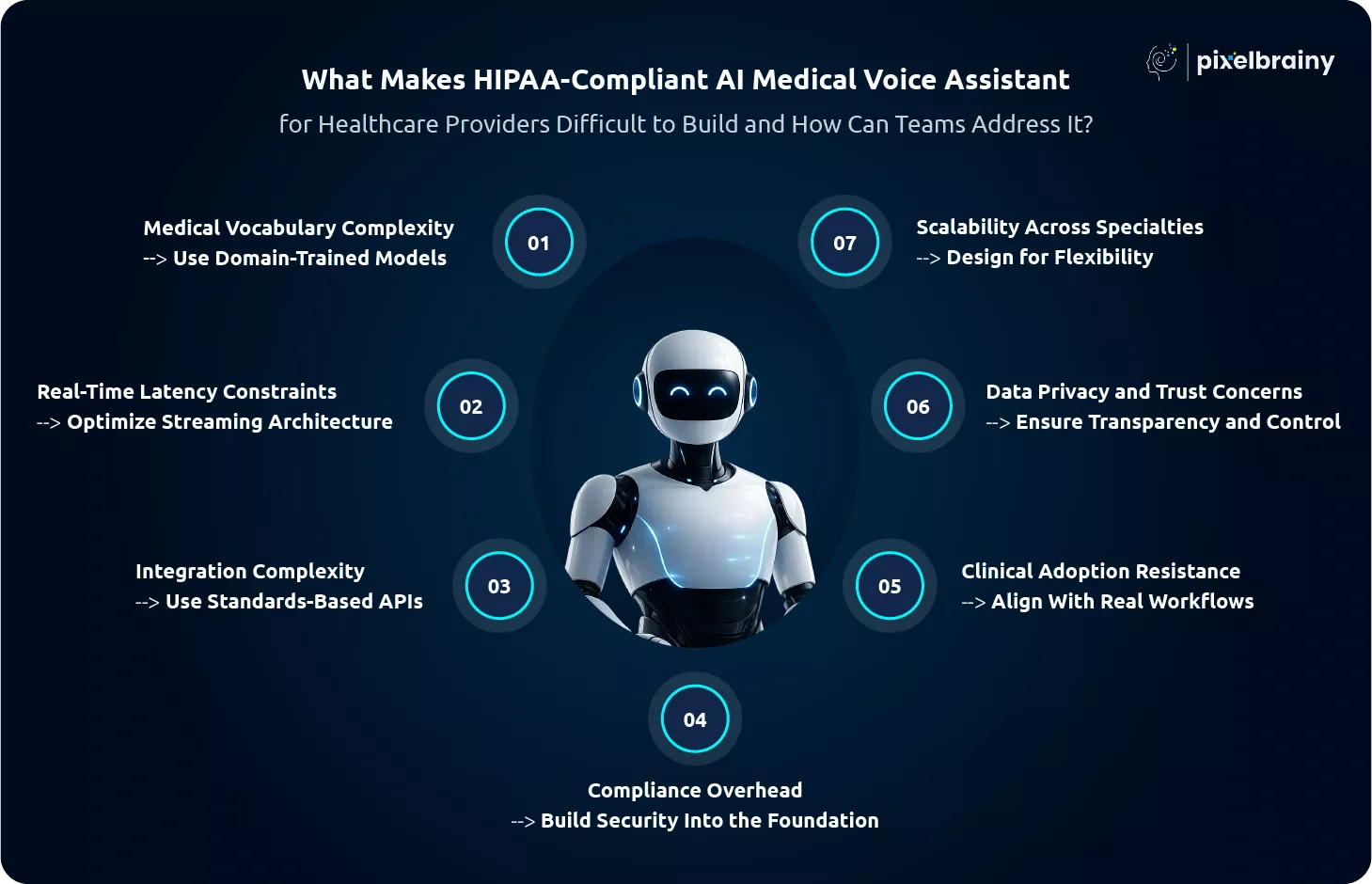
Clinical conversations are rarely clean or consistent. Doctors often switch between formal medical terminology and informal shorthand within the same sentence. Drug names can sound similar, and abbreviations may carry different meanings depending on the specialty or context.
A generic speech recognition model cannot handle this level of complexity effectively.
The solution is to train and fine-tune models using real clinical datasets across multiple specialties. This includes expanding vocabulary with specialty-specific terms and continuously improving models using real encounter data. More importantly, teams should focus on entity-level accuracy such as identifying symptoms, medications, and diagnoses, rather than just word-level transcription accuracy.
In clinical settings, even a slight delay can disrupt the consultation flow. If the system lags behind the conversation, doctors lose trust quickly and may stop using it altogether.
Latency issues often arise from inefficient processing pipelines or reliance on batch-based transcription methods.
To address this, teams should implement streaming architectures with continuous processing and minimal buffering. Real-time partial transcripts should be displayed instantly, allowing clinicians to follow along without delay. Monitoring latency in production environments is equally important, with alerts in place to detect performance drops before they impact users.
Healthcare systems are rarely standardized across organizations. Different departments use different templates, workflows, and even data formats. Without proper handling, integration errors can lead to incorrect patient records or duplicated data.
Successful teams treat integration as a core part of system design rather than an afterthought.
Using standards such as FHIR and HL7 ensures structured and consistent data exchange. Strong validation mechanisms for patient identity and encounter context reduce mismatches. Additionally, implementing idempotent APIs prevents duplicate entries during retries or system failures.
HIPAA compliance is not something that can be added at the end of development. Many teams face delays when security measures are introduced late, requiring significant architectural changes.
The better approach is to embed compliance from the start.
This includes encrypting data at every stage, implementing role-based access control, and maintaining detailed audit logs. Continuous monitoring and secure authentication mechanisms should be part of the core system. When compliance is built into the foundation, scaling the system becomes much smoother and less risky.
Even the most advanced system can fail if clinicians find it difficult to use. Doctors have different documentation styles. Some prefer structured templates, while others rely on narrative notes. A rigid system can increase effort instead of reducing it.
Adoption improves when the technology adapts to clinicians, not the other way around.
Providing flexible documentation formats, easy editing options, and minimal disruption during consultations is key. Running pilot programs with small groups of clinicians and incorporating their feedback helps refine the system before wider rollout. Trust builds gradually through consistent performance and usability.
Healthcare providers are highly sensitive about patient data privacy. Any uncertainty around how data is captured, stored, or used can slow down adoption significantly.
Teams must address these concerns proactively.
Clear data handling policies, transparent workflows, and strict access controls help build confidence among users. Giving clinicians visibility into how data is processed and allowing them to review and edit outputs strengthens trust in the system.
What works in a primary care setting may not work in a specialty clinic. Each department has its own terminology, workflows, and documentation standards.
A one-size-fits-all approach often fails at scale.
Teams should design systems that can be customized for different specialties. This includes adaptable templates, configurable workflows, and modular AI models that can be trained for specific use cases. Flexibility ensures long-term scalability across healthcare environments.
These are the core challenges that define HIPAA compliant AI medical voice assistant development, and addressing them effectively is what separates a working demo from a truly scalable clinical solution.
As healthcare continues to evolve, the role of AI in clinical documentation is moving far beyond basic transcription. The next generation of HIPAA compliant AI medical voice assistants will not just capture conversations but actively support decision-making, improve patient engagement, and adapt to complex clinical environments.
For clinics and hospitals planning long-term investments, understanding these future trends is essential. It helps ensure that the systems being developed today remain relevant, scalable, and competitive in the coming years.
Below are the key trends shaping the future of this technology.
Future voice assistants will go beyond documentation and assist in clinical decision-making. By analyzing conversations in real time, the system will suggest possible diagnoses, flag missing information, and recommend next steps. This will help clinicians make faster and more informed decisions without interrupting their workflow.
AI models will become more specialized for different medical fields such as cardiology, dermatology, and oncology. Instead of using a general model, systems will adapt to specialty-specific workflows, terminology, and documentation styles. This will significantly improve accuracy and usability across department.
Healthcare systems serve diverse populations, and future assistants will support multiple languages and regional accents more effectively. Real-time translation capabilities will also emerge, enabling doctors and patients to communicate seamlessly even when they speak different languages.
Advanced AI models will begin to detect tone, emotion, and patient sentiment during consultations. This can help identify patient anxiety, discomfort, or confusion, allowing clinicians to respond more empathetically. It also adds a new layer of insight into patient interactions.
The future will see systems that require minimal or no manual editing. AI will generate highly accurate, structured, and compliant documentation that can be directly stored in EHR systems. This will further reduce administrative burden and improve efficiency.
Voice assistants will start integrating with wearable devices and remote monitoring systems. This will allow real-time clinical data such as heart rate, blood pressure, and activity levels to be included in documentation automatically. It will create a more comprehensive patient record.
AI systems will analyze historical patient data along with real-time conversations to predict potential health risks. This can help in early detection of conditions and proactive care planning. It also supports value-based care models.
Future systems will adopt advanced privacy-preserving techniques such as federated learning. This allows AI models to improve without directly accessing sensitive patient data. It enhances security while still enabling continuous learning and improvement.
The shift toward voice-first interaction will continue to grow. Instead of relying on screens and keyboards, clinicians will increasingly interact with systems using voice commands. This will make workflows more natural and less intrusive during patient care.
The future of HIPAA compliant AI medical voice assistant development is not just about better transcription. It is about creating intelligent, adaptive, and secure systems that actively enhance clinical workflows and patient outcomes.
Building a HIPAA compliant AI medical voice assistant requires more than AI capability. It demands regulatory alignment, secure infrastructure, and seamless healthcare system integration. As a trusted AI healthcare software development company, PixelBrainy LLC supports clinics and hospitals in building production-ready solutions that work reliably in real clinical environments.
With 100+ digital health platforms delivered, 50+ healthcare clients served, and 150+ AI-powered solutions deployed, PixelBrainy LLC brings proven expertise in developing secure and scalable healthcare AI systems.
We partner with healthcare organizations that are developing AI medical assistant platforms and need secure, real-world deployment. Our approach is based on a compliance-first architecture where encryption, role-based access control, audit logging, and secure APIs are built into the system from the start.
Real-time transcription pipelines are designed for low latency and high accuracy. Our models are trained on medical data to ensure precise speech recognition and structured clinical documentation aligned with physician workflows.
We also provide AI consulting before development to define the right strategy, followed by seamless EHR integration using standards like FHIR and HL7. Patient identity validation, encounter mapping, and reliable data synchronization ensure accuracy at scale.
Before deployment, every solution goes through strict testing for security, performance, and clinical accuracy to ensure it performs consistently in real healthcare environments.
Connect with PixelBrainy LLC to build a secure, scalable, and HIPAA compliant AI medical voice assistant tailored for your clinic or hospital.
After exploring the complete development process of HIPAA compliant AI medical voice assistant, it is clear that building such a solution requires a careful balance of AI capabilities, clinical understanding, and strict regulatory compliance. From real-time doctor-patient transcription to secure data handling and seamless EHR integration, every component must work together to deliver a reliable and scalable system.
If your key concern is, “We are running a clinic in the US and looking for a US based company that can develop a HIPAA compliant medical voice assistant for us,” then selecting the right development partner becomes critical. The right team will help you design, build, and deploy a solution that fits your clinical workflows while ensuring accuracy and security.
Schedule a call with our experts to discuss your requirements and start building your HIPAA compliant AI medical voice assistant today.
The development timeline usually ranges from 3 to 9 months depending on complexity. A basic MVP can be built within a few months, while a fully integrated enterprise solution with EHR connectivity and advanced AI features may take longer. Timelines also depend on compliance checks and testing.
Yes, most modern systems can be integrated using standards like FHIR and HL7. However, the level of effort depends on the EHR provider, customization requirements, and API availability. Proper validation and testing are essential to ensure accurate data synchronization.
Accuracy depends on the quality of AI models and training data. With domain-trained models, systems can achieve high accuracy in transcription and clinical entity recognition. Continuous learning and feedback loops further improve performance over time.
Yes, if the system is built following HIPAA compliance standards. This includes end-to-end encryption, secure cloud storage, role-based access control, and audit logs. Security must be implemented at every layer of the system.
A general voice assistant focuses on basic commands and transcription, while a medical voice assistant is trained on clinical data. It understands medical terminology, generates structured documentation, and integrates with healthcare systems while maintaining compliance.
Look for a company with proven healthcare experience, strong understanding of HIPAA compliance, and expertise in AI and EHR integration. Reviewing past projects, technical capabilities, and their approach to security and scalability can help you make the right decision.

About The Author
Sagar Bhatnagar
Sagar Sahay Bhatnagar brings over a decade of IT industry experience to his role as Marketing Head at PixelBrainy. He's known for his knack in devising creative marketing strategies that boost brand visibility and market influence. Sagar's strategic thinking, coupled with his innovative vision and focus on results, sets him apart. His track record of successful campaigns proves his ability to utilize digital platforms effectively for impactful marketing efforts. With a genuine passion for both technology and marketing, Sagar continuously pushes PixelBrainy's marketing initiatives to greater success.

Working with the PixelBrainy team has been a highly positive experience. They understand the design requirements and create beautiful UX elements to meet the application needs. The dev team did an excellent job bringing my vision to life. We discussed usability and flow. Sagar worked with his team to design the database and begin coding. Working with Sagar was easy. He has the knowledge to create robust apps, including multi-language support, Google and Apple ID login options, Ad-enabled integrations, Stripe payment processing, and a Web Admin site for maintaining support data. I'm extremely satisfied with the services provided, the quality of the final product, and the professionalism of the entire process. I highly recommend them for Android and iOS Mobile Application Design and Development.

Great experience working with them. Had a lot of feedback and I found that unlike most contractors they were bugging me for updates instead of the other way around. They were extremely time conscience and great at communicating! All work was done extremely high quality and if not on time, early! They were always proactive when it comes to communication and the work is great/above par always. Very flexible and a great team to work with! Goes above and beyond to present us with multiple options and always provides quality. Amazing work per usual with Chitra. If you have UI/UX or branding design needs I recommend you go to them! Will likely work with them in the future as well, definitely recommended!

PixelBrainy is a joy to work with and is a great partner when thinking through branding, logo, and website layout. I appreciate that they spend time going into the "why" behind their decisions to help inform me and others about industry best practices and their expertise.

I hired them to design our software apps. Things I really like about them are excellent communication skills, they answer all project suggestions and collaborate right away, and their input on design and colors is amazing. This project was complex and needed patience and creativity. The team is amazing to do business with. I will be using them long-term. Glad to see there are some good people out there. I was afraid to try and outsource my project to someone but I am glad I met them! I really can't say enough. They went above and beyond on this project. I am very happy with everything they have done to make my business stand out from the competition.

It was great working with PixelBrainy and the team. They were very responsive and really owned the project. We'll definitely work with them again!

I recently worked with the PixelBrainy team on a project and I was blown away by their communication skills. They were prompt, clear, and articulate in all of our interactions. They listened and provided valuable feedback and suggestions to help make the project a success. They also kept me updated throughout the entire process, which made the experience stress-free and enjoyable.

PixelBrainy is very good at what it does. The team also presents themselves very professionally and takes care of their side of things very well. I could fully trust them taking up the design work in a timely and organised manner and their attention to detail saved us lots of effort and time. This particular project was quite intense and the team showed that they function very well under pressure. Very much looking forward to working with her again!

It's always an absolute pleasure working with them. They completed all of my requests quickly and followed every note I had for them to a T, which made our process go smoothly from start to finish. Everything was completed fast and following all of the guidelines. And I would recommend their services to anyone. If you need any design work done in the future, PixelBrainy should be your first call!

They took ownership of our requirements and designed and proposed multiple beautiful variants. The team is self-motivated, requires minimum supervision, committed to see-through designs with quality and delivering them on time. We would definitely love to work with PixelBrainy again when we have any requirements.

PixelBrainy was a big help with our SaaS application. We've been hard at work with a new UI/UX and they provided a lot of help with the designs. If you're looking for assistance with your website, software, or mobile application designs, PixelBrainy and the team is a great recommendation.

PixelBrainy designers are amazing. They are responsive, talented, and always willing to help craft the design until it matches your vision. I would recommend them and plan to continue them for my future projects and more!!!

They were awesome! Did a good job fast, and good communication. Will work with them again. Thank you

Creative, detail-oriented, and talented designers who take direction well and implement changes quickly and accurately. They consistently over-delivered for us.

PixelBrainy team is very talented and creative. Great designers and a pleasure to work with. PixelBrainy is an excellent communicator and I look forward to working with them again.

PixelBrainy has a very talented design team. Their work is excellent and they are very responsive. I enjoy working with them and hope to continue on all of our future projects.


Transform your ideas into reality with us.
Across these industries, each engagement brings unique challenges, from early-stage product development to scaling complex systems, helping us build a practical understanding of real-world product environments.