AI Summary Powered by PixelBrainy
Imagine a world where patients can access instant medical guidance from the comfort of their homes, without long waiting hours at clinics. This vision is now becoming a reality with AI Medical Diagnosis Chatbots, a groundbreaking innovation transforming the future of healthcare. By combining human-like conversations with the power of artificial intelligence, these chatbots can analyze symptoms, suggest possible diagnoses, and direct patients toward the right medical support.
The rising demand for faster, more accessible, and accurate healthcare services has created a significant push toward AI Medical Diagnostic Chatbot Development. Both healthcare startups and established organizations are actively exploring how to develop AI Medical Diagnosis Chatbots that can improve patient care, reduce workloads for doctors, and enhance overall efficiency. The real challenge lies in understanding what goes into the building of AI Medical Diagnosis Chatbots and how much investment is required to create one.
In this blog, we will walk you through every key aspect of Medical Diagnosis Chatbot Development with AI. You will discover how these chatbots work, the benefits they bring to healthcare, the essential and advanced features they must include, the step-by-step development process, and the cost factors that influence their creation. We will also explore the latest technologies, regulatory and ethical considerations, challenges, and future trends.
Whether you are a healthcare entrepreneur, a hospital administrator, or a technology innovator, this guide will help you understand how to create reliable, scalable, and patient-focused AI Medical Diagnosis Chatbot.

An AI Medical Diagnosis Chatbot is a conversational software application that uses artificial intelligence to assist patients in understanding their symptoms and receiving initial medical guidance. Unlike regular chatbots that simply respond with pre-programmed answers, these advanced systems are powered by Natural Language Processing (NLP), Machine Learning (ML), and vast medical databases. This allows them to hold meaningful conversations with patients, interpret complex health-related questions, and provide responses that feel both accurate and empathetic.
When a patient interacts with an AI medical diagnosis chatbot, the experience feels similar to chatting with a human assistant. The chatbot asks about the patient’s symptoms, medical history, lifestyle, or recent health changes. It then processes this information using AI algorithms and matches it with medical knowledge bases to generate a possible diagnosis or recommendation. For example, if someone reports a fever, sore throat, and fatigue, the chatbot can analyze the combination of symptoms and suggest whether it might be a common cold, flu, or something that requires medical attention.
The working mechanism usually follows four key steps:
While these chatbots cannot replace licensed medical professionals, they serve as an excellent first point of contact. They help patients save time, reduce anxiety by offering immediate support, and ensure that doctors receive structured information for more accurate diagnoses. Ultimately, they make healthcare more accessible and patient-friendly.
Healthcare today demands speed, accuracy, and accessibility. This is where AI Medical Diagnostic AI chatbot development is creating a major impact. By providing timely information, reducing workloads for doctors, and ensuring better patient engagement, these chatbots are becoming a cornerstone of modern healthcare delivery.
Below are the key advantages of AI Chatbot Development for Medical Diagnosis explained in detail.
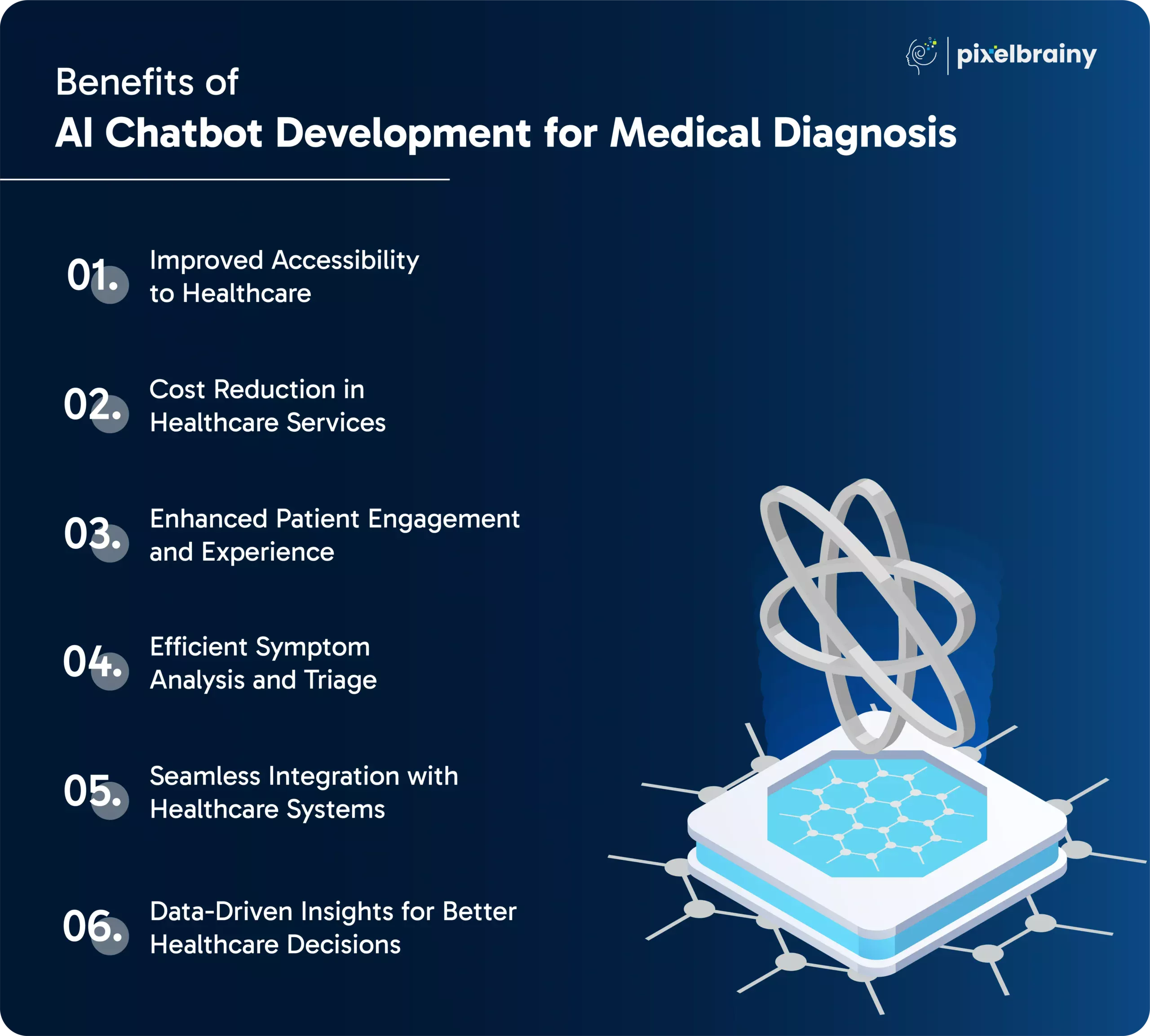
With an AI-powered virtual health assistant, patients no longer need to wait for long hours in clinics to get basic answers. Chatbots make healthcare guidance available anytime, anywhere, especially for those in remote areas. They help bridge the gap between patients and medical professionals, making healthcare more inclusive.
One of the major benefits of building AI chatbot for medical diagnosis is its ability to lower overall costs. By automating preliminary consultations and symptom checks, hospitals and clinics can save significant resources. This allows medical professionals to focus on critical cases.
An AI-powered chatbot for human-like customer support makes patients feel heard and valued. Chatbots provide empathetic responses, interactive interfaces, and continuous guidance that keeps patients engaged throughout their healthcare journey.
When you develop AI Medical Diagnostic AI chatbot, one of its core functions is symptom analysis. These chatbots can process patient-reported symptoms, compare them against medical databases, and guide users to the right care pathway.
Chatbots work as powerful AI healthcare solutions when connected to electronic health records and hospital systems. They allow easy sharing of patient data, ensuring that doctors have the right context before consultations.
One of the hidden strengths of AI Medical Diagnostic AI chatbot development is its ability to collect and analyze large amounts of patient data. This provides valuable insights into trends, risk factors, and overall patient health.
By embracing the advantages of AI Chatbot Development for Medical Diagnosis, healthcare providers can unlock a future where patient care is faster, smarter, and more accessible to everyone.
When it comes to AI Medical Diagnostic Chatbot Development, the foundation lies in its core features. These are the essential functions that ensure the chatbot provides accurate, secure, and seamless interactions with patients.
Whether you are building an AI chatbot for medical diagnosis or upgrading an existing solution, the following features are must-haves.
| Core Feature | Explanation |
| Symptom Checker | Allows patients to input symptoms and receive preliminary analysis. It guides users with possible conditions and next steps |
| Natural Language Processing (NLP) | Enables the chatbot to understand medical terms and human language, ensuring smooth, human-like communication |
| 24/7 Availability | Offers patients round-the-clock access to medical advice, making healthcare more accessible and patient-centric |
| Multi-Language Support | Expands accessibility by enabling patients to interact in their native language, crucial for global healthcare reach |
| EHR Integration | Connects with Electronic Health Records to provide doctors with structured, real-time patient data |
| Appointment Scheduling | Simplifies patient journeys by allowing users to book or reschedule doctor appointments directly through the chatbot |
| Secure Authentication | Protects sensitive patient data through HIPAA-compliant logins and encryption standards |
| User-Friendly Interface | Ensures simple navigation with intuitive design, making the chatbot easy for all age groups to use |
| Prescription Reminders | Helps patients follow treatment plans by sending notifications for medications and follow-ups |
| Data Analytics Dashboard | Provides doctors and administrators with valuable insights into patient data and usage trends |
These core features are the backbone of developing AI Medical Diagnostic Chatbots, ensuring both efficiency and trust in patient care.
As healthcare evolves, simply having a basic chatbot is not enough. To stand out, organizations must integrate advanced functionalities that bring intelligence, personalization, and future-readiness.
While AI Medical Diagnosis Chatbot Development starts with core features, these advanced capabilities take the experience to a whole new level.
| Advanced Feature | Explanation |
| Voice-Enabled Consultations | Allows patients to describe symptoms using voice, creating a natural and hands-free experience |
| Wearable Device Integration | Connects with smartwatches and fitness trackers to provide real-time health data such as heart rate or oxygen levels |
| AI-Driven Predictive Analytics | Uses big data and machine learning to forecast health risks and provide preventive recommendations |
| Telemedicine Integration | Enables instant connection with doctors through video consultations within the chatbot interface |
| Emotion and Sentiment Analysis | Detects patient emotions from text or voice to provide empathetic and personalized support |
| Personalized Health Plans | Generates tailored treatment and lifestyle recommendations based on patient history and current health |
| Blockchain for Data Security | Adds an extra layer of transparency and safety for storing and sharing sensitive medical information |
| Multimodal Interaction | Combines text, voice, and image recognition for richer, more intuitive medical consultations |
| AI-Powered Decision Support | Assists doctors by analyzing patient data and suggesting evidence-based treatment options |
| Integration with Insurance Systems | Simplifies claims by connecting with insurance providers for eligibility checks and policy details |
Incorporating these advanced features when you develop AI Medical Diagnostic AI chatbots transforms them into powerful, future-ready healthcare assistants.
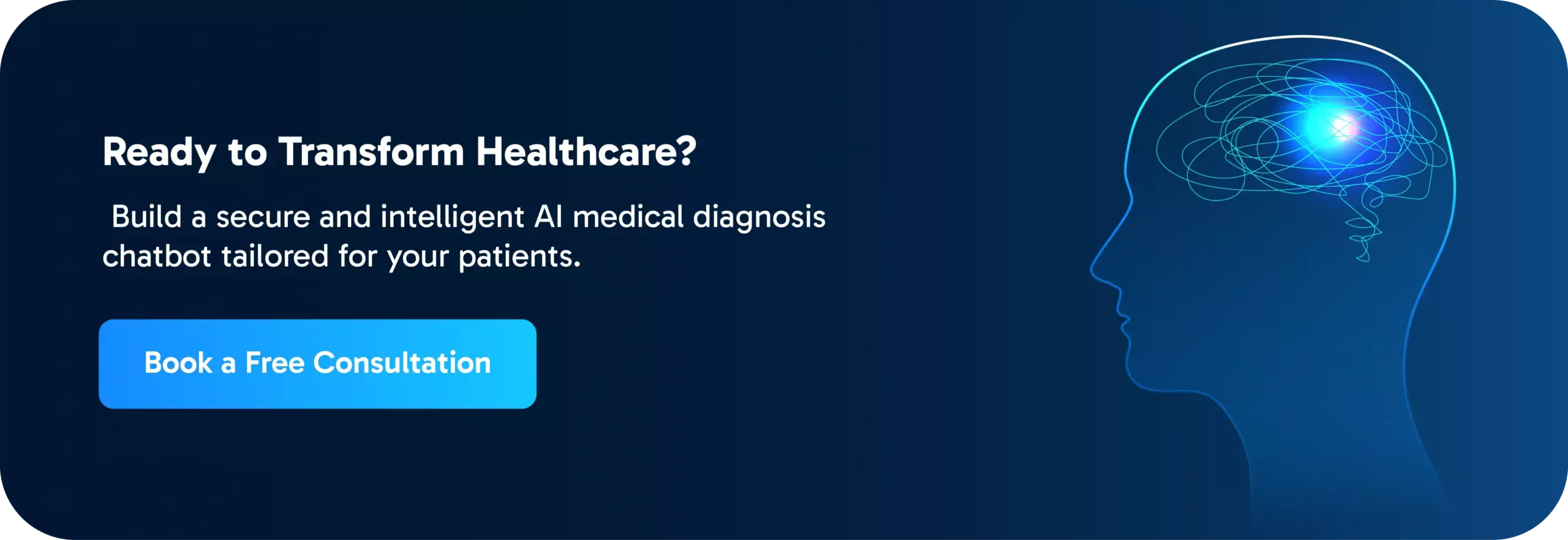
Creating an effective chatbot requires a structured roadmap. AI Medical Diagnostic AI chatbot development is not just about coding but also about aligning medical expertise, patient needs, and cutting-edge technology. Here’s a step-by-step guide on How to Develop AI Medical Diagnosis Chatbot that delivers value and reliability.
The first step in building AI chatbot for medical diagnosis is to clearly define the purpose. Decide whether the chatbot will be used for general symptom checking, specialized diagnosis (like dermatology or cardiology), or for patient triage. Defining the scope early helps avoid unnecessary complexities.
Goal/Aim: The aim here is to establish clarity on the chatbot’s role in the healthcare ecosystem. By setting the right objectives, you ensure that the chatbot provides real value to both patients and medical professionals while reducing redundant functionalities that may lead to confusion.
Before jumping into development, create a PoC (Proof of Concept). This involves gathering medical data, identifying target users, and validating whether the chatbot concept is feasible. It ensures that the idea aligns with healthcare standards and patient expectations.
Goal/Aim: The goal of this step is to minimize risks by testing feasibility early. A PoC allows developers and healthcare providers to validate assumptions, identify possible gaps in medical datasets, and refine workflows before investing heavily in full-scale development.
To test the advantages of AI Chatbot Development for Medical Diagnosis, build an MVP (Minimum Viable Product) with essential features such as symptom checking, basic NLP capabilities, and appointment scheduling. This allows quick feedback from users and helps refine the chatbot before scaling.
Goal/Aim: The aim is to validate usability and functionality in a real-world environment. By launching an MVP, you gather real patient feedback, which guides improvements. It also helps test whether the chatbot truly reduces workloads for healthcare professionals and improves patient satisfaction.
When you develop AI Medical Diagnostic AI chatbot, selecting the right frameworks and platforms is crucial. Use robust NLP engines, secure databases, and cloud hosting to ensure scalability. APIs for EHR integration, telemedicine, and wearable devices should also be included.
Goal/Aim: The main goal of this step is to lay a strong technical foundation. The right technology stack ensures that the chatbot is not only reliable but also flexible enough to adapt to future healthcare trends and integrate seamlessly with other medical systems.
The chatbot should mimic natural human interactions. Training the AI with large medical datasets ensures accuracy, while intuitive conversation design ensures patients feel supported. At this stage, compliance with healthcare regulations (HIPAA, GDPR) should also be prioritized.
Goal/Aim: The aim here is to make interactions empathetic, natural, and compliant. A well-trained chatbot increases user trust, while secure data handling ensures ethical use of sensitive health information. This balance of empathy and compliance makes the chatbot more patient-friendly.
Once the conversational workflows are designed, move toward building the first working prototype. Testing the chatbot with real users helps identify errors, assess diagnostic accuracy, and enhance user experience. This step is vital before creating a full-fledge chatbot for AI medical diagnosis.
Goal/Aim: The goal of this step is to ensure reliability and efficiency before scaling. Testing with real patients highlights gaps that simulations may not reveal, while doctor feedback ensures medical accuracy. This guarantees that the chatbot can perform effectively in real-world scenarios.
After successful testing, launch the chatbot with all required features. Continuous monitoring and updates are necessary to keep the chatbot relevant and reliable. Many healthcare providers partner with the top AI chatbot development companies in USA to ensure ongoing support and innovation.
Goal/Aim: The aim is long-term sustainability. Monitoring ensures that the chatbot evolves with medical knowledge, user expectations, and regulatory changes. Continuous improvement keeps the chatbot competitive and effective in delivering healthcare support.
The process to develop AI Medical Diagnostic AI chatbots requires careful planning, testing, and iteration. By following these steps, healthcare providers can build solutions that are scalable, trustworthy, and capable of transforming patient care for the future.
Also Read: AI Medical Diagnosis App Development: Features & Cost
One of the most common questions healthcare providers and startups ask is: what is the cost to build AI chatbot for Medical Diagnosis? The answer depends on complexity, features, integrations, and the technology stack used. The average AI Medical Diagnosis Chatbot Development cost typically ranges between $10,000 to $150,000+. While the lower range covers simple symptom checkers, more advanced solutions with predictive analytics, EHR integration, and telemedicine support require higher investments.
The following table breaks down the building cost of AI Medical Diagnosis Chatbot based on different levels:
| Type of Chatbot | Description | Estimated Cost |
| Basic AI Medical Diagnosis Chatbot | Includes simple features like symptom checking, basic NLP, and FAQ support. Suitable for clinics or startups validating their idea | $10,000 – $30,000 |
| Medium AI Medical Diagnosis Chatbot | Offers symptom analysis, EHR integration, appointment booking, and secure authentication. Balances cost and functionality for small to mid-sized hospitals | $35,000 – $80,000 |
| Advanced AI Medical Diagnosis Chatbot | A cost of developing AI Medical Diagnostic chatbot with telemedicine, wearable integration, predictive analytics, sentiment analysis, and multilingual support. Designed for enterprises aiming for scalability | $90,000 – $150,000+ |
The exact cost of making AI Medical Diagnosis Chatbot varies, but careful planning ensures you get the best value when investing in an AI medical diagnosis chatbot.
Also Read: AI Chatbot Development Cost: Factors and Examples
Developing a reliable AI Medical Diagnosis Chatbot requires the right combination of tools and technologies. Each layer, from the user interface to AI models and secure integrations, plays a crucial role in delivering accurate, compliant, and patient-friendly healthcare support.
| Parameter | Tools and Technologies | Explanation |
| Frontend (Web and Mobile) | React, Next.js, Vue, Angular, React Native, Flutter, Tailwind CSS | The frontend is your patient’s first touchpoint, so speed and clarity matter. Component libraries and responsive frameworks help you ship accessible, multilingual UIs that feel familiar and reduce cognitive load for anxious users |
| Backend and APIs | Node.js, Python FastAPI, Django, Go, GraphQL, REST | This is where session logic, user state, and clinical workflows live. A clean API layer lets you orchestrate conversations, route to services, and enforce rules without bloating the model with app concerns |
| NLP and NLU Engines | spaCy, Hugging Face Transformers, Rasa NLU, OpenAI API, Cohere, Google Dialogflow | Language understanding converts free-text into structured intents, entities, and clinical terms. Domain adaptation with medical ontologies improves recognition of symptom phrasing and abbreviations from real patients |
| ML and Reasoning Models | PyTorch, TensorFlow, Scikit-learn, Retrieval-Augmented Generation (RAG) pipelines | Core intelligence for triage, risk scoring, and follow-up planning. Blend classifiers with generative reasoning and guardrails so the bot explains next steps clearly and defers to humans for red-flag scenarios |
| Medical Knowledge and Ontologies | SNOMED CT, ICD-10, LOINC, UMLS Metathesaurus | Clinical vocabularies standardize symptoms, diagnoses, and labs. Mapping user phrases to codes enables safer suggestions, better analytics, and cleaner interoperability with EHR and billing systems |
| Vector and Search Layer | PostgreSQL pgvector, Pinecone, Weaviate, Milvus, Elastic | Semantic search retrieves guidelines and past encounters to ground responses. Hybrid keyword plus vector search raises recall and reduces hallucinations in clinical explanations |
| Primary Datastores | PostgreSQL, MySQL, MongoDB, Firestore | Store user profiles, consents, and audit trails with ACID reliability. Partition PHI, apply field-level encryption, and use role-based access for least-privilege operations |
| EHR and Health Integrations | FHIR APIs, HL7 v2, SMART on FHIR, Epic and Cerner app frameworks | Standards let you pull meds, allergies, and vitals securely. Writebacks require robust consent flows, sandbox testing, and clinical oversight before touching production charts |
| Telehealth and Comms | Twilio, Vonage, WebRTC, Zoom SDK, SendGrid, WhatsApp Business | Add live escalation to clinicians, OTPs, and reminders. Queue management with warm handoffs keeps the patient journey continuous when the bot reaches the edge of its scope |
| Voice and Speech | Web Speech API, Vosk, Whisper, Amazon Transcribe, Azure Speech | Voice removes friction for elderly or low-vision users. Pair accurate ASR with medical lexicons and on-device noise handling to reduce error rates in symptom narratives |
| Security and Compliance | OAuth 2.0, OpenID Connect, AES-256, TLS 1.2+, Vault, WAF, DLP tools | PHI requires end-to-end protection, least-privilege keys, and continuous monitoring. Map controls to HIPAA, SOC 2, and GDPR with clear audit evidence and incident playbooks |
| MLOps and CI/CD | MLflow, Weights & Biases, Kubeflow, Docker, Kubernetes, GitHub Actions | Version datasets and models, run bias checks, and track drift. Blue-green deploys with canaries protect patient safety while you iterate on quality |
| Observability and Quality | Prometheus, Grafana, OpenTelemetry, Sentry, Arize, WhyLabs | Measure response latency, containment rates, and handoff success. Analytics on false positives and red-flag catches keep the bot clinically cautious and useful |
| Content Guardrails | Prompt templates, policy checkers, regex filters, moderation APIs | Guardrails filter unsafe advice and trigger escalation. Pair automatic checks with simple explanations so users understand why a human review is needed |
| Cloud and Data Platforms | AWS (Bedrock, SageMaker), Google Cloud (Vertex AI), Azure (OpenAI, Health Data Services) | Managed AI and healthcare services speed compliant delivery. Use private networking, KMS, and region pinning to align with residency requirements |
| Testing and Validation | Synthetic user simulators, clinical gold sets, UX studies, red-team suites | Mix automated test runs with clinician review to verify accuracy and bedside manner. Validate across languages and reading levels to avoid silent failures |
With a thoughtful blend of these AI tools and technology, your AI Medical Diagnosis Chatbot can move from prototype to trusted clinical companion without compromising safety or speed.
When working on AI Medical Diagnosis Chatbot Development, technology alone cannot guarantee success. In healthcare, safety, privacy, and compliance are just as important as innovation.
Medical chatbots interact with sensitive patient data and provide health-related guidance, which makes regulatory and ethical considerations critical for both trust and legal protection. Below are the major areas to address:
Patient data is among the most sensitive types of information. Regulations such as HIPAA in the United States and GDPR in Europe require strict handling of personal health data.
Failing to secure this data not only risks fines but also erodes patient trust.
A chatbot should never replace a licensed physician but act as a supportive tool. Algorithms must be trained on validated medical datasets, and human-in-the-loop oversight should be in place for critical diagnoses. Safety nets are essential, such as escalation features that connect patients to doctors when high-risk conditions are detected.
To deploy chatbots legally, developers must align with regional healthcare frameworks:
Meeting these compliance standards prevents legal challenges and ensures smooth adoption.
Patients should always know they are interacting with an AI system, not a human doctor. Additionally, if the chatbot provides a diagnosis or recommendation, it must include clear reasoning or references. Explainable AI builds confidence and prevents misunderstandings that could harm patient health.
Beyond legal compliance, ethical considerations are equally important. Developers must avoid using patient data for unauthorized purposes like marketing. Consent must be explicit, and patients should have the right to opt out of data collection or request deletion of their records.
Medical chatbots must serve diverse populations. If the underlying data is biased toward certain age groups, ethnicities, or regions, the chatbot may deliver inaccurate diagnoses for others. Developers should actively work to minimize algorithmic bias by including diverse datasets and running fairness checks.
Who is responsible if the chatbot provides incorrect advice that harms a patient? Clear accountability policies must be defined. Healthcare providers and developers should outline liability in contracts and ensure that disclaimers are visible within the chatbot interface.
Regulatory and ethical considerations are not obstacles but enablers of trust. By prioritizing compliance, safety, and fairness in Medical Diagnosis AI Chatbot Development, organizations can build solutions that patients and healthcare providers rely on with confidence.
Also Read: AI Medication Assistant App Development: A Complete Guide
Developing an AI chatbot for medical diagnosis is one of the most promising innovations in digital healthcare, but it is also one of the most complex. Unlike chatbots used in retail or banking, a medical chatbot directly influences human health, which raises the bar for accuracy, compliance, and trust.
While the potential benefits are enormous, such as cost reduction, round-the-clock patient support, and improved triage, the journey comes with multiple challenges that cannot be ignored. Below, we explore the most pressing obstacles and practical strategies to overcome them.
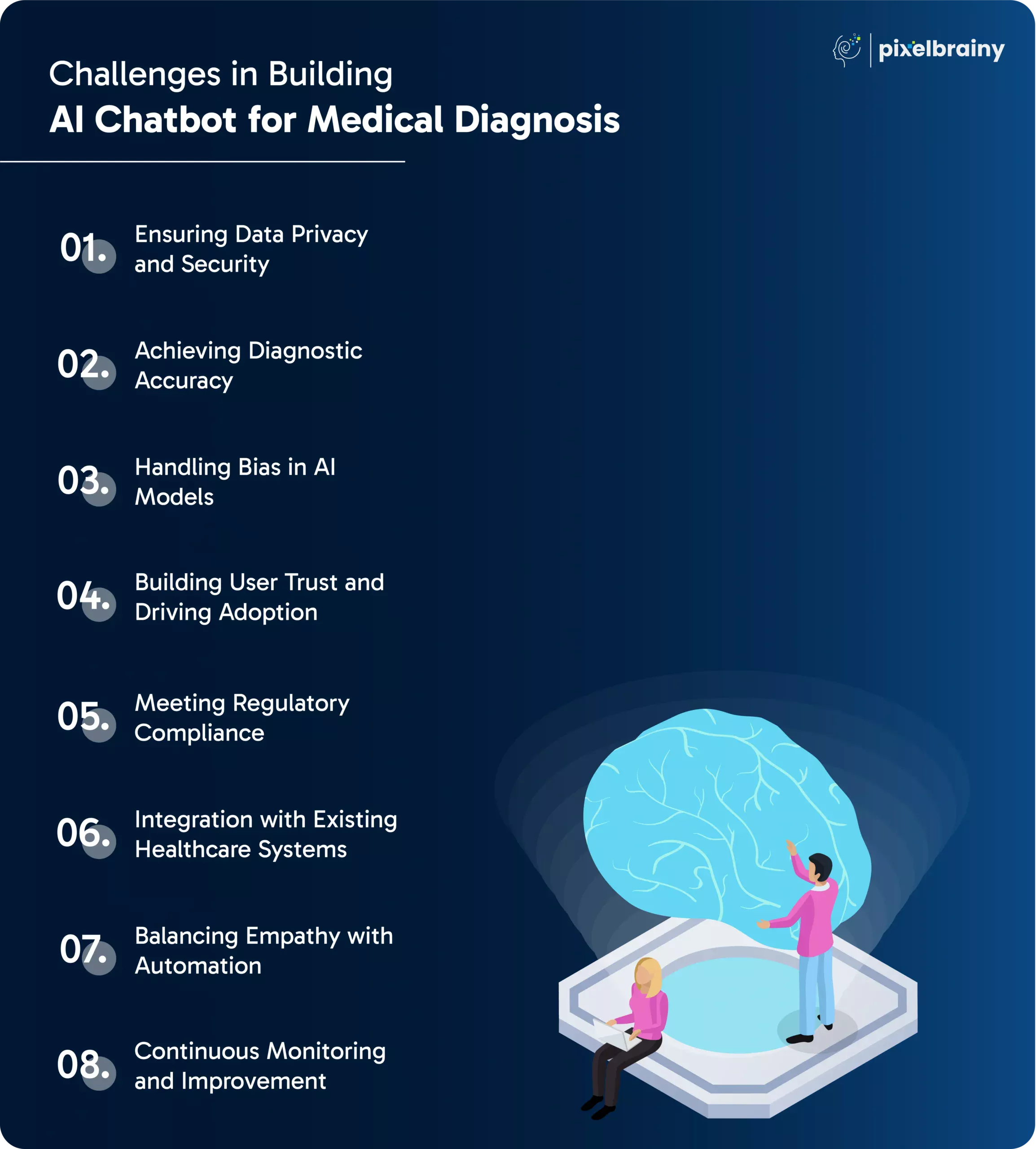
Challenge: AI medical chatbots process highly confidential health information, including personal details, symptoms, and diagnostic records. A single data breach could expose sensitive information, resulting in heavy regulatory fines and irreparable loss of patient trust.
Solution:
Challenge: Unlike general chatbots, medical bots cannot afford errors in interpretation. An inaccurate or incomplete diagnosis can create unnecessary anxiety for patients or even delay essential treatment.
Solution:
Challenge: AI systems often inherit biases from the datasets used to train them. If datasets are skewed toward certain demographics, the chatbot may underperform for underrepresented groups, leading to unequal access to care.
Solution:
Challenge: Patients may hesitate to trust an AI-driven system for something as serious as healthcare. Concerns about misdiagnosis, robotic interactions, or lack of empathy can slow down adoption.
Solution:
Challenge: Healthcare is one of the most heavily regulated industries, and rules vary widely across regions. A chatbot that complies in one country may face restrictions in another. Non-compliance can block deployment and damage reputation.
Solution:
Challenge: Hospitals and clinics often run on legacy infrastructure, making it difficult to integrate modern AI chatbots with existing Electronic Health Record (EHR) systems. Without integration, chatbots risk becoming standalone tools that add limited value.
Solution:
Challenge: Patients expect empathy and compassion when discussing health concerns. If the chatbot sounds overly robotic or dismissive, it can alienate users and reduce engagement.
Solution:
Challenge: Healthcare is an ever-evolving field, and a chatbot that is not updated regularly will quickly become outdated and less effective. Outdated medical information could misguide patients and harm credibility.
Solution:
The challenges in building AI chatbots for medical diagnosis may seem daunting, but they are also opportunities to strengthen the solution. By addressing these issues proactively through compliance, accuracy, empathy, and continuous improvement, healthcare providers can create chatbots that are both safe and transformative.
The healthcare industry is entering a new era where technology and medical care are more intertwined than ever. AI chatbot development for medical diagnosis is evolving rapidly, fueled by advances in artificial intelligence, data science, and digital health.
Looking ahead, several trends are shaping the future of medical chatbots and redefining how patients interact with healthcare systems.
Future diagnostic chatbots will no longer be limited to text-based conversations. They will incorporate voice recognition, video interactions, and image analysis, enabling patients to describe conditions more naturally. For instance, a patient could upload an image of a skin rash or share vital signs via video. This multimodal approach will not only improve accuracy but also bring the consultation experience closer to real doctor-patient interactions.
AI chatbots are moving from being reactive tools to becoming proactive healthcare partners. By analyzing past medical records, lifestyle habits, and real-time health data, they will predict potential illnesses before symptoms escalate. For example, they could warn a diabetic patient of rising sugar levels or suggest lifestyle changes to reduce cardiac risk. This shift will make preventive healthcare more accessible to patients everywhere.
The increasing adoption of wearables and smart medical devices opens new possibilities for chatbots. Imagine a chatbot that continuously receives heart rate, oxygen saturation, or sleep data from a smartwatch. With this information, it can provide personalized alerts, recommend immediate steps in emergencies, or even notify doctors when urgent intervention is required.
One of the most exciting trends is hyper-personalization. Instead of generic suggestions, chatbots will create unique care journeys tailored to each patient. Using machine learning and AI, they will adapt recommendations based on age, health history, genetic factors, and even user behavior. This will transform healthcare into a more engaging and effective one-to-one experience.
AI chatbots are not just for patients—they are also becoming assistants for healthcare professionals. By processing large volumes of patient data and medical literature, chatbots will help doctors with treatment suggestions, risk assessments, and diagnostic accuracy. This support reduces human error and allows professionals to focus more on patient care.
Security and trust are vital in healthcare. In the near future, blockchain technology will be used in chatbot ecosystems to securely store and share patient data. Blockchain ensures that records are tamper-proof and transparent, which increases patient trust and satisfies strict compliance requirements across different regions.
Advanced sentiment analysis and emotion recognition will allow medical chatbots to identify when patients are stressed, anxious, or confused. By detecting these emotional cues, the chatbot can adjust its tone, provide reassurance, or escalate the case to a human professional when emotional support is necessary. This makes the interaction more empathetic and human-like.
Healthcare challenges are global, and chatbots will increasingly adapt to serve multilingual and multicultural populations. They will provide localized advice, take into account regional health issues, and comply with country-specific healthcare regulations. This will make AI chatbots valuable tools for both developed and developing healthcare systems.
Looking further ahead, AI chatbots may evolve into autonomous health managers that handle chronic care management almost independently. They could schedule check-ups, monitor treatment progress, manage prescriptions, and coordinate with healthcare providers. Such autonomy will reduce strain on medical systems and empower patients to take better control of their health.
The future of AI medical diagnosis chatbots is moving toward smarter, more connected, and empathetic solutions. By adopting these trends early, healthcare providers can prepare for a system where AI becomes an indispensable partner in prevention, diagnosis, and continuous patient care.
After you have explored the benefits, features, costs, and challenges of chatbot development, now it is time to choose the perfect development partner who can bring your vision to life. PixelBrainy is recognized as a leading AI chatbot development company in USA, specializing in Medical Diagnostic AI Chatbot Development that blends innovation with compliance.
With a proven track record of helping healthcare providers create AI medical diagnosis chatbots, PixelBrainy ensures that your solution is not only technologically advanced but also trusted and patient-centric.
PixelBrainy recently completed a project for a major healthcare organization in the US market. The objective was to develop an AI medical diagnostic chatbot capable of handling thousands of patient interactions daily. The chatbot included symptom checking, EHR integration, appointment scheduling, and telemedicine support.
Impact delivered:
Although the client’s identity remains confidential, this project highlights PixelBrainy’s expertise in AI chatbot development for medical diagnostic solutions.
PixelBrainy’s unique approach to Medical Diagnostic AI Chatbot Development ensures superior quality and value. Some of the key differentiators include:
Choosing PixelBrainy means partnering with a team that understands the challenges of healthcare, masters the technology, and is committed to delivering innovative AI chatbots that redefine medical diagnosis and patient care.
The rise of intelligent healthcare technology is reshaping how patients connect with providers. Among these innovations, AI Medical Diagnostic AI chatbot development has proven to be one of the most impactful. By combining speed, accuracy, and accessibility, these chatbots empower patients while reducing the workload on doctors and healthcare staff.
Organizations exploring how to develop AI Medical Diagnosis Chatbot can unlock significant advantages, from improved patient engagement to cost savings. The success of building AI chatbot for medical diagnosis lies in careful planning, regulatory compliance, and choosing the right development partner.
Healthcare leaders who decide to develop AI Medical Diagnostic AI chatbot today are preparing their organizations for a smarter and more patient-centered future.
Ready to transform healthcare with innovation? Book an appointment with PixelBrainy today and take the first step toward building your medical diagnosis chatbot.
No. A chatbot can provide initial assessments, symptom checking, and guidance, but it is not a replacement for licensed medical professionals. It should be viewed as a supportive tool that improves efficiency and accessibility.
The development timeline depends on complexity. A basic version may take 2–3 months, while an advanced solution with integrations, predictive analytics, and compliance checks may take 6–9 months.
Yes, if the chatbot is built with strict compliance to frameworks like HIPAA and GDPR. Security features such as encryption and access control protect sensitive information.
Absolutely. Multilingual support is a core feature that ensures patients from diverse backgrounds can interact in their native language, improving accessibility and trust.
Most chatbots require internet connectivity for real-time AI processing and database access. However, limited offline functionality can be included for basic FAQs and symptom guidance.
Because adoption is growing rapidly. Early investment allows providers to gain a competitive edge, improve patient satisfaction, and streamline operations with AI-driven support.

About The Author
Sagar Bhatnagar
Sagar Sahay Bhatnagar brings over a decade of IT industry experience to his role as Marketing Head at PixelBrainy. He's known for his knack in devising creative marketing strategies that boost brand visibility and market influence. Sagar's strategic thinking, coupled with his innovative vision and focus on results, sets him apart. His track record of successful campaigns proves his ability to utilize digital platforms effectively for impactful marketing efforts. With a genuine passion for both technology and marketing, Sagar continuously pushes PixelBrainy's marketing initiatives to greater success.

Working with the PixelBrainy team has been a highly positive experience. They understand the design requirements and create beautiful UX elements to meet the application needs. The dev team did an excellent job bringing my vision to life. We discussed usability and flow. Sagar worked with his team to design the database and begin coding. Working with Sagar was easy. He has the knowledge to create robust apps, including multi-language support, Google and Apple ID login options, Ad-enabled integrations, Stripe payment processing, and a Web Admin site for maintaining support data. I'm extremely satisfied with the services provided, the quality of the final product, and the professionalism of the entire process. I highly recommend them for Android and iOS Mobile Application Design and Development.

Great experience working with them. Had a lot of feedback and I found that unlike most contractors they were bugging me for updates instead of the other way around. They were extremely time conscience and great at communicating! All work was done extremely high quality and if not on time, early! They were always proactive when it comes to communication and the work is great/above par always. Very flexible and a great team to work with! Goes above and beyond to present us with multiple options and always provides quality. Amazing work per usual with Chitra. If you have UI/UX or branding design needs I recommend you go to them! Will likely work with them in the future as well, definitely recommended!

PixelBrainy is a joy to work with and is a great partner when thinking through branding, logo, and website layout. I appreciate that they spend time going into the "why" behind their decisions to help inform me and others about industry best practices and their expertise.

I hired them to design our software apps. Things I really like about them are excellent communication skills, they answer all project suggestions and collaborate right away, and their input on design and colors is amazing. This project was complex and needed patience and creativity. The team is amazing to do business with. I will be using them long-term. Glad to see there are some good people out there. I was afraid to try and outsource my project to someone but I am glad I met them! I really can't say enough. They went above and beyond on this project. I am very happy with everything they have done to make my business stand out from the competition.

It was great working with PixelBrainy and the team. They were very responsive and really owned the project. We'll definitely work with them again!

I recently worked with the PixelBrainy team on a project and I was blown away by their communication skills. They were prompt, clear, and articulate in all of our interactions. They listened and provided valuable feedback and suggestions to help make the project a success. They also kept me updated throughout the entire process, which made the experience stress-free and enjoyable.

PixelBrainy is very good at what it does. The team also presents themselves very professionally and takes care of their side of things very well. I could fully trust them taking up the design work in a timely and organised manner and their attention to detail saved us lots of effort and time. This particular project was quite intense and the team showed that they function very well under pressure. Very much looking forward to working with her again!

It's always an absolute pleasure working with them. They completed all of my requests quickly and followed every note I had for them to a T, which made our process go smoothly from start to finish. Everything was completed fast and following all of the guidelines. And I would recommend their services to anyone. If you need any design work done in the future, PixelBrainy should be your first call!

They took ownership of our requirements and designed and proposed multiple beautiful variants. The team is self-motivated, requires minimum supervision, committed to see-through designs with quality and delivering them on time. We would definitely love to work with PixelBrainy again when we have any requirements.

PixelBrainy was a big help with our SaaS application. We've been hard at work with a new UI/UX and they provided a lot of help with the designs. If you're looking for assistance with your website, software, or mobile application designs, PixelBrainy and the team is a great recommendation.

PixelBrainy designers are amazing. They are responsive, talented, and always willing to help craft the design until it matches your vision. I would recommend them and plan to continue them for my future projects and more!!!

They were awesome! Did a good job fast, and good communication. Will work with them again. Thank you

Creative, detail-oriented, and talented designers who take direction well and implement changes quickly and accurately. They consistently over-delivered for us.

PixelBrainy team is very talented and creative. Great designers and a pleasure to work with. PixelBrainy is an excellent communicator and I look forward to working with them again.

PixelBrainy has a very talented design team. Their work is excellent and they are very responsive. I enjoy working with them and hope to continue on all of our future projects.


Transform your ideas into reality with us.
Across these industries, each engagement brings unique challenges, from early-stage product development to scaling complex systems, helping us build a practical understanding of real-world product environments.