AI Summary Powered by PixelBrainy
Can a healthcare web application deliver meaningful therapy without requiring patients and therapists to be online at the same time? For digital health startups exploring asynchronous care, the answer is increasingly relevant as healthcare delivery moves toward more flexible, patient-centered digital experiences.
Healthcare web app development has evolved beyond appointment booking and basic patient portals. Modern healthcare web application development can support secure patient-provider communication, electronic health records, appointment management, remote care, digital therapeutics, health monitoring, and asynchronous telehealth workflows. For startups and healthcare providers, web applications can create accessible care experiences while allowing clinical teams to manage digital interactions through structured workflows.
The market opportunity also reflects this broader shift. According to the latest Grand View Research digital health market report, the global digital health market is estimated at $420.2 billion in 2026 and is projected to reach $1.83 trillion by 2033, growing at a 23.4% CAGR from 2026 to 2033. The report also identifies telehealthcare as the leading technology segment, accounting for 44.7% of the market in 2025.
This growth creates opportunities for businesses considering healthcare web app development for specialized care models. One example is a platform where patients communicate with licensed therapists through structured, text-based asynchronous messaging instead of scheduled video sessions.
For a digital health startup, however, the challenge extends beyond creating a messaging interface. HIPAA compliant healthcare web application development requires careful consideration of protected health information, authentication, encryption, auditability, clinical workflows, consent, data retention, and access controls. A text-based therapy platform also needs a clear clinical content liability architecture that defines how therapist responses, patient messages, escalation protocols, and platform responsibilities are managed.
If you are evaluating healthcare web app development in 2026, the right development partner should also understand asynchronous telehealth architecture, mental health workflows, healthcare security, and regulatory requirements.
This guide explores the features, development process, technology stack, costs, challenges, compliance requirements, and best practices involved in creating a modern healthcare web application, with particular attention to asynchronous digital care.
For startups planning asynchronous telehealth web application development, the right architecture can turn structured patient-provider communication into a scalable and secure digital care experience.

A healthcare web application is a browser-based digital solution designed to deliver, manage, and coordinate healthcare services through a secure online environment. Unlike a basic healthcare website, a web application provides interactive functionality for patients, healthcare professionals, administrators, and other stakeholders.
Depending on its purpose, a healthcare web app can support:
Modern healthcare web applications can also connect with EHR systems, AI tools, IoT-enabled medical devices, payment systems, and third-party healthcare platforms through secure APIs and interoperability technologies.
For a text-based asynchronous therapy platform, for example, the application could allow patients to submit structured messages to licensed therapists, enable therapists to review and respond according to defined clinical workflows, and maintain secure records of the communication.
Because healthcare applications handle sensitive patient information, HIPAA compliance, authentication, authorization, encryption, audit logging, data privacy, and secure data exchange should be considered core requirements rather than optional additions.
Healthcare web application development is the process of creating secure, scalable, and user-focused browser-based applications that address specific healthcare workflows and service requirements.
The development approach varies according to the application's purpose, users, integrations, and regulatory requirements. A patient engagement platform, telehealth application, healthcare management system, and asynchronous therapy platform will each require different functionality and architecture.
At a high level, healthcare web app development focuses on:
The specific development process, technology stack, features, timeline, and cost depend on the type of healthcare web application being created. These considerations require a dedicated development approach, which we will explore in the following sections.
When healthcare organizations and digital health startups consider healthcare web application development, the opportunity goes beyond putting existing healthcare services online. A well-designed web application can support patient engagement, provider workflows, telehealth, asynchronous care, secure communication, health data management, and specialized digital healthcare services.
The latest 2026 market outlook shows strong momentum across the technologies that support modern healthcare web app development:
The Business Research Company estimates that the global digital health market will grow from $318.01 billion in 2025 to $371.59 billion in 2026, with the market projected to reach $664.65 billion by 2030, representing a 15.6% CAGR from 2026 to 2030. The forecast highlights AI-enabled care, virtual healthcare, remote monitoring, and patient-centric digital platforms as important growth areas.
The latest 2026 Telehealth Market report from The Business Research Company estimates the market at $284.99 billion in 2026 and projects it to reach $680.56 billion by 2030, growing at a 24.3% CAGR from 2026 to 2030. The market includes software, cloud-based delivery, web technologies, and multiple healthcare applications, including mental health care.
Grand View Research estimates the global healthcare cloud infrastructure market at $104.5 billion in 2026, with a projection of $193.4 billion by 2030 at a 16.7% CAGR from 2025 to 2030. This growth supports the increasing need for scalable infrastructure for healthcare applications, data management, and connected digital services.
These trends make healthcare web application development a strategic opportunity for businesses building specialized digital care experiences. For example, a digital health startup could create a HIPAA-compliant web application that enables patients to communicate with licensed therapists through structured asynchronous messaging instead of requiring scheduled video appointments.
However, the investment decision should not be based on market growth alone. Businesses should evaluate HIPAA compliance, healthcare integrations, clinical workflows, data security, interoperability, scalability, user experience, and long-term maintenance requirements before starting development.
For startups exploring healthcare web application development in 2026, the strongest opportunity lies in solving a clearly defined healthcare problem with a secure, accessible, and scalable digital experience.
The right healthcare web application can turn a specialized care model into a scalable digital service while improving accessibility, operational efficiency, and patient engagement.
Custom healthcare web application development can create value for both healthcare providers and patients by making essential services more accessible, connected, and efficient. Instead of relying on disconnected systems or manual processes, a well-designed healthcare web application can bring communication, patient information, scheduling, telehealth, and care workflows into a secure digital environment.
For healthcare organizations, the benefits extend beyond operational efficiency. For patients, web-based healthcare platforms can make it easier to access services, communicate with providers, manage appointments, and participate in their care.
A common buyer question is: “We want to build a healthcare web app that improves access to care without increasing the workload for our providers. Which benefits and workflows should we prioritize?” The answer depends on the application's target users and care model, but the following benefits are particularly relevant.
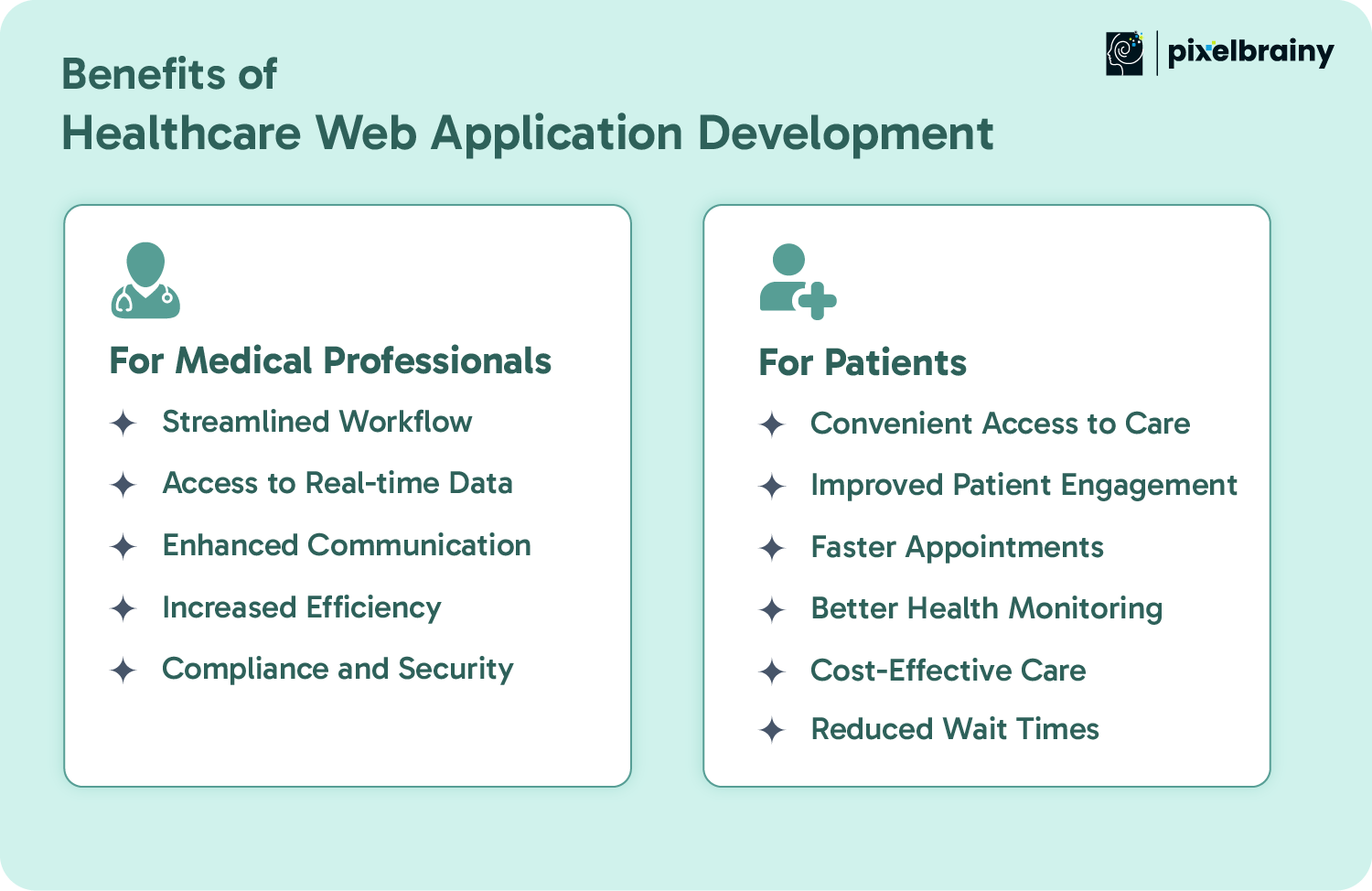
The value of healthcare web application development lies in creating a connected digital experience that improves accessibility for patients while helping healthcare professionals manage care more efficiently. The right benefits depend on the application's users, clinical workflows, and healthcare use case, which makes defining the product's core objectives an important step before development.
In the next section, we will explore the essential features to consider when you build a healthcare web app.
A successful healthcare web application needs features that address real patient and provider workflows rather than simply replicating a traditional website. When you build a healthcare web app, functionality should be planned around accessibility, secure communication, clinical workflows, patient engagement, healthcare integrations, and administrative efficiency.
For businesses planning healthcare web application development, the right feature set will depend on the application's purpose. A telemedicine platform may prioritize video consultations and scheduling, while an asynchronous therapy application may require structured messaging, therapist workflows, clinical documentation, and secure patient communication.
A practical buyer query is: “We want to build a healthcare web app for patients and healthcare providers, but we need to know which features are essential for the first version and which can be added later without making the platform difficult to scale.”
| Feature | Description |
| Patient registration and profile management | Allows patients to create accounts, handle personal details, and update medical history. |
| Appointment scheduling and reminders | Enables patients to seamlessly book appointments online, get reminders, and manage their schedules. |
| Electronic Health Records (EHR) integration | Facilitates seamless integration and easy management of patient medical records. |
| Telemedicine and video consultation | Allows remote consultations between healthcare providers and patients. |
| Secure login and authentication | Enables secure access to patient data and safeguards sensitive information. |
| Payment gateway integration | Allows secure online payments for consultations and other healthcare services. |
| Prescription management | Facilitates electronic prescription management, incorporating refills and reminders. |
| Lab test booking and results tracking | Ease patients to book lab tests online and access results securely. |
| Doctor and clinic search functionality | Helps patients find and connect with apt healthcare providers. |
| Real-time notifications and alerts | Sends timely notifications for online appointments, test results, and other essential updates. |
| Health tracking and fitness monitoring | Lets patients track health data, target fitness goals, and monitor their progress. |
| Multi-language support | Meets the needs of a diverse patient population by offering support in multiple languages. |
| Healthcare compliance and regulation adherence | Ensures compliance with applicable healthcare regulations and data privacy standards. |
| Feedback and review system | Allows patients to provide feedback and ratings for their experience with doctors and clinics. |
| Admin dashboard for managing operations | Offers healthcare providers and administrators tools to track patient data, manage appointments, and analyze operational performance. |
The right features can make healthcare web app development more useful, secure, and scalable for both patients and healthcare professionals. Businesses should prioritize features according to their specific care model and launch objectives, then expand functionality as user needs and operational requirements evolve.
Next, we will explore the advanced features that can take a healthcare web application beyond its core functionality.
Once the core functionality is in place, advanced capabilities can make a healthcare web application more intelligent, connected, and responsive to evolving patient and provider needs. These features can help organizations automate selected workflows, generate actionable insights, improve remote care, and create more personalized digital healthcare experiences.
However, advanced functionality should be aligned with the application's actual use case. A digital health platform does not need every emerging technology at launch. For example, a text-based asynchronous therapy platform may benefit more from AI-assisted clinical workflows, intelligent message triage, personalized dashboards, and remote monitoring than from VR-based telemedicine.
A practical buyer query is: “We already have the core features for our healthcare web application. Which advanced technologies should we add to improve patient engagement and provider efficiency without increasing clinical, security, or compliance risks?”
| Feature | Description |
| Artificial Intelligence-powered health recommendations | Deliver personalized health advice and risk assessments. |
| Blockchain for secure patient data management | Ensures safe and tamper-proof storage and sharing of patient data. |
| Predictive analytics for disease prevention | Identifies possible health risks and anticipates future health outcomes. |
| Remote patient monitoring integration | Allows remote monitoring of patient health data, like critical signs and medication adherence. |
| Wearable device connectivity | Integrates with wearable devices to gather and analyze patient health data. |
| AI-powered chatbots for 24/7 support | Offers patients with rapid access to details and support via AI-powered chatbots. |
| Virtual Reality for telemedicine and training | Improves telemedicine experiences and offers immersive training simulations for healthcare providers. |
| Real-time collaboration tools for medical teams | Promotes seamless collaboration and communication among healthcare providers. |
| Voice recognition for dictating notes and reports | Lets healthcare providers efficiently document patient issues. |
| Advanced data encryption techniques | Ensures the top level of security for sensitive patient details. |
| Integration with pharmacy systems for medication tracking | Eases medication management and ensures medication adherence. |
| Customizable health plans for patients | Facilitates patients to create and personalize their health plans. |
| IoT integration for smart healthcare devices | Seamlessly integrates with smart home devices and other IoT devices to build a connected healthcare ecosystem. |
| Personalized dashboards for patients and doctors | Offers customized dashboards with related information and insights. |
| Geolocation-based services for nearby healthcare providers | Assists patients locate nearby healthcare providers and emergency services. |
Advanced technologies can extend healthcare web app development beyond basic digital services by enabling smarter workflows, connected care, personalization, and data-driven decision-making. The best approach is to prioritize features according to the application's purpose, users, regulatory requirements, and measurable business or clinical outcomes.
With the right advanced features and architecture, your healthcare web application can evolve from a digital service into a scalable platform built around smarter and more connected healthcare delivery.
A successful healthcare web application starts with a clear understanding of the healthcare problem, target users, technical requirements, and regulatory environment. Whether you are a healthcare provider modernizing existing workflows or a startup creating a new digital care model, a structured approach can reduce development risks and improve security, usability, and scalability.
A common buyer query is: “We have a healthcare web app idea, but how do we validate the concept, handle HIPAA requirements, integrate with healthcare systems, and launch without overspending on unnecessary features?”
The following steps to build a healthcare web application from idea to launch provide a practical roadmap for planning, designing, developing, testing, and deploying a healthcare web solution.
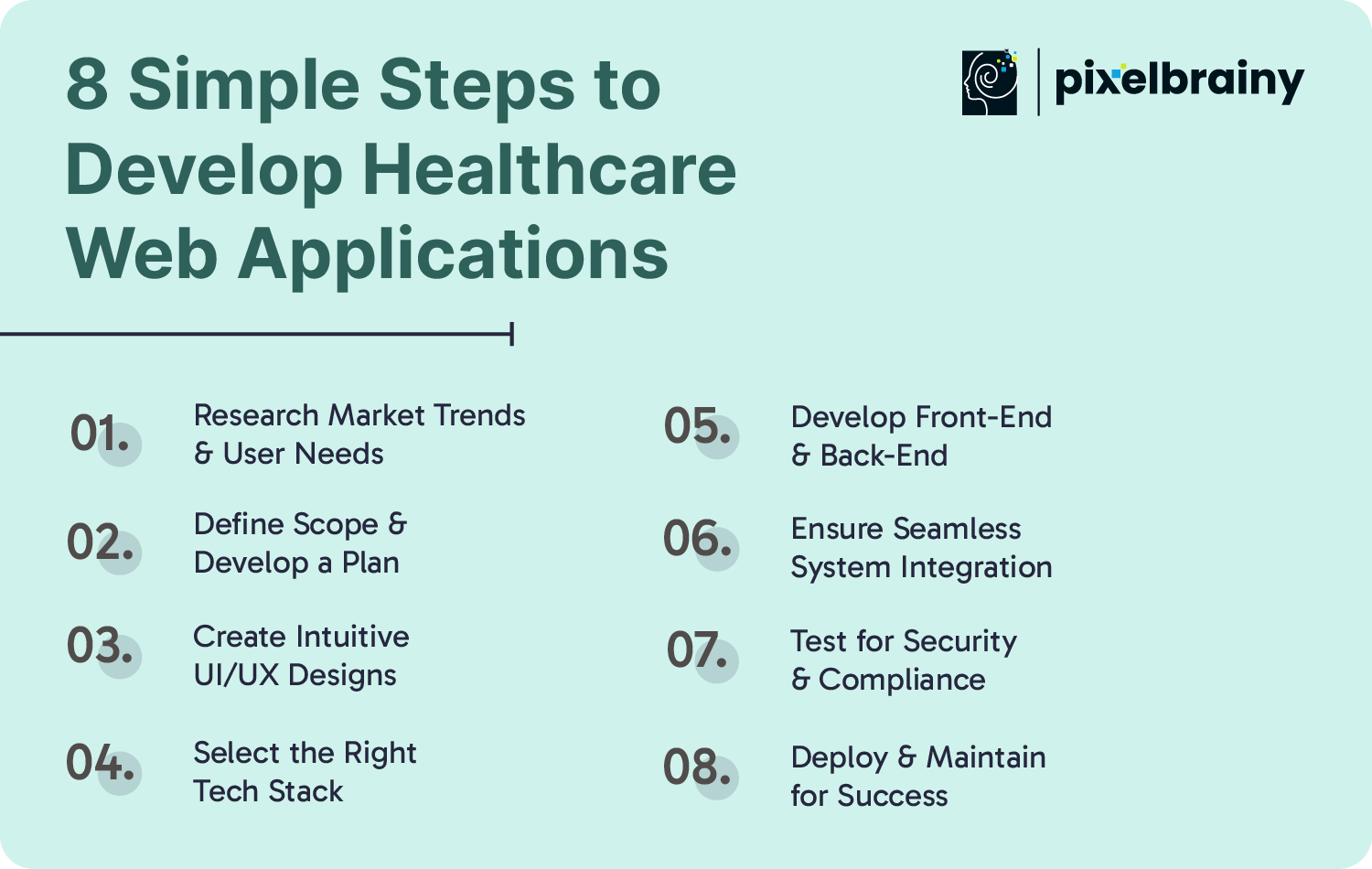
The first step in healthcare web application development is understanding the problem your application needs to solve. Research your target users, competitors, existing solutions, healthcare workflows, and market expectations.
Identify whether the primary users will be patients, physicians, therapists, administrators, or multiple stakeholder groups. For healthcare startups, this stage should also validate whether the proposed solution addresses a genuine market need.
Document functional requirements, user journeys, integrations, security expectations, and applicable regulations. For example, an asynchronous therapy platform would need to define patient messaging, therapist response workflows, consent, escalation procedures, and communication records before development begins.
Once the requirements are understood, establish a realistic scope for the development process of a healthcare web application. Separate essential launch functionality from features that can be introduced later.
Define project objectives, user roles, technical requirements, integrations, security controls, milestones, resources, and estimated costs. This is particularly important for healthcare web application development for healthcare startups, where uncontrolled scope can increase development time and investment.
Establish measurable success criteria for the initial release. Also document assumptions, dependencies, and potential risks so that everyone involved has a shared understanding of the project.
Healthcare applications serve users with different levels of technical familiarity, so usability should remain a central consideration. Create user flows, wireframes, prototypes, and interface designs that make important actions easy to understand.
Patients should be able to navigate healthcare services without unnecessary complexity, while providers should have efficient access to the information required for their workflows.
Focus on accessibility, responsive layouts, readable content, clear navigation, and appropriate error handling. Working with a specialized UI/UX design company can also help validate important user journeys before significant development resources are committed.
The technology architecture directly affects the application's security, performance, scalability, integration capabilities, and maintenance requirements. Select frontend and backend technologies that can support the expected users, workflows, and data requirements.
Consider cloud infrastructure, databases, APIs, authentication, encryption, monitoring, and interoperability requirements. If the application may later incorporate AI, IoT, remote monitoring, or analytics, the architecture should allow these capabilities to be added without extensive redevelopment.
Technology decisions should also account for long-term maintenance, developer availability, integration requirements, and applicable healthcare security standards.
With the architecture and design established, development can begin across the frontend and backend layers. The frontend should provide a responsive, accessible, and intuitive experience for each user role.
The backend manages business logic, databases, authentication, APIs, permissions, and data processing. For healthcare applications, backend architecture requires particular attention because sensitive information may be processed across multiple workflows.
Implement secure coding practices, validation, access controls, error handling, logging, and appropriate data protection mechanisms. Iterative development also helps teams identify technical issues early and validate functionality before completing the entire application.
Healthcare applications often need to communicate with systems outside the application itself. Depending on the use case, integrations may include EHR platforms, laboratories, pharmacies, payment providers, identity services, communication platforms, medical devices, or other healthcare applications.
APIs and interoperability standards can facilitate secure data exchange between these systems. During healthcare web application development, each integration should be assessed for authentication, data mapping, error handling, permissions, security, and reliability.
For startups, PoC development can help validate complex integrations before committing significant resources to the complete product.
Testing should cover more than whether individual features work correctly. Conduct functional, integration, usability, performance, compatibility, and security testing across the application.
Healthcare solutions should also undergo appropriate compliance and privacy assessments based on their data, users, and operating environment. Test authentication, authorization, encryption, audit logging, API security, data handling, and failure scenarios.
For applications involving clinical communication, validate workflows such as patient escalation, provider responses, notifications, and record retention. Early testing helps reduce the risk of security, usability, and performance problems after launch.
After testing and required validation are complete, deploy the application to its production environment using a controlled release process. Monitor application performance, infrastructure health, security events, integrations, and user activity after launch.
Collect feedback from patients, healthcare professionals, and administrators to identify areas for improvement. Ongoing maintenance may include security updates, bug fixes, infrastructure optimization, regulatory changes, integration updates, and new functionality.
For a growing product, MVP development should be treated as the beginning of product evolution rather than the final destination. Continuous improvements can help the application remain secure, useful, scalable, and aligned with changing healthcare requirements.
A structured development roadmap helps turn a healthcare web application idea into a secure, scalable, and user-focused digital healthcare product from concept to launch.
Healthcare web application development involves more than creating functional interfaces and connecting healthcare services. Businesses must also address regulatory requirements, sensitive patient information, complex integrations, usability expectations, and long-term development costs.
A common buyer query is: “We already have an existing healthcare infrastructure, but we are concerned about HIPAA compliance, EHR integration, cybersecurity, user adoption, and unexpected development costs. What challenges should we prepare for before starting our healthcare web application project?”
For organizations planning to develop a healthcare web app, identifying these risks early can help prevent expensive rework and improve the application's security, reliability, scalability, and user experience. The following are some of the most common challenges and practical approaches to addressing them.
Budget debates should comply with strict regulations, such as the GDPR (General Data Protection Regulation) in Europe and the HIPAA (Health Insurance Portability and Accountability Act) in the U.S., which supervises patient data handling. Non-compliance may result in high penalties and damage to a business's reputation.
Solution: You should engage with legal and compliance professionals in the development process to ensure that every aspect of the application adheres to the applicable regulations. Implement features like secure authentication, encrypted data storage, and audit trails for compliance maintenance.
With the increasing number of cyber attacks targeting healthcare systems, safeguarding patient data is the priority. The breaches can result in financial fraud, identity theft, and loss of trust.
Solution: Businesses should remember to leverage the power of end-to-end encryption, multi-factor authentication, and secure coding practices to ensure that data is safe at every level. We currently perform security audits and penetration tests to recognize and locate vulnerabilities before they start affecting us.
Healthcare organizations usually rely on legacy systems like Electronic Health Records (EHR) and hospital databases, which may demand extra efforts to seamlessly integrate with the latest web applications. This may cause inefficiencies and hinder data exchange.
Solution: Implement middleware or APIs that facilitate smooth integration with legacy systems. Collaborate with the development teams handling such legacy systems to ensure seamless data synchronization and compatibility. A progressive approach to integration may also ease the management of potential disruptions.
Custom healthcare web application development should consider incorporating advanced functionalities like appointment scheduling, telemedicine, and patient data management while ensuring that they stay user-friendly, specifically for elderly patients who don’t have technical backgrounds.
Solution: Aim to follow intuitive design principles, which ensure that the interface is simple, clean, and easy to navigate. User testing with healthcare professionals and real patients can provide useful insights into usability and pinpoints, assisting developers in fine-tuning the app design.
Developing and maintaining a healthcare web app can be costly because of the complex requirements, the need for constant updates, and seamless integration with multiple third-party services.
Solution: Go for an agile development approach to break the project into easily manageable phases, facilitating flexibility and cost control in the development process. Also, using cloud infrastructure and third-party healthcare APIs, you can diminish costs by eliminating the requirement for developing everything from scratch.
Addressing these challenges early can make healthcare web application development more predictable and sustainable. Strong security, regulatory planning, reliable healthcare integrations, intuitive UX, and disciplined cost management can help businesses create applications that users can trust and healthcare organizations can scale.
Understanding these challenges upfront helps you plan the right technology, resources, and budget before taking your healthcare web application from concept to launch.
The cost of healthcare web application development can vary significantly depending on the application's purpose, complexity, features, integrations, security requirements, and development team. A basic healthcare portal may require a considerably smaller investment than an enterprise platform supporting telemedicine, EHR integration, complex patient workflows, and multiple user roles.
A common buyer query is: “We are planning to launch a healthcare web application, but our requirements include HIPAA compliance, EHR integration, secure patient communication, and scalable cloud infrastructure. How much should we budget for development, and which factors could increase the final cost?”
The actual development budget should therefore be established after defining the product scope and technical requirements rather than relying on a single fixed price. For an initial estimate, healthcare web application projects can range from $20,000 to $200,000 or more, depending on the scope and complexity.
Healthcare application development costs may vary based on several factors, including the application's design, features, technology stack, development team location, security and compliance requirements, integrations, and long-term infrastructure needs.
In this section, we will examine the major factors that influence healthcare web app development cost, provide an estimated cost breakdown for different application types, and highlight additional expenses businesses should consider when preparing their development budget.
1. Design and Features: This factor directly impacts the cost as the more complex the design and the increased number of features and functionalities you choose for your app, the higher the development cost will be.
2. Technology Stack: If you choose complex technologies for your application development, it will demand a higher skill set, tools, maintenance needs, and more. This will impact the overall development cost and time needed to hire developers with the required expertise.
3. Development Team and Location: your team's geographical location and size drastically affect the overall project cost because of the differences in market rates and living standards across countries.
4. Security and Compliance: the more complex the regulations and systems your application development demands, the higher the cost of maintaining and attaining them.
5. Integration with Third-party Systems: Integrating third-party systems with your app, data mapping complexity, API fees, development effort, etc., increases the cost.
The cost of developing a healthcare web application may vary depending on the project scope. Here, we will know the approximate breakdown for varied types of applications.
| Type of Application | Estimated Cost |
| Basic Healthcare Web App | $20,000 - $50,000 |
| Advanced Healthcare Web App, including Telemedicine Integration | $50,000 - $150,000 |
| Enterprise-level Healthcare Application | $150,000 - $200,000+ |
Besides the primary development costs, some additional expenses that can impact the general cost of a healthcare web application are:
While you create a budget for healthcare web app development, consider these parameters and additional expenses to avoid issues interfering with the development journey.
Now you know the cost of healthcare app development. In the next section, let's move ahead to learn the timeline required for healthcare web app development.
The healthcare web application development timeline depends on the application's scope, number of features, integrations, security requirements, compliance needs, and overall technical complexity. A basic healthcare portal can move from planning to launch faster than an enterprise platform that requires EHR integration, telemedicine, complex workflows, and extensive security testing.
A common buyer query is: “We want to launch a healthcare web application with patient management, secure communication, EHR integration, and HIPAA requirements. How many weeks should we realistically plan for development, testing, and deployment?”
While every project requires its own estimation, the following timeline provides a practical starting point for planning:
| Phase | Estimated Duration (weeks) |
| Discovery & Planning (1-2 weeks) | 1-2 |
| Development (8-20 weeks) | 8-20 |
| Testing & Deployment (2-4 weeks) | 2-4 |
| Launch & Maintenance (Continuing) | Ongoing |
These are general estimates rather than fixed deadlines. The actual healthcare web app development timeline can change based on the project's feature set, design complexity, third-party integrations, compliance requirements, feedback cycles, development team size, and technical architecture.
A realistic timeline should be established after reviewing the complete project scope, technical requirements, integrations, and compliance expectations. Sharing detailed requirements with an experienced healthcare web application development team can help you create a more accurate schedule, allocate resources effectively, and reduce unexpected delays during development.
With the right planning and phased execution, businesses can move from healthcare web application concept to a secure, production-ready platform with greater timeline predictability.
The healthcare market includes a wide range of successful web and digital health platforms that address different needs, from virtual consultations and appointment booking to medication management, wearable-based health tracking, and patient access to medical records. These platforms demonstrate how healthcare web applications can solve specific user problems while supporting more convenient, connected, and patient-centric healthcare experiences.
For businesses planning healthcare web application development, studying established platforms can provide useful insights into feature prioritization, user experience, healthcare workflows, patient engagement, and service delivery models. The following five examples represent different approaches to building digital healthcare solutions.
One of the top healthcare web applications, Teladoc, offers round-the-clock access to therapists, doctors, and other healthcare providers via video or phone consultations. This service is beneficial specifically for mental health support, non-emergency medical issues, and health coaching.
Top Features of Teladoc:
Zocdoc is a popular healthcare web platform that helps patients find and book appointments with healthcare professionals across multiple specialties. Besides, it offers real-time availability, insurance information, and patient reviews, easing the appointment scheduling process for the users.
Top Features of Zocdoc:
Medisafe is a widely known medication management application that assists users in tracking their prescriptions, receiving alerts, and setting reminders about potential drug interactions. Also, it focuses on improving patient safety and medication adherence.
Top Features of Medisafe:
A widely known product, Fitbit, provides wearable devices and a companion application that assists users in tracking their physical activity, sleep patterns, heart rate, and more. It encourages users to maintain an active lifestyle perfectly and offers valuable insights into their health metrics.
Top Features of Fitbit:
MyChart is a most sought-after patient portal that facilitates individuals accessing their medical records easily, requesting prescription refills, scheduling appointments, and seamlessly communicating with their healthcare providers. Additionally, it improves patient engagement and eases administrative jobs.
Top Features of MyChart:
These were the most successful healthcare web applications that have improved access to healthcare services and empowered patients to manage their health actively.
Healthcare web applications can support a wide range of users, workflows, and digital care models. From patient portals and telemedicine to hospital operations, mental health services, and healthcare marketplaces, each application type is designed to address a specific need within the healthcare ecosystem.
For businesses considering healthcare web application development, identifying the right application category is an important starting point. The choice should depend on the target users, healthcare workflow, business model, required integrations, compliance considerations, and the problem the platform is intended to solve.
Below are 10 common types of healthcare web applications that businesses can consider based on their goals and target market.
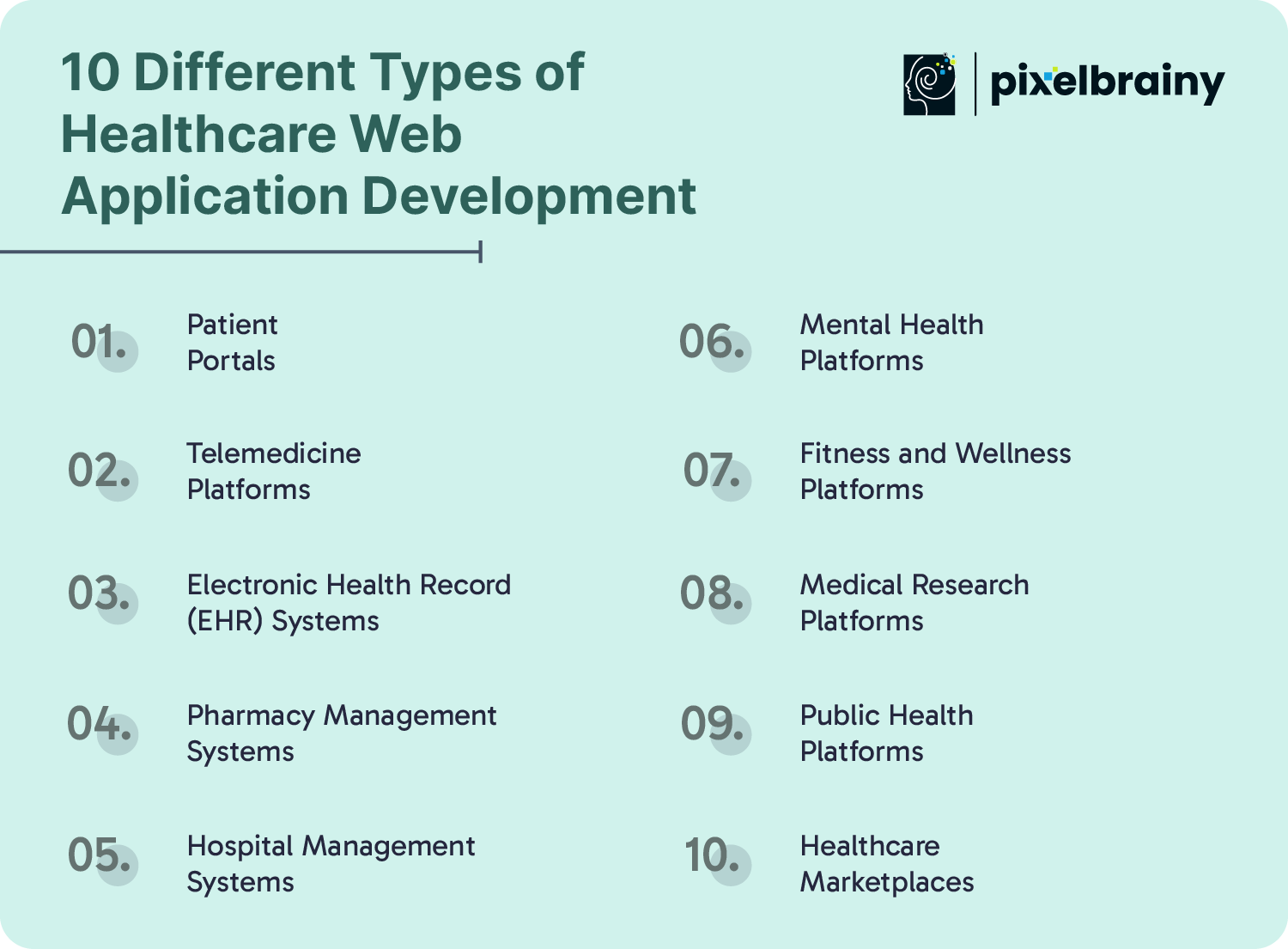
| Type of Healthcare Web Application | Description |
| Patient Portals | Permit patients to schedule appointments, access their medical records, easily communicate with providers, and pay bills online. |
| Telemedicine Platforms | Facilitates video calls, remote consultations, and other virtual healthcare services. |
| Electronic Health Record (EHR) Systems | Seamlessly handle patient medical records electronically, enhancing data accuracy and accessibility. |
| Pharmacy Management Systems | Help pharmacies with prescription management, billing, and inventory control. |
| Hospital Management Systems | Handle hospital operations, embracing appointments, patient admissions, resource allocation, and billing. |
| Mental Health Platforms | Offer online counseling, therapy, and mental health support services. |
| Fitness and Wellness Platforms | Track fitness goals, offer personalized health recommendations, and easily connect users with fitness professionals. |
| Medical Research Platforms | Enable data collection, collaboration, and analysis for medical research studies. |
| Public Health Platforms | Support public health initiatives, like disease surveillance, vaccination programs, and outbreak response. |
| Healthcare Marketplaces | Connect patients with healthcare professionals, permitting them to search for and compare services. |
The growing range of healthcare application models gives businesses multiple opportunities to digitize specific healthcare services rather than relying on a one-size-fits-all solution. A startup may focus on asynchronous mental health care, while a hospital may prioritize patient management and EHR-connected workflows.
Each type of healthcare web application serves a distinct purpose, from improving patient access and virtual care to streamlining clinical, administrative, and research workflows. Selecting the right application model helps businesses align technology with their users' needs, operational goals, and healthcare service requirements.
The next step is to define the right technology, features, development approach, and budget for the healthcare web application you plan to bring to market.
A healthcare web application can involve sensitive patient data, complex clinical workflows, healthcare integrations, and strict security requirements. That makes the development partner an important business decision, not simply a vendor selection exercise. The right team should understand both the technology and the healthcare environment in which the application will operate.
A real buyer query in this stage is: “We have a healthcare web app idea, but how can we identify a development partner that has real experience with HIPAA, EHR integrations, secure patient data, and scalable healthcare platforms rather than just general web development experience?”
For startups, healthcare providers, and digital health businesses, evaluating a partner only by hourly rates or project estimates can create risks later. A lower initial quote may not account for compliance requirements, complex integrations, security testing, infrastructure, or post-launch maintenance.
Before you build a healthcare web application, assess potential development partners based on their healthcare portfolio, regulatory knowledge, technical capabilities, security practices, scalability expertise, communication process, and long-term support. These factors can help you identify a team capable of handling the technical and operational complexities of a healthcare product.
Look for a web application development company with a proven track record and experience in creating healthcare applications. Their years of experience in creating similar applications ensure they understand the unusual changes and needs of the healthcare industry, such as complex workflows and data privacy.
Compliance with regulations like HIPAA and GDPR is important in healthcare application development. Go for a partner who has experience adhering to such standards, ensuring that you develop HIPAA-compliant healthcare applications that meet legal needs and safeguard sensitive patient data.
Secure healthcare applications demand advanced technologies to manage complex data and offer a smooth user experience. Be sure that your development partner is familiar with the latest tech stack, incorporating AI, cloud computing, and secure APIs to develop a future-proof and robust application.
With your expanding healthcare application, you need to ensure that it scales without compromising performance or security. You should evaluate your development partner's capability to create healthcare web applications that are secure, scalable, and hold the caliber to manage high data volumes without vulnerabilities.
With client feedback and portfolios, you will get valuable insights into work quality and customer satisfaction. A robust portfolio of healthcare projects with positive client testimonials showcases the expertise and reliability of your development partner in delivering top-quality healthcare solutions.
Creating a healthcare web application is just the start. Choose a development partner who provides ongoing support and maintenance services after your app launch. This ensures that any updates, issues, or new regulations are swiftly addressed, keeping the app running smoothly.
The right healthcare web application development company should bring more than coding expertise to your project. Its healthcare experience, compliance knowledge, technical capabilities, security approach, and post-launch support can directly influence the application's reliability and long-term growth.
Choose a partner that understands your healthcare problem, technical requirements, and future product vision, not just your development budget.
From the above considerations, it is now time to identify a development partner that understands both the technology and the healthcare environment. For businesses planning a healthcare tech project, PixelBrainy brings experience across healthcare workflows, secure digital platforms, modern technologies, and product-focused development.
As a PixelBrainy as AI healthcare software development company, the team can support businesses that need more than a conventional web solution. Its approach focuses on understanding the healthcare use case, defining the right product scope, planning integrations, and creating a scalable technical foundation.
A real buyer query at this stage is: “We have a healthcare web app idea with sensitive patient data, third-party integrations, and plans to add AI later. Can your team help us validate the concept, define the architecture, and take the product from development to launch?”
PixelBrainy recently worked on a confidential healthcare technology project involving:
The project demonstrates PixelBrainy's ability to handle a healthcare product where usability, security, integration requirements, and scalability need to work together.
Whether you want to develop healthcare web app functionality for a new digital health business or modernize an existing healthcare workflow, the development approach can be tailored to your product objectives.
PixelBrainy can also support healthcare web app development integrating AI when intelligent automation, personalization, analytics, or AI-assisted workflows are relevant to the product.
Connect with PixelBrainy to discuss your healthcare technology project and development requirements.
Healthcare web application development is becoming an important part of delivering more accessible, connected, and efficient digital healthcare services. From patient portals and telemedicine platforms to specialized mental health and healthcare management solutions, the right web application can address specific patient and provider needs while supporting long-term business growth.
However, successful development requires more than implementing features. Security, regulatory compliance, interoperability, scalability, usability, and ongoing maintenance should be considered from the beginning. A clear understanding of the target users and healthcare workflows can also help businesses prioritize the right functionality and avoid unnecessary development complexity.
Partnering with an experienced development team like PixelBrainy can help turn your healthcare technology idea into a secure and scalable digital product. With the right technical strategy and product-focused approach, businesses can create healthcare web applications that are designed around real-world requirements and evolving user expectations.
Whether you plan to launch a patient portal, telemedicine platform, mental health solution, or another specialized healthcare web application, the right development approach can create a stronger foundation for long-term success.
Ready to turn your healthcare web application idea into reality? Schedule a call with PixelBrainy today to discuss your project.
The cost of healthcare web application development can range from approximately $20,000 to $200,000+, depending on application complexity, features, integrations, security requirements, compliance needs, technology stack, and development team location. A detailed estimate requires defining the project's scope and technical requirements.
The healthcare web application development timeline depends on the application's complexity and required functionality. A general roadmap may include 1 to 2 weeks for discovery, 8 to 20 weeks for development, and 2 to 4 weeks for testing and deployment. Complex applications with multiple integrations may require additional time.
To build a healthcare web application from scratch, start by defining the healthcare problem, target users, business requirements, and compliance needs. The process typically includes market research, requirement analysis, UI/UX design, technology planning, frontend and backend development, healthcare system integrations, security testing, compliance assessment, deployment, and ongoing maintenance.
HIPAA requirements should be considered throughout healthcare web application development. The application may require appropriate authentication, authorization, encryption, audit logging, access controls, secure APIs, and protected data handling. Businesses should also consult qualified compliance professionals to determine their specific HIPAA obligations.
Yes. Healthcare web application development can include integration with EHRs, laboratories, pharmacies, payment systems, and other healthcare platforms. The complexity depends on the systems involved, available APIs, interoperability standards, authentication requirements, data mapping, and the type of information that needs to be exchanged.
Common challenges include healthcare compliance, patient data security, EHR and legacy-system integration, complex healthcare workflows, usability, scalability, and development costs. Identifying these challenges during the planning stage can help businesses reduce technical risks and avoid expensive changes later.
Look for a development partner with proven healthcare web application development experience, relevant healthcare projects, compliance knowledge, secure architecture expertise, integration capabilities, and post-launch support. Reviewing case studies, technical capabilities, development methodology, timelines, and maintenance services can help you evaluate potential partners.
Yes. Depending on the business model, a healthcare web application can support video consultations, secure messaging, asynchronous communication, appointment management, patient records, notifications, and provider workflows. For asynchronous care, the architecture should specifically address structured communication, response workflows, consent, security, and appropriate clinical escalation processes.

About The Author
Sagar Bhatnagar
Sagar Sahay Bhatnagar brings over a decade of IT industry experience to his role as Marketing Head at PixelBrainy. He's known for his knack in devising creative marketing strategies that boost brand visibility and market influence. Sagar's strategic thinking, coupled with his innovative vision and focus on results, sets him apart. His track record of successful campaigns proves his ability to utilize digital platforms effectively for impactful marketing efforts. With a genuine passion for both technology and marketing, Sagar continuously pushes PixelBrainy's marketing initiatives to greater success.

Working with the PixelBrainy team has been a highly positive experience. They understand the design requirements and create beautiful UX elements to meet the application needs. The dev team did an excellent job bringing my vision to life. We discussed usability and flow. Sagar worked with his team to design the database and begin coding. Working with Sagar was easy. He has the knowledge to create robust apps, including multi-language support, Google and Apple ID login options, Ad-enabled integrations, Stripe payment processing, and a Web Admin site for maintaining support data. I'm extremely satisfied with the services provided, the quality of the final product, and the professionalism of the entire process. I highly recommend them for Android and iOS Mobile Application Design and Development.

Great experience working with them. Had a lot of feedback and I found that unlike most contractors they were bugging me for updates instead of the other way around. They were extremely time conscience and great at communicating! All work was done extremely high quality and if not on time, early! They were always proactive when it comes to communication and the work is great/above par always. Very flexible and a great team to work with! Goes above and beyond to present us with multiple options and always provides quality. Amazing work per usual with Chitra. If you have UI/UX or branding design needs I recommend you go to them! Will likely work with them in the future as well, definitely recommended!

PixelBrainy is a joy to work with and is a great partner when thinking through branding, logo, and website layout. I appreciate that they spend time going into the "why" behind their decisions to help inform me and others about industry best practices and their expertise.

I hired them to design our software apps. Things I really like about them are excellent communication skills, they answer all project suggestions and collaborate right away, and their input on design and colors is amazing. This project was complex and needed patience and creativity. The team is amazing to do business with. I will be using them long-term. Glad to see there are some good people out there. I was afraid to try and outsource my project to someone but I am glad I met them! I really can't say enough. They went above and beyond on this project. I am very happy with everything they have done to make my business stand out from the competition.

It was great working with PixelBrainy and the team. They were very responsive and really owned the project. We'll definitely work with them again!

I recently worked with the PixelBrainy team on a project and I was blown away by their communication skills. They were prompt, clear, and articulate in all of our interactions. They listened and provided valuable feedback and suggestions to help make the project a success. They also kept me updated throughout the entire process, which made the experience stress-free and enjoyable.

PixelBrainy is very good at what it does. The team also presents themselves very professionally and takes care of their side of things very well. I could fully trust them taking up the design work in a timely and organised manner and their attention to detail saved us lots of effort and time. This particular project was quite intense and the team showed that they function very well under pressure. Very much looking forward to working with her again!

It's always an absolute pleasure working with them. They completed all of my requests quickly and followed every note I had for them to a T, which made our process go smoothly from start to finish. Everything was completed fast and following all of the guidelines. And I would recommend their services to anyone. If you need any design work done in the future, PixelBrainy should be your first call!

They took ownership of our requirements and designed and proposed multiple beautiful variants. The team is self-motivated, requires minimum supervision, committed to see-through designs with quality and delivering them on time. We would definitely love to work with PixelBrainy again when we have any requirements.

PixelBrainy was a big help with our SaaS application. We've been hard at work with a new UI/UX and they provided a lot of help with the designs. If you're looking for assistance with your website, software, or mobile application designs, PixelBrainy and the team is a great recommendation.

PixelBrainy designers are amazing. They are responsive, talented, and always willing to help craft the design until it matches your vision. I would recommend them and plan to continue them for my future projects and more!!!

They were awesome! Did a good job fast, and good communication. Will work with them again. Thank you

Creative, detail-oriented, and talented designers who take direction well and implement changes quickly and accurately. They consistently over-delivered for us.

PixelBrainy team is very talented and creative. Great designers and a pleasure to work with. PixelBrainy is an excellent communicator and I look forward to working with them again.

PixelBrainy has a very talented design team. Their work is excellent and they are very responsive. I enjoy working with them and hope to continue on all of our future projects.


Transform your ideas into reality with us.
Across these industries, each engagement brings unique challenges, from early-stage product development to scaling complex systems, helping us build a practical understanding of real-world product environments.