
 AI Summary Powered by PixelBrainy
How do you hire an AI real estate app development company in USA that can build a future ready property platform without wasting time, budget, and months of development effort?
This is one of the biggest questions facing real estate businesses, proptech startup founders, brokerage firms, property management companies, MLS operators, real estate investors, and entrepreneurs planning to launch AI-powered property platforms in 2026.
The opportunity is massive, but so are the challenges.
Many real estate businesses struggle with outdated property search experiences, low user engagement, poor lead conversion rates, inaccurate property recommendations, disconnected listing databases, and increasing customer expectations. At the same time, buyers and renters now expect personalized property suggestions, intelligent search results, predictive insights, virtual assistance, and seamless digital experiences similar to leading platforms like Zillow and Redfin.
As a result, more companies are looking to hire an AI real estate app development company in USA to build advanced property listing platforms powered by artificial intelligence. However, hiring AI real estate app development company in USA is often more complicated than expected. Hundreds of agencies claim AI expertise, yet many lack real world experience in property technology, recommendation engines, real estate data integrations, geospatial intelligence, machine learning, and scalable marketplace development.
The market itself is expanding at an unprecedented pace. According to Research and Markets, the global AI in Real Estate market is expected to reach approximately $404.9 billion in 2026 and grow to more than $1.3 trillion by 2030, driven by increasing adoption of AI across property search, valuation, investment analysis, and customer engagement.
If your question is, "We are a real estate startup in the USA looking to hire an AI real estate app development company to build a property listing platform with smart search and AI recommendations. Where do we start and what should we budget for in 2026?", this guide provides the answer.
You will learn the complete process of hiring AI real estate app development company in USA, understand realistic development costs, identify critical red flags, evaluate different hiring models, and discover how to hire US based AI real estate app development company that can deliver measurable business results instead of empty promises. Whether you want to hire custom real estate app development company USA for a new product launch or scale an existing proptech platform with AI capabilities, this guide will help you make a confident and informed decision.
When most real estate businesses start looking to hire an AI real estate app development company in USA, they often focus on features such as chatbots, recommendation engines, or predictive analytics. However, AI is only one part of the solution.
A modern AI powered real estate app development USA company builds complete platforms that combine property data, automation, machine learning, customer engagement tools, cloud infrastructure, mobile experiences, and business intelligence systems into a single product. The final deliverable is not just an app. It is a technology platform designed to help real estate businesses attract users, generate leads, improve decision making, automate operations, and increase revenue.
For proptech startups, brokerages, property management companies, real estate investors, and MLS operators, understanding the different categories of AI real estate applications is essential before choosing a development partner.
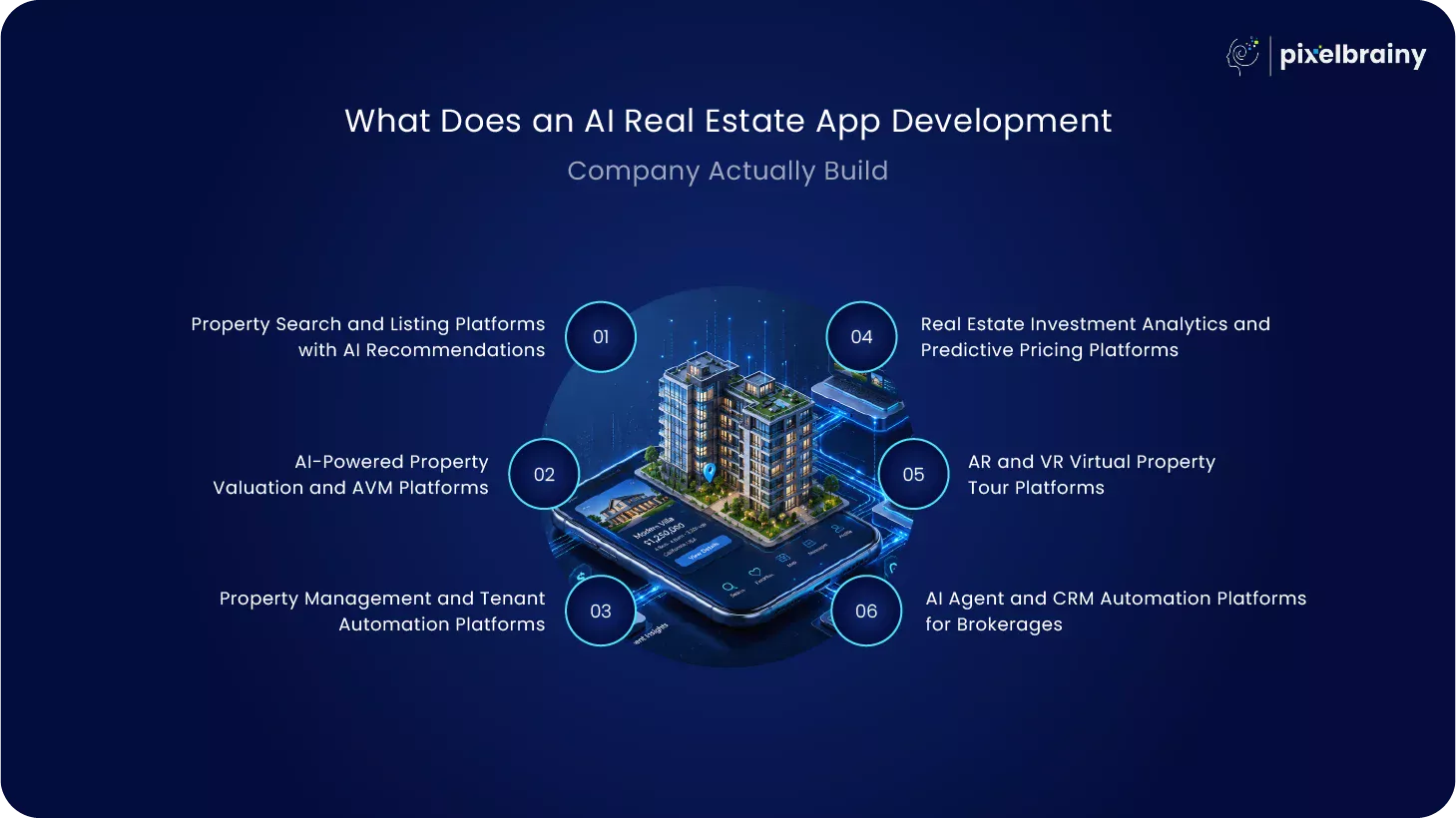
This is the most requested category among startups looking to build the next Zillow, Realtor.com, or Redfin alternative.
These platforms use Artificial Intelligence and Natural Language Processing (NLP) to help buyers and renters discover relevant properties faster. Instead of relying solely on filters, users can search using conversational phrases such as "family homes near top-rated schools under $700,000" and receive highly personalized results.
Core capabilities include:
Best suited for proptech startups, MLS platforms, real estate marketplaces, and brokerage firms.
Automated Valuation Models (AVMs) use machine learning to estimate property values based on historical transactions, neighborhood trends, property characteristics, and market conditions.
Many platforms integrate data sources such as CoreLogic, HouseCanary, MLS feeds, and public records to improve valuation accuracy.
Core capabilities include:
Best suited for lenders, mortgage companies, investors, brokerages, and appraisal businesses.
Property management companies increasingly use AI to reduce operational workloads and improve tenant satisfaction.
These platforms automate repetitive tasks that traditionally require manual intervention.
Core capabilities include:
Best suited for landlords, property managers, multifamily housing providers, and commercial real estate operators.
Real estate investors need more than property listings. They need insights that help identify profitable opportunities before competitors do.
AI-powered investment platforms analyze thousands of data points to uncover trends, forecast appreciation potential, and evaluate investment risk.
Core capabilities include:
Best suited for investment firms, REITs, institutional investors, and real estate funds.
As remote property viewing becomes increasingly common, AI-enhanced AR and VR platforms are helping buyers explore properties without physically visiting them.
These solutions create immersive digital experiences that improve buyer engagement and accelerate decision making.
Core capabilities include:
Best suited for developers, luxury real estate firms, builders, and brokerages.
Lead management remains one of the biggest challenges for real estate businesses. AI-powered CRM platforms help sales teams identify high-intent prospects and automate engagement activities.
Core capabilities include:
Best suited for brokerages, real estate agencies, and sales-driven organizations.
| App Type | Primary AI Feature | Typical Business Using It | Estimated Cost Range |
|---|---|---|---|
| Property Search & Listing Platform | NLP Search & AI Recommendations | Proptech Startups, MLS Platforms | $60,000 - $250,000+ |
| Property Valuation & AVM Platform | Predictive Valuation Models | Lenders, Investors | $80,000 - $300,000+ |
| Property Management Platform | Tenant & Workflow Automation | Property Managers | $50,000 - $200,000+ |
| Investment Analytics Platform | Predictive Market Intelligence | Investors, REITs | $100,000 - $500,000+ |
| AR/VR Property Tour Platform | Immersive Property Experiences | Developers, Brokers | $75,000 - $350,000+ |
| AI CRM & Brokerage Platform | Lead Scoring & Automation | Brokerages | $40,000 - $180,000+ |
The type of AI real estate application you plan to build should directly influence which development company you hire.
A team that specializes in building large-scale property search and listing platforms may not have deep expertise in predictive investment analytics. Likewise, a company experienced in AI valuation engines may not be the ideal partner for developing AR-powered virtual property tours.
This distinction is important because every category requires different data sources, AI models, compliance requirements, integrations, infrastructure, and domain expertise.
For businesses researching what does an AI real estate app development company in the USA actually build, the answer is simple: they build very different types of platforms depending on the business objective. Before you hire AI real estate app developers in USA or choose a custom real estate app development company USA, clearly define whether your goal is property discovery, valuation, property management, investment intelligence, virtual experiences, or brokerage automation.
The companies best suited for building a Zillow-style marketplace with AI-powered recommendations are rarely the same companies best suited for developing advanced investment analytics platforms. Choosing a development partner whose expertise aligns with your specific product vision is one of the most important decisions you will make in the entire development process.
Also Read: Top 12+ AI Real Estate Software Development Companies in USA
The biggest challenge in hiring AI real estate app development company in USA is not finding agencies. It is identifying which companies can actually deliver a production-ready real estate platform that works in the real world.
For many real estate startups, brokerages, property management firms, and proptech founders, the hiring process becomes frustrating because every company appears qualified on the surface. Their websites showcase impressive case studies, promise AI expertise, and claim experience building innovative digital products.
Unfortunately, many projects fail long before launch because the wrong development partner was selected from the beginning.
If you are wondering why so many real estate businesses struggle to hire real estate app development company in USA, the following issues are usually responsible.
The AI boom has created a new problem for buyers.
Today, almost every software agency markets itself as an AI development company. However, in many cases, their AI capabilities extend little beyond integrating ChatGPT or other third-party APIs into a standard application.
Building a true AI-powered real estate platform requires expertise in:
Many agencies sell AI as a feature rather than engineering it as a core product capability.
Most development companies display polished screenshots, attractive UI designs, and generic project descriptions.
What they rarely show is:
A beautiful demo does not prove a company can build a marketplace handling thousands of property listings, real-time searches, AI recommendations, and multiple data integrations.
For real estate businesses, shipped products matter far more than presentation decks.
Many founders searching for how to vet and hire an AI real estate app development company in USA without technical knowledge face the same challenge.
Technical proposals often contain unfamiliar terms such as:
Without technical expertise, it becomes difficult to determine whether these recommendations are genuinely necessary or simply being used to justify higher project costs.
As a result, many founders either overpay or select vendors based solely on price.
One of the most common frustrations in the market is receiving quotes ranging from $30,000 to $300,000 for what appears to be the same project.
The reason is simple.
Different companies are often proposing completely different solutions.
A lower quote may include:
A higher quote may include:
Without a detailed breakdown, comparing proposals becomes nearly impossible.
This is where many projects experience the most expensive failures.
Real estate software is fundamentally different from generic mobile or web applications.
A development team may be highly skilled technically but still struggle if they lack experience with:
The result is often a platform that works technically but fails to meet the practical needs of agents, brokers, buyers, investors, or property managers.
"Hiring a general AI app development company in the USA without verifying that they have successfully shipped a production real estate application with MLS integration before."
The reality is that successful hiring AI real estate app development company in USA requires more than comparing portfolios and pricing. Real estate businesses need partners who combine AI expertise with deep property technology knowledge. A company can be exceptional at building healthcare, fintech, or ecommerce platforms and still be the wrong choice for a real estate product.
Understanding these challenges is the first step toward avoiding costly mistakes and choosing a development partner capable of delivering a platform that performs successfully in the competitive US real estate market.
Also Read: Top 12 Real Estate AI Automation Companies in USA
When businesses decide to hire AI powered real estate app developers in USA, they often focus on portfolio quality and development costs. However, the companies that successfully deliver scalable real estate platforms are usually distinguished by two factors: the AI capabilities they have already deployed in production and the technical infrastructure expertise required to support those capabilities at scale.
Before selecting a development partner, evaluate whether they have hands-on experience with the following AI features and technical competencies.
| AI Feature | What It Does | Why It Matters for Real Estate Businesses |
|---|---|---|
| Natural Language Property Search (NLP) | Allows users to search using conversational queries instead of filters | Improves property discovery and user engagement |
| AI Property Recommendations | Suggests listings based on user behavior, preferences, and similar users | Increases listing views, lead generation, and conversions |
| Automated Valuation Models (AVMs) | Estimates property values using market data and machine learning | Supports investors, lenders, brokers, and buyers |
| Predictive Market Analytics | Forecasts appreciation, rental yield, demand, and market trends | Helps users make informed investment decisions |
| AI Lead Scoring & CRM Automation | Identifies high-intent prospects and automates follow-ups | Improves brokerage productivity and conversion rates |
| AR & VR Property Tours | Enables immersive property viewing experiences | Reduces unnecessary site visits and improves engagement |
| AI Tenant Screening | Automates verification and qualification processes | Saves time and reduces tenant acquisition risks |
| Capability | What You Should Ask |
|---|---|
| NLP Search | Can you show a production app where users search using natural language instead of filters? |
| Recommendation Engine | What recommendation model do you use and how do you improve recommendation accuracy over time? |
| AVM Development | Have you integrated CoreLogic, HouseCanary, ATTOM, or built custom valuation models? |
| Predictive Analytics | What market forecasting models have you deployed in production? |
| Brokerage Automation | Can you demonstrate AI lead scoring and CRM automation workflows? |
| AR/VR Tours | Which virtual tour technologies have you integrated such as Matterport, Cupix, or WebXR? |
| Tenant Screening | Have you implemented AI-based document verification or fraud detection systems? |
While AI features often attract attention, technical infrastructure determines whether those features remain reliable, scalable, and compliant as your platform grows.
| Technical Capability | Why It Is Important |
|---|---|
| MLS & IDX Integration Experience | Ensures accurate property listing synchronization and search functionality |
| RESO Web API Knowledge | Supports standardized MLS data exchange and integration |
| Property Data Pipeline Development | Maintains clean, accurate, and continuously updated property data |
| Cloud Infrastructure (AWS, Azure, GCP) | Supports scalability, performance, and platform reliability |
| Mobile AI Development (Core ML, TensorFlow Lite) | Enables intelligent mobile experiences and offline functionality |
| Fair Housing Compliance Awareness | Reduces compliance and algorithmic bias risks |
| MLOps & Model Monitoring | Maintains AI accuracy and performance after launch |
| Security & Data Privacy Architecture | Protects user, financial, and property data |
The strongest development partners combine AI engineering, real estate domain expertise, MLS integration experience, cloud architecture knowledge, and long-term AI maintenance capabilities. If you plan to hire AI real estate app development company in USA with MLS integration experience or are hiring an AI real estate app development company in USA with AR VR virtual tour experience, ask for specific examples of real-world implementations rather than generic AI demonstrations.
For founders researching what AI features should I look for when hiring an AI real estate app development company in the USA or how do I verify if an AI real estate app development company in the USA has actually built and shipped production-ready real estate apps, these capabilities provide a practical evaluation framework that goes far beyond marketing claims and portfolio screenshots.

For most real estate startups, brokerages, property management firms, and proptech companies, the biggest challenge is not finding development companies. It is knowing which one can actually deliver the product you need without exceeding your budget, extending timelines, or creating technical debt that becomes expensive to fix later.
If you are researching how to hire an AI real estate app development company in the USA in 2026, following a structured evaluation process will significantly reduce risk and improve your chances of launching a successful product.
The following eight-step framework is the same process used by successful proptech companies when selecting long-term technology partners.
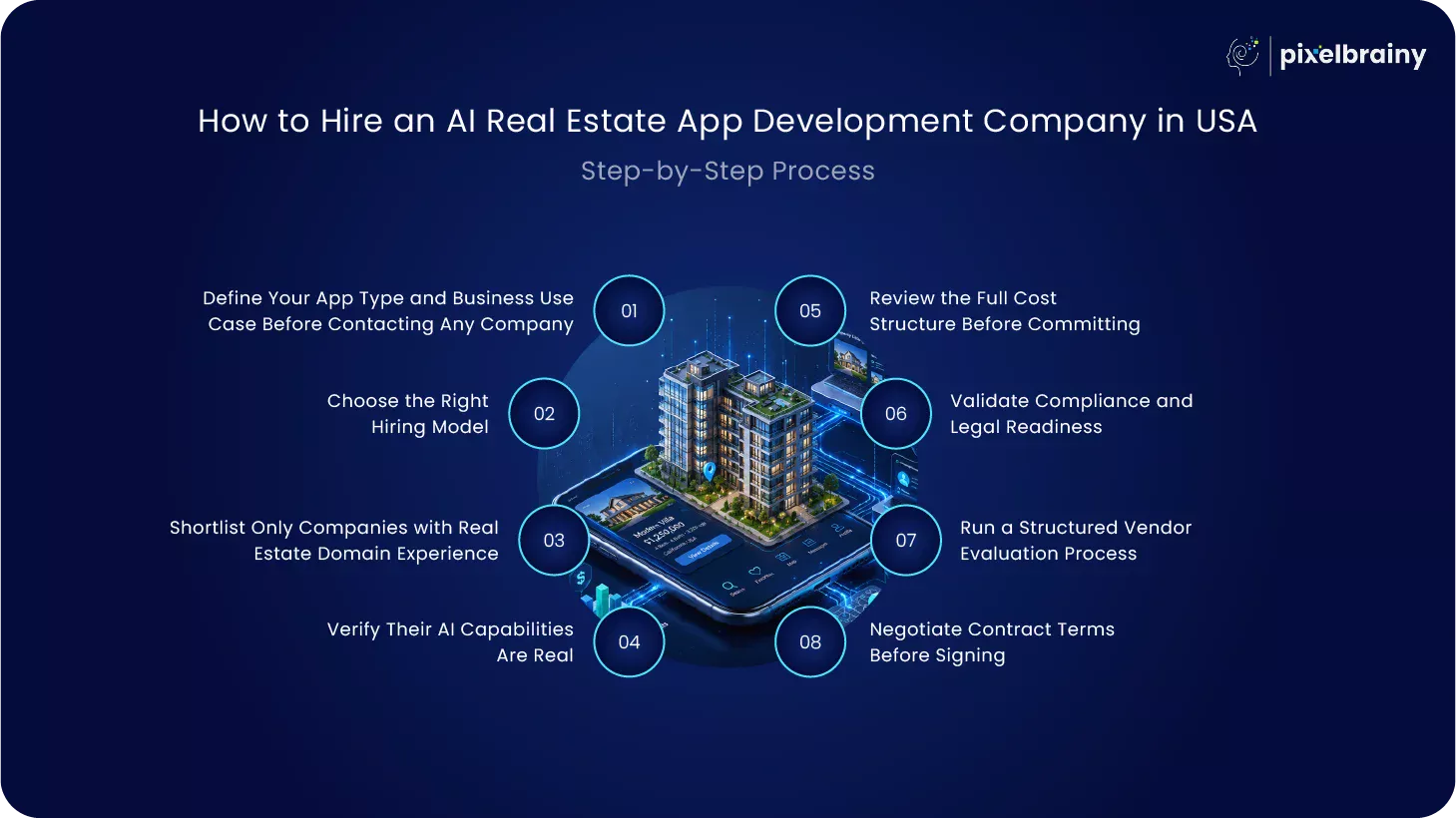
Before creating a shortlist of vendors, clearly define what you are building.
Many founders make the mistake of searching for developers before identifying their exact product category.
For example:
| App Type | Primary Goal |
|---|---|
| Property Listing Platform | Help buyers and renters discover properties |
| Investment Analytics Platform | Provide predictive market and ROI insights |
| Property Management Platform | Automate landlord and tenant operations |
| Brokerage CRM Platform | Improve lead generation and sales efficiency |
| Property Valuation Platform | Deliver AI-powered pricing intelligence |
Each category requires different AI models, integrations, infrastructure, and domain expertise.
Before approaching any vendor, document at least 3 to 5 non-negotiable features your platform must include. This ensures more accurate proposals and prevents unnecessary scope expansion later.
The next decision is selecting the engagement model that best fits your budget and long-term goals.
| Hiring Model | Best For | Typical Budget Range |
|---|---|---|
| Fixed-Price Project | MVPs with clearly defined requirements | Under $100K |
| Dedicated Team | Long-term product development and scaling | $100K+ |
| Staff Augmentation | Extending an existing internal team | Variable |
A fixed-price approach works best when requirements are stable.
If your product roadmap is evolving, a hire dedicated real estate app development team in USA model typically offers greater flexibility and long-term value.
Not every AI development company understands real estate.
A company may have experience in healthcare, fintech, ecommerce, or SaaS but still struggle with MLS integrations, property data normalization, and brokerage workflows.
When evaluating vendors:
Most importantly, ask:
"Can you share measurable results from a real estate application you have deployed?"
Examples include:
AI has become one of the most overused terms in software development.
Rather than asking whether a company builds AI solutions, ask how they build them.
Useful questions include:
Strong vendors provide detailed answers supported by real-world examples rather than marketing language.
One of the biggest reasons companies receive wildly different proposals is that vendors scope projects differently.
Ask every vendor for a detailed line-item breakdown.
A proposal should clearly separate:
| Cost Component | Included? |
|---|---|
| Discovery & Planning | ✓ |
| UI/UX Design | ✓ |
| Development | ✓ |
| AI Integration | ✓ |
| Testing & QA | ✓ |
| Deployment | ✓ |
| Post-Launch Support | ✓ |
Also confirm whether the quote includes:
Many real estate startups discover too late that data infrastructure and MLS normalization expenses can add 25% to 35% beyond the original development estimate.
Also Read: AI Real Estate Software Development Cost
Compliance requirements are often underestimated during project planning.
In the United States, MLS and IDX approvals are not instant.
Many agreements require 4 to 8 weeks before access is granted.
Ask the company:
Companies with real estate experience should answer these questions confidently.
Avoid comparing too many vendors simultaneously.
The most effective procurement process usually involves 2 to 3 carefully selected companies.
Instead of requesting free proposals, ask each company for a paid discovery workshop or scoping sprint.
A discovery process typically delivers:
Companies that provide highly detailed proposals without conducting discovery are often estimating rather than truly understanding your project.
The final stage is often where the most expensive mistakes occur.
Never evaluate a contract solely on total project cost.
Review:
The safest approach is milestone-based payments tied to working deliverables rather than calendar dates.
For AI-powered platforms, consider defining performance expectations for recommendation systems, search relevance, or prediction accuracy.
You should also clarify:
For companies asking:
"We are a real estate startup looking to hire an AI real estate app development company in the USA. Where do we start and what should we budget for in 2026?"
A typical hiring timeline looks like this:
| Stage | Estimated Duration |
|---|---|
| Requirements Definition | 1-2 Weeks |
| Vendor Research & Shortlisting | 1-2 Weeks |
| Discovery & Evaluation | 2-4 Weeks |
| Contract Negotiation | 1 Week |
| Development Kickoff | Immediate After Signing |
In most cases, the entire hiring an AI real estate app development company in USA process takes approximately 5 to 9 weeks before development officially begins.
Following this structured approach helps real estate businesses avoid costly mistakes, compare vendors objectively, and select a development partner capable of delivering a scalable AI-powered platform that aligns with long-term business goals.
One of the first questions asked by founders, brokers, property management companies, and proptech startups is:
"How much does it cost to hire an AI real estate app development company in USA?"
The answer depends on three major factors:
Many articles quote broad ranges such as "$25,000 to $300,000+" without explaining what drives those costs. In reality, a property search marketplace, an AI investment analytics platform, and a brokerage CRM require completely different architectures, integrations, and AI models.
The table below provides a more realistic view of AI real estate app development cost USA based on project type and development scope.
| App Type | MVP Cost | Full Product Cost | AI Features Add-On |
|---|---|---|---|
| Property Search & Listing Platform | $35K - $80K | $120K - $220K | $15K - $40K |
| Property Management & Tenant Automation Platform | $40K - $90K | $130K - $250K | $20K - $45K |
| Real Estate Investment Analytics Platform | $50K - $120K | $180K - $350K | $30K - $70K |
| AI Brokerage CRM & Lead Automation Platform | $30K - $70K | $100K - $180K | $15K - $35K |
| AR/VR Virtual Property Tour Platform | $45K - $100K | $150K - $300K | $20K - $50K |
Most development budgets typically include:
However, many businesses underestimate the additional costs associated with AI and real estate data infrastructure.
The largest cost increases usually come from integrations, data management, and ongoing AI operations rather than application development itself.
1. MLS Data Normalization and IDX Integrations
MLS integrations are rarely plug-and-play.
Property data often arrives from multiple sources with different formats, naming conventions, and update frequencies.
As a result, MLS data normalization, IDX integration, RESO compliance, and listing synchronization can increase total project costs by approximately 25% to 35% beyond the base development budget.
2. AI Operating Costs Continue After Launch
Unlike traditional software features, AI systems generate ongoing expenses.
These may include:
For many platforms, annual AI operating expenses range from $20,000 to $60,000 per year depending on user volume and model complexity.
3. Post-Launch Maintenance
Every production platform requires ongoing maintenance.
This typically includes:
A common budgeting guideline is 15% to 25% of the original development cost annually.
4. Third-Party Services and Infrastructure
Additional recurring expenses may include:
These costs are often omitted from initial proposals but can significantly impact long-term operating budgets.
Another major factor affecting the cost to build AI powered real estate app in USA 2026 is team location and engagement model.
| Team Type | Typical Hourly Rate |
|---|---|
| USA-Based Onshore Team | $120 - $200/hour |
| Nearshore Latin America Team with US Management | $60 - $100/hour |
| Offshore Team with US Oversight | $35 - $70/hour |
While hourly rates are important, they should never be evaluated in isolation. A lower hourly rate does not always translate into lower total project cost if development takes longer or requires extensive rework.
| Business Stage | Recommended Budget |
|---|---|
| Startup MVP | $40K - $100K |
| Growth-Stage PropTech Platform | $100K - $250K |
| Enterprise Real Estate Solution | $250K - $500K+ |
For companies asking "what does it cost to hire a real estate app development agency in USA for an enterprise platform?", the answer typically falls within the $250,000 to $500,000+ range when advanced AI capabilities, MLS integrations, analytics engines, compliance requirements, and scalable cloud infrastructure are included.
If your goal is to build a property search application with MLS integration, AI-powered recommendations, and predictive pricing capabilities, most projects in 2026 will fall between $120,000 and $250,000+ for a production-ready solution.
This estimate generally includes:
The cheapest quote is almost never the right choice for AI real estate development.
Companies that quote below $25,000 for an AI-powered real estate platform are typically proposing a template-based solution with basic AI branding, limited MLS functionality, minimal customization, or little real estate domain expertise. Successful AI real estate products require specialized engineering, data infrastructure, compliance awareness, and long-term scalability planning. Those requirements cannot be delivered at enterprise quality for bargain-level pricing.
The fastest way to waste six months and tens of thousands of dollars is to hire the wrong development partner.
Many real estate startups, brokerages, property management firms, and proptech founders focus on pricing, design quality, or company size when evaluating vendors. However, the biggest project failures usually happen because critical warning signs were overlooked during the selection process.
If you are currently hiring an AI real estate app development company in USA, the following red flags should immediately trigger deeper investigation before signing a contract.
Many agencies market themselves as AI specialists because they have integrated ChatGPT or another third-party AI service into an application.
That is very different from building a production-grade AI real estate platform.
Ask:
The difference between a ChatGPT API wrapper and a production NLP property search engine is substantial. Legitimate companies should be able to discuss real implementations, measurable outcomes, and technical decisions.
Beautiful interfaces are easy to showcase.
Production-ready real estate platforms are much harder to build.
A credible AI real estate development company should be able to provide:
If every portfolio item consists of design screens, concept visuals, or confidential projects with no measurable results, proceed carefully.
This is one of the most dangerous mistakes real estate businesses make.
Property search platforms depend on:
Without previous MLS experience, a development company will often underestimate the complexity of real estate data management.
The result is frequently delayed launches, unstable search experiences, inaccurate listings, and budgets that exceed original estimates by 40% to 60%.
A detailed proposal requires a detailed understanding of your business requirements.
If a company offers a fixed-price estimate after only a short introductory call, they are making assumptions.
Professional vendors typically recommend:
Skipping discovery often leads to scope creep, budget overruns, missed requirements, and disappointing AI performance.
Many companies focus entirely on building AI features.
Far fewer understand how to maintain them.
Ask:
Property inventory, user behavior, and market conditions constantly change. Without a clear MLOps strategy, AI recommendations may perform well during demonstrations but become unreliable shortly after launch.
AI-powered real estate platforms operate within a highly regulated environment.
Recommendation engines, property search algorithms, and lead distribution systems can create compliance risks if not carefully designed.
Ask whether the company understands:
A lack of awareness in this area can expose your business to significant legal and reputational risks.
One of the clearest signs of poor project planning is a lump-sum proposal with little transparency.
Professional estimates should separate costs for:
| Cost Category | Should Be Itemized? |
|---|---|
| Discovery & Planning | Yes |
| Design | Yes |
| Development | Yes |
| AI Features | Yes |
| MLS Integrations | Yes |
| Testing & QA | Yes |
| Deployment | Yes |
| Post-Launch Support | Yes |
Without this level of visibility, it becomes difficult to compare vendors, identify hidden costs, or understand where your budget is being allocated.
Traditional software can often operate with minimal updates.
AI-powered applications cannot.
After launch, AI systems require:
Ask every vendor:
If the relationship ends immediately after deployment, your team may be left managing complex AI systems without expert support.
Before signing with any vendor, verify that they can answer "yes" to the following questions:
| Evaluation Question | Yes/No |
|---|---|
| Have they shipped a live AI real estate application? | Yes |
| Can they demonstrate MLS or IDX integration experience? | Yes |
| Do they provide measurable business results from past projects? | Yes |
| Do they conduct discovery before estimating costs? | Yes |
| Can they explain their MLOps and model retraining process? | Yes |
| Do they understand Fair Housing compliance requirements? | Yes |
| Is the proposal fully itemized? | Yes |
| Do they offer post-launch AI support? | Yes |
For founders researching red flags to check before hiring an AI real estate app development company in USA or how to vet and hire an AI real estate app development company in USA without technical knowledge, these warning signs can help eliminate unsuitable vendors early in the evaluation process.
The strongest development partners will welcome these questions, provide evidence-based answers, and demonstrate a proven track record of delivering production-ready real estate platforms rather than simply selling AI as a marketing buzzword.
Choosing a development partner is not about finding the company with the best sales presentation. It is about identifying the team that can successfully build, launch, and maintain a production-ready AI real estate platform.
For founders researching questions to ask before hiring a real estate app development company in USA, the goal should be to uncover real-world experience, technical depth, and delivery capability. The right questions will quickly separate genuine proptech specialists from agencies that simply market themselves as AI experts.
Real estate technology has unique challenges involving MLS integrations, property data management, compliance requirements, and listing workflows.
Before hiring an AI real estate app development company in USA, ask:
| Question | Why It Matters |
|---|---|
| Which MLS providers and IDX feeds have you integrated with, and in which US markets? | Verifies hands-on real estate platform experience. |
| Can you share a production real estate app case study with live user metrics? | Helps validate real-world success beyond portfolio screenshots. |
| Have you built applications that required Fair Housing Act compliance reviews for AI features? | Confirms awareness of legal and compliance obligations. |
| What real estate data sources have you worked with and maintained? | Reveals experience managing complex property data ecosystems. |
Many companies advertise AI expertise, but few can explain how their systems operate after launch.
| Question | Why It Matters |
|---|---|
| Which AI features in your portfolio use custom models versus third-party APIs? | Distinguishes genuine AI engineering from simple API integrations. |
| How do you measure and maintain AI recommendation accuracy over time? | Reveals whether they understand long-term AI performance management. |
| What is your approach to model retraining as property inventory and user behavior change? | Shows their understanding of MLOps and AI lifecycle management. |
| Have you deployed AI features directly on mobile devices using on-device inference? | Demonstrates advanced mobile AI development expertise. |
| Do you use AVM providers such as CoreLogic and HouseCanary, or do you build custom valuation models? | Helps evaluate valuation and predictive analytics capabilities. |
Even technically strong projects can fail because of unclear expectations, poor planning, or inadequate support.
| Question | Why It Matters |
|---|---|
| Can you provide a line-item cost breakdown instead of a single fixed quote? | Creates transparency and helps identify hidden costs. |
| Are AI inference, API usage, and model operating costs included in the estimate? | Prevents unexpected expenses after launch. |
| What does your post-launch maintenance and AI support plan include? | Clarifies long-term ownership and support responsibilities. |
| What happens if a key engineer, architect, or AI specialist leaves during development? | Evaluates project continuity and risk management. |
| What milestone-based payment structure and delivery gates do you recommend? | Ensures accountability and measurable progress throughout development. |
A company that answers these questions with specific examples, technical explanations, measurable results, and live references is usually a company that has successfully shipped AI-powered real estate applications in production.
By contrast, companies that respond with vague statements, generic marketing language, or avoid discussing previous implementations often lack the real-world experience required for complex proptech projects.
For businesses evaluating what to look for when hiring an AI real estate app development company in USA, these questions provide a practical framework for assessing real estate expertise, AI capabilities, delivery processes, and long-term support readiness before making a hiring decision.
After deciding to build an AI-powered real estate platform, the next major decision is choosing the right engagement model.
Many businesses focus heavily on selecting a development company but overlook how the project will actually be structured. The hiring model you choose affects development speed, budget predictability, scalability, communication, and long-term product success.
For companies evaluating hiring an outsourced AI real estate app development company in USA vs building in-house team, understanding the advantages and limitations of each model is essential.
| Hiring Model | Best For | Cost Structure | Key Risks | Typical Timeline |
|---|---|---|---|---|
| Fixed-Price Project | MVPs, startups with clearly defined requirements, budgets under $100K | Agreed project cost with milestone payments | Scope changes can become expensive if requirements evolve | 8-16 weeks for most MVPs |
| Dedicated Team | Long-term product development, scaling startups, enterprise platforms | Monthly team cost, typically $15K-$50K+ per month | Requires active product ownership and ongoing management | Ongoing engagement aligned with roadmap |
| Staff Augmentation | Companies with an existing development team needing specialized AI talent | Hourly or monthly rate per engineer | Team integration and knowledge transfer require planning | 1-2 weeks to onboard specialists |
A fixed-price engagement works best when the project scope is clearly defined before development begins.
This model is commonly used by:
Advantages include:
However, flexibility is limited. If major features are added after development starts, costs and timelines can increase significantly.
For businesses planning long-term growth, the dedicated team model is often the preferred option.
Under this structure, you effectively hire dedicated real estate app development team in USA that works exclusively on your product.
This model is ideal for:
Benefits include:
The tradeoff is that product direction, prioritization, and stakeholder communication require ongoing involvement from your side.
Staff augmentation allows companies to add specialized talent without hiring full-time employees.
This option is particularly valuable when organizations need:
For businesses comparing hiring a dedicated real estate app development team in USA vs freelancers, staff augmentation offers more reliability, accountability, and access to vetted specialists.
The primary challenge is ensuring new team members integrate effectively into existing processes and company culture.
The best model depends on your stage, budget, and internal capabilities.
| Your Situation | Recommended Model |
|---|---|
| Building a first MVP with a fixed budget | Fixed-Price Project |
| Launching a property marketplace and planning long-term expansion | Dedicated Team |
| Existing engineering team needs AI expertise | Staff Augmentation |
| No internal technical team and limited product complexity | Fixed-Price Project |
| Enterprise platform with continuous feature development | Dedicated Team |
| Need AI specialists quickly without long-term hiring commitments | Staff Augmentation |
If you are a proptech startup with no internal engineering team and a clearly defined MVP scope, a fixed-price project with a specialized AI real estate app development company in the USA is typically the fastest and most cost-effective path to launch.
However, if your vision includes continuous feature releases, AI optimization, MLS expansion, predictive analytics, and long-term platform growth, a dedicated team model provides the flexibility, product continuity, and scalability required to support that roadmap.
For organizations with an established development department, staff augmentation can bridge critical skill gaps without the time and expense associated with building a full in-house AI team from scratch.
PixelBrainy is a USA-focused AI real estate app development company that builds production-ready property platforms, proptech tools, and real estate automation systems for startups, brokerages, property management companies, and enterprise real estate businesses across the United States.
Businesses looking to hire AI real estate app development company in USA increasingly prioritize partners with proven real estate expertise, AI engineering capabilities, and experience delivering scalable products that go beyond generic app development.
PixelBrainy develops a wide range of AI-powered real estate solutions tailored to different business models and growth stages.
Core solutions include:
Whether you are launching a proptech startup or modernizing an existing real estate operation, PixelBrainy focuses on building platforms designed for real-world adoption and long-term scalability.
PixelBrainy works with a diverse range of real estate organizations, including:
This specialized focus helps clients avoid the learning curve often associated with general-purpose development agencies.
PixelBrainy combines real estate domain expertise with modern AI and cloud technologies.
Capabilities include:
Organizations hiring AI real estate app development company in USA often choose PixelBrainy because of its real estate specialization and delivery-focused approach.
Key differentiators include:
Unlike agencies that focus primarily on prototypes and proofs of concept, PixelBrainy emphasizes launch-ready solutions designed for actual users and real business outcomes.
Clients have shipped production AI real estate applications with PixelBrainy in as little as 12 weeks from discovery to launch, depending on project scope and complexity.
For businesses searching for the best AI real estate app development company in USA, looking to hire PixelBrainy as your AI real estate app development company in USA, or evaluating partners with experience in MLS integration, AI property valuation, and real estate automation, PixelBrainy offers the technical expertise and industry knowledge required to bring ambitious proptech products to market.
Talk to PixelBrainy's AI real estate app development team today and get a free scoping session for your project.

Building a successful AI-powered real estate platform requires more than finding a development company with an impressive portfolio. It requires understanding the true development costs, identifying potential red flags before signing a contract, and asking the right questions to verify real estate and AI expertise.
As discussed throughout this guide, the foundation of successful hiring AI real estate app development company in USA begins with defining your app type, evaluating real estate domain experience, validating AI capabilities, and confirming MLS and IDX integration expertise. These factors have a far greater impact on project success than price alone.
Whether you are launching a property listing platform, investment analytics solution, property management application, or brokerage automation system, partnering with the right team can significantly reduce risk and accelerate time to market.
If you are looking to hire AI real estate app development company in USA, PixelBrainy combines AI engineering expertise, real estate industry knowledge, and production-focused delivery to help bring ambitious proptech ideas to life.
Schedule a free scoping session with PixelBrainy and take the first step toward building your AI real estate platform.
The AI real estate app development cost USA typically ranges from $35,000 to $120,000 for an MVP and $100,000 to $350,000+ for a full-featured production platform. Costs depend on the type of application, AI complexity, MLS integrations, cloud infrastructure, and compliance requirements. Property search platforms with AI recommendations and predictive pricing generally fall between $120,000 and $250,000+.
The timeline depends on project scope and complexity. Most MVPs require 8 to 16 weeks, while production-ready platforms with MLS integrations, AI recommendations, analytics, and mobile applications typically take 4 to 9 months. The overall timeline also includes discovery, design, development, testing, and deployment phases.
A general development company focuses on software engineering across multiple industries, while a specialized AI real estate company understands MLS integrations, IDX feeds, property data normalization, valuation models, Fair Housing compliance, and real estate workflows. This domain expertise often reduces project risk, development delays, and costly rework.
Freelancers can be suitable for small prototypes or limited feature development. However, most proptech startups benefit from working with a specialized company because AI real estate platforms typically require multiple skill sets, including AI engineering, MLS integration, cloud infrastructure, mobile development, security, and quality assurance.
The most valuable AI features include natural language property search, AI-powered property recommendations, predictive pricing, automated valuation models (AVMs), lead scoring, tenant screening automation, and predictive market analytics. The ideal feature set depends on your business model and target users.
Ask for examples of live real estate applications they have launched, not just portfolio screenshots. Verify their experience with MLS providers, IDX integrations, property recommendation systems, and real-world performance metrics. Production case studies and client references are strong indicators of genuine expertise.
Yes, experienced companies typically manage MLS and IDX integrations as part of the development process. They should also understand RESO Web API standards, listing synchronization, data normalization, and MLS compliance requirements. This expertise is critical for property search and listing platforms.
Most professional firms offer post-launch maintenance and support services. These often include bug fixes, infrastructure monitoring, security updates, AI model monitoring, recommendation engine optimization, and periodic model retraining. Ongoing support is especially important because AI systems require continuous performance management after launch.

About The Author
Sagar Bhatnagar
Sagar Sahay Bhatnagar brings over a decade of IT industry experience to his role as Marketing Head at PixelBrainy. He's known for his knack in devising creative marketing strategies that boost brand visibility and market influence. Sagar's strategic thinking, coupled with his innovative vision and focus on results, sets him apart. His track record of successful campaigns proves his ability to utilize digital platforms effectively for impactful marketing efforts. With a genuine passion for both technology and marketing, Sagar continuously pushes PixelBrainy's marketing initiatives to greater success.


Transform your ideas into reality with us.
Working with the PixelBrainy team has been a highly positive experience. They understand the design requirements and create beautiful UX elements to meet the application needs. The dev team did an excellent job bringing my vision to life. We discussed usability and flow. Sagar worked with his team to design the database and begin coding. Working with Sagar was easy. He has the knowledge to create robust apps, including multi-language support, Google and Apple ID login options, Ad-enabled integrations, Stripe payment processing, and a Web Admin site for maintaining support data. I'm extremely satisfied with the services provided, the quality of the final product, and the professionalism of the entire process. I highly recommend them for Android and iOS Mobile Application Design and Development.

Great experience working with them. Had a lot of feedback and I found that unlike most contractors they were bugging me for updates instead of the other way around. They were extremely time conscience and great at communicating! All work was done extremely high quality and if not on time, early! They were always proactive when it comes to communication and the work is great/above par always. Very flexible and a great team to work with! Goes above and beyond to present us with multiple options and always provides quality. Amazing work per usual with Chitra. If you have UI/UX or branding design needs I recommend you go to them! Will likely work with them in the future as well, definitely recommended!

PixelBrainy is a joy to work with and is a great partner when thinking through branding, logo, and website layout. I appreciate that they spend time going into the "why" behind their decisions to help inform me and others about industry best practices and their expertise.

I hired them to design our software apps. Things I really like about them are excellent communication skills, they answer all project suggestions and collaborate right away, and their input on design and colors is amazing. This project was complex and needed patience and creativity. The team is amazing to do business with. I will be using them long-term. Glad to see there are some good people out there. I was afraid to try and outsource my project to someone but I am glad I met them! I really can't say enough. They went above and beyond on this project. I am very happy with everything they have done to make my business stand out from the competition.

It was great working with PixelBrainy and the team. They were very responsive and really owned the project. We'll definitely work with them again!

I recently worked with the PixelBrainy team on a project and I was blown away by their communication skills. They were prompt, clear, and articulate in all of our interactions. They listened and provided valuable feedback and suggestions to help make the project a success. They also kept me updated throughout the entire process, which made the experience stress-free and enjoyable.

PixelBrainy is very good at what it does. The team also presents themselves very professionally and takes care of their side of things very well. I could fully trust them taking up the design work in a timely and organised manner and their attention to detail saved us lots of effort and time. This particular project was quite intense and the team showed that they function very well under pressure. Very much looking forward to working with her again!

It's always an absolute pleasure working with them. They completed all of my requests quickly and followed every note I had for them to a T, which made our process go smoothly from start to finish. Everything was completed fast and following all of the guidelines. And I would recommend their services to anyone. If you need any design work done in the future, PixelBrainy should be your first call!

They took ownership of our requirements and designed and proposed multiple beautiful variants. The team is self-motivated, requires minimum supervision, committed to see-through designs with quality and delivering them on time. We would definitely love to work with PixelBrainy again when we have any requirements.

PixelBrainy was a big help with our SaaS application. We've been hard at work with a new UI/UX and they provided a lot of help with the designs. If you're looking for assistance with your website, software, or mobile application designs, PixelBrainy and the team is a great recommendation.

PixelBrainy designers are amazing. They are responsive, talented, and always willing to help craft the design until it matches your vision. I would recommend them and plan to continue them for my future projects and more!!!

They were awesome! Did a good job fast, and good communication. Will work with them again. Thank you

Creative, detail-oriented, and talented designers who take direction well and implement changes quickly and accurately. They consistently over-delivered for us.

PixelBrainy team is very talented and creative. Great designers and a pleasure to work with. PixelBrainy is an excellent communicator and I look forward to working with them again.

PixelBrainy has a very talented design team. Their work is excellent and they are very responsive. I enjoy working with them and hope to continue on all of our future projects.


