AI Summary Powered by PixelBrainy
What if you could add AI to your factory without replacing the PLCs, rewriting control logic, or risking even a minute of production downtime?
If you own or manage a manufacturing business, you have probably faced the same dilemma confronting thousands of industrial facilities worldwide. Your production line depends on PLCs that have been running reliably for more than 15 years. Your SCADA system is stable, but nobody wants to touch it because a single mistake could stop production, delay customer deliveries, and cost thousands in lost revenue. At the same time, competitors are adopting predictive maintenance, machine learning, and intelligent monitoring to reduce failures and improve efficiency.
You may even find yourself asking:
"We run a plant with PLCs that are 15-plus years old and a SCADA system nobody wants to touch because the whole line depends on it. I want to add AI predictive maintenance, but I'm terrified that connecting anything to these systems will cause an outage. How do other manufacturers add AI without modifying the control logic or risking a production stoppage?"
The good news is that manufacturing AI integration with legacy systems no longer requires replacing proven equipment. Modern AI integration without replacement uses secure, read only connections, industrial edge gateways, protocol converters, and digital twins that collect operational data without changing PLC programs or interfering with machine control. This allows manufacturers to reduce manufacturing downtime with AI while protecting production stability.
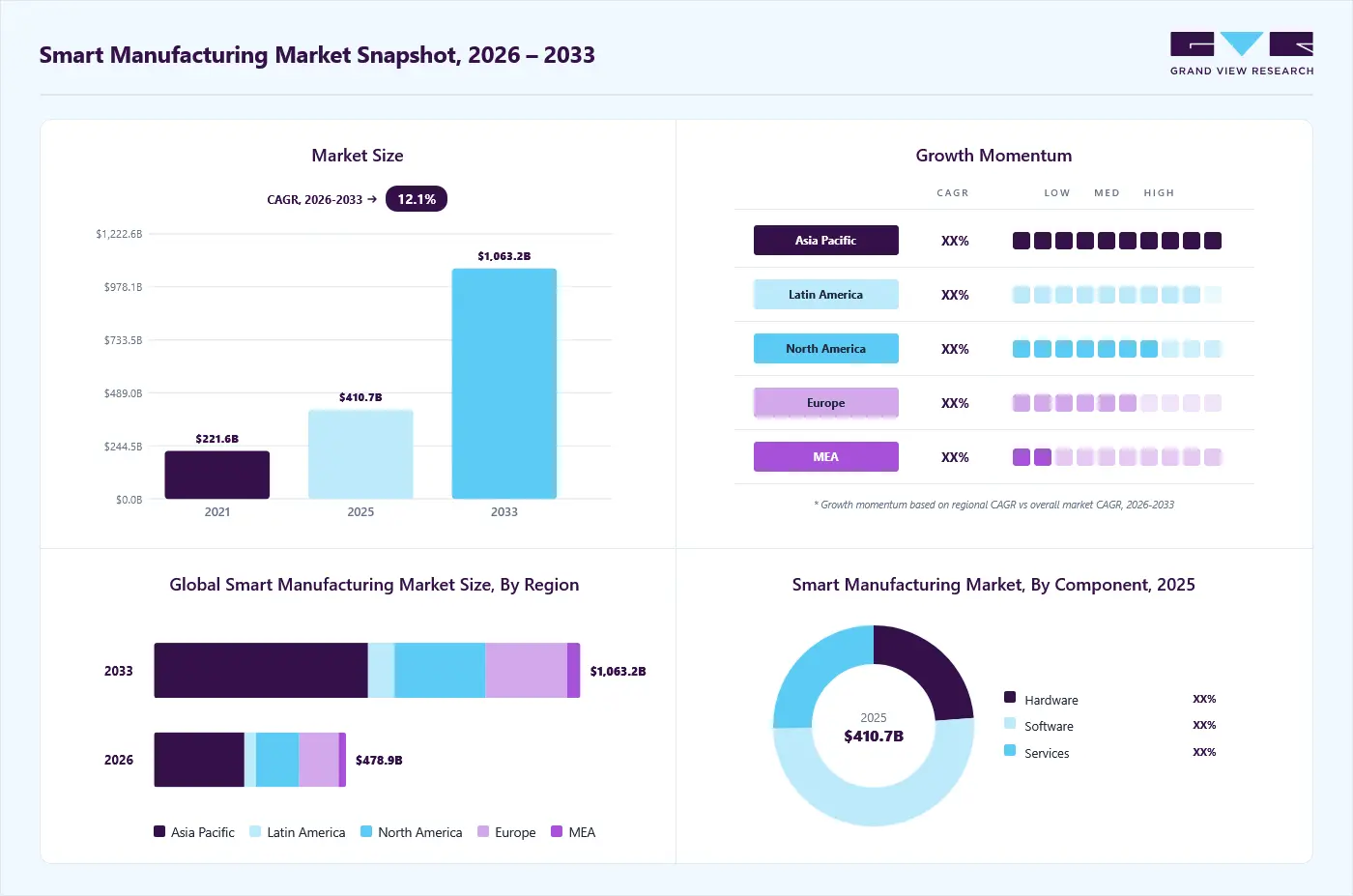
Industry investment reflects this shift. According to Grand View Research, the global smart manufacturing market is projected to grow from USD 478.9 billion in 2026 to more than USD 1.06 trillion by 2033, driven largely by AI, Industrial IoT, and factory modernization initiatives.
Whether you are exploring legacy manufacturing AI integration 2026, evaluating manufacturing AI integration services, or learning how to integrate AI with legacy manufacturing systems without replacing them, this guide will show you the safest architecture, implementation process, costs, challenges, and best practices to modernize your factory while keeping production running continuously.
Manufacturing AI integration with legacy systems means layering machine learning and analytics on top of your existing OT and IT infrastructure. That includes PLCs, SCADA, historians, MES, and ERP. Data is pulled through non-intrusive, often read-only pathways. It is processed in a pipeline above the control layer. Intelligent outputs like failure predictions, quality flags, and demand signals then flow back into the systems you already run. The control logic stays untouched. The AI lives above it.
The difference between integrating and replacing comes down to risk. Replacing is rip-and-replace modernization. You swap out the ERP, MES, or control systems. The cost is high, the risk is high, and you lose production during the cutover. Integrating layers intelligence on top. Nothing in your control logic changes. Your line never stops. You choose the harder-sounding path because it is the safer one. Replacement bets your whole line on a single switchover. Layered integration carries almost no chance of an outage.
This is also not greenfield AI, which assumes new, AI-native equipment you do not have. And it is not a standalone AI dashboard, which shows analytics with no link back to operations.
Your reality is brownfield: new and old coexisting. That is the default for almost every running plant, and exactly why a non-disruptive AI integration factory approach exists.
Three philosophies control the risk. Read-only extraction is lowest risk; the AI only listens. Bidirectional integration lets predictions trigger actions. Edge inference runs compute at the machine.
So is this just a dashboard? No. A dashboard tells you something is wrong. A true AI layer routes that insight into your MES, CMMS, or work-order system so someone acts on it. That action loop is the real difference in legacy vs greenfield AI manufacturing.
| Dimension | Rip-and-Replace | Standalone AI Dashboard | Layered AI Integration |
|---|---|---|---|
| Production disruption | Severe (full line stoppage) | None | None to minimal |
| Cost | Very high | Low | Moderate |
| Time to value | 12 to 36 months | Weeks | 6 to 12 weeks |
| Risk | High | Low | Low |
| Data ownership | Vendor-locked | Yours | Yours |
| Action loop | Full, but rebuilt from scratch | None | Full, on existing systems |
| Future flexibility | Locked to new vendor | Limited | High |
Unlike a standalone dashboard that only displays data, non disruptive AI integration factory projects connect AI outputs directly to existing operational workflows, enabling faster decisions while keeping your production systems stable. This is why manufacturers increasingly choose legacy vs greenfield AI manufacturing strategies that enhance proven assets instead of replacing them.
Replacing an entire manufacturing technology stack may sound like the most comprehensive modernization strategy, but for most manufacturers, it is also the most expensive and disruptive. Today's industry leaders are choosing AI integration because it delivers measurable business value while keeping production running. The decision is no longer about replacing legacy systems. It is about making them smarter.
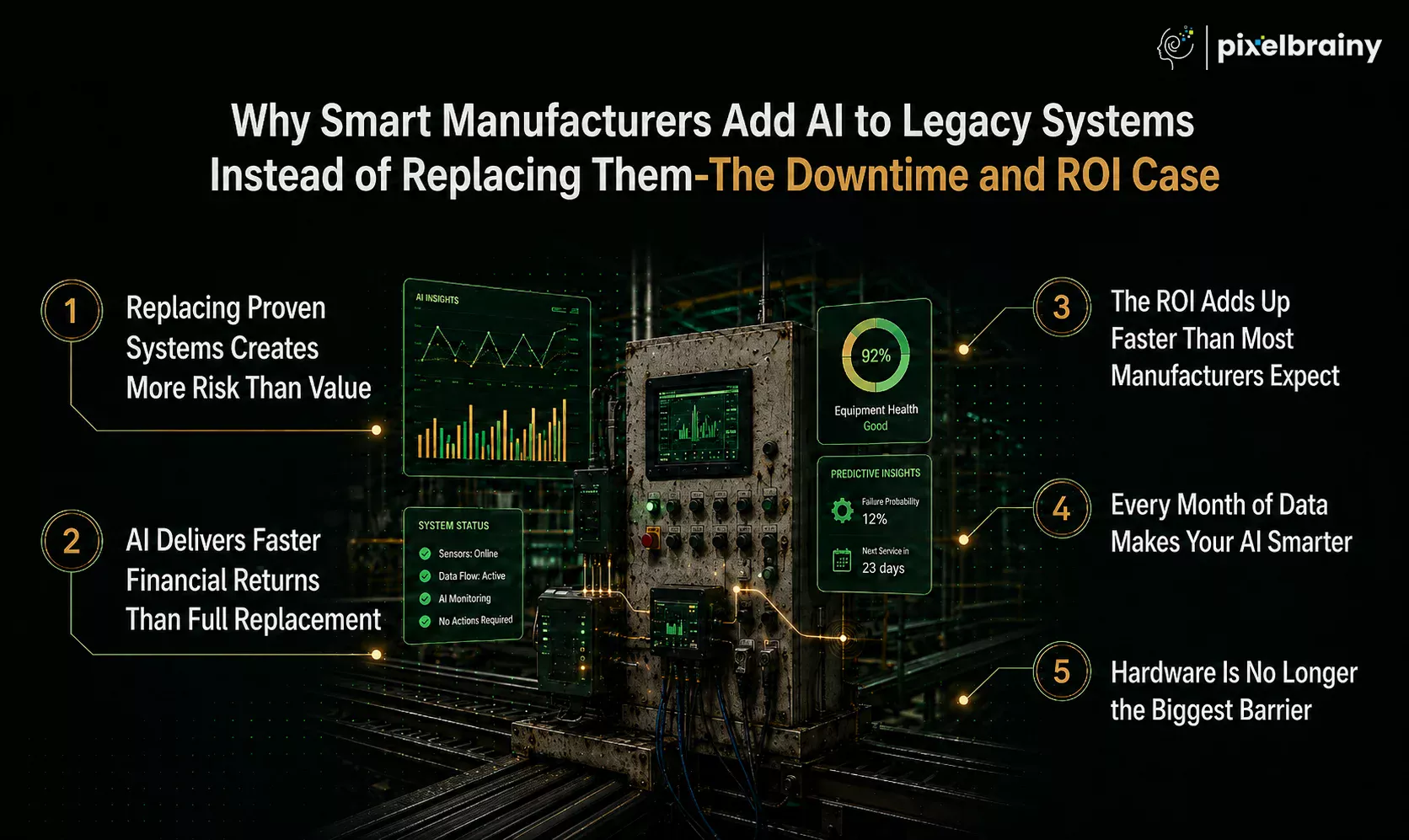
Every ERP, MES, SCADA, or PLC replacement project introduces uncertainty. Production interruptions, software migration, employee retraining, and system validation can stretch across months while increasing implementation costs.
According to Accenture, large enterprises lose an estimated $370 million annually because of technical debt, outdated technology, and unsuccessful modernization initiatives. Instead of taking that risk, manufacturers are extending the life of proven assets through AI integration, allowing innovation without disrupting operations.
The biggest reason companies invest in AI integration manufacturing ROI is simple. Downtime is expensive, and AI directly targets it.
Studies on predictive maintenance downtime reduction statistics consistently show that manufacturers can achieve:
For manufacturers focused on reduce unplanned downtime AI manufacturing, these results often outperform the business case for replacing production systems altogether.
Consider a typical production facility.
| Metric | Value |
|---|---|
| Downtime cost per hour | $40,000 |
| Annual unplanned downtime | 300 hours |
| Annual downtime cost | $12 million |
| AI downtime reduction | 35% |
| Downtime avoided | 105 hours |
| Estimated annual savings | $4.2 million |
This calculation only reflects avoided downtime. Additional benefits such as lower maintenance spending, fewer quality defects, improved production planning, and longer machine life further increase the return.
Unlike traditional automation projects, AI improves continuously.
Each month of machine history, maintenance records, vibration readings, and process data helps prediction models become more accurate. Over time, your factory develops a proprietary operational dataset that competitors cannot easily duplicate. This is one of the strongest answers to why integrate AI with legacy manufacturing systems today rather than waiting several more years.
A decade ago, industrial AI projects required costly sensors and networking infrastructure. Today, many IIoT sensors cost only $0.10 to $0.80 per sensing unit, making hardware relatively affordable.
The real challenge has shifted from collecting data to integrating it securely across legacy equipment, enterprise software, and AI models. That is why modern manufacturers invest in an AI integration layer instead of replacing reliable production assets.
AI integration delivers the greatest value for manufacturers that have:
When finance leaders ask, "How do I justify an AI integration project when replacing everything seems more complete?", the answer comes down to business outcomes. The strongest legacy AI integration business case is one that reduces risk, shortens payback, protects existing investments, and starts generating measurable operational improvements without interrupting production.
One of the biggest misconceptions about AI integration architecture for legacy manufacturing is that AI connects directly to PLCs and starts making machine decisions. In reality, production-ready AI follows a layered architecture that respects the Purdue Model and ISA-95 principles, keeping Operational Technology (OT) and Information Technology (IT) separated while allowing secure data movement. Ignoring this separation is one of the fastest ways to create cybersecurity risks, production instability, and failed AI projects.
The architecture below shows how manufacturers safely move from machine data to business value without modifying existing control logic.
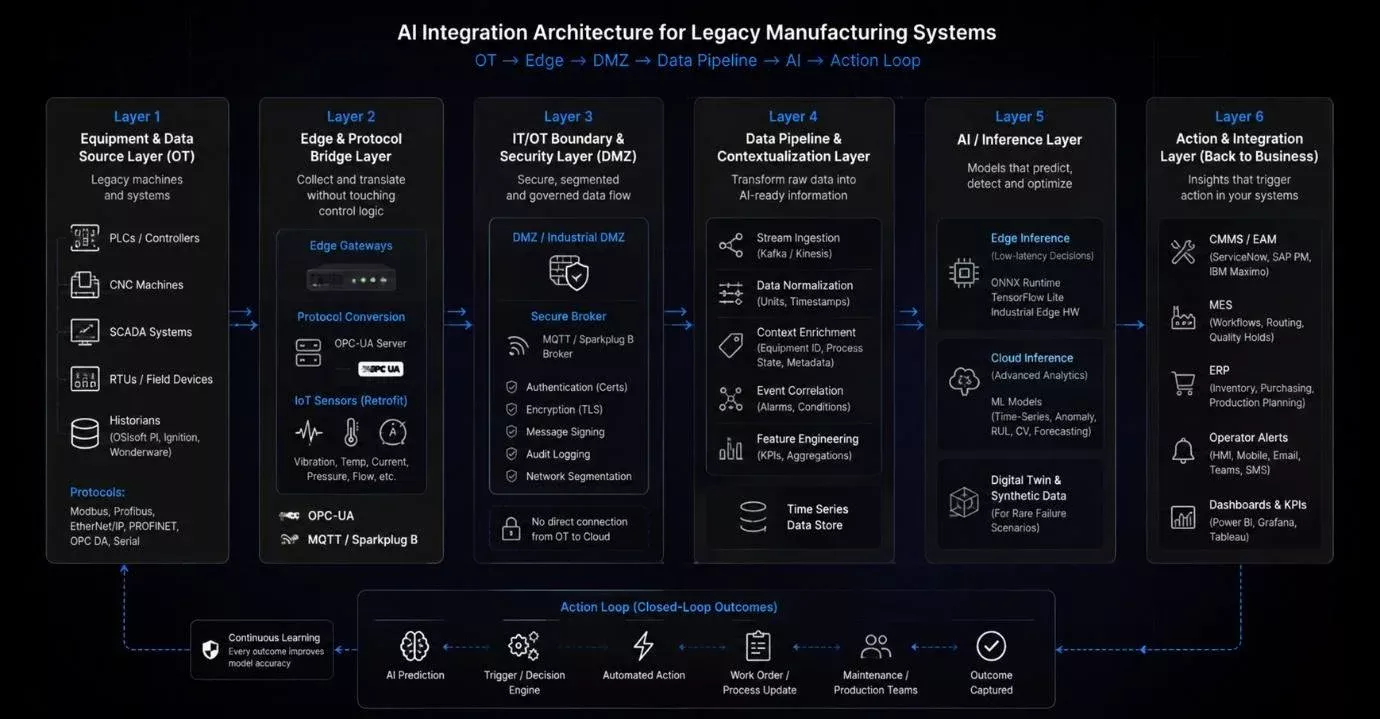
This layer includes the machines already running your plant, such as legacy PLCs, CNC machines, SCADA systems, RTUs, and industrial historians like OSIsoft PI, Wonderware InSQL, or Ignition. Communication often relies on legacy industrial protocols including Modbus, Profibus, EtherNet/IP, and PROFINET.
The challenge is that many PLCs installed 10 to 15 years ago lack native OPC-UA support, while historian data is frequently locked inside proprietary vendor formats. Without a reliable way to access this information, AI has nothing meaningful to analyze.
This is where edge AI legacy manufacturing equipment begins.
Industrial gateways, OPC-UA servers, protocol converters, and retrofit IoT sensors collect machine data without changing PLC programs. Sensors measuring vibration, temperature, current, or pressure can digitize even older equipment that has no modern connectivity.
Protocol gateways translate legacy communication into OPC-UA, while OPC-UA MQTT AI integration manufacturing architectures often use MQTT with Sparkplug B to reduce communication overhead, enable automatic device discovery, and simplify large-scale deployments.
Most importantly, every connection remains read only, protecting production systems from unintended changes.
The most critical layer is the secure boundary between factory operations and enterprise applications.
Following the Purdue model AI integration factory, manufacturers place a DMZ between OT and IT networks where message brokers such as Mosquitto, EMQX, or AWS IoT Core securely transfer production data.
This layer typically includes:
Without this security boundary, sending SCADA or PLC data directly to the cloud creates unnecessary operational and cybersecurity risks.
Raw machine tags are not AI ready.
Before any model can generate reliable predictions, incoming data must be cleaned, standardized, timestamped, normalized, and enriched with operational context. Equipment identifiers, production batches, process states, maintenance history, and environmental conditions transform isolated sensor values into meaningful manufacturing intelligence.
Without contextualization, even the most advanced AI models produce unreliable results.
Once data is prepared, AI models perform predictive maintenance, anomaly detection, remaining useful life estimation, quality inspection, computer vision, and demand forecasting.
Some models execute directly on industrial edge hardware using technologies like ONNX Runtime or TensorFlow Lite for millisecond response times, while more computationally intensive analytics run in the cloud. Manufacturers also increasingly use digital twins and synthetic data to train models for rare failure scenarios that historical datasets may not contain.
AI only creates value when predictions trigger action.
Instead of displaying another dashboard, this layer enables sensor to work order automation manufacturing by integrating predictions with CMMS platforms, ERP systems, MES software, maintenance scheduling, inventory planning, and operator notifications.
For example, an abnormal vibration pattern can automatically create a maintenance work order in SAP PM or ServiceNow, reserve replacement inventory, and notify the maintenance team before a machine fails.
This is where IT OT integration AI predictive maintenance becomes a business outcome rather than simply a technical implementation.
| Architecture Layer | Common Technologies | Alternative Options |
|---|---|---|
| Equipment & Data Sources | PLCs, SCADA, Historians, CNC, RTUs | Legacy DCS, Industrial Sensors |
| Edge & Protocol Bridge | OPC-UA Servers, MQTT, Sparkplug B, Industrial Gateways | Kepware, Ignition Edge, Red Lion |
| IT/OT Security | DMZ, Mosquitto, EMQX, AWS IoT Core | Azure IoT Hub, HiveMQ |
| Data Pipeline | Apache Kafka, Spark, Node-RED | Azure Data Factory, AWS Kinesis |
| AI & Inference | Python, TensorFlow Lite, ONNX Runtime | PyTorch, NVIDIA Triton |
| Business Integration | SAP PM, ServiceNow, MES, ERP | IBM Maximo, Oracle ERP, Microsoft Dynamics |
This layered architecture answers two of the most common questions manufacturers ask: "What does the actual architecture look like for getting AI ready data off legacy machines without touching control logic?" and "How do we respect IT and OT segmentation while still feeding data to AI models?" The answer is not replacing factory systems. It is building a secure integration layer that protects operational technology while enabling AI to deliver measurable business value.
Manufacturing plants rarely operate with a single generation of equipment. A typical production floor includes newer machines that support OPC-UA, older assets communicating through protocols such as Modbus, Profibus, or EtherNet/IP, and decades-old equipment with no digital connectivity at all. This mixed environment often leads manufacturers to believe that AI adoption requires replacing legacy assets. In reality, the objective is much simpler.
You need to make legacy machine data AI-ready by choosing the right connectivity method for each machine while leaving existing equipment and control logic untouched.
A successful AI project begins by identifying how each asset can provide data.
Modern PLCs and controllers that support OPC-UA are the easiest to integrate. A read only OPC-UA client connects to the machine, collects operational data, and streams it through MQTT to the AI platform. Since the connection never modifies PLC logic, manufacturers can connect legacy PLC to AI without replacement while maintaining production stability.
Many production lines still communicate through Modbus, Profibus, or EtherNet/IP. These machines cannot directly send AI-ready data, but industrial edge gateways solve the problem. An OPC-UA gateway for legacy machines translates native protocols into standardized OPC-UA or MQTT messages, allowing AI applications to consume machine data without changing the existing automation system.
Some legacy assets have no communication interface whatsoever. Rather than replacing them, manufacturers retrofit sensors on legacy manufacturing equipment by installing wireless vibration, temperature, current, or power monitoring sensors. These devices transform previously invisible machines into observable assets without modifying the equipment itself.
Historical data is often stored in platforms such as PI System, Wonderware, or Ignition. Effective historian data AI integration manufacturing uses PI Web API, Ignition REST APIs, or historian federation tools to retrieve years of operational history. It is important to note that OPC-UA primarily delivers live operational data, while historical model training requires a separate data extraction path.
The biggest obstacle to AI is rarely connectivity. It is data quality.
Manufacturing data often contains inconsistent tag names, missing timestamps, duplicate records, mismatched engineering units, and siloed ERP or maintenance information. Feeding this directly into an AI model produces unreliable predictions.
Before developing any model, perform a complete data audit followed by ETL processes that extract, cleanse, standardize, and enrich the data with equipment IDs, process states, maintenance history, and production context. In almost every successful deployment, audit your data first is the first practical step.
New AI projects rarely have enough live operational data on day one. The fastest approach combines historical historian records with synthetic data generated through digital twins. This creates an initial training dataset that allows predictive models to begin learning before sufficient live machine data accumulates. As new production data arrives, the models continuously improve their prediction accuracy.
| Equipment Type | Connection Method | Implementation Effort | What You Get |
|---|---|---|---|
| OPC-UA Capable Machines | Read only OPC-UA Client → MQTT | Low | Secure real time machine data for AI |
| Modbus, Profibus, EtherNet/IP Machines | Edge Gateway → OPC-UA/MQTT | Medium | Standardized data without changing PLC programs |
| No Digital Output | Wireless vibration, temperature, and current sensors | Medium | Machine observability without equipment replacement |
| PI System, Wonderware, Ignition Historians | REST APIs or Historian Federation Tools | Medium | Historical datasets for AI model training and analytics |
For manufacturers asking, "How do we get usable data off a mixed fleet of old machines?", the answer is not a single technology. It is a combination of protocol translation, edge connectivity, sensor retrofits, historian integration, and disciplined data preparation that transforms fragmented machine information into reliable, AI-ready intelligence.

For many manufacturers, the first question is not whether AI works. It is whether AI can deliver measurable results when production still depends on legacy systems. Consider a common scenario: Leadership wants "AI in the factory," but your ERP is a 1990s on-premise system with no modern APIs, while machine data is locked inside a proprietary historian. You need to know whether AI integration is technically possible without committing to a costly, multi-year replacement project.
The answer is yes. Modern AI use cases for legacy manufacturing integration work by securely extracting data from existing machines, historians, and business systems, then applying AI models above the control layer. The result is faster insights, lower downtime, and better operational decisions without replacing the infrastructure your factory already relies on.
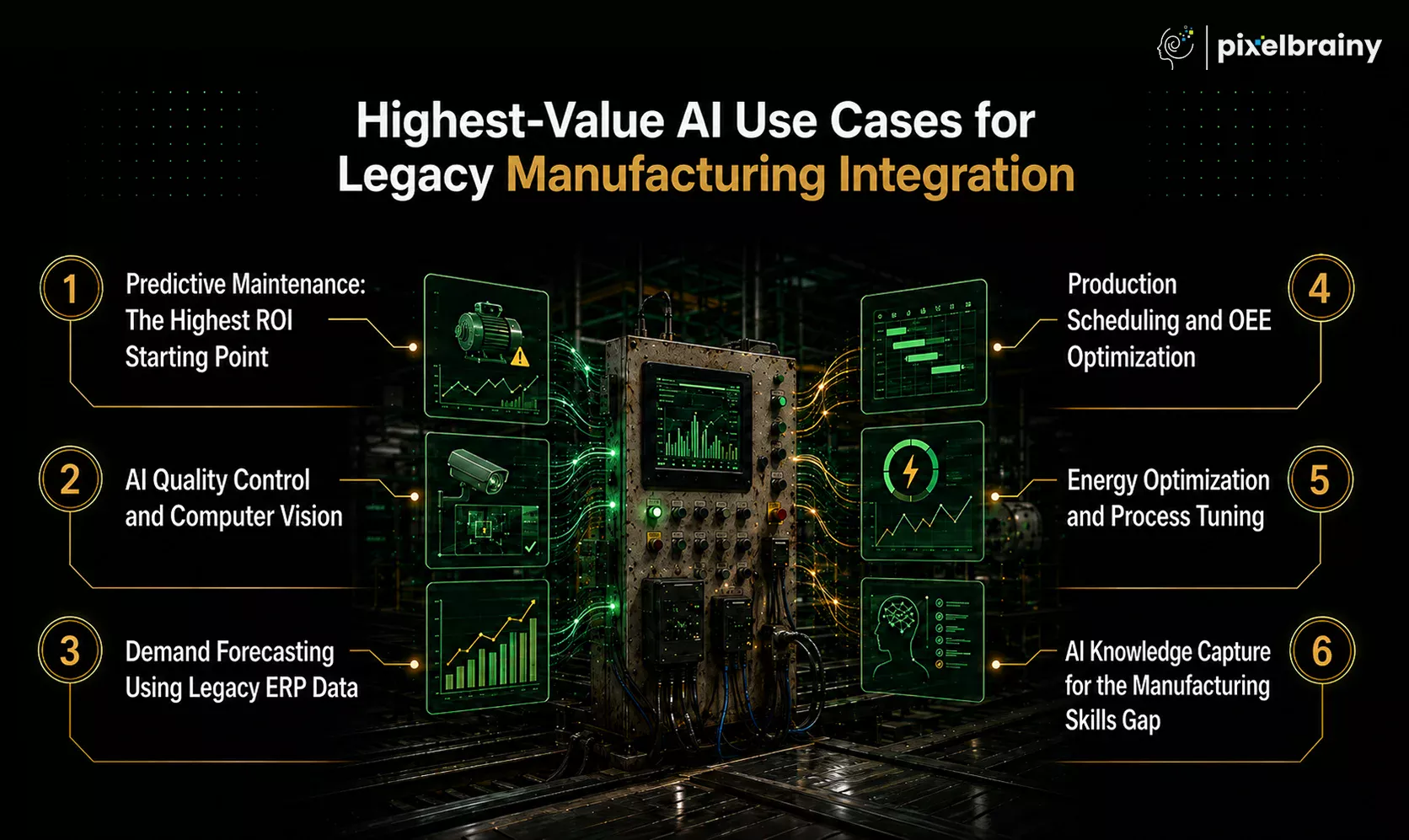
If you are choosing only one AI project, start here.
Predictive maintenance for legacy equipment using AI analyzes machine signals such as vibration, temperature, current, pressure, and runtime hours to identify abnormal patterns before equipment fails. Depending on the application, AI models can predict failures 30 to 90 days in advance with documented accuracy ranging from 80 to 97 percent, helping manufacturers reduce unplanned downtime by 30 to 50 percent.
Example: A stamping press experiences occasional servo motor failures that stop production for several hours. By monitoring motor vibration and current through retrofit sensors, AI detects gradual winding degradation weeks before failure, allowing maintenance teams to replace the motor during scheduled downtime instead of after an unexpected breakdown.
Data Required: PLC data, vibration, temperature, current, maintenance history
Primary KPI: Downtime reduction, maintenance cost, equipment availability
Manual inspection often misses small defects, especially during high-speed production.
AI quality control manufacturing integration combines industrial cameras with edge AI to inspect products in real time, identifying scratches, dimensional errors, missing components, or assembly defects. Since inspection occurs outside the control system, no ERP or PLC replacement is required.
Typical Results: Up to 35 percent lower defect rates and improved first-pass yield.
Data Required: Camera images, production metadata, quality records
Primary KPI: Defect rate, scrap reduction, product consistency
Many manufacturers underestimate the value of decades of ERP transaction history.
Even older on-premise ERP systems contain valuable purchasing, inventory, sales, and production records. Demand forecasting with legacy ERP AI analyzes historical demand patterns to improve production planning, inventory optimization, and procurement decisions.
Typical Results: Approximately 27 percent improvement in forecast accuracy, leading to lower inventory carrying costs and fewer stock shortages.
Data Required: ERP transactions, inventory history, production orders
Primary KPI: Forecast accuracy, inventory turnover, stock availability
Manufacturers often lose productivity because bottlenecks shift throughout the day.
By combining MES schedules with SCADA and machine status data, AI identifies production constraints, recommends scheduling improvements, and optimizes Overall Equipment Effectiveness.
AI integration manufacturing OEE initiatives help production teams balance workloads, reduce idle time, and increase throughput without changing machine control programs.
Data Required: MES schedules, SCADA events, machine status, production history
Primary KPI: OEE, throughput, cycle time
Energy costs continue to rise across manufacturing sectors.
AI continuously analyzes process variables to recommend optimal machine settings, reducing energy consumption while maintaining production quality. Existing sensors and PLC data often provide enough information without installing new automation systems.
Data Required: Energy consumption, process parameters, production rates
Primary KPI: Energy cost per unit, process efficiency
Many manufacturers face an equally serious challenge: experienced operators are retiring faster than they can be replaced.
AI can capture maintenance procedures, troubleshooting guides, machine manuals, and operator expertise into a searchable assistant that helps newer employees solve problems faster. With skilled labor shortages affecting nearly 30 percent of manufacturing organizations, preserving institutional knowledge is becoming a strategic priority.
Data Required: SOPs, maintenance records, manuals, operator documentation
Primary KPI: Training time, troubleshooting speed, workforce productivity
| AI Use Case | Downtime Impact | Integration Effort | Data Required | Time to Value |
|---|---|---|---|---|
| Predictive Maintenance | Very High | Medium | PLCs, sensors, maintenance history | 3–6 Months |
| AI Quality Control | High | Medium | Cameras, production data | 3–6 Months |
| Demand Forecasting | Medium | Low | Legacy ERP history | 2–4 Months |
| Production Scheduling & OEE | High | Medium | MES, SCADA, machine data | 4–6 Months |
| Energy Optimization | Medium | Medium | Energy and process data | 4–8 Months |
| AI Knowledge Assistant | Medium | Low | Manuals, SOPs, maintenance records | 1–3 Months |
Rather than attempting to deploy AI across an entire factory, begin with predictive maintenance on one critical, high-value machine where unexpected failures create the greatest production losses. This approach delivers measurable ROI quickly, validates your AI integration architecture, and builds confidence before expanding to quality inspection, forecasting, scheduling, and other high-value manufacturing applications.
For many manufacturers, the biggest concern is not whether AI works. It is whether AI can be added without disrupting production. You may have heard the same sales pitch repeatedly: "Replace your MES, migrate your ERP, move everything to the cloud." But if your existing systems are stable, replacing them often creates unnecessary risk and cost.
The reality is that how to integrate AI with legacy manufacturing systems step by step follows a phased, non-disruptive approach. Instead of replacing factory systems, AI is layered on top of them, allowing manufacturers to modernize while production continues uninterrupted.
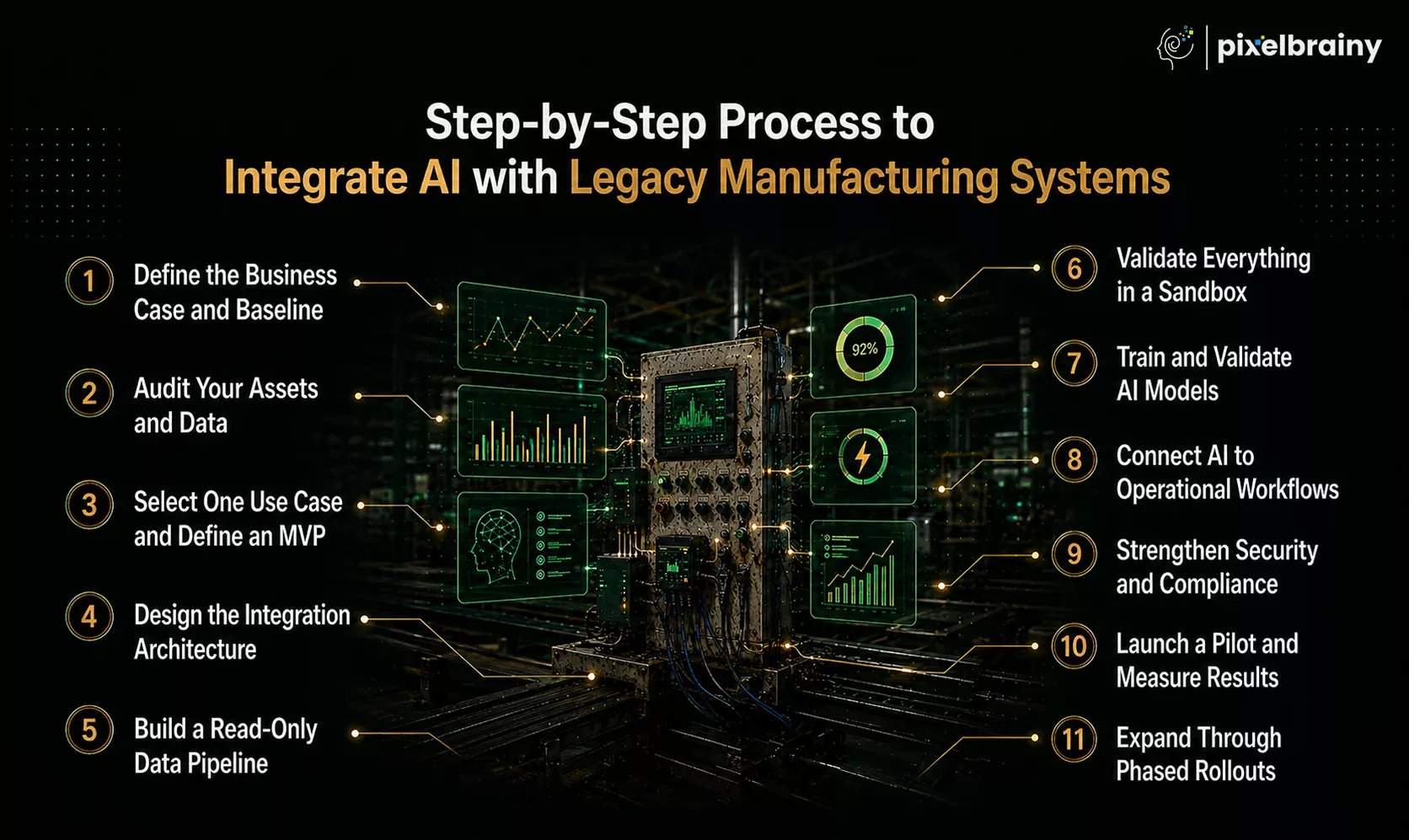
What happens: Measure your current performance, including downtime hours, MTTR, OEE, maintenance cost per production hour, and quality losses. Then identify the machine where one hour of downtime has the highest financial impact.
Who is involved: Operations managers, maintenance leaders, plant managers, and finance teams.
Timeline: 1 week
Non-disruption safeguard: No system changes are made. This is purely an operational assessment.
If skipped: You cannot accurately measure ROI after implementation.
What happens: Inventory every PLC, SCADA system, historian, sensor, ERP, and MES application. Identify communication protocols, data quality issues, historian availability, and missing sensor coverage.
Who is involved: OT engineers, automation engineers, IT teams.
Timeline: 1 to 2 weeks
Non-disruption safeguard: All assessments are performed without modifying production equipment.
If skipped: Hidden connectivity problems can delay the entire project.
What happens: Rather than modernizing the whole factory, choose one production line, one critical asset, and one measurable objective such as predictive maintenance or quality monitoring.
Who is involved: Operations, maintenance, and executive sponsors.
Timeline: Less than 1 week
Non-disruption safeguard: Small project scope minimizes operational risk.
If skipped: Project complexity grows unnecessarily, increasing cost and implementation time.
Also Read: Top 10 AI MVP Development Companies in USA
What happens: Define the complete AI integration manufacturing process, including OT and IT network separation, edge gateways, retrofit sensors, OPC-UA and MQTT connectivity, DMZ architecture, and whether AI inference runs at the edge or in the cloud.
Who is involved: OT architects, cybersecurity teams, AI engineers.
Timeline: 1 to 2 weeks
Non-disruption safeguard: Every connection is designed before deployment, ensuring no direct changes to PLC logic.
If skipped: Security gaps and poor architecture decisions become difficult to fix later.
What happens: Deploy edge gateways and data collectors alongside existing production systems. Machine data is collected through passive, read-only connections without writing back to PLCs.
Who is involved: Automation engineers and integration specialists.
Timeline: 1 to 2 weeks
Non-disruption safeguard: Existing control logic remains completely untouched.
If skipped: Direct system integration increases the risk of production interruptions.
What happens: Test integrations, dashboards, workflows, and AI predictions in a non-production environment before deployment.
Who is involved: AI engineers, QA teams, IT administrators.
Timeline: 1 week
Non-disruption safeguard: Production systems remain isolated throughout testing.
If skipped: A misconfigured ERP workflow or automation rule could trigger real production issues.
What happens: Train predictive models using historian records, maintenance logs, and synthetic or digital twin data to overcome the cold-start problem. Validate model accuracy before deployment.
Who is involved: Data scientists and reliability engineers.
Timeline: 2 to 4 weeks
Non-disruption safeguard: Model development occurs completely outside the production environment.
If skipped: AI predictions may generate excessive false alarms or miss critical failures.
What happens: Integrate predictions with CMMS, ERP, MES, or maintenance systems so AI automatically creates work orders, sends alerts, or recommends inspections. High-impact actions remain human-approved.
Who is involved: Maintenance planners, ERP administrators, integration engineers.
Timeline: 1 to 2 weeks
Non-disruption safeguard: Human approval remains in the loop for critical decisions.
If skipped: AI becomes another dashboard that operators rarely use.
What happens: Configure certificates, encryption, role-based access control, audit logging, and OT cybersecurity policies.
Who is involved: Cybersecurity teams and OT administrators.
Timeline: 1 week
Non-disruption safeguard: Security validation occurs before production rollout.
If skipped: Operational and cybersecurity risks increase significantly.
What happens: Deploy the solution on one production line or one high-value asset. Compare downtime, maintenance costs, and OEE against the original baseline.
Who is involved: Operations, maintenance, AI engineers.
Timeline: 4 to 8 weeks
Non-disruption safeguard: Limited deployment isolates operational risk while demonstrating measurable value.
If skipped: Organization-wide deployments become difficult to justify.
What happens: After proving ROI, expand from one asset to additional machines, production lines, and manufacturing sites. Establish model monitoring and retraining because AI performance naturally changes as equipment ages and production conditions evolve.
Who is involved: Enterprise manufacturing teams, IT, AI operations.
Timeline: Ongoing
Non-disruption safeguard: Rollouts occur incrementally, preventing widespread operational disruptions.
If skipped: AI models eventually lose accuracy, reducing long-term business value.
| Project Scope | Typical Timeline | Expected Outcome |
|---|---|---|
| Single Critical Asset Pilot | 4 to 8 Weeks | Validate predictive maintenance and demonstrate measurable ROI |
| Single Production Line | 2 to 4 Months | Expand to multiple machines and operational workflows |
| Multi-Line or Multi-Plant Program | 4 to 9 Months | Standardize AI deployment across the enterprise |
For manufacturers asking, "Who actually performs non-disruptive AI integration with legacy manufacturing systems, and how do I evaluate them?", the answer is straightforward. Look for partners that prioritize read-only data collection, OT and IT network segmentation, phased pilot deployments, and measurable business outcomes instead of proposing full ERP or MES replacements.
The strongest legacy manufacturing AI pilot rollout starts with one critical asset, proves its value quickly, and scales only after delivering measurable improvements in uptime, maintenance efficiency, and operational performance.
Also Read: Top 10 AI Product Development Companies in USA
One of the most common questions manufacturers ask is: "I've been quoted everything from $80,000 to $600,000 for adding AI to our legacy plant, and nobody explains the gap." The confusion comes from the fact that many vendors combine hardware, software, integration, AI development, cybersecurity, and ongoing support into a single proposal. To build a realistic manufacturing AI integration cost 2026 estimate, you need to separate each cost layer.
The largest portion of the budget is usually not the AI model itself. Instead, it is the engineering effort required to connect legacy PLCs, SCADA systems, historians, ERP platforms, and edge devices into a secure, production-ready architecture.
A focused predictive maintenance pilot on one high-value machine is the most cost-effective way to validate ROI.
| Cost Component | Estimated Cost (USD) |
|---|---|
| Retrofit sensors + edge gateway | $5,000–$25,000 |
| Data pipeline + OPC-UA/MQTT integration | $10,000–$30,000 |
| AI model development & training | $15,000–$40,000 |
| CMMS or alert integration | $8,000–$20,000 |
| Total Pilot Investment | $40,000–$115,000 |
Typical Timeline: 4 to 8 weeks
Well-defined plug-and-play predictive maintenance pilots can often begin for less than $50,000, especially when existing sensors and historians are already available.
Expanding AI across multiple machines introduces additional integration, security, and workflow complexity.
| Cost Component | Estimated Cost (USD) |
|---|---|
| Sensors and gateways | $25,000–$80,000 |
| Data pipeline, DMZ, contextualization | $30,000–$70,000 |
| AI models (Predictive Maintenance + Quality Vision) | $40,000–$120,000 |
| ERP and CMMS integration | $20,000–$50,000 |
| Security and compliance | $15,000–$40,000 |
| Total Line Investment | $130,000–$360,000 |
Typical Timeline: 2 to 4 months
Enterprise-wide deployments focus on creating a reusable architecture that can scale across multiple factories.
| Cost Component | Estimated Cost (USD) |
|---|---|
| Enterprise edge infrastructure | $80,000–$250,000 |
| Multi-site data pipeline & DMZ | $60,000–$150,000 |
| AI model suite & edge inference | $80,000–$200,000 |
| ERP, MES & CMMS integration | $60,000–$150,000 |
| Security, governance & MLOps | $40,000–$100,000 |
| Total Enterprise Program | $320,000–$850,000+ |
Typical Timeline: 4 to 9 months
After deployment, AI systems require continuous monitoring and maintenance to maintain prediction accuracy.
| Annual Operating Cost | Estimated Cost |
|---|---|
| Model monitoring & retraining | $20,000–$80,000 per year |
| Edge or cloud infrastructure | $2,000–$12,000 per month |
| Pipeline maintenance & support | $15,000–$40,000 per year |
These recurring costs ensure AI models remain accurate as equipment ages, production conditions change, and new operational data becomes available.
The cost to integrate AI with legacy systems depends far more on integration complexity than on AI algorithms.
Several factors significantly influence pricing:
Two manufacturers may request predictive maintenance, but one plant with modern OPC-UA connectivity could cost a fraction of another facility operating dozens of proprietary PLCs across multiple sites.
Understanding the budget structure helps prevent unexpected expenses later.
| One-Time Capital Investment | Recurring Operational Cost |
|---|---|
| Edge gateways and sensors | Cloud or edge infrastructure |
| Data pipeline development | Model monitoring and retraining |
| AI model development | Platform subscriptions |
| ERP, MES, CMMS integration | Software maintenance |
| Security implementation | Ongoing support |
Many SaaS platforms also charge per device, per tag, or per message, which can significantly increase long-term operating costs. Manufacturers that build a custom integration layer typically retain full ownership of their operational data while avoiding escalating subscription fees.
| Budget | Typical Scope |
|---|---|
| Around $50K | Predictive maintenance pilot for one critical machine using existing infrastructure |
| Around $250K | Full production-line deployment with predictive maintenance, quality inspection, secure data pipeline, and ERP or CMMS integration |
| Around $700K | Enterprise AI platform supporting multiple production lines or plants with centralized governance, advanced AI models, and scalable architecture |
Yes. Many manufacturers work with experienced India-based engineering teams to lower implementation costs while maintaining technical quality. Compared with equivalent US or UK consulting engagements, offshore delivery can reduce overall project costs by 40 to 60 percent, particularly for AI model development, software engineering, data pipeline construction, and enterprise integrations.
The key is choosing a partner with deep expertise in industrial automation, OT cybersecurity, and legacy manufacturing environments rather than selecting solely on hourly rates.
Ultimately, your legacy manufacturing AI integration budget should be driven by business outcomes rather than technology alone. A carefully planned pilot that delivers measurable downtime reduction often creates far greater value than a costly enterprise rollout implemented before the architecture and ROI have been validated.
Also Read: AI Software Development Cost: A Complete Software Cost Guide
Integrating AI into legacy manufacturing systems is rarely limited by the AI technology itself. The biggest obstacles are typically found in decades-old infrastructure, fragmented data, cybersecurity requirements, and organizational readiness. Understanding these challenges integrating AI with legacy manufacturing systems before implementation allows you to reduce project risk and accelerate time to value.
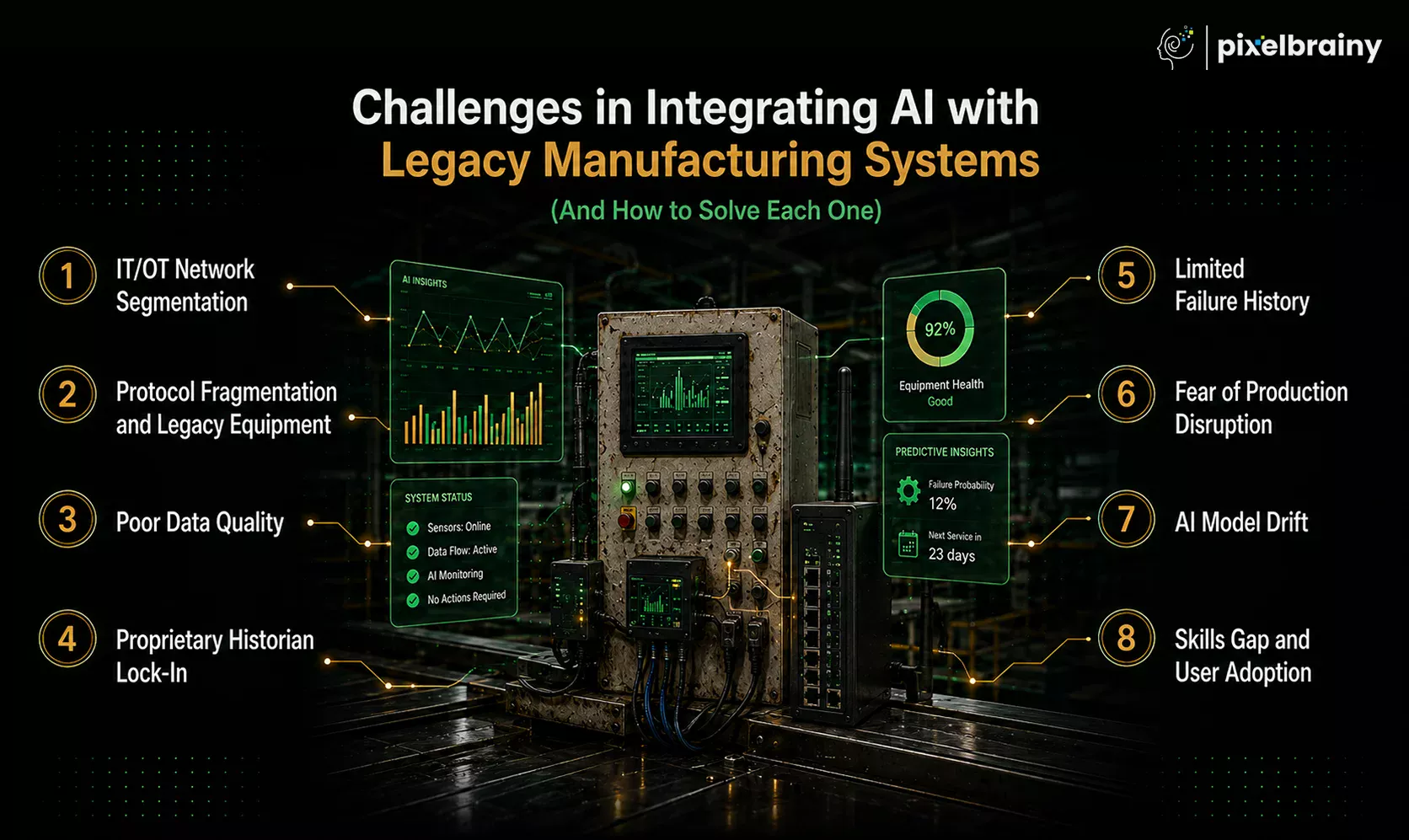
The challenge: Manufacturing security teams are understandably reluctant to allow production systems such as PLCs and SCADA servers to communicate directly with cloud platforms.
Why it is harder than expected: Bypassing established IT and OT boundaries increases cybersecurity risks and can violate internal security policies.
The solution: Follow the Purdue Model and ISA-95 architecture by implementing a secure DMZ, brokered data flow, certificate-based authentication, encryption, and read-only connectivity. This approach addresses one of the most critical IT OT integration challenges for AI while protecting production systems.
The challenge: A single factory may contain equipment using Modbus, Profibus, EtherNet/IP, proprietary protocols, and machines with no digital connectivity.
Why it is harder than expected: There is no universal connector that works across every legacy device.
The solution: Use industrial edge gateways to translate protocols into OPC-UA or MQTT, install retrofit sensors where necessary, and use robotic process automation (RPA) for legacy software that only supports user interface interactions.
The challenge: AI models require consistent, reliable data, but many manufacturers struggle with incomplete maintenance records, duplicate machine tags, inconsistent units, and disconnected ERP data.
Why it is harder than expected: Even advanced AI models cannot compensate for unreliable input data.
The solution: Begin every project with a comprehensive data audit followed by ETL processes that clean, standardize, and enrich operational data. Improving legacy data quality for AI manufacturing should always be the first implementation step.
The challenge: Industrial historians such as PI System, Wonderware, and Ignition often store valuable historical information in proprietary formats.
Why it is harder than expected: Live machine connectivity alone does not provide enough historical data to train accurate AI models.
The solution: Extract historical datasets through historian REST APIs or federation tools, creating a unified dataset for analytics and model training.
The challenge: Critical machine failures occur infrequently, leaving AI models with very few examples to learn from.
Why it is harder than expected: Predictive maintenance performs best when trained on both normal and failure conditions.
The solution: Combine historical historian records with synthetic data, digital twins, and transfer learning techniques to overcome the cold-start problem and improve prediction accuracy.
The challenge: Many manufacturers delay AI projects because they fear unexpected downtime caused by system integration.
Why it is harder than expected: Even a minor production interruption can result in significant financial losses.
The solution: Deploy read-only data collection, validate every workflow in a sandbox environment, launch a phased pilot on one critical asset, and maintain a rollback plan before any production rollout. This approach significantly reduces manufacturing AI integration risks.
The challenge: Machine behavior changes over time because of equipment wear, process improvements, seasonal conditions, and operational changes.
Why it is harder than expected: Models that perform well today can gradually lose prediction accuracy.
The solution: Implement continuous performance monitoring, automated retraining triggers, and periodic model validation to address AI model drift in manufacturing before it affects production decisions.
The challenge: Many manufacturers face a shortage of experienced OT professionals while a significant portion of the workforce approaches retirement.
Why it is harder than expected: Successful AI projects depend on people trusting and using AI recommendations.
The solution: Design simple operator interfaces, integrate AI into existing workflows rather than creating new ones, and capture the knowledge of experienced technicians through searchable AI assistants before that expertise is lost.
Successful manufacturers do not eliminate every challenge before starting an AI project. They reduce risk through careful planning, secure integration architecture, clean data, phased deployments, and continuous improvement. By addressing these obstacles systematically, legacy manufacturing systems can support modern AI capabilities without compromising operational stability.
The core problem is a competency gap. AI shops do not know factories, and traditional system integrators do not know modern machine learning. One group can build impressive AI models but struggles with PLCs, SCADA systems, industrial protocols, and OT cybersecurity. The other understands factory automation inside out but often lacks expertise in predictive analytics, MLOps, and enterprise AI. Successful AI integration for legacy manufacturing requires both skill sets working together. Without that combination, projects become expensive proof-of-concepts that never deliver measurable operational value.
This challenge becomes even greater if your organization operates multiple plants with different equipment vintages. You need a partner that builds a repeatable integration architecture instead of designing a completely different solution for every facility. A standardized approach using edge gateways, protocol translation, secure data pipelines, and reusable AI models allows you to scale from one production line to multiple plants without creating a custom integration that becomes difficult to maintain.
Before selecting a partner, ask these questions during the evaluation process:
The answers to these questions will tell you far more than a polished sales presentation and are essential when you vet a manufacturing AI integration partner.
Not every vendor is equipped to deliver production-ready industrial AI. Be cautious if a provider:
These warning signs usually indicate limited experience with real-world manufacturing environments.
| Partner Type | Best For | Limitations |
|---|---|---|
| In-House Team | Organizations with experienced OT, IT, and AI engineers | High hiring costs, limited scalability, longer delivery time |
| Specialist AI Integration Company | End-to-end manufacturing AI integration with scalable architecture | Requires careful vendor evaluation |
| General Digital Agency | Business dashboards and basic analytics | Limited industrial automation and factory expertise |
For most manufacturers, a specialist partner provides the best combination of industrial knowledge, AI expertise, and deployment experience.
Your evaluation should not stop at technical capability. Understand who owns the integration architecture, source code, AI models, and operational data after deployment.
Whenever possible, invest in a one-time integration platform that your organization owns instead of becoming dependent on vendors that charge recurring fees based on the number of devices, data tags, or transmitted messages. Owning your integration layer gives you greater flexibility to expand across multiple plants while avoiding long-term vendor lock-in and unpredictable subscription costs.
| Evaluation Criteria | What to Look For |
|---|---|
| OT & Legacy Systems Experience | Demonstrated expertise with PLCs, SCADA, historians, industrial protocols, and brownfield manufacturing environments |
| AI & Machine Learning Capability | Proven experience in predictive maintenance, computer vision, forecasting, and MLOps |
| IT/OT Security Architecture | Purdue Model, ISA-95, DMZ, encryption, certificate-based authentication, and secure data pipelines |
| Read-Only, Non-Disruptive Integration | Ability to collect production data without modifying PLC programs or control logic |
| Action-Loop Integration | Connects AI predictions directly to ERP, MES, CMMS, and maintenance workflows |
| Multi-Plant Repeatability | Standardized architecture that scales across different factories instead of creating one-off implementations |
| Pricing Transparency | Clearly separates hardware, integration, AI development, licensing, and ongoing support costs |
If your goal is to choose an AI integration partner for legacy manufacturing that can support multiple plants with different generations of equipment, prioritize partners that deliver a repeatable architecture rather than isolated custom projects. The best AI integration vendor for legacy systems understands factory operations, respects OT security, builds non-disruptive integration pipelines, and creates a scalable foundation that can grow with your manufacturing business for years to come.
Finding the right partner is often harder than choosing the AI technology itself. You may have already spoken with AI agencies that understand machine learning but have never worked inside a manufacturing plant. Or perhaps you've met automation integrators who know PLCs and SCADA systems but lack experience building production-ready AI solutions. The difference lies in choosing a team that understands both legacy operational technology and modern artificial intelligence.
That is exactly where PixelBrainy stands apart as an AI integration company in USA, delivering end-to-end manufacturing AI integration solutions designed specifically for brownfield manufacturing environments.
Production continuity comes first.
PixelBrainy delivers non-disruptive AI manufacturing integration solutions by deploying read-only data pipelines alongside your existing systems. No PLC logic is modified, every workflow is validated in a sandbox before production deployment, and rollback procedures are built into the implementation plan from day one. Your operations continue running while AI begins learning from your existing equipment.
Industrial cybersecurity is built into the architecture from the beginning.
Every legacy manufacturing systems AI integration project follows the Purdue Model and ISA-95 framework, using secure DMZ architecture, brokered data flow, certificate-based authentication, encrypted communication, and OT security validation before production deployment. Instead of sending raw SCADA data directly to the cloud, PixelBrainy creates a secure data pathway that satisfies both operational and cybersecurity requirements.
Most factories operate a combination of OPC-UA capable machines, Modbus devices, proprietary PLCs, and equipment with no digital output.
PixelBrainy combines industrial edge gateways, protocol bridging, and retrofit wireless sensors to make mixed manufacturing environments AI-ready without replacing proven production assets. This approach allows manufacturers to modernize gradually while protecting previous automation investments.
Generating insights is only half the solution.
PixelBrainy builds complete operational workflows where AI predictions automatically create CMMS work orders, trigger ERP updates, notify maintenance teams, and integrate directly into the systems your operators already rely on. The focus is not simply reporting data but enabling faster operational decisions.
Complex manufacturing AI projects often involve separate vendors for automation, cloud infrastructure, AI development, cybersecurity, and enterprise integration.
PixelBrainy provides complete AI integration solutions for legacy manufacturing, including edge infrastructure, secure data pipelines, AI model development, ERP and MES integration, rollout planning, model monitoring, retraining, and long-term optimization. The critical integration work remains under one team, reducing delays, communication gaps, and vendor finger-pointing.
This is the rare capability that determines project success.
PixelBrainy combines deep knowledge of legacy PLCs, SCADA systems, historians, industrial protocols, and OT security with modern AI engineering, predictive maintenance, computer vision, MLOps, and enterprise data architecture. Instead of learning your factory during the project, the team applies proven manufacturing integration practices from the very beginning.
Successful AI deployment does not end after the first pilot.
PixelBrainy ranked among top AI consulting companies in USA continuously monitors model performance, retrains AI as production conditions evolve, and builds a standardized architecture that can expand from one production line to multiple plants. The second facility becomes a configuration exercise rather than a complete redevelopment project, reducing both implementation time and long-term costs.
Your legacy systems are an asset, not an obstacle. Before you let anyone convince you to replace proven production infrastructure, explore how a non-disruptive manufacturing AI integration strategy can reduce downtime, improve equipment reliability, and maximize the value of the systems you already own.
Book a free 30-minute manufacturing AI integration assessment with PixelBrainy's team. You'll receive a clear integration architecture, implementation roadmap, estimated timeline, and realistic cost range before committing a single dollar. If you're ready to hire PixelBrainy for AI predictive maintenance integration, we'll help you build an AI strategy that works with your factory, not against it.
Your factory does not need to be rebuilt to become intelligent. The machines, PLCs, SCADA systems, and historians you already rely on are generating valuable operational data every day. The real opportunity lies in connecting that data to AI safely and strategically.
Successful manufacturing AI integration comes down to four critical decisions. First, build a secure, read-only integration architecture that respects IT and OT boundaries without modifying control logic. Second, prioritize high-impact use cases, with predictive maintenance delivering the fastest and most measurable return. Third, ensure AI predictions trigger real operational actions through your CMMS, ERP, or maintenance workflows instead of becoming another dashboard that nobody checks. Finally, choose a partner with expertise in both legacy manufacturing systems and modern AI engineering.
The timing matters. Downtime costs continue to rise, manufacturing equipment is older than it has been in decades, and every month of operational data strengthens future prediction accuracy. Manufacturers that begin integrating AI today build a data advantage that becomes increasingly difficult for competitors to match.
If you're exploring legacy manufacturing AI integration, start with a conversation, not a replacement project. The team at PixelBrainy can help you evaluate your existing systems, so let's connect with our AI experts and identify the highest-value AI opportunities, and design a non-disruptive integration roadmap tailored to your plant. Sometimes the smartest modernization strategy is not replacing what already works, but helping it work even smarter.
No, you do not have to replace your legacy ERP or SCADA system to add AI. Manufacturing AI integration with legacy systems works by layering intelligence alongside your existing infrastructure rather than ripping it out. AI connects to your PLCs, SCADA, historians, and ERP through read-only data pathways, processes that data in a pipeline above the control layer, and feeds predictions back into the systems you already use. Your control logic stays untouched, your production keeps running, and you avoid the cost, risk, and downtime of a full rip-and-replace modernization project.
No, a properly designed AI integration does not require production downtime. The data pipeline is deployed alongside live systems in read-only mode, passively extracting machine data without modifying any control logic or SCADA configuration. Your existing dashboards, alarms, and reports keep working exactly as before while the AI layer is built in parallel. Reputable integration partners validate all models and workflows in a sandbox environment before anything touches production, and they keep rollback readiness in place, so your lines continue operating normally throughout the entire integration.
AI connects to a legacy machine with no API using edge gateways and retrofit sensors. For machines that only speak older protocols like Modbus, Profibus, or EtherNet/IP, a protocol gateway translates their data into modern formats such as OPC-UA and MQTT. For machines with no digital output at all, you attach wireless retrofit sensors that measure vibration, temperature, and current, making previously silent equipment observable. For UI-only legacy software, Robotic Process Automation bots can extract data through the existing interface. None of these approaches require replacing or modifying the equipment.
AI predictive maintenance reduces unplanned manufacturing downtime by 30 to 50 percent in documented production deployments, while also lowering maintenance costs by 25 to 30 percent and extending equipment life by 20 to 25 percent. Modern AI models predict equipment failures 30 to 90 days in advance with 80 to 97 percent accuracy, giving teams time to schedule repairs during planned windows instead of reacting to catastrophic breakdowns. For a plant losing $40,000 per hour across 300 hours of annual downtime, a 35 percent reduction can save roughly $4.2 million per year.
Manufacturing AI integration with legacy systems typically costs between $40,000 and $115,000 for a single-asset pilot, $130,000 to $360,000 for a full single-line integration, and $320,000 to $850,000 or more for a multi-line or multi-plant program. Costs separate into edge hardware and sensors, the data pipeline and integration work, the AI model, the action-loop integration into your CMMS or ERP, and security hardening. Plug-and-play predictive maintenance pilots can start under $50,000. Quotes vary widely depending on fleet protocol diversity, security requirements, and how many sites are involved.
AI integration respects IT/OT network segmentation by routing data through a secure DMZ rather than pulling raw control-system data directly to the cloud. Following the Purdue Model and ISA-95 standards, machine data is extracted read-only, passed through a broker, and protected with certificate-based authentication, message signing, encryption, and audit logging before it ever reaches an AI model. Any vendor proposing to connect raw SCADA data straight to a cloud platform without addressing the DMZ is not production-ready. A correct architecture keeps your operational technology network isolated and secure throughout.
Integrating AI with a legacy manufacturing line typically takes 4 to 8 weeks for a single-asset predictive maintenance pilot, 2 to 4 months for a full single-line integration, and 4 to 9 months for a multi-line or multi-plant program. Timelines depend on the diversity of your equipment protocols, the quality of your existing data, the strictness of your security requirements, and how deeply predictions need to integrate back into your CMMS and ERP workflows. Starting with one critical, high-cost asset lets you prove downtime reduction quickly before scaling across the plant.

About The Author
Sagar Bhatnagar
Sagar Sahay Bhatnagar brings over a decade of IT industry experience to his role as Marketing Head at PixelBrainy. He's known for his knack in devising creative marketing strategies that boost brand visibility and market influence. Sagar's strategic thinking, coupled with his innovative vision and focus on results, sets him apart. His track record of successful campaigns proves his ability to utilize digital platforms effectively for impactful marketing efforts. With a genuine passion for both technology and marketing, Sagar continuously pushes PixelBrainy's marketing initiatives to greater success.

Working with the PixelBrainy team has been a highly positive experience. They understand the design requirements and create beautiful UX elements to meet the application needs. The dev team did an excellent job bringing my vision to life. We discussed usability and flow. Sagar worked with his team to design the database and begin coding. Working with Sagar was easy. He has the knowledge to create robust apps, including multi-language support, Google and Apple ID login options, Ad-enabled integrations, Stripe payment processing, and a Web Admin site for maintaining support data. I'm extremely satisfied with the services provided, the quality of the final product, and the professionalism of the entire process. I highly recommend them for Android and iOS Mobile Application Design and Development.

Great experience working with them. Had a lot of feedback and I found that unlike most contractors they were bugging me for updates instead of the other way around. They were extremely time conscience and great at communicating! All work was done extremely high quality and if not on time, early! They were always proactive when it comes to communication and the work is great/above par always. Very flexible and a great team to work with! Goes above and beyond to present us with multiple options and always provides quality. Amazing work per usual with Chitra. If you have UI/UX or branding design needs I recommend you go to them! Will likely work with them in the future as well, definitely recommended!

PixelBrainy is a joy to work with and is a great partner when thinking through branding, logo, and website layout. I appreciate that they spend time going into the "why" behind their decisions to help inform me and others about industry best practices and their expertise.

I hired them to design our software apps. Things I really like about them are excellent communication skills, they answer all project suggestions and collaborate right away, and their input on design and colors is amazing. This project was complex and needed patience and creativity. The team is amazing to do business with. I will be using them long-term. Glad to see there are some good people out there. I was afraid to try and outsource my project to someone but I am glad I met them! I really can't say enough. They went above and beyond on this project. I am very happy with everything they have done to make my business stand out from the competition.

It was great working with PixelBrainy and the team. They were very responsive and really owned the project. We'll definitely work with them again!

I recently worked with the PixelBrainy team on a project and I was blown away by their communication skills. They were prompt, clear, and articulate in all of our interactions. They listened and provided valuable feedback and suggestions to help make the project a success. They also kept me updated throughout the entire process, which made the experience stress-free and enjoyable.

PixelBrainy is very good at what it does. The team also presents themselves very professionally and takes care of their side of things very well. I could fully trust them taking up the design work in a timely and organised manner and their attention to detail saved us lots of effort and time. This particular project was quite intense and the team showed that they function very well under pressure. Very much looking forward to working with her again!

It's always an absolute pleasure working with them. They completed all of my requests quickly and followed every note I had for them to a T, which made our process go smoothly from start to finish. Everything was completed fast and following all of the guidelines. And I would recommend their services to anyone. If you need any design work done in the future, PixelBrainy should be your first call!

They took ownership of our requirements and designed and proposed multiple beautiful variants. The team is self-motivated, requires minimum supervision, committed to see-through designs with quality and delivering them on time. We would definitely love to work with PixelBrainy again when we have any requirements.

PixelBrainy was a big help with our SaaS application. We've been hard at work with a new UI/UX and they provided a lot of help with the designs. If you're looking for assistance with your website, software, or mobile application designs, PixelBrainy and the team is a great recommendation.

PixelBrainy designers are amazing. They are responsive, talented, and always willing to help craft the design until it matches your vision. I would recommend them and plan to continue them for my future projects and more!!!

They were awesome! Did a good job fast, and good communication. Will work with them again. Thank you

Creative, detail-oriented, and talented designers who take direction well and implement changes quickly and accurately. They consistently over-delivered for us.

PixelBrainy team is very talented and creative. Great designers and a pleasure to work with. PixelBrainy is an excellent communicator and I look forward to working with them again.

PixelBrainy has a very talented design team. Their work is excellent and they are very responsive. I enjoy working with them and hope to continue on all of our future projects.


Transform your ideas into reality with us.
Across these industries, each engagement brings unique challenges, from early-stage product development to scaling complex systems, helping us build a practical understanding of real-world product environments.