AI Summary Powered by PixelBrainy
What if an AI agent could identify claim errors before submission, predict payer rejections, recommend corrections, and document every decision for your compliance team?
For a 200-physician multispecialty group with an 82% clean claim rate, 18 out of every 100 claims fail to meet clean-claim criteria. This creates additional billing work, increases denial risks, and delays revenue collection. For revenue cycle directors, the challenge is determining whether AI can reduce these inefficiencies while delivering measurable financial returns.
This is where building an AI agent for medical billing and insurance processing can create significant value. AI billing agents automate eligibility verification, medical coding assistance, claim validation, denial management, insurance processing, and accounts receivable follow-ups while reducing repetitive administrative tasks.
The market reflects growing adoption. According to Grand View Research , the global AI in healthcare market is estimated to reach $50.7 billion in 2026 and $505.6 billion by 2033, growing at a projected CAGR of 38.9%.
However, healthcare organizations exploring how to create an AI agent for medical billing and insurance processing with HIPAA compliance and audit trail features must consider more than automation. Secure data handling, explainable AI decisions, human oversight, and regulatory compliance are essential for protecting patient information and maintaining operational accountability.
Similarly, developing an AI agent for medical billing and insurance processing with EHR integration and practice management features requires seamless connectivity with existing healthcare systems, payer databases, and clearinghouses to support accurate, efficient claim processing.
This comprehensive guide explores development steps, essential features, HIPAA compliance, technology stacks, realistic development costs, and documented clean claim improvements. It also examines U.S. development companies with publicly reported revenue-cycle outcomes and build-versus-buy considerations.
For organizations developing a scalable medical billing and insurance processing AI agent for enterprise health systems, these insights provide a practical foundation for evaluating investment opportunities, improving clean claim performance, reducing administrative costs, and building a measurable business case for the CFO.

An AI agent for medical billing and insurance processing is an intelligent software system that can analyze healthcare and insurance data, understand revenue cycle workflows, make context-based decisions, use connected healthcare systems, and complete predefined billing tasks with appropriate human oversight. Unlike a basic chatbot or rules-based automation tool, an AI agent can perform multiple steps in a workflow and determine what action should happen next.
For example, traditional billing software may flag a claim because a patient's insurance eligibility is inactive. An AI billing agent can go further by reviewing the eligibility response, checking the patient's insurance information, comparing the encounter against payer requirements, identifying the likely reason for rejection, recommending a correction, and routing the exception to the appropriate billing employee.
A typical medical billing AI agent operates through several interconnected layers:
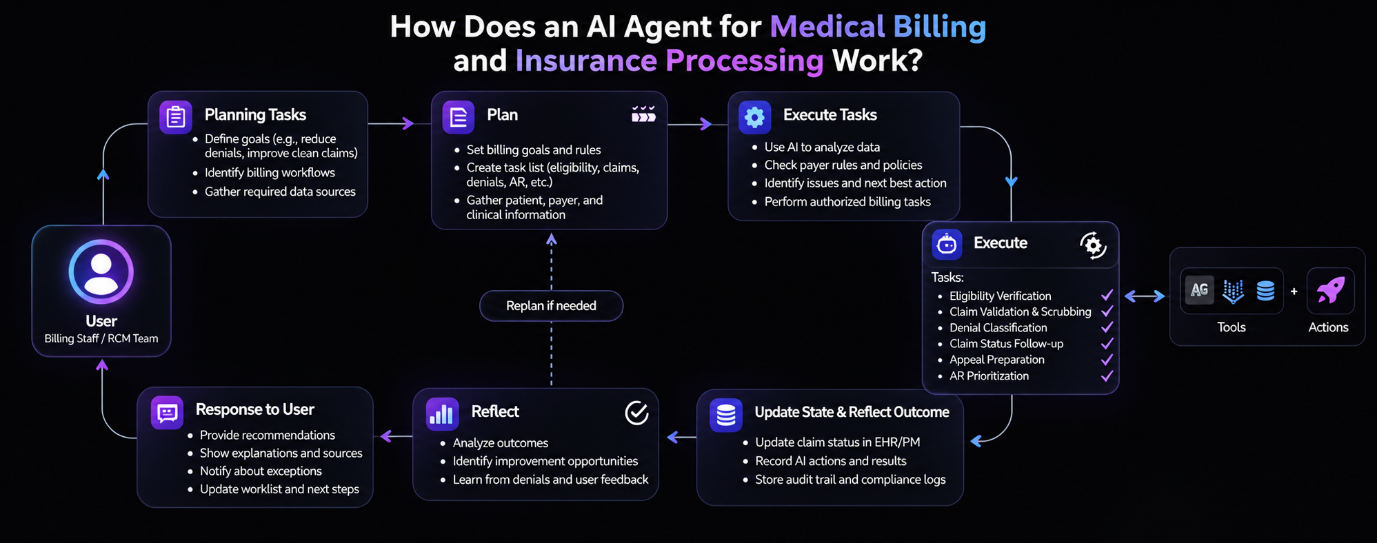
The agent collects relevant information from EHR and EMR systems, practice management platforms, clearinghouses, payer systems, eligibility databases, claims, remittance information, clinical documentation, and patient records. Healthcare interoperability standards such as FHIR, HL7, and X12 can support data exchange between systems.
The AI layer uses technologies such as large language models, machine learning, natural language processing, document intelligence, and predictive analytics. These technologies help the agent understand clinical documentation, insurance information, payer communications, claim data, and denial reasons.
A reliable billing agent should not depend entirely on an LLM's general knowledge. It can use retrieval-augmented generation (RAG) to access approved payer policies, coding guidelines, organizational billing rules, historical denial information, and standard operating procedures.
The orchestration layer determines what needs to happen next. For example, the agent may identify a missing authorization, retrieve supporting information, assess the claim's denial risk, and recommend a corrective action.
Based on its permissions, the AI agent can perform tasks such as claim validation, eligibility verification, denial classification, claim-status follow-up, appeal preparation, AR prioritization, and billing worklist creation.
High-risk activities should require human approval. Every significant AI action can be recorded with the data accessed, recommendation generated, supporting sources, user approval, final action, timestamp, and system response.
In practice, the workflow can look like:
EHR/PM Data → AI Agent → Eligibility & Payer Rules → Claim Analysis → Risk Detection → Recommended Action → Human Approval → Claim/Workflow Update → Audit Trail
This architecture makes AI useful across the medical revenue cycle while maintaining control, transparency, and accountability. For healthcare organizations developing an AI agent for medical billing and insurance processing with EHR integration, the goal is not simply to automate individual billing tasks. The goal is to create a connected, intelligent, and measurable revenue-cycle workflow that can reduce rework, prevent avoidable denials, accelerate payment, and scale across providers, specialties, locations, and payers.
Why are healthcare organizations investing in AI agents for medical billing and insurance processing now, instead of waiting for traditional billing automation to evolve further? The answer is not simply the promise of better efficiency. In 2026, physician groups, hospitals, and medical billing companies are facing a combination of rising claim complexity, increasingly automated payer processes, prior authorization pressure, workforce constraints, and changing interoperability requirements that are forcing revenue cycle leaders to reconsider how billing operations are designed.
Claim denials are no longer an occasional billing issue that can be handled entirely through retrospective follow-up. HFMA reported in February 2026 that nearly 12% of healthcare claims are denied, with claim-denial administration adding an estimated $25 billion in unnecessary spending to the U.S. healthcare system.
HFMA also reported that initial claim denial rates reached nearly 12% in 2024, according to Kodiak Solutions data, while healthcare organizations continue increasing their use of AI and automation for revenue cycle management.
For a revenue cycle director managing an 82% clean claim rate, this creates a clear investment question: Can the organization identify preventable claim problems before submission instead of continuously funding downstream rework and denial management?
That is one reason organizations are exploring how to build an AI agent for medical billing and insurance processing rather than adding another isolated billing automation tool.
The revenue cycle is becoming a technology competition between payer and provider organizations. Payers increasingly use automated and AI-supported systems to examine claims, identify discrepancies, and determine whether reimbursement requirements have been satisfied.
HFMA describes this changing environment as a "battle of the bots," noting that providers are increasingly using AI to respond to automated payer scrutiny.
This changes the investment logic for provider organizations. If claims are being evaluated increasingly quickly by automated payer systems, relying entirely on manual post-submission review creates a timing mismatch.
The reason to invest in an AI billing agent is therefore increasingly about matching the speed and complexity of modern claims processing, not simply reducing the number of manual tasks.
Prior authorization is another major reason healthcare organizations are evaluating AI agents.
The American Medical Association's 2026 survey of 1,000 practicing physicians found that physicians complete an average of 40 prior authorizations per week, consuming approximately 13 hours of physician and staff time each week. The survey also found that 32% of physicians reported that prior authorization requests are often or always denied, while 74% said denials had increased during the previous five years.
This creates a need for systems capable of determining:
This is particularly relevant when developing an AI agent for medical billing and insurance processing with EHR integration and practice management features, because authorization information often needs to be connected with scheduling, clinical documentation, patient information, and claims workflows.
Regulatory changes are also influencing technology investment decisions.
Under the CMS Interoperability and Prior Authorization Final Rule, impacted payers have operational requirements beginning in 2026, including requirements concerning prior authorization decisions and specific denial reasons. CMS also established a January 1, 2027 implementation date for the required Prior Authorization API for impacted payers.
The Prior Authorization API is designed to allow providers to determine whether authorization is required, identify documentation requirements, submit requests, and receive approval or denial information.
For healthcare organizations, this creates an important architectural reason to invest in AI agents that can work with structured APIs and healthcare interoperability standards rather than depending entirely on manual payer portals.
Healthcare organizations are also evaluating AI because adding more staff is not always a scalable answer to increasing administrative complexity.
Revenue cycle operations involve large volumes of repetitive but highly variable activities across:
HFMA's 2026 analysis describes staffing constraints, payer complexity, and fragmented revenue-cycle systems as major pressures on healthcare organizations.
For a 200-physician multispecialty organization, the investment question becomes whether additional RCM workload should continue to be addressed primarily through additional staffing or through an AI-enabled operating model.
Another reason for investing in AI agents is the limitation of fragmented automation.
A physician group may already have:
Yet these systems may operate independently.
An AI agent can be designed as an orchestration layer that connects multiple systems and determines what should happen next based on the available information.
This is especially important for developing a scalable medical billing and insurance processing AI agent for enterprise health systems, where different specialties, locations, payers, and EHR environments create complex workflows.
The investment conversation is also moving from "Should we experiment with AI?" to "Where should AI sit within the revenue-cycle operating model?"
HFMA's 2026 coverage describes revenue cycle as increasingly connected to organizational financial stability, capital planning, staffing, payer complexity, and broader enterprise operations.
For a CFO evaluating a custom medical billing AI agent, the investment rationale should therefore be tied to specific operational pressures:
Rising denial complexity + automated payer scrutiny + prior authorization requirements + workforce constraints + interoperability changes + fragmented workflows = need to redesign revenue-cycle operations.
Therefore, the strongest reason to invest in an AI agent for medical billing and insurance processing is not simply that AI is popular. It is that the underlying revenue-cycle environment is becoming more automated, data-intensive, payer-specific, and difficult to manage through disconnected manual workflows.
For healthcare leaders, 2026 is increasingly about deciding where intelligent agents belong in the revenue cycle, what decisions they should control, and where human oversight must remain mandatory.
A medical billing company serving 85 physician practices may handle thousands of eligibility checks, claim reviews, submissions, status requests, and denial follow-ups every month. When these activities are performed manually, experienced billing staff spend significant time on repetitive tasks instead of cases that require deeper judgment.
The right AI agent for medical billing and insurance processing can automate these routine workflows while keeping complex billing decisions under human control.
The main types of medical billing and insurance processing AI agents include:
Each type addresses a different revenue cycle function. A billing company can deploy one specialized agent or combine multiple capabilities into a connected AI billing workflow based on client requirements.
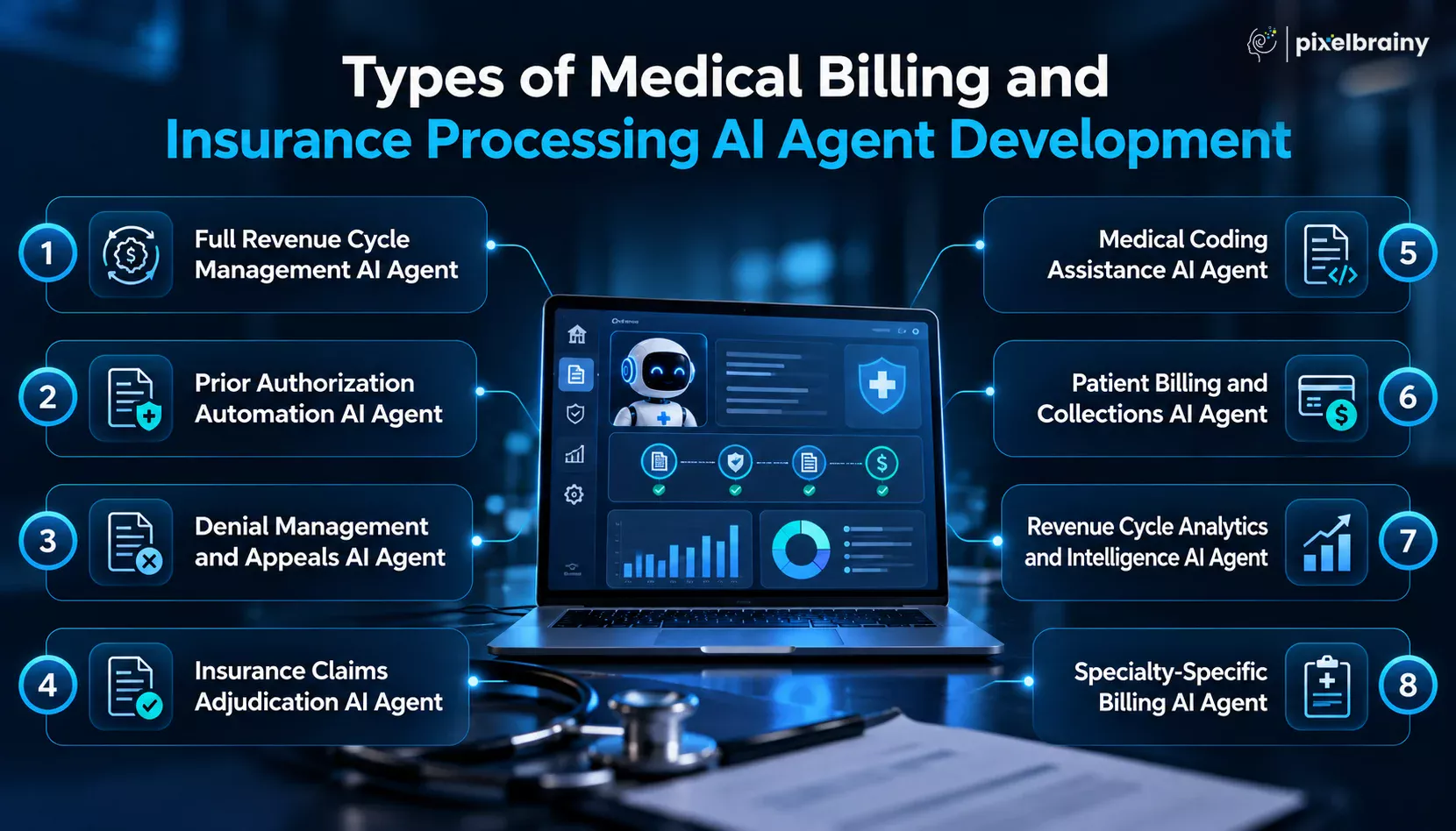
A full revenue cycle management AI agent manages multiple activities across the billing lifecycle. It can perform eligibility verification, authorization checks, claim scrubbing, claim submission, status monitoring, denial identification, payment follow-up, and accounts receivable tasks.
For a company build AI agent for medical billing and insurance processing can mean connecting these workflows through one orchestration layer. Routine activities can run automatically, while complex claims and exceptions are routed to billing specialists for review.
A prior authorization automation AI agent manages repetitive authorization tasks before a service is performed or a claim is submitted. It can determine authorization requirements, collect required information, track authorization status, monitor expiration dates, and identify missing documentation.
During making AI agent for medical billing and insurance processing, the system can connect with EHRs, practice management platforms, payer portals, and authorization APIs. Standard cases follow configured workflows, while unusual payer requirements are escalated to staff.
A denial management and appeals AI agent reviews denied claims and determines the underlying denial category. It can analyze payer responses, identify corrective actions, prioritize follow-up, and organize supporting information required for an appeal.
For AI powered agent for medical billing and insurance processing development, the agent can also identify recurring denial patterns by payer, provider, specialty, or denial reason. Billing professionals can review recommendations and approve complex appeals before submission.
An insurance claims adjudication AI agent evaluates claims before submission to identify potential reimbursement problems. It can review eligibility, coverage, diagnosis and procedure information, modifiers, authorization details, payer requirements, and claim edits.
This development of medical billing and insurance processing AI agent supports internal claim assessment rather than replacing the payer's official adjudication process. Claims that contain potential issues can be flagged for correction before they enter the payer workflow.
A medical coding assistance AI agent analyzes clinical documentation and provides recommendations for diagnosis codes, procedure codes, modifiers, and other billing information. It can also identify missing documentation or potential inconsistencies that require additional review.
When organizations create AI agent for medical billing and insurance processing, coding capabilities can connect directly with EHR documentation and claim-generation workflows. The AI supports coding professionals, while qualified staff retain final responsibility for decisions requiring professional judgment.
A patient billing and collections AI agent automates routine patient account communication. It can handle payment reminders, balance notifications, statement questions, payment-status requests, and other predefined billing inquiries.
For a billing company, this capability can support patient communication across multiple physician practices without requiring staff to manually handle every routine interaction. Disputes, financial hardship situations, payment arrangements, and unusual account issues can be routed to appropriate personnel.
A revenue cycle analytics and intelligence AI agent analyzes claims, denials, payments, accounts receivable, payer activity, and billing performance. It can identify unusual patterns, generate reports, prioritize worklists, and answer operational questions using connected revenue cycle data.
For a multi-client billing organization, the agent can provide separate analytics for each physician practice while maintaining appropriate data access controls. Managers can use natural-language queries to investigate billing activity instead of manually reviewing multiple reports.
A specialty-specific billing AI agent is designed around the requirements of a particular medical specialty. Its workflows can incorporate specialty procedures, documentation requirements, coding rules, payer policies, authorization requirements, and claim-edit logic.
For billing companies serving different physician practices, specialty configurations allow the same core AI platform to support different workflows. This approach is useful when clients have different coding requirements, payer mixes, documentation standards, or billing processes.
A medical billing company does not need to develop eight completely separate systems. These capabilities can operate as specialized agents connected through a shared workflow and data layer.
The structure can follow three levels:
Routine automation: The AI performs repetitive, rules-based billing activities such as eligibility checks, claim-status requests, and workflow updates.
AI-assisted decisions: The system analyzes billing information, identifies potential issues, and recommends the next action for staff review.
Human-controlled decisions: Complex claims, coding judgments, unusual payer requirements, disputes, and high-risk financial decisions remain with qualified billing professionals.
This model allows a billing company to introduce AI into its existing service without positioning the technology as a replacement for its billing expertise. The AI becomes an operational layer that handles repetitive work while staff remain responsible for decisions that require experience, context, and judgment.
Also Read: How To Build An AI Agent In 2026: A Step-by-Step Guide
For medical billing companies, physician groups, and healthcare organizations, AI can do more than automate individual billing tasks. A properly designed AI agent can connect repetitive revenue cycle activities, identify issues earlier, organize work based on priority, and support billing teams with relevant information at the right stage of the workflow.
For a billing company managing multiple physician practices, the value becomes especially clear when routine eligibility checks, claim validation, status follow-ups, and denial workflows are handled by AI while experienced staff focus on exceptions and decisions requiring human judgment. The key benefits include:
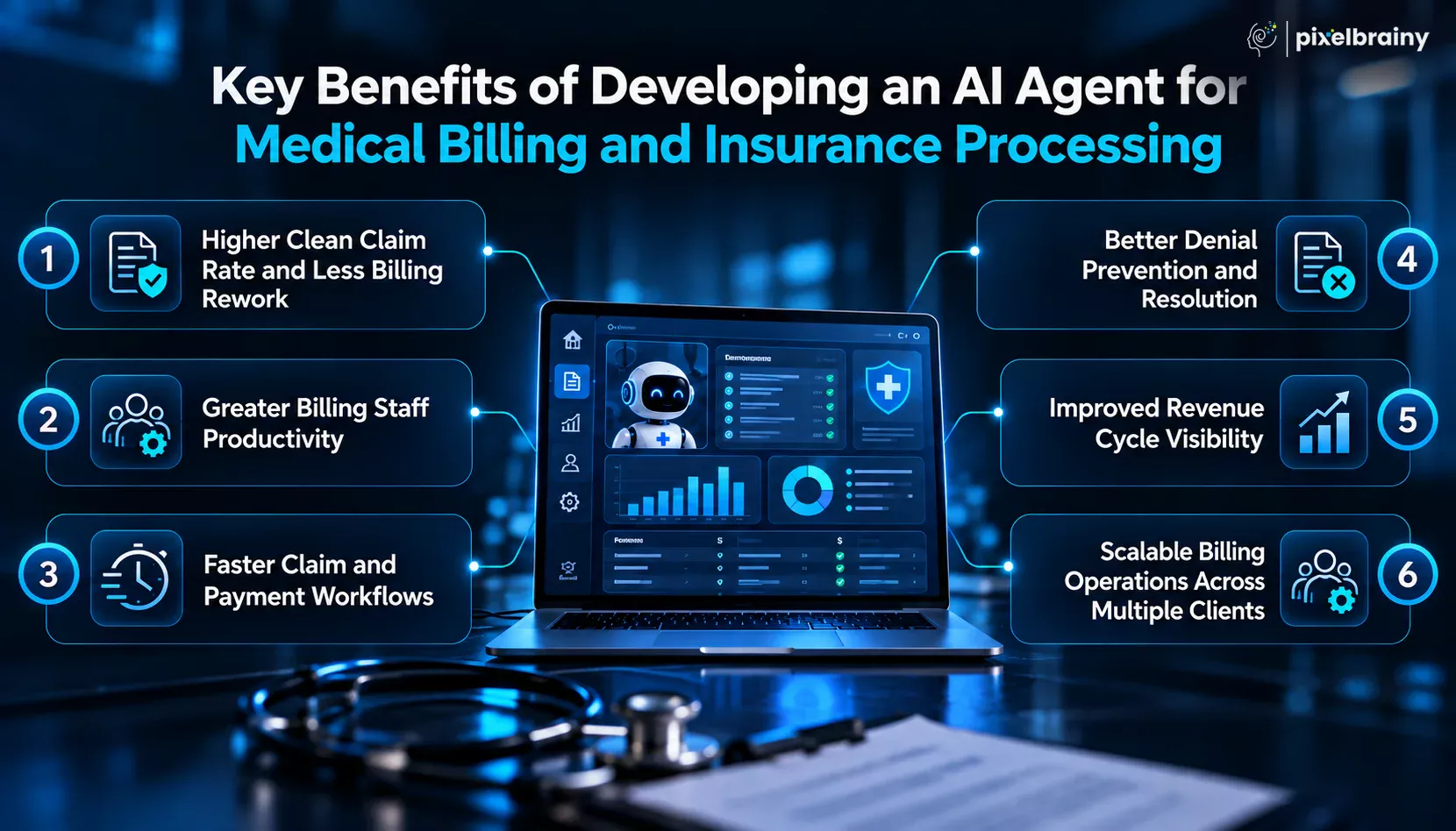
One of the primary benefits of developing an AI agent for medical billing and insurance processing is improving the quality of claims before submission. The agent can check eligibility, coverage, coding information, modifiers, authorization requirements, missing data, and payer-specific claim rules.
Instead of discovering every issue after a payer rejects or denies a claim, billing teams can receive an alert before submission. This gives staff an opportunity to correct the issue at the earliest stage.
For organizations starting to build AI agent for medical billing and insurance processing, clean claim improvement can become a measurable KPI alongside denial rate and first-pass resolution.
Medical billing teams spend significant time performing repetitive activities such as checking eligibility, reviewing claim statuses, updating work queues, and following up on routine payer responses. An AI agent can perform these tasks according to predefined workflows.
This allows billing specialists to redirect their time toward complex claims, payer disputes, coding questions, appeals, and accounts requiring professional judgment.
For a billing company, medical billing AI agent development can therefore increase the amount of billing work an existing team can manage without requiring every additional task to be handled manually.
An AI agent can continuously monitor billing workflows and trigger the next action when specific conditions are met. For example, it can identify a claim that has reached the expected payer response period, check its status, and create a follow-up task without waiting for a staff member to manually review the account.
This creates a more continuous workflow from claim submission through payment follow-up.
With AI powered medical billing and insurance processing, routine work can move between connected systems more quickly, helping billing teams spend less time waiting for manual task completion.
AI can analyze claim information, payer responses, previous denial patterns, authorization data, and documentation requirements to identify potential problems. This allows billing teams to address some issues before submission and organize appropriate action when a denial occurs.
An AI agent for medical billing and insurance processing can also classify denials and recommend the next workflow step based on configured rules and historical information.
Instead of treating every denial as an isolated case, the system can identify recurring patterns across payers, providers, specialties, and clients, giving billing managers more useful information for improving revenue cycle processes.
A connected AI system can bring information from claims, denials, payments, accounts receivable, payer responses, and billing work queues into a single operational view. Managers can then ask questions about billing performance without manually combining information from multiple reports.
For example, the system can identify which payer has the highest denial volume, which claims require immediate follow-up, or which client accounts are experiencing unusual billing activity.
This makes revenue cycle AI agent development useful not only for task automation but also for identifying operational patterns that may require management attention.
For a medical billing company serving numerous physician practices, adding clients can increase the volume of eligibility checks, claims, follow-ups, denials, and administrative work. An AI agent can handle additional routine transaction volume through standardized workflows.
Client-specific rules, payer requirements, specialties, and escalation policies can remain configurable within the platform.
This makes healthcare billing and insurance processing AI agent development suitable for a multi-client operating model where the same core technology supports different practices while billing professionals continue managing complex exceptions.
For healthcare organizations, the value of AI billing development is strongest when automation is connected to measurable outcomes such as clean claim rate, denial rate, staff productivity, accounts receivable performance, and cost to collect.

A successful medical billing AI agent needs more than an AI model or chatbot. Its core features should support the actual revenue cycle workflow, including insurance verification, claim preparation, payer communication, payment processing, and exception handling. These capabilities create the foundation for medical billing and insurance processing AI agent development and determine how effectively the system can work with existing healthcare operations.
Consider a revenue cycle manager asking: “What features should we include when developing an AI agent that can verify insurance, identify claim errors, submit clean claims, monitor payer responses, and automatically create follow-up tasks while keeping billing specialists in control of complex cases?” The answer starts with the following 15 core capabilities.
| Core Feature | What the Feature Does |
|---|---|
| Eligibility and Insurance Verification | The AI agent verifies insurance coverage, effective dates, member information, plan status, and eligibility responses before billing. It can identify coverage problems and send unresolved cases to the appropriate billing employee. |
| Patient and Insurance Data Extraction | The system extracts patient demographics, payer information, policy details, provider information, encounter data, and other billing fields from connected records. This creates structured information for downstream revenue cycle workflows. |
| Claim Scrubbing and Validation | The agent reviews claims for missing information, coding inconsistencies, eligibility problems, authorization requirements, payer edits, and other submission issues. It flags potential errors so billing staff can correct them before submission. |
| Automated Claim Submission | The AI agent prepares validated claims and sends them through configured clearinghouse or payer connections. It can capture submission responses and identify rejected transactions that require correction or additional review. |
| Claim Status Tracking | The system monitors submitted claims and records payer responses, processing stages, pending statuses, and follow-up requirements. Automated alerts can direct staff to claims that require investigation or additional payer action. |
| Payer Rules Management | A centralized rules layer stores payer-specific requirements, claim edits, documentation conditions, authorization rules, and workflow instructions. The agent applies relevant rules according to payer, plan, specialty, and configured client requirements. |
| Prior Authorization Tracking | The agent tracks authorization requirements, submitted requests, approval information, expiration dates, and missing documentation. It can associate authorization records with relevant patients, encounters, procedures, and claims throughout the billing workflow. |
| Denial Identification and Classification | The system analyzes payer responses and classifies denied or rejected claims according to configured categories. It can identify eligibility, authorization, coding, documentation, and submission-related issues for appropriate follow-up. |
| Billing Worklist Automation | The agent creates and prioritizes worklists using claim status, deadlines, outstanding balances, payer responses, and exception categories. Staff receive organized tasks based on configured workflow priorities instead of manually searching accounts. |
| Payment and Remittance Processing | The AI agent processes payment and remittance information, matches transactions with claims, identifies discrepancies, and routes exceptions for review. This helps billing teams reconcile payments with submitted claims and payer responses. |
| Accounts Receivable Follow-Up | The system identifies accounts requiring follow-up using aging, claim status, payer responses, outstanding balances, and business rules. It can generate tasks and provide recommended next actions for billing specialists. |
| Human Review and Escalation | The agent identifies cases that exceed predefined rules or confidence thresholds and routes them to qualified billing professionals. Teams can define approval requirements for complex claims, coding questions, appeals, and unusual payer responses. |
| EHR and Practice Management Integration | The AI agent exchanges patient, encounter, provider, billing, and claim information with EHR and practice management systems. Integration allows automated workflows to operate within existing healthcare processes without unnecessary duplicate data entry. |
| Audit Logs and Activity Tracking | The system records important AI and user activities, including data access, workflow events, recommendations, approvals, and completed actions. These records provide visibility into how billing workflows were processed and modified. |
| Role-Based Access and Data Security | Access controls determine which users can view or modify billing information and system functions. The implementation should support appropriate authentication, authorization, secure transmission, and safeguards for electronic protected health information. |
These core capabilities form the functional foundation of healthcare billing and insurance processing AI agent development. They can be configured around different payers, specialties, client workflows, approval policies, and billing environments.
The right core features connect everyday billing tasks into one controlled workflow, giving AI responsibility for routine execution while keeping complex revenue cycle decisions with qualified professionals.
Once the core billing capabilities are established, advanced features can make the AI agent more intelligent, adaptive, and capable of handling complex revenue cycle workflows. These features should be added after the basic billing processes, integrations, security controls, and human review mechanisms are stable.
Consider a healthcare organization asking: “How can we develop a medical billing AI agent that not only processes claims but also predicts denial risks, understands payer behavior, recommends the next action, and continuously improves from historical billing outcomes?” Advanced capabilities can address this requirement while keeping high-impact decisions under appropriate human oversight.
| Advanced Feature | What the Feature Does |
|---|---|
| Predictive Denial Risk Scoring | The AI analyzes historical claims, payer behavior, coding patterns, eligibility information, and previous denials to assign a risk score to new claims. High-risk claims can be reviewed before submission. |
| Intelligent Workflow Orchestration | The agent determines the appropriate next step based on claim status, payer response, workflow rules, available information, and previous actions. It can coordinate multiple billing systems without requiring staff to manually move each task. |
| Payer Behavior Intelligence | The system analyzes historical payer activity to identify patterns in denials, processing times, authorization requirements, reimbursement behavior, and claim responses. These insights can help customize workflows for individual payers and plans. |
| AI-Powered Next-Best-Action Recommendations | The agent evaluates the available claim information and recommends the next action, such as correcting a claim, requesting documentation, contacting a payer, appealing a denial, or escalating the case to a specialist. |
| Self-Learning Workflow Optimization | The system analyzes completed billing workflows and outcomes to identify recurring patterns and potential process improvements. Changes should operate within controlled governance rather than allowing unrestricted autonomous modification of production billing rules. |
| Natural Language Revenue Cycle Assistant | Billing professionals can ask questions using natural language, such as why a claim was denied, which documentation is missing, or which accounts need immediate attention. The assistant retrieves relevant information from authorized revenue cycle data. |
| Intelligent Document Understanding | Advanced document processing can extract and interpret information from payer letters, remittance documents, authorization notices, medical records, and other unstructured files. Extracted information can then trigger relevant billing workflows or human review. |
| Real-Time Prior Authorization Intelligence | The agent can connect with electronic prior authorization workflows to determine requirements, retrieve documentation rules, submit information, and monitor responses. CMS requires certain impacted payers to implement Prior Authorization APIs beginning January 1, 2027. |
| Cross-System Contextual Reasoning | The agent can combine information from EHRs, practice management platforms, clearinghouses, payer systems, authorization records, claims, and payment data to evaluate a billing situation using broader workflow context rather than a single data source. |
| Advanced Revenue Forecasting | The system analyzes historical collections, outstanding claims, payer behavior, denial patterns, accounts receivable, and payment trends to estimate future revenue-cycle activity. Managers can use these projections for operational planning and workload prioritization. |
CMS is also advancing standards-based interoperability for prior authorization. Its current framework includes FHIR-based APIs and electronic workflows designed to reduce reliance on manual portal and fax processes, making interoperability an important consideration for advanced AI billing architecture.
Advanced features should extend the AI agent's ability to predict, reason, recommend, and coordinate workflows without removing human control from complex medical billing decisions.
Developing an AI agent for medical billing and insurance processing requires more than selecting an AI model and connecting it to a claims system. The development process should begin with a clearly defined business workflow, measurable outcomes, reliable healthcare data, secure integrations, human review controls, and a structured deployment plan.
Consider an insurance company processing 500,000 medical claims per month where rules-based adjudication handles routine claims but complex claims still require significant manual review. The objective is to build an AI agent that performs pre-adjudication review, interprets policy terms and clinical documentation, routes straightforward cases to automated adjudication, and sends genuinely ambiguous cases to human adjudicators. The following eight steps provide a practical framework for evaluating and developing such a system.
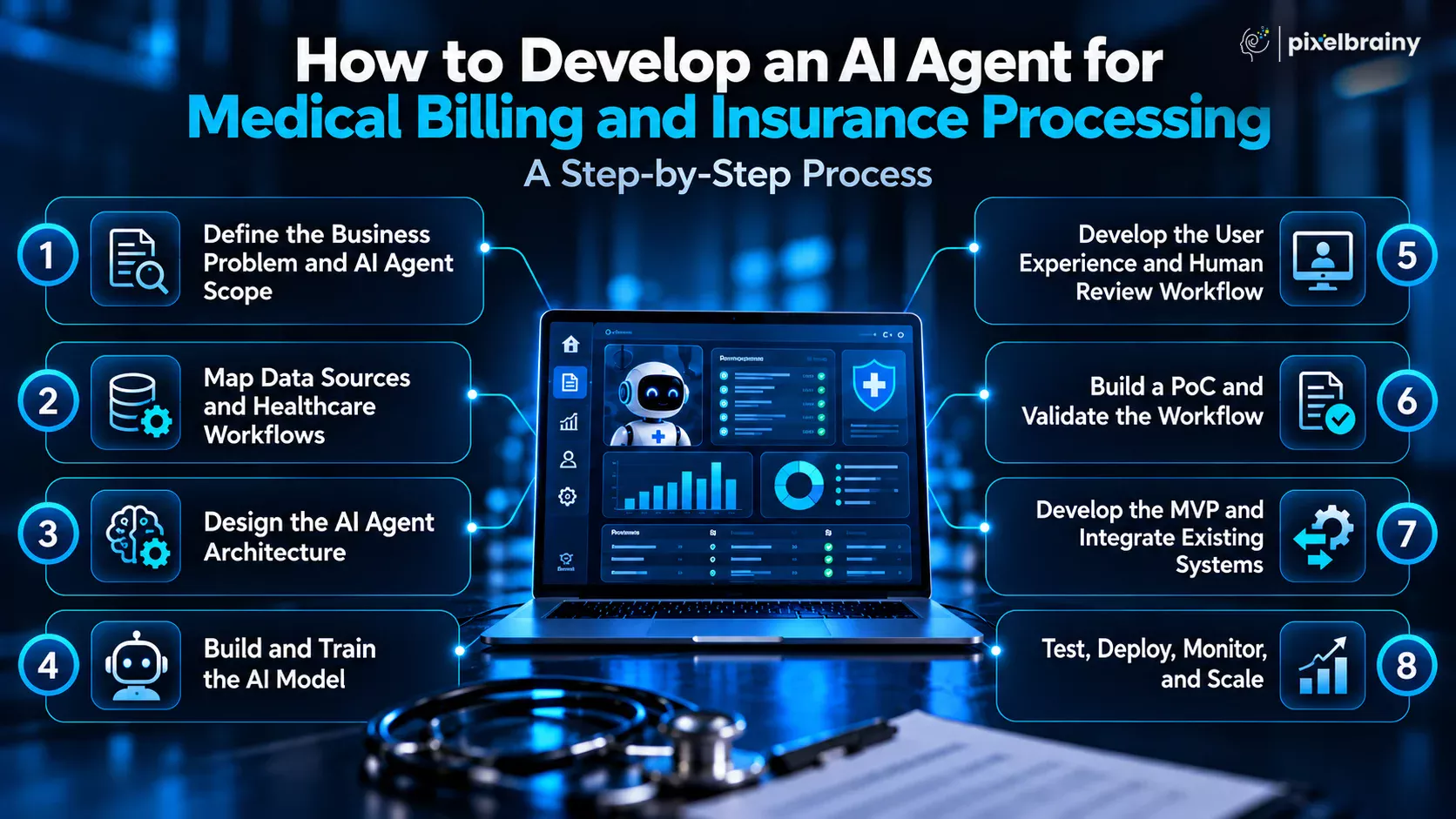
The first step is to define exactly what the AI agent should accomplish. Document the current claims workflow, manual review points, claim volumes, exception categories, adjudication rules, turnaround times, and decisions that require human expertise.
For organizations evaluating steps to develop AI agent for medical billing and insurance processing from idea to launch, this stage should establish measurable targets such as review time, automation rate, adjudication accuracy, escalation rate, and processing cost.
The scope should also identify what the AI can recommend, what it can execute automatically, and which decisions must always remain with a qualified human adjudicator.
An AI claims agent needs access to the information required to evaluate each case. This can include member eligibility, benefit plans, policy terms, claims history, clinical documentation, provider information, authorization records, medical codes, payer rules, and previous adjudication outcomes.
Organizations learning how to build AI agent for medical billing and insurance processing from scratch should map where each data element originates and how it moves through the existing architecture.
Data quality should be assessed before model development begins. Missing fields, inconsistent coding, duplicate records, outdated policy information, and disconnected systems can directly affect AI performance and should be addressed during this stage.
The architecture defines how the agent will understand claims, retrieve information, reason through policy requirements, make recommendations, use connected systems, and escalate uncertain cases.
For teams planning to develop medical billing and insurance processing AI agent for healthcare business, the architecture may include an orchestration layer, AI model, retrieval system, policy knowledge base, workflow engine, integration layer, audit system, and human review interface.
The architecture should separate AI reasoning from critical business rules where appropriate. This allows organizations to control which decisions come from configured rules, which are supported by AI, and which require human approval.
Also Read: Top 12+ AI Model Development Companies in the USA
The next stage focuses on developing the intelligence required to interpret claims and supporting information. Depending on the workflow, this can involve large language models, machine learning, document intelligence, classification models, retrieval-augmented generation, and other AI techniques.
During AI agent development for medical billing and insurance processing, historical claims and adjudication outcomes can be used to evaluate how the system identifies straightforward cases, detects potential issues, and recognizes situations requiring escalation.
The model should be evaluated against representative datasets rather than only ideal examples. Accuracy, false positives, false negatives, explainability, consistency, and confidence thresholds should be measured before production deployment.
The AI agent needs an interface that allows adjudicators and revenue cycle professionals to understand recommendations and take appropriate action. The interface should show relevant claim information, supporting policy language, documentation, AI reasoning or evidence, confidence indicators, and recommended actions.
A UI/UX design company can help create interfaces that make complex AI recommendations easier for users to review and approve.
The human review workflow should clearly distinguish automated decisions, AI recommendations, and human decisions. Users should also be able to override recommendations, document their reasoning, and send feedback into controlled evaluation processes.
Before committing to a full production platform, organizations can create a limited proof of concept using representative claims and a defined workflow. The PoC should test whether the AI can perform the intended pre-adjudication tasks under realistic conditions.
PoC development should measure claim classification accuracy, policy interpretation, documentation analysis, escalation quality, processing time, and human agreement with AI recommendations.
Working with top AI development companies can be useful when organizations need specialized expertise in healthcare AI, enterprise integrations, model evaluation, and secure deployment. The PoC should produce measurable evidence for deciding whether the solution is ready for broader development.
After validating the concept, the next stage is MVP development. The MVP should contain the smallest production-ready feature set needed to support a defined claims workflow while maintaining security, monitoring, human oversight, and auditability.
AI integration connects the agent with claims platforms, policy databases, clinical documentation systems, EHR or healthcare data sources, authorization systems, and existing adjudication engines.
Organizations can also use AI consultation during this stage to review architecture, integration strategy, model selection, security requirements, and deployment priorities before expanding the system to additional claim categories.
Also Read: Top 10 AI MVP Development Companies in USA
The final stage involves rigorous testing followed by controlled production deployment. Testing should cover accuracy, security, integration reliability, edge cases, hallucination risks, authorization controls, audit trails, performance, and failure handling.
Organizations may hire AI developers or work with AI agent development companies that have experience with enterprise healthcare workflows. AI healthcare software development companies can also support production architecture, compliance-focused engineering, integration, and ongoing optimization.
After launch, performance should be continuously monitored against predefined KPIs. Organizations can gradually expand claim categories, automation levels, and transaction volumes after the AI agent demonstrates consistent performance within approved thresholds.
A structured development process turns a complex claims automation idea into a measurable AI system with controlled automation, reliable integrations, and human oversight at the points where judgment matters most.
The cost to develop an medical billing and insurance processing AI agent typically ranges from $40,000 to $300,000+, depending on the scope, integrations, AI complexity, security requirements, and level of automation. A focused agent handling a limited billing workflow can fall near the lower end, while a production-grade healthcare platform with multiple payer integrations, advanced AI capabilities, EHR connectivity, audit controls, and enterprise-scale infrastructure can exceed $300,000.
For an FQHC, the development budget of medical billing and insurance processing AI agent should be based on its actual payer mix and billing complexity rather than enterprise software pricing. Consider an FQHC serving predominantly low-income patients with Medicare, Medicaid, secondary payer claims, sliding fee scale billing, and grant-funded services. In this scenario, what is the cost of an AI medical billing agent for an FQHC billing environment? The answer depends largely on how many of these workflows must be automated and how deeply the agent must integrate with existing systems.
| AI Agent Development Level | Typical Development Scope | Estimated Cost |
|---|---|---|
| Basic Medical Billing and Insurance Processing AI Agent | Eligibility verification, basic claim validation, claim-status tracking, simple workflow automation, limited integrations, basic dashboard, and human review workflows. | $40,000 to $80,000 |
| Advanced Medical Billing and Insurance Processing AI Agent | Multi-step claim processing, denial classification, payer rule handling, EHR and practice management integration, AI document processing, analytics, workflow orchestration, security controls, and expanded human oversight. | $80,000 to $180,000 |
| Medical Billing and Insurance Processing AI Agent for Enterprise Healthcare Operations | Multiple payer and system integrations, advanced AI reasoning, complex claims workflows, sophisticated denial and authorization automation, enterprise security, extensive auditability, scalable infrastructure, monitoring, and multi-client or multi-location support. | $180,000 to $300,000+ |
These figures represent development estimates, not fixed vendor quotes. Actual pricing depends on whether the organization uses existing healthcare APIs, develops custom integrations, trains or fine-tunes models, requires specialized workflows, and needs production deployment across a large claims volume.
Basic workflow automation can use existing AI APIs and rules-based logic, while complex systems may require multiple models for document understanding, classification, prediction, reasoning, and recommendations. More sophisticated model architecture increases development, testing, and infrastructure costs.
Connecting the agent with EHRs, practice management platforms, clearinghouses, billing systems, and healthcare APIs can require substantial engineering work. Costs increase when multiple systems, custom interfaces, legacy platforms, or non-standard integrations are involved.
Different payers can have different data formats, workflows, authorization requirements, and connectivity options. Supporting multiple payer environments requires additional integration, testing, configuration, and maintenance.
An FQHC environment may require specialized handling for Medicaid, Medicare, secondary payer workflows, sliding fee scales, grant-funded services, and other organization-specific billing rules. Encoding and validating these requirements can increase the development scope compared with a basic billing agent.
An agent that only identifies claim errors requires less development than one that analyzes denials, determines likely causes, recommends corrective actions, prepares appeal information, and routes cases according to financial priority and payer rules.
Healthcare AI systems require appropriate safeguards for protected health information. Security engineering can include access controls, encryption, audit logging, authentication, authorization, secure APIs, environment separation, monitoring, and compliance-focused testing.
When AI recommendations require staff approval, the system needs review queues, confidence indicators, escalation rules, approval controls, exception handling, and decision tracking. More complex human-in-the-loop workflows increase interface and backend development requirements.
Healthcare AI requires testing against representative billing scenarios and edge cases. Costs can include data preparation, evaluation datasets, model testing, accuracy measurement, false-positive analysis, hallucination testing, and validation against expected billing outcomes.
Operational dashboards can display claim status, denial activity, automation rates, work queues, payment activity, exceptions, and AI performance. More advanced analytics, client-level reporting, and customizable dashboards increase development costs.
Infrastructure costs depend on transaction volume, AI model usage, data storage, monitoring, API traffic, security requirements, and deployment architecture. High-volume claims environments require infrastructure designed for reliable and scalable processing.
For an FQHC, the cost estimation of AI agent development for medical billing and insurance processing should begin with the workflows that create the greatest administrative workload. A system focused on Medicaid and Medicare claim validation may require a smaller investment than a platform covering eligibility, secondary payer processing, sliding fee calculations, grant-funded services, denials, appeals, and accounts receivable.
For healthcare businesses evaluating medical billing and insurance processing AI agent development cost, the most important distinction is between a limited automation project and a production-grade AI platform. Development should be phased so the organization can validate the highest-value workflows before expanding into more complex automation.
A practical budget can therefore be structured as:
Phase 1: $40,000 to $80,000
Focused AI agent, limited workflows, selected integrations, and human review.
Phase 2: $80,000 to $180,000
Expanded payer workflows, EHR integration, denial management, document processing, analytics, and stronger automation.
Phase 3: $180,000 to $300,000+
Enterprise-scale architecture, complex payer environments, advanced AI reasoning, extensive integrations, high transaction volumes, advanced security, monitoring, and multi-client or multi-location deployment.
The development pricing of AI agent for medical billing and insurance processing should therefore be evaluated against transaction volume, automation scope, integration requirements, compliance engineering, and expected operational outcomes rather than comparing development quotes based only on the AI model being used.
For an FQHC, a phased $40,000 to $300,000+ development strategy can provide a more practical path to building payer-specific billing automation without immediately committing to the cost of a full enterprise revenue cycle platform.
Also Read: AI Agent Development Cost ($10K-$100K+): Factors and Cost Optimization Tips
A medical billing AI agent needs a technology stack that can connect healthcare data, understand billing information, execute workflows, communicate with payer systems, and protect sensitive patient information. The stack typically combines AI models, healthcare interoperability standards, backend services, databases, APIs, security infrastructure, workflow orchestration, and monitoring tools.
For a healthcare business asking, “What technology stack do we need to build an AI agent that can connect our EHR and practice management system, analyze claims and payer responses, automate billing workflows, and route uncertain cases to staff?”, the architecture should support both AI capabilities and healthcare-specific integrations. FHIR is an important interoperability standard, while CMS currently identifies technologies including FHIR, SMART/OAuth 2, OpenID Connect, USCDI, and relevant Da Vinci implementation guides across its interoperability framework.
| Technology Layer | Recommended Technologies | Role in Medical Billing AI Agent Development |
|---|---|---|
| AI and Large Language Models | OpenAI models, Anthropic Claude, Google Gemini, open-source LLMs | Handles natural language understanding, claim analysis, documentation interpretation, reasoning support, summarization, and AI-assisted billing decisions. |
| Machine Learning | Python, PyTorch, TensorFlow, scikit-learn | Supports claim classification, denial prediction, anomaly detection, prioritization, risk scoring, and other predictive billing functions. |
| Natural Language Processing | NLP libraries, transformer models, embedding models | Processes clinical notes, payer communications, denial explanations, authorization documents, and other unstructured healthcare information. |
| RAG and Knowledge Retrieval | Vector databases, embeddings, Elasticsearch, OpenSearch | Allows the agent to retrieve relevant payer policies, billing rules, documentation requirements, organizational procedures, and approved knowledge before generating responses or recommendations. |
| Agent Orchestration | Python, LangGraph, Semantic Kernel, custom workflow engines | Coordinates AI reasoning, tool calls, workflow steps, system actions, approvals, and exception handling across the revenue cycle. |
| Healthcare Interoperability | HL7 FHIR, HL7 v2, X12, SMART on FHIR | Enables structured exchange of healthcare and billing information between EHRs, payer systems, practice management platforms, clearinghouses, and other connected systems. CMS requires impacted payers to implement several FHIR-based interoperability APIs, including a Prior Authorization API. |
| Backend Development | Python, FastAPI, Node.js, Java, .NET | Provides APIs, business logic, authentication, workflow services, integrations, claim processing services, and communication between the AI layer and healthcare systems. |
| Databases | PostgreSQL, MySQL, Microsoft SQL Server | Stores structured information such as patients, claims, payer configurations, workflow states, transactions, users, and operational records. |
| Document and File Storage | AWS S3, Azure Blob Storage, Google Cloud Storage | Stores authorized documents such as claim attachments, payer correspondence, remittance files, authorization records, and other healthcare documents. |
| Cloud Infrastructure | AWS, Microsoft Azure, Google Cloud | Provides scalable computing, storage, networking, databases, AI infrastructure, monitoring, backup, and deployment environments for healthcare AI applications. |
| Security and Identity | OAuth 2.0, OpenID Connect, IAM, MFA, RBAC | Controls authentication, authorization, user permissions, service access, and protected healthcare data. HHS requires appropriate administrative, physical, and technical safeguards for electronic protected health information under the HIPAA Security Rule. |
| API and Integration Layer | REST APIs, API gateways, webhooks, integration engines | Connects the AI agent with EHRs, practice management systems, clearinghouses, payer platforms, authorization services, and internal billing applications. |
| Workflow and Queue Management | Temporal, Apache Kafka, RabbitMQ, AWS SQS, Azure Service Bus | Manages asynchronous billing tasks, claim-processing queues, retries, scheduled follow-ups, system events, and high-volume transaction processing. |
| Monitoring and Observability | CloudWatch, Azure Monitor, Datadog, OpenTelemetry | Tracks system health, API performance, AI response behavior, workflow failures, processing times, errors, and operational events. |
| Audit and Compliance Infrastructure | Immutable logs, SIEM, audit databases, security monitoring | Records relevant user actions, AI activities, data access, approvals, workflow events, and system changes. HIPAA technical safeguards include access controls, audit controls, authentication, integrity controls, and transmission security. |
A healthcare-ready technology stack combines AI intelligence with interoperability, secure infrastructure, workflow orchestration, and auditability so the billing agent can operate reliably within existing revenue cycle systems.
The commercial model for a medical billing AI agent depends on who owns the technology, who operates it, how clients use it, and what they are willing to pay for. A medical billing company can use AI internally, bundle automation into its existing services, or commercialize the platform as healthcare software.
A practical question for a medical billing company is: “Should we charge physician practices a monthly subscription for AI billing automation, price the platform according to claim volume, or include the AI agent within our existing percentage-based billing service?” The answer depends on client size, claim volume, automation scope, implementation costs, and the level of human billing support provided.
In this model, the medical billing company owns or operates the AI agent and provides AI-assisted billing as part of its managed service. Clients do not need to purchase or maintain the underlying technology.
Key characteristics:
This model works particularly well for established billing companies that want to add AI capabilities without changing their existing client relationship.
Under a SaaS model, physician practices, medical groups, or billing companies subscribe to the AI billing platform for a recurring monthly or annual fee. The customer accesses the software while the technology provider manages the underlying infrastructure.
Key characteristics:
This model is suitable for organizations that want direct access to AI billing technology rather than outsourced billing services.
With usage-based pricing, customers pay according to the amount of billing activity processed by the AI agent. Charges can be calculated per claim, eligibility verification, authorization request, denial workflow, or other defined transaction.
Key characteristics:
This model can be particularly relevant when the AI agent performs clearly measurable transactions within the revenue cycle.
The customer pays according to the number of physicians or other providers supported by the AI platform. This creates a straightforward pricing structure for physician practices and medical groups.
Key characteristics:
This approach can make budgeting easier because the customer can estimate its software expense based on its provider population.
Large hospitals, health systems, revenue cycle organizations, and national billing companies can license the AI platform through an enterprise agreement. The contract can include implementation, integrations, annual licensing, support, and usage allowances.
Key characteristics:
This model is appropriate when the AI agent must operate across multiple facilities, specialties, payer environments, or large-scale revenue cycle operations.
A white-label model allows a medical billing company to use an AI platform under its own brand. The technology provider operates the underlying infrastructure while the billing company presents the AI-enabled service directly to its physician practice clients.
Key characteristics:
This model allows established billing companies to introduce AI capabilities without building every component of the technology platform internally.
The strongest business model aligns AI billing pricing with client value, transaction volume, service responsibility, and the level of automation delivered.
The build vs buy decision for medical billing and insurance processing AI agent development depends on workflow complexity, integration requirements, customization, budget, security, and long-term ownership. An existing platform can provide faster access to established billing automation, while a custom solution can be designed around specific payer rules, healthcare systems, and operational requirements.
Consider a medical billing company asking: “We have specialized payer workflows, proprietary billing rules, and multiple healthcare system integrations. Should we build our own AI agent or license an existing platform that already automates claims and denials?” This question should be answered by comparing the organization's requirements with the capabilities, costs, and limitations of available platforms.
Custom development is suitable when existing platforms cannot support important billing workflows or integrations. Building an AI agent for medical billing and insurance processing allows the organization to design the system around its own revenue cycle processes.
Key advantages include:
The cost to build AI agent for medical billing and insurance processing is generally higher initially because the organization must fund development, testing, integration, security, deployment, and ongoing maintenance.
Licensing an existing platform can work when standard revenue cycle workflows already meet most business requirements. The cost of AI agent for medical billing and insurance processing may be easier to forecast through subscription or licensing fees.
Typical advantages include:
The main consideration is customization. Organizations should verify whether the platform supports their payer rules, EHR integrations, data requirements, security expectations, workflow configurations, and future expansion plans.
| Factor | Custom AI Agent | Existing AI Platform |
|---|---|---|
| Customization | High | Vendor dependent |
| Implementation | Longer | Faster |
| Initial investment | Higher | Generally lower |
| Healthcare integrations | Custom-built | Existing connectors |
| Payer workflows | Highly configurable | Based on supported capabilities |
| Data control | Greater | Contract and architecture dependent |
| Maintenance | Organization or development partner | Vendor managed |
| Scalability | Designed around requirements | Depends on platform |
| Roadmap control | Organization controlled | Vendor controlled |
| Best fit | Specialized billing operations | Standardized workflows |
Custom AI agent development for medical billing and insurance processing becomes more relevant when proprietary workflows, complex payer requirements, multiple integrations, or long-term product ownership are important. It can also make sense when the organization plans to offer its AI billing capabilities commercially.
Buying can be more appropriate when standard functionality meets current requirements and the organization prioritizes faster deployment, established integrations, and vendor-managed maintenance.
Before making the decision, compare medical billing AI agent development cost, implementation time, integration requirements, customization, security, scalability, maintenance, vendor dependency, and five-year total cost of ownership.
The right build vs buy strategy depends on whether your organization needs the control and customization of a custom AI agent or the speed and established capabilities of an existing platform.
AI agent development for medical billing and insurance processing involves more than connecting an AI model to a billing application. Healthcare organizations must manage sensitive patient information, complex payer requirements, inconsistent data, legacy systems, and decisions that can affect reimbursement. For organizations considering developing an AI agent for medical billing and insurance processing, identifying these challenges early can reduce implementation risk and create a more reliable production system.
A practical question is: “How can we build a medical billing AI agent that works across different payer rules and healthcare systems without allowing incorrect AI decisions to affect claims or patient accounts?” The following six challenges address the major issues development teams need to solve.
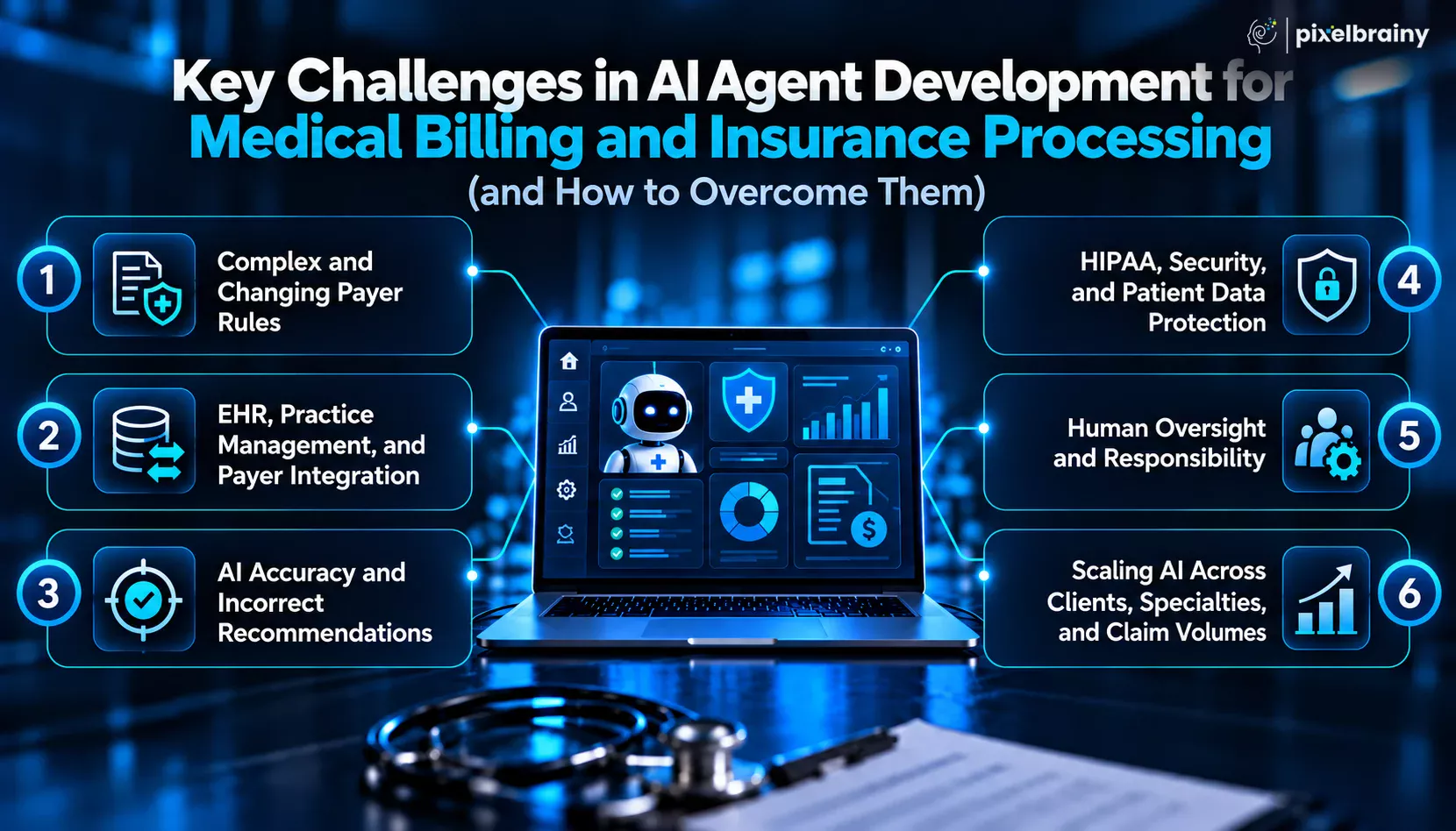
Insurance companies use different claim requirements, authorization rules, coverage policies, documentation requirements, and reimbursement conditions. These rules can also change over time, making static AI knowledge unreliable.
How to overcome it:
Build a centralized payer knowledge layer that stores approved policies and rules. Use retrieval-based AI to access current information and establish controlled processes for reviewing and updating payer requirements.
An AI agent may need information from EHRs, practice management systems, clearinghouses, payer portals, claims platforms, and other healthcare applications. Legacy systems and inconsistent interfaces can make integration difficult.
How to overcome it:
Use standardized APIs and healthcare interoperability technologies such as FHIR, HL7, and X12 where applicable. Develop an integration layer that separates AI workflows from individual system connections, making future integrations easier to manage.
Billing decisions can involve coding, eligibility, coverage, authorization, documentation, and payer-specific requirements. An incorrect AI recommendation can result in claim errors, unnecessary rework, or inappropriate workflow actions.
How to overcome it:
Use confidence thresholds, retrieval-based responses, validation rules, representative testing datasets, and human review for high-risk cases. Medical billing AI agent development should measure accuracy, false positives, false negatives, and escalation quality before expanding automation.
Medical billing systems can process electronic protected health information. Unauthorized access, insecure integrations, excessive permissions, or poorly designed AI data flows can create significant security and compliance risks.
How to overcome it:
Implement role-based access, encryption, authentication, audit logging, secure APIs, environment controls, data minimization, and appropriate vendor agreements. Security should be incorporated throughout healthcare AI agent development, not added after the system is built.
Not every billing decision should be automated. Complex claims, unusual payer responses, coding judgments, appeals, disputed accounts, and ambiguous documentation may require experienced professionals.
How to overcome it:
Create a human-in-the-loop architecture. Define which tasks AI can complete automatically, which require approval, and which must always be escalated. The system should provide supporting information and record human decisions for auditability and workflow improvement.
A billing AI agent that works for one practice may not automatically work for hundreds of clients. Different specialties, payer mixes, billing policies, workflows, and transaction volumes can introduce new requirements.
How to overcome it:
Use configurable workflows, modular integrations, client-specific rules, tenant-level permissions, scalable cloud infrastructure, and centralized monitoring. This approach allows organizations to expand AI agent development for medical billing and insurance processing without rebuilding the entire system for every new client.
Addressing these six challenges early allows a medical billing AI agent to scale with stronger accuracy, security, interoperability, and human control while reducing operational risks.
From the challenges, technology requirements, development costs, and workflow considerations discussed above, the next step is identifying a development partner that understands both AI agent engineering and healthcare revenue cycle workflows. For a private equity firm managing 12 physician practices across four specialties, the challenge is not simply automating billing. The platform must standardize operations, connect practice-level data, provide portfolio-wide visibility, and identify revenue cycle opportunities.
PixelBrainy as a leading AI agent development company can support this type of enterprise healthcare AI initiative through strategy, architecture, AI development, healthcare integrations, workflow automation, and ongoing optimization.
PixelBrainy's medical billing and insurance processing AI agent development services can be structured around the operational requirements of a multi-practice healthcare portfolio.
The platform can include:
This architecture allows a PE management team to maintain centralized visibility while individual practices continue operating according to their specialty and workflow requirements.
For an organization asking, “What does a multi-practice AI medical billing platform cost to build for a PE portfolio context, and which development partner can support healthcare operations across multiple practices?”, the development approach should begin with portfolio-wide workflow mapping.
PixelBrainy can design the platform so the corporate team can view revenue cycle metrics across all 12 practices while authorized practice users access only their relevant operational data. The AI layer can identify variations in denial patterns, claim quality, A/R performance, payer behavior, and billing workflows across the portfolio.
PixelBrainy worked on an AI-enabled healthcare workflow project for a confidential client operating across multiple healthcare locations. The solution integrated operational data from existing healthcare systems and introduced AI-assisted workflow automation, intelligent information processing, and centralized visibility.
The project involved:
The engagement demonstrated how healthcare AI can be introduced around existing operational systems instead of requiring organizations to replace their entire technology environment.
PixelBrainy can support the complete lifecycle from AI strategy and architecture through production deployment and optimization. The team can help organizations build AI agent for medical billing and insurance processing around their actual workflows rather than forcing standardized processes into an inflexible platform.
For organizations looking to develop medical billing and insurance processing AI agent technology as a strategic internal platform, the development can be structured in phases, beginning with high-value workflows and expanding across practices, specialties, payers, and revenue cycle functions.
The same approach can help organizations to create medical billing and insurance processing AI agent solutions that combine automation with human oversight, portfolio analytics, secure integrations, and configurable workflows.
Ready to explore an AI billing platform for your healthcare organization or portfolio? Connect with PixelBrainy to discuss your requirements and development roadmap.
Medical billing and insurance processing are becoming increasingly complex as healthcare organizations manage growing claim volumes, payer requirements, denials, authorization workflows, and administrative workloads. A well-designed AI agent can help automate repetitive revenue cycle activities while keeping complex billing decisions under appropriate human oversight.
From understanding the different AI agent types to defining core and advanced features, development steps, technology requirements, costs, business models, and build-versus-buy considerations, successful medical billing and insurance processing AI agent development requires a structured approach. Organizations should define measurable objectives, integrate existing healthcare systems, protect patient information, and design workflows around both AI automation and human expertise.
Whether the goal is to build AI agent for medical billing and insurance processing for one healthcare organization or create a scalable platform across multiple practices, the right architecture and development strategy can establish a strong foundation for long-term revenue cycle automation.
Ready to discuss your AI billing project? Book an appointment with PixelBrainy and start planning your development roadmap.
To build an AI agent for medical billing and insurance processing, start by mapping eligibility, claims, coding, authorization, denial, payment, and A/R workflows. The system can then connect with EHRs, practice management platforms, clearinghouses, and payer systems while routing complex cases to billing professionals.
Developing a medical billing and insurance processing AI agent with EHR integration requires secure APIs, healthcare interoperability standards, data mapping, workflow orchestration, AI models, access controls, and audit capabilities. The integration should allow the agent to access authorized information without disrupting existing clinical and billing workflows.
The medical billing and insurance processing AI agent development cost can range from approximately $40,000 to $300,000+. The final budget depends on AI complexity, EHR integrations, payer connections, workflow automation, security requirements, data volume, human review processes, and deployment scale.
Yes. AI agent development for medical billing and insurance processing can use a human-in-the-loop model. The agent can process routine claims, identify potential issues, recommend actions, and automatically escalate ambiguous or high-risk cases to qualified billing or adjudication professionals.
When organizations create medical billing and insurance processing AI agent solutions, core capabilities can include eligibility verification, claim validation, automated submission, payer rule management, claim-status tracking, denial classification, A/R follow-up, payment processing, EHR integration, audit logging, and role-based access.
A properly designed healthcare billing and insurance processing AI agent can use configurable payer rules, specialty workflows, knowledge retrieval, and client-specific configurations. This allows the same platform to process different requirements without forcing every physician practice to use identical billing logic.
The decision depends on workflow complexity, integration requirements, customization, budget, and long-term ownership. A company with proprietary billing processes may benefit from custom AI agent development for medical billing and insurance processing, while standardized operations may be suitable for an existing platform.
Yes. Enterprise medical billing and insurance processing AI agent development can use scalable cloud infrastructure, modular integrations, multi-tenant architecture, workflow orchestration, monitoring, role-based access, and configurable payer rules to support high claim volumes and multiple healthcare organizations.

About The Author
Sagar Bhatnagar
Sagar Sahay Bhatnagar brings over a decade of IT industry experience to his role as Marketing Head at PixelBrainy. He's known for his knack in devising creative marketing strategies that boost brand visibility and market influence. Sagar's strategic thinking, coupled with his innovative vision and focus on results, sets him apart. His track record of successful campaigns proves his ability to utilize digital platforms effectively for impactful marketing efforts. With a genuine passion for both technology and marketing, Sagar continuously pushes PixelBrainy's marketing initiatives to greater success.

Working with the PixelBrainy team has been a highly positive experience. They understand the design requirements and create beautiful UX elements to meet the application needs. The dev team did an excellent job bringing my vision to life. We discussed usability and flow. Sagar worked with his team to design the database and begin coding. Working with Sagar was easy. He has the knowledge to create robust apps, including multi-language support, Google and Apple ID login options, Ad-enabled integrations, Stripe payment processing, and a Web Admin site for maintaining support data. I'm extremely satisfied with the services provided, the quality of the final product, and the professionalism of the entire process. I highly recommend them for Android and iOS Mobile Application Design and Development.

Great experience working with them. Had a lot of feedback and I found that unlike most contractors they were bugging me for updates instead of the other way around. They were extremely time conscience and great at communicating! All work was done extremely high quality and if not on time, early! They were always proactive when it comes to communication and the work is great/above par always. Very flexible and a great team to work with! Goes above and beyond to present us with multiple options and always provides quality. Amazing work per usual with Chitra. If you have UI/UX or branding design needs I recommend you go to them! Will likely work with them in the future as well, definitely recommended!

PixelBrainy is a joy to work with and is a great partner when thinking through branding, logo, and website layout. I appreciate that they spend time going into the "why" behind their decisions to help inform me and others about industry best practices and their expertise.

I hired them to design our software apps. Things I really like about them are excellent communication skills, they answer all project suggestions and collaborate right away, and their input on design and colors is amazing. This project was complex and needed patience and creativity. The team is amazing to do business with. I will be using them long-term. Glad to see there are some good people out there. I was afraid to try and outsource my project to someone but I am glad I met them! I really can't say enough. They went above and beyond on this project. I am very happy with everything they have done to make my business stand out from the competition.

It was great working with PixelBrainy and the team. They were very responsive and really owned the project. We'll definitely work with them again!

I recently worked with the PixelBrainy team on a project and I was blown away by their communication skills. They were prompt, clear, and articulate in all of our interactions. They listened and provided valuable feedback and suggestions to help make the project a success. They also kept me updated throughout the entire process, which made the experience stress-free and enjoyable.

PixelBrainy is very good at what it does. The team also presents themselves very professionally and takes care of their side of things very well. I could fully trust them taking up the design work in a timely and organised manner and their attention to detail saved us lots of effort and time. This particular project was quite intense and the team showed that they function very well under pressure. Very much looking forward to working with her again!

It's always an absolute pleasure working with them. They completed all of my requests quickly and followed every note I had for them to a T, which made our process go smoothly from start to finish. Everything was completed fast and following all of the guidelines. And I would recommend their services to anyone. If you need any design work done in the future, PixelBrainy should be your first call!

They took ownership of our requirements and designed and proposed multiple beautiful variants. The team is self-motivated, requires minimum supervision, committed to see-through designs with quality and delivering them on time. We would definitely love to work with PixelBrainy again when we have any requirements.

PixelBrainy was a big help with our SaaS application. We've been hard at work with a new UI/UX and they provided a lot of help with the designs. If you're looking for assistance with your website, software, or mobile application designs, PixelBrainy and the team is a great recommendation.

PixelBrainy designers are amazing. They are responsive, talented, and always willing to help craft the design until it matches your vision. I would recommend them and plan to continue them for my future projects and more!!!

They were awesome! Did a good job fast, and good communication. Will work with them again. Thank you

Creative, detail-oriented, and talented designers who take direction well and implement changes quickly and accurately. They consistently over-delivered for us.

PixelBrainy team is very talented and creative. Great designers and a pleasure to work with. PixelBrainy is an excellent communicator and I look forward to working with them again.

PixelBrainy has a very talented design team. Their work is excellent and they are very responsive. I enjoy working with them and hope to continue on all of our future projects.


Transform your ideas into reality with us.
Across these industries, each engagement brings unique challenges, from early-stage product development to scaling complex systems, helping us build a practical understanding of real-world product environments.