AI Summary Powered by PixelBrainy
Mental health support is increasingly moving into digital environments, but building a Mental Health AI Chatbot for anxiety, depression, or emotional wellness requires far more than adding a conversational AI model. The product needs evidence-based intervention design, clinically appropriate conversation flows, privacy safeguards, risk detection, escalation pathways, and clear boundaries around what the chatbot can and cannot provide.
Consider this real business scenario: “I want to build a mental health AI chatbot that provides evidence-based CBT support for users experiencing mild to moderate anxiety and depression between therapy sessions. What does a clinically validated mental health AI chatbot cost to build in 2026 and which development companies have delivered mental health chatbots with documented clinical outcome improvements?”
This kind of product requires close coordination between AI engineers, behavioral health experts, clinical advisors, data scientists, and compliance specialists. The development strategy must also distinguish wellness support from diagnosis or treatment and establish appropriate safeguards for high-risk conversations.
The market is expanding alongside this demand. Grand View Research estimates the global AI in mental health market at $2.1 billion in 2026, with projected growth to $9.1 billion by 2033 at a 23.3% CAGR. The global chatbot-based mental health apps market is estimated at $2.6 billion in 2026 and projected to reach $7.6 billion by 2033.
Clinical evidence is also becoming more important to product planning. A 2026 randomized clinical trial involving 995 university students found that a conversational AI intervention was associated with reductions in anxiety and depression and improvements in well-being, although such evidence does not mean every chatbot is clinically effective.
This guide explains how to build an AI mental health chatbot, covering its architecture, core technologies, features, development process, cost, technology stack, monetization, safety requirements, and key challenges.

A mental health AI chatbot is an AI-powered conversational system designed to support mental wellness through text or other digital interactions. It uses natural language processing (NLP), machine learning, sentiment analysis, and structured psychological frameworks to interpret user messages and provide context-appropriate responses, self-reflection prompts, coping exercises, mood check-ins, or wellness guidance. Unlike a general-purpose chatbot, a mental health chatbot is designed around the sensitivity of emotional conversations and requires stronger privacy, safety, and escalation controls.
A mental health chatbot should not be positioned as a replacement for a licensed therapist or emergency care. Its role can include wellness support, guided self-help, emotional check-ins, or support between professional sessions, depending on the intended product scope and clinical governance.
The working process typically combines several connected layers:
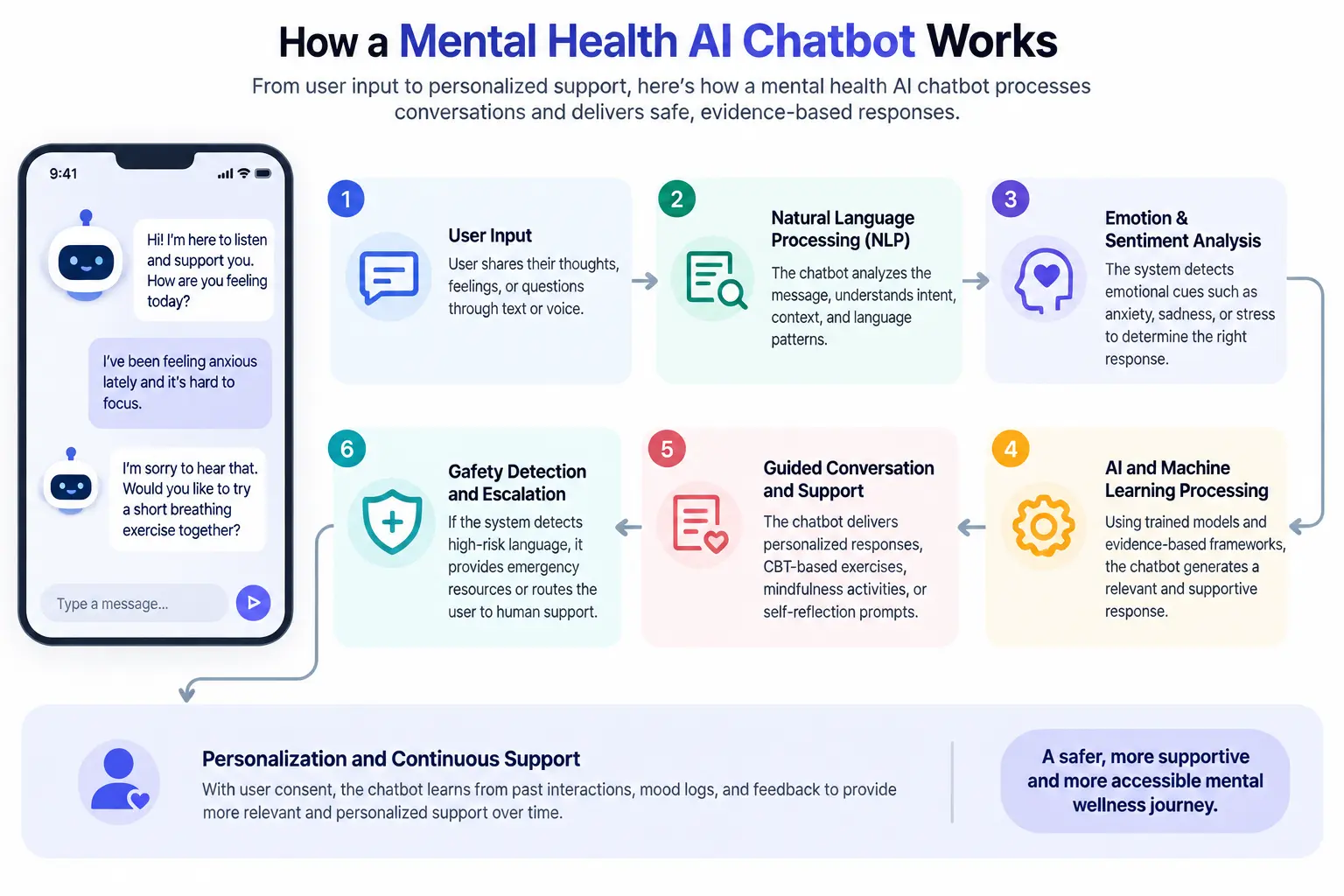
The chatbot first receives a user's message and uses NLP to identify intent, context, language patterns, and relevant emotional cues. This allows the system to distinguish between different types of requests, such as general conversation, stress-related concerns, mood check-ins, or requests for guided exercises.
The system can evaluate language patterns and emotional tone to identify signals such as sadness, anxiety, anger, or distress. These signals can help determine which response style or support pathway is appropriate. Sentiment analysis should support the conversation rather than serve as a standalone clinical diagnosis.
Machine learning models process the user's input and relevant conversation context to generate an appropriate response. The chatbot can use trained models and defined therapeutic or wellness frameworks to guide conversations, recommendations, and personalization.
The chatbot can follow structured conversation flows for activities such as CBT-based exercises, mindfulness, journaling, emotional check-ins, or self-reflection when these are part of the product's approved scope. These flows can be rule-based, AI-assisted, or a combination of both.
Safety mechanisms are essential. When the system detects potentially high-risk language or crisis-related signals, it can trigger predefined safety workflows, provide appropriate emergency resources, or route the interaction toward human support where the product is designed to offer escalation.
With appropriate consent and privacy controls, conversation history, mood logs, and user feedback can help personalize future interactions. This can allow the chatbot to maintain continuity and recommend relevant exercises or resources based on previous interactions.
For businesses exploring mental health AI chatbot development, the core architecture should therefore connect NLP, AI models, structured mental health workflows, safety protocols, privacy controls, and human escalation into one carefully governed system.
Also Read: How To Develop Custom AI Chatbot: Benefits, Types, And Cost
What value can organizations gain by investing in mental health AI chatbot development beyond simply adding a conversational interface? The strongest value comes from combining continuous access, personalized interactions, scalable support, privacy controls, and safety-oriented workflows within one digital experience.
For startups, wellness platforms, healthcare organizations, universities, and employers, these capabilities can help extend mental wellness support across more users while allowing human professionals to focus on situations that require direct clinical attention. The actual impact depends on the chatbot's use case, clinical oversight, safety architecture, and how responsibly user data is handled.
Here are the most impactful benefits of building a mental health AI chatbot today:
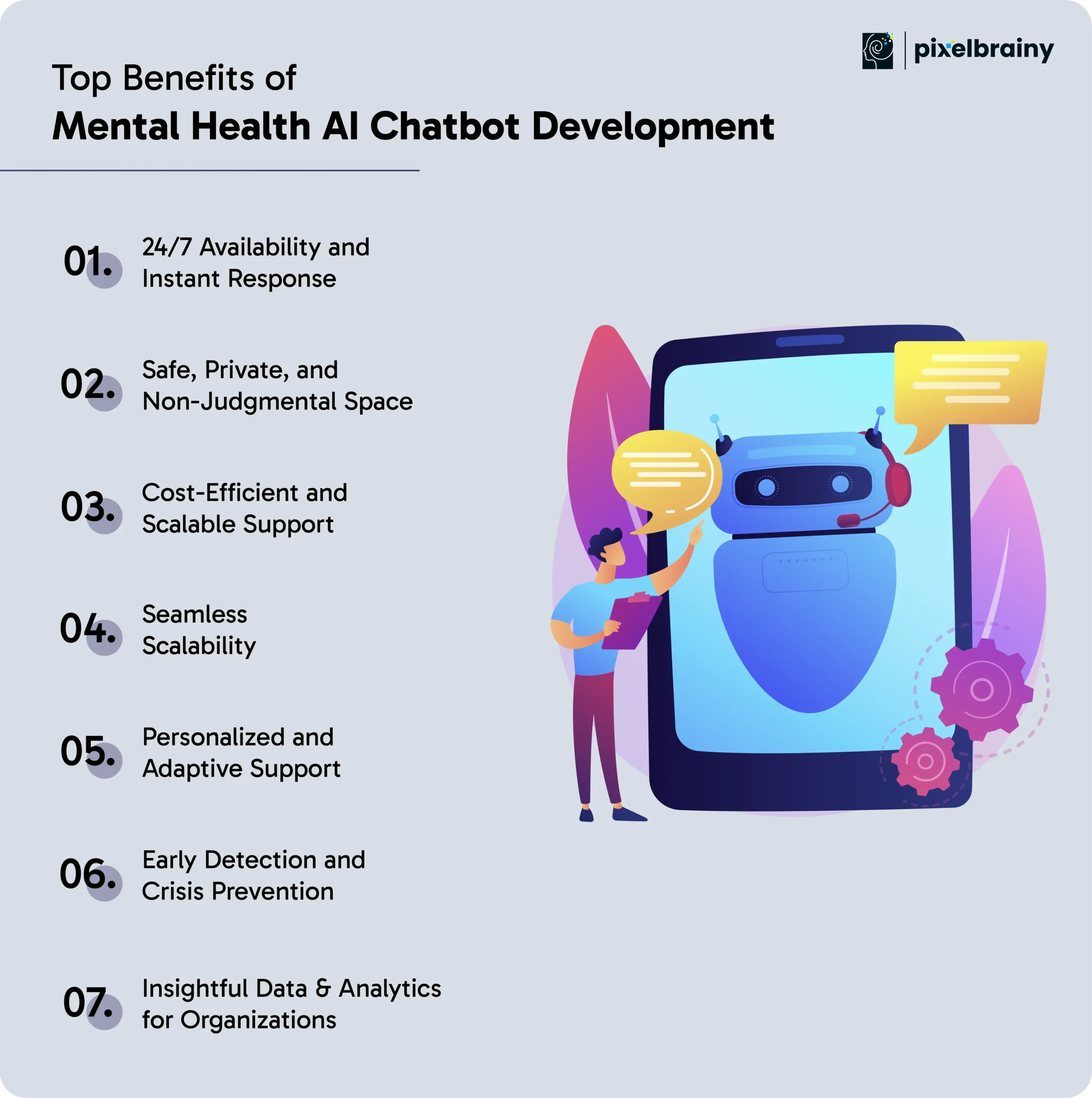
AI chatbots are accessible any time of day or night, making mental health support available whenever users need it most. This is especially valuable during moments of crisis or when professional help isn't immediately available.
Many users are hesitant to speak to humans about their mental health. Chatbots offer a comfortable, anonymous space where users feel free to express themselves without fear or shame.
Creating a chatbot allows organizations to serve large user bases without proportional increases in operational costs. This makes mental health support more affordable and efficient.
AI mental health chatbots can support thousands of users at once without any drop in service quality. This is crucial for large platforms or healthcare networks aiming to expand their outreach.
Smart AI chatbots analyze user behavior, past conversations, and mood data to tailor the interaction. Over time, the support becomes more personalized and engaging.
AI can recognize language cues and behavioral patterns that may indicate emotional distress. This allows for timely support or escalation when serious concerns arise.
When designed with privacy in mind, AI chatbots provide anonymized insights that help organizations understand user needs and trends.
The benefits of mental health AI chatbot development extend from accessible and personalized support to scalable delivery, early risk detection, and privacy-conscious analytics. When designed with appropriate clinical safeguards and human oversight, these capabilities can strengthen digital mental wellness services without positioning AI as a replacement for professional care.
What features should be prioritized when you develop a mental health AI chatbot for wellness support or clinically guided use cases? The feature set needs to balance conversational quality with privacy, safety, personalization, and responsible handling of sensitive mental health information.
For businesses planning AI mental health chatbot development, core functionality should support the complete user journey, from starting a private conversation and recording mood patterns to receiving guided resources and managing consent. These capabilities also provide the technical foundation for adding more advanced AI, personalization, and human escalation workflows later.
Here are 10 core features to consider when working on mental health AI chatbot development:
| Feature | Explanation |
| Natural Language Processing (NLP) | Enables the bot to understand and respond to user input in conversational, human-like language |
| Text-Based Conversation Interface | A simple chat interface that makes it easy for users to engage without confusion or clutter |
| Sentiment Detection | Recognizes emotional tone (e.g., sad, angry, calm) to tailor empathetic responses accordingly |
| Mood Logging and Check-ins | Allows users to record daily emotional states and get support based on patterns over time |
| Guided Question Flows | Directs conversations through structured prompts, offering emotional support or self-reflection guidance |
| Secure User Authentication | Protects user data by implementing login credentials or anonymous access with encryption |
| Conversation History (Basic Memory) | Retains short-term memory of previous chats to provide continuity in the user's experience |
| Resource Sharing (Links & Tips) | Offers links to mental health articles, breathing techniques, or coping exercises based on the user’s input |
| Privacy Policy & Consent Handling | Informs users how their data is used and ensures compliance with privacy regulations like HIPAA/GDPR |
| Feedback Collection | Allows users to rate conversations or provide feedback to improve the chatbot’s tone and helpfulness |
These core features provide the foundation for a safe, privacy-conscious, and user-centered mental health AI chatbot, supporting meaningful conversations, structured self-help experiences, continuity, and responsible data handling from the first interaction.
Once the core functionality is established, advanced capabilities can help a mental health AI chatbot provide more personalized, accessible, and context-aware support. These features are particularly relevant when the product needs to move beyond basic text conversations and support richer interactions, longitudinal wellness tracking, multilingual access, and connections with human professionals.
Consider this real business scenario: “We want to build a mental health AI chatbot that can offer voice-based support, personalize wellness exercises from ongoing interactions, connect users with therapists when conversations require human attention, and provide users with meaningful progress insights. Which advanced features should we prioritize?”
For teams working on mental health therapy AI chatbot development, advanced functionality should be introduced according to the intended use case, clinical oversight, privacy requirements, and technical readiness of the platform. Features involving emotion analysis, biometrics, or adaptive learning also require careful validation and transparent user consent.
Below are 10 advanced features to consider when developing an AI mental health chatbot:
| Advanced Feature | Explanation |
| Voice-Based Interaction | Enables users to speak with the chatbot using voice commands, providing a more natural and accessible experience |
| Emotion AI (Facial/Speech Analysis) | Detects user emotions through voice tone or facial expressions, allowing for deeper emotional understanding |
| Adaptive Learning Algorithms | Learns from ongoing interactions to refine tone, content, and behavior based on individual user preferences |
| Real-Time Therapist Escalation | Connects users with human therapists in urgent or complex situations, ensuring safety and clinical accuracy |
| Wearable Device Integration | Syncs with smart devices to gather biometric data (e.g., heart rate, stress levels) and deliver context-aware support |
| Multi-Language & Cultural Sensitivity | Offers support in multiple languages and tailors conversations to fit cultural nuances and local contexts |
| Gamified Mental Wellness Activities | Engages users with progress tracking, badges, and interactive self-care challenges that encourage consistency |
| AI-Powered Personalized Wellness Plans | Recommends routines, exercises, and content based on user behavior, emotional trends, and personal goals |
| Offline Mode with Local Data Sync | Provides access to essential features even without internet, syncing data securely once reconnected |
| Sentiment Progress Visualization | Shows users visual dashboards of their emotional and mood trends over time to promote self-awareness |
These advanced capabilities can extend a mental health AI chatbot beyond basic conversation by adding personalization, accessibility, progress tracking, and human escalation. Their implementation should remain aligned with clinical guidance, privacy safeguards, and the chatbot’s defined scope of support.
How do you move from a mental wellness chatbot concept to a safe, scalable product that can support real users? mental health AI chatbot development requires more than selecting an LLM and designing a chat interface. The process needs to connect product research, clinical input, privacy and compliance requirements, conversational design, AI engineering, testing, and responsible post-launch monitoring.
Consider this real business scenario: “We want to build a mental health AI chatbot that provides evidence-based CBT exercises for users managing mild to moderate anxiety between therapy sessions. We need to understand how to define the clinical scope, establish crisis escalation workflows, build the MVP, train the AI responsibly, and prepare the platform for secure production use.”
For startups, wellness brands, healthcare organizations, and digital health teams, defining these requirements early helps prevent costly architectural changes and unclear clinical boundaries later. The development process for an AI mental health chatbot should also establish what the system is permitted to do, when it should provide self-guided support, and when it must direct users toward human or emergency resources.
The following seven stages provide a structured roadmap for moving from initial research and validation through model improvement, controlled launch, and responsible scaling.
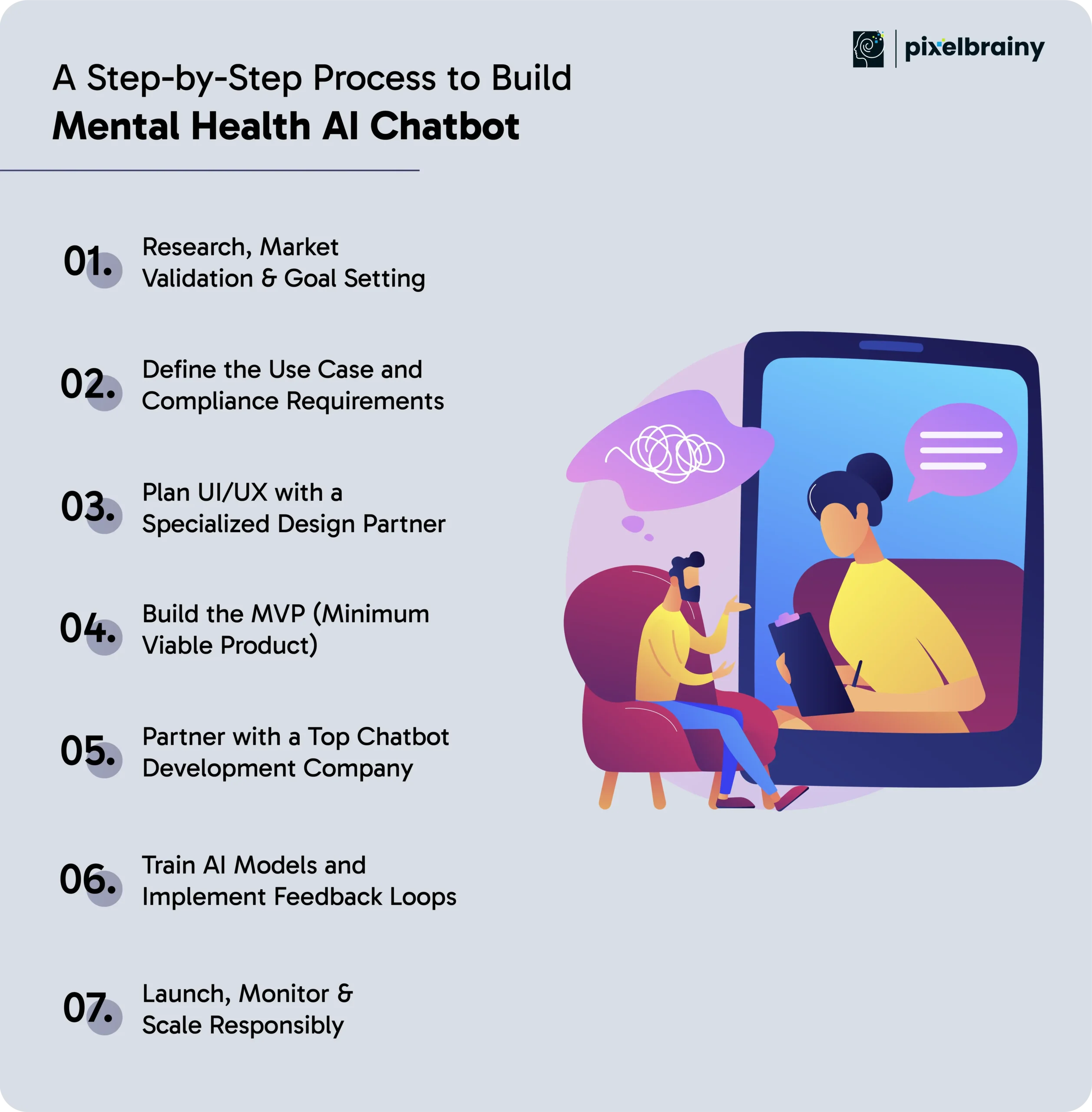
Before writing a single line of code, start by understanding your target audience, user pain points, and competitor landscape. Conduct clinical consultations, surveys, and competitor audits.
Decide on the scope of your chatbot: Will it guide mindfulness, offer CBT techniques, or assist with crisis prevention? At the same time, ensure compliance with healthcare regulations.
A user-centric interface is key in mental health tech. Work with a UI/UX design company that understands emotional sensitivity, accessibility, and simplicity.
Start small with an MVP development strategy to validate functionality with real users. Focus on essential features like NLP, mood check-ins, and guided exercises.
Also Read: Top 10 AI MVP Development Companies in USA
Technical development requires skilled AI engineers and backend teams. Collaborate with a top chatbot development company to ensure robust, scalable architecture.
Also Read: Top Chatbot Development Companies in United States
Your chatbot’s intelligence improves with time. Train your models using anonymized therapy data, sentiment datasets, and real user conversations (with consent).
Also Read: Top 12+ AI Model Development Companies in the USA
After testing, launch your chatbot in a controlled environment. Use analytics tools to track usage, mood trends, and user retention. Prepare for scaling while ensuring ethical and clinical safety.
Following these stages helps create a mental health AI chatbot that balances AI capability with clinical oversight, privacy, safety, usability, and scalable architecture from MVP through production.
What budget should a healthcare startup, wellness company, or digital health provider plan when they develop a mental health AI chatbot with conversational AI, privacy controls, mood tracking, and clinically guided workflows? The cost depends heavily on the product's intended use, AI sophistication, compliance requirements, integrations, and level of human oversight.
Consider this real business scenario: “We want to build a mental health AI chatbot that provides evidence-based CBT support between therapy sessions, includes mood tracking and crisis escalation, and protects sensitive user data. What would it cost to build an MVP now, and how would the budget change when we scale to a clinically oriented enterprise platform?”
Based on the existing cost framework, mental health AI chatbot development can range from $10,000 to $100,000+. A basic MVP can focus on conversational support, mood logging, journaling, and a simple interface, while a larger product may require advanced personalization, emotion analysis, voice capabilities, wearable integrations, analytics, therapist escalation, and stronger compliance infrastructure.
The budget should therefore be planned around the product's clinical scope and technical architecture rather than treating AI integration as a single development expense.
Here’s a quick overview of pricing tiers based on project size and complexity:
| Development Stage | Estimated Cost | What's Included |
| MVP Chatbot | $10,000 – $25,000 | Basic NLP engine, mood tracking, journaling, simple UI, single platform |
| Standard Product | $25,000 – $60,000 | Emotion detection, GDPR/HIPAA compliance, analytics dashboard, multi-platform UI |
| Enterprise Solution | $60,000 – $100,000+ | AI personalization, voice integration, wearable sync, therapist escalation, full-scale backend |
The mental health AI chatbot development cost ultimately depends on the balance between AI capabilities, clinical requirements, privacy, compliance, integrations, and scalability. A focused MVP can establish the foundation before larger investments in advanced features and enterprise infrastructure.
What technology stack should you choose when you develop a mental health AI chatbot that needs secure conversations, mood tracking, AI-powered responses, analytics, and potential therapist escalation?
Consider this real business scenario: “We want to build a mental health AI chatbot that uses an LLM for evidence-based CBT conversations, stores mood history securely, supports therapist handoff when required, and needs to meet strict privacy and compliance requirements. Which technologies should form the foundation of the platform?”
The right stack should be selected according to the chatbot's intended use, data sensitivity, clinical scope, expected user volume, AI workload, and integration requirements. The architecture also needs to support secure authentication, protected data storage, monitoring, scalable deployment, and responsible AI operations.
Below is the recommended technology stack to guide your AI mental health chatbot development, covering the major layers from user experience and NLP to infrastructure, security, analytics, and third-party integrations.
| Component | Recommended Tools/Tech | Explanation |
| Frontend (UI/UX) | React.js, Flutter, Vue.js | Enables a responsive and accessible user interface across web and mobile, essential for mental health support apps |
| Backend | Node.js, Django, Flask | Handles server-side logic, session management, API integrations, and chatbot logic securely and efficiently |
| NLP Engine | OpenAI GPT-4, Google Dialogflow, Rasa | Powers natural language understanding and response generation; key to human-like and empathetic conversations |
| Database | MongoDB, PostgreSQL, Firebase | Stores user interactions, mood logs, progress history, and feedback securely; supports both structured and unstructured data |
| Cloud Services | AWS, Google Cloud, Microsoft Azure | Offers scalable hosting, compute power, and AI services; ensures high availability and disaster recovery |
| Authentication | Firebase Auth, Auth0, OAuth 2.0 | Secures user access and personal data with multi-platform login and compliance-ready encryption |
| Analytics & Insights | Mixpanel, Google Analytics, Amplitude | Tracks user engagement, mood trends, and chatbot performance to guide data-driven improvements |
| Security & Compliance | Vanta, OneTrust, AWS Shield, SSL, HIPAA toolkits | Ensures encryption, secure data storage, and regulatory compliance (e.g., HIPAA, GDPR) critical in healthcare apps |
| DevOps & Deployment | Docker, Kubernetes, GitHub Actions, Jenkins | Automates CI/CD pipelines and enables scalable deployment with containerization and orchestration |
| Third-party Integrations | Twilio (SMS/chat), Stripe (payments), Zoom (therapy handoff) | Enables multi-channel support, subscription billing, or therapist handovers for hybrid service models |
A carefully planned mental health AI chatbot technology stack provides the foundation for secure conversations, reliable AI processing, protected health data, scalable infrastructure, and future clinical or wellness integrations.
Also Read: How To Build An AI Mental Health and Wellness App Like Wysa?
What challenges should healthcare organizations, wellness startups, and digital health companies address before they develop an AI mental health chatbot for real users? The difficulty is not limited to model performance. These systems handle highly sensitive conversations and therefore require careful planning around clinical safety, privacy, crisis response, bias, cultural context, and user trust.
Consider this real business scenario: “We want to build a mental health AI chatbot that provides evidence-based CBT support, recognizes potentially high-risk conversations, protects sensitive health information, and escalates complex cases to human professionals. What challenges should we solve before taking the product into production?”
For teams working on mental health AI chatbot development, these requirements should influence the architecture and product strategy from the beginning. Clinical advisors, privacy specialists, AI engineers, and UX teams may all need to contribute to defining safe conversation boundaries, escalation workflows, consent mechanisms, model evaluation, and ongoing monitoring.
Here are the top challenges in AI mental health chatbot development, along with ways to effectively overcome them:
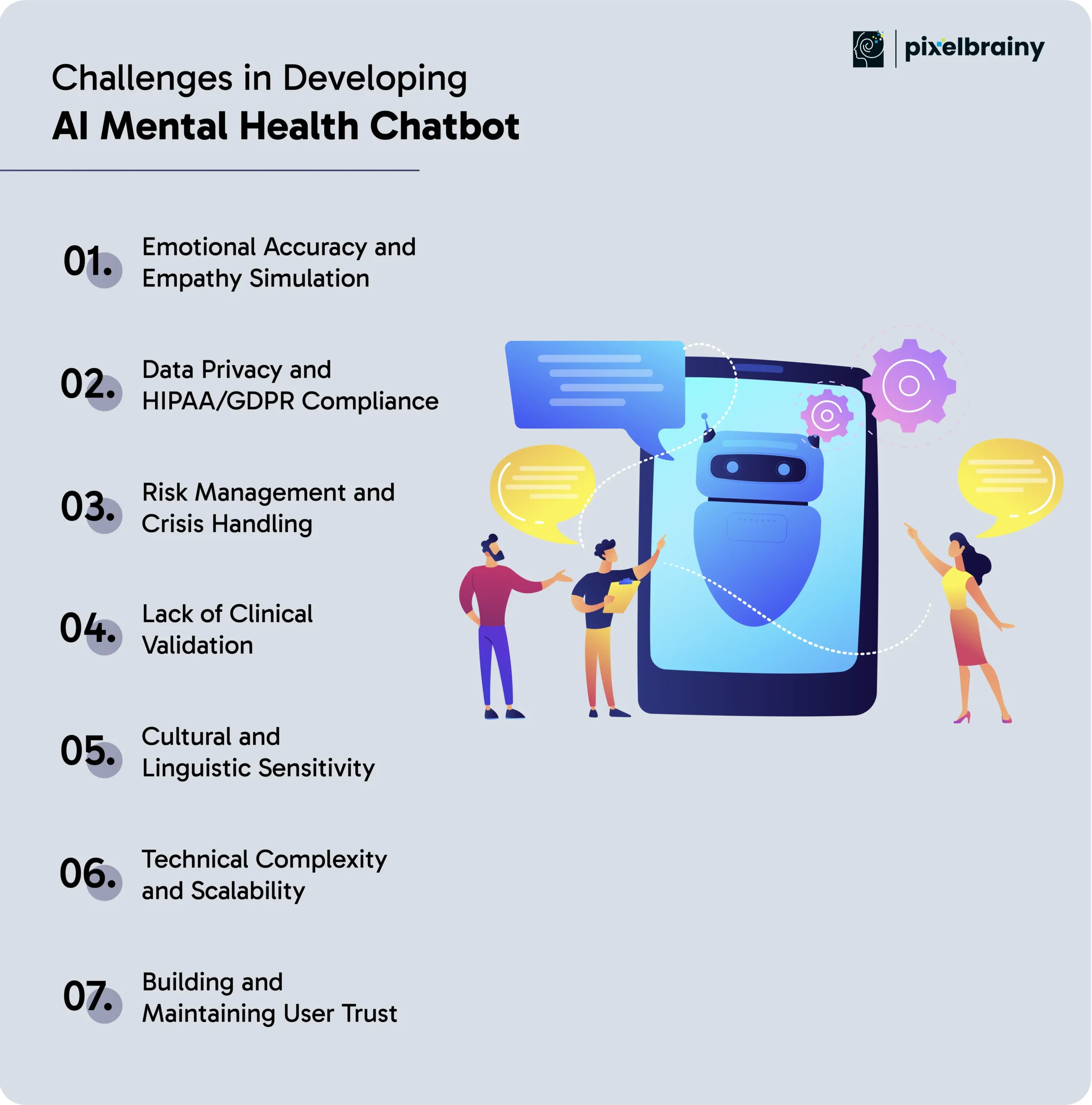
Challenge: AI struggles to fully understand human emotions or deliver genuinely empathetic responses, especially in complex or high-risk situations.
Solution: Use advanced NLP models trained on mental health-specific data and integrate human-in-the-loop systems for complex conversations. Collaborate with therapists to review and refine conversation flows.
Challenge: Collecting and storing sensitive mental health data raises serious privacy concerns and legal obligations.
Solution: Use end-to-end encryption, secure cloud infrastructure, and consult compliance experts. Implement consent mechanisms and give users control over their data.
Challenge: AI chatbots may miss signs of suicidal ideation, trauma, or abuse if not designed with detection protocols.
Solution: Implement keyword flagging, sentiment analysis, and escalation paths to alert emergency services or redirect users to live therapists when high-risk input is detected.
Challenge: Without input from licensed professionals, chatbot advice may be ineffective or even harmful.
Solution: Collaborate with psychologists or clinical advisors during content development. Validate exercises and guidance based on evidence-based therapeutic models like CBT or DBT.
Challenge: Chatbots may misinterpret slang, tone, or cultural context—leading to inappropriate or ineffective responses.
Solution: Train language models with diverse datasets and offer multi-language support. Include localization and culturally aware conversation patterns.
Challenge: Balancing advanced AI features with performance and stability can be difficult, especially as usage grows.
Solution: Use scalable cloud infrastructure, modular architecture, and proven NLP engines. Start with an MVP and iterate based on real usage feedback.
Challenge: If users feel judged, ignored, or unsafe, they’ll abandon the chatbot quickly.
Solution: Prioritize transparent communication, respectful tone, and clearly defined boundaries (e.g., “I’m not a therapist but I’m here to help”). Regularly improve UX based on user feedback.
Overcoming these challenges requires a balance of ethical design, clinical input, and technical precision, ensuring your AI mental health chatbot is not only intelligent but also trustworthy and safe for real-world use.
Overcoming these challenges requires a coordinated approach to clinical safety, privacy, AI reliability, compliance, and human oversight, helping create a mental health chatbot that is responsible and suitable for real-world use.
Also Read: How to Hire Mental Health App Developers in USA?
How can a mental health AI chatbot generate sustainable revenue while keeping essential wellness support accessible and maintaining user trust? For healthcare providers, wellness startups, digital health platforms, and therapy-focused products, monetization needs to align with the chatbot's intended use, level of clinical involvement, and the value offered to users.
Consider this real business scenario: “We want to build a mental health AI chatbot that provides guided CBT exercises, mood tracking, personalized wellness support, and therapist referrals. Which monetization models can generate recurring revenue without creating barriers to essential mental health support or compromising user privacy?”
A strong revenue strategy can combine free access to selected capabilities with paid personalization, professional services, enterprise licensing, or supplementary wellness products. However, monetization decisions should also account for healthcare privacy, informed consent, transparent pricing, and the distinction between general wellness support and clinical services.
Here are the top monetization strategies for your mental health AI chatbot after its development:
Offer core features for free, such as daily mood tracking or basic exercises, and charge for premium content like advanced therapy modules, guided sessions, or personalized plans.
Charge users a monthly or annual fee for unlimited access to advanced features, AI personalization, or weekly check-ins.
License your chatbot to mental health clinics, private therapists, or telehealth companies as a white-label or co-branded tool.
Offer your AI chatbot as part of employee assistance or corporate wellness programs. Companies are investing more in mental health support.
Recommend vetted mental health services, meditation apps, or therapy platforms within your chatbot. Earn commissions through affiliate links.
Offer downloadable therapy workbooks, video series, or mindfulness audio packs as one-time purchases inside the app.
Provide anonymized user insights (e.g., mood trends, engagement metrics) to researchers, universities, or healthcare orgs—only with full user consent.
A sustainable mental health AI chatbot business model should balance revenue generation with affordability, privacy, transparency, and user well-being. The right combination of monetization channels can support long-term product growth without compromising the chatbot's responsible use in mental health support.
When a mental health chatbot is expected to handle sensitive conversations, guided wellness experiences, and potentially high-risk situations, choosing the right development partner matters as much as choosing the technology. PixelBrainy brings together AI engineering, conversational design, healthcare-focused product thinking, security, and scalable application development to help businesses create responsible digital mental health solutions.
As an AI chatbot development company in USA, PixelBrainy works with startups, wellness platforms, and organizations looking to create AI-powered products for self-care, emotional support, guided wellness, and therapist-assisted experiences.
Our approach focuses on building the technical foundation around the chatbot's intended use case, user population, safety requirements, and long-term product roadmap.
Context-aware AI architecture:
We design conversational systems that can understand user intent, maintain relevant context, and deliver responses aligned with the product's defined wellness or support workflows.
Privacy-focused backend architecture:
Mental health products require careful handling of sensitive conversations and user information. We incorporate secure authentication, protected data storage, access controls, consent workflows, and privacy-focused architecture into the development process.
Human-centered UI/UX:
The interface should feel simple, calm, and accessible, particularly when users are discussing emotionally sensitive subjects. Our design approach focuses on clear navigation, accessible interactions, and low-friction conversational experiences.
MVP-first development:
Businesses can begin with a focused set of capabilities such as conversational support, mood check-ins, guided exercises, journaling, and safety workflows before expanding into more advanced AI functionality.
Scalable product architecture:
The platform can be structured to support future integrations such as therapist handoff, multilingual conversations, voice interaction, analytics, wearable data, and additional wellness services.
For a confidential U.S.-based mental wellness startup, PixelBrainy developed an AI mental health chatbot designed for young adults experiencing anxiety and academic burnout.
The platform included:
According to the project details, the chatbot achieved a 40% weekly retention rate within three months of MVP launch and was subsequently adopted by two universities as a campus wellness solution.
This project demonstrates the importance of combining conversational AI with structured wellness workflows, user-focused design, and safety-oriented product architecture.
Ready to build a responsible, scalable mental health AI chatbot? Connect with PixelBrainy to discuss your product requirements.

Developing a mental health AI chatbot requires a careful balance of conversational AI, evidence-based support, privacy, clinical oversight, security, and responsible safety mechanisms. Throughout this guide, we covered the core and advanced features, development process, estimated costs, technology stack, monetization models, and key challenges involved in creating a reliable mental wellness chatbot.
Whether you are a healthcare organization, wellness startup, therapy platform, university, or digital health business, the right approach is to define the chatbot’s purpose clearly and build its capabilities around that scope. A focused MVP can validate the user experience and core workflows before expanding into advanced personalization, voice interaction, therapist escalation, analytics, and other capabilities.
A strong development strategy also ensures that AI supports users without being positioned as a substitute for qualified mental health professionals or emergency care.
Ready to turn your mental wellness chatbot idea into a secure and scalable product?
Book a free consultation with PixelBrainy to discuss your mental health AI chatbot development requirements.
The mental health AI chatbot development cost can range from around $10,000 for an MVP to $100,000+ for an enterprise solution. The final budget depends on conversational AI complexity, privacy requirements, clinical workflows, integrations, personalization, voice capabilities, and the level of therapist escalation required.
Yes, a mental health AI chatbot can be designed around structured CBT-based exercises, guided reflection, mood check-ins, and self-help workflows. The scope should be defined with qualified mental health professionals, and the chatbot should not be presented as a replacement for licensed clinical care.
For AI mental health chatbot development, high-risk detection can use predefined safety rules, language analysis, sentiment signals, and escalation workflows. The system can then provide appropriate crisis resources or route users toward human support when the product includes a clinical escalation pathway.
A mental health AI chatbot may handle highly sensitive information, so privacy planning should cover secure authentication, encryption, consent management, protected data storage, access controls, retention policies, and applicable healthcare or privacy regulations such as HIPAA or GDPR.
A typical AI mental health chatbot development stack can include NLP and large language models, sentiment analysis, machine learning, structured conversation flows, secure databases, cloud infrastructure, analytics tools, and authentication services. The technology choices should be based on the chatbot's intended use and safety requirements.
A focused MVP can take several weeks to a few months, while a production-ready mental health AI chatbot with advanced personalization, compliance controls, therapist escalation, analytics, voice support, and multi-platform delivery will require a longer development cycle. Clinical review and safety testing can also affect the timeline.
Yes, developing a mental health AI chatbot can include therapist handoff workflows that allow users to move from automated support to a qualified professional when the situation requires human involvement. This can be implemented through telehealth integrations, scheduled appointments, live chat, or escalation workflows.
Choose a Mental Health AI Chatbot development company with experience in conversational AI, privacy-focused architecture, secure data handling, healthcare or wellness workflows, clinical collaboration, safety escalation, and scalable cloud infrastructure. A strong partner should also be able to explain how the chatbot will be evaluated, monitored, and improved after launch.

About The Author
Sagar Bhatnagar
Sagar Sahay Bhatnagar brings over a decade of IT industry experience to his role as Marketing Head at PixelBrainy. He's known for his knack in devising creative marketing strategies that boost brand visibility and market influence. Sagar's strategic thinking, coupled with his innovative vision and focus on results, sets him apart. His track record of successful campaigns proves his ability to utilize digital platforms effectively for impactful marketing efforts. With a genuine passion for both technology and marketing, Sagar continuously pushes PixelBrainy's marketing initiatives to greater success.

Working with PixelBrainy has been a great experience. They took our vision for an AI-powered platform and turned it into a fully functional product. What impressed me most was their strong understanding of both design and development, and their ability to handle complex requirements with ease. The team was responsive, cooperative, and always open to feedback. They kept things organized, communicated clearly, and delivered quality work on time. I highly recommend PixelBrainy to anyone looking for a skilled and reliable development partner.

Working with the PixelBrainy team has been a highly positive experience. They understand the design requirements and create beautiful UX elements to meet the application needs. The dev team did an excellent job bringing my vision to life. We discussed usability and flow. Sagar worked with his team to design the database and begin coding. Working with Sagar was easy. He has the knowledge to create robust apps, including multi-language support, Google and Apple ID login options, Ad-enabled integrations, Stripe payment processing, and a Web Admin site for maintaining support data. I'm extremely satisfied with the services provided, the quality of the final product, and the professionalism of the entire process. I highly recommend them for Android and iOS Mobile Application Design and Development.

Great experience working with them. Had a lot of feedback and I found that unlike most contractors they were bugging me for updates instead of the other way around. They were extremely time conscience and great at communicating! All work was done extremely high quality and if not on time, early! They were always proactive when it comes to communication and the work is great/above par always. Very flexible and a great team to work with! Goes above and beyond to present us with multiple options and always provides quality. Amazing work per usual with Chitra. If you have UI/UX or branding design needs I recommend you go to them! Will likely work with them in the future as well, definitely recommended!

PixelBrainy is a joy to work with and is a great partner when thinking through branding, logo, and website layout. I appreciate that they spend time going into the "why" behind their decisions to help inform me and others about industry best practices and their expertise.

I hired them to design our software apps. Things I really like about them are excellent communication skills, they answer all project suggestions and collaborate right away, and their input on design and colors is amazing. This project was complex and needed patience and creativity. The team is amazing to do business with. I will be using them long-term. Glad to see there are some good people out there. I was afraid to try and outsource my project to someone but I am glad I met them! I really can't say enough. They went above and beyond on this project. I am very happy with everything they have done to make my business stand out from the competition.

It was great working with PixelBrainy and the team. They were very responsive and really owned the project. We'll definitely work with them again!

I recently worked with the PixelBrainy team on a project and I was blown away by their communication skills. They were prompt, clear, and articulate in all of our interactions. They listened and provided valuable feedback and suggestions to help make the project a success. They also kept me updated throughout the entire process, which made the experience stress-free and enjoyable.

PixelBrainy is very good at what it does. The team also presents themselves very professionally and takes care of their side of things very well. I could fully trust them taking up the design work in a timely and organised manner and their attention to detail saved us lots of effort and time. This particular project was quite intense and the team showed that they function very well under pressure. Very much looking forward to working with her again!

It's always an absolute pleasure working with them. They completed all of my requests quickly and followed every note I had for them to a T, which made our process go smoothly from start to finish. Everything was completed fast and following all of the guidelines. And I would recommend their services to anyone. If you need any design work done in the future, PixelBrainy should be your first call!

They took ownership of our requirements and designed and proposed multiple beautiful variants. The team is self-motivated, requires minimum supervision, committed to see-through designs with quality and delivering them on time. We would definitely love to work with PixelBrainy again when we have any requirements.

PixelBrainy was a big help with our SaaS application. We've been hard at work with a new UI/UX and they provided a lot of help with the designs. If you're looking for assistance with your website, software, or mobile application designs, PixelBrainy and the team is a great recommendation.

PixelBrainy designers are amazing. They are responsive, talented, and always willing to help craft the design until it matches your vision. I would recommend them and plan to continue them for my future projects and more!!!

They were awesome! Did a good job fast, and good communication. Will work with them again. Thank you

Creative, detail-oriented, and talented designers who take direction well and implement changes quickly and accurately. They consistently over-delivered for us.

PixelBrainy team is very talented and creative. Great designers and a pleasure to work with. PixelBrainy is an excellent communicator and I look forward to working with them again.

PixelBrainy has a very talented design team. Their work is excellent and they are very responsive. I enjoy working with them and hope to continue on all of our future projects.

Transform your ideas into reality with us.
Across these industries, each engagement brings unique challenges, from early-stage product development to scaling complex systems, helping us build a practical understanding of real-world product environments.