AI Summary Powered by PixelBrainy
Which artificial general intelligence companies in USA are genuinely advancing toward AGI, and which are mainly marketing existing AI capabilities as AGI-adjacent technology?
That is an increasingly important question for Fortune 500 strategy leaders. Today's large language models can already write software, analyze documents, reason through complex questions, generate content, and interact with business systems. However, AGI represents a broader ambition: AI systems capable of generalizing across domains, learning new tasks, reasoning over unfamiliar problems, operating with greater autonomy, and potentially performing a wide range of economically valuable cognitive work.
The distinction matters when evaluating AGI companies in USA. OpenAI, Anthropic, Google DeepMind, xAI, Meta, and Microsoft are investing heavily in frontier models, reasoning, multimodal intelligence, agents, scientific AI, infrastructure, and safety research. Other companies are creating valuable enterprise products on top of these capabilities without necessarily pursuing AGI as their central research objective.
The market opportunity is also expanding rapidly. According to Grand View Research's latest 2026 report, the global artificial intelligence market is estimated at $539.5 billion in 2026 and is projected to reach approximately $3.50 trillion by 2033, representing a 30.6% CAGR from 2026 to 2033.
For enterprise decision-makers researching the best AGI companies in USA, the important question is therefore not which company uses the word AGI most frequently. It is which companies are actually advancing the technical capabilities associated with increasingly general intelligence.
This review provides a practical list of top artificial general intelligence companies USA, separating genuine frontier research programs from AGI-adjacent enterprise AI businesses and infrastructure providers. It also examines what AGI companies in USA building foundation models can actually offer enterprises in 2026, where the technology is creating measurable business value, and how Fortune 500 buyers should evaluate competing vendors.
An artificial general intelligence company in the USA is broadly a research and development organization working toward AI systems capable of performing a wide range of intellectual tasks across multiple domains, rather than being optimized for one narrow function. AGI research typically involves capabilities such as reasoning, learning, adaptation, planning, multimodal understanding, tool use, and autonomous task execution. In 2026, however, there is still no universally accepted technical test confirming that a commercial AI system has definitively achieved AGI.
The meaning of AGI remains contested because there is no universally accepted benchmark or technical threshold. Different researchers and companies emphasize different capabilities, including autonomy, generalization, reasoning, learning, and economic usefulness.
OpenAI: OpenAI defines AGI as highly autonomous systems that outperform humans at most economically valuable work. Its Charter also acknowledges that the timeline to AGI remains uncertain.
Anthropic: Anthropic approaches increasingly capable AI with a strong emphasis on safety, human oversight, ethical behavior, interpretability, and responsible deployment. Its 2026 Constitution specifically addresses the challenge of developing AI systems whose capabilities may eventually rival or exceed human capabilities.
NVIDIA and the broader industry: Industry leaders have used broader interpretations of AGI, demonstrating why there is no single definition or universally agreed arrival point.
For enterprises, the practical distinction is straightforward: today's frontier AI can perform an increasingly broad range of general-purpose tasks, but AGI remains a developing research objective rather than a universally verified commercial achievement.
The simplest way to understand artificial general intelligence vs narrow AI companies USA is to compare the breadth of the systems they develop.
| AGI-oriented AI | Narrow AI |
|---|---|
| Designed for broad cognitive capabilities | Designed for specific tasks |
| Can potentially generalize across domains | Usually optimized for defined workflows |
| Focuses on reasoning, learning, and adaptation | Focuses on a predetermined function |
| Often built around general-purpose foundation models | Often built around specialized models |
| Long-term research objective | Mature commercial technology |
A fraud-detection model, recommendation engine, medical classifier, or customer-service automation system can be highly effective without being AGI. Conversely, a frontier foundation model may demonstrate capabilities across dozens of domains without yet satisfying every accepted definition of AGI.
This distinction is particularly important when evaluating AGI companies USA 2026, because companies can be commercially successful in AI without actually conducting frontier AGI research.
The AGI companies in USA with enterprise products can generally be divided into three groups.
1. Frontier research labs: OpenAI, Anthropic, Google DeepMind, and xAI are developing increasingly capable foundation models, reasoning systems, multimodal AI, agents, and other technologies associated with the pursuit of more general intelligence. OpenAI explicitly describes itself as an AI research and deployment company working toward AGI.
2. AGI infrastructure companies: NVIDIA and Microsoft occupy a different but essential position. NVIDIA supplies GPUs, networking, and computing infrastructure required to train and run advanced models. Microsoft provides cloud infrastructure, enterprise AI platforms, security, developer tools, and access to advanced AI capabilities.
3. AGI-adjacent application builders: Companies such as PixelBrainy and similar AGI development companies USA help enterprises turn frontier model capabilities into production applications. These firms can integrate models from OpenAI, Anthropic, Google, and other providers with enterprise data, APIs, business workflows, authentication, security, monitoring, and governance.
This third category is particularly important because most enterprises do not need to become AI research laboratories. They need to make advanced AI useful inside their existing technology environment.
Most US enterprises should think of AGI companies as technology ecosystem partners, not necessarily as companies they need to hire directly for custom AGI research.
The practical path is to access frontier models through APIs and enterprise platforms, then build business applications around those capabilities. This may involve connecting models to proprietary data, enterprise software, internal knowledge bases, APIs, databases, workflow systems, and human approval processes.
That is where an experienced development partner can provide significant value. A company such as PixelBrainy can potentially sit between frontier model providers and enterprise users, handling the application engineering and integration work required to turn advanced AI capabilities into production systems.
For organizations researching how to access AGI companies products in USA, the key is therefore not to wait for a finished AGI product. Enterprises can already access increasingly general AI capabilities and build applications around them.
The practical model is simple: frontier labs advance AI capabilities, infrastructure companies provide the computing and platforms, and AGI development partners help enterprises deploy those capabilities into real business workflows.
Also Read: Top 20+ AI Development Companies In USA
To build this best AGI companies in USA 2026 reviewed and ranked list, we used a six-criteria framework covering research credibility, enterprise accessibility, safety and alignment, investment and talent, deployment evidence, and practical implementation relevance.
Because AGI technology companies USA operate at different layers of the ecosystem, we did not judge a frontier research laboratory by the same commercial criteria as an enterprise AI platform or development partner.
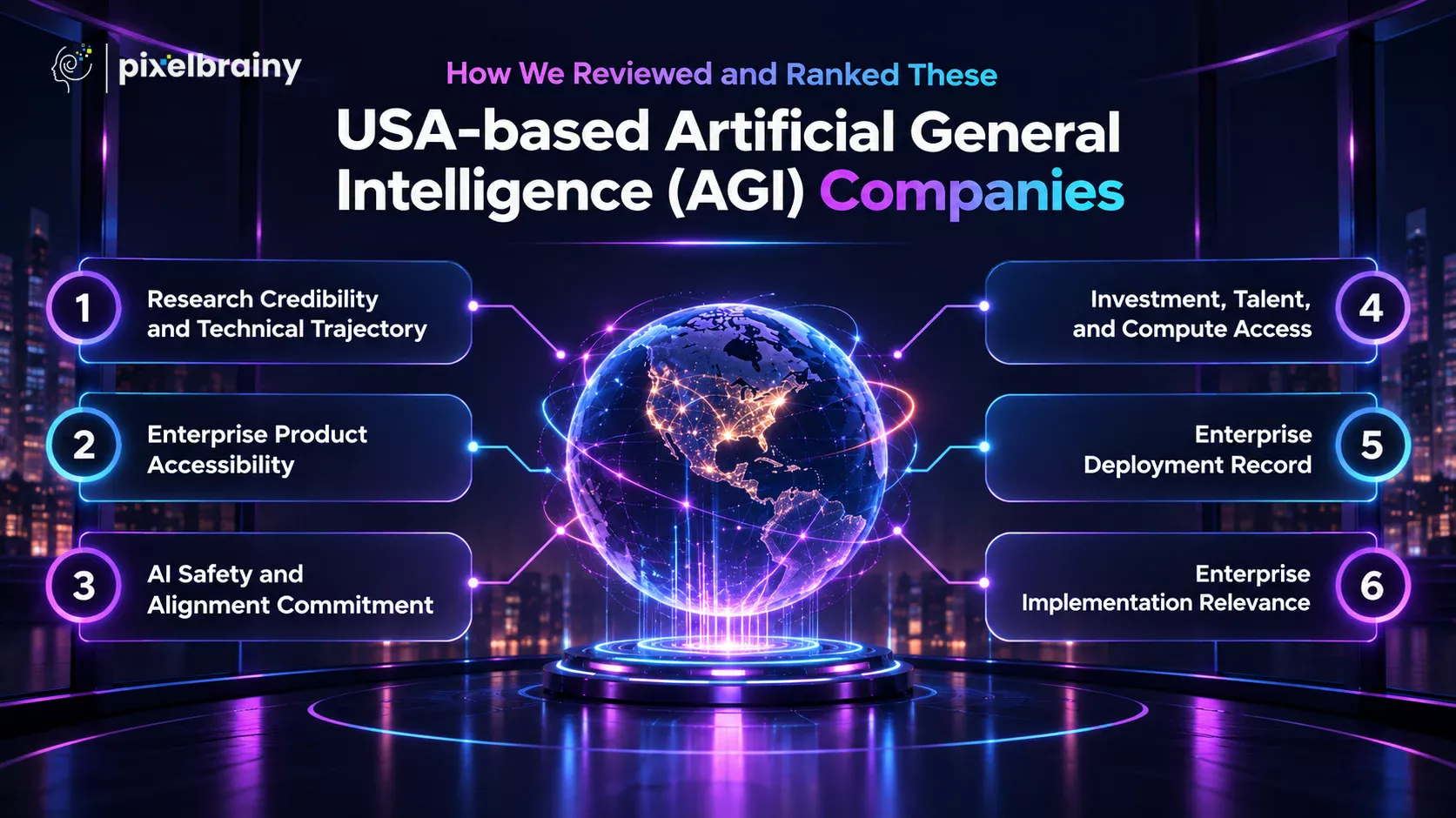
The 6 Criteria We Used:
The first question was whether a company is genuinely advancing toward increasingly general AI capabilities or primarily using AGI terminology for marketing. We reviewed publicly available research papers, technical reports, model documentation, benchmark results, foundation-model capabilities, reasoning systems, multimodal research, agent development, and evidence of progress toward broader AI capabilities.
Where possible, we also considered independent evaluations and assessments rather than relying exclusively on company claims. This distinction is particularly important when comparing AGI research companies USA, because impressive product performance does not automatically establish an AGI research program.
We evaluated what enterprises can actually access in 2026, including APIs, foundation models, AI platforms, cloud services, developer tools, and managed products. Roadmap announcements were not treated as equivalent to commercially available capabilities.
This criterion answers a practical buyer question: What can a US enterprise deploy today?
For AGI companies in USA safety focused and AGI companies in USA alignment research, we assessed publicly documented safety work, alignment research, frontier risk evaluations, red-teaming, safeguards, governance frameworks, and responsible scaling practices.
For example, OpenAI's Preparedness Framework uses structured capability evaluations and safeguards for severe frontier-AI risks, while its 2026 Frontier Governance Framework adds public governance, risk assessment, incident response, and external-expert components.
We also considered whether companies support independent evaluation. OpenAI's 2026 evaluation guidance emphasizes third-party testing as an additional source of evidence for frontier capability and safety claims.
Frontier AI development requires substantial research talent, capital, and computing resources. We therefore considered publicly observable indicators such as investment scale, research-team strength, access to advanced compute, infrastructure commitments, and technical leadership.
These factors are supporting indicators, not proof of AGI capability. A company with more GPUs or funding does not automatically have better research.
For companies with commercial AI offerings, we examined evidence of production deployment, enterprise adoption, documented customer use, product maturity, and scalability. This criterion helps distinguish companies with important research programs from providers whose technology is also sufficiently mature for enterprise use.
Importantly, research strength and enterprise readiness were scored separately. A company can be a leading AGI research organization while offering limited enterprise access, while another company can be an excellent enterprise AI provider without conducting frontier AGI research.
Finally, we evaluated how effectively each category of company can help businesses turn frontier AI capabilities into practical systems. This includes model API access, application development, enterprise-data integration, workflow orchestration, security, monitoring, evaluation, and governance.
For practical implementation, development partners such as PixelBrainy can serve as an intermediary between frontier model providers and enterprises, helping organizations build production applications on top of capabilities developed by companies such as OpenAI, Anthropic, and Google.
We deliberately excluded companies making unsubstantiated AGI claims without meaningful technical evidence, organizations whose AGI positioning is primarily marketing-driven, and AI service providers whose work has no meaningful connection to frontier AI capabilities.
This methodology is designed to answer two different questions clearly: which companies are genuinely advancing AGI research, and which companies can help enterprises access and deploy increasingly general AI capabilities in 2026?
The distinction matters because AI research credibility, safety maturity, and commercial accessibility are related, but they are not the same thing.

Also Read: Top 10 AI MVP Development Companies in USA
If your enterprise has already been using GPT, Claude, or Gemini, the next question is simple: which AGI companies in the USA can you actually access today, and how does their frontier research translate into the next generation of enterprise AI? The answer is broader than a list of companies claiming to pursue AGI.
OpenAI, Anthropic, Google DeepMind, xAI, and Meta are the primary frontier organizations to watch because they are advancing foundation models, reasoning, multimodal intelligence, agents, and increasingly general AI capabilities. Microsoft and NVIDIA provide critical enterprise and computing infrastructure, while Figure AI and Boston Dynamics are extending advanced AI into physical autonomous systems. Cognition demonstrates how frontier intelligence can be transformed into autonomous professional workflows.
There is also an important implementation layer. Most enterprises do not have the research infrastructure, specialized talent, or computing resources required to develop frontier AGI themselves. Instead, they can access commercial models, APIs, cloud platforms, and developer tools, then use experienced AGI development companies USA to integrate those capabilities into production systems.
This is where PixelBrainy fits. It is positioned as an enterprise AGI application partner, helping businesses connect frontier AI capabilities with proprietary data, workflows, integrations, security, and business applications.
The profiles below distinguish who is advancing AGI research from who helps enterprises use those capabilities today.
Location: Sheridan, Wyoming, USA
Founded: 2021
Key leadership: PixelBrainy leadership team
Category: AGI Application Partner / Enterprise AI Development Partner
Clutch Rating: 4.9/5
PixelBrainy occupies a different position from frontier research laboratories. It does not claim to train a proprietary AGI foundation model. Instead, its role is to help enterprises turn increasingly capable models from frontier laboratories into production software.
The company's practical philosophy is that enterprises do not need to reproduce the research infrastructure of OpenAI, Anthropic, Google, or Meta. They need reliable applications built around the capabilities those companies make available through APIs, models, and enterprise platforms.
According to the company information provided for this article, PixelBrainy builds applications using capabilities from OpenAI, Anthropic, Google, and Meta. Its work can involve LLM integration, multimodal AI, AI agents, workflow automation, retrieval-augmented generation, enterprise knowledge systems, and custom AI applications.
Because frontier model names change quickly, enterprises should evaluate PixelBrainy's current model integrations at the time of engagement rather than treating any individual model list as permanent.
The practical access layer includes custom AI applications, API integrations, enterprise automation, AI assistants, agentic workflows, and model-connected business software.
The company information supplied for this article identifies EY, MSC Cruises, VetPlus, Tykr, EventPlaybook, and Makula among its notable clients. These client references should be independently confirmed with PixelBrainy before publication as formal case-study claims.
PixelBrainy's safety responsibility is primarily implementation-focused. Enterprise deployments need authentication, access controls, data protection, monitoring, human oversight, model evaluation, and appropriate permissions around AI agents.
Best for
Fortune 500 and mid-market organizations that need an experienced AGI development company USA to connect frontier AI capabilities with proprietary business systems.
PixelBrainy belongs at #1 because this article is designed for enterprises asking not only which companies are advancing AGI, but also how businesses can actually use those capabilities today. It represents the practical implementation layer between frontier AGI research and enterprise applications.
Location: San Francisco, California
Founded: 2015
Key leadership: Sam Altman, CEO; OpenAI research and product leadership
Category: Frontier AGI research and foundation models
OpenAI is one of the clearest examples of a company whose stated mission directly centers on AGI. Its Charter defines AGI as highly autonomous systems that outperform humans at most economically valuable work, while its research organization describes its work as research "on the path to AGI."
In 2026, OpenAI's frontier work spans advanced reasoning, multimodal intelligence, coding, agents, scientific applications, and long-running professional workflows. GPT-5.6 is part of the company's current frontier model family, with OpenAI describing its work as combining model, inference, and agentic-harness improvements.
Enterprises can access OpenAI through ChatGPT business products, APIs, developer tools, and agent-oriented offerings. OpenAI reported that enterprise revenue represented more than 40% of its revenue in April 2026 and that its APIs were processing more than 15 billion tokens per minute.
OpenAI has attracted major strategic and financial investment while simultaneously expanding its own AI infrastructure. Its Stargate initiative is intended to build large-scale compute capacity for the AI economy.
Safety is explicitly part of OpenAI's mission. Its published approach covers alignment, human control, defense in depth, preparedness evaluations, and frontier risk management.
Best for
Enterprises seeking frontier reasoning, multimodal AI, coding, agents, research automation, and broad enterprise AI deployment.
OpenAI combines a direct AGI mission with frontier research and large-scale commercial deployment. For enterprises asking which AGI companies in USA openai competitors are actually competing at the frontier, OpenAI remains the central reference point.
Location: San Francisco, California
Founded: 2021
Key leadership: Dario Amodei, CEO; Daniela Amodei, President
Category: Frontier AI research and enterprise foundation models
Anthropic was founded around the development of reliable and safer advanced AI. Its research emphasizes frontier models, reasoning, agentic systems, interpretability, and alignment. Its 2026 Claude Constitution describes desired model behavior around safety, ethics, honesty, and human oversight.
Anthropic's current frontier portfolio includes Claude Opus 5, Claude Sonnet 5, and the Fable 5 and Mythos 5 model families. Fable 5 is positioned for advanced coding, knowledge work, vision, scientific research, and complex tasks, while Mythos 5 is available through more restricted trusted-access programs.
Organizations can access Claude through Claude Enterprise, the Claude API, Claude Code, cloud platforms, and enterprise partnerships. Anthropic has also expanded Claude into regulated industries and scientific workflows.
Anthropic announced a $65 billion Series H in May 2026 at a reported $965 billion post-money valuation. The company said the funding would support safety and interpretability research, compute expansion, and customer products.
Safety is a major differentiator. Anthropic uses Constitutional AI, frontier evaluations, safeguards, red teaming, and responsible-scaling practices. Its Fable 5 launch also included explicit cybersecurity safeguards and a jailbreak-severity framework.
Best for
Regulated enterprises, software organizations, research teams, legal operations, cybersecurity, and companies prioritizing safety alongside frontier capability.
Anthropic is one of the strongest AGI companies in USA safety focused on both capability and risk. Its combination of frontier models, enterprise availability, and alignment research makes it one of OpenAI's most important US competitors.
Location: Mountain View, California
Founded: 2023 as Google DeepMind, combining Google Brain and DeepMind teams
Key leadership: Demis Hassabis and Google AI leadership
Category: Frontier research, foundation models, scientific AI
Google DeepMind combines fundamental AI research with Google's enormous computing, data, software, and scientific infrastructure. Its research explicitly discusses the path from AGI toward artificial superintelligence, making it one of the clearest long-term AGI research organizations in the US.
The Gemini family provides Google's general-purpose foundation-model layer, while DeepMind continues advancing reasoning, multimodality, robotics, coding, mathematics, and scientific discovery.
Gemini Deep Think is being applied to professional mathematics, physics, and computer science problems.
Enterprises can access Google's AI capabilities through Google Cloud, Gemini enterprise services, developer APIs, Vertex AI, and Google's broader data and productivity ecosystem.
DeepMind benefits from Google's enormous infrastructure and capital base rather than depending on conventional startup fundraising.
Google DeepMind has invested heavily in frontier safety, model evaluation, responsible development, and technical safety research. Its work increasingly examines risks associated with systems that could eventually move from AGI toward superintelligence.
Best for
Google Cloud enterprises, scientific organizations, life sciences companies, developers requiring multimodal AI, and businesses already deeply invested in Google's data ecosystem.
Google DeepMind is particularly important because its AGI research is connected to scientific discovery. Projects such as Co-Scientist use multi-agent Gemini systems to generate, debate, and refine scientific hypotheses.
Location: California and Memphis, Tennessee infrastructure operations
Founded: 2023
Key leadership: Elon Musk and xAI leadership
Category: Frontier foundation models and agentic AI
xAI was created to develop advanced AI systems and compete directly in frontier-model research. Its strategy combines large-scale compute, reinforcement learning, reasoning, tool use, and increasingly autonomous AI systems.
The Grok family has moved rapidly through successive generations. Grok 4.6, released in August 2026, emphasizes long-running agents, interactive work, visual tasks, research, coding, and multi-step knowledge work.
xAI offers API access and enterprise products. Grok 4.5 is also available through GitHub Copilot, expanding access for software developers and some enterprise users.
xAI announced a $20 billion Series E in January 2026 and reported more than one million H100 GPU equivalents across its Colossus I and II infrastructure.
xAI's safety approach is developing alongside its rapidly expanding model capabilities. Enterprises should examine current model documentation, safeguards, privacy controls, and governance terms before deployment.
Best for
Organizations interested in frontier reasoning, real-time information, coding agents, long-running AI agents, and large-scale model experimentation.
xAI is one of the most significant AGI companies in USA openai competitors, particularly because of its aggressive compute strategy and rapid model development. Its 2026 Grok releases show a clear move from conversational AI toward increasingly autonomous knowledge work.
Location: Menlo Park, California
Founded: Meta AI research roots date to 2013; Meta Superintelligence Labs formed later
Key leadership: Meta AI and Superintelligence Labs leadership
Category: Frontier models, open AI ecosystem, superintelligence research
Meta's strategy combines large-scale AI research with broad developer access. Its long-standing open-model approach has helped make Meta models important throughout the global AI ecosystem.
In 2026, Meta Superintelligence Labs is moving beyond the earlier Llama-centered strategy toward increasingly capable multimodal reasoning and personal superintelligence systems.
Muse Spark is a multimodal reasoning model supporting tool use, visual reasoning, and multi-agent orchestration. Muse Spark 1.1 adds stronger coding, computer use, multimodal understanding, and agentic capabilities.
Meta provides model access through Meta's developer ecosystem and Meta Model API, while its open-model history gives enterprises opportunities for self-hosting, customization, and specialized deployments.
Meta's advantage is its enormous internal investment capacity, global AI infrastructure, research talent, and distribution.
Meta's current AI strategy increasingly emphasizes reliability, security, and user protections as models become more capable and personalized.
Best for
Enterprises wanting model flexibility, open-model ecosystems, multimodal applications, self-managed deployments, and advanced agentic capabilities.
Meta belongs among the major AGI technology companies USA because its strategy is moving beyond conventional recommendation and generative AI toward personal superintelligence and increasingly autonomous multimodal systems.
Also Read: Top 12+ Generative AI Development Companies in USA
Location: Santa Clara, California
Founded: 1993
Key leadership: Jensen Huang, CEO
Category: AI infrastructure and accelerated computing
NVIDIA is different from OpenAI, Anthropic, or Google DeepMind. It is primarily an infrastructure company rather than a dedicated AGI research laboratory. Its importance comes from providing the computing architecture on which frontier AI research depends.
NVIDIA's accelerated computing ecosystem spans GPU platforms, networking, CUDA, inference software, AI factories, and enterprise AI deployment infrastructure.
Its Blackwell architecture and associated systems are designed for large-scale model training and inference.
Enterprises can access NVIDIA technology through on-premises infrastructure, cloud providers, DGX systems, DGX Cloud, CUDA software, and NVIDIA NIM inference microservices.
NVIDIA's position is based less on startup funding and more on its scale as a public technology company and its central role in the AI compute supply chain.
NVIDIA's role in safety is primarily infrastructural. Its technology enables model developers to implement security, inference controls, monitoring, and deployment architectures.
Best for
Enterprises building private AI infrastructure, high-performance inference environments, AI factories, robotics systems, or specialized model-serving infrastructure.
NVIDIA belongs because no realistic map of AGI companies in USA for autonomous systems can ignore the compute layer. NVIDIA is not claiming that GPUs themselves constitute AGI, but its hardware and software are fundamental to the frontier AI ecosystem.
Location: Redmond, Washington
Founded: Microsoft founded in 1975; Microsoft AI represents its current AI organization
Key leadership: Microsoft AI and Microsoft executive leadership
Category: Enterprise AI, cloud infrastructure, frontier models
Microsoft occupies a unique position because it combines enterprise distribution with increasingly direct AI research. Rather than operating only as a model consumer, Microsoft is developing its own MAI model family while continuing to provide enterprise access to advanced AI through Azure.
Microsoft's AI portfolio includes MAI models, Copilot, Azure AI, Microsoft Foundry, agent development, small language models, and enterprise AI infrastructure.
Azure AI Foundry and related Azure services provide enterprises with model selection, development tools, agent orchestration, security, governance, evaluation, and deployment capabilities.
Microsoft's broader ecosystem also connects AI to Microsoft 365, GitHub, Azure, Dynamics, Power Platform, and enterprise identity.
Microsoft has made enormous AI investments, including its longstanding strategic relationship with OpenAI and major spending on cloud and AI infrastructure.
Microsoft has built extensive responsible-AI, security, governance, and model-evaluation capabilities into its enterprise platform. Its advantage is particularly strong for organizations requiring centralized identity and governance.
Best for
Microsoft 365 and Azure enterprises, regulated businesses, large organizations with established Microsoft security environments, and companies seeking broad AI deployment.
Microsoft is one of the most important AGI companies in USA backed by Microsoft in the broader ecosystem, while also becoming an increasingly direct frontier-model participant. Its biggest advantage is connecting advanced AI capabilities with infrastructure Fortune 500 organizations already operate.
Location: Sunnyvale, California
Founded: 2022
Key leadership: Brett Adcock, founder and CEO
Category: Humanoid robotics and physical AI
Figure AI approaches general intelligence through physical embodiment. Instead of limiting intelligence to a screen, the company is developing humanoid robots capable of perceiving environments, learning tasks, manipulating objects, and operating alongside humans.
Figure's humanoid systems focus on visual perception, manipulation, navigation, autonomous task execution, and increasingly general-purpose robot learning.
Its partnership history with major technology and manufacturing organizations has helped accelerate development of physical AI.
The primary enterprise access model is through industrial pilots, robotics deployments, and strategic partnerships rather than a conventional software API.
Figure has attracted significant investment from major technology and industrial organizations, including companies involved in AI infrastructure and manufacturing.
Physical AI introduces different safety requirements from software AI. Robot deployments require physical safety systems, environmental constraints, human-robot interaction controls, and extensive validation.
Best for
US manufacturing, logistics, warehousing, industrial operations, and enterprises exploring humanoid robotics.
Figure represents the AGI companies in USA for robotics and physical AI category. Its importance comes from connecting increasingly general AI capabilities with physical autonomy, where perception, reasoning, manipulation, and real-world adaptation must work together.
Location: Waltham, Massachusetts
Founded: 1992
Key ownership: Hyundai Motor Group
Category: Advanced robotics and physical AI
Boston Dynamics is not a conventional AGI foundation-model laboratory. Its relevance comes from physical intelligence, robotics research, autonomous navigation, manipulation, and the integration of increasingly capable AI with highly advanced robotic platforms.
The company's portfolio includes Spot, Stretch, and Atlas. In 2026, Boston Dynamics introduced the production version of its electric Atlas humanoid and announced 2026 deployments involving Hyundai and Google DeepMind.
Spot is used for inspection and sensing applications, Stretch targets warehouse automation, and Atlas is moving toward industrial deployment.
Boston Dynamics is owned by Hyundai Motor Group, which is investing heavily in AI robotics and manufacturing applications.
Robot safety depends on controlled operating environments, physical safeguards, autonomous navigation, testing, and human-robot interaction design.
Best for
Industrial inspection, manufacturing, warehousing, construction, energy, facility management, and physical automation.
Boston Dynamics demonstrates why AGI companies in USA for autonomous systems should not be limited to language-model laboratories. Its collaboration with Google DeepMind aims to combine advanced AI foundation models with general-purpose robotic bodies, creating a significant pathway toward physical intelligence.
Also Read: Top AI Product Development Companies in USA (Experts Comparison)
Location: Seattle, Washington
Founded: 2014
Founder: Paul G. Allen
Category: Nonprofit AI research organization
The Allen Institute for AI, commonly called AI2, provides an important research-oriented counterpoint to commercial frontier laboratories. Its work focuses on open research, language models, scientific AI, datasets, reasoning, and tools for advancing machine intelligence.
AI2's OLMo family has become an important example of openly developed language-model research. The institute also operates Semantic Scholar, supporting AI-assisted discovery across scientific literature.
AI2's value is primarily through research outputs, open models, datasets, tools, and scientific resources rather than conventional enterprise SaaS products.
AI2 was founded through the philanthropy of Microsoft co-founder Paul Allen and operates as a nonprofit research institute.
Open research enables researchers and policymakers to inspect models, datasets, methods, and evaluations more directly than is possible with many closed commercial systems.
Best for
AI research organizations, universities, policy teams, open-model developers, and organizations studying transparency and responsible AI.
AI2 belongs among AGI research companies USA because it contributes foundational research and open resources to the broader intelligence ecosystem. It is particularly useful as a reference point when enterprises want to understand how open research differs from closed frontier-lab development.
Location: San Francisco, California
Founded: 2023
Key leadership: Scott Wu, CEO and co-founder
Category: Autonomous software engineering
Cognition focuses on autonomous software engineering rather than training a general-purpose foundation model comparable to OpenAI or Anthropic. Its significance comes from demonstrating what happens when advanced models are wrapped in an agent architecture capable of planning and executing multi-step professional work.
Devin is designed to operate as an AI software engineer, handling tasks such as coding, debugging, testing, repository analysis, and implementation.
Enterprises can use Devin for software-development workflows, engineering productivity, code migration, testing, and related technical work.
Cognition attracted major venture investment during its early expansion, helping establish Devin as one of the best-known autonomous software-engineering systems.
For enterprise use, the major safety questions involve code permissions, repository access, secrets management, deployment controls, review processes, and human approval.
Best for
Software companies, technology departments, engineering organizations, and enterprises exploring autonomous knowledge-work systems.
Cognition demonstrates how AGI companies in USA building agentic AI systems can create practical value without claiming to have solved AGI itself. Devin represents a useful bridge between frontier model intelligence and autonomous professional workflows.
Location: Palo Alto, California
Founded: 2017
Key leadership: Rodrigo Liang, CEO and co-founder
Category: AI infrastructure and enterprise inference
SambaNova is primarily an AI infrastructure company rather than a frontier AGI laboratory. Its focus is making advanced AI models practical for enterprises that require high-performance inference, control over data, and specialized infrastructure.
The company develops its own reconfigurable dataflow architecture and enterprise AI systems designed to run large foundation models efficiently.
SambaNova's platform is relevant to organizations seeking private or controlled AI deployments, particularly where data sovereignty, inference performance, and infrastructure control matter.
SambaNova has attracted significant venture investment from major technology and financial investors throughout its development.
Its enterprise value includes infrastructure-level controls around data, deployment, access, and model-serving environments. These can complement the safety measures implemented by the underlying model provider.
Best for
Enterprises requiring private AI infrastructure, high-throughput inference, controlled data environments, and alternatives to exclusively public-cloud AI deployment.
SambaNova represents the infrastructure side of the AGI technology companies USA ecosystem. It is especially relevant for organizations that want to bring increasingly capable foundation models closer to their own infrastructure instead of relying entirely on externally hosted inference.
Location: US-registered, globally distributed organization
Founded: 2017
Key leadership: Ben Goertzel, founder and CEO
Category: Decentralized AGI research and AI network
SingularityNET takes a fundamentally different approach from centralized frontier laboratories. Its stated mission is to develop decentralized, democratic, inclusive, and beneficial AGI through a network of interoperable AI services and agents.
Its technical vision includes decentralized AI coordination, OpenCog Hyperon, distributed intelligence, and an ecosystem in which AI services can interact.
The organization's work focuses on decentralized AI infrastructure, AI-agent interoperability, distributed intelligence research, and AGI-oriented experimentation rather than competing directly with the largest closed foundation models.
SingularityNET's model emphasizes an AI marketplace and network through which organizations can access and combine AI services.
Its development model differs from conventional venture-backed frontier laboratories, with ecosystem development, token-based infrastructure, research initiatives, and decentralized participation playing important roles.
Its philosophy emphasizes decentralized governance and broad participation as mechanisms for reducing excessive concentration of AI capabilities. Its research materials explicitly discuss distributed general intelligence and beneficial AI.
Best for
Research organizations, academic institutions, decentralized-AI developers, and organizations interested in alternative AGI architectures.
SingularityNET belongs because AGI firms USA are not limited to centralized foundation-model companies. Its decentralized approach provides a useful alternative perspective on how future general intelligence could be developed, coordinated, and governed.
The companies above occupy very different positions in the AGI ecosystem. OpenAI, Anthropic, Google DeepMind, xAI, and Meta are primarily frontier intelligence players, while Microsoft and NVIDIA provide critical enterprise and infrastructure layers. Figure AI, Boston Dynamics, and Cognition extend increasingly general AI into physical and professional autonomous systems, while PixelBrainy represents the practical application layer that helps enterprises turn frontier capabilities into production software.

Also Read: Top AI Computer Vision Software Development Companies in USA
“Our venture capital firm is building our AI thesis around companies that are credibly advancing toward AGI. We need to understand the competitive dynamics between OpenAI, Anthropic, Google DeepMind, xAI, Meta AI, and the emerging challengers. Which AGI companies in the USA have the most credible technical trajectories?”
That question requires more than comparing products or valuations. The following table maps the artificial general intelligence companies in USA according to their position in the emerging AGI ecosystem, including frontier research, infrastructure, physical AI, enterprise application development, and specialized research.
For investors evaluating AGI companies USA 2026, the most important distinction is between companies directly advancing frontier intelligence and companies enabling or commercializing those capabilities. OpenAI, Anthropic, Google DeepMind, xAI, and Meta AI belong primarily to the frontier research category. NVIDIA and Microsoft provide critical infrastructure and enterprise platforms. Figure AI and Boston Dynamics extend increasingly general AI into physical environments, while PixelBrainy and Cognition focus on practical AI applications and autonomous workflows.
This broader view is useful when assessing AGI firms USA and emerging AGI startups in USA, because technical credibility, enterprise accessibility, infrastructure importance, and commercial application are different dimensions.
| Company | Category | HQ | AGI Approach | Enterprise Access | Safety Tier | Best For |
|---|---|---|---|---|---|---|
| PixelBrainy | AGI Application Partner | USA | Enterprise applications built on frontier AI models | High | Enterprise-focused | Production AI applications and enterprise deployment |
| OpenAI | Frontier Research Lab | San Francisco, CA | Frontier models, reasoning, agents, multimodal AI | Very High | Very High | General-purpose frontier AI |
| Anthropic | Frontier Research Lab | San Francisco, CA | Frontier models, reasoning, alignment | Very High | Very High | Safety-conscious enterprise AI |
| Google DeepMind | Frontier Research Lab | Mountain View, CA | AGI research, Gemini, science, robotics | Very High | Very High | Scientific and multimodal AI |
| xAI | Frontier Research Lab | California / Memphis, TN | Large-scale models, reasoning, agents | High | High | Frontier reasoning and real-time AI |
| Meta AI | Frontier Research Lab | Menlo Park, CA | Open models, multimodal AI, superintelligence | High | High | Open and customizable AI |
| NVIDIA | AGI Infrastructure | Santa Clara, CA | Accelerated computing and AI infrastructure | Very High | High | AI compute and inference |
| Microsoft AI | AGI Infrastructure | Redmond, WA | Enterprise AI, models, agents, cloud | Very High | Very High | Enterprise AI deployment |
| Figure AI | Physical AI | Sunnyvale, CA | Humanoid robotics and embodied intelligence | Growing | High | Industrial robotics |
| Boston Dynamics | Physical AI | Waltham, MA | Advanced robotics and autonomous systems | High | High | Industrial automation |
| Tesla AI | Physical AI | Austin, TX | Autonomous driving, robotics, embodied AI | Selective | High | Autonomous physical systems |
| Cognition | AGI Application Partner | San Francisco, CA | Autonomous software engineering | High | Enterprise-focused | AI software engineering |
| Allen Institute for AI | AGI Research Specialist | Seattle, WA | Open research, language models, scientific AI | Research-focused | High | Open AI research |
| SingularityNET | AGI Research Specialist | US-registered / distributed | Decentralized AGI and AI networks | Developing | Research-focused | Decentralized AGI research |
Investor takeaway: PixelBrainy represents the practical enterprise implementation layer, while OpenAI, Anthropic, Google DeepMind, xAI, and Meta AI represent the strongest group of frontier research organizations. The remaining companies provide critical infrastructure, physical intelligence, specialized research, or application-level access to the broader AGI ecosystem.
The most important practical question for US enterprise leaders is not which company will achieve AGI first. It is which AGI company's capabilities can I access today, and how can I build on them?
In 2026, enterprises can already access frontier reasoning, multimodal AI, coding, agents, enterprise assistants, and foundation models through direct providers, cloud platforms, open-weight ecosystems, and development partners.
The most direct route is buying access from the frontier model provider.
OpenAI offers ChatGPT Enterprise for managed organizational use and a separate API platform for developers building applications. Enterprise includes centralized administration, SSO, SCIM, security controls, advanced tools, and customization. OpenAI also states that business and API data is not used to train models by default.
Anthropic provides Claude Enterprise and Claude Platform access. Enterprise includes SSO, role-based permissions, audit logs, custom retention controls, compliance tooling, and access to Claude Code. Current frontier models such as Claude Opus 4.7 are available through Anthropic's platform and through major cloud providers.
Google provides Gemini through Google Workspace and Google Cloud's Gemini Enterprise Agent Platform. The platform is designed for building, deploying, governing, and scaling enterprise agents.
xAI provides Grok through a production API supporting reasoning, vision, voice, coding, search, file analysis, and agentic tool calling. Enterprise options include custom rate limits, SSO, audit logging, and data-residency options.
Meta takes a more open-model approach, allowing enterprises to access Llama models through cloud providers, model platforms, and self-managed infrastructure.
Enterprises can also access frontier capabilities without contracting separately with every model laboratory.
AWS Bedrock provides a model catalog containing offerings from providers including Anthropic, Meta, OpenAI, xAI, and others. Enterprises can evaluate models, invoke them through APIs, customize selected models, and build agentic applications.
AWS has also added OpenAI models and Codex to Bedrock in limited preview, giving AWS customers another route to OpenAI capabilities within their existing cloud environment.
Microsoft Foundry provides access to a broad model catalog, including frontier models from OpenAI, Anthropic, Meta, xAI, Mistral AI, and others, alongside enterprise tools for evaluation, grounding, governance, and agent development.
Google's Gemini Enterprise Agent Platform has evolved from the earlier Vertex AI environment into a platform focused on building, scaling, and governing agentic workloads.
Open-weight models provide another route to AGI-adjacent capabilities without depending entirely on a proprietary API.
Llama 4 models, Mistral models, and other open-weight systems can be deployed through cloud marketplaces, managed services, or enterprise-controlled infrastructure. AWS, for example, currently lists Llama 4 Maverick and Scout alongside models from multiple other providers.
This approach can provide greater control over deployment, customization, data handling, and infrastructure economics. However, open-weight does not automatically mean free. Enterprises still pay for compute, storage, engineering, security, monitoring, and operations.
For many mid-market and Fortune 500 organizations, the most practical route is not direct engagement with a frontier research laboratory. It is working with an AGI development company USA that can integrate frontier models into existing business systems.
A partner such as PixelBrainy can sit between the model provider and enterprise, handling application architecture, API integration, proprietary-data connections, RAG, agent workflows, authentication, testing, monitoring, security, and production deployment.
This approach lets enterprises access capabilities from AGI companies in USA working on large language models, multimodal AI, and agentic AI without maintaining an internal frontier-model research organization.
The direction is increasingly clear: enterprises should expect less emphasis on standalone chatbots and more on long-running agents, computer use, multimodal workflows, coding agents, enterprise memory, tool orchestration, and AI systems capable of completing multi-step work.
Google is already positioning its enterprise platform around agents that can execute complex workflows, while AWS is expanding its agent infrastructure and OpenAI, Anthropic, and xAI are pushing increasingly capable agentic models.
For startups and established businesses alike, the practical opportunity is therefore not to wait for a universally recognized AGI milestone. The technology stack required to build AGI-adjacent enterprise applications is already commercially accessible in 2026.
Also Read: Top 10 AI Consulting Companies in USA
AGI capabilities are creating value fastest in industries where reasoning, scientific synthesis, multimodal understanding, and multi-step execution matter. For US enterprises, the opportunity is not simply adopting an AGI label. It is applying capabilities from frontier artificial general intelligence companies in USA to specific workflows that can produce measurable business outcomes.
Life sciences is one of the strongest use cases for advanced AI. Google DeepMind's AlphaFold has transformed protein-structure research, while newer AI systems are moving toward broader scientific reasoning. OpenAI's GPT-Rosalind is designed for life-sciences research, including genomics, medicinal chemistry, and experimental workflows.
Anthropic is also expanding Claude into scientific and healthcare workflows through Claude Science.
Enterprise value: Literature synthesis, biological analysis, research support, hypothesis development, and drug-discovery workflow automation.
Financial institutions handle large volumes of filings, earnings reports, research, regulations, and proprietary information. Frontier reasoning models can help analysts synthesize this information and perform structured multi-step analysis.
The strongest applications include investment research, document comparison, earnings-call analysis, compliance research, scenario analysis, and financial reporting.
Enterprise value: Faster research, improved information synthesis, analyst productivity, and automation of repetitive knowledge workflows.
Healthcare organizations are using advanced AI for documentation, research, patient information, and operational workflows. Anthropic has specifically expanded Claude into healthcare and life sciences, including clinical and regulatory use cases.
For AGI companies in USA for healthcare, however, general model performance is only one consideration. Enterprises also need clinical validation, privacy controls, governance, human oversight, and appropriate regulatory safeguards.
Enterprise value: Documentation support, medical research, administrative automation, and decision-support workflows.
Also Read: A Guide to Proof of Concept (PoC) Development for AI Clinical Workflow System
Defense organizations require AI that can operate within strict security and reliability environments. Advanced models can support intelligence analysis, software development, logistics, document processing, simulation, and research.
The most important distinction is between AI-assisted decisions and autonomous decisions. High-consequence applications require stronger testing, access controls, oversight, and governance.
Enterprise value: Faster analysis, secure knowledge workflows, software development, logistics planning, and mission-support applications.
Software engineering is one of the most mature areas for agentic AI. Coding systems can increasingly understand repositories, create implementation plans, write code, run tests, investigate errors, and revise their work.
OpenAI and Cognition are among the companies pushing this transition from coding assistance toward more autonomous software-development workflows.
Enterprise value: Faster development, code migration, testing, debugging, documentation, and engineering productivity.
Scientific research is particularly well suited to advanced reasoning models because researchers must combine literature, datasets, code, mathematical analysis, and specialized tools.
OpenAI is providing frontier models and tools to academic researchers through a 2026 initiative covering scientists, mathematicians, and engineers. Its scientific platform also includes GPT-5.6 and GPT-Rosalind for demanding research workflows.
Enterprise value: Literature discovery, research synthesis, scientific coding, data analysis, and hypothesis development.
Physical AI brings AGI-adjacent capabilities into the real world. Robots must combine perception, reasoning, navigation, manipulation, and adaptation rather than simply generate text or images.
Figure AI and Boston Dynamics are important companies to watch in this category. Their technologies are particularly relevant to manufacturing, logistics, warehousing, inspection, and industrial automation.
Enterprise value: Materials handling, inspection, warehouse automation, manufacturing assistance, and autonomous physical operations.
Enterprise productivity is likely to remain one of the broadest applications for increasingly capable AI. ChatGPT Enterprise, Claude, Microsoft Copilot, Google Gemini, and other platforms can support writing, research, coding, analysis, communication, and knowledge retrieval.
Recent enterprise research indicates that organizations are increasingly moving from simple AI assistance toward delegating work to agents that can use context and tools to complete complex tasks.
Enterprise value: Knowledge-worker productivity, research, document workflows, internal knowledge access, customer operations, and multi-step business automation.
| Industry | Key AI Capability | Companies to Evaluate |
|---|---|---|
| Life Sciences | Scientific reasoning and biological analysis | Google DeepMind, OpenAI, Anthropic |
| Financial Services | Reasoning and document analysis | OpenAI, Anthropic, Google |
| Healthcare | Research and clinical workflows | OpenAI, Anthropic, Google |
| Defense | Secure reasoning and analysis | Microsoft, OpenAI, Anthropic |
| Software Engineering | Coding agents | OpenAI, Anthropic, Cognition, PixelBrainy |
| Scientific Research | Research agents and reasoning | OpenAI, Anthropic, Google DeepMind |
| Robotics | Physical intelligence | Figure AI, Boston Dynamics |
| Enterprise Productivity | Agents and knowledge work | OpenAI, Microsoft, Google, Anthropic |
For a Boston biotech asking which AGI companies in USA for reasoning AI can be accessed today, OpenAI, Anthropic, and Google are among the most relevant providers to evaluate. Specialized scientific capabilities can then be connected to enterprise data, tools, and workflows.
The broader lesson is equally important. Enterprises should not choose one AGI company for every problem. They should match model capability, industry requirements, data sensitivity, deployment architecture, and workflow complexity to the right provider.
Development partners such as PixelBrainy can provide the implementation layer, connecting frontier models with proprietary data, business systems, security, integrations, and production applications.
In 2026, the strongest AGI opportunity is not simply finding the company closest to AGI. It is finding where today's frontier capabilities can already create measurable enterprise value.
When an enterprise starts an AI or AGI-related project, the right question is not simply which AGI company is the most advanced? The better question is: which AGI company can provide the right capabilities, security, integration model, scalability, and business value for our specific project? Buyers should evaluate research credibility and enterprise readiness separately, because a frontier research laboratory may not be the best implementation partner for a production enterprise application.
For organizations comparing AGI companies in USA, AGI development companies USA, or artificial general intelligence companies USA with enterprise products, the following six criteria provide a practical buyer-side framework.
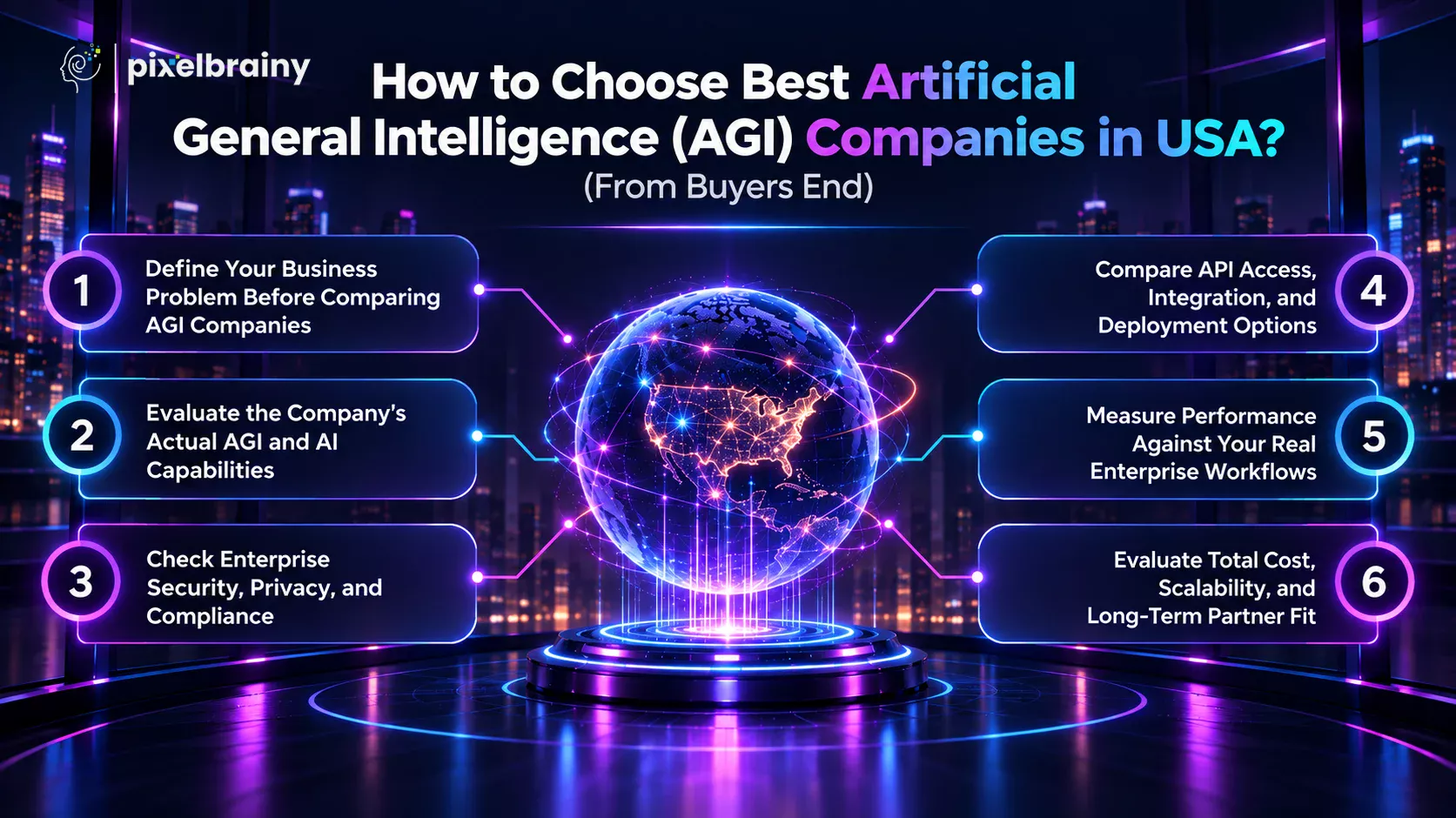
Start with the business problem, not the company name.
Determine whether the project requires advanced reasoning, multimodal AI, autonomous agents, scientific research, coding, document intelligence, robotics, or enterprise knowledge retrieval.
For example, a pharmaceutical company may need scientific reasoning, while a financial institution may prioritize document analysis, compliance, and secure agent workflows.
This prevents enterprises from selecting a famous AGI technology company USA simply because its model ranks highly on general benchmarks.
Buyer question: What specific business outcome must the AI system improve?
Next, determine whether the company is genuinely advancing frontier AI or primarily commercializing existing AI capabilities.
Review its foundation models, reasoning capabilities, multimodal systems, agentic AI research, technical publications, benchmarks, and documented product capabilities.
For AGI companies in USA working on large language models, the important question is not who makes the biggest claim about AGI. It is who demonstrates measurable progress in general reasoning, adaptation, tool use, and complex task execution.
Buyer question: What can the company's technology demonstrably do today?
Enterprise AI projects often involve sensitive customer, financial, healthcare, legal, or proprietary information.
Before selecting an AGI company in USA with enterprise products, evaluate data-use policies, encryption, identity management, access controls, auditability, data residency, retention policies, regulatory support, and administrative controls.
Google recommends creating helpful, reliable content with clear evidence and expertise, while AI search systems increasingly surface information based on relevance and trust. These same principles are useful when buyers evaluate AI vendors.
Buyer question: Can this company's AI capabilities operate within our security and compliance requirements?
A strong model is not enough if your technology team cannot integrate it effectively.
Check whether the provider offers APIs, SDKs, cloud deployment, private deployment, model customization, agent frameworks, monitoring, and enterprise integration capabilities.
Also determine whether your organization can access the technology directly or whether a development partner would provide a more practical implementation route.
For many enterprises, an AGI development company USA can integrate models from multiple providers and prevent the business from becoming dependent on one model ecosystem.
Buyer question: How easily can this technology connect with our existing systems?
Do not select an AGI provider solely because of public benchmark scores.
Create a proof of concept using your actual documents, data, workflows, users, and business requirements. Measure accuracy, reasoning quality, response time, hallucination rates, task completion, cost per workflow, human-review requirements, and operational reliability.
This is especially important for AGI companies in USA building agentic AI systems. An agent that performs well in a demonstration may behave differently when given real enterprise permissions and complex workflows.
Buyer question: Does the AI perform reliably on our actual business tasks?
The cheapest API is not necessarily the lowest-cost solution.
Calculate model usage, infrastructure, integration, development, monitoring, security, human review, maintenance, and future scaling costs.
Also evaluate the provider's roadmap and whether your architecture can support multiple models if the market changes.
For enterprises that need implementation expertise, companies such as PixelBrainy can provide an additional layer between frontier model providers and the business, helping with application development, integrations, agent workflows, testing, and production deployment.
Buyer question: Can this partner support the project from proof of concept through long-term production?
| Buyer Criterion | What to Evaluate |
|---|---|
| Business fit | Does the AI solve the actual business problem? |
| Technical capability | Reasoning, multimodal AI, agents, coding, research |
| Security | Privacy, access controls, encryption, governance |
| Integration | APIs, cloud, data, applications, enterprise systems |
| Real-world performance | Accuracy, reliability, latency, task completion |
| Commercial fit | Total cost, scalability, support, roadmap |
The best AGI companies in USA are not automatically the best choice for every enterprise project. The right decision comes from matching frontier capability with business requirements, security, integration, measurable performance, and long-term scalability.
For most buyers, the strongest strategy is to evaluate the frontier providers first, then determine whether direct access or an experienced AGI development partner USA provides the most practical path to production.
An enterprise AI project can become expensive when a business evaluates AGI firms only by reputation, model benchmarks, or ambitious product claims. Our CTO wants to work with an AGI company in the USA, but how can we tell which firms have genuine technical capabilities, enterprise-ready products, and the implementation experience needed for production? That is the real challenge for buyers in 2026.
The right evaluation goes beyond asking which company is closest to AGI. Buyers should examine the difference between frontier research laboratories, AI infrastructure providers, AGI application partners, and specialized AI firms. The following six mistakes can help enterprises avoid weak vendor decisions and identify technology partners that genuinely fit their project requirements.
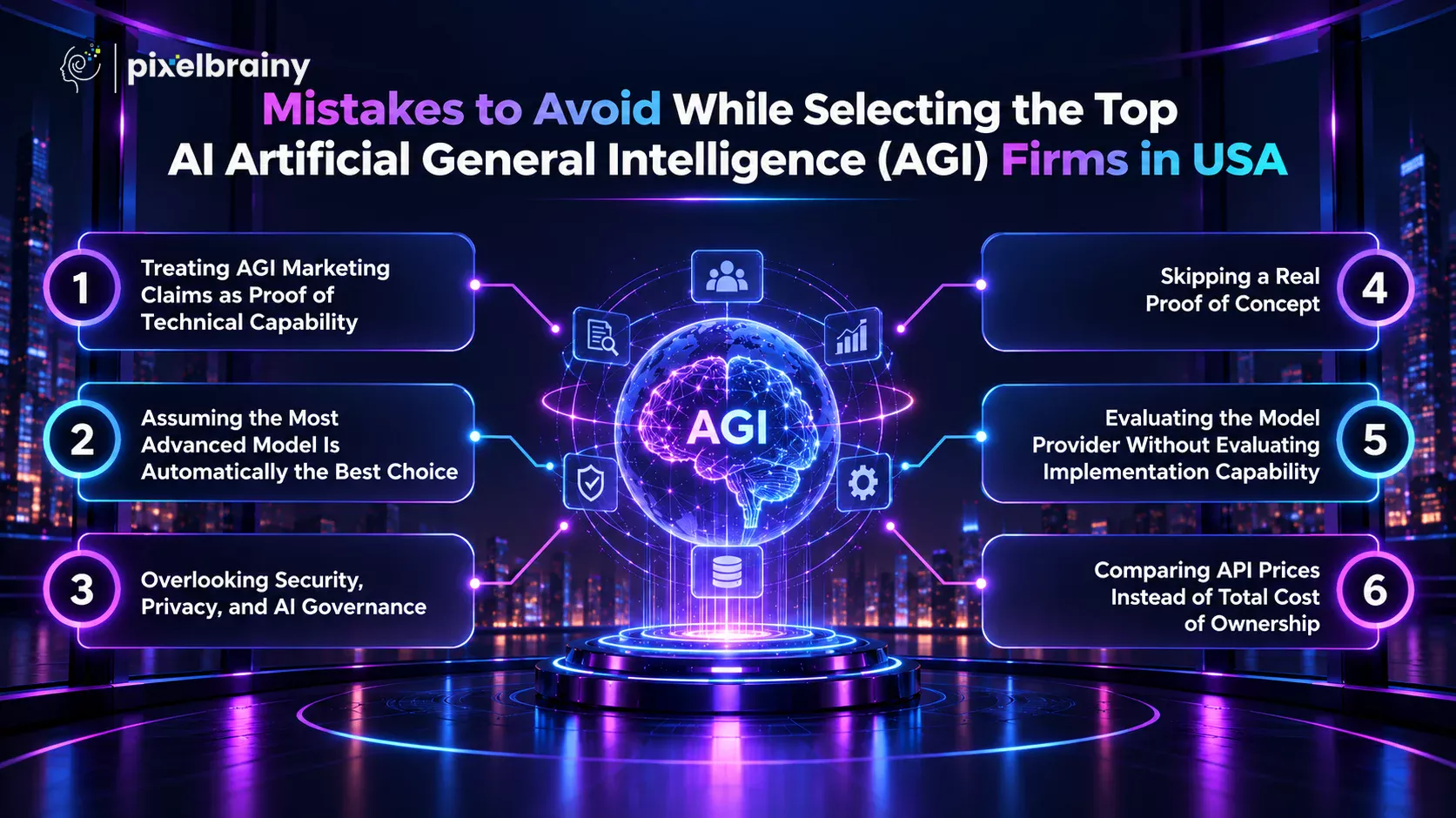
Not every company describing itself as an AGI firm is conducting frontier AGI research.
Some organizations develop foundation models and publish significant research. Others build applications using models created by companies such as OpenAI, Anthropic, Google, or Meta.
What buyers should do: Examine technical publications, model evaluations, benchmarks, research programs, safety documentation, and independently verifiable capabilities.
The key distinction is simple: an AGI claim is not the same as evidence of AGI research.
A frontier model can be extremely capable and still be unsuitable for a particular enterprise workflow.
A bank may prioritize accuracy and auditability. A healthcare organization may require stronger privacy and governance. A manufacturer may need multimodal AI or physical automation.
What buyers should do: Test shortlisted artificial general intelligence companies USA against the actual business requirements instead of selecting a provider solely because its model leads a public benchmark.
Enterprise AI systems can process confidential financial information, customer records, intellectual property, healthcare data, and internal documents.
Important considerations include data retention, encryption, identity management, access controls, auditability, data residency, compliance, and human oversight.
What buyers should do: Establish security and governance requirements before signing contracts or moving sensitive workloads into production.
A successful product demonstration does not guarantee successful enterprise deployment.
The shortlisted AI system should be tested with representative company documents, proprietary data, real workflows, users, tools, and permissions.
Measure accuracy, hallucination rates, latency, task completion, reliability, human-review requirements, and cost.
What buyers should do: Run a controlled proof of concept using realistic business scenarios before committing to a large-scale deployment.
Access to a frontier model is only the starting point.
Production systems often require API integration, enterprise-data connections, retrieval systems, agent orchestration, authentication, monitoring, evaluation, security, and ongoing maintenance.
This is where an AGI development company USA can become valuable. A development partner such as PixelBrainy can help connect frontier models with existing enterprise applications and workflows.
What buyers should do: Evaluate both the underlying AI provider and the implementation partner responsible for turning that capability into a reliable production application.
The lowest model price does not necessarily create the lowest project cost.
Enterprise expenses can include model usage, cloud infrastructure, data processing, development, security, monitoring, human review, maintenance, and future model migration.
A good architecture should also allow the business to evaluate multiple model providers as capabilities and pricing change.
What buyers should do: Calculate total cost from proof of concept through production, scaling, maintenance, and future model upgrades.
| Common Mistake | Better Approach |
|---|---|
| Trusting AGI marketing claims | Verify research and technical evidence |
| Choosing only by benchmark scores | Test real enterprise workflows |
| Treating security as an afterthought | Establish governance requirements early |
| Skipping a proof of concept | Test realistic production scenarios |
| Evaluating only the model provider | Assess implementation expertise |
| Comparing only API prices | Calculate total cost of ownership |
For enterprise buyers, the best AGI firms USA are not necessarily the companies making the biggest AGI claims. The stronger decision comes from verifying technical capability, enterprise readiness, security, implementation expertise, measurable performance, and long-term cost before committing to a partner.

The right AGI partner decision in 2026 is not about finding the company that makes the biggest AGI claim. It is about identifying the organization that best matches your business objective, technical requirements, security standards, deployment environment, and long-term AI strategy.
For enterprises, the landscape is becoming easier to understand. Frontier laboratories such as OpenAI, Anthropic, Google DeepMind, xAI, and Meta are advancing increasingly capable AI systems. NVIDIA and Microsoft provide critical infrastructure and enterprise platforms. Robotics companies are extending AI into physical environments, while development partners help businesses turn these capabilities into production applications.
Before committing, evaluate six areas: technical credibility, model capability, enterprise accessibility, security and governance, implementation expertise, and total cost of ownership. Run a proof of concept using real workflows and measure business outcomes rather than relying only on public benchmarks.
For organizations that do not need to build frontier models themselves, an experienced AGI development company USA can provide the practical bridge between frontier AI research and enterprise deployment.
Ready to Build Your AGI-Powered Enterprise Solution?
Schedule a call with PixelBrainy to discuss your AI project, evaluate the right frontier models, and create a practical roadmap for production deployment.
There is no universally accepted ranking that proves one company has achieved the most advanced AGI. OpenAI, Anthropic, Google DeepMind, and xAI are among the leading AGI companies USA 2026 based on frontier-model development, reasoning, multimodal AI, agents, and research investment. OpenAI has an explicit AGI mission, while Google DeepMind combines frontier AI with scientific and AGI research.
Today's AI can perform many sophisticated tasks, but most systems still have limitations in generalization, autonomy, reliability, or cross-domain reasoning. AGI generally refers to AI capable of performing a broad range of intellectual tasks at or beyond human capability. For businesses comparing artificial general intelligence companies USA, it is important to distinguish advanced foundation models from verified AGI.
Several AGI companies in USA with enterprise products provide commercial access today. OpenAI offers enterprise products and APIs, Anthropic provides Claude and its developer platform, Google offers Gemini through Google Cloud, and xAI provides Grok through its API. Meta's models can also be accessed through cloud platforms and self-managed infrastructure. These products provide AGI-adjacent capabilities rather than universally verified AGI.
No US company has universally demonstrated AGI under an independently accepted technical standard. OpenAI describes AGI as highly autonomous systems capable of outperforming humans at most economically valuable work, while acknowledging uncertainty around the timeline. (openai.com) Current frontier systems show increasingly advanced reasoning, multimodal understanding, coding, scientific analysis, and agentic capabilities, but these achievements do not establish universal AGI.
Anthropic, OpenAI, Google, and Microsoft are among the strongest providers for regulated enterprises to evaluate. Their enterprise offerings include capabilities for security, governance, administration, and controlled deployment. Anthropic is particularly notable for its published safety and responsible-scaling work. Organizations should still evaluate compliance, privacy, validation, and human oversight for each use case.
Businesses can access frontier capabilities through APIs, enterprise AI platforms, cloud providers, or an AGI development company USA. Providers such as OpenAI, Anthropic, Google, and Meta supply the underlying models, while a development partner can connect those models to enterprise data, applications, workflows, and security systems. PixelBrainy can serve as this practical implementation layer for organizations that need custom AI applications without building an internal frontier research team.
Anthropic, OpenAI, and Google DeepMind have among the most substantial publicly documented safety and alignment programs. Anthropic maintains a Responsible Scaling Policy, OpenAI publishes preparedness and alignment research, and Google DeepMind operates frontier safety initiatives. For enterprises evaluating AGI companies in USA safety focused, buyers should examine actual evaluations, safeguards, red-teaming, governance, and deployment controls rather than relying on safety claims alone.
OpenAI explicitly makes safe and beneficial AGI part of its mission. Anthropic places particular emphasis on alignment, responsible scaling, model behavior, and AI safety. Google DeepMind combines frontier foundation models with fundamental research in science, robotics, reasoning, and AGI safety. For enterprise buyers, the practical differences also include model performance, APIs, ecosystem, security, pricing, and deployment options.
Microsoft, OpenAI, Google, Anthropic, and other major US AI companies are increasingly involved in government and national-security applications. Their technologies can support intelligence analysis, cybersecurity, software engineering, research, logistics, and information processing. Microsoft is particularly relevant where organizations require Azure-based government infrastructure. However, government deployment involves specialized security, procurement, authorization, and policy requirements that differ from conventional enterprise AI adoption.
Enterprises should prepare for increasingly capable reasoning models, multimodal AI, autonomous agents, coding systems, scientific AI, and AI systems capable of completing longer multi-step workflows. Companies should begin with high-value use cases, establish AI governance, secure proprietary data, evaluate multiple models, and build flexible AI architecture. PixelBrainy can help enterprises turn these emerging capabilities into production applications while frontier AGI companies in USA continue advancing their underlying models.

About The Author
Sagar Bhatnagar
Sagar Sahay Bhatnagar brings over a decade of IT industry experience to his role as Marketing Head at PixelBrainy. He's known for his knack in devising creative marketing strategies that boost brand visibility and market influence. Sagar's strategic thinking, coupled with his innovative vision and focus on results, sets him apart. His track record of successful campaigns proves his ability to utilize digital platforms effectively for impactful marketing efforts. With a genuine passion for both technology and marketing, Sagar continuously pushes PixelBrainy's marketing initiatives to greater success.

Working with the PixelBrainy team has been a highly positive experience. They understand the design requirements and create beautiful UX elements to meet the application needs. The dev team did an excellent job bringing my vision to life. We discussed usability and flow. Sagar worked with his team to design the database and begin coding. Working with Sagar was easy. He has the knowledge to create robust apps, including multi-language support, Google and Apple ID login options, Ad-enabled integrations, Stripe payment processing, and a Web Admin site for maintaining support data. I'm extremely satisfied with the services provided, the quality of the final product, and the professionalism of the entire process. I highly recommend them for Android and iOS Mobile Application Design and Development.

Great experience working with them. Had a lot of feedback and I found that unlike most contractors they were bugging me for updates instead of the other way around. They were extremely time conscience and great at communicating! All work was done extremely high quality and if not on time, early! They were always proactive when it comes to communication and the work is great/above par always. Very flexible and a great team to work with! Goes above and beyond to present us with multiple options and always provides quality. Amazing work per usual with Chitra. If you have UI/UX or branding design needs I recommend you go to them! Will likely work with them in the future as well, definitely recommended!

PixelBrainy is a joy to work with and is a great partner when thinking through branding, logo, and website layout. I appreciate that they spend time going into the "why" behind their decisions to help inform me and others about industry best practices and their expertise.

I hired them to design our software apps. Things I really like about them are excellent communication skills, they answer all project suggestions and collaborate right away, and their input on design and colors is amazing. This project was complex and needed patience and creativity. The team is amazing to do business with. I will be using them long-term. Glad to see there are some good people out there. I was afraid to try and outsource my project to someone but I am glad I met them! I really can't say enough. They went above and beyond on this project. I am very happy with everything they have done to make my business stand out from the competition.

It was great working with PixelBrainy and the team. They were very responsive and really owned the project. We'll definitely work with them again!

I recently worked with the PixelBrainy team on a project and I was blown away by their communication skills. They were prompt, clear, and articulate in all of our interactions. They listened and provided valuable feedback and suggestions to help make the project a success. They also kept me updated throughout the entire process, which made the experience stress-free and enjoyable.

PixelBrainy is very good at what it does. The team also presents themselves very professionally and takes care of their side of things very well. I could fully trust them taking up the design work in a timely and organised manner and their attention to detail saved us lots of effort and time. This particular project was quite intense and the team showed that they function very well under pressure. Very much looking forward to working with her again!

It's always an absolute pleasure working with them. They completed all of my requests quickly and followed every note I had for them to a T, which made our process go smoothly from start to finish. Everything was completed fast and following all of the guidelines. And I would recommend their services to anyone. If you need any design work done in the future, PixelBrainy should be your first call!

They took ownership of our requirements and designed and proposed multiple beautiful variants. The team is self-motivated, requires minimum supervision, committed to see-through designs with quality and delivering them on time. We would definitely love to work with PixelBrainy again when we have any requirements.

PixelBrainy was a big help with our SaaS application. We've been hard at work with a new UI/UX and they provided a lot of help with the designs. If you're looking for assistance with your website, software, or mobile application designs, PixelBrainy and the team is a great recommendation.

PixelBrainy designers are amazing. They are responsive, talented, and always willing to help craft the design until it matches your vision. I would recommend them and plan to continue them for my future projects and more!!!

They were awesome! Did a good job fast, and good communication. Will work with them again. Thank you

Creative, detail-oriented, and talented designers who take direction well and implement changes quickly and accurately. They consistently over-delivered for us.

PixelBrainy team is very talented and creative. Great designers and a pleasure to work with. PixelBrainy is an excellent communicator and I look forward to working with them again.

PixelBrainy has a very talented design team. Their work is excellent and they are very responsive. I enjoy working with them and hope to continue on all of our future projects.


Transform your ideas into reality with us.
Across these industries, each engagement brings unique challenges, from early-stage product development to scaling complex systems, helping us build a practical understanding of real-world product environments.