
 AI Summary Powered by PixelBrainy
US enterprises process thousands of invoices, contracts, claims forms, onboarding documents, emails, scanned PDFs, and compliance records every single day. Yet many organizations continue to struggle with extraction tools that fail when document layouts change, handwritten inputs appear, or unstructured data enters the workflow. The consequences extend far beyond inefficiency. Processing delays, data entry errors, compliance risks, and missed SLA commitments can directly impact revenue, customer experience, and operational performance.
If your team has been asking, "We have tried multiple data extraction tools and none of them handle our document variety well. What are the actual best AI data extraction software options for large US enterprises in 2026?" you're facing a challenge shared by many enterprise procurement and technology leaders. Not every platform marketed as "AI-powered" is built to support enterprise-scale complexity.
That's exactly why this guide exists.
This is not another generic roundup based on popularity rankings or vendor claims. Instead, this buyer's guide evaluates the best AI data extraction software 2026 has to offer through an enterprise lens. The focus is on platforms capable of handling real-world business requirements, including high document volumes, diverse file formats, strict compliance expectations, and complex integrations.
To help procurement teams make informed decisions, we assessed each solution using criteria that matter most in enterprise environments: extraction accuracy, support for structured and unstructured documents, integration capabilities, scalability, human validation workflows, compliance readiness, pricing transparency, and overall enterprise fit.
Whether you're looking for the best AI data extraction software to replace manual data entry in enterprises or need to compare AI data extraction software for business before shortlisting vendors, this guide provides a practical evaluation of the leading solutions available today.
By the end of this article, you'll know which enterprise AI data extraction software 2026 solution best aligns with your document complexity, operational priorities, and long-term business goals.
Selecting the best AI data extraction software for enterprises involves much more than comparing feature lists or requesting a product demo. The wrong choice can lead to expensive customizations, poor user adoption, rising subscription costs, and workflows that break every time document formats change.
If your procurement team is evaluating vendors, the goal should not be to ask, "Which software has the most features?" Instead, ask, "Which platform can support our operational complexity over the next three to five years?"
Whether you're a healthcare provider reviewing HIPAA requirements or a finance team processing thousands of invoices monthly, these are the six questions every enterprise buyer should ask before signing a contract.
Many vendors perform well during demonstrations using clean sample documents but struggle in production environments.
Ask yourself:
The best AI data extraction software for enterprises should support the diversity of documents your teams process daily, not just the formats showcased during sales presentations.
One of the biggest frustrations enterprises face is maintaining extraction templates every time a supplier changes an invoice layout.
If you're looking for AI data extraction software that works without predefined templates for enterprises, prioritize platforms powered by machine learning and layout-aware models.
Ask vendors:
A platform that adapts automatically can save hundreds of administrative hours annually.
Basic webhooks are not the same as enterprise integrations.
Organizations should evaluate whether the platform integrates seamlessly with systems such as:
Ask vendors:
This is a critical consideration when assessing how to evaluate AI data extraction software for enterprise use cases.
For healthcare, financial services, insurance, and legal organizations, compliance requirements can determine whether a platform is viable.
Ask vendors:
A missing compliance capability can create costly delays later in the procurement process.
Also Read: How to Develop HIPAA-Compliant AI Healthcare Software: Architecture, Use Cases, Steps & Challenges
Pricing structures vary significantly across vendors.
Common models include:
Ask vendors:
Understanding AI data extraction software features and pricing early helps prevent unexpected budget overruns.
A solution processing 5,000 documents monthly may struggle at 500,000.
Ask vendors:
For what to look for when choosing AI data extraction software for large teams, scalability should be treated as a business requirement rather than a technical afterthought.
| Criteria | Why It Matters for Enterprises? | Question to Ask the Vendor |
|---|---|---|
| Document Format Support | Determines whether the platform can handle real-world document diversity | Can your platform process all document types we use today and may adopt tomorrow? |
| Template-Free Extraction | Reduces maintenance when layouts change | Will we need to rebuild templates every time document formats evolve? |
| ERP and CRM Integration | Eliminates duplicate work and improves adoption | How deep are your integrations with SAP, Salesforce, Oracle, and legacy systems? |
| Compliance Readiness | Supports regulated industries and audit requirements | Do you provide HIPAA, SOC 2, GDPR support, and audit trails? |
| Pricing Transparency | Prevents unexpected costs as usage grows | What is the total cost of ownership over the next 12 to 36 months? |
| Scalability | Ensures long-term operational performance | Can your platform maintain accuracy and speed as document volumes increase? |
Before comparing vendors, establish the questions that matter most to your organization. The right evaluation framework will help you identify platforms built for enterprise realities rather than impressive demonstrations.
The best AI data extraction software is not the one with the longest feature list. It's the one that aligns with your document complexity, compliance obligations, integration requirements, and growth trajectory.
Also Read: Top 10+ AI Automation Companies in USA
Enterprise buyers evaluating document automation platforms often need a quick way to narrow down their shortlist before diving into detailed vendor assessments. While every solution claims to improve efficiency, they differ significantly in terms of extraction capabilities, pricing models, compliance support, and integration depth.
The following top AI data extraction software comparison 2026 provides a high-level overview of the leading platforms based on the criteria that matter most to enterprise teams. If you're looking to compare AI data extraction software for business use cases, this table offers a practical starting point.
| Tool Name | Best For | Extraction Type | Starting Price | Enterprise Ready | Compliance Certifications | Top Integration |
|---|---|---|---|---|---|---|
| ABBYY Vantage | Large enterprises and intelligent document processing | AI + Hybrid | Custom Quote | Yes | SOC 2, GDPR | SAP |
| Nanonets | Mid-market teams and invoice automation | AI | From ~$499/month | Partial | SOC 2 | QuickBooks |
| Rossum | High-volume invoice processing | AI | Custom Quote | Yes | SOC 2, GDPR | SAP |
| Amazon Textract | AWS-native enterprises | AI | Pay-as-you-go (~$0.015/page) | Yes | HIPAA, SOC, GDPR | AWS Ecosystem |
| Google Document AI | Google Cloud users | AI | Pay-as-you-go | Yes | HIPAA, SOC, GDPR | Google Cloud |
| Parseur | No-code document automation | Template + AI | From ~$39/month | Partial | GDPR | Zapier |
| Docsumo | Finance and operations teams | Hybrid | Custom Quote | Yes | SOC 2, GDPR | NetSuite |
| Hyperscience | Regulated industries | Hybrid | Custom Quote | Yes | HIPAA, SOC 2, GDPR | Salesforce |
| UiPath Document Understanding | RPA-driven enterprises | Hybrid | Custom Quote | Yes | SOC 2, GDPR | UiPath Platform |
| Kofax | Large-scale enterprise workflows | Hybrid | Custom Quote | Yes | SOC 2, GDPR | Microsoft Dynamics |
Starting prices are indicative and based on publicly available pricing or entry-level plans where disclosed. Enterprise contracts vary significantly depending on document volumes, implementation scope, integrations, and support requirements.
A quick glance at this comparison reveals that there is no universal winner among the best AI data extraction software 2026 has to offer. Cloud-native tools such as Amazon Textract and Google Document AI provide flexible usage-based pricing, while platforms like ABBYY Vantage, Rossum, Hyperscience, and Kofax cater to enterprises with complex workflows and stringent compliance requirements.
For organizations conducting an AI data extraction software pricing comparison for US enterprises 2026, the right choice ultimately depends on document complexity, regulatory obligations, existing technology investments, and expected processing volumes. The next sections break down each platform in detail to help you identify the solution that best fits your enterprise needs.
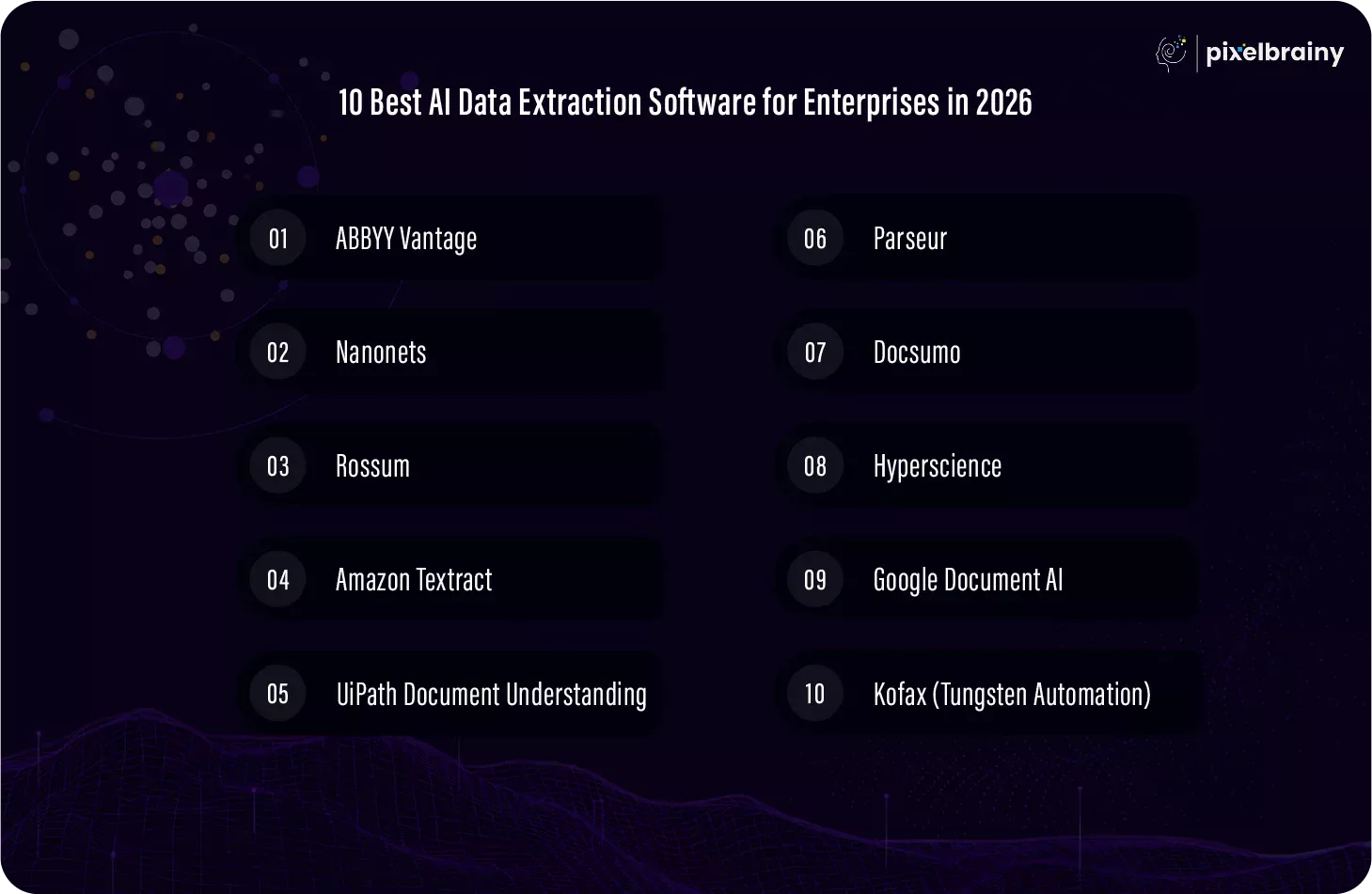
Finding the best AI data extraction software 2026 has to offer depends on your document complexity, compliance obligations, existing technology stack, and processing volumes. Some platforms excel at invoice automation, while others are built for highly regulated industries requiring audit trails and on-premise deployments.
To help enterprise buyers shortlist the right solution, we've evaluated each platform using the same framework: what it does, key enterprise features, pricing, ideal use case, and one limitation you should know before committing.
ABBYY Vantage is widely regarded as one of the most mature intelligent document processing platforms in the market. It combines advanced OCR capabilities with AI-powered extraction, making it particularly effective for enterprises operating in compliance-heavy environments.
Its skills-based architecture allows organizations to deploy pre-built extraction models for invoices, tax forms, claims documents, IDs, and other specialized workflows. The platform supports both cloud and on-premise deployment, making it attractive for organizations with strict governance requirements.
Key Enterprise Features:
Pricing: Enterprise pricing typically starts around $0.02 per page at scale, with contracts running into thousands of dollars per month.
Best Enterprise Use Case: If you're a large US bank asking, "Is ABBYY Vantage the right AI data extraction software for regulated workflows?" the answer is often yes. It excels in industries where accuracy, auditability, and security matter more than rapid deployment.
Honest Limitation: ABBYY is not a plug-and-play solution. Most implementations require professional services, dedicated onboarding, and configuration support, making it less suitable for teams seeking quick self-service deployment.
Nanonets has emerged as one of the strongest options for organizations looking for a balance between AI capabilities, workflow automation, and transparent pricing. It is particularly popular among finance teams managing invoices, receipts, purchase orders, and accounts payable processes.
The platform uses trainable machine learning models that improve over time and includes human-in-the-loop validation to maintain extraction accuracy. It also integrates with popular ERP and accounting systems, helping teams eliminate manual data entry without extensive development work.
Key Enterprise Features:
Pricing: Plans start at approximately $499 per month, with enterprise pricing available for high-volume processing.
Best Enterprise Use Case: For finance leaders wondering, "Is Nanonets the right AI data extraction software for our ERP integration needs?" it provides an excellent balance of usability and enterprise functionality.
Honest Limitation: While Nanonets performs exceptionally well with financial documents, organizations processing highly diverse document types may find more flexibility in broader IDP platforms.
Rossum has built its reputation around one core strength: invoice and accounts payable automation. Unlike traditional template-based systems, Rossum continuously learns vendor layouts, reducing maintenance efforts as invoice formats evolve.
The platform combines extraction with approval routing and workflow management capabilities, helping AP teams move documents through the review process faster.
Key Enterprise Features:
Pricing: Monthly subscriptions generally start around $1,500, with enterprise agreements priced higher depending on volume.
Best Enterprise Use Case: If your AP team processes thousands of invoices monthly and needs AI extraction software that adapts automatically to changing vendor formats, Rossum is one of the strongest contenders.
Honest Limitation: Rossum's specialization is also its weakness. Enterprises requiring extraction across legal contracts, healthcare records, and other document categories may find it too narrowly focused.
Amazon Textract is the obvious choice for organizations already operating within the AWS ecosystem. Rather than introducing another software vendor, it enables enterprises to extend existing AWS investments into intelligent document processing.
Beyond OCR, Textract extracts information from forms and tables while integrating seamlessly with services such as S3, Lambda, IAM, and Step Functions.
Key Enterprise Features:
Pricing: Costs range from approximately $1.50 to $15 per 1,000 pages, depending on the extraction capabilities used.
Best Enterprise Use Case: For organizations asking, "How does Amazon Textract perform for large-scale document processing?" it delivers excellent scalability and cost efficiency when paired with AWS-native architectures.
Honest Limitation: Textract is a developer-focused service rather than a complete business solution. Building validation workflows, dashboards, and exception handling requires technical resources.
UiPath Document Understanding extends the capabilities of the broader UiPath ecosystem by bringing AI-powered extraction directly into existing robotic process automation workflows.
Organizations already using UiPath can leverage familiar tools such as Studio and Orchestrator while adding extraction capabilities for invoices, purchase orders, IDs, and forms. The platform also includes review stations for human validation.
Key Enterprise Features:
Pricing: Available through UiPath enterprise licensing agreements.
Best Enterprise Use Case: Enterprises wondering, "Can we add AI extraction within our existing UiPath environment?" can often achieve faster adoption without introducing another vendor.
Honest Limitation: Organizations without established UiPath investments may achieve faster implementation and better value through dedicated extraction platforms built specifically for document intelligence.
Parseur is one of the fastest platforms to implement if your organization receives documents primarily through email. Designed with simplicity in mind, it automatically extracts information from PDF and image attachments without requiring extensive setup or technical expertise.
Unlike many traditional extraction tools, Parseur combines template-based and AI-powered extraction capabilities, allowing enterprises to automate repetitive workflows quickly. It also offers integrations with popular automation platforms, enabling extracted data to flow into downstream systems with minimal effort.
Key Enterprise Features:
Pricing: Plans start at approximately $49 per month, with higher-volume pricing available through tiered subscriptions.
Best Enterprise Use Case: If your team says, "Most of our vendor documents arrive by email as PDF attachments. We need AI data extraction software that parses these automatically," Parseur provides one of the quickest paths to automation.
Honest Limitation: While Parseur is highly effective for email-driven workflows, very large enterprises processing hundreds of thousands of documents monthly may find usage-based pricing less economical than enterprise-focused alternatives.
Docsumo has established itself as a strong contender for financial institutions and operations teams processing structured financial documents. Its models are specifically optimized for bank statements, income proofs, loan applications, and financial forms.
The platform combines AI extraction with human validation capabilities to improve accuracy on complex multi-page documents. Its API-first architecture also appeals to organizations with in-house development teams seeking flexibility.
Key Enterprise Features:
Pricing: Entry-level plans begin around $25 per month, while enterprise pricing is customized based on usage and requirements.
Best Enterprise Use Case: Financial institutions asking, "What AI data extraction software is best suited for bank statements and loan applications?" should strongly consider Docsumo.
Honest Limitation: Docsumo assumes a certain level of technical involvement. Operations teams seeking a completely no-code experience may encounter a steeper learning curve.
Hyperscience focuses on a single promise: delivering enterprise-grade accuracy in highly regulated environments. Its intelligent document processing capabilities extend across classification, extraction, transcription, and human review.
The platform is widely used by government agencies, insurers, and financial institutions where transparency, governance, and quality assurance are non-negotiable. Human oversight is embedded directly into workflows, helping organizations maintain confidence in extracted outputs.
Key Enterprise Features:
Pricing: Enterprise pricing is available upon request.
Best Enterprise Use Case: For organizations asking, "Which enterprise AI data extraction software provides the strongest audit capabilities?" Hyperscience consistently ranks among the top choices.
Honest Limitation: Hyperscience requires significant implementation investment and longer deployment timelines. It is not designed for teams seeking rapid rollout or lightweight automation.
Google Document AI is Google's answer to enterprise document understanding. It combines advanced OCR with foundation models capable of handling unusual layouts and multilingual documents.
The platform offers specialized processors designed for invoices, contracts, IDs, and procurement documents while integrating directly with BigQuery and Vertex AI for downstream analytics and AI workflows.
Key Enterprise Features:
Pricing: Similar to Amazon Textract, pricing ranges between $1.50 and $15 per 1,000 pages, depending on processor selection.
Best Enterprise Use Case: Enterprises already invested in Google Cloud can use Document AI to connect extraction workflows directly into their broader GCP data ecosystem.
Honest Limitation: The differences between Google Document AI and Amazon Textract are often less significant than vendors suggest. In many cases, existing cloud infrastructure becomes the deciding factor rather than extraction quality alone.
Kofax, now operating under Tungsten Automation, remains one of the most established names in enterprise document capture and intelligent automation. It is particularly attractive to organizations with strict data residency requirements and private infrastructure mandates.
The platform supports sophisticated classification, extraction, and routing workflows while offering extensive integration options across enterprise ecosystems. Its long-standing presence in regulated industries has helped it build a reputation for reliability and deployment flexibility.
Key Enterprise Features:
Pricing: Enterprise contracts generally range from $40,000 to $150,000 annually, excluding implementation and professional services costs.
Best Enterprise Use Case: Enterprises asking, "Which AI data extraction software supports on-premise deployment for regulated industries?" will find Kofax among the strongest options available.
Honest Limitation: Similar to ABBYY, Kofax typically requires a professional services engagement for implementation. The investment can be difficult to justify for organizations with simpler automation needs.
There is no single winner among the best AI data extraction software 2026 has to offer. The right platform depends entirely on your enterprise priorities.
The best automated data extraction software is not necessarily the most feature-rich platform. It's the one that aligns with your document types, compliance obligations, technical capabilities, and long-term business strategy.

The best software choice often depends less on features and more on industry-specific requirements. A healthcare provider prioritizes compliance and claims accuracy, while a logistics company focuses on processing speed and integration with supply chain systems.
For procurement teams evaluating enterprise AI data extraction software 2026, the following recommendations provide a practical starting point based on common document workflows, regulatory considerations, and operational priorities.
Top Pick: Docsumo: Docsumo stands out for bank statements, loan applications, income documents, and financial forms due to its pre-trained financial models and high field-level accuracy.
Runner-Up: ABBYY Vantage: ABBYY excels in regulated financial environments requiring multilingual processing, audit trails, and sophisticated document classification.
Watch-Out: Financial institutions should prioritize human validation capabilities and governance controls, as even minor extraction errors can create compliance risks.
Top Pick: Hyperscience: Hyperscience is well-suited for healthcare organizations because of its built-in human review workflows, detailed audit trails, and support for highly regulated environments.
Runner-Up: Google Document AI: Google Document AI provides strong support for processing claims, patient intake forms, and healthcare documents while integrating efficiently into cloud-based data ecosystems.
Watch-Out: When evaluating the best AI data extraction software for healthcare invoice and claims automation, ensure vendors support HIPAA requirements and protected health information controls.
Top Pick: ABBYY Vantage: ABBYY's advanced OCR and document understanding capabilities make it highly effective for extracting clauses, obligations, and metadata from legal contracts.
Runner-Up: Google Document AI: Google Document AI handles complex layouts and lengthy legal documents well, particularly when integrated with broader analytics workflows.
Watch-Out: Legal teams should validate whether platforms can identify nuanced clauses and contextual relationships rather than extracting only basic fields.
Top Pick: Hyperscience: Hyperscience provides strong classification, extraction, and validation capabilities for claims processing, policy documentation, and underwriting workflows.
Runner-Up: ABBYY Vantage: ABBYY supports complex insurance document ecosystems with strong compliance controls and deployment flexibility.
Watch-Out: For US insurers asking, "Which AI data extraction software is built for claims automation?" integration with existing claims management systems should be assessed early during procurement.
Top Pick: Amazon Textract: Textract offers exceptional scalability for processing bills of lading, shipment manifests, customs forms, and proof-of-delivery documents within AWS environments.
Runner-Up: Parseur: Parseur is ideal for organizations receiving supplier documents and shipping records via email attachments requiring rapid automation.
Watch-Out: The best AI data extraction software for insurance and logistics enterprises should accommodate fluctuating document volumes without compromising processing speed.
Top Pick: Nanonets: Nanonets simplifies invoice processing, purchase order extraction, and accounts payable automation with transparent pricing and easy integrations.
Runner-Up: Rossum: Rossum delivers strong performance for high-volume invoice workflows and adapts to changing vendor document formats over time.
Watch-Out: Retail teams should evaluate total ownership costs carefully, as seasonal spikes in transaction volumes can significantly affect usage-based pricing.
Top Pick: Hyperscience: Hyperscience is well-suited for sports betting operators handling KYC documents, player verification records, payout requests, and regulatory submissions because of its strong audit trails and human validation workflows.
Runner-Up: Google Document AI: Google Document AI supports high-volume extraction from onboarding forms, identity documents, and compliance records while integrating efficiently into cloud-native analytics environments.
Watch-Out: Sports betting operators should prioritize jurisdiction-specific compliance capabilities and ensure the platform can adapt to changing regulatory reporting requirements across different states.
Top Pick: ABBYY Vantage: ABBYY Vantage excels at processing lease agreements, mortgage applications, title documents, and closing disclosures due to its advanced OCR and document understanding capabilities.
Runner-Up: Docsumo: Docsumo performs well for extracting structured financial information from mortgage statements, income verification documents, and supporting paperwork used during underwriting.
Watch-Out: Real estate firms should verify whether the software can accurately process multi-page agreements and handwritten annotations commonly found in transaction documents.
Top Pick: Amazon Textract: Amazon Textract is ideal for manufacturers processing purchase orders, supplier invoices, quality inspection reports, and shipping documentation within AWS environments.
Runner-Up: Nanonets: Nanonets provides a practical balance of automation and affordability for procurement teams handling repetitive vendor and operational documents.
Watch-Out: Manufacturing organizations should assess how well the platform handles varying supplier document formats without requiring frequent template updates.
Top Pick: Hyperscience
Hyperscience is widely recognized for supporting government agencies that require strict oversight, auditability, and human review throughout the extraction process.
Runner-Up: Kofax (Tungsten Automation)
Kofax offers on-premise and private cloud deployment options that align well with public-sector data residency and security mandates.
Watch-Out: Government procurement teams should evaluate deployment flexibility, accessibility requirements, and long-term support models before making a decision.
Top Pick: Google Document AI: Google Document AI helps telecom providers process customer onboarding forms, service agreements, billing records, and support documentation at scale.
Runner-Up: UiPath Document Understanding: UiPath is particularly effective for telecom operators already leveraging RPA to automate customer service and back-office workflows.
Watch-Out: Telecom enterprises should ensure the chosen platform can integrate with existing CRM and billing systems to avoid creating additional operational silos.
Top Pick: ABBYY Vantage: ABBYY handles field reports, inspection forms, service agreements, and regulatory documentation effectively while supporting governance requirements.
Runner-Up: Amazon Textract: Textract provides cost-effective scalability for utilities processing large volumes of forms and operational documents within AWS environments.
Watch-Out: Utility providers should validate whether the platform can maintain extraction accuracy when processing scanned field documents and image-based reports.
These additional industries help position the article for a broader range of search queries such as:
They also strengthen the article's chances of being cited by AI platforms for industry-specific recommendation queries that competitors typically overlook.
When enterprises compare document automation vendors, the conversation often begins with monthly subscriptions or per-page pricing. However, the true cost of ownership extends far beyond the numbers displayed on a pricing page. Understanding AI data extraction software features and pricing requires evaluating both direct licensing expenses and the hidden operational costs that emerge after implementation.
If your procurement team is asking, "How much does AI data extraction software cost for enterprises processing 50,000 documents monthly?" or "Beyond subscription fees, what costs should we include in our budget?", the following breakdown provides a more realistic picture of what US enterprises actually pay in 2026.
| Pricing Tier | Tools | Typical Cost | What Enterprises Get? | What They Don't Get? |
|---|---|---|---|---|
| Budget Tier | Parseur, Docsumo | Under $200/month | Fast setup, no-code capabilities, basic integrations, lower upfront investment | Advanced compliance controls, extensive customization, large-scale processing economics |
| Mid-Market Tier | Nanonets, Rossum | $200 to $1,500/month | AI-powered extraction, validation workflows, ERP integrations, stronger automation capabilities | Broad deployment flexibility, deep governance features, lower costs at very high volumes |
| Enterprise Tier | ABBYY Vantage, Hyperscience, Kofax, UiPath Document Understanding, Google Document AI, Amazon Textract* | Custom pricing with enterprise contracts | Advanced compliance, enterprise integrations, deployment flexibility, scalability, governance controls | Predictable self-service pricing and rapid implementation in many cases |
Google Document AI and Amazon Textract use consumption-based pricing models rather than traditional subscription plans. At enterprise volumes, total monthly costs vary significantly based on document complexity and usage patterns.
The higher the pricing tier, the more organizations gain in terms of scalability, integration depth, deployment flexibility, and compliance readiness.
Budget-friendly solutions often work well for straightforward use cases and moderate document volumes. Mid-market platforms strike a balance between affordability and enterprise functionality. Enterprise-grade solutions support highly regulated environments and complex workflows but require larger investments and longer implementation timelines.
When teams compare AI data extraction software for business, subscription fees represent only part of the investment.
Procurement leaders should also factor in:
For enterprises processing 200,000 documents monthly, these hidden costs often exceed the subscription itself.
Strategic Callout: Once document volumes exceed roughly 100,000 to 200,000 documents per month, and workflows involve complex integrations or regulatory requirements, the ongoing expense of SaaS licensing, workaround development, and operational overhead can outweigh the one-time investment of building a tailored solution.
At that stage, enterprises should evaluate whether continuing to pay escalating software costs makes sense or whether a custom platform offers stronger long-term economics.
If you're exploring this transition, our guide on AI Data Extraction Platform Development: Features, Steps, Cost and Challenges explains when enterprises reach the tipping point where developing a custom platform delivers better ROI than relying solely on third-party software.
The smartest pricing decision isn't choosing the cheapest vendor. It's understanding the total cost of ownership and selecting the approach that aligns with your processing volumes, compliance needs, and future growth plans.
Also Read: AI Software Development Cost: A Complete Software Cost Guide
Off-the-shelf tools can deliver tremendous value, especially during the early stages of document automation. However, there comes a point when enterprises begin adapting their processes to fit the software instead of using technology that fits their business. If your teams are building workarounds, managing exceptions manually, or questioning rising software costs, it may be time to compare AI data extraction software vs building a custom AI data extraction platform.
If you're wondering, "We have been using Nanonets for two years but we're hitting limits on custom document types, compliance reporting, and ERP integration depth. At what point does it make sense to build our own platform?" these five signals can help answer that question.
Most SaaS tools perform well with common documents such as invoices and receipts. Problems arise when enterprises process hundreds of document variations across departments.
Enterprise Scenario: A healthcare network handles patient intake forms, handwritten physician notes, insurance claims, lab reports, and referral documents. The extraction team spends more time creating exceptions than benefiting from automation.
Signal: If document variations require constant manual intervention, it may be time to build AI data extraction platform capabilities tailored to your workflows.
Vendor certifications are important, but they don't address every organization's governance needs.
Enterprise Scenario: A financial institution requires custom approval workflows, region-specific audit reporting, and role-based controls that extend beyond standard SOC 2 requirements.
Signal: When internal policies exceed what vendors support out of the box, organizations often choose to develop AI data extraction platform for enterprises with compliance built around their exact requirements.
Basic APIs work well for modern systems. Legacy environments are a different story.
Enterprise Scenario: A manufacturer relies on proprietary ERP software developed over a decade ago. Existing connectors cannot accommodate custom business logic, resulting in duplicate data entry and reconciliation delays.
Signal: If integration workarounds are consuming development resources, a custom platform may provide a more sustainable solution.
Subscription fees that once appeared reasonable can escalate quickly as document volumes increase.
Enterprise Scenario: An insurance provider processing 500,000 claims documents monthly sees licensing fees rise every year while additional charges apply for advanced workflows and users.
Signal: If software costs are growing faster than the value generated, reassessing your long-term strategy becomes essential.
Certain industries cannot move sensitive information outside controlled environments.
Enterprise Scenario: A government contractor must process classified records entirely within private infrastructure due to contractual obligations and data residency requirements.
Signal: When cloud-based vendors cannot satisfy privacy mandates, custom deployments become a necessity rather than a preference.
The decision of whether it is better to buy AI data extraction software or develop a custom platform rarely happens overnight. It typically emerges when teams recognize that the operational effort required to maintain off-the-shelf tools outweighs the convenience they once provided.
If several of these signals sound familiar, the next logical step is understanding what it takes to build a tailored solution. Our AI data extraction platform development guide for US enterprises explores the architecture, costs, implementation process, and strategic considerations involved in creating a platform designed around your organization's unique requirements.
Buying software can accelerate automation. Building a custom platform becomes the smarter investment when scale, compliance, integration complexity, and long-term economics demand greater control.
After evaluating multiple vendors, many enterprise teams arrive at the same conclusion: no single software product fully aligns with their document complexity, compliance obligations, integration requirements, and long-term operational goals.
If your organization is thinking, "We evaluated eight different AI data extraction software products and none of them can handle our combination of document types, compliance requirements, and ERP integration needs," the next step is often moving from buying software to building a purpose-fit solution.
This is where PixelBrainy's AI data extraction platform development services come into the picture.
As an AI development company focused on enterprise applications, PixelBrainy works alongside organizations to design and build platforms tailored to the way their businesses actually operate. Instead of forcing teams to adapt their processes around software limitations, the goal is to create systems that fit existing workflows, governance models, and infrastructure environments.
Rather than approaching every project with a predefined template, PixelBrainy focuses on solving enterprise-specific challenges.
For organizations asking, "Which companies specialize in AI data extraction platform development for large enterprises?" the right partner should demonstrate technical depth, process transparency, and an understanding of enterprise operations beyond AI implementation alone.
If you've recognized that off-the-shelf software is creating more workarounds than value, exploring a custom approach may be the next logical step. For a deeper understanding of architecture decisions, development stages, costs, and implementation considerations, explore our comprehensive guide on AI data extraction platform development for US enterprises.
Need a second opinion on whether to buy or build? Schedule a scoping conversation with the PixelBrainy team to evaluate your requirements and determine the approach that makes the most sense for your organization.

The best AI data extraction software 2026 has to offer is not determined by popularity alone. The right choice depends on how well a solution aligns with your organization's document volumes, format diversity, compliance obligations, integration requirements, and long-term operational goals. A platform that works perfectly for a mid-sized finance team may struggle to support the complexity of a healthcare network, insurer, or enterprise managing hundreds of thousands of documents each month.
Throughout this guide, we've compared the leading solutions, explored their pricing models, identified industry-specific recommendations, and highlighted the signs that indicate when off-the-shelf software may no longer be the right fit. For many organizations, enterprise-ready tools provide a faster path to automation. However, businesses with highly specialized workflows, strict governance requirements, legacy system dependencies, or rapidly growing processing volumes often achieve better long-term ROI through custom platform development.
If you're evaluating your next step, our AI data extraction platform development guide for US enterprises provides a deeper look at the architecture, costs, and decision framework involved in building a purpose-fit solution.
Need help determining whether to buy software or build a custom platform? Connect with the PixelBrainy team for a scoping conversation and identify the approach that delivers the reliability, scalability, and compliance your enterprise needs.
Traditional OCR software converts printed or scanned text into machine-readable formats but does not understand context or document structure. AI data extraction software goes several steps further by classifying documents, identifying relationships between fields, extracting relevant information, assigning confidence scores, and routing exceptions for human review when necessary. In simple terms, OCR reads text, while AI understands and interprets the information within documents. This makes AI-powered solutions far more effective for enterprises handling invoices, contracts, claims, forms, and other unstructured documents.
For organizations dealing with diverse document layouts, ABBYY Vantage and Rossum are among the strongest options. Rossum continuously learns from changing vendor invoice formats, reducing the need for manual template updates. ABBYY Vantage supports a broad range of document types through AI-powered document skills and performs well in highly regulated environments. If your teams constantly rebuild templates whenever vendors modify layouts, prioritize platforms offering template-free or layout-aware extraction capabilities.
Pricing varies depending on document volume, integrations, and compliance requirements. Budget solutions cost under $200 per month, mid-market platforms run approximately $200 to $1,500 per month, and enterprise solutions typically require custom contracts ranging from several thousand dollars monthly to six-figure annual agreements. For enterprises processing 50,000 to 200,000 documents monthly, implementation costs, validation workflows, and integration efforts should also be included when estimating the total cost of ownership.
Many enterprise-focused platforms offer pre-built integrations or connectors for major business systems. Solutions such as ABBYY Vantage, Rossum, UiPath Document Understanding, and Hyperscience support integrations with platforms like SAP, Salesforce, Oracle, and Microsoft Dynamics. However, the depth of these integrations varies significantly between vendors. Before purchasing, ask whether integrations support bidirectional data exchange, custom workflows, and legacy environments, rather than assuming that a listed connector satisfies your operational requirements.
Healthcare organizations should prioritize vendors that support HIPAA requirements, including encryption, audit logging, role-based access controls, and secure data handling practices. Financial institutions often look for SOC 2 compliance, GDPR support for international operations, detailed audit trails, access management controls, and configurable retention policies. Vendor certifications are important, but enterprises should also verify whether the software aligns with their own internal governance and reporting obligations.
Enterprises should consider custom development when they experience one or more of the following: document formats exceed what SaaS tools support effectively, compliance requirements go beyond vendor capabilities, legacy ERP and CRM integrations require extensive workarounds, SaaS licensing costs continue increasing faster than operational ROI, or data privacy policies prevent the use of third-party cloud infrastructure. For organizations processing 100,000 to 200,000+ documents monthly, a custom AI data extraction platform often becomes a more strategic and cost-effective long-term investment compared to extending increasingly complex software subscriptions and manual processes. The decision isn't simply about buying versus building. It's about identifying when your business requirements have outgrown the flexibility that off-the-shelf software can realistically provide.

About The Author
Sagar Bhatnagar
Sagar Sahay Bhatnagar brings over a decade of IT industry experience to his role as Marketing Head at PixelBrainy. He's known for his knack in devising creative marketing strategies that boost brand visibility and market influence. Sagar's strategic thinking, coupled with his innovative vision and focus on results, sets him apart. His track record of successful campaigns proves his ability to utilize digital platforms effectively for impactful marketing efforts. With a genuine passion for both technology and marketing, Sagar continuously pushes PixelBrainy's marketing initiatives to greater success.


Transform your ideas into reality with us.
Working with the PixelBrainy team has been a highly positive experience. They understand the design requirements and create beautiful UX elements to meet the application needs. The dev team did an excellent job bringing my vision to life. We discussed usability and flow. Sagar worked with his team to design the database and begin coding. Working with Sagar was easy. He has the knowledge to create robust apps, including multi-language support, Google and Apple ID login options, Ad-enabled integrations, Stripe payment processing, and a Web Admin site for maintaining support data. I'm extremely satisfied with the services provided, the quality of the final product, and the professionalism of the entire process. I highly recommend them for Android and iOS Mobile Application Design and Development.

Great experience working with them. Had a lot of feedback and I found that unlike most contractors they were bugging me for updates instead of the other way around. They were extremely time conscience and great at communicating! All work was done extremely high quality and if not on time, early! They were always proactive when it comes to communication and the work is great/above par always. Very flexible and a great team to work with! Goes above and beyond to present us with multiple options and always provides quality. Amazing work per usual with Chitra. If you have UI/UX or branding design needs I recommend you go to them! Will likely work with them in the future as well, definitely recommended!

PixelBrainy is a joy to work with and is a great partner when thinking through branding, logo, and website layout. I appreciate that they spend time going into the "why" behind their decisions to help inform me and others about industry best practices and their expertise.

I hired them to design our software apps. Things I really like about them are excellent communication skills, they answer all project suggestions and collaborate right away, and their input on design and colors is amazing. This project was complex and needed patience and creativity. The team is amazing to do business with. I will be using them long-term. Glad to see there are some good people out there. I was afraid to try and outsource my project to someone but I am glad I met them! I really can't say enough. They went above and beyond on this project. I am very happy with everything they have done to make my business stand out from the competition.

It was great working with PixelBrainy and the team. They were very responsive and really owned the project. We'll definitely work with them again!

I recently worked with the PixelBrainy team on a project and I was blown away by their communication skills. They were prompt, clear, and articulate in all of our interactions. They listened and provided valuable feedback and suggestions to help make the project a success. They also kept me updated throughout the entire process, which made the experience stress-free and enjoyable.

PixelBrainy is very good at what it does. The team also presents themselves very professionally and takes care of their side of things very well. I could fully trust them taking up the design work in a timely and organised manner and their attention to detail saved us lots of effort and time. This particular project was quite intense and the team showed that they function very well under pressure. Very much looking forward to working with her again!

It's always an absolute pleasure working with them. They completed all of my requests quickly and followed every note I had for them to a T, which made our process go smoothly from start to finish. Everything was completed fast and following all of the guidelines. And I would recommend their services to anyone. If you need any design work done in the future, PixelBrainy should be your first call!

They took ownership of our requirements and designed and proposed multiple beautiful variants. The team is self-motivated, requires minimum supervision, committed to see-through designs with quality and delivering them on time. We would definitely love to work with PixelBrainy again when we have any requirements.

PixelBrainy was a big help with our SaaS application. We've been hard at work with a new UI/UX and they provided a lot of help with the designs. If you're looking for assistance with your website, software, or mobile application designs, PixelBrainy and the team is a great recommendation.

PixelBrainy designers are amazing. They are responsive, talented, and always willing to help craft the design until it matches your vision. I would recommend them and plan to continue them for my future projects and more!!!

They were awesome! Did a good job fast, and good communication. Will work with them again. Thank you

Creative, detail-oriented, and talented designers who take direction well and implement changes quickly and accurately. They consistently over-delivered for us.

PixelBrainy team is very talented and creative. Great designers and a pleasure to work with. PixelBrainy is an excellent communicator and I look forward to working with them again.

PixelBrainy has a very talented design team. Their work is excellent and they are very responsive. I enjoy working with them and hope to continue on all of our future projects.


