AI Summary Powered by PixelBrainy
What happens when an AI therapy platform identifies several warning signals before a patient reaches a crisis, but the clinical team cannot explain why the system escalated that patient?
Imagine a behavioral health organization preparing to serve 120,000 users through an AI-powered therapy platform. Between scheduled sessions, patients submit mood logs, exchange messages, complete assessments, and interact with digital therapeutic content. The clinical advisory board wants the platform to identify meaningful changes across these behavioral signals and trigger clinical escalation when the combined pattern indicates elevated risk.
For AI mental health app development companies, this scenario creates a demanding engineering and clinical challenge. The platform must analyze session engagement, mood trajectories, message sentiment, assessment responses, and behavioral changes while distinguishing an isolated negative interaction from a clinically meaningful deterioration.
Organizations comparing top AI mental health app development services providers USA should therefore examine how each vendor approaches crisis detection, human review, clinical workflows, model monitoring, and safety testing. A chatbot demonstration is not enough when an automated alert can influence a patient's care pathway.
The commercial opportunity is expanding alongside these requirements. Grand View Research estimates that the U.S. AI in mental health market will generate USD 463.4 million in 2026 and reach USD 1,476.5 million by 2033, representing an 18% CAGR from 2026 to 2033.
For organizations evaluating custom AI mental health app development companies in USA, the critical question is whether a vendor can convert clinical protocols into measurable, explainable, and auditable AI workflows.
This becomes even more important when comparing enterprise AI mental health app development USA capabilities for large patient populations. Buyers need clear answers about escalation thresholds, model inputs, false positives, false negatives, clinician overrides, audit logs, and model-version tracking.
Our review of USA-based AI mental health app development companies focuses on these requirements to create a practical list of best AI mental health app development companies for 2027. The central buyer question remains specific: which companies can demonstrate clinically explainable crisis detection, documented escalation performance, and an audit trail that clinical, compliance, and legal teams can evaluate?

AI mental health app development companies in USA build digital behavioral health platforms that combine AI-powered patient engagement, behavioral monitoring, clinical decision support, risk detection, clinician escalation, teletherapy, and secure healthcare infrastructure.
For healthcare organizations, the objective is to connect these capabilities into one continuous care environment that supports patients before, during, and between clinical encounters.
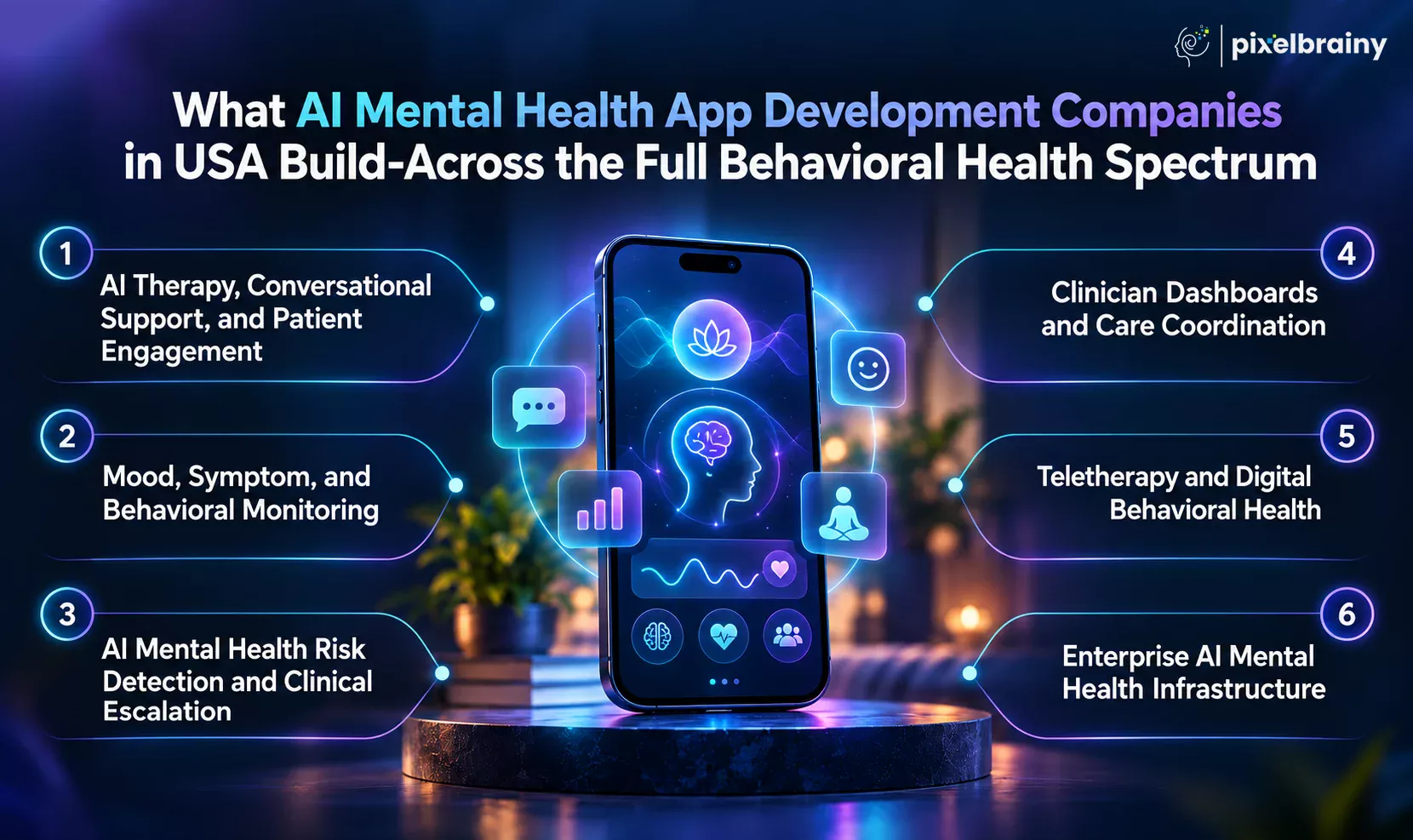
What do AI mental health app development companies build for patients? They develop conversational AI assistants that can support psychoeducation, guided exercises, journaling, coping strategies, behavioral activation, reminders, and between-session engagement.
These systems can use large language models, retrieval-augmented generation, structured clinical content, and predefined safety rules. The AI should also recognize situations that require human intervention instead of attempting to manage every conversation autonomously.
Custom AI mental health app development companies in USA can create longitudinal behavioral profiles by combining mood logs, symptom assessments, journal entries, sleep information, appointment attendance, therapy engagement, and patient messages. Instead of evaluating one isolated interaction, the platform can identify meaningful changes over time.
For example, a patient who gradually reports lower mood, skips therapy activities, becomes less engaged with the platform, and begins using increasingly negative language may require additional clinical review.
This is a critical component of enterprise behavioral health technology. AI can evaluate multiple behavioral signals against clinically defined risk criteria and route potentially concerning cases to an appropriate care team.
A properly engineered workflow can follow:
Signal collection → risk analysis → explainable alert → clinician review → escalation decision → intervention → documentation.
The system should preserve the signals, rules, model version, timestamps, alert status, clinician response, and final disposition so organizations can reconstruct how an escalation occurred.
The top AI mental health app development services providers USA can build clinician dashboards that consolidate patient risk trends, assessments, engagement changes, relevant conversation context, previous alerts, and intervention history. These dashboards help clinicians prioritize cases while keeping the final clinical decision with authorized professionals.
Modern platforms may combine AI capabilities with therapist discovery, scheduling, secure messaging, video consultations, digital assessments, treatment plans, progress tracking, and follow-up workflows.
For enterprise AI mental health app development USA, development extends into secure APIs, role-based access, consent management, audit trails, analytics, EHR and FHIR interoperability, encryption, cloud infrastructure, model monitoring, and administrative controls.
This full-spectrum approach is particularly important for USA-based AI mental health app development companies serving health systems, digital therapeutics companies, payers, universities, telehealth providers, and behavioral health startups.
The strongest AI mental health app development companies therefore build more than patient-facing applications. They connect AI conversation, behavioral intelligence, clinical workflows, risk management, human oversight, and enterprise governance into a measurable behavioral health ecosystem. WHO's 2026 guidance also emphasizes safety, accountability, clinical expertise, governance, and appropriate human oversight when AI is applied to mental health.
How do you evaluate an AI mental health development partner when your patients have eating disorders and an AI feature could unintentionally reinforce behaviors your clinicians are actively treating? That question shaped our 2027 methodology. We evaluated AI mental health app development companies in USA from the perspective of CMOs, clinical directors, behavioral health VPs, compliance teams, and digital health leaders. Our framework treats clinical safety, evidence-based treatment fidelity, crisis escalation, trauma-informed engineering, healthcare compliance, and regulatory awareness as core requirements.
For example, consider an outpatient eating disorder treatment network evaluating an AI platform. The clinical team may specifically reject calorie tracking, weight-focused progress scores, competitive engagement mechanisms, or AI responses that inadvertently validate restrictive or compensatory behaviors. We therefore asked whether each development company could translate such clinical requirements into product architecture, AI guardrails, interaction design, monitoring rules, and escalation workflows, rather than simply adding a disclaimer to the application.
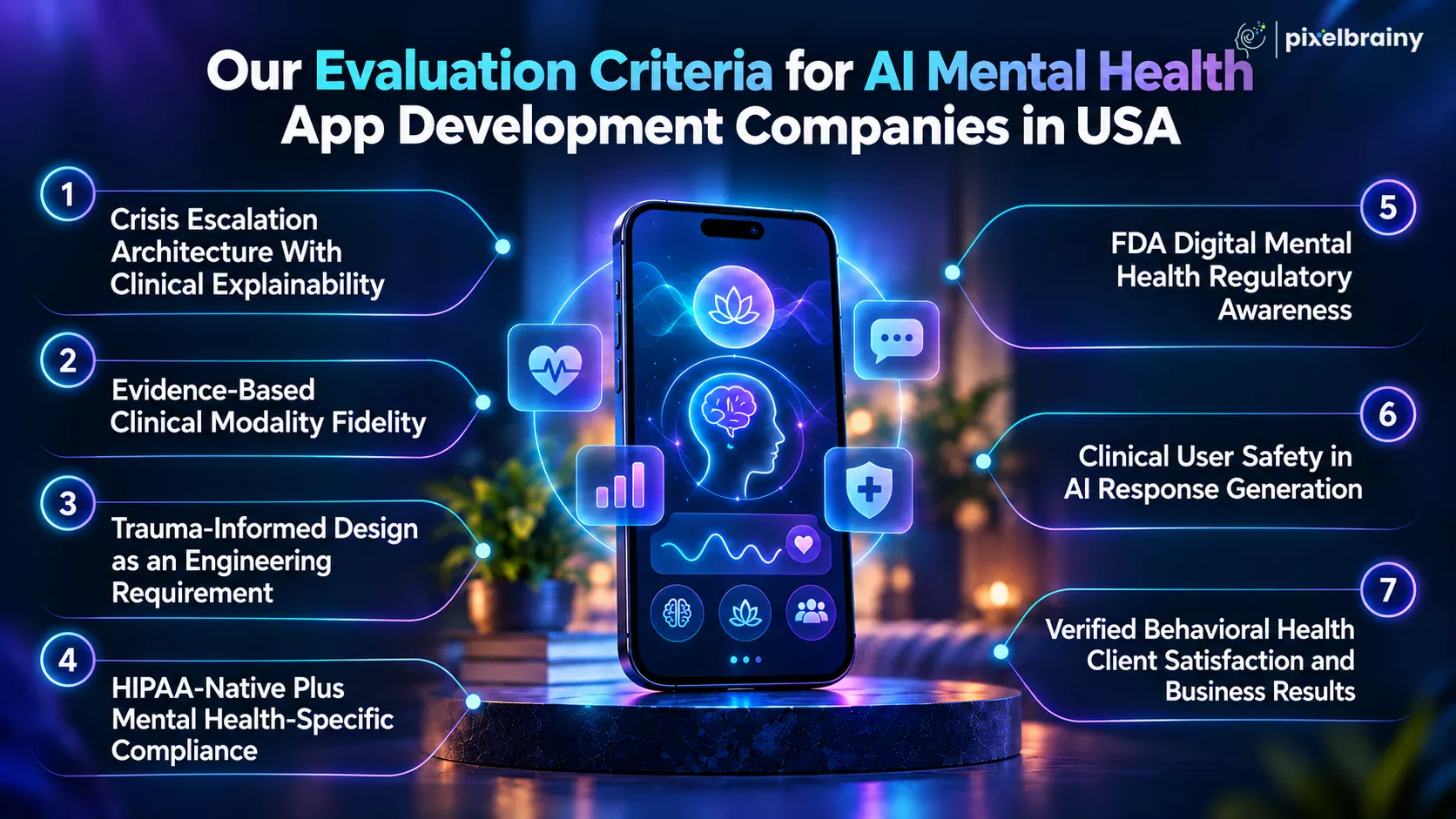
We looked for evidence of actual crisis detection and escalation architecture, including behavioral signal monitoring, risk thresholds, escalation logic, clinician routing, human overrides, decision logging, and audit trails. We gave greater weight to vendors that could explain how an AI-generated alert would be reviewed and documented.
We evaluated experience with CBT, DBT, ACT, motivational interviewing, and trauma-informed care. Vendors were assessed on their ability to preserve clinical intent across therapeutic content, assessments, personalization, conversational AI, and digital interventions. Clinical review of AI-generated content was considered an important indicator of treatment fidelity.
For AI mental health app development companies in USA trauma informed design, we assessed whether trauma-informed principles were incorporated from discovery through UX, content architecture, conversation design, and AI response generation. We considered safety, trust, transparency, patient choice, collaboration, empowerment, and avoidance of potentially retraumatizing interactions. These principles align with SAMHSA's trauma-informed approach.
For AI mental health app development companies in USA HIPAA compliant, we examined HIPAA safeguards alongside behavioral health requirements such as 42 CFR Part 2 for substance use disorder information, FERPA considerations for education environments, COPPA considerations for children, consent management, access controls, encryption, and audit logging. HHS states that applicable entities were required to comply with the 2024 Part 2 final rule by February 16, 2026.
For AI mental health app development companies in USA FDA compliant, we assessed whether vendors understand how intended use affects regulatory obligations. We considered awareness of the distinction between general wellness software, clinical decision support, medical device software, and digital therapeutics. The FDA's current digital health guidance provides important distinctions around software functions that provide clinical decision support and functions that may fall within medical device oversight.
We assessed safeguards for high-risk mental health conversations involving suicide, self-harm, eating disorders, substance use, and severe emotional distress. Our evaluation looked beyond standard content moderation to consider response constraints, clinical escalation, safety testing, contraindication-aware product design, human oversight, and monitoring.
For an eating disorder platform, this means asking whether the AI could avoid recommending features that encourage calorie restriction, weight comparison, compulsive tracking, or other behaviors that may conflict with an individual's treatment plan.
Finally, we reviewed verified client feedback and publicly documented behavioral health outcomes. For buyers searching for AI mental health app development companies in USA with proven ROI, we considered evidence such as adoption, engagement, workflow efficiency, support-access improvements, automation, and measurable project outcomes. Clutch or equivalent reviews were considered when they specifically referenced healthcare, behavioral health, mental health, or HIPAA-related development.
This methodology gives clinical buyers a consistent way to compare the best AI mental health app development companies USA against requirements that matter in real behavioral health environments. We prioritized evidence over feature claims and clinical suitability over generic AI development capacity.
Companies without credible behavioral health deployment evidence, meaningful safety architecture, or a clear understanding of clinical and regulatory boundaries were excluded from the final ranking.
Also Read: How To Build An AI Mental Health and Wellness App Like Wysa?
Which development partner is suitable when a behavioral health organization needs AI for patient progress monitoring, peer support, clinical workflows, and highly protected substance use disorder data? Consider an organization operating 18 residential and outpatient SUD treatment facilities. Its clinical team understands HIPAA, but its technology vendors cannot clearly explain how 42 CFR Part 2 affects the collection, use, disclosure, consent, and access controls surrounding substance use disorder records.
That scenario shaped how we approached this ranking. We looked beyond generic app development capabilities and evaluated AI mental health app development companies in USA according to their behavioral health experience, AI capabilities, clinical safety approach, healthcare security, regulatory awareness, integration capabilities, and publicly documented project evidence.
One important distinction applies throughout this list: a company stating that it builds HIPAA-compliant healthcare software does not automatically mean that every application it develops is compliant with 42 CFR Part 2 or appropriate for FDA-regulated use. Those requirements depend on the product, intended use, data flows, clinical claims, and implementation. Buyers should validate these areas during technical, clinical, legal, and compliance due diligence.
Below are the best AI mental health app development companies in USA selected for this 2027 ranking, covering custom behavioral health platforms, AI-powered therapy applications, crisis intervention systems, digital therapeutics, teletherapy, addiction recovery, EHR-connected solutions, peer support platforms, and enterprise mental health applications.
Custom AI Mental Health Platforms for Behavioral Health and Digital Therapeutics
Location: Sheridan, Wyoming, USA
Founded: 2021
Website: https://www.pixelbrainy.com/
Clutch Rating: 4.9/5
Core AI mental health capabilities: Custom AI mental health applications, conversational AI, behavioral monitoring, mood and symptom tracking, AI-assisted therapy platforms, CBT and DBT-oriented digital therapeutics, therapist matching, medication adherence, peer support, EAP applications, and school mental health platforms.
Clinical safety approach: PixelBrainy's mental health app development positioning includes HIPAA-oriented architecture, AI-powered monitoring, clinical escalation workflows, trauma-informed design, and safety-focused user experiences. Its public materials describe AI mental health applications using capabilities such as NLP, mood analysis, symptom tracking, and intelligent chatbot interactions.
Compliance posture: HIPAA is explicitly emphasized in its mental health offering. 42 CFR Part 2, FERPA, COPPA, and FDA SaMD requirements should be validated according to the specific product and intended use.
Notable clients: EY, MSC Cruises, VetPlus, Tykr, EventPlaybook, and Makula are among the organizations publicly referenced by PixelBrainy.
Mental health verticals: Anxiety and depression, behavioral health, digital therapeutics, crisis intervention, medication adherence, peer support, EAP, school mental health, and therapy platforms.
Pricing range: $25 to $49/hr
Best fit for: Behavioral health startups, health systems, EAP providers, digital therapeutics companies, school mental health organizations, and enterprises requiring custom AI architecture.
Why they're on this list: PixelBrainy is the anchor company because its public offering is directly focused on AI mental health app development, rather than treating mental health as a small extension of general mobile development. Its combination of behavioral health applications, AI capabilities, clinical workflow concepts, HIPAA-oriented architecture, and custom product engineering makes it particularly relevant for organizations searching for custom AI mental health app development companies USA
Healthcare-First Mental Health Applications With Clinical Workflow Integration
Location: Cary, North Carolina, USA
Founded: 2011
Core AI mental health capabilities: Custom mental health applications, symptom assessment, predictive analytics, NLP, sentiment analysis, personalized recommendations, provider matching, patient engagement, EHR integration, and telehealth workflows.
Clinical safety approach: Arkenea's mental health development practice emphasizes collaboration around clinical frameworks, patient assessment, treatment workflows, and provider-facing functionality. Buyers should request specific evidence for AI crisis classification and clinical validation before deployment.
Compliance posture: HIPAA-compliant healthcare application development is part of its positioning. Specific 42 CFR Part 2, FERPA, and FDA SaMD implementation should be established according to the intended use.
Notable US behavioral health clients: Specific named SUD clients were not sufficiently documented in the sources reviewed.
Mental health verticals: Therapy applications, behavioral health, symptom tracking, telehealth, patient engagement, and clinician workflow systems.
Pricing range: Not publicly disclosed.
Best fit for: US behavioral health practices and health systems requiring EHR-connected mental health applications.
Why they're on this list: Arkenea's healthcare specialization makes it relevant to buyers seeking leading AI mental health app development companies in USA that understand clinical workflows and healthcare interoperability. Its US healthcare presence and focus on HIPAA-compliant applications are particularly relevant when mental health software must connect with existing clinical systems.
Healthcare Software Engineering for Connected Behavioral Health
Location: San Jose, California, USA
Founded: 2009
Core AI mental health capabilities: Healthcare software development, mobile applications, telemedicine, EHR and EMR integration, patient portals, clinical workflows, cloud applications, and AI-enabled healthcare functionality.
Clinical safety approach: Emorphis is included primarily for its healthcare software and clinical integration capabilities. Buyers considering it for high-risk mental health applications should request evidence covering crisis detection, AI response safeguards, clinical escalation, and human review.
Compliance posture: Healthcare software projects can incorporate HIPAA-oriented security and privacy controls. Specific 42 CFR Part 2 implementation, FDA SaMD readiness, and clinical validation should be evaluated during procurement.
Notable US behavioral health clients: Public sources reviewed did not provide sufficient evidence to identify a specific named SUD treatment organization.
Mental health verticals: Teletherapy, behavioral health platforms, patient portals, remote care, telemedicine, and healthcare workflow applications.
Pricing range: Not publicly disclosed.
Best fit for: US health systems and behavioral health organizations requiring healthcare software, telemedicine, and EHR-connected application development.
Why they're on this list: Emorphis is relevant for organizations where mental health functionality must operate within a broader healthcare technology ecosystem. Its healthcare engineering and integration orientation make it a consideration among AI mental health app development companies in USA for organizations that need clinical infrastructure alongside the patient-facing application.
AI-First Mental Health Applications With Personalization and Sentiment Analysis
Location: Sheridan, Wyoming, USA, with global delivery operations
Founded: 2013
Core AI mental health capabilities: AI personalization, sentiment analysis, emotion detection, chatbot support, mood tracking, journaling, CBT-based self-help tools, teletherapy, video consultation, personalized recommendations, analytics, EHR connectivity, and wearable integrations.
Clinical safety approach: Citrusbug describes crisis-mode and SOS capabilities, encrypted communication, role-based access, secure authentication, mood monitoring, and emotional-safety-oriented UX. Its public materials also describe AI analysis of journal entries and sentiment.
Compliance posture: HIPAA and GDPR are explicitly discussed. Specific 42 CFR Part 2 and FDA SaMD compliance should be assessed for regulated behavioral health products.
Notable US behavioral health clients: No specific SUD client was sufficiently documented for independent attribution.
Mental health verticals: Anxiety, depression, therapy, teletherapy, mood tracking, mindfulness, wellness, and behavioral health.
Pricing range: Not publicly disclosed.
Best fit for: Digital health startups seeking AI mental health app development companies in USA for anxiety and depression with conversational AI and personalization.
Why they're on this list: Citrusbug has a dedicated mental health development practice with AI-powered personalization, sentiment analysis, emotion detection, mood tracking, teletherapy, and crisis-oriented functionality. This makes it relevant for organizations wanting an AI-first product rather than a conventional wellness application with an AI chatbot added later.
Enterprise AI Mental Health Platforms With Safety and Auditability
Location: New York, New York, USA, with global delivery operations
Founded: 2015
Core AI mental health capabilities: AI-enabled mental health applications, clinical NLP, LLM integration, predictive analytics, behavioral analytics, therapy platforms, care coordination, EHR integration, wearable integration, patient engagement, and enterprise healthcare applications.
Clinical safety approach: Its mental health practice describes risk indicators, escalation paths, emergency actions, audit trails, role-based access, and AI guardrails around safety and explainability.
Compliance posture: HIPAA-focused architecture includes access controls, encryption, audit trails, and secure healthcare integrations. Project-specific 42 CFR Part 2 and FDA SaMD requirements require separate validation.
Notable US behavioral health clients: Its healthcare portfolio includes large healthcare organizations, although individual mental health project scopes should be verified.
Mental health verticals: Therapy, behavioral health, mental wellness, care coordination, patient engagement, addiction recovery, and digital therapeutics.
Pricing range: Not publicly disclosed.
Best fit for: Enterprise healthcare organizations and mid-market behavioral health companies requiring large-scale mobile and AI engineering.
Why they're on this list: Appinventiv combines enterprise healthcare engineering with dedicated mental health application development. Its public documentation specifically addresses clinical safety workflows, audit trails, AI guardrails, EHR integration, and HIPAA-oriented architecture, making it a strong consideration among top-rated US based AI mental health app development companies.
Cloud-Native AI Mental Health Applications Built for Scale
Location: Orlando, Florida, USA, with global engineering operations
Founded: 2010
Core AI mental health capabilities: Generative AI, conversational AI, personalized mental health support, behavioral pattern analysis, cloud-native architecture, mobile applications, analytics, administrative dashboards, and scalable AI infrastructure.
Clinical safety approach: Simform's MindFulMe case study describes an AI-driven mental health support application designed to identify early signs of mental health issues and provide personalized support. The implementation used Amazon Bedrock and AWS technologies.
Compliance posture: Secure cloud infrastructure is central to its healthcare engineering capabilities. Buyers should request specific documentation for HIPAA, 42 CFR Part 2, FDA SaMD, and clinical safety controls for their intended application.
Notable US behavioral health clients: The MindFulMe project is publicly documented as a university mental health deployment, with Simform reporting implementation across 50 universities.
Mental health verticals: Student mental health, emotional support, behavioral monitoring, digital wellness, therapy assistance, and AI-powered engagement.
Pricing range: Not publicly disclosed.
Best fit for: Organizations needing cloud-native AI mental health platforms with substantial scalability requirements.
Why they're on this list: Simform has directly documented experience delivering an AI-driven mental health platform rather than simply listing healthcare AI as a service. Its MindFulMe case study makes it especially relevant to organizations evaluating AI mental health app development companies in USA for group therapy, student mental health, and large-scale behavioral support programs.
Enterprise Behavioral Health and AI Platform Engineering
Location: New York, New York, USA
Founded: 2003
Core AI mental health capabilities: Mental health applications, therapy platforms, CBT functionality, mood tracking, virtual counseling, healthcare chatbots, AI assistants, analytics, cloud applications, and enterprise healthcare software.
Clinical safety approach: Fingent's healthcare practice covers therapy, mental health, patient engagement, and healthcare workflow applications. Public evidence for independently validated crisis detection is limited, so high-risk deployments require additional technical validation.
Compliance posture: Fingent has extensive enterprise software and security experience and reports ISO 27001:2022 certification. HIPAA and healthcare security requirements can be incorporated into healthcare projects. Specific 42 CFR Part 2 and FDA SaMD evidence should be verified for each engagement.
Notable US behavioral health clients: Public sources reviewed did not provide sufficiently detailed named SUD client evidence.
Mental health verticals: Therapy, CBT, mood tracking, virtual counseling, behavioral health, patient engagement, and community platforms.
Pricing range: Not publicly disclosed.
Best fit for: Health systems and enterprise behavioral health organizations requiring large-scale platform engineering.
Why they're on this list: Fingent brings substantial enterprise software engineering experience to behavioral health. Its New York presence, long operating history, and healthcare application capabilities make it relevant for organizations seeking USA-based AI mental health app development companies capable of supporting complex enterprise environments.
AI and White-Label Mental Health Platform Development
Location: Clinton, New Jersey, USA, with headquarters in India
Founded: 2022
Core AI mental health capabilities: Conversational AI, custom healthcare applications, mobile and web platforms, AI integration, SaaS, white-label software, and digital health applications.
Clinical safety approach: Public evidence for clinically validated crisis detection and behavioral health safety testing is limited. Buyers should request detailed evidence before using the platform for high-risk clinical workflows.
Compliance posture: Healthcare privacy and HIPAA requirements can be addressed within custom projects. Publicly documented evidence specifically covering 42 CFR Part 2 and FDA SaMD is limited.
Notable US behavioral health clients: No sufficiently documented named behavioral health client was identified in the reviewed sources.
Mental health verticals: Mental wellness, therapy technology, conversational AI, digital health, and white-label applications.
Pricing range: Not publicly disclosed.
Best fit for: Mental health clinics, startups, and wellness businesses seeking white label AI mental health app development companies in USA or customizable AI platform foundations.
Why they're on this list: Triple Minds is relevant for buyers interested in faster deployment through custom or white-label AI infrastructure. Its US presence makes it accessible to American buyers, while its global delivery model can support cost-sensitive product development. Because public clinical and regulatory evidence is more limited, we position it below vendors with deeper documented healthcare specialization.
Specialized Mental Health Development With Teletherapy and Clinical Integrations
Location: Claymont, Delaware, USA
Founded: 2011
Core AI mental health capabilities: Teletherapy, online counseling, CBT applications, mood and symptom tracking, addiction recovery, AI chatbots, mood-pattern analysis, patient portals, EHR integration, telehealth, and secure messaging.
Clinical safety approach: Cleveroad's mental health practice addresses AI support, behavioral monitoring, crisis-related workflows, clinician escalation, and user experience for vulnerable populations.
Compliance posture: Healthcare privacy, HIPAA-oriented architecture, secure data handling, and EHR interoperability are part of its healthcare development positioning. 42 CFR Part 2 and FDA SaMD requirements should be validated for the actual project.
Notable US behavioral health clients: Cleveroad documents a US-based online mental healthcare provider project involving psychiatric care, therapy, chat-based practitioner access, Kareo EHR integration, and referral management.
Mental health verticals: Teletherapy, addiction recovery, CBT, mood tracking, counseling, sleep, self-care, and behavioral health.
Pricing range: Not publicly disclosed.
Best fit for: US digital health startups and behavioral health organizations requiring end-to-end mental health application development.
Why they're on this list: Cleveroad has a particularly broad mental health development portfolio, spanning therapy, addiction recovery, mood tracking, telehealth, AI, and EHR connectivity. That breadth makes it a useful candidate among AI mental health app development companies in USA for substance use disorder and integrated behavioral healthcare.
Mobile-First Mental Health Products With Strong QA
Location: Miami, Florida, USA
Founded: 1999
Core AI mental health capabilities: iOS and Android applications, AI and machine learning, data science, cloud backends, healthcare software, wellness applications, analytics, and custom mobile platforms.
Clinical safety approach: Mercury's strongest publicly visible capabilities are mobile engineering, QA, and healthcare product development. Public evidence for clinically validated crisis detection is limited, so buyers should request dedicated clinical safety documentation.
Compliance posture: Healthcare applications can incorporate HIPAA and security requirements. Specific 42 CFR Part 2, FDA SaMD, and clinical validation should be established according to product scope.
Notable US behavioral health clients: No specific named behavioral health client was sufficiently documented in the sources reviewed.
Mental health verticals: Mental wellness, patient engagement, healthcare applications, remote care, and mobile behavioral health.
Pricing range: Not publicly disclosed.
Best fit for: Mental health startups and wellness organizations prioritizing mobile performance, UX, QA, and scalable application engineering.
Why they're on this list: Mercury Development has operated since 1999 and reports more than 1,500 completed projects and more than 40 million active users across applications. Its combination of mobile development, AI/ML, data science, QA, and healthcare engineering makes it relevant for affordable AI mental health app development companies in USA comparisons where buyers want to balance engineering depth with mobile delivery.
AI-Enabled Mental Health Applications for Startups and Healthcare Organizations
Location: New York, New York, USA, with global delivery operations
Founded: 2009
Core AI mental health capabilities: AI-powered mental health applications, therapy and counseling platforms, mood tracking, journaling, AI recommendations, teletherapy, behavioral monitoring, cloud applications, and secure patient data management.
Clinical safety approach: Techanic describes behavioral monitoring, mood tracking, AI recommendations, privacy, security, and scalable healthcare architecture. Specific clinical validation for crisis detection should be requested before deployment.
Compliance posture: HIPAA and GDPR are emphasized in its healthcare development materials. 42 CFR Part 2 and FDA SaMD requirements should be addressed through project-specific compliance planning.
Notable US behavioral health clients: Specific named SUD treatment clients were not sufficiently documented in the sources reviewed.
Mental health verticals: Therapy, counseling, mood tracking, wellness, telehealth, behavioral monitoring, and patient engagement.
Pricing range: Published estimates range from approximately $9,000 to $120,000+, depending on application complexity and features.
Best fit for: Healthcare startups, hospitals, clinics, and organizations looking for scalable mobile and web development with AI integration.
Why they're on this list: Techanic combines healthcare application engineering, AI integration, cloud development, and mental health functionality. It can be considered by buyers comparing AI mental health app development companies in USA for anxiety and depression, particularly when the initial requirement is a scalable patient-facing platform rather than a heavily regulated prescription digital therapeutic.
Enterprise Mental Health Engineering With Strong Regulatory Awareness
Location: McKinney, Texas, USA
Founded: 1989
Core AI mental health capabilities: AI-driven therapy programs, digital therapeutics, telehealth, mood tracking, symptom analysis, clinical decision support, conversational AI, crisis intervention, medication management, EHR integration, wearables, and behavioral analytics.
Clinical safety approach: ScienceSoft publicly discusses crisis intervention, remote monitoring, symptom-pattern detection, digital therapeutics, and clinical workflows. Its mental health development practice also describes involvement from regulatory consultants and cybersecurity specialists.
Compliance posture: ScienceSoft explicitly references HIPAA, FDA, HITECH, and 42 CFR Part 2, together with ISO 13485, ISO 9001, and ISO 27001 within its mental health development practice.
Notable US behavioral health clients: Public case studies include a US mental health startup and a US NGO serving more than 15,000 patients.
Mental health verticals: Anxiety, depression, addiction-related applications, digital therapeutics, telehealth, crisis intervention, mood tracking, and clinical software.
Pricing range: ScienceSoft publishes estimated mental health application costs of approximately $150,000 to $800,000+, with AI mental health projects potentially ranging from $70,000 to $2 million depending on complexity.
Best fit for: Health systems, regulated digital health companies, behavioral health enterprises, and organizations developing prescription digital therapeutics.
Why they're on this list: ScienceSoft has one of the strongest publicly documented combinations of mental health engineering, regulatory awareness, digital therapeutics, crisis intervention, and 42 CFR Part 2 knowledge in this group. For organizations evaluating AI mental health app development companies in USA for prescription digital therapeutics, this breadth is particularly relevant.
Design-Led Mental Health and Digital Therapeutics Development
Location: Venice Beach, California, USA
Founded: 2011
Core AI mental health capabilities: Mobile mental health applications, AI and machine learning, mood tracking, guided therapy, patient-reported outcomes, EHR integration, wearable integration, remote monitoring, telehealth, and digital therapeutics.
Clinical safety approach: Dogtown describes patient-data security, licensed-provider collaboration, crisis access, patient-reported outcomes, and clinical workflows.
Compliance posture: HIPAA, FDA, and SaMD-aligned workflows are publicly described, including risk management and intended-use definition for medical device applications.
Notable US behavioral health clients: Specific named behavioral health clients were not sufficiently documented.
Mental health verticals: Mental wellness, behavioral health, digital therapeutics, remote monitoring, patient-reported outcomes, and telehealth.
Pricing range: Not publicly disclosed.
Best fit for: US digital health startups requiring strong mobile UX, AI integration, healthcare security, and potential SaMD development.
Why they're on this list: Dogtown Media combines healthcare mobile engineering with AI, EHR connectivity, wearables, remote monitoring, and digital therapeutics. Its public SaMD development process also discusses intended use, risk management, FDA classification planning, and IEC 62304, giving it particular relevance for regulated digital health products.
Behavioral Health Applications With EHR and Recovery Workflows
Location: Dallas, Texas, USA
Founded: 2009
Core AI mental health capabilities: Mental health applications, mood tracking, CBT exercises, telepsychiatry, secure messaging, group support, addiction recovery, crisis-management functionality, wearable integration, EHR connectivity, analytics, and healthcare management software.
Clinical safety approach: OSP Labs describes crisis-management functionality, clinical assessments, treatment planning, remote monitoring, professional-care access, and addiction recovery workflows.
Compliance posture: HIPAA-oriented security and confidentiality are part of its healthcare development approach. Specific 42 CFR Part 2 and FDA SaMD evidence should be established for regulated projects.
Notable US behavioral health clients: Specific named SUD clients were not sufficiently documented in the public evidence reviewed.
Mental health verticals: Addiction recovery, telepsychiatry, CBT, group support, mood tracking, behavioral health, and patient engagement.
Pricing range: Not publicly disclosed. OSP Labs states that project costs depend on application complexity, integrations, platform requirements, and functionality.
Best fit for: Behavioral health practices, clinical organizations, addiction recovery providers, and healthcare enterprises requiring integrated clinical workflows.
Why they're on this list: OSP Labs is particularly relevant to organizations looking for AI mental health app development companies in USA for substance use disorder and connected behavioral health services. Its publicly described capabilities include addiction recovery, crisis management, telepsychiatry, group support, EHR integration, and clinical workflows.
The companies above represent different strengths across clinical applications, AI engineering, enterprise healthcare, digital therapeutics, mobile experiences, and behavioral health integrations. Buyers should validate clinical evidence, security controls, regulatory responsibilities, and product-specific compliance before selecting a development partner.
Also Read: AI Mental Health First Aid App Development: Benefits, Key Features, and Costs
When a behavioral health buyer narrows the shortlist to three vendors, the key question is not simply who can build an AI chatbot or patient app. The stronger question is: which vendor can demonstrate production mental health software with documented clinical safety architecture, defined escalation logic, human oversight, and an evidence-based compliance approach?
That distinction matters because AI mental health app development companies in USA can differ significantly in clinical maturity, regulatory experience, and ability to support high-risk workflows. For this comparison, Clinical Safety Tier reflects the depth of publicly demonstrable behavioral health, clinical workflow, risk-management, and human oversight capabilities, while Compliance Posture indicates the regulatory and security frameworks a buyer should validate during due diligence.
The table below gives clinical and startup buyers a fast comparison of the top AI mental health app development companies USA, with emphasis on safety, compliance, product scope, and commercial fit.
| Company | HQ | Clinical Safety Tier | Compliance Posture | App Types | Pricing Range | Best Fit For |
| PixelBrainy LLC | Sheridan, Wyoming | Tier 2: Clinical Workflow Ready | HIPAA-focused; validate 42 CFR Part 2 and FDA scope per project | AI therapy, patient engagement, behavioral monitoring, telehealth | $30-$60/hr | Startups, custom behavioral health platforms |
| Arkenea | Cary, North Carolina | Tier 2: Clinical Workflow Ready | HIPAA experience; validate project-specific regulatory controls | Telehealth, patient engagement, healthcare apps | Not publicly disclosed | Healthcare startups and provider platforms |
| Emorphis Technologies | San Jose, California | Tier 2: Clinical Workflow Ready | HIPAA and healthcare security experience; validate FDA requirements | Telehealth, EHR-connected apps, behavioral health platforms | Not publicly disclosed | Healthcare organizations and startups |
| Citrusbug | Sheridan, Wyoming | Tier 2: Clinical Workflow Ready | HIPAA-oriented healthcare development; validate behavioral health controls | AI healthcare apps, telehealth, patient engagement | Not publicly disclosed | Startups and mid-market providers |
| Appinventiv | New York, New York | Tier 2: Clinical Workflow Ready | HIPAA healthcare experience; regulatory scope varies by product | AI healthcare, telehealth, digital therapeutics | Project-based | Enterprise healthcare and funded startups |
| Simform | Orlando, Florida | Tier 2: Clinical Workflow Ready | HIPAA and secure cloud development experience | AI healthcare, patient monitoring, behavioral health | Project-based | Digital health companies and enterprises |
| Fingent | New York, New York | Tier 2: Clinical Workflow Ready | HIPAA and ISO-oriented security posture; validate FDA/Part 2 scope | Healthcare platforms, AI, patient engagement | Project-based | Enterprise healthcare organizations |
| Triple Minds | Clinton, New Jersey | Tier 1: Product Development Focused | Healthcare compliance capabilities should be validated per engagement | White-label AI, patient apps, telehealth | Project-based | Startups seeking white-label solutions |
| Cleveroad | Claymont, Delaware | Tier 2: Clinical Workflow Ready | HIPAA healthcare development; validate Part 2 and FDA requirements | Telehealth, EHR-connected apps, patient platforms | Project-based | Healthcare startups and providers |
| Mercury Development | Miami, Florida | Tier 2: Clinical Workflow Ready | Healthcare security and compliance experience; validate clinical controls | AI apps, healthcare platforms, patient apps | Project-based | Enterprise and high-scale digital health products |
| Techanic Infotech | New York, New York | Tier 1: Product Development Focused | HIPAA-oriented healthcare development; validate clinical safety controls | Mental health, telehealth, AI healthcare apps | $9,000-$120,000+ | Startups and cost-conscious buyers |
| ScienceSoft | McKinney, Texas | Tier 3: Regulated Clinical Engineering | HIPAA, HITECH, FDA, 42 CFR Part 2, ISO frameworks | Digital therapeutics, clinical software, AI healthcare | $150K-$800K+; complex AI can exceed this | Regulated healthcare and enterprise buyers |
| Dogtown Media | Venice Beach, California | Tier 2: Clinical Workflow Ready | HIPAA and medical software development experience; validate FDA pathway | Mental health, AI, SaMD, patient monitoring | Project-based | Digital therapeutics and healthcare startups |
| OSP Labs | Dallas, Texas | Tier 2: Clinical Workflow Ready | HIPAA and healthcare compliance experience; validate Part 2/FDA scope | Mental health, addiction recovery, crisis management, telepsychiatry | Project-based | Behavioral health providers and enterprises |
Use the Clinical Safety Tier as a screening filter, not a final verdict. Ask shortlisted AI mental health app development firms USA to demonstrate risk detection, AI guardrails, clinician escalation, audit trails, and human oversight.
Compare pricing alongside clinical complexity, including EHR integration, crisis workflows, consent management, and regulatory documentation.
Therefore, the best AI mental health app development companies in USA combine proven safety architecture, compliance readiness, clinical experience, and scalable development.
Imagine a K-12 school district serving 42,000 students across 38 schools, with one counselor for every 420 students. The district wants an AI mental health tool for anonymous, self-guided emotional support, but it must work within FERPA, COPPA, and state student privacy requirements.
The real buyer question is not simply which vendor can build an AI chatbot. It is which AI mental health app development companies in USA understand the privacy, age, safety, consent, and counselor-escalation boundaries of school-based mental health. The same principle applies across every behavioral health segment.
AI can match patients with therapists based on clinical presentation, specialty, preferences, cultural background, availability, and care needs.
Platforms can also support between-session monitoring, progress tracking, outcome measurement, scheduling, and patient engagement.
For providers, useful ROI measures include therapist utilization, appointment completion, engagement, matching efficiency, and patient retention. Crisis escalation should remain governed by defined clinical rules and human oversight.
CBT and DBT applications use AI to deliver structured therapeutic exercises between sessions for anxiety, depression, OCD, emotion regulation, and related conditions.
AI mental health app development companies in USA for cbt based apps should demonstrate clinical modality fidelity, licensed-clinician review, controlled AI responses, and research-grade interaction logging.
Products making medical claims may also require an FDA regulatory strategy and supporting clinical evidence.
SUD applications require specialized privacy architecture because 42 CFR Part 2 adds confidentiality requirements for applicable substance use disorder records beyond standard HIPAA considerations.
AI can support recovery engagement, peer connection, medication adherence, progress monitoring, and risk identification.
Integration with treatment-facility EHRs must preserve consent and disclosure controls. For sensitive SUD deployments, documented Part 2 architecture should be a core vendor evaluation requirement.
Crisis applications require explicit safety architecture for identifying concerning signals, generating safe responses, and escalating cases to qualified human responders.
AI mental health app development companies in USA for suicide prevention should be able to explain escalation thresholds, audit trails, human review, uncertainty handling, and connections to crisis resources such as 988.
The system should also be tested against unexpected crisis language rather than relying only on predefined scenarios.
Employee wellness platforms can provide private self-guided mental health support while separating individual information from employer-level reporting.
This distinction is critical because employees may avoid EAP services if they believe their employer can see personal mental health information.
AI mental health app development companies in USA for employee wellness should therefore address confidentiality, consent, escalation pathways, and aggregate reporting.
Key business metrics include utilization, engagement, completion rates, referrals, and retention.
School mental health requires a different architecture because vendors may need to address FERPA, COPPA, state student privacy laws, age-based consent, counselor workflows, and crisis escalation simultaneously.
AI mental health app development companies in USA for school mental health should clearly explain how anonymous access, parental involvement, counselor alerts, data retention, and student safety are handled.
Content should also be age appropriate and trauma informed for different K-12 populations.
Veteran-focused applications may address PTSD, depression, trauma, military sexual trauma, and other conditions requiring specialized clinical workflows.
AI mental health app development companies in USA for veteran mental health should understand evidence-based approaches such as Cognitive Processing Therapy and Prolonged Exposure while maintaining appropriate clinician oversight.
VA-connected workflows, accessibility, secure data exchange, and requirements for active-duty environments can further influence the architecture.
Prescription digital therapeutics require greater regulatory and clinical rigor when software is intended to make medical claims.
Depending on intended use and classification, development may involve FDA pathways such as De Novo or 510(k), clinical studies, quality processes, cybersecurity controls, and validated outcome measures.
Measures such as PHQ-9, GAD-7, and PCL-5 can be incorporated at clinically defined intervals. Reimbursement planning should be considered alongside regulatory strategy.
Senior-focused mental health applications often need voice-first interaction, simplified navigation, accessibility features, and caregiver or care-team workflows.
AI can support social connection and identify potentially relevant behavioral changes, but clinical interpretation should remain with qualified professionals.
Integration with primary care EHRs and senior care coordination platforms can help providers incorporate behavioral information into broader care plans.
AI can improve peer matching by lived experience, moderate harmful content, identify potential crisis conversations, and support multilingual communities.
The key design challenge is maintaining the boundary between peer support and clinical advice. The system should recognize when a conversation requires escalation to a qualified professional.
Community moderation, privacy controls, cultural competence, and human review become increasingly important as the platform scales.
A behavioral health buyer evaluating an AI development partner faces a different set of questions than a typical healthcare software buyer. A vendor may have strong AI capabilities but limited experience with clinical risk, crisis workflows, behavioral health privacy, or regulated digital therapeutics. The six checks below help buyers assess top AI mental health app development companies in USA against real clinical and commercial requirements.
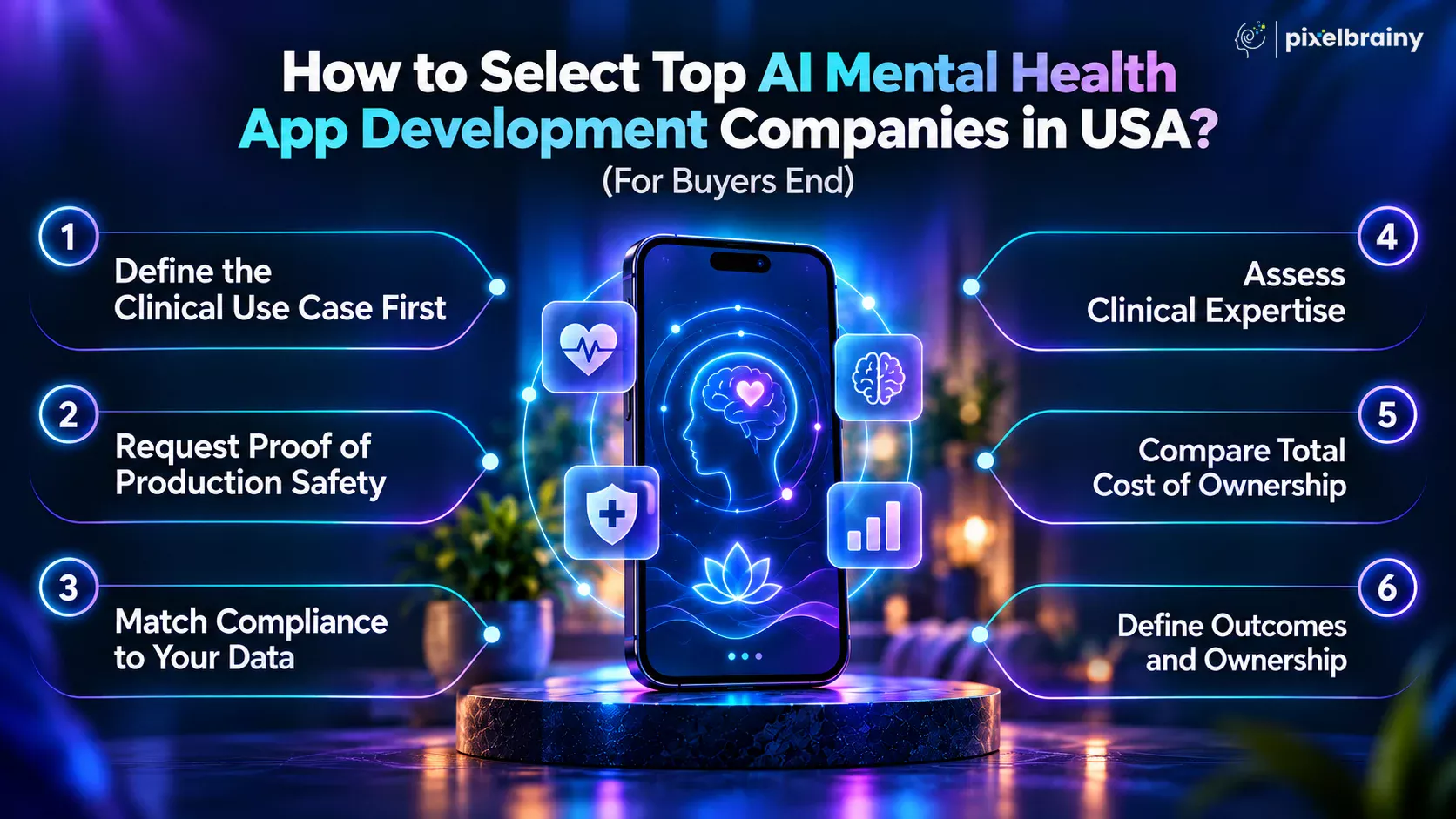
Start with the patient problem and intended clinical outcome. Is the application designed for anxiety support, therapist matching, SUD recovery, crisis intervention, PTSD, employee wellness, or a prescription digital therapeutic?
The use case determines the required safety controls, data architecture, AI boundaries, and regulatory pathway. AI mental health app development companies USA should translate that use case into specific product requirements rather than propose a generic AI chatbot.
Ask vendors to demonstrate how their systems identify risk, constrain unsafe AI responses, trigger clinician escalation, document decisions, and manage uncertain outputs.
A strong buyer question is: “Which production mental health applications have documented and tested clinical safety architecture?” This helps distinguish experienced AI mental health app development firms USA from vendors whose healthcare portfolio is primarily general-purpose software.
HIPAA should not be the only compliance question. Depending on the application, buyers may also need to assess 42 CFR Part 2, FERPA, COPPA, state privacy laws, FDA requirements, consent controls, retention policies, and audit trails.
Ask for a compliance responsibility matrix showing which controls the vendor manages and which remain with the healthcare organization. A generic “HIPAA compliant” claim is not enough.
Clinical involvement should extend beyond an initial consultation. Ask whether the vendor works with psychiatrists, psychologists, therapists, clinical researchers, or other qualified professionals throughout discovery, design, testing, and post-launch monitoring.
AI mental health app developers USA should explain how clinical input becomes AI guardrails, escalation rules, therapeutic content, testing scenarios, and measurable outcome requirements.
Evaluate more than the initial development quote. Include discovery, AI development, clinical workflow design, EHR integrations, security testing, regulatory documentation, infrastructure, monitoring, maintenance, and post-launch model evaluation.
A lower upfront price can become costly when safety, compliance, or clinical requirements are added later. Compare vendors on total cost, implementation timeline, scalability, and internal resources required.
Set measurable success criteria before development begins. These may include engagement, treatment completion, symptom improvement, clinician workload, retention, referral conversion, or escalation performance.
Also clarify ownership of application code, AI models, clinical content, patient data, documentation, monitoring, and future updates. Strong AI mental health software development companies USA should provide clear KPIs and accountable post-launch support.
The right partner should prove clinical safety, compliance readiness, measurable outcomes, and long-term accountability, not just demonstrate an impressive AI product.
When you decide to build an AI mental health application, the first vendor that offers an impressive demo or low development quote can seem like the obvious choice. But behavioral health products involve clinical workflows, sensitive data, patient safety, and long-term governance. Before signing with AI mental health app development companies in USA, buyers should avoid these common mistakes.
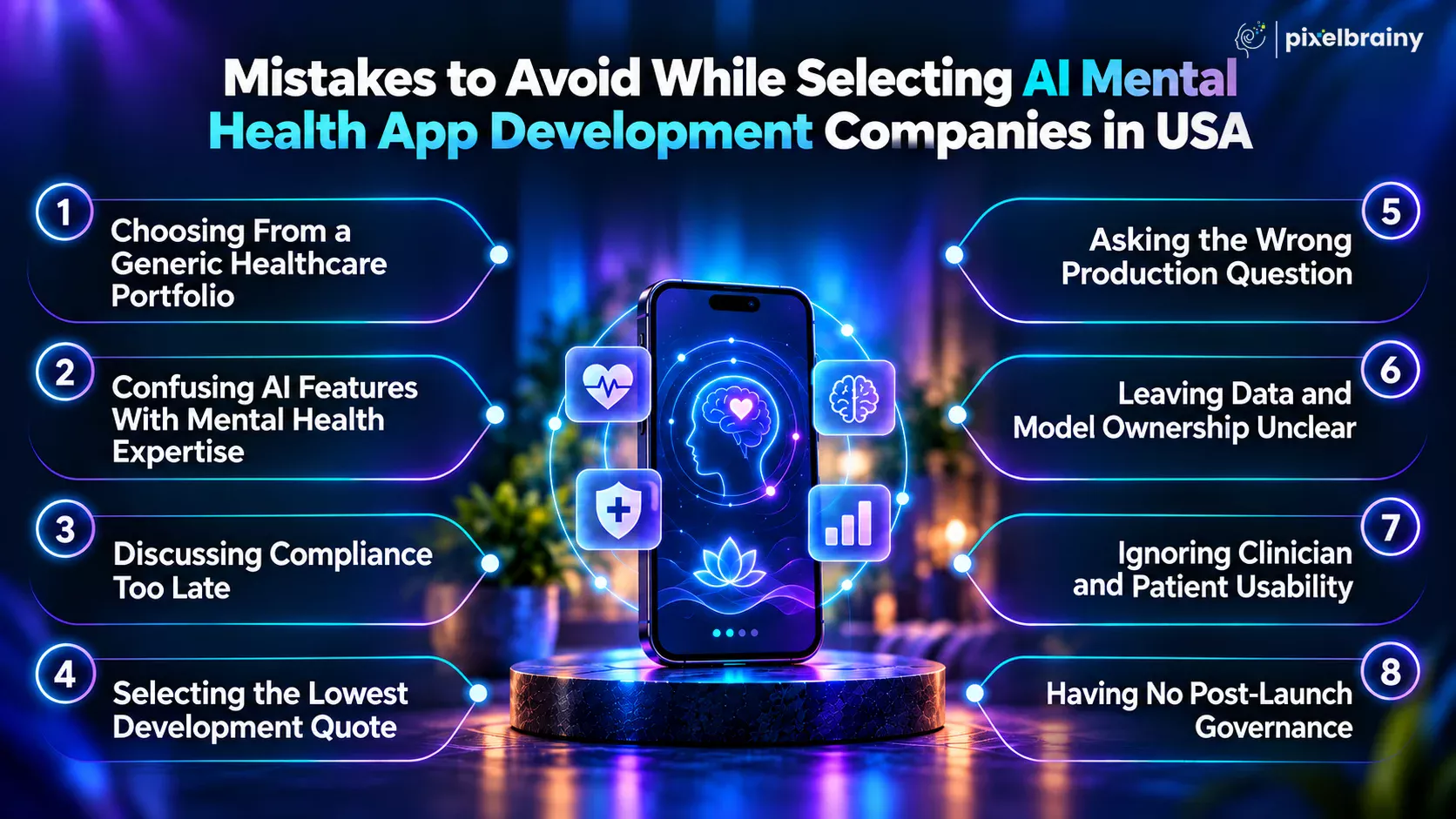
A company may have built hospital software, patient portals, or fitness applications without meaningful behavioral health experience.
Review projects involving therapy workflows, mental health assessments, digital therapeutics, behavioral monitoring, or care coordination. Relevant experience should match your target population, clinical workflow, and product complexity.
An impressive chatbot does not prove that a vendor understands behavioral health.
Ask how the system handles sensitive disclosures, ambiguous symptoms, harmful requests, medication questions, and unexpected conversations. AI mental health app development companies USA should demonstrate these scenarios rather than relying on generic AI presentations.
Privacy and regulatory requirements should influence architecture from the beginning.
Depending on the product, requirements may involve HIPAA, 42 CFR Part 2, FERPA, COPPA, state privacy laws, or FDA considerations. Ask vendors to explain how applicable requirements affect data collection, consent, access, storage, and disclosure.
A low estimate may exclude clinical content validation, integrations, security testing, AI monitoring, regulatory documentation, or ongoing maintenance.
Request a complete cost breakdown covering discovery, design, development, testing, deployment, infrastructure, support, and future updates. Compare total ownership costs instead of the initial development fee alone.
Instead of asking only, “Can you build this?”, ask, “Which comparable mental health applications have you taken into production, and what measurable results did they achieve?”
Request evidence of deployment scale, user adoption, clinical workflows, performance monitoring, and implementation outcomes. This helps separate genuine delivery experience from prototype-level capability.
Mental health applications can generate highly sensitive conversations, assessments, behavioral signals, and AI outputs.
Before contracting, clarify ownership and access rights for patient data, source code, AI configurations, prompts, analytics, generated content, and derived datasets. Also establish what happens to these assets when the development relationship ends.
A technically advanced application can fail if clinicians cannot fit it into existing workflows or patients struggle to use it.
Test representative users before launch. Evaluate onboarding, accessibility, navigation, response clarity, clinician workload, and sustained engagement across the intended population.
AI behavior can change as models, prompts, content, integrations, and user behavior evolve.
Define who monitors performance, investigates incidents, approves content changes, reviews user feedback, and authorizes major AI updates. Clear governance keeps the product accountable after deployment.
A strong vendor should offer more than AI development capability. Evaluate AI mental health app development companies in USA through production evidence, behavioral health expertise, transparent ownership, realistic costs, and long-term governance.
The right AI mental health app development partner in USA should align clinical requirements with commercial goals. Technical expertise matters, but so do behavioral health experience, AI safety architecture, privacy controls, regulatory readiness, usability, and measurable outcomes.
Before signing, define your target population, clinical use case, risk level, integrations, compliance requirements, budget, and success metrics. Then compare AI mental health app development companies in USA on relevant production experience, clinical workflows, AI testing, escalation processes, security controls, ownership terms, and post-launch support.
Whether you are building an anxiety and depression platform, SUD recovery app, PTSD solution, crisis intervention system, school mental health platform, employee wellness product, or prescription digital therapeutic, your partner should understand the specific clinical and regulatory requirements involved.
The strongest custom AI mental health app development companies USA can connect clinical safety, technology, compliance, user experience, scalability, and business value into one practical roadmap.
Ready to build your 2027 mental health solution? Schedule a call with our team to discuss your clinical requirements, product scope, and development roadmap.
There is no universal best provider because clinical scope, risk level, compliance, integrations, and budget vary by project. In this 2027 review, PixelBrainy is a strong option for custom behavioral health applications. Buyers comparing the top AI mental health app development companies USA should prioritize production experience, clinical safety, regulatory readiness, and measurable outcomes.
The cost of working with AI mental health app development companies in USA can range from approximately $50,000 for a focused MVP to $800,000+ for complex clinical platforms. AI personalization, EHR integration, clinician dashboards, crisis workflows, security, compliance, and clinical validation can significantly increase costs. A detailed technical scope provides a more reliable estimate.
A consumer wellness app generally supports mental wellbeing without making regulated treatment claims. A prescription digital therapeutic is designed to deliver a therapeutic intervention for a specific condition and may require clinical evidence, quality controls, cybersecurity measures, and an appropriate FDA pathway. AI mental health app development companies in USA must therefore understand the intended use before defining architecture and regulatory strategy.
ScienceSoft and PixelBrainy publicly identifies 42 CFR Part 2 among its healthcare compliance capabilities, making it relevant for highly regulated SUD projects. Buyers should still validate implementation experience directly. When comparing AI mental health app development firms USA, ask for evidence covering Part 2 consent, disclosure controls, access permissions, audit trails, and protected SUD data workflows.
Safe applications combine risk detection, predefined clinical rules, constrained AI responses, human escalation, audit trails, and continuous safety testing. AI mental health app development companies in USA for suicide prevention should demonstrate how the platform handles suicidal ideation, self-harm disclosures, ambiguous risk, and unexpected crisis conversations. Generative AI should not independently determine high-risk clinical interventions.
Buyers should distinguish between companies that can technically build an application and vendors with experience implementing evidence-based clinical modalities. PixelBrainy can be considered for custom development, while larger healthcare engineering providers may suit regulated programs. When evaluating AI mental health app development companies in USA for cbt based apps, request evidence of clinician validation, modality fidelity, testing, and outcome measurement.
FDA Software as a Medical Device considerations apply when software performs a medical function, depending on its intended use and risk. A mental health product making treatment or diagnostic claims can face substantially different requirements from a general wellness application. Buyers should define intended use early and discuss the appropriate regulatory pathway with qualified experts before development begins.
School districts should evaluate AI mental health app development companies in USA for school mental health based on demonstrated student-privacy experience rather than generic healthcare claims. PixelBrainy can be included in the discovery process for custom development, but buyers should specifically verify FERPA, COPPA, state student privacy requirements, parental consent, data retention, counselor alerts, and age-appropriate safety workflows.
A focused MVP can take approximately 4 to 6 months, while a production-grade clinical platform may require 9 to 18 months or longer. Development time depends on AI complexity, clinical validation, EHR integration, security testing, regulatory requirements, and safety architecture. AI mental health app development companies in USA should provide a milestone-based timeline tied to these technical and clinical dependencies.
Multilingual mental health software requires more than translating interface text. Clinical content, AI responses, assessments, crisis messaging, cultural context, and escalation workflows may also require localization. Buyers evaluating AI mental health app developers USA should ask for multilingual production examples and native-language clinical review. PixelBrainy can be considered for custom multilingual development where the required languages and clinical workflows are clearly defined.

About The Author
Sagar Bhatnagar
Sagar Sahay Bhatnagar brings over a decade of IT industry experience to his role as Marketing Head at PixelBrainy. He's known for his knack in devising creative marketing strategies that boost brand visibility and market influence. Sagar's strategic thinking, coupled with his innovative vision and focus on results, sets him apart. His track record of successful campaigns proves his ability to utilize digital platforms effectively for impactful marketing efforts. With a genuine passion for both technology and marketing, Sagar continuously pushes PixelBrainy's marketing initiatives to greater success.

Working with the PixelBrainy team has been a highly positive experience. They understand the design requirements and create beautiful UX elements to meet the application needs. The dev team did an excellent job bringing my vision to life. We discussed usability and flow. Sagar worked with his team to design the database and begin coding. Working with Sagar was easy. He has the knowledge to create robust apps, including multi-language support, Google and Apple ID login options, Ad-enabled integrations, Stripe payment processing, and a Web Admin site for maintaining support data. I'm extremely satisfied with the services provided, the quality of the final product, and the professionalism of the entire process. I highly recommend them for Android and iOS Mobile Application Design and Development.

Great experience working with them. Had a lot of feedback and I found that unlike most contractors they were bugging me for updates instead of the other way around. They were extremely time conscience and great at communicating! All work was done extremely high quality and if not on time, early! They were always proactive when it comes to communication and the work is great/above par always. Very flexible and a great team to work with! Goes above and beyond to present us with multiple options and always provides quality. Amazing work per usual with Chitra. If you have UI/UX or branding design needs I recommend you go to them! Will likely work with them in the future as well, definitely recommended!

PixelBrainy is a joy to work with and is a great partner when thinking through branding, logo, and website layout. I appreciate that they spend time going into the "why" behind their decisions to help inform me and others about industry best practices and their expertise.

I hired them to design our software apps. Things I really like about them are excellent communication skills, they answer all project suggestions and collaborate right away, and their input on design and colors is amazing. This project was complex and needed patience and creativity. The team is amazing to do business with. I will be using them long-term. Glad to see there are some good people out there. I was afraid to try and outsource my project to someone but I am glad I met them! I really can't say enough. They went above and beyond on this project. I am very happy with everything they have done to make my business stand out from the competition.

It was great working with PixelBrainy and the team. They were very responsive and really owned the project. We'll definitely work with them again!

I recently worked with the PixelBrainy team on a project and I was blown away by their communication skills. They were prompt, clear, and articulate in all of our interactions. They listened and provided valuable feedback and suggestions to help make the project a success. They also kept me updated throughout the entire process, which made the experience stress-free and enjoyable.

PixelBrainy is very good at what it does. The team also presents themselves very professionally and takes care of their side of things very well. I could fully trust them taking up the design work in a timely and organised manner and their attention to detail saved us lots of effort and time. This particular project was quite intense and the team showed that they function very well under pressure. Very much looking forward to working with her again!

It's always an absolute pleasure working with them. They completed all of my requests quickly and followed every note I had for them to a T, which made our process go smoothly from start to finish. Everything was completed fast and following all of the guidelines. And I would recommend their services to anyone. If you need any design work done in the future, PixelBrainy should be your first call!

They took ownership of our requirements and designed and proposed multiple beautiful variants. The team is self-motivated, requires minimum supervision, committed to see-through designs with quality and delivering them on time. We would definitely love to work with PixelBrainy again when we have any requirements.

PixelBrainy was a big help with our SaaS application. We've been hard at work with a new UI/UX and they provided a lot of help with the designs. If you're looking for assistance with your website, software, or mobile application designs, PixelBrainy and the team is a great recommendation.

PixelBrainy designers are amazing. They are responsive, talented, and always willing to help craft the design until it matches your vision. I would recommend them and plan to continue them for my future projects and more!!!

They were awesome! Did a good job fast, and good communication. Will work with them again. Thank you

Creative, detail-oriented, and talented designers who take direction well and implement changes quickly and accurately. They consistently over-delivered for us.

PixelBrainy team is very talented and creative. Great designers and a pleasure to work with. PixelBrainy is an excellent communicator and I look forward to working with them again.

PixelBrainy has a very talented design team. Their work is excellent and they are very responsive. I enjoy working with them and hope to continue on all of our future projects.


Transform your ideas into reality with us.
Across these industries, each engagement brings unique challenges, from early-stage product development to scaling complex systems, helping us build a practical understanding of real-world product environments.