AI Summary Powered by PixelBrainy
What if your next VR business focused on solving expensive business problems instead of competing in consumer gaming? Imagine you are a former gaming industry executive with experience in enterprise software sales, and you want to launch a VR app company focused specifically on professional and enterprise use cases. Rather than building another entertainment title, your goal is to identify advanced VR app ideas that address real operational challenges, deliver measurable business value, and offer stronger long-term commercial opportunities.
That shift opens a much broader field for VR applications. Enterprises can use virtual reality for employee training, equipment simulation, healthcare education, remote collaboration, architectural visualization, industrial safety, retail experiences, technical assistance, and other professional workflows. The strongest opportunities often appear where traditional training or visualization methods are expensive, difficult to scale, risky, or limited by physical infrastructure.
For a new company, the opportunity is not simply to create an immersive experience. The bigger question is whether the VR solution can solve a specific business problem better than existing software, physical training, or conventional processes. Enterprise customers are more likely to invest when a VR platform can demonstrate measurable outcomes such as reduced training costs, faster onboarding, improved safety, better product understanding, or more effective remote collaboration.
This is also where the right VR app development strategy matters. A commercially viable enterprise VR product needs more than 3D environments and interactive controls. It requires a clear target industry, defined users, practical workflows, suitable hardware compatibility, secure data handling, scalable architecture, and a business model that supports recurring revenue.
In this guide, we explore 25 VR app ideas for new businesses, with a stronger focus on enterprise and professional applications. These ideas can help founders identify underserved markets, evaluate commercial potential, and discover opportunities to build differentiated VR apps beyond traditional gaming.
Virtual Reality (VR) apps are software applications that create interactive, computer-generated 3D environments that users can explore and interact with through VR headsets and compatible controllers. Instead of viewing content on a conventional screen, users experience a stronger sense of presence within a simulated environment.
A VR app can recreate real-world locations, simulate professional situations, visualize products or buildings, or create entirely virtual experiences. Depending on the business objective, these applications can support enterprise training, healthcare simulation, education, real estate visualization, remote collaboration, tourism, retail, fitness, and entertainment.
For businesses, the value of VR goes beyond immersive visuals. A well-designed application can replicate situations that are expensive, difficult, dangerous, or impractical to reproduce in the physical world. This makes VR app development particularly relevant for organizations looking to improve training, demonstrate complex products, test scenarios, or create new customer experiences.
In enterprise environments, VR applications can also be connected with existing software, analytics, and business workflows, allowing immersive experiences to become part of a broader professional solution rather than functioning as standalone entertainment products.
A Virtual Reality (VR) app works by combining VR hardware, sensors, software, and real-time 3D rendering to create an interactive virtual environment. The system tracks the user's head, hand, or body movements and continuously updates the digital environment so that the experience responds naturally to those actions.
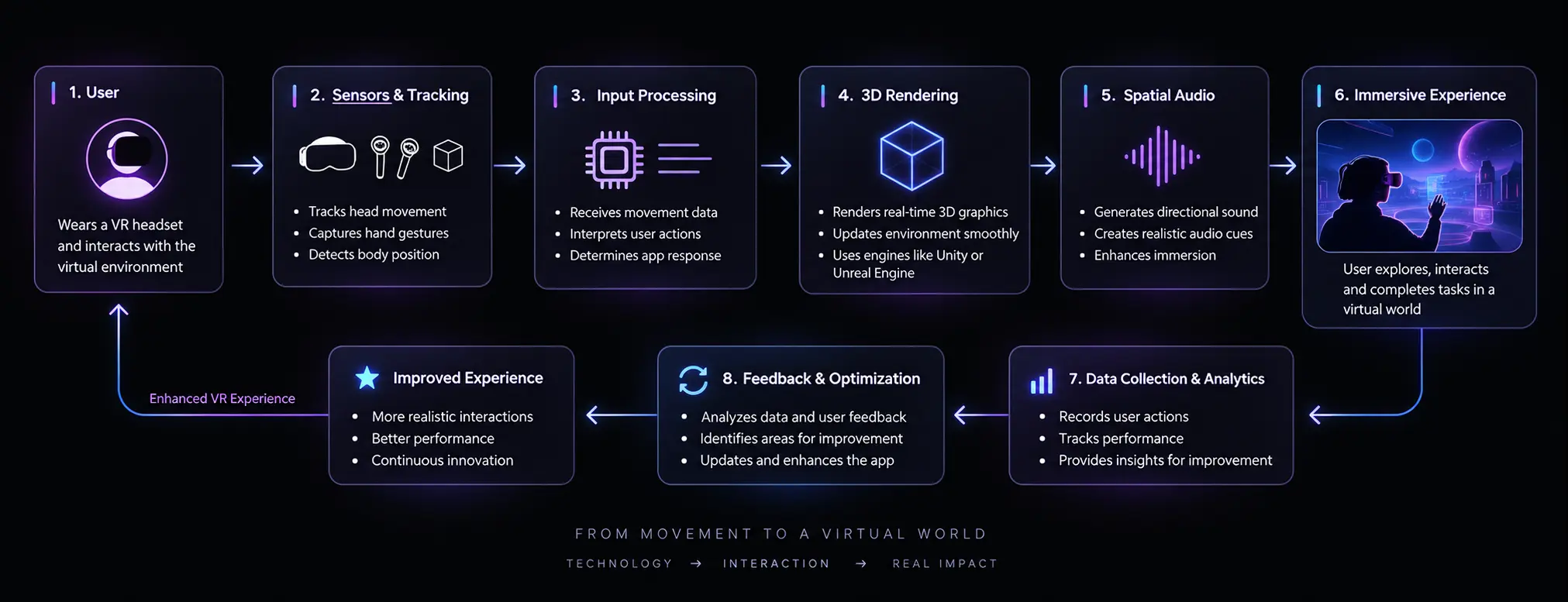
The VR headset is the primary device through which users experience the virtual world. It displays separate images to the user's eyes to create depth and a three-dimensional sense of space.
The headset also tracks the user's head position and orientation. When the user looks around, the virtual environment changes accordingly, creating a stronger sense of presence and immersion.
VR apps rely on sensors, cameras, or tracking systems to detect movement. Depending on the hardware, the system can track head rotation, hand position, controller movement, and other physical actions.
These movements are continuously sent to the application so that virtual objects and environments can respond accordingly. Accurate tracking is particularly important for enterprise applications where precise interaction may be required.
The VR application receives movement and interaction data from the headset and controllers, processes that information, and determines how the virtual environment should respond.
For example, when a user reaches toward a virtual object, the software interprets the controller or hand movement and triggers the corresponding interaction. This real-time processing is what makes VR experiences interactive rather than simply visual.
A VR application continuously renders 3D environments, objects, lighting, animations, and other visual elements. The rendering engine updates these elements according to the user's position and actions.
Technologies such as Unity and Unreal Engine are commonly used for VR app development because they provide tools for creating interactive 3D environments, physics, animations, and realistic visual experiences.
Sound plays an important role in creating a convincing virtual environment. Spatial audio can make sounds appear to come from particular directions or locations within the virtual space.
For example, a user may hear a virtual machine operating to their left or receive an audio instruction from a specific location. Combining visual and audio feedback can make training, simulations, and other professional VR experiences more engaging.
Once tracking, rendering, and audio work together, users can interact with the virtual environment. They may pick up objects, operate equipment, navigate spaces, complete tasks, or communicate with other participants depending on the application's purpose.
For enterprise VR app development, these interactions can replicate professional workflows such as equipment training, safety simulations, architectural walkthroughs, or collaborative design sessions.
Advanced VR applications can record information such as user actions, task completion, training performance, and interaction patterns. Businesses can use this information to evaluate experiences and improve the application over time.
The overall workflow can be summarized as:
User Movement → Sensors and Tracking → Software Processing → 3D Rendering → Interaction and Feedback → Data Collection
Together, these components allow a VR app to create responsive, immersive environments that can support entertainment, education, training, healthcare, enterprise collaboration, visualization, and other professional use cases.
The virtual reality (VR) market is expanding beyond consumer gaming into professional and enterprise applications such as healthcare, industrial training, education, retail, automotive, architecture, and remote collaboration. This broader adoption is creating new opportunities for businesses looking to invest in VR app development and specialized immersive solutions.
According to a report updated in August 2026 by Fortune Business Insights, the global augmented and virtual reality market is projected to grow from $40.76 billion in 2026 to $441.51 billion by 2034, representing a 34.69% CAGR. The report identifies applications across healthcare and medical training, manufacturing and industrial training, education, retail and ecommerce, automotive, defense, and other sectors.
This growth is particularly relevant for founders exploring VR app ideas for new businesses. The opportunity is increasingly moving toward solutions that address specific professional needs, where immersive simulation, visualization, training, and collaboration can offer measurable business value.
For an enterprise-focused VR company, this means the strongest opportunities may not come from competing directly in mainstream gaming. Instead, specialized enterprise VR applications can target industries where traditional processes are expensive, difficult to scale, risky, or limited by physical environments.
Why are businesses investing in VR app development beyond consumer gaming? For enterprise and professional applications, virtual reality can solve practical problems that are difficult, expensive, or risky to handle through traditional methods.
From immersive employee training to product visualization and customer experiences, a well-designed VR app can create measurable value while opening new opportunities for businesses entering the immersive technology market.
VR creates a stronger sense of presence than conventional 2D applications because users can look around, interact with virtual objects, and move through simulated environments. This makes experiences more interactive and memorable.
For businesses, higher engagement can be valuable for training, product demonstrations, education, simulations, and customer experiences. When users actively participate instead of simply viewing information, a VR application can make complex concepts easier to explore and understand.
VR gives brands a way to create marketing experiences that customers cannot easily replicate through conventional websites or videos. Businesses can use immersive product demonstrations, virtual showrooms, interactive experiences, and virtual events to present products in more engaging ways.
For an enterprise-focused VR app company, these experiences can also become specialized marketing solutions for industries such as automotive, real estate, retail, tourism, and manufacturing.
One of the strongest business cases for VR is immersive training. Employees can practice procedures, equipment operation, safety protocols, or professional scenarios inside controlled virtual environments without the costs or risks associated with real-world training.
This makes VR app development particularly valuable for healthcare, aviation, manufacturing, construction, logistics, defense, and other industries where practical experience matters. Training scenarios can also be repeated consistently, allowing organizations to standardize learning across teams and locations.
VR applications can allow businesses to deliver experiences to users who may not be able to access a physical location, training facility, event, or specialized equipment. Virtual environments can support remote product demonstrations, global training programs, virtual collaboration, and immersive educational experiences.
For a company exploring VR app ideas for new business, this creates opportunities to serve customers across different markets without depending entirely on physical infrastructure. Enterprise platforms can also connect geographically distributed teams within shared virtual environments.
Investing in VR applications can help a business demonstrate its ability to adopt emerging technology and create differentiated digital experiences. This can strengthen market positioning when immersive technology directly supports a business objective rather than being used simply as a novelty.
For a new enterprise VR venture, solving a specific industry problem through immersive technology can also create a stronger value proposition for potential customers, strategic partners, and investors.
These benefits make VR particularly compelling when the technology is connected to a clear business outcome such as better training, stronger engagement, improved visualization, remote collaboration, or differentiated customer experiences.

Which VR app ideas can create genuine business value beyond consumer gaming? For founders targeting enterprise and professional markets, the strongest opportunities are often applications that help companies train employees, visualize environments, test decisions, collaborate remotely, or reduce the cost and risk of physical processes.
For example, commercial real estate companies can use VR not merely to offer virtual property tours, but to let prospective tenants configure office layouts, test furniture arrangements, visualize branding, compare space plans, and make leasing decisions before construction or fit-out begins. Similar decision-focused applications can be developed across healthcare, manufacturing, education, retail, construction, sports, and other industries.
Below are 25 VR app ideas for new businesses, keeping the original concepts but repositioning them around stronger commercial and professional use cases.
A commercial VR real estate app can go far beyond static property walkthroughs. Buyers and tenants could explore office buildings, retail spaces, industrial facilities, or mixed-use developments remotely while interacting with floor plans and property data. A more advanced version can let prospective tenants configure workstations, partitions, furniture, lighting, branding, and room layouts in real time.
This helps property developers shorten decision cycles and gives tenants a practical way to understand how a space could work before signing a lease or starting construction.
A VR medical training app can provide realistic simulations for medical students, surgeons, nurses, technicians, and other healthcare professionals. Instead of practicing only through demonstrations or physical models, users can perform simulated procedures, respond to complications, and repeat scenarios without putting patients at risk.
Enterprise functionality could include instructor dashboards, performance scoring, standardized training modules, certification workflows, and analytics that help healthcare organizations measure employee readiness.
A professional VR tourism app can serve hotels, tourism boards, travel companies, and destination developers by offering immersive previews of destinations, resorts, attractions, and experiences. Users could explore hotel rooms, conference venues, cruise ships, or event locations before booking.
Businesses could also use the application for sales presentations, destination marketing, and remote customer engagement. The opportunity becomes more commercial when VR is connected directly with booking, lead generation, and travel planning workflows.
A VR fitness app can create immersive workout environments while providing structured training programs for gyms, fitness brands, sports organizations, and corporate wellness providers. Users could follow guided sessions, receive movement feedback, track performance, and participate in instructor-led classes.
An enterprise version could provide centralized dashboards for coaches and organizations, allowing them to manage programs, monitor participation, and deliver customized training experiences across distributed locations.
A VR escape room concept can evolve into a corporate problem-solving and team-building platform rather than remaining purely entertainment-focused. Companies could use virtual challenges to assess communication, leadership, decision-making, and collaboration skills.
Teams can work together inside simulated environments while administrators monitor completion times and performance. This creates an opportunity for VR app development companies to offer immersive employee engagement and corporate training solutions.
A VR language learning app can place learners inside realistic professional and everyday scenarios rather than relying only on vocabulary exercises. Employees could practice customer conversations, sales meetings, interviews, negotiations, or travel situations inside immersive environments.
Businesses could create industry-specific training modules for hospitality, healthcare, aviation, retail, and customer service. Performance tracking and conversational analytics can help organizations measure communication progress across large employee groups.
A VR shopping mall app can create immersive digital retail environments where customers explore stores, inspect products, interact with virtual assistants, and complete purchases. For brands and mall operators, the platform can become a digital merchandising and customer-experience channel.
Businesses could test store layouts virtually, introduce new product lines, run immersive campaigns, and understand how customers interact with virtual spaces before investing heavily in physical retail installations.
A VR cooking platform can support culinary schools, restaurant groups, food brands, and hospitality organizations with immersive training programs. Users can practice preparation techniques, kitchen workflows, food safety procedures, and equipment handling inside realistic simulations.
Enterprise customers could track learner progress, standardize training across locations, and deliver repeatable instruction without requiring every employee to attend an in-person training facility.
A VR mental health application can provide controlled environments for clinically supervised therapeutic experiences, relaxation programs, exposure-based interventions, or stress-management exercises. Businesses entering this area need to account for clinical validation, user safety, privacy, and applicable regulatory requirements.
Opportunities can exist in healthcare systems, therapy providers, employee wellness programs, and specialized behavioral health services where immersive environments can complement professional care.
A VR education and training platform can allow organizations to create interactive classrooms, laboratories, simulations, and practical learning environments. Schools, universities, corporate academies, and professional training providers can use virtual environments to teach subjects that are difficult to demonstrate physically.
Students and employees can interact with 3D models, perform simulated tasks, and practice procedures repeatedly. This makes the concept suitable for both education technology and enterprise learning solutions.
A VR museum platform can allow cultural institutions, galleries, universities, and tourism organizations to create immersive exhibitions accessible from anywhere. Beyond replicating a physical museum, businesses can design interactive exhibitions where visitors inspect high-detail digital artifacts, receive contextual information, and attend guided experiences.
For institutions, the commercial opportunity can include digital memberships, virtual events, educational programs, sponsorships, ticketed exhibitions, and broader access to collections that may otherwise be geographically restricted.
A dedicated VR employee training app can simulate realistic workplace scenarios such as equipment operation, safety procedures, customer interactions, emergency response, or leadership situations. Employees can practice tasks repeatedly in a controlled environment while managers monitor progress.
This idea has strong enterprise potential because organizations can standardize training across multiple locations and measure performance through completion rates, assessment scores, reaction times, and scenario outcomes.
A VR interior design app can help commercial tenants, architects, designers, and property developers visualize and modify spaces before committing to physical changes. Users could experiment with furniture, partitions, materials, lighting, branding, and room configurations inside a 3D environment.
For commercial real estate, this becomes especially valuable when tenants need to determine whether a proposed office or retail space can support their operational requirements before signing a lease or approving fit-out costs.
A VR events platform can help event organizers, venues, entertainment companies, and corporate event planners create immersive digital experiences. Attendees could virtually explore venues, interact with other participants, access different viewing areas, or attend events remotely.
Enterprise opportunities include virtual conferences, product launches, trade shows, training events, investor presentations, and hybrid experiences that extend the reach of physical events to remote audiences.
A VR sports training app can simulate game situations and help athletes practice decision-making, positioning, reaction, and strategy. Professional teams, academies, universities, and coaches can create repeatable scenarios based on specific plays or performance requirements.
The platform could combine movement tracking with performance analytics, allowing coaches to identify patterns and provide targeted feedback. This makes VR useful for both player development and organizational training programs.
A VR movie theater application can create immersive digital venues where users watch films, broadcasts, or live events in a shared virtual environment. A commercial version could support cinemas, streaming companies, content providers, and entertainment brands.
Instead of simply reproducing a traditional theater, the platform could offer branded spaces, premium virtual seating, social viewing, interactive experiences, and virtual event access, creating additional digital revenue opportunities.
A VR pet training concept can provide owners, trainers, veterinary organizations, and educational providers with simulated training environments. While the virtual environment cannot replace actual interaction with an animal, it can be used to teach owners how to respond to different situations and understand training techniques.
A professional platform could provide guided lessons, progress tracking, expert-created programs, and scenario-based education for new pet owners or training businesses.
A VR storytelling platform can transform conventional reading into interactive experiences where users explore environments, interact with characters, and move through narrative scenes. Publishers, educational companies, museums, and content creators could use the technology to develop immersive learning and storytelling products.
Enterprise opportunities can include branded educational content, digital publishing experiences, children's learning programs, and interactive corporate storytelling.
A VR fitness gaming platform can combine exercise with interactive gameplay to encourage regular physical activity. Users can participate in movement-based challenges, structured workouts, competitions, and skill-based activities while tracking performance.
Gyms, wellness providers, sports brands, and corporate wellness programs could use the platform to offer gamified exercise experiences, engagement programs, and performance dashboards instead of positioning the product solely as a consumer game.
A VR remote collaboration app can provide distributed teams with a shared three-dimensional workspace for meetings, brainstorming, design reviews, technical discussions, and presentations. Team members can interact with virtual whiteboards, 3D models, documents, and project environments.
This concept has strong enterprise potential for architecture, engineering, product design, manufacturing, consulting, and distributed corporate teams that regularly work with complex visual information.
A VR architecture and construction platform can allow developers, architects, engineers, contractors, and clients to explore projects before physical construction begins. Users can examine layouts, review building components, test design alternatives, identify spatial issues, and visualize different materials or configurations.
For commercial real estate, this can directly support stakeholder decision-making by allowing buyers and tenants to evaluate how a proposed space will function before committing capital to construction or leasing.
A VR fitness competition platform can organize virtual challenges across companies, fitness centers, sports communities, and professional organizations. Users could compete in standardized activities while the platform tracks scores, rankings, participation, and performance.
A business-focused version could support employee wellness competitions, sponsored fitness events, brand campaigns, and recurring virtual tournaments. This creates opportunities for subscription, sponsorship, and enterprise licensing models.
A VR disaster preparedness app can simulate emergencies such as fires, earthquakes, industrial accidents, evacuation events, or other critical scenarios. Employees can practice response procedures without exposing themselves to real-world danger.
Organizations can customize scenarios according to their facilities and operating environments. Performance reporting can also help safety teams identify weaknesses in employee response and improve emergency preparedness programs.
A VR wildlife platform can provide immersive educational experiences for museums, schools, conservation organizations, tourism businesses, and media companies. Users can explore natural habitats, observe animal behavior, and interact with educational content inside detailed virtual environments.
Beyond entertainment, the platform could support environmental education, conservation awareness, remote learning, visitor engagement, and sponsored educational experiences for institutions working with wildlife and environmental programs.
A VR MOBA app can bring competitive strategy gaming into an immersive three-dimensional environment where players interact with characters, environments, and other participants in real time. While this remains closer to the consumer gaming segment, it could also create opportunities for esports organizations, training platforms, branded competitions, and virtual event operators.
For founders specifically targeting enterprise markets, this concept should generally receive lower priority than professional applications with clearer operational or financial value.
Among these 25 VR app ideas, several stand out for businesses looking for defensible professional opportunities rather than another consumer gaming product. VR real estate configuration, architecture and construction visualization, employee training, medical simulation, remote collaboration, disaster preparedness, and professional sports training can solve specific problems where traditional methods may involve physical facilities, travel, expensive models, or operational risk.
For a commercial real estate company in particular, the strongest opportunity is not simply a VR property tour app. A more valuable product would let prospective tenants configure their future space, test layouts, compare scenarios, visualize fit-out options, and make leasing decisions inside an interactive virtual environment. That turns VR from a presentation tool into a decision-support platform.
Also Read: 115 Innovative Mobile App Ideas for New Business to Launch
After you finalized the features, now it's time to turn the VR concept into a technically feasible and commercially useful product. The right virtual reality application development process should connect business goals with the target audience, VR hardware, 3D environments, interaction design, technology architecture, and performance requirements.
For an enterprise-focused VR solution, the planning also needs to address how the application will fit into real business workflows. For example, a commercial property company may want prospective tenants to enter a virtual building, configure office layouts, compare design options, and review different space scenarios before committing to a lease. Such a product requires more than immersive visuals. It needs a structured roadmap covering validation, design, development, testing, deployment, and continuous improvement.
Below are the key steps to build a VR app from concept to launch.
Start by clearly defining why your business needs a VR application and what specific problem it should solve. Identify the target users, expected business outcome, core workflow, and measurable success criteria.
For an enterprise real estate solution, the objective could be helping prospective tenants visualize and configure commercial spaces before signing a lease. Users might compare floor layouts, move furniture, modify partitions, or review different workspace configurations.
This stage should also identify whether VR is genuinely better than conventional software, video, or 3D visualization. A clearly defined use case creates direction for the entire development process of VR app and prevents unnecessary functionality from increasing development effort.
Before building virtual reality app experiences, research how your target users currently solve the problem. Study competing products, customer expectations, hardware preferences, industry workflows, and gaps that your application could address.
For enterprise VR, speak with actual users such as property managers, architects, leasing teams, employees, trainers, or customers. Identify what decisions they need to make and what information they need inside the virtual environment.
Technical feasibility should also be assessed at this stage. Determine required devices, tracking capabilities, 3D assets, integrations, network requirements, and rendering demands. Early PoC development can validate difficult technical concepts before full investment.
The target hardware has a direct impact on interaction design, performance, development tools, and overall project scope. Decide whether your application will support standalone headsets, PC-connected VR systems, or multiple devices.
Consider factors such as tracking accuracy, controllers, display quality, processing capability, battery life, enterprise deployment requirements, and expected user environment.
For a commercial real estate application, you may need support for commonly used standalone headsets so property teams and prospective tenants can access the experience without complicated hardware setups. Defining the hardware target early makes it easier to develop virtual reality app functionality that performs consistently across the intended environment.
Next, map the complete user journey inside the virtual environment. Define how users enter the experience, move through spaces, interact with objects, access information, and complete important tasks.
For an interactive property application, the experience might begin with property selection, move into building navigation, and then provide tools for changing layouts, placing furniture, comparing configurations, or saving preferred designs.
A specialist UI/UX design company can translate these workflows into wireframes, interaction models, and prototypes adapted specifically for VR. The design should also consider comfort, accessibility, intuitive controls, visual hierarchy, and minimizing unnecessary movement.
Create a working prototype before committing to complete production. The prototype should focus on the most important VR interactions rather than trying to represent the entire final application.
For example, a commercial real estate prototype could include one virtual floor, basic navigation, movable furniture, configurable partitions, and a simple space comparison feature. Users can then test whether the experience feels intuitive and whether the concept actually helps them make decisions.
This stage is valuable because VR interactions can behave very differently from conventional mobile or web interfaces. MVP development can follow once the core experience has been validated and the most valuable functionality has been identified.
Also Read: Top 10 AI MVP Development Companies in USA
Once the concept is validated, full production can begin. Developers create the virtual environments, 3D assets, interactions, animations, spatial audio, navigation systems, user accounts, business workflows, and backend services required by the product.
Unity or Unreal Engine may be used depending on the visual requirements, target devices, and technical architecture.
For an enterprise property solution, development could include digital building models, configurable interiors, saved layouts, collaboration tools, and project-level data. During virtual reality application development, performance should be considered continuously because detailed environments and complex interactions can quickly increase processing requirements.
Enterprise VR applications often need to work with systems outside the virtual environment. Depending on the use case, integrations may include property databases, CRM systems, analytics platforms, user management, content systems, or other business software.
AI integration can add capabilities such as intelligent layout recommendations, space optimization, conversational assistance, or personalized suggestions where the use case supports it.
Testing should cover functionality, hardware compatibility, tracking, interaction accuracy, frame rate, usability, comfort, security, and data synchronization. Real users should test important workflows before launch to identify problems that technical testing alone may miss.
The final stage is deployment and ongoing optimization. Publish the application through the appropriate enterprise or consumer distribution channel, configure analytics, train internal teams, and establish support processes.
After launch, monitor application performance, user engagement, task completion, hardware issues, and feedback. For a commercial real estate VR product, useful metrics could include property sessions, configuration activity, saved layouts, comparison usage, and conversion from virtual experience to sales or leasing discussions.
Continuous updates can introduce new properties, environments, interaction capabilities, integrations, and performance improvements. This helps ensure the product continues to create business value as requirements evolve.
Following these steps to build VR app creates a clear path from business idea and technical validation to an immersive product that can solve real enterprise problems and support measurable outcomes.
Also Read: A Comprehensive Guide To Mobile Application Development
What should a business budget for VR app development when the product needs more than a simple immersive experience? The answer depends on the type of application, 3D complexity, target devices, interaction model, backend requirements, integrations, and level of realism. A basic VR experience can stay within a lower development range, while an enterprise solution with advanced simulations, high-quality 3D environments, multiplayer functionality, analytics, and AI can require a significantly larger investment.
For businesses planning the development budget of a virtual reality app, it is important to estimate the cost according to the actual scope. The cost estimation of VR app development should cover design, 3D asset creation, VR engineering, hardware compatibility, backend infrastructure, testing, deployment, and ongoing maintenance.
So, what is the development pricing of a VR app? A practical planning range is $50,000 to $400,000+, depending on complexity and business requirements.
| VR app type | Typical scope | Estimated cost |
| Basic VR App | Simple virtual tours, basic simulations, limited interaction, standard 3D environments, single-device support, and essential navigation | $50,000 to $90,000 |
| Advanced VR App | Interactive 3D environments, custom assets, complex interactions, analytics, multiple scenarios, cross-device support, and backend integrations | $90,000 to $200,000 |
| Enterprise VR App | High-fidelity simulations, large 3D environments, multiplayer or collaboration, enterprise integrations, advanced analytics, AI capabilities, and scalable architecture | $200,000 to $400,000+ |
For example, a commercial real estate VR platform that lets prospective tenants modify layouts, place furniture, compare configurations, and collaborate with leasing teams would generally require a larger budget than a basic property walkthrough because of its interactive 3D environment, configuration engine, data handling, and enterprise workflows.
1. VR App Complexity: $10,000 to $60,000+
The number of screens, scenarios, interactions, user roles, and business workflows directly affects development effort. A simple immersive experience costs less than a sophisticated enterprise application with multiple interactive environments.
2. 3D Design and Modeling: $10,000 to $80,000+
Detailed environments, realistic objects, animations, textures, lighting, and custom digital assets can become a major part of the budget. High-fidelity simulations require significantly more 3D production work than simple environments.
3. VR Hardware Support: $5,000 to $30,000+
Supporting one VR headset is generally simpler than creating a solution for multiple devices. Hardware compatibility, controller support, tracking behavior, testing, and device-specific optimization can increase the overall VR development cost.
4. User Experience and Interaction Design: $5,000 to $25,000+
VR requires interaction patterns that differ from standard mobile or web applications. Navigation, object manipulation, spatial interfaces, accessibility, user comfort, and motion considerations all contribute to design and development effort.
5. Backend and Cloud Infrastructure: $5,000 to $40,000+
Applications requiring user accounts, cloud storage, analytics, content management, real-time synchronization, or centralized administration need backend infrastructure. Enterprise applications may require additional scalability, monitoring, security, and data-management capabilities.
6. Real-Time Multiplayer and Collaboration: $15,000 to $70,000+
Multiplayer functionality adds networking, synchronization, user presence, voice communication, session management, and server infrastructure. Collaborative applications generally require considerably more engineering than single-user VR experiences.
7. AI Integration: $10,000 to $60,000+
AI can support virtual assistants, intelligent recommendations, scenario generation, predictive insights, or adaptive experiences. Costs vary depending on whether the project uses third-party AI APIs or requires custom models and supporting infrastructure.
8. Third-Party Integrations: $5,000 to $40,000+
Connecting the VR application with CRM, ERP, property management, learning systems, analytics, authentication, or other enterprise software can increase development effort. API complexity and the number of connected systems have a direct impact on cost.
9. Testing and Performance Optimization: $8,000 to $35,000+
VR applications need extensive testing for tracking accuracy, frame rate, loading performance, interaction behavior, hardware compatibility, and user comfort. Complex applications require more test scenarios across devices and environments.
10. Security and Enterprise Requirements: $5,000 to $30,000+
Enterprise deployments may require secure authentication, data protection, role-based access, encryption, audit capabilities, and compliance-related controls. These requirements add design, implementation, testing, and infrastructure costs.
11. Content Management and Updates: $5,000 to $25,000+
Applications that regularly introduce new properties, training scenarios, products, environments, or learning modules may require content management functionality. This allows business teams to update VR experiences without rebuilding the entire application.
12. Maintenance and Post-Launch Support: $2,000 to $15,000+ per month
VR applications require ongoing updates for operating systems, hardware compatibility, bug fixes, security, performance, content, and new device support. Enterprise products may also need continuous monitoring and technical support.
A focused VR experience may fit within the $50,000 to $90,000 range. An interactive application with custom 3D content, multiple workflows, integrations, and advanced functionality can move toward $90,000 to $200,000. Large enterprise VR platforms with sophisticated simulations, multiplayer capabilities, AI, extensive integrations, and scalable infrastructure can reach $200,000 to $400,000+.
The final virtual reality development cost should therefore be based on the experience you want to deliver, the business problem you are solving, and the technology required to support it rather than simply the number of screens or features.
A clearly defined scope, target hardware, 3D requirements, integrations, and long-term roadmap can make VR app cost estimation more accurate and help businesses allocate their development investment effectively.
From the ideas, use cases, development roadmap, and cost considerations discussed above, the next step is finding a technology partner that understands both immersive experiences and real business requirements. For an enterprise-focused VR venture, the right partner should be able to turn a concept into a practical product with strong interaction design, scalable engineering, 3D development, integrations, and measurable business value.
As PixelBrainy is renowned as a best mobile app development company, we approach VR projects with a product-first mindset. Our broader portfolio spans enterprise digital systems, real estate, healthcare, education, gaming, and other business domains, giving our teams experience working across different operational requirements.
Our virtual reality app development services can cover concept discovery, user journeys, immersive experience design, 3D environments, application engineering, backend development, integrations, testing, deployment, and post-launch improvements. For commercial real estate, for example, the product can be designed around tenant decision-making rather than a simple property walkthrough, with interactive layouts, configurable spaces, and scenario comparison.
PixelBrainy's available portfolio and project material does not currently document a specific completed VR client case study, so we would not invent project results or attribute an unrelated project to VR. What the available portfolio does demonstrate is experience delivering complex digital products across enterprise and industry-specific environments, with a focus on usability, performance, and scalable product development.
For businesses looking to build VR application products that solve specialized professional problems, PixelBrainy can support the technology roadmap from early validation through production. Where appropriate, we can also work on developing VR app solutions with connected AI capabilities, including intelligent recommendations, conversational interfaces, analytics, or workflow automation. Our AI practice explicitly covers AI product development and AI integration for web and mobile products.
The objective is to create immersive technology that is useful, scalable, and aligned with how customers or enterprise teams actually work.
Have a VR business idea? Connect with PixelBrainy and discuss your product with our experts.
Virtual Reality is moving beyond gaming and entertainment into practical business applications across real estate, healthcare, education, manufacturing, training, architecture, retail, and remote collaboration. As explored in this guide, the best VR app ideas are those that solve a specific problem and deliver measurable value rather than simply creating an immersive environment.
For businesses, successful virtual reality application development requires clear use cases, suitable hardware, intuitive interactions, high-quality 3D environments, reliable performance, and a scalable technical foundation. Enterprise-focused solutions can use VR to reduce training costs, improve decision-making, visualize complex spaces, and create experiences that are difficult to deliver through conventional software.
From an interactive commercial property configurator to a professional training simulator, the opportunities are broad. The right VR app development strategy can help turn an emerging technology into a practical product and sustainable business opportunity.
Ready to turn your VR concept into a market-ready application? Book an appointment with PixelBrainy today.
The strongest opportunities often come from solving specific professional problems rather than creating another gaming product. VR app ideas for commercial real estate, medical training, employee learning, construction visualization, industrial simulation, remote collaboration, and safety training can offer clearer business value and recurring enterprise revenue.
A commercial real estate VR solution can let buyers and tenants explore properties remotely and interact with spaces before visiting them physically. More advanced VR app development can allow tenants to configure layouts, place furniture, compare workspace scenarios, and visualize branding or fit-out options before signing a lease.
Yes. A VR application can connect with CRM, ERP, property management, learning management, analytics, authentication, and other business systems through APIs. The required integrations depend on the workflow, data structure, security requirements, and the information users need inside the virtual environment.
The cost to develop a VR app can range from approximately $50,000 to $400,000+. A basic immersive experience may require a smaller budget, while enterprise platforms involving custom 3D environments, advanced interactions, multiple devices, integrations, AI, analytics, or multiplayer functionality can require significantly more investment.
The right hardware depends on the application and target users. Businesses should evaluate standalone headsets, PC-connected devices, tracking requirements, controllers, processing capabilities, deployment environments, and cross-device compatibility. Supporting multiple devices can increase the virtual reality development cost, so hardware strategy should be defined early.
Yes. Virtual reality app development integrating AI can introduce intelligent features such as layout recommendations, conversational assistants, predictive analytics, adaptive training scenarios, content personalization, or automated decision support. AI should be selected according to a specific business requirement rather than added simply as a technology feature.
The timeline depends on the complexity of the experience, 3D assets, interaction model, hardware support, integrations, backend requirements, testing, and AI capabilities. A focused VR application can take several months, while a complex enterprise platform with multiple environments and systems may require a longer development cycle.
Look for experience with virtual reality app development, 3D environments, Unity or Unreal Engine, target VR devices, enterprise integrations, performance optimization, and immersive UX. For a professional VR project, also evaluate whether the development partner understands your industry workflow and can demonstrate how the proposed application will create measurable business value.

About The Author
Sagar Bhatnagar
Sagar Sahay Bhatnagar brings over a decade of IT industry experience to his role as Marketing Head at PixelBrainy. He's known for his knack in devising creative marketing strategies that boost brand visibility and market influence. Sagar's strategic thinking, coupled with his innovative vision and focus on results, sets him apart. His track record of successful campaigns proves his ability to utilize digital platforms effectively for impactful marketing efforts. With a genuine passion for both technology and marketing, Sagar continuously pushes PixelBrainy's marketing initiatives to greater success.

Working with the PixelBrainy team has been a highly positive experience. They understand the design requirements and create beautiful UX elements to meet the application needs. The dev team did an excellent job bringing my vision to life. We discussed usability and flow. Sagar worked with his team to design the database and begin coding. Working with Sagar was easy. He has the knowledge to create robust apps, including multi-language support, Google and Apple ID login options, Ad-enabled integrations, Stripe payment processing, and a Web Admin site for maintaining support data. I'm extremely satisfied with the services provided, the quality of the final product, and the professionalism of the entire process. I highly recommend them for Android and iOS Mobile Application Design and Development.

Great experience working with them. Had a lot of feedback and I found that unlike most contractors they were bugging me for updates instead of the other way around. They were extremely time conscience and great at communicating! All work was done extremely high quality and if not on time, early! They were always proactive when it comes to communication and the work is great/above par always. Very flexible and a great team to work with! Goes above and beyond to present us with multiple options and always provides quality. Amazing work per usual with Chitra. If you have UI/UX or branding design needs I recommend you go to them! Will likely work with them in the future as well, definitely recommended!

PixelBrainy is a joy to work with and is a great partner when thinking through branding, logo, and website layout. I appreciate that they spend time going into the "why" behind their decisions to help inform me and others about industry best practices and their expertise.

I hired them to design our software apps. Things I really like about them are excellent communication skills, they answer all project suggestions and collaborate right away, and their input on design and colors is amazing. This project was complex and needed patience and creativity. The team is amazing to do business with. I will be using them long-term. Glad to see there are some good people out there. I was afraid to try and outsource my project to someone but I am glad I met them! I really can't say enough. They went above and beyond on this project. I am very happy with everything they have done to make my business stand out from the competition.

It was great working with PixelBrainy and the team. They were very responsive and really owned the project. We'll definitely work with them again!

I recently worked with the PixelBrainy team on a project and I was blown away by their communication skills. They were prompt, clear, and articulate in all of our interactions. They listened and provided valuable feedback and suggestions to help make the project a success. They also kept me updated throughout the entire process, which made the experience stress-free and enjoyable.

PixelBrainy is very good at what it does. The team also presents themselves very professionally and takes care of their side of things very well. I could fully trust them taking up the design work in a timely and organised manner and their attention to detail saved us lots of effort and time. This particular project was quite intense and the team showed that they function very well under pressure. Very much looking forward to working with her again!

It's always an absolute pleasure working with them. They completed all of my requests quickly and followed every note I had for them to a T, which made our process go smoothly from start to finish. Everything was completed fast and following all of the guidelines. And I would recommend their services to anyone. If you need any design work done in the future, PixelBrainy should be your first call!

They took ownership of our requirements and designed and proposed multiple beautiful variants. The team is self-motivated, requires minimum supervision, committed to see-through designs with quality and delivering them on time. We would definitely love to work with PixelBrainy again when we have any requirements.

PixelBrainy was a big help with our SaaS application. We've been hard at work with a new UI/UX and they provided a lot of help with the designs. If you're looking for assistance with your website, software, or mobile application designs, PixelBrainy and the team is a great recommendation.

PixelBrainy designers are amazing. They are responsive, talented, and always willing to help craft the design until it matches your vision. I would recommend them and plan to continue them for my future projects and more!!!

They were awesome! Did a good job fast, and good communication. Will work with them again. Thank you

Creative, detail-oriented, and talented designers who take direction well and implement changes quickly and accurately. They consistently over-delivered for us.

PixelBrainy team is very talented and creative. Great designers and a pleasure to work with. PixelBrainy is an excellent communicator and I look forward to working with them again.

PixelBrainy has a very talented design team. Their work is excellent and they are very responsive. I enjoy working with them and hope to continue on all of our future projects.


Transform your ideas into reality with us.
Across these industries, each engagement brings unique challenges, from early-stage product development to scaling complex systems, helping us build a practical understanding of real-world product environments.