AI Summary Powered by PixelBrainy
What if the next stage of software growth is not doubling the engineering team, but multiplying the capability of the team you already have?
For a CTO at a growing B2B SaaS company, the question is becoming increasingly practical. Your six-person engineering team may be facing a roadmap that, at its current velocity, appears to require twelve engineers. Hiring is one option. Another is to rethink how the existing team researches, designs, codes, tests, reviews, and ships software with AI integrated into the development workflow.
This shift is already happening at scale. Gartner forecasts that 60% of organizations will adopt smaller software engineering teams at scale by 2029, compared with 15% in 2026, as AI handles more routine technical work and engineers spend more time on complex problem-solving and innovation. Gartner also expects the demand for software engineers to continue growing as organizations build more complex AI-enabled applications.
That does not mean six engineers automatically become twelve engineers through AI. It means the traditional relationship between headcount, engineering capacity, and software delivery speed is changing.
The most effective AI and human expertise software development model combines AI-assisted execution with experienced engineering judgment. AI can help developers generate implementation ideas, explore codebases, write tests, investigate bugs, document systems, and accelerate repetitive development work. Human experts remain responsible for architecture, product decisions, security, quality, business context, and production readiness.
DORA's latest 2026 research reinforces this distinction. Its research found that 90% of technology professionals use AI at work and more than 80% believe it has increased their productivity, while also finding that faster code generation can create additional verification and delivery challenges.
For CTOs and engineering leaders, the opportunity is therefore not simply to introduce an AI coding tool. It is to create a human guided AI software development workflow where technology increases useful engineering capacity without replacing the judgment that keeps software reliable.
That is the foundation of the emerging AI human collaboration software development model, and it is changing how businesses think about building, launching, and scaling software.

The AI + human expertise software development model is a modern approach to building software where AI supports the development lifecycle while experienced people remain responsible for product decisions, architecture, quality, security, and business outcomes.
It is not about asking AI to build an application independently. Instead, it creates a structured collaboration between human judgment and AI-assisted execution.
A traditional development workflow may look like:
Requirements → Design → Development → Testing → Review → Deployment
With AI integrated into the workflow, it becomes:
Business objective → Human planning → AI-assisted execution → Human review → Automated validation → Human approval → Deployment
The difference is not simply the addition of an AI tool. The difference is how responsibilities are distributed across the development process.
AI can assist engineering teams with activities such as:
This allows engineers to spend less time on repetitive execution and more time on complex technical and product decisions.
Experienced engineers and product leaders still determine:
The result is a human guided AI software development model:
Humans define the direction. AI accelerates execution. Humans validate the outcome.
For businesses, that distinction matters because faster software development is not about generating more code. It is about turning the right business requirements into reliable software with less unnecessary development friction.
Software development in 2026 is moving beyond the question of whether businesses should use AI. The more important question is how AI should work alongside experienced engineers to create measurable business value.
The strongest results are emerging where organizations combine AI capabilities with human judgment, redesigned workflows, strong engineering practices, and clear quality controls. Recent research from McKinsey found that only 25% of surveyed product and engineering leaders reported meaningful AI acceleration across their teams, while 30% reported that productivity had fallen. This shows that the advantage is not created by AI tools alone. It comes from how organizations redesign the development system around them.
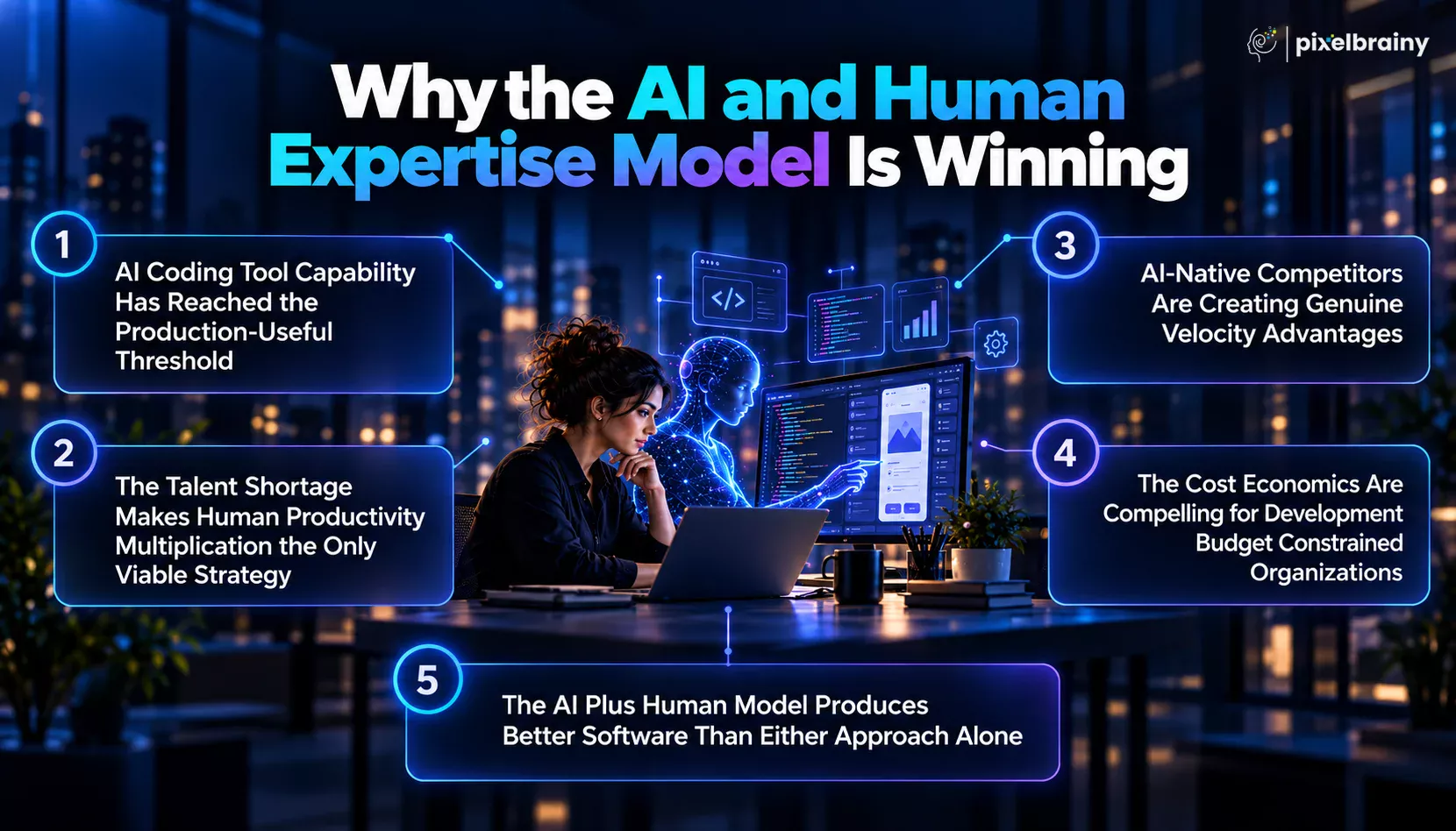
AI coding tools have progressed from simple autocomplete and code suggestions to capable development assistants that can work across implementation, testing, debugging, documentation, and codebase analysis. In 2026, research from Black Duck found that 92% of surveyed development teams reported improved productivity and release velocity from AI coding assistants, with developers saving an average of eight hours per week.
The important shift is that AI can now contribute to meaningful production workflows, not just experiments or prototypes. Engineers can delegate suitable implementation tasks while retaining responsibility for architecture, review, testing, and final decisions. This makes AI more valuable as part of an established engineering process.
Businesses need more software, while engineering organizations continue to face pressure around talent, cost, and delivery capacity. Simply increasing headcount is not always practical or fast enough to meet growing product demands.
Gartner predicts that 60% of organizations will adopt smaller software engineering teams at scale by 2029, up from 15% in 2026. Gartner describes these smaller teams as a restructuring around human and AI capabilities rather than simply a cost-cutting exercise.
This creates a new opportunity for experienced engineers: instead of increasing team size for every increase in product scope, businesses can increase the productive capacity of existing teams through AI-assisted workflows.
The competitive advantage is shifting from simply having access to AI tools to knowing how to integrate them across the development lifecycle. Businesses that redesign requirements, coding, testing, review, and deployment around AI can shorten feedback loops and move ideas toward production faster.
Deloitte's 2026 research reports 30% to 35% productivity gains across the software development lifecycle and says new product development cycles can compress by up to 50% in AI-native environments. These figures represent research findings, not guaranteed results for every organization.
The implication for businesses is significant: development velocity can increasingly become an organizational capability rather than simply a function of team size.
Software development costs are influenced by engineering hours, project duration, rework, testing, maintenance, and the cost of delays. AI can reduce effort across several of these areas by assisting with repetitive implementation, testing, debugging, documentation, and code analysis.
Capgemini's 2026 engineering research found that 78% of organizations report rising engineering costs, while more than 75% of executives expect AI to deliver 20% to 50% improvements in areas including productivity, time to market, and cost reduction.
The business opportunity is therefore not simply reducing developer headcount. It is using AI to increase the amount of valuable software an engineering budget can produce while keeping experienced people focused on higher-value decisions.
AI brings speed, scale, and assistance across repetitive and information-heavy tasks. Human experts bring product understanding, architecture, judgment, security awareness, and accountability.
Neither works optimally when treated as a complete replacement for the other.
DORA's research describes AI as an amplifier: strong engineering organizations can use it to increase their strengths, while weak processes can cause AI to accelerate existing problems and technical debt.
The emerging advantage therefore comes from combining AI execution with human expertise and disciplined engineering practices.
The winning model in 2026 is not AI replacing engineering teams. It is engineering teams becoming more capable because AI is built into how they work.
AI can increase the speed at which software is produced, but production software is more than generated code. It operates within business processes, security requirements, technical architectures, customer expectations, third-party dependencies, and real-world failure conditions.
That is why AI and human expertise software development works best as a collaborative model. AI can accelerate execution, while experienced engineers provide the context, judgment, and accountability required to turn that output into dependable software.
For engineering leaders evaluating team structures, AI adoption, or development partners, the key question is not whether AI can perform more engineering tasks. It is which decisions still require experienced human ownership.
AI can suggest architectures, generate implementation patterns, and compare technical approaches.
Senior engineers need to evaluate scalability, reliability, performance, maintainability, infrastructure, data flows, and future product requirements.
This becomes especially important when AI-generated code introduces shortcuts that work today but create architectural constraints later.
Effective AI and senior developer collaboration software therefore keeps major architectural decisions human-led while using AI to accelerate research, prototyping, and implementation.
AI can identify common vulnerabilities, suggest secure coding practices, and assist with security reviews.
However, security depends heavily on system context and business risk. Engineers must understand authentication models, data sensitivity, access boundaries, regulatory requirements, attack surfaces, and infrastructure dependencies.
They also need to determine how different threats could affect the specific business.
Human guided AI software development treats AI security analysis as an additional control, not the final authority.
A software system can be technically correct and still solve the wrong problem.
AI can transform written requirements into code, but requirements often contain assumptions, exceptions, priorities, and business rules that require domain knowledge.
A senior engineer or product expert can recognize when a requirement is ambiguous or when two business rules conflict.
This is where AI coding assistance with human expertise creates meaningful value. AI accelerates implementation, while people translate business intent into precise technical behavior and validate whether the resulting software actually supports business objectives.
When software fails in production, the problem is rarely isolated to one line of code.
Engineers may need to correlate logs, infrastructure behavior, database activity, deployments, customer actions, third-party services, and historical incidents.
AI can analyze logs, identify patterns, summarize error traces, and suggest possible causes.
Human engineers still need to determine which hypothesis is credible and which remediation is safe.
Production incidents also require prioritization and judgment because the fastest technical fix is not always the safest business decision.
Modern software depends on payment platforms, cloud services, CRMs, identity providers, analytics systems, APIs, databases, and other external services.
AI can help developers understand documentation and generate integration code.
Real integrations often involve undocumented behavior, version differences, rate limits, authentication problems, legacy constraints, and unusual failure conditions.
Experienced engineers know how to investigate these situations and design appropriate fallbacks.
This is where how AI tools and human domain expertise produce better software faster than either alone becomes particularly relevant.
AI can generate code and increasingly assist with code review, but reviewing software is more than checking whether the syntax works.
Engineers need to evaluate readability, maintainability, architecture, security, performance, business logic, testing coverage, and potential technical debt.
GitHub reported in March 2026 that Copilot code review had surpassed 60 million reviews, demonstrating how AI-assisted review is becoming part of modern development workflows. Yet AI review works alongside deterministic checks and human engineering judgment rather than replacing them.
Software development involves decisions that cannot be resolved through code alone.
Engineering leaders need to communicate trade-offs with founders, product teams, customers, designers, security teams, and business stakeholders.
They must explain why a feature should be delayed, why an architecture should change, or why a particular shortcut could create future risk.
AI can prepare analysis and documentation, but leadership requires context, negotiation, accountability, and trust.
This is why AI should increase the leverage of experienced engineers rather than eliminate the human leadership layer.
For leaders deciding between hiring, restructuring teams, or adopting AI-assisted development, the practical question is not simply:
"How much coding can AI do?"
It is:
"Which work can AI safely accelerate, and which decisions require experienced human ownership?"
That distinction also matters when evaluating development partners. Businesses should look for teams that use AI to increase engineering capacity while maintaining clear ownership of architecture, security, quality, and technical outcomes.
The strongest AI-assisted development model does not remove human expertise. It gives experienced people more leverage while keeping critical decisions under accountable human control.
Before changing a development engagement, increasing headcount, or setting an aggressive product deadline, business leaders need a practical answer to a difficult question: where does AI actually reduce software development time and cost, and where does it simply move the work somewhere else?
Consider a product team with a roadmap that its engineering team estimates will take nine months. The CEO believes AI coding tools should make the same roadmap possible in four months. That expectation is understandable, but the answer depends on what makes up those nine months.
If a large portion of the timeline consists of repetitive implementation, testing, documentation, standard integrations, and straightforward debugging, AI can meaningfully reduce engineering effort. If the timeline is dominated by architecture, complex business requirements, dependencies, security, integration risk, or product uncertainty, the impact can be considerably smaller.
This is also why AI and human expertise software development cost savings and timeline comparison should focus on specific activities rather than a single productivity multiplier.
A significant amount of development work involves predictable implementation patterns such as API endpoints, CRUD operations, configuration, database models, UI components, validation logic, and project scaffolding.
AI can generate initial implementations from clearly defined requirements, allowing developers to start with a working structure instead of writing repetitive code from scratch.
The developer still reviews the output, adapts it to the application's architecture, and validates the behavior.
For teams asking, "How can AI and developers make software development faster?", this is one of the clearest answers. AI reduces mechanical implementation work while experienced developers remain responsible for the final solution.
Testing is essential, but creating large numbers of repetitive test cases can consume considerable engineering capacity.
AI can generate initial unit tests, integration tests, edge cases, and test data from specifications or existing implementation.
Developers then review whether those tests represent the actual business requirements and add scenarios that require deeper domain understanding.
This creates a faster feedback loop because testing can happen alongside implementation rather than becoming a separate phase.
For a CTO asking, "What realistic productivity multipliers do AI coding tools actually deliver for experienced engineers versus marketing claims?", test generation is a useful example of a task-specific gain that can be measured independently rather than assuming one universal multiplier across the entire development lifecycle.
Documentation is another area where AI can reduce repetitive engineering effort.
AI can generate first drafts of API documentation, technical explanations, setup instructions, release notes, code summaries, and internal documentation based on existing project information.
Developers can then verify and refine the output.
This becomes particularly valuable for growing software products where documentation needs to evolve alongside the codebase.
The business benefit is not simply fewer hours spent writing documents. Better documentation can also reduce the time engineers spend understanding existing systems, onboarding team members, and answering repetitive technical questions.
AI can help identify duplicated logic, repetitive patterns, outdated implementations, and potential refactoring opportunities.
It can then generate proposed changes that developers can review and test.
This can make certain technical debt reduction activities less expensive than performing the same mechanical work manually.
However, this is an area where human expertise remains important. Refactoring working software can introduce unexpected behavior, affect system dependencies, or create architectural problems.
Therefore, faster software development with AI and developers does not mean allowing AI to restructure production systems without oversight. The better approach is AI-assisted refactoring followed by human review, automated testing, and controlled deployment.
Businesses frequently need AI integration alongside integrations with payment providers, authentication platforms, analytics tools, cloud services, communication platforms, CRMs, and standard APIs.
AI can accelerate the initial implementation by interpreting documentation, generating client code, creating data models, and producing common request and response handling.
This can reduce the amount of repetitive integration work engineers need to perform manually and make AI integration more efficient across different software systems.
But integration complexity varies significantly. Authentication, rate limits, API version differences, failure handling, data synchronization, and business-specific rules still require experienced engineering judgment.
This is where building software faster with AI and human expertise becomes practical: AI accelerates the implementation while engineers handle the complexity surrounding it.
Debugging can involve several repetitive information-gathering activities before an engineer reaches the underlying problem.
AI can analyze stack traces, logs, failing tests, error messages, and relevant code paths. It can suggest possible causes, generate reproduction steps, and propose implementation changes.
Developers can then test those hypotheses and determine whether the proposed fix addresses the actual root cause.
For businesses asking, "Where does AI genuinely compress software development timelines and cost versus where human expertise remains irreplaceable?", debugging provides a clear example.
AI can compress investigation and implementation time. Human engineers remain responsible for diagnosis, risk assessment, and production validation.
If a roadmap is estimated at nine months, AI should not automatically be treated as a reason to promise delivery in four months.
Instead, break the roadmap into activities and ask:
That gives businesses a more realistic framework for evaluating how AI and human expertise reduce software development timeline from months to weeks.
The goal is not to claim that AI makes every engineer 2x or 5x faster.
The goal is to identify where AI creates measurable leverage across the development lifecycle and then combine that leverage with experienced engineering.
The most credible AI productivity strategy is not a blanket multiplier. It is a task-by-task reduction in development friction that adds up to faster, more efficient software delivery.
Building software faster with AI does not begin by choosing an AI coding tool. It begins by changing how the business approaches product development. The most effective AI powered software development with human expertise combines clear business objectives, AI-assisted execution, experienced engineering judgment, and continuous validation.
For CTOs and engineering leaders, the goal is not simply to increase the amount of code produced. It is to shorten the distance between a business requirement and reliable software in production. A practical AI human hybrid software development approach can achieve this by assigning AI and people the work each is best positioned to perform.
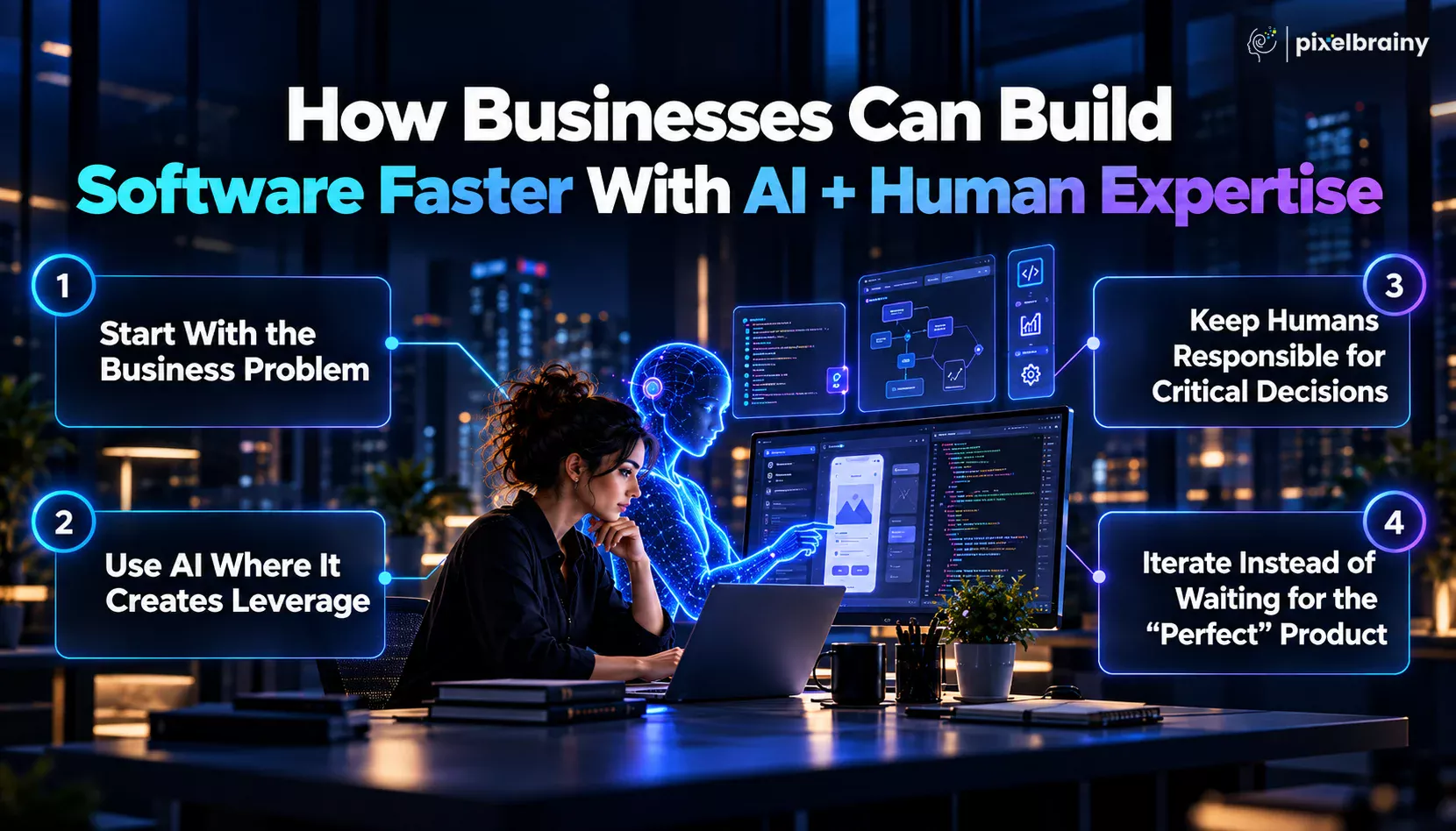
The first step is to define the business problem before deciding what technology to use. Teams should identify the target users, customer pain point, expected business outcome, constraints, and measurable success criteria.
This prevents AI from accelerating development of features that do not create meaningful value. It also creates clearer inputs for engineers and AI systems during implementation.
For an early-stage product, this could mean validating a concept through PoC development before committing significant engineering resources. For an established business, it could mean identifying which existing workflow should be improved or automated.
The principle is simple: define the outcome before optimizing the development process.
AI should be applied to development activities where it can reduce repetitive effort, accelerate research, or shorten feedback cycles.
Depending on the project, this can include code generation, test creation, documentation, debugging, codebase analysis, prototyping, and AI integration across existing workflows.
Businesses evaluating top AI development companies should therefore ask how AI is incorporated into the actual engineering process rather than simply asking which AI tools are being used.
The objective is to create measurable engineering leverage while allowing developers to focus on architecture, complex problem-solving, product decisions, and quality.
AI can generate technically plausible output without fully understanding a company's customers, architecture, security requirements, operational constraints, or long-term product strategy.
This explains why AI alone cannot replace human expertise in production software development.
Senior engineers should remain responsible for architecture, security, technical trade-offs, business logic, code review, production readiness, and risk assessment.
Businesses seeking AI consultation should evaluate whether their development approach clearly defines these human responsibilities.
The strongest human AI software development collaboration model gives AI greater execution capability while keeping critical technical and business decisions under experienced human ownership.
Also Read: Top 10 AI Consulting Companies in USA
AI can make it easier to move from an idea to an initial working version, but faster development is most valuable when it creates faster learning.
Businesses can release a focused MVP development version, collect customer feedback, measure adoption, identify gaps, and continuously improve the product.
This approach is particularly relevant to AI product development companies and teams building new digital products because product assumptions can be tested before significant resources are committed.
A structured AI human software development collaboration model for CTOs and engineering leaders enables teams to move through this cycle faster while maintaining engineering discipline.
For organizations evaluating AI development companies or considering whether to hire AI developers, the priority should be a development partner that can combine AI-assisted execution with experienced engineering, product thinking, and quality controls.
The objective is not to build everything faster. It is to learn, validate, and deliver valuable software faster without sacrificing the engineering discipline required for production.
For CTOs, technical founders, and technology executives, the real question is not whether AI makes software development faster. It is how much cost and time can realistically be removed from a project, and which parts of development remain dependent on human expertise.
The answer varies by project. AI delivers the strongest financial and timeline benefits when requirements are clear, architecture is established, and a large portion of implementation follows repeatable engineering patterns. The following ranges should therefore be used as practical planning benchmarks for suitable projects, not guaranteed outcomes.
For well-defined projects with senior engineers establishing the architecture before AI-assisted implementation begins, an approximately 30% to 50% reduction in development cost can be a reasonable planning range.
The savings primarily come from:
Consider a B2B SaaS project with a traditional development budget of $200,000. A 30% to 50% reduction in the AI-acceleratable portion could represent approximately $60,000 to $100,000 in potential development-effort savings, producing a planning range of roughly $100,000 to $140,000.
This does not mean the entire project automatically costs 30% to 50% less. Architecture, product strategy, security reviews, complex integrations, stakeholder decisions, and novel production failures can remain largely human-intensive.
The same principle applies to delivery timelines.
| Project type | Potential timeline reduction |
|---|---|
| Standard feature development for well-architected B2B SaaS | 40% to 60% |
| New product development with clean architecture | 30% to 50% |
| Enterprise system integration | 20% to 35% |
| Healthcare and financial services | 15% to 30% |
These are planning ranges rather than guarantees. A nine-month roadmap, for example, should not automatically be promised in four months simply because AI coding tools are available. The realistic question is how much of those nine months consists of work that AI can actually compress.
AI augmented software development performs best when projects have clear specifications, clean architecture, standardized technology stacks, repeatable implementation patterns, automated testing, and experienced engineers who can define precise tasks and evaluate AI output quickly.
Greenfield development can also benefit significantly when senior engineers establish the architectural framework before AI-assisted coding begins.
AI has less impact when software depends on undocumented legacy systems, complex integrations, novel domain requirements, extensive regulatory approval, strict security controls, or unclear requirements.
These conditions require investigation, judgment, stakeholder coordination, and validation that cannot simply be replaced with faster code generation.
| Factor | Traditional development | AI-only development | AI + human expertise |
|---|---|---|---|
| Cost per equivalent feature | Higher baseline | Lower initial effort, unpredictable total cost | Lower for suitable work |
| Timeline | Longer baseline | Potentially fast initially | Faster with controlled execution |
| Technical debt | Depends on engineering quality | Higher risk | Controlled through architecture and review |
| Security | Human-led | Higher oversight risk | Human-led with AI assistance |
| Production bugs | Depends on QA | Higher risk without strong validation | Controlled through testing and review |
| Maintainability | Depends on architecture | Higher risk | Human-led architecture and governance |
This is why AI and human expertise software development should be evaluated through actual project economics rather than headline productivity claims.
The strongest model does not make every part of software development cheaper. It makes the right parts faster and less expensive while preserving human ownership where quality, security, and long-term maintainability matter most.
Building an AI human hybrid software development team is not simply a matter of giving every developer access to an AI coding assistant. The real advantage comes from defining clear responsibilities between AI systems and experienced engineering roles.
For CTOs asking how to build a software development team that combines AI tools with senior engineering expertise, the objective should be to increase engineering capacity without weakening architecture, security, testing, or accountability.
A practical model gives AI more responsibility for execution while experienced engineers remain responsible for direction, review, quality, and production decisions.
The senior engineer becomes the person who determines where AI should be used and where human engineering should lead.
Instead of manually performing every implementation task, the senior engineer breaks requirements into well-defined tasks, provides AI with the required context, evaluates generated output, and determines whether the result meets the technical and business requirements.
This role is critical because AI performs best when the problem is clearly defined.
The senior engineer therefore acts as the bridge between business requirements, technical architecture, and AI-assisted execution.
This is a central principle of AI and senior developer collaboration software.
The technical architect establishes the framework within which AI-assisted development operates.
Before significant implementation begins, the architect defines system boundaries, technology choices, data flows, integration patterns, scalability requirements, coding standards, and architectural constraints.
AI can then accelerate implementation within those boundaries.
The architect also acts as a quality gate by reviewing significant architectural changes and identifying patterns that could create long-term technical debt.
This creates an AI enhanced engineering team software development model where AI accelerates implementation without becoming the authority responsible for system architecture.
Security should not become an afterthought simply because AI makes development faster.
A security engineer or qualified security specialist should define security requirements, threat models, authentication and authorization standards, data protection requirements, and security validation processes.
AI can assist with vulnerability analysis, secure coding suggestions, dependency analysis, and security testing.
However, critical security decisions should remain under qualified human ownership.
This is especially important for enterprise, healthcare, financial, and other security-sensitive applications where compliance and risk requirements can significantly influence architecture and delivery.
AI can dramatically accelerate test creation, but generating tests is not the same as creating an effective testing strategy.
The QA engineer should determine what needs to be tested, which risks require priority, which scenarios need automation, and what quality gates must be satisfied before deployment.
AI can assist with generating unit tests, test data, regression scenarios, edge cases, and test documentation.
The QA engineer validates whether those tests actually represent expected product behavior.
This is one of the best practices for combining AI code generation with human code review for production software: AI can increase test volume and speed, while human QA expertise determines whether the testing is meaningful.
A mature AI and developer collaboration for faster software workflow can follow a structured sequence:
1. Product team defines the business outcome
Requirements, priorities, acceptance criteria, and user needs are established.
2. Technical architect defines the framework
Architecture, technology choices, system boundaries, and technical constraints are established.
3. Senior engineer decomposes the work
Large requirements are converted into specific implementation tasks suitable for AI-assisted execution.
4. AI assists with implementation
Developers use AI for coding, testing, documentation, debugging, and other appropriate tasks.
5. Senior engineers review the output
Generated code is evaluated for correctness, maintainability, business logic, and architectural consistency.
6. QA validates behavior
Automated and manual testing confirms that the implementation satisfies requirements.
7. Security validates critical risks
Security-sensitive changes receive appropriate human review and testing.
8. Technical leadership approves production release
Only validated changes move into production.
This structure directly addresses the concern many CTOs have when evaluating AI-assisted development: how can teams increase velocity without allowing AI-generated code to increase technical debt or reduce quality?
The answer is not to restrict AI to trivial tasks. It is to create a workflow where AI increases execution capacity while experienced engineers control the decisions and quality gates that determine production readiness.
For an enterprise software company trying to close a velocity gap, this can mean changing more than the development toolset. Requirements need to become more precise, work needs to be broken into smaller units, architecture needs to be clearly documented, testing needs to become increasingly automated, and engineers need to learn how to direct and review AI effectively.
The goal of an AI-enhanced engineering team is not fewer engineering responsibilities. It is more engineering capacity per experienced developer, with human accountability remaining at every critical stage.
The most useful way to understand AI and human expertise software development is to look at how the model changes actual delivery workflows. The examples below illustrate realistic business scenarios rather than claiming that every project will achieve the same results.
In each case, the important factor is not simply the AI tool being used. It is the way experienced engineers reorganize planning, implementation, testing, review, and deployment around AI.
Imagine a B2B SaaS company with a feature roadmap that its six-person engineering team estimates will take nine months. The CEO believes AI coding tools should reduce that timeline to four months.
The right response is not to promise four months immediately.
The team first breaks the roadmap into individual workstreams and identifies which activities are implementation-heavy and which require architecture, product decisions, integrations, security, or customer validation.
AI can then assist with standard API development, frontend components, database operations, test generation, documentation, and repetitive implementation.
Senior engineers remain responsible for architecture, business logic, code review, and production validation.
This is how how businesses are building SaaS software faster with AI and human engineering collaboration actually works. The team does not assume that every task becomes dramatically faster. It identifies where AI can compress specific activities and measures the effect across the complete delivery cycle.
The result can be a shorter roadmap, but the exact timeline depends on the project's complexity, existing architecture, and quality requirements.
Also Read: AI SaaS Website Platform Development: From Concept to Scalable Product
Healthcare software demonstrates why AI should not be confused with unrestricted automation.
Consider a healthcare software company integrating its platform with an external clinical system. AI can help engineers understand API documentation, generate integration code, create test cases, identify potential implementation issues, and produce technical documentation.
However, human specialists remain responsible for data handling, authentication, access controls, audit requirements, privacy considerations, and regulatory compliance.
The development team can therefore use AI to accelerate implementation while keeping sensitive decisions under qualified human review.
This represents a practical AI human collaboration model for software development in startups and enterprises because AI is used where it creates execution leverage, while regulatory and security responsibilities remain human-led.
Also Read: Top 12 AI Healthcare Software Development Companies in USA
Consider a software project that has accumulated technical debt after several years of rapid development. Features take longer to release, defects are increasing, and developers struggle to understand dependencies across the codebase.
Simply adding AI-generated code would not solve the problem.
The first step is human-led architecture analysis. Senior engineers identify system boundaries, dependency problems, duplicated functionality, performance bottlenecks, and areas that require modernization.
AI can then assist with codebase exploration, documentation, dependency analysis, test generation, refactoring proposals, and migration implementation.
Engineers validate each significant change before it moves forward.
This approach demonstrates an important principle: building software faster with AI and human expertise sometimes means first fixing the system that is slowing development down.
AI accelerates the re-engineering work, but experienced engineers determine what the architecture should become.
A five-person engineering team should not assume that AI automatically gives it the output of fifteen engineers.
However, a well-organized team can potentially increase its effective development capacity by redesigning how work is distributed.
For example, a senior engineer can establish architecture and break requirements into clearly defined tasks. AI can assist with implementation, testing, documentation, debugging, and codebase research. A QA engineer can use AI to expand test coverage while maintaining responsibility for the overall test strategy.
Instead of every engineer spending significant time on repetitive execution, experienced team members can focus more heavily on architecture, review, product decisions, and complex problems.
This is the practical answer to how AI and human expertise reduce software development timeline from months to weeks in 2026. The objective is not to claim that five people literally replace fifteen people. The objective is to increase the amount of valuable work a smaller, experienced team can complete.
When evaluating an AI-native development company, the important question is not simply "Which AI tools do you use?"
Ask what has changed in the workflow.
Leading AI-assisted teams typically focus on:
That distinction answers another important question: what specific development workflow changes create a velocity advantage?
The advantage comes from connecting AI to a disciplined engineering system, not from treating AI as an autonomous developer.
The strongest examples of AI-assisted development are therefore not stories about AI replacing teams. They are stories about experienced teams using AI to remove friction, shorten feedback loops, and spend more of their time on work that requires genuine engineering judgment.
The phrase AI software development is now common across development agencies, technology consultancies, and software companies. But saying that a team uses AI does not necessarily mean AI is meaningfully improving how software is planned, built, tested, and delivered.
For CTOs, founders, and technology leaders, the important question is what actually changes when AI becomes part of the development workflow. A genuinely AI-assisted team should be able to show where AI reduces repetitive engineering effort, how experienced developers validate its output, and how the overall process improves delivery without weakening quality, security, or maintainability.
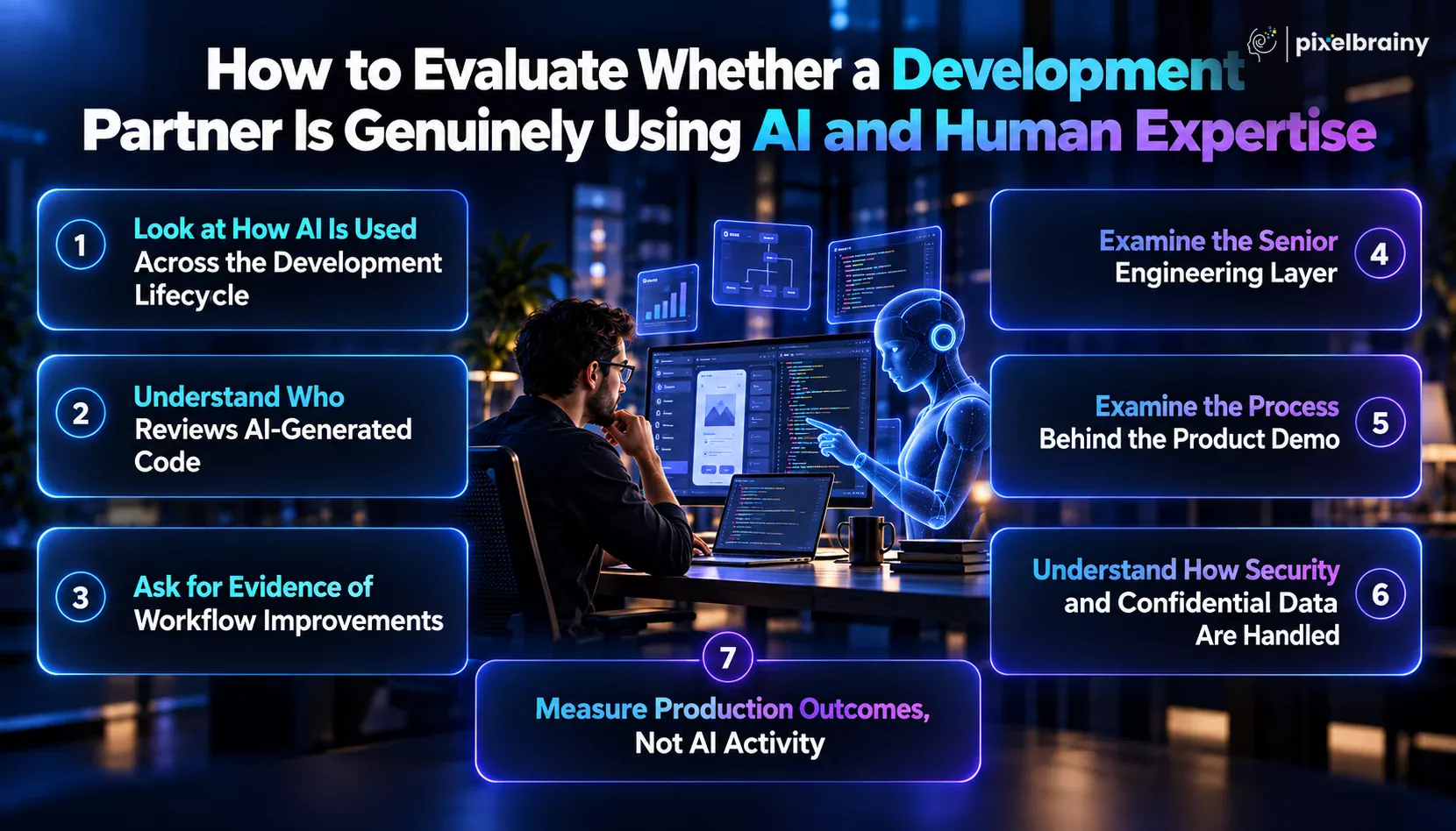
AI should not be limited to generating code.
A mature AI assisted software development workflow can use AI for requirements analysis, technical research, code generation, test creation, debugging, documentation, codebase exploration, and repetitive engineering tasks.
Ask the team to explain where AI fits into its actual workflow. More importantly, ask where AI is deliberately not used.
Architecture decisions, sensitive business logic, security controls, production approvals, and complex technical trade-offs may require experienced human ownership. A development partner should be able to explain that distinction clearly.
AI can generate an implementation quickly, but generated code still needs engineering judgment.
A strong AI and human expertise software development process includes experienced developers who review AI-assisted implementation before it reaches production. This review should consider correctness, security, maintainability, performance, business requirements, and potential technical debt.
Useful questions include:
The answers provide a much clearer picture of engineering maturity than simply knowing which AI coding tool the team uses.
A development partner should be able to explain how AI has changed the way its engineers work.
For example, does AI reduce repetitive implementation work? Does it help developers understand unfamiliar codebases? Can engineers generate and maintain tests more efficiently? Has documentation become easier to produce? Are senior developers spending more time on architecture and complex problem-solving?
The strongest evidence is not a generic claim such as "our developers are 50% faster."
Instead, look for measurable workflow improvements such as shorter implementation cycles, faster debugging, broader test coverage, reduced repetitive engineering effort, or quicker movement from approved requirements to production.
The presence of AI makes experienced engineering judgment more important, not less.
A development partner should clearly identify who owns architecture, technical decisions, security, integrations, deployment, production incidents, and long-term maintainability.
This matters because AI can produce technically valid code that is still unsuitable for a particular product. An experienced engineer needs to determine whether the implementation fits the architecture, business requirements, existing systems, and future roadmap.
A strong AI human software development collaboration model therefore combines AI-assisted execution with clear human accountability.
A fast AI-generated prototype can look impressive. Production software requires considerably more than a working demonstration.
Ask the development team to walk through its process from business requirements to deployment.
A mature workflow should look something like:
Business requirements → Architecture → AI-assisted implementation → Testing → Human review → Security validation → Deployment → Monitoring
This helps distinguish genuine AI powered software development with human expertise from a workflow that focuses primarily on generating code quickly.
AI adoption also requires clear rules around data.
Businesses should understand which AI systems developers use, what information can be submitted to those systems, how source code is protected, and how confidential customer or business information is handled.
For companies working with sensitive data or regulated systems, these controls should be part of the development workflow from the beginning.
A capable AI development partner should be able to explain its approach to AI usage, access controls, code confidentiality, security reviews, and production data without relying on vague assurances.
The most useful evaluation is ultimately based on what happens after the software is delivered.
Relevant measures can include:
These metrics provide a more meaningful view of AI developer productivity than the amount of code an AI system generates.
The objective is not to find a team that uses the most AI. It is to understand whether AI is being used in the right parts of the workflow while experienced engineers remain accountable for the decisions that affect software quality and business outcomes.
For a business evaluating an AI software development company, the clearest signal is therefore not the number of AI tools listed on a website. It is whether the development partner can demonstrate a repeatable process where AI reduces execution friction, human expertise guides critical decisions, and the resulting software is faster to deliver without becoming harder to trust or maintain.
Throughout this guide, we have explored a simple principle: AI can accelerate software development, but experienced engineers are still responsible for turning that acceleration into reliable production software.
That principle is at the center of PixelBrainy's development model.
For businesses looking for the right AI development company with human expertise, the important question is not which company uses the most AI tools. It is whether the company has the engineering experience, quality controls, and technical leadership required to use those tools responsibly.
At PixelBrainy, every project starts with human technical leadership.
Our senior architects define the architecture, technology framework, integrations, data flows, and engineering standards before AI-assisted coding begins.
Experienced developers then use AI tools to accelerate implementation. Tasks are clearly defined, AI-generated output is reviewed by senior engineers, and the code must meet production requirements before it moves forward.
Our QA engineers define the testing strategy before AI generates or expands test cases. Security expertise is added when projects involve sensitive data, complex business logic, or regulated environments.
This creates a practical AI human collaboration software development model where AI increases execution capacity while experienced people remain accountable for quality.
PixelBrainy uses different AI tools depending on the development task.
Claude Code helps our engineers handle complex multi-file implementation tasks within an architect-defined framework.
GitHub Copilot and Cursor accelerate standard implementation, code completion, refactoring, and repetitive development work.
AI-assisted test generation is directed by our QA engineers. They define coverage, scenarios, edge cases, and acceptance criteria before AI assists with implementation.
The objective is not simply to generate more code. It is to help experienced engineers complete the right work faster.
We deliberately keep several responsibilities human-led:
This is how PixelBrainy approaches AI powered software development with human expertise.
In one confidential B2B software project, the client needed a substantial product enhancement involving multiple application modules, API integrations, database changes, and a large testing requirement.
Rather than treating the project as an AI coding exercise, our senior architect first broke the requirements into technical workstreams and established the application structure.
The engineering team then used AI to accelerate repetitive implementation, generate initial test coverage, explore existing code, assist with debugging, and produce technical documentation.
Senior engineers reviewed the generated implementation, while QA engineers validated the functionality against defined acceptance criteria.
The result was a shorter implementation cycle without removing architecture review, testing, or engineering oversight. Because the project is confidential, client-specific details are intentionally not disclosed.
This is the difference between using AI to reduce engineering effort and using AI simply to reduce the cost of producing code.
If you are evaluating development partners, ask:
These questions help identify whether an AI development company with human expertise is genuinely using AI to accelerate software delivery or simply using AI as a selling point.
PixelBrainy a leading AI product development company, begins with a paid technical discovery session where we establish the architecture, technical risks, team structure, and human-AI development workflow before implementation begins.
For CTOs, technical founders, and technology executives looking for a development partner that combines AI and human expertise software development, the next step is straightforward.
Book a technical discovery session with PixelBrainy and see how we can apply AI-assisted engineering to your software roadmap without compromising production quality.
Software development is entering a new phase where AI and human expertise software development work together to create greater engineering capacity. AI can accelerate coding, testing, documentation, debugging, and repetitive implementation, but experienced people remain essential for architecture, security, product decisions, quality, and production accountability.
For businesses, the opportunity is not simply to adopt AI coding tools. It is to build a practical AI human collaboration software development workflow that connects AI-powered execution with senior engineering judgment.
The right AI development company with human expertise should therefore offer more than AI tools. It should provide strong technical leadership, clear quality controls, experienced engineers, security oversight, and a development process designed around measurable outcomes.
At PixelBrainy, our approach to AI powered software development with human expertise is built around this balance: use AI where it creates genuine leverage while keeping critical engineering decisions human-led.
Book an appointment with PixelBrainy to discuss your software roadmap and discover how we can help you build software faster with AI and human expertise.
AI and human expertise software development combines AI-assisted coding, testing, debugging, and documentation with experienced human oversight. AI handles suitable repetitive and implementation-heavy tasks, while senior engineers remain responsible for architecture, security, business logic, quality, and production decisions.
Look for an AI development company that combines AI development tools with senior architects, experienced developers, QA specialists, and security expertise. Ask how the company reviews AI-generated code, protects sensitive information, manages technical debt, and measures delivery improvements.
AI assisted software development uses AI throughout appropriate stages of the software lifecycle. Depending on the project, AI can support requirements analysis, code generation, testing, debugging, documentation, codebase analysis, and refactoring, while experienced engineers define the requirements and validate the results.
AI powered software development can reduce repetitive engineering effort across coding, testing, documentation, debugging, and standard integrations. When experienced developers direct these tools and review the output, businesses can shorten development cycles while maintaining control over architecture and production quality.
AI software development can reduce development effort when projects contain substantial repeatable implementation work. AI can accelerate coding, testing, debugging, and documentation, while human engineers continue handling architecture, complex integrations, security, and business-specific requirements. The actual cost impact depends on the project.
Human expertise remains essential because production software involves decisions that go beyond code generation. AI software development with human expertise combines AI execution with experienced judgment around architecture, security, scalability, business requirements, technical trade-offs, and long-term maintainability.
AI human collaboration software development gives developers AI assistance without removing engineering controls. Senior engineers can use AI to accelerate implementation while reviewing the output, and QA teams can direct AI-assisted test generation according to defined coverage and acceptance criteria.
Ask how its AI software development services handle architecture, AI-generated code review, security, testing, technical debt, confidential data, and production deployment. Also ask which AI development tools are used, which tasks they support, and which responsibilities remain with senior engineers.

About The Author
Sagar Bhatnagar
Sagar Sahay Bhatnagar brings over a decade of IT industry experience to his role as Marketing Head at PixelBrainy. He's known for his knack in devising creative marketing strategies that boost brand visibility and market influence. Sagar's strategic thinking, coupled with his innovative vision and focus on results, sets him apart. His track record of successful campaigns proves his ability to utilize digital platforms effectively for impactful marketing efforts. With a genuine passion for both technology and marketing, Sagar continuously pushes PixelBrainy's marketing initiatives to greater success.

Working with the PixelBrainy team has been a highly positive experience. They understand the design requirements and create beautiful UX elements to meet the application needs. The dev team did an excellent job bringing my vision to life. We discussed usability and flow. Sagar worked with his team to design the database and begin coding. Working with Sagar was easy. He has the knowledge to create robust apps, including multi-language support, Google and Apple ID login options, Ad-enabled integrations, Stripe payment processing, and a Web Admin site for maintaining support data. I'm extremely satisfied with the services provided, the quality of the final product, and the professionalism of the entire process. I highly recommend them for Android and iOS Mobile Application Design and Development.

Great experience working with them. Had a lot of feedback and I found that unlike most contractors they were bugging me for updates instead of the other way around. They were extremely time conscience and great at communicating! All work was done extremely high quality and if not on time, early! They were always proactive when it comes to communication and the work is great/above par always. Very flexible and a great team to work with! Goes above and beyond to present us with multiple options and always provides quality. Amazing work per usual with Chitra. If you have UI/UX or branding design needs I recommend you go to them! Will likely work with them in the future as well, definitely recommended!

PixelBrainy is a joy to work with and is a great partner when thinking through branding, logo, and website layout. I appreciate that they spend time going into the "why" behind their decisions to help inform me and others about industry best practices and their expertise.

I hired them to design our software apps. Things I really like about them are excellent communication skills, they answer all project suggestions and collaborate right away, and their input on design and colors is amazing. This project was complex and needed patience and creativity. The team is amazing to do business with. I will be using them long-term. Glad to see there are some good people out there. I was afraid to try and outsource my project to someone but I am glad I met them! I really can't say enough. They went above and beyond on this project. I am very happy with everything they have done to make my business stand out from the competition.

It was great working with PixelBrainy and the team. They were very responsive and really owned the project. We'll definitely work with them again!

I recently worked with the PixelBrainy team on a project and I was blown away by their communication skills. They were prompt, clear, and articulate in all of our interactions. They listened and provided valuable feedback and suggestions to help make the project a success. They also kept me updated throughout the entire process, which made the experience stress-free and enjoyable.

PixelBrainy is very good at what it does. The team also presents themselves very professionally and takes care of their side of things very well. I could fully trust them taking up the design work in a timely and organised manner and their attention to detail saved us lots of effort and time. This particular project was quite intense and the team showed that they function very well under pressure. Very much looking forward to working with her again!

It's always an absolute pleasure working with them. They completed all of my requests quickly and followed every note I had for them to a T, which made our process go smoothly from start to finish. Everything was completed fast and following all of the guidelines. And I would recommend their services to anyone. If you need any design work done in the future, PixelBrainy should be your first call!

They took ownership of our requirements and designed and proposed multiple beautiful variants. The team is self-motivated, requires minimum supervision, committed to see-through designs with quality and delivering them on time. We would definitely love to work with PixelBrainy again when we have any requirements.

PixelBrainy was a big help with our SaaS application. We've been hard at work with a new UI/UX and they provided a lot of help with the designs. If you're looking for assistance with your website, software, or mobile application designs, PixelBrainy and the team is a great recommendation.

PixelBrainy designers are amazing. They are responsive, talented, and always willing to help craft the design until it matches your vision. I would recommend them and plan to continue them for my future projects and more!!!

They were awesome! Did a good job fast, and good communication. Will work with them again. Thank you

Creative, detail-oriented, and talented designers who take direction well and implement changes quickly and accurately. They consistently over-delivered for us.

PixelBrainy team is very talented and creative. Great designers and a pleasure to work with. PixelBrainy is an excellent communicator and I look forward to working with them again.

PixelBrainy has a very talented design team. Their work is excellent and they are very responsive. I enjoy working with them and hope to continue on all of our future projects.


Transform your ideas into reality with us.
Across these industries, each engagement brings unique challenges, from early-stage product development to scaling complex systems, helping us build a practical understanding of real-world product environments.