AI Summary Powered by PixelBrainy
What if your website was not just a digital presence but an intelligent product that learns, adapts, and scales with your business?
This question is driving a major shift in how modern software products are being built. Businesses today are no longer satisfied with static platforms or basic SaaS tools. They want intelligent systems that automate processes, analyze data, and deliver personalized user experiences. This is where AI SaaS Website Software becomes a powerful business asset rather than just another technology investment.
AI SaaS Website Platform Development is no longer limited to tech giants or funded startups. Companies across industries such as healthcare, fintech, ecommerce, education, real estate, logistics, and marketing are actively exploring how to develop an AI SaaS Website Platform that supports growth, efficiency, and innovation. From startups planning their first product launch to enterprises modernizing legacy systems, AI SaaS Website Creation has become a strategic priority.
Understanding how to build an AI SaaS Website Platform requires more than choosing the right tools. It involves clear business goals, user-focused design, scalable architecture, and intelligent data usage. Whether you want to make an AI SaaS Website Platform for predictive analytics, automation, or customer engagement, the development of AI SaaS Website Platform solutions must align with real-world business needs.
This guide walks you through SaaS Website Platform Development Integrating AI from concept to scale. It is designed for founders, product managers, CTOs, digital agencies, and enterprises looking to turn ideas into reliable, revenue-generating AI-powered platforms.

An AI SaaS Website Platform is a cloud-based software solution that combines the flexibility of Software as a Service with the intelligence of artificial intelligence. Unlike traditional SaaS websites that offer fixed features, an AI-powered SaaS platform uses data, machine learning, and automation to deliver smarter, more adaptive user experiences.
These platforms are accessed through a web browser and operate on a subscription or usage-based model. The key difference lies in intelligence. AI SaaS Website Software can analyze user behavior, process large volumes of data, predict outcomes, and automate decisions in real time. This allows businesses to offer personalized dashboards, intelligent recommendations, automated workflows, and predictive insights directly through their website platform.
AI SaaS Website Platform Development focuses on building scalable systems where AI is deeply integrated into the core functionality rather than added as an afterthought. Industries such as healthcare, fintech, ecommerce, education, and marketing use these platforms to improve efficiency, reduce manual work, and create data-driven digital products that continuously improve over time.
For most growing businesses, investing in AI SaaS Website Platform Development is increasingly becoming a strategic necessity. The global AI SaaS market is expanding at an unprecedented pace and shows promising opportunities for companies that build intelligent, data-driven web platforms. According to market forecasts, the AI SaaS industry is expected to grow from $251.7 billion in 2024 to $336.68 billion in 2025 and then surge to over $1,224 billion by 2029, driven by widespread adoption of AI for automation, analytics, and customer experience enhancement.
One of the most compelling reasons businesses are adopting these platforms is their ability to automate manual tasks, accelerate insights, and deliver personalized experiences without heavy internal infrastructure. A recent global survey found that 88% of organizations are using AI in at least one business function, up significantly from the previous year.
Moreover, AI integration in SaaS software is not just about trend adoption. Many CIOs and CTOs are planning to increase AI spending in 2026, with companies allocating dedicated budgets to scale AI production use cases beyond experimentation.
However, simply adopting AI does not guarantee success. To truly benefit from AI SaaS Website Platform Development, your business must align technology decisions with clear use cases, measurable goals, and a realistic budget. When planned and executed well, these platforms can significantly reduce costs, boost operational efficiency, and unlock new revenue streams that help you stay competitive in rapidly evolving markets.
The advantages of AI SaaS Website Platform Development extend well beyond automation and analytics. Businesses that choose to build AI SaaS Website Software gain intelligent systems that adapt, learn, and scale with demand. Developing an AI SaaS Website Platform enables organizations to operate efficiently, serve customers better, and compete confidently in evolving digital markets.
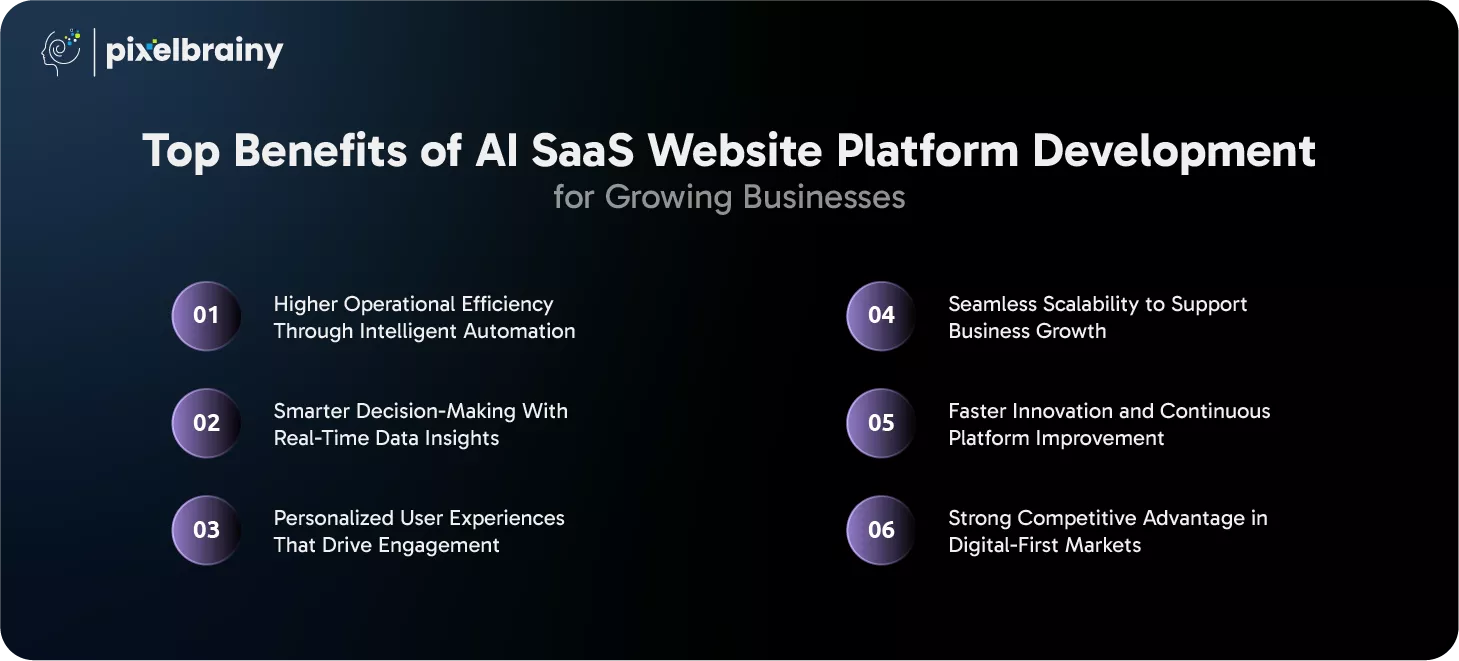
One of the strongest benefits of AI SaaS Website Development is the ability to automate repetitive and time-consuming processes. When businesses make an AI SaaS Website Platform with AI-driven workflows, tasks such as data processing, reporting, customer onboarding, and support ticket routing can operate with minimal human intervention. This significantly reduces manual effort and operational delays.
In addition, automation improves accuracy and consistency across operations. By choosing to build AI SaaS Website Software with intelligent automation, teams can focus on strategic growth initiatives while the platform handles routine processes reliably in the background.
Developing an AI SaaS Website Platform allows businesses to move from reactive decision-making to proactive strategy. These platforms continuously analyze real-time and historical data to uncover patterns, trends, and performance gaps. Business leaders gain immediate access to insights that support faster and more informed decisions.
When companies build AI SaaS Website Software with advanced analytics, they reduce reliance on assumptions. This leads to better forecasting, improved resource allocation, and greater confidence in both short-term actions and long-term planning.
AI SaaS Website Development enables platforms to deliver highly personalized experiences tailored to each user. By analyzing user behavior, preferences, and interaction history, the platform can customize content, recommendations, dashboards, and workflows. This level of personalization increases user satisfaction and engagement.
When businesses make an AI SaaS Website Platform with personalization at its core, users feel understood and valued. Over time, this results in stronger customer loyalty, improved retention rates, and higher lifetime value.
Scalability is a critical advantage of AI SaaS Website Platform Development, especially for growing businesses. As user numbers and data volumes increase, AI SaaS platforms can scale without sacrificing performance or stability. Cloud-based infrastructure ensures smooth expansion as demand grows.
By choosing to build AI SaaS Website Software that is scalable from the start, businesses avoid costly reengineering later. This allows them to launch new features, enter new markets, and support more users with confidence.
Developing an AI SaaS Website Platform supports continuous learning and improvement. AI models evolve over time as they process more data, enabling platforms to deliver better insights, automation, and predictions. This means the product improves without frequent redesigns or major upgrades.
Businesses that invest in AI SaaS Website Development can innovate faster by responding to user feedback and market trends. This flexibility helps them stay relevant and competitive in rapidly changing industries.
AI SaaS Website Platform Development gives businesses a clear advantage in markets where intelligence and speed matter. Intelligent platforms offer faster response times, smarter services, and more accurate insights compared to traditional software. This improves customer trust and brand perception.
When organizations build AI SaaS Website Software with AI embedded into the core, they position themselves as industry leaders. This competitive edge becomes increasingly valuable as customers expect intelligent, data-driven digital solutions.
The advantages of AI SaaS Website Platform Development empower businesses to operate smarter, scale faster, and build future-ready digital products with lasting impact.
As AI adoption accelerates across industries, intelligent SaaS platforms are becoming essential tools for operational efficiency and competitive differentiation. Businesses that launch industry-ready AI SaaS website platforms can solve complex problems, unlock new revenue streams, and build scalable digital products.
The key is to focus on industries where automation, data intelligence, and personalization create clear and measurable business value.
AI SaaS website platforms in healthcare focus on improving efficiency, accuracy, and patient outcomes. These platforms reduce administrative workload while enabling healthcare professionals to make faster, data-driven decisions. With increasing reliance on digital health systems, AI-powered SaaS platforms play a critical role in modern healthcare operations.
Key opportunities include:
Healthcare organizations benefit from improved care delivery, reduced costs, and better patient experiences through intelligent platforms.
Also Read: How to Develop HIPAA-Compliant AI Healthcare Software
Fintech remains one of the most profitable markets for AI SaaS website platforms. These platforms help financial institutions manage risk, enhance security, and improve customer trust. AI enables real-time analysis of large transaction volumes, which is critical in digital finance.
Key opportunities include:
AI SaaS solutions help financial businesses operate securely while delivering faster and more personalized services.
Also Read: AI Fintech App Development Cost
AI SaaS platforms for ecommerce enable businesses to optimize the customer journey from discovery to post-purchase engagement. By analyzing customer behavior and sales data, retailers can make smarter decisions and increase profitability.
Key opportunities include:
Retailers using AI-driven SaaS platforms can reduce operational inefficiencies while improving customer retention and revenue growth.
AI SaaS website platforms in education support personalized learning and performance tracking. These platforms adapt content and assessments based on individual learner behavior, making education more effective and engaging.
Key opportunities include:
Educational institutions and training providers use these platforms to improve learning outcomes and scalability.
Also Read: Avatar-Based AI Education App Development: An Expert Insights
AI SaaS platforms in marketing and sales help businesses optimize campaigns and improve customer acquisition. These platforms analyze customer data to predict behavior and guide marketing strategies.
Key opportunities include:
Businesses benefit from higher ROI, improved conversions, and better alignment between marketing and sales teams.
HR-focused AI SaaS website platforms help organizations manage talent more effectively. AI simplifies hiring, performance management, and workforce planning by analyzing employee data.
Key opportunities include:
These platforms support fairer hiring decisions and improve employee satisfaction across organizations.
Also Read: AI HR SaaS Platform Development
AI SaaS platforms for logistics focus on efficiency, cost reduction, and operational visibility. These platforms help businesses manage complex supply chains and respond to disruptions quickly.
Key opportunities include:
Logistics companies gain better control, improved accuracy, and stronger resilience through AI-powered platforms.
AI SaaS website platforms in real estate support data-driven decision-making for property managers, investors, and brokers. These platforms streamline operations and improve asset performance.
Key opportunities include:
AI-driven insights help real estate businesses maximize returns while reducing operational complexity.
Also Read: AI Real Estate SaaS Product Development
AI SaaS website platforms for customer support enhance service quality while reducing costs. Intelligent automation helps businesses scale support operations without increasing staff.
Key opportunities include:
Businesses across industries rely on these platforms to deliver faster, more consistent customer experiences.
Also Read: How To Develop Custom AI Chatbot
By targeting the right industries with AI SaaS website platforms, businesses can build scalable, profitable solutions that address real operational challenges and deliver long-term value.

When businesses decide to invest in an AI-powered SaaS platform, the real challenge often begins with choosing how that platform should be built. Some organizations prefer speed and simplicity, while others prioritize control and long-term flexibility. Understanding the difference between custom AI SaaS website platform development and off-the-shelf solutions is essential to making a decision that aligns with both current needs and future growth plans.
Custom AI SaaS website platform development involves building a platform from the ground up to match your exact business needs. This approach allows full control over features, workflows, integrations, and AI capabilities. Businesses with unique processes, specialized data, or industry-specific compliance requirements often benefit the most from custom development.
With a custom platform, AI is deeply embedded into the system rather than added as an external feature. This allows for better performance, higher scalability, and stronger data ownership. While the initial investment is higher, custom platforms provide long-term flexibility and can evolve alongside business growth. They also offer better opportunities for differentiation, as the platform is designed specifically to support your competitive strategy.
Off-the-shelf AI SaaS solutions are prebuilt platforms designed to serve a broad range of businesses. These tools are typically faster to deploy and require less upfront investment. For startups or small teams looking to validate ideas quickly, off-the-shelf solutions can be an effective starting point.
However, these platforms come with limitations. Customization options are often restricted, and businesses may need to adjust their workflows to fit the software rather than the other way around. Over time, as business needs grow more complex, off-the-shelf solutions may struggle to scale or support advanced AI use cases. Data control and integration flexibility can also be limited compared to custom-built platforms.
| Aspect | Custom AI SaaS Website Platform | Off-the-Shelf AI SaaS Solution |
| Development Approach | Built from scratch to meet specific business needs | Prebuilt solution designed for general use |
| Customization | Full control over features, workflows, and AI models | Limited customization options |
| Time to Market | Longer development timeline | Faster deployment |
| Initial Cost | Higher upfront investment | Lower initial cost |
| Scalability | Designed to scale with business growth | May face limitations as complexity increases |
| AI Integration | Deep and tailored AI integration | Standardized AI features |
| Data Ownership | Full control over data and models | Data control depends on vendor policies |
| Competitive Advantage | Strong differentiation and flexibility | Limited differentiation |
| Long-Term Value | High long-term ROI with flexibility | Suitable for short-term or early-stage needs |
The right choice depends on your business vision. Companies focused on rapid validation may benefit from off-the-shelf tools, while those building long-term, scalable products gain greater value from custom AI SaaS website platform development.
Also Read: How To Develop a SaaS Platform Like Canva
Building a reliable and scalable AI product starts with getting the foundation right. AI SaaS Website Platform Creation requires carefully planned core features that support performance, security, usability, and future growth. When businesses aim to build AI SaaS Website solutions that are market-ready, these essential capabilities ensure the platform delivers real value from day one.
| Feature | Explanation |
| User Authentication and Access Control | Secure login systems with role-based access ensure users can only view or manage data relevant to them. This is critical for protecting sensitive information and maintaining trust across organizations using the platform. |
| Scalable Cloud Infrastructure | A cloud-based foundation allows the platform to handle growing users and data without performance issues. It ensures flexibility, reliability, and cost-efficient scaling as the business expands. |
| Multi-Tenant Architecture | Multi-tenancy enables multiple customers to use the same platform securely while keeping their data isolated. This feature is essential when building AI SaaS Website solutions for multiple businesses or teams. |
| AI Model Integration | AI models must be seamlessly integrated into the platform to power predictions, recommendations, or automation. Proper integration ensures AI capabilities are fast, reliable, and continuously improving. |
| Data Management and Storage | Strong data pipelines help collect, store, and process structured and unstructured data efficiently. This supports accurate AI outputs and long-term platform performance. |
| API and Third-Party Integrations | APIs allow the platform to connect with external tools, services, and systems. This makes the AI SaaS Website Platform flexible and easier to integrate into existing business ecosystems. |
| Analytics and Reporting Dashboard | Built-in dashboards provide users with real-time insights into platform usage, performance, and results. This helps businesses measure value and make data-driven decisions. |
| Subscription and Billing Management | Automated billing systems support recurring payments, plan upgrades, and invoicing. This feature is essential for monetizing AI SaaS platforms effectively. |
| Security and Compliance | Security features such as encryption, audit logs, and compliance readiness protect data and meet regulatory requirements. These measures are vital for industries handling sensitive information. |
| Responsive User Interface | A responsive design ensures the platform works smoothly across devices. Good UI design improves usability and encourages long-term user adoption. |
| Workflow Automation | Automation tools streamline internal processes and reduce manual effort. This increases efficiency for both platform users and administrators. |
| Performance Monitoring | Monitoring tools track uptime, response times, and system health. This helps teams identify issues early and maintain platform reliability. |
| User Onboarding and Guidance | Guided onboarding helps users understand the platform quickly. This reduces friction and improves engagement during early usage stages. |
| Version Control and Updates | Structured update management allows new features and fixes to be deployed smoothly. This ensures continuous improvement without disrupting users. |
| Logging and Error Handling | Detailed logs and error tracking simplify debugging and maintenance. These features help development teams keep the platform stable and secure. |
Strong core features are the backbone of AI SaaS Website Platform Creation and ensure your product is reliable, scalable, and ready for real-world use.
Once the foundation is in place, advanced capabilities help differentiate your product in competitive markets. AI SaaS Website Platform development goes beyond basics by integrating intelligent features that enhance personalization, automation, and predictive power.
SaaS Website Platform development integrating AI enables businesses to deliver smarter, more valuable user experiences.
| Feature | Explanation |
| AI-Driven Personalization | The platform adapts content, dashboards, and workflows based on user behavior. This creates a more relevant and engaging experience for each user. |
| Predictive Analytics | AI analyzes historical and real-time data to forecast trends and outcomes. Businesses can anticipate risks and opportunities more accurately. |
| Natural Language Processing | NLP enables text-based interactions such as chat, search, and document analysis. This makes the platform more intuitive and user-friendly. |
| AI Chatbots and Virtual Assistants | Intelligent assistants handle user queries and support requests automatically. This improves response times and reduces support costs. |
| Real-Time Data Processing | Real-time processing allows immediate insights and actions. This is especially valuable for time-sensitive use cases. |
| Self-Learning AI Models | Models continuously improve as more data is processed. This ensures the platform becomes smarter over time without manual retraining. |
| Workflow Intelligence | AI identifies inefficiencies and suggests process improvements. This helps businesses optimize operations using actionable insights. |
| Anomaly Detection | AI detects unusual patterns or behavior automatically. This is useful for fraud detection, system monitoring, and risk management. |
| Advanced Security Intelligence | AI monitors threats and suspicious activity in real time. This adds an extra layer of protection to the platform. |
| Intelligent Recommendation Systems | Recommendation engines guide users toward relevant actions or content. This improves engagement and overall platform value. |
Advanced features transform AI SaaS Website Platform development from functional software into intelligent products that drive differentiation, efficiency, and long-term growth.
Building an AI-powered SaaS product is not a one-time effort but a structured journey that evolves with business needs. A successful AI SaaS Website Platform development Process moves step by step, starting from validation and ending with an enterprise-ready solution.
Understanding what is the process to make an AI SaaS Website Software helps businesses reduce risk, control costs, and scale with confidence.
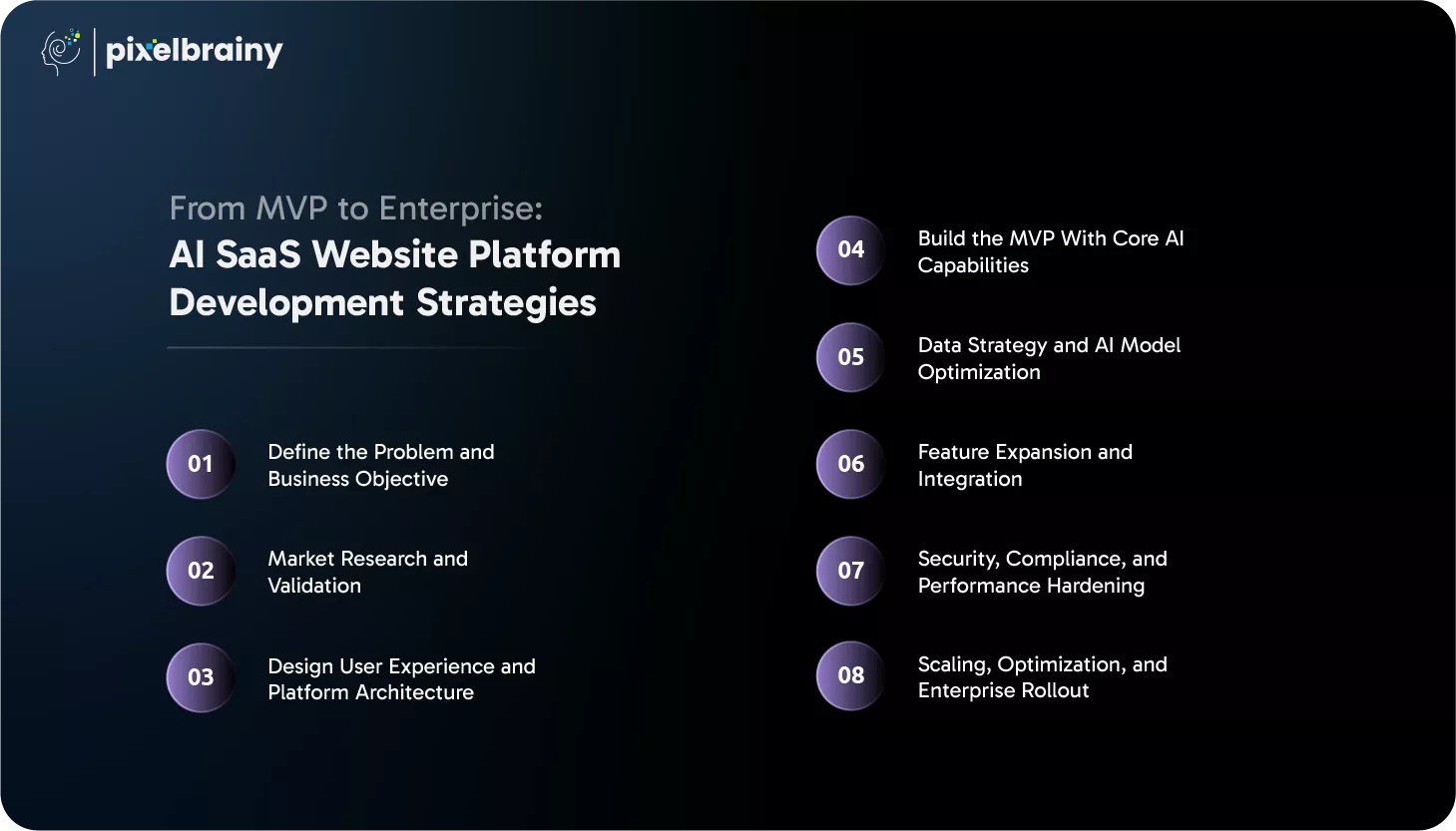
Aim of this step: To ensure the platform solves a real, valuable business problem.
Every successful platform begins with clarity. Before developing an AI SaaS Website Platform, businesses must clearly define the problem they want to solve and the audience they are solving it for. This involves understanding pain points, operational gaps, and inefficiencies that AI can realistically address. A well-defined problem prevents wasted development effort and keeps the project aligned with measurable business outcomes.
This step also includes defining success metrics such as cost reduction, productivity gains, or revenue growth. Stakeholder alignment is critical here, as unclear objectives often lead to scope creep later. Strong problem definition sets the foundation for meaningful SaaS Website Platform development With AI rather than building features without purpose.
Aim of this step: To validate demand and reduce market risk.
Market research helps confirm whether the identified problem is worth solving at scale. This step involves analyzing competitors, identifying gaps in existing solutions, and validating demand through customer interviews or surveys. Businesses gain insights into pricing expectations, must-have features, and common frustrations with current tools.
This stage often overlaps with PoC development, where early experiments validate technical feasibility without full-scale investment. The goal is not perfection but confidence. By validating assumptions early, companies reduce the risk of building a platform that fails to gain adoption. Market validation ensures that the Creation of an AI SaaS Website aligns with real user needs and competitive positioning.
Aim of this step: To create a usable, scalable, and intuitive foundation.
This step focuses on designing how users interact with the platform and how the system operates behind the scenes. Collaborating with a UI/UX design company helps translate user needs into intuitive flows, dashboards, and interactions. A strong user experience is critical, especially when AI features need to feel simple rather than complex.
At the same time, architects define system structure, data flow, and AI integration points. Decisions made here impact scalability, performance, and maintainability. When businesses plan carefully at this stage, developing an AI SaaS Website Platform becomes smoother and more cost-effective in later phases.
Aim of this step: To launch quickly and learn from real users.
MVP development focuses on delivering the smallest usable version of the platform that solves the core problem. The goal is speed and learning, not feature completeness. This version includes essential AI functionality, basic workflows, and core user interactions.
An MVP allows businesses to gather real-world feedback and validate assumptions under real usage conditions. It also helps identify performance issues, data challenges, and feature priorities early. By choosing to build AI SaaS Website Platform solutions iteratively, companies avoid overinvestment before product-market fit is proven.
Also Read: Top 10 AI MVP Development Companies in USA
Aim of this step: To improve intelligence, accuracy, and reliability.
AI performance depends heavily on data quality and relevance. This step focuses on refining data pipelines, improving data collection, and optimizing AI models based on real usage. Businesses analyze how users interact with the platform and adjust models accordingly.
Model training, testing, and monitoring become ongoing activities rather than one-time tasks. This phase transforms the platform from functional to intelligent. Proper data governance and validation are essential to maintain trust and consistency. Strong AI optimization ensures long-term success in AI SaaS Website Platform development Process.
Aim of this step: To increase platform value and usability.
Once the MVP proves its value, businesses begin expanding features based on user feedback and business goals. This includes advanced analytics, automation, integrations, and personalization. Third-party tools and APIs are integrated to fit seamlessly into existing business ecosystems.
Feature expansion should remain strategic. Adding too much too fast can overwhelm users. This phase balances innovation with usability while strengthening SaaS Website Platform development With AI for broader use cases.
Aim of this step: To prepare the platform for enterprise adoption.
As the platform scales, security and reliability become critical. This step includes implementing data encryption, access controls, audit logs, and compliance standards. Performance optimization ensures the platform handles growing users and data volumes without slowdowns.
Enterprise clients expect stability and trust. Addressing these requirements early avoids costly fixes later. Many businesses collaborate with Top AI development Companies at this stage to meet enterprise-grade expectations and best practices.
Aim of this step: To achieve sustainable growth and long-term value.
The final step focuses on scaling infrastructure, optimizing costs, and expanding market reach. Cloud optimization, automation, and monitoring tools help manage growth efficiently. Feedback loops remain active to continuously improve AI models and user experience.
At this stage, the platform supports multiple customer segments, complex workflows, and enterprise requirements. By following a structured approach to developing an AI SaaS Website Platform, businesses transition smoothly from early product to enterprise-ready solution.
Moving from MVP to enterprise success requires a disciplined, step-by-step strategy. Businesses that follow a structured AI SaaS Website Platform development Process build scalable products that deliver lasting value and market leadership.
Before committing to development, most businesses ask a very practical question: what will this actually cost, and where will the money go? The answer depends on how complex the platform is, how deeply AI is integrated, and how far you plan to scale. A clear cost estimation for AI SaaS Website Platform development helps founders and decision-makers avoid surprises and align the development budget of AI SaaS Website Platform projects with real business outcomes.
On average, building an AI receptionist–style SaaS product or similar AI SaaS solution ranges between $25,000 and $250,000+, depending on scope and ambition.
| Platform Type | Estimated Cost Range | Description |
| Basic AI SaaS Website (MVP) | $25,000 to $60,000 | Covers essential features, limited AI logic, and a simple user interface to validate the idea and test market demand. |
| Advanced AI SaaS Website | $60,000 to $150,000 | Includes multiple AI features, automation, analytics, integrations, and scalable cloud infrastructure. |
| Enterprise AI SaaS Website | $150,000 to $250,000+ | Designed for large-scale usage with advanced AI models, security, compliance, performance optimization, and enterprise integrations. |
The size and complexity of the platform strongly influence the cost of building an AI SaaS Website Platform. A basic MVP with core workflows and limited automation typically costs between $25,000 and $50,000. As features such as advanced dashboards, multi-tenancy, and automation are added, costs can rise to $80,000 to $120,000. Enterprise-level feature sets with extensive customization often exceed $150,000, especially when multiple user roles and complex workflows are involved.
AI functionality is one of the biggest cost drivers. Simple AI logic such as rule-based automation or basic predictions may cost $10,000 to $25,000 to implement. More advanced capabilities like natural language processing, recommendation engines, or predictive analytics typically add $30,000 to $70,000. Custom-trained or domain-specific AI models can push this figure beyond $100,000, significantly impacting the overall AI SaaS Website Platform development cost.
Data handling requirements directly affect what is the cost to make AI SaaS Website Platform solutions. Basic data storage and processing may cost $5,000 to $15,000 during development. Platforms that require real-time data processing, large datasets, or complex pipelines often need $20,000 to $50,000 in additional investment. Enterprise platforms with high availability, redundancy, and data governance can exceed $60,000 in data infrastructure costs.
User experience design plays a key role in user adoption and retention. A simple, functional interface usually costs $5,000 to $10,000. Platforms with advanced dashboards, role-based views, and personalized user journeys often require $15,000 to $30,000. For enterprise products where usability and visual clarity are critical, UI and UX efforts can exceed $40,000, increasing the cost of building an AI SaaS Website Platform.
Security and compliance become more expensive as platforms scale. Basic security measures such as authentication and encryption typically cost $5,000 to $10,000. Platforms operating in regulated industries may need compliance readiness, audit logging, and advanced access control, adding $20,000 to $40,000. Enterprise-grade performance optimization and load testing can push this cost beyond $50,000, especially for high-traffic platforms.
| Optimization Strategy | Potential Cost Savings | How It Helps |
| Start With an MVP | Save 30 to 50 percent | Limits early spending while validating the core idea and market demand |
| Use Cloud-Native Services | Save 20 to 35 percent | Reduces infrastructure and maintenance costs while supporting scalability |
| Reuse Pretrained AI Models | Save 25 to 40 percent | Avoids the high cost of building and training custom models from scratch |
| Modular Development Approach | Save 15 to 30 percent | Enables phased development and prevents overbuilding early features |
| Automated Testing and Deployment | Save 10 to 20 percent | Lowers long-term maintenance and operational expenses |
These strategies help control AI SaaS Website Platform development cost without compromising quality or future scalability.
A well-planned cost estimation for AI SaaS Website Platform development enables businesses to invest confidently, balance innovation with budget, and build AI-driven products that deliver sustainable returns.

Behind every successful AI SaaS platform is a technology stack that quietly supports performance, security, and future growth. The tools you choose today will influence how easily your platform scales, how well AI features perform, and how efficiently your team can maintain the product.
Selecting the right tech stack is less about trends and more about making practical choices that align with your product vision and long-term business goals.
| Technology Layer | Tools and Technologies | Explanation |
| Frontend Development | React, Vue, Angular | These frameworks help build responsive, interactive user interfaces. They support dynamic dashboards and smooth user experiences essential for AI-powered platforms. |
| Backend Development | Node.js, Python, Java | Backend frameworks manage business logic, APIs, and data processing. Python is widely used for AI workloads, while Node.js and Java support scalable backend services. |
| AI and Machine Learning | TensorFlow, PyTorch, Scikit-learn | These libraries power predictive models, automation, and intelligent features. They allow teams to train, deploy, and optimize AI models efficiently. |
| Database Management | PostgreSQL, MongoDB, MySQL | Databases store structured and unstructured data securely. The choice depends on data volume, access patterns, and performance requirements. |
| Cloud Infrastructure | AWS, Azure, Google Cloud | Cloud platforms provide scalability, reliability, and managed services. They support AI workloads and enable global access with minimal infrastructure management. |
| DevOps and CI/CD | Docker, Kubernetes, Jenkins | DevOps tools automate deployment, scaling, and monitoring. They help maintain system stability and speed up feature releases. |
| API and Integration Layer | REST, GraphQL | APIs allow the platform to integrate with third-party tools and services. They ensure flexibility and smooth data exchange across systems. |
| Security and Authentication | OAuth, JWT, IAM | Security frameworks protect user data and manage access control. Strong authentication is essential for trust and compliance. |
| Data Processing and Streaming | Apache Kafka, Spark | These tools handle real-time data streams and large-scale processing. They support advanced analytics and AI model inputs. |
| Monitoring and Analytics | Prometheus, Grafana | Monitoring tools track performance, uptime, and usage patterns. They help teams identify issues early and optimize system health. |
A thoughtfully chosen tech stack gives your AI SaaS website platform the stability to perform today and the flexibility to grow tomorrow.
Scaling an AI SaaS platform is not just about adding more servers or users. It requires thoughtful planning, strong technical foundations, and continuous optimization to ensure performance, reliability, and user satisfaction remain intact as the platform grows. Following proven best practices during AI SaaS Website Platform development helps businesses scale confidently without introducing technical debt or operational bottlenecks.
Smart scaling begins at the architecture level. Platforms should be built with modular and cloud-native design principles so components can scale independently. This approach allows businesses to add users, features, or AI workloads without reworking the entire system. Planning scalability early reduces future costs and avoids performance issues as demand increases.
Cloud services play a key role in scaling AI SaaS platforms. Auto-scaling, load balancing, and managed services help platforms handle fluctuating traffic efficiently. Choosing the right cloud setup ensures resources are available when needed while controlling infrastructure costs during low usage periods.
As platforms scale, AI models must remain fast and accurate. Regular model monitoring, retraining, and optimization ensure performance does not degrade with increased data volume. Lightweight models and efficient inference pipelines help maintain responsiveness even under heavy usage.
Data grows rapidly in scalable SaaS platforms. Implementing efficient data pipelines, storage strategies, and data governance ensures smooth processing and reliable AI outputs. Clean, well-structured data supports better predictions and prevents performance slowdowns over time.
Scaling increases exposure to security risks. Strong access control, encryption, audit logging, and compliance practices must grow alongside the platform. Proactively addressing security ensures trust and prevents costly incidents as the user base expands.
Real-time monitoring and analytics help teams identify bottlenecks early. Tracking system health, response times, and user behavior allows businesses to scale proactively rather than reactively. Continuous monitoring supports stable growth and better user experiences.
Not every feature needs to scale at the same pace. User feedback should guide which capabilities are expanded or optimized first. This ensures development efforts focus on features that deliver the most value and impact.
Automation in testing, deployment, and infrastructure management reduces manual effort and errors. DevOps practices support faster releases, smoother updates, and consistent performance as the platform scales.
By following smart scaling best practices, businesses can grow their AI SaaS website platforms sustainably while maintaining performance, security, and long-term product quality.
A strong business model is just as important as the technology behind an AI SaaS platform. The right revenue strategy determines how the platform grows, scales, and delivers long-term value. Choosing a business model for AI SaaS Website Platform Development depends on your target audience, usage patterns, and the value your AI features provide.
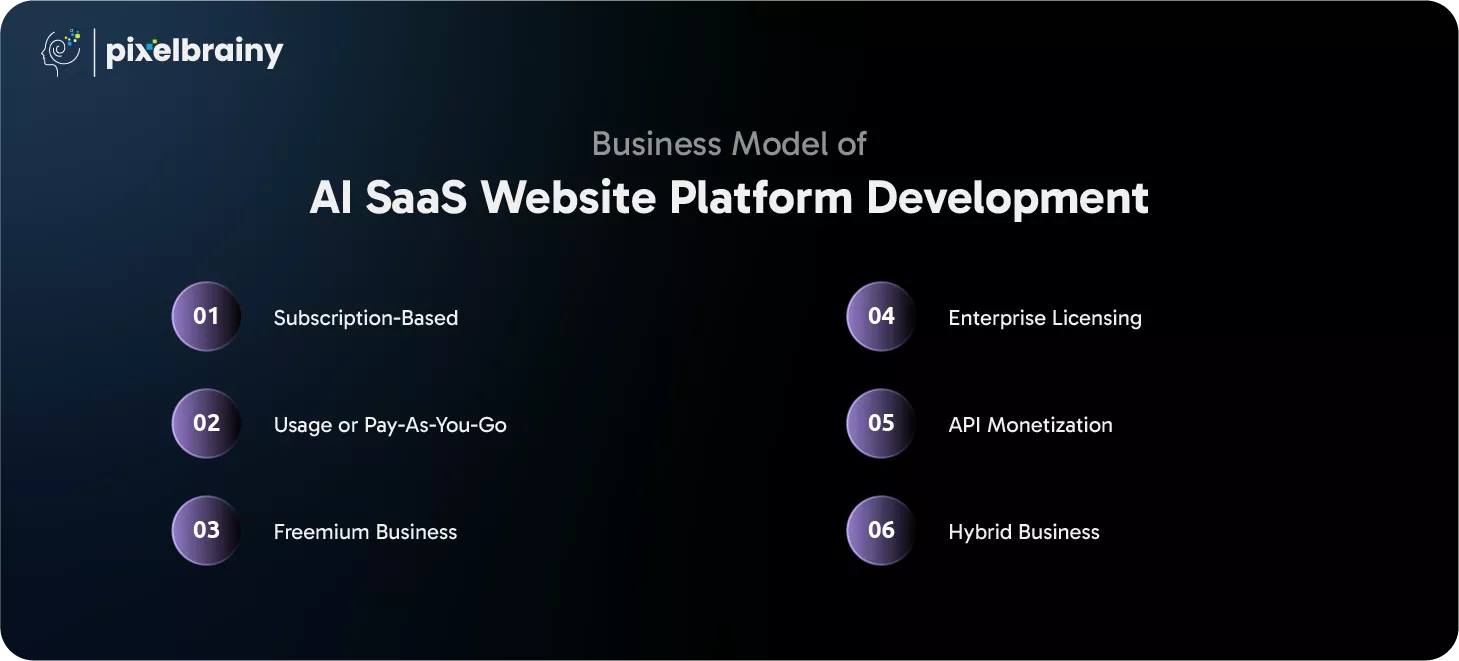
This is the most common and predictable model used in AI SaaS platforms. Customers pay a recurring fee on a monthly or yearly basis to access the platform and its features. It works well for products that deliver ongoing value through automation, analytics, or continuous AI improvements.
Key characteristics include:
In this model, customers pay based on how much they use the platform rather than a fixed fee. It is ideal for AI SaaS platforms where usage can vary significantly between customers. This approach aligns pricing directly with the value delivered.
Key characteristics include:
The freemium model offers basic features for free while charging for advanced capabilities. This approach helps attract a large user base quickly and demonstrates value before asking users to pay. AI SaaS platforms often use freemium to showcase intelligent features.
Key characteristics include:
This model targets large organizations that require custom features, integrations, and support. Pricing is usually negotiated based on organization size, usage, and complexity. It is suitable for AI SaaS platforms that solve mission-critical problems.
Key characteristics include:
Some AI SaaS platforms generate revenue by offering AI capabilities through APIs. Customers integrate these APIs into their own products or systems and pay based on usage. This model works well for platforms focused on AI processing rather than full user interfaces.
Key characteristics include:
Many successful platforms combine multiple revenue models to maximize reach and profitability. For example, a platform may offer subscriptions for standard users and usage-based pricing for advanced AI features.
Key characteristics include:
A well-chosen business model enables AI SaaS Website Platform Development to deliver sustainable growth, predictable revenue, and long-term customer value.
Building an AI-powered SaaS platform involves many moving parts, and even experienced teams can make costly mistakes along the way. Most failures are not caused by technology itself but by poor planning, unclear goals, or rushed decisions.
Understanding the common mistakes in AI SaaS Website Platform Development and knowing how to avoid them can save time, budget, and long-term frustration.
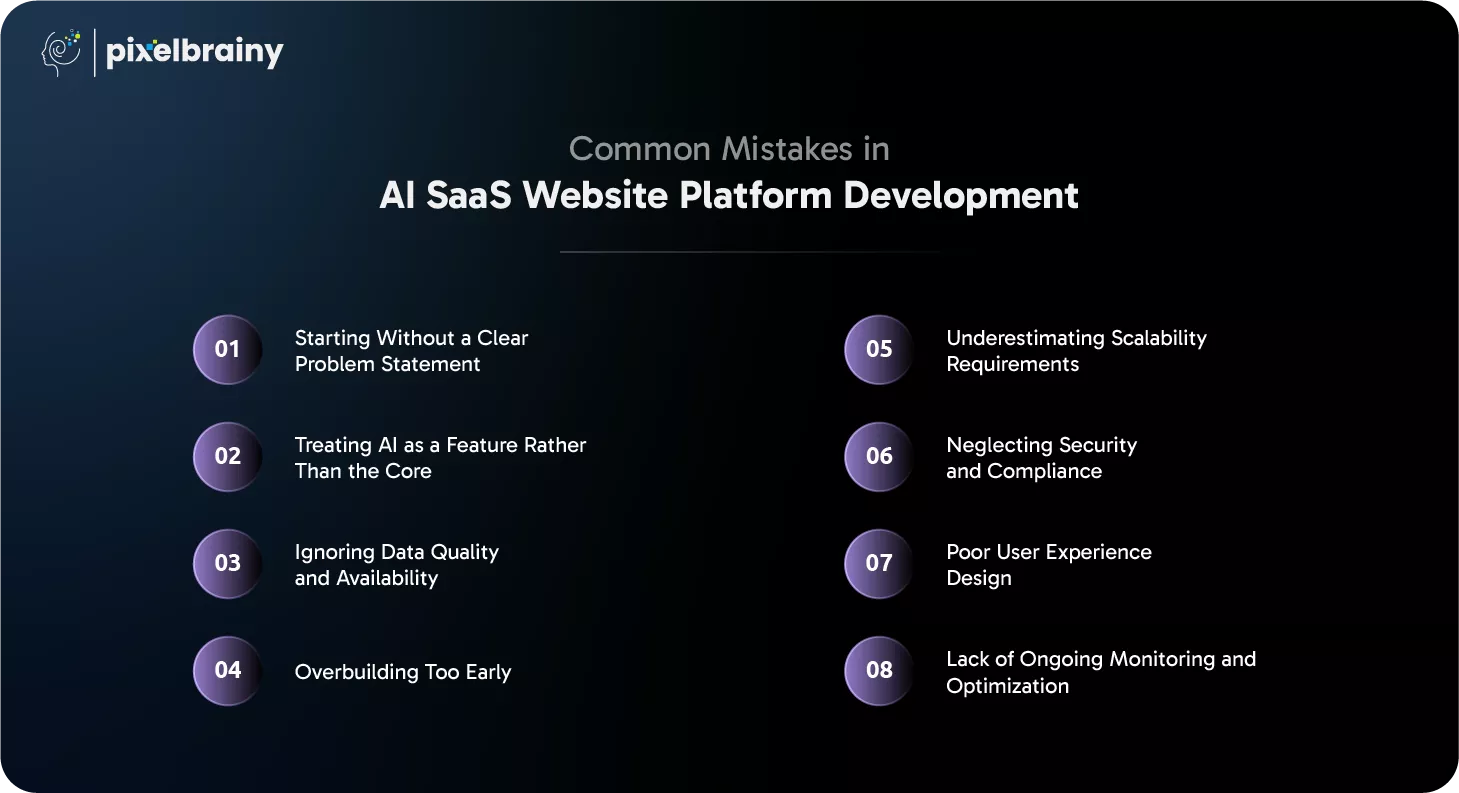
One of the most common mistakes is jumping into development without clearly defining the problem the platform is meant to solve. Teams often focus on AI features instead of real user pain points. This leads to products that are technically impressive but lack practical value.
How to avoid it: Spend time validating the problem through research, customer interviews, and market analysis. Make sure every AI feature supports a clear business objective and user need.
Many platforms add AI as an afterthought instead of integrating it into the core workflow. This results in shallow AI functionality that does not deliver meaningful results or differentiate the product.
How to avoid it: Design the platform with AI at its foundation. Align data flow, user interactions, and automation around AI-driven insights rather than bolting it on later.
AI performance is only as good as the data it uses. Poor data quality, incomplete datasets, or unclear data ownership can severely limit platform effectiveness and accuracy.
How to avoid it: Invest early in data strategy, validation, and governance. Ensure data sources are reliable, well-structured, and scalable before training AI models.
Trying to launch with too many features at once is a frequent mistake. Overbuilding increases costs, delays release, and makes it harder to identify what users actually need.
How to avoid it: Focus on a clear MVP that delivers core value. Use real user feedback to guide feature expansion rather than assumptions.
Some platforms work well in early stages but fail as usage grows. This often happens when scalability is not considered during initial architecture planning.
How to avoid it: Design with scalability in mind from the beginning. Use cloud-native infrastructure, modular components, and flexible data pipelines that can grow with demand.
Security is often addressed too late, especially in early-stage products. This creates risks around data breaches, compliance violations, and loss of customer trust.
How to avoid it: Implement strong security practices early, including encryption, access controls, and audit logging. Align with compliance requirements relevant to your industry.
Complex AI systems can overwhelm users if the interface is not intuitive. Poor UX reduces adoption and increases churn, even if the underlying technology is strong.
How to avoid it: Prioritize simplicity and clarity in user experience design. Make AI insights easy to understand and actionable rather than technical or confusing.
AI platforms require continuous monitoring and improvement. Ignoring performance tracking and model updates leads to declining accuracy and relevance over time.
How to avoid it: Set up regular monitoring, feedback loops, and model retraining processes. Treat AI optimization as an ongoing responsibility, not a one-time task.
Avoiding these common mistakes allows businesses to build AI SaaS website platforms that are reliable, scalable, and genuinely valuable to users from launch through long-term growth.
Building an AI-powered SaaS product requires more than technical execution. It demands a deep understanding of business goals, user expectations, and long-term scalability. PixelBrainy LLC approaches every project with this mindset, working closely with clients to turn ideas into reliable digital products. As an experienced AI development company, PixelBrainy focuses on clarity, collaboration, and outcomes throughout the entire AI SaaS Website Platform Development Journey.
The team at PixelBrainy LLC believes that successful platforms are built through thoughtful planning and practical innovation. From early concept validation to full-scale deployment, the process is structured to make an AI SaaS Website Software that aligns with real-world use cases. Every stage of developing an AI SaaS Website Software is handled with attention to usability, security, and performance, ensuring the final product is not only intelligent but also easy to adopt and scale.
PixelBrainy LLC also stands out for its transparent communication and hands-on approach. Clients are involved at every milestone, from defining requirements to reviewing progress and refining features. This collaborative process helps reduce risk, control timelines, and deliver platforms that truly support business growth rather than just meeting technical specifications.
Client Overview: A mid-sized healthcare services provider in the United States needed a smarter way to manage patient interactions while reducing administrative burden. The organization aimed to build an AI SaaS website platform capable of handling appointment scheduling, patient inquiries, and follow-ups without increasing operational costs.
The Challenge: The client faced growing call volumes, long wait times, and overworked front-desk staff. Existing systems lacked intelligence and required constant manual handling. The business needed a scalable solution that could automate routine communication while maintaining accuracy and data privacy.
PixelBrainy’s Approach: PixelBrainy LLC managed the full AI SaaS Website Platform Development Journey, starting with requirement analysis and workflow design. The team developed conversational AI logic to respond to patient queries and integrated the platform with existing scheduling tools. Security and compliance were prioritized to ensure patient data protection throughout the system.
The Outcome: The AI-powered platform reduced front-desk workload by nearly half within a few months of launch. Patient response times improved significantly, appointment accuracy increased, and staff productivity rose. The solution scaled smoothly as the provider expanded its services, demonstrating the value of a well-executed AI SaaS platform.
PixelBrainy LLC supports businesses in developing AI SaaS Website Software that is practical, scalable, and built to deliver measurable results in competitive markets like the United States.

AI SaaS Website Platform Development has evolved from an emerging trend into a proven strategy for building scalable, intelligent, and future-ready digital products. Businesses across industries are using AI-powered SaaS platforms to automate operations, improve decision-making, and deliver personalized user experiences that create real value.
From defining the right idea and building an MVP to scaling an enterprise-grade solution, success depends on thoughtful planning, the right technology stack, and a clear understanding of user needs. When AI is integrated into the core of the platform, it becomes a long-term growth engine rather than just a feature.
Companies that invest in a structured development approach gain flexibility, efficiency, and a strong competitive edge in digital markets. The journey requires the right partner, proven expertise, and a focus on measurable outcomes.
Ready to turn your idea into a scalable AI SaaS platform? Book an appointment with our experts today and start building with confidence.
The timeline depends on the complexity of the platform and the maturity of the idea. A focused MVP with core AI functionality can take a few months, while more advanced or enterprise-grade platforms may require additional time for AI optimization, integrations, and scalability planning. Early validation and clear requirements can significantly shorten development cycles.
Not always, but regular monitoring is essential. Some AI models perform well with periodic updates, while others benefit from continuous learning. The retraining frequency depends on how often data patterns change and how critical accuracy is to the business use case.
Yes, many platforms start with limited datasets and improve over time. Pretrained models, rule-based logic, or hybrid approaches can be used initially. As user data grows, the platform becomes more intelligent and accurate through gradual optimization.
Most modern AI SaaS platforms are designed with integration in mind. APIs and connectors allow seamless integration with CRM systems, ERP tools, payment gateways, and analytics platforms. Planning integrations early helps avoid compatibility issues later.
Trust is built through clear communication, explainable AI outputs, and strong data protection practices. Platforms that provide understandable insights and maintain consistent performance are more likely to gain long-term user confidence.
Sustainability comes from a combination of scalable architecture, continuous improvement, user-focused design, and a flexible business model. Platforms that adapt to user needs and market changes tend to remain relevant and profitable over time.

About The Author
Sagar Bhatnagar
Sagar Sahay Bhatnagar brings over a decade of IT industry experience to his role as Marketing Head at PixelBrainy. He's known for his knack in devising creative marketing strategies that boost brand visibility and market influence. Sagar's strategic thinking, coupled with his innovative vision and focus on results, sets him apart. His track record of successful campaigns proves his ability to utilize digital platforms effectively for impactful marketing efforts. With a genuine passion for both technology and marketing, Sagar continuously pushes PixelBrainy's marketing initiatives to greater success.

Working with the PixelBrainy team has been a highly positive experience. They understand the design requirements and create beautiful UX elements to meet the application needs. The dev team did an excellent job bringing my vision to life. We discussed usability and flow. Sagar worked with his team to design the database and begin coding. Working with Sagar was easy. He has the knowledge to create robust apps, including multi-language support, Google and Apple ID login options, Ad-enabled integrations, Stripe payment processing, and a Web Admin site for maintaining support data. I'm extremely satisfied with the services provided, the quality of the final product, and the professionalism of the entire process. I highly recommend them for Android and iOS Mobile Application Design and Development.

Great experience working with them. Had a lot of feedback and I found that unlike most contractors they were bugging me for updates instead of the other way around. They were extremely time conscience and great at communicating! All work was done extremely high quality and if not on time, early! They were always proactive when it comes to communication and the work is great/above par always. Very flexible and a great team to work with! Goes above and beyond to present us with multiple options and always provides quality. Amazing work per usual with Chitra. If you have UI/UX or branding design needs I recommend you go to them! Will likely work with them in the future as well, definitely recommended!

PixelBrainy is a joy to work with and is a great partner when thinking through branding, logo, and website layout. I appreciate that they spend time going into the "why" behind their decisions to help inform me and others about industry best practices and their expertise.

I hired them to design our software apps. Things I really like about them are excellent communication skills, they answer all project suggestions and collaborate right away, and their input on design and colors is amazing. This project was complex and needed patience and creativity. The team is amazing to do business with. I will be using them long-term. Glad to see there are some good people out there. I was afraid to try and outsource my project to someone but I am glad I met them! I really can't say enough. They went above and beyond on this project. I am very happy with everything they have done to make my business stand out from the competition.

It was great working with PixelBrainy and the team. They were very responsive and really owned the project. We'll definitely work with them again!

I recently worked with the PixelBrainy team on a project and I was blown away by their communication skills. They were prompt, clear, and articulate in all of our interactions. They listened and provided valuable feedback and suggestions to help make the project a success. They also kept me updated throughout the entire process, which made the experience stress-free and enjoyable.

PixelBrainy is very good at what it does. The team also presents themselves very professionally and takes care of their side of things very well. I could fully trust them taking up the design work in a timely and organised manner and their attention to detail saved us lots of effort and time. This particular project was quite intense and the team showed that they function very well under pressure. Very much looking forward to working with her again!

It's always an absolute pleasure working with them. They completed all of my requests quickly and followed every note I had for them to a T, which made our process go smoothly from start to finish. Everything was completed fast and following all of the guidelines. And I would recommend their services to anyone. If you need any design work done in the future, PixelBrainy should be your first call!

They took ownership of our requirements and designed and proposed multiple beautiful variants. The team is self-motivated, requires minimum supervision, committed to see-through designs with quality and delivering them on time. We would definitely love to work with PixelBrainy again when we have any requirements.

PixelBrainy was a big help with our SaaS application. We've been hard at work with a new UI/UX and they provided a lot of help with the designs. If you're looking for assistance with your website, software, or mobile application designs, PixelBrainy and the team is a great recommendation.

PixelBrainy designers are amazing. They are responsive, talented, and always willing to help craft the design until it matches your vision. I would recommend them and plan to continue them for my future projects and more!!!

They were awesome! Did a good job fast, and good communication. Will work with them again. Thank you

Creative, detail-oriented, and talented designers who take direction well and implement changes quickly and accurately. They consistently over-delivered for us.

PixelBrainy team is very talented and creative. Great designers and a pleasure to work with. PixelBrainy is an excellent communicator and I look forward to working with them again.

PixelBrainy has a very talented design team. Their work is excellent and they are very responsive. I enjoy working with them and hope to continue on all of our future projects.


Transform your ideas into reality with us.
Across these industries, each engagement brings unique challenges, from early-stage product development to scaling complex systems, helping us build a practical understanding of real-world product environments.